Next-Generation Interconnect Market By Type (Electrical, Optical, & Others), by Technology (Silicon Photonics, Co-Packaged Optics, & Others), By Data Transmission Level (Chip-to-Chip, Board-to-Board, & Others), By Data Rate (Up to 100, 100–400, 400–800, Above 800 Gbps), By Application (Data Centers & Cloud Computing, HPC & AI, & Others), and By End User (Technology & Cloud Service Providers, Telecom Operators,& Others) – Global Opportunity Analysis and Industry Forecast, 2025–2030
Industry: Semiconductor & Electronics | Publishing Date: June 9, 2026 | Last Updated: October 16, 2026 | No of Pages: N/A | No. of Tables: N/A | No. of Figures: N/A | Format: PDF | Report Code: SE3849
Industry Outlook
The global Next-Generation Interconnect Market size was valued at USD 19.84 billion in 2024 and is expected to reach USD 23.45 billion by 2025. Looking ahead, the industry is projected to expand significantly, reaching USD 54.10 billion by 2030, registering a CAGR of 18.2% from 2025 to 2030.
The market is advancing rapidly, driven by the growing demand for high-speed data transfer, low latency, and energy-efficient connectivity across computing, telecommunications, and automotive applications. The proliferation of AI, 5G, cloud computing, and data centres is intensifying the need for advanced interconnect technologies capable of supporting massive data throughput and processing workloads. Innovations in optical, silicon photonics, and chiplet-based interconnects are reshaping system architectures, enabling faster communication between processors, memory, and peripheral components. Manufacturers are investing in high-bandwidth, low-power, and scalable interconnect solutions to enhance performance and reliability in next-generation computing platforms. By combining speed, efficiency, and scalability, the next-generation interconnect market challenges is driving breakthroughs in semiconductor design, network infrastructure, and high-performance computing systems worldwide.
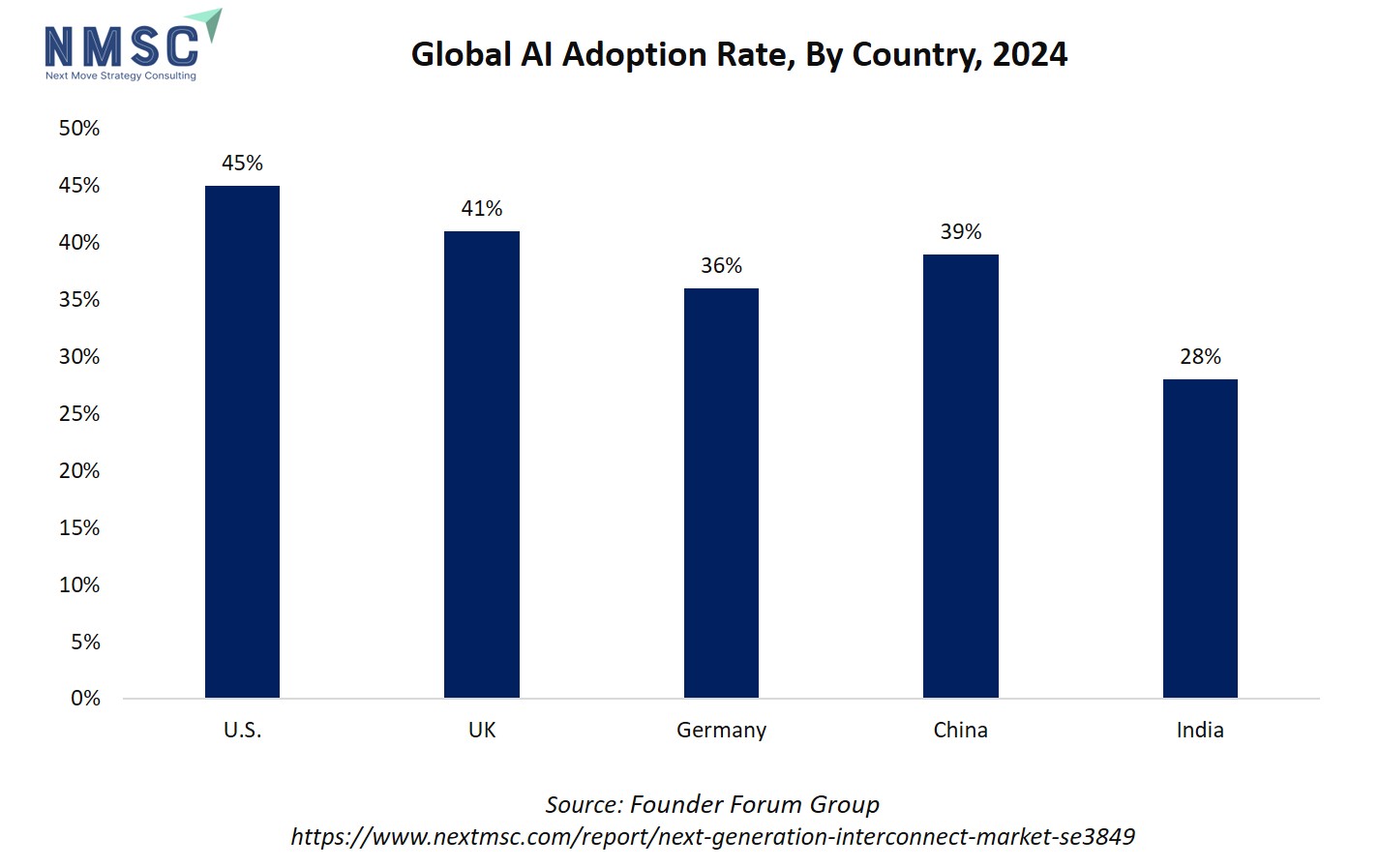
The chart reveals global AI adoption rates by country for 2024, led by the U.S. (45%) and UK (41%), with notable uptake in China (39%), Germany (36%), and India (28%). This widespread enterprise use of AI is transforming digital infrastructure needs, pushing organisations to adopt faster, more scalable, and secure connectivity solutions. Rapid increases in AI workloads and data-driven business operations directly benefit the next-generation interconnect market, since advanced interconnects, such as high-speed, low-latency fibre, chip-to-chip, and data center networking technologies, become critical for reliably transmitting huge volumes of data between systems, enabling seamless AI integration, and supporting future-ready enterprise architectures in leading economies.
What Are the Key Trends in the Next-Generation Interconnect Market?
How is AI Scale and Model Growth Driving Demand for Higher-Density, Lower-Latency Interconnects?
AI models scale toward multi-trillion parameters, hyperscalers require multi-petabit east–west network fabrics to handle massive parallelism and memory-sharing workloads. The performance bottleneck has shifted from port count to per-port aggregate bandwidth and deterministic latency. To manage power and heat, OEMs are adopting 400–800 Gbps+ lanes, co-packaged optics (CPO), and fabrics supporting CXL-based accelerator sharing. This architecture transition, from many moderate links to fewer ultra-high-bandwidth connections, reshapes demand for transceivers, retimers, and substrates. Vendors that deliver validated, low-latency optical modules with quantified power-per-bit advantages and workload-linked benchmarks will capture hyperscaler design wins and long-term supply commitments.
How Is 5G Densification and Edge Cloud Rollout Increasing Need for Compact, Rugged, High-Throughput Interconnects?
The expansion of 5G networks and edge cloud infrastructure creates thousands of distributed micro-data centers and base-station aggregation points that must deliver high throughput within tight physical and thermal constraints. Operators demand compact, ruggedised, and telecom-grade interconnects that ensure reliability and ease of maintenance under variable environments. As mobile data and low-latency applications surge, carriers are upgrading from traditional long-haul optics to dense rack-level interconnects with standardised pluggable formats to simplify field replacement. Suppliers that develop hardened, high-bandwidth optical assemblies with modular thermal designs and streamlined qualification workflows will gain share in metro and edge deployments.
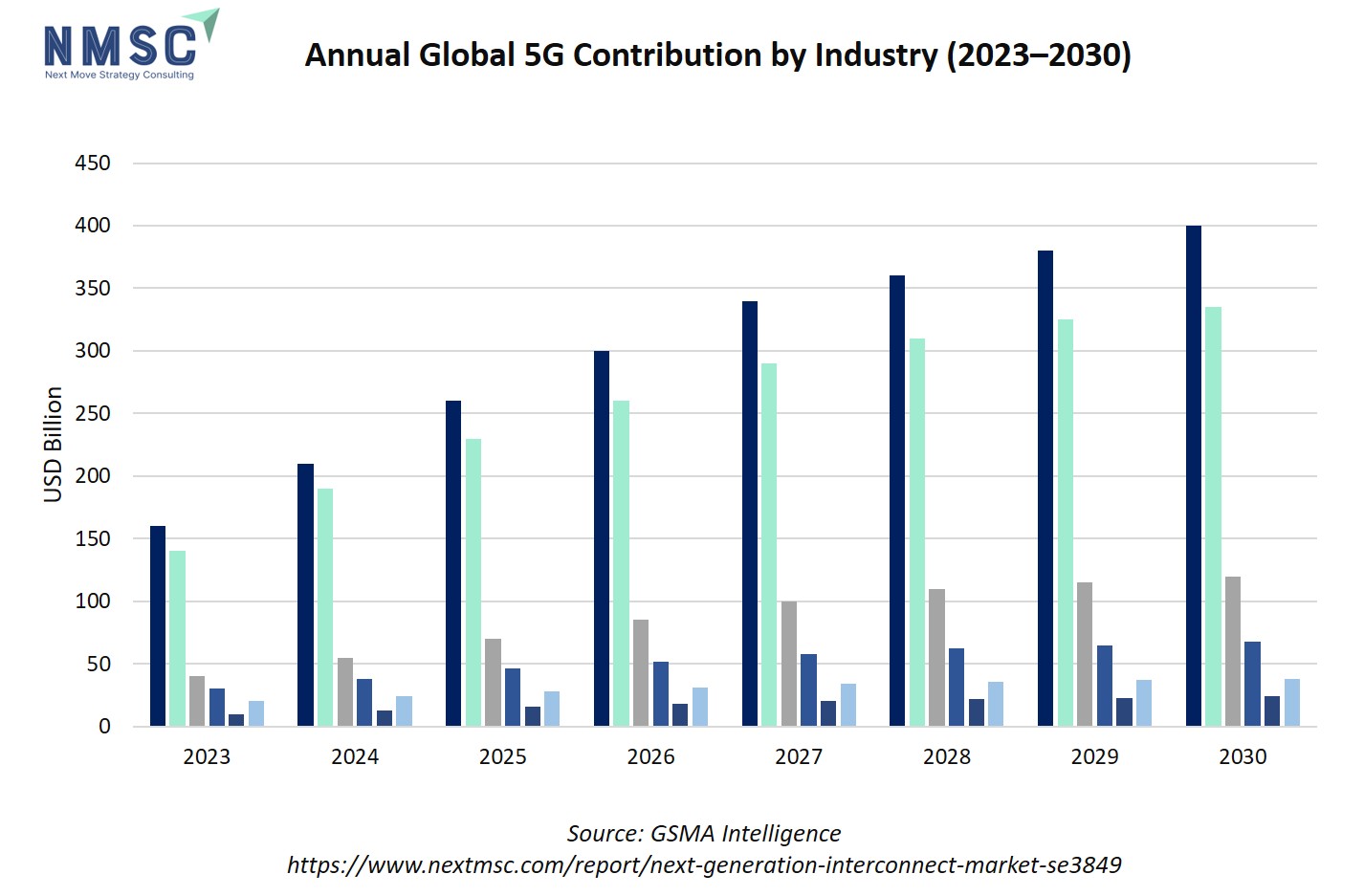
This chart illustrates the annual global economic contribution of 5G by industry from 2023 to 2030, highlighting especially strong growth in sectors such as manufacturing, services, and retail, which are forecast to reach USD 400 billion, USD 335 billion, and USD 120 billion respectively by 2030. The steady increase across industries reflects deepening reliance on high-speed, low-latency connectivity for digital transformation, automation, and smart infrastructure. The surge in 5G-enabled applications directly accelerates the next-generation interconnect market expansion, as enterprises and operators invest in advanced network hardware, fibre optics, and integrated silicon to handle next-level bandwidth, latency, and data processing demands, making robust interconnect solutions essential for scaling future-ready, highly connected business ecosystems across all key verticals.
How is Cloud Computing’s Continuing Expansion Pushing Interconnect Standardisation and Platform-Native Integrations?
Cloud hyperscalers increasingly demand modular, composable, and platform-certified interconnects that integrate seamlessly with orchestration, monitoring, and billing systems. Standardisation across footprints, power envelopes, and thermal profiles enables predictable total cost of ownership (TCO) and faster procurement. Consequently, vendors must go beyond hardware delivery, embedding software hooks for observability and management within existing cloud stacks. Managed onboarding, published certification artefacts, and validated deployment recipes to shorten customer rollout cycles. Suppliers offering platform-native, certified interconnect products (e.g., CPO modules, CXL-ready PHYs) differentiate on operational simplicity and win long-term supply contracts with major cloud operators.
What Are the Key Market Drivers, Breakthroughs, And Investment Opportunities that will Shape the Next-Generation Interconnect Market in the Next Decade?
Demand for advanced interconnect technology is primarily driven by exponential AI/HPC traffic growth, which magnifies east-west data movement inside data centers and increases demand for extremely high bandwidth and low-latency fabrics. Hyperscaler and cloud platform annual reports indicate sustained capital allocation to network and optical upgrades, amplifying procurement of optical modules, high-speed connectors and fabric silicon. At the same time, telecom modernisation (5G bearer/transport), edge expansion, and continued evolution of chip interfaces (CXL, PCIe 6.0) broaden the addressable market across data transmission levels.
Breakthroughs in silicon photonics, improved substrate-level interposers and validated co-packaging platforms are lowering cost-per-bit and power-per-bit thresholds, enabling new system architectures. However, manufacturing scale-up, supply chain maturity and thermal management remain constraints that slow rapid, universal adoption. The immediate opportunity is the commercialisation of modular CPO/CPX ecosystems that reduce integration risk and accelerate hyperscaler deployments. Vendors that resolve thermal/assembly and certification hurdles will capture an outsized share.
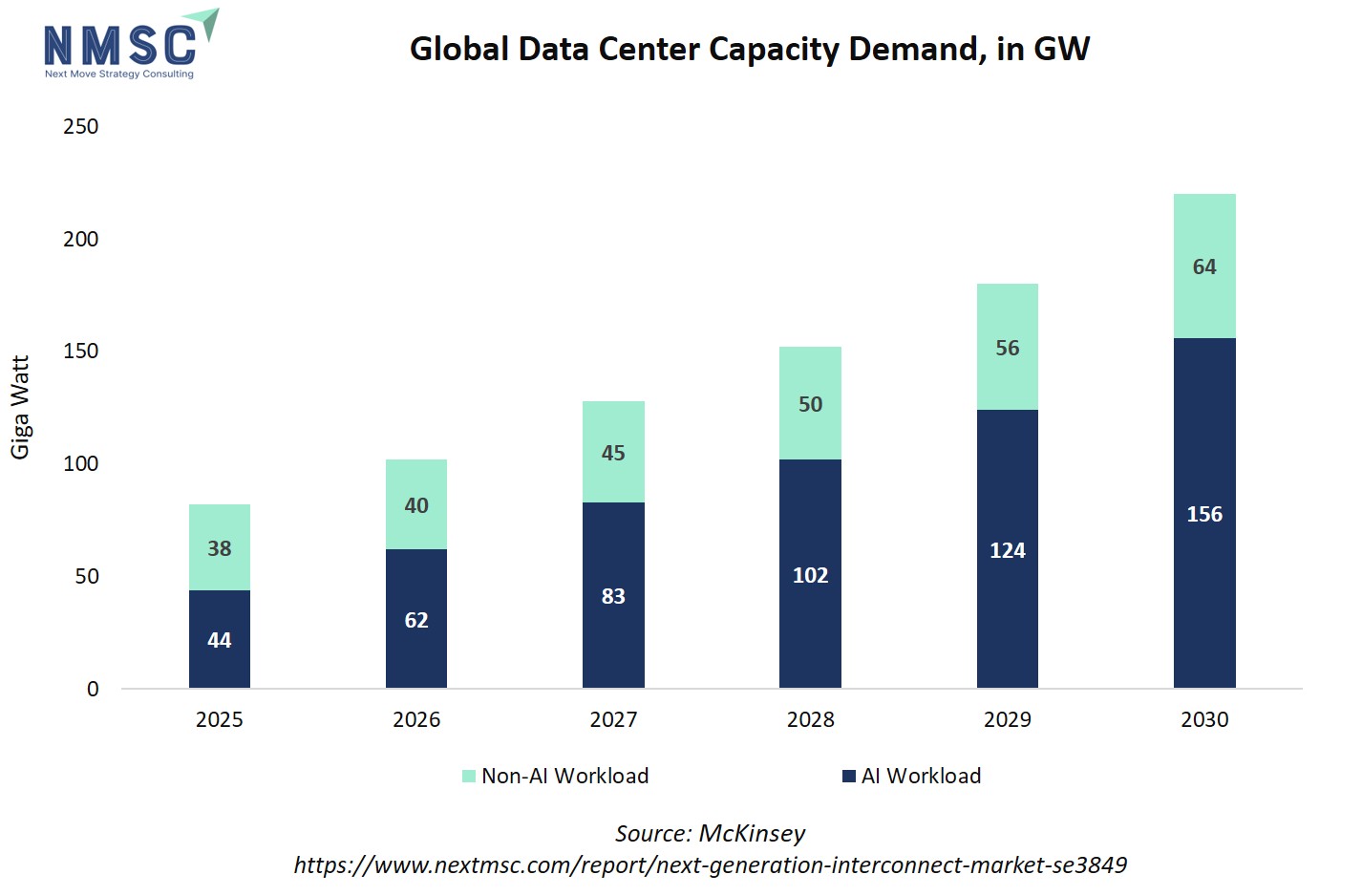
This chart displays a sharp increase in global data center capacity demand from 2025 to 2030, rising from 82 GW to 220 GW, with most growth driven by AI workloads, which surge from 44 GW to 156 GW. This trend underscores the massive expansion and computational intensity of AI-driven enterprise and cloud operations. The intensifying demand places huge pressure on high-bandwidth interconnect technologies, as data centers require high-bandwidth, ultra-low latency networking, and scalable chip-to-chip connections to optimally support AI training and inference; this drives innovation in fiber optics, silicon photonics, and advanced protocols to ensure seamless, future-proofed connectivity in increasingly complex and energy-intensive data center environments worldwide.
Growth Drivers:
How are AI Model Economics and Hyperscaler Capex Cycles Shaping Procurement Concentration and Scale Purchasing?
Hyperscalers’ periodic AI cluster expansions create concentrated, large-volume procurement waves that define the global interconnect demand curve. These cycles compress supplier timelines but generate multi-year revenue visibility for design-win vendors. The rapid refresh cadence around GPU and TPU clusters means that technical alignment with hyperscaler roadmaps, especially on bandwidth, latency, and power, is essential. Suppliers with validated reference designs and demonstrated yield stability secure preferred-vendor status. Early pilot engagements with one or two hyperscalers translate into recurring, high-volume contracts, establishing credibility and predictable revenue streams across subsequent AI infrastructure investment phases.
How are Technology Advances Such as Cxl, Pcie 6.0, And Silicon Photonics Creating High-Value Technical Niches?
Emerging standards such as CXL 3.0, PCIe 6.0, and integrated photonics are reshaping performance expectations for data interconnects, raising technical barriers to entry and increasing product complexity. These advancements require deep expertise in signal integrity, packaging, and thermal management. Vendors with strong IP in PHYs, retimers, and photonic integration gain a crucial advantage as qualification cycles lengthen and compliance requirements tighten. End-to-end validation and co-development with chipmakers are now essential to securing design wins. Suppliers investing in advanced R&D, high-speed testing, and ecosystem partnerships will lead in premium interconnect segments for AI, HPC, and next-generation data-center architectures.
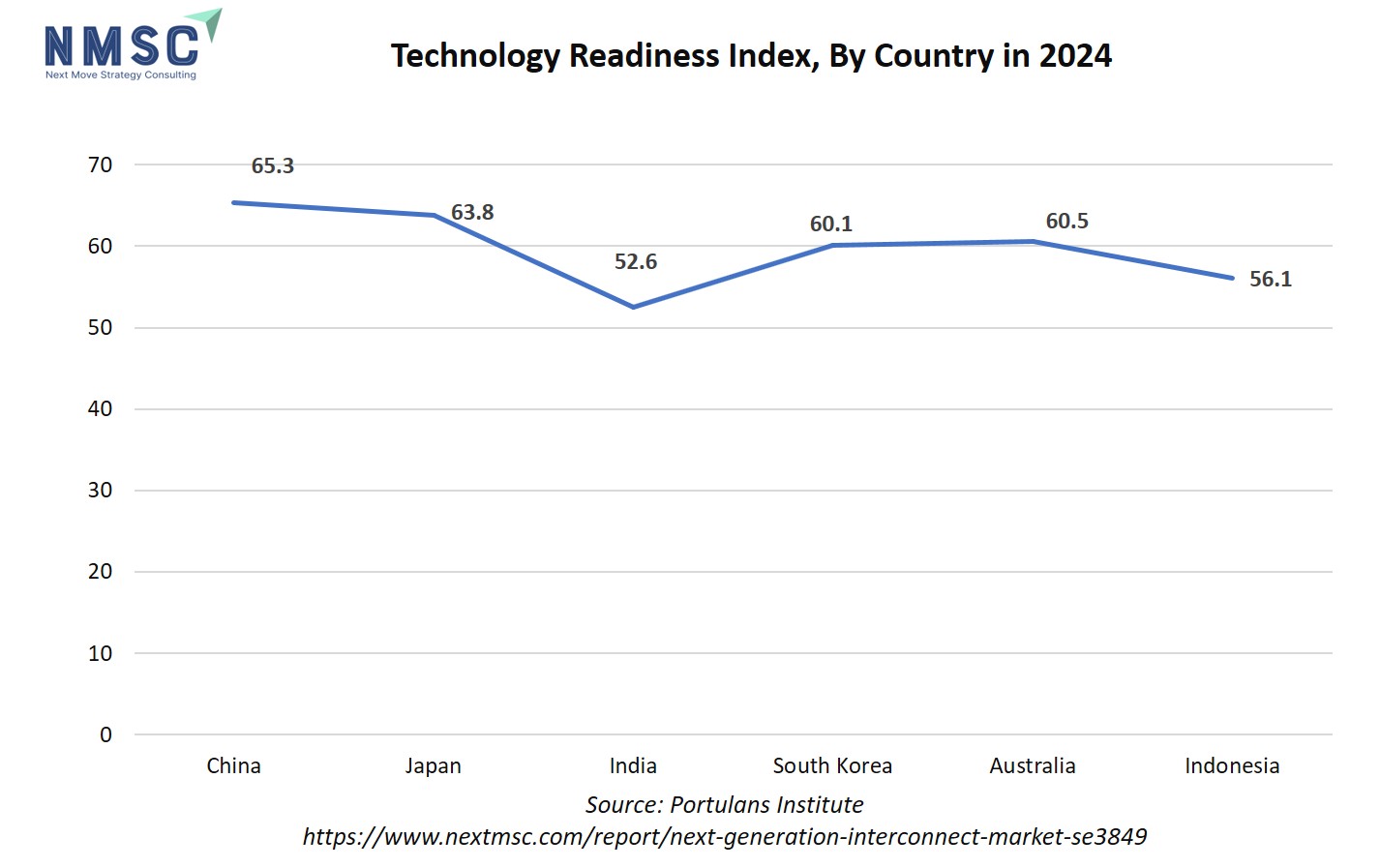
The chart shows Technology Readiness Index scores by country for 2024, with China (65.3), Japan (63.8), and South Korea (60.1) ranking highest, followed by Australia, Indonesia, and India. These scores reflect each nation’s ability to adopt, scale, and maximize advanced technologies in their economies. Countries with higher technology readiness drive faster adoption of smart factories, cloud computing, and AI, all of which increase enterprise demand for data transfer speed, security, and reliability. As a result, these markets see accelerated investment in advanced chip interconnect solutions, such as high-speed optical, chip-to-chip, and data center interconnects, crucial for supporting high-volume, low-latency applications integral to sustaining digital competitiveness and future growth.
Growth Inhibitors:
How do Thermal, Packaging and Manufacturing Scale Challenges Constrain Adoption?
CPO and CPX reduce link loss but relocate heat sources closer to dense switching silicon, increasing thermal management requirements reported in industry developer discussions (2024). Analysis: managing die-level heat, achieving high yield in new substrate assembly lines, and ensuring supply chain readiness add cost and integration risk, slowing broad commercial rollouts. Actionable insight: interconnect suppliers should bundle thermal solutions and provide tested assembly-and-test reference flows (DFM/DFT), and pursue strategic OEM partnerships to share scale-up risk and accelerate qualification cycle.
Where are the Highest Return Pockets for Investors?
demand concentration in hyperscaler AI data centers and telecom 5G/edge deployments produces concentrated, large-ticket procurements for validated CPO modules, CXL fabric silicon and high-density connectors. Analysis: vendors that offer certified end-to-end module + substrate + thermal kits and have hyperscaler references convert pilots to multi-year supply contracts. Actionable insight: investors should target firms with validated CPX/CPO reference designs, fabrication partners for photonics integration, and strong OEM qualification pipelines; prioritise companies demonstrating successful pilot production conversions with one or more hyperscaler customers.
How Next-Generation Interconnect Market Segmented in This Report, and What are the Key Insights from the Segmentation Analysis?
By Type of Interconnect Insights
Is Electrical, Optical or Wireless Interconnect Dominating 2025 Deployments?
Based on type, the next-generation interconnect industry is segmented into electrical interconnects, optical interconnects, and wireless interconnects.
Optical interconnects dominate long-reach and high-aggregate bandwidth needs at rack and data center scales, while electrical interconnects remain prevalent for very short links (chip-to-chip and board-to-board) because of cost and packaging familiarity. Wireless interconnects are emerging for niche board-level wireless bridges but are not yet material at hyperscaler scale. Analysis: transitional architectures combine electrical short hops with optical longer links and co-packaging strategies that move optics closer to the silicon plane. Suppliers should develop hybrid product families that cover electrical short-reach PHYs and optical transceiver modules to address the full stack from chip to rack.
By Technology Insights
Is Silicon Photonics, CPO, Pcie or CXL Dominating Technology Roadmaps?
Based on technology, the next-generation interconnect market is segmented into silicon photonics, co-packaged optics, PCI Express, Compute Express Link (CXL), InfiniBand, Ethernet innovations, and others.
Silicon photonics and co-packaged optics are the most strategically emphasised technologies for data centers seeking lower power and higher density, while CXL and PCIe are critical for disaggregated compute and accelerator coherency. Analysis: technology roadmaps show parallel investments, CPO/silicon photonics for optics density and CXL for memory/fabric disaggregation, indicating multi-front adoption rather than a single dominant technology. Technology suppliers should support multi-standard interoperability (CXL, PCIe) and provide photonics modules that integrate with CPO platforms, thereby de-risking customer migration paths.
By Data Transmission Level Insights
Is Chip-To-Chip, Board-To-Board or Rack-To-Rack Driving Procurement?
Based on data transmission level, the next-generation interconnect market overview is segmented into chip-to-chip, board-to-board, system-to-system, and rack-to-rack & data centre interconnects.
Short-reach (chip-to-chip, board-to-board) remains a high-volume area driven by switch and NIC vendor designs, whereas rack-to-rack and system-to-system interconnects requiring dense optics are the fastest-growing high-value procurement categories for AI/HPC. Analysis: hyperscaler budgets increasingly prioritise inter-rack optics and CPO to enable large model fabrics. Suppliers should tailor product families and qualification programs by transmission level to accelerate OEM qualification.
By Data Rate Insights
Are 100–400 Gbps, 400–800 Gbps or Above 800 Gbps Lanes the Primary Demand Tier?
Based on data rate, the next-generation interconnect market share is categorised into up to 100 Gbps, 100–400 Gbps, 400–800 Gbps, and above 800 Gbps.
Data centres are rapidly moving beyond 100–400 Gbps per lane to 400–800 Gbps and higher aggregated lane strategies; industry materials and product launches in 2024 documented solutions optimised for 224 Gbps per lane and roadmaps above 400 Gbps. Analysis: operating cost and link density favour lane aggregation and higher per-lane rates where signal integrity and thermal design are solved. Module and connector suppliers should publish validated operating envelopes for PAM4 or future modulation formats and offer migration kits for existing OEM linecards to higher lane-rate support.
By Application Insights
Are Data Centers & Cloud Computing or Telecommunications Driving Growth?
Based on application, the next-generation interconnect market is segmented into data centers and cloud computing, high-performance computing (HPC) and AI, telecommunications and 5G infrastructure, consumer electronics, automotive and industrial systems, and aerospace and defense.
Data centers and cloud computing (especially AI/HPC clusters) are the primary near-term growth drivers due to massive east-west traffic and hyperscaler capex. Telecom and 5G transport modernisation drive another growth pocket for long-reach optics and dense metro interconnects. Analysis: short-horizon demand is dominated by hyperscaler refresh cycles and AI rack fabric projects; telecom upgrades follow with multi-year programmatic rollouts. Vendors should maintain differentiated go-to-market motions and certification artefacts for hyperscaler DCO/CPO programs and separate telecom-grade packaging and long-haul module portfolios.
By End User Insights
Are Hyperscalers, Cloud Providers or Telecom Operators the Key Buyers?
Based on end user, the next-generation interconnect market is segmented into technology and cloud service providers, telecom operators, semiconductor manufacturers, enterprises, and research and defense institutions.
Hyperscalers and cloud service providers lead adoption for CPO and high-density optics; telecom operators are significant buyers for transport upgrades and fibre build-outs. Semiconductor manufacturers and research institutions purchase board-level and chip-level interconnects for prototype and production. Analysis: long-term TAM depends on broadening enterprise adoption beyond hyperscalers, but near-term procurement concentration means design-wins with a few hyperscalers be transformational. Prioritise a small number of hyperscaler or Tier-1 telecom proofs and standardise qualification packages to convert pilots into supply agreements.
Regional Outlook
The next-generation interconnect market is geographically studied across North America, Europe, Asia Pacific, Middle East & Africa, and Latin America and each region is further studied across countries.
Next-Generation Interconnect Market in North America
North America remains the global center of gravity for next-generation interconnect innovation, led by hyperscaler capital expenditure, semiconductor ecosystem strength, and early adoption of CPO and CXL technologies. Major cloud providers, chipmakers, and integrators conduct large-scale qualification programs across U.S. and Canadian facilities. Vendors that secure hyperscaler design wins in this region establish de facto global standards for performance and interoperability. The ecosystem’s maturity in testing, co-packaged optics, and fabric integration drives ongoing investments in advanced packaging and substrate manufacturing. North American reference deployments increasingly serve as global validation benchmarks for suppliers seeking rapid international expansion.
Next-Generation Interconnect Market in the United States
The U.S. dominates the next-generation interconnect landscape due to its unparalleled hyperscaler AI infrastructure investments and concentration of semiconductor, switch, and optics vendors. It serves as the primary launchpad for CPO and CXL system-level pilots, with OEMs and hyperscalers jointly driving specification, qualification, and standardisation cycles. U.S.-based innovation hubs in California, Texas, and Oregon anchor collaborations between chipmakers, optical suppliers, and substrate designers. The market favours suppliers capable of meeting hyperscaler-grade power efficiency, latency, and reliability metrics. Given the U.S.’s role in defining interconnect reference architectures, participation in pilot programs here significantly enhances vendor credibility and export potential.
Next-Generation Interconnect Market in Canada
Canada’s next-generation interconnect market demand shows steady but selective adoption, primarily anchored in academic high-performance computing (HPC) clusters and enterprise cloud modernisation projects. The nation’s strong research institutions and R&D partnerships in photonics, optics, and semiconductor packaging create strategic collaboration opportunities for international suppliers. Canadian data centres emphasise energy efficiency and hybrid architectures suitable for regulated environments. Local vendors and research centers act as innovation partners for early testing of fibre, optical, and advanced interconnect prototypes. The presence of technology incubators and public funding programs further supports photonics and optical connectivity development initiatives.
Next-Generation Interconnect Market in Europe
Europe’s interconnect market is shaped by its focus on interoperability, sustainability, and telecom modernisation. EU data infrastructure investments, combined with strict compliance and localisation standards, drive demand for telecom-grade and long-lifecycle optical modules. Key European nations are advancing sovereign cloud and HPC projects that emphasise certified, low-latency interconnect systems. Vendors entering the market must provide lifecycle support, documentation, and regulatory compliance to meet procurement thresholds. The regional emphasis on fibre manufacturing, co-packaged optics, and supply resilience supports strong demand across industrial, telecom, and enterprise segments.
Next-Generation Interconnect Market in the United Kingdom
The United Kingdom combines strong enterprise cloud activity with advanced research and HPC programs that serve as early adoption venues for next-generation interconnects. Demand is concentrated in financial services, research institutions, and government cloud projects, where compliance and data security are non-negotiable. Vendors offering localised support, transparent certification, and service-level traceability are preferred. Partnerships between hyperscalers, universities, and consulting integrators accelerate pilot deployments, particularly in co-packaged optics and CXL-based systems. The U.K.’s robust policy framework for digital infrastructure also incentivises domestic testing and validation capabilities.
Next-Generation Interconnect Market in Germany
Germany’s leadership in automotive, industrial automation, and HPC adoption drives sustained demand for deterministic, low-latency interconnects. The country’s strong engineering base and manufacturing sophistication foster tight collaboration between system integrators, OEMs, and research centers. German buyers prioritise reliability, precision, and lifecycle traceability, favouring vendors with validated high-speed signal integrity solutions and ruggedised designs. Local system integrators play a central role in qualification and compliance testing, ensuring interoperability across production environments. Industrial digitalisation and Industry 4.0 programs are expected to sustain market momentum through 2030.
Next-Generation Interconnect Market in France
France’s next-generation interconnect industry is driven by public investments in research, defense, and telecom modernisation. National HPC and cybersecurity programs create demand for high-speed, secure optical and electrical interconnects. Suppliers with robust compliance processes, lifecycle guarantees, and sustainability credentials are favoured by public-sector buyers. Collaboration between national laboratories, telecom operators, and technology firms encourages innovation in photonics and packaging. The market also benefits from France’s participation in EU semiconductor initiatives supporting advanced interconnect R&D and domestic capacity development.
Next-Generation Interconnect Market in Italy
Italy’s growing enterprise cloud ecosystem and digital manufacturing sectors are key drivers of selective interconnect upgrades. Demand is centred around hybrid optical-electrical solutions supporting cloud workloads and industrial automation. Local system integrators and telecom operators focus on modernising legacy systems with energy-efficient, high-density modules. While adoption is slower than in northern Europe, increasing participation in EU digital infrastructure programs is expected to enhance domestic demand. Vendors offering integration-friendly, hybrid deployment solutions are best positioned to succeed.
Next-Generation Interconnect Market in Spain
Spain’s logistics, telecom, and digital enterprise sectors underpin rising demand for high-capacity fiber and rack-scale optical solutions. The expansion of data centers in Madrid and Barcelona supports increasing use of co-packaged and high-throughput interconnect technologies. Telecom modernisation initiatives and cross-border fibre projects enhance market potential. Vendors that deliver pre-qualified, interoperable modules for regional carriers and data center operators are well placed to capture growth. Spain’s proximity to North Africa also strengthens its position as a logistics and connectivity hub.
Next-Generation Interconnect Market in the Nordics
Nordic countries lead in sustainable data infrastructure and high cloud maturity, driving demand for energy-efficient, high-density interconnects. Regional buyers favour suppliers offering low-carbon, thermally optimised optical modules and lifecycle traceability. The strong presence of hyperscaler data centers in Sweden and Finland accelerates the use of co-packaged optics and advanced substrate solutions. Nordic sustainability standards are influencing broader European procurement, rewarding suppliers with verifiable carbon-reduction metrics and energy-efficient designs.
Next-Generation Interconnect Market in the Asia-Pacific
Asia-Pacific represents the fastest-growing region for next-generation interconnects, fueled by rapid data center expansion, telecom fibre rollouts, and semiconductor manufacturing investments. China, Japan, and South Korea anchor the region’s optical and packaging supply chains, while India and Southeast Asia emerge as high-growth consumer markets. APAC’s ecosystem benefits from strong regional collaboration between OEMs, foundries, and hyperscalers, accelerating innovation in silicon photonics and CPO integration. Vendors entering the region must align with local standards and establish co-development partnerships with chipmakers and system integrators. Regional infrastructure initiatives and national digital programs continue to boost the adoption of high-speed, energy-efficient interconnect solutions.
Next-Generation Interconnect Market in China
China leads the global next-generation interconnect market growth opportunities in both consumption and manufacturing of interconnect components, driven by large domestic cloud providers and a rapidly advancing semiconductor ecosystem. Local suppliers specialise in silicon photonics, optical transceivers, and high-bandwidth module integration, reducing reliance on imports. Government-backed programs encourage vertical integration and self-sufficiency, while partnerships between hyperscalers and chipmakers accelerate product qualification cycles. The country’s dual focus on AI and 5G infrastructure creates sustained demand for high-performance, low-latency interconnects. Suppliers that localise production and certification gain a significant competitive advantage in securing long-term contracts with major Chinese platform operators.
Next-Generation Interconnect Market in Japan
Japan’s next-generation interconnect market is defined by precision manufacturing, long lifecycle expectations, and a strong emphasis on reliability and quality assurance. The country’s advanced materials industry supports hybrid optical-electrical interconnect innovations used in enterprise, telecom, and automotive applications. Japanese data center and telecom operators demand certified, thermally stable modules with long operational lifetimes. Domestic R&D in packaging, photonics, and co-packaged optics ensures Japan remains a critical innovation hub. Vendors with proven quality management systems, compliance certifications, and localised technical support enjoy preferential access to this discerning, high-specification market.
Next-Generation Interconnect Market in India
India’s industry expansion is underpinned by rapid cloud adoption, digital transformation, and large-scale telco modernisation initiatives. Demand is rising for high-density fibre optics and CPO-based systems that support large data workloads across enterprise, telecom, and government networks. Major hyperscalers and local data center operators are building new regional capacity, while system integrators focus on modular, scalable architectures. The government’s Digital India and semiconductor incentive programs create favourable conditions for interconnect manufacturing and R&D partnerships. Vendors offering cost-efficient, locally assembled, and energy-optimised solutions are best positioned to capture long-term growth opportunities.
Next-Generation Interconnect Market in South Korea
South Korea stands out as a strategic hub for advanced interconnect innovation, driven by its strong electronics, semiconductor, and telecom sectors. Leading OEMs and hyperscalers prioritise ultra-low-latency, high-throughput optical modules to support AI, memory, and 5G infrastructure. The government’s national AI and semiconductor programs further reinforce investment in CPO, silicon photonics, and next-generation substrate technologies. Collaboration between telecom providers and semiconductor fabs accelerates qualification and deployment cycles. Vendors demonstrating proven integration with Korean OEM ecosystems and local testing standards gain significant commercial traction.
Next-Generation Interconnect Market in Indonesia
Indonesia’s next-generation interconnect market remains nascent but is gaining momentum with increasing cloud adoption, telecom expansion, and enterprise modernisation initiatives. Data center growth in Jakarta and regional hubs is creating early opportunities for fibre deployment and rack-scale interconnects. Local telecoms and managed service providers are seeking ruggedised, easily maintainable modules suitable for tropical environments. International suppliers entering the market typically partner with regional integrators to manage logistics, qualification, and after-sales support. Continued investment in connectivity infrastructure and government-backed digital programs is expected to sustain medium-term growth.
Next-Generation Interconnect Market in Australia
Australia demonstrates a stable demand for high-performance optical interconnects, driven by strong enterprise cloud migration, hyperscaler data center expansion, and growing edge deployments. Its mature IT ecosystem and robust digital infrastructure policy support consistent market growth. Data center clusters around Sydney and Melbourne form regional anchors for high-capacity optical and CXL-based interconnect deployments. Australian operators prioritise energy efficiency and regulatory compliance, favouring vendors with transparent supply chains and sustainability credentials. The country’s strategic position also makes it a gateway for regional distribution and testing for Southeast Asian markets.
Next-Generation Interconnect Market in Latin America
Latin America’s interconnect market shows uneven adoption across countries, with Brazil and Mexico leading due to expanding telecom and cloud infrastructure investments. Regional modernisation programs are driving demand for high-bandwidth fibre optics and data center interconnects. Infrastructure challenges and logistics complexity remain barriers, yet increasing hyperscaler investments are improving availability and scale. Vendors targeting Latin America must offer localised support, financing flexibility, and modular, easy-to-deploy systems suited to regional climate and power constraints. Cross-border fibre projects and regional data initiatives are expected to accelerate medium-term adoption.
Next-Generation Interconnect Market in the Middle East & Africa
The Middle East and Africa region is witnessing rapid digital infrastructure expansion, particularly in Gulf Cooperation Council (GCC) countries and North Africa. Large-scale data center, telecom, and fibre network projects in Saudi Arabia, the UAE, Morocco, and Egypt are fueling demand for high-performance transport and rack-scale optics. Regional procurement favours partnerships with local integrators to ensure compliance and supply reliability. As governments invest in national cloud and AI strategies, the demand for co-packaged and low-latency interconnect technologies will rise. Vendors offering durable, high-temperature-rated modules and localised after-sales support build lasting market presence.
Competitive Landscape
Which Companies Dominate the Next-Generation Interconnect Market and How do they Compete?
Leading companies in the next-generation interconnect industry, such as (Corning, Lumentum), connector specialists (Samtec, Amphenol, TE Connectivity, Rosenberger, HUBER+SUHNER), and systems vendors (Cisco, Ciena) collectively shape the market. Each competes on depth (material science, photonics) or breadth (system integration, global logistics). Success depends on validated system-level offerings and hyperscaler or telecom qualifications.
Market Dominated by Next-Generation Interconnect Giants and Specialists
The competitive field spans material and fibre incumbents (Corning), connector and cable specialists (Samtec, Amphenol, TE Connectivity, Rosenberger), optics/transceiver vendors (Lumentum) and system/fabric vendors (Cisco, Ciena). Semiconductor and platform companies (Intel) influence standards (CXL, PCIe) and generate system-level demand through reference platforms. Competition centers on vertical integration (materials modules, connector system qualification) and the ability to deliver validated, scalable solutions for hyperscalers and telecom operators. Executing complex co-engineering programs and securing hyperscaler reference designs is the primary path to scale.
Innovation and Adaptability Drive Market Success
Firms investing in silicon photonics, low-loss connectors, and assembly automation demonstrate faster time-to-production. Samtec and collaborators published CPX designs and high-rate PAM4 connector platforms for 224 Gbps lanes (2024), indicating rapid product innovation. System vendors are integrating optics and offering software-assisted provisioning to reduce deployment complexity. Companies that combine mechanical, thermal and electrical design expertise with supply chain scale and formal qualification programs will lead. Actionable recommendation: secure multi-tier supplier partnerships to provide end-to-end validated kits that reduce OEM qualification time.
Market Players to Opt for Merger & Acquisition Strategies to Expand Their Presence
Consolidation and strategic partnerships accelerate capability portfolios (connector + cable + module + thermal). Public filings and industry activity in 2024–2025 show strategic acquisitions and collaborations to expand capabilities and regional reach. For investors and executives, monitoring M&A in interconnect specialists and module assemblers reveals areas where incumbents seek bolt-on capabilities. Actionable insight: consider partnership-first strategies to mitigate integration risk and use targeted acquisitions for missing assembly or photonics capabilities rather than end-to-end greenfield builds.
List of Key Next-Generation Interconnect Companies
-
Corning Incorporated.
-
Amphenol Corporation.
-
TE Connectivity
-
Sumitomo Electric Industries, Ltd
-
Furukawa Electric Co., Ltd.
-
Lumentum Operations LLC
-
Ciena Corporation
-
Molex LLC
-
Broadex Technologies.
-
Samtec
-
Intel
-
Rosenberger
-
HUBER+SUHNER
What Are the Latest Key Industry Developments?
-
August 2024- Corning and Lumen reach supply agreement on next-generation fibre-optic cable to support data center AI demands.
-
September 2025- Corning collaborated with GlobalFoundries to develop detachable fibre connector solutions for silicon photonics platforms, facilitating scalable next-generation optical connectivity for AI data centers and high-performance computing.
-
August 2025- Amphenol completed its USD 10.5 billion acquisition of CommScope’s Connectivity and Cable Solutions business in August 2025, significantly expanding its fibre and network infrastructure portfolio for high-speed data and 5G applications.
-
October 2025- TE showcased next-generation, high-density interconnect solutions for AI/ML workloads at the OCP Global Summit, focusing on rack-level power, liquid-cooled busbars, and optical interconnects supporting hyperscale data centers.
What Are the Key Factors Influencing Investment Analysis & Opportunities in the Next-Generation Interconnect Market?
Investment decisions hinge on three factors: concentration risk (hyperscaler procurement concentration), technology maturity (CPO, silicon photonics, CXL readiness), and manufacturing scale (assembly, yield and automation). Post-2024 primary sources show accelerated hyperscaler capex and strengthened vendor roadmaps; however, conversion from pilots to multi-site production requires demonstrated yield and thermal management. Hotspots: firms providing validated CPX/CPO modules, retimers and interposer packaging (high value-add) and automation/assembly technologies for photonics integration. Investors should prioritize businesses with one or more hyperscaler or Tier-1 telecom reference designs, robust IP in photonics/thermal domains, and proven pathways from prototype to volume production.
Key Benefits for Stakeholders:
Next Move Strategy Consulting (NMSC) presents a comprehensive analysis of the next-generation interconnect market trends, covering historical trends from 2020 through 2024 and offering detailed forecasts through 2030. Our study examines the market at regional and country levels, providing quantitative projections and insights into key growth drivers, challenges, and investment opportunities across all major next-generation interconnect segments.
Investors gain exposure to a high-growth, capital-intensive value chain where validated design-wins with hyperscalers convert into multi-year supply streams; OEM customers obtain higher bandwidth and energy efficiency for AI/HPC workloads, improving TCO; system integrators and assemblers capture higher margins by offering certified assembly and thermal solutions; policymakers and network planners obtain clearer pathways to scale national data infrastructures via standardized optical and interconnect modules..
Report Scope
|
Parameters |
Details |
|
Market Size in 2025 |
USD 23.45 Billion |
|
Revenue Forecast in 2030 |
USD 54.10 Billion |
|
Growth Rate |
CAGR of 18.2% from 2025 to 2030 |
|
Analysis Period |
2024–2030 |
|
Base Year Considered |
2024 |
|
Forecast Period |
2025–2030 |
|
Market Size Estimation |
Billion (USD) |
|
Growth Factors |
|
|
Companies Profiled |
15 |
|
Countries Covered |
33 |
|
Market Share |
Available for 10 companies |
|
Customization Scope |
Free customization (equivalent to up to 80 analyst-working hours) after purchase. Addition or alteration to country, regional & segment scope. |
|
Pricing and Purchase Options |
Avail customized purchase options to meet your exact research needs. |
|
Approach |
In-depth primary and secondary research; proprietary databases; rigorous quality control and validation measures. |
|
Analytical Tools |
Porter's Five Forces, SWOT, value chain, and Harvey ball analysis to assess competitive intensity, stakeholder roles, and relative impact of key factors. |
Key Market Segments
By Type of Interconnect
-
Electrical Interconnects
-
Optical Interconnects
-
Wireless Interconnects
By Technology
-
Silicon Photonics
-
Co-Packaged Optics
-
PCI Express
-
Compute Express Link (CXL)
-
InfiniBand
-
Ethernet Innovations
-
Others
By Data Transmission Level
-
Chip-to-Chip Interconnects
-
Board-to-Board Interconnects
-
System-to-System Interconnects
-
Rack-to-Rack and Data Center Interconnects
By Data Rate
-
Up to 100 Gbps
-
100–400 Gbps
-
400–800 Gbps
-
Above 800 Gbps
By Application
-
Data Centers and Cloud Computing
-
High-Performance Computing (HPC) and AI
-
Telecommunications and 5G Infrastructure
-
Consumer Electronics
-
Automotive and Industrial Systems
-
Aerospace and Defense
By End User
-
Technology and Cloud Service Providers
-
Telecom Operators
-
Semiconductor Manufacturers
-
Enterprises
-
Research and Defense Institutions
Geographical Breakdown
-
North America: U.S., Canada, and Mexico.
-
Europe: U.K., Germany, France, Italy, Spain, Sweden, Denmark, Finland, Netherlands, and rest of Europe.
-
Asia Pacific: China, India, Japan, South Korea, Taiwan, Indonesia, Vietnam, Australia, Philippines, Malaysia and rest of APAC.
-
Middle East & Africa (MEA): Saudi Arabia, UAE, Egypt, Israel, Turkey, Nigeria, South Africa, and rest of MEA.
-
Latin America: Brazil, Argentina, Chile, Colombia, and rest of LATAM
Conclusion & Recommendations
Our report equips stakeholders, industry participants, investors, and consultants with actionable intelligence to capitalize on next-generation interconnect’s transformative potential. By combining robust data-driven analysis with strategic frameworks, NMSC’s next-generation interconnect market report serves as an indispensable resource for navigating the evolving landscape.
Next-generation interconnects are at an inflexion point because converging needs, hyperscaler AI fabrics, telecom transport modernisation and chip-level disaggregation, drive simultaneous demand for silicon photonics, co-packaged optics and fabric standards (CXL). Adoption will be uneven: early hyperscaler and telecom programs will set performance and qualification barcodes that others follow. Vendors that solve thermal/assembly scale and offer validated kits win rapid scale.


About the Author
 Ridip Gogoi
— Ridip Gogoi is a Research Associate at Next Move Strategy Consulting, where he supports cross-vertical market research and analysis across multiple industry sectors, with four years of experience. His work includes market analysis, data validation, secondary research, and insight development, helping structure evidence into clear findings for business and strategy decisions. He contributes to research quality checks and reporting, with a focus on consistency, source review, and clarity accuracy.
Ridip Gogoi
— Ridip Gogoi is a Research Associate at Next Move Strategy Consulting, where he supports cross-vertical market research and analysis across multiple industry sectors, with four years of experience. His work includes market analysis, data validation, secondary research, and insight development, helping structure evidence into clear findings for business and strategy decisions. He contributes to research quality checks and reporting, with a focus on consistency, source review, and clarity accuracy.
About the Reviewer
 Supradip Baul
— Supradip Baul is an accomplished business consultant and strategist with over a decade of rich experience in market intelligence, strategy, technology, and business transformation. His work has included rigorous qualitative and quantitative analysis across multiple industries, helping clients shape investment decisions and long-term roadmaps. Earlier in his career, he was associated with Gartner, where he contributed to industry-leading reports and market share analyses. He has worked with leading global companies and holds an MBA with a dual specialization in Marketing and Finance.
Supradip Baul
— Supradip Baul is an accomplished business consultant and strategist with over a decade of rich experience in market intelligence, strategy, technology, and business transformation. His work has included rigorous qualitative and quantitative analysis across multiple industries, helping clients shape investment decisions and long-term roadmaps. Earlier in his career, he was associated with Gartner, where he contributed to industry-leading reports and market share analyses. He has worked with leading global companies and holds an MBA with a dual specialization in Marketing and Finance.
At Next Move Strategy Consulting, we understand that insightful market research is the cornerstone of successful business decisions. That's why we employ a robust and multifaceted approach, combining various methodologies to deliver the most accurate and actionable data for our clients.

Research Landscape
We navigate the world of research with two primary approaches:
Qualitative Approach
Our qualitative research methodologies involve immersive techniques such as in-depth interviews, focus groups, and observational studies. By engaging directly with individuals and stakeholders, we uncover valuable insights that quantitative data alone may overlook.

Quantitative Research
In tandem with qualitative methodologies, NMSC leverages the power of Quantitative Research to provide a robust foundation of numerical insights. Through systematic data collection and analysis, we quantify patterns, preferences, and market trends, offering a comprehensive view of the business landscape.
Our quantitative research approach employs diverse tools, including surveys, experiments, and statistical modelling. These methodologies enable us to gather data from a large and representative sample, ensuring the statistical significance of our findings. By employing structured questionnaires and standardized data collection methods, we guarantee the reliability and validity of the information we present to our clients.
Quantitative research is particularly effective in measuring the prevalence of trends, assessing market size, and gauging the impact of various factors on consumer behavior. The numerical precision attained through this approach equips our clients with actionable insights, facilitating data-driven decision-making and strategy formulation.


Our Specialized Toolbox for Industry-Specific Market Research
We deploy a specialized arsenal of techniques tailored to meet your unique requirements. Here's a glimpse into our comprehensive toolbox:

Information Procurement
The stage entails acquiring market data or relevant information through various sources and methodologies.


Market Research Approach
We utilize both top-down and bottom-up approaches in market research analysis to achieve a comprehensive understanding of the market dynamics, leveraging the broad perspective of industry trends and macroeconomic factors alongside detailed insights from specific segments and individual companies.

Porters Five Forces Analysis
We conduct Porter's Five Forces analysis to evaluate the competitive landscape of an industry, providing us with insights into factors that affect profitability and strategic positioning.

SWOT Analysis

Forecasting
We utilize a forecasting model to predict future consumption by considering parameters like population, economics, regulations, market competition, drivers, constraints, technology, and pricing. We also employ statistical techniques such as multilinear regression, exponential smoothing, moving average, ARIMA, and Monte Carlo simulations for accurate predictions. In econometric forecasting, we analyzed short-term and long-term event impacts, attributing values based on regulatory frameworks, economic factors, and market events.





 Speak to Our Analyst