PAMiDs Market Global Industry Analysis and Forecast (2026-2035)

PAMiD Market size was USD 4.85 Billion in 2025, projected to reach USD 11.20 Billion by 2035, growing at a CAGR of 8.9% from 2026 to 2035. Key drivers include rising 5G carrier aggregation complexity, 5G adoption in mid-tier smartphones, and demand for higher RF content per device, with Middle East & Africa expected to be the fastest-growing region.

Download Free Sample PDF
Base Year (2025)
$4.85 Billion
Forecast (2035)
$11.20 Billion
CAGR (2026-2035)
8.9%
Top Region
Asia-Pacific

What Is the PAMiD Market Size?

The global PAMiD market size was valued at USD 4.85 Billion in 2025 and is estimated to grow from USD 5.20 Billion in 2026 to USD 11.20 Billion by 2035, expanding at a CAGR of 8.9% between 2026 and 2035. Asia-Pacific led the PAMiD market with an approximate 62% revenue share in 2025, while Sub-6GHz PAMiD remained the dominant frequency-band segment with an approximate 55% share of global revenue.

We observed that the PAMiD market's momentum is best captured through a concise set of indicators before deeper analysis follows.

PAMiDs Market Global Industry Analysis and Forecast (2026-2035) Revenue Forecast

Values in USD Billion

2025 $4.85 Billion
2025
2026 $5.28 Billion
2026
2027 $5.75 Billion
2027
2028 $6.26 Billion
2028
2029 $6.82 Billion
2029
2030 $7.43 Billion
2030
2031 $8.09 Billion
2031
2032 $8.81 Billion
2032
2033 $9.59 Billion
2033
2034 $10.45 Billion
2034
2035 $11.20 Billion
2035

Key Takeaways

By Frequency Band: Sub-6GHz PAMiD held the largest share of approximately USD 2.67 billion in 2025, projected to reach USD 6.72 billion by 2035; Multi-Band PAMiD is the fastest-growing frequency band at 11.87% CAGR from 2026–2035.

By Application: Smartphones held the largest share of approximately USD 3.64 billion in 2025, projected to reach USD 7.28 billion by 2035; IoT and Wearable Devices are the fastest-growing application at 14.42% CAGR from 2026–2035.

By Integration Architecture: Single-Chip Integrated PAMiD held the largest share of approximately USD 2.91 billion in 2025, projected to reach USD 7.84 billion by 2035; Multi-Die Module PAMiD is the fastest-growing architecture at 5.63% CAGR from 2026–2035.

Dominant Region: Asia-Pacific dominated with approximately USD 3.01 billion in 2025, projected to reach USD 7.28 billion by 2035.

Fastest-Growing Region: Middle East & Africa is expected to register the highest CAGR of 10.71% during 2026–2035.

Dominant Country: China was the largest single national contributor within the Asia-Pacific region in 2025.

Fastest-Growing Country: India is expected to register the fastest growth, with its CAGR exceeding the Asia-Pacific regional average during 2026–2035.

By Frequency Band: Sub-6GHz PAMiD held the largest share of approximately USD 2.67 billion in 2025, projected to reach USD 6.72 billion by 2035; Multi-Band PAMiD is the fastest-growing frequency band at 11.87% CAGR from 2026–2035.

By Application: Smartphones held the largest share of approximately USD 3.64 billion in 2025, projected to reach USD 7.28 billion by 2035; IoT and Wearable Devices are the fastest-growing application at 14.42% CAGR from 2026–2035.

By Integration Architecture: Single-Chip Integrated PAMiD held the largest share of approximately USD 2.91 billion in 2025, projected to reach USD 7.84 billion by 2035; Multi-Die Module PAMiD is the fastest-growing architecture at 5.63% CAGR from 2026–2035.

The PAMiD market is projected to generate an incremental revenue opportunity of approximately USD 6.00 Billion between 2026 and 2035, reflecting the absolute dollar gap between the 2035 forecast and the 2026 base value a signal of sustained RF front-end content growth per handset as carrier aggregation complexity rises.

According to Next Move Strategy Consulting analysis, rising band-count complexity in 5G handsets is increasing average PAMiD silicon content per device even where overall smartphone unit shipments remain flat, a dynamic that decouples market growth from handset volume alone.

What does the PAMiD Market Encompass?

The PAMiD market encompasses power amplifier module integrated duplexer components that consolidate power amplifier, duplexer, filter, and switch functions into a single RF front-end module for cellular handsets and connected devices. Our assessment indicates that the market's scope spans single-chip and multi-die module architectures supplied directly to smartphone original equipment manufacturers and RF front-end integrators across sub-3GHz, sub-6GHz, and multi-band frequency configurations.

Structurally, the PAMiD market has evolved from discrete power amplifier and duplexer components toward highly integrated single-module solutions as carrier aggregation band counts have expanded across successive 4G and 5G handset generations. We found that regulatory environments administered by national telecommunications spectrum authorities continue to define supported frequency bands, while technology adoption trends toward higher carrier aggregation complexity are increasing average PAMiD content value per handset across premium and mid-tier device tiers.

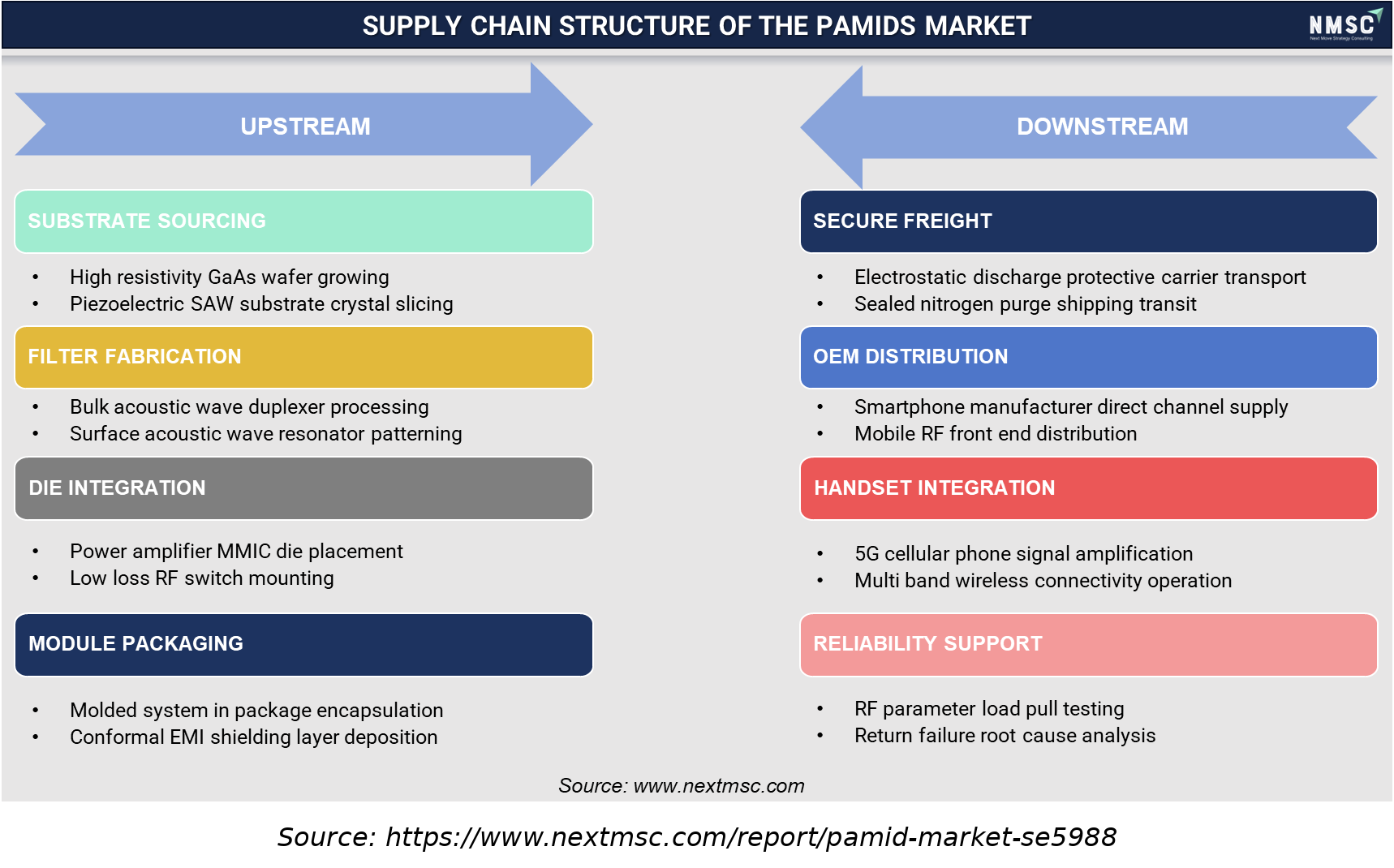
SUPPLY CHAIN STRUCTURE OF THE PAMIDS MARKET

SUPPLY CHAIN STRUCTURE OF THE PAMIDS MARKET
The PAMIDs market supply chain spans upstream material and component manufacturing through downstream integration and distribution. Upstream activities include GaAs wafer sourcing, SAW substrate processing, filter fabrication, die integration, and module packaging. Downstream stages cover secure freight, OEM distribution, handset integration, and reliability support, enabling RF components to reach smartphone and wireless communication applications.

Market Drivers & Dynamics

Interactive Dataset
Rising 5G carrier aggregation band-count complexity driver +2.4% Global 2026–2035
5G migration into mid-tier smartphone segments driver +1.8% Asia-Pacific, Latin America 2026–2033
Growth of cellular-connected IoT and wearable devices driver +1.2% North America, Asia-Pacific 2027–2035
Increasing single-chip integration reducing module footprint driver +0.9% Global 2026–2032
Smartphone unit shipment stagnation in mature markets restraint −0.8% North America, Europe 2026–2035
Pricing pressure from concentrated handset OEM buyers restraint −0.6% Asia-Pacific 2026–2035
Semiconductor supply chain and wafer capacity constraints restraint −0.5% Global 2026–2030
Source: Next Move Strategy Consulting

Growth Drivers

What Is the Primary Growth Driver for the PAMiD Market?

Rising 5G carrier aggregation band-count complexity is the primary growth driver, as each additional supported band combination increases required RF front-end silicon content per handset. The U.S. Federal Communications Commission has continued to allocate additional mid-band and high-band spectrum for commercial 5G use, underscoring the expanding band landscape that PAMiD modules must support across current and next-generation handset designs.

How Is 5G Mid-Tier Penetration Driving the Market Growth?

5G migration into mid-tier smartphone segments is driving growth by expanding the unit base eligible for multi-band PAMiD content beyond premium flagship devices alone. Company analysis indicates that suppliers with cost-optimized module variants are capturing share in this expanding mid-tier segment. Based on research conducted by Next Move Strategy Consulting, we found that this shift is most pronounced across Asia-Pacific handset OEM supply chains.

Growth Inhibitors

What Is Restraining the PAMiD Market?

Smartphone unit shipment stagnation in mature PAMiD market is restraining overall volume growth, as replacement cycles lengthen across North America and Europe. We observed that this restraint is most pronounced among suppliers reliant on unit-volume growth rather than rising content value per device, pushing suppliers to prioritize average selling price expansion through higher-complexity module sales.

What Are the Growth Opportunities?

Can Cost-Optimized Multi-Band Modules Unlock Mid-Tier 5G Demand?

Lower-cost multi-band PAMiD variants tailored to mid-tier smartphone price points can unlock incremental demand as 5G continues migrating downmarket. This mechanism primarily benefits suppliers with scaled manufacturing capacity able to serve high-volume, price-sensitive Android OEM segments.

Will Miniaturized PAMiD Variants Expand IoT Device Adoption?

Further miniaturized, lower-power PAMiD variants designed for cellular IoT and wearable applications offer a mechanism to expand beyond smartphone-dependent demand. Suppliers with wafer-level packaging expertise are best positioned to capture this opportunity as connected device categories continue expanding.

Can Regional Manufacturing Diversification Reduce Supply Concentration Risk?

Expanding RF front-end module assembly and test capacity outside traditional East Asian manufacturing hubs offers a mechanism to reduce geographic supply concentration risk for handset OEMs. Suppliers investing in diversified regional manufacturing footprints stand to benefit from OEM sourcing diversification strategies.

Segmentation Analysis

2025 (USD Billion)
2035 (USD Billion)
Sub-6GHz PAMiD 2025: $2.67 Billion | 2035: $6.72 Billion
Sub-6GHz PAM
Sub-3GHz PAMiD 2025: $1.46 Billion | 2035: $2.24 Billion
Sub-3GHz PAM
Multi-Band PAMiD 2025: $0.73 Billion | 2035: $2.24 Billion
Multi-Band P
Sub-6GHz PAMiD $2.67 Billion $6.72 Billion 9.68%
Sub-3GHz PAMiD $1.46 Billion $2.24 Billion 4.40%
Multi-Band PAMiD $0.73 Billion $2.24 Billion 11.87%

Which Frequency Band Dominates the PAMiD Market?

Sub-6GHz PAMiD dominates frequency-band segmentation with an estimated USD 2.67 Billion in 2025, rising to USD 6.72 Billion by 2035, reflecting its role as the primary frequency range for mainstream 5G handset deployment. Multi-Band PAMiD is the fastest-growing segment at a 11.87% CAGR, reflecting rising demand for modules supporting expanded carrier aggregation combinations across premium device tiers.

2025 (USD Billion)
2035 (USD Billion)
Smartphones
Tablets
IoT and wear
Other connec
Segment Item 2025 (USD Billion) 2035 (USD Billion) CAGR
Smartphones $10.0 USD Billion $40.0 USD Billion 27.0%
Tablets $17.1 USD Billion $51.1 USD Billion 9.0%
IoT and wearable devices $24.2 USD Billion $62.2 USD Billion 19.0%
Other connected devices $31.3 USD Billion $73.3 USD Billion 17.0%

Segment-wise data is locked

Unlock complete segment-wise numbers for By Application.

Unlock Full Data

Which Application Segment Is Gaining the Most Ground?

Smartphones remain the dominant application segment with USD 3.64 Billion in 2025 revenue, reflecting the category's role as the primary carrier of RF front-end content. IoT and Wearable Devices is growing fastest at a 14.42% CAGR as cellular connectivity expands into compact connected device form factors requiring miniaturized RF front-end modules.

2025 (USD Billion)
2035 (USD Billion)
Single-chip
Multi-die mo
Segment Item 2025 (USD Billion) 2035 (USD Billion) CAGR
Single-chip integrated PAMiD $10.0 USD Billion $40.0 USD Billion 25.0%
Multi-die module PAMiD $17.1 USD Billion $51.1 USD Billion 11.0%

Segment-wise data is locked

Unlock complete segment-wise numbers for By Integration Architecture.

Unlock Full Data

Which Integration Architecture Leads and Which Is Growing Fastest?

Single-Chip Integrated PAMiD leads architecture segmentation with USD 2.91 Billion in 2025 revenue, reflecting handset OEM preference for compact, board-space-efficient module designs. This architecture is also the fastest-growing at a 10.44% CAGR, driven by continued miniaturization pressure across premium and mid-tier smartphone form factors.

2025 (USD Billion)
2035 (USD Billion)
Direct OEM s
Distributor
Segment Item 2025 (USD Billion) 2035 (USD Billion) CAGR
Direct OEM supply $10.0 USD Billion $40.0 USD Billion 14.0%
Distributor supply $17.1 USD Billion $51.1 USD Billion 24.0%

Segment-wise data is locked

Unlock complete segment-wise numbers for By Distribution Channel.

Unlock Full Data
2025 (USD Billion)
2035 (USD Billion)
North Americ
Canada
Mexico
Europe: UK
Germany
Segment Item 2025 (USD Billion) 2035 (USD Billion) CAGR
North America: U.S. $10.0 USD Billion $40.0 USD Billion 24.0%
Canada $17.1 USD Billion $51.1 USD Billion 22.0%
Mexico $24.2 USD Billion $62.2 USD Billion 20.0%
Europe: UK $31.3 USD Billion $73.3 USD Billion 22.0%
Germany $38.4 USD Billion $84.4 USD Billion 13.0%

Segment-wise data is locked

Unlock complete segment-wise numbers for By Region.

Unlock Full Data

Growth Opportunities

Beyond current demand drivers, three whitespace opportunities stand out as forward-looking mechanisms for revenue expansion through 2035.

Can Cost-Optimized Multi-Band Modules Unlock Mid-Tier 5G Demand?

Lower-cost multi-band PAMiD variants tailored to mid-tier smartphone price points can unlock incremental demand as 5G continues migrating downmarket. This mechanism primarily benefits suppliers with scaled manufacturing capacity able to serve high-volume, price-sensitive Android OEM segments.
Will Miniaturized PAMiD Variants Expand IoT Device Adoption?

Further miniaturized, lower-power PAMiD variants designed for cellular IoT and wearable applications offer a mechanism to expand beyond smartphone-dependent demand. Suppliers with wafer-level packaging expertise are best positioned to capture this opportunity as connected device categories continue expanding.

Can Regional Manufacturing Diversification Reduce Supply Concentration Risk?

Expanding RF front-end module assembly and test capacity outside traditional East Asian manufacturing hubs offers a mechanism to reduce geographic supply concentration risk for handset OEMs. Suppliers investing in diversified regional manufacturing footprints stand to benefit from OEM sourcing diversification strategies.

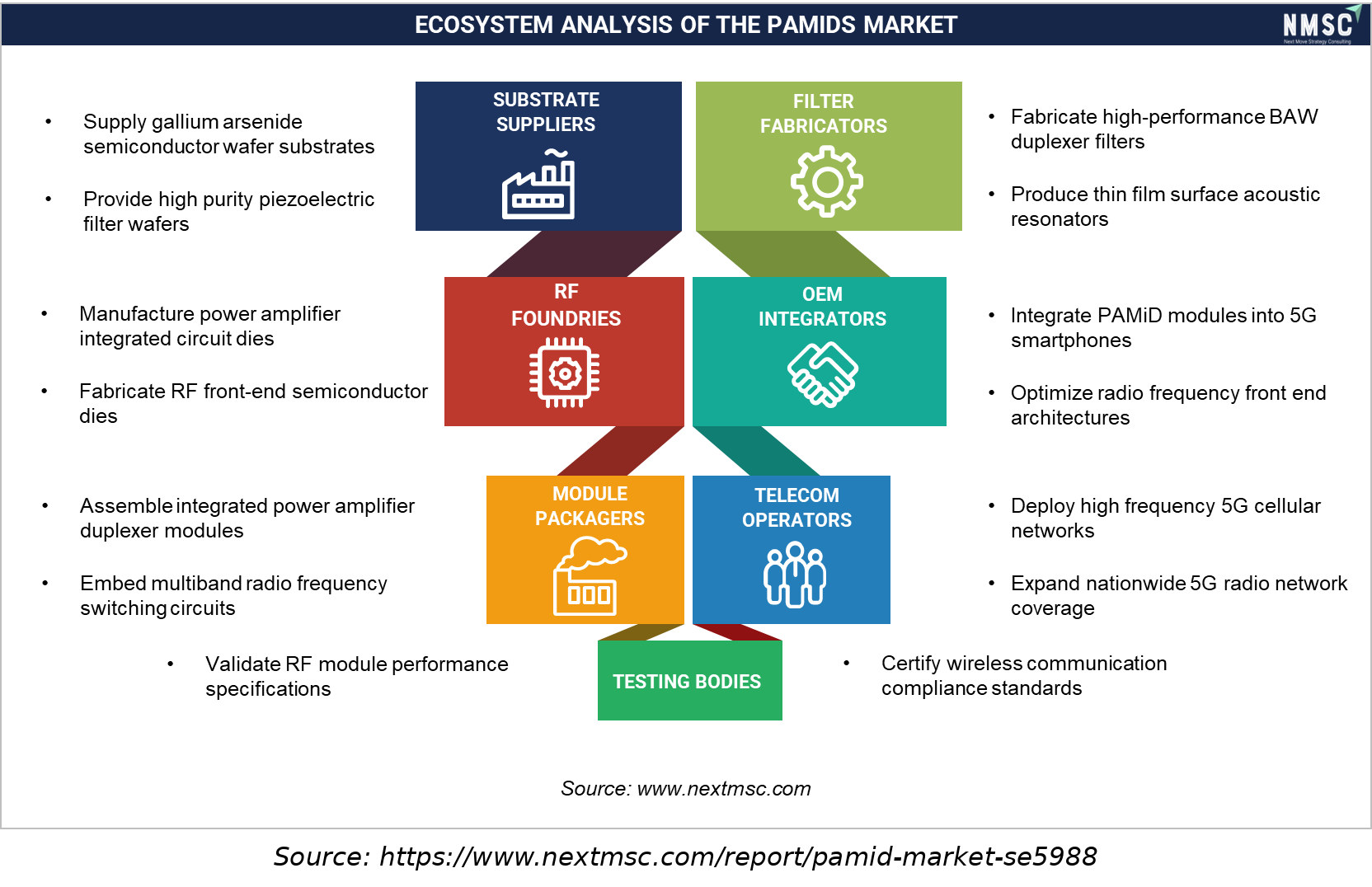
ECOSYSTEM ANALYSIS OF THE PAMIDS MARKET

The PAMIDs market ecosystem comprises substrate suppliers and filter fabricators that provide foundational RF components, followed by RF foundries and OEM integrators involved in component manufacturing and system integration. Module packagers prepare finished units, while telecom operators deploy them in wireless networks. Testing bodies support quality assurance, performance validation, and reliability across the value chain.

Regional Outlook

2025 (USD Billion)
2035 (USD Billion)
North Americ
Europe
Asia-Pacific
Middle East
Latin Americ
Region 2025 (USD Billion) 2035 (USD Billion) CAGR (%)
North America $10.0 USD Billion $40.0 USD Billion 9.0%
Europe $17.1 USD Billion $51.1 USD Billion 27.0%
Asia-Pacific $24.2 USD Billion $62.2 USD Billion 25.0%
Middle East & Africa $31.3 USD Billion $73.3 USD Billion 23.0%
Latin America $38.4 USD Billion $84.4 USD Billion 12.0%

Regional data is locked

Unlock complete regional numbers for this market.

Unlock Full Data

Competitive Landscape

Our findings suggest that the competitive landscape is concentrated among a small number of vertically integrated RF semiconductor manufacturers, each pursuing distinct differentiation strategies across module architecture and OEM design-win relationships.

Dimension Description
Dimension Assessment
Market Structure Highly concentrated; a small number of vertically integrated RF semiconductor manufacturers hold the substantial majority of global module supply
Innovation Focus Single-chip integration density, multi-band carrier aggregation support, miniaturized IoT-oriented module variants
M&A Activity Selective; suppliers pursue targeted acquisitions of filter and duplexer technology to strengthen integration capability

How Do Companies Compete in the PAMiD Market?

Companies compete primarily on integration density, carrier aggregation band-combination support, and depth of design-win relationships with major handset OEMs. Our analysis shows that suppliers with proprietary filter and duplexer technology sustain stronger module differentiation than competitors reliant on third-party component sourcing, particularly for premium flagship handset design wins.

Which Competitive Archetypes Dominate the Industry?

Two archetypes dominate: vertically integrated RF semiconductor majors with proprietary filter, duplexer, and amplifier technology, and specialized Asia-based module suppliers focused on cost-competitive mid-tier device segments. We observed that the differentiation between these archetypes is narrowing as specialized suppliers invest in higher-integration module capability.

What Innovation and Differentiation Strategies Are Companies Pursuing?

Company analysis indicates that leading firms are differentiating through proprietary bulk acoustic wave and surface acoustic wave filter technology integrated directly into PAMiD module designs. Investment in wafer-level packaging capability continues, alongside expanded module portfolios supporting higher carrier aggregation band-combination counts for premium handset tiers.


How Active Is M&A in the PAMiD Industry?

M&A activity remains selective as suppliers pursue targeted acquisitions of filter and duplexer technology developers to strengthen proprietary integration capability. Based on research conducted by Next Move Strategy Consulting, we found that acquisition activity is concentrated among suppliers seeking to reduce reliance on third-party filter sourcing for next-generation module designs.

Key Market Players

Our assessment indicates that the following companies represent the validated set of key players confirmed to design, produce, or brand power amplifier module integrated duplexer products within the PAMiD market.

Skyworks Solutions, Inc. Qorvo, Inc. Broadcom Inc. Murata Manufacturing Co., Ltd. Qualcomm Incorporated Samsung Electro-Mechanics Co., Ltd. TDK Corporation Taiyo Yuden Co., Ltd. STMicroelectronics N.V. NXP Semiconductors N.V. Vanchip (Tianjin) Technology Co., Ltd. Maxscend Technologies Inc. RichWave Technology Corporation Sunway Communication Co., Ltd.

Latest Developments

We found that recent M&A activity, product launches, and financial results within the PAMiDs market are concentrated on industry consolidation and mmWave technology expansion, reflecting the industry's rapid capitalization cycle.

Date Event
March 2025 Skyworks showcased the SKY58093-11 low-band L-PAMiD for 2G/4G/5G NR in its 2025 MWC mobile portfolio. The module integrates duplexers, a bidirectional coupler and low-profile packaging, supporting multiple cellular bands and simultaneous 4G/5G operation in compact smartphone designs.

Investment Opportunities

Where Is Capital Flowing Within the PAMiD Market?

Capital inflows are concentrated in filter and duplexer technology development by vertically integrated RF semiconductor majors seeking to reduce third-party component dependency. We found that Asia-based module suppliers are also attracting strategic investment tied to expanding domestic handset OEM supply relationships.

How Significant Is Infrastructure Investment in This Market?

Infrastructure investment is substantial, with suppliers expanding wafer fabrication and module assembly capacity to meet rising multi-band module demand. Our assessment indicates that continued investment in wafer-level packaging infrastructure is becoming a prerequisite for competing in higher-integration single-chip module categories.

What ESG Considerations Are Relevant to This Market?

ESG considerations center on semiconductor manufacturing energy intensity, responsible sourcing of rare-earth and specialty materials used in filter components, and electronic waste management tied to device replacement cycles. We observed that suppliers increasingly disclose manufacturing energy-efficiency commitments in annual sustainability reporting.

Key Benefits for Stakeholders

How Does This Report Benefit Industry Leaders?

Industry and enterprise leaders gain a structured view of frequency-band, application, and regional revenue distribution, supporting prioritization decisions across R&D investment and manufacturing capacity planning. Our analysis shows that this structured segmentation clarifies where competitive intensity is rising fastest ahead of resource-allocation decisions.

How Does This Report Benefit Investors and Financial Analysts?

Investors and financial analysts gain reconciled market-size, CAGR, and regional-growth data supporting valuation and portfolio-allocation decisions. Company analysis indicates that segment-level growth differentials, particularly around multi-band and IoT-oriented module categories, are material inputs for evaluating supplier growth durability.

How Does This Report Benefit Technology Vendors and Product Teams?

Technology vendors and product teams gain visibility into integration-architecture and application trends shaping module design priorities. We found that this analysis supports prioritization of engineering investment toward the fastest-growing device categories identified across the forecast period.

Key Market Segments Evaluated

By Frequency Band

  • Sub-6GHz PAMiD
  • Sub-3GHz PAMiD
  • Multi-Band PAMiD

By Application

  • Smartphones
  • Tablets
  • IoT and Wearable Devices
  • Other Connected Devices

By Integration Architecture

  • Single-Chip Integrated PAMiD
  • Multi-Die Module PAMiD

By Distribution Channel

  • Direct OEM supply
  • Distributor supply

By Region

  • North America: U.S.
  • Canada
  • Mexico
  • Europe: UK
  • Germany
  • France
  • Italy
  • Spain
  • Sweden
  • Denmark
  • Finland
  • Netherlands
  • Rest of Europe
  • Asia-Pacific: China
  • India
  • Japan
  • South Korea
  • Taiwan
  • Indonesia
  • Vietnam
  • Australia
  • Philippines
  • Malaysia
  • Rest of APAC
  • Middle East & Africa: Saudi Arabia
  • UAE
  • Egypt
  • Israel
  • Turkey
  • Nigeria
  • South Africa
  • Rest of MEA
  • Latin America: Brazil
  • Argentina
  • Chile
  • Colombia
  • Rest of LATAM

Conclusion & Recommendations

The long-term outlook remains firmly expansionary, with revenue projected to more than double from USD 5.20 Billion in 2026 to USD 11.20 Billion by 2035 at a 8.9% CAGR. Our analysis shows that this trajectory is underpinned by rising carrier aggregation content per handset rather than unit shipment growth alone.

What Strategic Positioning Should Companies Pursue?

Companies should prioritize proprietary filter and duplexer integration capability over reliance on third-party component sourcing. We found that suppliers combining in-house filter technology with single-chip integration density sustain stronger design-win positioning than competitors dependent on external component supply.

How Attractive Is the Market for Investment?

Investment attractiveness is high given double-digit growth in multi-band and IoT-oriented module categories alongside a concentrated, technically defensible supplier base. Our assessment indicates that capital allocators should weight exposure toward vertically integrated suppliers with proprietary filter technology over module assemblers reliant on external component sourcing.

What Market Shifts and Key Risks Should Stakeholders Monitor?

Key risks include smartphone unit shipment stagnation in mature markets, pricing pressure from concentrated handset OEM buyers, and semiconductor wafer capacity constraints. We observed that OEM buyer concentration poses the most immediate risk to supplier pricing power given the small number of major global handset customers.

What Are the Primary Growth Pathways Through 2035?

Primary growth pathways include cost-optimized multi-band modules for mid-tier 5G handsets, miniaturized variants for IoT and wearable devices, and regional manufacturing diversification to reduce supply concentration risk. Our findings suggest that companies combining all three pathways will outpace single-lever competitors through the forecast period.

FAQs

About the Author

Liza Phukan

Liza Phukan

Liza Phukan is Research Associate at Next Move Strategy Consulting, where she has covered emerging industries and market research across sectors for 3.5 years. Her work includes analyzing industry developments, validating market data, and developing structured business content from research findings. She uses secondary research and data-validation practices to turn complex market information into clear decision-useful market analysis for business audiences and support report development and B2B.

About the Reviewer

Supradip Baul

Supradip Baul

Supradip Baul is an accomplished business consultant and strategist with over a decade of rich experience in market intelligence, strategy, technology, and business transformation. His work has included rigorous qualitative and quantitative analysis across multiple industries, helping clients shape investment decisions and long-term roadmaps. Earlier in his career, he was associated with Gartner, where he contributed to industry-leading reports and market share analyses. He has worked with leading global companies and holds an MBA with a dual specialization in Marketing and Finance.

Download Free Sample

Rishabh Jogani

RISHABH JOGANI

Strategy Analyst

Accenture Japan

We are incredibly impressed with the market report on the real estate market in India provided by Next Move Strategy Consulting. The report was thorough, insightful, and well-structured, offering deep analysis and actionable recommendations. It not only captured the current trends and dynamics but also provided a forward-looking perspective that has been invaluable for our strategic planning. Their team demonstrated exceptional professionalism, attention to detail, and a profound understanding of the industry. The data-driven insights and clarity of presentation exceeded our expectations, making complex market trends easy to understand. We highly recommend Next Move Strategy Consulting to anyone looking for reliable and comprehensive market research services. Their expertise has given us the confidence to navigate the complexities of the Indian real estate market with clarity and foresight.

Nishant Awate

NISHANT AWATE

Business Development Global Sales

Zehnder Group Deutschland GmbH

Our experience working with Next Move Strategy Consulting was positive. The team was responsive, professional, and open to incorporating our specific requirements throughout the project. The India AHU market study was comprehensive and well structured, covering market value and volume forecasts, product and application segments, and key industry trends. The inclusion of both AHU and residential MVHR market insights made the study particularly relevant for our strategic market assessment. Overall, the report provides a solid foundation for evaluating market potential, identifying priority segments, and supporting business-development decisions in India.

Amos Chang

AMOS CHANG

Strategy Consultant

Kardex Group

I have bought the intralogistics market reports from NMSC two times so far. Joseph and his team are always very helpful and flexible in responding to any customization requirements on the report. Their expertise in market reports really helps us steer the day-to-day business. I will definitely recommend and come back myself whenever there is a need.

Henri Knyphausen

HENRI KNYPHAUSEN

Partner at Singulier [Ex-BCG]

Singulier

I recently engaged NEXTMSC.com for a commercial due diligence project within the intralogistics sector, and I am pleased to provide a reference based on my experience. In utilizing NEXTMSC.com's services, I found their report to offer valuable insights into market dynamics and key industry players. The initial report provided a solid foundation for our analysis. However, as we were investigating a smaller target in the market, and I had specific customization requests requiring additional research. These requests included detailed information on product portfolios of various players and sub-market sizes, both inclusive and exclusive of certain product categories. NEXTMSC.com demonstrated commendable responsiveness and agility in accommodating these customization requests. Within a timeframe of 1-2 weeks, they delivered a revised report that met our specific needs. Furthermore, they were receptive to my follow-up inquiries, ensuring clarity and understanding of the data provided. The final deliverable significantly contributed to our due diligence efforts. One of NEXTMSC.com's notable strengths lies in their qualitative research capabilities. However, for future engagements, I would recommend the inclusion of a quantified market model in Excel format. Such a model would offer the ability to conduct in-depth analyses and explore various market segments, including country-specific data and subcomponent breakdowns. Based on my positive experience, I would not hesitate to work with NEXTMSC.com again. Their responsiveness, willingness to accommodate customization requests, and commitment to delivering actionable insights make them a reliable partner for commercial research projects.

Diana Trejo

DIANA TREJO

Assistant Manager

Sumitomo Corporation de Mexico, S.A. de C.V.

Recently, we purchased a report on the Mexico Data Center Market from Next Move Strategy Consulting. The service has been excellent, with support that is always timely and thoroughly professional. The information provided is interesting, highly useful, and delivered with clarity. I would highly recommend NextMSC for anyone seeking insightful and dependable analysis.

Custom Market Research Services

We will customize the research for you if the listed report does not fully match your requirements.

Get 30% Free Customization

Select License

This website uses cookies to ensure you get the best experience on our website. Learn more

✖