South Korea wireless charging market by technology (inductive, magnetic resonance, radio frequency, and other technologies), by power level (low power (≤ 15 W), medium power (>15 W to 60 W), high power (>60 W to 500 W), and ultra high power (>500 W)), by application (consumer electronics, automotive, healthcare, industrial, aerospace and defense, and other applications), and by distribution channel (online, offline retail, OEM supply, and direct enterprise) analysis & forecast, 2025–2035
Industry: Semiconductor & Electronics | Latest Edition: September 30, 2026 | No of Pages: N/A | No. of Tables: N/A | No. of Figures: N/A | Format: PDF | Report Code: SE4909
How is the South Korea wireless charging market sized and forecasted?
|
Parameters |
Details |
|
Market size in 2025 |
USD 691.15 million |
|
Market size in 2026 |
USD 847.23 million |
|
Revenue forecast in 2035 |
USD 5,202.60 million |
|
Growth rate |
CAGR of 22.34% from 2026 to 2035 |
|
Analysis period |
2025–2035 |
|
Base year considered |
2025 |
|
Forecast period |
2026–2035 |
|
Market size estimation |
Million (USD) |
|
Companies profiled |
15 |
|
Market share |
Available for 10 companies |
What is the industry outlook for the South Korea wireless charging market?
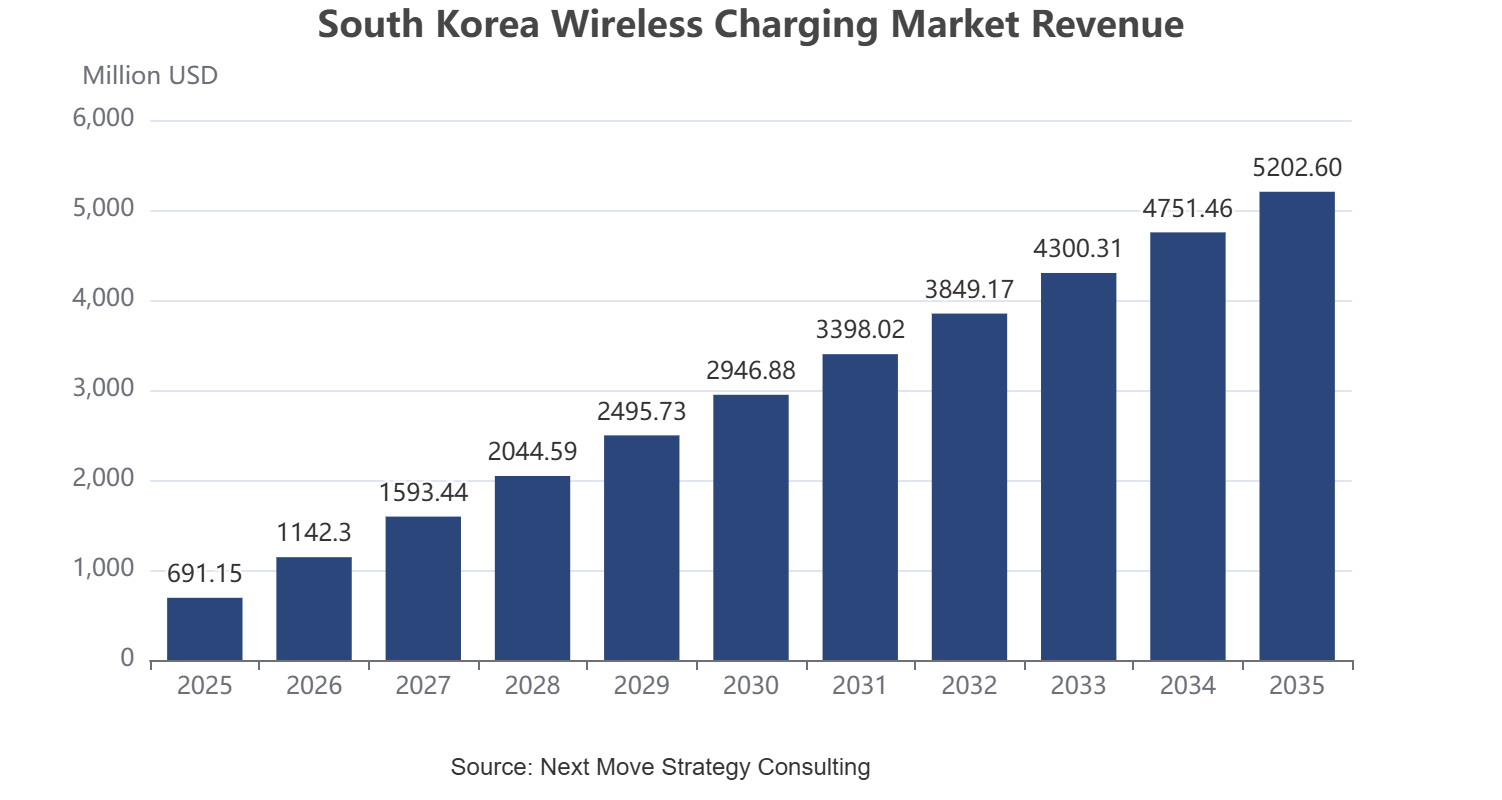
The South Korea wireless charging market was valued at USD 691.15 million in 2025 and is estimated at USD 847.23 million in 2026. It is projected to reach USD 5,202.60 million by 2035, reflecting a CAGR of 22.34% from 2026 to 2035. Growth is supported by premium device adoption, commercial innovation, and expanding mobility use cases across consumer, automotive, healthcare, and industrial environments.
What are the key drivers, risks, and opportunities shaping the market?
|
Drivers / Trends / Restraints |
(+/–) % Impact on CAGR Forecast |
Geographic Relevance |
Impact Timeline |
|
Strong presence of global electronics brands such as Samsung and LG accelerates innovation, product launches, and ecosystem-wide adoption of wireless charging technologies |
3.20% |
South Korea |
Short to medium term (1–4 years) |
|
High adoption of premium smartphones, wearables, and connected consumer devices drives sustained demand for advanced wireless charging solutions |
2.90% |
South Korea |
Short to medium term (1–4 years) |
|
Government support for smart mobility initiatives, EV deployment, and charging infrastructure development creates favorable conditions for wireless charging expansion |
2.50% |
South Korea |
Medium term (2–5 years) |
|
Market saturation in consumer electronics limits incremental growth opportunities and intensifies competition among wireless charging solution providers |
-1.40% |
South Korea |
Short to medium term (1–4 years) |
|
Expansion of wireless charging applications across automotive, industrial automation, and smart manufacturing environments opens new long-term revenue streams |
3.60% |
South Korea |
Long term (5–10 years) |
The South Korea wireless charging market is evolving as consumer electronics, connected mobility, and enterprise automation converge around convenient power delivery. Demand is strongest where users value clean product design, reduced cable dependency, and seamless integration into premium devices and shared spaces. At the same time, competition among hardware makers, ecosystem developers, and channel partners is pushing the market toward faster commercialization and broader application diversity.
Growth Driver:
How does a strong presence of leading global electronics brands accelerate technology commercialization?
A strong presence of leading global electronics brands accelerates technology commercialization because it shortens the path from prototype to mass-market product. In South Korea, large branded ecosystems encourage rapid testing, iterative design, and broad retail visibility. These advantages improve consumer trust, create stronger accessory attachment, and support continuous upgrades across phones, wearables, and charging peripherals. As a result, innovation cycles become shorter and more commercially relevant.
How do high adoption rates of premium mobile devices support demand?
High adoption rates of premium mobile devices support demand because customers in the upper-tier handset segment are more willing to pay for convenience, speed, and design-led features. Wireless charging is often positioned as a premium capability that reinforces device value and simplifies daily use. In South Korea, this preference for advanced smartphones, tablets, and wearable devices helps keep wireless charging highly visible in both retail and OEM channels.
How does government support for smart mobility and EV infrastructure development strengthen the market?
Government support for smart mobility and EV infrastructure development provides an additional growth catalyst by extending wireless charging beyond consumer electronics. Public and private pilots can validate stationary and dynamic charging concepts, while also encouraging partnerships among automakers, utilities, and infrastructure developers. This creates a practical pathway for higher-value deployments in transportation corridors, fleet operations, and smart city projects over the forecast period.
Growth inhibitor:
How does market saturation in the consumer electronics segment restrain expansion?
Market saturation in the consumer electronics segment restrains growth because many households and device users already own wireless charging accessories or compatible devices. When replacement demand becomes the dominant driver, expansion depends more on product refreshes than first-time adoption. This can pressure pricing, limit incremental unit growth, and make it harder for suppliers to differentiate offerings unless they add faster charging, better compatibility, or stronger design appeal.
Growth opportunity:
How will expansion into automotive and industrial wireless charging applications create new value?
Expansion into automotive and industrial wireless charging applications creates a major opportunity because it moves the market into higher-value, less saturated use cases. In-vehicle charging, stationary EV charging, AGVs, robots, and other automated systems all benefit from contactless power delivery. If vendors can improve efficiency, durability, and interoperability, these segments may generate longer contracts, better margins, and more resilient demand than consumer accessories alone.
How Is the South Korea Wireless Charging Market Segmented, and What Are the Key Insights from the Segmentation Analysis?
By Technology
How is the Technology segmentation analysis shaping revenue distribution in the South Korea wireless charging market?
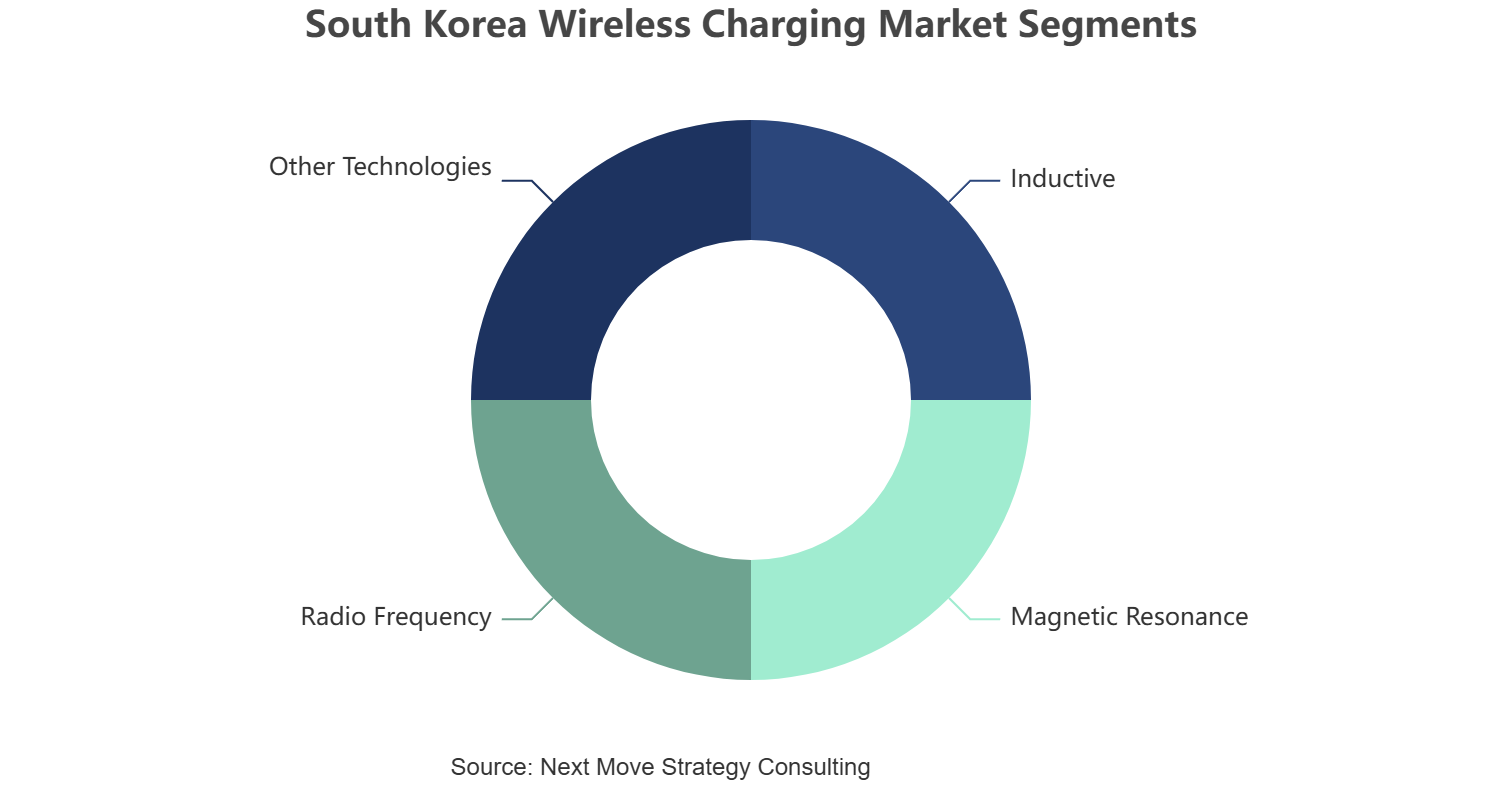
Based on technology, the South Korea wireless charging market is segmented into inductive, magnetic resonance, radio frequency, and other technologies. Inductive systems remain the volume leader because they are already embedded in mainstream consumer devices and accessories. Magnetic resonance is gaining relevance in automotive and industrial settings where alignment flexibility matters, while radio frequency and other technologies continue to support smaller niche applications and experimental deployments.
The technology mix will gradually shift as buyers demand greater efficiency, more tolerant positioning, and better multi-device compatibility. Inductive platforms should continue to anchor shipments, but magnetic resonance may capture more value in premium mobility and equipment use cases. Vendors that combine thermal management, software control, and interoperability are likely to defend share as the market evolves from simple consumer accessories into integrated power ecosystems.
By Application
How is the application segmentation driving demand insights in the South Korea wireless charging market?
Based on application, the South Korea wireless charging market is segmented into consumer electronics, automotive, healthcare, industrial, aerospace and defense, and other applications. Consumer electronics currently generates the broadest demand because smartphones, wearables, tablets, and notebooks already support wireless power features. Automotive is emerging quickly, while healthcare and industrial users are adopting wireless charging for hygienic, continuous, and low-maintenance power delivery.
Application demand is becoming more diversified as wireless charging moves from convenience to operational necessity. Consumer electronics will continue to anchor shipment volume, but automotive and industrial deployments can support higher average selling prices and longer-term contracts. Healthcare will value cleanliness and reliability, while aerospace and defense will prioritize ruggedness. Suppliers that tailor products to each use case should improve adoption and deepen enterprise relationships.
Ecosystem Analysis of the South Korea Wireless Charging Market
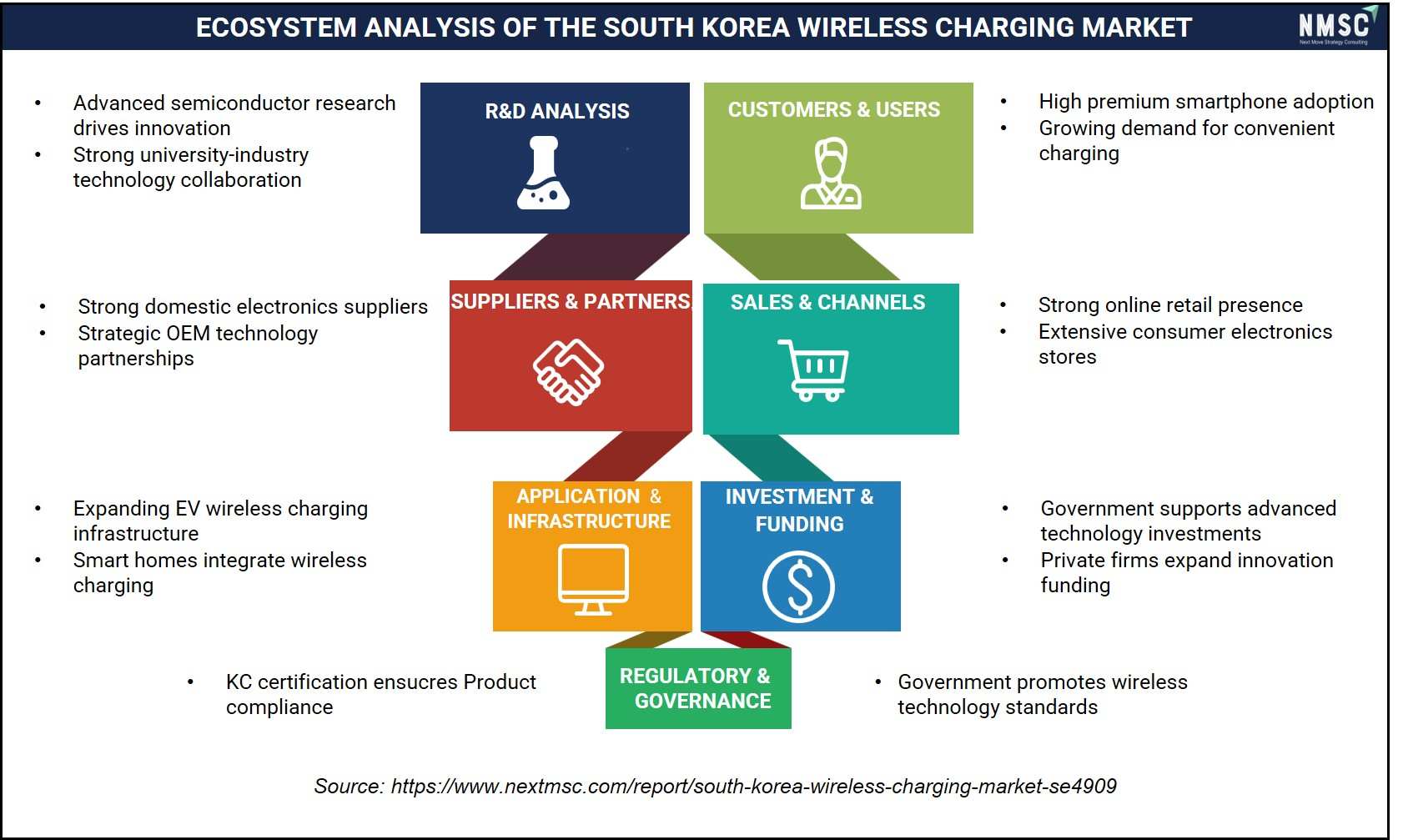
South Korea’s wireless charging market ecosystem is driven by its global leadership in consumer electronics, semiconductors, and advanced manufacturing technologies. Strong R&D investments, a highly tech-savvy consumer base, and extensive OEM and retail networks support market growth. Strategic partnerships, government-backed innovation initiatives, and robust regulatory oversight further accelerate the development and adoption of wireless charging solutions across consumer, automotive, and industrial applications.
Key segments
By Technology
-
Inductive
-
Magnetic Resonance
-
Radio Frequency
-
Other Technologies
By Power Level
-
Low Power (≤ 15 W)
-
Medium Power (>15 W to 60 W)
-
High Power (>60 W to 500 W)
-
Ultra High Power (>500 W)
By Application
-
Consumer Electronics
-
Smartphones and Tablets
-
Wearable
-
Laptops and Notebooks
-
Other Consumer Devices
-
-
Automotive
-
In-Vehicle Chargers
-
Stationary EV Charging
-
Dynamic EV Charging
-
-
Healthcare
-
Implantable Devices
-
Portable Equipment
-
-
Industrial
-
AGVs & AMRs
-
Robots
-
Tools & Machinery
-
Other Industrial Uses
-
-
Aerospace & Defense
-
UAVs
-
Military Equipment
-
-
Other Applications
By Distribution Channel
-
Online
-
Offline Retail
-
OEM Supply
-
Direct Enterprise
Competitive landscape
The South Korea wireless charging market is becoming more competitive as consumer electronics firms, accessory specialists, and wireless power developers target overlapping customer needs. Competition is increasingly defined by charging speed, compatibility, product design, and the ability to support multiple device categories without compromising safety or efficiency. Partnerships with OEMs, retailers, and enterprise buyers are becoming essential because they help vendors scale distribution and embed wireless power into larger ecosystems.
Key players
-
Ugreen Korea LLC
-
Belkin Korea Co., Ltd
-
Samsung Electronics Co., Ltd.
-
LG Innotek Co., Ltd.
-
Chemtronics Co., Ltd.
-
LW DESIGN HONG KONG LTD
-
Xiamen Newyea Science and Technology Co., Ltd.
-
Motorola Korea, Inc.
-
Spigen Korea Co., Ltd.
-
Nomad Goods, Inc.
-
GN Audio Korea Ltd.
-
Powerlabs Co., Ltd.
-
Alogic Pty Ltd
-
LinkCom Manufacturing Co., Ltd.
-
Shenzhen Lanhe Technology Co., Ltd
Samsung Electronics Co., Ltd., and Belkin Korea Co., Ltd. reinforce premium consumer ecosystems, while Ugreen Korea LLC, Spigen Korea Co., Ltd., Nomad Goods, Inc., Alogic Pty Ltd, and Motorola Korea, Inc. compete through design and compatibility. LG Innotek Co., Ltd., Chemtronics Co., Ltd., Powerlabs Co., Ltd., LinkCom Manufacturing Co., Ltd., GN Audio Korea Ltd., LW DESIGN HONG KONG LTD, Xiamen Newyea Science and Technology Co., Ltd., and Shenzhen Lanhe Technology Co., Ltd. add depth across the supply chain.
Strategic Framework of the South Korea Wireless Charging Market
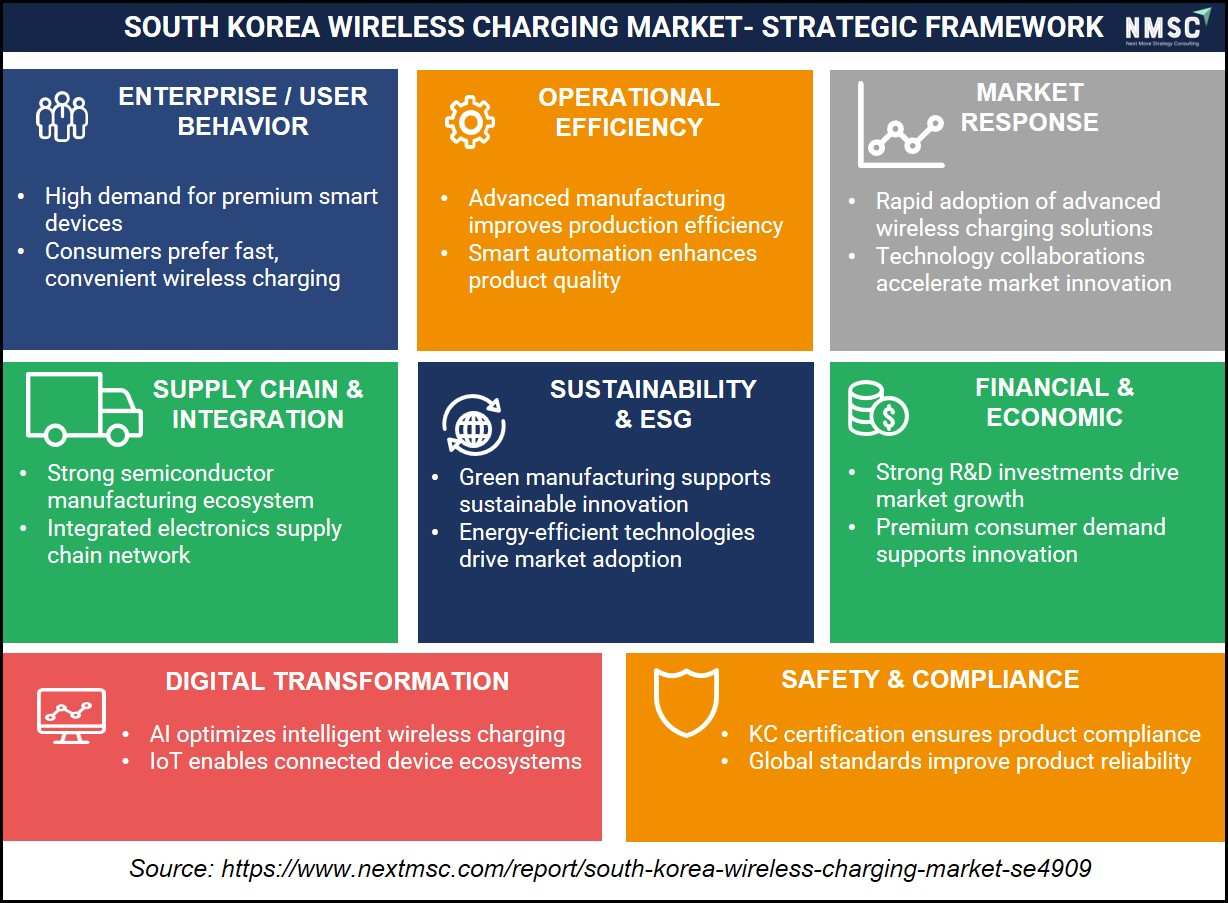
South Korea’s wireless charging market strategy is centered on strong consumer demand for premium smart devices, advanced manufacturing capabilities, and a globally competitive semiconductor ecosystem. Continuous R&D investments, AI-driven charging optimization, and IoT-enabled connectivity accelerate innovation and adoption. Supported by stringent KC certification standards and sustainability initiatives, the market is well-positioned for long-term growth across consumer electronics, automotive, and smart technology applications.
Key benefits for stakeholders
For investors and strategic planners, the South Korea wireless charging market offers a clear view of how consumer demand, mobility innovation, and enterprise adoption interact across the value chain. The analysis supports capital allocation by identifying where premium pricing, volume growth, and longer-duration contracts are most likely to emerge. It also helps stakeholders compare technology options, estimate commercialization timelines, and align product roadmaps with end-user requirements across multiple sectors.
For manufacturers, distributors, and enterprise buyers, the report clarifies how segment performance, channel preferences, and application priorities shape procurement decisions. Consumer electronics brands can identify accessory opportunities, while automotive and industrial firms can evaluate integration pathways for higher-power systems. Healthcare and aerospace stakeholders can assess reliability requirements and specialized use cases. This guidance supports product positioning, partnership planning, and go-to-market decisions across the South Korea market.
|
Parameters |
Details |
|
Customization scope |
Free customization (equivalent to up to 80 analyst-working hours) after purchase. |
|
Pricing and purchase options |
Avail customized purchase options to meet your exact research needs. |
|
Approach |
In-depth primary and secondary research; proprietary databases; rigorous quality control and validation measures. |
|
Analytical tools |
Porter's Five Forces, SWOT, value chain, and Harvey ball analysis to assess competitive intensity, stakeholder roles, and relative impact of key factors. |
Conclusion
The South Korea wireless charging market is positioned for sustained expansion through 2035, supported by premium device adoption, smart mobility development, and widening use across healthcare and industrial environments. Consumer electronics will remain the foundation of demand, while automotive and industrial applications offer the strongest future upside. Although saturation and compatibility issues remain a concern, competition among major brands and specialized vendors should continue to drive innovation, broader adoption, and ecosystem integration.
About the Author
 Mihul Sharma
— Mihul Sharma is Research Associate at Next Move Strategy Consulting, where he has covered technology, industrial, and healthcare markets for 3 years. His work applies structured business research, market analysis, and secondary-source review to assess market trends, competitive developments, and growth opportunities. He supports report development by fully synthesizing industry data, company information, and market signals into concise findings for strategy and investment-focused research teams.
Mihul Sharma
— Mihul Sharma is Research Associate at Next Move Strategy Consulting, where he has covered technology, industrial, and healthcare markets for 3 years. His work applies structured business research, market analysis, and secondary-source review to assess market trends, competitive developments, and growth opportunities. He supports report development by fully synthesizing industry data, company information, and market signals into concise findings for strategy and investment-focused research teams.
About the Reviewer
 Supradip Baul
— Supradip Baul is an accomplished business consultant and strategist with over a decade of rich experience in market intelligence, strategy, technology, and business transformation. His work has included rigorous qualitative and quantitative analysis across multiple industries, helping clients shape investment decisions and long-term roadmaps. Earlier in his career, he was associated with Gartner, where he contributed to industry-leading reports and market share analyses. He has worked with leading global companies and holds an MBA with a dual specialization in Marketing and Finance.
Supradip Baul
— Supradip Baul is an accomplished business consultant and strategist with over a decade of rich experience in market intelligence, strategy, technology, and business transformation. His work has included rigorous qualitative and quantitative analysis across multiple industries, helping clients shape investment decisions and long-term roadmaps. Earlier in his career, he was associated with Gartner, where he contributed to industry-leading reports and market share analyses. He has worked with leading global companies and holds an MBA with a dual specialization in Marketing and Finance.
At Next Move Strategy Consulting, we understand that insightful market research is the cornerstone of successful business decisions. That's why we employ a robust and multifaceted approach, combining various methodologies to deliver the most accurate and actionable data for our clients.

Research Landscape
We navigate the world of research with two primary approaches:
Qualitative Approach
Our qualitative research methodologies involve immersive techniques such as in-depth interviews, focus groups, and observational studies. By engaging directly with individuals and stakeholders, we uncover valuable insights that quantitative data alone may overlook.

Quantitative Research
In tandem with qualitative methodologies, NMSC leverages the power of Quantitative Research to provide a robust foundation of numerical insights. Through systematic data collection and analysis, we quantify patterns, preferences, and market trends, offering a comprehensive view of the business landscape.
Our quantitative research approach employs diverse tools, including surveys, experiments, and statistical modelling. These methodologies enable us to gather data from a large and representative sample, ensuring the statistical significance of our findings. By employing structured questionnaires and standardized data collection methods, we guarantee the reliability and validity of the information we present to our clients.
Quantitative research is particularly effective in measuring the prevalence of trends, assessing market size, and gauging the impact of various factors on consumer behavior. The numerical precision attained through this approach equips our clients with actionable insights, facilitating data-driven decision-making and strategy formulation.


Our Specialized Toolbox for Industry-Specific Market Research
We deploy a specialized arsenal of techniques tailored to meet your unique requirements. Here's a glimpse into our comprehensive toolbox:

Information Procurement
The stage entails acquiring market data or relevant information through various sources and methodologies.


Market Research Approach
We utilize both top-down and bottom-up approaches in market research analysis to achieve a comprehensive understanding of the market dynamics, leveraging the broad perspective of industry trends and macroeconomic factors alongside detailed insights from specific segments and individual companies.

Porters Five Forces Analysis
We conduct Porter's Five Forces analysis to evaluate the competitive landscape of an industry, providing us with insights into factors that affect profitability and strategic positioning.

SWOT Analysis

Forecasting
We utilize a forecasting model to predict future consumption by considering parameters like population, economics, regulations, market competition, drivers, constraints, technology, and pricing. We also employ statistical techniques such as multilinear regression, exponential smoothing, moving average, ARIMA, and Monte Carlo simulations for accurate predictions. In econometric forecasting, we analyzed short-term and long-term event impacts, attributing values based on regulatory frameworks, economic factors, and market events.





 Speak to Our Analyst