Parkinson's Disease Therapeutics Market Global Industry Analysis and Forecast (2026–2035)

The global Parkinson's Disease Therapeutics Market is estimated at USD 8.10 Billion in 2026 and is projected to reach USD 16.59 Billion by 2035, growing at a CAGR of 8.29% from 2026 to 2035. Growth is driven by rising disease prevalence, demand for effective treatments, and advancements in drug therapies

Download Free Sample PDF
Base Year (2025)
$8.10 Billion
Forecast (2035)
$16.59 Billion
CAGR (2026-2035)
8.3%
Top Region
North America

What Does the Parkinson's Disease Therapeutics Market Encompass?

The market report covers prescription drug classes used to manage motor and non-motor symptoms of Parkinson's disease therapeutics market including levodopa combinations, dopamine agonists, MAO-B inhibitors, COMT inhibitors, adenosine A2A receptor antagonists, and adjunctive agents. Market size and revenue estimates reflect ex-manufacturer sales of approved therapeutics across hospital, retail, specialty, and online distribution channels, and exclude devices used solely for diagnosis, surgical neuromodulation hardware, and rehabilitation services that fall outside the pharmacotherapy value chain.
The market has evolved from oral immediate-release levodopa toward extended-release oral formulations and continuous subcutaneous delivery systems designed to reduce OFF-time and motor fluctuations. Regulatory approval of novel dopamine receptor agonists and continuous infusion devices by the U.S. Food and Drug Administration has widened the treatment continuum, while national health authorities across Europe and Asia-Pacific continue to expand reimbursement for advanced formulations, supporting broader technology adoption among neurologists managing both early and advanced-stage patients.

Market Drivers & Dynamics

Interactive Dataset
Rising global Parkinson’s disease prevalence driver +2.1% Global 2026–2035
Approval of continuous infusion therapies driver +1.6% North America, Europe 2026–2030
Expanding neurologist access in Asia-Pacific driver +1.2% Asia-Pacific 2026–2035
Growing payer coverage for branded extended-release drugs driver +0.9% North America 2026–2032
Aging population and rising life expectancy driver +0.8% Global 2026–2035
Patent expiry of branded oral therapies restraint −1.1% North America, Europe 2028–2035
High cost of infusion devices and specialty drugs restraint −0.7% Latin America, MEA 2026–2035
Underdiagnosis in low-resource healthcare settings restraint −0.6% MEA, parts of Asia-Pacific 2026–2035
Reimbursement delays for novel formulations restraint −0.4% Latin America 2026–2030
Source: Next Move Strategy Consulting

Growth Drivers

Growth Inhibitors

Segmentation Analysis

2025 (USD Billion)
2035 (USD Billion)
Levodopa and carbidopa combinations 2025: $3.44 Billion | 2035: $8.20 Billion
Levodopa and
Dopamine agonists 2025: $1.43 Billion | 2035: $3.88 Billion
Dopamine ago
MAO B inhibitors 2025: $0.93 Billion | 2035: $1.80 Billion
MAO B inhibi
COMT inhibitors 2025: $0.66 Billion | 2035: $1.39 Billion
COMT inhibit
Adenosine A2A antagonists 2025: $0.14 Billion | 2035: $0.34 Billion
Adenosine A2
Amantadine and anticholinergics 2025: $0.56 Billion | 2035: $0.98 Billion
Amantadine a
Levodopa and carbidopa combinations $3.44 Billion $8.20 Billion 8.60%
Dopamine agonists $1.43 Billion $3.88 Billion 10.02%
MAO B inhibitors $0.93 Billion $1.80 Billion 6.36%
COMT inhibitors $0.66 Billion $1.39 Billion 7.26%
Adenosine A2A antagonists $0.14 Billion $0.34 Billion 8.80%
Amantadine and anticholinergics $0.56 Billion $0.98 Billion 5.29%

Which Drug Class Dominates the Parkinson's Disease Therapeutics Market?

Levodopa and carbidopa combinations dominate the drug class segment, generating USD 3.44 Billion in 2025 and projected to reach USD 8.20 Billion by 2035, supported by their position as first-line standard of care across nearly every national treatment guideline. Dopamine agonists represent the fastest-growing drug class at a CAGR of 10.02% between 2026 and 2035, driven by adoption of selective D1/D5 receptor agonists such as tavapadon among early-stage patients seeking monotherapy alternatives with improved tolerability profiles.

2025 (USD Billion)
2035 (USD Billion)
Oral
Subcutaneous
Enteral
Transdermal
Sublingual a
Segment Item 2025 (USD Billion) 2035 (USD Billion) CAGR
Oral $10.0 USD Billion $40.0 USD Billion 19.0%
Subcutaneous $17.1 USD Billion $51.1 USD Billion 25.0%
Enteral $24.2 USD Billion $62.2 USD Billion 23.0%
Transdermal $31.3 USD Billion $73.3 USD Billion 13.0%
Sublingual and inhalation $38.4 USD Billion $84.4 USD Billion 22.0%

Segment-wise data is locked

Unlock complete segment-wise numbers for By Route of Administration.

Unlock Full Data

Which Route of Administration Leads Market Adoption?

Oral administration leads the route segment with USD 5.72 Billion in 2025 revenue, rising to USD 12.30 Billion by 2035, reflecting its use as first-line therapy across early and moderate disease stages. Subcutaneous administration is the fastest-growing route at a CAGR of 13.61%, propelled by wearable infusion devices including ONAPGO and Vyalev that address motor fluctuations in advanced patients underserved by oral regimens alone.

2025 (USD Billion)
2035 (USD Billion)
Hospital pha
Retail pharm
Specialty ph
Online pharm
Segment Item 2025 (USD Billion) 2035 (USD Billion) CAGR
Hospital pharmacies $10.0 USD Billion $40.0 USD Billion 25.0%
Retail pharmacies $17.1 USD Billion $51.1 USD Billion 19.0%
Specialty pharmacies $24.2 USD Billion $62.2 USD Billion 25.0%
Online pharmacies $31.3 USD Billion $73.3 USD Billion 19.0%

Segment-wise data is locked

Unlock complete segment-wise numbers for By Distribution Channel.

Unlock Full Data

Which Distribution Channel Holds the Largest Parkinson's Disease Therapeutics Market Share?

Hospital pharmacies hold the largest distribution channel share, recording USD 2.79 Billion in 2025 and an estimated USD 6.02 Billion by 2035, owing to their role in initiating infusion-based and specialty therapies under clinical supervision. Specialty pharmacies represent the fastest-growing channel at a CAGR of 10.56%, benefiting from expanded payer networks that route high-cost branded and infusion therapies through dedicated specialty distribution arrangements.

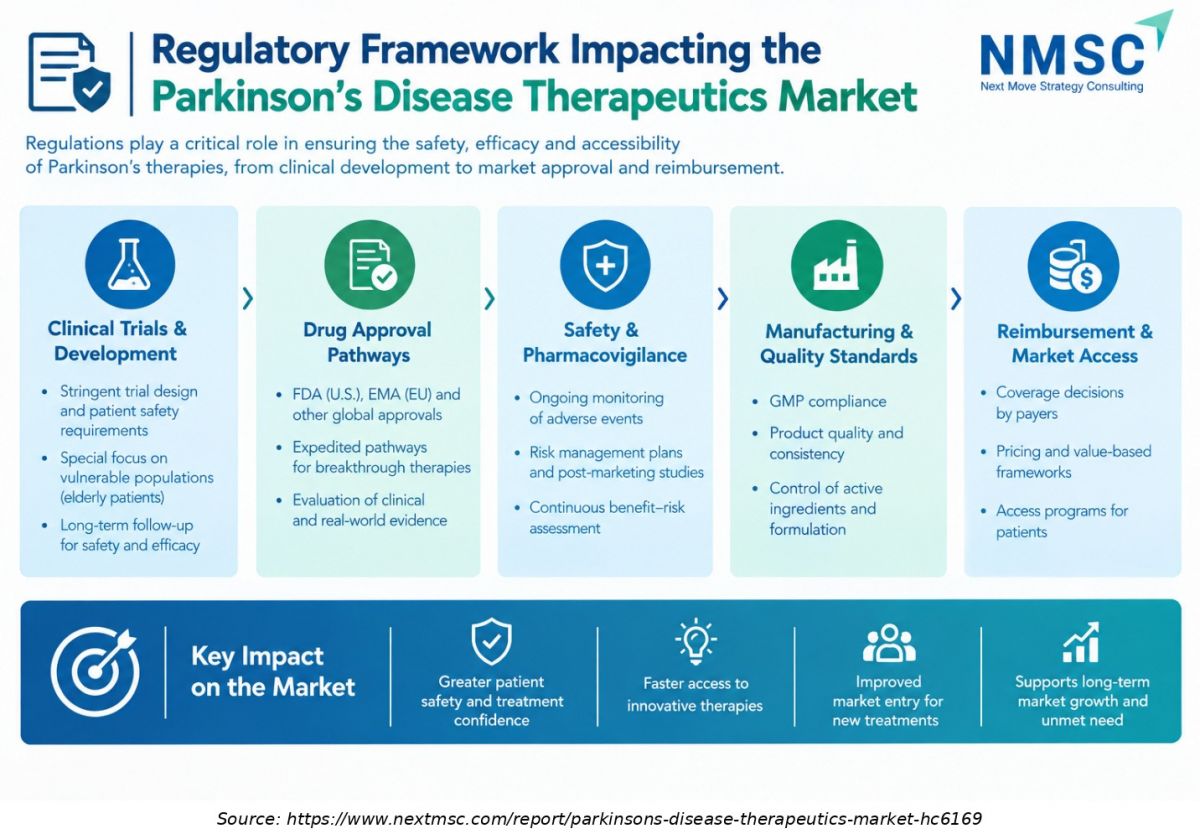
Regulatory Framework Impacting the Parkinson's Disease Therapeutics Market

The Regulatory Framework infographic for the Parkinson’s Disease Therapeutics Market highlights key requirements governing drug development, clinical trials, therapeutic approvals, patient safety, labelling, and post-market monitoring. It shows how regulatory standards influence the development, approval, and commercialization of Parkinson’s disease treatments and emerging therapies.

Growth Opportunities

The Parkinson's disease therapeutics market offers three forward-looking opportunities for stakeholders positioning ahead of the 2026–2035 forecast window.

Can Selective Dopamine Receptor Agonists Capture Early-Stage Monotherapy Share?

Selective D1/D5 receptor partial agonists create an opportunity to capture early-stage monotherapy patients seeking to delay levodopa initiation. Branded oral therapeutics manufacturers stand to benefit as neurologists reassess first-line sequencing following the 2026 approval of AbbVie's tavapadon-based therapy.

Can Wearable Infusion Platforms Expand Access Beyond Specialist Infusion Centers?

Home-administered wearable subcutaneous infusion systems create an opportunity to extend continuous dopaminergic therapy beyond hospital infusion suites. Device-integrated pharmaceutical manufacturers and specialty pharmacy networks are positioned to benefit as reimbursement expands for take-home infusion management.

Can Generic Manufacturers Capture Volume in Underpenetrated Asia-Pacific Parkinson's Disease Therapeutics Markets?

Expanding neurologist density and diagnostic access across China and India create an opportunity for generic and branded-generic manufacturers to capture first-time treatment volume. Regional manufacturers with established levodopa production capacity are positioned to benefit as national health programs broaden reimbursement for standard-of-care therapy.

Regional Outlook

2025 (USD Billion)
2035 (USD Billion)
North Americ
Europe
Asia-Pacific
Latin Americ
Middle East
Region 2025 (USD Billion) 2035 (USD Billion) CAGR (%)
North America $10.0 USD Billion $40.0 USD Billion 9.0%
Europe $17.1 USD Billion $51.1 USD Billion 27.0%
Asia-Pacific $24.2 USD Billion $62.2 USD Billion 25.0%
Latin America $31.3 USD Billion $73.3 USD Billion 23.0%
Middle East & Africa $38.4 USD Billion $84.4 USD Billion 12.0%

Regional data is locked

Unlock complete regional numbers for this market.

Unlock Full Data

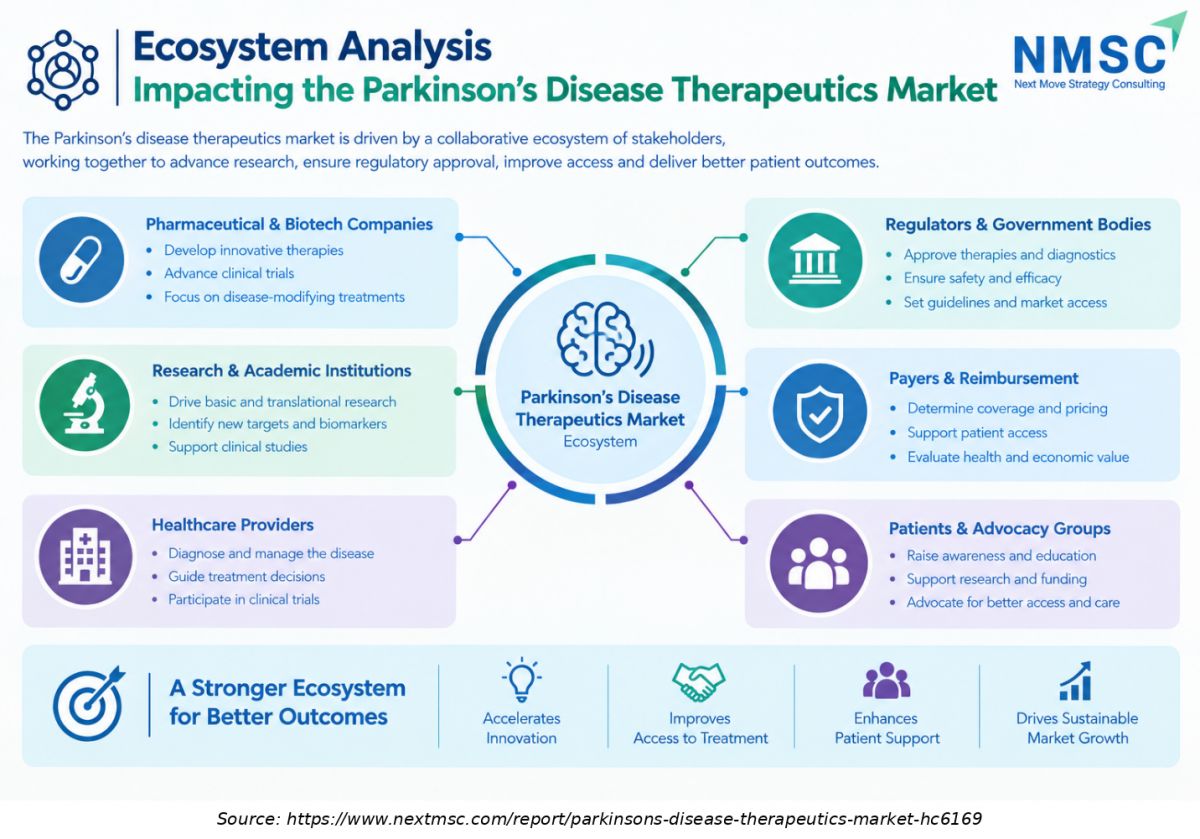
Ecosystem Analysis Impacting the Parkinson’s Disease Therapeutics Market

The Ecosystem Analysis infographic for the Parkinson’s Disease Therapeutics Market highlights key stakeholders, including pharmaceutical and biotechnology companies, research institutions, clinical trial organizations, healthcare providers, regulatory bodies, patient organizations, and patients. It illustrates their interconnected roles in drug development, clinical research, treatment delivery, and patient care.

Competitive Landscape

We found that the competitive structure of the Parkinson's disease therapeutics market reflects a mix of large diversified pharmaceutical companies and focused neurology specialists competing on formulation innovation. How Do Companies Compete in the Parkinson's Disease Therapeutics Market? Companies compete primarily on formulation differentiation rather than price, given the availability of low-cost generic levodopa across most markets. Manufacturers of branded extended-release and infusion-based therapies emphasize reduction in OFF time and motor fluctuation frequency as clinical differentiators. Generic manufacturers compete on production scale and distribution reach, particularly in Asia-Pacific and Latin America, where affordability drives prescribing volume more than incremental efficacy gains.

Dimension Description
Market Structure Moderately consolidated, led by a small group of multinational pharmaceutical companies alongside specialty neurology manufacturers
Innovation Focus Continuous delivery devices, selective dopamine receptor agonists, and extended-release oral formulations
M&A Activity Pipeline-driven acquisitions targeting late-stage Parkinson’s assets, exemplified by AbbVie’s 2023 acquisition of Cerevel Therapeutics

How Do Companies Compete in the Parkinson's Disease Therapeutics Market?

Companies compete primarily on formulation differentiation rather than price, given the availability of low-cost generic levodopa across most markets. Manufacturers of branded extended-release and infusion-based therapies emphasize reduction in OFF time and motor fluctuation frequency as clinical differentiators. Generic manufacturers compete on production scale and distribution reach, particularly in Asia-Pacific and Latin America, where affordability drives prescribing volume more than incremental efficacy gains.

Which Competitive Archetypes Dominate the Parkinson's Disease Therapeutics Market?

Two archetypes dominate the Parkinson's disease therapeutics market: diversified neuroscience-focused pharmaceutical companies with broad commercial infrastructure, such as AbbVie, and specialty manufacturers concentrated exclusively on movement disorder therapeutics, such as Supernus Pharmaceuticals and Amneal Pharmaceuticals. The former dominates through scale, payer relationships, and pipeline breadth, while the latter dominates specific delivery technology niches through focused clinical and regulatory expertise built over successive product cycles.

What Innovation and Differentiation Strategies Define the Parkinson's Disease Therapeutics Market?

Innovation strategy centers on advancing beyond broad-spectrum dopamine agonism toward receptor-selective mechanisms and continuous delivery platforms that reduce dosing burden. Differentiation increasingly rests on clinical trial evidence of reduced OFF time and improved tolerability rather than novel mechanisms alone, as regulatory agencies now expect robust comparative data against existing standard-of-care therapies before granting approval for next-generation formulations.

Key Market Players

AbbVie Inc. Teva Pharmaceutical Industries Ltd. Viatris Inc. Amneal Pharmaceuticals, Inc. Sun Pharmaceutical Industries Ltd. Novartis AG Sanofi Orion Corporation Supernus Pharmaceuticals, Inc. Zambon S.p.A. STADA Arzneimittel AG Kyowa Kirin Co., Ltd. Mitsubishi Tanabe Pharma Corporation Acadia Pharmaceuticals, Inc. Cipla Limited Lupin Limited Torrent Pharmaceuticals Ltd. Lundbeck A/S US WorldMeds, LLC Britannia Pharmaceuticals Ltd.

Latest Developments

We observed several regulatory and commercial milestones that shaped the Parkinson's disease therapeutics market through 2026.

Date Event
September 2 2025 Novartis entered a global licensing and collaboration agreement for ARO-SNCA, Arrowhead’s preclinical siRNA therapy targeting alpha-synuclein for Parkinson’s disease and other synucleinopathies
April 25 2025 Orion and Criceto signed an exclusive license agreement for APORON, a Phase 3 oromucosal apomorphine spray designed as a rescue treatment for OFF episodes in Parkinson’s disease
February 2025 Supernus received U.S. FDA approval for ONAPGO a wearable subcutaneous infusion device for motor fluctuations in adults with advanced Parkinson’s disease

Expert Insights

James Beck, PhD

Chief Scientific Officer | Parkinson’s Foundation

"This underscores the need for the widespread genetic testing that PD Generation offers and opens the door to gene-targeted therapies."

Analyst Interpretation

The statement highlights the growing connection between genetic testing and the development of targeted Parkinson’s therapies. As genetic variants become increasingly relevant to clinical-trial selection and therapeutic development, the market is moving toward more biomarker and genotype-informed approaches. This supports continued development of gene targeted therapies and precision medicine strategies in Parkinson’s disease.

Investment Opportunities

Where Are Capital Inflows Concentrating in the Parkinson's disease therapeutics Market?

Capital inflows are concentrating in continuous-delivery drug-device combination platforms and selective receptor agonist pipelines. AbbVie's USD 8.7 billion acquisition of Cerevel Therapeutics in 2023 illustrates the scale of capital directed toward late-stage Parkinson's assets, reflecting investor confidence in differentiated mechanisms ahead of the 2026–2035 forecast window covered in this report.

How Is Infrastructure Investment Supporting Parkinson's disease therapeutics Market Expansion?

Infrastructure investment is expanding specialty pharmacy networks and hospital infusion capacity needed to administer continuous subcutaneous therapies. Growth in neurologist training programs across Asia-Pacific and the Middle East, supported by national healthcare investment initiatives including Saudi Arabia's Vision 2030 program, is expanding diagnostic and treatment access ahead of anticipated demand growth through 2035.

What ESG Considerations Are Relevant to Market Investment?

Environmental, social, and governance considerations center on equitable access to high-cost infusion therapies across income levels and regions. Manufacturers face growing scrutiny over pricing transparency for branded continuous-delivery devices, while patient advocacy organizations such as the Parkinson's Foundation continue to press for expanded reimbursement coverage that ensures socioeconomic status does not determine access to advanced treatment options.

Key Benefits for Stakeholders

How Does This Report Benefit Pharmaceutical Industry Leaders?

Pharmaceutical industry leaders gain a validated segmentation framework and competitive benchmark against the twenty companies profiled in this report. The analysis identifies where continuous delivery and selective-agonist innovation is concentrating, supporting portfolio and pipeline prioritization decisions ahead of the 2026–2035 forecast period.

How Does This Report Benefit Investors and Financial Analysts?

Investors and financial analysts gain a consistent, single-point market size and CAGR framework spanning 2025 through 2035, alongside regional and segment-level revenue breakdowns. This supports valuation modelling for companies exposed to Parkinson's disease therapeutics and comparative benchmarking of expected growth trajectories by drug class and geography.

How Does This Report Benefit Technology and Device Vendors?

Technology and drug delivery device vendors gain visibility into which routes of administration are expanding fastest, supporting decisions on where to direct engineering and regulatory resources. The report's country-level regulatory context also helps vendors sequence market entry for continuous-delivery platforms across the 38 countries covered.

Key Market Segments Evaluated

By Drug Class

  • Levodopa and carbidopa combinations
  • Dopamine agonists
  • MAO B inhibitors
  • COMT inhibitors
  • Adenosine A2A antagonists
  • Amantadine and anticholinergics

By Route of Administration

  • Oral
  • Subcutaneous
  • Enteral
  • Transdermal
  • Sublingual and inhalation

By Distribution Channel

  • Hospital pharmacies
  • Retail pharmacies
  • Specialty pharmacies
  • Online pharmacies

By Region

  • North America 
    • U.S.
    • Canada
    • Mexico.
  • Europe 
    • UK
    • Germany
    • France
    • Italy
    • Spain
    • Sweden
    • Denmark
    • Finland
    • Netherlands
    • Rest of Europe.
  • Asia-Pacific 
    • China
    • India
    • Japan
    • South Korea
    • Taiwan
    • Indonesia
    • Vietnam
    • Australia
    • Philippines
    • Malaysia
    • Rest of APAC.
  • Middle East & Africa 
    • Saudi Arabia
    • UAE
    • Egypt
    • Israel
    • Turkey
    • Nigeria
    • South Africa
    • Rest of MEA.
  • Latin America 
    • Brazil
    • Argentina
    • Chile
    • Colombia
    • Rest of LATAM.

Conclusion & Recommendations

The long-term outlook remains favourable, with the Parkinson's disease therapeutics market projected to grow from USD 8.10 Billion in 2026 to USD 16.59 Billion by 2035 at a CAGR of 8.29%. Sustained global prevalence growth through 2050, as projected by Global Burden of Disease modelling, underpins demand well beyond the current forecast horizon, supporting continued investment across both branded and generic manufacturing capacity.

What Strategic Positioning Should Companies Pursue?

Companies should pursue differentiated positioning around continuous-delivery technology and receptor-selective mechanisms rather than competing directly against established generic levodopa pricing. Building specialty pharmacy and infusion center distribution relationships early will support commercial uptake as reimbursement frameworks continue to expand for advanced formulations through 2035.

How Attractive Is the Market for New Investment?

The market is attractive for new investment given its USD 8.49 Billion absolute revenue opportunity between 2026 and 2035 and demonstrated regulatory receptiveness to novel mechanisms, evidenced by three major FDA approvals across 2024 through 2026. Investment attractiveness is strongest in continuous delivery drug device platforms, where competitive intensity remains lower than in the crowded oral generic segment.

What Market Shifts and Key Risks Should Stakeholders Monitor?

Stakeholders should monitor patent expiry timelines for currently branded therapies, which historically accelerate a shift toward lower-priced generics and compress reported segment revenue. Reimbursement policy shifts in Latin America and the Middle East & Africa also carry risk, as delayed coverage decisions for newer formulations can extend commercialization timelines beyond initial company projections.

What Growth Pathways Should Companies Prioritize?

Companies should prioritize growth pathways centered on expanding continuous delivery infrastructure in North America and Europe, where reimbursement is most established, while simultaneously building affordable generic distribution capacity in Asia-Pacific and Latin America to capture rising diagnosed-patient volume through 2035.

FAQs

Market Size & Forecast

Parkinson's Disease Therapeutics Market Global Industry Analysis and Forecast (2026–2035) Revenue Forecast

Values in USD Billion

2025 $8.10 Billion
2025
2026 $8.77 Billion
2026
2027 $9.50 Billion
2027
2028 $10.29 Billion
2028
2029 $11.14 Billion
2029
2030 $12.06 Billion
2030
2031 $13.06 Billion
2031
2032 $14.15 Billion
2032
2033 $15.32 Billion
2033
2034 $16.59 Billion
2034
2035 $16.59 Billion
2035

Key Takeaways

Dominant Drug Class: Levodopa and carbidopa combinations, USD 3.44 Bn (2025) to USD 8.20 Bn (2035)

Fastest-Growing Drug Class: Dopamine agonists, CAGR of 10.02% (2026–2035)

Dominant Route of Administration: Oral, USD 5.72 Bn (2025) to USD 12.30 Bn (2035)

Fastest-Growing Route of Administration: Subcutaneous, CAGR of 13.61% (2026–2035)

Dominant Distribution Channel: Hospital pharmacies, USD 2.79 Bn (2025) to USD 6.02 Bn (2035)

Fastest-Growing Distribution Channel: Specialty pharmacies, CAGR of 10.56% (2026–2035)

Dominant Region: North America, USD 3.12 Bn (2025) to USD 6.75 Bn (2035)

Fastest-Growing Region: Asia-Pacific, CAGR of 11.44% (2026–2035)

Dominant Country: U.S., USD 2.78 Bn (2025) to USD 6.02 Bn (2035)

Fastest-Growing Country: India, CAGR of 16.47% (2026–2035)

About the Author

Mayurima Roy

Mayurima Roy

Mayurima Roy is Research Analyst at Next Move Strategy Consulting, where she has spent 4 years working across the firm's full industry coverage rather than a single fixed vertical. Her work centers on structured research, ongoing trend tracking, competitive assessment, and insight-led content development, translating complex market data into clear, decision-ready narratives that support informed client decision-making across diverse global industries, market sectors, and world regions every day.

About the Reviewer

Supradip Baul

Supradip Baul

Supradip Baul is an accomplished business consultant and strategist with over a decade of rich experience in market intelligence, strategy, technology, and business transformation. His work has included rigorous qualitative and quantitative analysis across multiple industries, helping clients shape investment decisions and long-term roadmaps. Earlier in his career, he was associated with Gartner, where he contributed to industry-leading reports and market share analyses. He has worked with leading global companies and holds an MBA with a dual specialization in Marketing and Finance.

Download Free Sample

Nishant Awate

NISHANT AWATE

Business Development Global Sales

Zehnder Group Deutschland GmbH

Our experience working with Next Move Strategy Consulting was positive. The team was responsive, professional, and open to incorporating our specific requirements throughout the project. The India AHU market study was comprehensive and well structured, covering market value and volume forecasts, product and application segments, and key industry trends. The inclusion of both AHU and residential MVHR market insights made the study particularly relevant for our strategic market assessment. Overall, the report provides a solid foundation for evaluating market potential, identifying priority segments, and supporting business-development decisions in India.

Mohit Agarwal

MOHIT AGARWAL

Chief Manager

DryChem India Pvt. Ltd.

Next Move Strategy Consulting is an amazing team of consultants. We required a market study report for our investors on top priority and the team went above and beyond our expectations to deliver the same with ample supporting data within a short time span enabling us to secure the investments and keep our project timeline maintained. Their professionalism, attention to detail, and timely delivery of actionable recommendations have left a lasting impression on our organization.

Kishu Kanda

KISHU KANDA

Strategy Analyst

Accenture

We purchased the AI Consumer Market Report from this company. Not only did they customize the report to meet our specific requirements, but they also showed great flexibility in accommodating our budget. The report we received fully met our expectations. Additionally, they provided prompt and thorough responses to both our pre-purchase and follow-up questions. We look forward to working with this company again in the future.

Pratyush Kumar Das

PRATYUSH KUMAR DAS

Assistant Manager

Polycab India Limited

We would like to express our appreciation for the data and insights provided by nextmsc. We are very pleased with the quality and depth of the information, which has proven to be highly valuable and beneficial for our business decision-making.

Kevin Coker

KEVIN COKER

Founder, CEO and Board Diector

Proxima Clinical Research

I have been using Next MSC reports for product positioning in a new geography for a long time. They have by far the best reports I have found and the price is reasonable too!

Custom Market Research Services

We will customize the research for you if the listed report does not fully match your requirements.

Get 30% Free Customization

Select License

This website uses cookies to ensure you get the best experience on our website. Learn more

✖