Peptide Synthesis Service Market Global Industry Analysis and Forecast (2026–2035)

The global Peptide Synthesis Service Market size was valued at USD 6.8 Billion in 2025 and is estimated at USD 8.0 Billion in 2026, forecast to reach USD 30.0 Billion by 2035, expanding at a 15.8% CAGR between 2026 and 2035. North America leads with approximately 43% share, while Custom Peptide Synthesis dominates all other service types with approximately 47% share.

Download Free Sample PDF
Base Year (2025)
$6.80 Billion
Forecast (2035)
$30.00 Billion
CAGR (2026-2035)
15.8%
Top Region
North America

What Is the Peptide Synthesis Service Market Size?

The global Peptide Synthesis Service Market size was valued at USD 6.8 Billion in 2025 and is estimated at USD 8.0 Billion in 2026, forecast to reach USD 30.0 Billion by 2035, expanding at a 15.8% CAGR between 2026 and 2035. North America leads with approximately 43% share, while under service type, Custom Peptide Synthesis dominates with approximately 47% share.

We observed that growth is accelerating across every segmentation axis, with GLP-1 driven GMP capacity expansion, cyclic peptide drug discovery, and conjugate chemistry adoption driving the dominant structural shifts through 2035.

Peptide Synthesis Service Market Global Industry Analysis and Forecast (2026–2035) Revenue Forecast

Values in USD Billion

2025 $6.80 Billion
2025
2026 $7.87 Billion
2026
2027 $9.12 Billion
2027
2028 $10.56 Billion
2028
2029 $12.23 Billion
2029
2030 $14.16 Billion
2030
2031 $16.40 Billion
2031
2032 $18.99 Billion
2032
2033 $21.99 Billion
2033
2034 $25.46 Billion
2034
2035 $30.00 Billion
2035

Key Takeaways

By Service Type: Custom Peptide Synthesis held the largest share of approximately 47% (USD 3.2 Billion) in 2025; GMP Peptide Manufacturing is the fastest-growing sub-segment at 18.0% CAGR from 2026–2035.

By Synthesis Technology: Solid-Phase Peptide Synthesis held the largest share of approximately 68% (USD 4.6 Billion) in 2025; Enzymatic Peptide Synthesis is the fastest-growing sub-segment at 26.2% CAGR from 2026–2035.

By Peptide Type: Linear Peptides held the largest share of approximately 60% (USD 4.1 Billion) in 2025; Cyclic Peptides is the fastest-growing sub-segment at 19.8% CAGR from 2026–2035.

By Peptide Modification: Unmodified Peptides held the largest share of approximately 44% (USD 3.0 Billion) in 2025; Conjugated Peptides is the fastest-growing sub-segment at 21.3% CAGR from 2026–2035.

By Purity Grade: Research Grade held the largest share of approximately 50% (USD 3.4 Billion) in 2025; GMP Grade is the fastest-growing sub-segment at 21.7% CAGR from 2026–2035.

By Production Scale: Milligram Scale held the largest share of approximately 38% (USD 2.6 Billion) in 2025; Large-Scale is the fastest-growing sub-segment at 24.7% CAGR from 2026–2035.

By End User: Pharmaceutical Companies held the largest share of approximately 44% (USD 3.0 Billion) in 2025; Animal Health Companies is the fastest-growing sub-segment at 23.3% CAGR from 2026–2035.

Dominant Region: North America dominated with approximately 43% revenue share (USD 2.9 Billion) in 2025.

Fastest-Growing Region: Asia-Pacific is expected to register the highest CAGR of 19.3% during 2026–2035.

Dominant Country: U.S. led with approximately USD 2.45 Billion in 2025.

Fastest-Growing Country: India is the fastest-growing country at approximately 22.3% CAGR from 2026–2035.

What Does the Peptide Synthesis Service Market Encompass?
The Peptide Synthesis Service Market encompasses custom synthesis, process development, and GMP manufacturing services that pharmaceutical, biotechnology, and diagnostic companies outsource to specialized contract manufacturers rather than perform in-house. Our assessment indicates that the market's scope spans solid-phase, liquid-phase, hybrid, and enzymatic synthesis technologies applied to linear, cyclic, branched, and library-format peptides across research, preclinical, clinical, and commercial production scales. The category has evolved from small-batch research synthesis into large-scale pharmaceutical API and formulation manufacturing as metabolic disease peptide therapeutics reach blockbuster commercial volumes.

Regulatory frameworks such as the U.S. Food and Drug Administration's current Good Manufacturing Practice requirements and the European Medicines Agency's quality guidelines increasingly shape sponsor selection of validated GMP-SPPS capacity. We observed that technology adoption is shifting toward automated and continuous synthesis platforms that reduce batch-to-batch variability at commercial scale. NMSC's analysis indicates that this shift, combined with intensifying GLP-1 capacity competition, is redefining sourcing criteria across the Peptide Synthesis Service Market.

Competitive Landscape

We observed that the Peptide Synthesis Service Market features a moderately consolidated competitive landscape, with large-scale GMP manufacturers competing alongside specialized research-grade synthesis providers on validated capacity and complex chemistry capability.

Dimension Description
Market Structure Moderately consolidated; the top five peptide manufacturing providers collectively control approximately 56% of global validated GMP-SPPS capacity, while numerous specialized research-grade providers compete for custom synthesis demand.
Innovation Focus Automated and continuous SPPS platforms, enzymatic synthesis, and conjugate chemistry capability dominate current innovation pipelines across leading manufacturers.
M&A Activity Active, exemplified by Samsung Biologics Co., Ltd.'s 2026 agreement to acquire PolyPeptide Group AG for approximately USD 1.81 Billion to enter GLP-1 peptide manufacturing.

How Do Companies Compete in the Peptide Synthesis Service Market?

Companies compete primarily on validated GMP capacity, complex chemistry expertise, and integrated biologics and small-molecule service breadth across the Peptide Synthesis Service Market. Global manufacturers such as Bachem Holding AG and PolyPeptide Group AG leverage extensive validated reactor capacity to secure long-term commercial supply agreements, while specialized vendors such as AnaSpec, Inc. and JPT Peptide Technologies GmbH compete on custom library and research-grade synthesis depth.

Which Competitive Archetypes Dominate the Peptide Synthesis Service Market?

Two archetypes dominate the market: large-scale GMP manufacturers offering integrated process development and commercial manufacturing capacity, and specialized research-grade providers focused on custom synthesis and peptide libraries. Bachem Holding AG and Corden Pharma International GmbH exemplify the large-scale archetype through validated commercial reactor capacity, while GenScript Biotech Corporation and Biomatik Corporation exemplify the specialized archetype built around rapid-turnaround custom peptide synthesis.

How Are Companies Differentiating Through Innovation in Peptide Synthesis Service?

Innovation and differentiation strategy increasingly center on large-scale reactor automation and sustainable synthesis chemistry. Bachem Holding AG's Building K facility, inaugurated in April 2026, illustrates how leading manufacturers are scaling automated commercial GMP capacity to meet compressed sponsor timelines. Our analysis shows that manufacturers unable to demonstrate validated large-scale capacity risk exclusion from commercial-stage sponsor shortlists as capacity allocation increasingly favors proven providers.

What M&A and Expansion Activity Is Shaping the Peptide Synthesis Service Market?

Consolidation and capacity expansion continue to reshape competitive positioning within the market. Samsung Biologics Co., Ltd. announced its agreement to acquire PolyPeptide Group AG for approximately USD 1.81 Billion in 2026, extending its contract manufacturing footprint into peptide-based drug modalities following its earlier acquisition of a U.S. biologics manufacturing site. This transaction illustrates how large diversified manufacturers are entering peptide synthesis through acquisition rather than organic capacity build-out alone.

Key Market Players

Our assessment indicates that the following 20 companies represent the validated competitive set actively shaping product innovation, capacity expansion, and strategic positioning within the global Peptide Synthesis Service Market.

Bachem Holding AG PolyPeptide Group AG Corden Pharma International GmbH WuXi AppTec Co., Ltd. GenScriptBiotech Corporation ThermoFisher Scientific Inc. Ajinomoto Bio-Pharma Services, Inc. SK pharmteco Inc. ScinoPharm Taiwan, Ltd. CPC Scientific Inc. Neuland Laboratories Limited GL Biochem (Shanghai) Ltd. BCN Peptides S.L. AnaSpec, Inc. JPT Peptide Technologies GmbH Bio-Synthesis, Inc. ProteoGenix AAPPTec LLC Biomatik Corporation LifeTein, LLC

Market Drivers & Dynamics

Interactive Dataset
Sustained commercial GLP-1 peptide therapeutic demand growth driver +3.4% North America, Europe 2026–2035
Expanding peptide drug pipeline across metabolic and oncology indications driver +2.6% Global 2026–2035
Rising GMP-scale manufacturing capacity investment among leading CDMOs driver +2.2% North America, Europe, Asia-Pacific 2026–2033
Growing adoption of cyclic and conjugated peptide drug modalities driver +1.8% Global 2026–2035
Regional capacity diversification reducing Asia-Pacific supply concentration risk driver +1.3% Asia-Pacific, North America 2026–2032
Increasing academic and biotech demand for custom peptide libraries driver +0.9% Global 2026–2032
Constrained validated GMP-SPPS capacity limiting near-term sponsor access restraint −1.6% Global 2026–2030
High capital cost of large-scale reactor and purification infrastructure restraint −1.1% Global 2026–2032
Consolidation reducing the number of independent capacity providers restraint −0.7% North America, Europe 2026–2030
Complex peptide synthesis yield and purification technical challenges restraint −0.5% Global 2026–2032
Source: Next Move Strategy Consulting

Growth Drivers

What Is the Primary Growth Driver of the Peptide Synthesis Service Market?

Sustained commercial demand for GLP-1 peptide therapeutics is the primary driver of the Peptide Synthesis Service Market. Bachem Holding AG guided to sales growth of between 35% and 40% in local currencies for 2026, driven substantially by commercial peptide and oligonucleotide active pharmaceutical ingredient demand. We observed that this demand trajectory, combined with continued U.S. Food and Drug Administration approvals of new peptide therapeutics, continues to anchor capacity investment across leading contract manufacturers.

How Is GMP Capacity Expansion Driving Market Growth?

Rising GMP-scale manufacturing capacity investment among leading CDMOs is accelerating market growth toward commercial-scale, long-term supply agreements. Corden Pharma International GmbH has invested nearly EUR 1 Billion in peptide manufacturing expansion, including a major facility in the Basel region of Switzerland. Our assessment indicates that this capacity build-out, combined with sponsor willingness to commit multi-year reservations, is compressing lead times for new commercial peptide manufacturing agreements.

Growth Inhibitors

What Is Restraining Peptide Synthesis Service Market Expansion?
Constrained validated GMP-SPPS capacity limits near-term sponsor access to commercial-scale peptide manufacturing despite strong underlying demand. Industry disclosures indicate that approximately 36% of peptide manufacturers operated at utilization rates above 80% through 2025, with the top five providers collectively controlling roughly 56% of global peptide manufacturing capacity. We found that smaller biotechnology sponsors face particular exposure, as capacity allocation increasingly favors large, established pharmaceutical customers with long-term volume commitments.

What Are the Growth Opportunities?

How Is Enzymatic Synthesis Creating Opportunities for Sustainability-Focused Manufacturers?

Enzymatic and chemo-enzymatic peptide synthesis presents a whitespace opportunity for manufacturers seeking to reduce solvent waste and improve process sustainability credentials. Vendors that commercialize scalable enzymatic coupling platforms stand to capture premium contracts from sponsors prioritizing green chemistry commitments alongside cost and yield performance.

Why Is Peptide-Drug Conjugate Development Emerging as a Growth Opportunity for Specialized CDMOs?

Peptide-drug conjugates present an underpenetrated opportunity for CDMOs with combined peptide and bioconjugation expertise serving oncology and metabolic disease programs. Providers that build integrated conjugation capability can secure differentiated, higher-margin contracts as biotechnology sponsors seek single-source partners across the conjugate value chain.

How Is Regional Capacity Diversification Unlocking Opportunities for Emerging Market CDMOs?

Sponsor efforts to diversify manufacturing away from concentrated Asia-Pacific supply chains create an opportunity for emerging regional CDMOs in the Middle East and Latin America. Early movers that achieve GMP certification can differentiate with sponsors pursuing dual-sourcing strategies to mitigate geographic concentration risk.

Segmentation Analysis

2025 (USD Billion)
2035 (USD Billion)
Custom Peptide Synthesis 2025: $3.20 Billion | 2035: $12.50 Billion
Custom Pepti
Peptide Process Development 2025: $1.40 Billion | 2035: $6.00 Billion
Peptide Proc
GMP Peptide Manufacturing 2025: $2.20 Billion | 2035: $11.50 Billion
GMP Peptide
Custom Peptide Synthesis $3.20 Billion $12.50 Billion 14.6%
Peptide Process Development $1.40 Billion $6.00 Billion 15.7%
GMP Peptide Manufacturing $2.20 Billion $11.50 Billion 18.0%

Which Service Type Dominates the Peptide Synthesis Service Market?

Custom Peptide Synthesis led the market with USD 3.2 Billion in 2025, supported by sustained demand from academic, biotechnology, and early-stage pharmaceutical research programs. We observed that GMP Peptide Manufacturing is the fastest-growing service type, expanding at an 18.0% CAGR from 2026 to 2035, as GLP-1 and other commercial-stage peptide therapeutics drive sponsors toward validated clinical and commercial-scale manufacturing capacity.

2025 (USD Billion)
2035 (USD Billion)
Solid-Phase
Conventional
Automated SP
Microwave-As
Continuous S
Segment Item 2025 (USD Billion) 2035 (USD Billion) CAGR
Solid-Phase Peptide Synthesis $10.0 USD Billion $40.0 USD Billion 10.0%
Conventional SPPS $17.1 USD Billion $51.1 USD Billion 16.0%
Automated SPPS $24.2 USD Billion $62.2 USD Billion 26.0%
Microwave-Assisted SPPS $31.3 USD Billion $73.3 USD Billion 12.0%
Continuous SPPS $38.4 USD Billion $84.4 USD Billion 15.0%

Segment-wise data is locked

Unlock complete segment-wise numbers for By Synthesis Technology.

Unlock Full Data
2025 (USD Billion)
2035 (USD Billion)
Linear Pepti
Short Linear
Long Linear
Cyclic Pepti
Disulfide-Cy
Segment Item 2025 (USD Billion) 2035 (USD Billion) CAGR
Linear Peptides $10.0 USD Billion $40.0 USD Billion 21.0%
Short Linear Peptides $17.1 USD Billion $51.1 USD Billion 23.0%
Long Linear Peptides $24.2 USD Billion $62.2 USD Billion 25.0%
Cyclic Peptides $31.3 USD Billion $73.3 USD Billion 27.0%
Disulfide-Cyclic Peptides $38.4 USD Billion $84.4 USD Billion 16.0%

Segment-wise data is locked

Unlock complete segment-wise numbers for By Peptide Type.

Unlock Full Data
2025 (USD Billion)
2035 (USD Billion)
Unmodified P
Native Seque
Standard Ter
Terminally M
N-Terminal M
Segment Item 2025 (USD Billion) 2035 (USD Billion) CAGR
Unmodified Peptides $10.0 USD Billion $40.0 USD Billion 25.0%
Native Sequence Peptides $17.1 USD Billion $51.1 USD Billion 23.0%
Standard Terminal Peptides $24.2 USD Billion $62.2 USD Billion 13.0%
Terminally Modified Peptides $31.3 USD Billion $73.3 USD Billion 23.0%
N-Terminal Modifications $38.4 USD Billion $84.4 USD Billion 12.0%

Segment-wise data is locked

Unlock complete segment-wise numbers for By Peptide Modification.

Unlock Full Data
2025 (USD Billion)
2035 (USD Billion)
Crude Grade
Unpurified P
Partially Pu
Research Gra
Standard Res
Segment Item 2025 (USD Billion) 2035 (USD Billion) CAGR
Crude Grade $10.0 USD Billion $40.0 USD Billion 12.0%
Unpurified Peptides $17.1 USD Billion $51.1 USD Billion 14.0%
Partially Purified Peptides $24.2 USD Billion $62.2 USD Billion 8.0%
Research Grade $31.3 USD Billion $73.3 USD Billion 18.0%
Standard Research Grade $38.4 USD Billion $84.4 USD Billion 9.0%

Segment-wise data is locked

Unlock complete segment-wise numbers for By Purity Grade.

Unlock Full Data
2025 (USD Billion)
2035 (USD Billion)
Microscale
Nanomole Sca
Microgram Sc
Milligram Sc
1–10 mg
Segment Item 2025 (USD Billion) 2035 (USD Billion) CAGR
Microscale $10.0 USD Billion $40.0 USD Billion 27.0%
Nanomole Scale $17.1 USD Billion $51.1 USD Billion 9.0%
Microgram Scale $24.2 USD Billion $62.2 USD Billion 27.0%
Milligram Scale $31.3 USD Billion $73.3 USD Billion 13.0%
1–10 mg $38.4 USD Billion $84.4 USD Billion 26.0%

Segment-wise data is locked

Unlock complete segment-wise numbers for By Production Scale.

Unlock Full Data
2025 (USD Billion)
2035 (USD Billion)
Pharmaceutic
Large Pharma
Mid-Size Pha
Generic Phar
Biotechnolog
Segment Item 2025 (USD Billion) 2035 (USD Billion) CAGR
Pharmaceutical Companies $10.0 USD Billion $40.0 USD Billion 26.0%
Large Pharmaceutical Companies $17.1 USD Billion $51.1 USD Billion 16.0%
Mid-Size Pharmaceutical Companies $24.2 USD Billion $62.2 USD Billion 18.0%
Generic Pharmaceutical Companies $31.3 USD Billion $73.3 USD Billion 8.0%
Biotechnology Companies $38.4 USD Billion $84.4 USD Billion 23.0%

Segment-wise data is locked

Unlock complete segment-wise numbers for By End User.

Unlock Full Data

Which End User Segment Leads Peptide Synthesis Service Market Demand?
Pharmaceutical Companies remained the dominant end user, reaching USD 3.0 Billion in 2025 due to sustained outsourcing of commercial-scale peptide active pharmaceutical ingredient manufacturing. Based on research conducted by NMSC, we found that Animal Health Companies represent the fastest-growing end user at a 23.3% CAGR from 2026 to 2035, reflecting expanding veterinary peptide therapeutic development from a comparatively small current base.

Supply Chain Structure of the Peptide Synthesis Service Market
Supply Chain Structure of the Peptide Synthesis Service Market
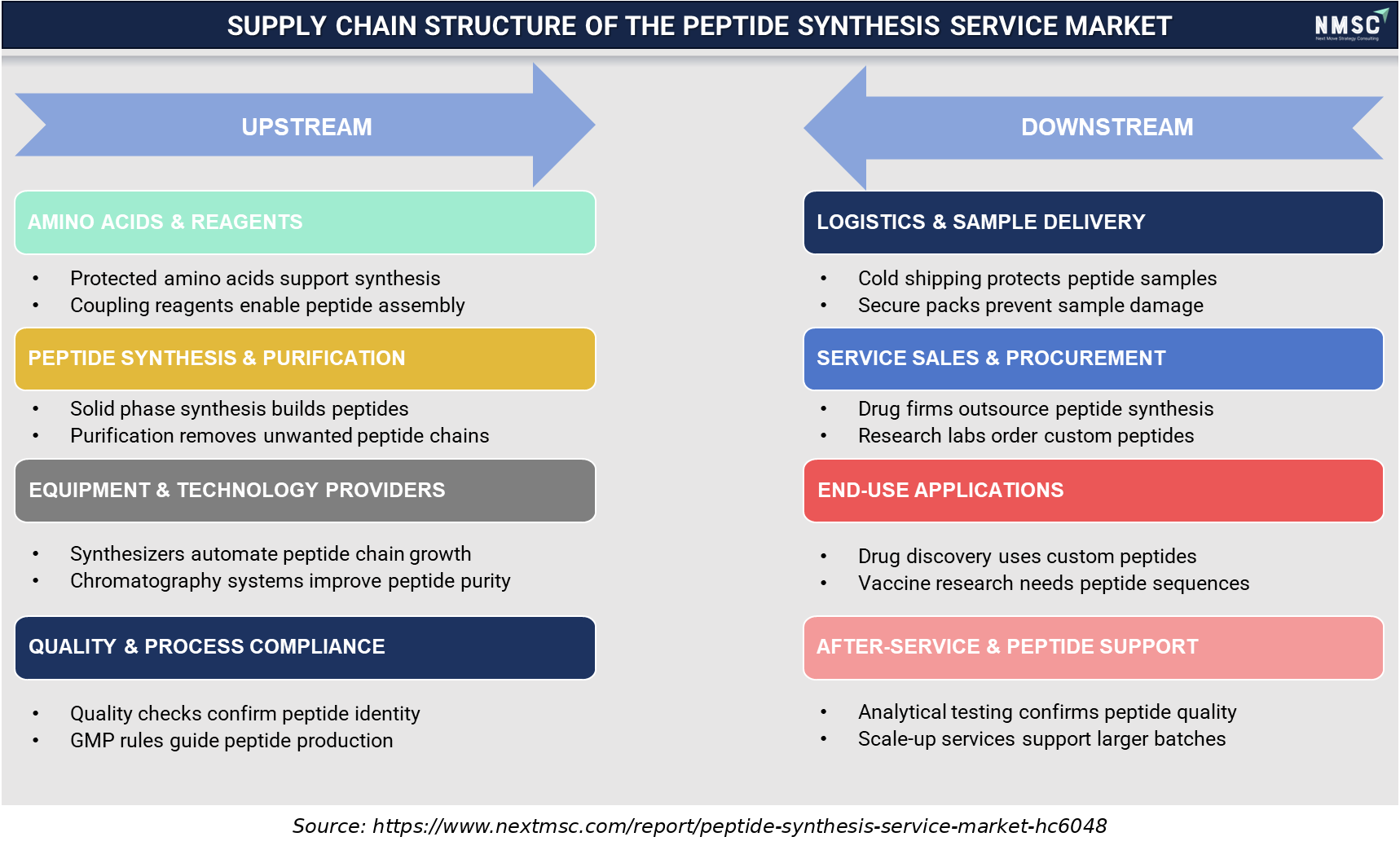
The supply chain structure of the peptide synthesis service market highlights the interconnected roles of upstream suppliers and downstream service providers. Upstream activities include amino acids and reagents, peptide synthesis and purification, equipment and technology, and quality compliance. Downstream activities cover logistics, service procurement, end-use applications, analytical testing, and scale-up support, demonstrating the market’s integrated value chain.

Growth Opportunities

Our analysis shows that three forward-looking opportunities stand out for stakeholders positioning within the Peptide Synthesis Service Market over the 2026-2035 forecast period.
How Is Enzymatic Synthesis Creating Opportunities for Sustainability-Focused Manufacturers?

Enzymatic and chemo-enzymatic peptide synthesis presents a whitespace opportunity for manufacturers seeking to reduce solvent waste and improve process sustainability credentials. Vendors that commercialize scalable enzymatic coupling platforms stand to capture premium contracts from sponsors prioritizing green chemistry commitments alongside cost and yield performance.

Why Is Peptide-Drug Conjugate Development Emerging as a Growth Opportunity for Specialized CDMOs?

Peptide-drug conjugates present an underpenetrated opportunity for CDMOs with combined peptide and bioconjugation expertise serving oncology and metabolic disease programs. Providers that build integrated conjugation capability can secure differentiated, higher-margin contracts as biotechnology sponsors seek single-source partners across the conjugate value chain.

How Is Regional Capacity Diversification Unlocking Opportunities for Emerging Market CDMOs?

Sponsor efforts to diversify manufacturing away from concentrated Asia-Pacific supply chains create an opportunity for emerging regional CDMOs in the Middle East and Latin America. Early movers that achieve GMP certification can differentiate with sponsors pursuing dual-sourcing strategies to mitigate geographic concentration risk.

Regional Outlook

2025 (USD Billion)
2035 (USD Billion)
North Americ
Europe
Asia-Pacific
Middle East
Latin Americ
Region 2025 (USD Billion) 2035 (USD Billion) CAGR (%)
North America $10.0 USD Billion $40.0 USD Billion 9.0%
Europe $17.1 USD Billion $51.1 USD Billion 27.0%
Asia-Pacific $24.2 USD Billion $62.2 USD Billion 25.0%
Middle East & Africa $31.3 USD Billion $73.3 USD Billion 23.0%
Latin America $38.4 USD Billion $84.4 USD Billion 12.0%

Regional data is locked

Unlock complete regional numbers for this market.

Unlock Full Data

Latest Developments

We found that recent capacity investments and transactions within the Peptide Synthesis Service Market are concentrated on GLP-1 driven GMP manufacturing expansion and strategic consolidation.
Date Event
August 2026 CordenPharma completed its acquisition of AmbioPharm, integrating peptide CDMO facilities in South Carolina and Shanghai. The transaction adds peptide development and manufacturing capabilities, including downstream purification and lyophilization in the U.S., while expanding CordenPharma’s options for complex peptide programs across development, clinical supply and commercial manufacturing.
April 2026 Bachem inaugurated Building K at its Bubendorf, Switzerland site, a new production facility designed for industrial-scale manufacturing of peptide and oligonucleotide active ingredients. The facility is part of Bachem’s broader global capacity-expansion program and is intended to address growing demand from pharmaceutical and biotechnology markets for high-volume active ingredients.
October 2025 SK pharmteco invested $6.1 million in its Rancho Cordova, California facility to establish and equip a laboratory and cGMP kilo-scale operation for solid-phase peptide synthesis and purification. The expansion adds development-to-manufacturing capabilities in the U.S. and complements the company’s broader global peptide capacity investments.

Investment Opportunities

What Capital Inflows Are Targeting the Peptide Synthesis Service Market?

Capital inflows into the market are increasingly directed toward validated GMP-scale manufacturing capacity and strategic consolidation. Samsung Biologics Co., Ltd.'s approximately USD 1.81 Billion agreement to acquire PolyPeptide Group AG in 2026 reflects continued investor confidence in peptide manufacturing as a durable growth category. We observed that investors favor manufacturers demonstrating validated commercial-scale capacity, viewing capacity utilization as a proxy for long-term contract retention with pharmaceutical sponsors.

How Is Infrastructure Investment Supporting Peptide Synthesis Service Deployment?

Infrastructure investment in large-scale reactor and purification capacity is expanding the operational foundation required for commercial-scale peptide manufacturing. Corden Pharma International GmbH's nearly EUR 1 Billion investment program, including a major Basel-region facility, reflects broader industry recognition that validated large-scale infrastructure is a prerequisite for securing long-term commercial supply agreements with pharmaceutical sponsors.

What ESG Considerations Are Shaping Peptide Synthesis Service Investment Decisions?

Environmental, social, and governance considerations increasingly intersect with Peptide Synthesis Service Market investment decisions through solvent reduction and sustainable manufacturing practices. Enzymatic and chemo-enzymatic synthesis platforms continue to displace solvent-intensive chemical coupling steps for select applications, reducing hazardous waste generation. We found that investors increasingly favor manufacturers with credible sustainability roadmaps alongside validated GMP compliance, treating environmental performance as a proxy for long-term regulatory and sponsor alignment.

Ecosystem Analysis of the Peptide Synthesis Service Market

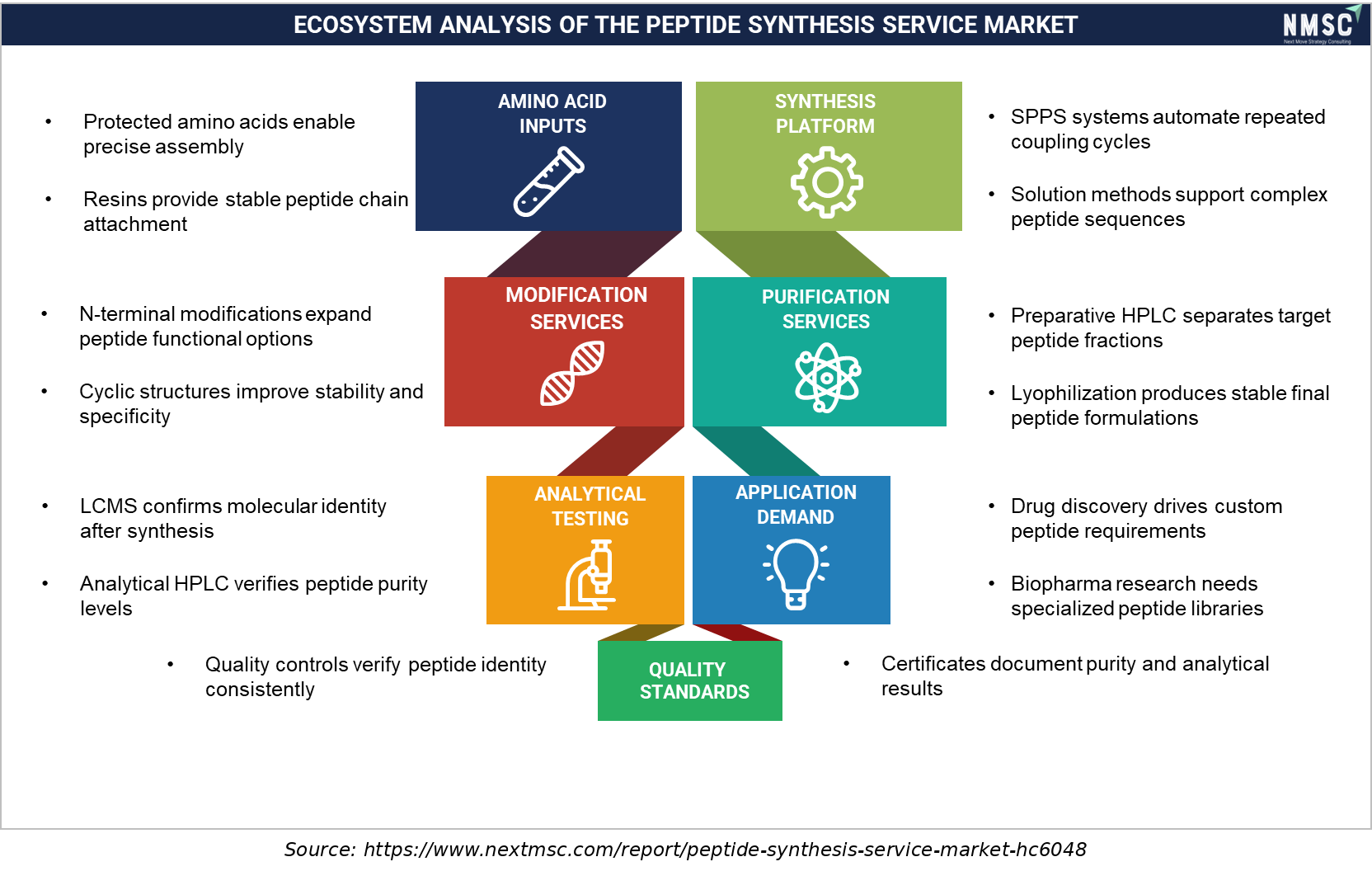
The peptide synthesis service market ecosystem integrates specialized inputs, synthesis technologies, modification, purification, and analytical testing capabilities. Service providers support diverse research and pharmaceutical applications by delivering customized peptide solutions with defined quality specifications. Demand from drug discovery, biotechnology, diagnostics, and research institutions drives service requirements, while quality standards, analytical validation, and process consistency remain critical across the value chain.

Key Benefits for Stakeholders

How Does This Report Benefit Enterprise and Industry Leaders?

Enterprise and industry leaders gain access to validated segmentation, competitive benchmarking, and regional demand forecasts that support capacity planning and sourcing decisions across the Peptide Synthesis Service Market. Our analysis shows that detailed service type, end-user, and regional breakdowns help procurement teams align specifications with regulatory and capacity requirements while identifying underserved service categories for portfolio expansion.

How Does This Report Benefit Investors and Financial Analysts?

Investors and financial analysts benefit from consistent, single-point market size and CAGR estimates that support valuation and capital-allocation decisions across the Peptide Synthesis Service Market manufacturer landscape. We observed that the report's regional and segment-level growth differentials help identify which manufacturers are best positioned to capture above-market growth in GMP manufacturing and conjugate chemistry categories through 2035.

How Does This Report Benefit Technology Vendors and Product Teams?

Technology vendors and product teams gain insight into emerging design requirements, including automated SPPS platforms, enzymatic synthesis, and conjugate chemistry capability, that are reshaping the Peptide Synthesis Service Market. Our findings suggest that this analysis helps R&D teams prioritize development roadmaps around capacity scalability and sustainability increasingly required by pharmaceutical sponsor procurement processes.

Key Market Segments Evaluated

By Service Type

  • Custom Peptide Synthesis
  • Peptide Process Development
  • GMP Peptide Manufacturing

By Synthesis Technology

  • Solid-Phase Peptide Synthesis
  • Conventional SPPS
  • Automated SPPS
  • Microwave-Assisted SPPS
  • Continuous SPPS
  • Liquid-Phase Peptide Synthesis
  • Classical LPPS
  • Fragment Condensation
  • Hybrid Peptide Synthesis
  • SPPS-LPPS
  • Convergent Synthesis
  • Chemical Ligation
  • Enzymatic Peptide Synthesis
  • Enzymatic Coupling
  • Chemo-Enzymatic Synthesis

By Peptide Type

  • Linear Peptides
  • Short Linear Peptides
  • Long Linear Peptides
  • Cyclic Peptides
  • Disulfide-Cyclic Peptides
  • Head-to-Tail Cyclic Peptides
  • Stapled Peptides
  • Macrocyclic Peptides
  • Branched Peptides
  • Multiple Antigen Peptides
  • Branched Sequence Peptides
  • Peptide Libraries
  • Overlapping Libraries
  • Alanine Scanning Libraries
  • Positional Scanning Libraries
  • Combinatorial Libraries

By Peptide Modification

  • Unmodified Peptides
  • Native Sequence Peptides
  • Standard Terminal Peptides
  • Terminally Modified Peptides
  • N-Terminal Modifications
  • C-Terminal Modifications
  • Chemically Modified Peptides
  • Lipidated Peptides
  • PEGylated Peptides
  • Glycosylated Peptides
  • Phosphorylated Peptides
  • Isotope-Labeled Peptides
  • Conjugated Peptides
  • Peptide-Protein Conjugates
  • Peptide-Oligonucleotide Conjugates
  • Peptide-Drug Conjugates
  • Peptide-Dye Conjugates

By Purity Grade

  • Crude Grade
  • Unpurified Peptides
  • Partially Purified Peptides
  • Research Grade
  • Standard Research Grade
  • High-Purity Research Grade
  • GLP Grade
  • GMP Grade

By Production Scale

  • Microscale
  • Nanomole Scale
  • Microgram Scale
  • Milligram Scale
  • 1–10 mg
  • 10–100 mg
  • 100 mg–1 g
  • Gram Scale
  • 1–10 g
  • 10–100 g
  • Kilogram Scale
  • 100 g–1 kg
  • 1–10 kg
  • 10–100 kg
  • Large-Scale
  • 100–1
  • 000 kg
  • Above 1
  • 000 kg

By End User

  • Pharmaceutical Companies
  • Biotechnology Companies
  • Academic and Research Institutions
  • Diagnostic Companies
  • Cosmetics Companies
  • Agricultural Companies
  • Animal Health Companies

Conclusion & Recommendations

The long-term outlook for the Peptide Synthesis Service Market remains strongly positive, with global revenue projected to expand more than fourfold from USD 6.8 Billion in 2025 to USD 30.0 Billion by 2035 at a 15.8% CAGR. We observed that sustained GLP-1 demand, combined with expanding cyclic and conjugated peptide drug pipelines, will continue underpinning demand across custom synthesis, process development, and GMP manufacturing categories through the forecast period.

What Strategic Positioning Should Peptide Synthesis Service Vendors Pursue?

Vendors should prioritize validated large-scale GMP capacity while pursuing complex chemistry expertise to secure long-term commercial supply agreements. Our assessment indicates that companies investing early in automated synthesis platforms and conjugate chemistry capability will be best positioned to capture premium pricing within the Peptide Synthesis Service Market.

How Attractive Is the Peptide Synthesis Service Market for New Investment?

The market presents a highly attractive investment case, supported by a USD 22.0 Billion absolute dollar opportunity between 2026 and 2035 and above-average growth in Asia-Pacific and GMP manufacturing categories. We found that investment attractiveness is highest for vendors combining validated commercial-scale capacity with specialized complex peptide expertise, positioning them to serve both large pharmaceutical and emerging biotechnology sponsor segments simultaneously.

What Market Shifts and Key Risks Should Stakeholders Monitor?

Stakeholders should monitor constrained validated GMP-SPPS capacity, high infrastructure capital costs, and consolidation-driven reduction in independent providers as key risks to the Peptide Synthesis Service Market. Our analysis shows that manufacturers unable to secure validated large-scale capacity risk losing commercial-stage sponsor accounts to consolidated competitors with proven capacity track records.

What Are the Key Growth Pathways for the Peptide Synthesis Service Market?

Key growth pathways include expanding commercial-scale GMP manufacturing capacity, scaling conjugate chemistry and enzymatic synthesis capability, and deepening penetration into emerging biotechnology and animal health sponsor channels. NMSC's analysis indicates that vendors pursuing these pathways while maintaining validated regulatory compliance will be best positioned to capture the market's projected growth through 2035.

FAQs

About the Author

Mihul Sharma

Mihul Sharma

Mihul Sharma is Research Associate at Next Move Strategy Consulting, where he has covered technology, industrial, and healthcare markets for 3 years. His work applies structured business research, market analysis, and secondary-source review to assess market trends, competitive developments, and growth opportunities. He supports report development by fully synthesizing industry data, company information, and market signals into concise findings for strategy and investment-focused research teams.

About the Reviewer

Supradip Baul

Supradip Baul

Supradip Baul is an accomplished business consultant and strategist with over a decade of rich experience in market intelligence, strategy, technology, and business transformation. His work has included rigorous qualitative and quantitative analysis across multiple industries, helping clients shape investment decisions and long-term roadmaps. Earlier in his career, he was associated with Gartner, where he contributed to industry-leading reports and market share analyses. He has worked with leading global companies and holds an MBA with a dual specialization in Marketing and Finance.

Download Free Sample

Robert Sean Trevino

ROBERT SEAN TREVINO

Sr. Director, Head of Strategic Insights & Analytics

Foundation Medicine

I realized that it was a reliable source of information. These days, there are many people who are looking for authentic data, and this is one of the only sources that can offer them with what they need;

Amos Chang

AMOS CHANG

Strategy Consultant

Kardex Group

I have bought the intralogistics market reports from NMSC two times so far. Joseph and his team are always very helpful and flexible in responding to any customization requirements on the report. Their expertise in market reports really helps us steer the day-to-day business. I will definitely recommend and come back myself whenever there is a need.

Henri Knyphausen

HENRI KNYPHAUSEN

Partner at Singulier [Ex-BCG]

Singulier

I recently engaged NEXTMSC.com for a commercial due diligence project within the intralogistics sector, and I am pleased to provide a reference based on my experience. In utilizing NEXTMSC.com's services, I found their report to offer valuable insights into market dynamics and key industry players. The initial report provided a solid foundation for our analysis. However, as we were investigating a smaller target in the market, and I had specific customization requests requiring additional research. These requests included detailed information on product portfolios of various players and sub-market sizes, both inclusive and exclusive of certain product categories. NEXTMSC.com demonstrated commendable responsiveness and agility in accommodating these customization requests. Within a timeframe of 1-2 weeks, they delivered a revised report that met our specific needs. Furthermore, they were receptive to my follow-up inquiries, ensuring clarity and understanding of the data provided. The final deliverable significantly contributed to our due diligence efforts. One of NEXTMSC.com's notable strengths lies in their qualitative research capabilities. However, for future engagements, I would recommend the inclusion of a quantified market model in Excel format. Such a model would offer the ability to conduct in-depth analyses and explore various market segments, including country-specific data and subcomponent breakdowns. Based on my positive experience, I would not hesitate to work with NEXTMSC.com again. Their responsiveness, willingness to accommodate customization requests, and commitment to delivering actionable insights make them a reliable partner for commercial research projects.

Diana Trejo

DIANA TREJO

Assistant Manager

Sumitomo Corporation de Mexico, S.A. de C.V.

Recently, we purchased a report on the Mexico Data Center Market from Next Move Strategy Consulting. The service has been excellent, with support that is always timely and thoroughly professional. The information provided is interesting, highly useful, and delivered with clarity. I would highly recommend NextMSC for anyone seeking insightful and dependable analysis.

Gustaf Hummel Burstrom

GUSTAF HUMMEL BURSTROM

Founder

Revline Tools AB

Joseph and the team at Next Move Strategy Consulting have been excellent to work with, in supplying us with relevant market data and forecasts for our specific category. We had some special requirements and they were able to do a custom package to suit our needs. We would definitely recommend them to any other company needing market data and forecasts

Custom Market Research Services

We will customize the research for you if the listed report does not fully match your requirements.

Get 30% Free Customization

Select License

This website uses cookies to ensure you get the best experience on our website. Learn more

✖