Physics-Informed AI Market Global Industry Analysis and Forecast (2026–2035)

The global Physics-Informed AI Market size was valued at USD 0.85 billion in 2025 and is estimated at USD 1.18 billion in 2026, forecast to reach USD 14.20 billion by 2035, expanding at a 31.9% CAGR between 2026 and 2035. North America leads with approximately 44% share, while Platforms and Software dominate all other offerings with approximately 68% share.

Download Free Sample PDF
Base Year (2025)
$0.85 Billion
Forecast (2035)
$14.20 Billion
CAGR (2026-2035)
31.9%
Top Region
North America

What Is the Physics-Informed AI Market Size?

The global physics-informed AI market size was valued at USD 0.85 billion in 2025 and is estimated at USD 1.18 billion in 2026, forecast to reach USD 14.20 billion by 2035, expanding at a 31.9% CAGR between 2026 and 2035. North America leads with approximately 44% share, while platforms and software dominate all other offerings with approximately 68% share.

We observed that growth is broad-based across every segmentation axis, with materials discovery applications and healthcare and life sciences end users recording the steepest structural gains through the forecast window.

Physics-Informed AI Market Global Industry Analysis and Forecast (2026–2035) Revenue Forecast

Values in USD Billion

2025 $0.85 Billion
2025
2026 $1.12 Billion
2026
2027 $1.48 Billion
2027
2028 $1.95 Billion
2028
2029 $2.57 Billion
2029
2030 $3.39 Billion
2030
2031 $4.48 Billion
2031
2032 $5.90 Billion
2032
2033 $7.79 Billion
2033
2034 $10.27 Billion
2034
2035 $14.20 Billion
2035

Key Takeaways

By Offering: Platforms and Software held the largest share of approximately 68% (USD 0.58 billion) in 2025; Services is the fastest-growing sub-segment at 34.0% CAGR from 2026–2035.

By Technique: Physics-Informed Neural Networks held the largest share of approximately 42% (USD 0.36 billion) in 2025; Neural Operators is the fastest-growing sub-segment at 35.0% CAGR from 2026–2035.

By Deployment Mode: Cloud held the largest share of approximately 54% (USD 0.46 billion) in 2025; Hybrid is the fastest-growing sub-segment at 34.0% CAGR from 2026–2035.

By Application: Engineering Simulation and Design held the largest share of approximately 41% (USD 0.35 billion) in 2025; Materials Discovery is the fastest-growing sub-segment at 36.0% CAGR from 2026–2035.

By End User Industry: Aerospace and Defense held the largest share of approximately 24% (USD 0.20 billion) in 2025; Healthcare and Life Sciences is the fastest-growing sub-segment at 35.0% CAGR from 2026–2035.

Dominant Region: North America dominated with approximately 44% revenue share (USD 0.375 billion) in 2025.

Fastest-Growing Region: Asia-Pacific is expected to register the highest CAGR of 35.0% during 2026–2035.

Dominant Country: U.S. led with approximately USD 0.32 billion in 2025.

Fastest-Growing Country: India is the fastest-growing country at approximately 38.4% CAGR from 2026–2035.

Market Opportunity: The physics-informed AI market is expected to create an absolute dollar opportunity of USD 13.02 billion between 2026 and 2035, presenting significant investment potential across the large physics model and industrial digital twin value chain.

According to Next Move Strategy Consulting analysis, aerospace, automotive, and semiconductor manufacturers are increasingly co-developing physics AI models directly with platform vendors rather than relying solely on legacy simulation software, a shift that favors GPU-accelerated, AI-native engineering platforms over traditional solver-only tools as large physics models scale across industrial design workflows through 2035.

What Does the Physics-Informed AI Market Encompass?
The market encompasses platforms, software, and services that embed governing physical laws, such as partial differential equations, directly into machine learning model architectures to simulate complex physical systems. Our assessment indicates that the scope spans physics-informed neural networks, neural operators, and hybrid physics-data models supplied for engineering simulation, digital twin development, computational fluid dynamics, structural analysis, materials discovery, climate modeling, drug discovery, and energy system optimization applications. The category has evolved from academic research into a commercial, GPU-accelerated engineering discipline as aerospace, automotive, and semiconductor manufacturers pursue faster, more accurate alternatives to traditional numerical solvers.
Public research funding and open-standard architecture initiatives shape adoption cadence and interoperability requirements for physics AI models. We observed that technology adoption is shifting toward large physics models that generalize across multiple engineering domains rather than narrow, single-application solvers. Next Move Strategy Consulting's analysis indicates that this structural shift, combined with growing GPU-accelerated computing capacity, is redefining procurement criteria across the physics-informed AI market.

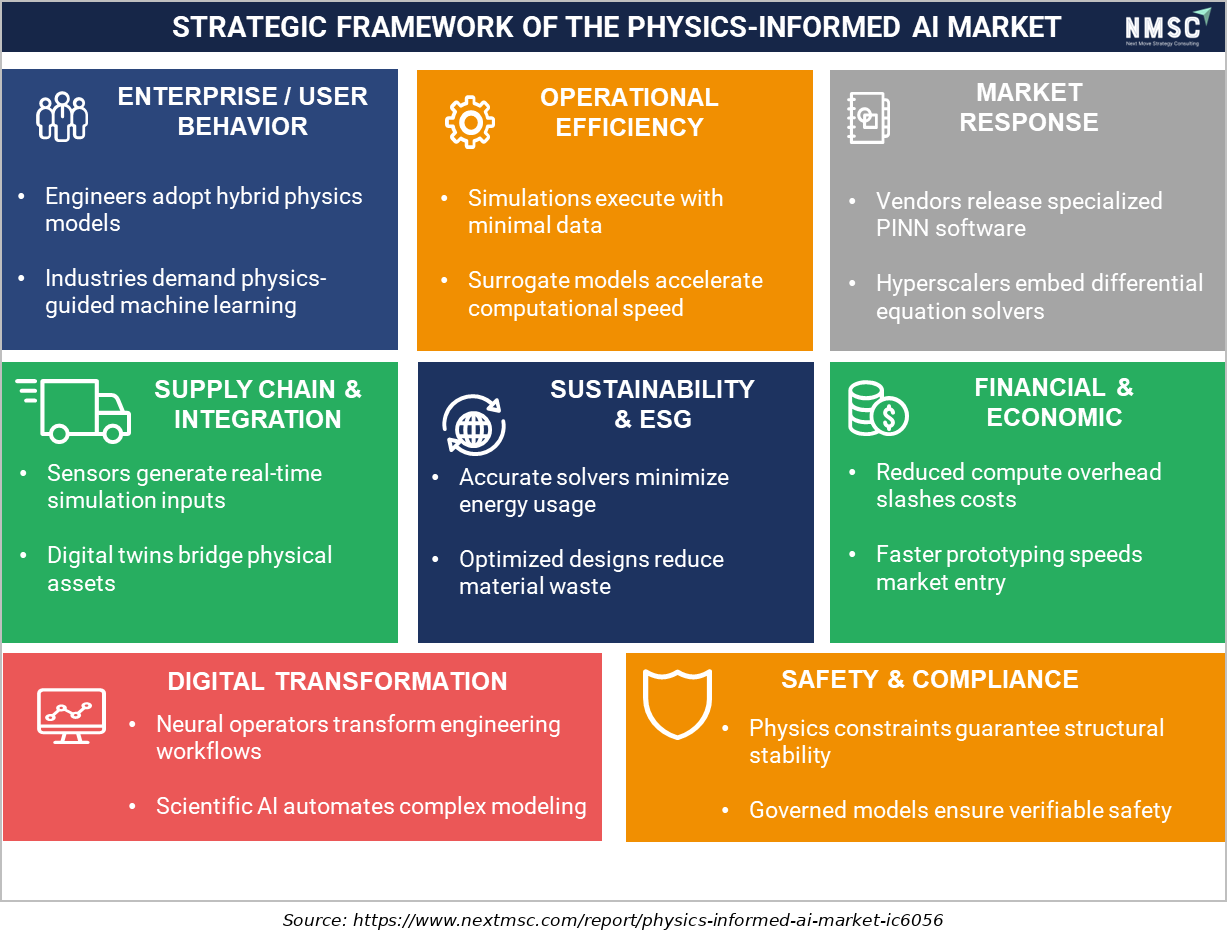
STRATEGIC FRAMEWORK OF THE PHYSICS-INFORMED AI MARKET

STRATEGIC FRAMEWORK OF THE PHYSICS-INFORMED AI MARKET
The strategic framework highlights the key factors shaping the market, spanning enterprise adoption, operational efficiency, market response, supply-chain integration, sustainability, financial benefits, digital transformation, and safety. It shows how physics-guided models and digital twins can improve simulation speed, reduce computational costs and material waste, automate engineering workflows, and support safer, more efficient decision-making across industries.

Market Drivers & Dynamics

Interactive Dataset
Rising demand for faster, physics-accurate engineering simulation driver +3.4% Global 2026–2035
Expanding digital twin adoption across aerospace and manufacturing driver +2.8% Global 2026–2035
Growing use of physics-informed AI in materials and drug discovery driver +2.3% Global 2028–2035
Rising GPU-accelerated computing capacity supporting large physics models driver +1.9% North America, Asia-Pacific 2026–2032
Increasing enterprise investment in AI-native engineering platforms driver +1.5% Global 2026–2033
Growing climate and weather modeling investment by public agencies driver +1.1% Global 2026–2035
Shortage of engineers skilled in both physics and machine learning restraint -1.3% Global 2026–2032
High computational cost of training large-scale physics AI models restraint -0.9% Global 2026–2030
Data and model validation challenges in safety-critical applications restraint -0.6% Global 2026–2033
Source: Next Move Strategy Consulting

Growth Drivers

What Is the Primary Growth Driver of the Physics-Informed AI Market?

Rising demand for faster, physics-accurate engineering simulation is the primary driver of the market. PhysicsX Ltd.'s June 2026 Series C funding round, which reached a valuation of approximately USD 2.4 billion, reflects sustained enterprise demand for models that deliver simulation results in seconds rather than hours. We observed that this expansion, reinforced by rising GPU-accelerated computing capacity, continues to anchor baseline demand for physics-informed AI platforms across aerospace, automotive, and semiconductor markets alike.

How Is GPU-Accelerated Computing Driving Physics-Informed AI Market Growth?

Expanding GPU-accelerated computing infrastructure is accelerating the scale and generality of physics AI models available to enterprise engineering teams. NVIDIA Corporation's 2026 expansion of its Agent Toolkit to include PhysicsNeMo and CUDA-X libraries reflects sustained platform investment in agent-ready physics AI tools. Our assessment indicates that this expansion, combined with growing open-standard architecture initiatives, is compressing adoption timelines for physics-informed AI across North America and Asia-Pacific engineering and manufacturing sectors.

Growth Inhibitors

What Is Restraining Physics-Informed AI Market Expansion?

A shortage of engineers skilled in both physics and machine learning restrains broader adoption among mid-sized manufacturers and research organizations. High computational cost of training large-scale physics AI models continues to constrain deployment among cost-sensitive enterprises. We found that organizations without established GPU infrastructure partnerships face particular exposure, as compute cost premiums reduce near-term return on investment compared with continued reliance on traditional numerical simulation methods.

What Are the Growth Opportunities?

How Can Open-Standard Physics AI Architecture Unlock New Revenue?

Open-standard physics AI architecture presents a whitespace opportunity for platform vendors seeking to reduce enterprise integration friction. Suppliers that contribute modular, interoperable frameworks stand to capture recurring platform revenue from aerospace and manufacturing customers seeking to avoid fragmented, single-vendor physics AI implementations across their engineering workflows.

Where Do Large Physics Models Create Recurring Platform Revenue?

Large physics models that generalize across multiple engineering domains represent an underpenetrated opportunity for platform vendors serving diversified industrial customers. Vendors that expand model coverage across computational fluid dynamics, structural analysis, and electromagnetics within a single platform can secure long-term contracts with automotive and semiconductor manufacturers managing multi-domain design workflows.

How Can Physics-Informed Molecular Modeling Expand Life Sciences Adoption?

Physics-informed molecular modeling creates an opportunity for specialized AI developers seeking to expand beyond traditional engineering customers into pharmaceutical and materials science markets. Early movers that validate physics-informed candidate screening for drug discovery can differentiate with healthcare and life sciences organizations pursuing faster, lower-cost alternatives to purely empirical laboratory testing.

Segmentation Analysis

2025 (USD Billion)
2035 (USD Billion)
Platforms and Software 2025: $0.58 Billion | 2035: $8.91 Billion
Platforms an
Services 2025: $0.27 Billion | 2035: $5.29 Billion
Services
Platforms and Software $0.58 Billion $8.91 Billion 30.7%
Services $0.27 Billion $5.29 Billion 34.0%

Which Offering Dominates the Physics-Informed AI Market?

Platforms and Software led the market with USD 0.58 billion in 2025, supported by enterprise preference for licensed, GPU-accelerated modeling frameworks over custom-built internal tools. We observed that Services is the fastest-growing offering, expanding at a 34.0% CAGR from 2026 to 2035, as enterprises increasingly require consulting, integration, and model customization support to embed physics AI into existing engineering workflows.

2025 (USD Billion)
2035 (USD Billion)
Physics-Info
Neural Opera
Physics-Info
Hybrid Physi
Segment Item 2025 (USD Billion) 2035 (USD Billion) CAGR
Physics-Informed Neural Networks $10.0 USD Billion $40.0 USD Billion 16.0%
Neural Operators $17.1 USD Billion $51.1 USD Billion 18.0%
Physics-Informed Graph Neural Networks $24.2 USD Billion $62.2 USD Billion 12.0%
Hybrid Physics-Data Models $31.3 USD Billion $73.3 USD Billion 26.0%

Segment-wise data is locked

Unlock complete segment-wise numbers for By Technique.

Unlock Full Data
2025 (USD Billion)
2035 (USD Billion)
Cloud
On-Premise
Hybrid
Segment Item 2025 (USD Billion) 2035 (USD Billion) CAGR
Cloud $10.0 USD Billion $40.0 USD Billion 9.0%
On-Premise $17.1 USD Billion $51.1 USD Billion 23.0%
Hybrid $24.2 USD Billion $62.2 USD Billion 9.0%

Segment-wise data is locked

Unlock complete segment-wise numbers for By Deployment Mode.

Unlock Full Data
2025 (USD Billion)
2035 (USD Billion)
Engineering
Digital Twin
Computationa
Structural A
Materials Di
Segment Item 2025 (USD Billion) 2035 (USD Billion) CAGR
Engineering Simulation and Design $10.0 USD Billion $40.0 USD Billion 18.0%
Digital Twin Development $17.1 USD Billion $51.1 USD Billion 16.0%
Computational Fluid Dynamics $24.2 USD Billion $62.2 USD Billion 22.0%
Structural Analysis $31.3 USD Billion $73.3 USD Billion 12.0%
Materials Discovery $38.4 USD Billion $84.4 USD Billion 19.0%

Segment-wise data is locked

Unlock complete segment-wise numbers for By Application.

Unlock Full Data

Which Application Leads Physics-Informed AI Market Demand?

Engineering Simulation and Design remained the leading application, valued at USD 0.35 billion in 2025, reflecting sustained enterprise investment in AI-native design workflows across aerospace and automotive manufacturers. Our analysis shows that Materials Discovery is the fastest-growing application, registering a 36.0% CAGR from 2026 to 2035, as physics-informed molecular modeling increasingly accelerates candidate screening cycles for advanced materials and semiconductor applications.

2025 (USD Billion)
2035 (USD Billion)
Aerospace an
Automotive
Manufacturin
Energy and U
Semiconducto
Segment Item 2025 (USD Billion) 2035 (USD Billion) CAGR
Aerospace and Defense $10.0 USD Billion $40.0 USD Billion 20.0%
Automotive $17.1 USD Billion $51.1 USD Billion 26.0%
Manufacturing $24.2 USD Billion $62.2 USD Billion 24.0%
Energy and Utilities $31.3 USD Billion $73.3 USD Billion 26.0%
Semiconductor and Electronics $38.4 USD Billion $84.4 USD Billion 9.0%

Segment-wise data is locked

Unlock complete segment-wise numbers for By End User Industry.

Unlock Full Data

Which End User Industry Leads Physics-Informed AI Market Demand?

Aerospace and Defense remained the leading end user industry, valued at USD 0.20 billion in 2025, reflecting the sector's early and sustained investment in physics AI for part design and manufacturing simulation. Our findings suggest that Healthcare and Life Sciences is the fastest-growing end user industry, registering a 35.0% CAGR from 2026 to 2035, as pharmaceutical and biotechnology organizations increasingly adopt physics-informed molecular modeling to accelerate drug discovery pipelines.

Growth Opportunities

Our analysis shows that three forward-looking opportunities stand out for stakeholders positioning within the physics-informed AI market over the 2026–2035 forecast period.

How Can Open-Standard Physics AI Architecture Unlock New Revenue?

Open-standard physics AI architecture presents a whitespace opportunity for platform vendors seeking to reduce enterprise integration friction. Suppliers that contribute modular, interoperable frameworks stand to capture recurring platform revenue from aerospace and manufacturing customers seeking to avoid fragmented, single-vendor physics AI implementations across their engineering workflows.

Where Do Large Physics Models Create Recurring Platform Revenue?

Large physics models that generalize across multiple engineering domains represent an underpenetrated opportunity for platform vendors serving diversified industrial customers. Vendors that expand model coverage across computational fluid dynamics, structural analysis, and electromagnetics within a single platform can secure long-term contracts with automotive and semiconductor manufacturers managing multi-domain design workflows.

How Can Physics-Informed Molecular Modeling Expand Life Sciences Adoption?

Physics-informed molecular modeling creates an opportunity for specialized AI developers seeking to expand beyond traditional engineering customers into pharmaceutical and materials science markets. Early movers that validate physics-informed candidate screening for drug discovery can differentiate with healthcare and life sciences organizations pursuing faster, lower-cost alternatives to purely empirical laboratory testing.

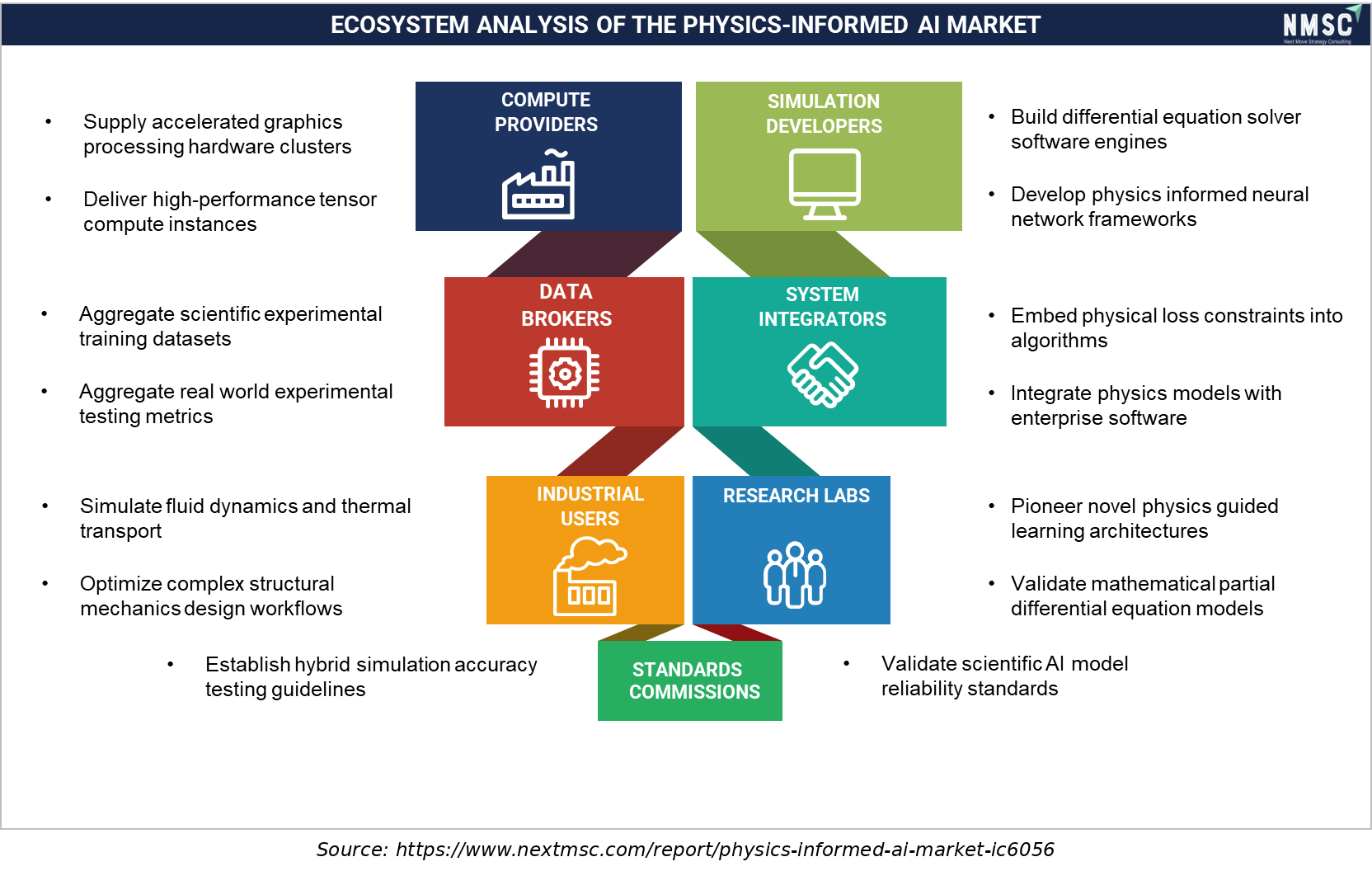
ECOSYSTEM ANALYSIS OF THE PHYSICS-INFORMED AI MARKET

The ecosystem of the Physics-Informed AI market connects compute providers, simulation developers, data brokers, system integrators, industrial users, research laboratories, and standards commissions. Compute and simulation providers supply the infrastructure and modeling platforms, while data and integration participants enable deployment across engineering environments. Industrial users and research labs drive practical applications and innovation, while standards bodies support model reliability, interoperability, governance, and responsible adoption.

Regional Outlook

2025 (USD Billion)
2035 (USD Billion)
North Americ
Asia-Pacific
Europe
Middle East
Latin Americ
Region 2025 (USD Billion) 2035 (USD Billion) CAGR (%)
North America $10.0 USD Billion $40.0 USD Billion 9.0%
Asia-Pacific $17.1 USD Billion $51.1 USD Billion 27.0%
Europe $24.2 USD Billion $62.2 USD Billion 25.0%
Middle East & Africa $31.3 USD Billion $73.3 USD Billion 23.0%
Latin America $38.4 USD Billion $84.4 USD Billion 12.0%

Regional data is locked

Unlock complete regional numbers for this market.

Unlock Full Data

Competitive Landscape

We observed that the physics-informed AI market features a moderately fragmented competitive landscape, with GPU-accelerated computing platforms competing alongside specialized physics AI startups on model generality and industrial design-win depth.

Dimension Description
Market Structure Moderately fragmented; a handful of established GPU and industrial software platforms profiled in this report collectively serve a majority of large aerospace and automotive contracts, while numerous specialized physics AI startups serve niche materials, drug discovery, and climate modeling demand.
Innovation Focus Large physics models, open-standard architecture, and physics-informed molecular modeling dominate current innovation pipelines across leading providers.
M&A Activity Selective capital raises and strategic partnerships, exemplified by PhysicsX Ltd.'s USD 300 million Series C funding round backed by Temasek, NVIDIA Corporation, and Siemens AG.

How Do Companies Compete in the Physics-Informed AI Market?

Companies compete primarily on model generality, GPU infrastructure access, and breadth of industrial design-win partnerships across the industry. Global players such as NVIDIA Corporation and Siemens AG leverage deep GPU and industrial software integration to serve multinational aerospace and automotive customers, while specialized startups such as PhysicsX Ltd. compete on rapid model deployment for niche engineering and manufacturing applications.

Which Competitive Archetypes Dominate the Physics-Informed AI Market?

Two archetypes dominate the market: GPU and infrastructure-integrated platform providers offering foundational physics AI frameworks, and specialized industrial AI startups focused on domain-specific applications. NVIDIA Corporation exemplifies the infrastructure-integrated archetype through its PhysicsNeMo framework and Agent Toolkit, while PhysicsX Ltd. and Neural Concept SA exemplify the specialized startup archetype serving niche aerospace, automotive, and manufacturing demand.

How Are Companies Differentiating Through Innovation in Physics-Informed AI Design?

Innovation and differentiation strategy increasingly center on model generality and open-standard interoperability. PhysicsX Ltd.'s collaboration with NVIDIA Corporation on open standards for physics AI architecture aims to reduce fragmentation across engineering workflows. Our analysis shows that providers unable to demonstrate credible multi-domain model coverage risk exclusion from large aerospace and semiconductor manufacturer vendor shortlists.

What M&A and Investment Activity Is Shaping the Physics-Informed AI Market?

Capital raises and strategic corporate investment continue to consolidate capabilities within the industry. PhysicsX Ltd.'s June 2026 Series C round, which included strategic participation from NVIDIA Corporation, Siemens AG, and Applied Materials, illustrates how established industrial and technology players are securing early access to physics AI capability through venture investment rather than outright acquisition.

Key Market Players

Our assessment indicates that the following 20 companies are actively shaping platform development, GPU infrastructure investment, and industrial design-win depth within the global physics-informed AI market.

NVIDIA Corporation Siemens AG Dassault Systèmes SE Synopsys, Inc. Hexagon AB Bentley Systems, Incorporated Cadence Design Systems, Inc. Altair Engineering Inc. COMSOL, Inc. Rescale, Inc. PhysicsX Ltd. Neural Concept SA Monolith AI Ltd. SandboxAQ, Inc. Atomwise, Inc. Citrine Informatics, Inc. Microsoft Corporation IBM Corporation Alphabet Inc. Schlumberger Limited (SLB)

Latest Developments

We found that recent funding rounds and strategic partnerships within the physics-informed AI market are concentrated on large physics model development and GPU infrastructure collaboration, reflecting the industry's broader shift toward mainstream industrial adoption.

Date Event
July 2026 Siemens released a unified Simcenter portfolio combining Siemens and Altair simulation technologies, with expanded AI-driven simulation, GPU acceleration and multiphysics workflows. Simcenter PhysicsAI generates physics-aware predictive models from simulation data and supports design exploration up to 1,000x faster than traditional solver simulations.

Expert Insights

Alex Gorodetsky

Chief AI Scientist | Geminus

"By uniting data-driven techniques with fundamental physics, PI-AI not only advances the capabilities of AI but also fosters deeper insights into the underlying mechanisms of the natural world."

Analyst Interpretation

The statement highlights the core technological advantage of Physics-Informed AI: combining machine learning with established physical laws. By incorporating physical constraints into AI models, PI-AI can improve prediction accuracy and generalization while reducing dependence on large datasets, particularly where industrial data are sparse, noisy, or indirect. This creates opportunities for adoption in energy, oil and gas, manufacturing, carbon capture, infrastructure, and other engineering-intensive applications, where conventional data-centric AI can face limitations.

Investment Opportunities

What Capital Inflows Are Targeting the Physics-Informed AI Market?

Capital inflows into the physics-informed AI market are increasingly directed toward large physics model development and GPU infrastructure partnerships. Strategic and venture investors continue to fund scale-up, as seen in PhysicsX Ltd.'s USD 300 million Series C round backed by Temasek, NVIDIA Corporation, and Siemens AG. We observed that investors favor providers demonstrating validated multi-domain model coverage, viewing generalized physics AI capability as a durable competitive moat.

How Is Infrastructure Investment Supporting Physics-Informed AI Deployment?

Infrastructure investment is expanding GPU-accelerated computing capacity to serve rising physics AI training and inference demand across aerospace, automotive, and semiconductor customers. Our findings suggest that providers are investing in dedicated GPU partnerships and agent-ready toolkits to reduce model deployment time, supporting the throughput required for enterprise-scale industrial design workflows.

What ESG Considerations Are Shaping Physics-Informed AI Investment Decisions?

Environmental, social, and governance considerations are central to investment decisions across the industry, with energy efficiency and reduced physical prototyping as key criteria. Physics-informed AI platforms that replace physical testing cycles with high-fidelity simulation can reduce material waste and energy consumption associated with traditional prototyping. We found that investors increasingly favor providers that demonstrate measurable reductions in physical testing requirements, treating simulation efficiency as a governance and sustainability indicator.

Key Benefits for Stakeholders

How Does This Report Benefit Enterprise and Industry Leaders?

Enterprise and industry leaders gain access to validated segmentation, competitive benchmarking, and regional demand forecasts that support sourcing and technology-partnership decisions across the physics-informed AI industry. Our analysis shows that detailed offering, application, and end user industry breakdowns help procurement teams align specifications with engineering and computational requirements while identifying underserved application segments for portfolio expansion.

How Does This Report Benefit Investors and Financial Analysts?

Investors and financial analysts benefit from consistent, single-point market size and CAGR estimates that support valuation and capital-allocation decisions across the physics-informed AI market supply chain. We observed that the report's regional and segment-level growth differentials help identify which platform, software, and service providers are best positioned to capture above-market growth through 2035.

How Does This Report Benefit Technology Vendors and Product Teams?

Technology vendors and product teams gain insight into emerging design requirements, including large physics models and open-standard interoperability, that are reshaping the industry. Our findings suggest that this analysis helps R&D teams prioritize development roadmaps around GPU-accelerated model training and multi-domain generality increasingly required by aerospace, automotive, and semiconductor procurement processes.

Key Market Segments Evaluated

By Offering

  • Platforms and Software
  • Services

By Technique

  • Physics-Informed Neural Networks
  • Neural Operators
  • Physics-Informed Graph Neural Networks
  • Hybrid Physics-Data Models

By Deployment Mode

  • Cloud
  • On-Premise
  • Hybrid

By Application

  • Engineering Simulation and Design
  • Digital Twin Development
  • Computational Fluid Dynamics
  • Structural Analysis
  • Materials Discovery
  • Climate and Weather Modeling
  • Drug Discovery
  • Energy System Optimization

By End User Industry

  • Aerospace and Defense
  • Automotive
  • Manufacturing
  • Energy and Utilities
  • Semiconductor and Electronics
  • Healthcare and Life Sciences
  • Oil and Gas

Conclusion & Recommendations

The long-term outlook for the market remains highly positive, with global revenue projected to expand more than sixteenfold from USD 0.85 billion in 2025 to USD 14.20 billion by 2035 at a 31.9% CAGR. We observed that sustained large physics model development, expanding GPU infrastructure investment, and accelerating materials and drug discovery adoption will continue underpinning demand across platform, software, and services applications through the forecast period.

What Strategic Positioning Should Physics-Informed AI Suppliers Pursue?

Suppliers should prioritize multi-domain model generality while pursuing open-standard architecture participation to secure long-term aerospace and semiconductor contracts. Our assessment indicates that providers investing early in GPU infrastructure partnerships and industrial design-win depth will be best positioned to capture premium pricing within the physics-informed AI market.

How Attractive Is the Physics-Informed AI Market for New Investment?

The physics-informed AI industry presents an attractive investment case, supported by a USD 13.02 billion absolute dollar opportunity between 2026 and 2035 and above-average growth in Asia-Pacific and materials discovery categories. We found that investment attractiveness is highest for providers combining GPU infrastructure access with multi-domain model coverage, positioning them to serve both cost-sensitive engineering simulation and premium materials discovery segments simultaneously.

What Market Shifts and Key Risks Should Stakeholders Monitor?

Stakeholders should monitor talent shortages, high computational training costs, and model validation challenges in safety-critical applications as key risks to the physics-informed AI market. Our analysis shows that suppliers unable to demonstrate validated multi-domain model coverage and defensible GPU infrastructure partnerships risk losing procurement shortlists to competitors with larger proprietary computing and industrial design-win portfolios, particularly within the increasingly competitive large physics model environment.

What Are the Key Growth Pathways for the Physics-Informed AI Market?

Key growth pathways include expanding large physics model coverage, scaling services revenue through integration and customization support, and deepening penetration into healthcare and materials discovery channels. Next Move Strategy Consulting's analysis indicates that suppliers pursuing these pathways while maintaining open-standard interoperability will be best positioned to capture the physics-informed AI market's projected growth through 2035.

FAQs

About the Author

Liza Phukan

Liza Phukan

Liza Phukan is Research Associate at Next Move Strategy Consulting, where she has covered emerging industries and market research across sectors for 3.5 years. Her work includes analyzing industry developments, validating market data, and developing structured business content from research findings. She uses secondary research and data-validation practices to turn complex market information into clear decision-useful market analysis for business audiences and support report development and B2B.

About the Reviewer

Supradip Baul

Supradip Baul

Supradip Baul is an accomplished business consultant and strategist with over a decade of rich experience in market intelligence, strategy, technology, and business transformation. His work has included rigorous qualitative and quantitative analysis across multiple industries, helping clients shape investment decisions and long-term roadmaps. Earlier in his career, he was associated with Gartner, where he contributed to industry-leading reports and market share analyses. He has worked with leading global companies and holds an MBA with a dual specialization in Marketing and Finance.

Download Free Sample

Henri Knyphausen

HENRI KNYPHAUSEN

Partner at Singulier [Ex-BCG]

Singulier

I recently engaged NEXTMSC.com for a commercial due diligence project within the intralogistics sector, and I am pleased to provide a reference based on my experience. In utilizing NEXTMSC.com's services, I found their report to offer valuable insights into market dynamics and key industry players. The initial report provided a solid foundation for our analysis. However, as we were investigating a smaller target in the market, and I had specific customization requests requiring additional research. These requests included detailed information on product portfolios of various players and sub-market sizes, both inclusive and exclusive of certain product categories. NEXTMSC.com demonstrated commendable responsiveness and agility in accommodating these customization requests. Within a timeframe of 1-2 weeks, they delivered a revised report that met our specific needs. Furthermore, they were receptive to my follow-up inquiries, ensuring clarity and understanding of the data provided. The final deliverable significantly contributed to our due diligence efforts. One of NEXTMSC.com's notable strengths lies in their qualitative research capabilities. However, for future engagements, I would recommend the inclusion of a quantified market model in Excel format. Such a model would offer the ability to conduct in-depth analyses and explore various market segments, including country-specific data and subcomponent breakdowns. Based on my positive experience, I would not hesitate to work with NEXTMSC.com again. Their responsiveness, willingness to accommodate customization requests, and commitment to delivering actionable insights make them a reliable partner for commercial research projects.

Pratyush Kumar Das

PRATYUSH KUMAR DAS

Assistant Manager

Polycab India Limited

We would like to express our appreciation for the data and insights provided by nextmsc. We are very pleased with the quality and depth of the information, which has proven to be highly valuable and beneficial for our business decision-making.

Nishant Awate

NISHANT AWATE

Business Development Global Sales

Zehnder Group Deutschland GmbH

Our experience working with Next Move Strategy Consulting was positive. The team was responsive, professional, and open to incorporating our specific requirements throughout the project. The India AHU market study was comprehensive and well structured, covering market value and volume forecasts, product and application segments, and key industry trends. The inclusion of both AHU and residential MVHR market insights made the study particularly relevant for our strategic market assessment. Overall, the report provides a solid foundation for evaluating market potential, identifying priority segments, and supporting business-development decisions in India.

Rishabh Jogani

RISHABH JOGANI

Strategy Analyst

Accenture Japan

We are incredibly impressed with the market report on the real estate market in India provided by Next Move Strategy Consulting. The report was thorough, insightful, and well-structured, offering deep analysis and actionable recommendations. It not only captured the current trends and dynamics but also provided a forward-looking perspective that has been invaluable for our strategic planning. Their team demonstrated exceptional professionalism, attention to detail, and a profound understanding of the industry. The data-driven insights and clarity of presentation exceeded our expectations, making complex market trends easy to understand. We highly recommend Next Move Strategy Consulting to anyone looking for reliable and comprehensive market research services. Their expertise has given us the confidence to navigate the complexities of the Indian real estate market with clarity and foresight.

Amos Chang

AMOS CHANG

Strategy Consultant

Kardex Group

I have bought the intralogistics market reports from NMSC two times so far. Joseph and his team are always very helpful and flexible in responding to any customization requirements on the report. Their expertise in market reports really helps us steer the day-to-day business. I will definitely recommend and come back myself whenever there is a need.

Custom Market Research Services

We will customize the research for you if the listed report does not fully match your requirements.

Get 30% Free Customization

Select License

This website uses cookies to ensure you get the best experience on our website. Learn more

✖