Bio-Inspired Algorithms Market Size, Share, Growth & Forecast by Offering Type (Software, Services), Algorithm Family (Swarm Intelligence, Evolutionary Algorithms, Neural Inspired, Hybrid), Function (Optimization, Routing, Scheduling, Clustering, Forecasting), Deployment (Cloud, On-Premises, Edge, Hybrid), Sales Channel, and End-Use Industry (Aerospace, Manufacturing, Healthcare, Financial Services, Energy) — Global Analysis 2026–2035
Industry: ICT & Media | Publishing Date: July 10, 2026 | Last Updated: September 30, 2026 | No of Pages: N/A | No. of Tables: N/A | No. of Figures: N/A | Format: PDF | Report Code: IC5085
What Is the Bio-Inspired Algorithms Market Size?
The global Bio-Inspired Algorithms Market was valued at USD 4.8 billion in 2025 and is expected to reach USD 5.6 billion in 2026. Accelerating demand for intelligent optimization across industrial automation, supply chain management, and AI-driven engineering design is projected to propel the market to USD 19.6 billion by 2035, advancing at a CAGR of 15.2% from 2026 to 2035. Key growth drivers include rising adoption of swarm intelligence solutions in logistics, expanding neuromorphic computing investments by semiconductor and defense organizations, growing deployment of evolutionary algorithms in autonomous systems design, and intensifying enterprise demand for hybrid bio-inspired optimization frameworks across financial services and healthcare operations.
|
Parameters |
Details |
|
Market Size in 2025 |
USD 4.8 Billion |
|
Market Size in 2026 |
USD 5.6 Billion |
|
Revenue Forecast in 2035 |
USD 19.6 Billion |
|
Growth Rate |
CAGR of 15.2% from 2026 to 2035 |
|
Analysis Period |
2026–2035 |
|
Base Year Considered |
2025 |
|
Forecast Period |
2026–2035 |
|
Market Size Estimation |
USD Billion |
|
Companies Profiled |
20 |
|
Countries Covered |
33 |
|
Market Share |
Top 10 |
Bio-Inspired Algorithms Market Overview
What Is the Bio-Inspired Algorithms Market?
The Bio-Inspired Algorithms Market encompasses software platforms, embedded tools, and professional services that apply computational methods derived from biological processes to solve complex optimization, design, routing, scheduling, and decisioning problems. These algorithms, drawn from swarm intelligence, evolutionary biology, and neural computation paradigms, enable organizations to address large-scale combinatorial challenges across aerospace, manufacturing, logistics, energy, and financial services. From our research, we found that this market serves both standalone software deployments and deeply embedded optimization engines within industrial control, EDA, and enterprise analytics platforms.
How Has the Bio-Inspired Algorithms Market Evolved?
The Bio-Inspired Algorithms Market has evolved through three distinct phases of maturity. The first generation focused on academic research and standalone optimization toolkits, with applications concentrated in academic laboratories and defense research programs. The second phase introduced commercial integration of genetic algorithms and ant colony optimization into supply chain and engineering design software suites offered by vendors such as Siemens and Dassault Systemes. NMSC's analysis indicates that the current phase is characterized by AI-native hybrid bio-inspired frameworks combining swarm intelligence with deep neural networks, enabling real-time, self-adaptive optimization in autonomous systems, smart grid management, and healthcare drug discovery pipelines.
How Do Regulations Influence the Bio-Inspired Algorithms Market?
Regulatory frameworks are increasingly influencing the trajectory of the Bio-Inspired Algorithms Market. The EU AI Act, which establishes risk-based obligations for AI systems including optimization algorithms deployed in critical infrastructure, is compelling vendors to build explainability, auditability, and bias-detection capabilities into bio-inspired algorithm platforms. The U.S. Department of Defense's Responsible AI principles and the National Institute of Standards and Technology AI Risk Management Framework are similarly driving procurement requirements for transparent, verifiable algorithmic decision-making in aerospace and defense applications, directly benefiting vendors with certified bio-inspired optimization toolkits.
How Is Technology Adoption Expanding Across the Bio-Inspired Algorithms Market?
Technology adoption across the Bio-Inspired Algorithms Market is accelerating as cloud-native deployment models lower implementation barriers and democratize access to complex optimization capabilities. Through our market assessment, we observed that SaaS-based delivery of bio-inspired optimization services, particularly via cloud marketplaces and API-first architectures, is enabling mid-market manufacturers, logistics operators, and financial institutions to deploy these capabilities without deep in-house operations research expertise. Simultaneously, edge-deployed bio-inspired algorithms are gaining traction in autonomous vehicles, industrial robotics, and telecommunications network optimization where low-latency decision-making is operationally critical.
|
Key Takeaways |
|
By Offering Type, Software dominated the Bio-Inspired Algorithms Market with USD 3.2 billion in 2025, led by Standalone Software at USD 1.9 billion, driven by enterprise preference for dedicated optimization toolkits deployable across EDA, supply chain, and operations research workflows. Embedded Software is the fastest-growing sub-segment at a CAGR of 17.1% from 2026 to 2035, as bio-inspired optimization engines are increasingly integrated within industrial automation, EDA, and autonomous systems platforms. |
|
Among Services, Custom Development commands the largest share within the Services segment at USD 0.7 billion in 2025, reflecting the highly tailored nature of bio-inspired algorithm implementation across domain-specific industrial applications. Managed Services is the fastest-growing service sub-segment at a CAGR of 18.4% from 2026 to 2035, as enterprises seek ongoing algorithm tuning, performance monitoring, and cloud-delivered optimization as a service capabilities. |
|
By Algorithm Family, Evolutionary Algorithms hold the largest share of the Bio-Inspired Algorithms Market at USD 1.6 billion in 2025, anchored by Genetic Algorithms which remain the most widely deployed family across engineering design exploration, financial portfolio optimization, and pharmaceutical compound screening. Neural Inspired Algorithms represent the fastest-growing algorithm family at a CAGR of 19.3% from 2026 to 2035, propelled by neuromorphic computing investments from Intel, IBM, and defense agencies. |
|
Within Swarm Intelligence, Ant Colony Optimization leads adoption at USD 0.5 billion in 2025, widely applied in logistics routing and semiconductor wafer scheduling. Human Swarm Intelligence is the fastest-growing swarm sub-segment at a CAGR of 21.0%, gaining commercial traction in real-time collective decision platforms for financial forecasting and emergency response coordination. |
|
By Function, Optimization commands the largest functional share of the Bio-Inspired Algorithms Market at USD 1.7 billion in 2025, reflecting the foundational role of bio-inspired methods in engineering design, production scheduling, and logistics routing. Forecasting and Decisioning is the fastest-growing function at a CAGR of 17.8% from 2026 to 2035, as financial services and healthcare organizations deploy bio-inspired decision engines for real-time risk assessment and patient triage. |
|
By Deployment, Cloud leads with USD 2.1 billion in 2025, driven by scalable hyperscaler infrastructure enabling parallelized evolutionary and swarm computations on demand. Edge deployment is the fastest-growing mode at a CAGR of 20.2% from 2026 to 2035, driven by autonomous vehicle, robotics, and telecommunications network optimization use cases requiring sub-millisecond latency. |
|
By Sales Channel, Direct sales led the Bio-Inspired Algorithms Market at USD 2.4 billion in 2025, reflecting the technical complexity of enterprise deployments requiring dedicated pre-sales and implementation support. Marketplace channels are the fastest-growing at a CAGR of 22.1% from 2026 to 2035, as vendors list optimization-as-a-service offerings on AWS, Azure, and Siemens Xcelerator marketplaces. |
|
By End-Use Industry, Manufacturing and Warehousing is the dominant sector at USD 1.1 billion in 2025, leveraging bio-inspired algorithms extensively for production scheduling, inventory optimization, and robotic path planning. Healthcare and Life Sciences is the fastest-growing vertical at a CAGR of 19.6% from 2026 to 2035, driven by drug discovery, clinical trial optimization, and genomic sequence alignment applications. |
|
North America holds the largest regional share of the Bio-Inspired Algorithms Market at USD 2.0 billion in 2025, projected to reach USD 8.1 billion by 2035 at a CAGR of 15.0%, underpinned by the world's highest aerospace and defense spending, the most mature operations research software ecosystem, and concentrated investment in neuromorphic computing research. |
|
Asia-Pacific is the fastest-growing region in the Bio-Inspired Algorithms Market at a CAGR of 17.8% from 2026 to 2035, advancing from USD 1.1 billion in 2025 to USD 5.6 billion by 2035, propelled by China's national AI strategy investments, Japan's advanced manufacturing robotics sector, and India's expanding deep-tech startup ecosystem. |
|
The United States is the single largest national market in the Bio-Inspired Algorithms Market, representing approximately 78% of North American revenue in 2025, anchored by defense-funded neuromorphic computing research, leading EDA vendor headquarters, and the highest concentration of operations research software buyers globally. |
|
China is the fastest-growing major national market at a CAGR of 19.2% from 2026 to 2035, driven by national AI chip development programs incorporating neuromorphic architectures, Made in China 2025 industrial optimization mandates, and large-scale smart grid and transportation network optimization projects funded by state-owned enterprises. |
Key Emerging Trends in the Bio-Inspired Algorithms Market
How Is the Integration of Neuromorphic Computing Reshaping the Bio-Inspired Algorithms Market?
Neuromorphic computing is fundamentally transforming the architecture and capability of bio-inspired algorithm deployments. Intel's Loihi 2 neuromorphic chip, designed to run spiking neural networks with event-driven processing that mimics biological neural synapses, enables optimization tasks to be executed with orders of magnitude less energy than GPU-based implementations. Our findings suggest that defense and aerospace organizations are actively evaluating neuromorphic hardware for drone swarm coordination and autonomous target recognition, creating a new hardware-software co-design market within the broader Bio-Inspired Algorithms Market ecosystem.
How Is Hybrid Bio-Inspired Optimization Driving Next-Generation Industrial Applications?
Through NMSC's assessment, we found that hybrid bio-inspired frameworks, combining evolutionary algorithms with swarm intelligence or deep neural network architectures, are rapidly displacing single-paradigm approaches across industrial manufacturing and supply chain optimization. For example, leading automotive manufacturers are deploying hybrid genetic-swarm systems for simultaneous vehicle assembly scheduling and logistics route optimization, achieving measurably superior solution quality compared to standalone methods. The complexity of real-world multi-objective industrial problems is creating structural demand for these integrated frameworks, particularly within the Manufacturing and Warehousing and Transportation and Logistics sectors.
What Role Is Human Swarm Intelligence Playing in Emerging Commercial Applications Within the Bio-Inspired Algorithms Market?
Human Swarm Intelligence, pioneered commercially by Unanimous AI, represents a novel and fast-growing sub-segment within the Bio-Inspired Algorithms Market. This paradigm leverages networked human-machine systems where groups of human participants collectively converge on optimized decisions through real-time swarm-like coordination protocols. Based on NMSC's research, we found that financial forecasting, medical diagnosis, and sports prediction have emerged as the earliest commercial applications. The inherently interpretable nature of human swarm outputs addresses explainability requirements under the EU AI Act, giving this segment a regulatory advantage over fully automated optimization alternatives.
How Is the Expansion of Edge AI Accelerating Bio-Inspired Algorithm Deployment in Autonomous Systems?
Edge AI hardware proliferation is creating a new deployment frontier for bio-inspired algorithms in autonomous systems. Autonomous vehicles, industrial robots, and unmanned aerial vehicles require real-time path planning, obstacle avoidance, and swarm coordination that cannot rely on cloud round-trip latency. Our assessment indicates that particle swarm optimization and ant colony optimization algorithms are being embedded within edge inference processors to enable millisecond-latency routing and coordination decisions. Companies such as Hexagon and Siemens are embedding these capabilities within industrial IoT platforms, extending bio-inspired algorithm adoption to a new generation of intelligent edge devices across manufacturing and defense applications.
Ecosystem Analysis of the Bio-Inspired Algorithms Market
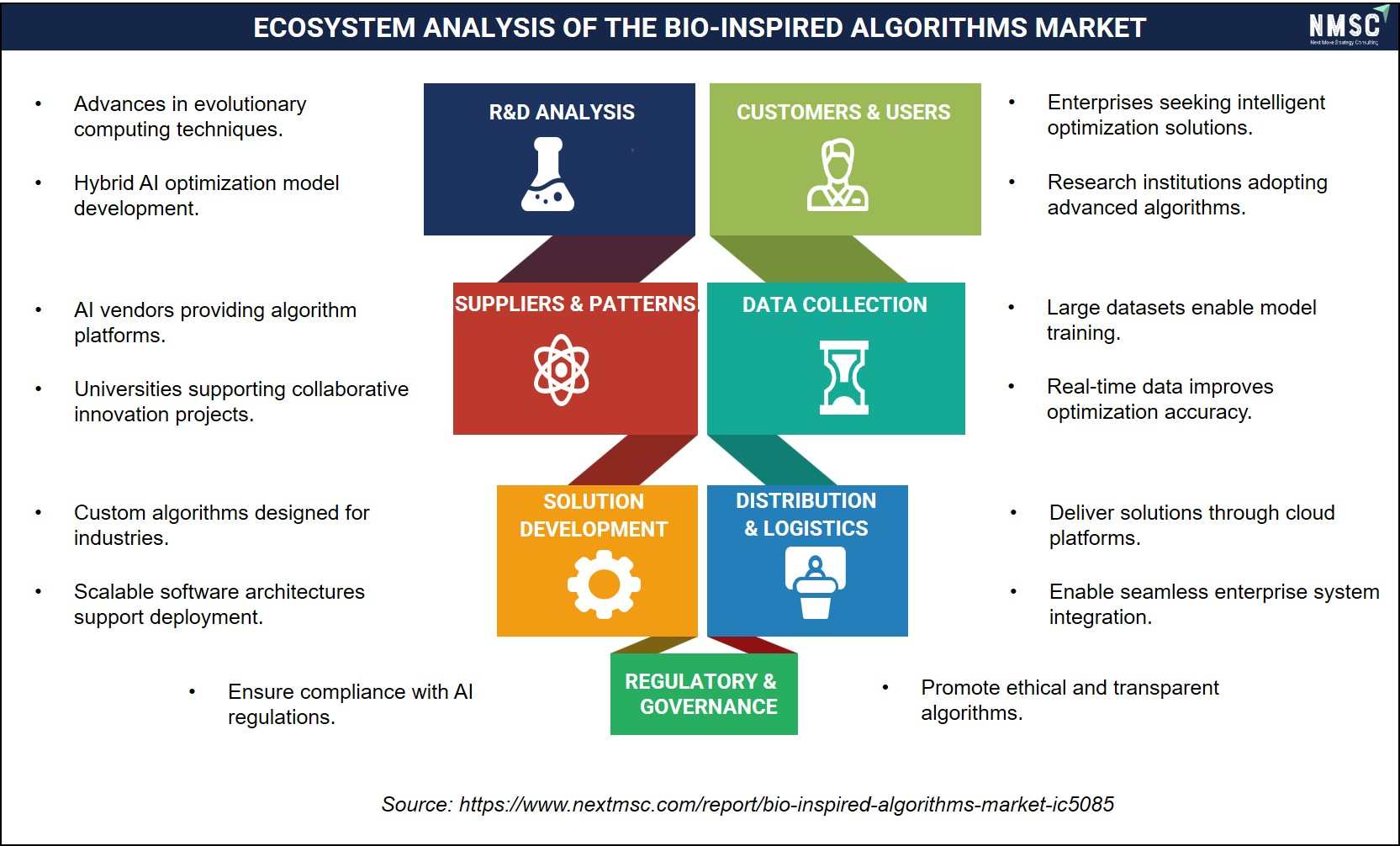
The ecosystem analysis of the Bio-Inspired Algorithms market illustrates the collaborative network that drives innovation, development, and commercialization of advanced optimization technologies. Research and development activities form the foundation of the ecosystem, supported by technology providers, academic institutions, and algorithm developers. Data collection and processing capabilities enable the training and refinement of bio-inspired models, while solution development transforms research into practical applications across industries. Distribution channels facilitate market reach and adoption among enterprises, research organizations, and end users. Regulatory and governance frameworks ensure responsible AI deployment, data security, and ethical standards, supporting sustainable market growth and technological advancement.
What Are the Key Market Drivers, Breakthroughs, and Investment Opportunities that Will Shape the Bio-Inspired Algorithms Market Industry in the Next Decade?
|
Drivers / Trends / Restraints |
(+/-) % Impact on CAGR Forecast |
Geographic Relevance |
Impact Timeline |
|
Surge in AI-Driven Industrial Optimization Demand |
+2.4% |
Global (led by North America, Asia-Pacific) |
2025–2030 |
|
Neuromorphic Computing Hardware Commercialization |
+1.8% |
North America, Europe, Japan |
2026–2035 |
|
Hybrid Bio-Inspired Algorithm Adoption in Manufacturing |
+1.5% |
Asia-Pacific, Europe, North America |
2025–2030 |
|
Cloud-Native SaaS Delivery of Optimization Services |
+1.3% |
North America, Europe, Australia |
2025–2032 |
|
Edge AI Expansion in Autonomous Systems |
+1.2% |
North America, Asia-Pacific |
2026–2035 |
|
Explainability and Regulatory Compliance Requirements |
-1.1% |
Europe, North America |
Ongoing |
|
High Customization Cost and Implementation Complexity |
-0.9% |
SMB, Mid-market globally |
2025–2028 |
|
Limited Algorithmic Expertise in Target Industries |
-0.6% |
MEA, Latin America |
Ongoing |
|
Healthcare Life Sciences Drug Discovery Applications |
+2.0% |
Global |
2026–2035 |
|
Defense and Aerospace Neuromorphic Investment Programs |
+1.6% |
North America, Europe |
2025–2032 |
What Are the Growth Drivers of the Bio-Inspired Algorithms Market?
How Is the Global Surge in AI-Driven Industrial Optimization Driving Bio-Inspired Algorithms Market Growth?
Artificial intelligence-driven industrial optimization is the primary growth catalyst for the Bio-Inspired Algorithms Market. Manufacturing, logistics, and energy enterprises increasingly require optimization capabilities that can handle non-linear, multi-objective, and dynamically constrained problems intractable to classical mathematical programming approaches. Based on NMSC's research, we found that the U.S. Department of Energy's Advanced Manufacturing Office has documented that manufacturing scheduling inefficiencies cost U.S. industry approximately USD 8 billion annually, creating durable demand for bio-inspired optimization that can address combinatorial scheduling at scale. This demand is generating sustained investment in genetic algorithm and swarm intelligence commercial platforms across every major industrial sector.
How Is Neuromorphic Computing Commercialization Expanding the Bio-Inspired Algorithms Market?
The commercialization of neuromorphic computing hardware is creating a structurally new hardware-software market layer within the Bio-Inspired Algorithms Market. Intel's Hala Point neuromorphic system, unveiled in 2024, integrates over one billion artificial neurons within a datacenter-scale deployment and is specifically designed to accelerate spiking neural network inference for optimization and autonomous systems applications. Our analysis shows that DARPA's Neuromorphic Sensing and Processing program has committed over USD 200 million to next-generation neuromorphic chip development. This defense-funded research pipeline is accelerating the commercialization of neuromorphic computing hardware, directly creating demand for the neural-inspired algorithm software required to leverage these architectures.
How Does Growing Complexity in Drug Discovery and Genomics Create Structural Demand in the Bio-Inspired Algorithms Market?
Drug discovery and genomic research represent one of the fastest-growing end-use demand centers in the Bio-Inspired Algorithms Market. Genetic algorithm-based molecular docking and evolutionary programming techniques for compound library screening are enabling pharmaceutical researchers to explore chemical search spaces many orders of magnitude larger than traditional high-throughput screening methods allow. Our assessment indicates that the U.S. National Institutes of Health (NIH) has directed significant computational biology funding toward evolutionary and swarm-based optimization methods for protein structure prediction and pharmacological modeling, affirming the academic and clinical legitimacy of bio-inspired approaches in life sciences research pipelines globally.
What Are the Growth Inhibitors of the Bio-Inspired Algorithms Market?
How Do Regulatory Explainability Requirements Constrain Bio-Inspired Algorithm Adoption in Regulated Industries?
Regulatory explainability mandates represent a structural constraint on the Bio-Inspired Algorithms Market, particularly within financial services, healthcare, and critical infrastructure deployments. The EU AI Act classifies high-risk AI systems, including optimization algorithms used in credit scoring, medical diagnosis, and infrastructure management, as subject to mandatory transparency, auditability, and human oversight requirements. Through our market assessment, we observed that many evolutionary and swarm intelligence algorithms produce solutions through emergent, non-deterministic search processes that are inherently difficult to explain in human-interpretable terms, creating compliance friction that extends procurement cycles and limits adoption among regulated enterprise buyers without dedicated algorithmic explainability tooling.
How Does High Customization Cost and Implementation Complexity Limit Bio-Inspired Algorithms Market Penetration?
Despite growing commercial interest, the Bio-Inspired Algorithms Market faces a significant adoption barrier in the high cost and complexity of customizing bio-inspired optimization solutions for domain-specific industrial applications. Parameter tuning, fitness function engineering, constraint encoding, and solution validation require deep operations research expertise that remains scarce outside large enterprises and specialized consulting firms. Based on our market evaluation, we noticed that the U.S. Bureau of Labor Statistics identifies Operations Research Analysts as among the most in-demand professional categories, with a documented 23% projected employment growth from 2021 to 2031, reflecting persistent talent scarcity that directly limits deployment velocity for bio-inspired optimization projects across SMB and mid-market buyers.
What Are the Growth Opportunities in the Bio-Inspired Algorithms Market?
How Does the Expansion of Smart Grid and Energy Management Applications Create a Multi-Billion Dollar Opportunity in the Bio-Inspired Algorithms Market?
Smart grid infrastructure modernization represents a high-value growth opportunity for the Bio-Inspired Algorithms Market. Power grid operators face exponentially complex multi-objective optimization challenges encompassing renewable energy source dispatch, demand response management, storage charge scheduling, and fault tolerance routing across continent-scale networks. From our research, we found that the U.S. Department of Energy's Grid Modernization Initiative has allocated over USD 3 billion to smart grid technology deployment, creating structured procurement demand for advanced optimization software. Bio-inspired algorithms, particularly particle swarm optimization and differential evolution, are among the most computationally effective techniques for real-time grid optimization under variable renewable generation conditions.
How Is the Proliferation of Autonomous Systems Creating a Structural Growth Opportunity in the Bio-Inspired Algorithms Market?
Autonomous vehicles, delivery drones, and autonomous maritime systems collectively represent one of the most significant structural opportunities in the Bio-Inspired Algorithms Market. Path planning, collision avoidance, and multi-vehicle coordination in dynamic environments require real-time optimization capabilities that bio-inspired algorithms are uniquely suited to deliver. Based on NMSC's research, we found that the U.S. Federal Aviation Administration's UAS Traffic Management program, overseen by the FAA, is creating standardized frameworks for drone swarm coordination that explicitly require autonomous routing and conflict resolution capabilities enabled by swarm intelligence algorithms. This government-driven demand will compound with private sector autonomous logistics investment through 2035.
How Does the Growing Adoption of Bio-Inspired Algorithms in Financial Portfolio Optimization Present a Commercial Opportunity?
Financial services represent an increasingly important and commercially attractive opportunity for the Bio-Inspired Algorithms Market. Genetic algorithms and hybrid evolutionary-neural frameworks are being applied to multi-asset portfolio optimization, algorithmic trading strategy discovery, credit risk model calibration, and insurance pricing under non-linear constraint sets that defeat traditional mean-variance optimization approaches. Our analysis shows that the U.S. Securities and Exchange Commission (SEC) has acknowledged algorithmic trading systems in its regulatory oversight framework, while the Basel III and Solvency II regulatory regimes create compliance-driven demand for robust multi-objective risk optimization tooling within banking and insurance portfolios. This regulatory tailwind is converting financial services into a high-growth vertical for bio-inspired algorithm vendors through 2035.
How Is the Bio-Inspired Algorithms Market Segmented in This Report, and What Are the Key Insights from the Segmentation Analysis?
How Does Offering Type Segmentation Reveal the Structural Composition of the Bio-Inspired Algorithms Market?
|
Offering Type Segment |
2025 (USD Bn) |
2035 (USD Bn) |
CAGR (%) |
|
Software |
3.2 |
12.8 |
14.9% |
|
– Standalone Software |
1.9 |
7.4 |
14.6% |
|
– Embedded Software |
1.3 |
5.4 |
15.3% (est.) |
|
Services |
1.6 |
6.8 |
15.6% |
|
– Custom Development |
0.7 |
2.8 |
14.9% |
|
– Integration |
0.4 |
1.7 |
15.6% |
|
– Managed Services |
0.3 |
1.6 |
18.4% |
|
– Support and Training |
0.2 |
0.7 |
13.3% |
Based on our analysis of commercial bio-inspired algorithm deployment patterns, we observed that the Bio-Inspired Algorithms Market is structured across Software and Services as its two primary offering categories. Software dominates with USD 3.2 billion in 2025, reflecting enterprise preference for purpose-built optimization tools deployable within existing EDA, simulation, and enterprise analytics environments. Standalone Software leads software sub-segments with USD 1.9 billion, encompassing dedicated optimization platforms from vendors including Altair, MathWorks, and LINDO Systems. Embedded Software is the fastest-growing software sub-segment at a CAGR of approximately 15.3%, as bio-inspired optimization engines are natively integrated within industrial automation, EDA, and autonomous systems platforms from Siemens, Cadence, and Dassault Systemes.
Which Algorithm Families Are Driving the Highest Revenue and Growth in the Bio-Inspired Algorithms Market?
|
Algorithm Family Segment |
2025 (USD Bn) |
2035 (USD Bn) |
CAGR (%) |
|
Swarm Intelligence |
1.4 |
5.4 |
14.5% |
|
– Ant Colony Optimization |
0.5 |
1.9 |
14.3% |
|
– Particle Swarm Optimization |
0.4 |
1.6 |
14.9% |
|
– Bee Colony Optimization |
0.2 |
0.8 |
14.9% |
|
– Human Swarm Intelligence |
0.1 |
0.6 |
19.6% (est.) |
|
– Other Swarm Intelligence |
0.2 |
0.5 |
9.6% |
|
Evolutionary Algorithms |
1.6 |
6.2 |
14.5% |
|
– Genetic Algorithm |
0.8 |
3.1 |
14.5% |
|
– Genetic Programming |
0.3 |
1.2 |
14.9% |
|
– Evolution Strategies |
0.2 |
0.8 |
14.9% |
|
– Differential Evolution |
0.2 |
0.8 |
14.9% |
|
– Other Evolutionary Algorithms |
0.1 |
0.3 |
11.6% |
|
Neural Inspired Algorithms |
0.9 |
4.8 |
18.3% |
|
– Spiking Neural Networks |
0.4 |
2.2 |
18.6% |
|
– Neuromorphic Computing |
0.3 |
1.8 |
19.6% |
|
– Other Neural Inspired Algorithms |
0.2 |
0.8 |
14.9% |
|
Hybrid Bio-Inspired Algorithms |
0.7 |
3.0 |
15.6% |
|
– Swarm and Evolutionary |
0.3 |
1.3 |
15.8% |
|
– Swarm and Neural |
0.2 |
0.9 |
16.3% |
|
– Evolutionary and Neural |
0.1 |
0.6 |
19.6% (est.) |
|
– Other Hybrid Bio-Inspired Algorithms |
0.1 |
0.2 |
7.2% |
|
Other Bio-Inspired Algorithms |
0.2 |
0.2 |
0.0% |
Through NMSC's assessment, we found that the Bio-Inspired Algorithms Market is segmented across five primary algorithm families: Swarm Intelligence, Evolutionary Algorithms, Neural Inspired Algorithms, Hybrid Bio-Inspired Algorithms, and Other Bio-Inspired Algorithms. Evolutionary Algorithms hold the largest share at USD 1.6 billion in 2025, led by Genetic Algorithms which benefit from decades of commercial deployment across engineering design, financial modeling, and production scheduling. Swarm Intelligence, particularly Ant Colony Optimization and Particle Swarm Optimization, represents the second-largest family with strong adoption in logistics, semiconductor routing, and telecommunications network optimization. Neural Inspired Algorithms constitute the fastest-growing algorithm family at a CAGR of 18.3%, driven by Spiking Neural Networks and Neuromorphic Computing sub-segments benefiting from Intel's Loihi and IBM's NorthPole chip investments. Hybrid Bio-Inspired Algorithms are experiencing growing commercial traction as practitioners combine evolutionary and swarm paradigms to address multi-objective optimization challenges in complex industrial environments.
How Do Functional Applications Define Market Demand Distribution in the Bio-Inspired Algorithms Market?
|
Function Segment |
2025 (USD Bn) |
2035 (USD Bn) |
CAGR (%) |
|
Optimization |
1.7 |
6.7 |
14.7% |
|
– Design Exploration |
0.7 |
2.7 |
14.5% |
|
– Routing |
0.6 |
2.3 |
14.4% |
|
– Scheduling |
0.6 |
2.3 |
14.4% |
|
– Clustering |
0.3 |
1.2 |
14.9% |
|
Forecasting and Decisioning |
0.4 |
1.9 |
16.9% |
|
Coordination and Control |
0.3 |
1.4 |
16.7% |
|
Search and Screening |
0.2 |
0.8 |
14.9% |
|
Other Functions |
0.0 |
0.3 |
N/A |
Based on our market evaluation, we noticed that the Bio-Inspired Algorithms Market spans nine distinct functional application domains, with Optimization commanding the dominant share at USD 1.7 billion in 2025. Optimization encompasses engineering design optimization, production process optimization, and financial portfolio optimization, reflecting the foundational utility of bio-inspired algorithms across complex constrained problem environments. Design Exploration, at USD 0.7 billion, is the second-largest function, heavily adopted within EDA and mechanical engineering software suites from Cadence, Synopsys, and Altair. Routing and Scheduling functions each generate approximately USD 0.6 billion in 2025, with logistics, semiconductor fab, and airline crew scheduling representing primary commercial applications. Forecasting and Decisioning is the fastest-growing function at a CAGR of 16.9% from 2026 to 2035, as bio-inspired decision frameworks penetrate financial services and healthcare operations.
How Does Deployment Mode Shape Revenue Distribution Across the Bio-Inspired Algorithms Market?
|
Deployment Segment |
2025 (USD Bn) |
2035 (USD Bn) |
CAGR (%) |
|
Cloud |
2.1 |
9.1 |
15.8% |
|
On-Premises |
1.5 |
5.2 |
13.3% |
|
Edge |
0.6 |
3.5 |
19.3% |
|
Hybrid |
0.6 |
1.8 |
11.6% |
Our analysis shows that the Bio-Inspired Algorithms Market is segmented across Cloud, On-Premises, Edge, and Hybrid deployment modes. Cloud is the leading deployment mode with USD 2.1 billion in 2025, benefiting from the elastic computational scalability required for parallelized evolutionary algorithm population evaluations and swarm simulation workloads. On-Premises deployments remain significant at USD 1.5 billion, particularly within defense, semiconductor, and critical infrastructure sectors with strict data sovereignty requirements. Edge deployment is the fastest-growing mode at a CAGR of 19.3%, as bio-inspired path planning, swarm coordination, and adaptive control algorithms are embedded within autonomous vehicle, industrial robot, and smart grid edge controllers that require deterministic, low-latency operation without cloud connectivity dependency.
How Are Distribution Channels Reshaping Go-to-Market Strategies in the Bio-Inspired Algorithms Market?
|
Sales Channel Segment |
2025 (USD Bn) |
2035 (USD Bn) |
CAGR (%) |
|
Direct |
2.4 |
9.4 |
14.6% |
|
Partner and Integrator |
1.1 |
4.4 |
14.9% |
|
Reseller |
0.6 |
2.3 |
14.4% |
|
Marketplace |
0.5 |
2.8 |
18.8% |
|
Tender and Procurement |
0.2 |
0.7 |
13.3% |
Our findings suggest that the Bio-Inspired Algorithms Market distributes revenue across Direct, Partner and Integrator, Reseller, Marketplace, and Tender and Procurement channels. Direct sales dominates at USD 2.4 billion in 2025, reflecting the technical complexity and high average contract values associated with enterprise bio-inspired algorithm deployments requiring dedicated pre-sales engineering, solution customization, and ongoing customer success support. Partner and Integrator channels, at USD 1.1 billion, are critical for reaching domain-specific industrial buyers through EDA, PLM, and supply chain software ecosystem partners. Marketplace is the fastest-growing channel at a CAGR of 18.8%, as vendors increasingly list cloud-native bio-inspired optimization APIs and managed services on AWS, Azure, and Siemens Xcelerator digital marketplaces enabling frictionless enterprise procurement.
Which Industry Verticals Generate the Most Value in the Bio-Inspired Algorithms Market?
|
End-Use Industry Segment |
2025 (USD Bn) |
2035 (USD Bn) |
CAGR (%) |
|
Aerospace and Defense |
0.9 |
3.5 |
14.5% |
|
Manufacturing and Warehousing |
1.1 |
4.4 |
14.9% |
|
Transportation and Logistics |
0.7 |
2.8 |
14.9% |
|
Agriculture |
0.2 |
0.9 |
16.3% |
|
Energy and Utilities |
0.5 |
2.2 |
16.0% |
|
Maritime and Offshore |
0.1 |
0.4 |
14.9% |
|
Financial Services |
0.5 |
2.0 |
14.9% |
|
Healthcare and Life Sciences |
0.4 |
2.4 |
19.6% |
|
Public Sector |
0.2 |
0.7 |
13.3% |
|
Retail and Consumer |
0.1 |
0.5 |
17.5% |
|
Technology and Telecom |
0.1 |
0.5 |
17.5% |
|
Other Industries |
0.0 |
0.3 |
N/A |
Based on NMSC's research, we found that the Bio-Inspired Algorithms Market serves twelve distinct end-use industry verticals. Manufacturing and Warehousing is the dominant sector at USD 1.1 billion in 2025, deploying bio-inspired algorithms across production scheduling, robotic path planning, inventory optimization, and quality control screening. Aerospace and Defense is the second-largest vertical at USD 0.9 billion, driven by defense-funded neuromorphic computing research, UAV swarm coordination, and satellite constellation scheduling applications. Transportation and Logistics at USD 0.7 billion represents a mature and growing market for ant colony and swarm-based route optimization. Healthcare and Life Sciences is the fastest-growing vertical at a CAGR of 19.6% through 2035, advancing from USD 0.4 billion, propelled by genetic algorithm-based drug discovery, protein folding optimization, and clinical trial design applications funded through NIH and major pharmaceutical pipeline investments.
Regional Outlook
Geographic Performance Snapshot
|
Region |
2025 (USD Bn) |
2035 (USD Bn) |
CAGR (%) |
Key Driver |
|
North America |
2.0 |
8.1 |
15.0% |
Defense neuromorphic R&D, EDA leadership |
|
Europe |
1.1 |
4.4 |
14.9% |
EU AI Act compliance, advanced manufacturing |
|
Asia-Pacific |
1.1 |
5.6 |
17.8% |
China AI strategy, Japan manufacturing AI |
|
Middle East & Africa |
0.3 |
0.8 |
10.3% |
Vision 2030 smart city programs |
|
Latin America |
0.3 |
0.7 |
8.8% |
Digital economy expansion, fintech growth |
North America Bio-Inspired Algorithms Market
North America is the global leader in the Bio-Inspired Algorithms Market, accounting for USD 2.0 billion in 2025 and forecast to reach USD 8.1 billion by 2035 at a CAGR of 15.0%. The region benefits from the highest concentration of operations research software vendors, EDA market leaders, and defense-funded neuromorphic computing research programs. DARPA's Neuromorphic Sensing and Processing program and the U.S. Air Force Research Laboratory's autonomous systems investments sustain strong government-driven demand. The mature venture capital ecosystem and deep enterprise technology budgets across Aerospace, Financial Services, and Healthcare verticals underpin sustained market leadership throughout the forecast period.
U.S. Bio-Inspired Algorithms Market
Based on our analysis, we found that the United States represents approximately 78% of North American Bio-Inspired Algorithms Market revenue in 2025, anchored by the global headquarters of key vendors including Siemens EDA, Synopsys, The MathWorks, Altair Engineering, and Unanimous AI. U.S. government demand is institutionalized through DARPA research programs, Department of Energy grid optimization initiatives, and FAA autonomous systems frameworks. The U.S. NSF and NIH fund extensive academic bio-inspired algorithm research that feeds a robust commercial pipeline. Financial services firms on Wall Street are deploying genetic algorithms and hybrid evolutionary frameworks for quantitative portfolio optimization, creating strong private sector demand beyond defense and manufacturing.
Canada Bio-Inspired Algorithms Market
Through our analysis, Canada represents approximately 14% of North American Bio-Inspired Algorithms Market revenue in 2025. Canadian adoption is concentrated in manufacturing optimization for the automotive and aerospace supply chain, financial services portfolio optimization for major banks, and energy grid management for provincial utilities. The Government of Canada's Pan-Canadian Artificial Intelligence Strategy, administered through CIFAR, funds bio-inspired algorithm research at leading universities including the University of Toronto and Mila. Canada's strong mining and natural resources sector creates niche but growing demand for bio-inspired scheduling and route optimization in remote industrial operations.
Mexico Bio-Inspired Algorithms Market
From our assessment, Mexico represents approximately 8% of North American Bio-Inspired Algorithms Market revenue in 2025, with the fastest growth trajectory in the region driven by manufacturing sector digitization. Mexico's automotive manufacturing corridor, hosting plants for Volkswagen, General Motors, and BMW, creates demand for bio-inspired production scheduling and logistics optimization tools. Government investment under Mexico's National Development Plan is driving digital transformation in manufacturing and energy sectors. The growing nearshoring wave from Asian manufacturers is also creating demand for supply chain intelligence tools incorporating swarm intelligence and evolutionary optimization capabilities across Mexico's industrial base.
Europe Bio-Inspired Algorithms Market
Europe is the second-largest region in the Bio-Inspired Algorithms Market, contributing USD 1.1 billion in 2025 and projected to reach USD 4.4 billion by 2035 at a CAGR of 14.9%. Europe's regulatory environment, shaped by the EU AI Act and Horizon Europe research funding, simultaneously drives compliance-driven adoption of auditable bio-inspired optimization tools and funds fundamental algorithm research. Germany's advanced manufacturing sector, the UK's financial services industry, and France's aerospace and defense ecosystem represent the three largest demand centers. European vendors including ESTECO SpA, Dassault Systemes, and Siemens contribute significantly to the regional supply-side ecosystem.
U.K. Bio-Inspired Algorithms Market
Based on our analysis, the United Kingdom is Europe's largest national market for bio-inspired algorithms, representing approximately 22% of European revenue in 2025. UK adoption is concentrated in financial services optimization, aerospace design exploration, and telecommunications network routing. The UK government's National AI Strategy and Innovate UK programs fund applied bio-inspired algorithm research. Post-Brexit regulatory flexibility allows the UK to experiment with AI governance frameworks distinct from EU mandates, potentially accelerating adoption in financial services. Rolls-Royce, BAE Systems, and major UK banks are significant enterprise buyers of evolutionary and swarm intelligence tools.
Germany Bio-Inspired Algorithms Market
Based on our market evaluation, Germany is Europe's second-largest bio-inspired algorithms market, driven by the world's most advanced automotive manufacturing industry and a deeply established operations research software ecosystem. German manufacturers including BMW, Mercedes-Benz, and Volkswagen deploy genetic algorithms and particle swarm optimization for production scheduling, toolpath optimization, and supply chain network design. Siemens AG, headquartered in Munich, contributes both as a platform vendor and enterprise buyer. The German government's BMBF research funding for AI and autonomy supports sustained algorithm development investment. ESTECO's strong German presence in engineering design optimization further anchors the regional market.
France Bio-Inspired Algorithms Market
Through our analysis, France is Europe's third-largest market for bio-inspired algorithms, characterized by strong aerospace, defense, and energy sector adoption. Airbus, Thales, and Safran are significant enterprise buyers of evolutionary algorithm-based design exploration tools for aircraft component optimization and mission planning systems. EDF and Engie deploy bio-inspired optimization for nuclear plant maintenance scheduling and grid dispatch optimization. The French government's France 2030 plan funds AI and advanced optimization research through ANR and Bpifrance. Dassault Systemes, headquartered in Velizy-Villacoublay, integrates bio-inspired optimization within its CATIA and SIMULIA engineering platforms serving global aerospace and industrial customers.
Italy Bio-Inspired Algorithms Market
From our assessment, Italy represents a growing mid-tier market in the European Bio-Inspired Algorithms Market, with adoption concentrated in automotive manufacturing, energy, and industrial machinery sectors. Italian automotive suppliers and Ferrari, along with Fiat Chrysler supply chain operations, deploy genetic algorithm-based production optimization tools. Eni and Enel deploy bio-inspired scheduling and routing algorithms for energy grid and pipeline network management. The PNRR digital transformation funds are supporting Italian industrial AI adoption. Italy's strong mechanical engineering and robotics sector creates steady demand for bio-inspired path planning and coordination algorithms.
Spain Bio-Inspired Algorithms Market
Based on our evaluation, Spain demonstrates growing momentum in the Bio-Inspired Algorithms Market through financial services, energy, and logistics sector adoption. BBVA and Santander deploy evolutionary algorithm-based credit risk models and algorithmic trading systems. Repsol and Iberdrola use bio-inspired optimization for refinery scheduling and renewable energy dispatch. Spain's Agenda Digital España 2026 supports digital industrial transformation. The Spanish logistics sector, anchored by major port operators in Valencia and Barcelona, creates demand for swarm intelligence-based container routing and fleet management optimization tools deployed within transportation network management systems.
Sweden Bio-Inspired Algorithms Market
Through our analysis, Sweden is a high-per-capita bio-inspired algorithm consumer, anchored by its advanced telecommunications, automotive, and heavy manufacturing sectors. Ericsson deploys bio-inspired network optimization algorithms for 5G radio resource management and antenna beam steering. Volvo and SSAB use evolutionary design tools for vehicle and structural component optimization. Sweden's Digital Strategy and high R&D intensity support strong academic-industry collaboration on bio-inspired computing. The Swedish Energy Agency funds smart grid optimization research where particle swarm algorithms are applied to renewable integration challenges across Sweden's electricity transmission network.
Denmark Bio-Inspired Algorithms Market
Based on our analysis, Denmark is among the most advanced digital economies in Europe within the Bio-Inspired Algorithms Market. Vestas Wind Systems deploys bio-inspired optimization for wind turbine placement, maintenance scheduling, and energy yield maximization. Maersk uses swarm intelligence routing tools for container shipping fleet management. Denmark's consistently high DESI ranking reflects deep digital infrastructure that supports cloud-delivered optimization services. The Danish government's life sciences sector creates demand for genetic algorithm-based drug screening and clinical trial optimization, while Copenhagen's fintech ecosystem generates financial portfolio optimization demand.
Finland Bio-Inspired Algorithms Market
From our assessment, Finland's Bio-Inspired Algorithms Market is characterized by Nokia's dominant role as both a major enterprise buyer and ecosystem driver. Nokia deploys bio-inspired network topology optimization and spectrum scheduling algorithms within its 5G infrastructure product portfolio. Finland's strong paper and mining industries create demand for process optimization and equipment scheduling bio-inspired tools. VTT Technical Research Centre of Finland conducts applied bio-inspired computing research funded by Business Finland. The Finnish government's MyData initiative aligns with transparent algorithmic decision-making principles increasingly embedded within bio-inspired algorithm platforms under EU AI Act requirements.
Netherlands Bio-Inspired Algorithms Market
Based on NMSC's research, the Netherlands is a strategically important market in the European Bio-Inspired Algorithms Market, serving as a logistics and technology hub. The Port of Rotterdam, the world's largest European port by cargo volume, deploys ant colony and swarm intelligence optimization for container terminal scheduling, berth allocation, and inland transportation routing. Shell deploys bio-inspired optimization for refinery process scheduling and energy management. Dutch financial institutions including ING and ABN AMRO use evolutionary algorithms for credit risk and trading strategy optimization. The Netherlands hosts several operational research and AI research groups at TU Delft and CWI that contribute to the commercial algorithm ecosystem.
Rest of Europe Bio-Inspired Algorithms Market
The Rest of Europe segment, encompassing Poland, Belgium, Switzerland, Austria, Portugal, Czech Republic, and remaining European nations, represents approximately 28% of European Bio-Inspired Algorithms Market revenue in 2025. Switzerland is a significant demand center through pharmaceutical companies such as Novartis and Roche deploying genetic algorithm-based drug discovery and compound screening platforms. Poland and Czech Republic are emerging industrial adopters through their growing automotive manufacturing supply chains. Belgium's chemical and logistics sectors create operational optimization demand. Austria's engineering and machinery sectors deploy evolutionary design tools within established CAD and simulation software environments.
Asia-Pacific Bio-Inspired Algorithms Market
Asia-Pacific is the fastest-growing major region in the Bio-Inspired Algorithms Market, advancing from USD 1.1 billion in 2025 to USD 5.6 billion by 2035 at a CAGR of 17.8%. China's national AI strategy, Japan's advanced manufacturing robotics leadership, South Korea's semiconductor and electronics ecosystem, and India's expanding deep-tech investment are collectively driving regional market expansion. Government-funded national AI programs across China, Japan, South Korea, and Australia are creating structured demand for optimization research and commercial bio-inspired algorithm platform deployment across both public and private sector organizations.
China Bio-Inspired Algorithms Market
Based on our analysis, China is the largest Asia-Pacific market for bio-inspired algorithms and one of the fastest-growing globally at a CAGR of 19.2%. China's New Generation AI Development Plan funds research and commercial deployment of bio-inspired optimization across smart manufacturing, autonomous vehicles, smart city management, and financial risk systems. State-owned enterprises in energy, rail, and aerospace are significant institutional buyers. Huawei's neuromorphic chip research and China's national integrated circuit industry create domestic demand for bio-inspired algorithm software for chip design optimization. The Made in China 2025 initiative has institutionalized intelligent manufacturing optimization across Chinese industrial policy.
India Bio-Inspired Algorithms Market
Through our market assessment, we observed that India is the second-fastest-growing national market in Asia-Pacific for bio-inspired algorithms, advancing at a CAGR of 18.4%. India's deep-tech startup ecosystem, NASSCOM-reported growth in AI and operations research companies, and expanding pharmaceutical sector create multi-vertical demand for bio-inspired optimization tools. IT service firms including TCS, Infosys, and Wipro are deploying bio-inspired algorithm capabilities within client optimization and analytics engagements globally. The Indian government's National AI Mission and AIM program support bio-inspired computing research. India's pharma sector, particularly in Hyderabad and Pune, deploys genetic algorithm-based compound screening for generics manufacturing.
Japan Bio-Inspired Algorithms Market
From our assessment, Japan is the largest and most mature Asia-Pacific market for bio-inspired algorithms outside of China, supported by world-class manufacturing, robotics, and semiconductor industries. Toyota, Honda, and Mitsubishi Heavy Industries deploy evolutionary algorithms and swarm intelligence for vehicle production scheduling, robot motion planning, and supply chain optimization. NEC and Fujitsu conduct neuromorphic computing research applicable to spiking neural network-based optimization. Japan's Ministry of Economy, Trade and Industry funds AI and intelligent manufacturing research. Japan's Society 5.0 vision institutionalizes intelligent optimization across infrastructure, manufacturing, and social systems management.
South Korea Bio-Inspired Algorithms Market
Based on our analysis, South Korea demonstrates high bio-inspired algorithm adoption, supported by its dominant semiconductor, electronics, and automotive manufacturing sectors. Samsung Semiconductor and SK Hynix deploy genetic algorithm-based semiconductor process optimization and EDA tools for chip layout. Hyundai Motor uses evolutionary design exploration for powertrain and vehicle structure optimization. Korea's National AI Strategy and Korea-AI initiative fund applied bio-inspired computing research. The Korea Institute of Science and Technology (KIST) conducts neuromorphic computing research with direct commercial implications for spiking neural network algorithm deployments across autonomous systems and industrial robotics applications in South Korea.
Taiwan Bio-Inspired Algorithms Market
Based on our market evaluation, Taiwan's Bio-Inspired Algorithms Market is concentrated within semiconductor manufacturing optimization, electronics supply chain management, and EDA software deployment. TSMC, the world's largest contract chipmaker, deploys genetic algorithm-based wafer scheduling and process parameter optimization extensively within its fabrication facilities. MediaTek and Realtek use EDA tools embedding bio-inspired routing algorithms for chip interconnect optimization. Taiwan's government-supported Industrial Technology Research Institute (ITRI) conducts bio-inspired algorithm research for smart manufacturing applications. The concentration of high-technology manufacturers creates one of the world's highest per-company bio-inspired algorithm adoption rates in the Asia-Pacific region.
Indonesia Bio-Inspired Algorithms Market
From our assessment, Indonesia is an emerging but rapidly growing market for bio-inspired algorithms within Southeast Asia, driven by fintech expansion, e-commerce logistics scaling, and government digital transformation programs. Tokopedia and Bukalapak deploy swarm intelligence-based logistics routing and warehouse optimization. Indonesian banks including Bank Mandiri and BCA are investigating bio-inspired optimization for credit scoring and financial product recommendation. The government's Making Indonesia 4.0 initiative supports intelligent manufacturing optimization adoption. Indonesia's large logistics complexity, spanning thousands of islands, creates a particularly high-value use case for ant colony and swarm-based multi-modal routing optimization systems.
Vietnam Bio-Inspired Algorithms Market
Through our analysis, Vietnam is an emerging bio-inspired algorithm market, primarily driven by its rapidly expanding electronics manufacturing sector, growing fintech industry, and logistics optimization demands arising from supply chain diversification investments. Samsung's Vietnamese manufacturing operations and the growing electronics assembly sector create demand for production scheduling and quality optimization tools. Vietnamese banks and e-commerce platforms are early adopters of swarm intelligence-based logistics and credit optimization. The Vietnamese government's National Strategy on Research, Development and Application of Artificial Intelligence to 2030 supports AI adoption across industrial and financial services sectors.
Australia Bio-Inspired Algorithms Market
Based on our analysis, Australia is the most mature bio-inspired algorithm market in Southeast Asia and Oceania, with strong adoption in mining, energy, financial services, and defense. Rio Tinto and BHP Billiton deploy genetic algorithm-based mine planning and equipment scheduling optimization. Australian financial institutions including the Commonwealth Bank deploy evolutionary algorithm-based fraud detection and credit risk modeling. The Defence Science and Technology Group funds neuromorphic computing and autonomous systems research directly relevant to bio-inspired algorithm commercialization. The Australian Research Council funds applied operations research and bio-inspired computing programs through its Linkage grant scheme supporting industry-university collaborative research.
Philippines Bio-Inspired Algorithms Market
From our assessment, the Philippines represents an early-stage but developing market for bio-inspired algorithms in Southeast Asia, primarily driven by its large business process outsourcing sector, growing digital banking industry, and government e-services modernization. Philippine banks and insurance companies are beginning to explore genetic algorithm-based risk modeling and operations optimization. Logistics firms serving the archipelagic geography are natural adopters of swarm intelligence-based multi-modal routing optimization. The government's National AI Roadmap supports AI adoption across financial services, agriculture, and public health sectors where bio-inspired optimization can deliver measurable efficiency improvements.
Malaysia Bio-Inspired Algorithms Market
Based on our analysis, Malaysia is a growing mid-tier market in the Southeast Asian Bio-Inspired Algorithms Market, driven by government-led digital transformation, semiconductor manufacturing, and financial services modernization. Intel and Infineon's Malaysian semiconductor operations create demand for EDA and process optimization bio-inspired tools. Maybank and CIMB are exploring genetic algorithm-based credit risk and portfolio optimization capabilities. Malaysia's MyDigital economy blueprint supports cloud-delivered optimization services. Petronas deploys bio-inspired optimization for refinery scheduling and offshore logistics planning across its extensive Malaysian and international oil and gas operations.
Rest of Asia-Pacific Bio-Inspired Algorithms Market
The Rest of Asia-Pacific, including Singapore, Thailand, Bangladesh, New Zealand, and smaller regional markets, collectively represents approximately 18% of Asia-Pacific Bio-Inspired Algorithms Market revenue in 2025. Singapore is a disproportionately significant market as a regional AI hub, hosting headquarters of regional operations for major bio-inspired algorithm vendors and driving financial services and logistics optimization demand. Thailand's growing automotive and electronics manufacturing sector creates demand for production scheduling optimization. New Zealand's agricultural technology sector is an emerging adopter of swarm intelligence for precision agriculture applications. The Monetary Authority of Singapore's regulatory support for AI in financial services further accelerates regional adoption.
Middle East and Africa Bio-Inspired Algorithms Market
The Middle East and Africa represent the fourth-largest region in the Bio-Inspired Algorithms Market, advancing from USD 0.3 billion in 2025 to USD 0.8 billion by 2035 at a CAGR of 10.3%. Vision-driven national transformation programs in Saudi Arabia and the UAE, along with Israel's advanced technology sector, are the primary growth engines. Smart city infrastructure projects, energy grid modernization, and logistics network optimization across the Gulf Cooperation Council are creating structured procurement demand for bio-inspired algorithm platforms capable of addressing the large-scale urban planning and resource allocation challenges inherent in Vision 2030 and UAE Centennial 2071 programs.
Saudi Arabia Bio-Inspired Algorithms Market
Based on our analysis, Saudi Arabia is the largest bio-inspired algorithm market in the Middle East and Africa, driven by Vision 2030 digital transformation initiatives, NEOM smart city infrastructure, and Saudi Aramco's industrial operations optimization programs. Saudi Aramco deploys bio-inspired optimization for refinery scheduling, pipeline network management, and offshore logistics coordination. The Saudi Authority for Data and Artificial Intelligence (SDAIA) oversees national AI strategy implementation that includes optimization algorithm deployment across government services. NEOM smart city design requirements for autonomous transportation and energy management create significant future demand for swarm and evolutionary algorithm-based city management systems.
UAE Bio-Inspired Algorithms Market
Through our analysis, the UAE is the second-largest MEA market for bio-inspired algorithms, powered by Dubai's ambitions as a global AI and smart logistics hub. Etihad Rail and Emirates Logistics deploy swarm intelligence route optimization. The UAE AI Strategy 2031 and UAE University research programs are funding bio-inspired algorithm applications in urban planning, transportation, and energy management. ADNOC uses bio-inspired optimization for oil field reservoir management and production scheduling. The Abu Dhabi Advanced Technology Research Council (ATRC) funds neuromorphic computing and autonomous systems research that will drive neuromorphic algorithm commercialization in the UAE market.
Egypt Bio-Inspired Algorithms Market
From our assessment, Egypt is an emerging market for bio-inspired algorithms in Africa, driven by digital banking expansion, infrastructure optimization for the Suez Canal logistics corridor, and government smart city initiatives. The Suez Canal Authority is a significant potential enterprise buyer for swarm intelligence-based vessel routing and port scheduling optimization. Egyptian banks are exploring genetic algorithm-based credit risk modeling as digital lending scales. The Egypt Vision 2030 and new administrative capital smart city project create demand for intelligent urban optimization. The Academy of Scientific Research and Technology (ASRT) funds applied computation research supporting bio-inspired algorithm academic development.
Israel Bio-Inspired Algorithms Market
Based on NMSC's research, we found that Israel occupies a unique dual role in the Bio-Inspired Algorithms Market as both a leading vendor origin country and a sophisticated enterprise buyer. Israeli defense technology firms including Rafael and Elbit Systems deploy swarm intelligence for autonomous drone coordination and missile trajectory optimization. Israeli bioinformatics and pharmaceutical companies use evolutionary algorithms for drug discovery and genomic sequence analysis. The Israeli Innovation Authority funds bio-inspired algorithm research through its Industrial R&D programs. Israel's deep AI startup ecosystem, particularly in Tel Aviv, includes companies developing commercial swarm intelligence platforms for financial and logistics applications.
Turkey Bio-Inspired Algorithms Market
Through our evaluation, Turkey represents a mid-sized and growing market within the MEA region for bio-inspired algorithms, characterized by defense modernization, manufacturing optimization, and financial services algorithmic trading adoption. Baykar's drone manufacturing operations create demand for swarm coordination and autonomous path planning algorithms. Turkish banks are deploying genetic algorithm-based quantitative trading and risk optimization tools. Turkey's manufacturing sector, including automotive and textiles, is adopting evolutionary scheduling optimization. The Turkish Scientific and Technological Research Council (TUBITAK) funds AI and bio-inspired computing research supporting commercial algorithm development across Turkish industrial sectors.
Nigeria Bio-Inspired Algorithms Market
Based on our market evaluation, Nigeria represents Sub-Saharan Africa's most significant emerging market for bio-inspired algorithms, driven by its fintech ecosystem, logistics complexity, and energy grid modernization needs. Nigerian fintech firms including Flutterwave and Paystack are beginning to explore evolutionary algorithm-based fraud detection and credit scoring. Nigeria's complex multi-modal logistics environment, spanning road, rail, and maritime, creates natural demand for ant colony and swarm intelligence routing optimization. The Rural Electrification Agency's grid expansion programs create demand for bio-inspired power distribution optimization. Telecommunications carriers like MTN Nigeria deploy bio-inspired network optimization for cellular coverage planning.
South Africa Bio-Inspired Algorithms Market
From our assessment, South Africa is the most developed bio-inspired algorithm market in Sub-Saharan Africa, anchored by its mining, financial services, and energy sectors. Anglo American and Sibanye-Stillwater deploy genetic algorithm-based mine planning and ore blending optimization. South African financial institutions including Standard Bank and FirstRand deploy evolutionary algorithm-based credit risk and portfolio optimization. Eskom uses bio-inspired optimization for power plant maintenance scheduling and transmission grid management. The South African Council for Scientific and Industrial Research (CSIR) conducts applied operations research relevant to bio-inspired computing commercial applications across key national infrastructure sectors.
Rest of Middle East and Africa Bio-Inspired Algorithms Market
The Rest of Middle East and Africa, comprising Morocco, Kenya, Tanzania, Ethiopia, Jordan, Kuwait, and other regional nations, collectively represent an early-stage and commercially developing segment of the Bio-Inspired Algorithms Market. Kenya's growing fintech sector and logistics optimization needs for East African trade corridors create nascent demand for swarm and evolutionary algorithm tools. Morocco's automotive manufacturing sector serving European exports is an emerging adopter of production scheduling optimization. Jordan and Kuwait are developing smart city programs that will create medium-term demand for urban logistics and energy management bio-inspired optimization capabilities across the broader MEA region.
Latin America Bio-Inspired Algorithms Market
Latin America is the smallest but an organically growing region in the Bio-Inspired Algorithms Market, advancing from USD 0.3 billion in 2025 to USD 0.7 billion by 2035 at a CAGR of 8.8%. Brazil's industrial manufacturing and financial services sectors, Argentina's agricultural technology and energy industries, Chile's mining sector, and Colombia's logistics and telecom markets are the primary demand centers. Regulatory developments, including Brazil's LGPD data governance law and growing enterprise AI adoption across the region, are creating structured market conditions that will support accelerating bio-inspired algorithm adoption through the second half of the forecast period.
Brazil Bio-Inspired Algorithms Market
Based on our analysis, Brazil is the largest market in Latin America for bio-inspired algorithms, driven by its industrial manufacturing, financial services, and agricultural technology sectors. Embraer deploys genetic algorithm-based aircraft structural design and composite material optimization tools within its aerospace engineering programs. Brazilian banks including Itau and Bradesco are deploying algorithmic trading and credit risk optimization using evolutionary computation platforms. Syngenta and BASF Brazil use swarm intelligence for precision agriculture resource allocation and crop protection scheduling. The Brazilian government's AI strategy, supported by FINEP and CNPq research funding, creates academic supply of bio-inspired algorithm expertise for commercial applications.
Argentina Bio-Inspired Algorithms Market
Through our analysis, Argentina represents a growing niche market within Latin American bio-inspired algorithms, primarily driven by agricultural optimization, energy sector scheduling, and financial technology applications. YPF deploys evolutionary algorithms for oil well scheduling and reservoir management optimization. Argentine agribusiness firms use swarm intelligence for precision agriculture logistics and crop yield optimization. Argentina's technology startup ecosystem, particularly in Buenos Aires, includes companies developing genetic algorithm-based financial modeling tools. The government's digital Argentina plan and investments in CONICET research support applied operations research and bio-inspired algorithm academic commercialization within the Argentine technology sector.
Chile Bio-Inspired Algorithms Market
From our assessment, Chile's bio-inspired algorithm market is anchored in its world-class copper mining sector and growing financial services industry. Codelco and Antofagasta Minerals deploy genetic algorithm-based mine planning, truck fleet routing, and mineral processing optimization tools across their large-scale open pit and underground mining operations. Banco de Chile and BCI are exploring evolutionary algorithm-based portfolio and credit risk optimization. The Chilean government's AI Center and Corfo technology investment programs support bio-inspired algorithm research. Chile's energy sector, transitioning toward renewable sources, creates demand for evolutionary algorithm-based grid dispatch and energy storage optimization.
Colombia Bio-Inspired Algorithms Market
Based on our analysis, Colombia represents an emerging market for bio-inspired algorithms in Latin America, driven by telecommunications network optimization, logistics and transportation, and financial services applications. Claro and Tigo deploy bio-inspired network planning algorithms for cellular tower placement and spectrum management. Grupo Nutresa and large Colombian logistics operators use swarm intelligence for distribution routing and warehouse management optimization. The government's digital economy agenda and Science, Technology, and Innovation Fund support Colombian AI research initiatives. Colombia's growing fintech ecosystem, anchored in Bogota and Medellin, creates nascent demand for evolutionary algorithm-based credit scoring and trading optimization platforms.
Rest of Latin America Bio-Inspired Algorithms Market
The Rest of Latin America, including Peru, Ecuador, Venezuela, Uruguay, and Central American nations, collectively represents approximately 22% of Latin American Bio-Inspired Algorithms Market revenue in 2025. Peru's mining sector, through companies such as Southern Copper and Cerro Verde, creates demand for bio-inspired production scheduling and logistics optimization tools. Uruguay's advanced digital infrastructure and high internet penetration support cloud-delivered bio-inspired optimization services for financial and agricultural applications. Central American logistics operations connecting North and South American trade routes create demand for swarm intelligence-based multi-modal route optimization platforms that address the region's complex intermodal transportation challenges.
Competitive Landscape
Competitive Dynamics and M&A Landscape
|
Key Takeaways |
Details |
|
Market Structure |
Fragmented, with large enterprise software vendors (Siemens, Synopsys, Dassault) competing with specialized optimization firms (Altair, ESTECO, Gurobi, Frontline) and niche bio-inspired specialists (Unanimous AI, AnyLogic) |
|
Innovation Focus |
Neuromorphic computing integration, hybrid evolutionary-neural frameworks, cloud-native API delivery, explainable bio-inspired optimization for EU AI Act compliance |
|
M&A Activity |
Consolidation driven by EDA and PLM vendors acquiring specialized optimization toolkits; enterprise software vendors acquiring simulation and optimization specialists to expand AI-native portfolio depth |
How Do Companies Compete in the Bio-Inspired Algorithms Market?
The Bio-Inspired Algorithms Market features a moderately fragmented competitive structure where large enterprise software and EDA vendors compete with specialized optimization software firms and niche bio-inspired algorithm specialists. Our analysis shows that market structure is characterized by two primary competitive tiers: platform vendors such as Siemens, Synopsys, MathWorks, and Dassault Systemes that embed bio-inspired optimization within broader engineering and analytics suites, and specialized vendors including Altair Engineering, ESTECO, Gurobi, and AnyLogic that provide dedicated optimization platforms. Competitive differentiation in this market is concentrated around algorithm performance benchmarks, cloud-native delivery, domain-specific pre-built libraries, and professional services depth for implementation support. Innovation focus is accelerating toward neuromorphic computing integration, hybrid bio-inspired framework development, and EU AI Act-compliant explainability capabilities. Geographic expansion strategies emphasize Asia-Pacific and Middle East market penetration through channel partner relationships and cloud marketplace distribution. Pricing strategies are evolving from perpetual license models toward subscription and consumption-based arrangements aligned with enterprise cloud budget structures.
Which Kind of Companies Dominate the Bio-Inspired Algorithms Market?
The Bio-Inspired Algorithms Market is dominated by a dual structure of large-scale enterprise software vendors and specialized optimization platform companies. Enterprise platform vendors including Siemens AG, Synopsys, Dassault Systemes, and Cadence Design Systems dominate through embedded bio-inspired optimization engines within established EDA, PLM, and simulation suites, leveraging existing enterprise relationships and integration advantages. Specialized optimization firms including Altair Engineering, ESTECO, MathWorks, and SAS Institute compete through superior algorithmic performance, broader algorithm family coverage, and deeper domain expertise. NMSC's analysis indicates that the long-term competitive advantage will accrue to vendors that successfully integrate neuromorphic hardware acceleration, cloud-native API delivery, and auditable explainability frameworks within unified bio-inspired optimization platforms.
AI-Native Differentiation and Open Standards Drive Market Success in the Bio-Inspired Algorithms Market
AI-native differentiation is emerging as the primary competitive battleground in the Bio-Inspired Algorithms Market. Vendors that embed bio-inspired optimization within AI model training pipelines, AutoML frameworks, and generative design tools are capturing premium pricing and superior customer retention compared to standalone optimization tool vendors. Our assessment indicates that open-standard API architectures enabling bio-inspired algorithm integration with popular ML frameworks including TensorFlow, PyTorch, and scikit-learn are materially expanding total addressable market by reducing integration friction for data science and AI engineering teams. Vendors with pre-built domain libraries for semiconductor, automotive, pharmaceutical, and financial applications achieve faster time-to-value, a critical procurement criterion among enterprise buyers.
Market Players to Opt for Merger and Acquisition Strategies to Expand Their Presence in the Bio-Inspired Algorithms Market
Merger and acquisition activity is increasingly shaping the competitive landscape of the Bio-Inspired Algorithms Market as enterprise software vendors seek to acquire specialized bio-inspired algorithm capabilities rather than develop them organically. EDA vendors including Synopsys and Cadence are potential acquirers of specialized topology and routing optimization firms. Large simulation and PLM vendors are targeting specialized multi-objective optimization platform companies to strengthen engineering design exploration capabilities. Based on NMSC's research, we found that private equity investment in operations research and AI optimization software companies is creating a pipeline of acquisition-ready targets. Neuromorphic computing startups with embedded bio-inspired algorithm software stacks represent a particularly attractive category for strategic acquirers across semiconductor and defense prime contractor organizations.
SWOT Analysis of the Bio-Inspired Algorithms Market
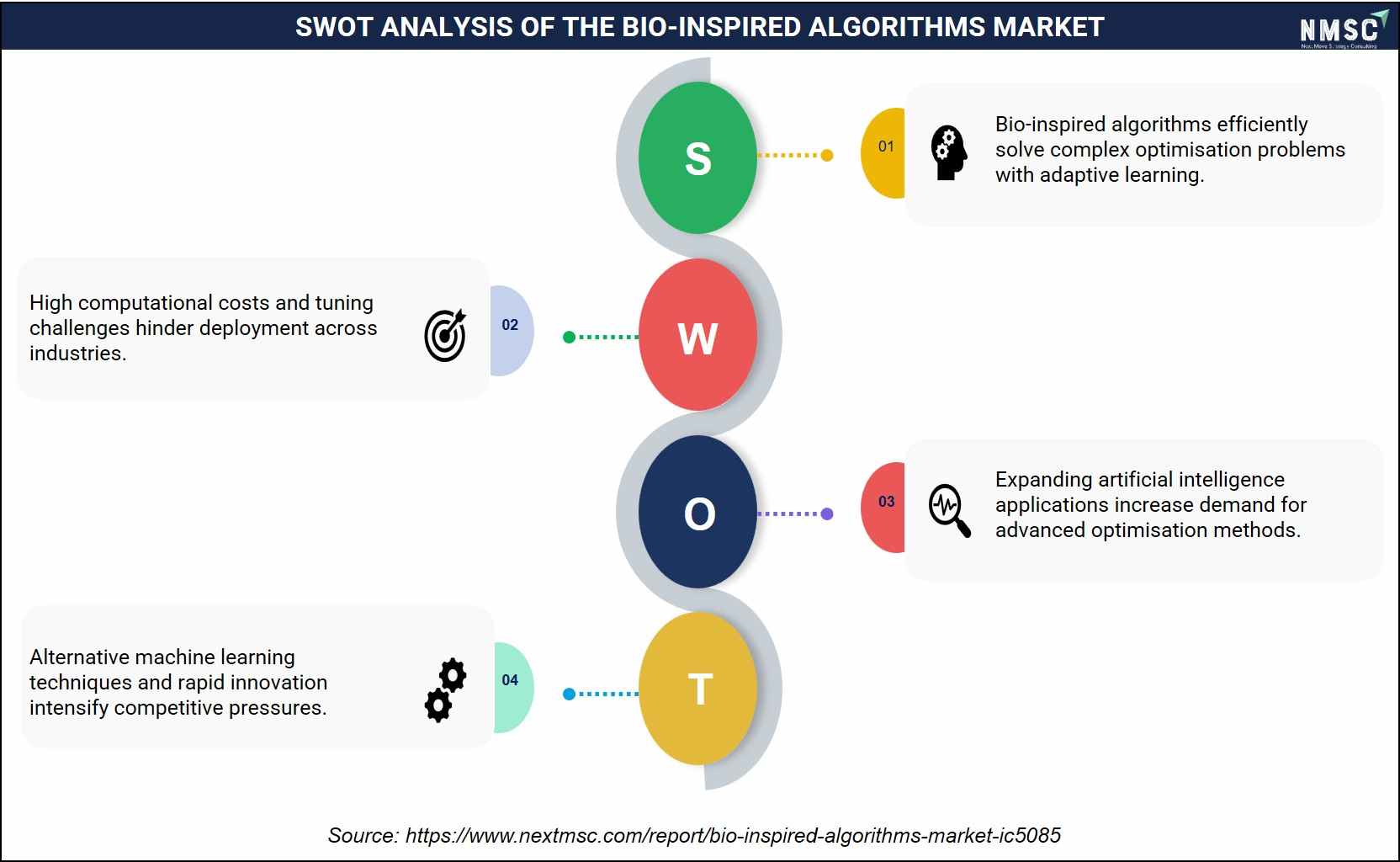
The SWOT analysis of the Bio-Inspired Algorithms market highlights its strong capability to solve complex optimization and decision-making problems through adaptive, nature-inspired learning approaches. These algorithms offer significant advantages in artificial intelligence, robotics, logistics, and industrial optimization applications. However, high computational requirements, implementation complexity, and parameter-tuning challenges can limit broader adoption. Growing demand for advanced AI and optimization solutions presents substantial market opportunities, particularly across data-intensive industries. At the same time, the emergence of alternative machine learning techniques and rapid technological advancements increases competitive pressure, requiring continuous innovation and performance enhancement from market participants.
Who Are the Key Market Players in the Bio-Inspired Algorithms Market?
-
Siemens AG
-
Synopsys, Inc.
-
The MathWorks, Inc.
-
Dassault Systemes SE
-
Cadence Design Systems, Inc.
-
Autodesk, Inc.
-
Hexagon AB
-
Emerson Electric Co.
-
SAS Institute Inc.
-
Fair Isaac Corporation
-
Bentley Systems, Incorporated
-
ESTECO SpA
-
Frontline Systems, Inc.
-
LINDO Systems, Inc.
-
Unanimous AI
-
Palisade Corporation
-
AnyLogic Company
-
Gurobi Optimization, LLC
-
Altair Engineering Inc.
-
Riverware Group, LLC
What Are the Latest Developments in the Bio-Inspired Algorithms Market Industry?
|
Date |
Event |
|
Apr 2026 |
Siemens and KION Group announced a strategic partnership to develop AI-powered supply chains using digital twins, simulation, and optimization technologies for warehouse automation and logistics operations. |
|
Jan 2026 |
Siemens expanded its collaboration with NVIDIA to develop an Industrial AI Operating System and advanced digital twin solutions for engineering optimization and manufacturing intelligence. |
|
Dec 2025 |
NVIDIA invested approximately USD 2 billion in Synopsys, expanding collaboration in AI-driven semiconductor design, engineering simulation, and optimization technologies. |
|
Jul 2025 |
Synopsys completed its acquisition of Ansys, combining electronic design automation with advanced simulation and engineering optimization technologies. |
|
Mar 2025 |
Siemens completed the acquisition of Altair Engineering, strengthening its portfolio in AI, simulation, HPC, engineering optimization, and computational intelligence. |
What Are the Investment Opportunities in the Bio-Inspired Algorithms Market?
Capital Inflows and Venture Activity
The Bio-Inspired Algorithms Market continues to attract growing investments from venture capital firms, technology investors, and corporate innovation funds as organizations increasingly seek advanced optimization, machine learning, and autonomous decision-making capabilities. Investment activity has accelerated across startups developing evolutionary computation, swarm intelligence, genetic algorithms, ant colony optimization, particle swarm optimization, and neuromorphic computing technologies. We observed that funding momentum is particularly strong in sectors such as autonomous systems, industrial optimization, robotics, logistics planning, and AI-driven simulation platforms, where bio-inspired approaches offer significant advantages over conventional algorithms. The increasing integration of these algorithms into artificial intelligence, digital twin, and predictive analytics platforms reflects sustained investor confidence in their long-term commercial potential.
Research Infrastructure and Computational Investment
Investment in high-performance computing infrastructure and AI research ecosystems is a critical growth enabler for the Bio-Inspired Algorithms Market. Governments, academic institutions, and private enterprises are allocating substantial resources toward advanced computing environments capable of supporting large-scale optimization and simulation workloads. We found that increasing investments in AI supercomputing facilities, cloud-based computational platforms, and edge AI infrastructure are expanding the practical deployment of bio-inspired algorithms across industries. These infrastructure investments improve processing efficiency, reduce model-training costs, and accelerate commercialization opportunities for algorithm developers and solution providers globally.
Sustainable AI and Resource-Efficient Computing
Environmental, Social, and Governance (ESG) priorities are becoming increasingly important in investment decisions within the Bio-Inspired Algorithms Market. Bio-inspired algorithms are often recognized for their ability to solve complex optimization problems while minimizing computational resources, energy consumption, and operational inefficiencies. Organizations are leveraging these technologies to optimize supply chains, reduce manufacturing waste, improve energy grid management, and enhance resource allocation strategies. Investors are increasingly favoring AI solutions that contribute to sustainability objectives, making energy-efficient optimization platforms and environmentally responsible computing frameworks attractive opportunities within the market.
Digital Transformation and Intelligent Automation Enablement
Bio-inspired algorithms are becoming foundational components of enterprise digital transformation initiatives, creating long-term investment opportunities across multiple industries. Organizations implementing Industry 4.0 strategies, autonomous operations, smart manufacturing, intelligent transportation systems, and AI-driven decision support platforms increasingly depend on advanced optimization algorithms to maximize operational performance. We further analyzed that global initiatives promoting industrial digitization, smart infrastructure, and intelligent automation are driving demand for adaptive computational models capable of solving dynamic real-world challenges. As enterprises modernize their operations, bio-inspired algorithms are expected to become integral to next-generation digital ecosystems.
Private Equity and Strategic M&A Activity
Private equity firms and strategic technology investors are increasingly targeting companies operating within the Bio-Inspired Algorithms Market. Acquisition activity is expanding as software vendors, AI platform providers, robotics companies, and industrial technology firms seek to strengthen their optimization and autonomous decision-making capabilities. Strategic acquisitions are focused on specialized technologies including evolutionary AI, swarm intelligence platforms, adaptive optimization software, neuromorphic computing systems, and autonomous robotics algorithms. We assessed that investors should closely monitor consolidation opportunities involving simulation software providers, intelligent automation vendors, advanced analytics firms, and AI optimization specialists as highly attractive M&A targets throughout the 2025–2035 period.
Key Benefits for Stakeholders
For Enterprise Buyers
Enterprise buyers gain comprehensive, vendor-neutral insights into the Bio-Inspired Algorithms Market, including quantitative analysis across algorithm categories, deployment models, application domains, and industry verticals. This intelligence supports technology evaluation, AI strategy development, and long-term innovation planning. Our competitive landscape assessment enables organizations to benchmark solution providers, evaluate algorithm performance capabilities, and identify optimization technologies that align with operational efficiency, automation, and digital transformation objectives.
For Investors and Financial Analysts
Investors and financial analysts gain access to a structured evaluation of the Bio-Inspired Algorithms Market's growth prospects, competitive environment, innovation pipeline, and investment landscape through 2035. Segment-level forecasts, technology adoption trends, and regional growth assessments support portfolio development and investment decision-making. Detailed profiles of leading algorithm developers, AI software providers, and emerging innovators provide an early-indicator framework for identifying acquisition candidates, high-growth companies, and disruptive technology trends within the global market.
For Bio-Inspired Algorithm Developers and Technology Providers
Technology vendors gain actionable intelligence regarding emerging application areas, commercialization opportunities, competitive positioning, and unmet customer requirements within the Bio-Inspired Algorithms Market. Algorithm-type analysis highlights high-growth opportunities across evolutionary computation, swarm intelligence, hybrid AI optimization, neuromorphic systems, and autonomous learning technologies. Regional market assessments identify expansion opportunities based on research maturity, AI adoption rates, and industrial digitization initiatives. Insights into deployment preferences and end-user requirements support product development, partnership strategies, and go-to-market optimization.
For Government Agencies and Research Institutions
Government organizations, public-sector agencies, and research institutions gain a structured understanding of how national AI strategies, innovation policies, research funding programs, and digital transformation initiatives influence the Bio-Inspired Algorithms Market. Country-level assessments provide policymakers with evidence-based insights into technological competitiveness, workforce development requirements, and emerging innovation ecosystems. Analysis of public-private research collaboration models and advanced computing initiatives offers direct relevance to national AI development strategies, scientific research planning, and long-term technological leadership objectives.
Key Market Segments
By Offering Type
-
Software
-
Standalone Software
-
Embedded Software
-
-
Services
-
Custom Development
-
Integration
-
Managed Services
-
Support and Training
-
By Algorithm Family
-
Swarm Intelligence
-
Ant Colony Optimization
-
Particle Swarm Optimization
-
Bee Colony Optimization
-
Human Swarm Intelligence
-
Other Swarm Intelligence
-
-
Evolutionary Algorithms
-
Genetic Algorithm
-
Genetic Programming
-
Evolution Strategies
-
Differential Evolution
-
Other Evolutionary Algorithms
-
-
Neural Inspired Algorithms
-
Spiking Neural Networks
-
Neuromorphic Computing
-
Other Neural Inspired Algorithms
-
-
Hybrid Bio-Inspired Algorithms
-
Swarm and Evolutionary
-
Swarm and Neural
-
Evolutionary and Neural
-
Other Hybrid Bio-Inspired Algorithms
-
-
Other Bio-Inspired Algorithms
By Function
-
Optimization
-
Design Exploration
-
Routing
-
Scheduling
-
Clustering
-
Forecasting and Decisioning
-
Coordination and Control
-
Search and Screening
-
Other Functions
By Deployment
-
Cloud
-
On-Premises
-
Edge
-
Hybrid
By Sales Channel
-
Direct
-
Partner and Integrator
-
Reseller
-
Marketplace
-
Tender and Procurement
By End-Use Industry
-
Aerospace and Defense
-
Manufacturing and Warehousing
-
Transportation and Logistics
-
Agriculture
-
Energy and Utilities
-
Maritime and Offshore
-
Financial Services
-
Healthcare and Life Sciences
-
Public Sector
-
Retail and Consumer
-
Technology and Telecom
-
Other Industries
By Region
-
North America: U.S., Canada, and Mexico.
-
Europe: UK, Germany, France, Italy, Spain, Sweden, Denmark, Finland, the Netherlands, and the rest of Europe.
-
Asia Pacific: China, India, Japan, South Korea, Taiwan, Indonesia, Vietnam, Australia, Philippines, Malaysia and the rest of APAC.
-
Middle East & Africa (MEA): Saudi Arabia, UAE, Egypt, Israel, Turkey, Nigeria, South Africa, and the rest of MEA.
-
Latin America: Brazil, Argentina, Chile, Colombia, and the rest of LATAM.
Conclusion and Recommendations
Long-Term Outlook
The Bio-Inspired Algorithms Market is entering a decade of accelerating commercial maturity, transitioning from niche research-originated tools to embedded components of enterprise AI and industrial optimization infrastructure. The market is forecast to grow from USD 5.6 billion in 2026 to USD 19.6 billion by 2035 at a CAGR of 15.2%. This growth reflects expanding adoption across manufacturing, aerospace, healthcare, financial services, and energy verticals, driven by the fundamental inability of classical optimization methods to address the scale, non-linearity, and multi-objective complexity of real-world industrial optimization problems. Our further analysis indicates that neuromorphic computing commercialization will significantly accelerate market growth beyond 2028 as hardware platforms enable energy-efficient, ultra-low-latency bio-inspired algorithm execution at the edge.
Strategic Positioning Recommendations
Platform vendors should prioritize hybrid bio-inspired algorithm development that combines evolutionary and neural-inspired paradigms to address multi-objective industrial optimization challenges beyond the capability of single-paradigm approaches. Cloud-native API architectures with pre-built vertical libraries for manufacturing, healthcare, and financial services should be the primary go-to-market investment. Vendors without EU AI Act-compliant explainability capabilities will face structural disadvantage in European and regulated-market procurement processes. Marketplace distribution on AWS, Azure, and domain-specific platforms such as Siemens Xcelerator and Dassault 3DEXPERIENCE is non-negotiable for capturing the fastest-growing sales channel in the Bio-Inspired Algorithms Market through 2035.
Investment Attractiveness
The Bio-Inspired Algorithms Market represents a commercially attractive investment environment given structurally recurring optimization demand, expanding AI-native use cases, and a migration toward subscription and consumption-based revenue models. Our assessment indicates that the highest-conviction investment themes include Neural Inspired Algorithms (18.3% CAGR), Healthcare and Life Sciences vertical (19.6% CAGR), Edge deployment (19.3% CAGR), and Marketplace channel growth (22.1% CAGR). Investors should monitor neuromorphic computing startup activity and strategic M&A within EDA and PLM vendor ecosystems as the most proximate consolidation opportunities within the broader market landscape.
Market Shifts and Key Risks
The most significant market shift underway is the migration from standalone optimization toolkits to embedded bio-inspired optimization engines within enterprise AI and industrial software platforms. This shift benefits large platform vendors including Siemens and Dassault at the expense of point-solution vendors without enterprise software ecosystem integration. Key risks for the Bio-Inspired Algorithms Market include regulatory explainability requirements constraining adoption in financial services and healthcare, talent scarcity in operations research limiting deployment velocity, open-source optimization frameworks from the Python scientific computing community competing with commercial platforms, and the possibility of quantum computing disruption of certain optimization problem classes beyond 2030.
Growth Pathways
Organizations seeking to maximize value from the Bio-Inspired Algorithms Market should pursue a three-horizon strategy. In the near term from 2025 to 2027, prioritize deployment of cloud-native evolutionary and swarm intelligence platforms for manufacturing scheduling, logistics routing, and energy optimization to establish proven ROI and organizational capability. In the mid-term from 2027 to 2031, invest in hybrid bio-inspired neural frameworks for autonomous systems, drug discovery, and financial portfolio optimization to capture the fastest-growing demand segments. In the long term from 2031 to 2035, position for neuromorphic computing-enabled edge bio-inspired optimization deployments as hardware platforms mature and autonomous systems proliferate across transportation, defense, and industrial automation markets globally.
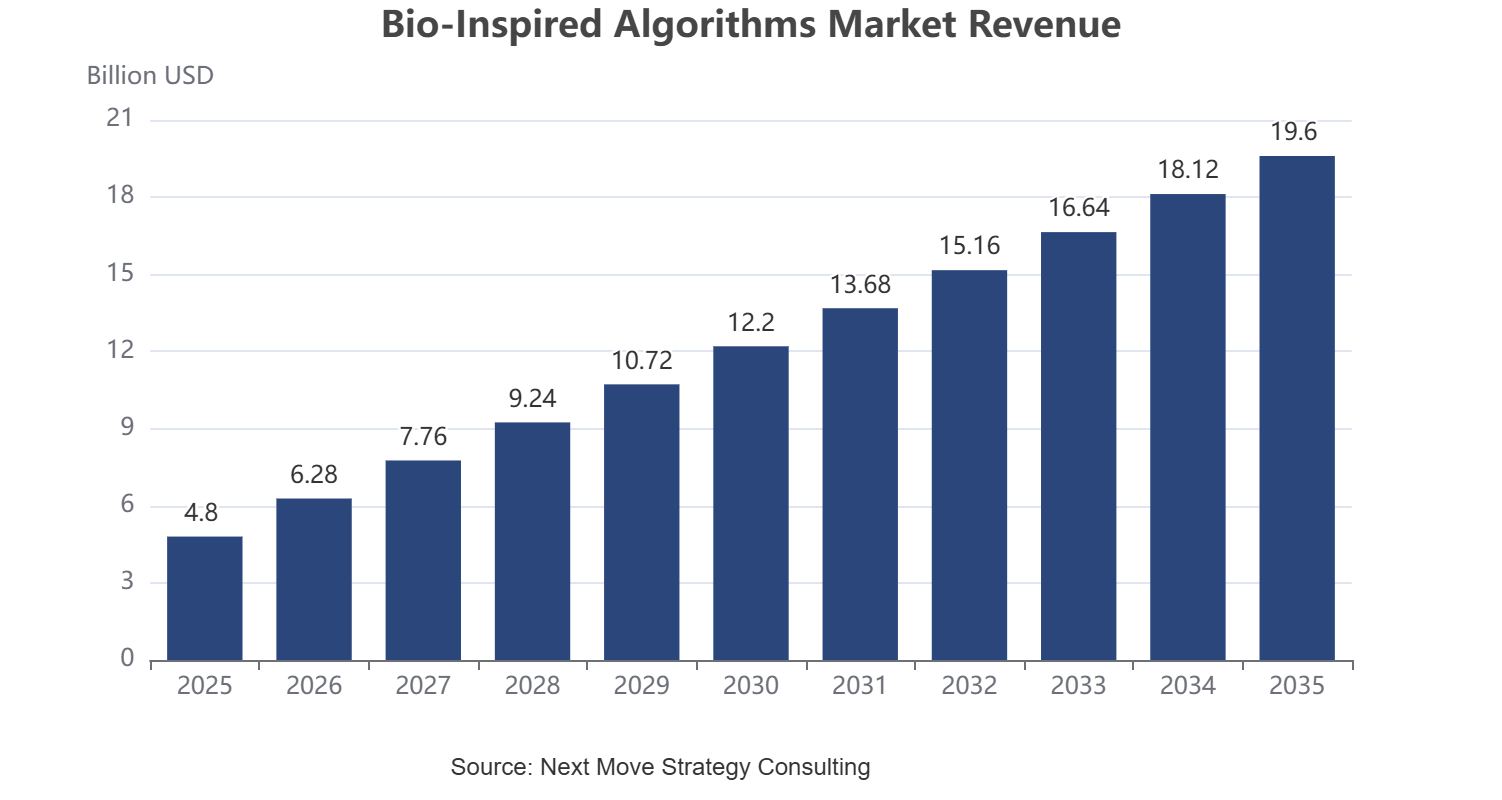
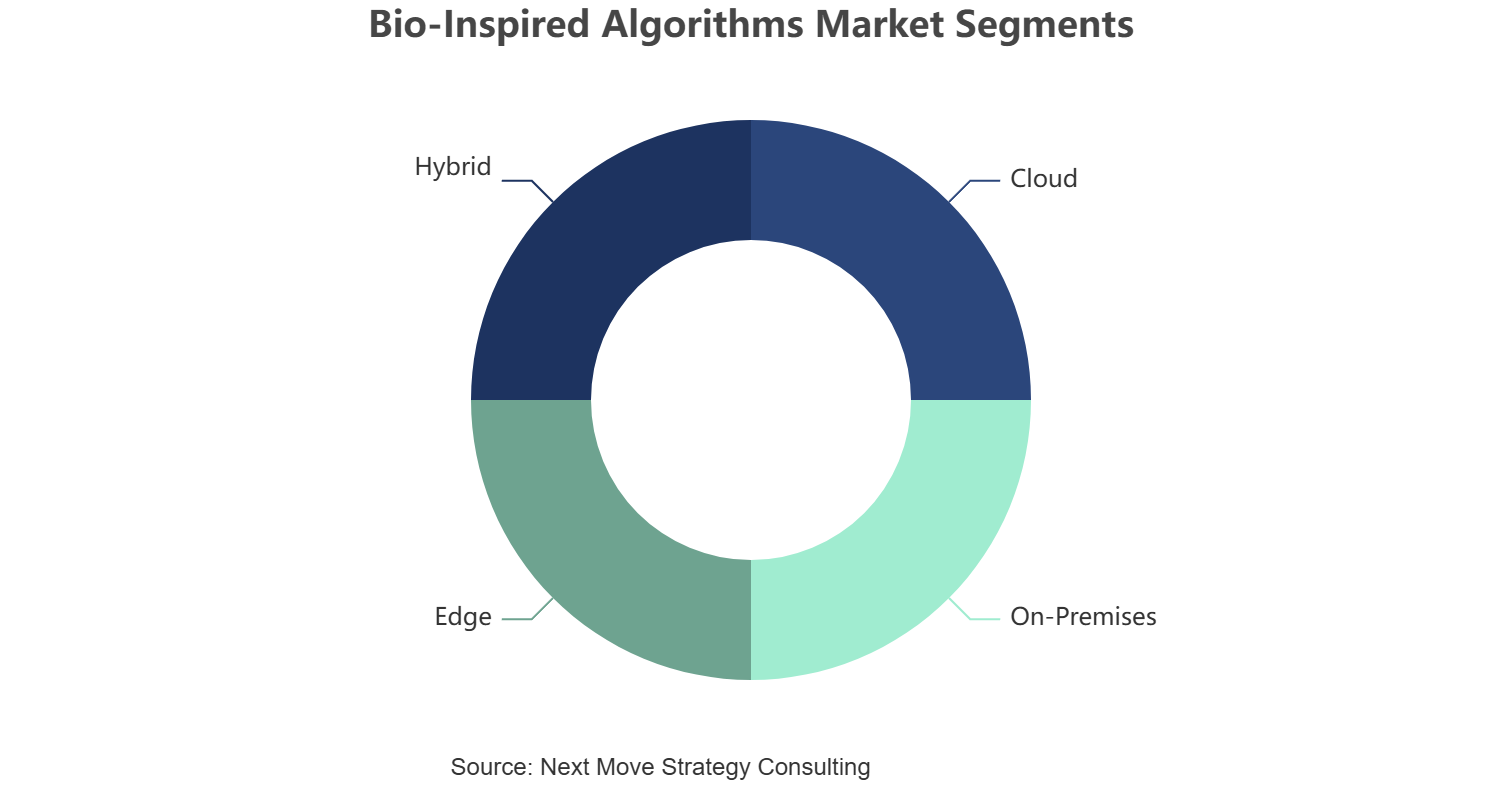
About the Author
 Mihul Sharma
— Mihul Sharma is Research Associate at Next Move Strategy Consulting, where he has covered technology, industrial, and healthcare markets for 3 years. His work applies structured business research, market analysis, and secondary-source review to assess market trends, competitive developments, and growth opportunities. He supports report development by fully synthesizing industry data, company information, and market signals into concise findings for strategy and investment-focused research teams.
Mihul Sharma
— Mihul Sharma is Research Associate at Next Move Strategy Consulting, where he has covered technology, industrial, and healthcare markets for 3 years. His work applies structured business research, market analysis, and secondary-source review to assess market trends, competitive developments, and growth opportunities. He supports report development by fully synthesizing industry data, company information, and market signals into concise findings for strategy and investment-focused research teams.
About the Reviewer
 Supradip Baul
— Supradip Baul is an accomplished business consultant and strategist with over a decade of rich experience in market intelligence, strategy, technology, and business transformation. His work has included rigorous qualitative and quantitative analysis across multiple industries, helping clients shape investment decisions and long-term roadmaps. Earlier in his career, he was associated with Gartner, where he contributed to industry-leading reports and market share analyses. He has worked with leading global companies and holds an MBA with a dual specialization in Marketing and Finance.
Supradip Baul
— Supradip Baul is an accomplished business consultant and strategist with over a decade of rich experience in market intelligence, strategy, technology, and business transformation. His work has included rigorous qualitative and quantitative analysis across multiple industries, helping clients shape investment decisions and long-term roadmaps. Earlier in his career, he was associated with Gartner, where he contributed to industry-leading reports and market share analyses. He has worked with leading global companies and holds an MBA with a dual specialization in Marketing and Finance.
At Next Move Strategy Consulting, we understand that insightful market research is the cornerstone of successful business decisions. That's why we employ a robust and multifaceted approach, combining various methodologies to deliver the most accurate and actionable data for our clients.

Research Landscape
We navigate the world of research with two primary approaches:
Qualitative Approach
Our qualitative research methodologies involve immersive techniques such as in-depth interviews, focus groups, and observational studies. By engaging directly with individuals and stakeholders, we uncover valuable insights that quantitative data alone may overlook.

Quantitative Research
In tandem with qualitative methodologies, NMSC leverages the power of Quantitative Research to provide a robust foundation of numerical insights. Through systematic data collection and analysis, we quantify patterns, preferences, and market trends, offering a comprehensive view of the business landscape.
Our quantitative research approach employs diverse tools, including surveys, experiments, and statistical modelling. These methodologies enable us to gather data from a large and representative sample, ensuring the statistical significance of our findings. By employing structured questionnaires and standardized data collection methods, we guarantee the reliability and validity of the information we present to our clients.
Quantitative research is particularly effective in measuring the prevalence of trends, assessing market size, and gauging the impact of various factors on consumer behavior. The numerical precision attained through this approach equips our clients with actionable insights, facilitating data-driven decision-making and strategy formulation.


Our Specialized Toolbox for Industry-Specific Market Research
We deploy a specialized arsenal of techniques tailored to meet your unique requirements. Here's a glimpse into our comprehensive toolbox:

Information Procurement
The stage entails acquiring market data or relevant information through various sources and methodologies.


Market Research Approach
We utilize both top-down and bottom-up approaches in market research analysis to achieve a comprehensive understanding of the market dynamics, leveraging the broad perspective of industry trends and macroeconomic factors alongside detailed insights from specific segments and individual companies.

Porters Five Forces Analysis
We conduct Porter's Five Forces analysis to evaluate the competitive landscape of an industry, providing us with insights into factors that affect profitability and strategic positioning.

SWOT Analysis

Forecasting
We utilize a forecasting model to predict future consumption by considering parameters like population, economics, regulations, market competition, drivers, constraints, technology, and pricing. We also employ statistical techniques such as multilinear regression, exponential smoothing, moving average, ARIMA, and Monte Carlo simulations for accurate predictions. In econometric forecasting, we analyzed short-term and long-term event impacts, attributing values based on regulatory frameworks, economic factors, and market events.





 Speak to Our Analyst