AIASE Market Size, Share, Trends and Growth Analysis, By Offering (Software Tools and Platforms, Professional Services, and Managed Services), By Application (ADAS and Autonomous Driving Software Engineering, Testing and Validation, Code Generation and Development, and Others), By Deployment Mode (Cloud and On-Premise), By End User (Original Equipment Manufacturers, Tier 1 Suppliers, and Software and Technology Vendors), and Region — Global Industry Report and Forecast, 2026–2035
Industry: ICT & Media | Publishing Date: August 7, 2026 | Last Updated: August 7, 2026 | No of Pages: N/A | No. of Tables: N/A | No. of Figures: N/A | Format: PDF | Report Code: IC5636
What Is the AIASE Market Size?
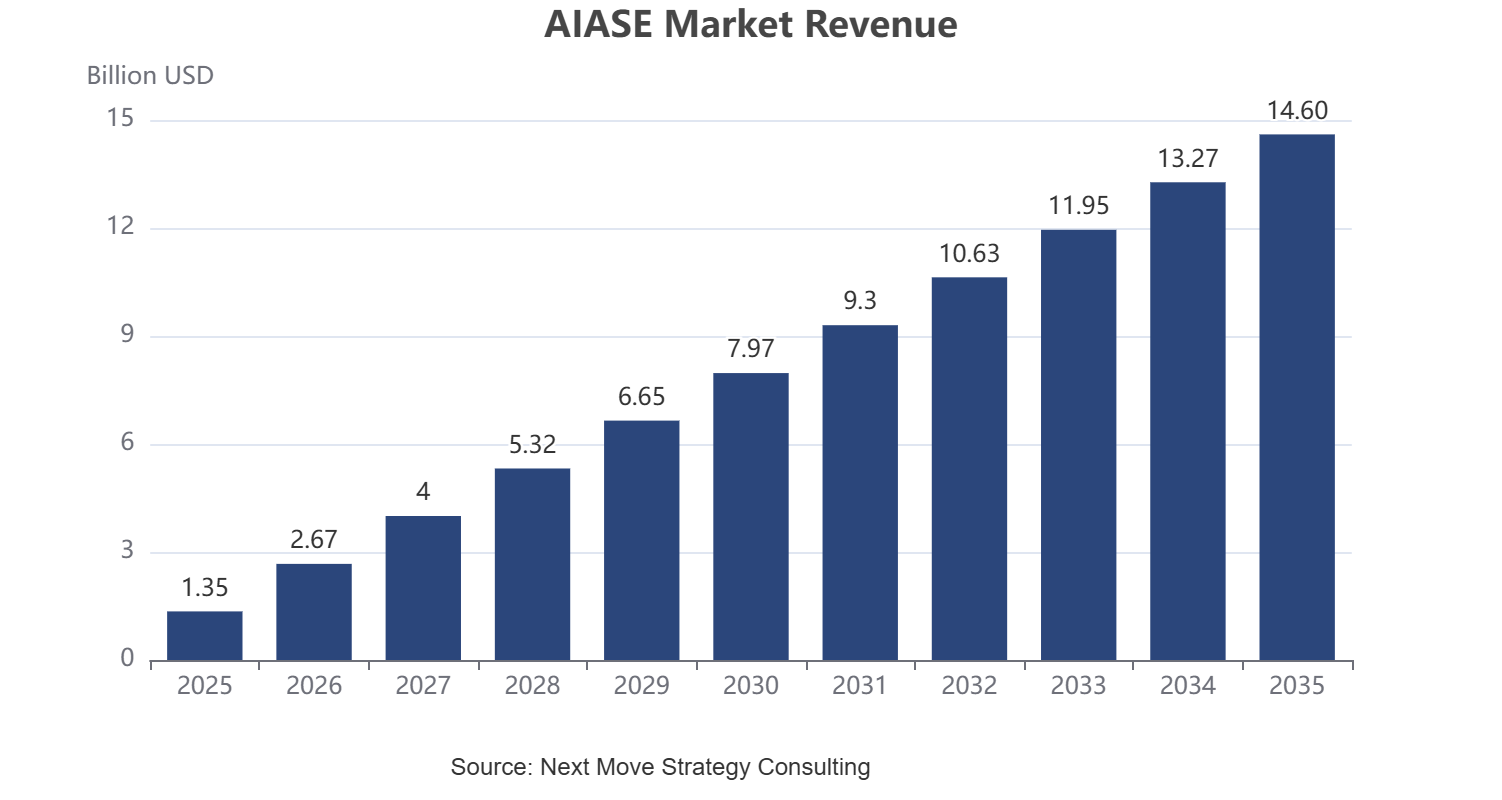
The global artificial intelligence in automotive software engineering market size was valued at USD 1.35 Billion in 2025 and is estimated at USD 1.72 Billion in 2026, forecast to reach USD 14.60 Billion by 2035, expanding at a 26.82% CAGR between 2026 and 2035. North America leads with approximately 36% share, while ADAS and Autonomous Driving Software Engineering dominates all other applications with approximately 34% share.
We observed that growth is concentrated around cloud-deployed tooling and OEM-led adoption, as automakers embed generative and predictive AI directly into software development pipelines for next-generation vehicle platforms through 2035.
|
Key Takeaways |
|
By Offering: Software Tools and Platforms held the largest share of approximately 58% (USD 0.78 Billion) in 2025; Managed Services is the fastest-growing sub-segment at 29.45% CAGR from 2026 to 2035. |
|
By Application: ADAS and Autonomous Driving Software Engineering held the largest share of approximately 34% (USD 0.46 Billion) in 2025; Code Generation and Development is the fastest-growing sub-segment at 29.23% CAGR from 2026 to 2035. |
|
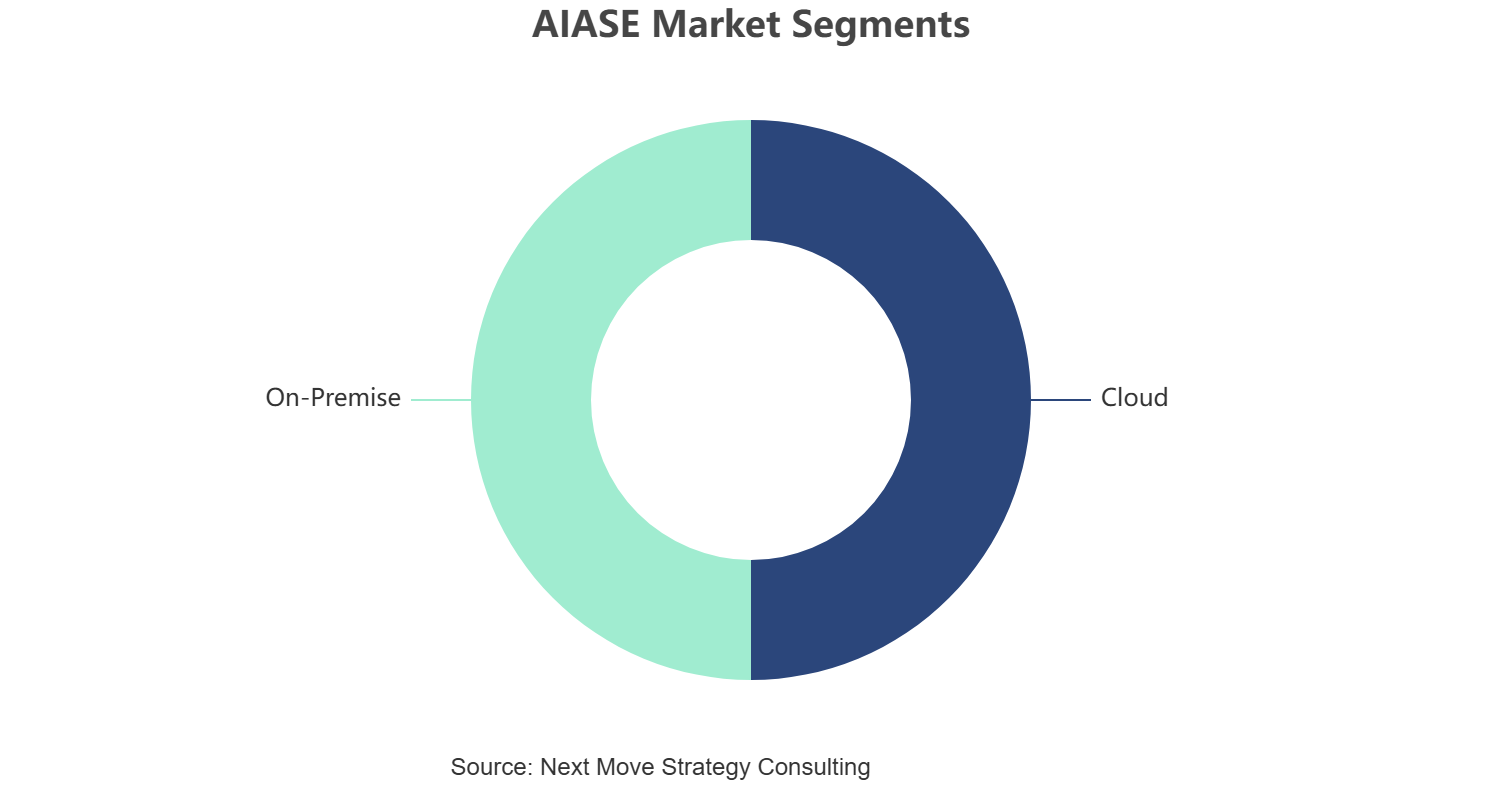
By Deployment Mode: Cloud held the largest share of approximately 63% (USD 0.85 Billion) in 2025; Cloud is the fastest-growing sub-segment at 28.65% CAGR from 2026 to 2035. |
|
By End User: Original Equipment Manufacturers held the largest share of approximately 46% (USD 0.62 Billion) in 2025; Software and Technology Vendors is the fastest-growing sub-segment at 29.95% CAGR from 2026 to 2035. |
|
Dominant Region: North America dominated with approximately 36% revenue share (USD 0.48 Billion) in 2025. |
|
Fastest-Growing Region: Asia-Pacific is expected to register the highest CAGR of 29.9% during 2026–2035. |
|
Dominant Country: U.S. led with approximately USD 0.39 Billion in 2025. |
|
Fastest-Growing Country: India is the fastest-growing country at approximately 32.3% CAGR from 2026 to 2035. |
Market Opportunity: The AIASE market is expected to create an absolute dollar opportunity of USD 12.88 Billion between 2026 and 2035, presenting significant investment potential across the software-tooling, testing-automation, and managed-services value chain.
According to Next Move Strategy Consulting analysis, OEMs are increasingly tying supplier qualification to demonstrated AI-assisted verification coverage on safety-critical code paths, a shift that favors tooling vendors with automotive-grade certification traceability over general-purpose development platforms.
What Does the AIASE Market Encompass?
The artificial intelligence in automotive software engineering market encompasses AI-enabled tools, platforms, and professional services used to design, generate, test, and validate software for vehicle electronic control units, ADAS stacks, and autonomous-driving systems. Our assessment indicates that the scope spans code-generation copilots, automated test-case synthesis, model-based simulation, and predictive-diagnostics engineering delivered to OEMs, Tier 1 suppliers, and software vendors across cloud and on-premise deployment models. The category has evolved from rule-based static analysis tooling into generative and agentic AI systems embedded directly within automotive software development lifecycles.
Regulatory frameworks including ISO 26262 functional-safety requirements and UNECE WP.29 cybersecurity regulations shape how AI-generated code is validated before production release, while ISO/PAS 8800 guidance for AI in road-vehicle safety is increasingly referenced by supplier qualification programs. We observed that technology adoption is shifting toward agentic coding assistants integrated directly into automotive-grade toolchains such as AUTOSAR-compliant development environments. Next Move Strategy Consulting's analysis indicates that this shift, alongside parallel growth in the automotive semiconductor market, is redefining sourcing criteria for software-engineering platforms across the industry.
|
Parameters |
Details |
|
Market Size in 2025 |
USD 1.35 Billion |
|
Market Size in 2026 |
USD 1.72 Billion |
|
Revenue Forecast in 2035 |
USD 14.60 Billion |
|
Growth Rate |
CAGR of 26.82% from 2026 to 2035 |
|
Analysis Period |
2025–2035 |
|
Base Year Considered |
2025 |
|
Forecast Period |
2026–2035 |
|
Market Size Estimation |
Revenue (USD Billion) |
|
Companies Profiled |
20 |
|
Countries Covered |
33 |
|
Market Share |
Available for Top 10 Companies |
Key Emerging Trends
Based on research conducted by Next Move Strategy Consulting, we found that four structural trends are reshaping tooling adoption, sourcing, and stakeholder engagement across the industry.
How Are Agentic Coding Assistants Transforming ECU Software Development?
Agentic AI coding assistants capable of autonomously drafting, refactoring, and unit-testing embedded software modules are replacing single-suggestion autocomplete tools across automotive development teams. We observed that NVIDIA Corporation expanded its automotive software development platform in 2025 to integrate generative code assistance directly within AUTOSAR-compliant toolchains, reducing manual coding effort for ADAS perception modules. Suppliers without comparable agentic tooling risk longer development cycles relative to competitors embedding these workflows into standard engineering practice.
Why Is AI-Driven Test-Case Synthesis Gaining Adoption?
Automated test-case generation using AI models is gaining adoption as OEMs face expanding validation requirements for ADAS and autonomous-driving software releases. Our findings suggest that dSPACE GmbH expanded its simulation-based validation portfolio in 2025 to include AI-assisted scenario generation for safety-critical test coverage. This trend is reducing manual test-authoring workloads while improving traceability against ISO 26262 verification requirements across supplier qualification programs.
How Is Cloud-Native Tooling Reshaping Development Infrastructure?
Cloud-native development environments are displacing on-premise toolchains as OEMs seek elastic compute capacity for large-scale AI model training and simulation workloads. We observed that Microsoft Corporation expanded its automotive-focused cloud development services in 2025 to support distributed simulation and continuous-integration pipelines for software-defined vehicle programs. This shift is elevating demand for cloud-deployment models among suppliers previously reliant on on-premise infrastructure.
What Role Does Predictive Diagnostics Engineering Play in Software Lifecycle Management?
Predictive-diagnostics engineering, which uses AI models to anticipate software-related field failures before deployment, is emerging as a differentiator among Tier 1 suppliers managing over-the-air update programs. Our analysis shows that Continental AG expanded its predictive software-diagnostics engineering services in 2025 to support proactive over-the-air patch prioritization for connected-vehicle fleets. This direction is influencing new service-contract structures among competing Tier 1 suppliers.
Strategic Framework of the AIASE Market
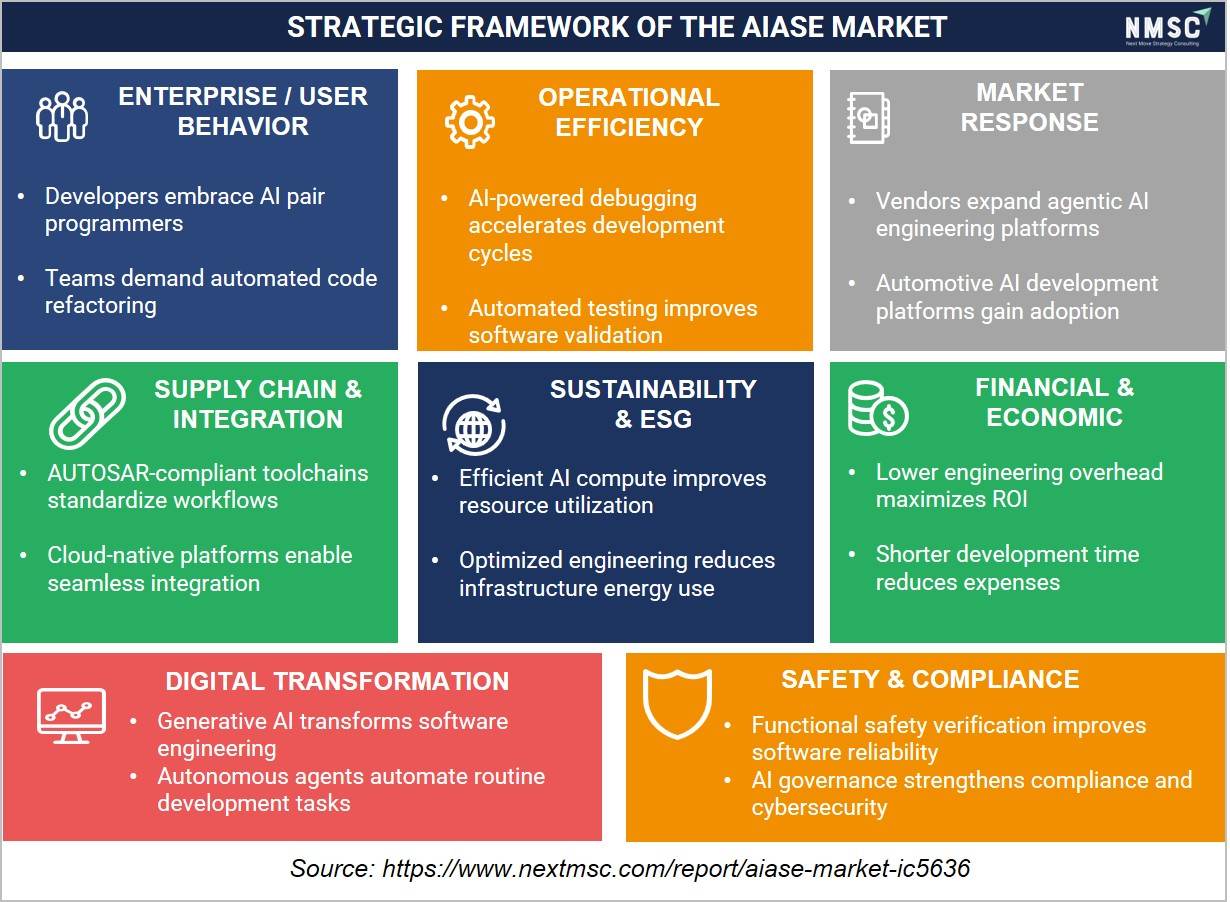
Based on research conducted by NMSC, we found that developer adoption of AI coding assistants and automated software engineering tools is driving the AIASE Market. Intelligent debugging and AI-powered testing accelerate development cycles, while cloud-native platforms and integrated toolchains improve operational efficiency. Furthermore, optimized engineering workflows enhance productivity, and robust governance, functional safety standards, and cybersecurity compliance strengthen software reliability and deployment confidence.
Growth Drivers & Restraints
Growth Catalyst & Risk Assessment Matrix
|
Factors |
Type |
(+/−) % Impact on CAGR |
Geographic Relevance |
Impact Timeline |
|
Rising software content per vehicle platform |
Driver |
+6.1% |
Global |
2026–2035 |
|
OEM adoption of generative AI coding tools |
Driver |
+5.4% |
North America, Europe |
2026–2033 |
|
Expansion of software-defined vehicle programs |
Driver |
+4.2% |
Global |
2026–2035 |
|
Growth of cloud-based simulation and validation platforms |
Driver |
+3.6% |
Asia-Pacific, North America |
2026–2034 |
|
Government investment in AI and automotive R&D |
Driver |
+2.8% |
Asia-Pacific, Europe |
2026–2032 |
|
Functional-safety certification complexity for AI-generated code |
Restraint |
−3.1% |
Global |
2026–2031 |
|
Shortage of AI-trained automotive software engineers |
Restraint |
−2.4% |
North America, Europe |
2026–2030 |
|
Data-privacy constraints on cloud-based development environments |
Restraint |
−1.7% |
Europe, Middle East and Africa |
2026–2032 |
What Is the Primary Growth Driver?
Rising software content per vehicle platform is the primary growth driver, as automakers expand electronic control unit counts and lines of code per model year across new vehicle programs. We found that the U.S. National Highway Traffic Safety Administration's 2025 ADAS reporting data shows continued expansion in driver-assistance feature deployment, reinforcing sustained software-engineering tooling demand across supplier tiers.
How Is OEM Adoption of Generative AI Tools Driving the Market Growth?
OEMs are formally adopting generative AI coding assistants within qualified development environments to accelerate software release cycles for software-defined vehicle platforms. Our assessment indicates that the German Federal Ministry for Economic Affairs and Climate Action expanded its 2025 automotive software funding initiative to support AI-tooling pilots among domestic suppliers, a policy pattern echoed across other major automotive-producing economies.
What Is Restraining the AIASE Market?
Functional-safety certification complexity for AI-generated code remains the primary restraint, as auditors require additional traceability evidence before approving AI-assisted code paths for safety-critical systems. We observed that the International Organization for Standardization's 2025 publication of ISO/PAS 8800 guidance for AI in road-vehicle safety introduced additional verification steps that are slowing certification timelines for AI-assisted development workflows.
Segmentation Analysis
Segment Sizing: By Offering
|
Segment |
2025 (USD) |
2035 (USD) |
CAGR% (2026–2035) |
|
Software Tools and Platforms |
USD 0.78 Billion |
USD 8.93 Billion |
27.58% |
|
Professional Services |
USD 0.41 Billion |
USD 3.56 Billion |
23.94% |
|
Managed Services |
USD 0.16 Billion |
USD 2.11 Billion |
29.45% |
|
Total |
USD 1.35 Billion |
USD 14.60 Billion |
26.82% |
What Is the Outlook Across AIASE Offerings?
By offering, the market spans software tools and platforms, professional services, and managed services. Software Tools and Platforms dominates with approximately 58% share in 2025, supported by widespread licensing of AI-assisted development environments across supplier tiers. Managed Services is the fastest-growing offering at 29.45% CAGR, as suppliers increasingly outsource ongoing model tuning and validation-pipeline operation to specialized providers.
Segment Sizing: By Application
|
Segment |
2025 (USD) |
2035 (USD) |
CAGR% (2026–2035) |
|
ADAS and Autonomous Driving Software Engineering |
USD 0.46 Billion |
USD 5.22 Billion |
27.54% |
|
Testing and Validation |
USD 0.32 Billion |
USD 3.25 Billion |
25.76% |
|
Code Generation and Development |
USD 0.28 Billion |
USD 3.63 Billion |
29.23% |
|
Diagnostics and Predictive Maintenance |
USD 0.19 Billion |
USD 1.80 Billion |
25.07% |
|
Other Applications |
USD 0.10 Billion |
USD 0.70 Billion |
21.51% |
|
Total |
USD 1.35 Billion |
USD 14.60 Billion |
26.82% |
Which Application Leads AIASE Demand?
By application, the market is segmented into ADAS and autonomous driving software engineering, testing and validation, code generation and development, diagnostics and predictive maintenance, and other applications. ADAS and Autonomous Driving Software Engineering leads with approximately 34% share in 2025, reflecting concentrated AI-tooling investment in safety-critical perception and planning software. Code Generation and Development is the fastest-growing application at 29.23% CAGR, as generative coding assistants expand across broader software-development workflows.
Segment Sizing: By Deployment Mode
|
Segment |
2025 (USD) |
2035 (USD) |
CAGR% (2026–2035) |
|
Cloud |
USD 0.85 Billion |
USD 10.46 Billion |
28.65% |
|
On-Premise |
USD 0.50 Billion |
USD 4.14 Billion |
23.12% |
|
Total |
USD 1.35 Billion |
USD 14.60 Billion |
26.82% |
What Is Driving Demand Across Deployment Modes?
By deployment mode, the market covers cloud and on-premise delivery models. Cloud holds approximately 63% share in 2025, driven by elastic compute demand for large-scale AI model training and simulation workloads. Cloud is the fastest-growing deployment mode at 28.65% CAGR, supported by suppliers migrating legacy on-premise toolchains toward managed cloud environments.
Growth Opportunities
Three forward-looking whitespace opportunities stand out for stakeholders positioning ahead of 2035 demand curves.
Where Can Certified AI-Assisted Verification Tools Create Value?
Limited availability of AI-assisted verification tooling with pre-approved ISO 26262 traceability creates whitespace for tooling vendors able to demonstrate certified audit trails. Tier 1 suppliers managing safety-critical ECU software stand to benefit from faster qualification cycles as certified tooling becomes available.
How Can Managed AI-Tooling Services Address Talent Shortages?
Persistent shortages of AI-trained automotive software engineers create an addressable opportunity for managed-services providers offering outsourced model tuning and pipeline operation. Small and mid-sized Tier 1 suppliers lacking in-house AI expertise are the primary beneficiary segment for this emerging service category.
What Opportunity Exists in Software-Defined Vehicle Platform Tooling?
Automakers transitioning to centralized software-defined vehicle architectures create a structural opportunity for platform vendors offering unified AI-assisted development environments spanning multiple ECU domains. OEMs consolidating fragmented toolchains stand to capture efficiency gains as unified platforms mature through 2035.
Regional Outlook
Geographic Performance Snapshot
|
Region |
2025 (USD) |
2035 (USD) |
CAGR% (2026–2035) |
Key Driver |
|
North America |
USD 0.48 Billion |
USD 4.67 Billion |
25.16% |
OEM generative-AI tooling adoption |
|
Europe |
USD 0.38 Billion |
USD 3.79 Billion |
25.75% |
ISO 26262 and ISO/PAS 8800 compliance tooling |
|
Asia-Pacific |
USD 0.37 Billion |
USD 4.89 Billion |
29.9% |
Government automotive AI R&D investment |
|
Middle East and Africa |
USD 0.07 Billion |
USD 0.77 Billion |
27.53% |
Emerging software-defined vehicle pilots |
|
Latin America |
USD 0.05 Billion |
USD 0.48 Billion |
24.27% |
Tier 1 supplier cloud-migration programs |
|
Total |
USD 1.35 Billion |
USD 14.60 Billion |
26.82% |
— |
North America AIASE Market
North America's AIASE market benefits from concentrated OEM investment in generative AI coding tools and mature cloud-development infrastructure. Key drivers include rapid software-defined vehicle program rollouts and strong Tier 1 supplier tooling budgets. Regulatory influence stems from National Highway Traffic Safety Administration ADAS reporting requirements, while technology adoption favors agentic coding assistants. The region's strategic outlook favors vendors with automotive-grade certification traceability through 2035.
Europe AIASE Market
Europe's market reflects a mature regulatory environment shaped by ISO 26262 functional-safety requirements and UNECE WP.29 cybersecurity regulations. Key drivers include government-funded automotive AI research programs and dense supplier-qualification frameworks. Technology adoption favors certified verification tooling aligned with ISO/PAS 8800 guidance. The region's strategic outlook centers on harmonizing AI-assisted development practices across fragmented national certification regimes through 2035.
Asia-Pacific AIASE Market
Asia-Pacific is the fastest-growing region, driven by government automotive AI R&D investment and rapid software-defined vehicle platform development across China, Japan, and South Korea. Key drivers include expanding domestic AI-tooling vendor ecosystems and rising cloud-infrastructure adoption. Regulatory influence stems from national automotive-software standards bodies. The region's strategic outlook favors vendors building scalable, cost-efficient AI-tooling platforms through 2035.
Middle East and Africa AIASE Market
The Middle East and Africa region reflects an early-stage AIASE market anchored by emerging software-defined vehicle pilot programs among regional automotive assemblers. Key drivers include growing government interest in digital-mobility infrastructure and selective Tier 1 supplier cloud-migration initiatives. Regulatory influence remains limited relative to mature markets. The region's strategic outlook favors vendors partnering directly with regional assembly operations through 2035.
Latin America AIASE Market
Latin America's market is anchored by Tier 1 supplier cloud-migration programs supporting regional vehicle-assembly operations. Key drivers include gradual adoption of AI-assisted testing tools among domestic software-engineering teams. Regulatory influence stems from harmonization with North American and European safety standards. The region's strategic outlook favors vendors offering cost-efficient managed-services models through 2035.
U.S. AIASE Market
Based on our estimates, the U.S. was valued at approximately USD 0.39 Billion in 2025 and is projected to reach approximately USD 3.84 Billion by 2035, expanding at a 25.56% CAGR. Demand structure reflects OEM-led generative AI tooling deployment continues to anchor demand, with adoption levels varying by supplier tier. Regulatory influence, technology penetration in AI-assisted development tools, and competitive intensity among certified vendors continue to shape the country's strategic outlook toward 2035.
Canada AIASE Market
The market in Canada was valued at approximately USD 0.07 Billion in 2025 and is projected to reach approximately USD 0.64 Billion by 2035, expanding at a 24.86% CAGR. Demand structure reflects supplier cloud-infrastructure investment is expanding steadily, with adoption levels varying by supplier tier. Regulatory influence, technology penetration in AI-assisted development tools, and competitive intensity among certified vendors continue to shape the country's strategic outlook toward 2035.
UK AIASE Market
As per our estimate, the UK was valued at approximately USD 0.06 Billion in 2025 and is projected to reach approximately USD 0.60 Billion by 2035, expanding at a 25.55% CAGR. Demand structure reflects certified verification-tooling adoption is accelerating among domestic suppliers, with adoption levels varying by supplier tier. Regulatory influence, technology penetration in AI-assisted development tools, and competitive intensity among certified vendors continue to shape the country's strategic outlook toward 2035.
Germany AIASE Market
According to our analysis, Germany was valued at approximately USD 0.13 Billion in 2025 and is projected to reach approximately USD 1.34 Billion by 2035, expanding at a 26.25% CAGR. Demand structure reflects government-funded automotive AI research programs anchor tooling demand, with adoption levels varying by supplier tier. Regulatory influence, technology penetration in AI-assisted development tools, and competitive intensity among certified vendors continue to shape the country's strategic outlook toward 2035.
France AIASE Market
Based on our estimates, France was valued at approximately USD 0.05 Billion in 2025 and is projected to reach approximately USD 0.52 Billion by 2035, expanding at a 25.35% CAGR. Demand structure reflects Tier 1 supplier AI-tooling pilots continue to expand, with adoption levels varying by supplier tier. Regulatory influence, technology penetration in AI-assisted development tools, and competitive intensity among certified vendors continue to shape the country's strategic outlook toward 2035.
China AIASE Market
The market in China was valued at approximately USD 0.10 Billion in 2025 and is projected to reach approximately USD 1.49 Billion by 2035, expanding at a 31.1% CAGR. Demand structure reflects domestic AI-tooling vendor ecosystems are scaling rapidly, with adoption levels varying by supplier tier. Regulatory influence, technology penetration in AI-assisted development tools, and competitive intensity among certified vendors continue to shape the country's strategic outlook toward 2035.
India AIASE Market
As per our estimate, India was valued at approximately USD 0.07 Billion in 2025 and is projected to reach approximately USD 1.04 Billion by 2035, expanding at a 32.3% CAGR. Demand structure reflects software-engineering outsourcing providers are rapidly expanding AI-tooling capacity, with adoption levels varying by supplier tier. Regulatory influence, technology penetration in AI-assisted development tools, and competitive intensity among certified vendors continue to shape the country's strategic outlook toward 2035.
Japan AIASE Market
According to our analysis, Japan was valued at approximately USD 0.08 Billion in 2025 and is projected to reach approximately USD 1.09 Billion by 2035, expanding at a 30.1% CAGR. Demand structure reflects OEM-led software-defined vehicle programs are driving tooling adoption, with adoption levels varying by supplier tier. Regulatory influence, technology penetration in AI-assisted development tools, and competitive intensity among certified vendors continue to shape the country's strategic outlook toward 2035.
South Korea AIASE Market
Based on our estimates, South Korea was valued at approximately USD 0.05 Billion in 2025 and is projected to reach approximately USD 0.71 Billion by 2035, expanding at a 30.5% CAGR. Demand structure reflects domestic automaker AI-tooling investment continues to accelerate, with adoption levels varying by supplier tier. Regulatory influence, technology penetration in AI-assisted development tools, and competitive intensity among certified vendors continue to shape the country's strategic outlook toward 2035.
Australia AIASE Market
The market in Australia was valued at approximately USD 0.02 Billion in 2025 and is projected to reach approximately USD 0.29 Billion by 2035, expanding at a 29.6% CAGR. Demand structure reflects early-stage AI-tooling adoption among regional suppliers is emerging, with adoption levels varying by supplier tier. Regulatory influence, technology penetration in AI-assisted development tools, and competitive intensity among certified vendors continue to shape the country's strategic outlook toward 2035.
UAE AIASE Market
As per our estimate, the UAE was valued at approximately USD 0.02 Billion in 2025 and is projected to reach approximately USD 0.25 Billion by 2035, expanding at a 28.43% CAGR. Demand structure reflects software-defined vehicle pilot programs are gaining government support, with adoption levels varying by supplier tier. Regulatory influence, technology penetration in AI-assisted development tools, and competitive intensity among certified vendors continue to shape the country's strategic outlook toward 2035.
Saudi Arabia AIASE Market
According to our analysis, Saudi Arabia was valued at approximately USD 0.02 Billion in 2025 and is projected to reach approximately USD 0.19 Billion by 2035, expanding at a 28.13% CAGR. Demand structure reflects national digital-mobility investment is supporting early tooling adoption, with adoption levels varying by supplier tier. Regulatory influence, technology penetration in AI-assisted development tools, and competitive intensity among certified vendors continue to shape the country's strategic outlook toward 2035.
South Africa AIASE Market
Based on our estimates, South Africa was valued at approximately USD 0.01 Billion in 2025 and is projected to reach approximately USD 0.10 Billion by 2035, expanding at a 27.13% CAGR. Demand structure reflects regional vehicle-assembly operations are beginning cloud-tooling migration, with adoption levels varying by supplier tier. Regulatory influence, technology penetration in AI-assisted development tools, and competitive intensity among certified vendors continue to shape the country's strategic outlook toward 2035.
Brazil AIASE Market
The market in Brazil was valued at approximately USD 0.02 Billion in 2025 and is projected to reach approximately USD 0.21 Billion by 2035, expanding at a 24.57% CAGR. Demand structure reflects Tier 1 supplier cloud-migration programs continue to expand, with adoption levels varying by supplier tier. Regulatory influence, technology penetration in AI-assisted development tools, and competitive intensity among certified vendors continue to shape the country's strategic outlook toward 2035.
Argentina AIASE Market
As per our estimate, Argentina was valued at approximately USD 0.01 Billion in 2025 and is projected to reach approximately USD 0.10 Billion by 2035, expanding at a 24.77% CAGR. Demand structure reflects early-stage AI-tooling adoption remains concentrated among larger suppliers, with adoption levels varying by supplier tier. Regulatory influence, technology penetration in AI-assisted development tools, and competitive intensity among certified vendors continue to shape the country's strategic outlook toward 2035.
PESTEL Analysis of the AIASE Market
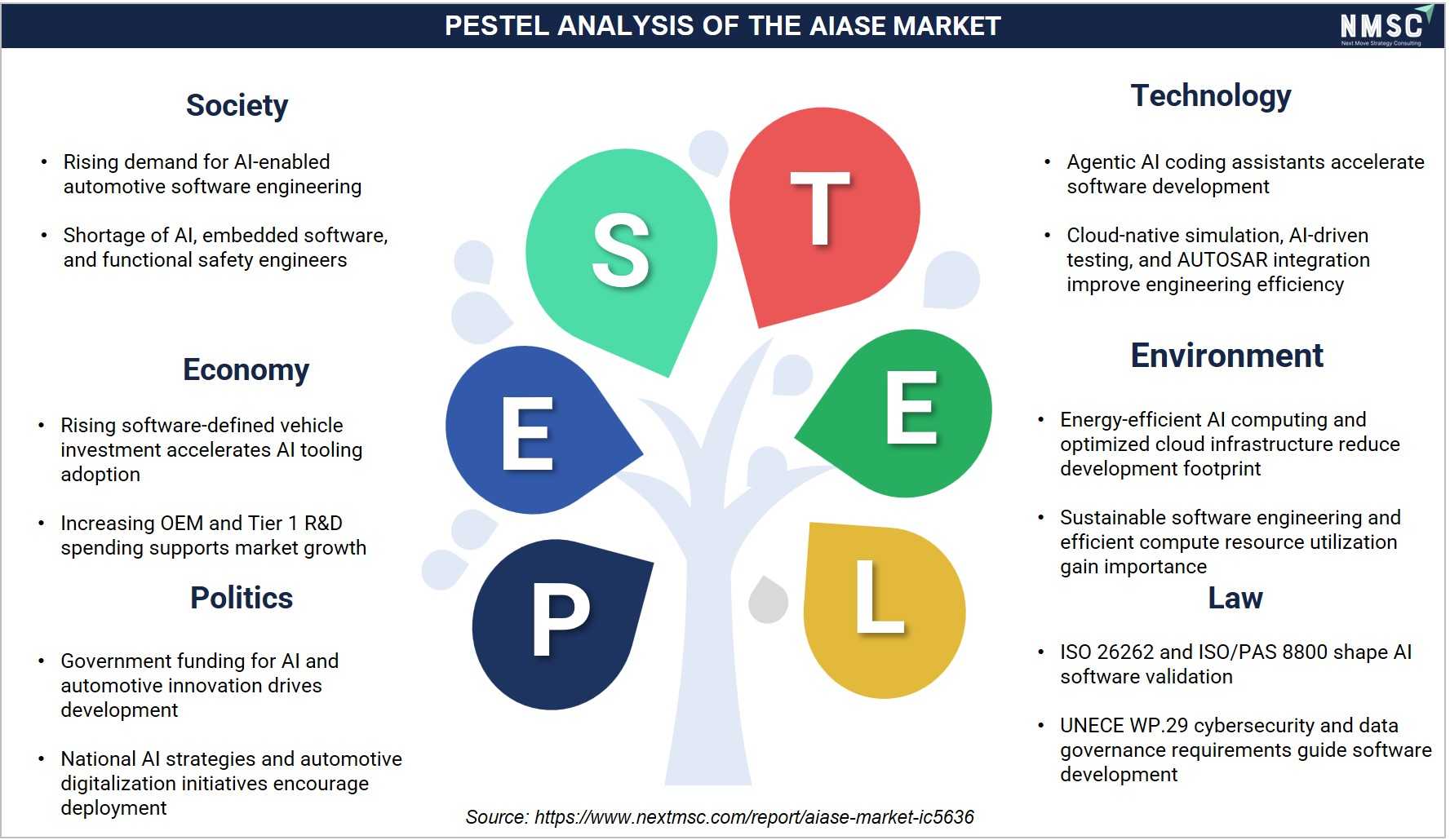
NMSC's analysis indicates that rising software-defined vehicle investment, government AI initiatives, and OEM adoption of generative AI are accelerating growth in the AIASE Market. Furthermore, agentic coding assistants, cloud-native development, and AI-driven validation improve engineering efficiency. Concurrently, ISO 26262, ISO/PAS 8800, UNECE WP.29 cybersecurity requirements, and AI governance frameworks shape compliance, software quality, and deployment across automotive software engineering worldwide.
Competitive Landscape
Next Move Strategy Consulting's analysis indicates that the competitive landscape remains moderately concentrated, with diversified automotive-technology suppliers competing alongside specialized AI-tooling vendors.
Key Takeaways
|
Dimension |
Assessment |
|
Market Structure |
Moderately concentrated, with diversified Tier 1 suppliers and specialized AI-tooling vendors coexisting |
|
Innovation Focus |
Agentic coding assistants, automated test-case synthesis, predictive-diagnostics engineering |
|
M&A Activity |
Selective acquisitions of AI-tooling startups by established automotive-software suppliers |
How Do Companies Compete in the Industry?
Companies compete primarily on certification traceability, integration depth with AUTOSAR-compliant toolchains, and demonstrated safety-verification coverage rather than price alone. Diversified Tier 1 suppliers leverage scale to fund proprietary AI-tooling development, while specialized vendors differentiate through narrow, deeply certified capabilities. Industry participants increasingly publish verifiable functional-safety compliance metrics as a core competitive lever across supplier-qualification processes.
Which Competitive Archetypes Dominate the AIASE Market?
Two archetypes dominate: diversified automotive-technology suppliers extending AI capabilities across existing software-engineering platforms, and specialized AI-tooling vendors built around a single differentiated capability such as test-case synthesis or code generation. The first archetype competes on integration breadth and supplier relationships, while the second competes on technical depth and certification speed, together defining the industry's competitive structure through 2035.
What Innovation and Differentiation Strategies Are Companies Pursuing?
Companies are investing in agentic coding assistants, automated verification-evidence generation, and predictive-diagnostics engineering to differentiate beyond standard static-analysis tooling. Innovation focus is shifting from incremental productivity gains toward end-to-end AI-assisted software-lifecycle management, positioning early adopters ahead of tightening functional-safety certification requirements across key geographies.
What M&A Activity Is Shaping the Industry?
M&A activity remains selective, concentrated on acquisitions of AI-tooling startups with certified verification capabilities by larger automotive-technology suppliers seeking rapid platform expansion. This pattern reflects broader geographic expansion and pricing strategies aimed at capturing OEM and Tier 1 supplier tooling budgets without diluting existing certification standards.
Key Market Players
Next Move Strategy Consulting's analysis identifies the following companies as the leading participants shaping the AIASE market through 2035.
-
Robert Bosch GmbH
-
Continental AG
-
Aptiv PLC
-
NVIDIA Corporation
-
Microsoft Corporation
-
Alphabet Inc.
-
Amazon.com, Inc.
-
Siemens AG
-
dSPACE GmbH
-
Vector Informatik GmbH
-
Synopsys, Inc.
-
Cadence Design Systems, Inc.
-
BlackBerry Limited
-
Wind River Systems, Inc.
-
KPIT Technologies Limited
-
Tata Consultancy Services Limited
-
Capgemini SE
-
DXC Technology Company
-
Applied Intuition, Inc.
-
Sonatus, Inc.
Latest Developments
We found that recent developments reflect accelerating investment in agentic tooling, certified verification, and predictive-diagnostics engineering across the industry.
|
Date |
Event |
|
June 2026 |
Sonatus partnered with Schaeffler to bring Sonatus Edge AI technology into Schaeffler's motion-control solutions for software-defined vehicles. The collaboration integrates Sonatus Collector AI and Sonatus AI Director into Schaeffler control units, enabling real-time data collection, AI model deployment, and continuous improvement of vehicle functions such as steering, braking, and energy management. |
|
March 2026 |
Synopsys launched its Electronics Digital Twin (eDT) Platform, an open solution designed to accelerate physical AI system development and software validation for software-defined vehicles. The platform enables automotive OEMs to execute up to 90 percent of software validation in virtual environments prior to hardware availability. |
|
January 2026 |
KPIT Technologies announced a strategic collaboration with Microsoft to launch its Next-Generation Agentic AI mobility solution suite built on Microsoft AI infrastructure. The suite utilizes AI-driven agents across the automotive software development lifecycle to accelerate vehicle software engineering, validation, and integration for software-defined vehicles. |
Expert Insights
 “Automotive software development is becoming more dependent on AI systems, but the software must still be developed, deployed, and maintained with safety in mind. AI systems bring additional challenges to achieving functional safety and to provide guidance, new and updated standards are emerging for their use in safety-critical applications.”
— Jill Britton, Director of Compliance, Perforce
Statement made during the release of the 2025 State of Automotive Software Development Report discussing the growing adoption of AI in automotive software engineering and the need for evolving functional safety standards in safety-critical vehicle applications.
Market Interpretation
The statement highlights that artificial intelligence is becoming an integral component of automotive software engineering, particularly in software-defined vehicles, autonomous driving, and advanced driver assistance systems. As AI-enabled software grows in complexity, compliance with functional safety standards and emerging AI-specific regulations is becoming increasingly important. Consequently, automotive manufacturers and software developers are investing in AI-aware software engineering tools, verification and validation frameworks, safety-compliance solutions, and lifecycle management platforms to ensure reliable deployment in safety-critical applications.
Investment Opportunities
Where Are Capital Inflows Concentrating?
Capital inflows are concentrating in certified AI-tooling development and cloud-simulation infrastructure serving safety-critical ADAS and autonomous-driving software programs. We found that venture and strategic investors are prioritizing tooling vendors with demonstrated ISO 26262 traceability to reduce supplier-qualification risk, directing capital toward companies with verifiable compliance track records.
How Is Infrastructure Investment Evolving?
Infrastructure investment is shifting toward GPU-accelerated cloud simulation environments that support large-scale AI model training for perception and planning software. Growth in the AI agents market is reinforcing parallel investment in AI-assisted software-engineering infrastructure that overlaps with AIASE demand.
What ESG Considerations Are Shaping Capital Allocation?
Environmental, Social, and Governance considerations are increasingly embedded in capital-allocation screening, with investors requiring transparent AI-model governance and data-provenance disclosures ahead of financing approval. Our findings suggest that this trend is accelerating fastest across Europe, where AI-governance disclosure expectations are gaining adoption among institutional technology investors.
Key Benefits for Stakeholders
How Does This Report Benefit Industry Leaders?
Industry leaders gain access to validated segmentation, regional, and competitive-positioning data that supports AI-tooling investment prioritization and supplier-qualification decisions. The report's forecasts and driver analysis help executive teams benchmark growth trajectories against verified market-sizing methodology ahead of 2035 planning cycles.
How Does This Report Benefit Investors and Financial Analysts?
Investors and financial analysts gain a fundamentals-supported view of market sizing, CAGR drivers, and regional capital-allocation trends, supporting due-diligence and valuation work across automotive-software and AI-tooling investment targets. The report's regional and country-level breakdowns help identify underpenetrated markets ahead of broader capital inflows.
How Does This Report Benefit Technology Vendors and Product Teams?
Technology vendors and product teams serving the automotive software-engineering space gain insight into adoption patterns and unmet demand across offering and deployment-mode segments. The report's competitive-landscape and trend analysis inform product-roadmap prioritization for certified AI-tooling infrastructure through 2035.
Key Market Segments
By Offering
-
Software Tools and Platforms
-
Professional Services
-
Managed Services
By Application
-
ADAS and Autonomous Driving Software Engineering
-
Testing and Validation
-
Code Generation and Development
-
Diagnostics and Predictive Maintenance
-
Other Applications
By Deployment Mode
-
Cloud
-
On-Premise
By End User
-
Original Equipment Manufacturers
-
Tier 1 Suppliers
-
Software and Technology Vendors
By Region
-
North America: U.S., Canada, Mexico.
-
Europe: UK, Germany, France, Italy, Spain, Sweden, Denmark, Finland, Netherlands, Rest of Europe.
-
Asia-Pacific: China, India, Japan, South Korea, Taiwan, Indonesia, Vietnam, Australia, Philippines, Malaysia, Rest of APAC.
-
Middle East & Africa: Saudi Arabia, UAE, Egypt, Israel, Turkey, Nigeria, South Africa, Rest of MEA.
-
Latin America: Brazil, Argentina, Chile, Colombia, Rest of LATAM.
Conclusion & Recommendations
What Is the Long-Term Outlook?
The AIASE market is projected to grow from USD 1.72 Billion in 2026 to USD 14.60 Billion by 2035, reflecting a 26.82% CAGR anchored by rising software content per vehicle and accelerating generative AI adoption. Long-term outlook remains favorable as certification frameworks mature and OEMs extend AI-assisted tooling across additional software domains through the forecast window.
What Strategic Positioning Do We Recommend?
We recommend that vendors prioritize certified verification traceability and deep AUTOSAR toolchain integration ahead of competitors, given OEM qualification processes increasingly favor demonstrable safety-compliance evidence. Strategic positioning around managed AI-tooling services offers additional differentiation for suppliers facing internal AI-talent shortages.
How Attractive Is the Market for Investment?
Investment attractiveness remains high, with an absolute dollar opportunity of USD 12.88 Billion created between 2026 and 2035. North America offers scale, while Asia-Pacific offers the highest growth rate at 29.9% CAGR, together presenting a balanced portfolio allocation opportunity for automotive-technology and AI-tooling investors.
What Market Shifts and Key Risks Should Stakeholders Monitor?
Stakeholders should monitor functional-safety certification complexity and AI-talent shortages as the primary risks to sustained growth. A shift toward standardized AI-verification frameworks would accelerate adoption, while unresolved certification bottlenecks could slow the pace of AI-tooling deployment among smaller suppliers.
What Are the Primary Growth Pathways Through 2035?
Primary growth pathways include expanding certified verification tooling for safety-critical software, scaling managed AI-tooling services for talent-constrained suppliers, and unifying development environments for software-defined vehicle platforms. ADAS and Autonomous Driving Software Engineering and Code Generation and Development together represen
About the Author
 Saista Faiyaz
— Saista Faiyaz is Research Associate at Next Move Strategy Consulting, where she has covered consumer markets and healthcare technologies for 3 years. Her work includes primary interview review, secondary-source validation, market sizing, and structured analysis of company and industry data. She supports research by comparing evidence across sources, organizing findings into market narratives, and documenting assumptions used in analysis. Her scope includes cross-market benchmarking, and reports.
Saista Faiyaz
— Saista Faiyaz is Research Associate at Next Move Strategy Consulting, where she has covered consumer markets and healthcare technologies for 3 years. Her work includes primary interview review, secondary-source validation, market sizing, and structured analysis of company and industry data. She supports research by comparing evidence across sources, organizing findings into market narratives, and documenting assumptions used in analysis. Her scope includes cross-market benchmarking, and reports.
About the Reviewer
 Supradip Baul
— Supradip Baul is an accomplished business consultant and strategist with over a decade of rich experience in market intelligence, strategy, technology, and business transformation. His work has included rigorous qualitative and quantitative analysis across multiple industries, helping clients shape investment decisions and long-term roadmaps. Earlier in his career, he was associated with Gartner, where he contributed to industry-leading reports and market share analyses. He has worked with leading global companies and holds an MBA with a dual specialization in Marketing and Finance.
Supradip Baul
— Supradip Baul is an accomplished business consultant and strategist with over a decade of rich experience in market intelligence, strategy, technology, and business transformation. His work has included rigorous qualitative and quantitative analysis across multiple industries, helping clients shape investment decisions and long-term roadmaps. Earlier in his career, he was associated with Gartner, where he contributed to industry-leading reports and market share analyses. He has worked with leading global companies and holds an MBA with a dual specialization in Marketing and Finance.
At Next Move Strategy Consulting, we understand that insightful market research is the cornerstone of successful business decisions. That's why we employ a robust and multifaceted approach, combining various methodologies to deliver the most accurate and actionable data for our clients.

Research Landscape
We navigate the world of research with two primary approaches:
Qualitative Approach
Our qualitative research methodologies involve immersive techniques such as in-depth interviews, focus groups, and observational studies. By engaging directly with individuals and stakeholders, we uncover valuable insights that quantitative data alone may overlook.

Quantitative Research
In tandem with qualitative methodologies, NMSC leverages the power of Quantitative Research to provide a robust foundation of numerical insights. Through systematic data collection and analysis, we quantify patterns, preferences, and market trends, offering a comprehensive view of the business landscape.
Our quantitative research approach employs diverse tools, including surveys, experiments, and statistical modelling. These methodologies enable us to gather data from a large and representative sample, ensuring the statistical significance of our findings. By employing structured questionnaires and standardized data collection methods, we guarantee the reliability and validity of the information we present to our clients.
Quantitative research is particularly effective in measuring the prevalence of trends, assessing market size, and gauging the impact of various factors on consumer behavior. The numerical precision attained through this approach equips our clients with actionable insights, facilitating data-driven decision-making and strategy formulation.


Our Specialized Toolbox for Industry-Specific Market Research
We deploy a specialized arsenal of techniques tailored to meet your unique requirements. Here's a glimpse into our comprehensive toolbox:

Information Procurement
The stage entails acquiring market data or relevant information through various sources and methodologies.


Market Research Approach
We utilize both top-down and bottom-up approaches in market research analysis to achieve a comprehensive understanding of the market dynamics, leveraging the broad perspective of industry trends and macroeconomic factors alongside detailed insights from specific segments and individual companies.

Porters Five Forces Analysis
We conduct Porter's Five Forces analysis to evaluate the competitive landscape of an industry, providing us with insights into factors that affect profitability and strategic positioning.

SWOT Analysis

Forecasting
We utilize a forecasting model to predict future consumption by considering parameters like population, economics, regulations, market competition, drivers, constraints, technology, and pricing. We also employ statistical techniques such as multilinear regression, exponential smoothing, moving average, ARIMA, and Monte Carlo simulations for accurate predictions. In econometric forecasting, we analyzed short-term and long-term event impacts, attributing values based on regulatory frameworks, economic factors, and market events.





 Speak to Our Analyst