Polypropylene Resin Market Global Industry Analysis and Forecast (2026–2035)

The global Polypropylene Resin Market size was valued at USD 132.50 billion in 2025 and is estimated at USD 141.30 billion in 2026, forecast to reach USD 255.44 billion by 2035, expanding at a 6.8% CAGR between 2026 and 2035. Asia Pacific leads with approximately 55% share, while Homopolymer dominates the product type segmentation with nearly 59% share.
Download Free Sample PDF
Base Year (2025)
$132.50 Billion
Forecast (2035)
$255.44 Billion
CAGR (2026-2035)
6.8%
Top Region
Asia Pacific

What Is the Polypropylene Resin Market Size?
The global polypropylene resin market size was valued at USD 132.50 billion in 2025 and is estimated at USD 141.30 billion in 2026, forecast to reach USD 255.44 billion by 2035, expanding at a CAGR of 6.8% from 2026 to 2035. Asia Pacific led with approximately 55% revenue share, while Homopolymer dominated the product type segmentation with nearly 59% share in 2025.

We observed that demand consolidation around high-purity homopolymer grades, packaging-driven consumption, and automotive lightweighting sustains steady, broad-based expansion across the polypropylene resin market throughout the forecast period.

Polypropylene Resin Market Global Industry Analysis and Forecast (2026–2035) Revenue Forecast
Values in USD Billion

2025 $132.50 Billion
2025
2026 $141.51 Billion
2026
2027 $151.13 Billion
2027
2028 $161.41 Billion
2028
2029 $172.39 Billion
2029
2030 $184.11 Billion
2030
2031 $196.63 Billion
2031
2032 $210.00 Billion
2032
2033 $224.28 Billion
2033
2034 $239.53 Billion
2034
2035 $255.44 Billion
2035

Key Takeaways

By Product Type: Homopolymer held the largest share of approximately 59% (USD 77.51 billion) in 2025; Impact Copolymer is the fastest-growing sub-segment at 8.3% CAGR from 2026–2035.

By Process: Injection Molding held the largest share of approximately 40% (USD 53.00 billion) in 2025; Fiber and Nonwoven Extrusion is the fastest-growing sub-segment at 8.4% CAGR from 2026–2035.

By Application: Packaging held the largest share of approximately 38% (USD 49.69 billion) in 2025; Electrical and Electronics is the fastest-growing sub-segment at 9.3% CAGR from 2026–2035.

By Distribution Channel: Direct Sales held the largest share of approximately 62% (USD 82.15 billion) in 2025; Online Procurement Platforms is the fastest-growing sub-segment at 11.4% CAGR from 2026–2035.

By End User: Packaging Converters held the largest share of approximately 38% (USD 50.35 billion) in 2025; Automotive OEMs and Tier Suppliers is the fastest-growing sub-segment at 8.5% CAGR from 2026–2035.

Dominant Region: Asia Pacific dominated with approximately 55% revenue share (USD 72.21 billion) in 2025.

Fastest-Growing Region: Middle East and Africa is expected to register the highest CAGR of 9.4% during 2026–2035.

Dominant Country: China led with approximately USD 32.86 billion in 2025.

Fastest-Growing Country: India is the fastest-growing major country at approximately 9.7% CAGR from 2026–2035.

What Does the Polypropylene Resin Market Encompass?
The polypropylene resin market encompasses the production, compounding, and distribution of polypropylene polymer in homopolymer, random copolymer, and impact copolymer grades used across packaging, automotive, consumer goods, construction, textile, and electrical applications. We found that the market spans upstream propylene monomer producers, integrated petrochemical resin manufacturers, and downstream converters that transform pellet-form resin into finished components through injection molding, extrusion, and blow molding processes across 38 countries.

Regulatory frameworks such as the U.S. Food and Drug Administration's food-contact polymer regulations and the European Union's Packaging and Packaging Waste Regulation shape resin formulation and recyclability requirements across the industry. Our analysis shows that structural evolution toward mono-material and recycled-content grades, combined with rising single-site catalyst adoption, is reshaping resin technology roadmaps as brand owners pursue circular-economy commitments and automotive OEMs pursue lightweighting mandates to meet emissions targets.

Supply Chain Structure of the Polypropylene Resin Industry

Supply Chain Structure of the Polypropylene Resin Industry
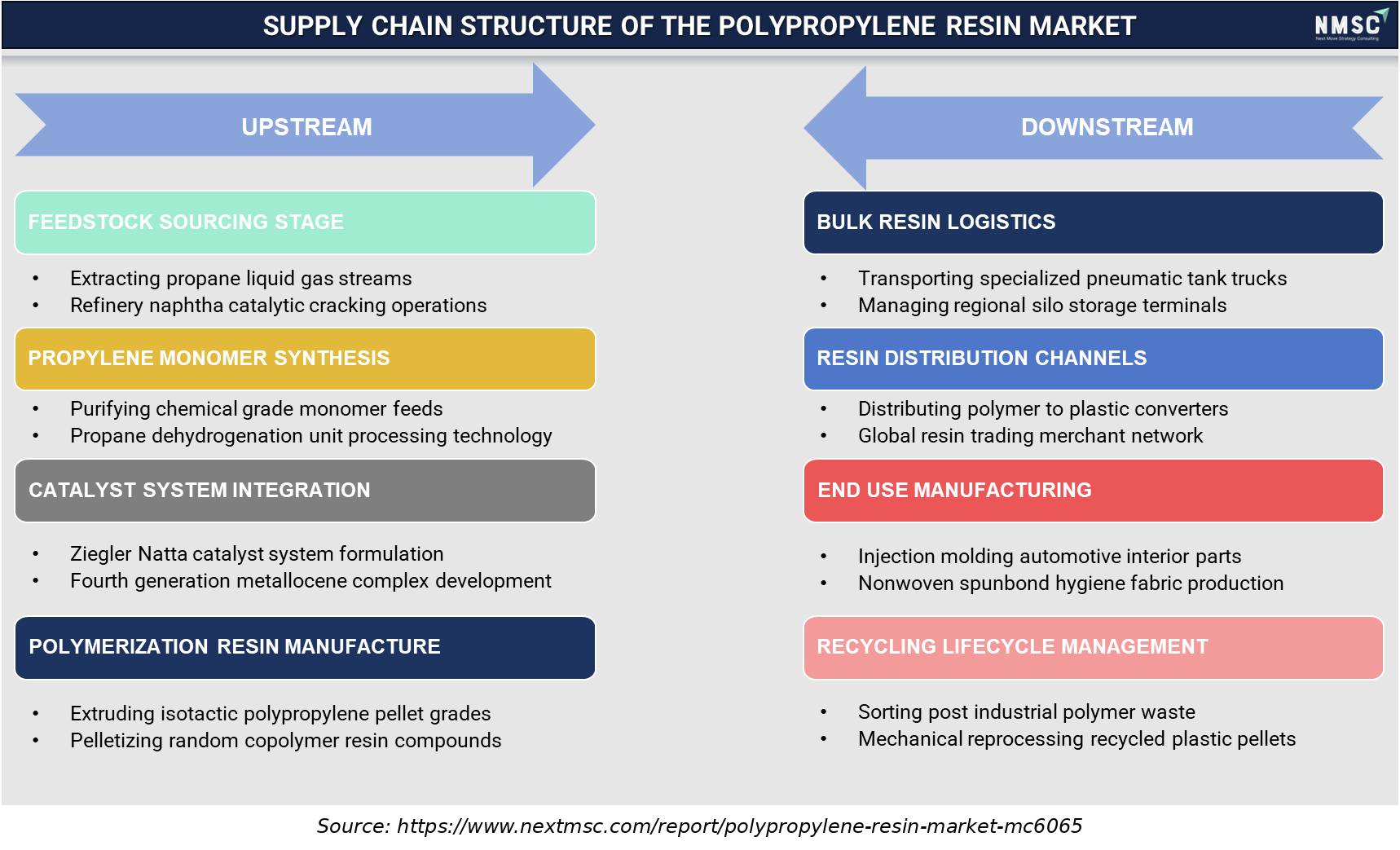
Based on research conducted by NMSC, we found that the supply chain structure of the Polypropylene Resin Market connects propane gas extraction, monomer synthesis, catalyst integration, and pellet polymerization with bulk pneumatic transport. Downstream, global distribution networks supply polymer resins to converters for molding automotive components and nonwoven hygiene fabrics. Ultimately, sorting post-industrial polymer waste and mechanical reprocessing into recycled plastic pellets sustain circular lifecycle management across global manufacturing sectors.
Market Drivers & Dynamics

Interactive Dataset
Rising packaging demand from e-commerce and food delivery driver +1.6% Global 2026–2035
Automotive lightweighting and EV component substitution driver +1.3% North America, Europe, Asia Pacific 2026–2035
Capacity expansion across China and India driver +1.1% Asia Pacific 2026–2032
Growth of nonwoven hygiene and medical textiles driver +0.9% Global 2026–2035
Rising infrastructure investment in pipe and profile extrusion driver +0.7% Middle East and Africa, Latin America 2026–2035
Advances in single-site catalyst and high-purity resin technology driver +0.6% Europe, North America 2026–2033
Crude oil and propylene feedstock price volatility restraint −1.2% Global 2026–2035
Extended producer responsibility and single-use plastic regulation restraint −0.9% Europe, North America 2026–2035
Competitive substitution from polyethylene and biopolymers in packaging restraint −0.5% Global 2026–2032
Source: Next Move Strategy Consulting

Growth Drivers

What Is the Primary Growth Driver of the Polypropylene Resin Market?

Rising global packaging demand is the primary driver of the market. The U.S. Environmental Protection Agency reported that containers and packaging accounted for 28.1% of total municipal solid waste generation, or 82.2 million tons, underscoring the scale of packaging material consumption that polypropylene resin serves. We found that flexible and rigid packaging applications continue to absorb the largest share of new resin capacity as e-commerce and food-delivery volumes expand across developed and emerging economies.

How Is Automotive Lightweighting Driving the Market Growth?

Automotive lightweighting mandates tied to fuel-efficiency and emissions regulation are accelerating market growth. Our findings suggest that engineered impact copolymer and talc-filled compounds are increasingly specified in bumper, interior trim, and battery-enclosure components as automakers pursue weight reduction to extend electric-vehicle range and meet regulatory emissions targets across North America, Europe, and Asia Pacific automotive manufacturing hubs.

Growth Inhibitors

What Is Restraining Polypropylene Resin Market Expansion?
Volatility in crude oil and propylene feedstock pricing restrains margin stability across the polypropylene resin supply chain. Our assessment indicates that naphtha-cracker economics and regional propylene supply-demand imbalances translate directly into resin price swings, complicating long-term procurement planning for converters and increasing working-capital exposure for resin producers operating on thin integrated margins.

Segmentation Analysis

2025 (USD Billion)
2035 (USD Billion)
Homopolymer 2025: $77.51 Billion | 2035: $144.32 Billion
Homopolymer
Random Copolymer 2025: $27.16 Billion | 2035: $54.92 Billion
Random Copol
Impact Copolymer 2025: $21.86 Billion | 2035: $44.70 Billion
Impact Copol
Others 2025: $5.97 Billion | 2035: $11.50 Billion
Others
Homopolymer $77.51 Billion $144.32 Billion 7.2%
Random Copolymer $27.16 Billion $54.92 Billion 8.1%
Impact Copolymer $21.86 Billion $44.70 Billion 8.3%
Others $5.97 Billion $11.50 Billion 7.6%

Which Product Type Segment Dominates the Polypropylene Resin Market?

Homopolymer led the polypropylene resin market with USD 77.51 billion in 2025, supported by its broad-spectrum use in packaging, fiber, and consumer-goods applications where cost efficiency and processability are prioritized. We observed that Impact Copolymer is the fastest-growing sub-segment at 8.3% CAGR from 2026 to 2035, driven by rising automotive component demand requiring enhanced low-temperature impact resistance for bumper and interior trim applications across expanding vehicle production bases.

2025 (USD Billion)
2035 (USD Billion)
Injection Mo
Film and She
Fiber and No
Blow Molding
Pipe and Pro
Segment Item 2025 (USD Billion) 2035 (USD Billion) CAGR
Injection Molding $10.0 USD Billion $40.0 USD Billion 25.0%
Film and Sheet Extrusion $17.1 USD Billion $51.1 USD Billion 11.0%
Fiber and Nonwoven Extrusion $24.2 USD Billion $62.2 USD Billion 25.0%
Blow Molding $31.3 USD Billion $73.3 USD Billion 11.0%
Pipe and Profile Extrusion $38.4 USD Billion $84.4 USD Billion 16.0%

Segment-wise data is locked

Unlock complete segment-wise numbers for By Process.

Unlock Full Data

Which Processing Method Is Most Widely Used for Polypropylene Resin?

Injection Molding remained the dominant processing method across the market, reaching USD 53.00 billion in 2025 due to its suitability for high-volume, precision-molded automotive, consumer-goods, and packaging components. Fiber and Nonwoven Extrusion is the fastest-growing process at 8.4% CAGR from 2026 to 2035, supported by rising hygiene-product and medical-textile nonwoven fabric consumption across expanding healthcare and personal-care manufacturing bases in Asia Pacific and North America.

2025 (USD Billion)
2035 (USD Billion)
Packaging
Flexible Pac
Rigid Packag
Automotive
Interior Tri
Segment Item 2025 (USD Billion) 2035 (USD Billion) CAGR
Packaging $10.0 USD Billion $40.0 USD Billion 27.0%
Flexible Packaging $17.1 USD Billion $51.1 USD Billion 9.0%
Rigid Packaging $24.2 USD Billion $62.2 USD Billion 19.0%
Automotive $31.3 USD Billion $73.3 USD Billion 17.0%
Interior Trim $38.4 USD Billion $84.4 USD Billion 18.0%

Segment-wise data is locked

Unlock complete segment-wise numbers for By Application.

Unlock Full Data

Which Application Segment Leads Polypropylene Resin Market Demand?

Packaging remained the leading application within the market, valued at USD 49.69 billion in 2025 on sustained flexible film, rigid container, and closure demand across food, beverage, and personal-care end uses. Electrical and Electronics is the fastest-growing application at 9.3% CAGR from 2026 to 2035, propelled by rising use of engineered polypropylene compounds in connector housings, insulation components, and consumer-electronics enclosures as manufacturers seek flame-retardant, lightweight material alternatives.

2025 (USD Billion)
2035 (USD Billion)
Direct Sales
Distributors
Online Procu
Segment Item 2025 (USD Billion) 2035 (USD Billion) CAGR
Direct Sales $10.0 USD Billion $40.0 USD Billion 14.0%
Distributors and Traders $17.1 USD Billion $51.1 USD Billion 24.0%
Online Procurement Platforms $24.2 USD Billion $62.2 USD Billion 22.0%

Segment-wise data is locked

Unlock complete segment-wise numbers for By Distribution Channel.

Unlock Full Data
2025 (USD Billion)
2035 (USD Billion)
Packaging Co
Automotive O
Consumer Goo
Construction
Textile Manu
Segment Item 2025 (USD Billion) 2035 (USD Billion) CAGR
Packaging Converters $10.0 USD Billion $40.0 USD Billion 24.0%
Automotive OEMs and Tier Suppliers $17.1 USD Billion $51.1 USD Billion 22.0%
Consumer Goods Manufacturers $24.2 USD Billion $62.2 USD Billion 20.0%
Construction Contractors $31.3 USD Billion $73.3 USD Billion 22.0%
Textile Manufacturers $38.4 USD Billion $84.4 USD Billion 13.0%

Segment-wise data is locked

Unlock complete segment-wise numbers for By End User.

Unlock Full Data

Growth Opportunities

Our analysis shows that three forward-looking opportunities stand out for stakeholders positioning within the polypropylene resin market over the 2026–2035 forecast period.

How Can Chemically Recycled Polypropylene Unlock Value for Packaging Brand Owners?

Chemically recycled polypropylene presents a whitespace opportunity for food-contact and cosmetics packaging brand owners seeking certified recycled content without compromising purity or regulatory compliance. Producers investing in molecular recycling capacity stand to capture premium pricing as brand owners commit to circular-packaging targets.

Where Do High-Purity Medical-Grade Resins Create New Demand?

Medical device manufacturers and pharmaceutical packaging converters represent an underpenetrated opportunity for high-purity, gamma-stable polypropylene grades engineered for sterilization compatibility. Resin producers offering validated medical-grade portfolios can capture premium margins as healthcare device outsourcing expands globally.

How Can Bio-Based Propylene Feedstock Benefit Sustainability-Focused Converters?

Sustainability-focused converters and automotive OEMs pursuing reduced carbon-footprint sourcing create an opportunity for producers offering mass-balance and bio-attributed polypropylene grades derived from renewable feedstock, enabling drop-in compatibility with existing processing equipment while supporting corporate decarbonization commitments.

Regional Outlook

2025 (USD Billion)
2035 (USD Billion)
North Americ
Europe
Asia Pacific
Middle East
Latin Americ
Region 2025 (USD Billion) 2035 (USD Billion) CAGR (%)
North America $10.0 USD Billion $40.0 USD Billion 9.0%
Europe $17.1 USD Billion $51.1 USD Billion 27.0%
Asia Pacific $24.2 USD Billion $62.2 USD Billion 25.0%
Middle East and Africa $31.3 USD Billion $73.3 USD Billion 23.0%
Latin America $38.4 USD Billion $84.4 USD Billion 12.0%

Regional data is locked

Unlock complete regional numbers for this market.

Unlock Full Data

PESTEL Analysis of the Polypropylene Resin Industry

PESTEL Analysis of the Polypropylene Resin Industry
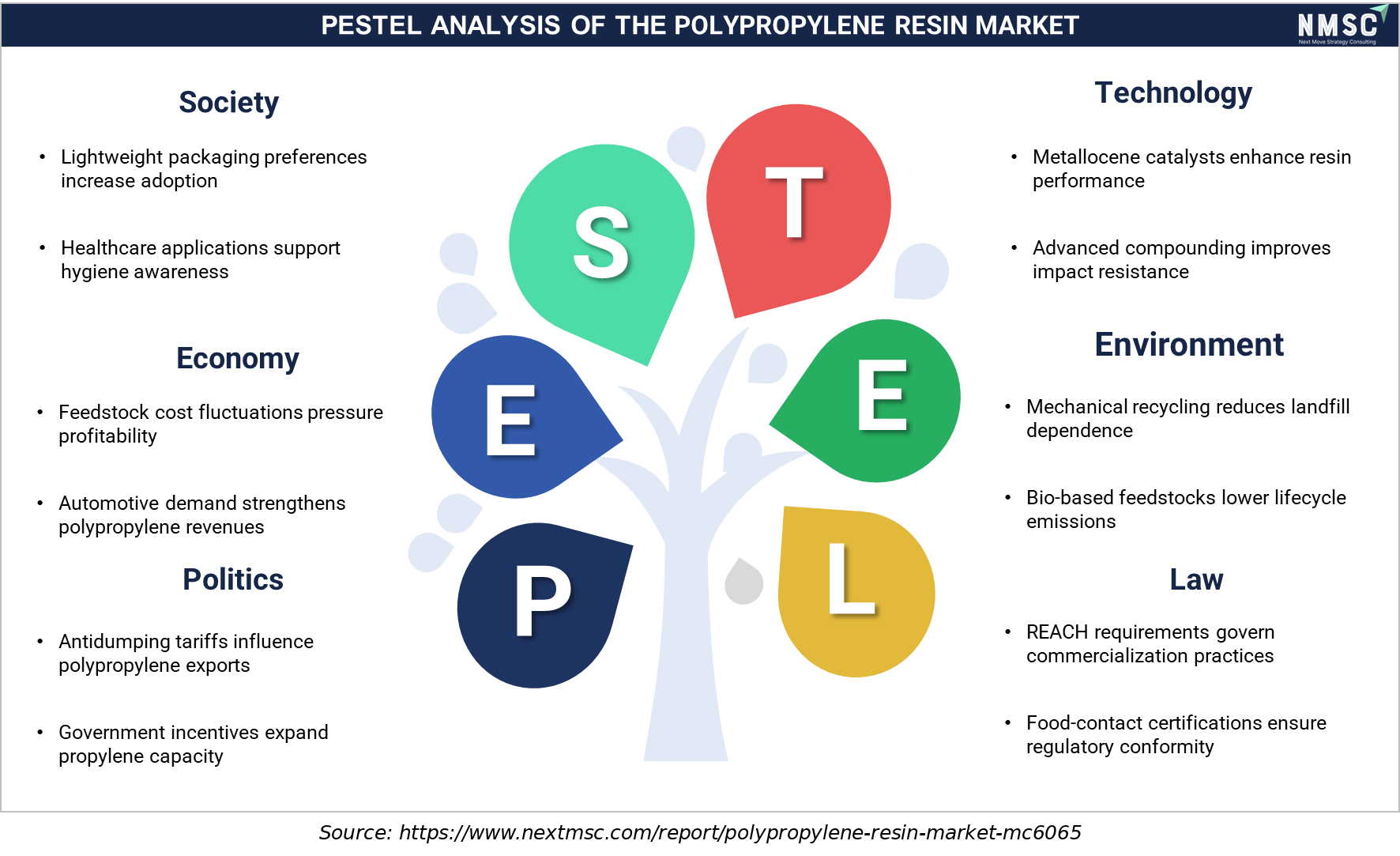
NMSC's analysis indicates that consumer preferences for lightweight packaging, healthcare hygiene demands, and growing automotive market revenue drive expansion in the Polypropylene Resin Market. Furthermore, metallocene catalysts and advanced compounding enhance resin impact resistance. Concurrently, fluctuating feedstock costs pressure profitability, while bio-based feedstocks, mechanical recycling, antidumping tariffs, REACH requirements, and food-contact certifications govern regulatory compliance and sustainability across operating markets.

Competitive Landscape

We observed that the polypropylene resin market features a moderately consolidated competitive landscape, with globally integrated petrochemical majors competing alongside regional producers across capacity, feedstock integration, and product specialization.

Dimension Description
Market Structure Moderately consolidated; the top ten companies collectively account for a substantial majority of global capacity across integrated petrochemical operations.
Innovation Focus Recycled-content integration, single-site catalyst technology, and high melt strength foam grades.
M&A Activity Feedstock-integration expansions, joint ventures, and capacity-scaling investments across Asia Pacific and Europe.

How Do Companies Compete in the Polypropylene Resin Market?

Companies compete primarily on feedstock integration, capacity scale, and product-portfolio breadth across the industry. Integrated majors such as LyondellBasell Industries N.V. and ExxonMobil Corporation leverage upstream propylene production to secure cost advantages, while specialty compounders differentiate through certified recycled-content and high-performance automotive grades tailored to Tier-1 supplier specifications.

Which Competitive Archetypes Dominate the Polypropylene Resin Market?

Two archetypes dominate the market: fully integrated global petrochemical majors offering feedstock-to-polymer production at scale, and regionally focused producers specializing in application-specific compound development. Integrated majors compete on cost leadership and capacity, while specialized producers compete on technical service, certification support, and rapid grade customization for converter customers.

How Are Companies Differentiating Through Innovation in Polypropylene Resin?

Innovation and differentiation strategy increasingly center on recycled-content validation and single-site catalyst resin technology. Borealis's Borstar Nextension platform targets next-generation single-site polypropylene grades for packaging, healthcare, and mobility customers, while LyondellBasell's Circulen and MoReTec initiatives advance certified recycled and molecularly recycled polymer portfolios for premium applications.

What M&A and Expansion Activity Is Shaping the Market?

Capacity expansion and joint-venture activity continue to shape competitive positioning within the industry. Borealis's Baystar joint venture with TotalEnergies SE and Borouge joint venture with ADNOC illustrate how integrated producers are pooling feedstock and market access to scale polypropylene and broader polyolefin capacity across the United States and Middle East.

Key Market Players

Our assessment indicates that the following 20 companies are actively shaping capacity expansion, product innovation, and sustainability strategy within the polypropylene resin market.

LyondellBasell Industries N.V. ExxonMobil Corporation China Petroleum and Chemical Corporation (Sinopec) SABIC PetroChina Company Limited Dow Inc. TotalEnergies SE INEOS Group Holdings S.A. Reliance Industries Limited Borealis AG Braskem S.A. Formosa Plastics Corporation Chevron Phillips Chemical Company LLC LG Chem Ltd. Sumitomo Chemical Co., Ltd. Mitsui Chemicals, Inc. Indorama Ventures Public Company Limited PTT Global Chemical Public Company Limited Repsol S.A. NOVA Chemicals Corporation

Latest Developments

We found that recent capacity and product-development activity within the polypropylene resin market are concentrated on recycled-content integration and single-site catalyst technology, reflecting the industry's broader sustainability and performance-differentiation focus.

Date Event
September 2025 Borealis announced a major capital investment exceeding USD 108 million to construct a new polypropylene compounding line at its production facility in Schwechat, Austria, with operational startup anticipated in the second half of 2026.
January 2025 SABIC localized and commercially launched SABIC VESTOLEN P9421, a green-colored polypropylene random copolymer solution formulation in Saudi Arabia, engineered in collaboration with leading industry partners specifically for high-temperature hot and cold-water piping applications.

Investment Opportunities

What Capital Inflows Are Targeting the Polypropylene Resin Market?

Capital inflows into the market are increasingly directed toward propylene feedstock expansion and advanced recycling capacity. LyondellBasell's approved metathesis unit at Channelview, Texas, converting ethylene into propylene, illustrates how integrated producers are investing to secure feedstock supply for polypropylene and propylene oxide production amid tightening regional capacity.

How Is Infrastructure Investment Supporting Polypropylene Resin Manufacturing?

Infrastructure investment is expanding compounding and specialty-grade production capacity across Europe and Asia Pacific. Borealis's over EUR 100 million investment in Schwechat, Austria, compounding facilities, alongside continued petrochemical capacity additions in China and India, is strengthening regional supply chains to serve rising domestic and export-oriented converter demand.

What ESG Considerations Are Shaping Polypropylene Resin Investment Decisions?

Environmental, social, and governance considerations are central to investment decisions across the industry, with recycled-content sourcing and reduced-emissions production increasingly influencing capital allocation. Producers pursuing molecular recycling and mass-balance certified bio-attributed feedstock are positioning to meet brand-owner circularity commitments and evolving European Union packaging-recyclability regulation.

Key Benefits for Stakeholders

How Does This Report Benefit Enterprise and Industry Leaders?

Enterprise and industry leaders gain access to validated segmentation, competitive benchmarking, and regional demand forecasts that support sourcing and capacity-planning decisions. The report's country-level analysis and company profiling enable procurement and strategy teams to identify supply-chain risks and prioritize partnerships across the polypropylene resin value chain with greater confidence.

How Does This Report Benefit Investors and Financial Analysts?

Investors and financial analysts benefit from consistent, single-point market size and CAGR estimates that support valuation and capital-allocation decisions. The report's segmentation and regional forecasts provide a structured basis for assessing growth trajectories across product types, applications, and geographies relevant to petrochemical and polymer-sector investment theses.

How Does This Report Benefit Technology Vendors and Product Teams?

Technology vendors and product teams gain insight into emerging resin-formulation requirements, including recycled-content integration, single-site catalyst grades, and high melt strength foam technology. This analysis supports research and development prioritization for catalyst suppliers, additive manufacturers, and compounding-equipment providers serving the polypropylene resin industry.

Key Market Segments Evaluated

By Product Type

  • Homopolymer
  • Random Copolymer
  • Impact Copolymer
  • Others

By Process

  • Injection Molding
  • Film and Sheet Extrusion
  • Fiber and Nonwoven Extrusion
  • Blow Molding
  • Pipe and Profile Extrusion
  • Other Processes

By Application

  • Packaging
  • Automotive
  • Consumer Goods and Housewares
  • Building and Construction
  • Textiles and Nonwovens
  • Electrical and Electronics
  • Other Applications

By Distribution Channel

  • Direct Sales
  • Distributors and Traders
  • Online Procurement Platforms

By End User

  • Packaging Converters
  • Automotive OEMs and Tier Suppliers
  • Consumer Goods Manufacturers
  • Construction Contractors
  • Textile Manufacturers
  • Other End Users

Conclusion & Recommendations

The long-term outlook for the market remains positive, with global revenue projected to nearly double from USD 132.50 billion in 2025 to USD 255.44 billion by 2035. We observed that sustained packaging, automotive, and construction demand, combined with rising recycled-content adoption, supports steady structural growth across all major geographic regions through the forecast period.

What Strategic Positioning Should Polypropylene Resin Suppliers Pursue?

Suppliers should prioritize recycled-content and single-site catalyst product platforms while pursuing feedstock-integration investments to secure cost-competitive propylene supply. Producers that combine capacity scale with certified sustainability credentials are best positioned to capture premium pricing and long-term converter partnerships across packaging and automotive end markets.

How Attractive Is the Market for New Investment?

The polypropylene resin industry presents an attractive investment case, supported by a USD 114.14 billion absolute dollar opportunity between 2026 and 2035 and a steady 6.8% CAGR. Our assessment indicates that capacity expansion in Asia Pacific and the Middle East offers the strongest near-term return profile given feedstock-cost advantages and rising regional consumption.

What Market Shifts and Key Risks Should Stakeholders Monitor?

Stakeholders should monitor feedstock-price volatility, tightening extended producer responsibility regulations, and competitive pressure from alternative packaging materials. We found that resin producers with diversified geographic footprints and integrated feedstock positions are better insulated against regional price shocks and evolving plastic-waste policy across key end markets.

What Are the Key Growth Pathways for the Market?

Key growth pathways include expanding recycled-content and specialty compound portfolios, scaling single-site catalyst production capacity, and deepening penetration into automotive lightweighting and medical-grade applications. Our findings suggest that producers pursuing these pathways alongside geographic capacity diversification will be best positioned to capture the polypropylene resin market's projected USD 114.14 billion opportunity through 2035.

FAQs

About the Author

Mayurima Roy

Mayurima Roy

Mayurima Roy is Research Analyst at Next Move Strategy Consulting, where she has spent 4 years working across the firm's full industry coverage rather than a single fixed vertical. Her work centers on structured research, ongoing trend tracking, competitive assessment, and insight-led content development, translating complex market data into clear, decision-ready narratives that support informed client decision-making across diverse global industries, market sectors, and world regions every day.

About the Reviewer

Supradip Baul

Supradip Baul

Supradip Baul is an accomplished business consultant and strategist with over a decade of rich experience in market intelligence, strategy, technology, and business transformation. His work has included rigorous qualitative and quantitative analysis across multiple industries, helping clients shape investment decisions and long-term roadmaps. Earlier in his career, he was associated with Gartner, where he contributed to industry-leading reports and market share analyses. He has worked with leading global companies and holds an MBA with a dual specialization in Marketing and Finance.

Download Free Sample

Kishu Kanda

KISHU KANDA

Strategy Analyst

Accenture

We purchased the AI Consumer Market Report from this company. Not only did they customize the report to meet our specific requirements, but they also showed great flexibility in accommodating our budget. The report we received fully met our expectations. Additionally, they provided prompt and thorough responses to both our pre-purchase and follow-up questions. We look forward to working with this company again in the future.

Rishabh Jogani

RISHABH JOGANI

Strategy Analyst

Accenture Japan

We are incredibly impressed with the market report on the real estate market in India provided by Next Move Strategy Consulting. The report was thorough, insightful, and well-structured, offering deep analysis and actionable recommendations. It not only captured the current trends and dynamics but also provided a forward-looking perspective that has been invaluable for our strategic planning. Their team demonstrated exceptional professionalism, attention to detail, and a profound understanding of the industry. The data-driven insights and clarity of presentation exceeded our expectations, making complex market trends easy to understand. We highly recommend Next Move Strategy Consulting to anyone looking for reliable and comprehensive market research services. Their expertise has given us the confidence to navigate the complexities of the Indian real estate market with clarity and foresight.

Nishant Awate

NISHANT AWATE

Business Development Global Sales

Zehnder Group Deutschland GmbH

Our experience working with Next Move Strategy Consulting was positive. The team was responsive, professional, and open to incorporating our specific requirements throughout the project. The India AHU market study was comprehensive and well structured, covering market value and volume forecasts, product and application segments, and key industry trends. The inclusion of both AHU and residential MVHR market insights made the study particularly relevant for our strategic market assessment. Overall, the report provides a solid foundation for evaluating market potential, identifying priority segments, and supporting business-development decisions in India.

Semih Kavaklioglu

SEMIH KAVAKLIOGLU

Co-Founder & Sales Manager

Decortie

I work a lot in the marketing industry and I know that research is an essential part of any campaign. I have used Market research reports for my own products and I found them to be very informative and well-researched. The team here produces insightful reports for a good price

Kevin Coker

KEVIN COKER

Founder, CEO and Board Diector

Proxima Clinical Research

I have been using Next MSC reports for product positioning in a new geography for a long time. They have by far the best reports I have found and the price is reasonable too!

Custom Market Research Services

We will customize the research for you if the listed report does not fully match your requirements.

Get 30% Free Customization

Select License

This website uses cookies to ensure you get the best experience on our website. Learn more

✖