Polyurethane Systems Market Global Industry Analysis and Forecast (2026–2035)

The global Polyurethane Systems Market is estimated at USD 1.36 Billion in 2026 and is projected to reach USD 2.34 Billion by 2035, growing at a CAGR of 6.17% from 2026 to 2035. Growth is driven by demand for energy-efficient insulation, automotive applications, and polyurethane foam, coatings, adhesives, and sealants.

Download Free Sample PDF
Base Year (2025)
$1.25 Billion
Forecast (2035)
$2.34 Billion
CAGR (2026-2035)
6.2%
Top Region
Asia-Pacific

What Is the Polyurethane Systems Market Size?

The global Polyurethane Systems Market was valued at USD 1.25 Billion in 2025, is estimated at USD 1.36 Billion in 2026, and is projected to reach USD 2.34 Billion by 2035, growing at a CAGR of 6.17% from 2026–2035. Asia-Pacific led with approximately 41.6% share in 2025, while rigid foam systems dominated with approximately 41.6% share.

We observed that revenue is shifting gradually from commodity foam toward engineered coating, adhesive, and sealant systems, which shapes the following key takeaways.

Polyurethane Systems Market Global Industry Analysis and Forecast (2026–2035) Revenue Forecast

Values in USD Billion

2025 $1.25 Billion
2025
2026 $1.36 Billion
2026
2027 $1.44 Billion
2027
2028 $1.53 Billion
2028
2029 $1.63 Billion
2029
2030 $1.73 Billion
2030
2031 $1.83 Billion
2031
2032 $1.95 Billion
2032
2033 $2.07 Billion
2033
2034 $2.20 Billion
2034
2035 $2.34 Billion
2035

Key Takeaways

System type, dominant: Rigid foam systems (USD 0.52 Billion in 2025; USD 0.96 Billion in 2035)

System type, fastest growing: Coating, adhesive and sealant systems (CAGR of 7.65% from 2026–2035)

Application, dominant: Building and construction (USD 0.44 Billion in 2025; USD 0.84 Billion in 2035)

Application, fastest growing: Industrial equipment and energy (CAGR of 9.87% from 2026–2035)

Dominant Region: Asia-Pacific (USD 0.52 Billion in 2025; USD 1.15 Billion in 2035)

Fastest-Growing Region: Asia-Pacific (CAGR of 7.90% from 2026–2035)

Dominant Country: China (USD 0.26 Billion in 2025; USD 0.54 Billion in 2035)

Fastest-Growing Country: India (CAGR of 10.22% from 2026–2035)

Market opportunity: the polyurethane systems market adds an absolute revenue opportunity of USD 0.98 Billion between 2026 and 2035, signalling a durable entry window for capital directed at insulation, coating, and sealant system capacity.

According to NMSC analysis, coating, adhesive and sealant systems, at 24.8% of 2025 revenue, will lift their share to 28.2% by 2035 as formulators Favor higher margin engineered chemistries over commodity foam.

What does the Polyurethane Systems Market Encompass?

This market report defines polyurethane systems as formulated, ready to process combinations of polyol blends and isocyanates, with catalysts, surfactants, and blowing agents, supplied by system houses to processors at a fixed mixing ratio. The polyurethane systems market covers rigid and flexible foam, elastomer, and coating, adhesive and sealant systems. It excludes standalone MDI, TDI, and polyol raw materials and finished foam goods, so each dollar counts once, at the system sale.
Our findings suggest that suppliers have moved from selling raw materials toward local system houses, and BASF operates a network of 38 such sites worldwide. Regulation shapes formulation: the European Union restricts diisocyanate use without worker training since August 2023 and sets new exposure limits for transposition by April 2026. Technology adoption favors low global warming potential blowing agents, bio attributed feedstocks, and closed dispensing equipment.

Market Drivers & Dynamics

Interactive Dataset
Building energy efficiency regulation and retrofits driver +1.5% North America, Europe 2026–2035
Urbanization and construction activity in Asia-Pacific driver +1.1% Asia-Pacific 2026–2035
Vehicle lightweighting and thermal management driver +0.9% Asia-Pacific, Europe 2026–2033
Appliance and cold chain insulation demand driver +0.8% Global 2026–2035
Wind energy and industrial equipment applications driver +0.7% Europe, Asia-Pacific 2027–2035
Raw material price volatility restraint −1.0% Global 2026–2030
Competition from alternative insulation materials restraint −0.8% North America, Europe 2026–2035
Diisocyanate handling and exposure rules restraint −0.7% Europe, North America 2026–2032
MDI overcapacity pressure on system pricing restraint −0.6% Asia-Pacific 2026–2029
Source: Next Move Strategy Consulting

Growth Drivers

What is the primary growth driver of the Polyurethane Systems Market?

Energy efficiency regulation in buildings is the primary growth driver. The International Energy Agency reports that buildings account for roughly 30% of global final energy consumption, and the European Union’s recast Energy Performance of Buildings Directive requires new buildings to be zero emission from 2030. Our analysis shows that these rules raise insulation thickness per project, which lifts demand for rigid foam systems across new construction and retrofit.

How is vehicle and appliance demand driving Polyurethane Systems Market growth?

Insulation and lightweight materials in appliances, refrigerated transport, and vehicles sustain system demand beyond construction. Foam in refrigerators and cold chain panels improves energy ratings, while elastomers and adhesives support vehicle assembly. We found that Asia-Pacific manufacturing output anchors this demand, with appliances and cold chain systems expanding from USD 0.17 Billion in 2025 to USD 0.31 Billion in 2035 industry derived estimate, no publicly verifiable dataset available.

Growth Inhibitors

What is restraining the growth of the polyurethane systems market?

Raw material volatility is the main restraint, because MDI, TDI, and polyol prices move with energy and feedstock costs and system suppliers pass through increases with a lag. We estimate that price volatility and substitute insulation materials together reduce the 2026–2035 CAGR by roughly 1.8 percentage points industry-derived estimate, no publicly verifiable dataset available. Wanhua’s continued MDI capacity additions in China also pressure pricing across Asia-Pacific.

What Are the Growth Opportunities?

Can retrofit insulation programs expand the Polyurethane Systems Market?

Government retrofit programs in Europe and North America target older building stock, where spray foam and rigid board systems add insulation without major reconstruction. The mechanism is public funding tied to energy performance standards. Rigid foam systems and the applicators and contractors that buy them benefit most, particularly spray foam suppliers that provide training and certified equipment, since projects increasingly require qualified installers.

Will electric vehicle and battery applications create new demand?

Electric vehicles need lightweight structures, thermal management, and protective bonding around battery packs. Polyurethane adhesives, sealants, and elastomer components compete for these uses against silicones and epoxies. Coating, adhesive and sealant systems benefit, along with automotive suppliers that specify them. Success depends on flame retardancy and thermal conductivity performance, yet each vehicle platform win secures multiyear volume for the supplier.

Can wind energy and industrial insulation open higher margin niches?

Wind blade manufacturers, pipe insulation contractors, and industrial equipment makers buy engineered systems with strict performance and certification requirements. The mechanism is specification driven pricing, which rewards technical service over volume. Industrial equipment and energy applications benefit most, because cast elastomers and rigid foam systems serve blade tooling, district heating pipes, and machinery, and long qualification cycles protect supplier relationships once approved.

Segmentation Analysis

2025 (USD Billion)
2035 (USD Billion)
Rigid foam systems 2025: $0.52 Billion | 2035: $0.96 Billion
Rigid foam s
Flexible foam systems 2025: $0.30 Billion | 2035: $0.50 Billion
Flexible foa
Elastomer systems 2025: $0.12 Billion | 2035: $0.22 Billion
Elastomer sy
Coating, adhesive and sealant systems 2025: $0.31 Billion | 2035: $0.66 Billion
Coating, adh
Rigid foam systems $0.52 Billion $0.96 Billion 5.96%
Flexible foam systems $0.30 Billion $0.50 Billion 5.08%
Elastomer systems $0.12 Billion $0.22 Billion 6.02%
Coating, adhesive and sealant systems $0.31 Billion $0.66 Billion 7.65%

Which system type leads the Polyurethane Systems Market?

System type separates products by foam, elastomer, and coating chemistry. Rigid foam systems led with USD 0.52 Billion in 2025 because insulation mandates anchor demand in buildings and appliances. Based on research conducted by NMSC, we found that coating, adhesive and sealant systems grow fastest at 7.65% through 2035, as construction sealing and bonding specifications rise, while flexible foam trails at 5.08% on mature furniture demand.

2025 (USD Billion)
2035 (USD Billion)
Building and
Automotive a
Furniture an
Appliances a
Footwear
Segment Item 2025 (USD Billion) 2035 (USD Billion) CAGR
Building and construction $10.0 USD Billion $40.0 USD Billion 25.0%
Automotive and transportation $17.1 USD Billion $51.1 USD Billion 11.0%
Furniture and bedding $24.2 USD Billion $62.2 USD Billion 25.0%
Appliances and cold chain $31.3 USD Billion $73.3 USD Billion 11.0%
Footwear $38.4 USD Billion $84.4 USD Billion 16.0%

Segment-wise data is locked

Unlock complete segment-wise numbers for By Application.

Unlock Full Data

Which application dominates the Polyurethane Systems Market?

Application reflects the end use of each system. Building and construction led with USD 0.44 Billion in 2025, supported by insulation codes and roofing and panel demand. Our findings suggest that industrial equipment and energy grow fastest at 9.87% through 2035, driven by wind blade, pipe insulation, and machinery uses, while building and construction advances at 6.17%.

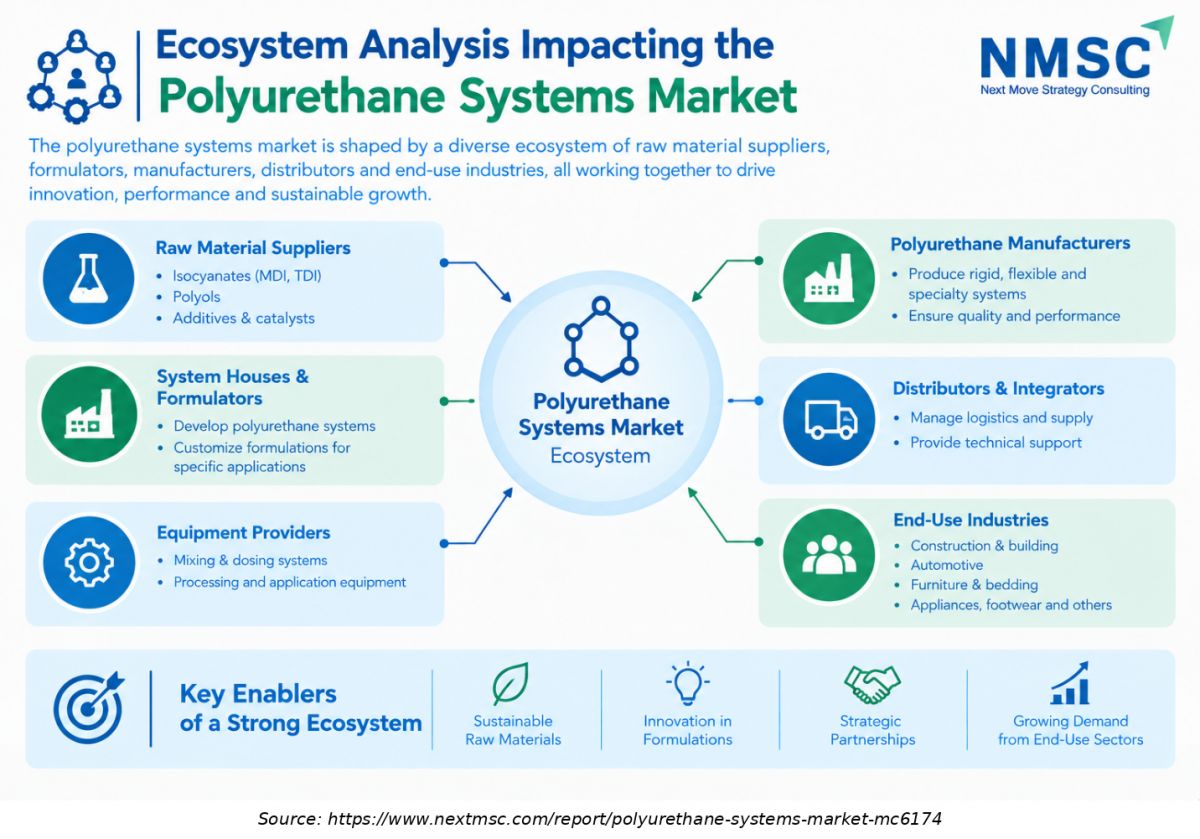
Ecosystem Analysis Infographic for the Polyurethane Systems Market

The Ecosystem Analysis infographic for the Polyurethane Systems Market highlights key stakeholders including raw material suppliers, polyurethane manufacturers, technology and equipment providers, distributors, end-use industries, research institutions, and regulatory bodies. It illustrates their interconnected roles in product development, manufacturing, distribution, innovation, and adoption across major end-use industries.

Growth Opportunities

Our assessment indicates that three whitespace opportunities offer the clearest route to revenue beyond the base forecast.

Can retrofit insulation programs expand the Polyurethane Systems Market?

Government retrofit programs in Europe and North America target older building stock, where spray foam and rigid board systems add insulation without major reconstruction. The mechanism is public funding tied to energy performance standards. Rigid foam systems and the applicators and contractors that buy them benefit most, particularly spray foam suppliers that provide training and certified equipment, since projects increasingly require qualified installers.

Will electric vehicle and battery applications create new demand?

Electric vehicles need lightweight structures, thermal management, and protective bonding around battery packs. Polyurethane adhesives, sealants, and elastomer components compete for these uses against silicones and epoxies. Coating, adhesive and sealant systems benefit, along with automotive suppliers that specify them. Success depends on flame retardancy and thermal conductivity performance, yet each vehicle platform win secures multiyear volume for the supplier.

Can wind energy and industrial insulation open higher margin niches?

Wind blade manufacturers, pipe insulation contractors, and industrial equipment makers buy engineered systems with strict performance and certification requirements. The mechanism is specification driven pricing, which rewards technical service over volume. Industrial equipment and energy applications benefit most, because cast elastomers and rigid foam systems serve blade tooling, district heating pipes, and machinery, and long qualification cycles protect supplier relationships once approved.

Regional Outlook

2025 (USD Billion)
2035 (USD Billion)
North Americ
Europe
Asia-Pacific
Middle East
Latin Americ
Region 2025 (USD Billion) 2035 (USD Billion) CAGR (%)
North America $10.0 USD Billion $40.0 USD Billion 9.0%
Europe $17.1 USD Billion $51.1 USD Billion 27.0%
Asia-Pacific $24.2 USD Billion $62.2 USD Billion 25.0%
Middle East & Africa $31.3 USD Billion $73.3 USD Billion 23.0%
Latin America $38.4 USD Billion $84.4 USD Billion 12.0%

Regional data is locked

Unlock complete regional numbers for this market.

Unlock Full Data

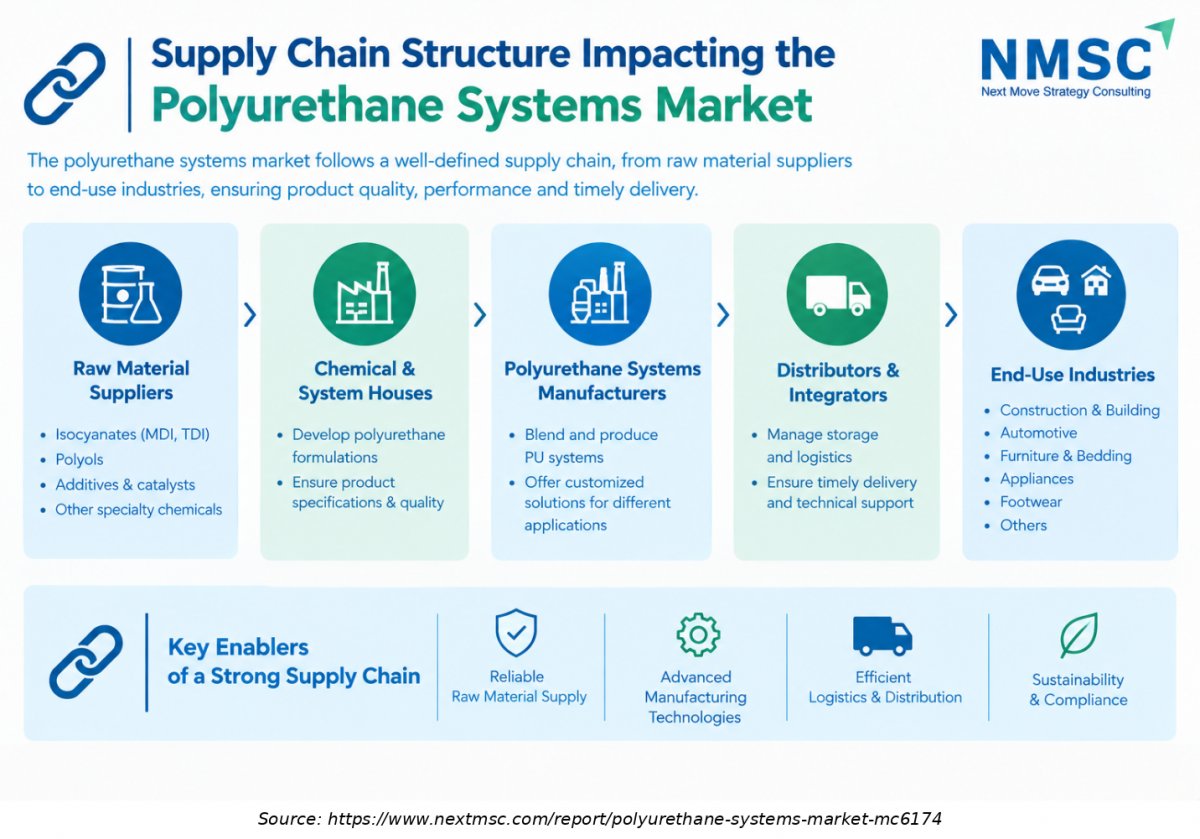
Supply Chain Structure of Polyurethane Systems Market

Supply Chain Structure of Polyurethane Systems Market
The Supply Chain Structure infographic for the Polyurethane Systems Market illustrates the flow from raw material suppliers of polyols, isocyanates, and additives to polyurethane system manufacturers, distributors, and end-use industries. It highlights how efficient sourcing, formulation, manufacturing, and distribution support the market’s growth and product availability.

Competitive Landscape

Our assessment indicates that the industry is moderately concentrated, with integrated chemical majors competing against specialty formulators and construction chemical groups.

Dimension Description
Parameter Key Takeaway
Market Structure Moderately concentrated; integrated MDI and polyol producers lead, with specialty formulators and construction chemical groups in niches
Innovation Focus Lower global warming blowing agents, bio attributed feedstocks, low emission formulations, and engineered coating, adhesive and sealant systems
M&A Activity Selective; ownership changes at large producers, with bolt on deals among formulators

How do companies compete in the Market?

Companies compete on raw material integration, regional system house coverage, technical service, and regulatory compliance. Integrated producers such as BASF, Dow, Covestro, and Wanhua control isocyanate and polyol supply, which stabilizes cost. Smaller formulators win with custom blends and speed. We observed that geographic expansion follows customer clusters, and pricing strategies pair volume contracts with indexed raw material pass through.

Which company archetypes dominate the market?

Three archetypes dominate: integrated chemical majors, construction chemical groups, and specialty formulators. Majors such as BASF and Huntsman win through raw material scale and global system house networks. Construction groups such as Sika and SOPREMA win through contractor channels and certified roofing and sealing systems. Specialists win through application expertise, and these themes of integration, channel access, and technical service explain dominance in the polyurethane systems market.

What defines innovation and differentiation strategy?

Differentiation centers on sustainability and application performance. Suppliers develop lower global warming potential foams, mass balance feedstocks, and faster curing sealants, and they support customers with testing and equipment. Our analysis shows that vendors combining a certified low emission system with application training retain customers longest, while premium pricing is easiest to sustain in regulated insulation and automotive uses.

How active is M&A in the sector?

Ownership changes have centered on large producers. XRG, a subsidiary of ADNOC, completed its takeover of Covestro in December 2025, bringing a Gulf energy investor into the global supply base. We found that smaller transactions involve formulators and applicators seeking regional reach. Further consolidation is likely among regional blenders as compliance costs rise, which will reshape the market competitive landscape.

Key Market Players

NMSC’s analysis indicates that the following 15 verified companies define the competitive set, listed in ranked order.

BASF SE Dow Inc. Covestro AG Huntsman Corporation Wanhua Chemical Group Co., Ltd. Sika AG Henkel AG & Co. KGaA Mitsui Chemicals, Inc. LANXESS AG RPM International Inc. Carlisle Companies Incorporated Tosoh Corporation SOPREMA Group H.B. Fuller Company Arkema S.A.

Latest Developments

We noticed that the most verifiable recent developments concern ownership, regulation, and supply footprint.

Date Event
September 2026 Covestro introduced Desmodur Climate Value a polymeric MDI grade available to European customers
September 2026 LANXESS launched Purventis, a new flame-retardant platform, with Purventis Core as its first commercial product for rigid polyurethane and polyisocyanurate insulation foams
September 2026 BASF advanced the feasibility study for a potential MDI production complex in Dahej, Gujarat, India, and secured industrial land for the proposed project through BASF India Polyurethanes Private Limited.
August 2026 BASF launched Lupragen BisDMAPU, a globally available low-emission amine catalyst for flexible polyurethane foams
August 2026 Dow and Adient commercially launched SPECFLEX REN, a polyurethane seating solution using ISCC PLUS-certified bio-attributed feedstocks through mass balance
April 2026 BASF introduced ELASTOSPRAY BMB, a biomass-balance isocyanate developed for BASF spray polyurethane foam systems
December 2025 BASF expanded its spray polyurethane foam portfolio with WALLTITE RSB a closed-cell SPF system incorporating recycled and renewable raw materials

Expert Insights

Cavidan Karaca

Cavidan Karaca

CEO | Kimpur

"Carbon neutral targets, energy efficiency requirements and incentives for recycled materials will directly impact product development processes in our sector."

Analyst Interpretation

The statement highlights the increasing influence of carbon targets, energy-efficiency requirements, and recycled materials on polyurethane formulation and product development. These factors are encouraging system houses and manufacturers to incorporate lower carbon feedstocks, recycled content, and improved process efficiency. As sustainability requirements become more integrated into product specifications, material innovation is becoming an increasingly important competitive and technical consideration.

Market Interpretation

The statement highlights the increasing influence of carbon targets, energy-efficiency requirements, and recycled materials on polyurethane formulation and product development. These factors are encouraging system houses and manufacturers to incorporate lower carbon feedstocks, recycled content, and improved process efficiency. As sustainability requirements become more integrated into product specifications, material innovation is becoming an increasingly important competitive and technical consideration.

Investment Opportunities

Where are capital inflows concentrating in the Polyurethane Systems Market?

Capital flows toward local system houses, low global warming potential rigid foam capacity, and engineered sealant and adhesive lines. The XRG takeover of Covestro in December 2025 shows that energy groups will fund chemical platforms. We estimate that Asia-Pacific attracts the largest share of new system capacity, consistent with its USD 0.52 Billion 2025 revenue base industry derived estimate, no publicly verifiable dataset available.

Which infrastructure investments matter most for the Polyurethane Systems Market?

Priority investments include blending and storage sites near customer clusters, closed dispensing equipment, and application training centers. Isocyanate handling requires controlled logistics and safety systems, so regions with limited chemical infrastructure lag regardless of demand. During our market evaluation, we noticed that suppliers who add local technical laboratories shorten qualification cycles with automotive and appliance customers.

How do ESG considerations affect investment in the Polyurethane Systems Market?

Environmental factors dominate: buildings account for roughly 30% of global final energy consumption according to the International Energy Agency, so insulation systems support decarbonization, while blowing agent and feedstock choices determine product footprint. Social factors include worker exposure to diisocyanates, regulated in Europe through training requirements. Governance centers on transparent mass balance claims. Investors increasingly Favor suppliers with verified footprint data.



Key Benefits for Stakeholders

How does this Polyurethane Systems Market report benefit enterprise and industry leaders?

Industry leaders gain a segment level view of where revenue sits and where it will move. The report sizes each system type, application, and region for 2025 and 2035, helping executives allocate investment between foam and engineered chemistries. Competitive analysis of the market clarifies system house locations, partnership targets, and pricing positions against rivals.

How does this report benefit investors and financial analysts?

Investors receive a triangulated forecast anchored on USD 1.25 Billion in 2025 and USD 2.34 Billion in 2035, with a 6.17% CAGR for 2026–2035. The catalyst and risk matrix quantifies how each driver and restraint shifts growth, supporting scenario modelling. Country level projections identify where capital can earn the highest incremental returns.

How does this report benefit technology vendors and product teams?

Formulators and product teams obtain evidence on which chemistries gain traction and which regulations shape launches. Segment growth rates guide research priorities across low global warming foams, bio attributed systems, and engineered sealants. Regional and application analysis shows where specifications align with product strengths, helping managers sequence launches and tailor go to market strategies.

Key Market Segments Evaluated

By System type

  • Rigid foam systems 
    • Spray foam systems
    • Panel and board foam systems
    • Appliance insulation foam systems
  • Flexible foam systems 
    • Slab stock foam systems
    • Molded foam systems
  • Elastomer systems 
    • Cast elastomer systems
    • Microcellular elastomer systems
  • Coating, adhesive and sealant systems 
    • Coating systems
    • Adhesive systems
    • Sealant systems

By Application

  • Building and construction
  • Automotive and transportation
  • Furniture and bedding
  • Appliances and cold chain
  • Footwear
  • Industrial equipment and energy

By Region

  • North America 
    • U.S.
    • Canada
    • Mexico.
  • Europe 
    • UK
    • Germany
    • France
    • Italy
    • Spain
    • Sweden
    • Denmark
    • Finland
    • Netherlands
    • Rest of Europe.
  • Asia-Pacific 
    • China
    • India
    • Japan
    • South Korea
    • Taiwan
    • Indonesia
    • Vietnam
    • Australia
    • Philippines
    • Malaysia
    • Rest of APAC.
  • Middle East & Africa 
    • Saudi Arabia
    • UAE
    • Egypt
    • Israel
    • Turkey
    • Nigeria
    • South Africa
    • Rest of MEA.
  • Latin America 
    • Brazil
    • Argentina
    • Chile
    • Colombia
    • Rest of LATAM.

Conclusion & Recommendations

Our analysis shows that the polyurethane systems market will expand from USD 1.25 Billion in 2025 to USD 2.34 Billion in 2035, a 6.17% CAGR from 2026–2035. Energy efficiency regulation and Asia-Pacific manufacturing provide durable demand, while the mix tilts toward engineered coating, adhesive and sealant systems and industrial applications.

Strategic Positioning Recommendations

Suppliers should expand local system houses in Asia-Pacific, qualify lower global warming formulations early, and bundle training with equipment to meet diisocyanate rules. Integrated producers should defend cost positions, while specialists should target engineered niches. Focus on certified sustainability data, since verified footprint claims are becoming a condition of specification in this market.

Investment Attractiveness

Attractiveness is highest in coating, adhesive and sealant systems, at 7.65% CAGR, and in Asia-Pacific, at 7.90%. The market adds USD 0.98 Billion between 2026 and 2035. Risk is moderated by regulation driven demand, but investors should weigh raw material volatility, since margin pass through lags feedstock moves, and timing of price increases determines realized returns.

Market Shifts and Key Risks

Key shifts include lower global warming blowing agents, bio attributed feedstocks, and regional system houses. Risks include raw material volatility, MDI overcapacity, substitute insulation, and stricter exposure rules. Our assessment indicates that a prolonged construction downturn would delay the rigid foam outlook, whereas faster retrofit funding would lift volumes above our base case.

Growth Pathways

Growth pathways include building retrofit programs, electric vehicle bonding and sealing, and wind and industrial insulation niches. Each targets a distinct segment, from rigid foam to adhesive systems and cast elastomers. Companies that align certified chemistry, local service, and cost position can convert these pathways into recurring revenue as the polyurethane systems market matures through 2035.

FAQs

About the Author

Mayurima Roy

Mayurima Roy

Mayurima Roy is Research Analyst at Next Move Strategy Consulting, where she has spent 4 years working across the firm's full industry coverage rather than a single fixed vertical. Her work centers on structured research, ongoing trend tracking, competitive assessment, and insight-led content development, translating complex market data into clear, decision-ready narratives that support informed client decision-making across diverse global industries, market sectors, and world regions every day.

About the Reviewer

Supradip Baul

Supradip Baul

Supradip Baul is an accomplished business consultant and strategist with over a decade of rich experience in market intelligence, strategy, technology, and business transformation. His work has included rigorous qualitative and quantitative analysis across multiple industries, helping clients shape investment decisions and long-term roadmaps. Earlier in his career, he was associated with Gartner, where he contributed to industry-leading reports and market share analyses. He has worked with leading global companies and holds an MBA with a dual specialization in Marketing and Finance.

Download Free Sample

Semih Kavaklioglu

SEMIH KAVAKLIOGLU

Co-Founder & Sales Manager

Decortie

I work a lot in the marketing industry and I know that research is an essential part of any campaign. I have used Market research reports for my own products and I found them to be very informative and well-researched. The team here produces insightful reports for a good price

Ross J Mckenzie

ROSS J MCKENZIE

Business Insight Manager

Staysure Group

“Next MSC have been incredibly helpful in providing detailed & robust information on our market, alongside quantifying growth by different segments. The process to procure was simple and easy, with sample reports and regular contact to ensure we had what we needed. Succinct detail on their sources & methodologies is also greatly received, allowing transparency in this respect helps build trust in the detail you pay for. Joseph in particular was fantastic, and helped ensure efficient provision of the insight pack – thank you NMSC!”.

Gustaf Hummel Burstrom

GUSTAF HUMMEL BURSTROM

Founder

Revline Tools AB

Joseph and the team at Next Move Strategy Consulting have been excellent to work with, in supplying us with relevant market data and forecasts for our specific category. We had some special requirements and they were able to do a custom package to suit our needs. We would definitely recommend them to any other company needing market data and forecasts

Pratyush Kumar Das

PRATYUSH KUMAR DAS

Assistant Manager

Polycab India Limited

We would like to express our appreciation for the data and insights provided by nextmsc. We are very pleased with the quality and depth of the information, which has proven to be highly valuable and beneficial for our business decision-making.

Melanie Samko

MELANIE SAMKO

Director of Marketing

TOSOH BIOSCIENCE, INC.

The information provided by NMSC is incredibly valuable, thank you so much for such a excellent work. I really appreciate it. I will make sure to reference all of it, in my summary document.

Custom Market Research Services

We will customize the research for you if the listed report does not fully match your requirements.

Get 30% Free Customization

Select License

This website uses cookies to ensure you get the best experience on our website. Learn more

✖