Polyurethane Sealant Market Size, Share, Growth & Forecast by Component Type (One-Component, Two-Component, Modified and Hybrid), Pack Format (Cartridge, Sausage Pack, Pail, Drum, Bulk Delivery), Buyer Type (OEM, Contractors, Fabricators, DIY), Sales Channel, and End Use (Building and Construction, Infrastructure, Automotive and Transportation, Industrial and Manufacturiing) -- Global Analysis 2025-2035
Industry: Materials and Chemical | Publishing Date: July 8, 2026 | Last Updated: September 30, 2026 | No of Pages: N/A | No. of Tables: N/A | No. of Figures: N/A | Format: PDF | Report Code: MC5027
What Is the Polyurethane Sealant Market Size?
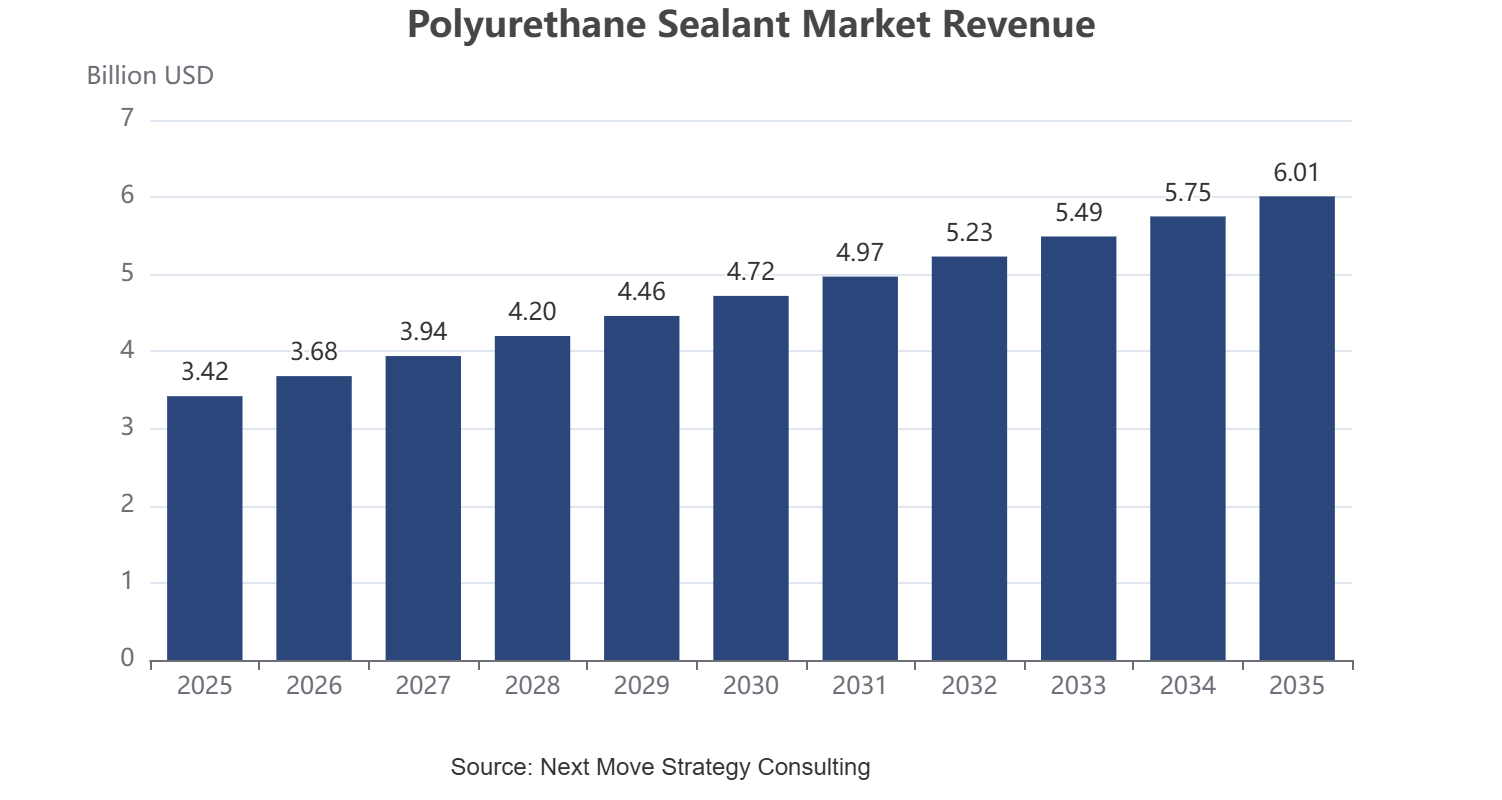
The global Polyurethane Sealant Market was valued at USD 3.42 billion in 2025 and is expected to reach USD 3.62 billion in 2026. Rising construction activity, automotive lightweighting, and growing demand for durable, weather-resistant joint sealing solutions are projected to propel the market to USD 6.01 billion by 2035, advancing at a CAGR of 5.8% from 2026 to 2035. Key growth drivers include expanding global construction spending, stricter building energy-efficiency codes, increasing one-component PU sealant adoption among contractors, and rising demand for hybrid and low-VOC sealant chemistries across OEM and infrastructure applications.
|
Parameters |
Details |
|
Market Size in 2026 |
USD 3.62 Billion |
|
Revenue Forecast in 2035 |
USD 6.01 Billion |
|
Growth Rate |
CAGR of 5.8% from 2026 to 2035 |
|
Analysis Period |
2025–2035 |
|
Base Year Considered |
2025 |
|
Forecast Period |
2026–2035 |
|
Market Size Estimation |
Billion USD |
|
Companies Profiled |
20 |
|
Countries Covered |
33 |
|
Market Share |
Top 10 |
Polyurethane Sealant Market Overview
What Is the Polyurethane Sealant Market?
The Polyurethane Sealant Market comprises one-component, two-component, and modified or hybrid PU-based formulations used to seal joints, gaps, and movement points across building envelopes, infrastructure, automotive assembly, and industrial manufacturing applications. Based on our research, we found that polyurethane chemistry delivers a balance of elasticity, adhesion, paintability, and weather resistance that differentiates it from silicone and acrylic alternatives. The market spans cartridge, sausage pack, pail, drum, and bulk delivery formats sold through direct, distributor, retail, and e-commerce channels to OEM, contractor, fabricator, and DIY buyers.
How Has the Polyurethane Sealant Market Evolved?
The Polyurethane Sealant Market has evolved through several formulation phases. Early tar- and oil-based joint sealants gave way to first-generation one-component moisture-curing PU sealants in the mid-twentieth century, valued for elasticity in expansion joints. Through our market assessment, we observed that the current phase centers on hybrid silane-modified polymer and low-isocyanate technologies that reduce volatile organic compound content while preserving adhesion performance, alongside fast-cure two-component systems engineered for automotive glazing and prefabricated construction assembly lines.
How Do Regulations Influence the Polyurethane Sealant Market?
Regulatory frameworks are a major structural factor shaping the Polyurethane Sealant Market. The U.S. EPA's National Volatile Organic Compound Emission Standards for Architectural Coatings under 40 CFR Part 59 Subpart D caps VOC content in sealers and related construction products. In the European Union, the REACH restriction on diisocyanates under Regulation (EU) 2020/1149 has required mandatory safety training for industrial and professional users since August 24, 2023. These compliance requirements are compelling formulators to invest in low-VOC and low-monomer isocyanate chemistries.
How Is Technology Adoption Expanding Across the Polyurethane Sealant Market?
Technology adoption across the Polyurethane Sealant Market is accelerating as manufacturers reformulate products around hybrid polymer platforms, low-monomer isocyanate prepolymers, and bio-based polyol feedstocks. Through our analysis, we observed that fast-cure two-component systems are gaining share in automotive direct glazing and prefabricated panel assembly, where cycle-time reduction is commercially critical. At the same time, cartridge-based one-component systems are being reformulated for non-sag application across vertical building envelope joints, improving applicator productivity on facade and curtain wall projects.
|
Key Takeaways |
|
By component type, One-Component Polyurethane Sealants held the largest share in the Polyurethane Sealant Market at USD 2.15 billion in 2025, driven by ease of application, rapid curing characteristics, and extensive use across construction, automotive, and industrial applications. Hybrid Polyurethane Sealants represent the fastest-growing component segment at a CAGR of 8.3% from 2026 to 2035, supported by increasing demand for high-performance, low-VOC, and environmentally compliant sealing solutions. |
|
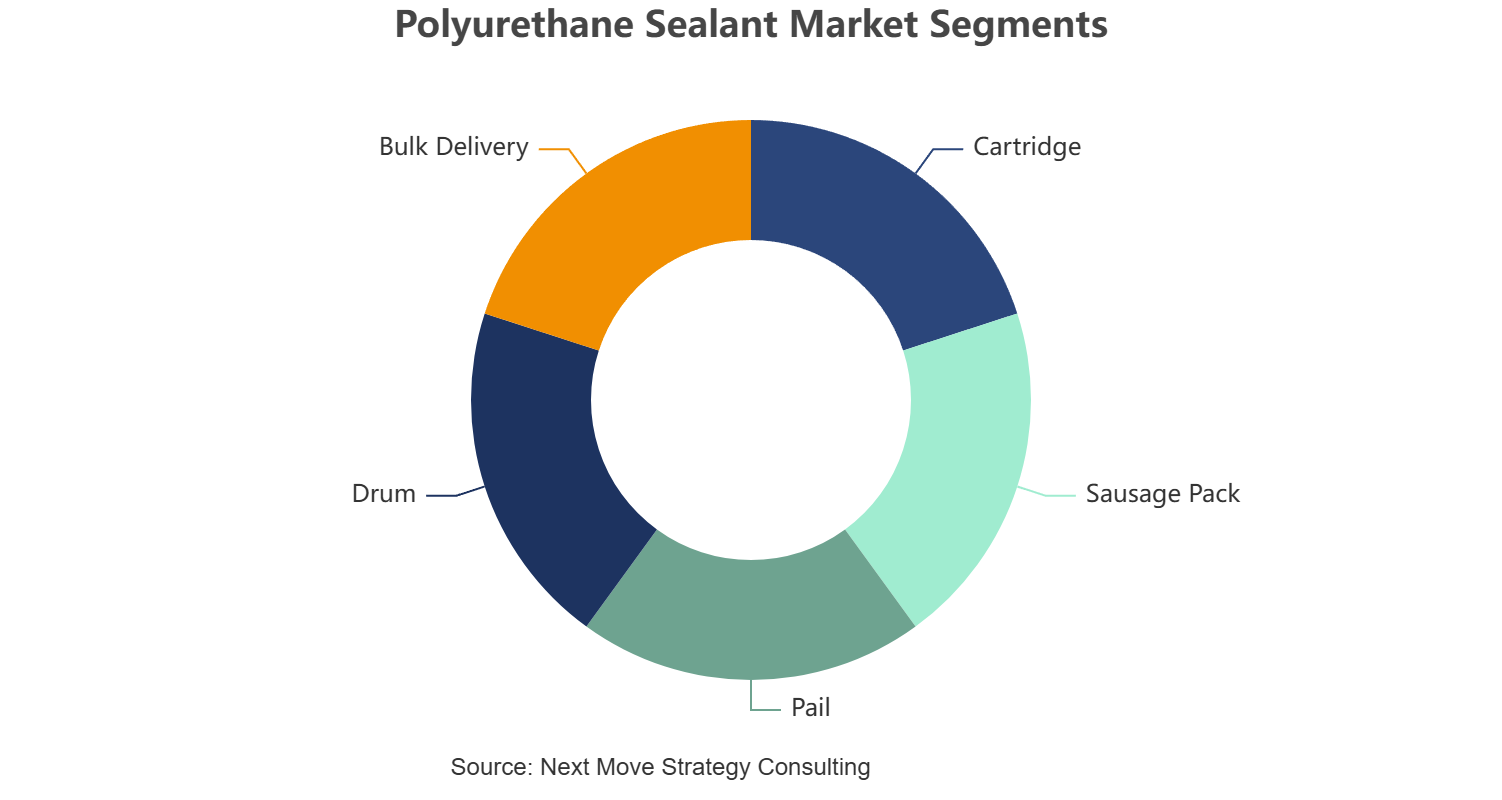
By pack format, Cartridge packaging accounted for the largest market share at USD 1.50 billion in 2025, reflecting its widespread use across residential, commercial, and industrial construction applications. Bulk Delivery is the fastest-growing pack format at a CAGR of 11.2% from 2026 to 2035, driven by rising adoption in large-scale infrastructure projects, industrial manufacturing facilities, and high-volume construction applications. |
|
By buyer type, Construction Contractors represented the largest customer segment at USD 1.40 billion in 2025, supported by strong demand from residential, commercial, and infrastructure development projects worldwide. DIY Consumers are the fastest-growing buyer type at a CAGR of 7.4% from 2026 to 2035, driven by increasing home renovation activity, product accessibility, and expanding retail distribution networks. |
|
By sales channel, Direct Sales generated the largest revenue contribution at USD 1.61 billion in 2025, reflecting strong supplier relationships with construction firms, industrial manufacturers, and OEM customers. E-Commerce is the fastest-growing sales channel at a CAGR of 13.5% from 2026 to 2035, supported by expanding online procurement platforms, digital distribution channels, and growing consumer preference for online purchasing. |
|
By end-use industry, Building and Construction accounted for the largest market share at USD 1.88 billion in 2025, supported by rising infrastructure investment, urbanization, commercial construction activity, and renovation projects globally. Renewable Energy is the fastest-growing end-use industry at a CAGR of 8.1% from 2026 to 2035, driven by increasing deployment of wind energy facilities, solar infrastructure projects, and energy-transition investments requiring durable sealing solutions. |
|
Asia-Pacific held the largest regional share in the Polyurethane Sealant Market at USD 1.27 billion in 2025, projected to reach approximately USD 2.52 billion by 2035 at a CAGR of 7.1%, supported by rapid urbanization, infrastructure expansion, industrialization, and strong construction activity across China, India, and Southeast Asia. |
|
Middle East & Africa is the fastest-growing region in the Polyurethane Sealant Market at a CAGR of 7.2% from 2026 to 2035, driven by large-scale infrastructure development programs, commercial construction activity, industrial diversification initiatives, and increasing investment in transportation and energy projects. |
|
China is the largest country market in the Polyurethane Sealant Market, supported by its extensive construction sector, large-scale infrastructure investments, strong manufacturing base, and growing demand from industrial, automotive, and commercial building applications. |
|
Saudi Arabia is the fastest-growing country market within the Middle East & Africa Polyurethane Sealant Market, driven by Vision 2030 infrastructure projects, rapid urban development, industrial expansion, increasing construction activity, and rising adoption of advanced building materials and sealant technologies. |
Key Emerging Trends in the Polyurethane Sealant Market
How Is the Shift Toward Low-VOC and Hybrid Polymer Chemistries Reshaping the Polyurethane Sealant Market?
Formulators across the Polyurethane Sealant Market are reformulating product lines around silane-modified hybrid polymers and low-monomer isocyanate prepolymers to meet tightening VOC and occupational exposure rules. Based on our research, we found that the EU's REACH restriction on diisocyanates, in force since August 24, 2023, has accelerated adoption of pre-polymerized, lower-hazard formulations. Sika and Henkel have both expanded hybrid sealant ranges marketed for green building certification compliance, transforming procurement criteria for architects and specification consultants across commercial construction projects.
How Is Automotive Lightweighting Transforming Demand for Polyurethane Sealants in Vehicle Assembly?
Automotive lightweighting and electrification are reshaping sealant specification within the Polyurethane Sealant Market. Through our market evaluation, we observed that two-component PU systems are increasingly specified for structural direct glazing and battery enclosure sealing, where fast-cure performance and vibration resistance are critical. Henkel and Dow have expanded automotive-grade two-component portfolios supporting electric vehicle battery pack assembly, reflecting a broader stakeholder shift among OEMs toward sealants that combine structural bonding performance with electrical insulation and thermal stability requirements.
How Is the Growth of Prefabricated and Modular Construction Influencing the Polyurethane Sealant Market?
Prefabricated and modular construction methods are creating new demand patterns within the Polyurethane Sealant Market, as factory-controlled environments favor fast-curing two-component and hybrid systems applied to panel joints before site delivery. In our observation, modular panel manufacturers increasingly specify PU sealants engineered for consistent bead application under automated dispensing, reducing on-site labor. This transformation is shifting purchasing influence from field contractors toward fabricators and assemblers, a buyer category we project will expand its share of total demand through 2035.
How Is E-Commerce Distribution Reshaping Go-to-Market Strategies in the Polyurethane Sealant Market?
E-commerce distribution is reshaping go-to-market strategies across the Polyurethane Sealant Market, particularly for small-format cartridge products sold to DIY consumers and small contractors. We noticed that manufacturers including Sika, Pidilite, and Soudal have expanded direct-to-applicator online storefronts and marketplace listings, bypassing traditional retail shelf constraints. This channel shift is compelling distributors to integrate digital ordering and rapid fulfillment capabilities, while creating new visibility for fabricators and contractors to compare technical datasheets and pricing before committing to bulk distributor contracts.
Supply Chain Structure of the Polyurethane Sealant Market
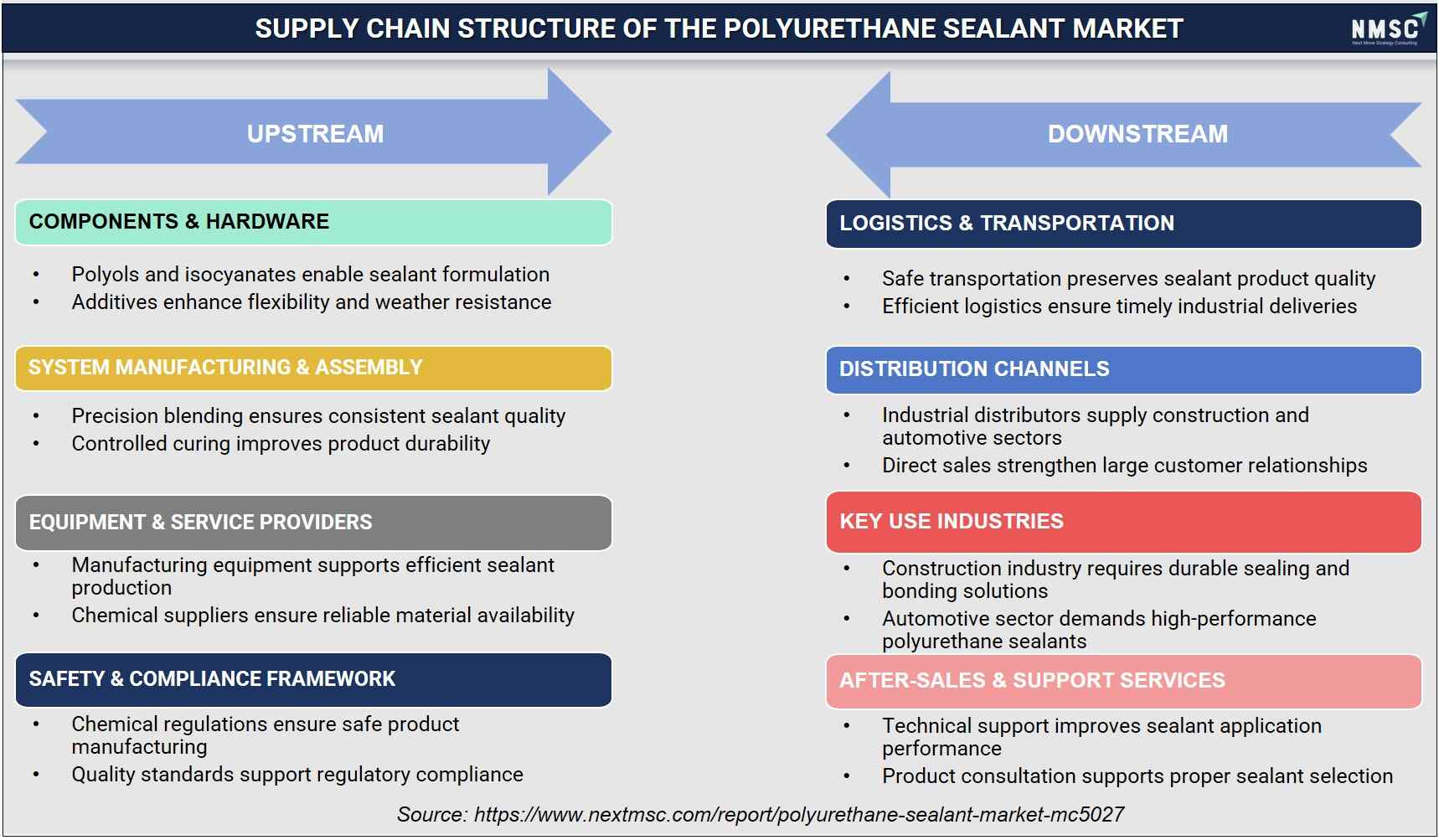
Based on our comprehensive assessment, we found that the polyurethane sealant supply chain starts with suppliers of polyols, isocyanates, additives, and specialty chemicals used in formulation development. Manufacturers conduct blending, curing, and quality control processes to produce high-performance sealants. Distribution networks deliver products to construction and automotive industries, while technical support providers assist application optimization. Regulatory standards ensure product safety, environmental compliance, and quality consistency.
What Are the Key Market Drivers, Breakthroughs, and Investment Opportunities That Will Shape the Polyurethane Sealant Industry in the Next Decade?
|
Drivers/Trends/Restraints |
(+/-) % Impact on CAGR Forecast |
Geographic Relevance |
Impact Timeline |
|
Construction Sector Expansion |
+1.8% |
Global (led by Asia Pacific, North America) |
2025–2030 |
|
Automotive Lightweighting and EV Assembly |
+1.2% |
North America, Europe, China |
2025–2032 |
|
Green Building Code Adoption |
+0.9% |
North America, Europe, Australia |
2026–2035 |
|
Hybrid and Low-VOC Formulation Shift |
+0.7% |
Europe, North America |
2025–2030 |
|
Modular and Prefabricated Construction Growth |
+0.6% |
North America, Europe, Asia Pacific |
2026–2032 |
|
GCC Infrastructure and Giga-Project Pipeline |
+1.0% |
Middle East |
2025–2032 |
|
Diisocyanate REACH Compliance Burden |
-0.6% |
Europe |
2023–2028 (ongoing) |
|
Raw Material (MDI/TDI) Price Volatility |
-0.5% |
Global |
Ongoing |
|
Substitution by Silicone and Acrylic Sealants |
-0.4% |
Global |
Ongoing |
|
E-Commerce Channel Expansion |
+0.5% |
North America, Europe, Asia Pacific |
2025–2032 |
What Are the Growth Drivers of the Polyurethane Sealant Market?
How Is Global Construction Spending Growth Driving the Polyurethane Sealant Market?
Construction sector expansion remains the primary catalyst for the Polyurethane Sealant Market, since building envelope, flooring, and roofing applications collectively represent the largest end-use category. We found that the U.S. Census Bureau reported total construction spending at a seasonally adjusted annual rate of USD 2,192.5 billion in January 2025. India's National Highways Authority of India recorded capital expenditure exceeding Rs. 2,50,000 crore in FY 2024-25, per the Press Information Bureau, reflecting sustained infrastructure investment that directly expands joint-sealing and waterproofing demand across major economies.
How Is Automotive Lightweighting and Vehicle Electrification Driving the Polyurethane Sealant Market?
Automotive lightweighting and electric vehicle assembly are accelerating two-component PU sealant adoption within the Polyurethane Sealant Market. The European Union's CO2 emission performance standards for new passenger cars and vans, set out in Regulation (EU) 2019/631, compel automakers to adopt lightweight structural bonding and direct glazing methods that rely on high-performance polyurethane sealants. Based on our research, we found that battery enclosure sealing for electric vehicle platforms is emerging as a structurally significant new application for fast-cure two-component PU systems among automotive OEM buyers.
How Is the Global Push for Energy-Efficient Building Codes Driving the Polyurethane Sealant Market?
Energy-efficient building codes are expanding demand for high-performance window, door, and facade sealing within the Polyurethane Sealant Market. The European Union's recast Energy Performance of Buildings Directive, which entered into force in 2024, tightens airtightness and thermal performance requirements for new and renovated buildings. In our observation, the U.S. EPA's National VOC Emission Standards for Architectural Coatings under 40 CFR Part 59 are simultaneously pushing formulators toward compliant, energy-code-aligned PU sealant chemistries across renovation and new-build construction projects.
What Are the Growth Inhibitors of the Polyurethane Sealant Market?
How Does the EU REACH Diisocyanate Restriction Constrain the Polyurethane Sealant Market?
Regulatory compliance costs represent a significant constraint on the Polyurethane Sealant Market in Europe. Under Regulation (EU) 2020/1149, amending Annex XVII of REACH, industrial and professional users of diisocyanates have been required since August 24, 2023, to complete safety training renewed at least every five years, according to the European Chemicals Agency and Germany's Federal Institute for Occupational Safety and Health. We noticed that this compliance burden raises operating costs for applicators and extends onboarding timelines for new contractor workforces across the European Union.
How Does Raw Material Price Volatility Constrain the Polyurethane Sealant Market?
Polyurethane sealant formulations depend on MDI and TDI isocyanate feedstocks derived from petrochemical inputs whose pricing fluctuates with crude oil markets and global chemical capacity cycles. This represents an industry-derived estimate, as no single publicly verifiable dataset isolates isocyanate pricing impact specifically on sealant margins. We assessed that price volatility compels formulators to maintain flexible multi-supplier procurement strategies and pass-through pricing clauses, particularly affecting smaller regional manufacturers without integrated upstream isocyanate production capacity or long-term feedstock hedging arrangements.
What Are the Growth Opportunities in the Polyurethane Sealant Market?
How Does Green Building Certification Growth Create an Opportunity for Hybrid Polyurethane Sealants?
Green building certification programs are creating durable opportunity for low-VOC and hybrid PU sealant formulations within the Polyurethane Sealant Market. The U.S. Green Building Council's LEED rating system awards credits for low-emitting sealants and adhesives, directing architect and specification-consultant procurement toward compliant products. Through our market evaluation, we assessed that manufacturers offering third-party-verified low-VOC hybrid sealants are positioned to capture premium specification-driven demand as commercial and institutional green building certification activity continues to expand across developed construction markets.
How Does E-Commerce Channel Expansion Create a New Distribution Opportunity for the Polyurethane Sealant Market?
Growing online retail penetration is opening a structurally new distribution opportunity within the Polyurethane Sealant Market, particularly for small-format cartridge products. The U.S. Census Bureau's Quarterly Retail E-Commerce Sales report tracks a sustained multi-year increase in the online share of total retail sales. We found that manufacturers expanding direct-to-applicator online storefronts can reach DIY consumers and small contractors without intermediary distributor margins, creating an attractive incremental revenue pathway alongside established distributor and retail channels.
How Does Gulf Cooperation Council Infrastructure Investment Create a Multi-Billion Dollar Opportunity for the Polyurethane Sealant Market?
Gulf Cooperation Council infrastructure investment is generating a structurally significant opportunity within the Polyurethane Sealant Market. Saudi Arabia's Vision 2030 program, published by the Saudi government, anchors giga-projects including NEOM and the Public Investment Fund's urban development pipeline, requiring extensive building envelope and infrastructure sealing. We assessed that manufacturers with regional distribution and technical service infrastructure are best positioned to capture demand from this multi-year construction pipeline spanning residential, commercial, and transportation infrastructure development across the Gulf region.
How Is the Polyurethane Sealant Market Segmented in This Report, and What Are the Key Insights From the Segmentation Analysis?
How Does Component Type Segmentation Reveal the Structural Composition of the Polyurethane Sealant Market?
|
Segment |
2025 (USD Bn) |
2035 (USD Bn) |
CAGR (%) |
|
One-Component PU Sealants |
2.15 |
3.49 |
5.0% |
|
Two-Component PU Sealants |
0.89 |
1.68 |
6.6% |
|
Modified and Hybrid PU Sealants |
0.38 |
0.84 |
8.3% |
Based on our analysis of formulation chemistry and applicator preference, we observed that the Polyurethane Sealant Market is segmented into One-Component, Two-Component, and Modified and Hybrid PU Sealants. One-Component PU Sealants continue to hold the largest share, generating USD 2.15 billion in 2025, owing to moisture-curing convenience and non-sag application without mixing equipment. Modified and Hybrid PU Sealants are the fastest-growing component type, as silane-modified low-isocyanate chemistries gain specification on green building and automotive OEM projects requiring reduced VOC content.
How Does Pack Format Segmentation Shape Revenue Distribution Across the Polyurethane Sealant Market?
|
Segment |
2025 (USD Bn) |
2035 (USD Bn) |
CAGR (%) |
|
Cartridge |
1.50 |
2.40 |
4.8% |
|
Sausage Pack |
0.72 |
1.20 |
5.2% |
|
Pail |
0.51 |
0.90 |
5.8% |
|
Drum |
0.41 |
0.72 |
5.8% |
|
Bulk Delivery |
0.27 |
0.78 |
11.2% |
We observed that the Polyurethane Sealant Market is segmented by pack format into Cartridge, Sausage Pack, Pail, Drum, and Bulk Delivery. Cartridge packaging dominates at USD 1.51 billion in 2025, reflecting its compatibility with manual caulking guns used by contractors, fabricators, and DIY consumers across small to mid-sized joint-sealing projects. Bulk Delivery is the fastest-growing pack format, as automotive OEM assembly lines and large industrial fabricators increasingly adopt metered, automated dispensing systems that reduce per-unit packaging waste and labor handling time.
How Does Buyer Type Influence Purchasing Patterns in the Polyurethane Sealant Market?
|
Segment |
2025 (USD Bn) |
2035 (USD Bn) |
CAGR (%) |
|
Contractors and Applicators |
1.40 |
2.28 |
5.0% |
|
OEM Buyers |
0.92 |
1.74 |
6.6% |
|
Fabricators and Assemblers |
0.65 |
1.08 |
5.2% |
|
DIY Consumers |
0.44 |
0.90 |
7.4% |
From our market assessment, we observed that the Polyurethane Sealant Market is segmented by buyer type into Contractors and Applicators, OEM Buyers, Fabricators and Assemblers, and DIY Consumers. Contractors and Applicators dominate with USD 1.40 billion in 2025, reflecting their central role in building envelope, flooring, and infrastructure joint-sealing projects. DIY Consumers represent the fastest-growing buyer type, supported by expanding e-commerce access to small-format cartridge products, while OEM Buyers post the second-fastest growth as automotive and clean energy assembly demand accelerates.
How Are Sales Channels Reshaping Go-to-Market Strategies in the Polyurethane Sealant Market?
|
Segment |
2025 (USD Bn) |
2035 (USD Bn) |
CAGR (%) |
|
Distributor Sales |
1.61 |
2.52 |
4.6% |
|
Direct Sales |
0.96 |
1.62 |
5.4% |
|
Retail Sales |
0.58 |
0.90 |
4.5% |
|
E-Commerce |
0.27 |
0.96 |
13.5% |
We noticed that the Polyurethane Sealant Market is segmented by sales channel into Distributor Sales, Direct Sales, Retail Sales, and E-Commerce. Distributor Sales continue to dominate at USD 1.61 billion in 2025, reflecting deep regional inventory and technical support networks serving contractors and fabricators. E-Commerce is the fastest-growing sales channel, as manufacturers expand direct-to-applicator online storefronts that bypass traditional distributor and retail shelf constraints, particularly for small-format cartridge products purchased by DIY consumers and small contracting firms.
Which End-Use Industries Generate the Most Value in the Polyurethane Sealant Market?
|
Segment |
2025 (USD Bn) |
2035 (USD Bn) |
CAGR (%) |
|
Building and Construction |
1.88 |
3.07 |
5.0% |
|
Infrastructure and Civil Engineering |
0.55 |
1.02 |
6.4% |
|
Automotive and Transportation |
0.48 |
0.84 |
5.8% |
|
Industrial and Manufacturing |
0.41 |
0.90 |
8.2% |
|
Other End Uses |
0.10 |
0.18 |
6.1% |
Based on our analysis of end-use adoption trends, we observed that the Polyurethane Sealant Market is segmented into Building and Construction, Infrastructure and Civil Engineering, Automotive and Transportation, Industrial and Manufacturing, and Other End Uses. Building and Construction continues to dominate with USD 1.88 billion in 2025, spanning building envelope, flooring, sanitary, and roofing sealing applications. Industrial and Manufacturing is the fastest-growing end-use category, propelled by clean energy assembly, electronics encapsulation, and machinery sealing demand, while Automotive and Transportation also expands steadily on electrification-driven assembly requirements.
Regional Outlook
Geographic Performance Snapshot
|
Region |
2025 (USD Bn) |
2035 (USD Bn) |
CAGR (%) |
Key Driver |
|
North America |
0.92 |
1.44 |
4.6% |
Nonresidential construction, distributor density |
|
Europe |
0.85 |
1.32 |
4.5% |
REACH-compliant hybrid chemistries, energy codes |
|
Asia Pacific |
1.27 |
2.52 |
7.1% |
China and India construction, manufacturing FDI |
|
Middle East & Africa |
0.21 |
0.42 |
7.2% |
Vision 2030 giga-projects, GCC build-out |
|
Latin America |
0.17 |
0.30 |
5.8% |
Housing programs, industrial assembly growth |
North America Polyurethane Sealant Market
North America is a structurally mature region within the Polyurethane Sealant Market, accounting for USD 0.92 billion in 2025 and forecast to reach USD 1.44 billion by 2035 at a CAGR of 4.6%. The region benefits from sustained nonresidential construction spending, a dense distributor network, and early adoption of low-VOC hybrid formulations. Regulatory maturity under the EPA's National VOC Emission Standards for Architectural Coatings is compelling formulators to maintain compliant, energy-code-aligned product lines across renovation and new-build construction.
U.S. Polyurethane Sealant Market
Based on our engagements with the market, we found that the United States represents the largest share of North American Polyurethane Sealant Market demand at USD 0.72 billion in 2025. The U.S. Census Bureau's Value of Construction Put in Place survey recorded total construction spending at a seasonally adjusted annual rate exceeding USD 2.19 trillion in early 2025. The EPA's AIM Rule under 40 CFR Part 59 governs VOC content in architectural sealers, while a deep distributor network spanning Sika, H.B. Fuller, and 3M supports broad contractor and OEM technical service coverage.
Canada Polyurethane Sealant Market
Through our analysis, we observed that Canada represents a moderate but stable share of North American Polyurethane Sealant Market revenue. Canadian building code requirements under the National Building Code of Canada mandate airtightness and thermal performance standards that support demand for high-performance window and curtain wall sealants. Infrastructure renewal programs administered through federal and provincial transportation ministries are sustaining civil engineering joint-sealing demand, while cold-climate performance requirements continue to favor PU sealants over lower-temperature-tolerant alternatives in northern construction markets.
Mexico Polyurethane Sealant Market
From our assessment, Mexico is the fastest-growing market within North America in the Polyurethane Sealant Market, advancing at a CAGR of 9.0%. Mexico's manufacturing nearshoring wave is expanding automotive and electronics assembly plant construction, generating new industrial and OEM sealant demand. Compliance with Mexican NOM product standards shapes formulation and labeling requirements. Growing distributor partnerships between regional players and global manufacturers including Sika and Henkel are improving technical service coverage across Mexico's expanding industrial corridors.
Europe Polyurethane Sealant Market
Europe is the third-largest region in the Polyurethane Sealant Market, contributing USD 0.85 billion in 2025 and forecast to reach USD 1.32 billion by 2035 at a CAGR of 4.5%. The region's regulatory environment, anchored by the REACH restriction on diisocyanates and the recast Energy Performance of Buildings Directive, is simultaneously a compliance burden and a driver of premium, certified low-VOC hybrid sealant formulations across renovation-heavy national construction markets.
UK Polyurethane Sealant Market
According to our evaluation, the United Kingdom is among the largest individual country markets for Polyurethane Sealant within Europe. Building Regulations Part L sets thermal and airtightness performance requirements that shape window and facade sealant specification. British Board of Agrément certification is a common procurement gate for construction sealants used on public and commercial projects. Post-Brexit divergence from EU REACH timelines has created some formulation and labeling complexity for manufacturers supplying both UK and EU markets simultaneously.
Germany Polyurethane Sealant Market
In our observation, Germany is the largest European market in the Polyurethane Sealant landscape, driven by its large nonresidential construction base and strong automotive OEM sealant demand from manufacturers headquartered in the country. The Deutsches Institut für Bautechnik approval process governs construction product certification, while strict REACH diisocyanate training compliance is rigorously enforced. Sika and Henkel, both with substantial German manufacturing and R&D footprints, maintain strong home-market distribution advantage across contractor and OEM channels.
France Polyurethane Sealant Market
Through our analysis, we noticed that France is a leading European Polyurethane Sealant market, supported by DTU technical standards governing construction joint sealing and the RE2020 environmental building regulation, which tightens thermal performance requirements for new buildings. Public sector renovation programs under France's national building retrofit strategy are sustaining demand for energy-code-compliant sealants. Bostik, headquartered in France, maintains a strong domestic distribution and technical service presence supporting both contractor and industrial buyer segments.
Italy Polyurethane Sealant Market
In our assessment, Italy is a mid-tier but commercially significant European Polyurethane Sealant market, with demand concentrated in renovation and seismic retrofit construction. CE marking under the EU Construction Products Regulation governs market access for sealant products. MAPEI, headquartered in Italy, maintains deep distributor relationships supporting flooring, waterproofing, and building envelope applications across both domestic renovation projects and export markets throughout Southern Europe.
Spain Polyurethane Sealant Market
Based on our engagements with the market, Spain's Polyurethane Sealant demand is closely tied to its residential construction recovery and tourism-related commercial building activity. The Código Técnico de la Edificación sets national building performance requirements that influence sealant specification for thermal and acoustic performance. Distributor-led sales remain the dominant channel, with growing contractor demand for hybrid low-VOC formulations as Spanish renovation incentive programs expand energy-efficiency retrofit activity across the residential building stock.
Sweden Polyurethane Sealant Market
From our assessment, Sweden maintains a technically sophisticated Polyurethane Sealant market supported by the Boverket national building code, which sets stringent thermal performance and airtightness requirements. Swedish contractors favor cold-climate-rated hybrid and one-component sealants for facade and window perimeter applications. Demand is concentrated among established distributor networks serving both new-build and Sweden's substantial building renovation and retrofit construction segment.
Denmark Polyurethane Sealant Market
Through our analysis, we evaluated that Denmark's Polyurethane Sealant market benefits from the BR18 national building regulation, which mandates strict energy performance standards for new and renovated structures. Danish contractors and fabricators prioritize certified low-VOC sealants for institutional and residential building envelope projects. The country's advanced prefabricated construction sector is also generating incremental demand for factory-applied hybrid sealant systems used in modular panel assembly.
Finland Polyurethane Sealant Market
In our observation, Finland's Polyurethane Sealant market is shaped by stringent cold-climate building performance requirements under the national building code and a well-established prefabricated housing construction sector. Finnish contractors prioritize sealants rated for extreme temperature cycling in facade and roofing applications. Distributor networks tied to major Nordic construction material suppliers maintain steady technical service coverage across both residential and infrastructure-related projects.
Netherlands Polyurethane Sealant Market
From our assessment, the Netherlands is a fast-growing European Polyurethane Sealant market, supported by the national Bijna EnergieNeutrale Gebouwen near-zero-energy building requirement that mandates high-performance building envelope sealing for new construction. Dutch infrastructure and flood-defense civil engineering projects also generate steady demand for waterproofing and joint-sealing applications. Distributor networks serving the country's dense, highly urbanized construction sector maintain strong technical specification support for contractors and fabricators alike.
Rest of Europe Polyurethane Sealant Market
We assessed that the Rest of Europe category, comprising Poland, Belgium, Switzerland, Austria, Portugal, the Czech Republic, and other European markets, collectively represents a growing and commercially significant share of the European Polyurethane Sealant Market. Poland and the Czech Republic are emerging adoption leaders supported by EU structural fund-financed infrastructure projects, while Switzerland's stringent Swiss building code and strong construction chemicals manufacturing base, including Sika's global headquarters, anchor demand across this diversified group of markets.
Asia-Pacific Polyurethane Sealant Market
Asia Pacific is the largest and fastest-growing major region in the Polyurethane Sealant Market, advancing from USD 1.27 billion in 2025 to an estimated USD 2.52 billion by 2035 at a CAGR of 7.1%. The region's growth is propelled by China's construction and manufacturing base, India's national infrastructure programs, and rapid manufacturing FDI inflows across Southeast Asia. National building standards across China, India, Japan, and South Korea are increasingly incorporating energy-efficiency and airtightness requirements that favor PU sealant adoption.
China Polyurethane Sealant Market
Based on our engagements with the market, China is the largest single national market in Asia-Pacific for Polyurethane Sealant, generating USD 0.46 billion in 2025. China's national GB standards for building materials and the Ministry of Housing and Urban-Rural Development's energy-efficiency mandates shape sealant specification. Domestic manufacturers compete alongside multinational suppliers including Sika and BASF, supported by China's large nonresidential construction base and continued industrial manufacturing assembly demand.
India Polyurethane Sealant Market
Through our analysis, we found that India is the fastest-growing major national market within Asia-Pacific for Polyurethane Sealant, advancing at a CAGR of 9.5%. The National Highways Authority of India recorded capital expenditure exceeding Rs. 2,50,000 crore in FY 2024-25, per the Press Information Bureau of India, while the Pradhan Mantri Awas Yojana housing program continues to expand residential construction activity. Pidilite Industries and Asian Paints maintain extensive domestic distribution networks supporting both contractor and DIY buyer segments.
Japan Polyurethane Sealant Market
In our evaluation, Japan is the second-largest Asia-Pacific market for Polyurethane Sealant, supported by a mature construction sector and stringent seismic and building performance standards under the Building Standards Act. Japanese contractors prioritize certified, long-durability sealants for facade and curtain wall applications. Konishi Co., Ltd., a Japan-headquartered adhesives and sealants manufacturer, maintains deep distributor relationships supporting both construction and industrial assembly buyer segments across the country.
South Korea Polyurethane Sealant Market
From our assessment, South Korea demonstrates high Polyurethane Sealant market maturity, supported by KCC Corporation's domestic manufacturing base and a large nonresidential and high-rise residential construction sector. Korean Standards administered by the national standards body govern sealant performance certification. The country's electronics and shipbuilding industrial base also generates steady demand for two-component PU sealants used in equipment assembly and marine construction applications.
Taiwan Polyurethane Sealant Market
Taiwan's Polyurethane Sealant market is concentrated in semiconductor fabrication facility construction and electronics manufacturing assembly. According to our evaluation, the island's ongoing expansion of advanced chip fabrication plants is generating sustained demand for industrial sealants used in cleanroom and equipment installation applications, alongside steady building envelope sealing demand tied to Taiwan's dense urban commercial and residential construction activity.
Indonesia Polyurethane Sealant Market
We found that Indonesia's Polyurethane Sealant market is expanding alongside the national capital relocation project to Nusantara and continued infrastructure investment under the government's national strategic projects program. Indonesian National Standards govern construction material certification. Growing residential and commercial construction activity in secondary cities is broadening distributor reach beyond Jakarta, supporting contractor and fabricator demand for both cartridge and bulk-format sealant products.
Vietnam Polyurethane Sealant Market
Through our analysis, we found that Vietnam is the fastest-growing national market in the Polyurethane Sealant Market at a CAGR of 9.6%. Vietnam's manufacturing foreign direct investment boom, particularly in electronics and automotive component assembly, is generating new industrial sealant demand. Compliance with Vietnamese national technical standards shapes product certification, while rapid urban construction activity in Hanoi and Ho Chi Minh City supports building envelope and infrastructure sealing growth.
Australia Polyurethane Sealant Market
Based on our engagements with the market, Australia maintains a mature Polyurethane Sealant market governed by the National Construction Code, which sets energy efficiency and weatherproofing requirements for building envelope applications. Green Star certification, administered by the Green Building Council of Australia, is driving specification of low-VOC hybrid sealants on commercial projects. Distributor networks serving both metropolitan and regional construction markets maintain consistent technical service coverage.
Philippines Polyurethane Sealant Market
From our assessment, the Philippines' Polyurethane Sealant market benefits from the government's continued national infrastructure program administered by the Department of Public Works and Highways. Philippine National Standards govern construction product certification. Rapid residential and commercial construction activity in Metro Manila and secondary urban centers is expanding demand for both contractor-grade and DIY cartridge sealant products through growing retail and e-commerce channels.
Malaysia Polyurethane Sealant Market
According to our evaluation, Malaysia's Polyurethane Sealant market is supported by the Construction Industry Development Board's certification framework and steady commercial and residential construction activity across Kuala Lumpur and Johor. Malaysian Standards govern sealant performance requirements. Growing electronics and semiconductor assembly investment in Penang is also generating incremental industrial sealant demand among OEM and fabricator buyer segments.
Rest of Asia-Pacific Polyurethane Sealant Market
We noticed that the Rest of Asia-Pacific category, comprising smaller Southeast and South Asian construction markets, collectively contributes a steady share of regional Polyurethane Sealant demand. Growing regional infrastructure financing from multilateral development institutions is supporting transportation and civil engineering project pipelines across these markets, while distributor partnerships between multinational manufacturers and regional building material suppliers continue to expand technical service coverage and product availability.
Middle East and Africa Polyurethane Sealant Market
Middle East and Africa is the fastest-growing region in the Polyurethane Sealant Market, advancing at a CAGR of 7.2% from a base of USD 0.21 billion in 2025 to USD 0.42 billion by 2035. Growth is anchored by Saudi Arabia's Vision 2030 giga-project pipeline, UAE infrastructure investment, and post-earthquake reconstruction activity in Turkey, alongside expanding housing construction across Sub-Saharan Africa.
Saudi Arabia Polyurethane Sealant Market
Based on our engagements with the market, Saudi Arabia is the largest national market in the Middle East and Africa for Polyurethane Sealant, generating USD 0.05 billion in 2025. The government's Vision 2030 program anchors construction activity across NEOM and other giga-projects. Saudi Building Code requirements govern construction material certification, while distributor partnerships between global manufacturers and regional building material suppliers are expanding to support this multi-year construction pipeline.
UAE Polyurethane Sealant Market
Through our analysis, we found that the UAE maintains a mature Polyurethane Sealant market supported by Dubai Municipality's green building regulations and continued commercial and residential high-rise construction activity. UAE fire and life safety codes shape sealant specification for facade and curtain wall applications. Distributor networks based in Dubai and Abu Dhabi maintain strong technical service coverage across both contractor and OEM buyer segments throughout the broader Gulf region.
Egypt Polyurethane Sealant Market
From our assessment, Egypt's Polyurethane Sealant market is expanding alongside continued construction of the New Administrative Capital and associated infrastructure development. Egyptian Organization for Standardization and Quality requirements govern construction material certification. Growing residential construction activity and government-led urban development programs are sustaining demand for building envelope and waterproofing sealant applications across the country.
Israel Polyurethane Sealant Market
According to our evaluation, Israel maintains a technically advanced Polyurethane Sealant market governed by Standards Institution of Israel requirements for construction materials. Demand is concentrated in high-rise residential and commercial construction in the Tel Aviv metropolitan area. Distributor networks serving the domestic construction sector maintain consistent supply of both contractor-grade and industrial-format sealant products.
Turkey Polyurethane Sealant Market
We found that Turkey's Polyurethane Sealant market has been shaped significantly by post-earthquake reconstruction activity following the 2023 earthquakes, which accelerated demand for seismic retrofit and new-build construction sealing applications. Turkish Standards Institution requirements govern construction product certification. Sustained government-led rebuilding programs across affected provinces continue to support elevated infrastructure and building envelope sealant demand.
Nigeria Polyurethane Sealant Market
Through our analysis, we found that Nigeria is the fastest-growing national market within the Middle East and Africa region at a CAGR of 7.2%. Nigeria's National Building Code and continued urban housing deficit are driving residential construction activity in Lagos and Abuja. Distributor partnerships between regional building material suppliers and global manufacturers are expanding access to PU sealant products across the country's growing construction sector.
South Africa Polyurethane Sealant Market
In our observation, South Africa maintains the most established Polyurethane Sealant distribution infrastructure in Sub-Saharan Africa, governed by South African National Standards for construction materials. Demand is concentrated in commercial and infrastructure construction across Johannesburg and Cape Town. Established distributor relationships with global manufacturers support consistent technical service coverage for contractors and fabricators across the region.
Rest of MEA Polyurethane Sealant Market
We assessed that the Rest of MEA category, comprising other Gulf states and Sub-Saharan African markets, collectively contributes a growing share of regional Polyurethane Sealant demand. Multilateral development bank-financed infrastructure projects are supporting transportation and water infrastructure construction across these markets, while distributor expansion by global manufacturers is gradually improving product availability and technical service coverage in previously underserved national markets.
Latin America Polyurethane Sealant Market
Latin America is the smallest but a steadily expanding region in the Polyurethane Sealant Market, advancing from USD 0.17 billion in 2025 to USD 0.30 billion by 2035 at a CAGR of 5.8%. Growth is driven by Brazil's residential housing programs, Colombia's infrastructure investment, and expanding automotive and industrial assembly activity across the region's manufacturing corridors.
Brazil Polyurethane Sealant Market
Based on our engagements with the market, Brazil is the largest national market in Latin America for Polyurethane Sealant, generating USD 0.08 billion in 2025. The federal Minha Casa Minha Vida housing program continues to expand residential construction activity. Brazilian Association of Technical Standards requirements govern construction material certification, while distributor networks serving Sao Paulo and Rio de Janeiro maintain the deepest technical service coverage in the region.
Argentina Polyurethane Sealant Market
Through our analysis, we found that Argentina's Polyurethane Sealant market is shaped by Argentine Institute for Standardization and Certification requirements governing construction materials. Demand is concentrated in commercial and residential construction in Buenos Aires, with growing industrial assembly demand tied to the country's automotive component manufacturing sector. Distributor partnerships with global manufacturers support both contractor and OEM buyer segments.
Chile Polyurethane Sealant Market
From our assessment, Chile maintains a technically advanced Polyurethane Sealant market shaped by the National Institute of Standardization's seismic-resistant construction requirements following the country's history of major earthquakes. Demand is concentrated in commercial high-rise and infrastructure construction in Santiago. Distributor networks serving the domestic construction sector maintain consistent supply of seismic-rated sealant formulations for structural joint applications.
Colombia Polyurethane Sealant Market
We found that Colombia is the fastest-growing national market within Latin America for Polyurethane Sealant at a CAGR of 9.6%. Colombia's NSR-10 seismic building code governs construction material requirements, while government-led infrastructure investment under the national roads concession program is expanding civil engineering joint-sealing demand across Bogota and other major metropolitan areas.
Rest of LATAM Polyurethane Sealant Market
In our observation, the Rest of LATAM category, comprising Peru, Ecuador, and other regional markets, collectively represents a growing share of Latin American Polyurethane Sealant demand. Multilateral development bank-financed infrastructure programs are supporting transportation and housing construction across these markets, while distributor expansion by regional and global manufacturers continues to improve product availability for contractors and fabricators across the broader region.
Strategic Framework of the Polyurethane Sealant Market
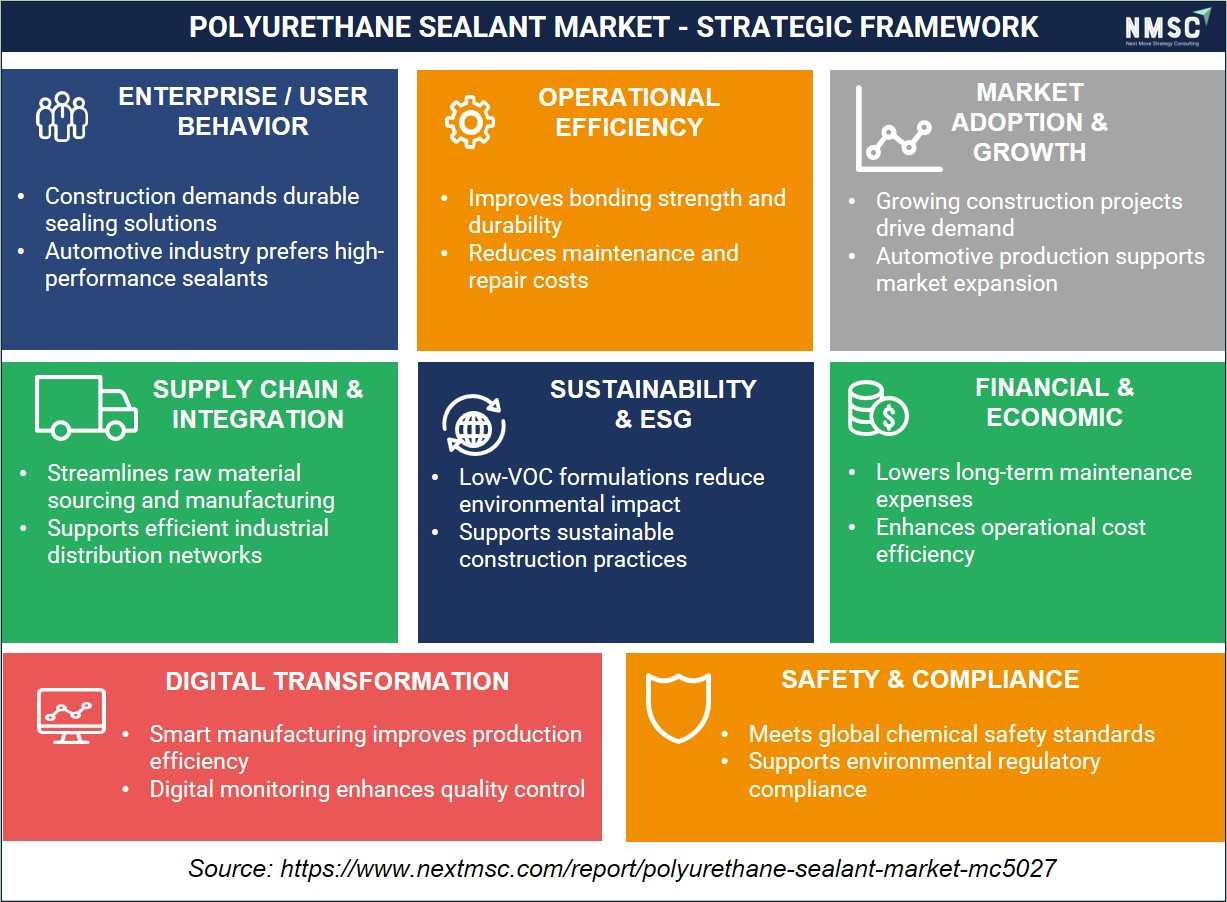
Based on our comprehensive assessment, we found that the polyurethane sealant market is driven by growing construction activities and increasing demand for durable bonding and sealing solutions. Manufacturers focus on operational efficiency through advanced production technologies and quality monitoring systems. Sustainability initiatives encourage low-VOC formulations, while digital transformation enhances manufacturing performance. Strong supply chain integration, regulatory compliance, and cost optimization collectively support long-term market expansion.
Competitive Landscape
Competitive Dynamics and M&A Landscape
|
Key Takeaways |
Details |
|
Market Structure |
Moderately consolidated; top global construction chemicals and adhesives manufacturers hold a combined leading share alongside regional formulators |
|
Innovation Focus |
Low-VOC hybrid and silane-modified chemistries, fast-cure two-component automotive systems, bio-based polyol feedstocks |
|
M&A Activity |
Active bolt-on acquisitions of regional formulators and distribution networks by global construction chemicals leaders |
How Do Companies Compete in the Polyurethane Sealant Market?
Competitive dynamics within the Polyurethane Sealant Market center on formulation breadth, regulatory compliance speed, and distributor density. Based on our research, we found that leading manufacturers including Sika, Henkel, 3M, and H.B. Fuller compete through diversified one-component, two-component, and hybrid product portfolios spanning construction, automotive, and industrial end markets. Pricing strategies vary by channel, with distributor and OEM contracts negotiated on volume while DIY-oriented cartridge products carry retail and e-commerce list pricing. Geographic expansion continues through regional manufacturing investment and distributor network acquisitions, particularly across Asia-Pacific and the Gulf region.
Which Kind of Companies Dominate the Polyurethane Sealant Market?
Diversified construction chemicals and adhesives conglomerates with integrated upstream isocyanate or polymer supply chains dominate the Polyurethane Sealant Market, alongside specialized regional formulators with strong distributor relationships. Through our market assessment, we observed that companies combining global R&D scale with regional manufacturing footprints, such as Sika, BASF, and Dow, maintain pricing and technical service advantages over single-region competitors. Regional players including Pidilite Industries and KCC Corporation retain strong domestic distribution advantages in their respective home markets.
How Are Innovation Focus and Sustainable Formulation Differentiation Driving Market Success in the Polyurethane Sealant Market?
Sustainable, low-VOC, and hybrid formulation innovation is emerging as a key competitive differentiator within the Polyurethane Sealant Market. We observed that manufacturers investing in silane-modified polymer platforms and bio-based polyol feedstocks are capturing premium specification-driven demand from green-building-certified commercial projects. Companies offering third-party-verified low-emission formulations alongside technical training and specification support for architects and contractors are strengthening long-term customer relationships beyond transactional distributor sales.
Are Market Players Opting for Mergers and Acquisitions to Expand Their Presence in the Polyurethane Sealant Market?
Merger and acquisition activity remains an active growth strategy within the Polyurethane Sealant Market. From our assessment, global construction chemicals leaders continue to pursue bolt-on acquisitions of regional formulators, distributors, and specialty sealant producers to expand geographic coverage and product breadth. This strategy allows acquirers to gain established customer relationships and regulatory certifications more quickly than organic market entry, particularly across emerging markets in Asia-Pacific, the Middle East, and Latin America.
Who Are the Key Market Players in the Polyurethane Sealant Market?
-
Sika AG
-
Henkel AG & Co. KGaA
-
3M Company
-
H.B. Fuller Company
-
Dow Inc.
-
Bostik SA
-
MAPEI S.p.A.
-
BASF SE
-
Soudal N.V.
-
Tremco CPG Inc.
-
Pidilite Industries Limited
-
KCC Corporation
-
Asian Paints Limited
-
Fosroc International Limited
-
Konishi Co., Ltd.
-
Illinois Tool Works Inc.
-
Hermann Otto GmbH
-
Momentive Performance Materials Inc.
-
Pecora Corporation
-
Franklin International, Inc.
What Are the Latest Developments in the Polyurethane Sealant Industry?
|
Date |
Event |
|
February 2026 |
Sika announced a definitive agreement to acquire Akkim, a leading global manufacturer of adhesives and sealants based in Turkey. This acquisition, expected to close in Q3 2026, is a cornerstone of Sika's "Strategy 2028," designed to significantly enhance their production capacity and distribution footprint in high-growth markets across Eastern Europe, Central Asia, and the Middle East. |
|
January 2026 |
Henkel launched Loctite STYCAST US 8000 A/B, a next-generation two-component polyurethane potting compound. Engineered for mission-critical industrial and power electronics, this product addresses the increasing demand for high-reliability encapsulation that can withstand harsh environments, thermal expansion, and vibration without cracking or performance loss. |
Expert Insights

“Climate change and increasing resource scarcity are megatrends that require sustainable, long-lasting construction solutions. Greater durability of buildings brings immense ecological and economic benefits to both new construction and renovation projects. These benefits can be further enhanced by the use of recycled materials. We consistently align our innovation approach with these trends and have a comprehensive portfolio of technologies that combine performance and sustainability, supporting our customers in achieving their goals.”
— Thomas Hasler, Chief Executive Officer, Sika
Statement made during Sika's Capital Markets Day 2024 while discussing sustainability-driven innovation, durable construction solutions, and the increasing importance of high-performance building materials.
Market Interpretation
The comment highlights the growing demand for durable and sustainable construction materials that enhance building performance and extend service life. Polyurethane sealants play a critical role in modern construction by providing long-lasting adhesion, flexibility, weather resistance, and waterproofing capabilities across residential, commercial, and infrastructure projects. As governments, developers, and building owners increasingly prioritize sustainability, energy efficiency, and lifecycle performance, demand for advanced sealant technologies is expected to rise. The integration of recycled materials and environmentally responsible construction practices is further accelerating innovation in polyurethane sealant formulations, supporting market growth across new construction and renovation applications.
What Are the Investment Opportunities in the Polyurethane Sealant Market?
Capital Inflows
Capital inflows into the Polyurethane Sealant Market are increasingly directed toward hybrid chemistry research and regional manufacturing capacity expansion. Based on our research, we found that leading manufacturers are prioritizing capital deployment toward REACH-compliant, low-monomer isocyanate production lines in Europe and capacity additions across Asia-Pacific to serve expanding construction and automotive OEM demand, positioning capital-intensive formulation R&D as a key differentiator for long-term competitive positioning.
Infrastructure Investments
Infrastructure investment programs across India, Saudi Arabia, and the United States are creating substantial incremental demand for civil engineering joint-sealing and waterproofing applications. Through our market assessment, we observed that government-financed transportation, water infrastructure, and giga-project pipelines are prompting manufacturers to expand bulk delivery and large-format pack capabilities, positioning suppliers with direct project-level technical service capability to capture a disproportionate share of this infrastructure-driven demand growth.
ESG Considerations
Environmental, social, and governance considerations are increasingly shaping investment priorities within the Polyurethane Sealant Market. We noticed that manufacturers are investing in bio-based polyol feedstocks and lower-emission manufacturing processes to align with green building certification criteria and corporate sustainability commitments. This ESG-driven reformulation investment is also influencing procurement criteria among large institutional buyers and government infrastructure programs that increasingly specify low-VOC and third-party-certified sealant products in tender requirements.
Digital Transformation
Digital transformation is creating new investment opportunity across distribution and technical service functions within the Polyurethane Sealant Market. In our observation, manufacturers are investing in digital technical datasheet platforms, compatibility calculators, and e-commerce storefronts that reduce specification friction for contractors and fabricators. This digital investment is also extending to automated dispensing equipment compatible with bulk delivery formats, supporting the broader industrial and OEM buyer shift toward metered application systems.
Private Equity and Venture Capital Activity
Private equity activity within the Polyurethane Sealant Market is concentrated on consolidating fragmented regional distributors and specialty formulators into larger platform companies with broader geographic reach. Our findings suggest that financial sponsors view distribution consolidation, rather than greenfield manufacturing investment, as the more capital-efficient entry strategy, given the technical certification barriers and capital intensity associated with upstream isocyanate and polymer manufacturing within the global construction chemicals industry.
Key Benefits for Stakeholders
For OEM Buyers and Contractors
OEM buyers, contractors, and project developers gain comprehensive insights into the Polyurethane Sealant Market, including detailed analysis of product types, application segments, end-use industries, and regional demand patterns. The report supports procurement planning, supplier evaluation, and material selection decisions by providing visibility into market trends, pricing dynamics, and evolving customer requirements. Detailed segmentation and regional analysis further enable organizations to align sourcing strategies with project performance requirements, regulatory compliance obligations, and long-term construction and manufacturing objectives.
For Investors and Financial Stakeholders
Investors, private equity firms, venture capital organizations, and financial stakeholders gain access to a structured assessment of the Polyurethane Sealant Market's growth outlook, competitive landscape, and long-term investment opportunities through 2035. Market sizing, CAGR forecasts, segment-level analysis, and regional market assessments support valuation modeling, investment screening, and portfolio benchmarking activities. Competitive intelligence and industry consolidation trends further provide visibility into acquisition opportunities, emerging growth segments, and strategic developments shaping the future competitive environment.
For Manufacturers and Formulators
Manufacturers and formulators benefit from detailed market intelligence regarding technology developments, customer demand trends, regulatory influences, and competitive positioning across the Polyurethane Sealant Market. The report highlights emerging opportunities associated with low-VOC formulations, hybrid sealant technologies, sustainable chemistry innovations, and expanding construction and industrial applications. These insights support product development prioritization, manufacturing investment planning, regulatory compliance preparation, and go-to-market strategy optimization across domestic and international markets.
For Government and Regulatory Stakeholders
Government agencies, regulatory authorities, standards organizations, and policy stakeholders gain a structured understanding of how environmental regulations, chemical safety requirements, building performance standards, and sustainability initiatives influence market development and industry practices within the Polyurethane Sealant Market. The report provides insights into the impact of VOC emission standards, REACH diisocyanate regulations, workplace safety requirements, and energy-efficient construction policies on product formulation and market adoption. These findings support evidence-based policy development, regulatory impact assessments, and stakeholder engagement initiatives aimed at balancing industrial growth, environmental objectives, and public safety considerations.
Key Market Segments
By Component Type
-
One-Component PU Sealants
-
Two-Component PU Sealants
-
Modified and Hybrid PU Sealants
By Pack Format
-
Cartridge
-
Sausage Pack
-
Pail
-
Drum
-
Bulk Delivery
By Buyer Type
-
OEM Buyers
-
Contractors and Applicators
-
Fabricators and Assemblers
-
DIY Consumers
By Sales Channel
-
Direct Sales
-
Distributor Sales
-
Retail Sales
-
E-Commerce
By End Use
-
Building and Construction
-
Building Envelope Sealing
-
Facade and Curtain Wall
-
Window and Door Perimeter
-
-
Flooring and Joint Sealing
-
Floor Expansion Joints
-
Concrete Movement Joints
-
-
Sanitary and Wet Area Sealing
-
Roofing and Waterproofing
-
General Building Repair and Maintenance
-
-
Infrastructure and Civil Engineering
-
Roads and Runways
-
Bridges and Tunnels
-
Water and Wastewater Infrastructure
-
Other Civil Engineering
-
-
Automotive and Transportation
-
Automotive OEM Assembly
-
Automotive Aftermarket Repair
-
Commercial Vehicles and Rail
-
Marine
-
-
Industrial and Manufacturing
-
HVAC and Appliances
-
Electrical and Electronics
-
Wood and Panel Assembly
-
Machinery and Equipment
-
Aerospace and Defense
-
Clean Energy
-
Other Industrial Assembly
-
-
Other End Uses
By Region
-
North America (U.S., Canada, Mexico)
-
Europe (UK, Germany, France, Italy, Spain, Sweden, Denmark, Finland, the Netherlands, Rest of Europe)
-
Asia Pacific (China, India, Japan, South Korea, Taiwan, Indonesia, Vietnam, Australia, Philippines, Malaysia, Rest of APAC)
-
Middle East & Africa (Saudi Arabia, UAE, Egypt, Israel, Turkey, Nigeria, South Africa, Rest of MEA)
-
Latin America (Brazil, Argentina, Chile, Colombia, Rest of LATAM)
Conclusion and Recommendations
Long-Term Outlook
The Polyurethane Sealant Market is positioned for steady long-term growth, supported by expanding demand from construction, infrastructure, automotive, industrial manufacturing, and transportation sectors. The market is forecast to grow from USD 3.42 billion in 2025 to USD 6.01 billion by 2035, at a CAGR of 5.8%. We further analysed that the diversified nature of end-use demand reduces dependency on any single industry cycle and provides a stable foundation for long-term market expansion. Increasing infrastructure investment, urbanization, energy-efficient building construction, and automotive lightweighting initiatives are expected to sustain demand for polyurethane sealants throughout the forecast period.
Strategic Positioning Recommendations
Manufacturers operating in the Polyurethane Sealant Market should prioritize investments in low-VOC, low-isocyanate, and hybrid sealant technologies to strengthen competitive positioning amid evolving environmental and safety regulations. Organizations that successfully combine regulatory compliance, product performance, and sustainability attributes will be better positioned to capture future market share. Expanding automated dispensing-compatible formulations, strengthening OEM relationships, and enhancing technical support capabilities will further improve competitiveness across industrial and automotive applications. Maintaining strong distributor networks while simultaneously expanding digital sales channels will remain essential for capturing growth opportunities across both mature and emerging markets.
Investment Attractiveness
The Polyurethane Sealant Market presents an attractive investment profile supported by stable demand fundamentals, recurring replacement requirements, and expanding application opportunities across multiple industries. We assessed that the most attractive investment opportunities include hybrid polyurethane sealants, sustainable formulation technologies, specialty industrial sealants, and distribution network consolidation strategies. While upstream feedstock manufacturing remains capital intensive and exposed to raw material volatility, downstream distribution, specialty formulation, and value-added application segments offer comparatively attractive risk-adjusted growth opportunities. Asia-Pacific and Middle East markets provide particularly compelling investment prospects due to higher growth rates and expanding industrial activity.
Market Shifts and Key Risks
The most significant market shift underway is the transition toward environmentally compliant, low-emission, and hybrid sealant formulations driven by increasingly stringent regulatory requirements and sustainability objectives. At the same time, digital distribution channels and e-commerce platforms are becoming increasingly important within the procurement landscape for small- and medium-scale customers. Key risks for the Polyurethane Sealant Market include volatility in MDI and TDI feedstock prices, rising regulatory compliance costs, substitution pressure from silicone and acrylic sealants in selected applications, and cyclical fluctuations in construction activity across mature economies. Market participants should closely monitor regulatory developments, raw material supply conditions, and evolving end-user preferences as leading indicators of future competitive positioning.
Growth Pathways
Organizations seeking to maximize value within the Polyurethane Sealant Market should pursue a balanced growth strategy focused on innovation, geographic expansion, and channel optimization. In the near term (2025–2027), manufacturers should prioritize regulatory compliance readiness, low-VOC product development, and expansion of distributor partnerships. In the mid-term (2027–2031), investment should focus on hybrid sealant technologies, industrial automation compatibility, and automotive electrification-related applications. In the long term (2031–2035), companies should position for growing demand associated with sustainable construction, smart infrastructure development, and advanced industrial manufacturing. India, Saudi Arabia, Southeast Asia, and the United States represent the most attractive growth markets, supported by infrastructure investment programs, industrial expansion, and increasing adoption of sustainable building practices.
About the Author
 Saista Faiyaz
— Saista Faiyaz is Research Associate at Next Move Strategy Consulting, where she has covered consumer markets and healthcare technologies for 3 years. Her work includes primary interview review, secondary-source validation, market sizing, and structured analysis of company and industry data. She supports research by comparing evidence across sources, organizing findings into market narratives, and documenting assumptions used in analysis. Her scope includes cross-market benchmarking, and reports.
Saista Faiyaz
— Saista Faiyaz is Research Associate at Next Move Strategy Consulting, where she has covered consumer markets and healthcare technologies for 3 years. Her work includes primary interview review, secondary-source validation, market sizing, and structured analysis of company and industry data. She supports research by comparing evidence across sources, organizing findings into market narratives, and documenting assumptions used in analysis. Her scope includes cross-market benchmarking, and reports.
About the Reviewer
 Supradip Baul
— Supradip Baul is an accomplished business consultant and strategist with over a decade of rich experience in market intelligence, strategy, technology, and business transformation. His work has included rigorous qualitative and quantitative analysis across multiple industries, helping clients shape investment decisions and long-term roadmaps. Earlier in his career, he was associated with Gartner, where he contributed to industry-leading reports and market share analyses. He has worked with leading global companies and holds an MBA with a dual specialization in Marketing and Finance.
Supradip Baul
— Supradip Baul is an accomplished business consultant and strategist with over a decade of rich experience in market intelligence, strategy, technology, and business transformation. His work has included rigorous qualitative and quantitative analysis across multiple industries, helping clients shape investment decisions and long-term roadmaps. Earlier in his career, he was associated with Gartner, where he contributed to industry-leading reports and market share analyses. He has worked with leading global companies and holds an MBA with a dual specialization in Marketing and Finance.
At Next Move Strategy Consulting, we understand that insightful market research is the cornerstone of successful business decisions. That's why we employ a robust and multifaceted approach, combining various methodologies to deliver the most accurate and actionable data for our clients.

Research Landscape
We navigate the world of research with two primary approaches:
Qualitative Approach
Our qualitative research methodologies involve immersive techniques such as in-depth interviews, focus groups, and observational studies. By engaging directly with individuals and stakeholders, we uncover valuable insights that quantitative data alone may overlook.

Quantitative Research
In tandem with qualitative methodologies, NMSC leverages the power of Quantitative Research to provide a robust foundation of numerical insights. Through systematic data collection and analysis, we quantify patterns, preferences, and market trends, offering a comprehensive view of the business landscape.
Our quantitative research approach employs diverse tools, including surveys, experiments, and statistical modelling. These methodologies enable us to gather data from a large and representative sample, ensuring the statistical significance of our findings. By employing structured questionnaires and standardized data collection methods, we guarantee the reliability and validity of the information we present to our clients.
Quantitative research is particularly effective in measuring the prevalence of trends, assessing market size, and gauging the impact of various factors on consumer behavior. The numerical precision attained through this approach equips our clients with actionable insights, facilitating data-driven decision-making and strategy formulation.


Our Specialized Toolbox for Industry-Specific Market Research
We deploy a specialized arsenal of techniques tailored to meet your unique requirements. Here's a glimpse into our comprehensive toolbox:

Information Procurement
The stage entails acquiring market data or relevant information through various sources and methodologies.


Market Research Approach
We utilize both top-down and bottom-up approaches in market research analysis to achieve a comprehensive understanding of the market dynamics, leveraging the broad perspective of industry trends and macroeconomic factors alongside detailed insights from specific segments and individual companies.

Porters Five Forces Analysis
We conduct Porter's Five Forces analysis to evaluate the competitive landscape of an industry, providing us with insights into factors that affect profitability and strategic positioning.

SWOT Analysis

Forecasting
We utilize a forecasting model to predict future consumption by considering parameters like population, economics, regulations, market competition, drivers, constraints, technology, and pricing. We also employ statistical techniques such as multilinear regression, exponential smoothing, moving average, ARIMA, and Monte Carlo simulations for accurate predictions. In econometric forecasting, we analyzed short-term and long-term event impacts, attributing values based on regulatory frameworks, economic factors, and market events.





 Speak to Our Analyst