High-Voltage Direct Current (HVDC) Systems Market By Project Stage (New Build Systems, Upgrades and Refurbishments, Lifecycle Services), By System Configuration (Point-to-Point, Back-to-Back, Multi-Terminal), By Technology Type (LCC, VSC, Hybrid Converter), By Transmission Medium, By Voltage Class, By Application Type, By Customer Type, and By Region – Global Industry Analysis, Market Size, Share, Growth, Trends, Opportunities, Competitive Landscape, and Forecast 2026–2035
Industry: Energy & Power | Publishing Date: July 10, 2026 | Last Updated: September 30, 2026 | No of Pages: N/A | No. of Tables: N/A | No. of Figures: N/A | Format: PDF | Report Code: EP5083
What Is the High-Voltage Direct Current (HVDC) Systems Market Size?
The global High-Voltage Direct Current (HVDC) Systems Market was valued at USD 14.8 billion in 2025 and is expected to reach USD 16.5 billion in 2026. Accelerating offshore wind integration, large-scale cross-border grid interconnections, and the global energy transition toward renewable power are projected to propel the market to USD 46.2 billion by 2035, advancing at a CAGR of 12% from 2026 to 2035. Key growth drivers include surging offshore wind capacity additions in Europe and Asia-Pacific, urgent grid reinforcement investments driven by government decarbonization mandates, rapid adoption of Voltage Source Converter technology for urban infeed applications, and the strategic expansion of multi-terminal HVDC grids enabling meshed power transmission networks across continents.
|
Parameters |
Details |
|
Market Size in 2025 |
USD 14.8 Billion |
|
Market Size in 2026 |
USD 16.5 Billion |
|
Revenue Forecast in 2035 |
USD 46.2 Billion |
|
Growth Rate |
CAGR of 12.0% from 2026 to 2035 |
|
Analysis Period |
2025–2035 |
|
Base Year Considered |
2025 |
|
Forecast Period |
2026–2035 |
|
Market Size Estimation |
Billion USD |
|
Companies Profiled |
20 |
|
Countries Covered |
33 |
|
Market Share |
Top 10 |
High-Voltage Direct Current (HVDC) Systems Market Overview
What Is the High-Voltage Direct Current (HVDC) Systems Market?
High-Voltage Direct Current (HVDC) Systems are electrical power transmission technologies that convert alternating current (AC) to direct current (DC) to enable efficient long-distance and submarine power transmission. Unlike conventional AC systems, HVDC Systems offer lower transmission losses over distances exceeding 600 kilometers, enable stable asynchronous grid interconnections, and provide precise, electronically controlled power flow management. The HVDC Systems Market encompasses converter stations, cables, protection systems, and lifecycle services supporting bulk power transmission, offshore wind integration, cross-border interconnection, and urban grid reinforcement applications globally.
How Has the High-Voltage Direct Current (HVDC) Systems Market Evolved?
The HVDC Systems Market has undergone four distinct technology evolution phases. The first phase, spanning the 1950s through the 1990s, focused on Line Commutated Converter technology for long-distance terrestrial bulk transmission, particularly in China, India, and Brazil. The second phase in the 2000s introduced Voltage Source Converter technology enabling offshore wind connections and urban cable infeed. The third phase centers on multi-terminal HVDC grid development and VSC technology at ultra-high voltage ratings above 800 kV. The fourth emerging phase involves hybrid converter architectures and digitally integrated protection systems for meshed HVDC grids. NMSC's analysis indicates this structural evolution has transformed HVDC Systems from a niche long-distance technology into a foundational energy infrastructure platform.
How Do Regulations Influence the High-Voltage Direct Current (HVDC) Systems Market?
Regulatory frameworks at national and supranational levels have become principal demand catalysts for the HVDC Systems Market. The European Union's European Green Deal targets climate neutrality by 2050, with the REPowerEU plan mandating 300 GW of offshore wind capacity by 2030, directly requiring major HVDC interconnector investments across the North Sea, Baltic Sea, and Mediterranean. In China, the National Energy Administration continues to authorize ultra-high-voltage HVDC corridors linking hydropower-rich western provinces to eastern industrial load centers. The U.S. Department of Energy's Grid Deployment Office has allocated USD 10.5 billion under the Infrastructure Investment and Jobs Act to strengthen interstate transmission capacity. Through NMSC's assessment, we found these regulatory investments represent committed pipeline demand for HVDC Systems spanning the full 2025 to 2035 forecast horizon.
How Is Technology Adoption Expanding Across the High-Voltage Direct Current (HVDC) Systems Market?
Technology adoption within the HVDC Systems Market is accelerating across multiple dimensions. VSC technology has achieved commercial maturity at 525 kV and is being qualified for deployment at 640 kV and above, expanding its addressable application base to bulk power transmission corridors previously served only by LCC systems. Hybrid converter technologies combining LCC and VSC characteristics are being developed for ultra-high-voltage multi-terminal applications. Digital monitoring and cybersecurity integration has become a standard lifecycle service requirement. Based on NMSC's research, modular converter design, use of silicon carbide power semiconductors, and factory preassembly techniques are collectively reducing HVDC project execution timelines and installation costs across multiple geographies.
|
Key Takeaways |
|
By Project Stage, New Build Systems held the largest share of the HVDC Systems Market at USD 9.8 billion in 2025, driven by sustained offshore wind project commissioning and national grid expansion programs. Point-to-Point Link sub-systems dominate the New Build category, accounting for the majority of contracted project value owing to their established engineering and regulatory approval pathway. |
|
Lifecycle Services is the fastest-growing project stage sub-segment in the HVDC Systems Market, projected to expand at a CAGR of 13.4% from 2026 to 2035, fueled by a growing installed base of HVDC links commissioned between 2000 and 2015 entering major maintenance cycles alongside rising demand for digital monitoring and cybersecurity retrofit services. |
|
By System Configuration, Point-to-Point Links dominate the HVDC Systems Market at USD 8.6 billion in 2025, reflecting the established deployment model for long-distance terrestrial and offshore transmission corridors. Multi-Terminal Systems represent the fastest-growing configuration at a CAGR of 14.2%, driven by North Sea offshore grid projects and China's pilot meshed HVDC programs. |
|
By Technology Type, VSC (Voltage Source Converter) technology is the dominant and fastest-growing technology segment in the HVDC Systems Market, accounting for USD 7.9 billion in 2025 and projected to reach USD 27.4 billion by 2035 at a CAGR of 13.3%, reflecting strong preference for VSC in all new offshore wind and urban infeed applications globally. |
|
By Transmission Medium, Overhead Line remains the largest segment at USD 5.9 billion in 2025, serving long-distance terrestrial applications. Submarine Cable is the fastest-growing medium at a CAGR of 14.1%, driven by accelerating offshore wind project commissioning and cross-border subsea interconnector investments across Europe, Asia-Pacific, and the Middle East. |
|
By Voltage Class, the ±321 kV to ±500 kV range holds the largest market share, representing the standard voltage rating for most current offshore wind and cross-border HVDC projects. The Above ±500 kV class is the fastest-growing voltage segment, driven by China's continued deployment of ±800 kV and ±1,100 kV ultra-high-voltage direct current corridors. |
|
By Application Type, Bulk Power Transmission is the dominant application in the HVDC Systems Market at USD 5.4 billion in 2025. Offshore Wind Integration is the fastest-growing application at a CAGR of 15.2%, driven by the European North Sea offshore wind targets under the North Seas Energy Cooperation agreement and Asia-Pacific offshore expansion programs. |
|
By Customer Type, Transmission System Operators held the largest market share at USD 6.2 billion in 2025, reflecting their role as primary project owners and operators for national grid interconnections. Offshore Wind Developers are the fastest-growing customer segment at a CAGR of 15.8%, as cumulative offshore wind capacity additions accelerate through the forecast period. |
|
North America held a regional share in the HVDC Systems Market at USD 3.8 billion in 2025 and is projected to reach USD 11.4 billion by 2035 at a CAGR of 11.6%, anchored by federal grid modernization funding and the eastern seaboard offshore wind build-out. Europe is the fastest-growing major region at a CAGR of 12.8%, propelled by the North Sea offshore wind grid and EU cross-border interconnection mandates. |
|
Europe is the fastest-growing major region in the HVDC Systems Market,, driven by the North Sea offshore wind grid, EU cross-border interconnection mandates, and growing investments in energy security and grid decarbonization. |
|
China is the single largest country market in the HVDC Systems Market, representing approximately 28% of global revenue in 2025, driven by continued ultra-high-voltage DC corridor development and the world's largest installed HVDC base. The United Kingdom is the fastest-growing major country market within Europe, anchored by Celtic Interconnector, Viking Link, and the planned Eastern Green Link projects. |
|
The United Kingdom is the fastest-growing major country market within Europe in the HVDC Systems Market, driven by strategic interconnector projects including Viking Link, Celtic Interconnector, and Eastern Green Link, alongside rapid offshore wind transmission network expansion. |
Key Emerging Trends in the High-Voltage Direct Current (HVDC) Systems Market
How Is the Transition to Multi-Terminal HVDC Grids Reshaping the HVDC Systems Market?
The evolution from point-to-point HVDC links to multi-terminal and meshed HVDC grid configurations is the most consequential structural trend in the HVDC Systems Market. Multi-terminal systems enable flexible power routing between three or more converter stations, dramatically increasing grid resilience and enabling offshore wind hub architectures. The North Seas Energy Cooperation agreement between twelve European countries has identified a North Sea offshore hybrid grid as a central infrastructure element. China's State Grid Corporation has commissioned multiple pilot multi-terminal DC projects including the Zhangbei flexible DC grid, demonstrating viability at commercial scale. Our analysis shows this trend will increasingly shift project engineering requirements toward advanced DC protection coordination and grid control systems throughout the forecast period.
How Is the Rise of Silicon Carbide Power Semiconductors Transforming HVDC Systems Market Technology?
Silicon carbide power semiconductors are emerging as a transformative enabler for next-generation VSC-HVDC converter technology within the HVDC Systems Market. SiC devices offer significantly lower switching losses, higher switching frequencies, and greater thermal efficiency compared to conventional silicon insulated gate bipolar transistors, enabling more compact converter stations with reduced footprint and improved energy efficiency. Hitachi Energy's HVDC Light platform and Siemens Energy's HVDC PLUS converter systems are incorporating SiC modules to enhance converter performance. From our research, we found that SiC-based VSC converters can reduce converter station energy losses by 30 to 40 percent compared to silicon IGBT equivalents, with direct implications for the economics of offshore HVDC systems where converter losses are capitalized over operational lifetimes.
How Is Digital Integration and Cybersecurity Becoming a Critical HVDC Systems Market Service Layer?
Digital monitoring, predictive maintenance, and cybersecurity services are transitioning from optional add-ons to mandatory lifecycle requirements within the HVDC Systems Market. HVDC converter stations and submarine cable networks represent critical national infrastructure, making them targets for sophisticated cyber threats. The European Union's NIS2 Directive, which expanded critical infrastructure cybersecurity obligations across member states in 2024, directly applies to HVDC operators. Hitachi Energy's Lumada platform and Siemens Energy's OMNIVISE digital suite are providing real-time condition monitoring, partial discharge analytics, and remote diagnostics for HVDC assets. NMSC's analysis indicates digital lifecycle services will constitute an increasing share of total HVDC lifecycle economics, particularly for offshore assets where physical access is constrained by weather and vessel availability.
How Is the Expansion of Offshore Wind Clusters Driving HVDC Transmission Network Development?
The rapid scaling of offshore wind development from individual farm connections to integrated offshore energy hub concepts is fundamentally altering HVDC Systems Market demand structure. Offshore energy hubs aggregate power from multiple wind farms across national boundaries before transmitting onshore via shared HVDC infrastructure, requiring multi-terminal HVDC architecture and standardized equipment specifications. The North Sea Wind Power Hub consortium, a collaboration between TenneT, Energinet, and Elia, is developing 10 to 12 GW artificial energy island projects in the North Sea. Based on our market evaluation, we noticed this concept is being replicated across Baltic Sea, Irish Sea, and Asia-Pacific offshore zone developments, creating a structural demand shift toward larger-capacity, standardized HVDC system modules.
What Are the Key Market Drivers, Breakthroughs, and Investment Opportunities that Will Shape the High-Voltage Direct Current (HVDC) Systems Market Industry in the Next Decade?
|
Drivers / Trends / Restraints |
(+/-) % Impact on CAGR Forecast |
Geographic Relevance |
Impact Timeline |
|
Offshore Wind Grid Expansion |
+2.4% |
Europe, Asia-Pacific, North America |
2025–2035 |
|
Cross-Border Interconnection Mandates |
+1.8% |
Europe, Middle East, Latin America |
2025–2032 |
|
Ultra-High-Voltage DC Corridor Build-Out |
+1.6% |
China, India, Brazil |
2025–2035 |
|
Grid Reinforcement and Urban Infeed Demand |
+1.2% |
Europe, North America, APAC |
2025–2030 |
|
VSC Technology Cost Reduction |
+1.0% |
Global |
2025–2030 |
|
Digital Lifecycle Services Growth |
+0.8% |
Global (all regions) |
2026–2035 |
|
Multi-Terminal Grid Development |
+0.7% |
Europe, China |
2027–2035 |
|
High Capital Cost and Long Lead Times |
-1.4% |
Global (all regions) |
Ongoing |
|
Supply Chain Constraints for Cable Systems |
-1.0% |
Europe, Asia-Pacific |
2025–2028 |
|
Regulatory Permitting Complexity |
-0.7% |
Europe, North America |
Ongoing |
What Are the Growth Drivers of the High-Voltage Direct Current (HVDC) Systems Market?
How Is Accelerating Global Offshore Wind Capacity Expansion Driving the HVDC Systems Market?
Offshore wind capacity expansion is the single most powerful near-term demand driver for the HVDC Systems Market. Europe's North Sea, Baltic Sea, and Atlantic offshore zones require dedicated HVDC export cables and subsea interconnectors to bring power onshore efficiently. The International Energy Agency confirmed in its World Energy Outlook 2024 that offshore wind global installed capacity is on track to surpass 370 GW by 2030 under announced policy commitments, up from approximately 75 GW in 2023. Each gigawatt of new offshore wind capacity requires, on average, approximately USD 150 to USD 200 million in HVDC transmission infrastructure investment. Our findings suggest that the offshore wind application segment will contribute a progressively larger share of total market revenue through the forecast period.
How Are National and Supranational Grid Modernization Programs Sustaining HVDC Systems Market Growth?
Government-mandated grid modernization and expansion programs constitute a durable and policy-secured demand base for the HVDC Systems Market across multiple geographies. The U.S. Department of Energy's Grid Deployment Office committed USD 10.5 billion under the Infrastructure Investment and Jobs Act specifically for long-distance and offshore transmission infrastructure. The European Commission's Trans-European Energy Networks regulation mandates specific cross-border interconnection targets for each member state, creating legally binding project pipelines for HVDC interconnectors. China's 14th Five-Year Plan for energy targets the completion of multiple ±800 kV ultra-high-voltage DC corridors connecting renewable-rich western regions to eastern demand centers. Our assessment indicates these government commitments provide multi-year revenue visibility for market participants.
How Is the Global Energy Transition Creating Sustained HVDC Systems Market Demand Across Geographies?
The structural shift from fossil fuel-based centralized power generation toward distributed renewable energy sources is creating a fundamental and enduring demand driver for HVDC transmission infrastructure. Renewable energy resources, particularly solar and wind, are often located far from population and industrial load centers, necessitating efficient long-distance transmission that HVDC Systems provide. The United Nations Framework Convention on Climate Change COP29 reaffirmed commitments to triple renewable energy capacity globally by 2030, which the International Renewable Energy Agency estimates will require USD 35 trillion in energy transition infrastructure investment through 2030. Through NMSC's assessment, we found that HVDC Systems Market expansion is directly correlated with the pace of renewable energy capacity additions, particularly in geographies with significant geographic mismatch between generation resources and demand.
Ecosystem Analysis of the High Voltage Direct Current (HVDC) Systems Market
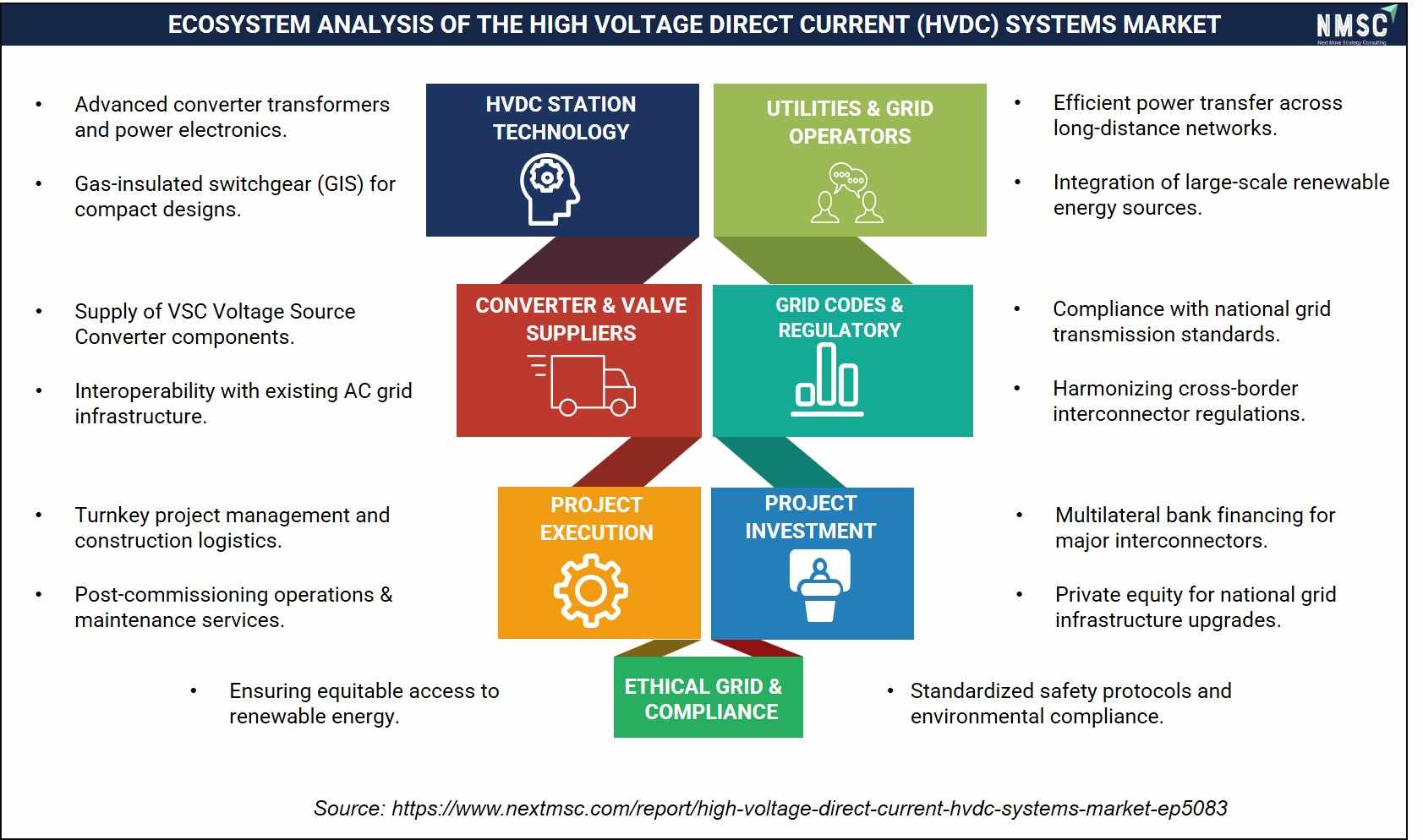
The ecosystem analysis of the High-Voltage Direct Current (HVDC) Systems Market illustrates the interconnected network of technology providers, utilities, regulatory bodies, suppliers, investors, and project execution partners driving market growth. HVDC station technology, converter and valve suppliers, and grid operators form the core operational framework, while regulatory compliance and investment support large-scale infrastructure deployment. Increasing renewable energy integration, offshore wind expansion, and cross-border power transmission projects are strengthening collaboration across the HVDC value chain globally.
What Are the Growth Inhibitors of the High-Voltage Direct Current (HVDC) Systems Market?
How Do High Capital Costs and Extended Project Lead Times Constrain the HVDC Systems Market?
The very high capital intensity of HVDC Systems represents a significant structural constraint on market growth rates, particularly for smaller utilities and developing market economies. A single HVDC point-to-point submarine cable project can require capital investment exceeding USD 2 to USD 4 billion, including converter stations, cable manufacturing, installation vessels, and protection systems. The specialized nature of HVDC submarine cable manufacturing has created production bottlenecks, with leading manufacturers including Prysmian, Nexans, and NKT operating at near-full capacity. The U.S. Government Accountability Office has documented analogous capital constraint challenges in federal transmission infrastructure programs. Our analysis shows these factors extend project decision timelines, increase financing complexity, and create risks of project deferrals during periods of high interest rates.
How Does Regulatory Permitting Complexity Restrain the High-Voltage Direct Current (HVDC) Systems Market?
Complex and lengthy regulatory permitting processes represent a persistent structural restraint on the HVDC Systems Market, particularly for cross-border projects requiring coordinated approval from multiple national authorities. Submarine cable routing through exclusive economic zones requires regulatory clearance from each territorial jurisdiction, creating multi-year approval timelines for even straightforward two-country interconnectors. The European Commission's TEN-E Regulation reforms introduced in 2022 aim to streamline permitting to a 3.5-year maximum for projects of common interest. However, in practice, national-level environmental impact assessments, indigenous land consultations in North America, and fisheries protection requirements continue to extend actual project timelines. Our findings suggest that permitting reform represents one of the most material policy levers for accelerating HVDC Systems Market growth.
What Are the Growth Opportunities in the High-Voltage Direct Current (HVDC) Systems Market?
How Does the Build-Out of Multi-Terminal and Meshed HVDC Grids Represent a Major HVDC Systems Market Opportunity?
The planned transition from point-to-point HVDC links to multi-terminal and meshed HVDC networks across Europe and Asia represents one of the highest-value growth opportunities in the HVDC Systems Market over the next decade. Multi-terminal HVDC grids require not only converter stations and cables but also DC circuit breakers, DC-DC converters, power flow controllers, and advanced grid management systems, substantially increasing per-project value relative to conventional two-terminal links. The European Network of Transmission System Operators for Electricity ten-year network development plan identifies 17 offshore hybrid asset projects requiring multi-terminal HVDC capability by 2035. Our assessment indicates that the first commercial meshed HVDC grid projects in the North Sea region will create standardization precedents and technology learning curves that accelerate subsequent deployments globally.
How Does the Expanding Middle East and Africa Power Infrastructure Investment Create HVDC Systems Market Opportunity?
The Middle East and Africa region represents an underserved but rapidly maturing opportunity for the HVDC Systems Market. Saudi Arabia's Vision 2030 National Renewable Energy Program targets 130 GW of renewable energy by 2030, requiring major transmission infrastructure including potential HVDC corridors for solar power export to neighboring countries. The African Development Bank's Desert to Power initiative aims to develop 10 GW of solar energy in the Sahel region, with long-distance transmission via HVDC identified as a key enabling technology. Egypt's national electricity authority has announced plans for a major HVDC interconnector linking Egyptian solar generation to European demand via subsea cable. Our findings suggest the Middle East and Africa market will grow at a CAGR exceeding 14.0% through 2035, representing a material diversification opportunity for leading HVDC equipment vendors.
How Does the Growing Lifecycle Services and Digitalization Opportunity Expand the HVDC Systems Market?
The increasing age of the global HVDC installed base is creating a substantial and recurring revenue opportunity in lifecycle services, upgrades, and digital retrofits within the HVDC Systems Market. More than 40 HVDC projects commissioned globally before 2010 are approaching major maintenance or refurbishment decision points. Retrofitting aging LCC converter stations with modern control and protection systems, replacing degraded cable sections, and installing digital monitoring infrastructure represent multi-billion-dollar aftermarket opportunities. The European Commission's NIS2 Directive has created a regulatory mandate for cybersecurity upgrades across HVDC operators. NMSC's analysis indicates that the lifecycle services segment growing at a CAGR of 13.4% through 2035 will provide market vendors with more predictable and higher-margin revenue streams compared to new build project cycles.
Porter's Five Forces Analysis of the High Voltage Direct Current (HVDC) Systems Market
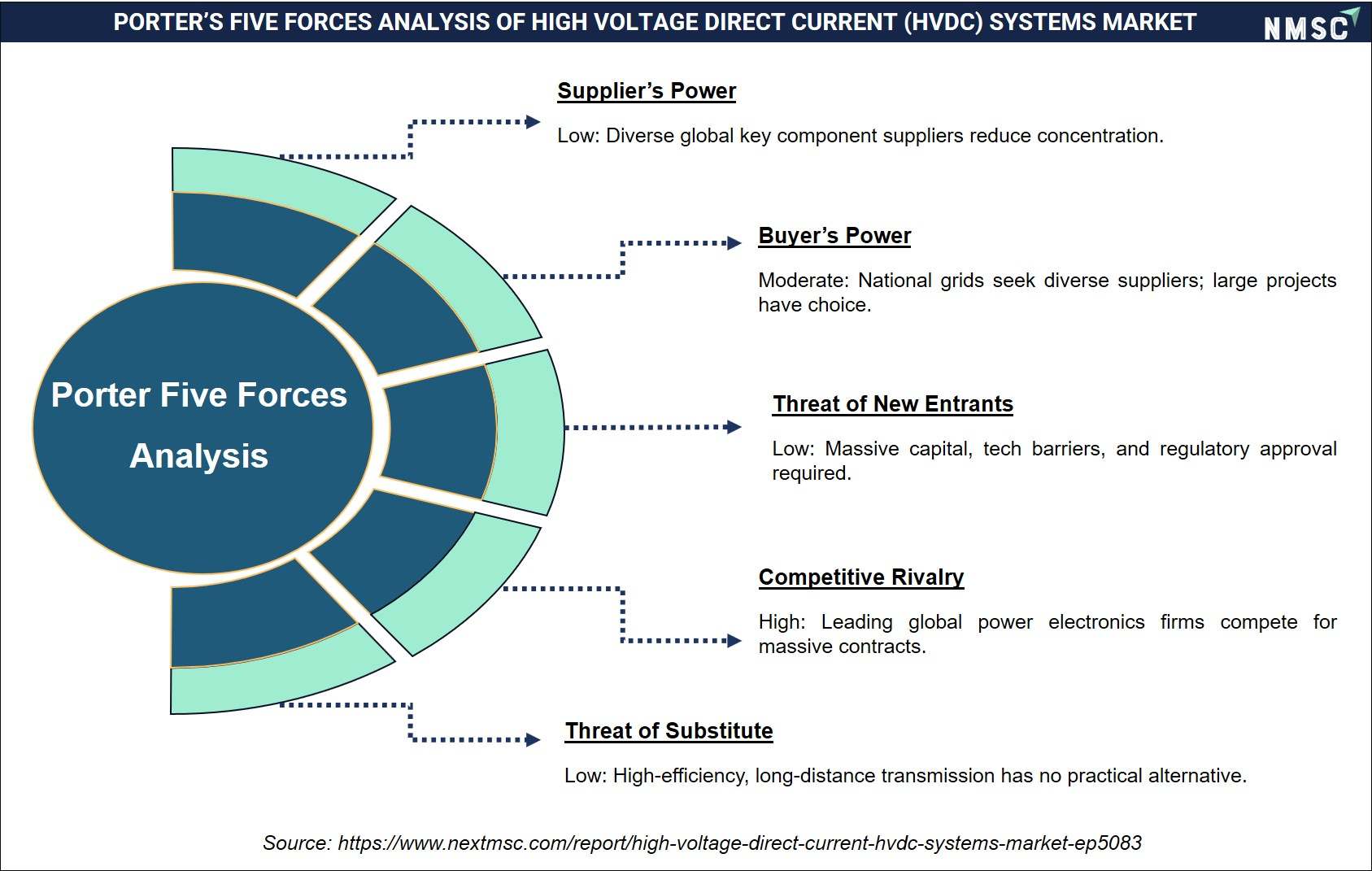
The Porter's Five Forces analysis of the High-Voltage Direct Current (HVDC) Systems Market highlights the competitive dynamics shaping industry growth and profitability. The market is characterized by high entry barriers due to significant capital investment, advanced technological requirements, and strict regulatory standards. Supplier power remains strong because of the limited number of specialized component manufacturers, while buyer power is moderate, led by utilities and transmission operators. Competitive rivalry is intense among major global players, driven by increasing investments in renewable energy integration and cross-border power transmission projects.
How Is the High-Voltage Direct Current (HVDC) Systems Market Segmented in This Report, and What Are the Key Insights from the Segmentation Analysis?
How Do Project Stage Segments Reflect Demand Patterns Across the HVDC Systems Market Life Cycle?
|
Project Stage Segment |
2025 (USD Bn) |
2035 (USD Bn) |
CAGR (%) |
|
New Build Systems |
9.8 |
28.4 |
11.2% |
|
Upgrades and Refurbishments |
2.6 |
7.6 |
11.4% |
|
Lifecycle Services |
2.4 |
10.2 |
13.4% |
Based on our analysis of global HVDC project pipelines and installed base dynamics, the HVDC Systems Market is segmented into New Build Systems, Upgrades and Refurbishments, and Lifecycle Services by project stage. New Build Systems dominate, encompassing Point-to-Point Links that remain the most prevalent project type due to proven engineering approaches, Back-to-Back Links used for asynchronous grid interconnections, and Multi-Terminal Systems representing the fastest-growing sub-category driven by offshore wind hub development in Europe and pilot meshed grid projects in China. Upgrades and Refurbishments encompass Converter Station Upgrades, Cable System Upgrades, and Control and Protection Retrofits, which are gaining momentum as the global HVDC installed base ages. Lifecycle Services, including Operation and Maintenance, Spare Parts and Repairs, and Digital Monitoring and Cybersecurity, constitute the fastest-growing project stage segment as operators invest in performance optimization and regulatory compliance programs for aging HVDC infrastructure.
How Do System Configuration Choices Shape Value Distribution Across the HVDC Systems Market?
|
System Configuration |
2025 (USD Bn) |
2035 (USD Bn) |
CAGR (%) |
|
Point-to-Point Link |
8.6 |
24.8 |
11.2% |
|
Back-to-Back Link |
2.4 |
6.2 |
9.9% |
|
Multi-Terminal System |
3.8 |
15.2 |
14.2% |
Through our market assessment, we observed that the HVDC Systems Market by system configuration encompasses Point-to-Point Links, Back-to-Back Links, and Multi-Terminal Systems. Point-to-Point Links constitute the dominant configuration, serving the largest share of contracted project value due to their well-established engineering design, predictable regulatory approval pathways, and suitability for both terrestrial long-distance transmission and offshore wind export applications. Back-to-Back Links, used specifically to connect asynchronous AC grids without transmitting power over long distances, maintain steady demand particularly in India, the Americas, and Japan where regional AC grids operate at different frequencies or phases. Multi-Terminal Systems are the fastest-growing configuration segment, reflecting the transition toward integrated offshore energy grid architectures in Northern Europe and China's continued investment in flexible multi-terminal DC pilot projects that lay the technical foundation for commercial meshed HVDC grid deployment.
How Does Technology Type Segmentation Reveal the Competitive Dynamics Within the HVDC Systems Market?
|
Technology Type |
2025 (USD Bn) |
2035 (USD Bn) |
CAGR (%) |
|
LCC (Line Commutated Converter) |
5.4 |
12.8 |
9.0% |
|
VSC (Voltage Source Converter) |
7.9 |
27.4 |
13.3% |
|
Hybrid Converter |
1.5 |
6.0 |
14.9% |
From our research, we found that the HVDC Systems Market by technology type is segmented into LCC, VSC, and Hybrid Converter technologies, each serving distinct application requirements and market segments. LCC technology, which relies on thyristor-based power conversion and requires reactive power compensation, remains relevant for very high-power bulk transmission applications at ±800 kV and above, particularly in China and India where it serves established ultra-high-voltage DC corridors at costs lower than equivalent VSC systems. VSC technology, which uses fully controllable switching devices enabling independent active and reactive power control, island operation support, and underground and submarine cable suitability, has become the dominant technology choice for all new offshore wind connections and urban infeed applications globally. Hybrid Converter technology, which combines elements of both LCC and VSC to deliver high-power capability with greater controllability, represents the fastest-growing segment and is expected to enable the next generation of ultra-high-voltage multi-terminal HVDC systems beyond 2028.
How Does the Choice of Transmission Medium Drive Investment Allocation Across the HVDC Systems Market?
|
Transmission Medium |
2025 (USD Bn) |
2035 (USD Bn) |
CAGR (%) |
|
Overhead Line |
5.9 |
16.2 |
10.6% |
|
Submarine Cable |
4.2 |
15.8 |
14.1% |
|
Underground Cable |
2.8 |
8.4 |
11.6% |
|
Mixed Route |
1.9 |
5.8 |
11.8% |
NMSC's analysis of HVDC project databases and infrastructure investment pipelines indicates that the HVDC Systems Market by transmission medium encompasses Overhead Line, Submarine Cable, Underground Cable, and Mixed Route deployments. Overhead Line remains the largest segment by revenue, serving the long-distance terrestrial bulk power transmission corridors in China, India, and Brazil where land availability enables overhead construction at lower cost per kilometer than cable alternatives. Submarine Cable is the fastest-growing medium, directly driven by the explosive growth of offshore wind capacity requiring dedicated subsea export cables and by the expanding program of cross-border subsea interconnectors in Europe and Southeast Asia. Underground Cable deployment is growing steadily for urban infeed applications and environmentally sensitive terrestrial corridors where overhead line construction faces community or regulatory opposition. Mixed Route projects combining overhead, underground, and submarine segments are characteristic of complex cross-border European interconnectors.
How Does Voltage Class Segmentation Reflect the Technical Evolution of the HVDC Systems Market?
|
Voltage Class |
2025 (USD Bn) |
2035 (USD Bn) |
CAGR (%) |
|
Up to ±320 kV |
3.6 |
9.8 |
10.6% |
|
±321 kV to ±500 kV |
6.8 |
19.4 |
11.1% |
|
Above ±500 kV |
4.4 |
17.0 |
14.5% |
Based on our market evaluation, we noticed that the HVDC Systems Market by voltage class is segmented into Up to ±320 kV, ±321 kV to ±500 kV, and Above ±500 kV categories. The ±321 kV to ±500 kV class holds the largest share, representing the standard voltage specification for the majority of current VSC-HVDC offshore wind export cables, European interconnectors, and new-generation cross-border transmission links. The Up to ±320 kV segment serves shorter-distance submarine connections and urban infeed applications. The Above ±500 kV segment is the fastest-growing voltage class, driven by China's continued investment in ±800 kV and ±1,100 kV ultra-high-voltage DC technology for inter-provincial power transmission and by India's plans to extend its existing ±800 kV HVDC program with additional corridors connecting solar-rich Rajasthan and Gujarat to eastern industrial states.
How Do Application Type Segments Reflect End-Use Demand Structure in the HVDC Systems Market?
|
Application Type |
2025 (USD Bn) |
2035 (USD Bn) |
CAGR (%) |
|
Bulk Power Transmission |
5.4 |
14.8 |
10.6% |
|
Offshore Wind Integration |
3.2 |
14.6 |
16.4% |
|
Cross-Border Interconnection |
3.0 |
8.6 |
11.1% |
|
Grid Reinforcement and Urban Infeed |
2.0 |
5.6 |
10.8% |
|
Industrial and Special Applications |
0.8 |
1.8 |
8.4% |
|
Other Applications |
0.4 |
0.8 |
7.2% |
Our findings suggest that the HVDC Systems Market by application type is segmented into Bulk Power Transmission, Offshore Wind Integration, Cross-Border Interconnection, Grid Reinforcement and Urban Infeed, Industrial and Special Applications, and Other Applications. Bulk Power Transmission remains the dominant application segment, primarily driven by large-scale LCC and hybrid HVDC corridors in China, India, and Brazil linking generation-rich regions with demand centers. Offshore Wind Integration is the fastest-growing application at a CAGR of 16.4% through 2035, reflecting the structural demand surge created by European and Asian offshore wind targets. Cross-Border Interconnection projects, linking national grids to improve energy security and market integration, represent a steady and policy-supported demand segment. Grid Reinforcement and Urban Infeed applications utilize VSC-HVDC technology to inject power into congested urban AC grids without expanding overhead line infrastructure.
How Does the Customer Type Segmentation Illuminate Procurement Dynamics in the HVDC Systems Market?
|
Customer Type |
2025 (USD Bn) |
2035 (USD Bn) |
CAGR (%) |
|
Transmission System Operator |
6.2 |
18.0 |
11.2% |
|
Electric Utility |
3.2 |
9.0 |
10.9% |
|
Offshore Wind Developer |
2.8 |
13.2 |
16.8% |
|
Interconnector Consortium |
1.4 |
3.6 |
9.9% |
|
Industrial User |
0.8 |
1.6 |
7.2% |
|
Other Customers |
0.4 |
0.8 |
7.2% |
Based on our analysis of HVDC project ownership structures and procurement patterns, we observed that the HVDC Systems Market by customer type encompasses Transmission System Operators, Electric Utilities, Offshore Wind Developers, Interconnector Consortia, Industrial Users, and Other Customers. Transmission System Operators remain the dominant customer segment, owning and procuring the majority of national grid interconnectors and terrestrial bulk transmission corridors in regulated network frameworks. Electric Utilities constitute the second-largest customer category, particularly in China, India, and Brazil where vertically integrated utilities procure HVDC systems directly. Offshore Wind Developers are the fastest-growing customer type at a CAGR of 16.8% through 2035, reflecting the shift toward developer-owned transmission infrastructure in markets adopting integrated transmission and generation procurement models, particularly in the United Kingdom, Germany, and the Netherlands.
Regional Outlook
Geographic Performance Snapshot
|
Region |
2025 (USD Bn) |
2035 (USD Bn) |
CAGR (%) |
Key Driver |
|
North America |
3.8 |
11.4 |
11.6% |
Offshore wind, federal grid funding |
|
Europe |
4.6 |
15.6 |
12.8% |
North Sea offshore wind, EU interconnection |
|
Asia-Pacific |
5.2 |
15.0 |
11.2% |
China UHVDC, India renewables, APAC offshore |
|
Middle East & Africa |
0.8 |
2.6 |
12.5% |
Vision 2030, Desert to Power initiative |
|
Latin America |
0.4 |
1.6 |
14.9% |
Hydro corridors, solar transmission expansion |
North America High-Voltage Direct Current (HVDC) Systems Market
North America held an HVDC Systems Market revenue of USD 3.8 billion in 2025 and is forecast to reach USD 11.4 billion by 2035 at a CAGR of 11.6%. The region benefits from growing federal transmission investment under the Infrastructure Investment and Jobs Act, a rapidly expanding U.S. offshore wind pipeline, and multiple committed cross-border interconnector projects with Canada and Mexico. Regulatory support from FERC Order 1000 and its successors is progressively improving transmission project approval frameworks. Technology adoption is advancing with VSC-HVDC emerging as the preferred technology for new submarine cable and long-distance underground applications. The competitive landscape is concentrated among Hitachi Energy, Siemens Energy, and GE Vernova for converter systems, and Prysmian and NKT for cable supply.
U.S. High-Voltage Direct Current (HVDC) Systems Market
Based on our engagements with industry stakeholders and review of federal project documentation, the United States HVDC Systems Market is entering a period of accelerating growth driven by the largest federal energy infrastructure investment in the country's history. The U.S. Department of Energy's Grid Deployment Office has committed USD 10.5 billion in grid transmission funding, with a specific program supporting long-distance HVDC corridors. Projects including the SunZia Wind and Transmission system in the Southwest and Champlain Hudson Power Express in the Northeast reflect increasing confidence in HVDC as the preferred technology for new long-distance and submarine transmission in constrained corridors. State-level offshore wind mandates in New York, New Jersey, Massachusetts, and California are creating structured procurement programs for offshore HVDC cables worth USD 4 to USD 8 billion in aggregate contracted project value through 2030.
Canada High-Voltage Direct Current (HVDC) Systems Market
Through our analysis of Canadian energy infrastructure plans and utility filings, we found that Canada's HVDC Systems Market is primarily driven by interprovincial hydropower transmission and cross-border electricity export projects with the United States. Manitoba Hydro, Hydro-Quebec, and BC Hydro operate significant portions of their transmission systems via existing HVDC links, creating a steady demand for upgrades, refurbishments, and lifecycle services. Canada's clean energy transmission investments under the Canada Infrastructure Bank are creating additional capital deployment for new provincial HVDC corridors. The regulatory environment under provincial jurisdiction creates a relatively supportive permitting framework compared to multi-state U.S. projects. Technology adoption is mature for LCC systems, with VSC technology increasingly specified for new and upgrade projects.
Mexico High-Voltage Direct Current (HVDC) Systems Market
From our assessment of Mexico's national electricity infrastructure plans and energy reform trajectory, we observed that the Mexico HVDC Systems Market remains at an early stage of development but holds meaningful long-term growth potential. CFE (Comision Federal de Electricidad) has identified several long-distance transmission corridors in the national transmission expansion program that could benefit from HVDC technology, particularly for transmitting solar and wind power from resource-rich regions in Oaxaca and Sonora to the Mexico City metropolitan demand center. Regulatory uncertainty following recent energy policy reforms has created project development delays. However, structured power purchase frameworks with U.S. buyers for cross-border renewable transmission represent a credible catalyst for the first major Mexican HVDC project in the latter half of the forecast period.
Europe High-Voltage Direct Current (HVDC) Systems Market
Europe is the fastest-growing major region in the HVDC Systems Market at a CAGR of 12.8%, contributing USD 4.6 billion in 2025 and forecast to reach USD 15.6 billion by 2035. Europe's regulatory environment, shaped by the EU Offshore Renewable Energy Strategy targeting 300 GW of offshore wind by 2050, the TEN-E Regulation mandating cross-border interconnection projects, and the REPowerEU energy security program, creates an exceptionally supportive policy environment for sustained HVDC investment. The North Sea offshore wind build-out, Baltic Sea integration, and Mediterranean solar transmission programs collectively represent the world's most concentrated HVDC project pipeline. ENTSO-E's ten-year network development plan projects EUR 100 billion in transmission investment requirements through 2035, with HVDC constituting a substantial portion.
UK High-Voltage Direct Current (HVDC) Systems Market
Based on our engagements with UK transmission industry participants and review of Ofgem regulatory documentation, the United Kingdom is the most active individual country market for new HVDC Systems project awards in Europe. The UK's Eastern Green Link 1 and Eastern Green Link 2 projects, each approximately 2 GW capacity connecting Scottish renewables to the English grid via subsea cable, represent the largest current domestic HVDC procurement programs globally. Viking Link, a 1.4 GW interconnector between the UK and Denmark commissioned in 2024, demonstrates sustained cross-border interconnector investment. National Grid ESO's Holistic Network Design and the Accelerated Strategic Transmission Investment program provide regulatory and financial frameworks for accelerated HVDC capital deployment. Technology adoption is at the leading edge globally, with all new UK HVDC projects specified as VSC technology.
Germany High-Voltage Direct Current (HVDC) Systems Market
Through our analysis of German energy transition legislation and transmission network plans, we found that Germany's HVDC Systems Market is driven by the urgent need to transmit large volumes of northern offshore and onshore wind power to southern industrial and population centers. The four German SuedLink and SuedOstLink HVDC corridor projects, totaling approximately 8 GW of transmission capacity, represent the largest single national HVDC construction program currently underway in Europe. The German Federal Network Agency Bundesnetzagentur provides a structured regulatory framework for cost recovery on approved transmission projects. Technology adoption is exclusively VSC for all new projects. Environmental permitting complexity and community acceptance challenges in southern Germany have historically extended project timelines, representing the primary risk to the construction schedule.
France High-Voltage Direct Current (HVDC) Systems Market
From our assessment of French energy infrastructure and RTE transmission plans, we observed that France's HVDC Systems Market is developing around offshore wind integration and cross-border interconnection projects. RTE's STARS offshore wind grid study has identified a potential multi-terminal HVDC network for aggregating planned 40 GW offshore wind capacity additions. The France-United Kingdom IFA2 interconnector and the planned Celtic Interconnector to Ireland reflect active cross-border HVDC investment. France's nuclear-dominated generation mix creates a strategic interest in export-oriented interconnectors to monetize surplus nuclear output. The CEREMA and energy ministry permitting processes are supportive of transmission investment aligned with France 2030 program objectives.
Italy High-Voltage Direct Current (HVDC) Systems Market
According to our evaluation of Italian transmission infrastructure plans and Terna network documentation, Italy represents one of Europe's most active HVDC Systems Markets for domestic underwater cable projects. Terna, Italy's transmission system operator, operates multiple existing HVDC submarine links between the Italian mainland and Sardinia, Sicily, and the Italian peninsula, with several upgrade and capacity addition projects planned through 2030. The SA.PE.I. link between mainland Italy and Sardinia has recently been upgraded. Italy's geographic configuration as a peninsula with island territories creates a structurally permanent demand for HVDC submarine cable technology. Cross-border interconnector investments with Montenegro and planned links with Tunisia for renewable energy import are adding to the project pipeline.
Spain High-Voltage Direct Current (HVDC) Systems Market
Based on our market evaluation, Spain's HVDC Systems Market is developing around offshore wind integration and Iberian Peninsula cross-border interconnection. Spain's national energy and climate plan targets 62 GW of offshore wind by 2030, requiring significant HVDC export cable infrastructure. The Bay of Biscay submarine HVDC link between Spain and France, a long-planned interconnector to improve Iberian grid integration with continental Europe, has received renewed political support following REPowerEU energy security priorities. REE (Red Electrica de Espana) network development plans identify HVDC as the preferred technology for new long-distance transmission within Spain given landscape and environmental constraints on overhead line expansion in high-value coastal and ecological zones.
Sweden High-Voltage Direct Current (HVDC) Systems Market
Through our analysis of Swedish transmission policy and Svenska Kraftnat planning documents, we observed that Sweden has one of the world's highest HVDC penetration rates relative to grid size. Svenska Kraftnat operates extensive HVDC interconnectors to Norway, Denmark, Finland, Germany, Lithuania, and Poland. The recently commissioned Viking Link between Sweden and the United Kingdom demonstrates continued strategic interconnector investment. Sweden's ambitious Baltic Sea offshore wind targets require new HVDC export infrastructure. Fenno-Skan 1 and 2 HVDC links to Finland are scheduled for refurbishment, contributing to the lifecycle services segment.
Denmark High-Voltage Direct Current (HVDC) Systems Market
From our assessment of Danish energy policy and Energinet grid plans, Denmark's HVDC Systems Market is positioned at the intersection of the North Sea offshore wind build-out and Baltic Sea interconnector investment. Energinet operates or co-owns HVDC interconnectors to Germany (Kontek), Norway (Skagerrak), Sweden (Konti-Skan), Netherlands (COBRAcable), and the UK (Viking Link). The planned Bornholm Energy Island, a 3 GW offshore hub combining Danish and German wind capacity with multi-terminal HVDC export infrastructure, is among the most strategically significant HVDC projects in European planning. Denmark's regulatory framework is supportive of interconnector investment and hybrid offshore grid development.
Finland High-Voltage Direct Current (HVDC) Systems Market
Based on our engagements with Nordic energy sector stakeholders, Finland's HVDC Systems Market is anchored by its strategic role in Baltic Sea energy security following Finland's accession to NATO and the Baltic States' desynchronization from the Russian BRELL power ring. Finland operates HVDC interconnectors with Sweden (Fenno-Skan) and Estonia (Estlink 1 and 2). The expansion of offshore wind in the Finnish exclusive economic zone requires new HVDC export cables. Fingrid's national transmission development plan allocates significant capital for grid reinforcement and new interconnector capacity. The technology adoption trajectory is toward VSC for all new cable projects with increasing interest in digital lifecycle service contracts.
Netherlands High-Voltage Direct Current (HVDC) Systems Market
Through our analysis of Dutch transmission infrastructure planning and TenneT documentation, the Netherlands HVDC Systems Market is driven by the most ambitious per-capita offshore wind program in Europe. TenneT's Program NEMO and offshore wind infrastructure plans target more than 50 GW of North Sea offshore wind capacity connected to the Dutch grid by 2040. TenneT's standardized 2 GW HVDC offshore platform concept, which uses standardized converter station designs to accelerate offshore grid construction, represents a breakthrough procurement model being adopted across North Sea jurisdictions. The planned DolWin and BorWin HVDC cluster upgrades alongside new offshore connections reflect a multi-decade HVDC investment pipeline. Regulation under the Dutch Authority for Consumers and Markets supports transparent cost recovery for approved transmission assets.
Rest of Europe High-Voltage Direct Current (HVDC) Systems Market
According to our evaluation of European transmission development plans beyond core markets, the Rest of Europe HVDC Systems submarket includes important projects in Norway, Belgium, Poland, and the Baltic states. Norway's role as Europe's largest hydropower resource creates demand for HVDC export cables, with North Connect, NordLink, and NSN Link demonstrating sustained Norwegian interconnector investment. Belgium's Elia grid operator is investing in offshore HVDC connections as part of the Belgian Princess Elisabeth energy island program. The Baltic states of Estonia, Latvia, and Lithuania are desynchronizing from the Russian power grid and connecting to the European continental synchronous area via HVDC, representing a structurally significant and policy-mandated project pipeline.
Asia-Pacific High-Voltage Direct Current (HVDC) Systems Market
Asia-Pacific is the largest regional market in the HVDC Systems Market at USD 5.2 billion in 2025 and is forecast to reach USD 15.0 billion by 2035 at a CAGR of 11.2%. The region encompasses the world's largest single national HVDC market in China, the rapidly expanding Indian HVDC program, growing offshore wind activity in Japan, Taiwan, South Korea, and Vietnam, and early-stage HVDC investments across Southeast Asia and Australia. China's State Grid Corporation and Southern Power Grid operate the world's largest aggregate HVDC installed base, with continued expansion of ultra-high-voltage direct current corridors under the 14th Five-Year Plan sustaining above-market growth dynamics. Technology adoption spans the full range from mature LCC ultra-high-voltage technology in China and India to cutting-edge VSC offshore systems in East Asian markets.
China High-Voltage Direct Current (HVDC) Systems Market
Based on our engagements with Chinese energy sector participants and review of State Grid Corporation and Southern Power Grid publications, China constitutes approximately 28% of the global HVDC Systems Market revenue in 2025, making it the world's single largest national HVDC market by a substantial margin. China's ultra-high-voltage DC program has delivered commercially operational ±1,100 kV HVDC systems, the world's highest voltage class, with the Changji-Guquan link connecting Xinjiang wind and solar power to central China. The 14th Five-Year Plan has authorized additional ±800 kV corridors from Inner Mongolia, Gansu, and Xinjiang solar and wind bases to eastern demand centers. Technology adoption is maturing toward VSC for multi-terminal applications, with China's Zhangbei flexible DC grid providing the world's most advanced operational meshed DC network experience.
India High-Voltage Direct Current (HVDC) Systems Market
Through our analysis of Indian power sector planning documents and Ministry of New and Renewable Energy targets, India's HVDC Systems Market is entering a high-growth phase driven by the world's largest renewable energy addition program. India targets 500 GW of renewable capacity by 2030 under its Nationally Determined Contribution commitments, requiring massive long-distance transmission infrastructure to move solar power from Rajasthan and Gujarat and wind power from southern and eastern regions to northern demand centers.
Japan High-Voltage Direct Current (HVDC) Systems Market
From our assessment of Japanese power infrastructure and Ministry of Economy Trade and Industry planning documents, Japan's HVDC Systems Market reflects both the unique frequency interconnection requirement of its split 50 Hz and 60 Hz national grid and the growing offshore wind development agenda. HVDC back-to-back converters connecting the eastern and western Japanese grid systems are critical national infrastructure. Japan's offshore wind targets of 45 GW by 2040 under the Green Growth Strategy require substantial HVDC cable investments. Technology penetration is advancing with Japanese manufacturers Mitsubishi Electric, Toshiba, and Hitachi Energy (with Japanese roots) active in both domestic deployment and global supply. Regulatory frameworks under METI provide structured support for offshore wind and transmission infrastructure investment.
South Korea High-Voltage Direct Current (HVDC) Systems Market
Based on our evaluation of South Korean energy infrastructure plans and KEPCO publications, South Korea's HVDC Systems Market is driven by island connections and emerging offshore wind development. KEPCO operates HVDC submarine links to Jeju Island and has plans to integrate growing renewable capacity on outlying islands via HVDC. South Korea's offshore wind target of 14.3 GW by 2030 under the 10th Basic Plan for Electricity Supply and Demand requires significant HVDC cable infrastructure. Korean manufacturers LS Cable and System, HD Hyundai Electric, and Hyosung Heavy Industries are active in both domestic supply and international HVDC cable markets, providing strategic supply chain depth. Technology adoption is advancing toward VSC for offshore applications.
Taiwan High-Voltage Direct Current (HVDC) Systems Market
Through our analysis of Taiwanese energy policy and Taipower infrastructure plans, Taiwan's HVDC Systems Market is developing around island grid integration and offshore wind transmission. Taiwan's offshore wind program, targeting 15 GW by 2035 under the Energy Transition roadmap, requires dedicated HVDC export cable infrastructure. Taipower's planned interconnection with Penghu and other outlying island grids via HVDC submarine cable is a near-term project. The strategic sensitivity of cross-strait power infrastructure creates a preference for domestically produced or allied-nation sourced HVDC equipment. Technology adoption is at the VSC stage, consistent with offshore wind application requirements.
Indonesia High-Voltage Direct Current (HVDC) Systems Market
According to our evaluation of Indonesian energy infrastructure and PLN national electricity planning documents, Indonesia's HVDC Systems Market is driven by the geographic necessity of inter-island power transmission and the country's ambition to develop renewable energy resources in Sumatra, Kalimantan, and Eastern Indonesia for transmission to Java's demand centers. PLN's long-term electricity supply business plan identifies multiple inter-island HVDC links as strategic infrastructure priorities. The Sumatra-Java HVDC link is the most strategically significant project under active development, potentially transmitting up to 3 GW of Sumatra geothermal and hydropower to Java. Indonesian government support under the National Energy Plan is creating regulatory momentum, though financing complexity for major infrastructure remains a challenge.
Vietnam High-Voltage Direct Current (HVDC) Systems Market
From our assessment of Vietnamese power sector planning and EVN (Electricity of Vietnam) development plans, Vietnam's HVDC Systems Market is an emerging opportunity driven by rapid renewable energy growth and north-south transmission constraints. Vietnam's 8th National Power Development Plan targets significant solar and wind capacity additions in the south and central regions, requiring expanded north-south transmission to serve Hanoi and northern industrial zones. HVDC technology is under evaluation for the long north-south transmission corridor as an alternative to AC expansion constrained by right-of-way limitations. The government's commitment to 47% renewable energy by 2030 provides a policy basis for major transmission infrastructure investment. Market maturity is early-stage, with project development likely accelerating in the second half of the forecast period.
Australia High-Voltage Direct Current (HVDC) Systems Market
Based on our engagements with Australian energy sector participants and review of Australian Energy Market Operator planning documentation, Australia's HVDC Systems Market is developing around state interconnection and offshore wind integration. The proposed Sun Cable project, envisioning a 4,200-kilometer HVDC submarine cable transmitting solar power from Australia's Northern Territory to Singapore, represents one of the world's most ambitious HVDC projects under development. The Marinus Link between Tasmania and Victoria, a VSC-HVDC submarine cable project currently in advanced development stages, will provide a commercial precedent for Australian HVDC infrastructure financing and permitting. Technology adoption is VSC for all new cable projects, with mature operational experience in existing Basslink infrastructure.
Philippines High-Voltage Direct Current (HVDC) Systems Market
Through our analysis of Philippine energy infrastructure and Department of Energy planning documents, the Philippines HVDC Systems Market is driven by the country's archipelago geography requiring inter-island power transmission. The National Grid Corporation of the Philippines operates the Visayas-Mindanao Interconnection HVDC link and has plans for additional inter-island connections to improve grid reliability and enable renewable energy sharing. The Philippines' 100% renewable energy target under the Renewable Energy Act provides a policy foundation for expanding island-to-island HVDC infrastructure. Technology adoption is developing, with VSC increasingly preferred for new submarine cable installations. Regulatory support from the Energy Regulatory Commission provides a structured framework for transmission investment.
Malaysia High-Voltage Direct Current (HVDC) Systems Market
According to our evaluation of Malaysian energy policy and TNB transmission plans, Malaysia's HVDC Systems Market is developing around Sabah-Sarawak-Peninsular Malaysia interconnection and regional cross-border power trading. The Sarawak-West Kalimantan Cross-Border Interconnection and the Sabah-Sarawak Link HVDC projects reflect Malaysia's strategy to monetize Sarawak's hydropower through long-distance HVDC export. Regional ASEAN Power Grid initiatives under the ASEAN Plan of Action for Energy Cooperation are creating a framework for cross-border HVDC interconnections across Southeast Asia. Malaysia's Renewable Energy Act and national energy transition policy provide regulatory support for infrastructure enabling renewable energy trading across the region.
Rest of Asia-Pacific High-Voltage Direct Current (HVDC) Systems Market
Based on our market assessment of emerging Asia-Pacific HVDC opportunities, the Rest of Asia-Pacific HVDC Systems submarket includes growing project activity in Thailand, Singapore, New Zealand, and Pacific Island nations. Singapore's energy import strategy, including the planned Lao PDR-Thailand-Malaysia-Singapore ASEAN Power Grid interconnection, creates potential for multi-country HVDC routing across the Malay Peninsula. New Zealand's Cook Strait HVDC pole replacement program represents a major near-term refurbishment project. Thailand's AEDP energy plan and ambitions for ASEAN grid interconnection position it as a future transit point for regional HVDC power trading.
Middle East and Africa High-Voltage Direct Current (HVDC) Systems Market
The Middle East and Africa HVDC Systems Market held USD 0.8 billion in 2025 and is forecast to reach USD 2.6 billion by 2035 at a CAGR of 12.5%. The region is at an early to mid-stage of HVDC adoption, driven by renewable energy export ambitions, intra-regional grid integration programs, and national infrastructure diversification strategies. Saudi Arabia's Vision 2030 renewable energy targets, the African Union's ambitious Desert to Power solar initiative, and Egypt's strategic positioning as a hub for Mediterranean-to-Europe green energy corridors are the three primary demand catalysts. Technology adoption spans LCC for the highest-power applications and VSC for submarine and hybrid projects.
Saudi Arabia High-Voltage Direct Current (HVDC) Systems Market
Based on our engagements with Saudi energy sector stakeholders and review of Saudi Electricity Company and NEOM project documentation, Saudi Arabia's HVDC Systems Market is driven by Vision 2030's 130 GW renewable energy target and the strategic ambition to become a major green hydrogen and renewable electricity exporter. NEOM's planned 9 GW renewable energy cluster will require HVDC transmission infrastructure for power delivery. The interconnection of Saudi Arabia with neighboring GCC states through the GCC Interconnection Authority, which currently operates an AC interconnected grid, may require HVDC for specific high-power bilateral corridors. Saudi Arabia's National Renewable Energy Program is creating a structured procurement environment for large-scale transmission infrastructure.
UAE High-Voltage Direct Current (HVDC) Systems Market
Through our analysis of UAE energy infrastructure and TRANSCO planning documents, the UAE's HVDC Systems Market is developing around renewable energy integration and Gulf region interconnection. The UAE's clean energy target of 44% by 2050 under the UAE Energy Strategy 2050 requires significant grid infrastructure investment. Masdar, Abu Dhabi's renewable energy champion, is involved in large-scale solar project development that may require dedicated HVDC transmission. The UAE's participation in the GCC Interconnection Authority grid and its strategic interest in solar energy export to Europe via submarine HVDC cables, analogous to the planned Xlinks Morocco project, creates long-term HVDC demand potential. Technology adoption is at an early VSC adoption stage for new projects.
Egypt High-Voltage Direct Current (HVDC) Systems Market
From our assessment of Egyptian energy infrastructure and New and Renewable Energy Authority plans, Egypt is emerging as one of the most strategically significant HVDC opportunities in the Africa and Middle East region. Egypt's renewable energy capacity is expanding rapidly under national targets, with the Benban solar complex already among the world's largest. The proposed MENA-to-Europe HVDC submarine cable projects, including the MEDGRID and Xlinks concepts that propose transmitting North African solar power to European consumers, position Egypt as a potential hub for intercontinental green energy trade. Egypt's NREA is actively evaluating HVDC submarine cable proposals. The government's economic partnership with the European Union under the Global Gateway initiative provides a financing framework for major energy infrastructure.
Israel High-Voltage Direct Current (HVDC) Systems Market
According to our evaluation of Israeli energy infrastructure and IEC network plans, Israel's HVDC Systems Market is an emerging opportunity driven by regional grid integration ambitions and offshore natural gas transmission infrastructure. The planned EuroAsia Interconnector, a 2 GW HVDC submarine cable linking Israel, Cyprus, and Greece and representing the world's longest planned submarine HVDC cable at approximately 1,208 kilometers, is the defining project for the Israeli market. The project has received Project of Common Interest status from the European Commission. Israel Electric Corporation is the primary domestic stakeholder. Regulatory development under the Israeli Electricity Authority is supporting cross-border infrastructure investment.
Turkey High-Voltage Direct Current (HVDC) Systems Market
Based on our engagements with Turkish energy sector participants, Turkey's HVDC Systems Market reflects its strategic geographic position between European and Middle Eastern electricity systems. Turkey operates an asynchronous AC link with continental Europe via a Back-to-Back HVDC converter, enabling managed power trading while maintaining grid independence. Expansion of Turkey's offshore wind program in the Black Sea and Aegean requires HVDC submarine cable infrastructure. Turkey's stated ambition to serve as a regional power trading hub between the Caspian, Middle East, and European grid systems creates long-term HVDC interconnection demand. TEIAS (Turkish Electricity Transmission Corporation) is the primary transmission infrastructure entity.
Nigeria High-Voltage Direct Current (HVDC) Systems Market
Through our analysis of Nigerian power sector plans and Transmission Company of Nigeria documentation, Nigeria represents an early-stage but structurally important HVDC opportunity in sub-Saharan Africa. Nigeria's power sector reform agenda, supported by the World Bank and African Development Bank, includes evaluation of HVDC technology for inter-regional bulk power transmission within the country's geographically dispersed generation and load centers. Participation in the West African Power Pool requires cross-border transmission infrastructure where HVDC may provide advantages over AC interconnections. Technology adoption is currently pre-commercial, with market development expected in the latter half of the forecast period pending power sector reform progress.
South Africa High-Voltage Direct Current (HVDC) Systems Market
According to our evaluation of South African energy infrastructure and Eskom transmission plans, South Africa's HVDC Systems Market opportunity centers on long-distance bulk power transmission and renewable energy integration in a geography with large renewable resource areas remote from coastal load centers. Eskom's Cahora Bassa HVDC line from Mozambique to South Africa, one of Africa's largest operating HVDC links, requires refurbishment and capacity expansion. South Africa's Renewable Energy Independent Power Producer Programme is creating a growing renewable energy base that may require long-distance HVDC transmission for optimal grid integration. The North Karoo solar and Northern Cape wind resource areas are candidates for HVDC-linked transmission corridors.
Rest of Middle East and Africa High-Voltage Direct Current (HVDC) Systems Market
Based on our assessment of MEA energy infrastructure opportunities, the Rest of Middle East and Africa HVDC Systems submarket includes emerging projects across Morocco, Ethiopia, Kenya, and the Gulf Cooperation Council states. Morocco's ambition to export renewable electricity to Europe via submarine HVDC cable reflects the broader North Africa-to-Europe green energy corridor opportunity, with Xlinks Morocco UK Power Project planning a 3,800-kilometer submarine HVDC cable. Ethiopia's Grand Renaissance Dam hydropower and Kenya's geothermal resources provide potential for East African HVDC power corridors aligned with the Eastern Africa Power Pool regional integration agenda. Gulf states including Oman and Kuwait are evaluating HVDC for domestic renewable integration and regional interconnection.
Latin America High-Voltage Direct Current (HVDC) Systems Market
Latin America's HVDC Systems Market held USD 0.4 billion in 2025 and is forecast to reach USD 1.6 billion by 2035 at a CAGR of 14.9%, representing the region's fastest-growing HVDC investment trajectory driven primarily by Brazil's hydropower transmission program expansion and emerging cross-border renewable energy interconnection projects. The region's large geographic scale, abundant renewable resources remote from population centers, and growing renewable energy capacity additions across Brazil, Chile, and Colombia create compelling structural demand for long-distance HVDC transmission infrastructure over the forecast period.
Brazil High-Voltage Direct Current (HVDC) Systems Market
From our engagements with Brazilian energy sector stakeholders and review of ONS and ANEEL regulatory publications, Brazil operates one of the world's longest-established national HVDC transmission programs. The Belo Monte HVDC complex, comprising two ±800 kV circuits transmitting 8 GW of hydropower from the Amazon basin to southeastern Brazil's load centers, represents the world's highest-capacity HVDC installation. Subsequent hydropower development in the Amazon region and the planned offshore wind expansion along Brazil's northeastern coastline will require additional long-distance HVDC infrastructure. ANEEL's competitive transmission auction framework creates a structured procurement environment for new HVDC corridors. Technology adoption spans LCC for ultra-high-voltage applications and VSC for offshore wind connections.
Argentina High-Voltage Direct Current (HVDC) Systems Market
Through our analysis of Argentine energy infrastructure and CAMMESA system planning, Argentina's HVDC Systems Market is at an early development stage with potential driven by Patagonian wind and solar resources that require long-distance transmission to Buenos Aires and the northeast population centers. Argentina's Renewable Energy Law targets 20% renewable energy, with wind energy capacity expanding rapidly in Patagonia. HVDC technology is under active consideration for the planned Patagonia-to-Buenos Aires long-distance transmission corridor that could unlock multi-gigawatt renewable energy transmission. Economic volatility and currency constraints present financing challenges but do not diminish the structural infrastructure requirement.
Chile High-Voltage Direct Current (HVDC) Systems Market
Based on our evaluation of Chilean energy infrastructure and CNE planning documents, Chile's HVDC Systems Market is an emerging opportunity driven by the country's world-class solar and wind resources in the Atacama Desert and Patagonia regions. Chile's energy transition strategy targets 100% renewable electricity by 2050, with interim milestones requiring significant transmission expansion. The planned submarine HVDC link between Chile's northern SIC and SING grids and potential cross-Andes power interconnections with Argentina represent HVDC application opportunities. Chile's regulatory framework under the Comision Nacional de Energia provides structured support for transmission investment, and the country's ambition to export green hydrogen creates further long-term demand for renewable energy transmission infrastructure.
Colombia High-Voltage Direct Current (HVDC) Systems Market
According to our evaluation of Colombian power sector plans and XM system operator documentation, Colombia's HVDC Systems Market development is linked to cross-border electricity interconnection with Panama, Ecuador, and Venezuela and to long-distance transmission of hydropower and renewable energy resources. Colombia participates in the Andean Electrical Interconnection System and has active power trading via AC interconnectors with Ecuador. The evaluation of HVDC for higher-capacity cross-border interconnections capable of trading renewable surplus during El Nino weather conditions, which reduce Colombian hydropower output, creates a strategic application case. Technology adoption is pre-commercial at present, with HVDC investment expected to materialize in the second half of the forecast period.
Rest of Latin America High-Voltage Direct Current (HVDC) Systems Market
From our assessment of broader Latin American energy infrastructure opportunities, the Rest of Latin America HVDC Systems submarket encompasses growing project opportunities in Peru, Uruguay, Ecuador, and Central America. Peru's significant hydropower resources in the Amazon basin create potential for long-distance HVDC transmission to Lima and coastal demand centers. Uruguay's grid interconnection programs with Brazil and Argentina are structured as AC links but may evolve toward HVDC for higher-capacity trading. Central American regional integration under SIEPAC operates via AC but faces capacity constraints that HVDC point-to-point submarine reinforcement could address at key choke points.
Competitive Landscape
Competitive Dynamics and M&A Landscape
|
Key Takeaways |
Details |
|
Market Structure |
The High-Voltage Direct Current (HVDC) Systems Market is characterized by competition among major power technology providers and grid infrastructure companies, including Hitachi Energy, Siemens Energy, GE Vernova, Nexans, and Prysmian Group. Companies compete through converter technologies, transmission efficiency, offshore grid integration capabilities, and large-scale project execution expertise. |
|
Innovation Focus |
Innovation in the HVDC Systems Market centers on Voltage Source Converter (VSC) technology, multi-terminal HVDC networks, offshore wind integration, subsea transmission systems, digital grid management, and advanced power electronics designed to improve transmission efficiency, grid stability, and renewable energy integration. |
|
M&A Activity |
Strategic partnerships, acquisitions, and joint ventures are increasingly shaping the market as companies seek to strengthen grid modernization and renewable energy transmission capabilities. Industry participants are expanding their portfolios through investments in power electronics, subsea cable technologies, and smart grid solutions to address growing demand for long-distance, high-capacity electricity transmission. |
How Do Companies Compete in the High-Voltage Direct Current (HVDC) Systems Market?
The High-Voltage Direct Current (HVDC) Systems Market is characterized by competition among global power technology providers, transmission infrastructure specialists, and grid modernization solution vendors. Major participants including Hitachi Energy, Siemens Energy, GE Vernova, and Mitsubishi Electric compete on technology performance, project execution capability, manufacturing scale, and long-term service offerings. Competition is particularly intense in converter station technology, where Voltage Source Converter (VSC) platforms, Modular Multilevel Converter (MMC) architectures, and advanced digital control systems serve as key differentiators.
Which Kind of Companies Dominate the High-Voltage Direct Current (HVDC) Systems Market?
Three distinct categories of companies dominate the High-Voltage Direct Current (HVDC) Systems Market. First, global power transmission technology leaders such as Hitachi Energy, Siemens Energy, and GE Vernova provide integrated HVDC converter stations, control systems, transformers, and grid integration services. Second, cable and transmission infrastructure specialists including Prysmian Group, Nexans, and NKT dominate the supply of submarine and underground HVDC cable systems. Finally, engineering, procurement, and construction (EPC) contractors support large-scale deployment through project management, installation, and commissioning services for utility-scale transmission projects.
Advanced Converter Technologies and Grid Digitalization Drive Market Success in the High-Voltage Direct Current (HVDC) Systems Market
Innovation within the High-Voltage Direct Current (HVDC) Systems Market is focused on advanced VSC technology, grid-forming converters, silicon carbide (SiC) power semiconductors, digital substations, and intelligent grid control systems. Companies are investing heavily in converter efficiency improvements, compact station designs, and enhanced renewable energy integration capabilities. We observed that suppliers offering advanced offshore wind transmission solutions, multi-terminal HVDC systems, digital monitoring platforms, predictive maintenance tools, and cybersecurity-enabled grid management solutions are strengthening their competitive positioning. Open and interoperable grid architectures are also becoming increasingly important as utilities seek greater flexibility and scalability in future transmission networks.
Market Players to Opt for Strategic Partnerships and Selective Acquisitions to Expand Their Presence in the High-Voltage Direct Current (HVDC) Systems Market
Strategic partnerships and selective acquisitions continue to shape competition in the High-Voltage Direct Current (HVDC) Systems Market. While large-scale merger and acquisition activity remains relatively limited due to high technological barriers and a concentrated supplier base, companies continue to pursue partnerships across renewable energy, offshore wind, and transmission infrastructure value chains. Hitachi Energy's continued integration following the ABB Power Grids transaction strengthened its global HVDC portfolio and market presence. Industry participants are increasingly collaborating with utilities, transmission system operators, offshore wind developers, and cable manufacturers to secure large-scale interconnection projects. Geographic expansion strategies are focused on establishing engineering, manufacturing, and service capabilities across high-growth markets including India, United States, Saudi Arabia, and emerging renewable energy hubs, where significant investments in grid modernization and long-distance power transmission are creating substantial growth opportunities.
Who Are the Key Market Players in the High-Voltage Direct Current (HVDC) Systems Market?
-
Hitachi Energy Ltd.
-
Siemens Energy AG
-
GE Vernova Inc.
-
Prysmian S.p.A.
-
Nexans S.A.
-
NKT A/S
-
Sumitomo Electric Industries, Ltd.
-
Mitsubishi Electric Corporation
-
Toshiba Corporation
-
TBEA Co., Ltd.
-
XJ Electric Co., Ltd.
-
NR Electric Co., Ltd.
-
LS Cable & System Ltd.
-
ZTT Group Co., Ltd.
-
Hengtong Group Co., Ltd.
-
Taihan Cable & Solution Co., Ltd.
-
Hyosung Heavy Industries Corporation
-
Bharat Heavy Electricals Limited
-
Ningbo Orient Wires & Cables Co., Ltd.
-
HD Hyundai Electric Co., Ltd.
What Are the Latest Developments in the High-Voltage Direct Current (HVDC) Systems Market Industry?
|
Date |
Event |
|
April 2026 |
Hitachi Energy and Adani commissioned an HVDC city center infeed system in Mumbai, boosting electricity transfer capacity for over 20 million people. |
|
December 2025 |
GE Vernova received a contract to modernize India's Chandrapur–Ramagundam HVDC transmission corridor. |
|
December 2025 |
GE Vernova and Seatrium secured the BalWin5 offshore HVDC grid connection contract from TenneT in Germany. |
|
August 2024 |
Mitsubishi Electric received a contract from Siemens Energy for development of multi-terminal HVDC systems to support large-scale renewable integration. |
Expert Insights
 “We are entering the ‘electricity age’, a time when the world’s energy systems are being rebuilt around electrification, digitalization, and sustainability.”
- Andreas Schierenbeck, Chief Executive Officer, Hitachi Energy
Statement published in Hitachi Energy’s official CEO Letter discussing the future of global energy infrastructure, grid modernization, and electrification trends.
Market Interpretation
This statement highlights the accelerating transformation of global power systems toward electrified and renewable-based infrastructure. HVDC transmission systems are becoming increasingly critical for enabling long-distance renewable energy transmission, offshore wind integration, and cross-border power exchange. The comment reflects growing global investments in advanced transmission technologies required to support decarbonization and grid reliability initiatives.
What Are the Investment Opportunities in the High-Voltage Direct Current (HVDC) Systems Market?
Capital Inflows and Infrastructure Investment
The HVDC Systems Market is attracting substantial capital inflows from both public and private sources. The European Commission's Connecting Europe Facility Energy program has allocated EUR 5.84 billion for energy infrastructure including HVDC interconnectors designated as Projects of Common Interest. The U.S. Department of Energy's Loan Programs Office has provided multi-billion-dollar loan guarantees for transmission projects including HVDC links. National development banks across China, India, Brazil, and the GCC states are providing concessional financing for HVDC corridors aligned with national energy transition goals. Infrastructure investment funds managed by Macquarie, Brookfield, and Copenhagen Infrastructure Partners have all made significant commitments to HVDC transmission assets in Europe, attracted by the long-term, inflation-linked regulated revenue characteristics of approved interconnector projects. Our assessment indicates the aggregate global HVDC project capital expenditure pipeline through 2035 exceeds USD 150 billion.
ESG Considerations
HVDC Systems are intrinsically aligned with ESG investment mandates as direct enablers of renewable energy integration and grid decarbonization. The EU Taxonomy for Sustainable Activities explicitly recognizes electricity transmission and distribution infrastructure supporting renewable energy integration as eligible for green financing. HVDC project operators and equipment vendors with strong Scope 1, 2, and 3 emissions reporting and verified lifecycle carbon assessments are increasingly preferred in procurement tenders supported by public finance institutions. The physical climate resilience of HVDC infrastructure, particularly submarine cable systems rated for 40-year design lifetimes, is a positive ESG attribute for long-duration infrastructure investors. Based on our market evaluation, ESG-aligned financing structures including green bonds and sustainability-linked loans are progressively lowering the cost of capital for HVDC project sponsors.
Digital Transformation and Technology Investment
Investment in digital transformation is creating a significant and growing investment opportunity within the HVDC Systems Market lifecycle services segment. Predictive maintenance platforms, digital twins of converter stations and cable systems, AI-enabled fault detection algorithms, and cybersecurity systems for critical energy infrastructure are all attracting investment from HVDC equipment vendors, specialized industrial software firms, and utility technology procurement budgets. Hitachi Energy's Lumada, Siemens Energy's OMNIVISE, and GE Vernova's Grid Software platforms are targeting the HVDC digital services market. The European Union's NIS2 Directive has mandated cybersecurity investment for critical infrastructure operators including HVDC grid operators, creating a regulatory-driven investment requirement that cannot be deferred.
PE/VC Activity
Private equity and venture capital investment in the HVDC Systems Market value chain is concentrating in technology-adjacent areas rather than large-scale project development directly. Specialized HVDC component manufacturers, digital asset management software developers, cable installation vessel operators, and engineering consultancies supporting HVDC project development have all attracted growth capital from infrastructure-focused private equity firms. The supply chain constraints in HVDC submarine cable manufacturing have attracted investment in alternative cable technology startups and manufacturing capacity expansion by existing producers. Our findings suggest that PE interest in HVDC-adjacent technology, including DC circuit breaker development, SiC power semiconductor manufacturing, and offshore installation engineering, will intensify through 2030 as the North Sea offshore grid build-out accelerates.
Key Benefits for Stakeholders
For HVDC Equipment Vendors and Technology Providers
HVDC equipment manufacturers, converter technology providers, cable suppliers, and grid technology companies gain comprehensive intelligence on market size, growth forecasts, competitive dynamics, and emerging technology opportunities across the global High-Voltage Direct Current (HVDC) Systems Market. The report provides detailed analysis of converter technologies, transmission infrastructure developments, offshore wind integration projects, and regional investment trends. Market participants can leverage these insights to prioritize product innovation, optimize manufacturing investments, strengthen competitive positioning, and identify high-growth geographic markets for expansion.
For Transmission System Operators and Electric Utilities
Transmission system operators (TSOs), electric utilities, and grid operators receive strategic insights into HVDC deployment trends, technology adoption patterns, and regional transmission infrastructure developments. The report provides comprehensive analysis of grid modernization initiatives, renewable energy integration requirements, interconnection projects, and country-level transmission investments. These findings support long-term transmission planning, technology procurement decisions, asset optimization strategies, and the development of resilient and efficient electricity networks capable of supporting future energy transition objectives.
For Investors and Infrastructure Funds
Investors, private equity firms, infrastructure funds, and financial institutions gain a structured assessment of the High-Voltage Direct Current (HVDC) Systems Market's growth potential, investment landscape, and long-term value creation opportunities through 2035. Detailed market forecasts, regional growth analysis, technology segmentation, and competitive benchmarking support investment evaluation, portfolio diversification, and due diligence activities. Insights into renewable energy transmission projects, cross-border interconnections, offshore wind developments, and grid modernization programs help identify attractive investment opportunities across the global HVDC ecosystem.
For Government Agencies and Regulatory Authorities
Government bodies, energy ministries, regulators, and public infrastructure agencies benefit from comprehensive analysis of transmission infrastructure requirements, energy transition trends, and policy-driven market developments. The report examines regulatory frameworks, grid expansion priorities, renewable energy integration initiatives, and regional adoption patterns that support evidence-based policymaking and strategic infrastructure planning. These insights assist authorities in designing effective transmission policies, streamlining permitting processes, enhancing grid reliability, and accelerating national decarbonization and energy security objectives.
For Engineering, Procurement, and Construction (EPC) Companies
Engineering firms, EPC contractors, and project management organizations gain valuable intelligence regarding upcoming transmission investments, technology deployment trends, and regional project pipelines. The report highlights emerging opportunities in offshore wind transmission, subsea interconnections, multi-terminal HVDC systems, and large-scale grid expansion programs. Market insights enable EPC companies to evaluate project opportunities, strengthen bidding strategies, optimize resource allocation, and develop specialized expertise in high-growth transmission infrastructure segments.
For Academic and Research Institutions
Universities, research organizations, energy institutes, and innovation centers receive access to in-depth market analysis, technology assessments, and industry developments within the High-Voltage Direct Current (HVDC) Systems Market. The report serves as a valuable resource for research related to power electronics, transmission technologies, renewable energy integration, grid modernization, and sustainable energy systems. Expert insights, market forecasts, and technology trend evaluations provide a strong foundation for academic studies, innovation programs, and future advancements in electricity transmission infrastructure.
Key Market Segments
By Project Stage
-
New Build Systems
-
Point-to-Point Link
-
Back-to-Back Link
-
Multi-Terminal System
-
Radial
-
Meshed
-
-
Other New Build
-
-
Upgrades and Refurbishments
-
Converter Station Upgrade
-
Cable System Upgrade
-
Control and Protection Retrofit
-
Other Upgrades
-
-
Lifecycle Services
-
Operation and Maintenance
-
Spare Parts and Repairs
-
Digital Monitoring and Cybersecurity
-
Other Services
-
By System Configuration
-
Point-to-Point Link
-
Back-to-Back Link
-
Multi-Terminal System
By Technology Type
-
LCC (Line Commutated Converter)
-
VSC (Voltage Source Converter)
-
Hybrid Converter
By Transmission Medium
-
Overhead Line
-
Submarine Cable
-
Underground Cable
-
Mixed Route
By Voltage Class
-
Up to ±320 kV
-
±321 kV to ±500 kV
-
Above ±500 kV
By Application Type
-
Bulk Power Transmission
-
Offshore Wind Integration
-
Cross-Border Interconnection
-
Grid Reinforcement and Urban Infeed
-
Industrial and Special Applications
-
Other Applications
By Customer Type
-
Transmission System Operator
-
Electric Utility
-
Offshore Wind Developer
-
Interconnector Consortium
-
Industrial User
-
Other Customers
By Region
-
North America: U.S., Canada, and Mexico.
-
Europe: UK, Germany, France, Italy, Spain, Sweden, Denmark, Finland, the Netherlands, and the rest of Europe.
-
Asia Pacific: China, India, Japan, South Korea, Taiwan, Indonesia, Vietnam, Australia, Philippines, Malaysia and the rest of APAC.
-
Middle East & Africa (MEA): Saudi Arabia, UAE, Egypt, Israel, Turkey, Nigeria, South Africa, and the rest of MEA.
-
Latin America: Brazil, Argentina, Chile, Colombia, and the rest of LATAM.
Conclusion and Recommendations
Long-Term Outlook
The High-Voltage Direct Current (HVDC) Systems Market is entering its most consequential growth phase, underpinned by the largest global energy infrastructure investment cycle since electrification. The market is forecast to grow from USD 16.5 billion in 2026 to USD 46.2 billion by 2035 at a CAGR of 12.0%, driven by the accelerating convergence of offshore wind expansion, grid decarbonization mandates, and the structural transition to meshed multi-terminal DC networks. NMSC's analysis indicates this growth trajectory is structurally secured by policy commitments, project auction programs, and transmission development plans with legislative backing across the European Union, China, India, and the United States, reducing demand forecast risk relative to most infrastructure technology markets.
Strategic Positioning Recommendations
HVDC Systems Market participants should prioritize VSC technology leadership at 525 kV and above to address the offshore wind application segment, which represents the fastest-growing demand driver at a CAGR of 15.2% through 2035. Investment in multi-terminal DC grid interoperability, including participation in IEC TC115 and CIGRE B4 standardization working groups, will create competitive differentiation for the meshed offshore grid era beginning post-2028. Submarine cable manufacturers should evaluate further factory capacity expansion, as current production bottlenecks represent both a supply chain risk for projects and a pricing power opportunity for established producers. Lifecycle services digitalization represents the highest-margin growth opportunity in the mid-term, with NIS2 cybersecurity mandates creating a regulatory compliance pull for digital retrofit investments.
Investment Attractiveness
The HVDC Systems Market represents a highly attractive long-cycle investment environment characterized by visible project pipelines, policy-mandated demand creation, and high barriers to new entrant competition. The highest-conviction investment themes identified by NMSC's analysis include Offshore Wind Integration applications growing at a CAGR of 16.4%, Lifecycle Services expanding at 13.4%, Submarine Cable medium growing at 14.1%, and the Middle East and Africa region developing at 12.5%. Infrastructure funds are increasingly recognizing HVDC interconnector assets as a distinct asset class combining regulated utility return characteristics with meaningful exposure to the energy transition growth theme, likely driving increased PE and institutional capital allocation to HVDC project equity and subordinated debt.
Market Shifts and Key Risks
The most significant market shift underway is the transition from two-terminal point-to-point HVDC links toward multi-terminal and eventually meshed offshore grid architectures. This shift will increase per-project engineering complexity, extend project timelines, and require new technical standards but will also substantially increase per-connection system value. Key risks for the HVDC Systems Market include submarine cable manufacturing bottlenecks extending project schedules, high interest rates increasing the cost of capital for long-duration infrastructure projects, permitting delays affecting European North Sea projects, and potential geopolitical disruption to Asian supply chains for key materials including synthetic insulation compounds and copper conductor.
Growth Pathways
Organizations seeking to maximize value creation from the HVDC Systems Market should pursue a three-horizon strategy. In the near term through 2027, invest in VSC converter station production capacity, submarine cable manufacturing expansion, and digital lifecycle service platform development to capture immediate project demand in Europe, the United States, and China. In the mid-term from 2027 to 2031, invest in multi-terminal DC grid technology including DC circuit breakers and power flow control devices, lifecycle service contract models, and geographic expansion into Middle East, South and Southeast Asian HVDC markets. In the long term from 2031 to 2035, position for ultra-high-voltage hybrid converter deployments, intercontinental submarine HVDC cable projects linking North Africa and Southeast Asia with European and East Asian demand centers, and AI-integrated digital grid management platforms for complex multi-vendor HVDC networks.
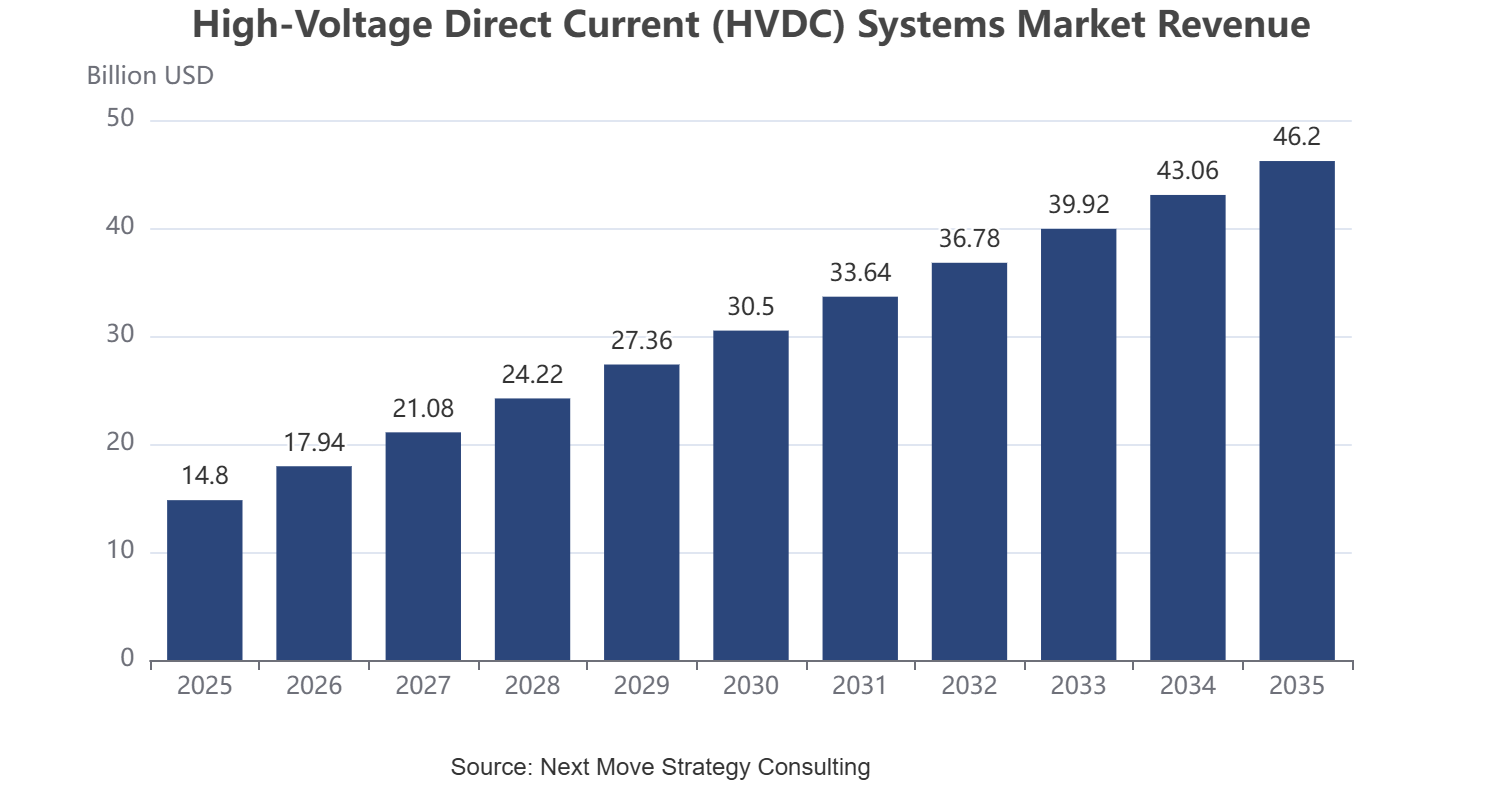
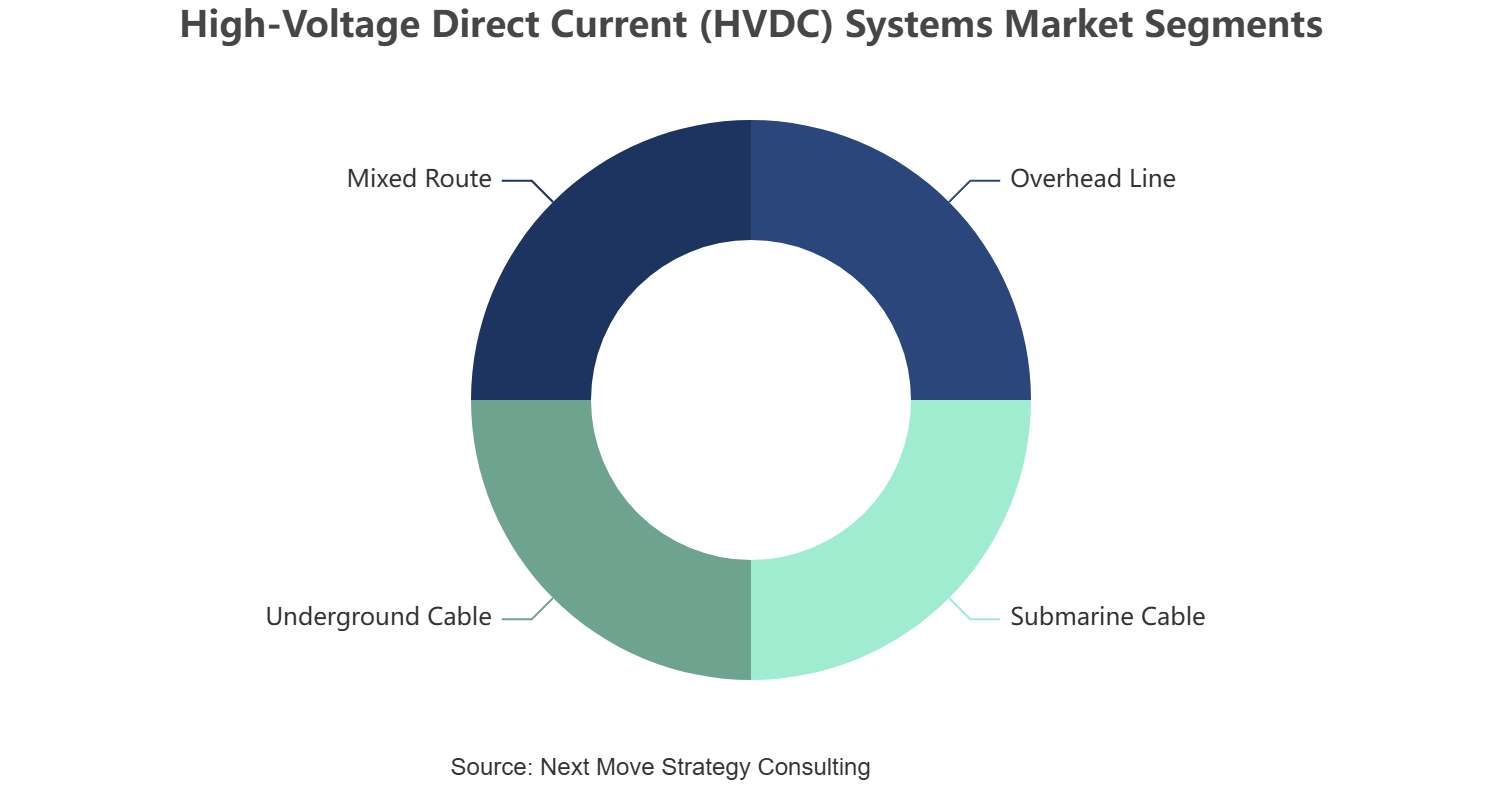
About the Author
 Mihul Sharma
— Mihul Sharma is Research Associate at Next Move Strategy Consulting, where he has covered technology, industrial, and healthcare markets for 3 years. His work applies structured business research, market analysis, and secondary-source review to assess market trends, competitive developments, and growth opportunities. He supports report development by fully synthesizing industry data, company information, and market signals into concise findings for strategy and investment-focused research teams.
Mihul Sharma
— Mihul Sharma is Research Associate at Next Move Strategy Consulting, where he has covered technology, industrial, and healthcare markets for 3 years. His work applies structured business research, market analysis, and secondary-source review to assess market trends, competitive developments, and growth opportunities. He supports report development by fully synthesizing industry data, company information, and market signals into concise findings for strategy and investment-focused research teams.
About the Reviewer
 Supradip Baul
— Supradip Baul is an accomplished business consultant and strategist with over a decade of rich experience in market intelligence, strategy, technology, and business transformation. His work has included rigorous qualitative and quantitative analysis across multiple industries, helping clients shape investment decisions and long-term roadmaps. Earlier in his career, he was associated with Gartner, where he contributed to industry-leading reports and market share analyses. He has worked with leading global companies and holds an MBA with a dual specialization in Marketing and Finance.
Supradip Baul
— Supradip Baul is an accomplished business consultant and strategist with over a decade of rich experience in market intelligence, strategy, technology, and business transformation. His work has included rigorous qualitative and quantitative analysis across multiple industries, helping clients shape investment decisions and long-term roadmaps. Earlier in his career, he was associated with Gartner, where he contributed to industry-leading reports and market share analyses. He has worked with leading global companies and holds an MBA with a dual specialization in Marketing and Finance.
At Next Move Strategy Consulting, we understand that insightful market research is the cornerstone of successful business decisions. That's why we employ a robust and multifaceted approach, combining various methodologies to deliver the most accurate and actionable data for our clients.

Research Landscape
We navigate the world of research with two primary approaches:
Qualitative Approach
Our qualitative research methodologies involve immersive techniques such as in-depth interviews, focus groups, and observational studies. By engaging directly with individuals and stakeholders, we uncover valuable insights that quantitative data alone may overlook.

Quantitative Research
In tandem with qualitative methodologies, NMSC leverages the power of Quantitative Research to provide a robust foundation of numerical insights. Through systematic data collection and analysis, we quantify patterns, preferences, and market trends, offering a comprehensive view of the business landscape.
Our quantitative research approach employs diverse tools, including surveys, experiments, and statistical modelling. These methodologies enable us to gather data from a large and representative sample, ensuring the statistical significance of our findings. By employing structured questionnaires and standardized data collection methods, we guarantee the reliability and validity of the information we present to our clients.
Quantitative research is particularly effective in measuring the prevalence of trends, assessing market size, and gauging the impact of various factors on consumer behavior. The numerical precision attained through this approach equips our clients with actionable insights, facilitating data-driven decision-making and strategy formulation.


Our Specialized Toolbox for Industry-Specific Market Research
We deploy a specialized arsenal of techniques tailored to meet your unique requirements. Here's a glimpse into our comprehensive toolbox:

Information Procurement
The stage entails acquiring market data or relevant information through various sources and methodologies.


Market Research Approach
We utilize both top-down and bottom-up approaches in market research analysis to achieve a comprehensive understanding of the market dynamics, leveraging the broad perspective of industry trends and macroeconomic factors alongside detailed insights from specific segments and individual companies.

Porters Five Forces Analysis
We conduct Porter's Five Forces analysis to evaluate the competitive landscape of an industry, providing us with insights into factors that affect profitability and strategic positioning.

SWOT Analysis

Forecasting
We utilize a forecasting model to predict future consumption by considering parameters like population, economics, regulations, market competition, drivers, constraints, technology, and pricing. We also employ statistical techniques such as multilinear regression, exponential smoothing, moving average, ARIMA, and Monte Carlo simulations for accurate predictions. In econometric forecasting, we analyzed short-term and long-term event impacts, attributing values based on regulatory frameworks, economic factors, and market events.





 Speak to Our Analyst