AI-Enhanced Autonomous Energy Systems Market Size, Share, Trends and Growth Analysis, By Control Domain (Grid Autonomy, DER Autonomy, Microgrid Autonomy, Building Autonomy, Industrial Autonomy, Generation Autonomy, Storage Autonomy, EV Charging Autonomy, and Other Asset Autonomy), By Offering Type (Hardware,Software and Services), By Buyer Type, By Sales Channel, By Deployment Mode, By AI Function, By End User Industry, and Region — Global Industry Report and Forecast, 2026–2035
Industry: Energy & Power | Publishing Date: July 25, 2026 | Last Updated: September 30, 2026 | No of Pages: N/A | No. of Tables: N/A | No. of Figures: N/A | Format: PDF | Report Code: EP5401
What Is the AI-Enhanced Autonomous Energy Systems Market Size?
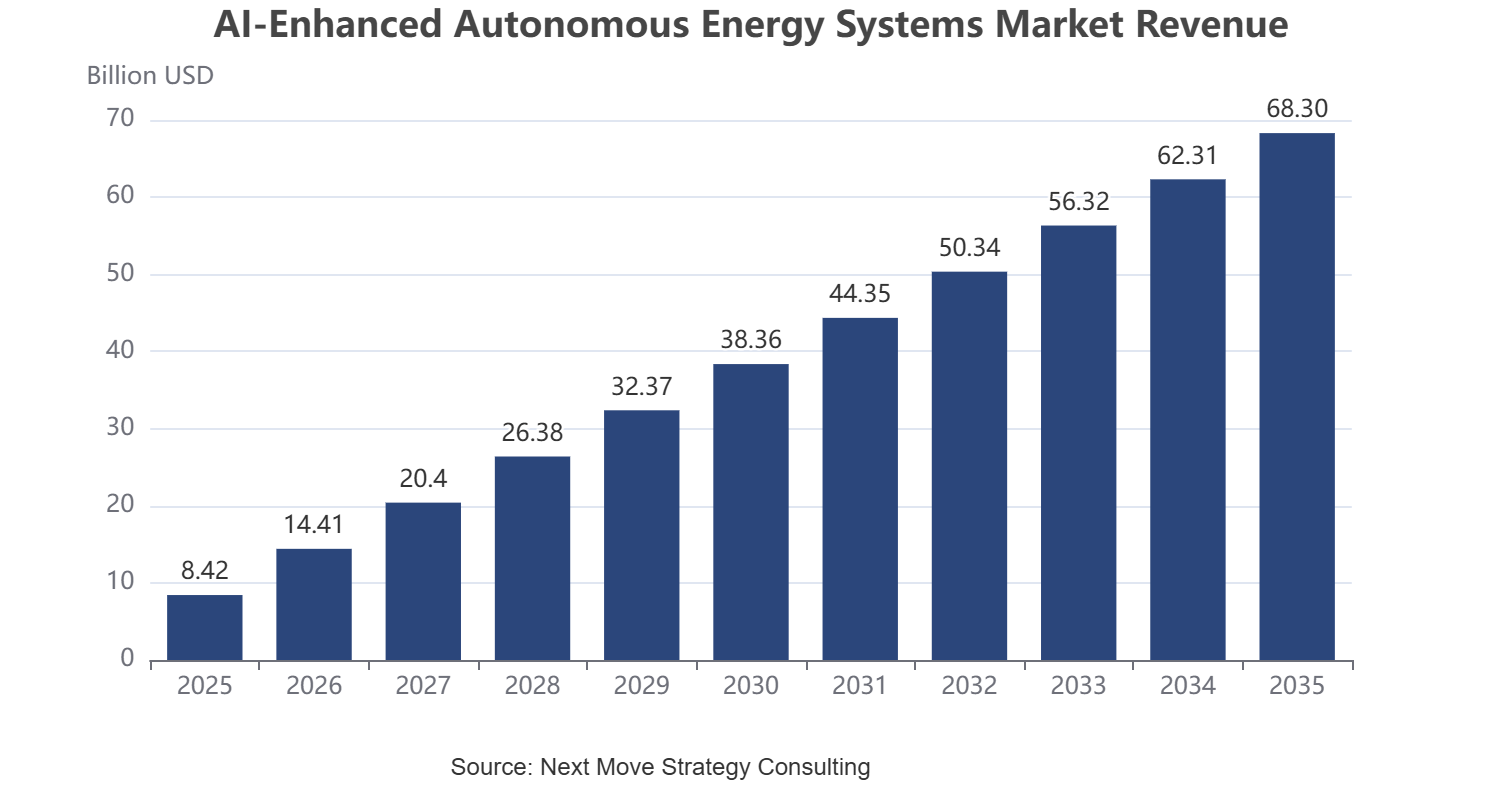
The global AI-enhanced autonomous energy systems market size was valued at USD 8.42 billion in 2025 and is estimated at USD 10.55 billion in 2026, forecast to reach USD 68.30 billion by 2035, expanding at a 23.1% CAGR between 2026 and 2035. North America leads with approximately 34% share, while grid autonomy dominates all other control domains with approximately 23% share.
We observed that growth is broad-based across every segmentation axis, with electric vehicle charging autonomy and storage autonomy driving the fastest structural shifts as utilities and commercial operators shift toward closed-loop, self-optimizing energy operations through 2035.
|
Key Takeaways |
|
By Control Domain: Grid Autonomy held the largest share of approximately 23% (USD 1.94 Billion) in 2025; EV Charging Autonomy is the fastest-growing sub-segment at 30.3% CAGR from 2026–2035. |
|
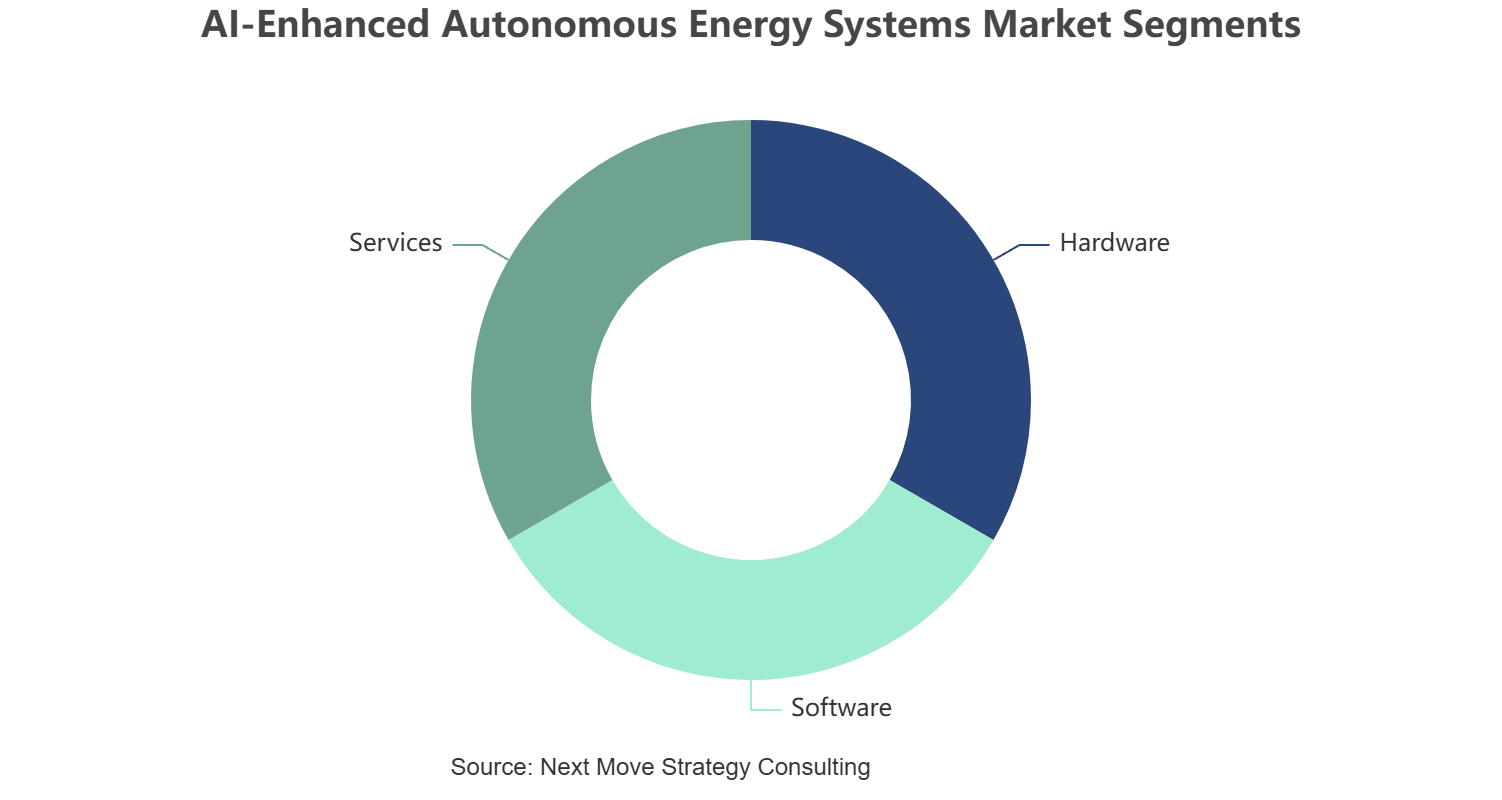
By Offering Type: Hardware held the largest share of approximately 42% (USD 3.54 Billion) in 2025; Software is the fastest-growing sub-segment at 25.7% CAGR from 2026–2035. |
|
By Buyer Type: Utility held the largest share of approximately 29% (USD 2.44 Billion) in 2025; Aggregator is the fastest-growing sub-segment at 26.7% CAGR from 2026–2035. |
|
By Sales Channel: Direct sales held the largest share of approximately 31% (USD 2.61 Billion) in 2025; Utility Program is the fastest-growing sub-segment at 27.5% CAGR from 2026–2035. |
|
By Deployment Mode: Cloud held the largest share of approximately 47% (USD 3.96 Billion) in 2025; Edge Embedded is the fastest-growing sub-segment at 28.4% CAGR from 2026–2035. |
|
By AI Function: Optimization held the largest share of approximately 27% (USD 2.27 Billion) in 2025; Predictive Maintenance is the fastest-growing sub-segment at 27.9% CAGR from 2026–2035. |
|
By End User Industry: Utilities held the largest share of approximately 33% (USD 2.78 Billion) in 2025; Data Centres is the fastest-growing sub-segment at 29.6% CAGR from 2026–2035. |
|
Dominant Region: North America dominated with approximately 34% revenue share (USD 2.86 Billion) in 2025. |
|
Fastest-Growing Region: Asia-Pacific is expected to register the highest CAGR of 25.4% during 2026–2035. |
|
Dominant Country: U.S. led with approximately USD 1.98 billion in 2025. |
|
Fastest-Growing Country: India is the fastest-growing country at approximately 28.6% CAGR from 2026–2035. |
Market Opportunity: The AI-enhanced autonomous energy systems market is expected to create an absolute dollar opportunity of USD 57.75 billion between 2026 and 2035, presenting significant investment potential across grid modernization, distributed energy resource aggregation, and behind-the-meter storage value chains.
According to Next Move Strategy Consulting analysis, utilities and independent power producers are increasingly consolidating vendor relationships with software providers capable of closed-loop control across grid, storage, and demand-side assets simultaneously, a shift that favors platform vendors over single-function point solutions as interoperability requirements intensify through 2035.
What Does the AI-Enhanced Autonomous Energy Systems Market Encompass?
The AI-enhanced autonomous energy systems market encompasses hardware, software, and services that apply machine learning, forecasting, and closed-loop control to operate grid, generation, storage, and demand-side energy assets with minimal human intervention. Our assessment indicates that the scope spans transmission and distribution grid autonomy, virtual power plant and demand response platforms, microgrid controllers, building and industrial IoT energy management, generation and storage optimization, and electric vehicle charging autonomy supplied to utilities, independent power producers, aggregators, commercial and industrial owners, and public sector buyers worldwide.
The category has evolved from rule-based supervisory control toward autonomous, self-learning energy operations, driven by rising renewable penetration, grid congestion, and electrification of transport and heating. Regulatory frameworks such as FERC Order 2222 and the EU's Clean Energy for All Europeans Package shape distributed energy resource participation rules, while grid codes increasingly mandate advanced forecasting and flexibility services. We observed that technology adoption is shifting toward edge-embedded inference and cloud-based digital twins. Next Move Strategy Consulting's analysis indicates that this shift, combined with rising data center and EV load growth, is redefining procurement criteria across the market.
|
Parameters |
Details |
|
Market Size in 2025 |
USD 8.42 Billion |
|
Market Size in 2026 |
USD 10.55 Billion |
|
Revenue Forecast in 2035 |
USD 68.30 Billion |
|
Growth Rate |
CAGR of 23.1% from 2026 to 2035 |
|
Analysis Period |
2025–2035 |
|
Base Year Considered |
2025 |
|
Forecast Period |
2026–2035 |
|
Market Size Estimation |
Revenue (USD Billion) |
|
Companies Profiled |
20 |
|
Countries Covered |
33 |
|
Market Share |
Available for Top 10 Companies |
Key Emerging Trends
Based on research conducted by Next Move Strategy Consulting, we found that four structural trends are reshaping product development, deployment models, and stakeholder engagement across the AI-enhanced autonomous energy systems industry.
How Is Closed-Loop Grid Control Transforming Distribution Operations?
Utilities are moving beyond advisory analytics toward closed-loop control that autonomously reconfigures feeders and dispatches distributed assets without operator approval. We observed that Schneider Electric's EcoStruxure Grid platform expanded autonomous fault-location and service-restoration capability across multiple distribution utilities during 2025, cutting outage-restoration time meaningfully. Grid operators are adopting these architectures to manage rising distributed generation, while regulators are updating interconnection standards to accommodate autonomous switching.
Why Are Virtual Power Plants Scaling Faster Than Traditional Demand Response?
Virtual power plant platforms that aggregate batteries, electric vehicles, and smart thermostats into dispatchable capacity are scaling faster than legacy demand response programs. We observed that Tesla's Virtual Power Plant program in several U.S. states expanded enrolled residential battery capacity substantially during 2025 and 2026. Aggregators are adopting AI-based forecasting to bid flexibility into wholesale markets, while utilities increasingly contract VPP capacity as a lower-cost alternative to peaker plants.
How Is Predictive Maintenance Reducing Renewable Asset Downtime?
Predictive maintenance models trained on turbine, inverter, and battery telemetry are reducing unplanned downtime across renewable and storage fleets. We observed that GE Vernova's asset performance management software incorporated expanded anomaly-detection models for offshore wind assets during 2025. Asset owners are adopting these tools to extend equipment life, while original equipment manufacturers are bundling predictive maintenance into service contracts to differentiate offerings.
What Role Does Data Center Load Growth Play in Autonomous Energy Adoption?
Rising hyperscale data center electricity demand is accelerating adoption of autonomous behind-the-meter generation, storage, and load-shifting systems. We found that hyperscale operators are increasingly deploying on-site autonomous microgrid controllers to manage co-located generation and battery assets alongside grid supply. Data center operators are adopting these systems to secure reliable power and manage demand charges, while utilities are engaging large loads in flexibility programs to defer transmission upgrades.
Strategic Framework of the AI-Enhanced Autonomous Energy Systems Market
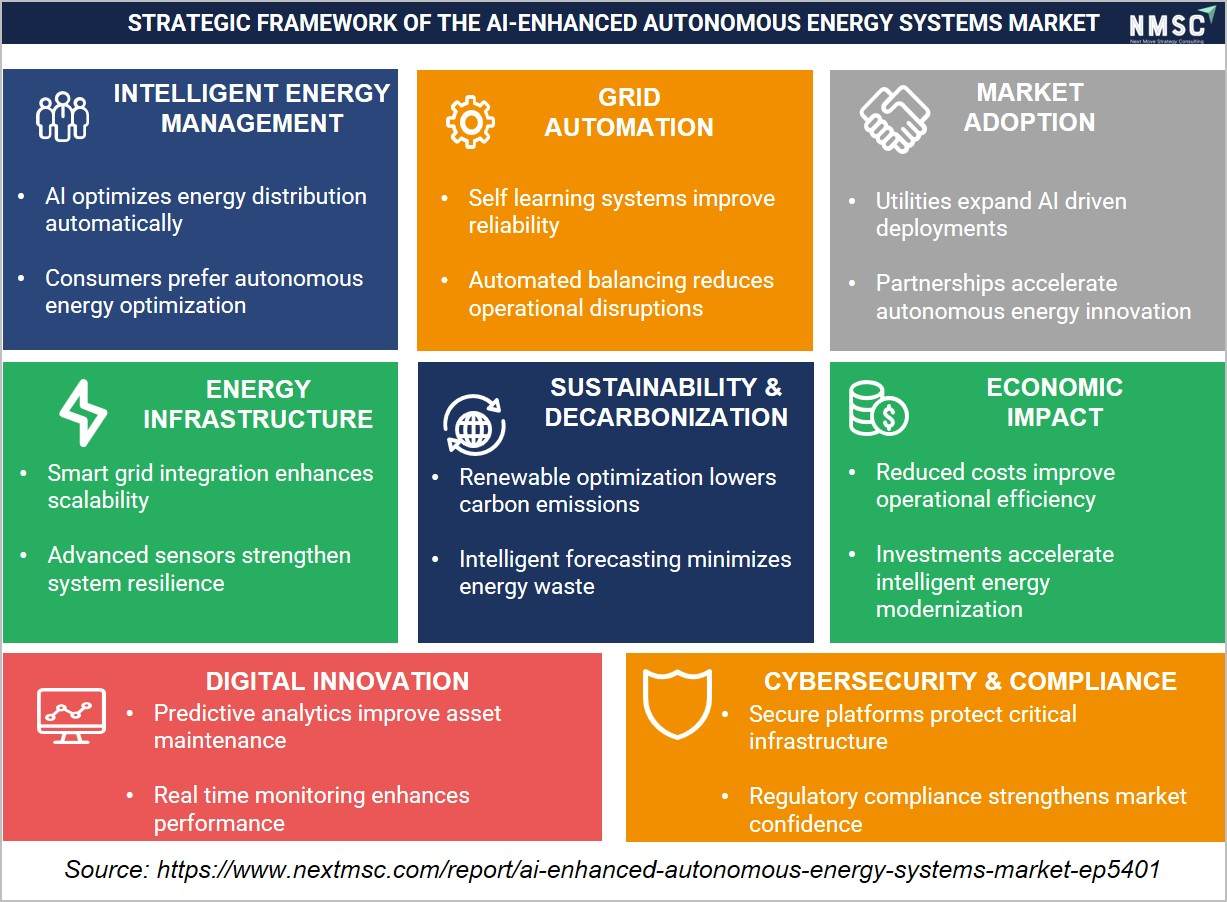
Our analysis indicates that the AI-Enhanced Autonomous Energy Systems Market is driven by intelligent energy management, grid automation, and expanding utility adoption to improve operational efficiency and system resilience. Smart infrastructure, predictive analytics, and autonomous optimization accelerate renewable energy integration while reducing operational costs and emissions. Strategic investments, digital innovation, and cross-sector partnerships support market expansion, whereas robust cybersecurity frameworks and regulatory compliance strengthen trust and ensure the secure deployment of autonomous energy solutions.
Growth Drivers & Restraints
Growth Catalyst & Risk Assessment Matrix
|
Factors |
Type |
(+/−) % Impact on CAGR |
Geographic Relevance |
Impact Timeline |
|
Rising renewable and distributed generation penetration |
Driver |
+4.8% |
Global |
2026–2035 |
|
Grid congestion and interconnection queue backlogs |
Driver |
+3.6% |
North America, Europe |
2026–2031 |
|
Electrification of transport and building loads |
Driver |
+3.9% |
Global |
2026–2035 |
|
Falling AI compute and edge-inference costs |
Driver |
+3.1% |
Global |
2026–2033 |
|
Data center and hyperscale load growth |
Driver |
+2.9% |
North America, Asia-Pacific |
2026–2035 |
|
Regulatory support for flexibility markets (e.g., FERC Order 2222) |
Driver |
+2.4% |
North America, Europe |
2026–2032 |
|
High upfront integration and cybersecurity investment |
Restraint |
−2.1% |
Global |
2026–2030 |
|
Legacy SCADA interoperability constraints |
Restraint |
−1.8% |
Europe, Asia-Pacific |
2026–2029 |
|
Utility regulatory approval and rate-case delays |
Restraint |
−1.5% |
North America |
2026–2031 |
What Is the Primary Growth Driver of the AI-Enhanced Autonomous Energy Systems Market?
Rising renewable and distributed generation penetration is the primary growth driver, as grid operators require autonomous coordination to manage variable output at scale. The U.S. Energy Information Administration projects renewables will supply a growing share of U.S. generation through the decade, a trend also reflected in European Commission clean energy targets. We observed that this variability is pushing utilities toward AI-based forecasting and dispatch to maintain reliability without proportional increases in staffing.
How Is Electrification Driving Market Growth?
Electrification of transport and building heating is driving market growth by adding large, flexible loads that require autonomous coordination. The U.S. Department of Energy has documented rising electric vehicle charging infrastructure deployment nationally, creating demand for depot and fleet charging autonomy. Our analysis shows that utilities are increasingly requiring smart, autonomous charge management as a condition of large-load interconnection to avoid transformer overloads.
What Is Restraining the AI-Enhanced Autonomous Energy Systems Market?
High upfront integration and cybersecurity investment requirements restrain adoption, particularly among smaller utilities and municipal operators. The U.S. Cybersecurity and Infrastructure Security Agency has highlighted rising cybersecurity requirements for grid-connected autonomous control systems, which raises implementation costs. We found that legacy SCADA and OT interoperability constraints further slow deployment timelines, requiring costly middleware and phased migration approaches across established utility infrastructure.
Segmentation Analysis
Segment Sizing: By Control Domain
|
Segment |
2025 (USD Billion) |
2035 (USD Billion) |
CAGR% (2026–2035) |
|
Grid Autonomy |
1.94 |
11.61 |
19.0 |
|
DER Autonomy |
1.09 |
10.24 |
25.0 |
|
Microgrid Autonomy |
0.93 |
6.83 |
21.8 |
|
Building Autonomy |
0.84 |
5.46 |
20.0 |
|
Industrial Autonomy |
1.01 |
7.51 |
21.9 |
|
Generation Autonomy |
0.84 |
6.15 |
21.6 |
|
Storage Autonomy |
1.01 |
11.61 |
27.9 |
|
EV Charging Autonomy |
0.51 |
6.83 |
30.3 |
|
Other Asset Autonomy |
0.25 |
2.06 |
23.1 |
|
Total |
8.42 |
68.30 |
23.1 |
Which Control Domain Dominates and Which Is Fastest-Growing?
Grid Autonomy dominates the control domain segmentation, holding approximately 23% share in 2025 as transmission and distribution utilities prioritize autonomous fault management and load balancing. We found that EV Charging Autonomy is the fastest-growing sub-segment at a 30.3% CAGR from 2026–2035, driven by fleet electrification and depot charge-management mandates. Storage Autonomy follows closely, benefiting from falling battery costs and expanding standalone and hybrid battery energy storage system deployments worldwide.
Segment Sizing: By Offering Type
|
Segment |
2025 (USD Billion) |
2035 (USD Billion) |
CAGR% (2026–2035) |
|
Hardware |
3.54 |
22.54 |
19.8 |
|
Software |
3.20 |
31.42 |
25.7 |
|
Services |
1.68 |
14.34 |
23.7 |
|
Total |
8.42 |
68.30 |
23.1 |
Which Offering Type Leads Market Revenue?
Hardware leads offering-type revenue with approximately 42% share in 2025, reflecting continued sensor, controller, and inverter deployment across grid and storage assets. Our analysis shows that Software is the fastest-growing offering at a 25.7% CAGR from 2026–2035, as buyers shift spend toward forecasting, optimization, and closed-loop control platforms layered atop existing hardware. Services growth is supported by rising demand for integration, cybersecurity, and managed operations contracts.
Segment Sizing: By Buyer Type
|
Segment |
2025 (USD Billion) |
2035 (USD Billion) |
CAGR% (2026–2035) |
|
Utility |
2.44 |
16.39 |
20.5 |
|
IPP |
1.01 |
7.51 |
21.9 |
|
Aggregator |
0.84 |
8.88 |
26.7 |
|
C and I Owner |
1.52 |
11.61 |
22.3 |
|
Residential |
0.76 |
6.83 |
24.5 |
|
Public Sector |
0.67 |
5.46 |
23.1 |
|
ESCO |
0.67 |
6.83 |
26.2 |
|
OEM |
0.51 |
4.79 |
25.2 |
|
Total |
8.42 |
68.30 |
23.1 |
Which Buyer Type Drives the Largest Share and Fastest Growth?
Utility buyers drive the largest share at approximately 29% in 2025, reflecting continued grid-modernization capital programs across transmission and distribution operators. We observed that Aggregator buyers are the fastest-growing category at a 26.7% CAGR from 2026–2035, as flexibility markets mature and third-party aggregators scale virtual power plant portfolios. ESCO buyers also post above-average growth, supported by expanding energy-as-a-service contracts with commercial and industrial customers.
Growth Opportunities
Beyond the core drivers shaping the market, three forward-looking opportunities present distinct whitespace for vendors and investors through 2035.
How Can Vendors Capture Value From Fleet Electrification?
Depot and vehicle-to-grid charging autonomy presents a concrete opportunity as commercial fleet operators electrify delivery and transit vehicles. Vendors offering integrated charge-scheduling and V2G dispatch stand to benefit as fleet operators seek to minimize demand charges and monetize idle battery capacity.
What Opportunity Exists in AI-Driven Trading and Flexibility Markets?
Autonomous trading algorithms that bid distributed flexibility into wholesale and ancillary service markets present a scalable opportunity. Aggregators and independent power producers adopting these tools can capture incremental revenue from existing storage and generation assets without additional capital expenditure.
How Can Data Center Operators Benefit From Autonomous Microgrids?
Autonomous microgrid controllers that coordinate on-site generation, storage, and grid supply present a significant opportunity for data center operators facing interconnection delays. Vendors serving this segment benefit from long-term contracts tied to mission-critical reliability requirements.
Regional Outlook
|
Region |
2025 (USD Billion) |
2035 (USD Billion) |
CAGR% (2026–2035) |
Key Driver |
|
North America |
2.86 |
21.17 |
21.8 |
Grid modernization and data center load growth |
|
Europe |
2.19 |
16.39 |
22.0 |
Clean energy regulation and DER integration |
|
Asia-Pacific |
2.27 |
21.86 |
25.4 |
Renewable capacity expansion and EV adoption |
|
Middle East & Africa |
0.59 |
4.78 |
23.1 |
Grid diversification and giga-project investment |
|
Latin America |
0.51 |
4.10 |
23.1 |
Distributed generation and grid reliability needs |
|
Total |
8.42 |
68.30 |
23.1 |
— |
North America AI-Enhanced Autonomous Energy Systems Market Outlook
North America holds the largest regional share, supported by mature utility grid-modernization programs and rapid data center load growth. Regulatory frameworks including FERC Order 2222 are opening wholesale markets to distributed flexibility, encouraging aggregator participation. We observed that technology adoption is concentrated in closed-loop grid control and virtual power plant platforms, with strategic outlook favoring continued utility capital deployment through 2035.
Europe AI-Enhanced Autonomous Energy Systems Market Outlook
Europe's market is shaped by the Clean Energy for All Europeans Package and national grid codes mandating flexibility services from distributed assets. We found that regulatory influence is pushing utilities toward autonomous DER coordination to manage rising rooftop solar penetration. Technology adoption is strongest in microgrid and building autonomy, with strategic outlook favoring vendors offering interoperable, standards-compliant platforms across fragmented national markets.
Asia-Pacific AI-Enhanced Autonomous Energy Systems Market Outlook
Asia-Pacific is the fastest-growing region, driven by large-scale renewable capacity additions and accelerating electric vehicle adoption across China, India, and Southeast Asia. Our assessment indicates that regulatory support for grid modernization and manufacturing incentives is expanding local supply chains for autonomous energy hardware. Technology adoption spans generation and storage autonomy, with strategic outlook favoring vendors with regional manufacturing and integration capability.
Middle East & Africa AI-Enhanced Autonomous Energy Systems Market Outlook
The Middle East & Africa market benefits from giga-project investment in autonomous grid and renewable infrastructure across Gulf states. We observed that regulatory bodies are prioritizing grid diversification away from single-fuel generation, supporting demand for autonomous storage and generation controls. Technology adoption remains early-stage in Sub-Saharan Africa, with strategic outlook favoring vendors partnering with regional utilities and sovereign investment vehicles.
Latin America AI-Enhanced Autonomous Energy Systems Market Outlook
Latin America's market is supported by distributed generation growth and grid reliability initiatives across Brazil and Argentina. We found that regulatory environments are gradually opening distribution networks to autonomous DER participation, though implementation pace varies by country. Technology adoption is concentrated in microgrid and generation autonomy, with strategic outlook favoring vendors offering flexible financing models suited to regional utility budgets.
U.S. AI-Enhanced Autonomous Energy Systems Market
Based on our estimates, the U.S. AI-enhanced autonomous energy systems market was valued at approximately USD 1.98 billion in 2025 and is projected to reach USD 14.30 billion by 2035, at a 21.6% CAGR. Demand structure is led by investor-owned utilities deploying autonomous distribution control, with strong technology penetration across virtual power plant and predictive maintenance platforms amid intensifying competition among established grid software vendors.
Canada AI-Enhanced Autonomous Energy Systems Market
The market in Canada was valued at approximately USD 0.62 billion in 2025 and is projected to reach USD 4.72 billion by 2035, at a 22.5% CAGR. Demand structure centers on provincial utility modernization programs, with regulatory influence from federal clean electricity regulations supporting steady technology adoption and moderate competitive intensity among regional integrators.
UK AI-Enhanced Autonomous Energy Systems Market
As per our estimate, the market in UK was valued at approximately USD 0.42 billion in 2025 and is projected to reach USD 3.14 billion by 2035, at a 22.4% CAGR. Demand structure reflects Ofgem-driven flexibility market development, with rising technology penetration in demand response aggregation and a competitive landscape featuring both domestic and international platform vendors.
Germany AI-Enhanced Autonomous Energy Systems Market
According to our analysis, the market in Germany was valued at approximately USD 0.51 billion in 2025 and is projected to reach USD 3.69 billion by 2035, at a 21.8% CAGR. Demand structure is shaped by high distributed solar penetration requiring autonomous grid balancing, with strong regulatory influence from national grid codes and a strategic outlook favoring vendors with proven interoperability credentials.
France AI-Enhanced Autonomous Energy Systems Market
Based on our estimates, the market in France was valued at approximately USD 0.35 billion in 2025 and is projected to reach USD 2.66 billion by 2035, at a 22.7% CAGR. Demand structure is supported by nuclear-renewable grid balancing needs, with regulatory influence from RTE grid codes and growing technology penetration in industrial energy autonomy applications.
China AI-Enhanced Autonomous Energy Systems Market
The market in China was valued at approximately USD 0.94 billion in 2025 and is projected to reach USD 9.55 billion by 2035, at a 26.3% CAGR. Demand structure is dominated by large-scale renewable integration and grid-scale storage deployment, with strong government-backed technology penetration and an intensely competitive landscape among domestic manufacturers.
India AI-Enhanced Autonomous Energy Systems Market
As per our estimate, the market in India was valued at approximately USD 0.36 billion in 2025 and is projected to reach USD 4.10 billion by 2035, at a 28.6% CAGR, the fastest-growing country covered. Demand structure reflects rapid renewable capacity additions and rural electrification programs, with regulatory influence from Central Electricity Authority guidelines supporting expanding technology penetration.
Japan AI-Enhanced Autonomous Energy Systems Market
According to our analysis, the market in Japan was valued at approximately USD 0.41 billion in 2025 and is projected to reach USD 3.14 billion by 2035, at a 22.9% CAGR. Demand structure centers on post-disaster grid resilience priorities, with strong regulatory influence from METI energy policy and steady technology penetration across microgrid autonomy applications.
South Korea AI-Enhanced Autonomous Energy Systems Market
Based on our estimates, the market in South Korea was valued at approximately USD 0.27 billion in 2025 and is projected to reach USD 2.32 billion by 2035, at a 24.2% CAGR. Demand structure is supported by aggressive renewable energy targets, with regulatory influence from the Korea Electric Power Corporation's grid modernization roadmap and rising competitive intensity among domestic technology vendors.
Australia AI-Enhanced Autonomous Energy Systems Market
The market in Australia was valued at approximately USD 0.20 billion in 2025 and is projected to reach USD 1.71 billion by 2035, at a 23.9% CAGR. Demand structure reflects high rooftop solar penetration requiring autonomous grid-edge management, with regulatory influence from the Australian Energy Market Operator supporting expanding virtual power plant technology adoption.
UAE AI-Enhanced Autonomous Energy Systems Market
As per our estimate, the market in UAE was valued at approximately USD 0.14 billion in 2025 and is projected to reach USD 1.16 billion by 2035, at a 23.7% CAGR. Demand structure is driven by giga-project renewable and grid investments, with regulatory influence from national energy strategy targets and growing technology penetration among utility-scale developers.
Saudi Arabia AI-Enhanced Autonomous Energy Systems Market
According to our analysis, the market in Saudi Arabia was valued at approximately USD 0.17 billion in 2025 and is projected to reach USD 1.44 billion by 2035, at a 23.9% CAGR. Demand structure is anchored by large renewable and grid diversification programs under national economic diversification plans, with regulatory influence from the Saudi Electricity Regulatory Authority supporting technology adoption.
South Africa AI-Enhanced Autonomous Energy Systems Market
Based on our estimates, the market in South Africa was valued at approximately USD 0.07 billion in 2025 and is projected to reach USD 0.55 billion by 2035, at a 22.8% CAGR. Demand structure reflects grid reliability priorities amid persistent capacity constraints, with regulatory influence from the National Energy Regulator supporting gradual technology penetration among municipal utilities.
Brazil AI-Enhanced Autonomous Energy Systems Market
The market in Brazil was valued at approximately USD 0.24 billion in 2025 and is projected to reach USD 1.99 billion by 2035, at a 23.5% CAGR. Demand structure is shaped by distributed generation growth and grid reliability initiatives, with regulatory influence from ANEEL supporting expanding technology penetration among regional distribution utilities.
Argentina AI-Enhanced Autonomous Energy Systems Market
As per our estimate, the market in Argentina was valued at approximately USD 0.09 billion in 2025 and is projected to reach USD 0.71 billion by 2035, at a 22.9% CAGR. Demand structure reflects early-stage grid modernization amid economic constraints, with regulatory influence from national energy policy gradually supporting technology adoption among distribution operators.
PESTEL Analysis of the AI-Enhanced Autonomous Energy Systems Market
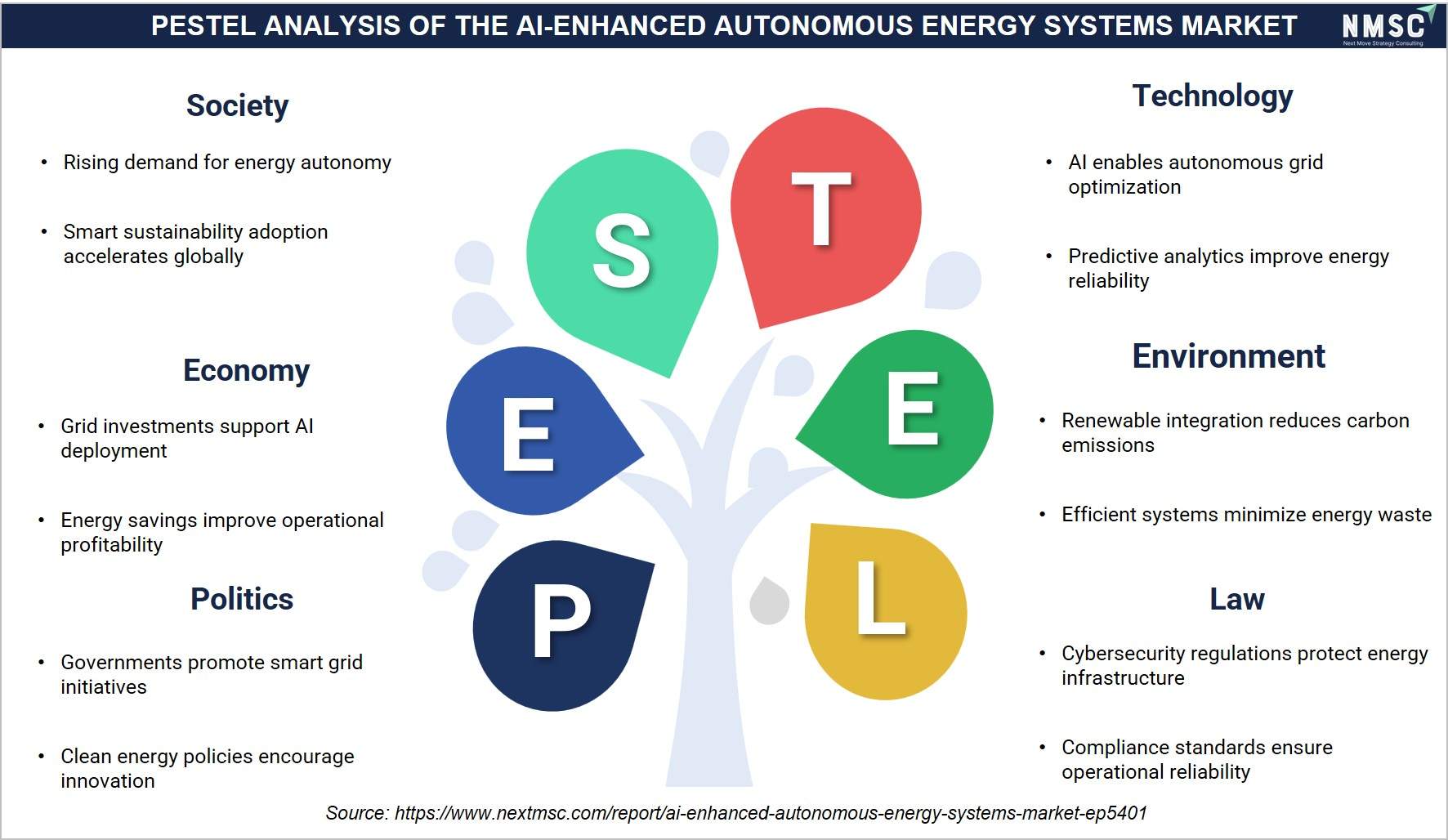
Our findings suggest that the AI-Enhanced Autonomous Energy Systems Market is shaped by supportive government policies promoting clean energy, growing investments in smart grid modernization, and increasing demand for sustainable power systems. Rapid advances in artificial intelligence, automation, and predictive analytics enhance grid intelligence, while environmental objectives accelerate renewable integration. At the same time, evolving cybersecurity regulations, data governance requirements, and energy compliance standards influence technology deployment, market adoption, and long-term industry development.
Competitive Landscape
Our findings suggest that the competitive landscape spans diversified industrial conglomerates, pure-play energy software vendors, and specialized storage and charging technology providers competing across hardware, software, and services tiers.
|
Dimension |
Assessment |
|
Market Structure |
Moderately fragmented, with the top 10 companies accounting for a meaningful but non-dominant share of global revenue |
|
Innovation Focus |
Closed-loop control, edge AI inference, and interoperable platform architectures |
|
M&A Activity |
Active, concentrated on software and analytics tuck-ins by diversified hardware manufacturers |
How Do Companies Compete in the AI-Enhanced Autonomous Energy Systems Market?
Companies compete primarily on breadth of asset coverage, forecasting accuracy, and proven grid-scale reliability track records. We observed that vendors increasingly bundle hardware, software, and managed services into outcome-based contracts to differentiate from point-solution competitors. Pricing strategies favor subscription and performance-based models over one-time hardware sales, reflecting customer preference for predictable operating expenditure.
Which Competitive Archetypes Dominate the Market?
Diversified industrial conglomerates with deep utility relationships and integrated hardware-software portfolios dominate large grid-scale contracts, while pure-play software vendors lead in aggregator-facing virtual power plant platforms. Our analysis shows that this dual-archetype structure reflects differing buyer priorities, with utilities favoring proven integrators and aggregators favoring agile, API-first software providers.
What Innovation and Differentiation Strategies Are Companies Pursuing?
Companies are pursuing edge-embedded inference to reduce latency in closed-loop control, alongside expanding digital twin capabilities for predictive maintenance. We found that geographic expansion into Asia-Pacific manufacturing hubs is a common differentiation strategy, supporting localized hardware production and faster regulatory approval cycles across fragmented national markets.What M&A Activity Is Shaping the Competitive Landscape?
M&A activity is concentrated on software and analytics acquisitions by diversified hardware manufacturers seeking to close capability gaps in forecasting and optimization. Our assessment indicates that this consolidation trend is expected to continue as buyers increasingly demand single-vendor accountability across hardware, software, and services layers of autonomous energy deployments.
Key Market Players
Next Move Strategy Consulting's analysis indicates that the following companies represent the leading participants across hardware, software, and services tiers of the AI-enhanced autonomous energy systems market.
-
Siemens AG
-
Schneider Electric SE
-
ABB Ltd
-
GE Vernova Inc.
-
Tesla, Inc.
-
Hitachi Energy Ltd.
-
Johnson Controls International plc
-
Sungrow Power Supply Co., Ltd.
-
Wärtsilä Oyj Abp
-
Fluence Energy, Inc.
-
Eaton Corporation plc
-
Enphase Energy, Inc.
-
SolarEdge Technologies, Inc.
-
Generac Holdings Inc.
-
Itron, Inc.
-
Enel X S.r.l.
-
Emerson Electric Co.
-
Stem, Inc.
-
Uplight, Inc.
Latest Developments
We observed several notable corporate developments across the industry through the first half of 2026 that reflect accelerating platform consolidation and capability expansion.
|
Date |
Event |
|
June 2026 |
Fluence Energy expanded its high-density storage portfolio with the introduction of the Smartstack 10 MWh system, integrating advanced digital asset optimization software and scalable architecture to support mission-critical, AI-driven energy storage deployments |
|
March 2026 |
ABB extended its global collaboration with VoltaGrid to supply 35 additional synchronous condensers with flywheel technology and eHouses, delivering the critical behind-the-meter stabilization and reactive power management required for hyperscale AI data center microgrids |
|
February 2026 |
Siemens showcased its interoperable Gridscale X and digital twin portfolio at DTECH 2026, demonstrating real-time, AI-powered automation and virtualized protection systems designed to help utilities transform traditional infrastructure into autonomous, self-healing grids |
Expert Insights
 "Autonomy is rapidly becoming the new operating model of industry. As AI advances and energy systems come under growing pressure, autonomous operations are proving essential for resilience and competitiveness. And this shift isn't about replacing people, it's about empowering them to focus on higher value work, strengthening safety, and elevating skills."
— Gwenaelle Avice Huet, Executive Vice President, Schneider Electric
Statement made while announcing Schneider Electric's global research on autonomous operations in the energy sector, highlighting how AI-driven autonomous energy systems are enhancing operational resilience, improving competitiveness, and enabling a safer, more skilled workforce amid increasing energy complexity.
Market Interpretation
The statement underscores the growing role of AI-enhanced autonomous energy systems in transforming energy generation, transmission, and industrial operations. As energy networks become increasingly decentralized, digitalized, and data-intensive, organizations are leveraging AI, automation, and advanced analytics to optimize asset performance, improve grid resilience, and enhance operational decision-making. Furthermore, rising investments in autonomous energy management platforms and intelligent control systems are expected to accelerate market growth while supporting the transition toward more efficient, reliable, and sustainable energy infrastructure.
Investment Opportunities
What Capital Inflows Are Supporting Market Growth?
Venture and growth capital continue flowing into autonomous energy software startups, particularly in virtual power plant aggregation and grid-edge analytics. We observed that strategic corporate investors, including diversified industrial manufacturers, are increasingly co-investing alongside financial sponsors to secure early access to emerging autonomous control technologies ahead of broader market adoption.
How Is Infrastructure Investment Shaping the Market?
Public and private infrastructure investment in grid modernization is directly expanding addressable demand for autonomous energy storage systems. The U.S. Department of Energy has committed substantial grid resilience funding through recent infrastructure programs, supporting utility procurement of autonomous distribution management platforms. Our assessment indicates that similar public investment programs across Europe and Asia-Pacific are reinforcing this capital expenditure cycle.
What ESG Considerations Influence Investment Decisions?
Environmental, social, and governance considerations increasingly influence capital allocation toward autonomous energy systems that reduce curtailment and improve renewable integration efficiency. Investors are prioritizing vendors with transparent emissions-reduction disclosures and demonstrated grid-reliability outcomes, reflecting growing institutional demand for measurable decarbonization impact alongside financial returns.
Key Benefits for Stakeholders
How Does This Report Benefit Enterprise and Industry Leaders?
Enterprise and utility leaders gain access to validated segmentation, competitive benchmarking, and regional demand data to inform technology procurement and capital allocation decisions. Our analysis, forecasts, and strategic insights support prioritization of investment across control domains and geographies with the strongest growth trajectories through 2035.
How Does This Report Benefit Investors and Financial Analysts?
Investors and financial analysts gain a validated, industry-derived market sizing model, competitive landscape assessment, and growth driver analysis to support valuation and due diligence on autonomous energy technology companies. The report's regional and segment-level forecasts support scenario modeling for portfolio allocation decisions across the value chain.
How Does This Report Benefit Technology Vendors and Product Teams?
Technology vendors and product teams gain insight into emerging trends, buyer preferences, and competitive positioning to inform roadmap and go-to-market decisions. The report's segmentation by AI function and deployment mode supports prioritization of product investment toward the fastest-growing sub-segments identified across the forecast period.
Key Market Segments
By Control Domain
-
Grid Autonomy
-
Transmission
-
Distribution
-
Grid Edge
-
-
DER Autonomy
-
Virtual Power Plants
-
Demand Response
-
Flexibility Markets
-
-
Microgrid Autonomy
-
Campus
-
Community
-
Remote Site
-
-
Building Autonomy
-
HVAC
-
Lighting
-
Whole Building
-
-
Industrial Autonomy
-
Process Control
-
Utilities Optimisation
-
Energy Management
-
-
Generation Autonomy
-
Renewables
-
Thermal Plants
-
Hybrid Plants
-
-
Storage Autonomy
-
Standalone BESS
-
Hybrid BESS
-
Fleet Storage
-
-
EV Charging Autonomy
-
Depot Charging
-
Public Charging
-
Vehicle to Grid
-
-
Other Asset Autonomy
-
District Energy
-
Hydrogen
-
Other
-
By Offering Type
-
Hardware
-
Software
-
Services
By Buyer Type
-
Utility
-
IPP
-
Aggregator
-
C and I Owner
-
Residential
-
Public Sector
-
ESCO
-
OEM
By Sales Channel
-
Direct
-
Partner
-
System Integrator
-
OEM Embedded
-
Marketplace
-
Utility Program
By Deployment Mode
-
Cloud
-
On Premise
-
Hybrid
-
Edge Embedded
By AI Function
-
Forecasting
-
Optimization
-
Closed Loop Control
-
Anomaly Detection
-
Trading
-
Predictive Maintenance
By End User Industry
-
Utilities
-
Commercial Buildings
-
Industrial
-
Data Centres
-
Residential
-
Transportation
-
Public Infrastructure
-
Oil and Gas
-
Mining
By Region
-
North America: U.S., Canada, Mexico
-
Europe: UK, Germany, France, Italy, Spain, Sweden, Denmark, Finland, Netherlands, Rest of Europe
-
Asia-Pacific: China, India, Japan, South Korea, Taiwan, Indonesia, Vietnam,Australia, Philippines, Malaysia, Rest of APAC
-
Middle East & Africa: Saudi Arabia, UAE, Egypt, Israel, Turkey, Nigeria, South Africa, Rest of MEA
-
Latin America: Brazil, Argentina, Chile, Colombia, Rest of LATAM
Conclusion & Recommendations
What Is the Long-Term Outlook for the AI-Enhanced Autonomous Energy Systems Market?
The long-term outlook remains strongly positive, with the market expanding from USD 10.55 billion in 2026 to USD 68.30 billion by 2035 at a 23.1% CAGR. Next Move Strategy Consulting's analysis indicates that sustained renewable integration, electrification, and data center load growth will maintain double-digit growth well beyond the current forecast window as autonomous control becomes standard grid infrastructure.
What Strategic Positioning Should Vendors Pursue?
Vendors should prioritize interoperable, platform-based architectures that span hardware, software, and services rather than single-function point solutions. Our assessment indicates that companies combining proven grid-scale reliability with modern, API-first software architecture will be best positioned to capture share as utility and aggregator buyers consolidate vendor relationships.
How Attractive Is the Market for New Investment?
The market presents an attractive investment case, supported by a USD 57.75 billion absolute dollar opportunity between 2026 and 2035 and above-average growth in Asia-Pacific and storage autonomy categories. We found that investment attractiveness is highest for companies combining software differentiation with proven grid-scale deployment track records.
What Market Shifts and Key Risks Should Stakeholders Monitor?
Stakeholders should monitor cybersecurity regulatory tightening, interconnection queue delays, and potential rate-case pushback on utility capital recovery as key risks. Our analysis shows that vendors unable to demonstrate clear cybersecurity compliance risk losing utility contracts as regulatory scrutiny of grid-connected autonomous systems intensifies globally.
What Are the Key Growth Pathways for the Market?
Key growth pathways include expanding aggregator-facing flexibility trading platforms, scaling electric vehicle charging autonomy, and deepening penetration into data center and industrial energy management. Next Move Strategy Consulting's analysis indicates that vendors pursuing these pathways while maintaining cybersecurity and interoperability credentials will be best positioned to capture the market's projected growth through 2035.
About the Author
 Saista Faiyaz
— Saista Faiyaz is Research Associate at Next Move Strategy Consulting, where she has covered consumer markets and healthcare technologies for 3 years. Her work includes primary interview review, secondary-source validation, market sizing, and structured analysis of company and industry data. She supports research by comparing evidence across sources, organizing findings into market narratives, and documenting assumptions used in analysis. Her scope includes cross-market benchmarking, and reports.
Saista Faiyaz
— Saista Faiyaz is Research Associate at Next Move Strategy Consulting, where she has covered consumer markets and healthcare technologies for 3 years. Her work includes primary interview review, secondary-source validation, market sizing, and structured analysis of company and industry data. She supports research by comparing evidence across sources, organizing findings into market narratives, and documenting assumptions used in analysis. Her scope includes cross-market benchmarking, and reports.
About the Reviewer
 Supradip Baul
— Supradip Baul is an accomplished business consultant and strategist with over a decade of rich experience in market intelligence, strategy, technology, and business transformation. His work has included rigorous qualitative and quantitative analysis across multiple industries, helping clients shape investment decisions and long-term roadmaps. Earlier in his career, he was associated with Gartner, where he contributed to industry-leading reports and market share analyses. He has worked with leading global companies and holds an MBA with a dual specialization in Marketing and Finance.
Supradip Baul
— Supradip Baul is an accomplished business consultant and strategist with over a decade of rich experience in market intelligence, strategy, technology, and business transformation. His work has included rigorous qualitative and quantitative analysis across multiple industries, helping clients shape investment decisions and long-term roadmaps. Earlier in his career, he was associated with Gartner, where he contributed to industry-leading reports and market share analyses. He has worked with leading global companies and holds an MBA with a dual specialization in Marketing and Finance.
At Next Move Strategy Consulting, we understand that insightful market research is the cornerstone of successful business decisions. That's why we employ a robust and multifaceted approach, combining various methodologies to deliver the most accurate and actionable data for our clients.

Research Landscape
We navigate the world of research with two primary approaches:
Qualitative Approach
Our qualitative research methodologies involve immersive techniques such as in-depth interviews, focus groups, and observational studies. By engaging directly with individuals and stakeholders, we uncover valuable insights that quantitative data alone may overlook.

Quantitative Research
In tandem with qualitative methodologies, NMSC leverages the power of Quantitative Research to provide a robust foundation of numerical insights. Through systematic data collection and analysis, we quantify patterns, preferences, and market trends, offering a comprehensive view of the business landscape.
Our quantitative research approach employs diverse tools, including surveys, experiments, and statistical modelling. These methodologies enable us to gather data from a large and representative sample, ensuring the statistical significance of our findings. By employing structured questionnaires and standardized data collection methods, we guarantee the reliability and validity of the information we present to our clients.
Quantitative research is particularly effective in measuring the prevalence of trends, assessing market size, and gauging the impact of various factors on consumer behavior. The numerical precision attained through this approach equips our clients with actionable insights, facilitating data-driven decision-making and strategy formulation.


Our Specialized Toolbox for Industry-Specific Market Research
We deploy a specialized arsenal of techniques tailored to meet your unique requirements. Here's a glimpse into our comprehensive toolbox:

Information Procurement
The stage entails acquiring market data or relevant information through various sources and methodologies.


Market Research Approach
We utilize both top-down and bottom-up approaches in market research analysis to achieve a comprehensive understanding of the market dynamics, leveraging the broad perspective of industry trends and macroeconomic factors alongside detailed insights from specific segments and individual companies.

Porters Five Forces Analysis
We conduct Porter's Five Forces analysis to evaluate the competitive landscape of an industry, providing us with insights into factors that affect profitability and strategic positioning.

SWOT Analysis

Forecasting
We utilize a forecasting model to predict future consumption by considering parameters like population, economics, regulations, market competition, drivers, constraints, technology, and pricing. We also employ statistical techniques such as multilinear regression, exponential smoothing, moving average, ARIMA, and Monte Carlo simulations for accurate predictions. In econometric forecasting, we analyzed short-term and long-term event impacts, attributing values based on regulatory frameworks, economic factors, and market events.





 Speak to Our Analyst