Private Military Contractors (PMCs) Market Global Industry Analysis and Forecast (2026–2035)

The global Private Military Contractors (PMCs) Market size was valued at USD 224.50 billion in 2025 and is estimated at USD 239.80 billion in 2026, forecast to reach USD 444.60 billion by 2035, expanding at a 7.1% CAGR between 2026 and 2035. North America leads with approximately 34% share, while Armed Security and Protective Services dominate all other service types with approximately 26% share.

Download Free Sample PDF
Base Year (2025)
$224.50 Billion
Forecast (2035)
$444.60 Billion
CAGR (2026-2035)
7.1%
Top Region
North America

What Is the Private Military Contractors (PMCs) Market Size?

The global Private Military Contractors (PMCs) Market size was valued at USD 224.50 billion in 2025 and is estimated at USD 239.80 billion in 2026, forecast to reach USD 444.60 billion by 2035, expanding at a 7.1% CAGR between 2026 and 2035. North America leads with approximately 34% share, while Armed Security and Protective Services dominate all other service types with approximately 26% share.

We observed that growth is broad-based across every segmentation axis, with cyber and information technology support and indefinite delivery contracting structures driving the dominant structural shifts through 2035.

Private Military Contractors (PMCs) Market Global Industry Analysis and Forecast (2026–2035) Revenue Forecast

Values in USD Billion

2025 $224.50 Billion
2025
2026 $239.80 Billion
2026
2027 $256.83 Billion
2027
2028 $275.06 Billion
2028
2029 $294.59 Billion
2029
2030 $315.51 Billion
2030
2031 $337.91 Billion
2031
2032 $361.90 Billion
2032
2033 $387.59 Billion
2033
2034 $415.11 Billion
2034
2035 $444.60 Billion
2035

Key Takeaways

By Service Type: Armed Security and Protective Services held the largest share of approximately 26% (USD 58.37 Billion) in 2025; Cyber and Information Technology Services is the fastest-growing sub-segment at 16.47% CAGR from 2026–2035.

By Customer Type: Government Customers held the largest share of approximately 68% (USD 152.66 Billion) in 2025; Commercial Customers is the fastest-growing sub-segment at 10.73% CAGR from 2026–2035.

By Contract Type: Fixed-Price Contracts held the largest share of approximately 38% (USD 85.31 Billion) in 2025; Indefinite Delivery Contracts is the fastest-growing sub-segment at 12.04% CAGR from 2026–2035.

Dominant Region: North America dominated with approximately 34% revenue share (USD 76.33 Billion) in 2025.

Fastest-Growing Region: Asia-Pacific is expected to register the highest CAGR of 9.29% during 2026–2035.

Dominant Country: U.S. led with approximately USD 47.30 billion in 2025.

Fastest-Growing Country: India is the fastest-growing country at approximately 12.61% CAGR from 2026–2035.

Market Opportunity: The Private Military Contractors (PMCs) market is expected to create an absolute dollar opportunity of USD 204.80 billion between 2026 and 2035, presenting significant investment potential across the government defense outsourcing, commercial energy security, and cyber support value chain.

According to Next Move Strategy Consulting analysis, governments are increasingly consolidating contracted support under fewer, multi-domain providers capable of bundling logistics, training, and cyber services, a shift that favors diversified contractors over single-service specialists as procurement frameworks evolve through 2035.

What Does the Private Military Contractors (PMCs) Market Encompass?

The Private Military Contractors (PMCs) Market encompasses privately contracted armed security, training, logistics, intelligence, cyber, and technical support services delivered to government, intergovernmental, and commercial customers in place of or alongside uniformed military personnel. Our assessment indicates that the scope spans static and mobile security, combat and aviation training, theater logistics, base life support, and specialized ISR and cyber capabilities supplied under fixed-price, cost-reimbursement, time and materials, and indefinite delivery contracting vehicles across defense, intelligence, and commercial end markets worldwide.
Regulatory frameworks such as the Montreux Document on private military and security companies and the International Code of Conduct Association's certification standards shape accountability and conduct requirements, while U.S. Department of State International Traffic in Arms Regulations govern cross-border service exports. We observed that technology adoption is shifting toward AI-enabled intelligence analysis and remote ISR platforms. Next Move Strategy Consulting's analysis indicates that this structural shift, combined with rising indefinite delivery contracting, is redefining sourcing criteria across the Private Military Contractors (PMCs) market.

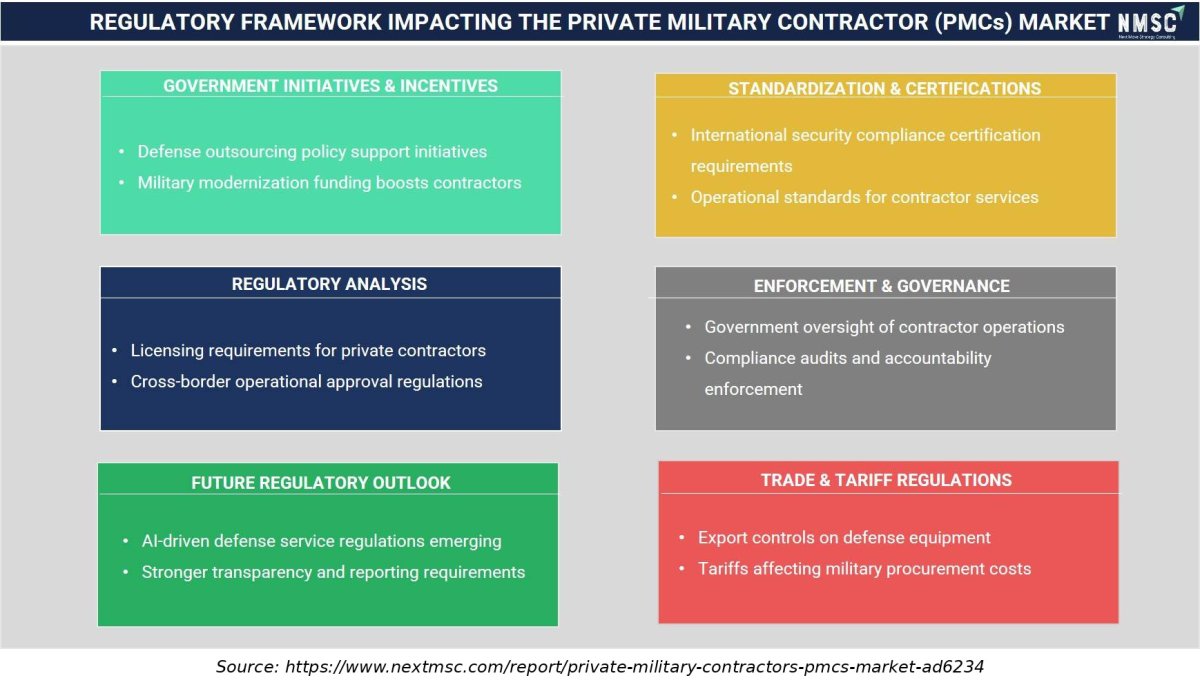
Regulatory Framework Impacting the Private Military Contractor (PMCs) Market

Based on our regulatory assessment, we identified that the private military contractor (PMCs) market is governed by government outsourcing initiatives, licensing requirements, international security certifications, operational oversight, trade regulations, and evolving compliance policies. Furthermore, our industry evaluation indicates that transparent governance, standardized operational practices, cross-border regulatory approvals, and strengthened accountability measures improve service quality, ensure legal compliance, and support sustainable market growth.

Market Drivers & Dynamics

Interactive Dataset
Rising Defense Outsourcing and Force Optimization driver +1.8% North America, Europe 2026–2035
Expansion of Overseas Contingency and Stabilization Operations driver +1.4% Middle East & Africa, Asia-Pacific 2026–2032
Growing Commercial Demand for Maritime and Energy-Sector Security driver +1.1% Asia-Pacific, Middle East & Africa 2026–2035
Increasing Adoption of Cyber and ISR Support Contracts driver +1.6% North America, Europe 2026–2035
Rising Use of Indefinite Delivery and Multi-Year Framework Contracts driver +0.9% Global 2026–2033
Regulatory Scrutiny Under the Montreux Document and ICoCA Codes restraint −0.7% Europe, North America 2026–2035
Reputational and Political Risk From Contractor Conduct Incidents restraint −0.6% Global 2026–2030
Budget Constraints Among Allied and Partner Governments restraint −0.5% Latin America, Africa 2026–2032
Competition From In-House Government Security Force Expansion restraint −0.4% Asia-Pacific 2026–2035
Source: Next Move Strategy Consulting

Growth Drivers

What Is the Primary Growth Driver of the Private Military Contractors (PMCs) Market?

Rising defense outsourcing and force optimization represent the primary growth driver, as defense ministries reallocate uniformed personnel toward core combat roles. According to the U.S. Government Accountability Office, contracted support personnel have remained a substantial share of the U.S. Department of Defense's deployed workforce in recent contingency operations. This structural reliance on contracted logistics, training, and base operations support sustains steady demand across allied defense establishments.

How Is Commercial Sector Demand Driving Private Military Contractors (PMCs) Market Growth?

Expanding commercial demand from energy, mining, and maritime shipping companies is driving market growth beyond traditional government budgets. Commercial Customers accounted for approximately USD 44.90 billion of 2025 revenue and are the fastest-growing customer category at 10.73% CAGR. We observed that companies operating in politically unstable or high-piracy-risk regions increasingly contract armed maritime escort and static facility protection services to safeguard personnel and assets.

Growth Inhibitors

What Is Restraining Growth in the Private Military Contractors (PMCs) Market?

Regulatory scrutiny under frameworks such as the Montreux Document and the International Code of Conduct Association's certification standards restrains market expansion by raising compliance costs and accountability requirements. Reputational risk following past contractor conduct incidents has also prompted some governments to reduce reliance on armed contracted personnel in populated operating environments, tempering growth in select high-visibility service categories despite continued underlying demand.

Segmentation Analysis

2025 (USD Billion)
2035 (USD Billion)
Armed Security and Protective Services 2025: $58.37 Billion | 2035: $97.81 Billion
Armed Securi
Military Training and Advisory Services 2025: $29.19 Billion | 2035: $53.35 Billion
Military Tra
Operational Logistics and Supply Chain Services 2025: $33.68 Billion | 2035: $62.24 Billion
Operational
Base Operations and Life Support Services 2025: $22.45 Billion | 2035: $35.57 Billion
Base Operati
Intelligence, Surveillance and Reconnaissance Services 2025: $20.21 Billion | 2035: $44.46 Billion
Intelligence
Cyber and Information Technology Services 2025: $13.47 Billion | 2035: $56.75 Billion
Cyber and In
Operational Engineering and Technical Services 2025: $13.47 Billion | 2035: $26.68 Billion
Operational
Medical and Health Services 2025: $8.98 Billion | 2035: $17.78 Billion
Medical and
Explosive Ordnance and Mine Action Services 2025: $5.61 Billion | 2035: $13.34 Billion
Explosive Or
Aviation Support Services 2025: $15.72 Billion | 2035: $31.12 Billion
Aviation Sup
Operational and Mission Support Services 2025: $3.35 Billion | 2035: $5.50 Billion
Operational
Armed Security and Protective Services $58.37 Billion $97.81 Billion 5.13%
Military Training and Advisory Services $29.19 Billion $53.35 Billion 6.15%
Operational Logistics and Supply Chain Services $33.68 Billion $62.24 Billion 6.29%
Base Operations and Life Support Services $22.45 Billion $35.57 Billion 4.48%
Intelligence, Surveillance and Reconnaissance Services $20.21 Billion $44.46 Billion 8.36%
Cyber and Information Technology Services $13.47 Billion $56.75 Billion 16.47%
Operational Engineering and Technical Services $13.47 Billion $26.68 Billion 7.11%
Medical and Health Services $8.98 Billion $17.78 Billion 7.11%
Explosive Ordnance and Mine Action Services $5.61 Billion $13.34 Billion 9.30%
Aviation Support Services $15.72 Billion $31.12 Billion 7.10%
Operational and Mission Support Services $3.35 Billion $5.50 Billion 4.88%

Which Service Type Dominates the Private Military Contractors (PMCs) Market?

Armed Security and Protective Services dominate the Private Military Contractors (PMCs) market with approximately 26% share in 2025, valued at USD 58.37 billion, reflecting sustained government and commercial demand for static, mobile, and maritime protection. Cyber and Information Technology Services is the fastest-growing segment at 16.47% CAGR, driven by defense agency IT modernization programs and rising demand for defensive cyber operations, network engineering, and enterprise software sustainment support across government and allied customer bases.

2025 (USD Billion)
2035 (USD Billion)
Government c
Defense depa
Intelligence
Civil govern
Allied and p
Segment Item 2025 (USD Billion) 2035 (USD Billion) CAGR
Government customers $10.0 USD Billion $40.0 USD Billion 25.0%
Defense departments and ministries $17.1 USD Billion $51.1 USD Billion 11.0%
Intelligence agencies $24.2 USD Billion $62.2 USD Billion 25.0%
Civil government agencies $31.3 USD Billion $73.3 USD Billion 11.0%
Allied and partner governments $38.4 USD Billion $84.4 USD Billion 16.0%

Segment-wise data is locked

Unlock complete segment-wise numbers for By Customer Type.

Unlock Full Data

Which Customer Type Leads Private Military Contractors (PMCs) Market Demand?

Government Customers lead Private Military Contractors (PMCs) market demand with approximately 68% share in 2025, valued at USD 152.66 billion, reflecting continued reliance on defense ministries and intelligence agencies for contracted support. Commercial Customers represent the fastest-growing category at 10.73% CAGR, as energy, mining, and infrastructure companies expand contracted protective and logistics arrangements to secure operations across politically unstable or high-risk international markets through 2035.

2025 (USD Billion)
2035 (USD Billion)
Fixed-price
Cost-reimbur
Time and mat
Indefinite d
Segment Item 2025 (USD Billion) 2035 (USD Billion) CAGR
Fixed-price contracts $10.0 USD Billion $40.0 USD Billion 27.0%
Cost-reimbursement contracts $17.1 USD Billion $51.1 USD Billion 9.0%
Time and materials contracts $24.2 USD Billion $62.2 USD Billion 19.0%
Indefinite delivery contracts $31.3 USD Billion $73.3 USD Billion 17.0%

Segment-wise data is locked

Unlock complete segment-wise numbers for By Contract Type.

Unlock Full Data

Which Contract Type Dominates the Private Military Contractors (PMCs) Market?

Fixed-Price Contracts dominate the Private Military Contractors (PMCs) market with approximately 38% share in 2025, valued at USD 85.31 billion, favored by government customers seeking cost predictability for defined-scope engagements. Indefinite Delivery Contracts are the fastest-growing contract type at 12.04% CAGR, as agencies consolidate recurring, multi-year support requirements under flexible task order vehicles that reduce repeated procurement cycles across logistics, training, and technical services.

Growth Opportunities

Next Move Strategy Consulting identifies three forward-looking growth opportunities positioned to reshape competitive dynamics within the Private Military Contractors (PMCs) market through 2035.

Can Cyber and IT Support Contracts Unlock New Revenue Pools for Contractors?

Contractors expanding defensive cyber operations and enterprise IT sustainment capabilities can capture new government agency spending as legacy in-house cyber workforces face persistent shortages, benefiting technically diversified prime contractors.

Does Maritime Security Demand From Commercial Shipping Present a Scalable Opportunity?

Commercial shipping and energy companies operating through high-risk maritime corridors present a scalable opportunity for contractors with established vessel protection and armed escort capabilities, benefiting maritime security specialists.

Can Indefinite Delivery Framework Contracts Expand Recurring Revenue for Contractors?

Indefinite delivery, indefinite quantity contracting structures allow contractors to secure recurring, multi-year task order revenue across logistics and training categories, benefiting large-scale prime contractors with proven delivery records.

Regional Outlook

2025 (USD Billion)
2035 (USD Billion)
North Americ
Europe
Asia-Pacific
Middle East
Latin Americ
Region 2025 (USD Billion) 2035 (USD Billion) CAGR (%)
North America $10.0 USD Billion $40.0 USD Billion 9.0%
Europe $17.1 USD Billion $51.1 USD Billion 27.0%
Asia-Pacific $24.2 USD Billion $62.2 USD Billion 25.0%
Middle East & Africa $31.3 USD Billion $73.3 USD Billion 23.0%
Latin America $38.4 USD Billion $84.4 USD Billion 12.0%

Regional data is locked

Unlock complete regional numbers for this market.

Unlock Full Data

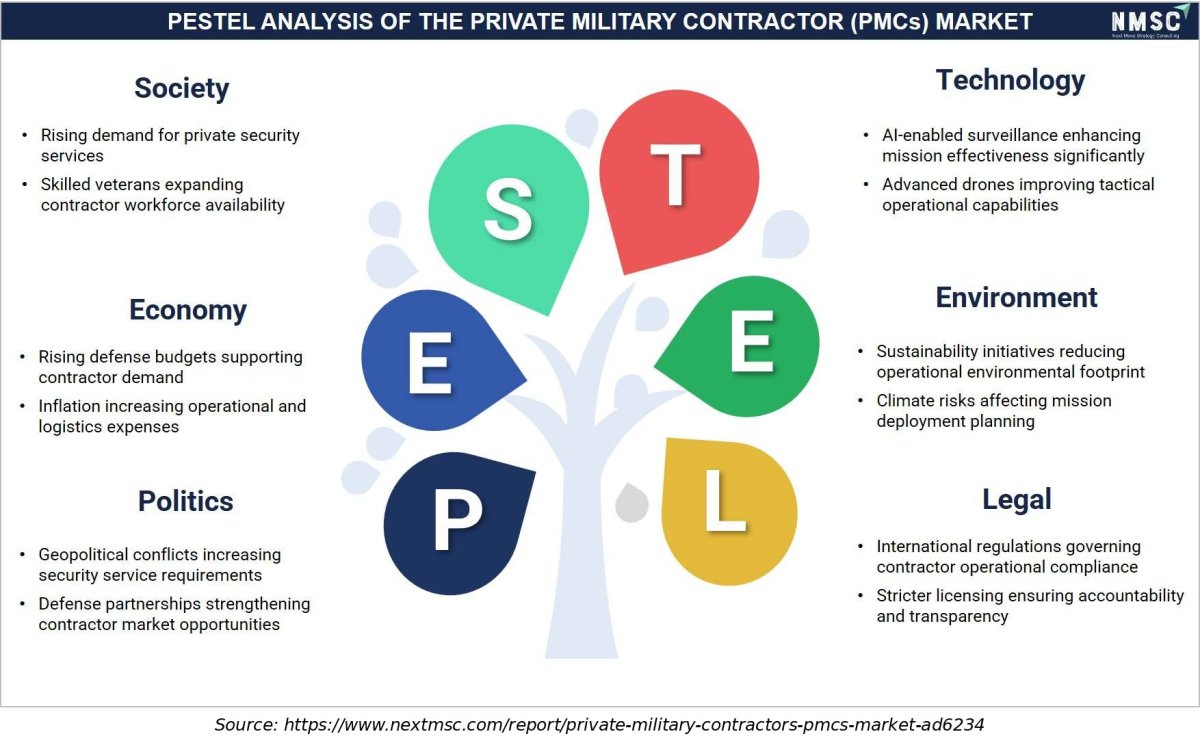
PESTEL Analysis of the Private Military Contractor (PMCs) Industry

PESTEL Analysis of the Private Military Contractor (PMCs) Industry
Based on our PESTEL assessment, we identified that the private military contractor (PMCs) market is shaped by geopolitical conflicts, government outsourcing policies, defense expenditure, technological advancements in security operations, environmental risk management, and evolving legal oversight. Furthermore, our industry evaluation indicates that rising demand for specialized security services, modernization of defense capabilities, stringent regulatory frameworks, and international compliance standards strengthen market expansion while ensuring operational accountability and service reliability.

Competitive Landscape

Next Move Strategy Consulting's analysis indicates that the Private Military Contractors (PMCs) market remains moderately consolidated among large diversified prime contractors, with specialized regional firms competing for niche service categories.

Dimension Description
Market Structure Moderately consolidated among diversified defense services primes with regional specialist competition
Innovation Focus AI-enabled ISR analytics, cyber and IT sustainment platforms, mono-domain training simulation systems
M&A Activity Active consolidation through bolt-on acquisitions of cyber, logistics, and maritime security specialists

How Do Companies Compete in the Private Military Contractors (PMCs) Market?

Companies compete primarily on breadth of service catalog, security clearance depth, and proven multi-domain delivery records across government task order vehicles. We observed that Amentum Holdings and Leidos leverage scale advantages to win indefinite delivery contracts spanning logistics, training, and cyber categories. Smaller specialized firms compete on niche expertise in maritime security or explosive ordnance disposal, often through teaming arrangements with larger primes.

Which Company Archetypes Dominate the Private Military Contractors (PMCs) Market?

Diversified technical services primes with deep government relationships dominate the Private Military Contractors (PMCs) market, given their ability to bundle logistics, engineering, and cyber capabilities under single contracting vehicles. Pure-play armed security specialists such as GardaWorld Security Corporation and Constellis Holdings retain strong positions in protective services, while intelligence and analytics-focused firms including CACI International compete effectively for ISR and signals intelligence support categories.

What Innovation and Differentiation Strategies Are Contractors Pursuing?

Contractors are differentiating through investment in AI-enabled intelligence analytics, cloud-based enterprise IT platforms, and simulation-based training systems that reduce delivery costs. We observed that Booz Allen Hamilton has expanded artificial intelligence and data analytics capabilities within its government services portfolio. Firms unable to modernize technical offerings risk losing task order competitions to better-resourced diversified primes across cyber and ISR categories.

Key Market Players

Next Move Strategy Consulting's analysis indicates that the following 20 companies represent the leading validated participants shaping competitive dynamics across the Private Military Contractors (PMCs) market.

Amentum Holdings, Inc. Leidos Holdings, Inc. CACI International Inc. Booz Allen Hamilton Holding Corporation Science Applications International Corporation Peraton Corporation V2X, Inc. KBR, Inc. Parsons Corporation Serco Group plc Babcock International Group PLC ManTech International Corporation Fluor Corporation GardaWorld Security Corporation Constellis Holdings LLC Allied Universal Topco LLC Acuity International, LLC SOS International LLC MAG Aerospace LLC Control Risks Group Limited

Latest Developments

Next Move Strategy Consulting's analysis indicates that consolidation and service-line expansion remain the dominant themes among recent industry developments.

Date Event
July 2026 CACI International Inc. announced a six-year technology contract valued at up to USD 308 million from the Department of Veterans Affairs to modernize enterprise resource planning platforms and replace legacy financial infrastructure with streamlined digital systems.
June 2026 Amentum Holdings Inc. secured a 60-month, USD 77 million firm-fixed-price contract from the General Services Administration (GSA) to deliver AI-driven supply chain support and modernized logistics operations for the Pentagon and federal clients operating across Japan under the U.S. Indo-Pacific Command.
April 2026 Leidos Holdings, Inc. was awarded a five-year, USD869 million competitive MACRO II contract by the U.S. Army to design, build, and integrate secure systems leveraging artificial intelligence and modular open architectures to accelerate multi-domain battlefield decision-making.

Investment Opportunities

What Capital Inflows Are Shaping the Private Military Contractors (PMCs) Market?

Capital inflows into the Private Military Contractors (PMCs) market are increasingly directed toward contractors with cyber, ISR, and AI-analytics capabilities. Private equity investors have shown sustained interest in security services consolidation, supporting scale-driven acquisitions. We observed that this capital flow favors diversified contractors capable of bidding across multiple indefinite delivery task order categories, reinforcing consolidation trends across the broader competitive landscape through the forecast period.

How Is Infrastructure Investment Influencing the Private Military Contractors (PMCs) Market?

Infrastructure investment across energy, mining, and logistics sectors in emerging markets is driving demand for contracted protective and technical support services. Our analysis shows that commercial infrastructure operators in Latin America, Africa, and Asia-Pacific increasingly budget for dedicated security contracting alongside capital projects, creating durable multi-year revenue streams for contractors with established regional operating footprints and licensing credentials.

What ESG Considerations Affect Private Military Contractors (PMCs) Market Investment?

Environmental, Social, and Governance considerations increasingly influence investment decisions within the Private Military Contractors (PMCs) market, as institutional investors scrutinize contractor conduct records and certification under frameworks such as the International Code of Conduct Association. We found that contractors demonstrating strong governance and accountability practices attract more favorable financing terms, while firms lacking certification face growing difficulty securing institutional capital and government task order eligibility.

Key Benefits for Stakeholders

How Does This Report Benefit Industry Leaders?

Industry leaders gain a structured view of segment-level revenue, competitive positioning, and contracting-vehicle trends across the Private Military Contractors (PMCs) market. Next Move Strategy Consulting's analysis indicates that the report's segmentation and regional data support portfolio prioritization decisions, helping executives identify which service lines and geographies offer the strongest growth trajectories through 2035.

How Does This Report Benefit Investors and Financial Analysts?

Investors and financial analysts benefit from reconciled market size, CAGR, and segment-level forecasts that support valuation and due diligence work. Our assessment indicates that the report's competitive landscape and latest developments sections provide context for evaluating acquisition targets and consolidation trends shaping the Private Military Contractors (PMCs) market's capital allocation environment.

How Does This Report Benefit Technology Vendors and Product Teams?

Technology vendors and product teams supplying analytics, communications, and simulation systems to contractors gain visibility into which service categories, such as cyber and ISR support, are expanding fastest. We observed that this report's trend and driver analysis helps technology suppliers align product roadmaps with contractor demand for AI-enabled and cloud-based operational tools.

Key Market Segments Evaluated

By Service Type

  • Armed security and protective services 
    • Static security
    • Personal protective services
    • Mobile security and convoy escort
    • Maritime security
    • Canine security services
  • Military training and advisory services 
    • Combat training
    • Security force assistance
    • Aviation training
    • Simulation based training
    • Doctrine development and curriculum design
  • Operational logistics and supply chain services 
    • Theater distribution
    • Transportation management
    • Warehousing and inventory management
    • Fuel supply services
    • Water supply services
    • Field feeding services
  • Base operations and life support services 
    • Contingency camp operations
    • Facilities maintenance
    • Utilities management
    • Base support services
    • Morale and welfare services
  • Intelligence, surveillance and reconnaissance services 
    • Intelligence analysis
    • Geospatial intelligence
    • Signals intelligence support
    • Human intelligence support
    • Full motion video analysis
    • ISR training support
  • Cyber and information technology services 
    • Defensive cyber operations
    • Network engineering
    • Enterprise IT support
    • Software development and sustainment
    • Cloud infrastructure support
  • Operational engineering and technical services 
    • Systems engineering
    • Systems integration
    • Test and evaluation
    • Technical advisory services
    • Environmental support services
  • Medical and health services 
    • Field medical support
    • Aeromedical evacuation
    • Medical facility operations
    • Health readiness services
  • Explosive ordnance and mine action services 
    • Mine clearance
    • Battle area clearance
    • Explosive ordnance disposal support
    • Improvised explosive device training
    • Ammunition management support
  • Aviation support services 
    • Aircraft maintenance
    • Airfield operations
    • Aircrew augmentation
    • Unmanned aircraft operations
    • Aviation logistics
  • Operational and mission support services 
    • Language services
    • Cultural advisory services
    • Meteorological support
    • Administrative support services
    • Specialized mission support

By Customer Type

  • Government customers 
    • Defense departments and ministries
    • Intelligence agencies
    • Civil government agencies
    • Allied and partner governments
  • International and nongovernmental organizations 
    • United Nations organizations
    • Nongovernmental organizations
    • Multilateral security organizations
  • Commercial customers 
    • Energy companies
    • Mining companies
    • Infrastructure companies
    • Maritime companies

By Contract Type

  • Fixed-price contracts
  • Cost-reimbursement contracts
  • Time and materials contracts
  • Indefinite delivery contracts

By Region

  • North America 
    • U.S.
    • Canada
    • Mexico
  • Europe 
    • UK
    • Germany
    • France
    • Italy
    • Spain
    • Sweden
    • Denmark
    • Finland
    • Netherlands
    • Rest of Europe
  • Asia-Pacific 
    • China
    • India
    • Japan
    • South Korea
    • Taiwan
    • Indonesia
    • Vietnam
    • Australia
    • Philippines
    • Malaysia
    • Rest of APAC
  • Middle East & Africa 
    • Saudi Arabia
    • UAE
    • Egypt
    • Israel
    • Turkey
    • Nigeria
    • South Africa
    • Rest of MEA
  • Latin America 
    • Brazil
    • Argentina
    • Chile
    • Colombia
    • Rest of LATAM

Conclusion & Recommendations

The long-term outlook for the Private Military Contractors (PMCs) market remains favorable, supported by sustained government outsourcing and expanding commercial security demand through 2035. Next Move Strategy Consulting's analysis indicates that the market will grow from USD 239.80 billion in 2026 to USD 444.60 billion by 2035, at a 7.1% CAGR, with cyber and ISR services capturing an increasing share of total contractor revenue over the forecast period.

What Strategic Positioning Should Contractors Pursue?

Contractors should prioritize building multi-domain service catalogs spanning logistics, training, and cyber support to remain competitive for indefinite delivery task orders. Our assessment indicates that firms pursuing International Code of Conduct Association certification alongside scaled technical capabilities will be best positioned to secure long-term government and commercial contracts across the forecast period.

How Attractive Is the Private Military Contractors (PMCs) Market for New Investment?

The Private Military Contractors (PMCs) market presents an attractive investment case, supported by a USD 204.80 billion absolute dollar opportunity between 2026 and 2035 and above-average growth in Asia-Pacific and cyber service categories. We found that investment attractiveness is highest for contractors combining certification credentials with scaled multi-domain delivery capacity, positioning them to serve both government and commercial customer segments simultaneously.

What Market Shifts and Key Risks Should Stakeholders Monitor?

Stakeholders should monitor tightening regulatory scrutiny under Montreux Document and International Code of Conduct Association frameworks, reputational risk from contractor conduct incidents, and budget constraints among smaller allied governments as key risks. Our analysis shows that contractors unable to demonstrate certified governance practices risk losing eligibility for government task orders as procurement standards continue tightening globally.

What Are the Key Growth Pathways for the Private Military Contractors (PMCs) Market?

Key growth pathways include expanding cyber and IT service portfolios, scaling commercial maritime and energy-sector security offerings, and deepening participation in indefinite delivery contracting vehicles. Next Move Strategy Consulting's analysis indicates that contractors pursuing these pathways while maintaining compliance credentials will be best positioned to capture the Private Military Contractors (PMCs) market's projected growth through 2035.

FAQs

About the Author

Saista Faiyaz

Saista Faiyaz

Saista Faiyaz is Research Associate at Next Move Strategy Consulting, where she has covered consumer markets and healthcare technologies for 3 years. Her work includes primary interview review, secondary-source validation, market sizing, and structured analysis of company and industry data. She supports research by comparing evidence across sources, organizing findings into market narratives, and documenting assumptions used in analysis. Her scope includes cross-market benchmarking, and reports.

About the Reviewer

Supradip Baul

Supradip Baul

Supradip Baul is an accomplished business consultant and strategist with over a decade of rich experience in market intelligence, strategy, technology, and business transformation. His work has included rigorous qualitative and quantitative analysis across multiple industries, helping clients shape investment decisions and long-term roadmaps. Earlier in his career, he was associated with Gartner, where he contributed to industry-leading reports and market share analyses. He has worked with leading global companies and holds an MBA with a dual specialization in Marketing and Finance.

Download Free Sample

Kishu Kanda

KISHU KANDA

Strategy Analyst

Accenture

We purchased the AI Consumer Market Report from this company. Not only did they customize the report to meet our specific requirements, but they also showed great flexibility in accommodating our budget. The report we received fully met our expectations. Additionally, they provided prompt and thorough responses to both our pre-purchase and follow-up questions. We look forward to working with this company again in the future.

Mohit Agarwal

MOHIT AGARWAL

Chief Manager

DryChem India Pvt. Ltd.

Next Move Strategy Consulting is an amazing team of consultants. We required a market study report for our investors on top priority and the team went above and beyond our expectations to deliver the same with ample supporting data within a short time span enabling us to secure the investments and keep our project timeline maintained. Their professionalism, attention to detail, and timely delivery of actionable recommendations have left a lasting impression on our organization.

Gaurav Jaiswal

GAURAV JAISWAL

Founder & CEO

Yano Charge Private Limited

The EV Charging market research report provided by the NextMSC was exceptionally detailed and insightful. It offered a comprehensive analysis that proved to be a game-changer for our strategic planning. Truly a testament to the NextMSC’s expertise and thoroughness in EV market landscape & analysis.

Gustaf Hummel Burstrom

GUSTAF HUMMEL BURSTROM

Founder

Revline Tools AB

Joseph and the team at Next Move Strategy Consulting have been excellent to work with, in supplying us with relevant market data and forecasts for our specific category. We had some special requirements and they were able to do a custom package to suit our needs. We would definitely recommend them to any other company needing market data and forecasts

Nishant Awate

NISHANT AWATE

Business Development Global Sales

Zehnder Group Deutschland GmbH

Our experience working with Next Move Strategy Consulting was positive. The team was responsive, professional, and open to incorporating our specific requirements throughout the project. The India AHU market study was comprehensive and well structured, covering market value and volume forecasts, product and application segments, and key industry trends. The inclusion of both AHU and residential MVHR market insights made the study particularly relevant for our strategic market assessment. Overall, the report provides a solid foundation for evaluating market potential, identifying priority segments, and supporting business-development decisions in India.

Custom Market Research Services

We will customize the research for you if the listed report does not fully match your requirements.

Get 30% Free Customization

Select License

This website uses cookies to ensure you get the best experience on our website. Learn more

✖