Rear Door Heat Exchanger Market Size, Share and Growth Analysis, By Revenue Stream (Hardware, Accessories and Upgrade Kits, Services), By Cooling Medium (Chilled Water, Warm Water, Water Glycol, Dielectric Fluid, Other Coolants), By Deployment (New Installation, Retrofit, OEM Factory), By Cooling Capacity (Up to 20 kW, 21 kW to 40 kW, 41 kW to 60 kW, Above 60 kW), By Rack Standard, By Control Method, By Buyer Type, By Sales Channel, By End User – Global Industry Report and Forecast, 2026–2035.
Industry: ICT & Media | Publishing Date: July 20, 2026 | Last Updated: September 30, 2026 | No of Pages: N/A | No. of Tables: N/A | No. of Figures: N/A | Format: PDF | Report Code: IC5248
What Is the Rear Door Heat Exchange Market Size?
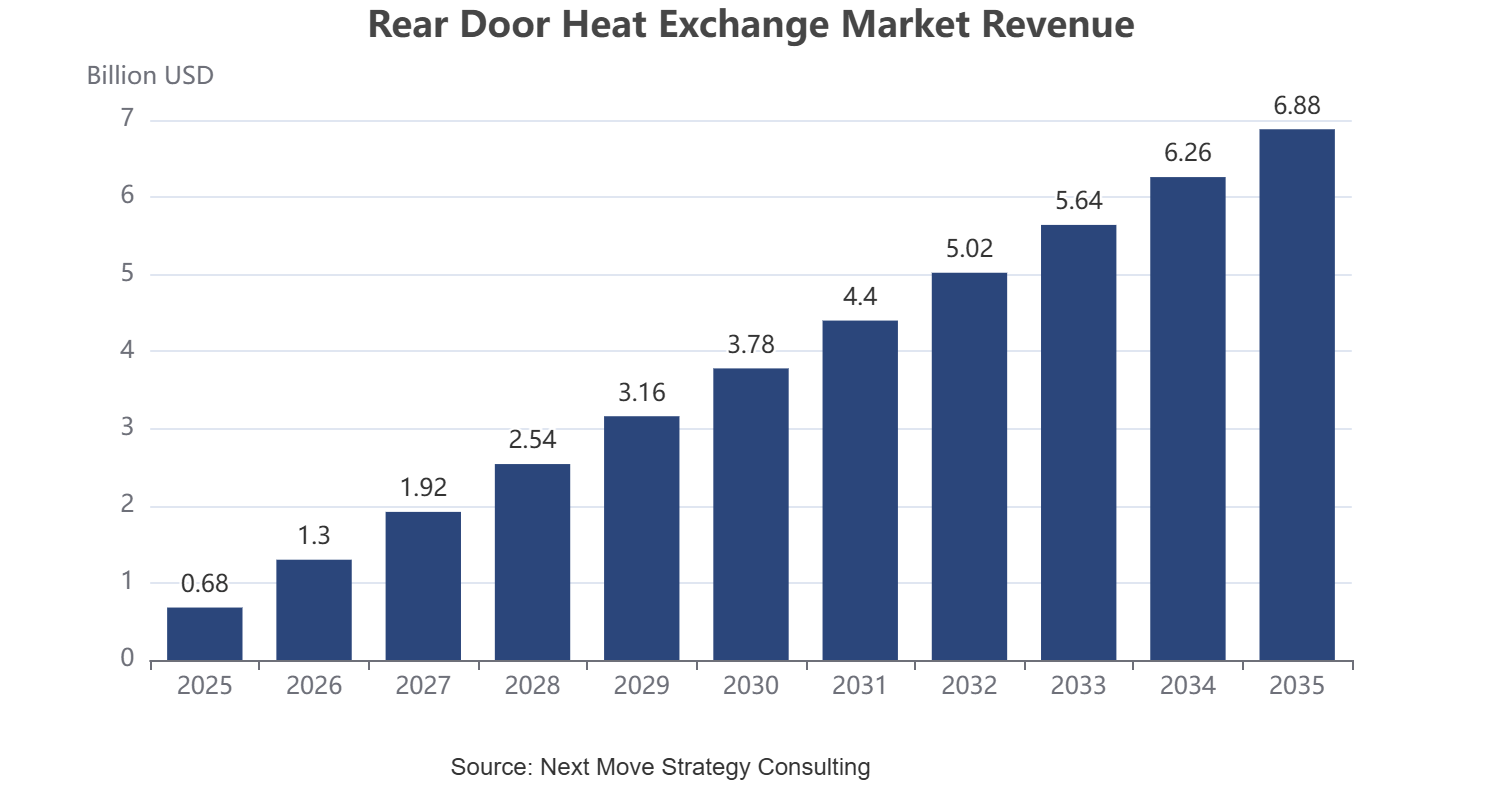
The global rear door heat exchange market was valued at USD 0.68 billion in 2025 and is estimated at USD 0.86 billion in 2026, forecast to reach USD 6.88 billion by 2035, expanding at a 26.0% CAGR between 2026 and 2035. North America leads with approximately 44% share, while hardware leads with approximately 70% share.
We observed that the growth is broad-based across every segmentation axis, with AI-driven rack density increases and hyperscale liquid cooling retrofits driving the dominant structural shifts through 2035.
|
Key Takeaways |
|
By Revenue Stream: Hardware held the largest share of approximately 70% (USD 0.48 billion) in 2025; Services is the fastest-growing sub-segment at 33.8% CAGR from 2026–2035. |
|
By Cooling Medium: Chilled Water held the largest share of approximately 52% (USD 0.35 billion) in 2025; Dielectric Fluid is the fastest-growing sub-segment at 31.3% CAGR from 2026–2035. |
|
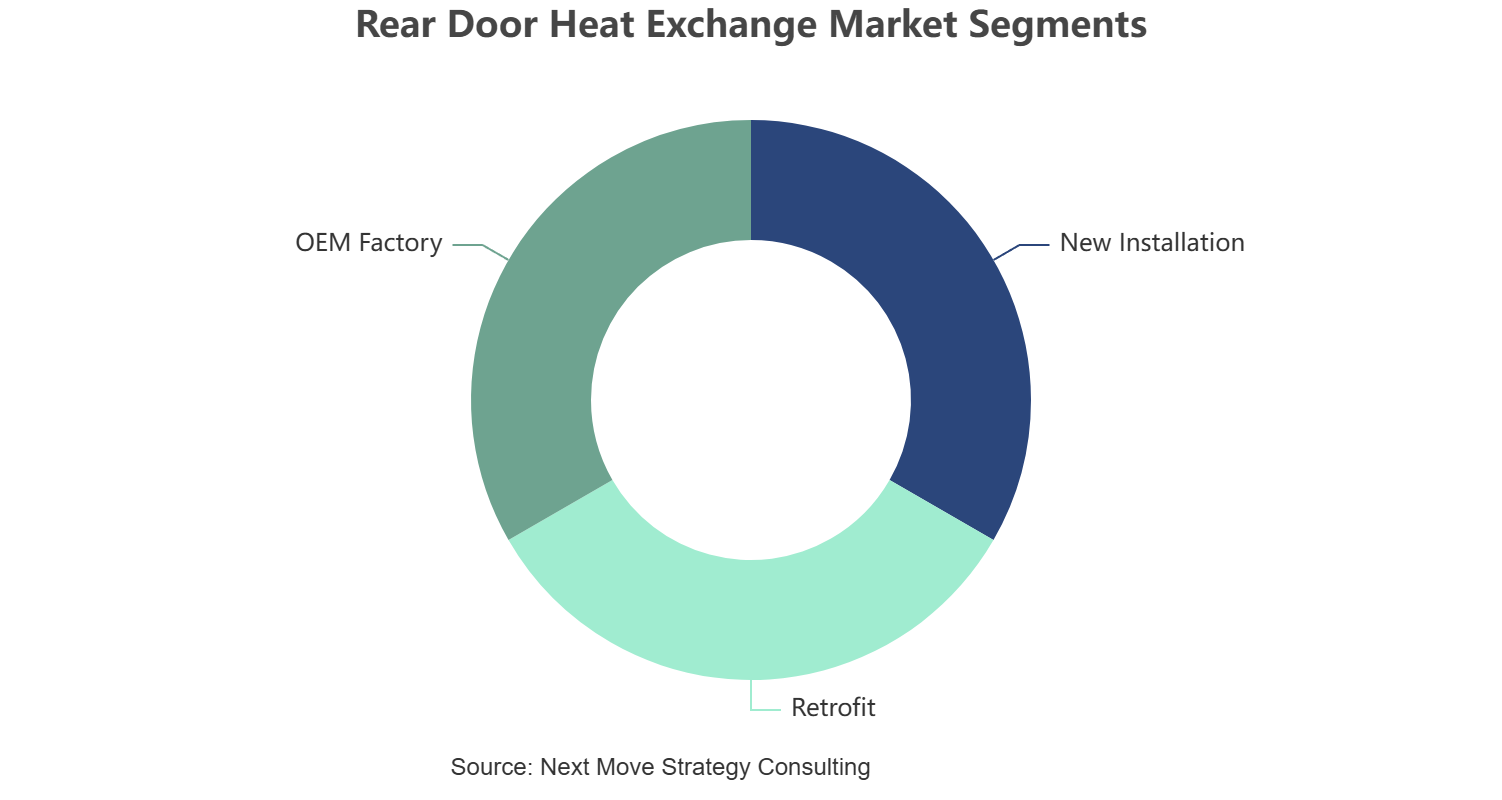
By Deployment: New Installation held the largest share of approximately 48% (USD 0.33 billion) in 2025; OEM Factory is the fastest-growing sub-segment at 30.0% CAGR from 2026–2035. |
|
By Cooling Capacity: 21 kW to 40 kW held the largest share of approximately 38% (USD 0.26 billion) in 2025; Above 60 kW is the fastest-growing sub-segment at 36.8% CAGR from 2026–2035. |
|
By Rack Standard: EIA Standard Rack held the largest share of approximately 58% (USD 0.39 billion) in 2025; Open Compute Rack is the fastest-growing sub-segment at 30.0% CAGR from 2026–2035. |
|
By Control Method: Local Control held the largest share of approximately 42% (USD 0.29 billion) in 2025; Data Center Infrastructure Management Integration is the fastest-growing sub-segment at 32.7% CAGR from 2026–2035. |
|
By Buyer Type: Hyperscale Cloud Provider held the largest share of approximately 28% (USD 0.19 billion) in 2025; Server Manufacturer is the fastest-growing sub-segment at 31.5% CAGR from 2026–2035. |
|
By Sales Channel: Direct Sales held the largest share of approximately 44% (USD 0.30 billion) in 2025; OEM is the fastest-growing sub-segment at 35.4% CAGR from 2026–2035. |
|
By End User: Hyperscale Data Center held the largest share of approximately 21% (USD 0.14 billion) in 2025; Artificial Intelligence Infrastructure is the fastest-growing sub-segment at 31.4% CAGR from 2026–2035. |
|
Dominant Region: North America dominated with approximately 44% revenue share (USD 0.30 billion) in 2025. |
|
Fastest-Growing Region: Asia-Pacific is expected to register the highest CAGR of 29.1% during 2026–2035. |
|
Dominant Country: U.S. led with approximately USD 0.25 billion in 2025. |
|
Fastest-Growing Country: India is the fastest-growing country at approximately 29.2% CAGR from 2026–2035. |
Market Opportunity: The rear door heat exchange market is expected to create an absolute dollar opportunity of USD 6.02 billion between 2026 and 2035, presenting significant investment potential across hyperscale, colocation, and AI infrastructure cooling deployments.
According to NMSC analysis, data center operators are increasingly deploying rear door heat exchangers alongside direct-to-chip liquid cooling as a room-neutral bridging technology, a combination that favors vendors with proven multi-technology thermal chain portfolios as rack densities exceed 60 kW across AI and HPC deployments through 2035.
What Does the Rear Door Heat Exchange Market Encompass?
The rear door heat exchange market encompasses hardware, accessories, and services that remove server-generated heat directly at the rack level using chilled water, warm water, or dielectric fluid coils mounted on rack doors, forming a specialized segment within the broader data center cooling market. Our assessment indicates that the scope spans active and passive rear door heat exchangers, door and control upgrade kits, and design, installation, and maintenance services deployed by hyperscale cloud providers, colocation operators, and enterprise data centers seeking a room-neutral, retrofit-friendly alternative to traditional computer room air conditioning.
The category has evolved from a niche high-density retrofit technology into a mainstream component of the AI data center thermal chain, deployed alongside direct-to-chip liquid cooling for room-neutral heat capture. ASHRAE's TC9.9 thermal guidelines and growing U.S. Department of Energy data center energy efficiency initiatives are shaping how operators document liquid cooling water quality and leak containment practices. We observed that vendors are responding by expanding pre-piped, factory-integrated rear door heat exchanger offerings, while original equipment manufacturers increasingly ship racks with heat exchangers pre-installed to reduce on-site commissioning time.
|
Parameter |
Details |
|
Market Size in 2025 |
USD 0.68 Billion |
|
Market Size in 2026 |
USD 0.86 Billion |
|
Revenue Forecast in 2035 |
USD 6.88 Billion |
|
Growth Rate |
CAGR of 26.0% from 2026 to 2035 |
|
Analysis Period |
2025–2035 |
|
Base Year Considered |
2025 |
|
Forecast Period |
2026–2035 |
|
Market Size Estimation |
Revenue (USD Billion) |
|
Companies Profiled |
20 |
|
Countries Covered |
38 |
|
Market Share |
Available for Top 10 Companies |
Key Emerging Trends
Based on research conducted by NMSC, we found that four structural trends are reshaping product development, deployment strategy, and stakeholder engagement across the industry.
How Is AI Rack Density Transforming Heat Exchanger Design?
Rising GPU rack densities are pushing rear door heat exchanger capacity well beyond legacy design thresholds. We observed that Vertiv launched its CoolLoop RDHx in March 2025, a chilled water heat exchanger supporting up to 80 kW per rack that can be deployed standalone or paired with direct-to-chip liquid cooling for a room-neutral solution. Data center operators are adopting these higher-capacity doors to manage NVIDIA GB200 NVL72 racks and similar dense AI compute, extending heat exchanger deployment life as chip thermal envelopes continue climbing.
Why Is the Thermal Chain Approach Gaining Adoption?
Vendors are increasingly packaging rear door heat exchangers as one component within an integrated thermal chain rather than a standalone product. Our findings suggest that Schneider Electric's September 2025 unveiling of its Motivair-based liquid cooling portfolio, combining coolant distribution units, ChilledDoor rear door heat exchangers, and dynamic cold plates, illustrates how suppliers are bundling multiple cooling architectures, including immersion cooling, into a single design-and-service engagement. Data center operators are adopting this bundled approach to simplify vendor management across hybrid air-and-liquid cooling deployments.
How Is Open Compute Standardization Reshaping Rack Compatibility?
Rack and coolant distribution standardization is accelerating as hyperscale operators push for interoperable thermal components. We observed that nVent unveiled its Project Deschutes coolant distribution unit at SC25 in November 2025, engineered to the Google Open Compute Project specification alongside updated racks based on leading reference designs. Server manufacturers and system integrators are increasingly specifying Open Compute Rack-compatible heat exchangers to reduce qualification cycles across multi-vendor hyperscale deployments.
What Role Does M&A Play in Thermal Portfolio Expansion?
Consolidation is expanding vendor capability across fluid management, heat rejection, and cold plate engineering. Next Move Strategy Consulting's analysis indicates that Vertiv's approximately USD 1.0 billion acquisition of PurgeRite, completed in December 2025, and its subsequent acquisition of Strategic Thermal Labs in April 2026, extend Vertiv's thermal chain from fluid commissioning services into server-side liquid cooling engineering. Suppliers are pursuing similar acquisitions to offer end-to-end thermal chain accountability spanning design, installation, and lifecycle services.
Growth Drivers and Restraints
Growth Catalyst and Risk Assessment Matrix
|
Factors |
Type |
(+/−) % Impact on CAGR |
Geographic Relevance |
Impact Timeline |
|
Rising AI and HPC rack densities exceeding 60 kW per rack |
Driver |
+4.1% |
Global |
2026–2035 |
|
Hyperscale liquid cooling retrofit programs |
Driver |
+2.8% |
North America, Asia-Pacific |
2026–2035 |
|
Growing OEM factory-integrated heat exchanger shipments |
Driver |
+2.2% |
Global |
2026–2034 |
|
Data center energy efficiency and PUE reduction mandates |
Driver |
+1.8% |
North America, Europe |
2026–2035 |
|
Open Compute Project rack and CDU standardization |
Driver |
+1.4% |
Global |
2026–2033 |
|
Expansion of colocation and hyperscale capacity in Asia-Pacific |
Driver |
+1.2% |
Asia-Pacific |
2026–2035 |
|
Competition from direct-to-chip and immersion cooling architectures |
Restraint |
−1.7% |
Global |
2026–2035 |
|
High upfront capital cost versus air cooling retrofits |
Restraint |
−1.1% |
Global |
2026–2032 |
|
Water quality, leak containment, and facility piping complexity |
Restraint |
−0.8% |
Global |
2026–2035 |
What Is the Primary Growth Driver of the Rear Door Heat Exchange Market?
Rising AI and HPC rack densities exceeding 60 kW per rack are the primary driver of the market. Vertiv reported a liquid cooling-driven backlog of USD 9.5 billion as of the third quarter of 2025, reflecting accelerating demand for high-density thermal management across its CoolLoop and CoolChip product lines. We observed that this demand curve is reinforced by data center operators retrofitting existing air-cooled racks with rear door heat exchangers to accommodate next-generation GPU deployments without requiring full facility redesign.
How Is Hyperscale Capacity Expansion Driving Market Growth?
Hyperscale and colocation capacity expansion is accelerating investment in rack-level liquid cooling infrastructure. Vertiv's January 2026 introduction of its MegaMod HDX modular power and cooling infrastructure, supporting up to 10 MW and rack densities from 50 kW to more than 100 kW, illustrates the scale of thermal infrastructure hyperscale operators are now deploying. Our assessment indicates that operators are prioritizing rear door heat exchangers for their room-neutral profile, sustaining demand as facilities scale AI compute capacity without disrupting existing raised-floor air distribution.
What Is Restraining Rear Door Heat Exchange Market Expansion?
Competition from direct-to-chip and immersion cooling architectures restrains near-term rear door heat exchanger expansion, particularly for the highest-density AI accelerator racks. Industry technical documentation indicates that direct-to-chip cooling more efficiently addresses the extreme, concentrated heat loads of next-generation GPU modules, positioning rear door heat exchangers as a complementary rather than standalone solution above certain density thresholds. We found that vendors are responding by bundling rear door heat exchangers with direct-to-chip cooling as a combined room-neutral offering rather than positioning them as competing technologies.
Segmentation Analysis
Segment Sizing: By Revenue Stream
|
Segment |
2025 (USD) |
2035 (USD) |
CAGR% (2026–2035) |
|
Hardware |
USD 0.48 Billion |
USD 3.99 Billion |
23.6% |
|
Accessories and Upgrade Kits |
USD 0.08 Billion |
USD 0.69 Billion |
24.1% |
|
Services |
USD 0.12 Billion |
USD 2.20 Billion |
33.8% |
|
Total |
USD 0.68 Billion |
USD 6.88 Billion |
26.0% |
Which Revenue Stream Dominates the Rear Door Heat Exchange Market?
Hardware led the market with USD 0.48 billion in 2025, reflecting the capital-intensive nature of active and passive heat exchanger units that anchor every deployment. We observed that Services is the fastest-growing revenue stream, expanding at a 33.8% CAGR from 2026 to 2035, as the increasing complexity of liquid cooling deployments drives demand for specialized design, installation, and preventive maintenance expertise that many data center operators lack in-house.
Segment Sizing: By End User
|
Segment |
2025 (USD) |
2035 (USD) |
CAGR% (2026–2035) |
|
Hyperscale Data Center |
USD 0.14 Billion |
USD 1.65 Billion |
28.0% |
|
Colocation Data Center |
USD 0.11 Billion |
USD 1.03 Billion |
25.1% |
|
Enterprise Data Center |
USD 0.10 Billion |
USD 0.69 Billion |
21.3% |
|
Artificial Intelligence Infrastructure |
USD 0.09 Billion |
USD 1.38 Billion |
31.4% |
|
High Performance Computing |
USD 0.07 Billion |
USD 0.69 Billion |
25.7% |
|
Telecommunications |
USD 0.04 Billion |
USD 0.34 Billion |
23.9% |
|
Semiconductor Manufacturing |
USD 0.03 Billion |
USD 0.34 Billion |
27.5% |
|
Financial Services |
USD 0.03 Billion |
USD 0.21 Billion |
21.5% |
|
Government and Defense |
USD 0.02 Billion |
USD 0.21 Billion |
26.5% |
|
Education and Research |
USD 0.02 Billion |
USD 0.14 Billion |
21.5% |
|
Healthcare |
USD 0.01 Billion |
USD 0.10 Billion |
25.9% |
|
Industrial |
USD 0.01 Billion |
USD 0.07 Billion |
21.5% |
|
Other Mission Critical Facilities |
USD 0.01 Billion |
USD 0.03 Billion |
11.6% |
|
Total |
USD 0.68 Billion |
USD 6.88 Billion |
26.0% |
Which End User Leads Rear Door Heat Exchange Market Demand?
Hyperscale Data Center remained the leading end user, valued at USD 0.14 billion in 2025, as large cloud operators retrofit existing air-cooled halls with rack-level liquid cooling to accommodate AI accelerator deployments without full facility redesign. Our findings suggest that Artificial Intelligence Infrastructure is the fastest-growing end user, registering a 31.4% CAGR from 2026 to 2035, as purpose-built AI-optimized data center infrastructure facilities scale GPU cluster capacity that exceeds the thermal limits of conventional air cooling.
Segment Sizing: By Buyer Type
|
Segment |
2025 (USD) |
2035 (USD) |
CAGR% (2026–2035) |
|
Enterprise Data Center Operator |
USD 0.16 Billion |
USD 1.28 Billion |
22.7% |
|
Colocation Provider |
USD 0.15 Billion |
USD 1.40 Billion |
24.8% |
|
Hyperscale Cloud Provider |
USD 0.19 Billion |
USD 2.20 Billion |
27.8% |
|
Government Organization |
USD 0.05 Billion |
USD 0.48 Billion |
25.4% |
|
Research Institution |
USD 0.04 Billion |
USD 0.34 Billion |
23.9% |
|
System Integrator |
USD 0.05 Billion |
USD 0.56 Billion |
27.3% |
|
Server Manufacturer |
USD 0.04 Billion |
USD 0.62 Billion |
31.5% |
|
Total |
USD 0.68 Billion |
USD 6.88 Billion |
26.0% |
Which Buyer Type Leads the Rear Door Heat Exchange Market?
Hyperscale Cloud Provider led the market with USD 0.19 billion in 2025, reflecting large-scale operators with the capital budgets and AI compute demand to justify facility-wide liquid cooling deployment. Based on research conducted by NMSC, we found that Server Manufacturer is the fastest-growing buyer type, expanding at a 31.5% CAGR from 2026 to 2035, as original equipment manufacturers increasingly ship racks with heat exchangers pre-installed for hyperscale data center customers seeking reduced on-site commissioning time.
Ecosystem Analysis of the Rear Door Heat Exchange Market
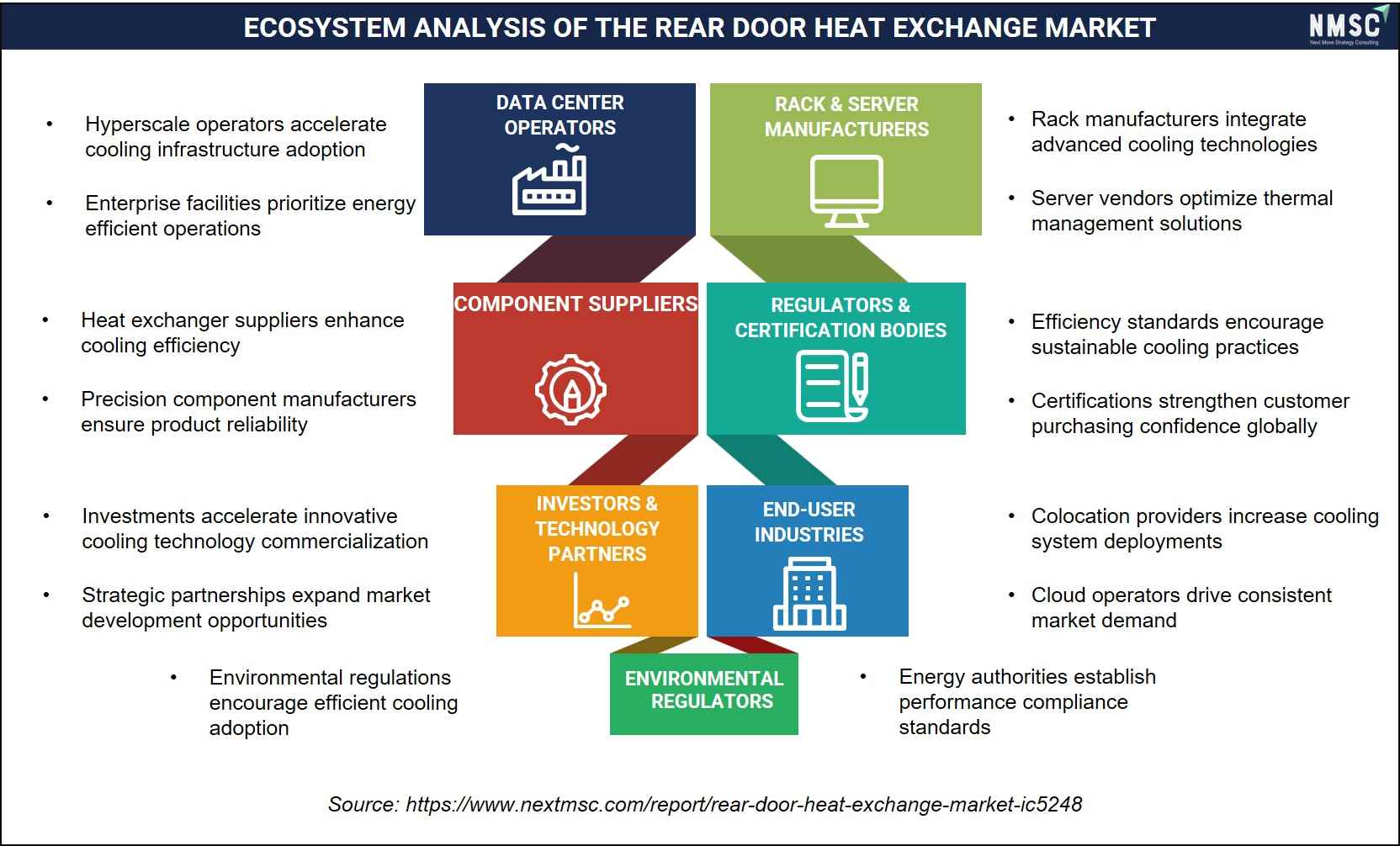
The Rear Door Heat Exchanger market ecosystem comprises data center operators, rack and server manufacturers, component suppliers, regulators, certification bodies, technology partners, investors, and end-user industries. Collaboration among these stakeholders accelerates innovation, improves cooling efficiency, supports AI-driven infrastructure expansion, and ensures compliance with evolving energy efficiency and sustainability standards across global data centers.
Growth Opportunities
Our analysis shows that three forward-looking opportunities stand out for stakeholders positioning within the rear door heat exchange market over the 2026–2035 forecast period.
How Can OEM Factory Integration Unlock Value for Server Manufacturers?
Server manufacturers that pre-integrate rear door heat exchangers at the factory level represent a whitespace opportunity as hyperscale buyers seek reduced on-site commissioning time. Vertiv's rack portfolio, which bundles CoolLoop RDHx with OCP-compliant racks and in-rack coolant distribution units, illustrates how factory-integrated thermal chains simplify deployment. Vendors that formalize OEM supply agreements with server manufacturers stand to capture recurring hardware revenue from the fastest-growing sales channel through 2035.
Where Does Open Compute Standardization Create New Demand?
Open Compute Rack-compatible heat exchangers represent an underpenetrated opportunity as hyperscale operators standardize around interoperable reference designs. nVent's Project Deschutes coolant distribution unit, built to the Google Open Compute Project specification and unveiled in November 2025, illustrates growing demand for OCP-aligned thermal components. Vendors that certify heat exchanger compatibility with leading OCP reference designs can capture new hyperscale and colocation revenue as multi-vendor rack qualification cycles shorten.
How Can Bundled Thermal Chain Services Expand Adoption Among Colocation Providers?
Colocation providers that lack in-house liquid cooling expertise create an opportunity for vendors offering bundled design, installation, and maintenance service packages. Schneider Electric's Motivair-based liquid cooling portfolio, spanning coolant distribution units, rear door heat exchangers, and dynamic cold plates alongside dedicated services, illustrates the scale achievable through bundled thermal chain offerings. Vendors that package services with hardware stand to capture disproportionate share of the fastest-growing revenue stream through 2035.
Regional Outlook
Geographic Performance Snapshot
|
Region |
2025 (USD) |
2035 (USD) |
CAGR% (2026–2035) |
Key Driver |
|
North America |
USD 0.30 Billion |
USD 2.61 Billion |
24.2% |
Hyperscale AI data center retrofit and new-build activity |
|
Europe |
USD 0.15 Billion |
USD 1.36 Billion |
24.7% |
Energy efficiency mandates and colocation liquid cooling upgrades |
|
Asia-Pacific |
USD 0.16 Billion |
USD 2.06 Billion |
29.1% |
Expanding hyperscale and colocation capacity in China and India |
|
Middle East & Africa |
USD 0.04 Billion |
USD 0.50 Billion |
28.7% |
Sovereign AI data center investment and Gulf hyperscale expansion |
|
Latin America |
USD 0.03 Billion |
USD 0.35 Billion |
27.8% |
Growing colocation and hyperscale capacity in Brazil |
|
Total |
USD 0.68 Billion |
USD 6.88 Billion |
26.0% |
— |
North America Rear Door Heat Exchange Market Outlook
North America leads the rear door heat exchange market, anchored by mature hyperscale and colocation adoption alongside an established base of thermal management vendors including Vertiv, nVent, and Schneider Electric. We observed that Vertiv's approximately USD 9.5 billion liquid cooling-driven backlog as of the third quarter of 2025 reflects sustained regional demand for rack-level thermal infrastructure. Technology adoption remains advanced, with OEM factory integration increasingly embedded into hyperscale procurement workflows, while competitive intensity stays high among incumbent vendors defending large enterprise accounts.
Europe Rear Door Heat Exchange Market Outlook
Europe's rear door heat exchange market reflects a mature but increasingly efficiency-conscious landscape shaped by regional energy efficiency and carbon reduction mandates. Our findings suggest that data center operators across Germany, France, and the UK are accelerating liquid cooling retrofits to reduce power usage effectiveness ahead of stricter regulatory reporting requirements. Technology adoption favors chilled water and warm water heat exchangers, supported by vendors such as Rittal and STULZ investing in regional manufacturing and engineering capacity across the bloc.
Asia-Pacific Rear Door Heat Exchange Market Outlook
Asia-Pacific is the fastest-growing rear door heat exchange market region, propelled by expanding hyperscale and colocation capacity across China and India. We observed that regional data center operators are scaling AI compute capacity rapidly, driving demand for rack-level liquid cooling that can be deployed without full facility redesign. Competitive intensity is elevated among domestic and international vendors, including Huawei and Delta Electronics, competing for share in the region's fast-growing hyperscale and colocation cooling infrastructure base.
Middle East & Africa Rear Door Heat Exchange Market Outlook
The rear door heat exchange market in Middle East & Africa is expanding as Gulf Cooperation Council economies pursue sovereign AI infrastructure and hyperscale data center investment under national digital economy strategies. Our analysis shows that Saudi Arabia and the UAE are attracting significant data center capacity investment, driving demand for high-density liquid cooling infrastructure. Regulatory influence remains moderate, while technology adoption is accelerating as regional operators implement rear door heat exchangers to support newly commissioned AI compute facilities.
Latin America Rear Door Heat Exchange Market Outlook
Latin America's rear door heat exchange market is supported by expanding colocation and hyperscale capacity in Brazil and growing enterprise data center investment in Argentina. We observed that regulatory frameworks are less stringent than in North America or Europe, though multinational colocation operators active locally are introducing liquid cooling specifications to match global standards. Technology adoption remains concentrated among larger hyperscale and colocation operators, with competitive intensity increasing as regional integrators partner with global thermal management vendors.
U.S. Rear Door Heat Exchange Market
Based on our estimates, the U.S. market was valued at approximately USD 0.25 billion in 2025 and is projected to reach USD 2.09 billion by 2035, growing at a 23.7% CAGR. Demand is anchored by mature hyperscale and colocation adoption alongside heightened AI data center capacity investment across major cloud regions. Technology penetration favors OEM factory-integrated heat exchangers, and competitive intensity remains high among established vendors including Vertiv, nVent, and Schneider Electric serving national hyperscale accounts.
Canada Rear Door Heat Exchange Market
The market in Canada reached roughly USD 0.03 billion in 2025 and is forecast to hit USD 0.26 billion by 2035 at a 24.1% CAGR. Demand structure mirrors U.S. hyperscale and colocation liquid cooling retrofit patterns, while Canadian data center operators are increasingly specifying rear door heat exchangers for AI compute expansion. Technology penetration is rising as national colocation providers adopt chilled water cooling infrastructure, with competitive intensity moderate given reliance on vendors headquartered in the United States.
UK Rear Door Heat Exchange Market
As per our estimate, the UK market stood at about USD 0.03 billion in 2025, advancing toward USD 0.23 billion by 2035 at a 22.6% CAGR. Demand is driven by established colocation operators navigating national energy efficiency reporting obligations that increasingly touch data center power usage effectiveness. Regulatory influence is significant, technology penetration favors chilled water heat exchangers, and competitive intensity remains steady among domestic and European vendors serving UK hyperscale and colocation brands.
Germany Rear Door Heat Exchange Market
According to our analysis, Germany's market was valued near USD 0.04 billion in 2025 and is set to reach USD 0.31 billion by 2035, expanding at a 22.7% CAGR. Demand structure benefits from a strong domestic industrial and colocation base, with vendors including Rittal headquartered in the country and supplying liquid cooling infrastructure regionally. Germany's energy efficiency enforcement under the EU framework shapes regulatory influence, while technology penetration favors chilled water and warm water heat exchangers among leading colocation operators.
France Rear Door Heat Exchange Market
Based on our estimates, France's market reached approximately USD 0.02 billion in 2025, projected to climb to USD 0.18 billion by 2035 at a 24.6% CAGR. Demand is supported by France's expanding hyperscale and colocation sector, which shapes adoption of rack-level liquid cooling to support growing AI compute capacity. Regulatory influence from French and EU energy efficiency authorities is notable, and competitive intensity remains high given the concentration of global thermal management vendors serving French data center brands.
China Rear Door Heat Exchange Market
The market in China stood at roughly USD 0.05 billion in 2025 and is forecast to reach USD 0.58 billion by 2035, registering a 27.8% CAGR. Demand is fueled by a dense base of hyperscale and colocation operators adopting rack-level liquid cooling for domestic AI compute buildout. Regulatory influence is increasing gradually, technology penetration is accelerating through OEM factory integration, and competitive intensity remains elevated among domestic vendors including Huawei and Shenzhen Envicool serving China's fast-growing data center sector.
India Rear Door Heat Exchange Market
As per our estimate, India's market was valued at about USD 0.03 billion in 2025, projected to reach USD 0.39 billion by 2035 at a 29.2% CAGR, the fastest among covered countries. Demand structure reflects rapidly expanding hyperscale and colocation capacity, with India's data center construction pipeline among the fastest-growing globally. Regulatory influence remains developing, while technology penetration is rising quickly as domestic and multinational vendors localize rear door heat exchanger deployment to serve India's expanding hyperscale base.
Japan Rear Door Heat Exchange Market
According to our analysis, Japan's market reached close to USD 0.03 billion in 2025 and is expected to hit USD 0.27 billion by 2035, growing at a 24.6% CAGR. Demand is supported by Japan's precision-oriented data center sector, which prioritizes reliability and redundancy in liquid cooling deployment. Regulatory influence is well established, technology penetration is advancing among domestic hyperscale and colocation operators, and competitive intensity remains high among long-standing enterprise vendors serving Japan's data center industry.
South Korea Rear Door Heat Exchange Market
Based on our estimates, South Korea's market stood at approximately USD 0.02 billion in 2025, forecast to reach USD 0.24 billion by 2035 at a 28.2% CAGR. Demand structure benefits from the country's advanced semiconductor manufacturing and hyperscale data center infrastructure alongside growing AI compute investment. Technology penetration is high, with domestic and international vendors supplying chilled water and dielectric fluid cooling platforms, and competitive intensity remains pronounced amid rapid product innovation cycles.
Australia Rear Door Heat Exchange Market
The rear door heat exchange market in Australia reached about USD 0.01 billion in 2025 and is projected to reach USD 0.11 billion by 2035, expanding at a 27.1% CAGR. Demand is supported by a well-established colocation sector alongside growing hyperscale investment to serve regional cloud capacity needs. Regulatory influence stems from national energy efficiency guidelines, while technology penetration favors chilled water heat exchangers amid moderate competitive intensity among domestic and international vendors.
UAE Rear Door Heat Exchange Market
As per our estimate, the UAE market was valued near USD 0.01 billion in 2025, projected to reach USD 0.11 billion by 2035 at a 27.1% CAGR. Demand structure is shaped by the UAE's role as a regional sovereign AI infrastructure hub anchored by major hyperscale and colocation investment. Regulatory influence remains moderate, technology penetration is improving through factory-integrated heat exchanger adoption, and competitive intensity is rising as vendors expand product portfolios to serve Gulf hyperscale markets.
Saudi Arabia Rear Door Heat Exchange Market
According to our analysis, Saudi Arabia's market reached roughly USD 0.01 billion in 2025 and is expected to hit USD 0.12 billion by 2035, growing at a 28.2% CAGR. Demand is driven by Vision 2030-linked sovereign AI data center investment and expanding hyperscale capacity supported by national digital economy programs. Regulatory influence is developing, and technology penetration is advancing as domestic operators and newly established hyperscale facilities scale rack-level liquid cooling deployment.
South Africa Rear Door Heat Exchange Market
Based on our estimates, South Africa's market stood at about USD 0.01 billion in 2025, forecast to reach USD 0.05 billion by 2035 at a 17.5% CAGR. Demand structure reflects a developing colocation and enterprise data center sector serving regional Southern African cloud and hosting markets. Regulatory influence remains moderate, technology penetration is gradually improving, and competitive intensity is limited given reliance on international vendors supplying rear door heat exchangers to regional colocation operators.
Brazil Rear Door Heat Exchange Market
The market in Brazil reached approximately USD 0.02 billion in 2025 and is projected to reach USD 0.16 billion by 2035, registering a 23.1% CAGR. Demand is underpinned by Brazil's expanding hyperscale and colocation sector adopting rack-level liquid cooling to support growing regional cloud capacity. Regulatory influence stems from national energy efficiency oversight, technology penetration favors chilled water deployment, and competitive intensity remains moderate among regional and international vendors.
Argentina Rear Door Heat Exchange Market
As per our estimate, Argentina's market was valued near USD 0.01 billion in 2025, projected to reach USD 0.05 billion by 2035 at a 17.5% CAGR. Demand structure is supported by steady enterprise and colocation data center consumption despite macroeconomic volatility affecting capital-investment cycles. Regulatory influence remains limited, technology penetration is modest, and competitive intensity is centered on a small number of vendors serving domestic data center operators across the country.
Competitive Landscape
We observed that the rear door heat exchange market features a moderately consolidated competitive landscape, with critical digital infrastructure specialists competing alongside diversified electrical equipment groups and server manufacturers.
|
Key Takeaways |
|
Market Structure: Moderately consolidated; the top companies profiled in this report collectively serve a majority of hyperscale and colocation accounts, while numerous specialized vendors serve enterprise and regional data center operators. |
|
Innovation Focus: High-capacity chilled water heat exchangers, OEM factory integration, and bundled thermal chain services connecting rear door cooling with direct-to-chip and immersion architectures dominate current innovation pipelines. |
|
M&A Activity: Active consolidation through platform acquisitions, exemplified by Vertiv's approximately USD 1.0 billion acquisition of PurgeRite and Schneider Electric's controlling investment in Motivair to expand liquid cooling capability. |
How Do Companies Compete in the Rear Door Heat Exchange Market?
Companies compete primarily on cooling capacity per rack, rack-format compatibility, and depth of integrated thermal chain services across the industry. Diversified critical infrastructure vendors such as Vertiv and Schneider Electric leverage broad portfolios spanning coolant distribution units, heat exchangers, and services to serve multinational hyperscale accounts, while specialized vendors including CoolIT Systems and Coolcentric compete on engineering precision and rapid deployment for enterprise and colocation customers.
Which Competitive Archetypes Dominate the Rear Door Heat Exchange Market?
Two archetypes dominate the rear door heat exchange industry: diversified critical digital infrastructure groups offering integrated thermal chain portfolios spanning multiple cooling architectures, and specialized point-solution vendors focused on rear door heat exchanger engineering alone. Vertiv and Schneider Electric exemplify the diversified archetype through end-to-end thermal chain platforms, while CoolIT Systems and Coolcentric exemplify focused, engineering-led vendors built specifically around high-density liquid cooling precision.
How Are Companies Differentiating Through Innovation?
Innovation and differentiation strategy increasingly center on higher-capacity heat exchangers and Open Compute Project-aligned rack compatibility. Vertiv's CoolLoop RDHx, supporting up to 80 kW per rack, and nVent's Project Deschutes coolant distribution unit, built to the Google OCP specification, both extend product capability to match rising AI rack densities. Our analysis shows that vendors unable to demonstrate high-capacity, standards-aligned engineering risk exclusion from hyperscale request-for-proposal shortlists as buyers consolidate vendor relationships.
What M&A and Expansion Activity Is Shaping the Market?
Mergers, acquisitions, and portfolio expansion continue to consolidate capabilities within the industry. Vertiv's completed acquisition of PurgeRite in December 2025 and subsequent acquisition of Strategic Thermal Labs in April 2026 extended its thermal chain from fluid management services into server-side liquid cooling engineering, while Schneider Electric's controlling investment in Motivair, completed in early 2025, added ChilledDoor rear door heat exchangers to its portfolio, illustrating how diversified groups pursue geographic expansion and engineering depth across the thermal chain.
PESTEL Analysis of the Rear Door Heat Exchange Market
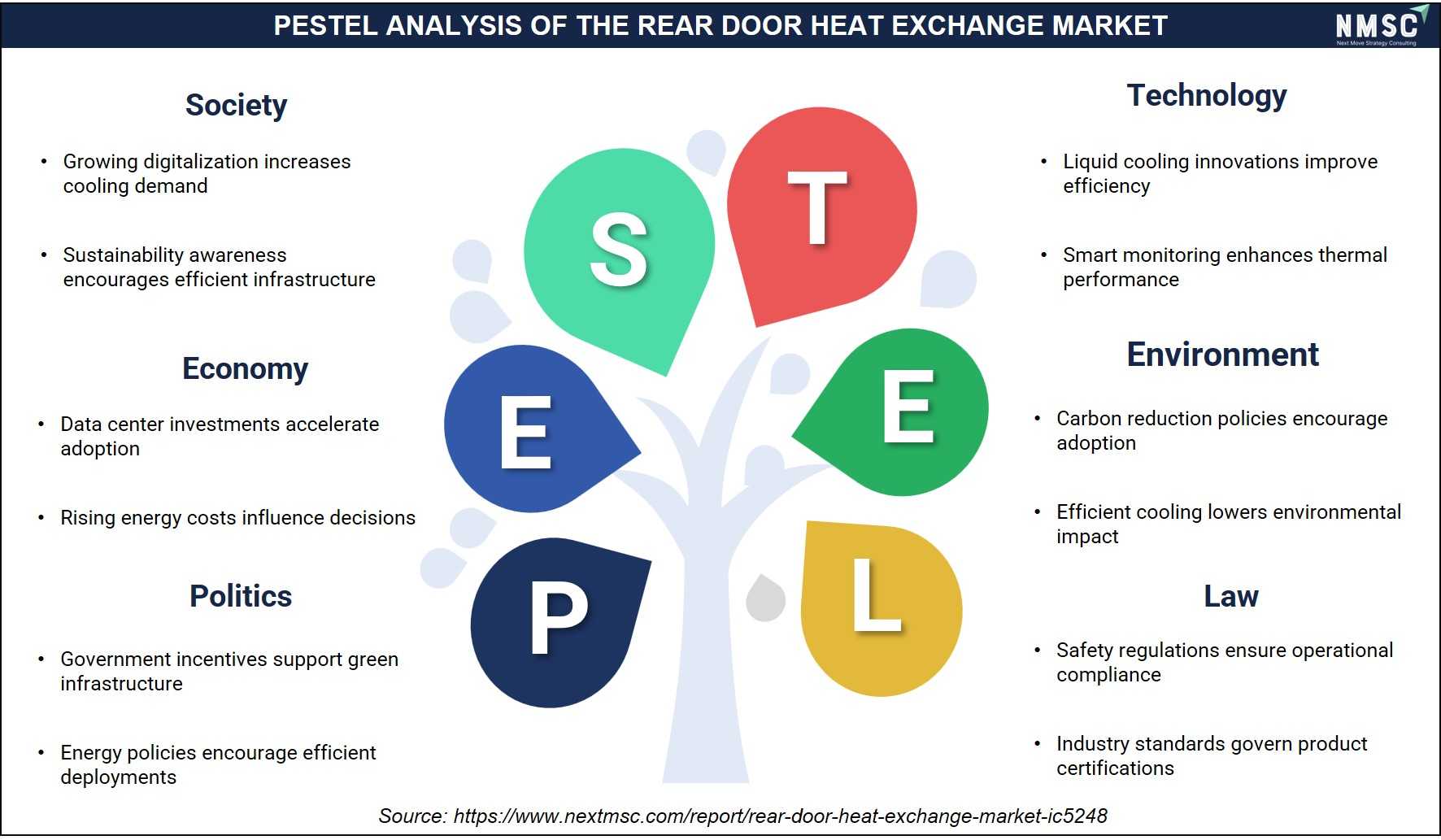
PESTEL analysis highlights the external factors shaping the Rear Door Heat Exchanger market, including government energy policies, rising investments in AI infrastructure, technological advancements in liquid cooling, environmental sustainability goals, and evolving regulatory standards. These factors collectively influence product adoption, innovation, operational efficiency, and long-term market growth across modern data center environments.
Key Market Players
Our assessment indicates that the following 20 companies are actively shaping product innovation, thermal chain capability, and geographic expansion within the global rear door heat exchange market.
-
Vertiv Holdings Co.
-
nVent Electric plc
-
Rittal GmbH & Co. KG
-
STULZ GmbH
-
Delta Electronics, Inc.
-
Legrand SA
-
Huawei Technologies Co., Ltd.
-
Munters AB
-
Shenzhen Envicool Technology Co., Ltd.
-
Nortek Air Solutions, LLC
-
Lenovo Group Limited
-
Hewlett Packard Enterprise Company
-
Super Micro Computer, Inc.
-
CoolIT Systems Inc.
-
Coolcentric
-
Attom Technology
-
Suzhou BEEHE Electric Co., Ltd.
-
Alfa Laval AB
Latest Developments
We found that recent developments within the rear door heat exchange market are concentrated on higher-capacity product launches and thermal chain M&A, reflecting the industry's broader shift toward integrated, high-density cooling portfolios.
|
Date |
Event |
|
September 2025 |
Schneider Electric unveiled its complete Motivair-based liquid cooling portfolio, including ChilledDoor rear door heat exchangers, coolant distribution units, and dynamic cold plates. |
|
November 2025 |
nVent unveiled its Project Deschutes coolant distribution unit, built to the Google Open Compute Project specification, alongside new liquid cooling racks at SC25. |
|
December 2025 |
Vertiv completed its approximately USD 1.0 billion acquisition of PurgeRite, strengthening its thermal management services capabilities for high-density computing. |
|
April 2026 |
Vertiv acquired Strategic Thermal Labs, extending its thermal chain engineering capability at the interface between server-side liquid cooling and supporting infrastructure. |
|
May 2026 |
Vertiv expanded its EMEA liquid cooling portfolio with the CoolChip CDU 2300 and Fluid Network Row Manifolds to accelerate AI-ready data center deployments. |
Expert Insights
 "Rear door heat exchangers are great products for retrofitting existing data centers for high density workloads... It hits the sweet spot of cooling data center racks without doing any modifications to the servers."
— Jennifer Graham, Research Director, IDC
Statement made during an interview with Network World discussing the growing adoption of liquid cooling technologies for AI and high-density data centers, highlighting the advantages of rear door heat exchangers for retrofitting existing facilities.
Market Interpretation
The statement highlights the increasing role of rear door heat exchangers (RDHx) as a practical liquid-cooling solution for modern data centers supporting AI, HPC, and other high-density workloads. By enabling operators to retrofit existing facilities without modifying server hardware, RDHx technology reduces deployment costs and infrastructure complexity while improving thermal efficiency. This trend is expected to accelerate RDHx adoption as enterprises seek scalable, energy-efficient cooling solutions for next-generation computing environments.
Investment Opportunities
What Capital Inflows Are Targeting the Rear Door Heat Exchange Market?
Capital inflows are increasingly directed toward thermal chain consolidation and fluid management service capability. Vertiv's approximately USD 1.0 billion acquisition of PurgeRite, completed in December 2025, and its subsequent acquisition of Strategic Thermal Labs in April 2026 illustrate strategic acquirers funding end-to-end thermal chain expansion rather than relying solely on organic product development. We observed that investors favor vendors demonstrating high-capacity engineering and OEM integration capability, viewing factory-integrated thermal chains as a proxy for durable hyperscale contract retention.
How Is Infrastructure Investment Supporting Rear Door Heat Exchange Platforms?
Infrastructure investment is expanding manufacturing capacity and engineering capability to support rising rack-density thermal requirements. STULZ's new liquid cooling manufacturing facilities in Hamburg and Denton County, Texas, illustrate how vendors are investing in regional production capacity to reduce lead times and mitigate supply chain risk. Our findings suggest that vendors are prioritizing localized manufacturing investment to support the accelerating pace of hyperscale data center construction across North America and Europe.
What ESG Considerations Are Shaping Rear Door Heat Exchange Investment Decisions?
Environmental, social, and governance considerations increasingly shape investment decisions, with power usage effectiveness reduction and water stewardship emerging as central governance criteria across the industry. Vertiv's thermal chain approach, which pairs rear door heat exchangers with direct-to-chip cooling to reduce facility-level air handling energy consumption, reflects growing vendor emphasis on measurable efficiency gains. We found that investors increasingly favor vendors with documented PUE improvement data and water-efficient coolant management practices, treating sustainability performance as a governance indicator alongside deployment scale.
Key Benefits for Stakeholders
How Does This Report Benefit Enterprise and Industry Leaders?
Enterprise and industry leaders gain access to validated segmentation, competitive benchmarking, and regional demand forecasts that support technology-sourcing and facility-planning decisions across the rear door heat exchange industry. Our analysis shows that detailed cooling capacity, rack standard, and buyer-type breakdowns help procurement and facilities teams align platform selection with rack density requirements and deployment timelines, while identifying underserved end-user segments such as semiconductor manufacturing and telecommunications for portfolio expansion.
How Does This Report Benefit Investors and Financial Analysts?
Investors and financial analysts benefit from consistent, single-point market size and CAGR estimates that support valuation and capital-allocation decisions across the rear door heat exchange supply chain. We observed that the report's regional and segment-level growth differentials help identify which vendors are best positioned to capture above-market growth in Asia-Pacific and OEM sales channel categories through 2035, informing diligence on pending and future thermal chain consolidation transactions.
How Does This Report Benefit Technology Vendors and Product Teams?
Technology vendors and product teams gain insight into emerging design requirements, including higher cooling capacity thresholds, Open Compute Project rack compatibility, and DCIM integration, that are reshaping the industry. Our findings suggest that this analysis helps product teams prioritize development roadmaps around factory-integration readiness and bundled service capability that are increasingly required by hyperscale and colocation request-for-proposal processes.
Key Market Segments
By Revenue Stream
-
Hardware
-
Active Rear Door Heat Exchanger
-
Passive Rear Door Heat Exchanger
-
-
Accessories and Upgrade Kits
-
Door Upgrade Kit
-
Control Kit
-
Monitoring Kit
-
Connectivity Kit
-
-
Services
-
Design and Engineering
-
Installation and Commissioning
-
Preventive Maintenance
-
Repair
-
Technical Support
-
Spare Parts
-
By Cooling Medium
-
Chilled Water
-
Warm Water
-
Water Glycol
-
Dielectric Fluid
-
Other Coolants
By Deployment
-
New Installation
-
Retrofit
-
OEM Factory
By Cooling Capacity
-
Up to 20 kW
-
21 kW to 40 kW
-
41 kW to 60 kW
-
Above 60 kW
By Rack Standard
-
EIA Standard Rack
-
Open Compute Rack
-
Custom Rack
By Control Method
-
Local Control
-
Building Management System Integration
-
Data Center Infrastructure Management Integration
By Buyer Type
-
Enterprise Data Center Operator
-
Colocation Provider
-
Hyperscale Cloud Provider
-
Government Organization
-
Research Institution
-
System Integrator
-
Server Manufacturer
By Sales Channel
-
Direct Sales
-
Distributor
-
Value Added Reseller
-
System Integrator
-
OEM
By End User
-
Enterprise Data Center
-
Colocation Data Center
-
Hyperscale Data Center
-
High Performance Computing
-
Artificial Intelligence Infrastructure
-
Telecommunications
-
Semiconductor Manufacturing
-
Financial Services
-
Government and Defense
-
Education and Research
-
Healthcare
-
Industrial
-
Other Mission Critical Facilities
By Region
-
North America: U.S., Canada, Mexico
-
Europe: UK, Germany, France, Italy, Spain, Sweden, Denmark, Finland, Netherlands, Rest of Europe
-
Asia-Pacific: China, India, Japan, South Korea, Taiwan, Indonesia, Vietnam, Australia, Philippines, Malaysia, Rest of APAC
-
Middle East & Africa: Saudi Arabia, UAE, Egypt, Israel, Turkey, Nigeria, South Africa, Rest of MEA
-
Latin America: Brazil, Argentina, Chile, Colombia, Rest of LATAM
Conclusion and Recommendations
What Is the Long-Term Outlook for the Rear Door Heat Exchange Market?
The long-term outlook for the market remains strongly positive, with global revenue projected to expand more than tenfold from USD 0.68 billion in 2025 to USD 6.88 billion by 2035 at a 26.0% CAGR. We observed that sustained AI rack density growth, hyperscale liquid cooling retrofits, and expanding OEM factory integration will continue underpinning demand across hardware, accessories, and services solutions through the forecast period.
What Strategic Positioning Should Rear Door Heat Exchange Suppliers Pursue?
Suppliers should prioritize high-capacity, Open Compute Project-compatible heat exchangers while pursuing bundled thermal chain services to secure long-term hyperscale and colocation contracts amid intensifying rack density requirements. Our assessment indicates that vendors investing early in OEM factory integration, DCIM connectivity, and multi-technology thermal chain portfolios spanning direct-to-chip and immersion cooling will be best positioned to capture premium hyperscale and enterprise accounts within the rear door heat exchange market.
How Attractive Is the Rear Door Heat Exchange Market for New Investment?
The rear door heat exchange industry presents an attractive investment case, supported by a USD 6.02 billion absolute dollar opportunity between 2026 and 2035 and above-average growth in Asia-Pacific and OEM sales channel categories. We found that investment attractiveness is highest for vendors combining high-capacity engineering with proven thermal chain integration capability, positioning them to serve both cost-sensitive enterprise buyers and premium hyperscale segments simultaneously.
What Market Shifts and Key Risks Should Stakeholders Monitor?
Stakeholders should monitor competitive displacement from direct-to-chip and immersion cooling, capital cost sensitivity, and facility piping complexity as key risks to the rear door heat exchange market. Our analysis shows that vendors unable to position rear door heat exchangers as a complementary, room-neutral technology risk losing hyperscale contracts to competitors offering integrated, multi-architecture thermal chain portfolios, particularly as rack densities continue climbing above 60 kW.
What Are the Key Growth Pathways for the Rear Door Heat Exchange Market?
Key growth pathways include expanding OEM factory-integrated shipments, scaling Open Compute Rack-compatible product lines, and deepening penetration into semiconductor manufacturing and artificial intelligence infrastructure end-user segments. NMSC's analysis indicates that suppliers pursuing these pathways while maintaining bundled thermal chain service capability will be best positioned to capture the rear door heat exchange market's projected growth through 2035.
About the Author
 Mihul Sharma
— Mihul Sharma is Research Associate at Next Move Strategy Consulting, where he has covered technology, industrial, and healthcare markets for 3 years. His work applies structured business research, market analysis, and secondary-source review to assess market trends, competitive developments, and growth opportunities. He supports report development by fully synthesizing industry data, company information, and market signals into concise findings for strategy and investment-focused research teams.
Mihul Sharma
— Mihul Sharma is Research Associate at Next Move Strategy Consulting, where he has covered technology, industrial, and healthcare markets for 3 years. His work applies structured business research, market analysis, and secondary-source review to assess market trends, competitive developments, and growth opportunities. He supports report development by fully synthesizing industry data, company information, and market signals into concise findings for strategy and investment-focused research teams.
About the Reviewer
 Supradip Baul
— Supradip Baul is an accomplished business consultant and strategist with over a decade of rich experience in market intelligence, strategy, technology, and business transformation. His work has included rigorous qualitative and quantitative analysis across multiple industries, helping clients shape investment decisions and long-term roadmaps. Earlier in his career, he was associated with Gartner, where he contributed to industry-leading reports and market share analyses. He has worked with leading global companies and holds an MBA with a dual specialization in Marketing and Finance.
Supradip Baul
— Supradip Baul is an accomplished business consultant and strategist with over a decade of rich experience in market intelligence, strategy, technology, and business transformation. His work has included rigorous qualitative and quantitative analysis across multiple industries, helping clients shape investment decisions and long-term roadmaps. Earlier in his career, he was associated with Gartner, where he contributed to industry-leading reports and market share analyses. He has worked with leading global companies and holds an MBA with a dual specialization in Marketing and Finance.
At Next Move Strategy Consulting, we understand that insightful market research is the cornerstone of successful business decisions. That's why we employ a robust and multifaceted approach, combining various methodologies to deliver the most accurate and actionable data for our clients.

Research Landscape
We navigate the world of research with two primary approaches:
Qualitative Approach
Our qualitative research methodologies involve immersive techniques such as in-depth interviews, focus groups, and observational studies. By engaging directly with individuals and stakeholders, we uncover valuable insights that quantitative data alone may overlook.

Quantitative Research
In tandem with qualitative methodologies, NMSC leverages the power of Quantitative Research to provide a robust foundation of numerical insights. Through systematic data collection and analysis, we quantify patterns, preferences, and market trends, offering a comprehensive view of the business landscape.
Our quantitative research approach employs diverse tools, including surveys, experiments, and statistical modelling. These methodologies enable us to gather data from a large and representative sample, ensuring the statistical significance of our findings. By employing structured questionnaires and standardized data collection methods, we guarantee the reliability and validity of the information we present to our clients.
Quantitative research is particularly effective in measuring the prevalence of trends, assessing market size, and gauging the impact of various factors on consumer behavior. The numerical precision attained through this approach equips our clients with actionable insights, facilitating data-driven decision-making and strategy formulation.


Our Specialized Toolbox for Industry-Specific Market Research
We deploy a specialized arsenal of techniques tailored to meet your unique requirements. Here's a glimpse into our comprehensive toolbox:

Information Procurement
The stage entails acquiring market data or relevant information through various sources and methodologies.


Market Research Approach
We utilize both top-down and bottom-up approaches in market research analysis to achieve a comprehensive understanding of the market dynamics, leveraging the broad perspective of industry trends and macroeconomic factors alongside detailed insights from specific segments and individual companies.

Porters Five Forces Analysis
We conduct Porter's Five Forces analysis to evaluate the competitive landscape of an industry, providing us with insights into factors that affect profitability and strategic positioning.

SWOT Analysis

Forecasting
We utilize a forecasting model to predict future consumption by considering parameters like population, economics, regulations, market competition, drivers, constraints, technology, and pricing. We also employ statistical techniques such as multilinear regression, exponential smoothing, moving average, ARIMA, and Monte Carlo simulations for accurate predictions. In econometric forecasting, we analyzed short-term and long-term event impacts, attributing values based on regulatory frameworks, economic factors, and market events.





 Speak to Our Analyst