Receiver-in-Canal (RIC) Hearing Aids Market Size, Share, Trends and Growth Analysis, By Product Type (Standard RIC, Slim RIC, Mini RIC, Power RIC, CROS RIC, and BiCROS RIC), By Power Source (Rechargeable and Disposable Battery), By Technology (Conventional Digital and AI Digital), By Receiver Type, By Connectivity (Wireless and Non-Wireless), By Degree of Hearing Loss, By Distribution Channel, By End User, and Region — Global Industry Report and Forecast, 2026–2035
Industry: Healthcare | Publishing Date: July 27, 2026 | Last Updated: September 30, 2026 | No of Pages: N/A | No. of Tables: N/A | No. of Figures: N/A | Format: PDF | Report Code: HC5415
What Is the Receiver-in-Canal (RIC) Hearing Aids Market Size?
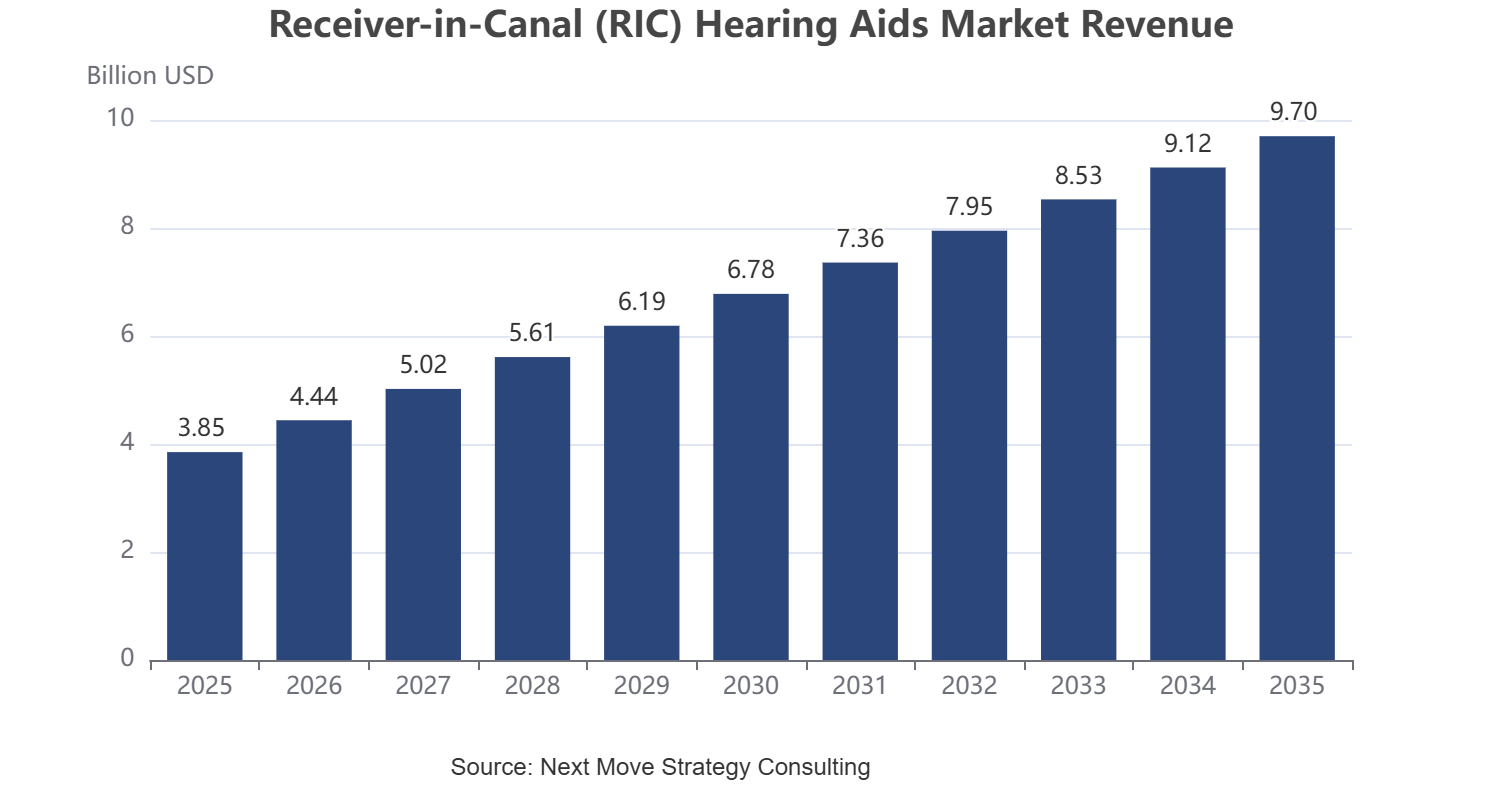
The global Receiver-in-Canal (RIC) Hearing Aids Market size was valued at USD 3.85 Billion in 2025 and is estimated at USD 4.18 Billion in 2026, forecast to reach USD 9.70 Billion by 2035, expanding at a 9.8% CAGR between 2026 and 2035. Asia-Pacific is the fastest-emerging growth engine while North America leads with approximately 31% share, and Standard RIC devices dominate all other product types with approximately 30% share.
We observed that growth is broad-based across every segmentation axis, with rechargeable lithium-ion architectures and AI-enabled digital signal processing driving the dominant structural shifts through 2035.
|
Key Takeaways |
|
By Product Type: Standard RIC held the largest share of approximately 30% (USD 1.16 Billion) in 2025; Power RIC is the fastest-growing sub-segment at 13.2% CAGR from 2026–2035. |
|
By Power Source: Rechargeable held the largest share of approximately 58% (USD 2.23 Billion) in 2025; Rechargeable is also the fastest-growing category at 12.7% CAGR from 2026–2035. |
|
By Technology: Conventional Digital held the largest share of approximately 61% (USD 2.35 Billion) in 2025; AI Digital is the fastest-growing sub-segment at 14.4% CAGR from 2026–2035. |
|
By Receiver Type: Standard Receiver held the largest share of approximately 36% (USD 1.39 Billion) in 2025; Ultra Power Receiver is the fastest-growing sub-segment at 13.2% CAGR from 2026–2035. |
|
By Connectivity: Wireless held the largest share of approximately 72% (USD 2.77 Billion) in 2025; Wireless is also the fastest-growing category at 12.2% CAGR from 2026–2035. |
|
By Degree of Hearing Loss: Moderate held the largest share of approximately 38% (USD 1.46 Billion) in 2025; Profound is the fastest-growing sub-segment at 12.1% CAGR from 2026–2035. |
|
By Distribution Channel: Audiology Clinics held the largest share of approximately 34% (USD 1.31 Billion) in 2025; E-Commerce is the fastest-growing sub-segment at 15.9% CAGR from 2026–2035. |
|
By End User: Adults held the largest share of approximately 86% (USD 3.31 Billion) in 2025; Pediatrics is the fastest-growing sub-segment at 12.3% CAGR from 2026–2035. |
|
Dominant Region: North America dominated with approximately 31% revenue share (USD 1.19 Billion) in 2025. |
|
Fastest-Growing Region: Asia-Pacific is expected to register the highest CAGR of 13.3% during 2026–2035. |
|
Dominant Country: U.S. led with approximately USD 940 Million in 2025. |
|
Fastest-Growing Country: India is the fastest-growing country at approximately 15.2% CAGR from 2026–2035. |
Market Opportunity: The Receiver-in-canal (RIC) Hearing Aids market is expected to create an absolute dollar opportunity of USD 5.52 billion between 2026 and 2035, presenting significant investment potential across the audiology clinic, hearing care retail, and consumer electronics-driven hearing health value chain.
According to Next Move Strategy Consulting analysis, hearing care providers are increasingly bundling rechargeable RIC devices with app-based fitting and remote-care subscriptions, a shift that favors manufacturers with integrated software ecosystems over single-product hardware specialists as connected-care adoption accelerates through 2035.
What Does the Receiver-in-Canal (RIC) Hearing Aids Market Encompass?
The Receiver-in-canal (RIC) Hearing Aids market encompasses behind-the-ear style devices that house the microphone and processor in a small case behind the ear while positioning the receiver, or loudspeaker, directly inside the ear canal via a thin wire. Our assessment indicates that the scope spans standard, slim, mini, power, CROS, and BiCROS architectures supplied to audiology clinics, hearing care retailers, hospitals, and government hearing-health programs across adult and pediatric patient populations with mild to profound hearing loss. The category has evolved from a bulky, cable-dependent design into a discreet, app-connected format, driven by miniaturized receivers, rechargeable lithium-ion cells, and rising awareness of untreated hearing loss worldwide.
Regulatory frameworks such as the U.S. Food and Drug Administration's over-the-counter hearing aid rule and the European Union's Medical Device Regulation (EU) 2017/745 shape device classification, labeling, and post-market surveillance requirements, while national reimbursement programs increasingly influence channel economics. We observed that technology adoption is shifting toward AI-enabled digital signal processing that automatically classifies listening environments and suppresses background noise in real time. Next Move Strategy Consulting's analysis indicates that this structural shift, combined with Bluetooth Low Energy connectivity for direct smartphone streaming, is redefining product positioning across the Receiver-in-canal (RIC) Hearing Aids market.
Adjacent connectivity ecosystems, including the Bluetooth Low Energy Audio Market, continue to shape receiver-side wireless standards that RIC hearing aid manufacturers are progressively adopting for lower-latency, lower-power audio streaming.
|
Parameters |
Details |
|
Market Size in 2025 |
USD 3.85 Billion |
|
Market Size in 2026 |
USD 4.18 Billion |
|
Revenue Forecast in 2035 |
USD 9.70 Billion |
|
Growth Rate |
CAGR of 9.8% from 2026 to 2035 |
|
Analysis Period |
2025–2035 |
|
Base Year Considered |
2025 |
|
Forecast Period |
2026–2035 |
|
Market Size Estimation |
Revenue (USD Billion) |
|
Companies Profiled |
17 |
|
Countries Covered |
33 |
|
Market Share |
Available for Top 10 Companies |
Key Emerging Trends
Based on research conducted by Next Move Strategy Consulting, we found that four structural trends are reshaping product development, distribution, and stakeholder engagement across the industry.
How Is AI-Enabled Sound Processing Transforming RIC Hearing Aid Performance?
AI digital chipsets are replacing conventional processors to enable real-time scene classification and adaptive noise suppression. We observed that Starkey Laboratories' Edge AI platform uses onboard deep neural networks to analyze speech-in-noise environments and adjust amplification automatically, reducing manual user adjustments. Audiology clinics are adopting these platforms to differentiate fitting outcomes, while manufacturers retool firmware pipelines to support over-the-air algorithm updates across the installed base of connected RIC devices.
Why Are Rechargeable Lithium-Ion RIC Devices Gaining Adoption Over Disposable Battery Models?
Rechargeable lithium-ion Receiver-in-canal (RIC) Hearing Aids are gaining share as patients seek elimination of frequent zinc-air battery replacement and improved dexterity-friendly charging. Our findings suggest that inductive charging docks paired with all-day battery life are becoming a baseline expectation among first-time adult users. Manufacturers such as Sonova and Demant are expanding rechargeable portfolios, positioning these formats as the default recommendation within the broader distribution-channel structure.
How Is Direct-to-Consumer and E-Commerce Channel Growth Reshaping RIC Distribution?
Online and direct-to-consumer channels are pushing suppliers toward remote hearing-screening tools and app-guided self-fitting workflows. We observed that several manufacturers now bundle video-otoscopy compatible packaging with teleaudiology support before listing devices on e-commerce marketplaces. This trend is elevating demand for simplified, tool-free receiver-swap mechanisms among online buyers, while traditional audiology clinics adapt hybrid tele-fitting models to retain patients drawn to remote-purchase convenience.
What Role Does Multi-Protocol Wireless Connectivity Play in RIC Hearing Aid Innovation?
Multi-protocol wireless connectivity is emerging as a differentiator that lets a single RIC device pair simultaneously with multiple Bluetooth-enabled source devices. Our analysis shows that manufacturers in the premium RIC segment are piloting Bluetooth LE Audio and Auracast broadcast compatibility to support assistive-listening use cases in public venues. GN Store Nord's ReSound Nexia platform, introduced in 2024, exemplifies this direction with cross-platform smartphone streaming engineered for continuous use across daily listening environments.
Price Point Analysis of the Receiver-in-Canal (RIC) Hearing Aids Market
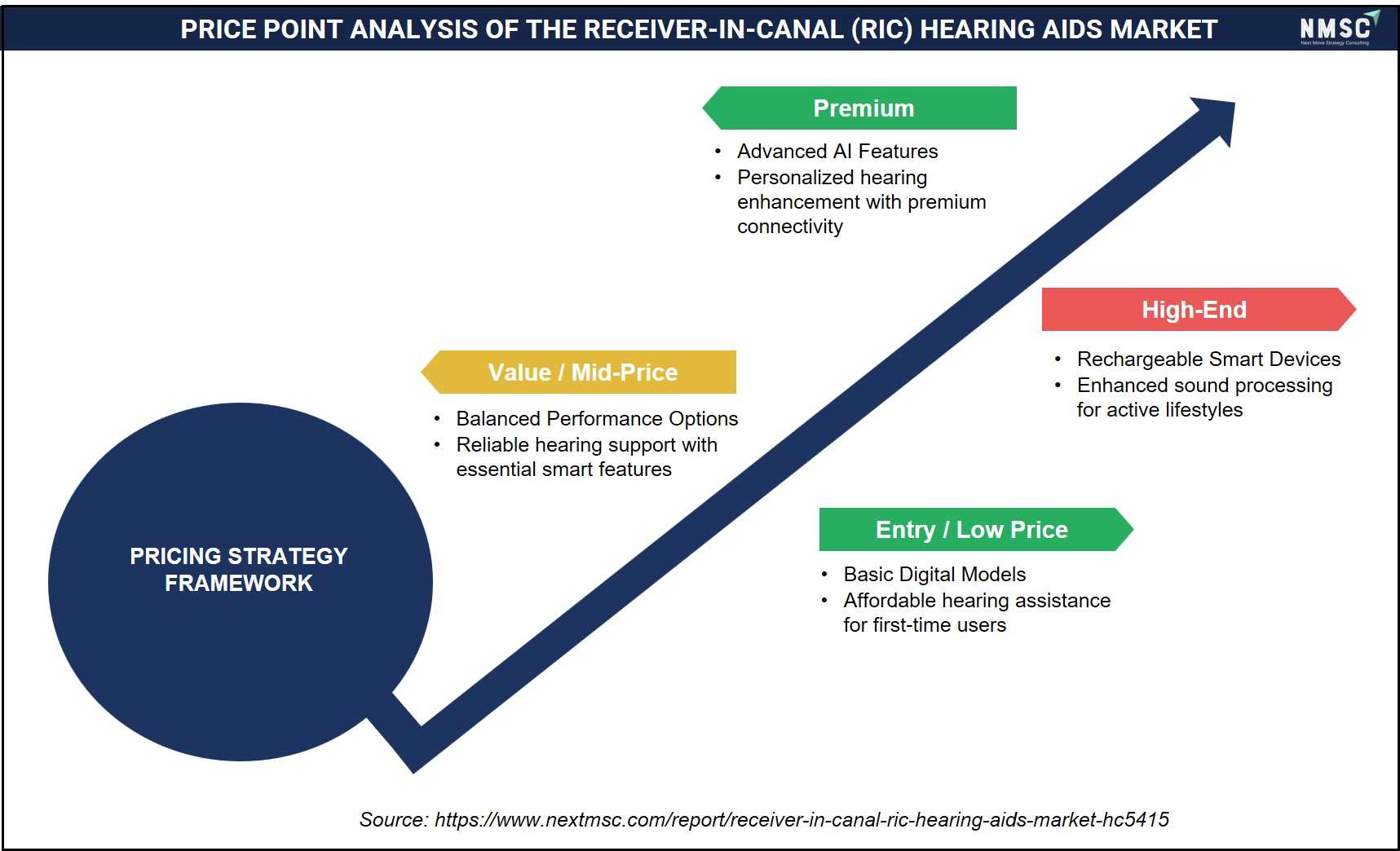
Our analysis indicates that the pricing structure of the Receiver-in-Canal (RIC) Hearing Aids Market spans entry-level, value, premium, and high-end segments based on technology, connectivity, and personalization features. Entry-level products focus on affordability, while value-tier devices balance performance and cost. Premium and high-end offerings integrate advanced sound processing, Bluetooth connectivity, AI-enabled hearing optimization, and rechargeable batteries, targeting users seeking superior hearing performance, comfort, and personalized listening experiences.
Growth Drivers & Restraints
Growth Catalyst & Risk Assessment Matrix
|
Factors |
Type |
(+/−) % Impact on CAGR |
Geographic Relevance |
Impact Timeline |
|
Rising global prevalence of age-related hearing loss |
Driver |
+2.1% |
Global |
2026–2035 |
|
OTC hearing aid regulatory pathway expansion |
Driver |
+1.6% |
North America, Europe |
2026–2030 |
|
Growing adoption of rechargeable lithium-ion platforms |
Driver |
+1.4% |
Global |
2026–2035 |
|
Expansion of AI-enabled digital signal processing |
Driver |
+1.8% |
North America, Europe, Asia-Pacific |
2026–2035 |
|
Rising e-commerce and teleaudiology channel penetration |
Driver |
+1.1% |
Global |
2026–2032 |
|
Government hearing-health screening programs |
Driver |
+0.9% |
Asia-Pacific, Latin America, MEA |
2026–2035 |
|
High device and fitting cost in low-income markets |
Restraint |
−1.2% |
Asia-Pacific, MEA, Latin America |
2026–2035 |
|
Limited insurance and reimbursement coverage |
Restraint |
−1.0% |
North America, MEA |
2026–2032 |
|
Persistent social stigma around visible hearing devices |
Restraint |
−0.7% |
Global |
2026–2030 |
What Is the Primary Growth Driver?
The primary growth driver is the rising global prevalence of disabling hearing loss among aging populations. According to the World Health Organization, over 1.5 billion people live with some degree of hearing loss, with the condition disproportionately affecting adults above 60 years of age. We observed that this demographic base is expanding fastest across North America, Europe, and East Asia, sustaining structural demand for RIC devices across audiology clinics and hearing care retail channels through 2035.
How Is Regulatory Reform Driving the Market Growth?
Regulatory reform is accelerating market growth as the U.S. Food and Drug Administration's over-the-counter hearing aid category, finalized in 2022, expanded consumer access without requiring an audiologist visit for mild to moderate hearing loss. Our findings suggest that this pathway has lowered adoption barriers and broadened the addressable population, encouraging manufacturers to launch OTC-compatible RIC variants alongside prescription-channel devices to capture both regulatory tiers of demand.
What Is Restraining the Market Growth?
The primary restraint is limited insurance and reimbursement coverage for hearing aids across major markets, including traditional Medicare in the United States, which excludes routine hearing aid coverage. Our assessment indicates that out-of-pocket costs remain a meaningful barrier to adoption among lower-income patients, particularly across Asia-Pacific and Middle East & Africa markets, where device and professional fitting costs constrain the pace of RIC hearing aid penetration relative to diagnosed hearing-loss prevalence.
Segmentation Analysis
Segment Sizing: By Product Type
|
Segment |
2025 (USD) |
2035 (USD) |
CAGR% (2026–2035) |
|
Standard RIC |
USD 1.16 Billion |
USD 2.60 Billion |
9.4% |
|
Slim RIC |
USD 0.92 Billion |
USD 2.49 Billion |
11.7% |
|
Mini RIC |
USD 0.69 Billion |
USD 1.74 Billion |
10.7% |
|
Power RIC |
USD 0.54 Billion |
USD 1.64 Billion |
13.2% |
|
CROS RIC |
USD 0.35 Billion |
USD 0.81 Billion |
9.9% |
|
BiCROS RIC |
USD 0.19 Billion |
USD 0.42 Billion |
9% |
|
Total |
USD 3.85 Billion |
USD 9.70 Billion |
9.8% |
Which Product Type Dominates and Which Is Growing Fastest?
Standard RIC devices dominate the product type segmentation, valued at USD 1.16 Billion in 2025, supported by broad audiologist familiarity and established fitting protocols across mild to moderate hearing loss cases. Power RIC is the fastest-growing sub-segment at 13.2% CAGR from 2026–2035, driven by rising demand among patients with severe to profound hearing loss who require higher-output receivers without switching to larger behind-the-ear form factors.
Segment Sizing: By Power Source
|
Segment |
2025 (USD) |
2035 (USD) |
CAGR% (2026–2035) |
|
Rechargeable |
USD 2.23 Billion |
USD 6.54 Billion |
12.7% |
|
Disposable Battery |
USD 1.62 Billion |
USD 3.16 Billion |
7.7% |
|
Total |
USD 3.85 Billion |
USD 9.70 Billion |
9.8% |
Which Power Source Dominates and Which Is Growing Fastest?
Rechargeable devices dominate the power source segmentation, valued at USD 2.23 Billion in 2025, reflecting strong patient preference for lithium-ion cells that eliminate frequent zinc-air battery replacement. Rechargeable is also the fastest-growing category at 12.7% CAGR from 2026–2035, as manufacturers standardize inductive charging docks across new product launches and phase out disposable-battery-only platforms in premium price tiers.
Segment Sizing: By Technology
|
Segment |
2025 (USD) |
2035 (USD) |
CAGR% (2026–2035) |
|
Conventional Digital |
USD 2.35 Billion |
USD 4.67 Billion |
7.9% |
|
AI Digital |
USD 1.50 Billion |
USD 5.03 Billion |
14.4% |
|
Total |
USD 3.85 Billion |
USD 9.70 Billion |
9.8% |
Which Technology Dominates and Which Is Growing Fastest?
Conventional Digital technology dominates with USD 2.35 Billion in 2025, reflecting the still-large installed base of standard digital signal processing chipsets across price-sensitive channels. AI Digital is the fastest-growing sub-segment at 14.4% CAGR from 2026–2035, as manufacturers integrate deep-learning-based noise classification into flagship RIC platforms and clinics increasingly recommend AI-enabled devices for complex listening environments.
Growth Opportunities
Beyond current segmentation performance, three forward-looking whitespace opportunities stand out for stakeholders positioning within the Receiver-in-canal (RIC) Hearing Aids market.
Can Teleaudiology-Enabled Remote Fitting Unlock Underserved Rural Demand?
Teleaudiology platforms paired with self-fitting RIC devices can extend professional-grade hearing care to rural and semi-urban populations lacking nearby audiology clinics. Hearing care retailers that build remote-fitting infrastructure stand to capture patients otherwise excluded from in-person channels, particularly across Asia-Pacific and Latin America.
Can Multi-Protocol Auracast Broadcast Support Expand Assistive-Listening Use Cases?
Auracast broadcast audio compatibility allows RIC devices to receive public-venue audio streams directly, extending assistive-listening utility beyond phone calls. Manufacturers that certify devices for venue-level broadcast standards can capture government and institutional procurement tied to accessibility mandates.
Can Pediatric-Specific RIC Platforms Capture an Underpenetrated End-User Segment?
Pediatric hearing loss cases remain underserved by adult-oriented RIC designs, creating whitespace for tamper-resistant, growth-adaptable receiver cables. Manufacturers and hospitals collaborating on pediatric-specific fitting protocols stand to benefit as early-intervention screening programs expand across developed and emerging markets alike.
Regional Outlook
|
Region |
2025 (USD) |
2035 (USD) |
CAGR% (2026–2035) |
Key Driver |
|
North America |
USD 1.19 Billion |
USD 2.65 Billion |
9.3% |
OTC regulatory expansion |
|
Europe |
USD 1.04 Billion |
USD 2.37 Billion |
9.6% |
MDR compliance and reimbursement reform |
|
Asia-Pacific |
USD 1.00 Billion |
USD 3.08 Billion |
13.3% |
Aging population and screening programs |
|
Middle East & Africa |
USD 0.35 Billion |
USD 0.92 Billion |
11.5% |
Government hearing-health initiatives |
|
Latin America |
USD 0.27 Billion |
USD 0.68 Billion |
10.8% |
Rising audiology clinic penetration |
|
Total |
USD 3.85 Billion |
USD 9.70 Billion |
9.8% |
— |
North America Receiver-in-canal (RIC) Hearing Aids Market
North America leads the Receiver-in-canal (RIC) Hearing Aids market with a mature audiology infrastructure and an established over-the-counter regulatory pathway. We observed that the region benefits from high patient awareness, broad hearing care retailer coverage, and early adoption of rechargeable and AI-enabled devices. Regulatory clarity from the U.S. Food and Drug Administration continues to shape product classification, while manufacturers prioritize direct-to-consumer channel expansion to sustain the region's approximately 31% global revenue share through 2035.
Europe Receiver-in-canal (RIC) Hearing Aids Market
Europe's Receiver-in-canal (RIC) Hearing Aids market is shaped by the Medical Device Regulation framework and national reimbursement schemes that vary meaningfully across member states. Our assessment indicates that Germany, the UK, and France anchor regional demand, supported by strong audiologist networks and public health insurance contributions toward device costs. Technology adoption favors rechargeable, connectivity-enabled platforms as clinics standardize fitting protocols across the region's aging population.
Asia-Pacific Receiver-in-canal (RIC) Hearing Aids Market
Asia-Pacific is the fastest-growing region at 13.3% CAGR, propelled by a rapidly aging population, expanding government hearing-screening programs, and rising middle-class healthcare spending. We found that China, India, and Japan collectively anchor regional volume, while manufacturers localize price-tiered RIC portfolios to address wide affordability gaps. Regulatory harmonization efforts across the region are gradually easing market entry for multinational hearing aid manufacturers.
Middle East & Africa Receiver-in-canal (RIC) Hearing Aids Market
The Middle East & Africa Receiver-in-canal (RIC) Hearing Aids market benefits from government-led hearing-health initiatives and rising private healthcare investment across Gulf Cooperation Council countries. Our analysis shows that Saudi Arabia and the UAE lead regional adoption, supported by expanding audiology clinic networks, while South Africa anchors demand across the broader African continent. Affordability remains a structural constraint across lower-income markets within the region.
Latin America Receiver-in-canal (RIC) Hearing Aids Market
Latin America's Receiver-in-canal (RIC) Hearing Aids market is expanding on the back of rising audiology clinic penetration and growing awareness of hearing-health screening among aging urban populations. We observed that Brazil anchors regional demand, supported by an expanding private healthcare sector, while Argentina shows steady adoption growth. Reimbursement remains limited across the region, keeping out-of-pocket purchasing the dominant transaction model.
U.S. Receiver-in-canal (RIC) Hearing Aids Market
Based on our estimates, U.S.'s Receiver-in-canal (RIC) Hearing Aids market was valued at approximately USD 940 Million in 2025 and is projected to reach approximately USD 1943 Million by 2035, expanding at a 8.4% CAGR from 2026 to 2035. Demand structure favors rechargeable, AI-enabled RIC devices sold through both audiology clinics and the newly established OTC retail channel, with high technology penetration and intense competitive activity among global manufacturers.
Canada Receiver-in-canal (RIC) Hearing Aids Market
The market in Canada was valued at approximately USD 190 Million in 2025 and is projected to reach approximately USD 416 Million by 2035, expanding at a 9.1% CAGR from 2026 to 2035. Adoption is concentrated in urban audiology networks, with provincial health programs providing partial reimbursement support and steady demand for wireless-connected devices among aging patients.
UK Receiver-in-canal (RIC) Hearing Aids Market
As per our estimate, UK's Receiver-in-canal (RIC) Hearing Aids market was valued at approximately USD 280 Million in 2025 and is projected to reach approximately USD 593 Million by 2035, expanding at a 8.7% CAGR from 2026 to 2035. The National Health Service anchors a significant share of device provisioning, while private audiology clinics serve patients seeking premium rechargeable and AI-enabled RIC platforms with faster fitting turnaround.
Germany Receiver-in-canal (RIC) Hearing Aids Market
According to our analysis, Germany's Receiver-in-canal (RIC) Hearing Aids market was valued at approximately USD 310 Million in 2025 and is projected to reach approximately USD 646 Million by 2035, expanding at a 8.5% CAGR from 2026 to 2035. Statutory health insurance contributions toward hearing aid costs support broad market access, while strong domestic audiology networks drive early adoption of connectivity-enabled devices.
France Receiver-in-canal (RIC) Hearing Aids Market
Based on our estimates, France's Receiver-in-canal (RIC) Hearing Aids market was valued at approximately USD 210 Million in 2025 and is projected to reach approximately USD 452 Million by 2035, expanding at a 8.9% CAGR from 2026 to 2035. Reimbursement reform under the 100% Santé program has expanded patient access to fully covered hearing aids, accelerating adoption of standard and slim RIC formats across public and private channels.
China Receiver-in-canal (RIC) Hearing Aids Market
The market in China was valued at approximately USD 295 Million in 2025 and is projected to reach approximately USD 915 Million by 2035, expanding at a 13.4% CAGR from 2026 to 2035. Rapid population aging and expanding hearing-screening initiatives are driving demand, though price sensitivity keeps conventional digital and disposable-battery formats prevalent outside major urban centers.
India Receiver-in-canal (RIC) Hearing Aids Market
As per our estimate, India's Receiver-in-canal (RIC) Hearing Aids market was valued at approximately USD 127 Million in 2025 and is projected to reach approximately USD 454 Million by 2035, expanding at a 15.2% CAGR from 2026 to 2035. Government hearing-health programs and rising private audiology clinic penetration are expanding access, with strong growth momentum in mid-tier rechargeable devices sold through hearing care retailers.
Japan Receiver-in-canal (RIC) Hearing Aids Market
According to our analysis, Japan's Receiver-in-canal (RIC) Hearing Aids market was valued at approximately USD 239 Million in 2025 and is projected to reach approximately USD 554 Million by 2035, expanding at a 9.8% CAGR from 2026 to 2035. A highly aged population sustains steady structural demand, with strong preference for compact, discreet RIC formats and established distribution through hospital-affiliated audiology departments.
South Korea Receiver-in-canal (RIC) Hearing Aids Market
Based on our estimates, South Korea's Receiver-in-canal (RIC) Hearing Aids market was valued at approximately USD 113 Million in 2025 and is projected to reach approximately USD 303 Million by 2035, expanding at a 11.6% CAGR from 2026 to 2035. Rising disposable income and government subsidy programs for elderly hearing aid purchases are supporting adoption of AI-enabled and wireless-connected devices among urban patients.
Australia Receiver-in-canal (RIC) Hearing Aids Market
The market in Australia was valued at approximately USD 77 Million in 2025 and is projected to reach approximately USD 185 Million by 2035, expanding at a 10.2% CAGR from 2026 to 2035. A well-established government hearing services program supports pediatric and adult access alike, sustaining consistent demand for both standard and power RIC devices across audiology clinics.
UAE Receiver-in-canal (RIC) Hearing Aids Market
As per our estimate, UAE's Receiver-in-canal (RIC) Hearing Aids market was valued at approximately USD 70 Million in 2025 and is projected to reach approximately USD 193 Million by 2035, expanding at a 11.9% CAGR from 2026 to 2035. Expanding private healthcare investment and rising awareness campaigns are driving adoption of premium rechargeable RIC devices among a growing expatriate and aging national population.
Saudi Arabia Receiver-in-canal (RIC) Hearing Aids Market
According to our analysis, Saudi Arabia's Receiver-in-canal (RIC) Hearing Aids market was valued at approximately USD 90 Million in 2025 and is projected to reach approximately USD 234 Million by 2035, expanding at a 11.2% CAGR from 2026 to 2035. Government-backed hearing-health initiatives under national health transformation programs are expanding audiology clinic infrastructure and device accessibility across urban centers.
South Africa Receiver-in-canal (RIC) Hearing Aids Market
Based on our estimates, South Africa's Receiver-in-canal (RIC) Hearing Aids market was valued at approximately USD 50 Million in 2025 and is projected to reach approximately USD 114 Million by 2035, expanding at a 9.6% CAGR from 2026 to 2035. Adoption remains concentrated in private healthcare and urban audiology clinics, with affordability constraints limiting penetration across broader rural populations.
Brazil Receiver-in-canal (RIC) Hearing Aids Market
The market in Brazil was valued at approximately USD 130 Million in 2025 and is projected to reach approximately USD 322 Million by 2035, expanding at a 10.6% CAGR from 2026 to 2035. An expanding private healthcare sector and growing audiology clinic network are driving adoption, with rechargeable devices gaining preference among urban patients over legacy disposable-battery formats.
Argentina Receiver-in-canal (RIC) Hearing Aids Market
As per our estimate, Argentina's Receiver-in-canal (RIC) Hearing Aids market was valued at approximately USD 50 Million in 2025 and is projected to reach approximately USD 117 Million by 2035, expanding at a 9.9% CAGR from 2026 to 2035. Steady demand growth is supported by expanding private insurance coverage and rising awareness of hearing-health screening among the country's aging population.
Pain Point Analysis of the Receiver-in-Canal (RIC) Hearing Aids Market
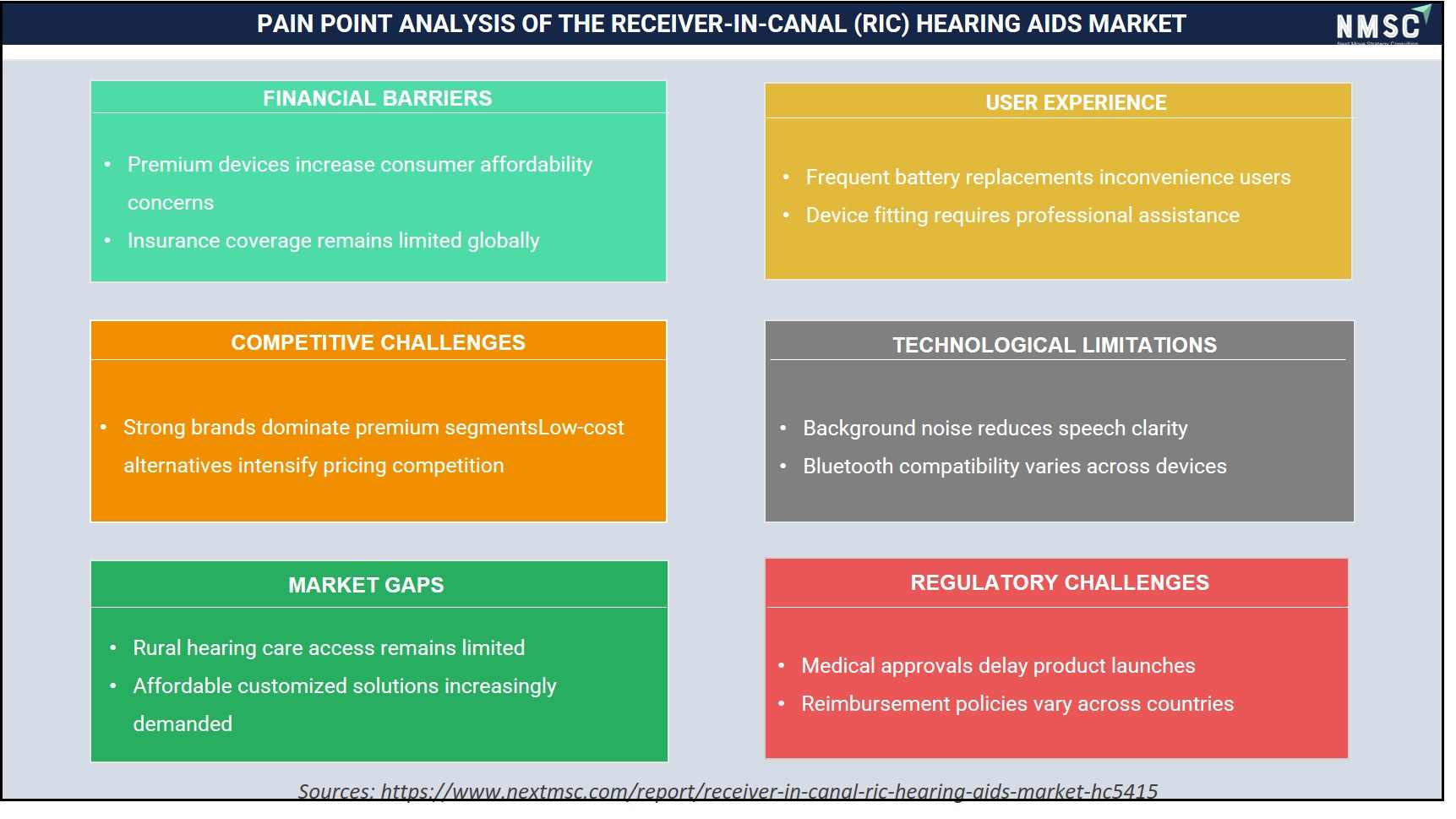
Our analysis indicates that the Receiver-in-Canal (RIC) Hearing Aids Market faces challenges related to affordability, user convenience, technological limitations, and regulatory requirements. Premium pricing and limited reimbursement reduce accessibility, while frequent battery replacement, professional fitting needs, and background noise interference affect user experience. Limited rural hearing care access, varying Bluetooth compatibility, and lengthy regulatory approval processes further influence adoption, encouraging manufacturers to prioritize affordable, user-friendly, and technologically advanced hearing solutions.
Competitive Landscape
Next Move Strategy Consulting's analysis indicates that the Receiver-in-canal (RIC) Hearing Aids industry is moderately consolidated, with global manufacturers competing on connectivity innovation, rechargeable battery integration, and audiology clinic partnerships.
|
Attribute |
Details |
|
Market Structure |
Moderately consolidated, led by a small group of vertically integrated global manufacturers alongside regional specialists |
|
Innovation Focus |
AI-enabled digital signal processing, rechargeable lithium-ion platforms, and multi-protocol wireless connectivity |
|
M&A Activity |
Selective acquisitions of software and connectivity specialists to strengthen app-based fitting ecosystems |
How Do Companies Compete in the Receiver-in-canal (RIC) Hearing Aids Industry?
Companies compete primarily on signal-processing quality, battery life, and integration with smartphone-based fitting and streaming applications. Our findings suggest that audiology clinic relationships and reimbursement-channel access remain decisive competitive levers, particularly in markets with partial insurance coverage, while manufacturers differentiate premium tiers through AI-enabled noise management and multi-protocol wireless support.
Which Competitive Archetypes Dominate the Receiver-in-canal (RIC) Hearing Aids Market?
Two archetypes dominate: vertically integrated global manufacturers that control device design, clinic distribution, and software ecosystems, and regional specialists focused on price-competitive conventional digital devices for cost-sensitive markets. We observed that the first archetype captures premium rechargeable and AI-enabled segments, while the second sustains volume in disposable-battery and standard digital categories across emerging markets.
What Innovation and Differentiation Strategies Define Competition?
Innovation strategy centers on proprietary AI chipsets, extended rechargeable battery life, and app-based remote fine-tuning that reduces follow-up clinic visits. Our analysis shows that leading manufacturers invest heavily in receiver miniaturization and Bluetooth LE Audio compatibility to differentiate premium RIC platforms, positioning connected-care software as a recurring-revenue complement to hardware sales.
What M&A Activity Is Shaping the Competitive Landscape?
M&A activity has concentrated on acquiring teleaudiology software platforms and hearing-screening technology providers to strengthen direct-to-consumer and remote-fitting capabilities. Our assessment indicates that manufacturers are prioritizing bolt-on acquisitions over large-scale consolidation, reflecting an already concentrated global manufacturing base and a strategic focus on software-enabled differentiation.
Key Market Players
Based on research conducted by Next Move Strategy Consulting, the following companies represent the validated set of key players shaping the Receiver-in-canal (RIC) Hearing Aids market.
-
Sonova Holding AG
-
Demant A/S
-
WS Audiology A/S
-
GN Store Nord A/S
-
Starkey Laboratories, Inc.
-
Eargo, Inc.
-
Audina Hearing Instruments, Inc.
-
IntriCon Corporation
-
Huizhou Jinghao Medical Technology Co., Ltd.
-
Guangdong NewSound Technology Co., Ltd.
-
SeboTek Hearing Systems LLC
-
Microson S.A.U.
-
Horentek S.r.l.
-
Arphi Electronics Private Limited
-
ELKON Pvt. Ltd.
-
Persona Medical, Inc.
-
Benson Medical Instruments Co.
Latest Developments
Our assessment indicates that recent product launches and regulatory milestones underscore accelerating innovation across the Receiver-in-canal (RIC) Hearing Aids industry.
|
Date |
Event |
|
May 2026 |
WS Audiology A/S launched the Signia Active Mini IX, introduced as the world's smallest ready-to-wear in-the-ear (ITE) hearing aid featuring direct connectivity and the full processing power of the IX platform. |
|
January 2026 |
Demant A/S expanded the global rollout of Oticon Zeal, a revolutionary in-the-ear hearing aid combining second-generation AI-driven Deep Neural Network 2.0 sound processing, rechargeability, and a same-day custom fitting option. |
|
October 2025 |
Sonova Holding AG introduced the Phonak Infinio Ultra, integrating next-generation artificial intelligence power management and advanced wax-management technology to enhance speech clarity and simplify daily maintenance for users. |
Investment Opportunities
Where Are Capital Inflows Concentrated Within the Receiver-in-canal (RIC) Hearing Aids Market?
Capital inflows are concentrated in rechargeable battery technology, AI chipset development, and teleaudiology software platforms. Our findings suggest that private equity and strategic investors favor companies combining hardware manufacturing with recurring-revenue software, reflecting a broader shift toward connected-care business models across the industry.
How Is Infrastructure Investment Supporting Market Expansion?
Infrastructure investment is expanding audiology clinic networks and remote-fitting capabilities across underserved regions, particularly in Asia-Pacific and Latin America. We observed that government-backed hearing-health screening programs are catalyzing complementary private investment in clinic infrastructure and workforce training to support rising device demand.
What ESG Considerations Are Shaping Investment Decisions?
ESG considerations increasingly influence investment decisions through accessibility mandates and equitable healthcare access commitments. Our analysis shows that manufacturers expanding OTC-compatible and government-subsidized product lines align with social-impact investment theses, while battery recyclability programs address environmental governance expectations tied to lithium-ion component sourcing.
Key Benefits for Stakeholders
How Does This Report Benefit Industry Leaders and Manufacturers?
Industry leaders gain access to detailed segmentation, regional forecasts, and competitive benchmarking that inform product roadmap and channel-investment decisions. Our analysis, data, and strategic insights help manufacturers prioritize rechargeable and AI-enabled platform development to align with the fastest-growing sub-segments identified across the forecast period.
How Does This Report Benefit Investors and Financial Analysts?
Investors and financial analysts benefit from consolidated market-sizing, CAGR, and regional opportunity data that support capital-allocation decisions across the hearing health value chain. The report's forecasts and competitive landscape analysis help identify companies best positioned to capture disproportionate share of the projected market opportunity.
How Does This Report Benefit Technology Vendors and Product Teams?
Technology vendors and product teams gain insight into connectivity, AI processing, and battery technology trends shaping product specifications. The report's segmentation and emerging-trends analysis support prioritization of engineering investment toward the sub-segments demonstrating the strongest structural growth momentum.
Key Market Segments
By Product Type
-
Standard RIC
-
Slim RIC
-
Mini RIC
-
Power RIC
-
CROS RIC
-
BiCROS RIC
By Power Source
-
Rechargeable
-
Lithium-Ion
-
Silver Zinc
-
Other Rechargeable
-
-
Disposable Battery
-
Zinc-Air Size 10
-
Zinc-Air Size 312
-
Zinc-Air Size 13
-
Other Disposable Battery
-
By Technology
-
Conventional Digital
-
AI Digital
By Receiver Type
-
Standard Receiver
-
Medium Power Receiver
-
Power Receiver
-
Ultra Power Receiver
By Connectivity
-
Wireless
-
Bluetooth Classic
-
Bluetooth LE
-
Multi-Protocol
-
-
Non-Wireless
By Degree of Hearing Loss
-
Mild
-
Moderate
-
Severe
-
Profound
By Distribution Channel
-
Audiology Clinics
-
Hearing Care Retailers
-
Hospitals
-
Government Programs
-
Direct to Consumer
-
E-Commerce
By End User
-
Adults
-
Pediatrics
By Region
-
North America: U.S., Canada, Mexico
-
Europe: UK, Germany, France, Italy, Spain, Sweden, Denmark, Finland, Netherlands, Rest of Europe
-
Asia-Pacific: China, India, Japan, South Korea, Taiwan, Indonesia, Vietnam, Australia, Philippines, Malaysia, Rest of APAC
-
Middle East & Africa: Saudi Arabia, UAE, Egypt, Israel, Turkey, Nigeria, South Africa, Rest of MEA
-
Latin America: Brazil, Argentina, Chile, Colombia, Rest of LATAM
Conclusion & Recommendations
What Is the Long-Term Outlook for the Receiver-in-canal (RIC) Hearing Aids Market?
The long-term outlook remains firmly positive, with the market forecast to expand from USD 4.18 Billion in 2026 to USD 9.70 Billion by 2035 at a 9.8% CAGR. We observed that structural demand drivers, including population aging and expanding OTC access, are durable rather than cyclical, supporting sustained double-digit growth across AI-enabled and rechargeable sub-segments through the forecast horizon.
What Strategic Positioning Should Manufacturers Pursue?
Manufacturers should prioritize rechargeable, AI-enabled platform development while strengthening direct-to-consumer and teleaudiology distribution capabilities. Our findings suggest that companies integrating hardware with recurring-revenue software services are best positioned to defend premium pricing and capture the fastest-growing distribution channels through 2035.
How Attractive Is the Market for New Investment?
Investment attractiveness is high given the absolute dollar opportunity of USD 5.52 billion between 2026 and 2035 and the market's exposure to durable demographic tailwinds. Our analysis shows that capital deployed toward connectivity innovation and emerging-market clinic infrastructure carries favorable risk-adjusted return potential relative to more mature medical device categories.
What Are the Key Market Shifts and Risks to Monitor?
Key shifts include accelerating OTC channel adoption and rising competitive intensity from consumer electronics entrants targeting mild hearing loss cases. Our assessment indicates that reimbursement policy uncertainty and persistent affordability constraints in emerging markets remain the principal risks to monitor across the 2026–2035 forecast period.
What Growth Pathways Offer the Strongest Return Potential?
The strongest growth pathways lie in AI-enabled digital platforms, rechargeable lithium-ion architectures, and expansion into underpenetrated Asia-Pacific and Latin American markets. We found that manufacturers combining these pathways with teleaudiology-enabled distribution stand to outperform the broader market's baseline growth trajectory through 2035.
About the Author
 Saista Faiyaz
— Saista Faiyaz is Research Associate at Next Move Strategy Consulting, where she has covered consumer markets and healthcare technologies for 3 years. Her work includes primary interview review, secondary-source validation, market sizing, and structured analysis of company and industry data. She supports research by comparing evidence across sources, organizing findings into market narratives, and documenting assumptions used in analysis. Her scope includes cross-market benchmarking, and reports.
Saista Faiyaz
— Saista Faiyaz is Research Associate at Next Move Strategy Consulting, where she has covered consumer markets and healthcare technologies for 3 years. Her work includes primary interview review, secondary-source validation, market sizing, and structured analysis of company and industry data. She supports research by comparing evidence across sources, organizing findings into market narratives, and documenting assumptions used in analysis. Her scope includes cross-market benchmarking, and reports.
About the Reviewer
 Supradip Baul
— Supradip Baul is an accomplished business consultant and strategist with over a decade of rich experience in market intelligence, strategy, technology, and business transformation. His work has included rigorous qualitative and quantitative analysis across multiple industries, helping clients shape investment decisions and long-term roadmaps. Earlier in his career, he was associated with Gartner, where he contributed to industry-leading reports and market share analyses. He has worked with leading global companies and holds an MBA with a dual specialization in Marketing and Finance.
Supradip Baul
— Supradip Baul is an accomplished business consultant and strategist with over a decade of rich experience in market intelligence, strategy, technology, and business transformation. His work has included rigorous qualitative and quantitative analysis across multiple industries, helping clients shape investment decisions and long-term roadmaps. Earlier in his career, he was associated with Gartner, where he contributed to industry-leading reports and market share analyses. He has worked with leading global companies and holds an MBA with a dual specialization in Marketing and Finance.
At Next Move Strategy Consulting, we understand that insightful market research is the cornerstone of successful business decisions. That's why we employ a robust and multifaceted approach, combining various methodologies to deliver the most accurate and actionable data for our clients.

Research Landscape
We navigate the world of research with two primary approaches:
Qualitative Approach
Our qualitative research methodologies involve immersive techniques such as in-depth interviews, focus groups, and observational studies. By engaging directly with individuals and stakeholders, we uncover valuable insights that quantitative data alone may overlook.

Quantitative Research
In tandem with qualitative methodologies, NMSC leverages the power of Quantitative Research to provide a robust foundation of numerical insights. Through systematic data collection and analysis, we quantify patterns, preferences, and market trends, offering a comprehensive view of the business landscape.
Our quantitative research approach employs diverse tools, including surveys, experiments, and statistical modelling. These methodologies enable us to gather data from a large and representative sample, ensuring the statistical significance of our findings. By employing structured questionnaires and standardized data collection methods, we guarantee the reliability and validity of the information we present to our clients.
Quantitative research is particularly effective in measuring the prevalence of trends, assessing market size, and gauging the impact of various factors on consumer behavior. The numerical precision attained through this approach equips our clients with actionable insights, facilitating data-driven decision-making and strategy formulation.


Our Specialized Toolbox for Industry-Specific Market Research
We deploy a specialized arsenal of techniques tailored to meet your unique requirements. Here's a glimpse into our comprehensive toolbox:

Information Procurement
The stage entails acquiring market data or relevant information through various sources and methodologies.


Market Research Approach
We utilize both top-down and bottom-up approaches in market research analysis to achieve a comprehensive understanding of the market dynamics, leveraging the broad perspective of industry trends and macroeconomic factors alongside detailed insights from specific segments and individual companies.

Porters Five Forces Analysis
We conduct Porter's Five Forces analysis to evaluate the competitive landscape of an industry, providing us with insights into factors that affect profitability and strategic positioning.

SWOT Analysis

Forecasting
We utilize a forecasting model to predict future consumption by considering parameters like population, economics, regulations, market competition, drivers, constraints, technology, and pricing. We also employ statistical techniques such as multilinear regression, exponential smoothing, moving average, ARIMA, and Monte Carlo simulations for accurate predictions. In econometric forecasting, we analyzed short-term and long-term event impacts, attributing values based on regulatory frameworks, economic factors, and market events.





 Speak to Our Analyst