rigid-flex PCB market, rigid-flex PCB market size, rigid-flex PCB market share, rigid-flex circuit board industry, HDI rigid-flex PCB, flexible printed circuit board, rigid-flex PCB manufacturers, rigid-flex PCB market growth, rigid-flex PCB market trends, rigid-flex PCB segmentation, rigid-flex PCB market report, high-frequency rigid-flex PCB
Industry: Semiconductor & Electronics | Publishing Date: July 25, 2026 | Last Updated: September 30, 2026 | No of Pages: N/A | No. of Tables: N/A | No. of Figures: N/A | Format: PDF | Report Code: SE5399
What Is the Rigid-Flex PCB Market Size?
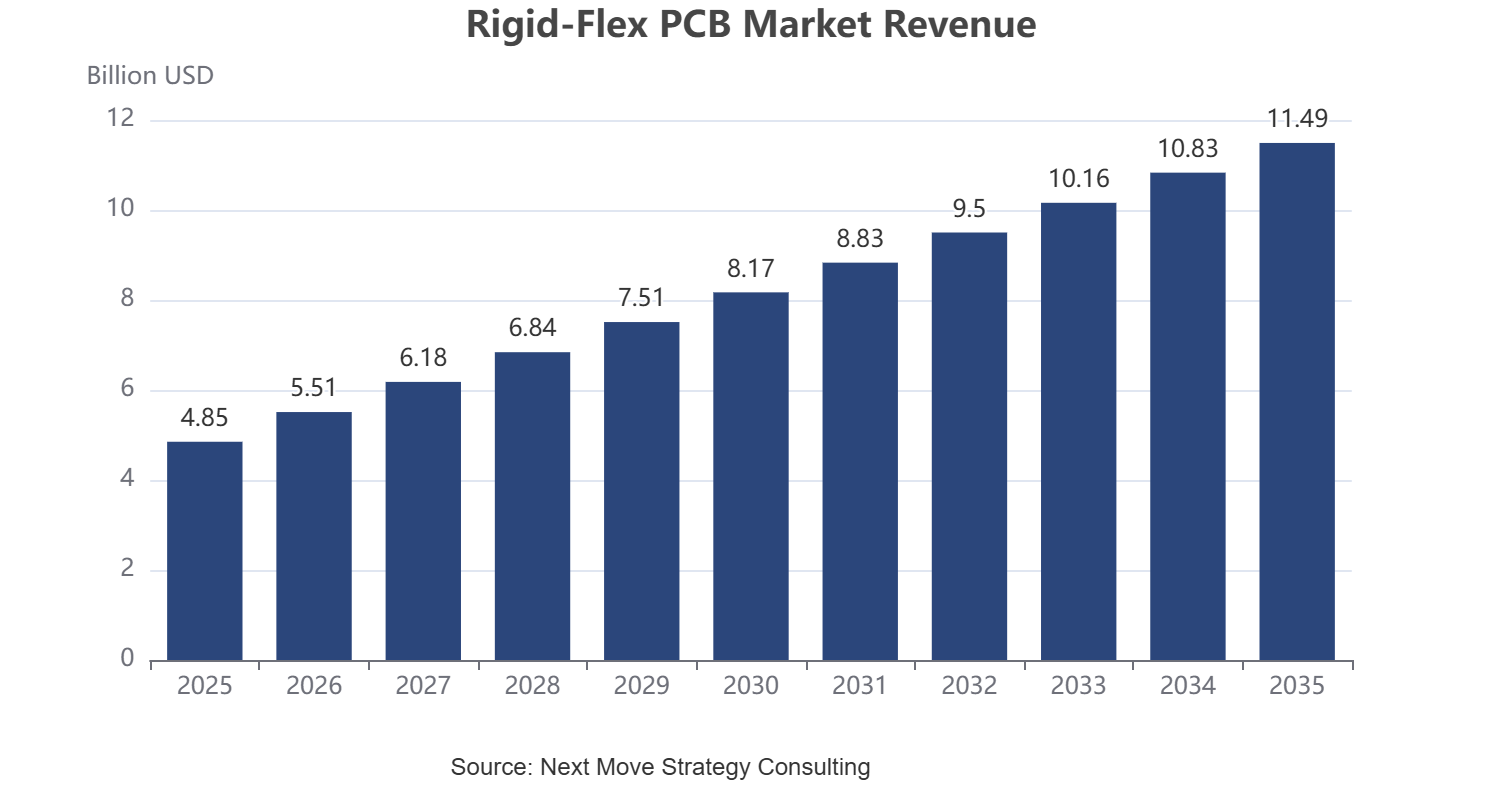
The global rigid-flex PCB market size was valued at USD 4.85 billion in 2025 and is estimated at USD 5.29 billion in 2026, forecast to reach USD 11.49 billion by 2035, expanding at a 9.0% CAGR between 2026 and 2035. Asia-Pacific leads with approximately 58% share, while Standard Rigid-Flex dominates all other product architectures with approximately 34% share.
We observed that growth is broad-based across every segmentation axis, with high-frequency architectures and automotive electrification driving the dominant structural shifts through 2035.
|
Key Takeaways |
|
By Product Architecture: Standard Rigid-Flex held the largest share of approximately 34% (USD 1.65 Billion) in 2025; High-Frequency Rigid-Flex is the fastest-growing sub-segment at 11.3% CAGR from 2026–2035. |
|
By Material System: Polyimide held the largest share of approximately 46% (USD 2.23 Billion) in 2025; LCP is the fastest-growing sub-segment at 11.8% CAGR from 2026–2035. |
|
By End User: Consumer Electronics held the largest share of approximately 30% (USD 1.46 Billion) in 2025; Automotive is the fastest-growing sub-segment at 11.2% CAGR from 2026–2035. |
|
By Layer Count: 9 to 16 Layers held the largest share of approximately 36% (USD 1.75 Billion) in 2025; 17 Plus Layers is the fastest-growing sub-segment at 11.6% CAGR from 2026–2035. |
|
By Revenue Stream: Volume Production held the largest share of approximately 58% (USD 2.81 Billion) in 2025; Engineering Services is the fastest-growing sub-segment at 11.0% CAGR from 2026–2035. |
|
By Sales Channel: Direct OEM held the largest share of approximately 41% (USD 1.99 Billion) in 2025; Online Prototype is the fastest-growing sub-segment at 12.4% CAGR from 2026–2035. |
|
Dominant Region: Asia-Pacific dominated with approximately 58% revenue share (USD 2.81 Billion) in 2025. |
|
Fastest-Growing Region: Middle East & Africa is expected to register the highest CAGR of 12.1% during 2026–2035. |
|
Dominant Country: China led with approximately USD 1.13 billion in 2025. |
|
Fastest-Growing Country: India is the fastest-growing country at approximately 12.6% CAGR from 2026–2035. |
Market Opportunity: The rigid-flex PCB market is expected to create an absolute dollar opportunity of USD 6.20 billion between 2026 and 2035, presenting significant investment potential across the automotive electrification, 5G infrastructure, and aerospace and defence electronics value chain.
According to Next Move Strategy Consulting analysis, original equipment manufacturers are increasingly consolidating rigid-flex sourcing with fewer, high-reliability suppliers capable of supporting HDI and automotive PCB qualification requirements, a shift that favors vertically integrated manufacturers over single-process specialists as design complexity increases through 2035.
What Does the Rigid-Flex PCB Market Encompass?
The rigid-flex PCB market encompasses hybrid circuit structures that combine rigid and flexible substrate layers within a single interconnect, enabling three-dimensional packaging in space-constrained electronic assemblies. Our assessment indicates that the scope spans standard, HDI, semi-flex, high-frequency, embedded component, and cavity architectures supplied to original equipment manufacturers, electronics manufacturing services providers, and design houses across consumer electronics, automotive, industrial, medical, aerospace and defence, and communications end markets. The category has evolved from a niche military and aerospace interconnect into a mainstream packaging format, driven by miniaturization demand, foldable device proliferation, and the electrification of vehicle architectures worldwide.
Regulatory frameworks such as the U.S. Federal Communications Commission's electromagnetic compliance requirements and the European Union's Restriction of Hazardous Substances Directive shape material selection and manufacturing process qualification, while IPC Association Connecting Electronics Industries standards increasingly govern reliability testing. We observed that technology adoption is shifting toward embedded component and cavity architectures that reduce assembly footprint and improve signal integrity. Next Move Strategy Consulting's analysis indicates that this structural shift, combined with 5G and advanced driver assistance system demand, is redefining sourcing criteria across the rigid-flex PCB market.
|
Parameter |
Details |
|
Market Size in 2025 |
USD 4.85 Billion |
|
Market Size in 2026 |
USD 5.29 Billion |
|
Revenue Forecast in 2035 |
USD 11.49 Billion |
|
Growth Rate |
CAGR of 9.0% from 2026 to 2035 |
|
Analysis Period |
2025–2035 |
|
Base Year Considered |
2025 |
|
Forecast Period |
2026–2035 |
|
Market Size Estimation |
Revenue (USD Billion) |
|
Companies Profiled |
20 |
|
Countries Covered |
33 |
|
Market Share |
Available for Top 10 Companies |
Key Emerging Trends
Based on research conducted by Next Move Strategy Consulting, we found that four structural trends are reshaping product development, sourcing, and stakeholder engagement across the industry.
How Is HDI Integration Transforming Rigid-Flex Design?
High density interconnect integration is replacing traditional multilayer rigid-flex builds to meet miniaturization targets in foldable and wearable devices. We observed that TTM Technologies expanded its HDI rigid-flex capacity at its Chippewa Falls facility in 2025 to support smartphone and wearable customers requiring sub-100-micron trace geometries. Original equipment manufacturers are adopting these architectures to satisfy thinner form-factor roadmaps, while electronics manufacturing services providers are retooling laser drilling lines to accommodate finer-pitch interconnects across consumer and wearable applications.
Why Is Automotive Electrification Accelerating Rigid-Flex Adoption?
Electric vehicle powertrains and advanced driver assistance systems require rigid-flex assemblies that withstand vibration, thermal cycling, and space constraints unmet by conventional rigid boards. Original equipment manufacturers are qualifying rigid-flex suppliers earlier in vehicle platform design cycles to secure automotive-grade reliability certification. Zhen Ding Technology and AT&S Austria Technologie & Systemtechnik have each expanded automotive-qualified rigid-flex capacity, positioning suppliers with IATF 16949 certification to capture premium electrification-linked demand across battery management and sensor interconnect applications.
How Are Embedded Component Architectures Redefining Assembly Density?
Embedded component rigid-flex designs, which integrate passive and active components within internal substrate layers, are gaining adoption among manufacturers pursuing higher functional density. We observed that Ibiden and Samsung Electro-Mechanics have advanced embedded-die processes for smartphone camera modules and radio frequency front-end assemblies. Design houses are collaborating earlier with fabricators to co-develop embedded architectures, shifting the competitive basis toward process capability rather than board layout alone across consumer and communications applications.
Why Are High-Frequency Rigid-Flex Boards Gaining Traction in 5G and Aerospace?
High-frequency rigid-flex boards built on low-loss laminate and liquid crystal polymer materials are gaining traction as 5G infrastructure and aerospace radar systems demand tighter signal-loss tolerances. Our findings suggest that Meiko Electronics and Shennan Circuits are scaling low-loss laminate processing lines to serve millimeter-wave antenna-in-package and satellite communication customers. Communications equipment makers and defence contractors are increasingly specifying these architectures to reduce insertion loss across high-speed data links.
Porter's Five Forces Analysis of the Rigid-Flex PCB Market
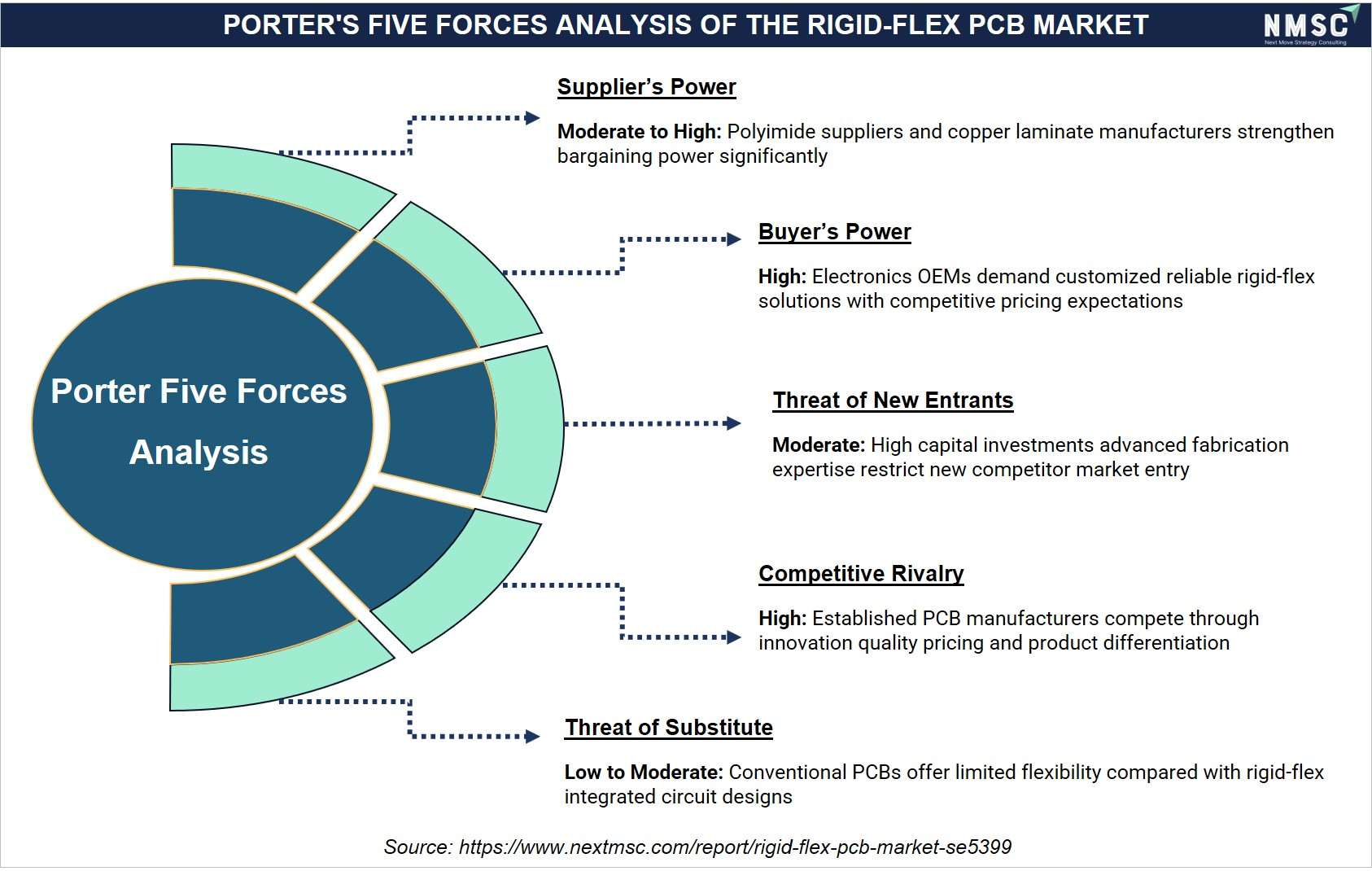
Our findings suggest that the rigid-flex PCB market experiences moderate supplier bargaining power due to dependence on specialized raw materials and fabrication technologies, while buyer bargaining power remains moderate to high because OEMs demand high reliability, customization, and competitive pricing. The threat of new entrants is relatively low owing to substantial capital investment, technological expertise, and certification requirements. The threat of substitutes remains moderate, as conventional rigid or flexible PCBs may serve selected applications, although they cannot fully match rigid-flex performance in compact, high-reliability designs. Competitive rivalry is high, driven by continuous innovation, manufacturing capabilities, product quality, and strategic partnerships across automotive, aerospace, medical, and consumer electronics sectors.
Growth Drivers & Restraints
Growth Catalyst & Risk Assessment Matrix
|
Factors |
Type |
(+/-) % Impact on CAGR |
Geographic Relevance |
Impact Timeline |
|
Smartphone and wearable miniaturization |
Driver |
+1.8% |
Global, concentrated in Asia-Pacific |
2026–2035 |
|
Automotive electrification and ADAS adoption |
Driver |
+2.1% |
North America, Europe, China |
2026–2035 |
|
5G infrastructure and data centre buildout |
Driver |
+1.4% |
North America, Asia-Pacific |
2026–2032 |
|
Aerospace and defence electronics modernization |
Driver |
+1.1% |
North America, Europe |
2026–2035 |
|
Medical wearable and implantable device growth |
Driver |
+0.9% |
North America, Europe, Japan |
2026–2035 |
|
Raw material and laminate price volatility |
Restraint |
-1.2% |
Global |
2026–2030 |
|
High capital intensity of HDI fabrication |
Restraint |
-0.8% |
Global, acute in emerging APAC |
2026–2035 |
|
Design and yield complexity of cavity structures |
Restraint |
-0.6% |
Global |
2026–2032 |
|
Geopolitical trade restrictions on electronics supply chains |
Restraint |
-0.7% |
China, U.S., Taiwan< |
2026–2030 |
What Is the Primary Growth Driver of the Rigid-Flex PCB Market?
Automotive electrification is the primary growth driver, as the U.S. Department of Energy reports electric vehicle sales continuing to expand across light-duty fleets, each requiring multiple rigid-flex assemblies for battery management and sensor interconnects. We found that this driver alone contributes an estimated 2.1 percentage points to the 2026–2035 CAGR, with Automotive end-use revenue reaching approximately USD 1.07 billion in 2025.
How Is 5G Infrastructure Deployment Driving Market Growth?
5G infrastructure deployment is driving rigid-flex demand as the U.S. Federal Communications Commission continues authorizing additional millimeter-wave spectrum for carrier networks, requiring high-frequency interconnects in base station and antenna-in-package modules. Our analysis shows that Communications and Networking end-use revenue reached approximately USD 0.44 billion in 2025, supported by low-loss laminate and liquid crystal polymer material adoption across base station equipment.
What Is Restraining the Rigid-Flex PCB Market?
Raw material and laminate price volatility restrains margins across the industry, as U.S. Geological Survey data shows copper price fluctuations directly affecting substrate and via-fill input costs. We observed that this restraint reduces the 2026–2035 CAGR by an estimated 1.2 percentage points, disproportionately affecting smaller fabricators without long-term laminate supply agreements.
Segmentation Analysis
Segment Sizing: By Product Architecture
|
Segment |
2025 (USD Billion) |
2035 (USD Billion) |
CAGR% (2026–2035) |
|
Standard Rigid-Flex |
1.65 |
3.44 |
7.5% |
|
HDI Rigid-Flex |
1.07 |
2.81 |
10.3% |
|
Semi-Flex |
0.49 |
1.08 |
8.3% |
|
High-Frequency Rigid-Flex |
0.68 |
1.94 |
11.3% |
|
Embedded Component Rigid-Flex |
0.39 |
0.98 |
9.8% |
|
Cavity Rigid-Flex |
0.34 |
0.79 |
8.8% |
|
Other |
0.24 |
0.44 |
6.3% |
|
Total |
4.85 |
11.49 |
9.0% |
Which Product Architecture Dominates the Rigid-Flex PCB Market?
Standard Rigid-Flex dominates the rigid-flex PCB market, valued at USD 1.65 billion in 2025 on the strength of established qualification across consumer electronics and industrial control applications. We found that High-Frequency Rigid-Flex is the fastest-growing architecture at an 11.3% CAGR, propelled by 5G base station and aerospace radar demand requiring low-loss signal transmission through 2035.
Segment Sizing: By Material System
|
Segment |
2025 (USD Billion) |
2035 (USD Billion) |
CAGR% (2026–2035) |
|
Polyimide |
2.23 |
4.99 |
8.3% |
|
FR-4 Hybrid |
1.16 |
2.48 |
7.7% |
|
Low-Loss Laminate |
0.78 |
2.22 |
11.1% |
|
LCP |
0.49 |
1.44 |
11.8% |
|
Other |
0.19 |
0.36 |
5.8% |
|
Total |
4.85 |
11.49 |
9.0% |
Which Material System Leads the Rigid-Flex PCB Market?
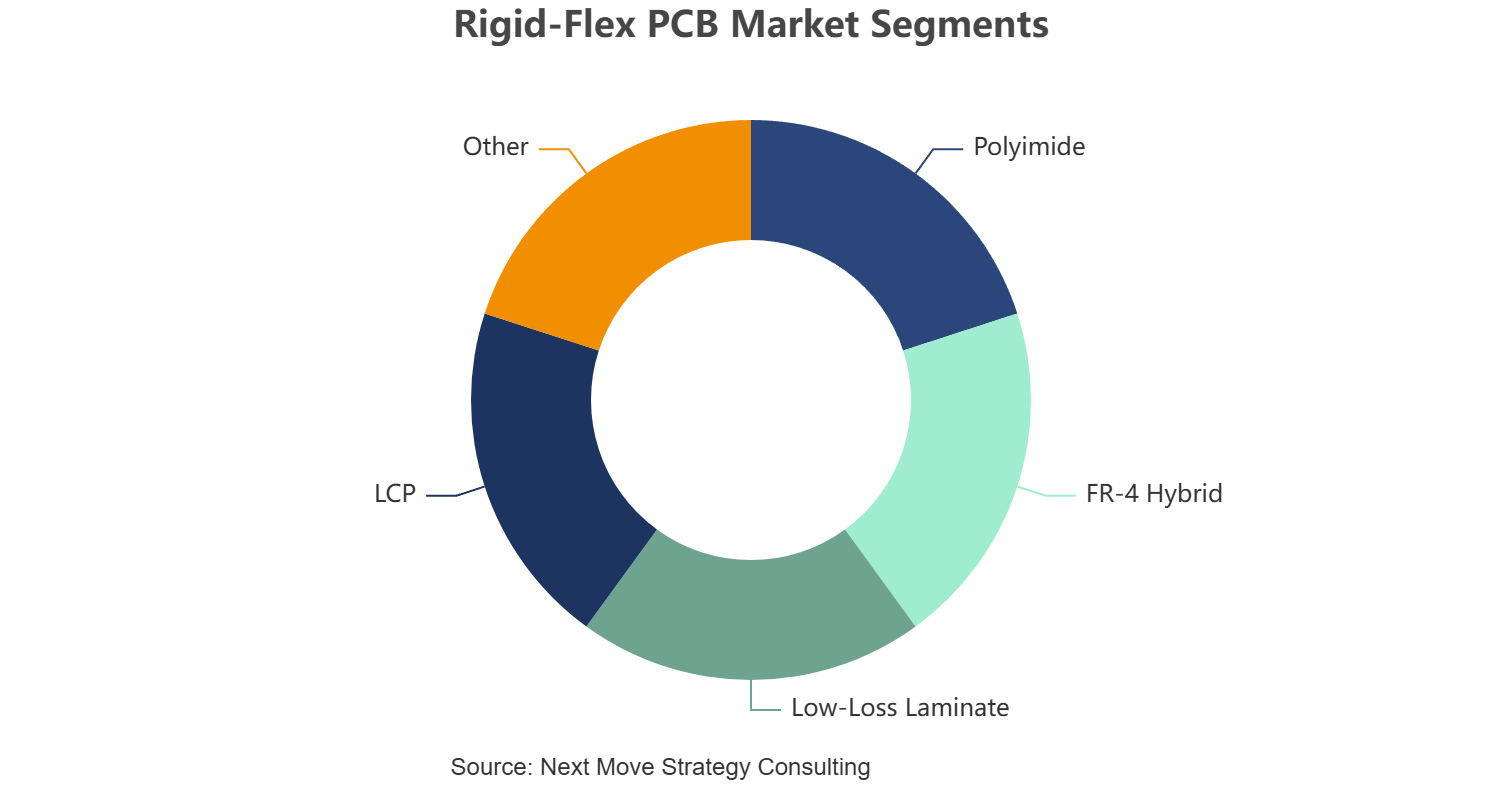
Polyimide leads the rigid-flex PCB market with a 46% share in 2025, reflecting its established flexibility, thermal stability, and dominance in consumer electronics applications. Our analysis shows that LCP is the fastest-growing material system at an 11.8% CAGR, as its low dielectric loss properties make it the preferred substrate for high-frequency 5G and radar applications requiring superior signal integrity.
Segment Sizing: By End User
|
Segment |
2025 (USD Billion) |
2035 (USD Billion) |
CAGR% (2026–2035) |
|
Consumer Electronics |
1.46 |
2.98 |
7.2% |
|
Automotive |
1.07 |
3.03 |
11.2% |
|
Industrial |
0.58 |
1.26 |
7.9% |
|
Medical |
0.49 |
1.14 |
8.9% |
|
Aerospace and Defence |
0.44 |
1.05 |
9.2% |
|
Communications and Networking |
0.44 |
1.09 |
9.6% |
|
Computing and Data Centres |
0.29 |
0.78 |
10.4% |
|
Other |
0.10 |
0.17 |
5.4% |
|
Total |
4.85 |
11.49 |
9.0% |
Which End User Segment Dominates the Rigid-Flex PCB Market?
Consumer Electronics dominates the rigid-flex PCB market with a 30% share in 2025, driven by smartphone, wearable, and foldable device volumes. We observed that Automotive is the fastest-growing end user at an 11.2% CAGR, as electric vehicle platforms increasingly displace conventional rigid boards, a trend consistent with broader growth seen in the Automotive Semiconductor Market serving adjacent vehicle electronics content.
Growth Opportunities
Next Move Strategy Consulting's analysis indicates three forward-looking whitespace opportunities are emerging across the rigid-flex PCB value chain through 2035.
How Can Suppliers Capture Value From Foldable and Wearable Device Growth?
Foldable smartphone and wearable device platforms require ultra-thin HDI rigid-flex assemblies with dynamic bend-cycle durability, creating whitespace for fabricators investing in sub-50-micron dielectric processing. Consumer electronics original equipment manufacturers stand to benefit from suppliers offering integrated design-for-reliability support.
What Opportunity Exists in Satellite and Low-Earth-Orbit Communications?
Expanding low-earth-orbit satellite constellations require lightweight, high-frequency rigid-flex assemblies capable of withstanding launch vibration and thermal extremes. Aerospace and defence end users benefit as suppliers with space-qualified low-loss laminate processes secure long-term constellation supply contracts.
How Can Embedded Component Architectures Unlock Data Centre Interconnect Demand?
Data centre accelerator modules increasingly require embedded component rigid-flex boards that shorten signal paths between processing and memory tiers. Computing and Data Centres end users benefit as suppliers combining embedded-die capability with high-layer-count processing capture premium-priced interconnect content.
Regional Outlook
|
Region |
2025 (USD Billion) |
2035 (USD Billion) |
CAGR% (2026–2035) |
Key Driver |
|
Asia-Pacific |
2.81 |
6.98 |
9.6% |
Consumer electronics and PCB manufacturing base |
|
North America |
0.97 |
2.06 |
7.7% |
Automotive electrification and aerospace demand |
|
Europe |
0.68 |
1.36 |
7.0% |
Automotive and industrial electronics regulation |
|
Middle East & Africa |
0.19 |
0.59 |
12.1% |
Telecommunications infrastructure expansion |
|
Latin America |
0.19 |
0.50 |
10.0% |
Electronics manufacturing services expansion |
|
Total |
4.85 |
11.49 |
9.0% |
— |
Asia-Pacific Rigid-Flex PCB Market
Asia-Pacific dominates the rigid-flex PCB industry, supported by concentrated smartphone assembly, PCB fabrication capacity, and electronics manufacturing services infrastructure across China, Taiwan, Japan, and South Korea. We observed that regional technology adoption is shifting towardHDI and embedded component processes as manufacturers pursue higher value-add content. Regulatory support for domestic semiconductor and electronics supply chains continues to shape capacity expansion strategy, positioning the region for sustained leadership through 2035.
North America Rigid-Flex PCB Market
North America's rigid-flex PCB industry benefits from automotive electrification, aerospace and defence modernization, and reshoring incentives under the U.S. CHIPS and Science Act supporting domestic electronics manufacturing. Our assessment indicates that technology adoption is concentrated in high-reliability automotive and aerospace-qualified architectures. Regulatory emphasis on supply chain security continues to favor North American-qualified suppliers, supporting steady, quality-driven growth through 2035.
Europe Rigid-Flex PCB Market
Europe's rigid-flex PCB industry is shaped by automotive electrification mandates and the European Union's Restriction of Hazardous Substances Directive governing material composition. We found that German and French automotive suppliers are driving adoption of automotive-qualified rigid-flex architectures for battery management systems. Regulatory emphasis on recyclability and hazardous substance restriction continues to influence material selection across the region's electronics supply base.
Middle East & Africa Rigid-Flex PCB Market
The Middle East & Africa rigid-flex PCB industry is expanding rapidly as telecommunications infrastructure investment accelerates 5G network rollout across Gulf Cooperation Council states. We observed that regional demand remains import-dependent, with limited local fabrication capacity. Strategic outlook favors continued import growth as regional carriers and defence programs expand high-frequency interconnect procurement through 2035.
Latin America Rigid-Flex PCB Market
Latin America's rigid-flex PCB market is supported by expanding electronics manufacturing services operations in Brazil and Mexico serving consumer electronics and automotive customers. Our findings suggest that regional technology adoption remains concentrated in standard and semi-flex architectures, with limited HDI fabrication capacity. Strategic outlook favors continued growth as nearshoring trends redirect North American electronics assembly demand into the region through 2035.
U.S. Rigid-Flex PCB Market
Based on our estimates, the U.S. rigid-flex PCB industry was valued at approximately USD 590 million in 2025 and is projected to reach USD 1.25 billion by 2035, expanding at a 7.8% CAGR. Demand is concentrated in automotive-qualified and aerospace-grade architectures, supported by strong technology penetration among defence contractors. Regulatory emphasis on domestic supply chain security under the CHIPS and Science Act continues to shape competitive intensity among qualified suppliers, with strategic outlook favoring reshored high-reliability production.
Canada Rigid-Flex PCB Market
The market in Canada was valued at approximately USD 116 million in 2025 and is projected to reach USD 247 million by 2035, expanding at a 7.7% CAGR. Demand structure is weighted toward aerospace and industrial control applications, with moderate technology penetration relative to the U.S. Regulatory alignment with North American automotive standards shapes adoption, while competitive intensity remains limited to a small qualified supplier base with strategic outlook tied to aerospace program awards.
UK Rigid-Flex PCB Market
As per our estimate, the UK rigid-flex PCB industry was valued at approximately USD 204 million in 2025 and is projected to reach USD 408 million by 2035, expanding at a 7.0% CAGR. Demand is driven by aerospace and defence electronics programs, with growing technology penetration in medical device interconnects. Regulatory influence from post-Brexit conformity assessment requirements shapes supplier qualification, with strategic outlook favoring defence-linked procurement through 2035.
Germany Rigid-Flex PCB Market
According to our analysis, Germany's rigid-flex PCB industry was valued at approximately USD 190 million in 2025 and is projected to reach USD 381 million by 2035, expanding at a 7.0% CAGR. Demand structure is dominated by automotive electrification programs among domestic vehicle manufacturers. Regulatory influence from the European Union's Restriction of Hazardous Substances Directive shapes material selection, with competitive intensity high among automotive-qualified suppliers and strategic outlook favoring battery management system content growth.
France Rigid-Flex PCB Market
Based on our estimates, France's rigid-flex PCB industry was valued at approximately USD 122 million in 2025 and is projected to reach USD 245 million by 2035, expanding at a 7.0% CAGR. Demand is supported by aerospace and defence programs alongside growing automotive electrification content. Technology penetration is concentrated in high-reliability architectures, with regulatory influence from European Union material directives shaping strategic outlook toward defence-linked and automotive supplier qualification.
China Rigid-Flex PCB Market
The market in China was valued at approximately USD 1.13 billion in 2025 and is projected to reach USD 2.79 billion by 2035, expanding at a 9.6% CAGR. Demand structure is anchored by concentrated smartphone and consumer electronics assembly capacity. Technology penetration is advancing toward HDI and embedded component architectures, with regulatory support for domestic electronics supply chains shaping competitive intensity among a large qualified fabricator base and strategic outlook favoring continued manufacturing leadership.
India Rigid-Flex PCB Market
As per our estimate, India's rigid-flex PCB industry was valued at approximately USD 394 million in 2025 and is projected to reach USD 1.25 billion by 2035, expanding at a 12.6% CAGR, the fastest among covered countries. Demand is accelerating under the government's Production Linked Incentive scheme for electronics manufacturing. Technology penetration remains early-stage relative to established APAC hubs, with strategic outlook favoring rapid capacity buildout through 2035.
Japan Rigid-Flex PCB Market
According to our analysis, Japan's rigid-flex PCB industry was valued at approximately USD 450 million in 2025 and is projected to reach USD 1.12 billion by 2035, expanding at a 9.6% CAGR. Demand structure is weighted toward high-precision consumer electronics and automotive electronics applications. Technology penetration in embedded component architectures is advanced, with regulatory quality standards shaping competitive intensity among established domestic fabricators and strategic outlook favoring premium, high-reliability segments.
South Korea Rigid-Flex PCB Market
Based on our estimates, South Korea's rigid-flex PCB industry was valued at approximately USD 338 million in 2025 and is projected to reach USD 838 million by 2035, expanding at a 9.6% CAGR. Demand is concentrated among domestic smartphone and display manufacturers requiring advanced HDI architectures. Technology penetration is among the most advanced regionally, with strategic outlook favoring continued leadership in foldable device interconnects through 2035.
Australia Rigid-Flex PCB Market
The market in Australia was valued at approximately USD 113 million in 2025 and is projected to reach USD 279 million by 2035, expanding at a 9.6% CAGR. Demand structure is weighted toward defence and mining-sector industrial electronics applications, with import-dependent supply. Technology penetration is moderate, with regulatory alignment to international standards shaping supplier qualification and strategic outlook favoring defence procurement programs.
UAE Rigid-Flex PCB Market
As per our estimate, the UAE rigid-flex PCB industry was valued at approximately USD 58 million in 2025 and is projected to reach USD 177 million by 2035, expanding at a 12.0% CAGR. Demand is driven by telecommunications infrastructure and smart-city electronics initiatives. Technology penetration is rising quickly from a small base, with strategic outlook favoring continued import growth as regional 5G network density increases through 2035.
Saudi Arabia Rigid-Flex PCB Market
According to our analysis, Saudi Arabia's rigid-flex PCB industry was valued at approximately USD 68 million in 2025 and is projected to reach USD 207 million by 2035, expanding at a 12.1% CAGR. Demand structure is linked to Vision 2030 digital infrastructure investment programs. Technology penetration remains early-stage, with strategic outlook favoring continued telecommunications and defence-linked procurement growth through 2035.
South Africa Rigid-Flex PCB Market
Based on our estimates, South Africa's rigid-flex PCB industry was valued at approximately USD 29 million in 2025 and is projected to reach USD 89 million by 2035, expanding at a 12.0% CAGR. Demand is concentrated in telecommunications and industrial automation applications. Technology penetration remains limited relative to Gulf Cooperation Council markets, with strategic outlook favoring gradual import-led growth through 2035.
Brazil Rigid-Flex PCB Market
The market in Brazil was valued at approximately USD 97 million in 2025 and is projected to reach USD 250 million by 2035, expanding at a 9.9% CAGR. Demand structure is supported by expanding electronics manufacturing services operations serving consumer electronics and automotive customers. Technology penetration is concentrated in standard architectures, with strategic outlook favoring nearshoring-driven capacity growth through 2035.
Argentina Rigid-Flex PCB Market
As per our estimate, Argentina's rigid-flex PCB industry was valued at approximately USD 39 million in 2025 and is projected to reach USD 100 million by 2035, expanding at a 9.9% CAGR. Demand is concentrated in industrial and automotive electronics applications, with import-dependent supply. Technology penetration remains limited, with strategic outlook favoring gradual growth tied to regional electronics assembly expansion through 2035.
Competitive Landscape
We found that competitive intensity in the rigid-flex PCB market is high, with leading fabricators differentiating through process capability, capacity scale, and application-specific qualification rather than price alone.
|
Attribute |
Details |
|
Market Structure |
Moderately consolidated among the top ten fabricators, with a long tail of regional specialists |
|
Innovation Focus |
HDI miniaturization, embedded component integration, and low-loss laminate processing |
|
M&A Activity |
Selective capacity-expansion acquisitions and joint ventures targeting automotive and 5G qualification |
How Do Companies Compete in the Rigid-Flex PCB Market?
Companies compete primarily on process capability, layer-count capacity, and application-specific certification rather than price, given the high reliability requirements of automotive and aerospace end markets. Our analysis shows that suppliers with automotive IATF 16949 and aerospace AS9100 certifications command premium positioning, while scale advantages in HDI processing support cost competitiveness in consumer electronics volume production.
Which Competitive Archetypes Dominate the Rigid-Flex PCB Market?
Two archetypes dominate the rigid-flex PCB industry: large-scale Taiwanese and Chinese fabricators competing on HDI process capacity for consumer electronics, and specialized North American and European suppliers competing on automotive and aerospace qualification depth. We observed that this bifurcation explains why consumer-focused fabricators pursue volume efficiency while defence-oriented suppliers pursue reliability certification as their core differentiator.
What Innovation and Differentiation Strategies Define Market Leaders?
Market leaders differentiate through embedded component integration, low-loss laminate processing, and design-for-manufacturability collaboration with original equipment manufacturers early in product development cycles. Next Move Strategy Consulting's analysis indicates that suppliers investing in automated optical inspection and laser direct imaging capacity are best positioned to support the tightening tolerances required by HDI and high-frequency architectures.
What M&A and Geographic Expansion Activity Is Shaping the Market?
M&A activity remains selective, with fabricators pursuing capacity-expansion joint ventures in Southeast Asia to diversify manufacturing footprint amid geopolitical trade uncertainty. We observed that Taiwanese and Chinese suppliers are establishing production facilities in Vietnam and Thailand to maintain tariff-neutral access to North American and European customers, reflecting a broader geographic diversification strategy across the industry.
Supply Chain Structure of the Rigid-Flex PCB Industry
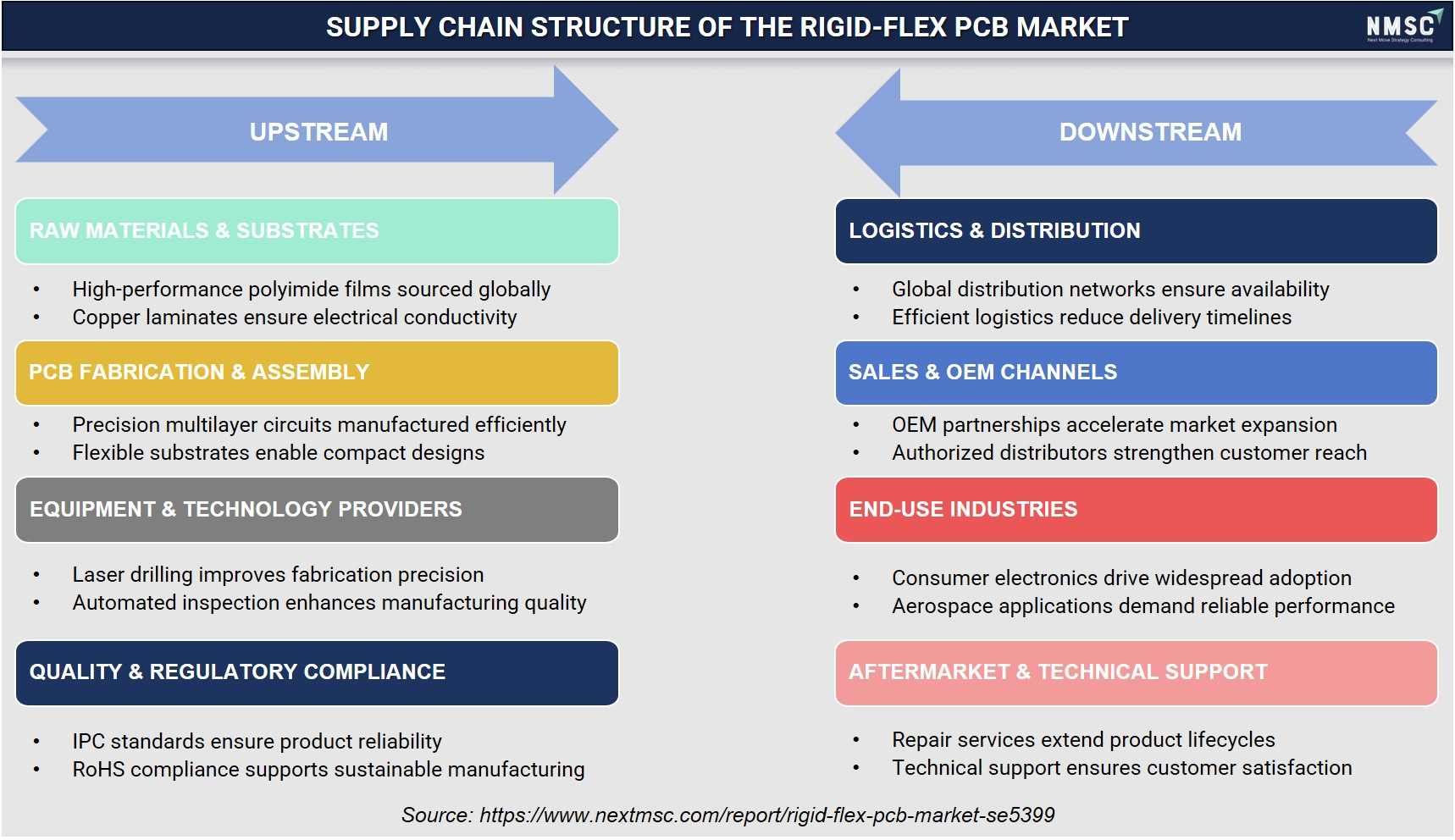
Our analysis indicates that the rigid-flex PCB market supply chain starts with suppliers of high-performance polyimide films, copper laminates, and other advanced substrate materials, followed by PCB fabrication, multilayer assembly, and precision equipment providers that ensure manufacturing quality and reliability. Downstream activities include logistics and distribution, OEM and authorized sales channels, end-use industries such as consumer electronics and aerospace, and aftermarket technical support that extends product lifecycle, enhances customer satisfaction, and supports long-term market growth.
Key Market Players
Our findings suggest that the following companies represent the leading validated participants shaping competitive dynamics across the rigid-flex PCB industry.
-
Avary Holding (Shenzhen) Co., Limited.
-
Zhen Ding Technology Holding Limited.
-
Unimicron Technology Corporation.
-
Compeq Manufacturing Co., Ltd.
-
Samsung Electro-Mechanics Co., Ltd.
-
Ibiden Co., Ltd.
-
TTM Technologies, Inc.
-
Shennan Circuits Co., Ltd.
-
Kinwong Electronic Co., Ltd.
-
Tripod Technology Corporation.
-
Meiko Electronics Co., Ltd.
-
Daeduck Electronics Co., Ltd.
-
Nan Ya Printed Circuit Board Corp.
-
Flexium Interconnect, Inc.
-
WUS Printed Circuit Co., Ltd.
-
HannStar Board Corporation.
-
Sanmina Corporation.
-
Interflex Co., Ltd.
-
SI Flex Co., Ltd.
Latest Developments
We observed that recent developments across the rigid-flex PCB market reflect capacity expansion and qualification milestones among leading fabricators.
|
Date |
Event |
|
June 2026 |
TTM Technologies announced a definitive agreement to acquire European printed circuit board specialists Swiss Technology Group AG (STG) and ILFA GmbH in all-cash transactions, expanding its technical footprint in specialized rigid-flex and miniaturized interconnect solutions for high-reliability medical, aerospace, and defense applications |
|
May 2026 |
Unimicron Technology announced a strategic production shift at its annual general meeting to aggressively scale up advanced ABF substrates and high-end AI system-board upgrades, targeting record-breaking annual revenues driven by surging demand for AI-related ASICs, switches, and high-performance computing hardware |
|
February 2026 |
Ibiden Co., Ltd. formally approved an extensive capital investment plan directed toward expanding its production footprint for high-performance IC package substrates, scaling manufacturing capabilities to support next-generation server and AI processor roadmaps |
Investment Opportunities
Where Are Capital Inflows Concentrated in the Rigid-Flex PCB Market?
Capital inflows are concentrated in HDI and automotive-qualified capacity expansion, with fabricators in Taiwan, China, and Southeast Asia directing investment towardlaser direct imaging and automated optical inspection equipment. We observed that this capital allocation pattern reflects rising demand for tighter tolerance and higher reliability rigid-flex assemblies across consumer and automotive end markets.
How Is Infrastructure Investment Shaping Manufacturing Capacity?
Infrastructure investment is shaping capacity through new facility construction in Vietnam, Thailand, and Malaysia as fabricators diversify away from single-country concentration amid geopolitical trade uncertainty. Our findings suggest that this diversification supports resilience for original equipment manufacturers seeking tariff-neutral supply continuity across North American and European customer bases.
What ESG Considerations Are Relevant to Rigid-Flex PCB Investment?
Environmental, social, and governance considerations are increasingly relevant as manufacturers respond to the European Union's Restriction of Hazardous Substances Directive and expanding extended producer responsibility frameworks governing electronic waste. We found that fabricators investing in lead-free and halogen-free material qualification are better positioned to meet tightening disclosure requirements from environmentally conscious original equipment manufacturer customers.
Key Benefits for Stakeholders
How Does This Report Benefit Industry Leaders?
Industry leaders benefit from the report's segmentation analysis and competitive benchmarking, which clarify where capacity investment and qualification depth create the strongest differentiation across product architectures and end-use verticals. Our analysis shows that this evidence base supports more informed capital allocation decisions across the rigid-flex PCB market's fastest-growing segments.
How Does This Report Benefit Investors and Financial Analysts?
Investors and financial analysts benefit from the report's reconciled market-size forecasts and regional growth differentials, which support comparative evaluation of fabricators positioned in high-CAGR segments such as automotive and high-frequency architectures. We found that this data foundation strengthens due diligence around capacity-expansion and consolidation opportunities through 2035.
How Does This Report Benefit Technology Vendors and Product Teams?
Technology vendors and product teams benefit from the report's trend analysis covering HDI, embedded component, and high-frequency architecture adoption, which informs process equipment and material development roadmaps. Our assessment indicates that this insight helps vendors align capacity and material innovation with the qualification requirements of automotive, aerospace, and communications customers.
Key Market Segments
By Product Architecture
-
Standard Rigid-Flex
-
HDI Rigid-Flex
-
Semi-Flex
-
High-Frequency Rigid-Flex
-
Embedded Component Rigid-Flex
-
Cavity Rigid-Flex
-
Other
By Material System
-
Polyimide
-
FR-4 Hybrid
-
Low-Loss Laminate
-
LCP
-
Other
By Layer Count
-
2 to 4 Layers
-
5 to 8 Layers
-
9 to 16 Layers
-
17 Plus Layers
By Revenue Stream
-
Prototype
-
NPI
-
Volume Production
-
Engineering Services
-
Other
By Sales Channel
-
Direct OEM
-
Direct EMS
-
Distributor
-
Online Prototype
-
Other Direct
By End User
-
Consumer Electronics
-
Automotive
-
Industrial
-
Medical
-
Aerospace and Defence
-
Communications and Networking
-
Computing and Data Centres
-
Other
By Region
-
North America: U.S., Canada, Mexico.
-
Europe: UK, Germany, France, Italy, Spain, Sweden, Denmark, Finland, Netherlands, Rest of Europe.
-
Asia-Pacific: China, India, Japan, South Korea, Taiwan, Indonesia, Vietnam, Australia, Philippines, Malaysia, Rest of APAC.
-
Middle East & Africa: Saudi Arabia, UAE, Egypt, Israel, Turkey, Nigeria, South Africa, Rest of MEA.
-
Latin America: Brazil, Argentina, Chile, Colombia, Rest of LATAM.
Conclusion & Recommendations
What Is the Long-Term Outlook for the Rigid-Flex PCB Market?
The long-term outlook for the rigid-flex PCB market remains positive, supported by sustained automotive electrification, 5G infrastructure buildout, and miniaturization demand across consumer electronics through 2035. We found that Asia-Pacific will retain its manufacturing leadership while North America and Europe capture disproportionate value in high-reliability automotive and aerospace segments.
What Strategic Positioning Should Suppliers Pursue?
Suppliers should prioritize HDI and embedded component process investment while pursuing automotive IATF 16949 and aerospace AS9100 certification to secure long-term original equipment manufacturer contracts. Our assessment indicates that converters investing early in low-loss laminate capability and high-frequency qualification will be best positioned to capture premium pricing within the rigid-flex PCB market.
How Attractive Is the Rigid-Flex PCB Market for New Investment?
The rigid-flex PCB market presents an attractive investment case, supported by a USD 6.20 billion absolute dollar opportunity between 2026 and 2035 and above-average growth in automotive and high-frequency product categories. We found that investment attractiveness is highest for fabricators combining automotive qualification with scaled HDI manufacturing capacity.
What Market Shifts and Key Risks Should Stakeholders Monitor?
Stakeholders should monitor laminate price volatility, tightening geopolitical trade restrictions on electronics supply chains, and competitive pressure from alternative substrate technologies as key risks to the rigid-flex PCB market. Our analysis shows that suppliers unable to diversify manufacturing footprint risk losing customer allocation to competitors with tariff-resilient production bases.
What Are the Key Growth Pathways for the Rigid-Flex PCB Market?
Key growth pathways include expanding automotive-qualified and high-frequency product portfolios, scaling embedded component capacity, and deepening penetration into satellite communication and data centre interconnect channels. Next Move Strategy Consulting's analysis indicates that suppliers pursuing these pathways while maintaining cost competitiveness in standard architectures will be best positioned to capture the rigid-flex PCB market's projected growth through 2035.
About the Author
 Saista Faiyaz
— Saista Faiyaz is Research Associate at Next Move Strategy Consulting, where she has covered consumer markets and healthcare technologies for 3 years. Her work includes primary interview review, secondary-source validation, market sizing, and structured analysis of company and industry data. She supports research by comparing evidence across sources, organizing findings into market narratives, and documenting assumptions used in analysis. Her scope includes cross-market benchmarking, and reports.
Saista Faiyaz
— Saista Faiyaz is Research Associate at Next Move Strategy Consulting, where she has covered consumer markets and healthcare technologies for 3 years. Her work includes primary interview review, secondary-source validation, market sizing, and structured analysis of company and industry data. She supports research by comparing evidence across sources, organizing findings into market narratives, and documenting assumptions used in analysis. Her scope includes cross-market benchmarking, and reports.
About the Reviewer
 Supradip Baul
— Supradip Baul is an accomplished business consultant and strategist with over a decade of rich experience in market intelligence, strategy, technology, and business transformation. His work has included rigorous qualitative and quantitative analysis across multiple industries, helping clients shape investment decisions and long-term roadmaps. Earlier in his career, he was associated with Gartner, where he contributed to industry-leading reports and market share analyses. He has worked with leading global companies and holds an MBA with a dual specialization in Marketing and Finance.
Supradip Baul
— Supradip Baul is an accomplished business consultant and strategist with over a decade of rich experience in market intelligence, strategy, technology, and business transformation. His work has included rigorous qualitative and quantitative analysis across multiple industries, helping clients shape investment decisions and long-term roadmaps. Earlier in his career, he was associated with Gartner, where he contributed to industry-leading reports and market share analyses. He has worked with leading global companies and holds an MBA with a dual specialization in Marketing and Finance.
At Next Move Strategy Consulting, we understand that insightful market research is the cornerstone of successful business decisions. That's why we employ a robust and multifaceted approach, combining various methodologies to deliver the most accurate and actionable data for our clients.

Research Landscape
We navigate the world of research with two primary approaches:
Qualitative Approach
Our qualitative research methodologies involve immersive techniques such as in-depth interviews, focus groups, and observational studies. By engaging directly with individuals and stakeholders, we uncover valuable insights that quantitative data alone may overlook.

Quantitative Research
In tandem with qualitative methodologies, NMSC leverages the power of Quantitative Research to provide a robust foundation of numerical insights. Through systematic data collection and analysis, we quantify patterns, preferences, and market trends, offering a comprehensive view of the business landscape.
Our quantitative research approach employs diverse tools, including surveys, experiments, and statistical modelling. These methodologies enable us to gather data from a large and representative sample, ensuring the statistical significance of our findings. By employing structured questionnaires and standardized data collection methods, we guarantee the reliability and validity of the information we present to our clients.
Quantitative research is particularly effective in measuring the prevalence of trends, assessing market size, and gauging the impact of various factors on consumer behavior. The numerical precision attained through this approach equips our clients with actionable insights, facilitating data-driven decision-making and strategy formulation.


Our Specialized Toolbox for Industry-Specific Market Research
We deploy a specialized arsenal of techniques tailored to meet your unique requirements. Here's a glimpse into our comprehensive toolbox:

Information Procurement
The stage entails acquiring market data or relevant information through various sources and methodologies.


Market Research Approach
We utilize both top-down and bottom-up approaches in market research analysis to achieve a comprehensive understanding of the market dynamics, leveraging the broad perspective of industry trends and macroeconomic factors alongside detailed insights from specific segments and individual companies.

Porters Five Forces Analysis
We conduct Porter's Five Forces analysis to evaluate the competitive landscape of an industry, providing us with insights into factors that affect profitability and strategic positioning.

SWOT Analysis

Forecasting
We utilize a forecasting model to predict future consumption by considering parameters like population, economics, regulations, market competition, drivers, constraints, technology, and pricing. We also employ statistical techniques such as multilinear regression, exponential smoothing, moving average, ARIMA, and Monte Carlo simulations for accurate predictions. In econometric forecasting, we analyzed short-term and long-term event impacts, attributing values based on regulatory frameworks, economic factors, and market events.





 Speak to Our Analyst