Satellite Launch and Space Insurance Market Global Industry Analysis and Forecast (2026–2035)

The global Satellite Launch and Space Insurance Market size was valued at USD 1.15 billion in 2025 and is estimated at USD 1.26 billion in 2026, forecast to reach USD 2.93 billion by 2035, expanding at a 9.8% CAGR from 2026 to 2035. Key drivers include rising commercial LEO mega-constellation deployment volumes and increasing government and defense satellite program investment, supported by expanding launch activity, insured fleet sizes, scientific missions, navigation satellites, and specialized government-linked coverage demand, with North America leading the global market.

Download Free Sample PDF
Base Year (2025)
$1.15 Billion
Forecast (2035)
$2.93 Billion
CAGR (2026-2035)
9.8%
Top Region
North America

What Is the Satellite Launch and Space Insurance Market Size?

The global satellite launch and space insurance market size was valued at USD 1.15 billion in 2025 and is estimated at USD 1.26 billion in 2026, forecast to reach USD 2.93 billion by 2035, expanding at a 9.8% CAGR between 2026 and 2035. North America leads with approximately 38% share, while in-orbit insurance dominates all other coverage types with approximately 42% share.

We observed that growth is broad-based across every segmentation axis, with third-party liability insurance and low Earth orbit coverage emerging as the dominant structural shifts reshaping the satellite launch and space insurance market through 2035.

Satellite Launch and Space Insurance Market Global Industry Analysis and Forecast (2026–2035) Revenue Forecast

Values in USD Billion

2025 $1.15 Billion
2025
2026 $1.26 Billion
2026
2027 $1.39 Billion
2027
2028 $1.52 Billion
2028
2029 $1.67 Billion
2029
2030 $1.84 Billion
2030
2031 $2.02 Billion
2031
2032 $2.21 Billion
2032
2033 $2.43 Billion
2033
2034 $2.67 Billion
2034
2035 $2.93 Billion
2035

Key Takeaways

By Coverage Type: In-Orbit Insurance held the largest share of approximately 42% (USD 0.483 billion) in 2025; Third-Party Liability Insurance is the fastest-growing sub-segment at 11.1% CAGR from 2026–2035.

By Satellite Type: Commercial Communication Satellites held the largest share of approximately 48% (USD 0.552 billion) in 2025; Earth Observation Satellites is the fastest-growing sub-segment at 13.6% CAGR from 2026–2035.

By Provider Type: Direct Insurers held the largest share of approximately 54% (USD 0.621 billion) in 2025; Insurance Brokers and MGAs are the fastest-growing sub-segment at 11.9% CAGR from 2026–2035.

By Orbit Type: Geostationary Orbit held the largest share of approximately 46% (USD 0.529 billion) in 2025; Low Earth Orbit is the fastest-growing sub-segment at 12.9% CAGR from 2026–2035.

By End User: Commercial Satellite Operators held the largest share of approximately 62% (USD 0.713 billion) in 2025; Commercial Satellite Operators also lead in growth at 10.8% CAGR from 2026–2035.

Dominant Region: North America dominated with approximately 38% revenue share (USD 0.437 billion) in 2025.

Fastest-Growing Region: Asia-Pacific is expected to register the highest CAGR of 13.5% during 2026–2035.

Dominant Country: The U.S. led with approximately USD 0.341 billion in 2025.

Fastest-Growing Country: China is the fastest-growing country at approximately 15.8% CAGR from 2026–2035.

Market Opportunity: The satellite launch and space insurance market is expected to create an absolute dollar opportunity of USD 1.67 billion between 2026 and 2035, presenting significant investment potential across the in-orbit, liability, and LEO constellation underwriting value chain.

According to NMSC analysis, we found that underwriters are increasingly developing parametric and telemetry-based policy structures tailored to high-volume small satellite constellations rather than relying solely on traditional single-asset launch policies, a shift that favors insurers with dedicated smallsat underwriting teams over generalist aerospace carriers as constellation operators scale deployment through 2035.

What Does the Satellite Launch and Space Insurance Market Encompass?

The satellite launch and space insurance market encompasses specialized underwriting products that protect satellite operators, launch providers, and government agencies against financial loss during pre-launch, launch, and in-orbit operational phases. Our assessment indicates that the scope spans coverage for commercial communication satellites, Earth observation platforms, and navigation constellations, underwritten through direct insurers, reinsurers, and specialized brokers serving operators of space launch services and satellite fleets worldwide. The category has evolved from covering a handful of high-value geostationary assets into a diversified market insuring thousands of small satellites, driven by rising constellation deployment volumes and expanding third-party liability exposure.
Regulatory frameworks such as national space liability statutes and international treaty obligations under the Outer Space Treaty shape mandatory third-party liability coverage requirements across launch-licensing jurisdictions. We observed that technology adoption is shifting toward parametric and telemetry-based policy structures that price risk using real-time satellite health data rather than static pre-launch assessments alone. NMSC's analysis indicates that this structural shift, combined with rising constellation deployment volumes, is redefining underwriting criteria across the satellite launch and space insurance market.

Market Drivers & Dynamics

Interactive Dataset
Rising commercial LEO mega-constellation deployment volumes driver +3.6% Global 2026-2035
Expanding third-party liability exposure and regulatory mandates driver +2.4% North America, Europe 2026-2035
Growing government and defense satellite program investment driver +2.1% Asia-Pacific, Middle East 2026-2035
Adoption of parametric and telemetry-based underwriting models driver +1.7% Global 2026-2032
Rising insured asset values for high-capacity GEO satellites driver +1.2% North America, Europe 2026-2035
Expanding reinsurance capacity for smallsat constellation risk driver +1.0% Europe, Asia-Pacific 2026-2032
Limited underwriting capacity among specialized space insurers restraint -1.3% Global 2026-2035
High premium volatility following major launch or in-orbit losses restraint -0.9% Global 2026-2032
Rising uninsured launch share among low-cost commercial operators restraint -0.6% North America, Asia-Pacific 2026-2032
Orbital debris and collision risk complicating claims assessment restraint -0.4% Global 2028-2035
Source: Next Move Strategy Consulting

Growth Drivers

What Is the Primary Growth Driver of the Satellite Launch and Space Insurance Market?

Rising commercial LEO mega-constellation deployment volumes are the primary driver of the market. The U.S. Federal Aviation Administration continues to license a growing volume of annual commercial launches supporting large-scale satellite constellation buildouts. We observed that this regulatory activity, combined with expanding insured fleet sizes among constellation operators, continues to anchor baseline premium volume growth across developed and emerging satellite insurance markets alike.

How Is Government Space Investment Driving Space Insurance Market Growth?

Rising government and defense satellite program investment is accelerating market growth toward specialized government-linked coverage lines. The European Space Agency's budget grew to EUR 10.6 billion across 2023 to 2025, according to the agency's official disclosures, stimulating demand for coverage of scientific missions and navigation satellites including Galileo. Our assessment indicates that this sustained public investment, combined with expanding national space programs, is compressing procurement cycles for government-linked satellite insurance coverage.

Growth Inhibitors

What Is Restraining Satellite Launch and Space Insurance Market Expansion?

Limited underwriting capacity among specialized space insurers restrains the pace of premium volume growth across the industry. Only a small number of carriers worldwide maintain dedicated space underwriting teams with the technical expertise to price satellite and launch risk accurately. We found that this concentrated capacity structure exposes the broader market to significant premium volatility following major launch or in-orbit losses, as a handful of large claims can materially affect available capacity for subsequent policy periods.

What Are the Growth Opportunities?

How Can Parametric Coverage Unlock Value for Smallsat Constellation Operators?

Parametric insurance products present a whitespace opportunity for insurers serving operators of large LEO satellite mega-constellations seeking faster claims settlement across hundreds of insured units. Insurers that commercialize telemetry-triggered payout structures stand to capture recurring fleet-wide premium revenue as constellation operators prioritize claims speed over traditional loss-adjustment processes.

Where Does Debris Liability Coverage Create New Demand?

Rising orbital congestion creates an underpenetrated opportunity for insurers offering dedicated debris liability and collision-avoidance-linked coverage products. Insurers that develop proprietary conjunction-risk pricing models can secure long-term contracts with constellation operators, benefiting from recurring premium revenue tied to mandatory liability coverage requirements in increasingly congested low Earth orbit shells.

How Can Government Space Program Partnerships Benefit Specialized Underwriters?

National space agencies expanding scientific and navigation satellite programs represent an underpenetrated opportunity for insurers offering government-tailored coverage structures. Early movers that build dedicated public-sector underwriting relationships can differentiate with government and defense agency customers pursuing sovereign satellite program expansion across Europe, Asia-Pacific, and the Middle East.

Segmentation Analysis

2025 (USD Billion)
2035 (USD Billion)
Pre-Launch Insurance 2025: $0.09 Billion | 2035: $0.21 Billion
Pre-Launch I
Launch Insurance 2025: $0.39 Billion | 2035: $0.88 Billion
Launch Insur
In-Orbit Insurance 2025: $0.48 Billion | 2035: $1.32 Billion
In-Orbit Ins
Third-Party Liability Insurance 2025: $0.18 Billion | 2035: $0.53 Billion
Third-Party
Pre-Launch Insurance $0.09 Billion $0.21 Billion 8.3%
Launch Insurance $0.39 Billion $0.88 Billion 8.4%
In-Orbit Insurance $0.48 Billion $1.32 Billion 10.6%
Third-Party Liability Insurance $0.18 Billion $0.53 Billion 11.1%

Which Coverage Type Dominates the Satellite Launch and Space Insurance Market?

In-Orbit Insurance led the market with USD 0.483 billion in 2025, supported by the longer duration and higher aggregate premium volume associated with multi-year operational coverage policies. We observed that Third-Party Liability Insurance is the fastest-growing coverage type, expanding at an 11.1% CAGR from 2026 to 2035, as regulators and operators increasingly account for collision and space debris liability exposure amid rising orbital congestion.

2025 (USD Billion)
2035 (USD Billion)
Commercial C
Earth Observ
Navigation S
Scientific a
Defense and
Segment Item 2025 (USD Billion) 2035 (USD Billion) CAGR
Commercial Communication Satellites $10.0 USD Billion $40.0 USD Billion 19.0%
Earth Observation Satellites $17.1 USD Billion $51.1 USD Billion 13.0%
Navigation Satellites $24.2 USD Billion $62.2 USD Billion 27.0%
Scientific and Research Satellites $31.3 USD Billion $73.3 USD Billion 21.0%
Defense and Government Satellites $38.4 USD Billion $84.4 USD Billion 18.0%

Segment-wise data is locked

Unlock complete segment-wise numbers for By Satellite Type.

Unlock Full Data
2025 (USD Billion)
2035 (USD Billion)
Direct Insur
Reinsurers
Insurance Br
Segment Item 2025 (USD Billion) 2035 (USD Billion) CAGR
Direct Insurers $10.0 USD Billion $40.0 USD Billion 22.0%
Reinsurers $17.1 USD Billion $51.1 USD Billion 24.0%
Insurance Brokers and MGAs $24.2 USD Billion $62.2 USD Billion 14.0%

Segment-wise data is locked

Unlock complete segment-wise numbers for By Provider Type.

Unlock Full Data
2025 (USD Billion)
2035 (USD Billion)
Low Earth Or
Medium Earth
Geostationar
Segment Item 2025 (USD Billion) 2035 (USD Billion) CAGR
Low Earth Orbit $10.0 USD Billion $40.0 USD Billion 16.0%
Medium Earth Orbit $17.1 USD Billion $51.1 USD Billion 18.0%
Geostationary Orbit $24.2 USD Billion $62.2 USD Billion 20.0%

Segment-wise data is locked

Unlock complete segment-wise numbers for By Orbit Type.

Unlock Full Data

Which Orbit Type Leads Market Demand?

Geostationary Orbit remained the leading orbit type within the market, valued at USD 0.529 billion in 2025 on sustained high per-asset insured values for large communication satellites. Our findings suggest that Low Earth Orbit coverage is the fastest-growing orbit segment, registering a 12.9% CAGR from 2026 to 2035, as constellation operators insure increasingly large fleets of small satellites deployed for broadband and Earth observation missions.

2025 (USD Billion)
2035 (USD Billion)
Commercial S
Government a
Research and
Segment Item 2025 (USD Billion) 2035 (USD Billion) CAGR
Commercial Satellite Operators $10.0 USD Billion $40.0 USD Billion 26.0%
Government and Defense Agencies $17.1 USD Billion $51.1 USD Billion 16.0%
Research and Scientific Institutions $24.2 USD Billion $62.2 USD Billion 18.0%

Segment-wise data is locked

Unlock complete segment-wise numbers for By End User.

Unlock Full Data

Which End User Segment Is Most Significant in the Market?

Commercial Satellite Operators remained the dominant end user across the market, reaching USD 0.713 billion in 2025 due to rapidly expanding constellation fleet insurance needs. Based on research conducted by NMSC, we found that Commercial Satellite Operators also register the fastest growth among end users at a 10.8% CAGR from 2026 to 2035, reflecting sustained private-sector constellation deployment outpacing government and research program growth.

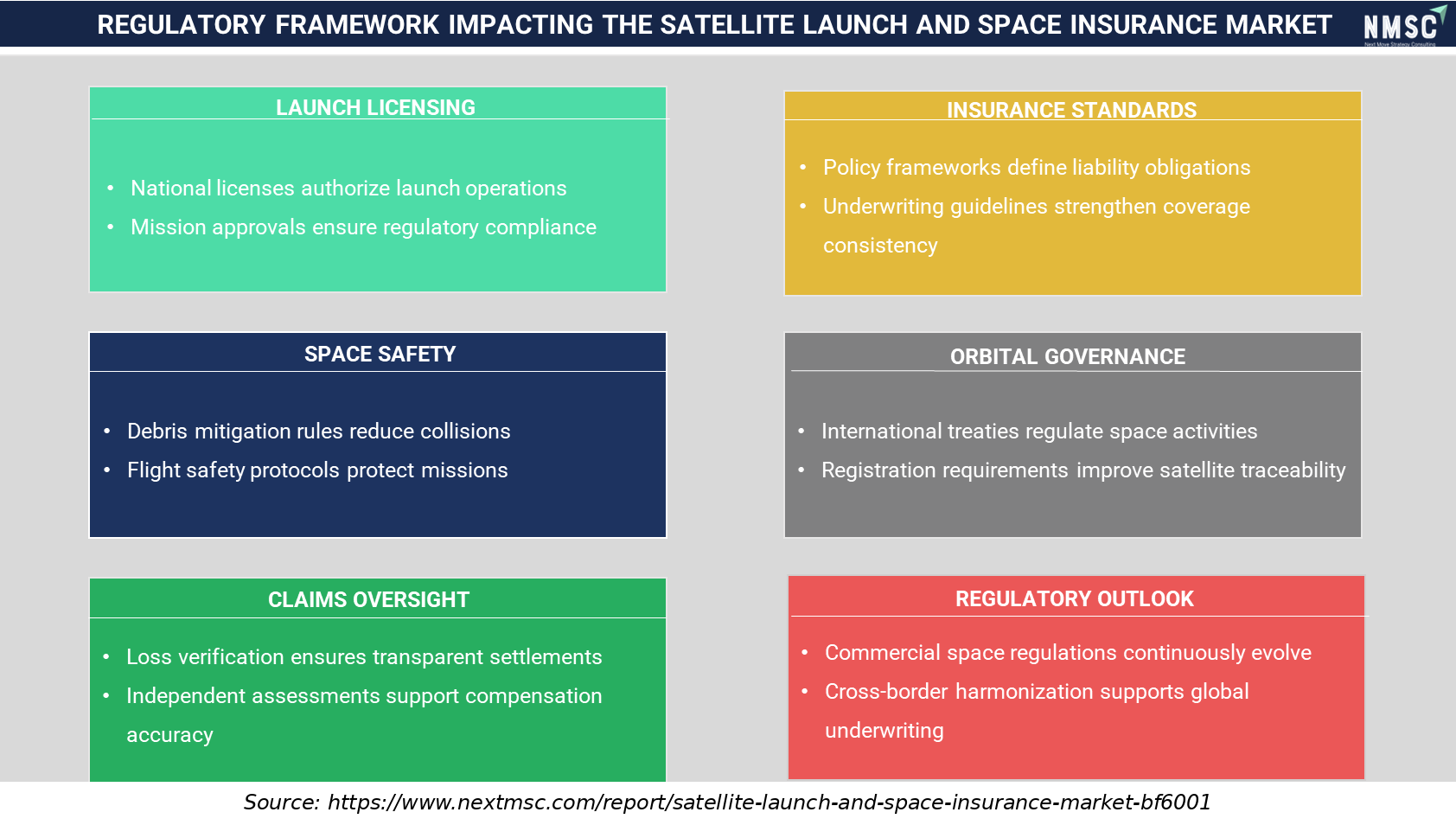
Regulatory Framework Impacting the Satellite Launch and Space Insurance Market

The regulatory framework shapes the satellite launch and space insurance market by establishing launch licensing, orbital safety, underwriting standards, claims oversight, and international compliance requirements. Evolving space governance, debris mitigation regulations, and cross-border policy harmonization enhance risk transparency, strengthen insurer confidence, and support sustainable market growth as commercial space activities continue to expand globally.

Growth Opportunities

Our analysis shows that three forward-looking opportunities stand out for stakeholders positioning within the satellite launch and space insurance market over the 2026-2035 forecast period.

How Can Parametric Coverage Unlock Value for Smallsat Constellation Operators?

Parametric insurance products present a whitespace opportunity for insurers serving operators of large LEO satellite mega-constellations seeking faster claims settlement across hundreds of insured units. Insurers that commercialize telemetry-triggered payout structures stand to capture recurring fleet-wide premium revenue as constellation operators prioritize claims speed over traditional loss-adjustment processes.

Where Does Debris Liability Coverage Create New Demand?

Rising orbital congestion creates an underpenetrated opportunity for insurers offering dedicated debris liability and collision-avoidance-linked coverage products. Insurers that develop proprietary conjunction-risk pricing models can secure long-term contracts with constellation operators, benefiting from recurring premium revenue tied to mandatory liability coverage requirements in increasingly congested low Earth orbit shells.

How Can Government Space Program Partnerships Benefit Specialized Underwriters?

National space agencies expanding scientific and navigation satellite programs represent an underpenetrated opportunity for insurers offering government-tailored coverage structures. Early movers that build dedicated public-sector underwriting relationships can differentiate with government and defense agency customers pursuing sovereign satellite program expansion across Europe, Asia-Pacific, and the Middle East.

Regional Outlook

2025 (USD Billion)
2035 (USD Billion)
North Americ
Europe
Asia-Pacific
Middle East
Latin Americ
Region 2025 (USD Billion) 2035 (USD Billion) CAGR (%)
North America $10.0 USD Billion $40.0 USD Billion 9.0%
Europe $17.1 USD Billion $51.1 USD Billion 27.0%
Asia-Pacific $24.2 USD Billion $62.2 USD Billion 25.0%
Middle East & Africa $31.3 USD Billion $73.3 USD Billion 23.0%
Latin America $38.4 USD Billion $84.4 USD Billion 12.0%

Regional data is locked

Unlock complete regional numbers for this market.

Unlock Full Data

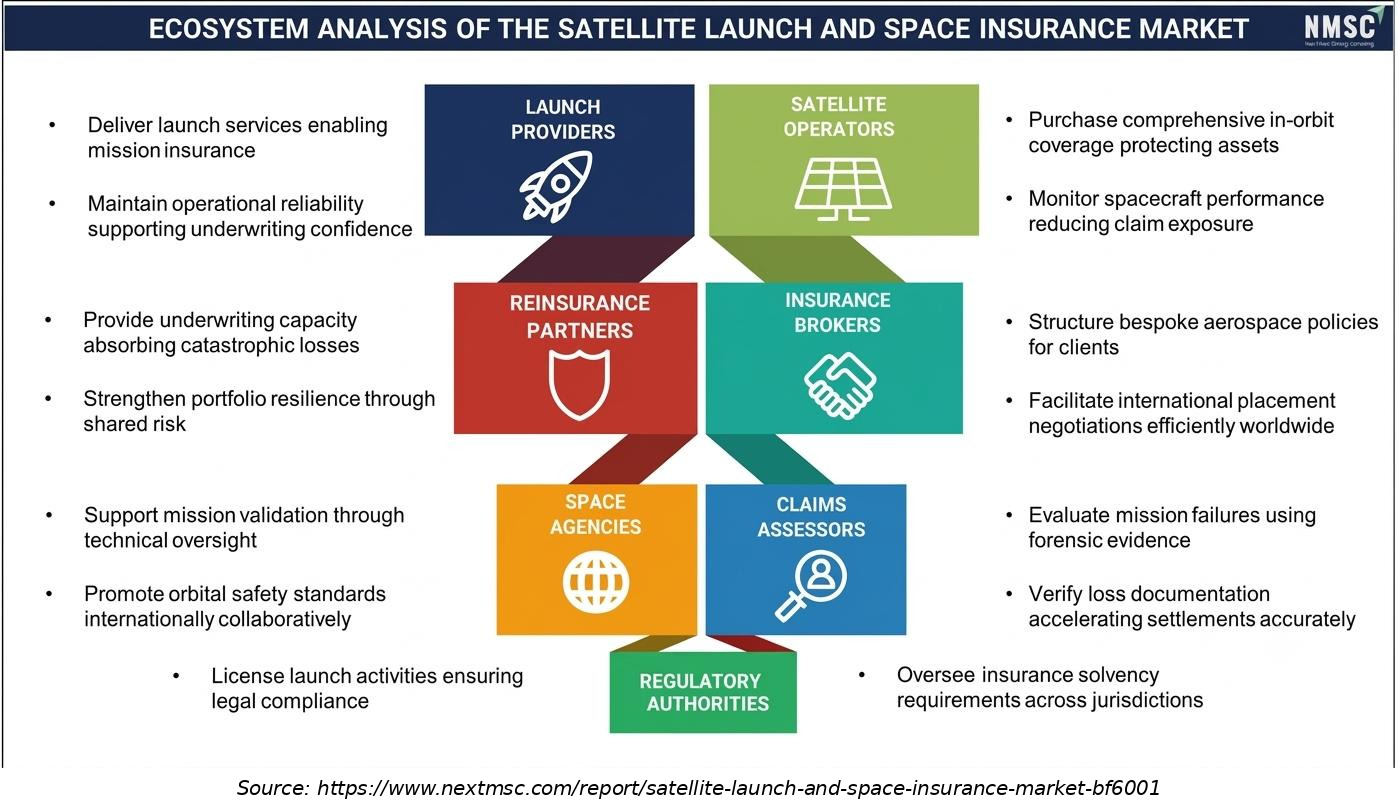
Ecosystem Analysis of the Satellite Launch and Space Insurance Market

The satellite launch and space insurance market ecosystem connects launch providers, satellite operators, reinsurers, insurance brokers, claims assessors, space agencies, and regulatory authorities. Effective collaboration among these stakeholders improves risk assessment, underwriting accuracy, claims management, and regulatory compliance, enabling resilient insurance solutions that support the growing commercial and government space industry.

Competitive Landscape

We observed that competitive dynamics within the satellite launch and space insurance industry are increasingly shaped by underwriting capacity depth, constellation-scale risk modeling, and reinsurance backing rather than pricing alone. Key Takeaways

Dimension Description
Market Structure Highly concentrated among a small number of specialized carriers and Lloyd's syndicates, with the top five markets controlling an estimated majority of global underwriting capacity.
Innovation Focus Parametric and telemetry-based policy structures, debris liability bundling, and proprietary constellation-scale actuarial modeling.
M&A Activity Continued build-out of dedicated space underwriting teams within diversified global insurers rather than standalone specialist acquisitions.

How Do Companies Compete in the Satellite Launch and Space Insurance Market?

Companies compete primarily on underwriting capacity depth, technical risk-assessment expertise, and claims settlement speed rather than price alone. Our analysis shows that only a small number of carriers worldwide maintain dedicated space underwriting teams with the actuarial expertise required to price launch and in-orbit risk accurately. Providers increasingly differentiate through proprietary constellation risk models, reinsurance treaty depth, and parametric product innovation tailored to high-volume smallsat fleets.

Which Competitive Archetypes Dominate the Satellite Launch and Space Insurance Market?

Three competitive archetypes dominate the market: diversified global insurers operating dedicated aerospace and space underwriting divisions, Lloyd's of London syndicates providing specialized lead capacity, and insurance brokers structuring multi-carrier placements for complex satellite risk. We found that carriers such as AXA XL differentiate through dedicated space practice teams spanning multiple financial centers, while Lloyd's syndicates such as Atrium differentiate through concentrated technical underwriting expertise built over decades of space risk placement.

How Are Companies Differentiating Through Innovation in Space Insurance?

Providers are differentiating through parametric coverage products, telemetry-based pricing models, and expanded reinsurance capacity for constellation-scale risk. We observed that AXA XL launched a new parametric satellite coverage product in 2025 specifically designed for smallsat constellation operators, addressing a segment traditional policy structures had historically underserved. Competing carriers are similarly developing proprietary actuarial models incorporating real-time satellite health telemetry to differentiate pricing accuracy for large operator fleets.

What M&A and Expansion Activity Is Shaping the Satellite Launch and Space Insurance Market?

Expansion activity is concentrated on deepening dedicated space underwriting capabilities within existing diversified insurer platforms rather than standalone acquisitions of specialist carriers. Our findings suggest that continental European insurers, particularly Allianz AGCS, Munich Re, and SCOR, continue deepening space underwriting capabilities through dedicated teams and proprietary actuarial models rather than acquiring independent space specialists. This organic capability-building trend illustrates how large diversified carriers are prioritizing internal expertise development over market consolidation.

Key Market Players

Our assessment indicates that the following 20 companies are actively shaping underwriting capacity, product innovation, and reinsurance depth within the global satellite launch and space insurance market.

Allianz SE AXA SA Münchener Rückversicherungs-Gesellschaft Aktiengesellschaft in München (Munich Re) Swiss Re Ltd American International Group, Inc. Chubb Limited Marsh & McLennan Companies, Inc. Aon plc WTW plc Global Aerospace Underwriting Managers Limited Beazley plc Hiscox Ltd Atrium Underwriters Limited Starr International Company, Inc. Tokio Marine Holdings, Inc. SCOR SE PICC Property and Casualty Company Limited Assicurazioni Generali S.p.A. QBE Insurance Group Limited Berkshire Hathaway Inc.

Latest Developments

We found that recent corporate developments within the satellite launch and space insurance market are concentrated on parametric product innovation and expanding launch cadence driving insured fleet growth.

Date Event
June 2026 Marsh reported continued changes in the aerospace insurance market driven by claims activity, geopolitical risks, and supply chain challenges, outlining their impact on underwriting conditions for aviation and space insurance.

Expert Insights

EJ Hentenaar

EJ Hentenaar

CEO | Lockton Europe

"Space insurance is a complex and dynamic field, reflecting the high-risk nature of space activities. It requires a deep understanding of both the technical aspects of space operations and the financial implications of the risks involved."

Analyst Interpretation

The statement underscores the increasing complexity of the satellite launch and space insurance market as commercial space activities accelerate worldwide. With the rapid growth of satellite constellations, reusable launch vehicles, and private-sector participation, insurers are required to develop specialized underwriting expertise capable of assessing both launch and in-orbit risks. This trend is driving greater demand for tailored space insurance products, advanced risk modeling, and comprehensive coverage solutions, positioning insurance as a critical enabler of investment and long-term growth in the global space economy.

Investment Opportunities

What Capital Inflows Are Targeting the Satellite Launch and Space Insurance Market?

Capital inflows into the satellite launch and space insurance market are increasingly directed toward reinsurance capacity supporting large constellation risk and parametric product development. Strategic reinsurers continue to deepen proprietary actuarial models for commercial rockets and constellation deployment risk. We observed that investors favor carriers demonstrating dedicated technical underwriting expertise, viewing specialized space risk knowledge as a proxy for long-term underwriting profitability amid limited industry-wide capacity.

How Is Infrastructure Investment Supporting Space Insurance Market Expansion?

Infrastructure investment in satellite tracking and conjunction-assessment data is expanding underwriters' ability to price debris and collision risk with greater precision. Our findings suggest that insurers are increasingly investing in proprietary telemetry integration and orbital risk analytics to support parametric product development, enabling more accurate premium pricing for constellation operators managing hundreds of insured satellites simultaneously.

What ESG Considerations Are Shaping Space Insurance Investment Decisions?

Environmental, social, and governance considerations are increasingly central to investment decisions across the industry, with orbital debris mitigation and end-of-life satellite disposal as key criteria. National space agency guidelines increasingly inform underwriting standards for debris mitigation compliance among insured operators. We found that insurers increasingly favor operators with transparent end-of-life disposal plans, treating orbital sustainability practices as a governance indicator alongside traditional financial risk assessment.

Key Benefits for Stakeholders

How Does This Report Benefit Enterprise and Industry Leaders?

Enterprise and industry leaders gain access to validated segmentation, competitive benchmarking, and regional demand forecasts that support underwriting capacity planning and coverage product decisions across the satellite launch and space insurance industry. Our analysis shows that detailed coverage-type, orbit-type, and end-user breakdowns help underwriting teams align product development with constellation deployment trends while identifying underserved segments for portfolio expansion.

How Does This Report Benefit Investors and Financial Analysts?

Investors and financial analysts benefit from consistent, single-point market size and CAGR estimates that support valuation and capital-allocation decisions across the satellite launch and space insurance supply chain. We observed that the report's regional and segment-level growth differentials help identify which insurers and brokers are best positioned to capture above-market growth in low Earth orbit and third-party liability coverage categories through 2035.

How Does This Report Benefit Technology Vendors and Product Teams?

Technology vendors and product teams gain insight into emerging underwriting requirements, including parametric policy structures, telemetry-based pricing, and debris liability bundling, that are reshaping the industry. Our findings suggest that this analysis helps product development teams prioritize investment around constellation-scale risk analytics increasingly required by insurer and broker underwriting workflows.

Key Market Segments Evaluated

By Coverage Type

  • Pre-Launch Insurance
  • Launch Insurance
  • In-Orbit Insurance
  • Third-Party Liability Insurance

By Satellite Type

  • Commercial Communication Satellites
  • Earth Observation Satellites
  • Navigation Satellites
  • Scientific and Research Satellites
  • Defense and Government Satellites

By Provider Type

  • Direct Insurers
  • Reinsurers
  • Insurance Brokers and MGAs

By Orbit Type

  • Geostationary Orbit (GEO)
  • Medium Earth Orbit (MEO)
  • Low Earth Orbit (LEO)

By End User

  • Commercial Satellite Operators
  • Government and Defense Agencies
  • Research and Scientific Institutions

Conclusion & Recommendations

The long-term outlook for the satellite launch and space insurance market remains positive, with revenue projected to grow from USD 1.15 billion in 2025 to USD 2.93 billion by 2035 at a 9.8% CAGR. We observed that this trajectory is anchored by durable constellation deployment growth and expanding liability exposure rather than short-lived launch cadence spikes, suggesting the current growth cycle rests on structural demand extending well beyond isolated large-satellite programs.

What Strategic Positioning Should Space Insurance Providers Pursue?

Providers should pursue strategic positioning around parametric product depth, constellation-scale risk modeling, and reinsurance capacity rather than competing on price alone in a capacity-constrained market. Our assessment indicates that carriers combining dedicated technical underwriting expertise with telemetry-based pricing innovation are best positioned to retain constellation operator customers as procurement increasingly favors claims-speed and pricing accuracy over generalist aerospace coverage.

How Attractive Is the Satellite Launch and Space Insurance Market for New Investment?

The satellite launch and space insurance market presents solid investment attractiveness given its 9.8% forecast CAGR and durable demand growth across commercial, government, and research end users. We found that investment attractiveness is strongest in low Earth orbit and third-party liability coverage categories, which are growing faster than the broader geostationary segment, alongside emerging-market opportunities backed by national space program investment in Asia-Pacific and the Middle East.

What Market Shifts and Key Risks Should Stakeholders Monitor?

Stakeholders should monitor limited underwriting capacity, premium volatility following major losses, and rising uninsured launch share among low-cost commercial operators as key risks shaping the market. The concentrated nature of specialized space underwriting capacity illustrates how a small number of large claims can materially affect available capacity, underscoring the importance of reinsurance depth for underwriters exposed to constellation-scale risk aggregation.

What Are the Key Growth Pathways for the Satellite Launch and Space Insurance Market?

Key growth pathways include parametric coverage expansion, debris liability bundling, and government space program partnerships across Asia-Pacific and the Middle East. Our analysis shows that insurers expanding telemetry-based pricing capabilities and reinsurance treaty depth alongside core launch and in-orbit coverage are best positioned to capture recurring, higher-margin premium revenue as constellation operator procurement matures beyond initial single-asset policies.

FAQs

About the Author

Mihul Sharma

Mihul Sharma

Mihul Sharma is Research Associate at Next Move Strategy Consulting, where he has covered technology, industrial, and healthcare markets for 3 years. His work applies structured business research, market analysis, and secondary-source review to assess market trends, competitive developments, and growth opportunities. He supports report development by fully synthesizing industry data, company information, and market signals into concise findings for strategy and investment-focused research teams.

About the Reviewer

Debashree Dey

Debashree Dey

Debashree Dey is Assistant Manager at Next Move Strategy Consulting, where she supports cross-vertical market content and communications across diverse industries for 6 years. Her professional background includes senior content writing, communications, and published manuscript authorship, with experience developing audience-focused business narratives and maintaining clear, consistent messaging. Her role supports research-led content development and editorial quality across NextMSC publications.

Download Free Sample

Kishu Kanda

KISHU KANDA

Strategy Analyst

Accenture

We purchased the AI Consumer Market Report from this company. Not only did they customize the report to meet our specific requirements, but they also showed great flexibility in accommodating our budget. The report we received fully met our expectations. Additionally, they provided prompt and thorough responses to both our pre-purchase and follow-up questions. We look forward to working with this company again in the future.

Robert Sean Trevino

ROBERT SEAN TREVINO

Sr. Director, Head of Strategic Insights & Analytics

Foundation Medicine

I realized that it was a reliable source of information. These days, there are many people who are looking for authentic data, and this is one of the only sources that can offer them with what they need;

Mohit Agarwal

MOHIT AGARWAL

Chief Manager

DryChem India Pvt. Ltd.

Next Move Strategy Consulting is an amazing team of consultants. We required a market study report for our investors on top priority and the team went above and beyond our expectations to deliver the same with ample supporting data within a short time span enabling us to secure the investments and keep our project timeline maintained. Their professionalism, attention to detail, and timely delivery of actionable recommendations have left a lasting impression on our organization.

Gustaf Hummel Burstrom

GUSTAF HUMMEL BURSTROM

Founder

Revline Tools AB

Joseph and the team at Next Move Strategy Consulting have been excellent to work with, in supplying us with relevant market data and forecasts for our specific category. We had some special requirements and they were able to do a custom package to suit our needs. We would definitely recommend them to any other company needing market data and forecasts

Kevin Coker

KEVIN COKER

Founder, CEO and Board Diector

Proxima Clinical Research

I have been using Next MSC reports for product positioning in a new geography for a long time. They have by far the best reports I have found and the price is reasonable too!

Custom Market Research Services

We will customize the research for you if the listed report does not fully match your requirements.

Get 30% Free Customization

Select License

This website uses cookies to ensure you get the best experience on our website. Learn more

✖