AI Satellite Market Size, Share, Trends and Growth Analysis, By Offering (AI Satellite Platforms, AI Satellite Subsystems, AI Ground Segment Solutions, and AI Satellite Services), By Technology, By Orbit (LEO, MEO, GEO, and Beyond GEO), By Deployment Mode, By Application (Earth Observation, Satellite Communications, Navigation, and others), By Revenue Model (Product Sales, Subscription Services, and Others), By End User, and Region – Global Industry Report and Forecast, 2026–2035
Industry: Aerospace & Defense | Publishing Date: July 14, 2026 | Last Updated: September 30, 2026 | No of Pages: N/A | No. of Tables: N/A | No. of Figures: N/A | Format: PDF | Report Code: AD5139
What Is the AI Satellite Market Size?
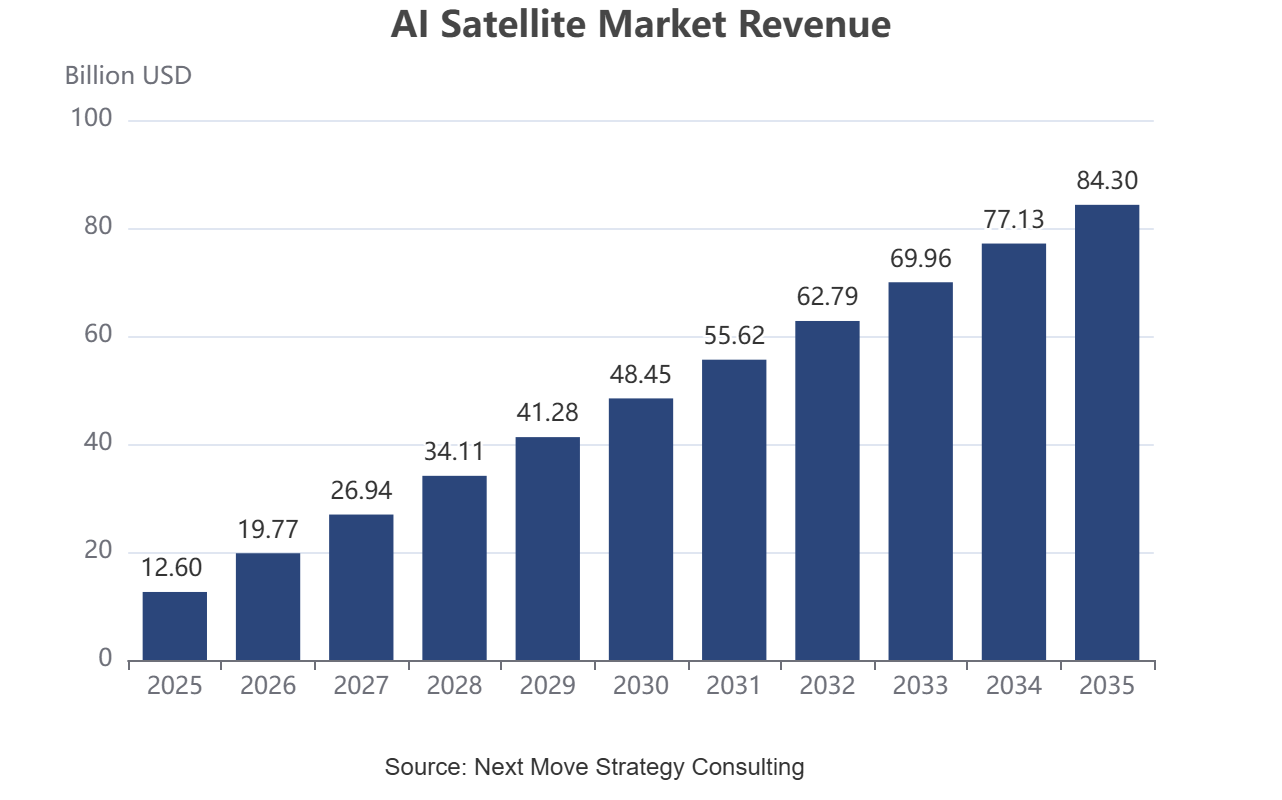
The global AI satellite market size was valued at USD 12.60 billion in 2025 and is estimated at USD 15.80 billion in 2026, forecast to reach USD 84.30 billion by 2035, expanding at a CAGR of 20.4% between 2026 and 2035. North America leads with approximately 39% share, while AI satellite platforms dominate all other offerings with approximately 38% share.
We observed that the growth is broad-based across every segmentation axis, with onboard edge AI adoption and orbital data center expansion driving the dominant structural shifts through 2035.
|
Key Takeaways |
|
By Offering: AI Satellite Platforms held the largest share of approximately 38% (USD 4.79 billion) in 2025; AI Satellite Services is the fastest-growing sub-segment at 27.9% CAGR from 2026–2035. |
|
By Technology: Machine Learning held the largest share of approximately 27% (USD 3.40 billion) in 2025; Federated AI is the fastest-growing sub-segment at 36.9% CAGR from 2026–2035. |
|
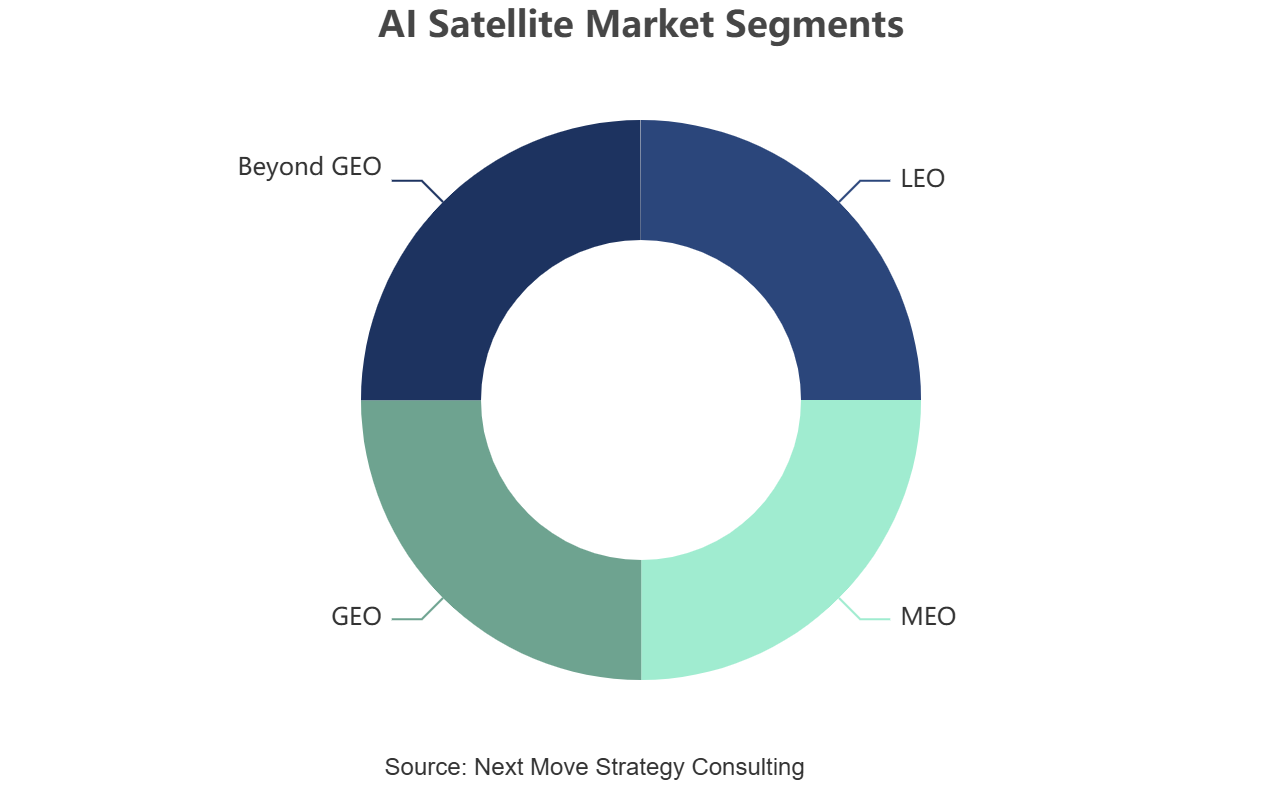
By Orbit: LEO held the largest share of approximately 71% (USD 8.95 billion) in 2025; Beyond GEO is the fastest-growing sub-segment at 41.1% CAGR from 2026–2035. |
|
By Deployment Mode: Ground-Based Processing held the largest share of approximately 46% (USD 5.79 billion) in 2025; Hybrid Processing is the fastest-growing sub-segment at 28.5% CAGR from 2026–2035. |
|
By Application: Earth Observation held the largest share of approximately 29% (USD 3.66 billion) in 2025; Disaster Management is the fastest-growing sub-segment at 30.1% CAGR from 2026–2035. |
|
By Revenue Model: Product Sales held the largest share of approximately 34% (USD 4.28 billion) in 2025; Licensing is the fastest-growing sub-segment at 29.2% CAGR from 2026–2035. |
|
By End User: Defense held the largest share of approximately 32% (USD 4.03 billion) in 2025; Commercial Enterprises is the fastest-growing sub-segment at 29.2% CAGR from 2026–2035. |
|
Dominant Region: North America dominated with approximately 39% revenue share (USD 4.92 billion) in 2025. |
|
Fastest-Growing Region: Asia-Pacific is expected to register the highest CAGR of 27.5% during 2026–2035. |
|
Dominant Country: U.S. led with approximately USD 3.34 billion in 2025. |
|
Fastest-Growing Country: India is the fastest-growing country at approximately 30.7% CAGR from 2026–2035. |
Market Opportunity: The AI satellite market is expected to create an absolute dollar opportunity of USD 68.50 billion between 2026 and 2035, presenting significant investment potential across the onboard AI processing and orbital data center value chain.
According to Next Move Strategy Consulting analysis, satellite operators are increasingly embedding edge AI processors at the point of data capture to reduce downlink dependency, a shift that favors vertically integrated platform providers over ground-segment-only vendors as onboard autonomy requirements intensify through 2035.
What Does the AI Satellite Market Encompass?
The AI satellite market encompasses satellite platforms, subsystems, ground segment software, and data and analytics services that embed machine learning, computer vision, and autonomous decision-making directly into space-based systems. Our assessment indicates that the scope spans Earth observation, communication, computing, navigation, and scientific satellites supplied to defense, government, satellite operator, commercial enterprise, and research institution end users. The category has evolved from ground-based image post-processing into onboard, real-time inference, driven by falling launch costs, radiation-tolerant commercial processors, and rising demand for near-instantaneous geospatial and signal intelligence worldwide.
Regulatory frameworks such as the U.S. Federal Communications Commission's spectrum and orbital debris rules and the National Reconnaissance Office's Commercial Systems Program Office shape procurement of AI-enabled imaging and data services, while the U.S. Space Force's Space Development Agency increasingly specifies autonomous, AI-capable payloads for proliferated constellations. We observed that technology adoption is shifting toward onboard edge inference using commercial GPU-class processors, replacing ground-only processing architectures. Next Move Strategy Consulting's analysis indicates that this structural shift, combined with rising orbital data center investment, is redefining sourcing criteria across the AI satellite market.
|
Parameter |
Details |
|
Market Size in 2025 |
USD 12.60 Billion |
|
Market Size in 2026 |
USD 15.80 Billion |
|
Revenue Forecast in 2035 |
USD 84.30 Billion |
|
Growth Rate |
CAGR of 20.4% from 2026 to 2035 |
|
Analysis Period |
2025–2035 |
|
Base Year Considered |
2025 |
|
Forecast Period |
2026–2035 |
|
Market Size Estimation |
Revenue (USD Billion) |
|
Companies Profiled |
20 |
|
Countries Covered |
38 |
|
Market Share |
Available for Top 10 Companies |
Key Emerging Trends
Based on research conducted by Next Move Strategy Consulting, we found that four structural trends are reshaping satellite design, mission operations, and stakeholder engagement across the industry.
How Is Onboard Edge AI Transforming Earth Observation Satellites?
Onboard edge AI processors are replacing traditional downlink-then-process architectures across Earth observation constellations. We observed that Planet Labs' Pelican satellites integrate NVIDIA Jetson edge processors that completed AI-driven object detection directly in orbit in March 2026, cutting insight latency from hours to minutes. Earth observation operators are adopting similar architectures to satisfy defense and intelligence customers demanding near real-time change detection, while ground segment providers retool analytics pipelines to consume pre-processed, onboard-filtered imagery rather than raw sensor data.
Why Are Orbital Data Centers Gaining Momentum in the AI Satellite Market?
Orbital data centers are emerging as a distinct computing satellite category as terrestrial power and cooling constraints intensify. Our findings suggest that Starcloud's satellite carrying a data-center-class NVIDIA H100 GPU completed the first in-orbit large language model training in December 2025, validating space-based AI inference at scale. Hyperscale compute providers and AI technology firms are evaluating orbital deployment to access continuous solar power and passive radiative cooling, positioning computing satellites as a premium, higher-margin category within the broader market segmentation structure.
How Is AI Strengthening Space Situational Awareness Capabilities?
AI-powered space situational awareness platforms are gaining adoption as orbital congestion and adversarial activity increase across low Earth orbit. We found that LeoLabs' Object Catalog, licensed jointly by the U.S. Department of Commerce and U.S. Space Force in December 2025, applies AI-based maneuver detection across nearly 25,000 tracked objects. Government and commercial operators are increasingly specifying AI-driven conjunction assessment and threat characterization, positioning space situational awareness as a premium, higher-growth application segment within the market.
What Role Do Optical Inter-Satellite Links Play in AI Satellite Innovation?
Optical inter-satellite links are emerging as the connective backbone enabling distributed, constellation-scale AI compute. Our analysis shows that Kepler Communications commissioned 40 NVIDIA Jetson Orin edge processors across ten optically interconnected satellites in March 2026, creating a decentralized compute fabric with automatic workload failover. This trend is elevating demand for high-throughput optical links among computing and communication satellite operators, while ground segment integrators redesign network orchestration software to route AI workloads dynamically across space-based nodes.
Ecosystem Analysis of the AI Satellite Market
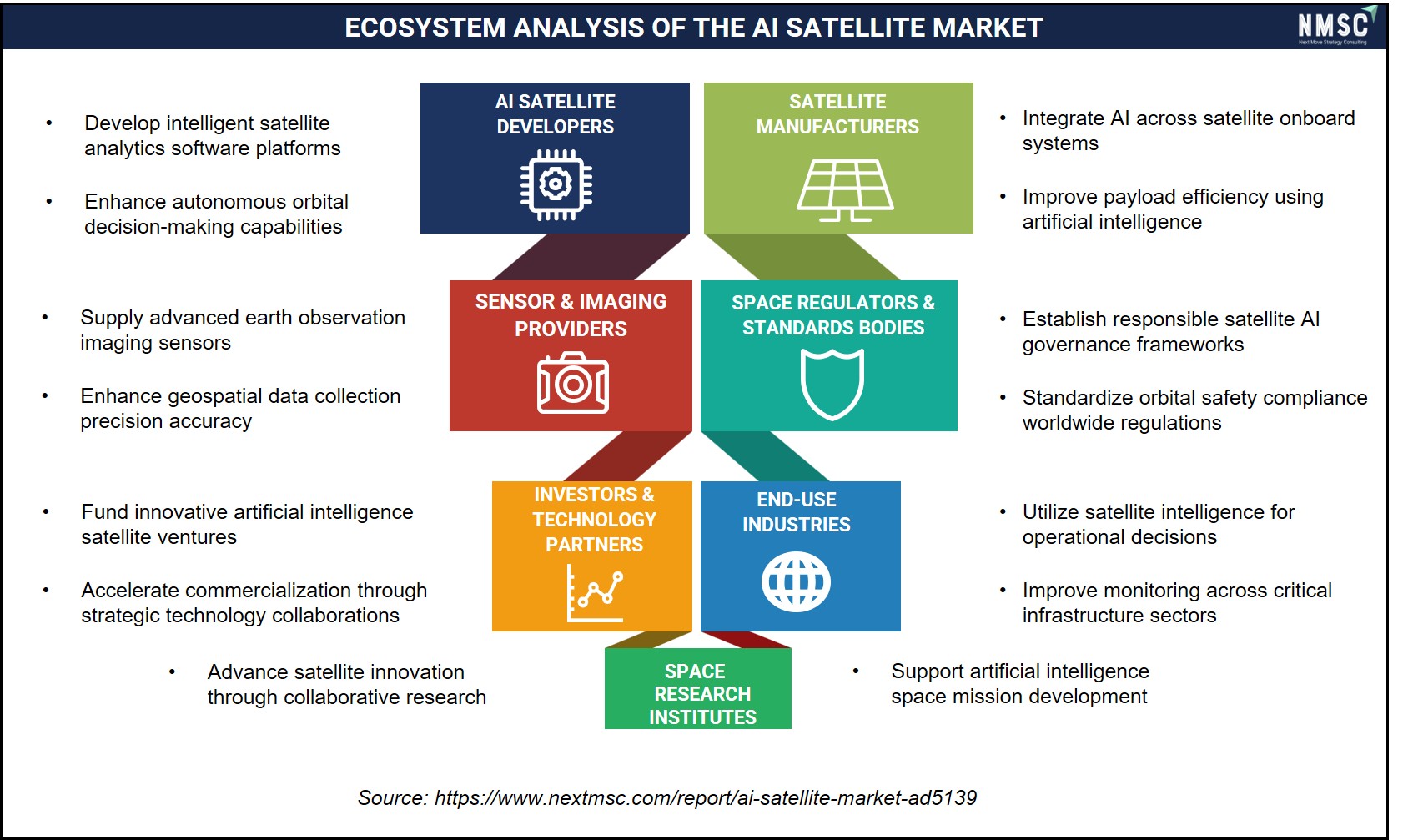
Based on our ecosystem assessment, we identified that AI satellite developers, satellite manufacturers, sensor and imaging providers, space regulators, technology partners, research institutes, and end-use industries collectively drive market innovation and commercialization. Furthermore, our industry analysis indicates that strategic collaboration across hardware, AI software, regulatory compliance, and space research strengthens satellite intelligence capabilities, accelerates deployment efficiency, and supports sustainable growth across commercial, defense, scientific, and communication applications.
Growth Drivers and Restraints
|
Factors |
Type |
(+/−) % Impact on CAGR |
Geographic Relevance |
Impact Timeline |
|
Rising government and defense investment in AI-enabled space situational awareness |
Driver |
+3.2% |
Global |
2026–2035 |
|
Proliferation of low-cost LEO mega-constellations requiring autonomous onboard AI |
Driver |
+2.8% |
Global |
2026–2035 |
|
Rising demand for real-time Earth observation analytics across agriculture, defense, and climate monitoring |
Driver |
+2.4% |
Global |
2026–2035 |
|
Falling launch costs and reusable rocket access expanding satellite deployment economics |
Driver |
+2.1% |
North America, Europe |
2026–2035 |
|
Expansion of edge AI processors and radiation-hardened AI chips for onboard inference |
Driver |
+1.9% |
North America, Asia-Pacific |
2026–2035 |
|
Growing orbital data center and in-space computing investment |
Driver |
+1.6% |
North America |
2026–2032 |
|
Export controls and technology-transfer restrictions on advanced AI processors and radiation-hardened chips |
Restraint |
−1.4% |
Global |
2026–2035 |
|
Rising orbital congestion and collision risk complicating AI-driven autonomous operations |
Restraint |
−0.9% |
Global |
2026–2035 |
|
High capital intensity and long development cycles for radiation-hardened AI hardware |
Restraint |
−0.7% |
Global |
2028–2035 |
What Is the Primary Growth Driver of the AI Satellite Market?
Rising government and defense investment in AI-enabled space situational awareness is the primary driver of the market. The U.S. Department of Commerce's Office of Space Commerce and U.S. Space Force jointly licensed LeoLabs' AI-processed Object Catalog in December 2025 to support space traffic coordination across nearly 25,000 tracked objects. We observed that this institutional demand, reinforced by escalating orbital congestion, continues to anchor baseline consumption of AI-enabled space situational awareness and computing satellites across developed and emerging space programs alike.
How Is Onboard Compute Adoption Driving AI Satellite Market Growth?
Rising deployment of onboard edge AI processors is accelerating market growth toward real-time, autonomous satellite operations. The National Reconnaissance Office's Commercial Systems Program Office awarded Pixxel a Strategic Commercial Enhancements contract in May 2026 to integrate AI-informed hyperspectral analytics into its intelligence architecture. Our assessment indicates that this institutional validation, combined with falling commercial GPU-class processor costs, is compressing adoption timelines for onboard inference across Earth observation and computing satellite categories in North America and Asia-Pacific.
What Is Restraining AI Satellite Market Expansion?
Export controls and technology-transfer restrictions on advanced AI processors and radiation-hardened chips restrain supply chain flexibility across the industry. The U.S. Federal Communications Commission and allied export authorities continue to review licensing frameworks governing high-performance space-qualified processors, constraining component sourcing for smaller satellite manufacturers. We found that companies without diversified, domestically sourced processor supply chains face particular exposure, as limited scale reduces their ability to secure radiation-tolerant AI hardware compared with larger, vertically integrated satellite platform providers.
Segmentation Analysis
Segment Sizing: By Offering
|
Segment |
2025 (USD) |
2035 (USD) |
CAGR% (2026–2035) |
|
AI Satellite Platforms |
USD 4.79 Billion |
USD 27.81 Billion |
21.6% |
|
AI Satellite Subsystems |
USD 3.15 Billion |
USD 18.55 Billion |
21.8% |
|
AI Ground Segment Solutions |
USD 2.27 Billion |
USD 16.02 Billion |
24.2% |
|
AI Satellite Services |
USD 2.39 Billion |
USD 21.92 Billion |
27.9% |
|
Total |
USD 12.60 Billion |
USD 84.30 Billion |
20.4% |
Which Offering Segment Dominates the AI Satellite Market?
AI Satellite Platforms, encompassing Earth observation, communication, computing, navigation, and scientific satellites, led the market with USD 4.79 billion in 2025, supported by sustained constellation deployment across defense and commercial operators. We observed that AI Satellite Services are the fastest-growing offering, expanding at a 27.9% CAGR from 2026 to 2035, as data-as-a-service and analytics-as-a-service models gain traction among operators seeking recurring revenue from AI-processed geospatial and intelligence data.
Segment Sizing: By Application
|
Segment |
2025 (USD) |
2035 (USD) |
CAGR% (2026–2035) |
|
Earth Observation |
USD 3.66 Billion |
USD 21.92 Billion |
22.0% |
|
Satellite Communications |
USD 3.02 Billion |
USD 16.86 Billion |
21.1% |
|
Navigation |
USD 1.51 Billion |
USD 8.43 Billion |
21.1% |
|
Space Situational Awareness |
USD 1.13 Billion |
USD 10.96 Billion |
28.7% |
|
Constellation Operations |
USD 1.01 Billion |
USD 7.59 Billion |
25.1% |
|
Scientific Research |
USD 0.88 Billion |
USD 5.06 Billion |
21.5% |
|
Climate Monitoring |
USD 0.76 Billion |
USD 6.74 Billion |
27.4% |
|
Disaster Management |
USD 0.63 Billion |
USD 6.74 Billion |
30.1% |
|
Total |
USD 12.60 Billion |
USD 84.30 Billion |
20.4% |
Which Application Segment Leads AI Satellite Market Demand?
Earth Observation remained the leading application within the market, valued at USD 3.66 billion in 2025 on sustained agricultural, defense, and environmental monitoring demand. Our findings suggest that Disaster Management is the fastest-growing application, registering a 30.1% CAGR from 2026 to 2035, as AI-driven change detection and predictive monitoring increasingly support rapid-response mapping following floods, wildfires, and other climate-linked emergencies across vulnerable regions.
Segment Sizing: By End User
|
Segment |
2025 (USD) |
2035 (USD) |
CAGR% (2026–2035) |
|
Defense |
USD 4.03 Billion |
USD 22.77 Billion |
21.2% |
|
Government |
USD 3.02 Billion |
USD 16.86 Billion |
21.1% |
|
Satellite Operators |
USD 2.77 Billion |
USD 17.70 Billion |
22.9% |
|
Commercial Enterprises |
USD 2.02 Billion |
USD 20.23 Billion |
29.2% |
|
Research Institutions |
USD 0.76 Billion |
USD 6.74 Billion |
27.4% |
|
Total |
USD 12.60 Billion |
USD 84.30 Billion |
20.4% |
Which End User Segment Is Most Prominent in the AI Satellite Market?
Defense end users remained the dominant customer base within the market, reaching USD 4.03 billion in 2025 due to sustained investment in space situational awareness and autonomous constellation operations. Based on research conducted by Next Move Strategy Consulting, we found that Commercial Enterprises represent the fastest-growing end user category at a 29.2% CAGR from 2026 to 2035, reflecting expanding enterprise adoption of AI-processed Earth observation and connectivity data across agriculture, insurance, and logistics sectors.
Growth Opportunities
Our analysis shows that three forward-looking opportunities stand out for stakeholders positioning within the AI satellite market over the 2026–2035 forecast period.
How Can Onboard Edge AI Processors Unlock Value for Small Satellite Operators?
Onboard edge AI processors present a whitespace opportunity for small satellite operators seeking to differentiate through real-time analytics rather than raw data delivery. Suppliers that commercialize radiation-tolerant, commercial-grade edge processors stand to capture recurring software and processing-as-a-service revenue as operators shift from bandwidth-constrained downlink models toward onboard-filtered, actionable intelligence delivery.
Where Do AI-Powered Space Situational Awareness Platforms Create New Demand?
Government and allied defense agencies represent an underpenetrated opportunity for AI-powered space situational awareness platforms engineered for adversarial maneuver detection. Providers that deliver validated, high-confidence threat characterization can secure long-term interagency licensing contracts, benefiting from recurring subscription revenue tied to escalating orbital congestion and space domain awareness requirements.
How Can Orbital Data Center Infrastructure Benefit Hyperscale AI Compute Providers?
Hyperscale AI compute providers seeking sustainable, low-cost inference capacity create an opportunity for orbital data center developers offering space-qualified GPU compute platforms. Early movers that validate multi-tenant, radiation-shielded compute nodes can differentiate with cloud and AI technology companies pursuing diversified, carbon-efficient compute capacity beyond terrestrial grid constraints.
Regional Outlook
Geographic Performance Snapshot
|
Region |
2025 (USD) |
2035 (USD) |
CAGR% (2026–2035) |
Key Driver |
|
North America |
USD 4.92 Billion |
USD 27.82 Billion |
21.2% |
Sustained defense space situational awareness investment and NRO commercial data contracts |
|
Europe |
USD 3.02 Billion |
USD 16.02 Billion |
20.4% |
ESA institutional programs and EU space regulation driving sovereign AI satellite capability |
|
Asia-Pacific |
USD 3.40 Billion |
USD 30.35 Billion |
27.5% |
Expanding national space programs and rising commercial constellation deployment in China and India |
|
Middle East & Africa |
USD 0.76 Billion |
USD 5.90 Billion |
25.6% |
Gulf sovereign satellite investment and diversification-linked space programs |
|
Latin America |
USD 0.50 Billion |
USD 4.21 Billion |
26.7% |
Growing agricultural and environmental monitoring demand for AI-processed Earth observation data |
|
Total |
USD 12.60 Billion |
USD 84.30 Billion |
20.4% |
- |
North America AI Satellite Market Outlook
North America leads the AI satellite market with an established defense and intelligence procurement base and mature commercial space industry. We observed that National Reconnaissance Office and U.S. Space Force contracts sustain demand for AI-enabled hyperspectral and space situational awareness capabilities, while commercial operators increasingly specify onboard edge processors to meet defense customer latency requirements. Technology adoption remains advanced, with orbital data center pilots and optical inter-satellite link deployments driving demand across the region's commercial space ecosystem.
Europe AI Satellite Market Outlook
Europe's AI satellite market reflects an institutionally driven landscape shaped by the European Space Agency's Earth observation and navigation programs. Our findings suggest that national space agencies across Germany, France, and the UK are accelerating adoption of AI-processed geospatial analytics to support sovereign defense and climate monitoring priorities. Technology adoption favors ground segment AI integration, supported by regional integrators investing in autonomous mission operations software for institutional constellations.
Asia-Pacific AI Satellite Market Outlook
Asia-Pacific is the fastest-growing AI satellite market region, propelled by expanding national space programs in China and India and rising commercial constellation deployment. We found that regulatory frameworks remain less harmonized than in Europe, giving regional manufacturers flexibility to scale AI-enabled Earth observation and communication satellite production rapidly. Technology adoption is accelerating as regional operators, including several China-based and India-based suppliers, expand hyperspectral and computing satellite capacity to serve global commercial and government customers.
Middle East & Africa AI Satellite Market Outlook
The AI satellite market in Middle East & Africa is expanding as Gulf Cooperation Council economies pursue sovereign satellite capability and diversification-linked space investment. Our analysis shows that the UAE and Saudi Arabia are attracting AI ground segment and Earth observation investment tied to national space strategies. Regulatory influence remains moderate, while technology adoption is gradually shifting toward imported AI-enabled satellite platforms as regional operators align with global commercial standards.
Latin America AI Satellite Market Outlook
Latin America's AI satellite market is supported by growing agricultural and environmental monitoring demand in Brazil and Argentina and expanding regional space agency programs. We observed that regulatory frameworks are less stringent than in North America or Europe, though national space agencies operating locally are introducing AI-processed Earth observation procurement. Technology adoption remains centered on Earth observation data services, with competitive intensity increasing as regional operators partner with global satellite platform providers.
U.S. AI Satellite Market
The market in the U.S. was valued at approximately USD 3.34 billion in 2025 and is projected to reach USD 18.08 billion by 2035, growing at a 20.6% CAGR. Demand is anchored by National Reconnaissance Office and U.S. Space Force procurement, high commercial constellation density, and Federal Communications Commission spectrum and orbital debris oversight. Technology penetration favors onboard edge AI processors, and competitive intensity remains high among established platform providers serving national security and commercial customers.
Canada AI Satellite Market
Based on our estimates, Canada's market reached roughly USD 0.49 billion in 2025 and is forecast to hit USD 2.50 billion by 2035 at a 19.8% CAGR. Demand structure mirrors U.S. defense and commercial Earth observation consumption patterns, while Canadian Space Agency guidance shapes optical inter-satellite link and data relay specifications. Technology penetration is rising as domestic operators, including Kepler Communications, scale optical constellation and on-orbit compute capacity.
UK AI Satellite Market
As per our estimate, the UK market stood at about USD 0.79 billion in 2025, advancing toward USD 3.52 billion by 2035 at an 18.1% CAGR. Demand is driven by established defense and Earth observation programs navigating UK Space Agency licensing requirements. Regulatory influence is well established, technology penetration favors AI-processed geospatial analytics, and competitive intensity remains high given the concentration of specialized space technology firms headquartered domestically.
Germany AI Satellite Market
According to our analysis, Germany's market reached close to USD 0.73 billion in 2025 and is expected to hit USD 3.68 billion by 2035, growing at a 19.8% CAGR. Demand is supported by Germany's institutional Earth observation and defense space programs, led by national procurement through the German Aerospace Center. Regulatory influence is well established, technology penetration is advanced, and competitive intensity remains high among long-standing domestic manufacturers.
France AI Satellite Market
Based on our estimates, France's market reached approximately USD 0.48 billion in 2025, projected to climb to USD 2.40 billion by 2035 at a 19.5% CAGR. Demand is supported by France's prominent institutional space program, which shapes AI-enabled Earth observation and navigation satellite adoption. Regulatory influence from the French space agency CNES is notable, and competitive intensity remains high given the concentration of premium satellite manufacturers headquartered domestically.
China AI Satellite Market
The market in China stood at roughly USD 1.02 billion in 2025 and is forecast to reach USD 8.50 billion by 2035, registering a 26.6% CAGR. Demand is fueled by expanding national space program investment and a dense base of regional satellite manufacturers. Regulatory influence is increasing gradually, technology penetration is accelerating through domestic AI processor development, and competitive intensity remains elevated among numerous China-based suppliers.
India AI Satellite Market
As per our estimate, India's market was valued at about USD 0.54 billion in 2025, projected to reach USD 6.07 billion by 2035 at a 30.7% CAGR, the fastest among covered countries. Demand structure reflects rising national space program investment and expanding commercial hyperspectral and Earth observation capacity. Regulatory influence remains developing under the Indian Space Research Organisation, while technology penetration is rising quickly as domestic operators localize AI satellite sourcing to serve India's expanding space economy.
Japan AI Satellite Market
According to our analysis, Japan's market reached close to USD 0.48 billion in 2025 and is expected to hit USD 3.34 billion by 2035, growing at a 24.2% CAGR. Demand is supported by Japan's precision-engineered satellite manufacturing heritage, led by institutional programs coordinated through the Japan Aerospace Exploration Agency. Regulatory influence is well established, technology penetration is advanced, and competitive intensity remains high among long-standing domestic manufacturers.
South Korea AI Satellite Market
Based on our estimates, South Korea's market stood at approximately USD 0.34 billion in 2025, forecast to reach USD 2.73 billion by 2035 at a 26.0% CAGR. Demand structure benefits from the country's growing commercial Earth observation and communication satellite industry. Technology penetration is high, with domestic operators supplying AI-enabled imaging payloads, and competitive intensity remains pronounced amid rapid constellation deployment cycles.
Australia AI Satellite Market
The AI satellite market in Australia reached about USD 0.27 billion in 2025 and is projected to reach USD 2.12 billion by 2035, expanding at a 25.6% CAGR. Demand is supported by a well-established Earth observation and space situational awareness sector coordinated through the Australian Space Agency. Regulatory influence stems from national space object tracking requirements, while technology penetration favors imported AI-enabled satellite systems amid moderate competitive intensity.
UAE AI Satellite Market
As per our estimate, the UAE market was valued near USD 0.23 billion in 2025, projected to reach USD 1.53 billion by 2035 at a 23.7% CAGR. Demand structure is shaped by the UAE's role as a regional sovereign satellite and space technology hub. Regulatory influence remains moderate, technology penetration is improving through imported AI-enabled Earth observation systems, and competitive intensity is rising as operators expand regional satellite service portfolios.
Saudi Arabia AI Satellite Market
According to our analysis, Saudi Arabia's market reached roughly USD 0.26 billion in 2025 and is expected to hit USD 1.89 billion by 2035, growing at a 24.8% CAGR. Demand is driven by Vision 2030-linked space sector diversification and rising government investment in sovereign satellite capability. Regulatory influence is developing under the Saudi Space Agency, and technology penetration is advancing as domestic programs scale AI-enabled satellite procurement.
South Africa AI Satellite Market
Based on our estimates, South Africa's market stood at about USD 0.11 billion in 2025, forecast to reach USD 0.71 billion by 2035 at a 23.5% CAGR. Demand structure reflects a developing national space program serving regional Southern African monitoring needs. Regulatory influence remains moderate under the South African National Space Agency, technology penetration is gradually improving, and competitive intensity is limited given reliance on imported satellite platforms from Europe and Asia.
Brazil AI Satellite Market
The market in Brazil reached approximately USD 0.23 billion in 2025 and is projected to reach USD 1.86 billion by 2035, registering a 26.0% CAGR. Demand is underpinned by Brazil's expanding agricultural monitoring needs and national space agency Earth observation programs. Regulatory influence stems from the Brazilian Space Agency, technology penetration favors Earth observation data services, and competitive intensity remains moderate among regional operators.
Argentina AI Satellite Market
As per our estimate, Argentina's market was valued near USD 0.10 billion in 2025, projected to reach USD 0.76 billion by 2035 at a 25.1% CAGR. Demand structure is supported by steady Earth observation and environmental monitoring consumption despite macroeconomic volatility. Regulatory influence remains limited, technology penetration is modest, and competitive intensity is centered on a small number of regional operators serving domestic government agencies.
PESTEL Analysis of the AI Satellite Market
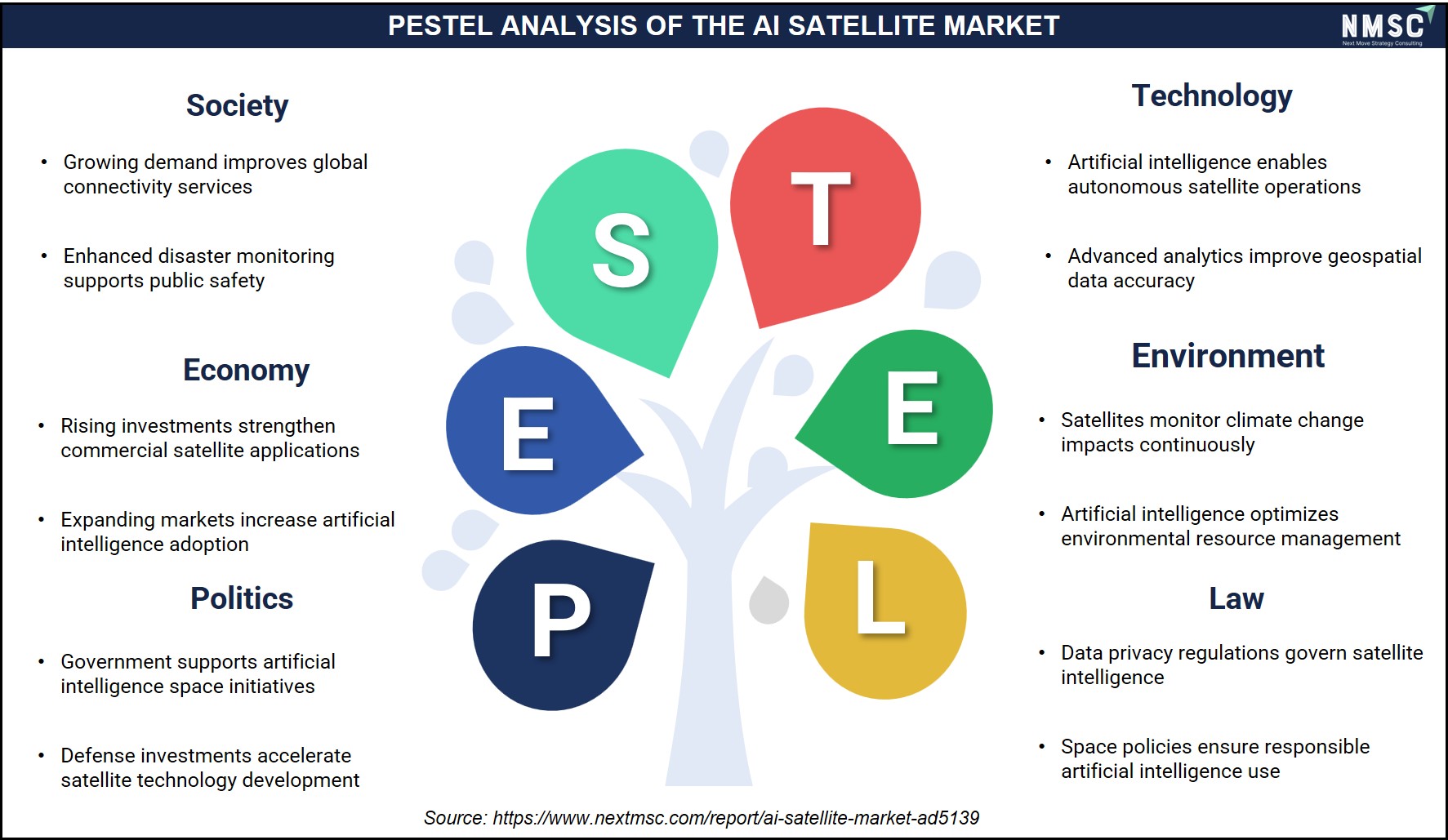
Based on our PESTEL assessment, we observed that political investments, economic expansion of the space economy, technological advances in AI processing, environmental monitoring requirements, evolving legal frameworks, and increasing societal demand for real-time satellite intelligence collectively influence market development. Moreover, our industry analysis indicates that these external factors accelerate innovation, improve operational resilience, strengthen regulatory compliance, and create long-term opportunities for AI-powered satellite platforms worldwide.
Competitive Landscape
We observed that the AI satellite market features a moderately consolidated competitive landscape, with vertically integrated defense primes competing alongside specialized new-space AI satellite companies on innovation, data quality, and mission autonomy.
|
Key Takeaways |
|
Market Structure: Moderately consolidated; the top companies profiled in this report collectively account for a majority of global AI satellite market revenue, while numerous specialized new-space operators serve commercial Earth observation and computing satellite demand. |
|
Innovation Focus: Onboard edge AI processors, optical inter-satellite links, and orbital data center architectures dominate current innovation pipelines across leading suppliers. |
|
M&A Activity: Selective consolidation and strategic partnership activity, exemplified by Starcloud's collaboration with Crusoe and Axiom Space to commercialize orbital compute capacity for AI workloads. |
How Do Companies Compete in the AI Satellite Market?
Companies compete primarily on onboard processing performance, data quality, and mission autonomy credentials across the industry. Global defense primes such as Lockheed Martin Corporation and Northrop Grumman Corporation leverage broad platform and payload integration capabilities to serve government customers, while specialized new-space operators compete on rapid iteration and AI-native architecture for commercial Earth observation and computing satellite applications.
Which Competitive Archetypes Dominate the AI Satellite Market?
Two archetypes dominate the market: diversified defense and aerospace primes offering full-service platform and mission integration, and specialized new-space companies focused on AI-native satellite architectures. Lockheed Martin Corporation and BAE Systems plc exemplify the diversified archetype through integrated payload-to-platform manufacturing, while Planet Labs PBC and Pixxel Space Technologies Pvt. Ltd. exemplify the specialized archetype serving commercial Earth observation and hyperspectral analytics demand.
How Are Companies Differentiating Through Innovation in AI Satellites?
Innovation and differentiation strategy increasingly center on onboard edge AI validation and optical inter-satellite link performance. Kepler Communications Inc.'s distributed on-orbit compute fabric and Starcloud, Inc.'s data-center-class GPU deployment both demonstrate commercially operational AI processing in orbit. Our analysis shows that suppliers unable to demonstrate credible onboard AI performance risk exclusion from defense and intelligence agency request-for-proposal shortlists in North America and Europe.
What M&A and Expansion Activity Is Shaping the AI Satellite Market?
Mergers, acquisitions, and strategic partnership activity continue to consolidate AI satellite capabilities within the industry. Starcloud, Inc.'s partnerships with Crusoe and Axiom Space to commercialize orbital compute capacity illustrate how emerging operators pursue geographic and commercial expansion, while Kepler Communications Inc.'s collaboration with Axiom Space on-orbit data center nodes demonstrates cross-sector consolidation between connectivity and computing satellite providers.
Key Market Players
Our assessment indicates that the following 20 companies are actively shaping product innovation, capacity expansion, and mission autonomy strategy within the global AI satellite market.
-
Space Exploration Technologies Corp
-
BAE Systems plc
-
Airbus Defence and Space SAS
-
Northrop Grumman Corporation
-
Thales Alenia Space SAS
-
BlackSky Technology Inc.
-
Satellogic Inc.
-
Rocket Lab USA, Inc.
-
Redwire Corporation
-
Open Cosmos Ltd.
-
Pixxel Space Technologies Pvt. Ltd.
-
Sidus Space, Inc.
-
Space42 PLC
-
Kepler Communications Inc.
-
LeoLabs, Inc.
-
Guoxing Aerospace Technology Co., Ltd.
-
Dhruva Space Private Limited
-
Starcloud, Inc.
Latest Developments
We found that recent product launches within the AI satellite market are concentrated on onboard edge AI processing and orbital compute architectures, reflecting the industry's broader shift toward real-time, autonomous space systems.
|
Date |
Event |
|
May 2026 |
Pixxel announced the Pathfinder satellite mission, India's first orbital data center. Unlike traditional satellites that rely on low-power edge chips, Pathfinder will host data-center-class GPUs capable of running full-stack foundation models directly in orbit. This allows for real-time hyperspectral data analysis and inference, minimizing the need to downlink massive volumes of raw imagery. |
|
April 2026 |
Lockheed Martin successfully launched the final GPS III SV10 satellite. The spacecraft features an optical crosslink payload, allowing satellites to communicate directly in space. This "mesh network" architecture, integrated with digital twins during production, provides a massive boost to anti-jamming and timing accuracy, essential for global navigation infrastructure. |
|
February 2026 |
Airbus Defence and Space and ST Engineering signed an agreement to develop 3D Multi-static SAR (Synthetic Aperture Radar). By using one transmitter and three receiver satellites, the system uses AI to generate real-time 3D models of Earth, maintaining high accuracy through darkness, cloud cover, or jamming, directly supporting defense and disaster monitoring applications. |
Expert Insights

“AI is becoming fundamental to the geospatial business. The more powerful our analytics, the more value our data delivers.”
— Martijn Blanken, CEO, Neo Space Group (NSG)
Statement made during an interview with Via Satellite, discussing the growing role of artificial intelligence in geospatial analytics and satellite data intelligence. Blanken emphasized how AI-powered analytics are enabling organizations to extract actionable insights from vast volumes of optical, radar, hyperspectral, and multispectral satellite data, supporting applications across defense, intelligence, and civilian sectors.
Market Interpretation
The statement highlights the increasing integration of artificial intelligence into satellite-based geospatial services, where advanced analytics are transforming large-scale Earth observation data into actionable intelligence. AI technologies are enabling faster image interpretation, automated feature detection, and predictive analytics, enhancing decision-making across defense, environmental monitoring, infrastructure management, and disaster response. As satellite operators increasingly embed AI capabilities into their data platforms, the market is evolving beyond traditional imaging services toward intelligent geospatial solutions that deliver greater operational efficiency and commercial value.
Investment Opportunities
What Capital Inflows Are Targeting the AI Satellite Market?
Capital inflows into the AI satellite market are increasingly directed toward onboard compute hardware and optical inter-satellite link infrastructure. Venture and strategic investors continue to fund new-space AI satellite companies, as seen in Starcloud, Inc.'s Series A funding round that valued the company at over USD 1 billion in March 2026. We observed that investors favor operators demonstrating validated onboard AI performance, viewing successful in-orbit demonstrations as a proxy for long-term government and commercial contract retention.
How Is Infrastructure Investment Supporting AI Satellite Manufacturing?
Infrastructure investment is expanding satellite manufacturing and radiation-hardened processor capacity across North America and Asia-Pacific, particularly to serve rising commercial constellation demand. Our findings suggest that regional manufacturers are investing in automated assembly lines and commercial-grade GPU integration to improve production throughput for Earth observation, computing, and communication satellite categories, supporting the precision required for onboard AI processing at scale.
What ESG Considerations Are Shaping AI Satellite Investment Decisions?
Environmental, social, and governance considerations are increasingly relevant to investment decisions across the industry, with orbital debris mitigation and sustainable deorbit planning as key criteria. The U.S. Federal Communications Commission's orbital debris rules continue to inform operator compliance disclosures. We found that investors increasingly favor manufacturers with credible collision-avoidance and end-of-life disposal plans, treating space sustainability as a governance indicator alongside data security and export-control compliance.
Key Benefits for Stakeholders
How Does This Report Benefit Enterprise and Industry Leaders?
Enterprise and industry leaders gain access to validated segmentation, competitive benchmarking, and regional demand forecasts that support platform and mission-planning decisions across the AI satellite industry. Our analysis shows that detailed offering, orbit, and application breakdowns help procurement teams align specifications with mission requirements while identifying underserved application segments for portfolio expansion.
How Does This Report Benefit Investors and Financial Analysts?
Investors and financial analysts benefit from consistent, single-point market size and CAGR estimates that support valuation and capital-allocation decisions across the AI satellite market supply chain. We observed that the report's regional and segment-level growth differentials help identify which platform providers and ground segment integrators are best positioned to capture above-market growth in computing and services categories through 2035.
How Does This Report Benefit Technology Vendors and Product Teams?
Technology vendors and product teams gain insight into emerging design requirements, including onboard edge AI integration, optical inter-satellite links, and orbital data center architectures, that are reshaping the industry. Our findings suggest that this analysis helps R&D teams prioritize development roadmaps around radiation-tolerant processor validation and autonomous mission software increasingly required by defense and commercial request-for-proposal processes.
Key Market Segments
By Offering
-
AI Satellite Platforms
-
Earth Observation Satellites
-
Optical Satellites
-
Hyperspectral Satellites
-
SAR Satellites
-
Multimodal Satellites
-
-
Communication Satellites
-
LEO Satellites
-
MEO Satellites
-
GEO Satellites
-
-
Computing Satellites
-
Edge AI Satellites
-
Orbital Computing Satellites
-
-
Navigation Satellites
-
Scientific Satellites
-
-
AI Satellite Subsystems
-
AI Processors
-
Radiation-Hardened Processors
-
Commercial Processors
-
-
AI Payloads
-
Optical Payloads
-
Hyperspectral Payloads
-
SAR Payloads
-
RF Payloads
-
-
Autonomous Software
-
Mission Planning
-
Navigation
-
Fault Detection
-
Resource Management
-
-
Inter-Satellite Links
-
Optical Links
-
RF Links
-
-
-
AI Ground Segment Solutions
-
Mission Operations Software
-
Constellation Management
-
Health Monitoring
-
Orbit Management
-
Collision Avoidance
-
-
Data Processing Platforms
-
Image Processing
-
Geospatial Analytics
-
Predictive Analytics
-
AI Model Management
-
-
Ground Infrastructure Intelligence
-
Network Optimization
-
Spectrum Management
-
Cybersecurity
-
-
-
AI Satellite Services
-
DAAS
-
Earth Observation Data
-
Geospatial Intelligence Data
-
Environmental Data
-
Defense Intelligence Data
-
-
AAAS
-
Object Detection
-
Change Detection
-
Predictive Monitoring
-
Risk Assessment
-
-
AI Software Licensing
-
Integration Services
-
Managed Services
-
By Technology
-
Machine Learning
-
Deep Learning
-
Computer Vision
-
Reinforcement Learning
-
Edge AI
-
Generative AI
-
Federated AI
By Orbit
-
LEO
-
MEO
-
GEO
-
Beyond GEO
By Deployment Mode
-
Onboard Processing
-
Ground-Based Processing
-
Hybrid Processing
By Application
-
Earth Observation
-
Satellite Communications
-
Navigation
-
Space Situational Awareness
-
Constellation Operations
-
Scientific Research
-
Climate Monitoring
-
Disaster Management
By Revenue Model
-
Product Sales
-
Subscription Services
-
Licensing
-
Project Contracts
-
Managed Services
By End User
-
Defense
-
Government
-
Satellite Operators
-
Commercial Enterprises
-
Research Institutions
By Region
-
North America: U.S., Canada, Mexico
-
Europe: UK, Germany, France, Italy, Spain, Sweden, Denmark, Finland, Netherlands, Rest of Europe
-
Asia-Pacific: China, India, Japan, South Korea, Taiwan, Indonesia, Vietnam, Australia, Philippines, Malaysia, Rest of APAC
-
Middle East & Africa: Saudi Arabia, UAE, Egypt, Israel, Turkey, Nigeria, South Africa, Rest of MEA
-
Latin America: Brazil, Argentina, Chile, Colombia, Rest of LATAM
Conclusion and Recommendations
What Is the Long-Term Outlook for the AI Satellite Market?
The long-term outlook for the market remains positive, with global revenue projected to expand nearly sevenfold from USD 12.60 billion in 2025 to USD 84.30 billion by 2035 at a 20.4% CAGR. We observed that sustained defense and government investment, onboard AI adoption, and orbital data center expansion will continue underpinning demand across Earth observation, computing, and services categories through the forecast period.
What Strategic Positioning Should AI Satellite Suppliers Pursue?
Suppliers should prioritize onboard edge AI validation and optical inter-satellite link capability while pursuing defense and intelligence agency qualification to secure long-term contracts. Our assessment indicates that platform providers investing early in radiation-tolerant commercial processor integration and autonomous mission software will be best positioned to capture premium pricing within the AI satellite market.
How Attractive Is the AI Satellite Market for New Investment?
The AI satellite industry presents an attractive investment case, supported by a USD 68.50 billion absolute dollar opportunity between 2026 and 2035 and above-average growth in Asia-Pacific and services categories. We found that investment attractiveness is highest for operators combining validated onboard AI performance with scaled manufacturing capacity, positioning them to serve both government and commercial customer segments simultaneously.
What Market Shifts and Key Risks Should Stakeholders Monitor?
Stakeholders should monitor export-control tightening on advanced AI processors, rising orbital congestion, and competitive pressure from vertically integrated defense primes as key risks to the AI satellite market. Our analysis shows that suppliers unable to secure diversified, compliant processor supply chains risk losing government contract eligibility to competitors with domestically qualified hardware, particularly within North America's increasingly restricted export environment.
What Are the Key Growth Pathways for the AI Satellite Market?
Key growth pathways include expanding onboard compute and orbital data center portfolios, scaling optical inter-satellite link capacity, and deepening penetration into commercial enterprise and disaster management applications. Next Move Strategy Consulting's analysis indicates that suppliers pursuing these pathways while maintaining defense and government qualification will be best positioned to capture the AI satellite market's projected growth through 2035.
About the Author
 Saista Faiyaz
— Saista Faiyaz is Research Associate at Next Move Strategy Consulting, where she has covered consumer markets and healthcare technologies for 3 years. Her work includes primary interview review, secondary-source validation, market sizing, and structured analysis of company and industry data. She supports research by comparing evidence across sources, organizing findings into market narratives, and documenting assumptions used in analysis. Her scope includes cross-market benchmarking, and reports.
Saista Faiyaz
— Saista Faiyaz is Research Associate at Next Move Strategy Consulting, where she has covered consumer markets and healthcare technologies for 3 years. Her work includes primary interview review, secondary-source validation, market sizing, and structured analysis of company and industry data. She supports research by comparing evidence across sources, organizing findings into market narratives, and documenting assumptions used in analysis. Her scope includes cross-market benchmarking, and reports.
About the Reviewer
 Supradip Baul
— Supradip Baul is an accomplished business consultant and strategist with over a decade of rich experience in market intelligence, strategy, technology, and business transformation. His work has included rigorous qualitative and quantitative analysis across multiple industries, helping clients shape investment decisions and long-term roadmaps. Earlier in his career, he was associated with Gartner, where he contributed to industry-leading reports and market share analyses. He has worked with leading global companies and holds an MBA with a dual specialization in Marketing and Finance.
Supradip Baul
— Supradip Baul is an accomplished business consultant and strategist with over a decade of rich experience in market intelligence, strategy, technology, and business transformation. His work has included rigorous qualitative and quantitative analysis across multiple industries, helping clients shape investment decisions and long-term roadmaps. Earlier in his career, he was associated with Gartner, where he contributed to industry-leading reports and market share analyses. He has worked with leading global companies and holds an MBA with a dual specialization in Marketing and Finance.
At Next Move Strategy Consulting, we understand that insightful market research is the cornerstone of successful business decisions. That's why we employ a robust and multifaceted approach, combining various methodologies to deliver the most accurate and actionable data for our clients.

Research Landscape
We navigate the world of research with two primary approaches:
Qualitative Approach
Our qualitative research methodologies involve immersive techniques such as in-depth interviews, focus groups, and observational studies. By engaging directly with individuals and stakeholders, we uncover valuable insights that quantitative data alone may overlook.

Quantitative Research
In tandem with qualitative methodologies, NMSC leverages the power of Quantitative Research to provide a robust foundation of numerical insights. Through systematic data collection and analysis, we quantify patterns, preferences, and market trends, offering a comprehensive view of the business landscape.
Our quantitative research approach employs diverse tools, including surveys, experiments, and statistical modelling. These methodologies enable us to gather data from a large and representative sample, ensuring the statistical significance of our findings. By employing structured questionnaires and standardized data collection methods, we guarantee the reliability and validity of the information we present to our clients.
Quantitative research is particularly effective in measuring the prevalence of trends, assessing market size, and gauging the impact of various factors on consumer behavior. The numerical precision attained through this approach equips our clients with actionable insights, facilitating data-driven decision-making and strategy formulation.


Our Specialized Toolbox for Industry-Specific Market Research
We deploy a specialized arsenal of techniques tailored to meet your unique requirements. Here's a glimpse into our comprehensive toolbox:

Information Procurement
The stage entails acquiring market data or relevant information through various sources and methodologies.


Market Research Approach
We utilize both top-down and bottom-up approaches in market research analysis to achieve a comprehensive understanding of the market dynamics, leveraging the broad perspective of industry trends and macroeconomic factors alongside detailed insights from specific segments and individual companies.

Porters Five Forces Analysis
We conduct Porter's Five Forces analysis to evaluate the competitive landscape of an industry, providing us with insights into factors that affect profitability and strategic positioning.

SWOT Analysis

Forecasting
We utilize a forecasting model to predict future consumption by considering parameters like population, economics, regulations, market competition, drivers, constraints, technology, and pricing. We also employ statistical techniques such as multilinear regression, exponential smoothing, moving average, ARIMA, and Monte Carlo simulations for accurate predictions. In econometric forecasting, we analyzed short-term and long-term event impacts, attributing values based on regulatory frameworks, economic factors, and market events.





 Speak to Our Analyst