Sexual Dysfunction Treatment Market Global Industry Analysis and Forecast (2026–2035)

The global Sexual Dysfunction Treatment Market size was valued at USD 31.80 billion in 2025 and is estimated at USD 33.60 billion in 2026, forecast to reach USD 58.40 billion by 2035, expanding at a 6.33% CAGR from 2026 to 2035. Key drivers include rising prevalence of erectile dysfunction with the aging population and expanding telehealth-enabled prescribing and online pharmacy access, with North America leading the global market.

Download Free Sample PDF
Base Year (2025)
$31.80 Billion
Forecast (2035)
$58.40 Billion
CAGR (2026-2035)
6.3%
Top Region
North America

What Is the Sexual Dysfunction Treatment Market Size?

The global Sexual Dysfunction Treatment Market size was valued at USD 31.80 billion in 2025 and is estimated at USD 33.60 billion in 2026, forecast to reach USD 58.40 billion by 2035, expanding at a 6.33% CAGR between 2026 and 2035. North America leads with approximately 39% share, while drug therapy dominates all other therapy types with approximately 78% share.

We observed that growth is anchored in expanding PDE5 inhibitor prescription volume and rising diagnosis and treatment-seeking rates for female sexual dysfunction across developed and emerging healthcare systems through 2035.

Sexual Dysfunction Treatment Market Global Industry Analysis and Forecast (2026–2035) Revenue Forecast

Values in USD Billion

2025 $31.80 Billion
2025
2026 $33.81 Billion
2026
2027 $35.95 Billion
2027
2028 $38.23 Billion
2028
2029 $40.65 Billion
2029
2030 $43.22 Billion
2030
2031 $45.96 Billion
2031
2032 $48.87 Billion
2032
2033 $51.96 Billion
2033
2034 $55.25 Billion
2034
2035 $58.40 Billion
2035

Key Takeaways

By Therapy: Drug Therapy held the largest share of approximately 78% (USD 24.80 Billion) in 2025; Device Therapy is the fastest-growing sub-segment at 8.3% CAGR from 2026–2035.

By Indication: Male Sexual Dysfunction held the largest share of approximately 71% (USD 22.58 Billion) in 2025; Female Sexual Dysfunction is the fastest-growing sub-segment at 8.2% CAGR from 2026–2035.

By Distribution Channel: Hospital Pharmacy held the largest share of approximately 32% (USD 10.18 Billion) in 2025; Online Pharmacy is the fastest-growing sub-segment at 9.8% CAGR from 2026–2035.

Dominant Region: North America dominated with approximately 39% revenue share (USD 12.40 Billion) in 2025.

Fastest-Growing Region: Middle East and Africa is expected to register the highest CAGR of 8.5% during 2026–2035.

Dominant Country: U.S. led with approximately USD 10.67 billion in 2025.

Fastest-Growing Country: India is the fastest-growing country at approximately 10.9% CAGR from 2026–2035.

Market Opportunity: The sexual dysfunction treatment market is expected to create an absolute dollar opportunity of USD 24.80 billion between 2026 and 2035, presenting significant investment potential across the female sexual dysfunction drug, device therapy, and online pharmacy distribution value chain.

According to Next Move Strategy Consulting analysis, treatment providers are increasingly integrating telehealth-based prescribing with direct-to-patient pharmacy fulfillment, a shift that favors manufacturers with digital-health partnerships over traditional in-clinic-only distribution models as patient privacy preferences continue to shape channel selection through 2035.

What Does the Sexual Dysfunction Treatment Market Encompass?

The sexual dysfunction treatment market report covers pharmacological and device-based interventions for male and female sexual dysfunction, spanning PDE5 inhibitors, hormone therapy, premature ejaculation drugs, penile prostheses, and vacuum erection devices across hospital, retail, online, and specialty pharmacy channels. Our assessment indicates that the market has evolved from predominantly male erectile-dysfunction-focused oral therapy toward a broader treatment landscape addressing female sexual dysfunction, genitourinary syndrome of menopause, and device-based options for patients unresponsive to pharmacological therapy.
Regulatory frameworks such as the U.S. Food and Drug Administration's approval pathways for PDE5 inhibitors and female sexual dysfunction drugs and the European Medicines Agency's centralized authorization procedures shape product launch timelines, while national health-insurance reimbursement policies increasingly influence prescription-drug accessibility. We observed that technology adoption is shifting toward telehealth-enabled prescribing and direct-to-patient online pharmacy fulfillment, and Based on research conducted by Next Move Strategy Consulting, we found that this structural shift, combined with declining stigma around treatment-seeking, is redefining sourcing criteria across the market report on this market.

Regulatory Framework Impacting the Sexual Dysfunction Treatment Market

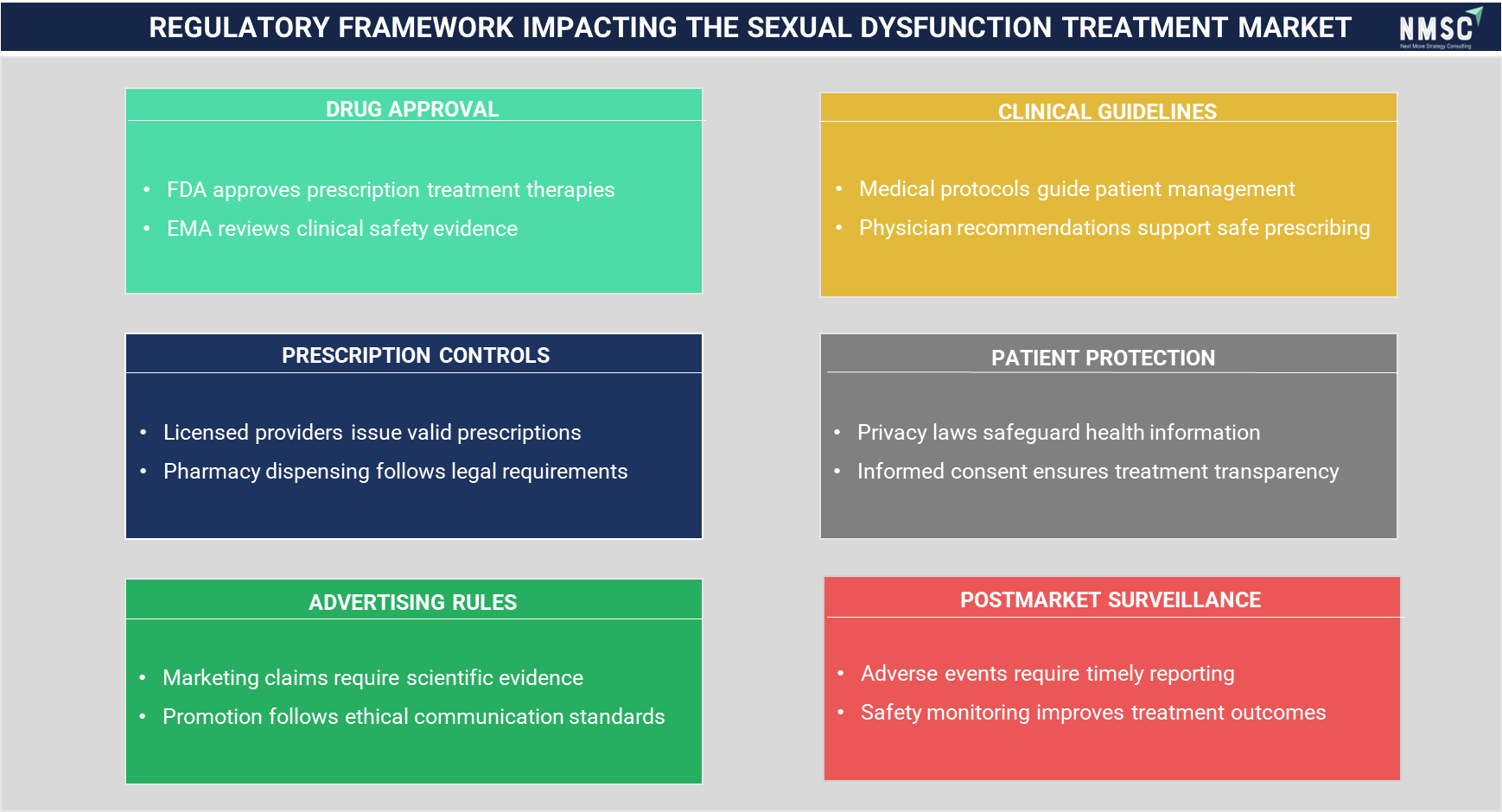
Based on our regulatory assessment, we identified that the sexual dysfunction treatment market is governed by drug approval processes, clinical practice guidelines, prescription controls, patient privacy regulations, advertising standards, and post-market pharmacovigilance requirements. Furthermore, our analysis indicates that regulatory agencies emphasize clinical safety, evidence-based prescribing, transparent promotional practices, adverse event reporting, and continuous product monitoring to ensure patient protection and treatment effectiveness.

Market Drivers & Dynamics

Interactive Dataset
Rising prevalence of erectile dysfunction with aging population driver +1.6% Global 2026-2035
Expanding female sexual dysfunction drug approvals driver +1.2% North America, Europe 2026-2035
Growth of telehealth-enabled prescribing and online pharmacy driver +1.0% North America, Europe, Asia-Pacific 2026-2035
Declining social stigma around treatment-seeking driver +0.8% Global 2026-2035
Increasing generic PDE5 inhibitor penetration lowering cost barriers driver +0.6% Asia-Pacific, Latin America 2026-2035
Rising diabetes and cardiovascular disease prevalence driver +0.5% Global 2026-2032
Limited insurance reimbursement for sexual dysfunction therapy restraint -0.7% North America, Asia-Pacific, MEA 2026-2035
Persistent underdiagnosis of female sexual dysfunction restraint -0.6% Global 2026-2035
Side-effect and cardiovascular safety concerns with PDE5 inhibitors restraint -0.4% Global 2026-2032
Source: Next Move Strategy Consulting

Growth Drivers

What Is the Primary Growth Driver of the Sexual Dysfunction Treatment Market?

Rising prevalence of erectile dysfunction with the aging population is the primary driver of the market. The U.S. Centers for Disease Control and Prevention continues to report rising prevalence of diabetes and cardiovascular disease, both established risk factors for erectile dysfunction, among the aging population. We observed that this epidemiological trend, reinforced by expanding treatment-seeking behavior, continues to anchor baseline prescription-volume growth across developed and emerging healthcare systems alike.

How Is Telehealth Prescribing Driving Market Growth?

Expanding telehealth-enabled prescribing and online pharmacy access is accelerating treatment initiation among patients who previously avoided in-person clinical visits. The U.S. Food and Drug Administration continues to authorize digital-health prescribing pathways that support remote consultation for approved sexual dysfunction therapies. Our assessment indicates that this regulatory support, combined with growing direct-to-patient pharmacy partnerships, is compressing the diagnosis-to-treatment timeline across privacy-conscious patient segments.

Growth Inhibitors

What Is Restraining Sexual Dysfunction Treatment Market Expansion?

Limited insurance reimbursement for sexual dysfunction therapy restrains treatment uptake, particularly for female sexual dysfunction drugs and device-based interventions. The Centers for Medicare & Medicaid Services continues to classify many sexual dysfunction treatments as non-covered services under standard benefit structures. We found that patients facing high out-of-pocket costs are more likely to discontinue therapy, particularly across markets with limited private-insurance penetration for elective sexual health treatment.

What Are the Growth Opportunities?

How Can Telehealth-Integrated Pharmacy Partnerships Unlock Value for Manufacturers?

Telehealth-integrated pharmacy partnerships present a whitespace opportunity for manufacturers seeking to capture patients who avoid traditional in-person prescribing pathways. Companies that build direct telehealth-to-pharmacy fulfillment pipelines stand to capture recurring-prescription revenue within the online pharmacy distribution-channel segment.

Where Do Underdiagnosed Female Sexual Dysfunction Patients Create New Demand?

Underdiagnosed female sexual dysfunction patients represent an underpenetrated opportunity across markets with limited gynecological screening infrastructure. Companies that invest in clinician-education and screening-awareness programs can secure long-term prescribing relationships, benefiting from expanding diagnosis rates within the female sexual dysfunction indication segment.

How Can Outpatient-Compatible Device Designs Benefit Ambulatory Surgical Centers?

Ambulatory surgical centers seeking shorter-recovery, outpatient-compatible penile prosthesis and vacuum erection device designs create an opportunity for device manufacturers. Early movers that secure surgeon-training partnerships can differentiate with ambulatory surgical centers pursuing scalable device-therapy procedure volume within the device therapy segment.

Segmentation Analysis

2025 (USD Billion)
2035 (USD Billion)
Drug Therapy 2025: $24.80 Billion | 2035: $43.22 Billion
Drug Therapy
Device Therapy 2025: $7.00 Billion | 2035: $15.18 Billion
Device Thera
Drug Therapy $24.80 Billion $43.22 Billion 5.7%
Device Therapy $7.00 Billion $15.18 Billion 8.3%

Which Therapy Type Dominates the Sexual Dysfunction Treatment Market?

Drug Therapy led the market with USD 24.80 billion in 2025, supported by widespread PDE5 inhibitor prescribing and established generic manufacturing capacity across oral erectile dysfunction treatment. We observed that Device Therapy is the fastest-growing therapy type, expanding at an 8.3% CAGR from 2026 to 2035, as penile prostheses and vacuum erection devices gain adoption among patients unresponsive to or ineligible for pharmacological therapy.

2025 (USD Billion)
2035 (USD Billion)
Male Sexual
Erectile Dys
Premature Ej
Peyronie&#03
Other Male S
Segment Item 2025 (USD Billion) 2035 (USD Billion) CAGR
Male Sexual Dysfunction $10.0 USD Billion $40.0 USD Billion 17.0%
Erectile Dysfunction $17.1 USD Billion $51.1 USD Billion 27.0%
Premature Ejaculation $24.2 USD Billion $62.2 USD Billion 25.0%
Peyronie's Disease $31.3 USD Billion $73.3 USD Billion 11.0%
Other Male Sexual Dysfunction $38.4 USD Billion $84.4 USD Billion 12.0%

Segment-wise data is locked

Unlock complete segment-wise numbers for By Indication.

Unlock Full Data

Which Indication Leads Sexual Dysfunction Treatment Market Demand?

Male Sexual Dysfunction remained the leading indication within the market, valued at USD 22.58 billion in 2025 on sustained erectile dysfunction and premature ejaculation treatment volume. Our findings suggest that Female Sexual Dysfunction is the fastest-growing indication, registering an 8.2% CAGR from 2026 to 2035, as expanding drug approvals and declining diagnostic stigma accelerate treatment-seeking among previously underdiagnosed patients.

2025 (USD Billion)
2035 (USD Billion)
Hospital Pha
Public Hospi
Private Hosp
Retail Pharm
Chain Pharma
Segment Item 2025 (USD Billion) 2035 (USD Billion) CAGR
Hospital Pharmacy $10.0 USD Billion $40.0 USD Billion 25.0%
Public Hospitals $17.1 USD Billion $51.1 USD Billion 19.0%
Private Hospitals $24.2 USD Billion $62.2 USD Billion 25.0%
Retail Pharmacy $31.3 USD Billion $73.3 USD Billion 19.0%
Chain Pharmacy $38.4 USD Billion $84.4 USD Billion 20.0%

Segment-wise data is locked

Unlock complete segment-wise numbers for By Distribution Channel.

Unlock Full Data

Which Distribution Channel Is Most Significant in the Sexual Dysfunction Treatment Market?

Hospital Pharmacy remained the largest distribution channel, reaching USD 10.18 billion in 2025 on sustained dispensing volume tied to specialist consultation and device-therapy procedures. Based on research conducted by Next Move Strategy Consulting, we found that Online Pharmacy is the fastest-growing channel at a 9.8% CAGR from 2026 to 2035, reflecting rising patient preference for discreet, telehealth-linked prescription fulfillment.

2025 (USD Billion)
2035 (USD Billion)
Oral
Tablets
Capsules
Injectable
Intracaverno
Segment Item 2025 (USD Billion) 2035 (USD Billion) CAGR
Oral $10.0 USD Billion $40.0 USD Billion 19.0%
Tablets $17.1 USD Billion $51.1 USD Billion 25.0%
Capsules $24.2 USD Billion $62.2 USD Billion 23.0%
Injectable $31.3 USD Billion $73.3 USD Billion 13.0%
Intracavernosal $38.4 USD Billion $84.4 USD Billion 22.0%

Segment-wise data is locked

Unlock complete segment-wise numbers for By Route of Administration.

Unlock Full Data
2025 (USD Billion)
2035 (USD Billion)
Male
Adult
Geriatric
Female
Premenopausa
Segment Item 2025 (USD Billion) 2035 (USD Billion) CAGR
Male $10.0 USD Billion $40.0 USD Billion 8.0%
Adult $17.1 USD Billion $51.1 USD Billion 26.0%
Geriatric $24.2 USD Billion $62.2 USD Billion 16.0%
Female $31.3 USD Billion $73.3 USD Billion 22.0%
Premenopausal $38.4 USD Billion $84.4 USD Billion 21.0%

Segment-wise data is locked

Unlock complete segment-wise numbers for By Gender.

Unlock Full Data
2025 (USD Billion)
2035 (USD Billion)
Hospitals
Public Hospi
Private Hosp
Specialty Cl
Urology Clin
Segment Item 2025 (USD Billion) 2035 (USD Billion) CAGR
Hospitals $10.0 USD Billion $40.0 USD Billion 26.0%
Public Hospitals $17.1 USD Billion $51.1 USD Billion 16.0%
Private Hospitals $24.2 USD Billion $62.2 USD Billion 18.0%
Specialty Clinics $31.3 USD Billion $73.3 USD Billion 8.0%
Urology Clinics $38.4 USD Billion $84.4 USD Billion 23.0%

Segment-wise data is locked

Unlock complete segment-wise numbers for By End User.

Unlock Full Data

Growth Opportunities

Our analysis shows that three forward-looking opportunities stand out for stakeholders positioning within the sexual dysfunction treatment market over the 2026-2035 forecast period.

How Can Telehealth-Integrated Pharmacy Partnerships Unlock Value for Manufacturers?

Telehealth-integrated pharmacy partnerships present a whitespace opportunity for manufacturers seeking to capture patients who avoid traditional in-person prescribing pathways. Companies that build direct telehealth-to-pharmacy fulfillment pipelines stand to capture recurring-prescription revenue within the online pharmacy distribution-channel segment.

Where Do Underdiagnosed Female Sexual Dysfunction Patients Create New Demand?

Underdiagnosed female sexual dysfunction patients represent an underpenetrated opportunity across markets with limited gynecological screening infrastructure. Companies that invest in clinician-education and screening-awareness programs can secure long-term prescribing relationships, benefiting from expanding diagnosis rates within the female sexual dysfunction indication segment.

How Can Outpatient-Compatible Device Designs Benefit Ambulatory Surgical Centers?

Ambulatory surgical centers seeking shorter-recovery, outpatient-compatible penile prosthesis and vacuum erection device designs create an opportunity for device manufacturers. Early movers that secure surgeon-training partnerships can differentiate with ambulatory surgical centers pursuing scalable device-therapy procedure volume within the device therapy segment.

Regional Outlook

2025 (USD Billion)
2035 (USD Billion)
North Americ
Europe
Asia-Pacific
Middle East
Latin Americ
Region 2025 (USD Billion) 2035 (USD Billion) CAGR (%)
North America $10.0 USD Billion $40.0 USD Billion 9.0%
Europe $17.1 USD Billion $51.1 USD Billion 27.0%
Asia-Pacific $24.2 USD Billion $62.2 USD Billion 25.0%
Middle East & Africa $31.3 USD Billion $73.3 USD Billion 23.0%
Latin America $38.4 USD Billion $84.4 USD Billion 12.0%

Regional data is locked

Unlock complete regional numbers for this market.

Unlock Full Data

Porter’s Five Forces Analysis of the Sexual Dysfunction Treatment Market

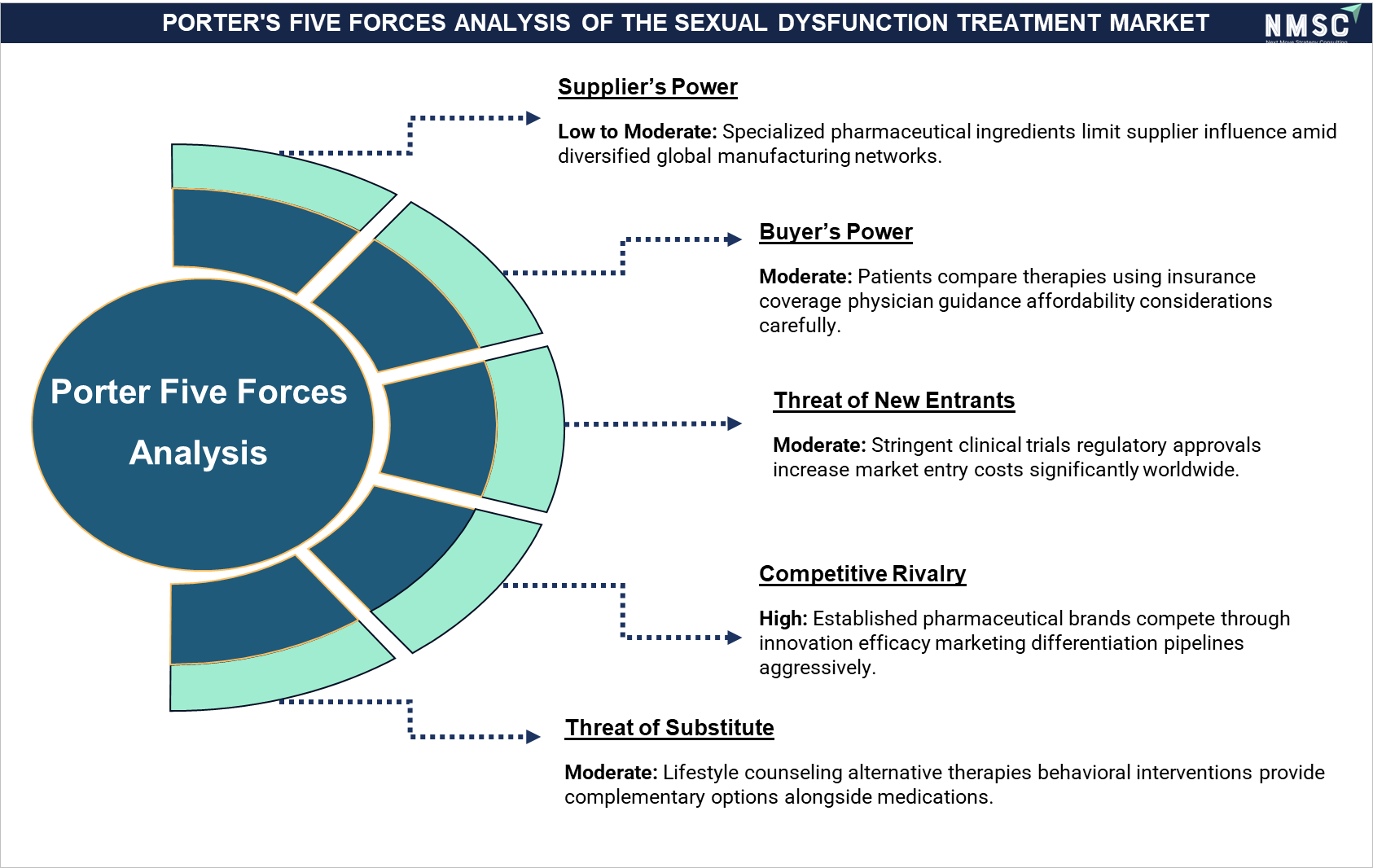
Based on our Porter’s Five Forces assessment, we identified that the threat of new entrants remains low due to stringent regulatory approvals, extensive clinical trial requirements, and high research and development investments. Supplier bargaining power is moderate, supported by specialized pharmaceutical ingredients but balanced by diversified supply networks. Buyer bargaining power is moderate as patients and healthcare providers consider efficacy, safety, and treatment costs. The threat of substitutes is moderate to high, driven by behavioral therapies, lifestyle interventions, and alternative treatment approaches. Competitive rivalry is high, with established pharmaceutical companies competing through innovation, clinical evidence, product differentiation, and geographic expansion.

Competitive Landscape

We observed that the sexual dysfunction treatment market remains moderately consolidated, with large multinational pharmaceutical manufacturers, generic drug producers, and specialized device makers all competing for prescriber and distribution-channel share.

Dimension Description
Market Structure Moderately consolidated, with the Top 10 companies accounting for a defined share of Industry revenue
Innovation Focus Female sexual dysfunction drug development, telehealth-pharmacy integration, and outpatient-compatible device design
M&A Activity Consolidation among specialty pharmaceutical firms and device manufacturers to broaden indication coverage

How Do Companies Compete Within the Sexual Dysfunction Treatment Market?

Companies compete primarily on clinical-trial evidence strength, prescriber-relationship depth, and distribution-channel breadth across hospital, retail, and online pharmacy networks. Our analysis shows that manufacturers increasingly differentiate through telehealth-partnership integration rather than product volume alone, as patients prioritize discreet, low-friction prescribing pathways.

Which Competitive Archetypes Dominate the Sexual Dysfunction Treatment Market?

Three archetypes dominate: large multinational pharmaceutical manufacturers such as Pfizer Inc. and Eli Lilly and Company; generic drug producers such as Viatris Inc. and Teva Pharmaceutical Industries Ltd.; and specialized device makers such as Boston Scientific Corporation and Coloplast A/S. Each archetype leverages distinct distribution channels, from branded direct-to-consumer marketing to generic retail-pharmacy contracts.

What Innovation and Differentiation Strategies Are Companies Pursuing?

Companies are pursuing female sexual dysfunction drug development, telehealth-pharmacy partnerships, and outpatient-compatible device design as core differentiation strategies. We found that Industry leaders are also investing in direct-to-consumer digital marketing to expand reach across previously undiagnosed and treatment-hesitant patient populations.

Key Market Players

Our findings suggest that the following 17 companies represent the leading verified providers active in the sexual dysfunction treatment market as of 2026, ranked in the order supplied for this report.

Pfizer Inc. Eli Lilly and Company Boston Scientific Corporation Coloplast A/S ViatrisInc. Teva Pharmaceutical Industries Ltd. Endo, Inc. Organon & Co. Sprout Pharmaceuticals, Inc. Sun Pharmaceutical Industries Limited Cipla Limited Zydus Lifesciences Limited Ferring Pharmaceuticals Petros Pharmaceuticals, Inc. Futura Medical plc Takeda Pharmaceutical Company Limited Laborie Medical Technologies

Latest Developments

We observed that recent product approvals and distribution expansions reflect the industry's continued shift toward broadened indication coverage and telehealth-enabled access.

Date Event
April 2026 Sun Pharmaceutical Industries Limited entered into a definitive cross-border agreement to acquire New Jersey-headquartered Organon & Co. for USD 11.75 billion, creating an expanded global portfolio spanning women's health therapeutics and specialty chronic care segments.
July 2026 Futura Medical continued the international commercialisation of MED3000, marketed as Eroxon®, which is available in 27 markets worldwide, including the United States, Mexico, most of Europe and several Middle Eastern countries. Futura operates through distribution and licensing partners in major consumer markets and, following EU market launch clearance announced on July 31, 2026, continued to advance Eroxon’s international commercial expansion.

Expert Insights

Dr. Run Wang

Dr. Run Wang

President | International Society for Sexual Medicine (ISSM)

"“Even when we are talking about shockwave therapy, which at least appears to have no physiologic side effects, there can be significant harm providing unproven treatment.”"

Analyst Interpretation

The statement highlights the growing emphasis on clinically validated and evidence-based therapies in the treatment of sexual dysfunction. As innovative modalities such as shockwave therapy, regenerative medicine, and combination treatment approaches gain traction, healthcare providers and regulators are prioritizing safety, efficacy, and long-term clinical outcomes. This increasing focus on scientifically proven interventions is expected to accelerate investment in advanced therapeutics and support the sustained growth of the global Sexual Dysfunction Treatment Market.

Investment Opportunities

What Capital Inflows Are Targeting the Sexual Dysfunction Treatment Market?

Capital inflows continue to target female sexual dysfunction drug development and telehealth-pharmacy infrastructure, with specialty pharmaceutical firms attracting sustained investor interest. Our assessment indicates that investors favor companies demonstrating measurable diagnosis-rate improvement and prescription-adherence outcomes over pure revenue-growth metrics.

How Is Infrastructure Investment Shaping Market Expansion?

Telehealth and online pharmacy infrastructure investment continues to expand treatment accessibility, supporting the 9.8% CAGR projected for Online Pharmacy distribution through 2035. We found that companies are prioritizing digital-prescribing platform investment to serve privacy-conscious patients across North America, Europe, and Asia-Pacific regions.

What ESG Considerations Are Relevant to Sexual Dysfunction Treatment Investment?

Environmental, Social, and Governance considerations increasingly favor companies expanding affordable generic access and supporting destigmatization and patient-education initiatives. Our analysis shows that institutional investors are prioritizing companies with transparent clinical-trial diversity and patient-access disclosures aligned with international pharmaceutical-governance standards.

Key Benefits for Stakeholders

How Does This Report Benefit Healthcare and Industry Leaders?

Healthcare and industry leaders gain access to verified segmentation, regional sizing, and competitive benchmarking that inform product-portfolio and distribution-channel investment decisions. Our analysis, data, and forecasts help leaders prioritize telehealth-integration and female-indication investments aligned with projected segment growth.

How Does This Report Benefit Investors and Financial Analysts?

Investors and financial analysts benefit from validated market-sizing, CAGR methodology, and company-level competitive positioning that support capital-allocation and valuation decisions. Our findings suggest that segment-level growth differentials, particularly in Device Therapy and Female Sexual Dysfunction, offer actionable signals for portfolio construction.

How Does This Report Benefit Pharmacy and Distribution Product Teams?

Pharmacy and distribution product teams gain strategic insight into emerging trends, competitive archetypes, and regional demand patterns that inform channel-partnership and inventory-planning prioritization. We observed that this analysis supports go-to-market planning for telehealth-pharmacy integration and generic-portfolio expansion across target distribution channels.

Key Market Segments Evaluated

By Therapy

  • Drug Therapy
  • Device Therapy

By Indication

  • Male Sexual Dysfunction
  • Female Sexual Dysfunction

By Distribution Channel

  • Hospital Pharmacy
  • Retail Pharmacy
  • Online Pharmacy
  • Specialty Pharmacy

By Route of Administration

  • Oral
  • Tablets
  • Capsules
  • Injectable
  • Intracavernosal
  • Subcutaneous
  • Intramuscular
  • Topical
  • Gel
  • Cream
  • Intraurethral
  • Suppositories
  • Applicators
  • Implantable
  • Penile Prostheses
  • Hormone Pellets
  • Device Based
  • External Devices
  • Implantable Devices

By Gender

  • Male
  • Adult
  • Geriatric
  • Female
  • Premenopausal
  • Postmenopausal

By End User

  • Hospitals
  • Public Hospitals
  • Private Hospitals
  • Specialty Clinics
  • Urology Clinics
  • Gynecology Clinics
  • Ambulatory Surgical Centers
  • Day Surgery Centers
  • Office Based Centers
  • Home Care
  • Self-Administration
  • Caregiver Administration

Conclusion & Recommendations

The long-term outlook remains positive, with the market projected to expand from USD 33.60 billion in 2026 to USD 58.40 billion by 2035 at a 6.33% CAGR. Our assessment indicates that sustained PDE5 inhibitor prescribing volume and expanding female sexual dysfunction drug approvals will anchor growth across both mature and emerging economies through the forecast horizon.

What Strategic Positioning Should Companies Pursue?

Companies should prioritize telehealth-pharmacy integration and female-indication drug development to differentiate within an increasingly access-focused treatment landscape. Our findings suggest that companies combining broad generic portfolios with verified clinical evidence will be best positioned to retain prescriber and distribution-channel relationships.

How Attractive Is the Market for New Investment?

The market presents an attractive investment case, supported by a USD 24.80 billion absolute dollar opportunity between 2026 and 2035 and above-average growth in the Middle East and Africa and the Device Therapy segment. We found that investment attractiveness is highest for companies combining pharmaceutical and device-therapy capability with telehealth distribution reach.

What Market Shifts and Key Risks Should Stakeholders Monitor?

Stakeholders should monitor limited insurance reimbursement, persistent underdiagnosis of female sexual dysfunction, and PDE5 inhibitor safety scrutiny as key risks. Our analysis shows that companies unable to demonstrate strong clinical evidence and patient-access support risk losing prescriber share to competitors with stronger diagnosis-gap-closure programs.

What Are the Key Growth Pathways for the Market?

Key growth pathways include expanding telehealth-pharmacy partnerships, scaling female sexual dysfunction diagnosis and treatment infrastructure, and deepening generic-drug penetration across Asia-Pacific and Latin America. Next Move Strategy Consulting's analysis indicates that companies pursuing these pathways while maintaining broad indication coverage will be best positioned to capture the market's projected growth through 2035.

FAQs

About the Author

Saista Faiyaz

Saista Faiyaz

Saista Faiyaz is Research Associate at Next Move Strategy Consulting, where she has covered consumer markets and healthcare technologies for 3 years. Her work includes primary interview review, secondary-source validation, market sizing, and structured analysis of company and industry data. She supports research by comparing evidence across sources, organizing findings into market narratives, and documenting assumptions used in analysis. Her scope includes cross-market benchmarking, and reports.

About the Reviewer

Debashree Dey

Debashree Dey

Debashree Dey is Assistant Manager at Next Move Strategy Consulting, where she supports cross-vertical market content and communications across diverse industries for 6 years. Her professional background includes senior content writing, communications, and published manuscript authorship, with experience developing audience-focused business narratives and maintaining clear, consistent messaging. Her role supports research-led content development and editorial quality across NextMSC publications.

Download Free Sample

Mohit Agarwal

MOHIT AGARWAL

Chief Manager

DryChem India Pvt. Ltd.

Next Move Strategy Consulting is an amazing team of consultants. We required a market study report for our investors on top priority and the team went above and beyond our expectations to deliver the same with ample supporting data within a short time span enabling us to secure the investments and keep our project timeline maintained. Their professionalism, attention to detail, and timely delivery of actionable recommendations have left a lasting impression on our organization.

Kishu Kanda

KISHU KANDA

Strategy Analyst

Accenture

We purchased the AI Consumer Market Report from this company. Not only did they customize the report to meet our specific requirements, but they also showed great flexibility in accommodating our budget. The report we received fully met our expectations. Additionally, they provided prompt and thorough responses to both our pre-purchase and follow-up questions. We look forward to working with this company again in the future.

Robert Sean Trevino

ROBERT SEAN TREVINO

Sr. Director, Head of Strategic Insights & Analytics

Foundation Medicine

I realized that it was a reliable source of information. These days, there are many people who are looking for authentic data, and this is one of the only sources that can offer them with what they need;

Ross J Mckenzie

ROSS J MCKENZIE

Business Insight Manager

Staysure Group

“Next MSC have been incredibly helpful in providing detailed & robust information on our market, alongside quantifying growth by different segments. The process to procure was simple and easy, with sample reports and regular contact to ensure we had what we needed. Succinct detail on their sources & methodologies is also greatly received, allowing transparency in this respect helps build trust in the detail you pay for. Joseph in particular was fantastic, and helped ensure efficient provision of the insight pack – thank you NMSC!”.

Gustaf Hummel Burstrom

GUSTAF HUMMEL BURSTROM

Founder

Revline Tools AB

Joseph and the team at Next Move Strategy Consulting have been excellent to work with, in supplying us with relevant market data and forecasts for our specific category. We had some special requirements and they were able to do a custom package to suit our needs. We would definitely recommend them to any other company needing market data and forecasts

Custom Market Research Services

We will customize the research for you if the listed report does not fully match your requirements.

Get 30% Free Customization

Select License

This website uses cookies to ensure you get the best experience on our website. Learn more

✖