Singapore Urea Market By Grade (Feed Grade, Fertilizer Grade, and Others), By Product Form (Solid Urea, Liquid Urea, and Specialty Urea), By Production Technology (Conventional Synthesis, Enhanced Production Technology, and Others), By Distribution Channel (Direct Sales, Distributor/Wholesale Network, and Others), By Application (Nitrogenous Fertilizer, Chemical Synthesis, and Others), By End Use Industry (Agriculture, Chemical Manufacturing, and Others) – Analysis & Forecast, 2025-2035
Industry: Materials and Chemical | Latest Edition: September 30, 2026 | No of Pages: 232 | No. of Tables: 118 | No. of Figures: 106 | Format: PDF | Report Code: MC4621
Singapore Urea Market Size & Forecast
|
Parameters |
Details |
|
Market Size in 2026 |
USD 469.6 million |
|
Revenue Forecast in 2035 |
USD 493.3 million |
|
Growth Rate |
CAGR of 0.55% from 2026 to 2035 |
|
Market Volume in 2026 |
1.28 million tons |
|
Volume Forecast in 2035 |
1.53 million tons |
|
Growth Rate |
CAGR of 2.02% from 2026 to 2035 |
|
Analysis Period |
2025–2035 |
|
Base Year Considered |
2025 |
|
Forecast Period |
2026–2035 |
|
Market Size Estimation |
Billion (USD) |
|
Companies Profiled |
10 |
|
Market Share |
Available for 10 companies |
Industry Outlook
The Singapore Urea Market size was valued at USD 436.6 million in 2025 and is expected to reach USD 469.6 million by 2026. Looking ahead, the industry is projected to expand significantly, reaching USD 493.3 million by 2035, registering a CAGR of 0.55% from 2026 to 2035. In terms of volume, the market recorded 1.15 million tons in 2025, with forecasts indicating growth to 1.28 million tons by 2026 and further to 1.53 million tons by 2035, reflecting a CAGR of 2.02% over the same period.
Regulatory Framework of the Singapore Urea Market:
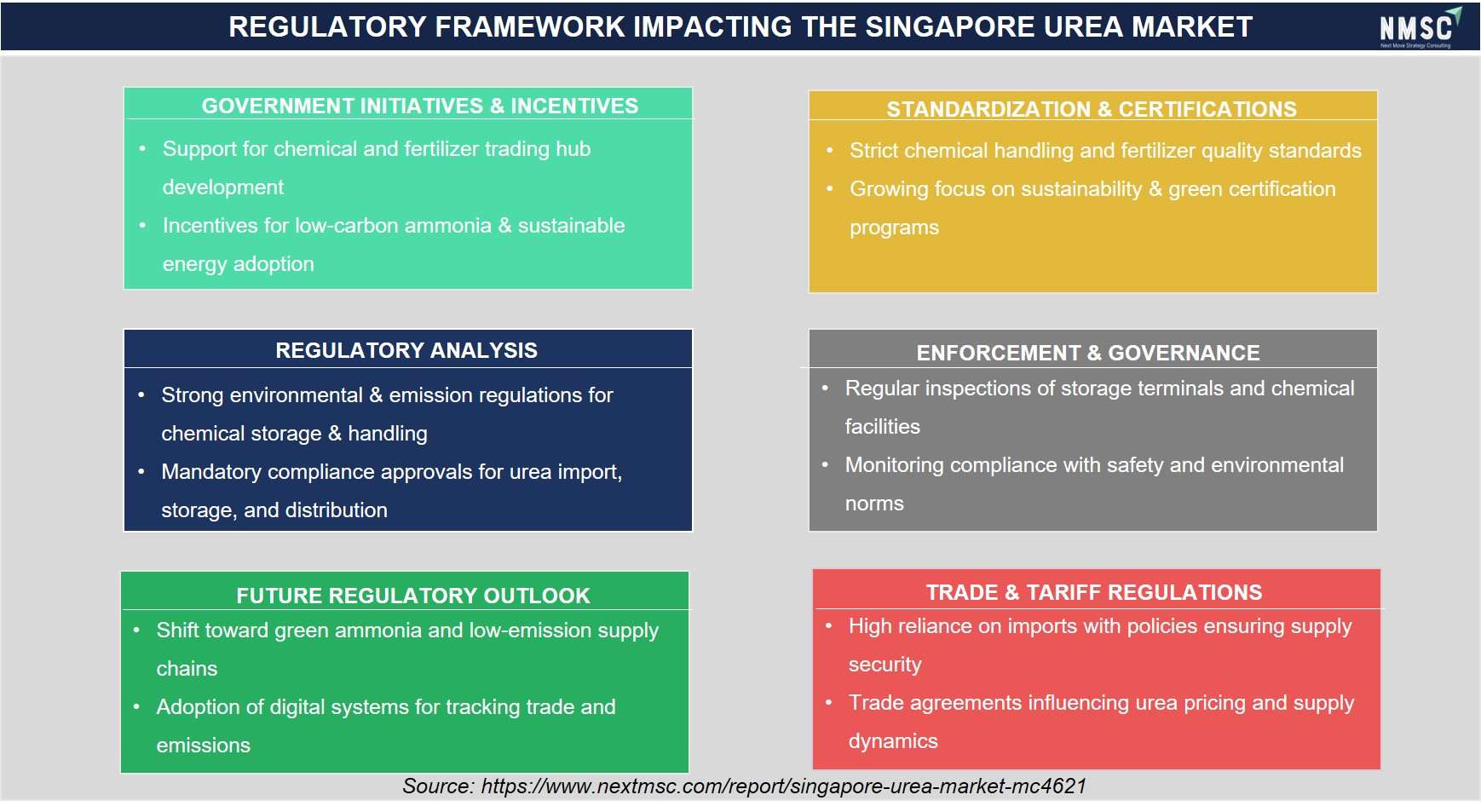
The chart depicts a stringent yet supportive regulatory framework for Singapore’s urea market, anchored by government incentives for chemical trading hubs and low-carbon ammonia. Our analysis indicates that strict compliance approvals and sustainability certifications govern imports and storage. Additionally, future regulations emphasize green ammonia and digital emissions tracking, while trade agreements ensure supply security. Regular enforcement by authorities on safety and environmental norms further underscores a market transitioning toward low-emission, digitally compliant supply chains.
What Are the Key Market Drivers, Breakthroughs, and Investment Opportunities That Will Shape the Urea Industry in the Next Decade?
Growth Catalyst & Risk Assessment Matrix
|
DRIVERS / TRENDS / RESTRAINTS |
(+/–) % IMPACT ON CAGR FORECAST |
GEOGRAPHIC RELEVANCE |
IMPACT TIMELINE |
|
Controlled-environment agriculture (indoor vertical farms, hydroponics, rooftop greenhouses) shaping precise nitrogen fertilizer demand |
+1.2% |
Nationwide, with strong concentration in Lim Chu Kang, Sungei Tengah, and Seletar agricultural clusters |
Short to medium term (1–3 years) |
|
Domestic agricultural subsidies alongside national food security programs ("30 by 30" goal, Singapore Food Story R&D) driving market expansion |
+1.0% |
Nationwide, via Singapore Food Agency (SFA) and Agri-Food Innovation Lab (AFIL) |
Short to medium term (1–3 years) |
|
High-tech farming infrastructure (automated nutrient delivery, IoT climate control, recirculating hydroponics) supporting fertilizer efficiency |
+0.9% |
Commercial high-tech farms in Lim Chu Kang, Sungei Tengah, Changi |
Medium term (2–4 years) |
|
Adoption of digital agricultural tools (real-time nutrient sensors, AI-based crop models, farm management software) creating new opportunities |
+0.8% |
Progressive indoor and vertical farms nationwide |
Medium term (2–4 years) |
|
Stringent environmental safeguards limiting nutrient discharge (NEA regulations, closed-loop requirements, zero-waste targets) restraining market growth |
-0.7% |
Nationwide, with strict enforcement in water-sensitive and urban-adjacent farming zones |
Medium term (2–4 years) |
It is observed that the Singapore urea market is steadily transforming into a niche, high-value segment shaped by the rapid expansion of urban farming systems, including hydroponics, vertical farming, and ornamental horticulture within controlled environments. These advanced cultivation models depend heavily on precise nitrogen management, where nitrogen fertilizer remains a preferred input due to its efficiency, solubility, and cost-effectiveness in formulated nutrient solutions. Government-led initiatives under the Singapore Green Plan and related support frameworks are actively promoting precision fertilization practices and the adoption of controlled-release and stabilized urea variants, thereby improving nutrient efficiency. The integration of high-tech infrastructure, such as automated climate systems and digital nutrient monitoring tools, is enhancing application accuracy and minimizing wastage. Nevertheless, stringent environmental regulations governing nutrient discharge and sustainability are enforcing tightly controlled fertilizer usage patterns. Singapore’s urea market is evolving as a technology-intensive and efficiency-driven ecosystem, where innovation in agri-tech, digital farming, and advanced fertilizer formulations is expected to play a critical role in optimizing nitrogen use while supporting sustainable, high-productivity urban agriculture.
Growth Drivers:
How Is Controlled-Environment Agriculture Shaping Nitrogen Fertilizer Demand in Singapore?
Controlled-environment agriculture is a key driver of urea demand in Singapore, as vertical farms, hydroponic systems, and indoor cultivation require precise nutrient management to sustain consistent crop output. These systems depend on a stable nitrogen supply to support rapid growth cycles and high productivity, with urea-based solutions commonly used in formulated nutrient mixes due to their efficiency and compatibility. This demand is further reinforced by the national focus on strengthening local food production, while limited land availability supports the adoption of high-intensity cultivation practices. As a result, controlled-environment agriculture is contributing to stable urea demand in Singapore.
How Are Domestic Agricultural Subsidies Alongside National Food Security Programs Driving Singapore Urea Market Expansion?
Our analysis indicates that policy-driven initiatives are increasingly shaping fertilizer usage trends in the Singapore urea market, as government grants and Singapore’s Green Plan programs promote precision nutrient management and the adoption of controlled-release urea formulations. These frameworks encourage urban farmers, hydroponic operators, and horticultural producers to implement balanced fertilization techniques that reduce nitrogen losses while maintaining productivity. As a result, environment-friendly fertilizers remains a primary nitrogen source, supported by targeted applications and technical guidance through government and private sector collaboration. These initiatives are also enhancing awareness of environmentally responsible practices, thereby reinforcing the adoption of advanced nutrient solutions and supporting sustainable urea usage across Singapore’s specialty agricultural systems.
How is High-Tech Farming Infrastructure Supporting Fertilizer Efficiency in Singapore?
We evaluated that advanced farming infrastructure is playing a significant role in improving fertilizer efficiency in Singapore, as technologies such as automated climate control, precision irrigation systems, and controlled nutrient delivery solutions are enhancing overall crop management practices. These systems enable accurate and timely nutrient application, improving nitrogen utilization while minimizing input wastage, with urea commonly incorporated into structured nutrient formulations to ensure stable and consistent crop growth in controlled environments. As farmers and agri-operators increasingly rely on these technologies to maximize productivity within limited spaces, ongoing investment in agri-tech development is further strengthening operational efficiency and system performance, thereby supporting optimized fertilizer use and sustaining consistent precision fertilizers demand in Singapore’s high-tech agricultural ecosystem.
Growth Inhibitor:
Are Stringent Environmental Safeguards Limiting Nutrient Discharge and Limiting Singapore Urea Market Growth?
Stringent environmental safeguards are limiting nutrient discharge and moderating urea market growth in Singapore, as strict regulations governing water quality, chemical usage, and waste management require controlled application of nitrogen-based fertilizers across agricultural systems. Urban farming operators must comply with defined discharge standards, which restrict excess nutrient release into surrounding ecosystems and encourage precise, minimal fertilizer use. In response, farmers and agri-tech operators are adopting controlled nutrient delivery systems to meet compliance requirements, while broader sustainability frameworks promote efficient resource utilization and discourage over-application. As a result, environmental safeguards are ensuring responsible fertilizer usage while constraining volume-driven expansion in Singapore’s urea market.
Growth Opportunity:
How Is the Adoption of Digital Agricultural Tools Creating New Opportunities?
Our research indicates that in the urea market in Singapore, the growing use of digital agricultural tools is emerging as a notable opportunity to enhance fertilizer efficiency and optimize distribution, as growers increasingly adopt technologies such as variable-rate equipment and soil testing systems to align nitrogen application with specific crop and soil requirements. This approach improves nutrient use efficiency while reducing unnecessary consumption, with real-time soil monitoring and precision machinery further minimizing losses from leaching and volatilization while maintaining stable productivity in controlled environments. Although adoption is currently more prominent among technologically advanced and commercial operators due to higher investment needs, government support for smart agriculture is expected to expand accessibility, thereby creating new growth opportunities for urea suppliers and agritech providers in Singapore.
Porter’s Five Forces Analysis of the Singapore Urea Market:
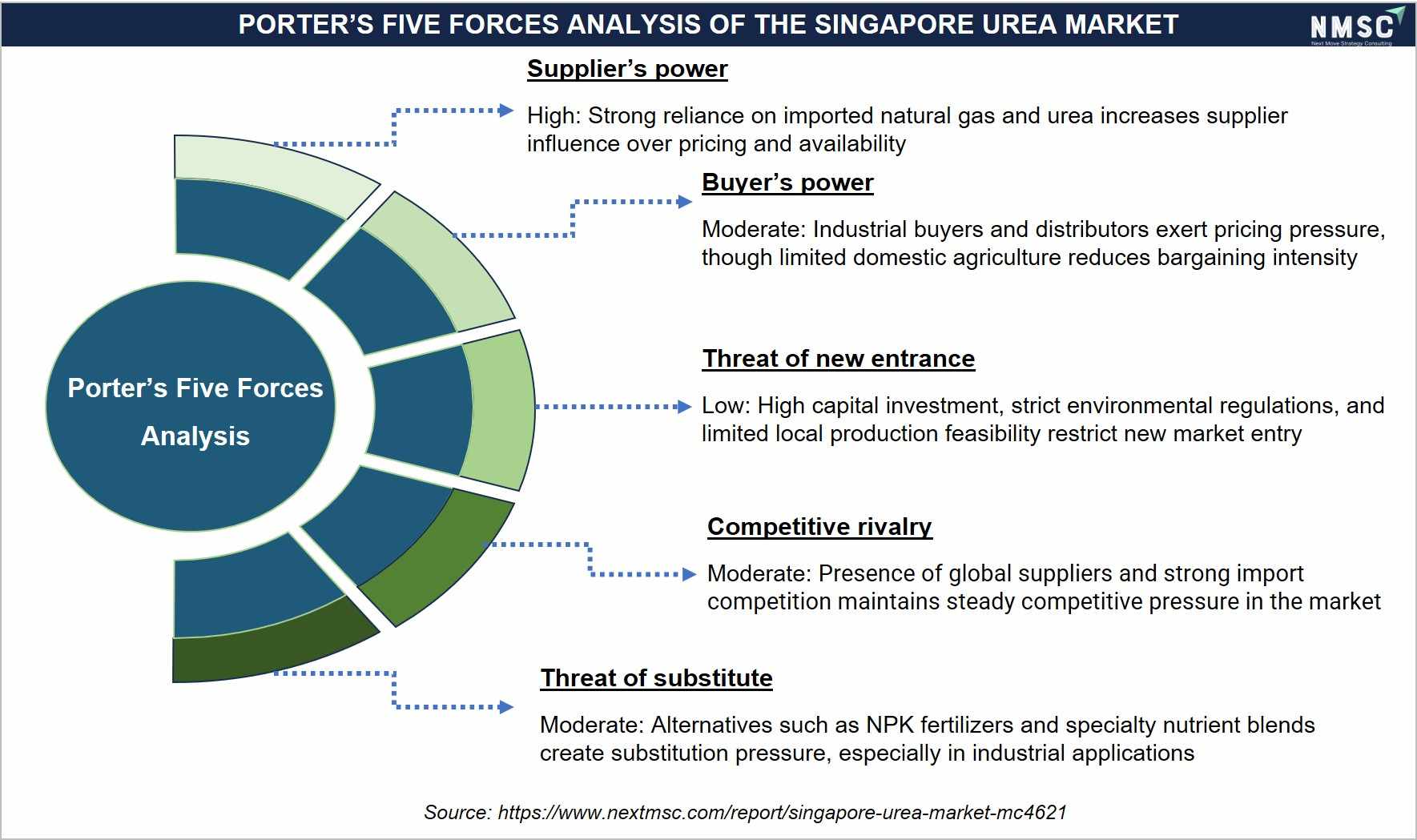
Our analysis of Porter’s Five Forces framework highlights a unique landscape for the Singapore urea market. As a global trading hub with no domestic production, the threat of new entrants is high for traders, though low for manufacturers. Supplier power is concentrated among major producing nations. Buyer power is strong due to price-sensitive regional agriculture. Rivalry is intense among trading houses, while the threat of substitutes, such as slow-release fertilizers, remains a notable market pressure point.
How Is the Singapore Urea Market Segmented in This Report, And What Are the Key Insights from the Segmentation Analysis?
By Application Insights
Is Application Segment Shaping the Singapore Urea Market in 2025?
Based on application, the Singapore urea market is segmented into nitrogenous fertilizer, chemical synthesis, diesel exhaust fluid production, animal feed, medical and pharmaceutical use, cosmetics and personal care, deicing agent, laboratory reagent, textiles and construction chemicals, and oilfield chemicals.
We observed that nitrogenous fertilizer applications are primarily driven by urban farming, hydroponics, and controlled-environment agriculture, where precise nutrient delivery is essential. Chemical synthesis supports industrial processing and specialty chemical production within Singapore’s advanced manufacturing ecosystem. Diesel exhaust fluid production contributes to environmental compliance in transportation and logistics operations. Additionally, pharmaceutical, cosmetics, and laboratory use further expand high-value demand, while textiles, construction chemicals, and oilfield applications add industrial diversity. This broad application structure enhances product utilization efficiency, supports innovation across sectors, and ensures stable, niche-driven growth in the Singapore urea market.
By End Use Industry Insights
Is End Use Industry Segment Shaping the Singapore Urea Market in 2025?
Based on end-use industry, the Singapore urea market is segmented into agriculture, chemical manufacturing, automotive and transportation, animal nutrition, healthcare and cosmetics, and construction and other industrial uses.
Agriculture demand is largely shaped by urban farming, hydroponics, and controlled-environment cultivation, where precise nutrient management is essential for optimal output. Our review indicates that chemical manufacturing contributes through Singapore’s advanced industrial ecosystem, supporting the production of specialty chemicals and intermediates. The automotive and transportation sector utilizes urea in emission control applications such as diesel exhaust fluids, aligning with environmental regulations. Healthcare, cosmetics, and animal nutrition add to high-value consumption, while construction and other industrial uses expand overall chemical demand. Overall, this diversified end-use structure improves resource efficiency, encourages cross-sector innovation, and supports stable, niche-driven growth in the Singapore market.
Competitive Landscape
The Singapore urea industry is shaped by global fertilizer producers, regional trading firms, and specialized distributors operating within a moderately structured competitive environment. Key players, including Saudi Basic Industries Corporation (SABIC), PTT International Trading Pte. Ltd., EuroChem Trading (Singapore) Pte. Ltd., ARNA International Pte. Ltd., Liven Agrichem Pte. Ltd., Agro Alliance Pte. Ltd., GKE Fairchem Pte. Ltd., Merck Pte. Ltd. (Singapore), CTH Chemical Pte. Ltd., and EnviroTech Singapore Pte. Ltd., ensure stable urea supply through import networks and local distribution channels. Moreover, advisory partners enhance technical support and tailored solutions, enabling efficient use across urban farming, hydroponics, and industrial applications. Consequently, supply reliability, innovation, and agronomic expertise continue to shape market performance in Singapore.
Key Players of the Singapore Urea Market:
-
Saudi Basic Industries Corporation (SABIC)
-
PTT International Trading Pte. Ltd.
-
EuroChem Trading (Singapore) Pte. Ltd.
-
ARNA International Pte. Ltd.
-
Liven Agrichem Pte. Ltd.
-
Agro Alliance Pte. Ltd.
-
GKE Fairchem Pte. Ltd.
-
Merck Pte. Ltd. (Singapore)
-
CTH Chemical Pte. Ltd.
-
EnviroTech Singapore Pte. Ltd.
Competition in the Singapore urea market is driven more by efficient supply chains, advanced fertilizer formulations, and strong agronomic expertise rather than production scale alone. Further, companies are increasingly prioritizing stabilized and controlled-release urea products, which enhance nitrogen use efficiency and support environmentally responsible practices in urban farming, hydroponics, and ornamental horticulture. The growing adoption of precision nutrient management also highlights farmers’ preference for inputs that improve productivity while aligning with sustainability goals. Key suppliers are strengthening distribution networks, offering agronomic advisory services, and partnering with retailers and cooperative programs. Consequently, these initiatives reinforce market reach, technical support, and innovation-led competitiveness in the Singapore urea market.
Singapore Urea Market Key Segments
By Grade
-
Feed Grade
-
Fertilizer Grade
-
Technical / Industrial Grade
-
Medical / Laboratory Grade
By Product Form
-
Solid Urea
-
Granular Urea
-
Prilled Urea
-
Pellet Urea
-
Crystal Urea
-
-
Liquid Urea
-
Urea Ammonium Nitrate Solution
-
Aqueous Urea Solution
-
Diesel Exhaust Fluid
-
Liquid Fertilizer Blends
-
-
Specialty Urea
-
Urea-Formaldehyde
-
Methylene Urea
-
Melamine
-
Urea-Ammonium Sulfate
-
By Production Technology
-
Conventional Synthesis
-
Low Emission / Green Technology
-
Enhanced Production Technology
-
Specialty Urea Manufacturing
By Distribution Channel
-
Direct Sales
-
Distributor / Wholesale Network
-
Retail / Agro Stores
-
Online / B2B Platforms
-
Institutional / Government Procurement
By Application
-
Nitrogenous Fertilizer
-
Chemical Synthesis
-
Diesel Exhaust Fluid Production
-
Animal Feed
-
Medical and Pharmaceutical Use
-
Cosmetics and Personal Care
-
Deicing Agent
-
Laboratory Reagent
-
Textiles and Construction Chemicals
-
Oilfield Chemicals
By End Use Industry
-
Agriculture
-
Chemical Manufacturing
-
Automotive and Transportation
-
Animal Nutrition
-
Healthcare and Cosmetics
-
Construction and Other Industrial Uses
Key Benefits for Stakeholders:
Next Move Strategy Consulting (NMSC) presents a detailed evaluation of the Singapore urea market trends, analyzing industry developments from 2020 to 2025 while outlining forward-looking projections through 2035. The study evaluates fertilizer consumption patterns in the market by combining quantitative market assessment with qualitative insights into key demand drivers, distribution frameworks, agronomic practices, and developments in urea formulations and application techniques. This structured analysis provides a clear understanding of how urban farming systems, rising hydroponics adoption, and sustainability-oriented cultivation practices are shaping nutrient usage trends within Singapore’s controlled agricultural environment.
From a value-chain standpoint, the market supports efficient nutrient management, higher productivity, and environmentally responsible farming. Urban growers gain improved plant performance and precise nitrogen utilization, while manufacturers focus on controlled-release and stabilized urea innovations. At the same time, distributors and agronomy providers enhance efficiency through advisory services and precision farming solutions.
|
Parameters |
Details |
|
Customization Scope |
Free customization (equivalent to up to 80 analyst-working hours) after purchase. |
|
Pricing and Purchase Options |
Avail customized purchase options to meet your exact research needs. |
|
Approach |
In-depth primary and secondary research; proprietary databases; rigorous quality control and validation measures. |
|
Analytical Tools |
Porter's Five Forces, SWOT, value chain, and Harvey ball analysis to assess competitive intensity, stakeholder roles, and relative impact of key factors. |


About the Author
 Mayurima Roy
— Mayurima Roy is Research Analyst at Next Move Strategy Consulting, where she has spent 4 years working across the firm's full industry coverage rather than a single fixed vertical. Her work centers on structured research, ongoing trend tracking, competitive assessment, and insight-led content development, translating complex market data into clear, decision-ready narratives that support informed client decision-making across diverse global industries, market sectors, and world regions every day.
Mayurima Roy
— Mayurima Roy is Research Analyst at Next Move Strategy Consulting, where she has spent 4 years working across the firm's full industry coverage rather than a single fixed vertical. Her work centers on structured research, ongoing trend tracking, competitive assessment, and insight-led content development, translating complex market data into clear, decision-ready narratives that support informed client decision-making across diverse global industries, market sectors, and world regions every day.
About the Reviewer
 Supradip Baul
— Supradip Baul is an accomplished business consultant and strategist with over a decade of rich experience in market intelligence, strategy, technology, and business transformation. His work has included rigorous qualitative and quantitative analysis across multiple industries, helping clients shape investment decisions and long-term roadmaps. Earlier in his career, he was associated with Gartner, where he contributed to industry-leading reports and market share analyses. He has worked with leading global companies and holds an MBA with a dual specialization in Marketing and Finance.
Supradip Baul
— Supradip Baul is an accomplished business consultant and strategist with over a decade of rich experience in market intelligence, strategy, technology, and business transformation. His work has included rigorous qualitative and quantitative analysis across multiple industries, helping clients shape investment decisions and long-term roadmaps. Earlier in his career, he was associated with Gartner, where he contributed to industry-leading reports and market share analyses. He has worked with leading global companies and holds an MBA with a dual specialization in Marketing and Finance.
At Next Move Strategy Consulting, we understand that insightful market research is the cornerstone of successful business decisions. That's why we employ a robust and multifaceted approach, combining various methodologies to deliver the most accurate and actionable data for our clients.

Research Landscape
We navigate the world of research with two primary approaches:
Qualitative Approach
Our qualitative research methodologies involve immersive techniques such as in-depth interviews, focus groups, and observational studies. By engaging directly with individuals and stakeholders, we uncover valuable insights that quantitative data alone may overlook.

Quantitative Research
In tandem with qualitative methodologies, NMSC leverages the power of Quantitative Research to provide a robust foundation of numerical insights. Through systematic data collection and analysis, we quantify patterns, preferences, and market trends, offering a comprehensive view of the business landscape.
Our quantitative research approach employs diverse tools, including surveys, experiments, and statistical modelling. These methodologies enable us to gather data from a large and representative sample, ensuring the statistical significance of our findings. By employing structured questionnaires and standardized data collection methods, we guarantee the reliability and validity of the information we present to our clients.
Quantitative research is particularly effective in measuring the prevalence of trends, assessing market size, and gauging the impact of various factors on consumer behavior. The numerical precision attained through this approach equips our clients with actionable insights, facilitating data-driven decision-making and strategy formulation.


Our Specialized Toolbox for Industry-Specific Market Research
We deploy a specialized arsenal of techniques tailored to meet your unique requirements. Here's a glimpse into our comprehensive toolbox:

Information Procurement
The stage entails acquiring market data or relevant information through various sources and methodologies.


Market Research Approach
We utilize both top-down and bottom-up approaches in market research analysis to achieve a comprehensive understanding of the market dynamics, leveraging the broad perspective of industry trends and macroeconomic factors alongside detailed insights from specific segments and individual companies.

Porters Five Forces Analysis
We conduct Porter's Five Forces analysis to evaluate the competitive landscape of an industry, providing us with insights into factors that affect profitability and strategic positioning.

SWOT Analysis

Forecasting
We utilize a forecasting model to predict future consumption by considering parameters like population, economics, regulations, market competition, drivers, constraints, technology, and pricing. We also employ statistical techniques such as multilinear regression, exponential smoothing, moving average, ARIMA, and Monte Carlo simulations for accurate predictions. In econometric forecasting, we analyzed short-term and long-term event impacts, attributing values based on regulatory frameworks, economic factors, and market events.





 Speak to Our Analyst