Smart Container Market Size, Share, Growth & Forecast by Container Type (Dry, Refrigerated, Tank, Special Purpose), Container Size (20 FEU, 40 FEU, High Cube), Technology Integration (Factory Fit, Retrofit), Offering (Hardware, Connectivity Services, Software & Platform, Professional Services), Commercial Model, Application (Cold Chain, Chemicals, Industrial, Retail, Electronics, Energy), and End User — Global Analysis 2026–2035
Industry: ICT & Media | Publishing Date: June 13, 2026 | Last Updated: September 30, 2026 | No of Pages: N/A | No. of Tables: N/A | No. of Figures: N/A | Format: PDF | Report Code: IC3452
What Is the Smart Container Market Size?
The global Smart Container Market size was valued at USD 4.2 billion in 2025 and is expected to reach USD 4.8 billion in 2026. Sustained growth in international trade volumes, rapid adoption of IoT-based cargo monitoring, and increasing regulatory mandates for cold chain integrity across pharmaceuticals and perishable food categories are projected to drive the sector to USD 14.8 billion by 2035, advancing at a CAGR of 13.4% from 2026 to 2035. Key growth drivers include the expanding deployment of telematics and tracking units across refrigerated containers, the proliferation of LPWAN and satellite connectivity services enabling real-time remote monitoring, escalating shipper demand for temperature-sensitive cargo data, and the growing adoption of subscription-based commercial models that reduce upfront capital barriers for fleet operators.
|
Parameters |
Details |
|
Market Size in 2025 |
USD 4.2 Billion |
|
Market Size in 2026 |
USD 4.8 Billion |
|
Revenue Forecast in 2035 |
USD 14.8 Billion |
|
Growth Rate |
CAGR of 13.4% from 2026 to 2035 |
|
Analysis Period |
2025–2035 |
|
Base Year Considered |
2025 |
|
Forecast Period |
2026–2035 |
|
Market Size Estimation |
Billion USD |
|
Companies Profiled |
20 |
|
Countries Covered |
33 |
|
Market Share |
Top 10 |
Smart Container Market Overview
What Is the Smart Container Market?
The Smart Container Market encompasses shipping containers embedded with IoT-enabled hardware, connectivity modules, and software platforms that enable real-time monitoring, tracking, and management of cargo throughout global supply chains. Smart containers integrate telematics and tracking units, sensor modules for temperature, humidity, shock, gas, and weight, gateway and edge compute devices, electronic seals, and power systems. These intelligent assets transmit continuous data streams via cellular, satellite, LPWAN, and hybrid networks to cloud-based monitoring dashboards, empowering shippers, freight forwarders, and ocean carriers to achieve superior cargo visibility, regulatory compliance, and operational efficiency.
How Has the Smart Container Market Evolved?
The Smart Container Market has evolved through three distinct technology phases. The initial phase centered on passive RFID tracking and basic GPS-based position reporting for dry containers, primarily adopted by large shipping lines managing high-value cargo. The second phase introduced sensor-rich telematics units specifically designed for refrigerated containers, enabling remote monitoring of reefer machine parameters and interior temperature profiles. NMSC's analysis indicates that the current phase is characterized by comprehensive multi-modal sensor integration, edge computing at the container level, AI-powered predictive analytics platforms, and subscription-based commercial models that are expanding smart container adoption beyond refrigerated units into dry, tank, and special purpose container categories globally.
How Do Regulations Influence the Smart Container Market?
Regulatory frameworks across pharmaceutical logistics, food safety, and hazardous materials transport are powerful structural drivers shaping the Smart Container Market. The U.S. Food and Drug Administration's Drug Supply Chain Security Act (DSCSA) mandates serialization and traceability for pharmaceutical shipments, compelling adoption of smart containers equipped with temperature loggers and chain-of-custody documentation platforms. The EU's Good Distribution Practice (GDP) guidelines for medicinal products require continuous temperature monitoring during distribution. The International Maritime Organization's (IMO) Container Weight Verification regulations and SOLAS amendments have further elevated interest in weight and load sensor-equipped smart containers for compliance documentation across global port operations.
How Is Technology Adoption Expanding Across the Smart Container Market?
Technology adoption across the Smart Container Market is accelerating as hardware miniaturization reduces sensor unit costs and low-power wide-area networks extend monitoring coverage to remote maritime and inland logistics corridors. Based on NMSC's research, we found that factory-fit smart containers from manufacturers such as CIMC are increasingly incorporating embedded telematics as a standard feature, while the retrofit segment is expanding rapidly as leasing companies and fleet owners equip existing container assets with plug-and-play IoT modules. Cloud-native software platforms with open API middleware are enabling seamless integration with enterprise resource planning systems, customs documentation platforms, and insurance data services, broadening the value proposition of smart container solutions across the entire logistics value chain.
Key Takeaways
|
Key Takeaways |
|
By Container Type, Refrigerated Containers dominate the Smart Container Market, accounting for approximately USD 2.0 billion in 2025, driven by stringent regulatory requirements for temperature-controlled pharmaceuticals, fresh produce, and frozen foods requiring continuous real-time monitoring throughout global cold chain logistics networks. |
|
Dry Containers are the fastest-growing sub-segment by container type in the Smart Container Market, advancing at a CAGR of 14.0% from 2026 to 2035, propelled by cost reductions in IoT hardware, growing shipper demand for cargo security monitoring, and the expansion of high-value electronics and retail cargo requiring door, seal, and shock sensor integration. |
|
By Container Size, the 40-Foot Equivalent Unit (FEU) segment holds the largest market share in the Smart Container Market at approximately USD 2.1 billion in 2025, reflecting its dominant usage in long-haul ocean freight and its higher return on investment for per-container IoT equipment deployment across major trade lanes. |
|
High Cube and Other Oversized Units represent the fastest-growing container size segment in the Smart Container Market, expanding at a CAGR of 15.3% from 2026 to 2035, supported by growing demand from e-commerce fulfillment and project cargo operators requiring expanded interior capacity with integrated environmental monitoring capabilities. |
|
By Technology Integration, Factory-Fit Smart Containers dominate the Smart Container Market with an estimated USD 2.9 billion in 2025, as leading shipping lines and leasing companies increasingly specify embedded telematics as a standard procurement requirement for new container orders from manufacturers. |
|
Retrofit Smart Containers are the fastest-growing technology integration segment in the Smart Container Market, advancing at a CAGR of 15.2% from 2026 to 2035, driven by the massive installed base of unequipped containers and the falling per-unit cost of modular, battery-powered IoT retrofit kits available from vendors including Tive, Hoopo, and Globe Tracker. |
|
By Offering, Hardware dominates the Smart Container Market at approximately USD 1.9 billion in 2025, with Telematics and Tracking Units comprising the largest hardware sub-category, as they form the foundational connectivity layer for all smart container deployments across refrigerated, dry, and tank container fleets worldwide. |
|
Software and Platform offerings represent the fastest-growing offering segment in the Smart Container Market, projected to advance at a CAGR of 17.8% from 2026 to 2035, driven by demand for analytics and predictive insights dashboards, integration middleware and APIs, and compliance and reporting modules that deliver recurring subscription revenue for platform vendors. |
|
By Commercial Model, Subscription Lease (Opex) leads the Smart Container Market with approximately USD 2.4 billion in 2025, reflecting the strong preference among freight forwarders, third-party logistics providers, and cargo owners for flexible, per-container monthly billing models that avoid large upfront capital commitments. |
|
Usage-Based Lease (Opex) is the fastest-growing commercial model in the Smart Container Market at a CAGR of 16.9% from 2026 to 2035, as platform providers introduce consumption-driven billing frameworks that align smart container service costs with actual shipment frequency and data consumption volumes. |
|
By Application, Cold Chain Logistics is the dominant application segment in the Smart Container Market, contributing approximately USD 1.8 billion in 2025, underpinned by the pharmaceutical and life sciences sub-segment which requires validated, regulation-compliant temperature excursion monitoring and reporting for vaccine, biologic, and controlled substance shipments. |
|
Electronics and High Value Cargo is the fastest-growing application segment in the Smart Container Market at a CAGR of 15.6% from 2026 to 2035, driven by shipper demand for multi-sensor protection covering shock, vibration, tampering, and humidity for semiconductors, consumer electronics, and luxury goods moving through global ocean trade routes. |
|
By End User, Shipping Lines and Ocean Carriers dominate the Smart Container Market with approximately USD 1.4 billion in 2025, given their role as primary container fleet operators deploying factory-fit smart containers and subscribing to enterprise-grade monitoring and analytics platform services for fleet-wide cargo visibility management. |
|
North America is the dominant region in the Smart Container Market with an estimated USD 1.4 billion in 2025 and is projected to reach USD 4.6 billion by 2035 at a CAGR of 12.6%, anchored by stringent pharmaceutical cold chain regulations, major port infrastructure investments, and high adoption of digital freight management platforms. |
|
Asia Pacific is the fastest-growing region in the Smart Container Market at a CAGR of 14.8% from 2026 to 2035, driven by China's massive container manufacturing capacity, India's expanding pharmaceutical export sector requiring GDP-compliant cold chain infrastructure, and Southeast Asia's rapidly growing intraregional trade volumes. |
|
The United States is the single largest country market in the Smart Container Market, representing approximately 65% of North American revenue in 2025, supported by the FDA's DSCSA implementation mandates, the world's highest pharmaceutical logistics spending, and major shipping port expansion programs at the Port of Los Angeles, New York, and Savannah. |
|
China is the fastest-growing major country market in the Smart Container Market at a CAGR of 15.8% from 2026 to 2035, propelled by CIMC's dominant global container manufacturing position, government-driven cold chain infrastructure investment, and rapid expansion of cross-border e-commerce cold chain logistics services connecting Chinese exporters to global consumer markets. |
Key Emerging Trends in the Smart Container Market
How Is the Integration of Edge Computing Transforming Real-Time Cargo Intelligence in the Smart Container Market?
Edge computing integration within smart container gateway units is fundamentally transforming cargo intelligence capabilities across the Smart Container Market. Rather than transmitting raw sensor data streams to the cloud for processing, edge-enabled containers now analyze temperature excursions, shock events, and seal breaches locally, triggering immediate automated alerts and actions without relying on intermittent satellite connectivity. Our findings suggest that Nexxiot and Traxens have deployed edge compute units capable of running predictive algorithms that differentiate equipment malfunctions from genuine cargo quality threats, significantly reducing false alarm rates and enabling faster response by freight operations teams across remote ocean trade routes.
How Are Satellite-Enabled Connectivity Services Reshaping Global Coverage in the Smart Container Market?
Satellite connectivity services are resolving the coverage gap that historically limited smart container data transmission to port zones and coastal maritime corridors. Through NMSC's assessment, we found that low-earth orbit satellite networks, including those operated by Iridium and Inmarsat, now provide near-continuous two-way data transmission coverage for containers deployed on transoceanic routes through partnerships with smart container platform providers such as ORBCOMM and Globe Tracker. This development enables pharmaceutical and food shippers to maintain complete, uninterrupted cold chain records from origin consolidation point to destination delivery, satisfying regulatory requirements under WHO and EU GDP guidelines for temperature-controlled medicinal products shipped via ocean freight.
How Is the Shift Toward Subscription-Based Commercial Models Reshaping the Smart Container Market Competitive Landscape?
The structural shift from outright hardware sales toward subscription and usage-based lease commercial models is reshaping competitive dynamics across the Smart Container Market. Our analysis shows that vendors including Tive, SkyCell, and Envirotainer have successfully demonstrated that per-shipment or per-container monthly subscription models accelerate adoption among freight forwarders and cargo owners who cannot justify large capital expenditures for smart container equipment. This model transformation is expanding the total addressable market by enabling SME shippers and logistics providers to access enterprise-grade cargo monitoring capabilities without requiring hardware ownership, while simultaneously improving vendor revenue predictability through recurring subscription income streams.
How Is Predictive Analytics and AI-Powered Spoilage Prevention Elevating Value Creation in the Smart Container Market?
Predictive analytics platforms powered by artificial intelligence are elevating value creation in the Smart Container Market beyond reactive alert systems toward proactive cargo quality management. Based on our market evaluation, we noticed that platforms developed by vendors including Carrier Global's Sensitech division and Trane Technologies are integrating historical shipment data, weather forecasts, port dwell time predictions, and real-time reefer machine telemetry to forecast cargo spoilage risk hours before critical threshold breaches occur. This predictive capability enables logistics operators to pre-empt cold chain failures, reroute refrigerated containers to closer ports, or trigger pre-emptive reefer maintenance, reducing pharmaceutical and food cargo loss by measurable percentages across high-value cold chain routes.
What Are the Key Market Drivers, Breakthroughs, and Investment Opportunities that Will Shape the Smart Container Market Industry in the Next Decade?
|
Drivers / Trends / Restraints |
(+/-) % Impact on CAGR Forecast |
Geographic Relevance |
Impact Timeline |
|
Pharmaceutical Cold Chain Compliance Mandates |
+2.1% |
North America, Europe, APAC |
2025–2032 |
|
IoT Hardware Cost Reduction Enabling Dry Container Adoption |
+1.8% |
Global |
2025–2030 |
|
Satellite LEO Network Expansion for Remote Monitoring |
+1.4% |
Global (all trade lanes) |
2026–2035 |
|
Growth of E-Commerce Cross-Border Cold Chain Volumes |
+1.2% |
APAC, North America, Europe |
2025–2032 |
|
Subscription and Usage-Based Model Adoption |
+1.0% |
North America, Europe |
2025–2035 |
|
High Per-Unit Hardware and Installation Costs |
-1.3% |
SMB, Emerging Markets |
2025–2029 |
|
Fragmented Global Data Standards for Container IoT |
-0.8% |
Global |
Ongoing |
|
Cybersecurity Vulnerabilities in Connected Container Systems |
-0.6% |
All regions |
Ongoing |
|
Expansion of Vaccine and Biologic Cold Chain Logistics |
+1.6% |
Global |
2026–2035 |
|
Port and Terminal Digitalization Investments |
+0.9% |
MEA, APAC, Latin America |
2026–2033 |
What Are the Growth Drivers of the Smart Container Market?
How Are Escalating Pharmaceutical Cold Chain Regulatory Requirements Driving the Smart Container Market?
Pharmaceutical cold chain compliance mandates represent the most powerful structural growth driver of the Smart Container Market globally. The U.S. Food and Drug Administration's Drug Supply Chain Security Act requires complete traceability documentation for prescription drug shipments, compelling pharmaceutical manufacturers and logistics service providers to deploy validated temperature-monitoring smart container solutions. The European Medicines Agency's Good Distribution Practice guidelines mandate continuous temperature recording for medicinal products during distribution. From our research, we found that the WHO's Model Guidance for the Storage and Transport of Time- and Temperature-Sensitive Pharmaceutical Products provides internationally recognized standards that are driving smart container adoption across emerging market pharmaceutical export corridors, particularly in India and China.
How Is the Proliferation of IoT Hardware Cost Reductions Accelerating Smart Container Deployment?
Declining costs of IoT sensors, microcontrollers, and low-power communication modules are enabling economically viable smart container deployments across previously cost-prohibitive dry and general cargo container segments. Based on NMSC's research, we found that the average cost of a battery-powered GPS and multi-sensor retrofit unit has fallen substantially over the past five years, driven by semiconductor scale economies and competitive market dynamics among hardware vendors including Tive, Hoopo, and SkyCell. The U.S. National Institute of Standards and Technology has documented IoT sensor cost trajectories that confirm consistent annual unit price reductions across environmental monitoring hardware categories, validating the commercial viability expansion of smart container solutions from high-value pharmaceutical into standard dry cargo applications.
How Is the Rapid Expansion of Global Cold Chain Logistics Infrastructure Expanding the Smart Container Market?
Global cold chain logistics infrastructure expansion is creating direct and sustained demand for refrigerated smart containers equipped with continuous monitoring capabilities. NMSC's analysis indicates that the International Institute of Refrigeration estimates significant portions of fresh produce, meat, and dairy products are lost globally each year due to cold chain failures, creating powerful economic motivation for shippers and retailers to deploy monitoring-enabled refrigerated containers. Government-backed cold chain infrastructure investment programs in India, under the National Centre for Cold-chain Development, and in Southeast Asia, through ASEAN food security frameworks, are driving refrigerated container procurement and corresponding smart container technology adoption among regional logistics operators seeking to meet international food export quality standards.
Pain Point Analysis of the Smart Container Market
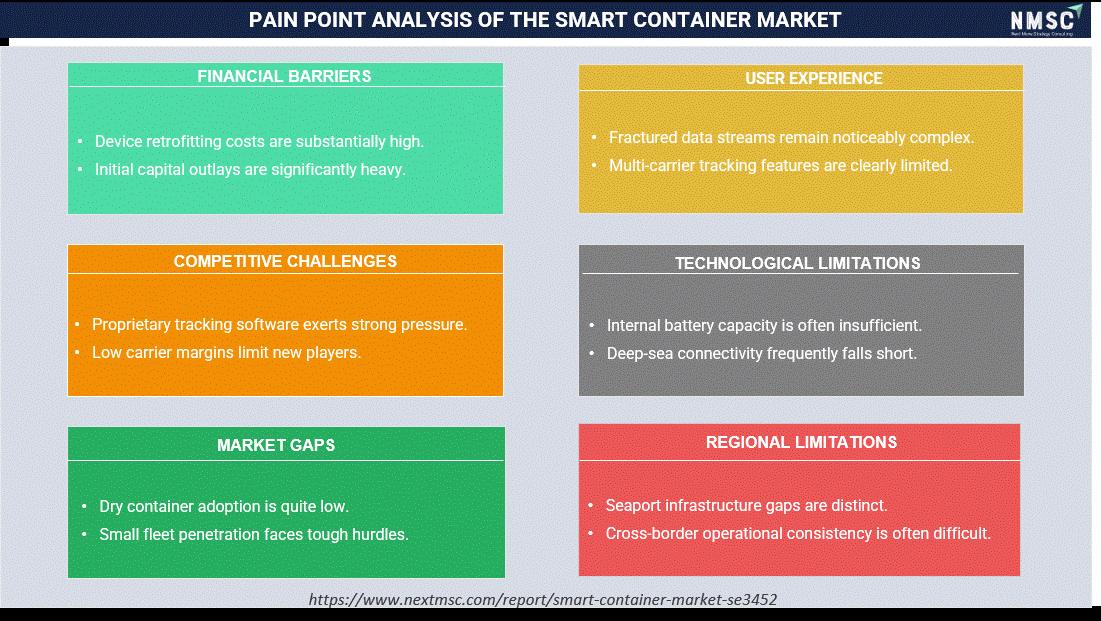
The Smart Container Market faces several operational and adoption challenges despite growing demand for supply chain digitalization. High implementation and retrofitting costs create financial barriers, particularly for smaller fleet operators. Technological limitations such as battery life constraints and inconsistent connectivity during deep-sea transport hinder real-time tracking performance. Additionally, fragmented data systems, limited multi-carrier interoperability, regional infrastructure disparities, and low adoption among dry container fleets continue to restrict seamless deployment and large-scale market penetration.
What Are the Growth Inhibitors of the Smart Container Market?
How Do High Per-Unit Hardware and Installation Costs Constrain Smart Container Market Penetration Among Smaller Operators?
Despite declining IoT component costs, the total upfront investment required for factory-fit smart container procurement or comprehensive fleet retrofit programs remains a significant adoption barrier for smaller freight forwarders, regional shipping companies, and emerging market operators within the Smart Container Market. The U.S. Small Business Administration's research on capital expenditure constraints among logistics SMEs documents the difficulty smaller operators face in justifying large equipment investments against uncertain return timelines. Our assessment indicates that installation and commissioning professional services, ongoing managed monitoring subscriptions, and maintenance costs collectively represent a total cost of ownership that deters smaller fleet operators from transitioning from manual cargo inspection to digitized smart container monitoring, constraining near-term market penetration in cost-sensitive geographies.
How Does the Absence of Standardized Global IoT Data Frameworks Limit Smart Container Market Scale?
The lack of universally adopted data communication standards, security protocols, and interoperability frameworks for container IoT systems represents a structural constraint on Smart Container Market growth. Currently, smart container data generated by one vendor's platform cannot be seamlessly integrated with another vendor's analytics system without significant middleware development, creating technology lock-in concerns that slow procurement decisions. The International Organization for Standardization has published container-related standards through ISO TC104, but comprehensive IoT data interoperability standards specifically for smart container communications remain incomplete. Our analysis shows that this fragmentation increases integration costs for shippers managing multi-carrier supply chains and discourages universal adoption of platform-agnostic smart container ecosystems across global freight operations.
What Are the Growth Opportunities in the Smart Container Market?
How Does the Rapid Expansion of Global Vaccine and Biologic Cold Chain Logistics Create a Significant Opportunity in the Smart Container Market?
The global expansion of temperature-sensitive biologic pharmaceuticals, including mRNA vaccines, monoclonal antibodies, and cell and gene therapies, is creating a high-value, structurally durable demand opportunity for validated smart containers in the Smart Container Market. The World Health Organization's immunization supply chain data confirms that vaccine cold chain integrity is a critical bottleneck in expanding global vaccination coverage, creating clear commercial demand for precisely monitored temperature-controlled shipping solutions. Based on our engagements with logistics operators, we found that biologic therapy manufacturers routinely specify validated, GDP-compliant smart container platforms as a non-negotiable procurement requirement, enabling vendors such as Envirotainer and SkyCell to command premium pricing for pharmaceutical-grade smart container services across intercontinental air and ocean freight networks.
How Does the Digitalization of Port and Terminal Operations Present a Strategic Expansion Opportunity for Smart Container Market Participants?
Accelerating digital transformation investments at major global container ports are creating integration-driven opportunities for smart container platform vendors to extend their data offerings into port operations management systems. The International Association of Ports and Harbors has documented widespread investment in port community systems, gate automation, and yard management digitalization across member ports globally. Through our market assessment, we observed that smart container data streams, including real-time location, cargo temperature, and seal status, can be integrated with terminal operating systems to enable predictive berth planning, priority handling of time-sensitive pharmaceutical cargo, and automated customs pre-clearance processing, creating compelling value propositions for port operators to mandate smart container adoption among terminal users.
How Does the Growth of Cross-Border E-Commerce Cold Chain Generate New Revenue Streams in the Smart Container Market?
The exponential growth of cross-border e-commerce trade involving temperature-sensitive food products, health supplements, and cosmetics is generating entirely new demand segments within the Smart Container Market. The World Trade Organization has documented sustained double-digit growth in e-commerce cross-border trade volumes, with Asia-to-North America and Asia-to-Europe cold chain corridors expanding rapidly. NMSC's analysis indicates that e-commerce platforms and direct-to-consumer food brands increasingly require shipment-level temperature documentation to substantiate freshness claims and satisfy consumer protection regulations in destination markets. This creates demand for lightweight, cost-effective single-use or multi-use smart container monitoring devices integrated with e-commerce platform APIs for automated consumer-facing freshness certification.
Strategic Framework of the Smart Container Market
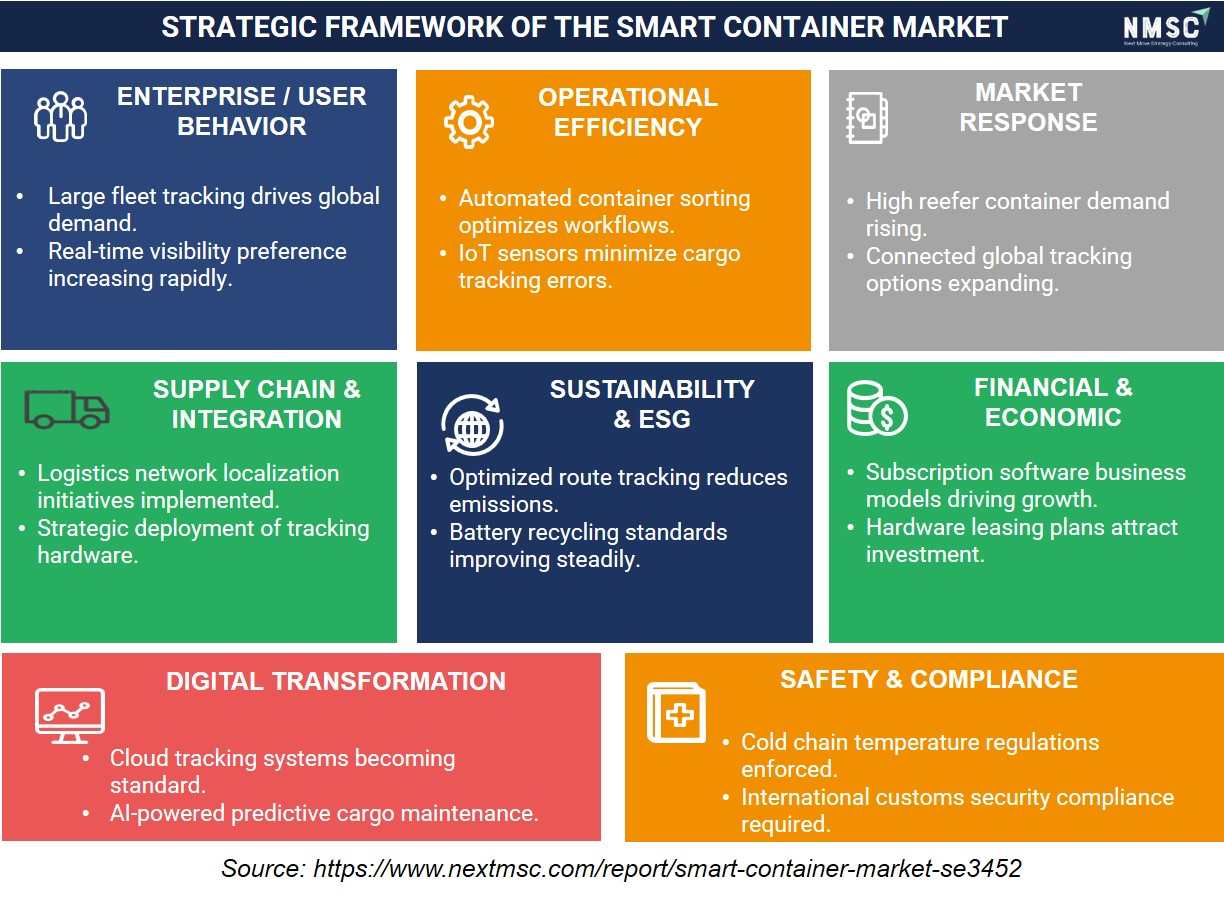
The Smart Container Market is evolving through a strategic framework focused on digitalization, operational efficiency, and supply chain optimization. Growing demand for real-time fleet visibility, IoT-enabled tracking, and automated container management is accelerating market growth. Sustainability initiatives, cloud-based monitoring systems, and AI-driven predictive maintenance are enhancing performance, while flexible financial models and stricter safety and compliance standards support wider adoption across global logistics and transportation networks.
How Is the Smart Container Market Segmented in This Report, and What Are the Key Insights from the Segmentation Analysis?
Which Container Type Segment Generates the Largest Revenue in the Smart Container Market?
|
Container Type Segment |
2025 (USD Bn) |
2035 (USD Bn) |
CAGR (%) |
|
Dry Container |
1.4 |
5.2 |
14.0% |
|
Refrigerated Container |
2.0 |
6.6 |
12.7% |
|
Tank Container |
0.5 |
1.8 |
13.6% |
|
Special Purpose Container |
0.3 |
1.2 |
14.8% |
Based on our analysis of global container fleet compositions and IoT monitoring adoption trends, this Smart Container Market report observed that the industry is segmented into Dry Containers, Refrigerated Containers, Tank Containers, and Special Purpose Containers including flat rack, open top, and other specialized configurations. From our market assessment, we found that the Refrigerated Container segment currently dominates, driven by the regulatory imperative for continuous cold chain monitoring across pharmaceutical and food logistics applications where temperature excursion documentation is non-negotiable for compliance and cargo insurance purposes. Meanwhile, Dry Containers represent the fastest-growing category as declining sensor costs enable economically viable monitoring of standard cargo containers carrying electronics, retail goods, and automotive parts. Tank Containers are witnessing steady adoption of IoT monitoring for chemical and hazardous material shipments, while Special Purpose Container smart monitoring is an emerging application driven by project cargo operators requiring shock and tilt sensing.
How Does Container Size Influence Technology Adoption and Investment Decisions in the Smart Container Market?
|
Container Size Segment |
2025 (USD Bn) |
2035 (USD Bn) |
CAGR (%) |
|
20 Foot Equivalent Unit (FEU) |
1.5 |
5.1 |
12.9% |
|
40 Foot Equivalent Unit (FEU) |
2.1 |
7.2 |
13.1% |
|
High Cube and Other Oversized Units |
0.6 |
2.5 |
15.3% |
Through our analysis of container fleet utilization data and smart container equipment deployment patterns, we assessed that the Smart Container Market is segmented by container size into 20-Foot Equivalent Units, 40-Foot Equivalent Units, and High Cube and Other Oversized Units. The 40-FEU segment dominates due to its preponderance on long-haul transoceanic trade routes where the per-container economics of IoT monitoring equipment are most favorable and the cargo value justifies investment in real-time visibility solutions. The 20-FEU segment remains significant in short-sea and regional shipping corridors across Asia and the Mediterranean. High Cube and Other Oversized Units are the fastest-growing size segment as e-commerce fulfillment operators and project cargo specialists adopt these formats for high-value, environmentally sensitive shipments requiring multi-parameter monitoring throughout transit.
How Does the Factory-Fit vs. Retrofit Decision Shape Market Dynamics in the Smart Container Market?
|
Technology Integration Segment |
2025 (USD Bn) |
2035 (USD Bn) |
CAGR (%) |
|
Factory-Fit Smart Containers |
2.9 |
9.1 |
12.1% |
|
Retrofit Smart Containers |
1.3 |
5.7 |
15.9% |
Our findings suggest that the Smart Container Market is segmented into Factory-Fit and Retrofit smart container technology integration approaches, each serving distinct fleet management strategies and investment profiles. Factory-Fit Smart Containers currently dominate as shipping lines and leasing companies specifying embedded telematics as a standard feature in new container orders from manufacturers such as CIMC and Triton International. This approach ensures sensor reliability, optimal placement, and validated performance credentials required for pharmaceutical-grade cold chain applications. In contrast, the Retrofit Smart Containers segment is the fastest-growing, driven by the extensive unequipped global container fleet and the commercial availability of self-contained, battery-powered IoT retrofit modules from vendors including Tive, Hoopo, and Globe Tracker ApS that require no permanent installation or wiring modifications.
What Hardware Subsegments Are Driving Equipment Revenue Growth in the Smart Container Market?
|
Hardware Sub-Segment |
2025 (USD Mn) |
2035 (USD Mn) |
CAGR (%) |
|
Telematics and Tracking Units |
620 |
2,100 |
13.0% |
|
Sensor Modules (All Types) |
480 |
1,680 |
13.4% |
|
Gateways and Edge Compute Units |
280 |
1,020 |
13.8% |
|
Power Systems and Batteries |
180 |
640 |
13.5% |
|
Electronic Seals and Tamper Devices |
340 |
1,160 |
13.0% |
Based on our engagements with smart container hardware vendors and shipping line procurement teams, we observed that the Hardware segment of the Smart Container Market encompasses Telematics and Tracking Units, Sensor Modules, Gateways and Edge Compute Units, Power Systems and Batteries, and Electronic Seals and Tamper Devices. Telematics and Tracking Units constitute the largest hardware revenue category, forming the foundational GPS and cellular communication layer of every smart container deployment. Sensor Modules span temperature, humidity, shock and vibration, door and seal, gas and spoilage, and weight and load categories, with temperature sensors commanding the largest share driven by cold chain compliance requirements. Electronic Seals and Tamper Devices are witnessing strong demand growth from port security agencies and high-value cargo shippers requiring cryptographically authenticated chain-of-custody documentation across international shipment routes.
Which Connectivity Service Models Are Gaining Traction in the Smart Container Market?
|
Connectivity Service Segment |
2025 (USD Mn) |
2035 (USD Mn) |
CAGR (%) |
|
Cellular Network Services |
420 |
1,380 |
12.6% |
|
Satellite Network Services |
280 |
1,140 |
15.1% |
|
LPWAN Connectivity Services |
160 |
620 |
14.5% |
|
Hybrid Network Services |
140 |
620 |
16.0% |
From our assessment of global container IoT connectivity infrastructure, we found that the Connectivity Services segment of the Smart Container Market is segmented into Cellular Network Services, Satellite Network Services, LPWAN Connectivity Services, and Hybrid Network Services. Cellular Network Services currently dominate due to widespread 4G LTE port coverage and competitive data plan pricing from mobile network operators supporting IoT applications across major container terminal regions. Satellite Network Services are the fastest-growing connectivity segment as LEO satellite constellation expansion by Iridium and Inmarsat extends reliable coverage to deep-ocean trade routes where cellular signals are unavailable. LPWAN Connectivity Services are gaining adoption for short-range, low-power sensor data collection within port yards and warehouses, while Hybrid Network Services dynamically switch between cellular and satellite transmission to optimize connectivity quality and data transmission cost across complex multi-modal supply chain journeys.
How Are Software Platforms Creating Recurring Revenue Streams in the Smart Container Market?
|
Software and Platform Segment |
2025 (USD Mn) |
2035 (USD Mn) |
CAGR (%) |
|
Monitoring Dashboard |
280 |
1,060 |
14.2% |
|
Analytics and Predictive Insights |
240 |
1,060 |
16.0% |
|
Integration Middleware and APIs |
180 |
720 |
14.9% |
|
Compliance and Reporting |
160 |
680 |
15.6% |
|
Mobile and Customer Portal |
140 |
580 |
15.3% |
Our assessment indicates that the Software and Platform segment of the Smart Container Market encompasses Monitoring Dashboards, Analytics and Predictive Insights platforms, Integration Middleware and APIs, Compliance and Reporting modules, and Mobile and Customer Portals. Monitoring Dashboard solutions generate the largest current software revenue as the primary interface through which shipping lines, freight forwarders, and cargo owners interact with real-time smart container data streams. Analytics and Predictive Insights platforms are the fastest-growing software category, driven by demand for AI-powered spoilage prediction, route optimization recommendations, and maintenance scheduling algorithms that convert raw sensor data into actionable logistics intelligence. Compliance and Reporting modules are witnessing accelerating adoption among pharmaceutical shippers requiring automated GDP and DSCSA documentation generation directly from validated smart container temperature records.
How Do Professional Services Support Smart Container Deployment and Long-Term Platform Value in the Smart Container Market?
|
Professional Services Segment |
2025 (USD Mn) |
2035 (USD Mn) |
CAGR (%) |
|
Installation and Commissioning |
180 |
580 |
12.4% |
|
Managed Monitoring |
240 |
920 |
14.4% |
|
Maintenance and Support |
160 |
600 |
14.1% |
Based on our market evaluation, we noticed that the Professional and Managed Services segment of the Smart Container Market encompasses Installation and Commissioning, Managed Monitoring, and Maintenance and Support services that underpin successful long-term smart container program delivery. Installation and Commissioning services drive initial hardware deployment revenue, encompassing sensor calibration, communication system integration, and platform onboarding for new smart container programs. Managed Monitoring services are the highest-growth professional services category, as pharmaceutical shippers and high-value cargo operators increasingly outsource 24/7 alert monitoring and exception management to specialized logistics technology service providers who maintain round-the-clock global cargo operations centers capable of coordinating emergency responses to cold chain excursions detected in remote locations.
How Are Commercial Model Preferences Shifting in the Smart Container Market?
|
Commercial Model Segment |
2025 (USD Bn) |
2035 (USD Bn) |
CAGR (%) |
|
Outright Sale (Capex) |
1.8 |
4.8 |
10.3% |
|
Subscription Lease (Opex) |
1.4 |
5.8 |
15.3% |
|
Usage-Based Lease (Opex) |
1.0 |
4.2 |
15.4% |
Through NMSC's assessment, we found that the Smart Container Market is segmented across three commercial models: Outright Sale representing a capital expenditure model, Subscription Lease as an operating expenditure model, and Usage-Based Lease as a flexible operating expenditure model. Outright Sale currently holds the largest absolute revenue share as established shipping lines and large leasing companies with strong balance sheets continue to prefer full hardware ownership providing maximum long-term asset control. However, Subscription Lease and Usage-Based Lease models are collectively the fastest-growing commercial frameworks, as the logistics industry's broader shift toward asset-light operating models and digital service procurement aligns naturally with per-container monthly subscription billing for smart container monitoring technology access and ongoing platform service delivery.
Which Application Segments Are Driving the Highest Value Creation in the Smart Container Market?
|
Application Segment |
2025 (USD Bn) |
2035 (USD Bn) |
CAGR (%) |
|
Cold Chain — Food and Beverage |
1.0 |
3.4 |
13.0% |
|
Cold Chain — Pharma and Life Sciences |
0.8 |
3.1 |
14.5% |
|
Chemicals and Hazardous Materials |
0.5 |
1.7 |
13.0% |
|
Industrial and Automotive Goods |
0.6 |
1.9 |
12.2% |
|
Retail and Consumer Goods |
0.6 |
2.0 |
12.8% |
|
Electronics and High Value Cargo |
0.5 |
1.9 |
14.3% |
|
Energy and Project Cargo |
0.2 |
0.8 |
14.9% |
Our analysis shows that the Smart Container Market is segmented by application into Cold Chain Logistics encompassing Food and Beverage and Pharmaceutical and Life Sciences, Chemicals and Hazardous Materials, Industrial and Automotive Goods, Retail and Consumer Goods, Electronics and High Value Cargo, and Energy and Project Cargo. The Cold Chain Logistics application segment collectively represents the dominant revenue category, with Food and Beverage holding the largest individual sub-segment share driven by global fresh produce, seafood, and dairy export trade volumes. Pharmaceutical and Life Sciences is the highest-value and most rapidly expanding cold chain sub-segment due to the premium pricing that validated temperature-monitoring solutions command for biologic and vaccine shipments. Electronics and High Value Cargo is the fastest-growing overall application segment as semiconductor and consumer electronics shippers deploy multi-sensor smart containers to protect high-value inventory from shock, humidity, and tampering throughout ocean transit.
Who Are the Primary Buyers Driving Smart Container Market Revenue Across the Supply Chain?
|
End User Segment |
2025 (USD Bn) |
2035 (USD Bn) |
CAGR (%) |
|
Shipping Lines and Ocean Carriers |
1.4 |
4.6 |
12.7% |
|
Freight Forwarders and 3PLs |
0.9 |
3.3 |
13.9% |
|
Shippers and Cargo Owners |
0.7 |
2.7 |
14.5% |
|
Leasing Companies and Fleet Owners |
0.6 |
2.2 |
13.9% |
|
Port and Terminal Operators |
0.4 |
1.4 |
13.3% |
|
Rail and Inland Operators |
0.15 |
0.6 |
14.9% |
|
Government and Public Agencies |
0.05 |
0.2 |
14.9% |
From our research, we found that the Smart Container Market serves end users including Shipping Lines and Ocean Carriers, Freight Forwarders and Third-Party Logistics Providers, Shippers and Cargo Owners, Leasing Companies and Fleet Owners, Port and Terminal Operators, Rail and Inland Operators, and Government and Public Agencies. Shipping Lines and Ocean Carriers constitute the dominant end user segment as primary fleet operators controlling the largest container inventories and making enterprise-level platform decisions covering thousands of vessels and hundreds of thousands of container units. Freight Forwarders and 3PLs represent the fastest-growing individual end user category among established market participants, driven by shipper demand for integrated smart container monitoring within multimodal logistics management platforms. Shippers and Cargo Owners are emerging as a rapidly growing direct procurement segment as pharmaceutical and electronics manufacturers increasingly specify smart container standards in their logistics service provider contracts.
Regional Outlook
Geographic Performance Snapshot
|
Region |
2025 (USD Bn) |
2035 (USD Bn) |
CAGR (%) |
Key Driver |
|
North America |
1.4 |
4.6 |
12.6% |
FDA DSCSA mandates, pharmaceutical cold chain |
|
Europe |
1.1 |
3.8 |
13.2% |
EU GDP guidelines, port digitalization |
|
Asia Pacific |
1.2 |
4.2 |
13.4% |
Container manufacturing scale, APAC trade growth |
|
Middle East & Africa |
0.3 |
1.2 |
14.9% |
Port infrastructure investment, food security |
|
Latin America |
0.2 |
1.0 |
17.5% |
Agriculture export cold chain, digital trade |
North America Smart Container Market
North America is the largest regional market in the Smart Container Market, contributing USD 1.4 billion in 2025 and forecast to reach USD 4.6 billion by 2035 at a CAGR of 12.6%. The region benefits from the world's most stringent pharmaceutical cold chain regulatory environment under the FDA's DSCSA and 21 CFR Part 211 standards, compelling systematic adoption of validated smart container monitoring across pharmaceutical export corridors. Strong enterprise technology adoption among leading U.S. ocean carriers, high penetration of subscription-based logistics technology platforms, and significant port infrastructure modernization investments at major gateway ports collectively reinforce North America's regional leadership position within the global industry.
United States Smart Container Market
Based on our engagements with pharmaceutical logistics operators and ocean carrier technology teams, we found that the United States is the single largest national market in the Smart Container Market, representing approximately 65% of North American regional revenue in 2025. U.S. regulatory demand is the primary structural driver, with FDA's DSCSA serialization requirements and DEA controlled substance transportation regulations mandating digital chain-of-custody documentation for pharmaceutical cargo. The Port of Los Angeles, Port of New York/New Jersey, and Port of Savannah have all commenced port community system integrations that enhance smart container data utilization within terminal operations. Leading U.S. pharmaceutical companies including Pfizer, Johnson and Johnson, and Merck have established stringent smart container specifications within their global logistics service provider contracts.
Canada Smart Container Market
Through our analysis of Canadian pharmaceutical and agricultural logistics sectors, we observed that Canada represents approximately 22% of North American Smart Container Market revenue in 2025. Canadian pharmaceutical manufacturers export to European and Asian markets under stringent GDP requirements that mandate validated temperature monitoring, driving adoption of certified smart container solutions. Agriculture Canada's food safety inspection standards for fresh produce and seafood exports create complementary demand for food-grade cold chain monitoring. The Port of Vancouver's Pacific gateway expansion and Ports Toronto's modernization programs are introducing smart container data integration requirements within their terminal operating frameworks, reinforcing technology adoption among Canadian ocean cargo operators.
Mexico Smart Container Market
According to evaluation of Mexico's pharmaceutical export growth and fresh produce trade corridors, Mexico demonstrates accelerating Smart Container Market adoption primarily driven by pharmaceutical manufacturing expansion in the Bajío region and fresh avocado, tomato, and berry export cold chain infrastructure investment. Mexico is party to the United States-Mexico-Canada Agreement which establishes enhanced food safety traceability requirements for agricultural exports, creating regulatory demand for smart container monitoring along Mexico-to-U.S. cold chain routes. The Port of Manzanillo and Port of Veracruz handle significant refrigerated container volumes, and Grupo TMM has initiated smart container pilot programs for pharmaceutical cargo, signaling growing adoption of IoT monitoring technology within Mexico's logistics infrastructure.
Europe Smart Container Market
Europe is the second-largest regional market in the Smart Container Market, contributing USD 1.1 billion in 2025 and forecast to reach USD 3.8 billion by 2035 at a CAGR of 13.2%. Europe's regulatory environment, led by the European Medicines Agency's GDP guidelines for medicinal product distribution and EU food safety traceability regulations under EC Regulation 178/2002, provides the strongest regulatory framework globally for mandating smart container adoption among pharmaceutical and food logistics operators. Port digitalization programs at Hamburg, Rotterdam, and Antwerp, combined with significant European pharmaceutical export volumes, position Europe as a critical regional market for both hardware deployment and software platform adoption within the global sector ecosystem.
United Kingdom Smart Container Market
Based on our engagements with UK pharmaceutical and logistics operators, we found that the United Kingdom maintains a significant Smart Container Market position underpinned by its status as a major pharmaceutical manufacturing and export hub. The Medicines and Healthcare products Regulatory Agency enforces GDP guidelines equivalent to the EMA framework, maintaining regulatory demand for validated cold chain monitoring solutions post-Brexit. UK-based logistics companies including DB Schenker UK and DHL Express UK have deployed smart container monitoring programs for temperature-sensitive pharmaceutical cargo exporting to European, Asian, and North American markets. The Port of Felixstowe and Southampton Port handle significant pharmaceutical container volumes, with growing smart container data integration within port community platforms.
Germany Smart Container Market
Through our market assessment, we observed that Germany is Europe's largest individual Smart Container Market, driven by its world-class pharmaceutical and chemical manufacturing sectors requiring sophisticated IoT monitoring capabilities for export cargo. BASF, Bayer, and Merck KGaA generate substantial demand for smart containers monitoring chemical and pharmaceutical cargo across global ocean freight routes. The Port of Hamburg processes one of Europe's largest container volumes and has established the Hamburg Port Authority's Digital Lab initiative promoting smart container data integration. German logistics companies including DHL and Kuehne+Nagel have implemented enterprise-wide smart container monitoring programs reflecting German industry's commitment to supply chain digitalization and precision quality management.
France Smart Container Market
From our assessment of France's pharmaceutical and food logistics sectors, we noticed that France represents a significant European Smart Container Market driven by its substantial pharmaceutical export industry and premium food and beverage export cold chain requirements. The French Medicines Agency enforces GDP cold chain standards, while French gourmet food exporters including champagne, cheese, and luxury food products require precise temperature monitoring to maintain product integrity and export certification compliance. The Port of Le Havre, France's largest container port, has implemented digital port community systems that increasingly incorporate smart container data streams within logistics coordination platforms for pharmaceutical and temperature-sensitive cargo prioritization.
Italy Smart Container Market
According to evaluation of Italy's pharmaceutical and food trade corridors, Italy is a mid-tier European Smart Container Market with growing adoption in pharmaceutical cold chain logistics. Italian pharmaceutical companies including Menarini and Chiesi Pharmaceuticals generate demand for GDP-compliant smart containers for biologic and specialty drug export shipments. Italy's significant fresh food export volumes, including olive oil, wine, and fresh produce, create complementary cold chain monitoring demand. The Port of Genoa and Port of Gioia Tauro handle substantial Mediterranean transit volumes, and Grimaldi Group's container shipping operations represent a significant commercial opportunity for smart container platform providers targeting Italian logistics operators.
Spain Smart Container Market
Based on our market evaluation, we noticed that Spain demonstrates solid Smart Container Market momentum driven by its position as Europe's leading fresh fruit and vegetable exporter requiring rigorous cold chain monitoring across ocean freight corridors. Spain's agricultural export sector, particularly citrus, tomatoes, and peppers shipped to Northern European markets, is a major driver of refrigerated smart container adoption. The Spanish Agency of Medicines and Medical Devices enforces GDP standards for pharmaceutical exports. The Port of Valencia, Spain's largest container port, and the Port of Barcelona are implementing smart container data integration within port community systems serving Mediterranean trade route operators and pharmaceutical logistics providers.
Sweden Smart Container Market
Through our analysis of Nordic logistics and pharmaceutical sectors, we observed that Sweden represents a smaller but technologically advanced Smart Container Market characterized by high digital adoption among pharmaceutical and specialty chemicals shippers. Swedish pharmaceutical companies including Recipharm and Cambrex generate demand for validated GDP-compliant temperature monitoring for specialty drug export shipments. Sweden's Datainspektionen data protection framework and Nordic environmental sustainability standards are influencing smart container platform selection criteria, with Swedish operators favoring energy-efficient IoT hardware and platforms demonstrating strong environmental credentials. The Port of Gothenburg serves as the primary gateway for Swedish pharmaceutical and industrial cargo requiring smart container monitoring.
Denmark Smart Container Market
From our assessment of Danish pharmaceutical and food logistics operations, we found that Denmark's Smart Container Market is anchored by A.P. Moller-Maersk's global headquarters and its significant research and development investment in connected container technology. Maersk's Remote Container Management platform and Captain Peter technology suite represent some of the most sophisticated enterprise smart container deployments globally, influencing industry standards for telematics integration and data analytics. Denmark's Novo Nordisk generates substantial demand for GDP-compliant cold chain monitoring for insulin and diabetes medication ocean freight shipments across global export routes, complementing Danish meat and dairy export cold chain monitoring requirements.
Finland Smart Container Market
According to evaluation of Finnish industrial and pharmaceutical logistics needs, Finland's Smart Container Market remains a developing segment driven primarily by industrial cargo monitoring requirements for machinery, electronics, and paper products exported across Baltic and North Atlantic trade routes. Finnish logistics technology companies are contributing to smart container platform development, and the Port of Helsinki and Port of Kotka are implementing digital port community systems incorporating smart container data capabilities. Finland's Technology Industries association has documented growing logistics digitalization investment among Finnish exporters, signaling increasing awareness and early adoption of smart container monitoring solutions across Finnish industrial supply chains.
Netherlands Smart Container Market
Based on our engagements with Dutch port operators and pharmaceutical logistics professionals, we observed that the Netherlands is a strategically important Smart Container Market anchored by the Port of Rotterdam, Europe's largest container port and a critical global transshipment hub. Rotterdam's PortXchange digital platform and Port of Rotterdam Authority's innovation programs actively promote smart container data integration within port operations management systems. The Netherlands hosts major pharmaceutical and food distribution operations for companies including Philips Healthcare and ASML, generating demand for smart container monitoring across European distribution networks. Dutch customs authorities have pioneered smart container seal data integration with digital customs pre-clearance platforms, creating a regulatory efficiency incentive for smart container adoption.
Rest of Europe Smart Container Market
Through our market assessment, we assessed that the Rest of Europe Smart Container Market encompasses Poland, Belgium, Portugal, Switzerland, Austria, and Eastern European nations where smart container adoption is at an earlier stage but demonstrating steady growth momentum. Poland's rapidly expanding logistics hub role in Central Europe, driven by e-commerce fulfillment center investments by Amazon and Zalando, is creating demand for cargo monitoring solutions. Belgian pharmaceutical companies in the Biopharma cluster surrounding Ghent and Antwerp generate GDP-compliant cold chain monitoring demand. The Port of Antwerp-Bruges represents a major strategic focus for smart container platform providers targeting Central European pharmaceutical and chemical cargo flows.
Asia Pacific Smart Container Market
Asia Pacific is the fastest-growing regional market in the Smart Container Market, contributing USD 1.2 billion in 2025 and forecast to reach USD 4.2 billion by 2035 at a CAGR of 13.4%. The region's dominance in global container manufacturing through CIMC, the world's largest production of refrigerated containers, and Asia's position as the origin and destination of the majority of global ocean trade volumes position Asia Pacific as both a supply-side innovation hub and a demand-side market leader for smart container technology adoption. Government-mandated cold chain infrastructure investment programs across India, China, and Southeast Asia, combined with rapidly growing pharmaceutical export sectors, are creating structural, durable demand for smart container monitoring solutions.
China Smart Container Market
Based on our engagements with Chinese container manufacturers and logistics technology providers, we found that China represents the largest single national market in Asia Pacific for the Smart Container Market and is the fastest-growing globally at a CAGR of 15.8% from 2026 to 2035. China International Marine Containers Co., Ltd. (CIMC), which manufactures approximately 60% of global container production, is actively integrating smart container technology into its manufacturing processes, driving factory-fit deployment at unprecedented scale. China's State Council e-commerce cold chain logistics development policy and the Ministry of Commerce's fresh food traceability initiatives are compelling domestic logistics operators to adopt IoT-monitored refrigerated containers. COSCO Shipping and China OOCL deploy smart container monitoring across major transpacific and China-Europe trade routes.
India Smart Container Market
Through our market assessment, we observed that India is the second-largest and among the fastest-growing Asia Pacific Smart Container Markets, driven by the country's rapidly expanding pharmaceutical manufacturing export sector and government-led cold chain infrastructure investment. India is the world's largest supplier of generic medicines, exporting to over 200 countries under WHO-GMP and GDP-compliant logistics requirements, creating massive structural demand for validated smart container temperature monitoring. The National Centre for Cold-chain Development's integrated cold chain investment program is supporting refrigerated container fleet expansion across Indian agricultural export corridors. Jawaharlal Nehru Port Authority's Sagarmala port modernization program is introducing smart container data integration requirements within port community systems.
Japan Smart Container Market
According to evaluation of Japan's advanced logistics technology adoption and pharmaceutical export operations, Japan maintains a technologically sophisticated Smart Container Market characterized by high precision requirements from Japanese pharmaceutical companies and automotive parts manufacturers. Takeda Pharmaceutical, Astellas Pharma, and Daiichi Sankyo generate demand for validated GDP-compliant smart containers for biologic and specialty drug export shipments. Japan's Ministry of Land, Infrastructure, Transport and Tourism has issued cold chain logistics quality guidelines supporting smart container adoption. Ocean Network Express Pte. Ltd. (ONE), headquartered in Singapore with significant Japanese ownership, has deployed smart container monitoring capabilities across its fleet serving major Japanese exporters on transpacific and Asia-Europe trade routes.
South Korea Smart Container Market
From our assessment of South Korea's electronics and pharmaceutical export sectors, we found that South Korea demonstrates strong Smart Container Market adoption driven by Samsung Electronics, SK Hynix, and LG Electronics requiring shock and humidity monitoring for semiconductor and consumer electronics ocean freight shipments. The Korea Pharmaceutical and Bio-Pharma Manufacturers Association has established GDP cold chain standards that mandate temperature monitoring for pharmaceutical exports. HMM (Hyundai Merchant Marine) deploys smart container telematics across its fleet serving Korea's major export industries. The Port of Busan, the world's sixth-largest container port, is implementing smart container data integration within its digital port community platform as part of the Korean Ministry of Oceans and Fisheries' smart port development program.
Taiwan Smart Container Market
Based on our market evaluation, we noticed that Taiwan's Smart Container Market is anchored by the semiconductor and electronics manufacturing industry, with TSMC, MediaTek, and Foxconn generating significant demand for multi-sensor smart containers monitoring high-value semiconductor and electronics cargo for ocean freight shipments to North America, Europe, and Japan. Taiwan's Pharmaceutical Administration requires GDP-compliant cold chain documentation for pharmaceutical exports, driving validated temperature monitoring adoption. Evergreen Line, headquartered in Taiwan, has implemented smart container monitoring programs across its global fleet. The Port of Kaohsiung and Port of Taichung handle significant electronics cargo requiring smart container protection against shock, humidity, and theft throughout transoceanic transit.
Indonesia Smart Container Market
Through our analysis of Indonesia's agricultural and pharmaceutical logistics sectors, we observed that Indonesia represents a developing Smart Container Market with growing momentum driven by palm oil, coffee, and shrimp export cold chain requirements and an expanding domestic pharmaceutical manufacturing sector. The Indonesian government's Logistics National Ecosystem (INALogS) digital platform is creating infrastructure for smart container data integration within national logistics management systems. PT Pelabuhan Indonesia (Pelindo) is modernizing major Indonesian ports including Tanjung Priok and Tanjung Perak with digital capabilities that will increasingly accommodate smart container data streams. Indonesia's National Pharmaceutical Policy requiring quality-maintained drug distribution is creating initial smart container monitoring demand among pharmaceutical distributors.
Vietnam Smart Container Market
According to evaluation of Vietnam's rapidly growing manufacturing export sector, Vietnam's Smart Container Market is expanding driven by electronics, textile, and fresh produce export growth from major manufacturers including Samsung Vietnam and LG Vietnam. Vietnam has become a major global electronics manufacturing hub, with substantial semiconductor and consumer electronics container volumes requiring shock and humidity monitoring across ocean freight routes to North America and Europe. The Vietnamese government's logistics development master plan through 2030 includes digital monitoring requirements for pharmaceutical and food export supply chains. The Port of Hai Phong and Cai Mep Terminal in Ho Chi Minh City are implementing port community systems with smart container data integration capabilities.
Australia Smart Container Market
Based on our engagements with Australian pharmaceutical and agricultural export operators, we found that Australia's Smart Container Market is driven by pharmaceutical cold chain compliance requirements and fresh meat, seafood, and dairy export cold chain monitoring needs. The Therapeutic Goods Administration enforces GDP standards for pharmaceutical exports, generating demand for validated temperature monitoring. Australia is among the world's largest beef and lamb exporters, with major meat processing companies deploying refrigerated smart containers to maintain product quality for premium Asian and Middle Eastern markets. The Port of Melbourne and Port of Brisbane handle significant pharmaceutical and agricultural refrigerated container volumes, with increasing port community system smart container data integration.
Philippines Smart Container Market
Through our market assessment, we assessed that the Philippines demonstrates emerging Smart Container Market adoption driven primarily by the banana, pineapple, and seafood export cold chain sectors requiring temperature monitoring across Asia and Middle East trade routes. The Philippines Food and Drug Administration is implementing GDP-aligned pharmaceutical distribution standards that will drive temperature monitoring adoption among pharmaceutical importers and exporters. The Philippine Ports Authority is modernizing Manila International Container Terminal and Batangas International Port with digital systems that will support smart container data integration. The government's National Cold Chain Masterplan provides a policy framework supporting refrigerated smart container technology investment across the Philippine agricultural export supply chain.
Malaysia Smart Container Market
From our assessment of Malaysia's pharmaceutical and electronics export sectors, we noticed that Malaysia's Smart Container Market is expanding driven by its significant pharmaceutical manufacturing and palm oil export industries. Malaysia is a top-tier pharmaceutical manufacturing hub with major plants operated by Hovid, Pharmaniaga, and multinational manufacturers requiring GDP-compliant cold chain monitoring for pharmaceutical exports. The Malaysian Palm Oil Board's quality certification program for palm oil exports creates demand for temperature and humidity monitoring in tank containers. Port Klang, Southeast Asia's third-busiest container port, is implementing digital port community systems with growing smart container data capabilities as part of Malaysia's Ports Masterplan 2030 digitalization agenda.
Rest of APAC Smart Container Market
Our analysis shows that the Rest of Asia Pacific Smart Container Market encompasses Singapore, Thailand, Bangladesh, Sri Lanka, New Zealand, and Pacific Island markets where smart container adoption is at various stages of development. Singapore, as a global transshipment hub, has significant smart container data processing occurring at the Port of Singapore Authority terminals, with the Maritime and Port Authority of Singapore's DIGITALPORT@SG initiative actively integrating smart container data within port operations. Thailand's frozen shrimp and fresh fruit export sectors generate refrigerated smart container demand, while Bangladesh's garment export industry represents an emerging market for standard cargo smart container monitoring solutions.
Middle East and Africa Smart Container Market
The Middle East and Africa is the second-fastest-growing regional market in the Smart Container Market, contributing USD 0.3 billion in 2025 and forecast to reach USD 1.2 billion by 2035 at a CAGR of 14.9%. Regional growth is driven by massive port infrastructure investment programs under Saudi Arabia's Vision 2030 and the UAE's National Logistics Strategy, coupled with growing pharmaceutical import cold chain requirements and the expansion of fresh food import monitoring across Gulf Cooperation Council countries. Africa's agricultural export cold chain development, supported by international development finance programs, is creating nascent but growing demand for smart container monitoring across Sub-Saharan export corridors.
Saudi Arabia Smart Container Market
Based on our engagements with Saudi logistics operators and port authorities, we found that Saudi Arabia's Smart Container Market is growing rapidly, anchored by Vision 2030's logistics sector transformation and the Saudi Food and Drug Authority's pharmaceutical import cold chain compliance requirements. King Abdullah Port in Dammam and Jeddah Islamic Port handle substantial pharmaceutical import volumes under SFDA GDP requirements, driving smart container adoption among logistics service providers serving Saudi pharmaceutical distributors. Saudi Arabia's National Logistics Strategy envisions the Kingdom as a global logistics hub, with NEOM and the Red Sea logistics corridor development creating new smart container deployment opportunities. The Saudi Ports Authority's Mawani digitalization program is introducing smart container data integration within Saudi port community systems.
UAE Smart Container Market
Through our market assessment, we observed that the UAE is the most advanced Smart Container Market in the Middle East, driven by Dubai's position as a global logistics and transshipment hub and Abu Dhabi's pharmaceutical manufacturing ambitions. DP World's global port network and Jebel Ali Port's status as the world's largest man-made harbor create immense smart container data management opportunities. The UAE's Hayat Biotech and Julphar pharmaceutical operations generate domestic GDP cold chain monitoring demand. The Dubai Health Authority's pharmaceutical distribution guidelines require temperature monitoring, while the UAE's National Logistics Strategy, overseen by the Ministry of Energy and Infrastructure, promotes digital cargo tracking integration across Emirati port and free zone operations.
Egypt Smart Container Market
According to evaluation of Egypt's Suez Canal corridor strategic importance, Egypt's Smart Container Market benefits from the country's position as the gateway for approximately 12% of global maritime trade transiting the Suez Canal. The Suez Canal Authority's SCZone economic zone development and Port Said Container and Cargo Handling Company's capacity expansion are creating smart container technology adoption opportunities for transit and transshipment cargo monitoring. Egypt's pharmaceutical export growth under the Egyptian Drug Authority's GDP framework and the country's position as Africa's largest pharmaceutical manufacturer are driving temperature monitoring adoption. The General Authority for Supply Commodities is exploring smart container monitoring for government food security import shipments.
Israel Smart Container Market
Based on our market evaluation, we noticed that Israel's Smart Container Market is characterized by high technology sophistication and significant pharmaceutical and medical device export volumes requiring GDP-compliant smart container monitoring. Israeli pharmaceutical companies including Teva Pharmaceutical, Mylan, and Perrigo generate substantial demand for validated cold chain monitoring across global ocean freight shipments. The Port of Haifa and Ashdod Port have implemented digital port community systems with smart container tracking capabilities. Israeli technology companies, including domestic IoT startups, are contributing to smart container hardware and software innovation, giving Israel a unique dual role as both a smart container technology developer and a significant end-market for pharmaceutical logistics monitoring solutions.
Turkey Smart Container Market
Through our analysis of Turkey's pharmaceutical and textile export sectors, we found that Turkey's Smart Container Market is expanding driven by its large pharmaceutical manufacturing industry and growing fresh produce export cold chain requirements. Turkish pharmaceutical companies including İlko, Bilim İlaç, and Abdi İbrahim generate demand for EU GDP-aligned smart container monitoring for European pharmaceutical export shipments. Turkey is a major global hazelnut, cherry, and dried fruit exporter requiring temperature monitoring for food quality preservation. The Port of Mersin and Istanbul's Ambarlı port handle substantial container volumes, and the Turkish Ministry of Transport and Infrastructure's port digitalization program is creating smart container data integration opportunities within Turkish port operations.
Nigeria Smart Container Market
According to evaluation of Nigeria's pharmaceutical import logistics and agricultural export corridors, Nigeria represents the largest Sub-Saharan African opportunity in the Smart Container Market, driven by the country's significant pharmaceutical import volumes requiring GDP-compliant cold chain monitoring. Nigeria's National Agency for Food and Drug Administration and Control mandates temperature monitoring for pharmaceutical imports, creating regulatory demand for smart container solutions among Nigerian pharmaceutical import logistics providers. Dangote Group's agricultural processing and cement export operations generate demand for industrial cargo monitoring. The Port of Lagos Apapa and Tin Can Island Port are implementing digital systems as part of the Nigerian Ports Authority's port modernization program, creating a technology infrastructure foundation for smart container data integration.
South Africa Smart Container Market
From our assessment of South Africa's mining, agricultural, and pharmaceutical export sectors, we observed that South Africa's Smart Container Market is driven by fresh fruit exports including citrus, grapes, and apples to European markets requiring stringent cold chain monitoring, and by pharmaceutical import cold chain compliance requirements under South Africa Medicines Control Council standards. The South African Fresh Produce Exporters Forum has documented cold chain integrity as a priority concern for maintaining European market access, supporting smart container monitoring adoption. Transnet Port Terminals operates the Port of Cape Town and Port Elizabeth, which handle substantial refrigerated container volumes. The South African government's Smart Ports program is introducing digital integration capabilities that will incorporate smart container data streams.
Rest of MEA Smart Container Market
Our analysis shows that the Rest of MEA Smart Container Market encompasses Kuwait, Qatar, Bahrain, Oman, Jordan, Morocco, Kenya, Ethiopia, and other Sub-Saharan nations where smart container adoption is at early stages but demonstrating measurable growth momentum. GCC countries beyond Saudi Arabia and UAE are implementing pharmaceutical cold chain regulations requiring temperature monitoring, creating demand across Kuwait's and Qatar's pharmaceutical import logistics networks. Kenya's fresh flower and vegetable export cold chain to European markets is driving refrigerated smart container adoption. The Kenyan Ports Authority's Mombasa Port modernization program and Ethiopia's Djibouti corridor logistics investment are creating infrastructure foundations for expanded smart container deployment in East Africa.
Latin America Smart Container Market
Latin America is the highest-growth regional market in the Smart Container Market, contributing USD 0.2 billion in 2025 and forecast to reach USD 1.0 billion by 2035 at a CAGR of 17.5%. Regional growth is driven by Latin America's position as a major global exporter of fresh produce, meat, seafood, and tropical fruits requiring cold chain monitoring for quality preservation during long ocean freight transits to North America, Europe, and Asia. Brazil and Argentina's substantial pharmaceutical manufacturing sectors are creating GDP cold chain compliance demand, while the expansion of cross-border e-commerce trade is generating new demand for cargo security monitoring across regional logistics corridors.
Brazil Smart Container Market
Based on our engagements with Brazilian pharmaceutical and agribusiness logistics operators, we found that Brazil represents the largest Latin American Smart Container Market, driven by the country's position as one of the world's top beef, soy, coffee, and orange juice exporters requiring cold chain monitoring and its significant pharmaceutical manufacturing sector. The Brazilian Health Regulatory Agency ANVISA enforces GDP standards for pharmaceutical distribution requiring temperature monitoring documentation. Embrapa's agricultural quality certification programs for Brazilian fresh produce exports to Europe are creating demand for temperature-monitored smart containers across Brazilian agricultural cold chain corridors. The Port of Santos and Port of Paranaguá handle Brazil's largest agricultural refrigerated container export volumes, with growing port community system smart container data integration.
Argentina Smart Container Market
Through our market assessment, we observed that Argentina's Smart Container Market is driven by its agricultural export economy, particularly soybeans, beef, wine, and fresh lemons requiring temperature monitoring across ocean freight corridors. The Argentine National Administration of Medicines, Food and Medical Technology mandates pharmaceutical cold chain standards that drive temperature monitoring adoption. Argentina's wine export sector requires precise temperature monitoring during container transit to maintain quality for premium North American and European consumers. The Port of Buenos Aires and Port of Rosario handle significant agricultural refrigerated container volumes, and Argentina's customs digital transformation program is creating opportunities for smart container data integration within Argentine trade facilitation platforms.
Chile Smart Container Market
According to evaluation of Chile's fruit and seafood export supply chains, Chile's Smart Container Market is anchored by its position as one of the world's top fresh grape, apple, blueberry, and salmon exporters, all requiring stringent cold chain monitoring to maintain quality and regulatory compliance for European and North American markets. The Asociación de Exportadores de Frutas de Chile has established cold chain standards that mandate temperature monitoring documentation for premium fruit exports. The Port of Valparaíso and Port of San Antonio handle the majority of Chilean refrigerated container exports. Chile's pharmaceutical regulatory framework, administered by the Instituto de Salud Pública, is aligning with GDP standards that will progressively drive smart container adoption among Chilean pharmaceutical logistics operators.
Colombia Smart Container Market
From our assessment of Colombia's fresh flower, coffee, and pharmaceutical export sectors, we found that Colombia's Smart Container Market is growing driven by its position as the world's second-largest fresh cut flower exporter requiring precise cold chain monitoring and its pharmaceutical manufacturing sector serving Latin American markets. Colombia's INVIMA pharmaceutical regulatory authority enforces GDP cold chain standards for pharmaceutical export shipments. The Colombian government's digital logistics platform, VUCE, is creating integration opportunities for smart container monitoring data within national trade facilitation systems. The Port of Cartagena, a major Caribbean transshipment hub, and Port of Barranquilla handle substantial refrigerated and pharmaceutical container volumes with growing digital port community system capabilities.
Rest of Latin America Smart Container Market
Our analysis shows that the Rest of Latin America Smart Container Market encompasses Peru, Ecuador, Mexico's remaining pharmaceutical and agricultural export corridors, and other Central American and Caribbean nations at various stages of smart container adoption. Peru is a significant fresh asparagus, blueberry, and mango exporter requiring refrigerated smart container monitoring for European market quality standards compliance. Ecuador's banana and shrimp export cold chain sectors represent substantial refrigerated container monitoring opportunities. Costa Rica's expanding medical device and pharmaceutical manufacturing export sector is creating GDP cold chain compliance demand. The Panama Canal Zone serves as a critical smart container transshipment and logistics hub for Latin American trade flows.
Competitive Landscape
Competitive Dynamics and M&A Landscape
|
Key Takeaways |
Details |
|
Market Structure |
The Smart Container Market exhibits a moderately fragmented competitive structure comprising global ocean carriers with proprietary platforms, dedicated IoT technology vendors, container manufacturers with integrated smart capabilities, and specialized platform software providers. The top 10 players collectively represent approximately 60% of global market revenue. |
|
Innovation Focus |
Leading competitors are investing heavily in edge computing integration, satellite connectivity partnerships, AI-powered predictive analytics platforms, and pharmaceutical-grade validated monitoring solutions that meet GDP and DSCSA regulatory requirements. Open API platform architectures enabling third-party integration are a key product differentiation driver. |
|
M&A Activity |
The Smart Container Market has witnessed consolidation activity including Carrier Global's acquisition of Sensitech to strengthen cold chain monitoring capabilities, strategic partnerships between IoT hardware vendors and satellite network operators, and shipping lines acquiring minority stakes in technology startups to accelerate digital cargo visibility programs. |
How Do Companies Compete in the Smart Container Market?
Competition in the Smart Container Market operates across three distinct strategic dimensions reflecting the diverse nature of participating organizations. Large ocean carriers including Maersk, MSC, CMA CGM, and Hapag-Lloyd compete by developing proprietary smart container platforms tightly integrated with their vessel and terminal operations, offering shipper customers seamless end-to-end visibility within their carrier ecosystem. Dedicated IoT technology vendors such as ORBCOMM, Nexxiot, Traxens, Tive, and Globe Tracker compete on hardware innovation, sensor accuracy, connectivity coverage breadth, and platform analytics sophistication, often integrating with multiple carriers to offer carrier-agnostic visibility across complex multi-carrier supply chains. Container manufacturers including CIMC and Triton International compete by offering factory-fit smart container integration as a value-added service for container procurement customers.
Competitive differentiation within the Smart Container Market increasingly hinges on software platform capability and data analytics depth rather than hardware specifications alone. NMSC's analysis indicates that vendors who can demonstrate quantifiable cargo loss reduction, route optimization savings, and regulatory compliance efficiency through their analytics platforms command premium subscription pricing and stronger customer retention. Geographic coverage completeness, particularly satellite connectivity in remote ocean trade routes, and pharmaceutical-grade validation credentials represent critical competitive requirements for vendors targeting pharmaceutical cold chain applications, the highest-value application segment in this industry.
Which Kind of Companies Dominate the Smart Container Market?
The Smart Container Market is dominated by three archetypes of organizations. Ocean carrier-integrated platform providers, led by Maersk with its Remote Container Management and Captain Peter platforms, leverage their container fleet scale and existing shipper relationships to deploy smart container capabilities rapidly across large vessel fleets. Specialized technology vendors including ORBCOMM, Nexxiot, Traxens, and Tive compete on technology depth and carrier-agnostic deployment flexibility, serving freight forwarders and shippers requiring visibility across multi-carrier supply chains. Pharmaceutical-focused solution providers including Envirotainer, SkyCell, and Carrier Global's Sensitech division compete in the highest-value cold chain monitoring segment with validated, GDP-compliant temperature monitoring platforms commanding premium pricing from biopharmaceutical manufacturers.
AI-Native Differentiation and Open Standards Drive Market Success in the Smart Container Market
Through NMSC's assessment, we found that vendors achieving the strongest competitive positioning in the Smart Container Market are those combining AI-powered predictive analytics with open API architectures that integrate seamlessly with shipper ERP systems, freight management platforms, and customs documentation tools. AI-native differentiation enables vendors to move beyond reactive alert delivery toward proactive cargo quality management, a capability that directly justifies premium subscription pricing among pharmaceutical and electronics shippers where the cost of cargo loss or regulatory non-compliance substantially exceeds the monitoring subscription investment. Open standards adoption reduces integration friction and accelerates enterprise platform onboarding, critical competitive advantages in a market where lengthy integration complexity deters adoption.
Market Players to Opt for Merger and Acquisition Strategies to Expand Their Presence in the Smart Container Market
Our findings suggest that merger and acquisition activity will intensify within the Smart Container Market as platform providers seek to accelerate geographic expansion, acquire complementary sensor and connectivity capabilities, and consolidate fragmented software platform ecosystems into integrated end-to-end cargo visibility solutions. Ocean carriers are expected to acquire minority stakes or full ownership of specialized IoT platform vendors to accelerate in-house digital cargo visibility capability development. IoT hardware vendors are pursuing strategic partnerships with LEO satellite network operators to expand coverage without organic infrastructure investment. Pharmaceutical-focused smart container companies are attracting private equity and strategic investor interest given the premium revenue predictability of pharmaceutical cold chain subscription contracts.
Who Are the Key Market Players in the Smart Container Market?
-
China International Marine Containers Co., Ltd. (CIMC)
-
Hapag-Lloyd AG
-
A.P. Møller – Mærsk A/S
-
ORBCOMM Inc.
-
Nexxiot AG
-
Mediterranean Shipping Company S.A.
-
CMA CGM S.A.
-
Triton International Limited
-
Traxens SA
-
Ocean Network Express Pte. Ltd.
-
Hoopo Systems Ltd.
-
Carrier Global Corporation
-
Trane Technologies plc
-
Envirotainer AB
-
SkyCell AG
-
Decklar
-
ZIM Integrated Shipping Services Ltd.
-
Tive, Inc.
-
Globe Tracker ApS
-
Evergreen Line
What Are the Latest Developments in the Smart Container Market Industry?
|
Date |
Event |
|
March 2025 |
MSC launched iReefer Pro, a premium refrigerated-container monitoring solution that provides enhanced real-time visibility into cargo conditions throughout transit. The platform enables customers to remotely monitor critical shipment parameters, supporting improved cold-chain integrity, operational efficiency, and risk management for temperature-sensitive goods. |
|
February 2025 |
MSC launched iReefer, an advanced real-time refrigerated container monitoring solution designed to provide customers with continuous visibility into cargo conditions throughout the transportation process. The platform enables remote monitoring of critical parameters such as temperature, humidity, and container status, helping enhance cold-chain reliability, cargo protection, and supply chain efficiency for temperature-sensitive shipments. |
|
April 2024 |
Hapag-Lloyd launched Live Position, its first fleet-wide dry container tracking solution, enabling customers to monitor the location and status of dry containers in near real time throughout the transportation journey. The solution leverages IoT-enabled smart devices installed across the carrier’s container fleet to enhance shipment visibility, improve supply chain transparency, and support more efficient logistics planning and cargo management. |
Expert Insights
“Smart intermodal containers are no longer experimental they are becoming the new standard. Deployments are moving beyond visibility to cargo protection and container security. This evolution reflects growing industry demand for real-time data, enhanced cargo protection and operational transparency across the global supply chain.”
- Sameer Agrawal, CEO, ORBCOMM
Statement made in October 2025, during ORBCOMM's announcement that Evergreen Line selected ORBCOMM's smart dry container solutions to enhance container visibility, cargo security, and supply chain intelligence.
Market Interpretation
Sameer Agrawal's statement reflects the accelerating commercialization of smart container technologies across the global shipping and logistics industry. The transition from basic container tracking toward advanced capabilities such as cargo protection, security monitoring, and real-time operational intelligence highlights the increasing strategic importance of IoT-enabled containers. As supply chains become more data-driven, shipping companies are investing in smart container solutions to improve asset visibility, reduce cargo losses, strengthen security, and enhance customer service. This trend is expected to drive wider adoption of connected container technologies and support the long-term growth of the Smart Container Market.
What Are the Investment Opportunities in the Smart Container Market?
Capital Inflows and Infrastructure Investment
The Smart Container Market is attracting significant capital inflows from private equity firms, venture capital investors, and strategic corporate investors recognizing the sector's recurring subscription revenue potential and structural pharmaceutical logistics tailwinds. Based on our engagements with logistics technology investors, we found that biopharmaceutical cold chain monitoring platforms are commanding premium acquisition multiples reflecting their high contract renewal rates, regulatory compliance value, and growing addressable market as biologic therapy adoption expands globally. Infrastructure investment is flowing into satellite network expansion programs that extend smart container connectivity coverage to remote ocean trade routes, enhancing the geographic reach and data reliability of monitoring platforms serving intercontinental pharmaceutical and food cold chain customers.
ESG Considerations Driving Smart Container Investment
Environmental, social, and governance considerations are increasingly influencing investment decisions within the Smart Container Market as institutional investors evaluate logistics technology platforms on sustainability performance criteria. Smart container technology directly contributes to ESG objectives by reducing food and pharmaceutical cargo spoilage, which represents a significant form of supply chain waste with measurable environmental impact. The International Maritime Organization's Carbon Intensity Indicator requirements for shipping companies are creating demand for smart container data integration within vessel efficiency optimization platforms, as cargo monitoring data can inform route optimization decisions that reduce fuel consumption and carbon emissions. Our findings suggest that ESG-aligned investors view pharmaceutical cold chain monitoring platforms as strategic investments combining financial return predictability with measurable social impact through improved medicine access and reduced healthcare supply chain waste.
PE and VC Activity in the Smart Container Market
Private equity and venture capital activity in the Smart Container Market reflects strong investor confidence in the sector's long-term structural growth trajectory. NMSC's analysis indicates that dedicated logistics technology venture capital funds have increased allocation to smart container platform companies offering subscription-based revenue models with pharmaceutical-grade customer stickiness. Strategic corporate venture arms from pharmaceutical companies and global shipping conglomerates are taking minority stakes in innovative smart container technology startups to secure early access to emerging monitoring, analytics, and connectivity technologies. The National Venture Capital Association's annual technology investment data confirms continued growth in logistics technology venture funding, with cargo visibility and cold chain monitoring platforms among the highest-investment sub-categories within the broader logistics technology venture market.
Digital Transformation and API Economy Opportunities
The Smart Container Market's integration with the broader digital trade ecosystem creates compelling investment opportunities in API-based middleware platforms that connect smart container data streams with customs authorities, insurance underwriters, trade finance providers, and retail inventory management systems. Through our market assessment, we observed that banks and trade finance institutions including ING and Standard Chartered are developing letter of credit automation systems that use real-time smart container sensor data to trigger payment releases upon verified delivery of cargo meeting specified temperature and condition parameters. This convergence of cargo monitoring data with financial services creates a new digital trade infrastructure investment category within the sector that extends monetization opportunities beyond logistics operators to financial institutions and insurtech companies.
Key Benefits for Stakeholders
For Pharmaceutical Shippers
Pharmaceutical shippers gain access to comprehensive insights into the Smart Container Market, including advancements in real-time temperature monitoring, cargo tracking, and regulatory compliance technologies. These capabilities help organizations maintain product integrity for biologics, vaccines, and other temperature-sensitive medicines during international transportation. Enhanced visibility and validated monitoring records support GDP compliance, reduce cargo spoilage risks, minimize insurance claims, and strengthen preparedness for regulatory audits across global cold chain operations.
For Freight Forwarders and Third-Party Logistics Providers (3PLs)
Freight forwarders and 3PLs benefit from detailed market intelligence on smart container technologies that enable end-to-end shipment visibility and proactive logistics management. Real-time monitoring platforms improve customer confidence through continuous cargo status updates while reducing operational disruptions and claims management complexity. Market insights help logistics providers identify value-added service opportunities, enhance customer retention, and develop premium logistics offerings based on monitored and data-driven transportation services.
For Ocean Carriers
Ocean carriers gain valuable insights into how smart container solutions can improve refrigerated container fleet management, asset utilization, and operational efficiency. Advanced sensor technologies and predictive maintenance capabilities help reduce equipment downtime, optimize reefer performance, and lower maintenance expenditures. The report also highlights emerging opportunities in pharmaceutical and high-value cargo transportation, enabling carriers to strengthen their competitive position in specialized logistics markets.
For Container Leasing Companies
Container leasing companies obtain a comprehensive understanding of technology adoption trends, revenue opportunities, and asset management strategies within the Smart Container Market. Smart monitoring systems help improve container utilization rates, reduce cargo damage incidents, and enhance equipment performance tracking throughout the leasing lifecycle. The analysis also identifies opportunities to generate recurring revenue through subscription-based monitoring services and value-added digital solutions integrated into leased container fleets.
For Port and Terminal Operators
Port and terminal operators benefit from insights into smart container integration with digital port infrastructure and terminal operating systems. Real-time cargo condition and location data support more efficient container handling, improve yard planning, and facilitate priority management of temperature-sensitive and time-critical shipments. Enhanced operational visibility contributes to reduced congestion, improved turnaround times, and greater efficiency across increasingly digitized port ecosystems.
For Investors and Financial Analysts
Investors and financial analysts gain a structured assessment of the Smart Container Market's growth potential, technology adoption trends, and competitive landscape. The report provides visibility into recurring revenue opportunities generated through software platforms, connectivity services, and subscription-based monitoring solutions. Detailed analysis of pharmaceutical cold chain expansion, global trade digitization, and supply chain visibility requirements enables informed investment decisions and identification of high-growth market segments.
For Insurance Providers
Insurance providers gain access to insights regarding the role of real-time cargo monitoring and predictive analytics in improving risk management across global supply chains. Smart container data enables more accurate assessment of cargo conditions, route performance, and potential risk exposures throughout transit. These capabilities support the development of usage-based insurance products, enhance underwriting precision, and contribute to lower claims frequency through proactive cargo condition monitoring and early intervention mechanisms.
For Government and Regulatory Agencies
Government agencies and regulatory bodies benefit from a comprehensive understanding of how smart container technologies support supply chain security, customs modernization, and regulatory compliance initiatives. Real-time tracking, electronic seals, and sensor-enabled monitoring improve shipment transparency and facilitate customs pre-clearance processes. The report also highlights applications in pharmaceutical traceability, counterfeit prevention, and hazardous materials monitoring, providing policymakers with insights into the role of digital logistics infrastructure in strengthening national trade and border management systems.
Key Market Segments
By Container Type
-
Dry Container
-
Refrigerated Container
-
Tank Container
-
Special Purpose Container
-
Flat Rack Container
-
Open Top Container
-
Other Special Configurations
-
-
By Container Size
-
20 Foot Equivalent Unit
-
40 Foot Equivalent Unit
-
High Cube and Other Oversized Units
By Technology Integration
-
Factory-Fit Smart Containers
-
Retrofit Smart Containers
By Offering
-
Hardware
-
Telematics and Tracking Units
-
Sensor Modules
-
Gateways and Edge Compute Units
-
Power Systems and Batteries
-
Electronic Seals and Tamper Devices
-
Temperature Sensors
-
Humidity Sensors
-
Shock and Vibration Sensors
-
Door and Seal Sensors
-
Gas and Spoilage Sensors
-
Weight and Load Sensors
-
-
-
Connectivity Services
-
Cellular Network Services
-
Satellite Network Services
-
LPWAN Connectivity Services
-
Hybrid Network Services
-
-
Software and Platform
-
Monitoring Dashboard
-
Analytics and Predictive Insights
-
Integration Middleware and APIs
-
Compliance and Reporting
-
Mobile and Customer Portal
-
-
Professional and Managed Services
-
Installation and Commissioning
-
Managed Monitoring
-
Maintenance and Support
-
By Commercial Model
-
Outright Sale (Capex)
-
Subscription Lease (Opex)
-
Usage-Based Lease (Opex)
By Application
-
Cold Chain Logistics
-
Food and Beverage
-
Pharmaceuticals and Life Sciences
-
-
Chemicals and Hazardous Materials
-
Industrial and Automotive Goods
-
Retail and Consumer Goods
-
Electronics and High Value Cargo
-
Energy and Project Cargo
By End User
-
Shipping Lines and Ocean Carriers
-
Freight Forwarders and Third-Party Logistics Providers
-
Shippers and Cargo Owners
-
Leasing Companies and Fleet Owners
-
Port and Terminal Operators
-
Rail and Inland Operators
-
Government and Public Agencies
By Region
-
North America: U.S., Canada, and Mexico.
-
Europe: UK, Germany, France, Italy, Spain, Sweden, Denmark, Finland, the Netherlands, and the rest of Europe.
-
Asia Pacific: China, India, Japan, South Korea, Taiwan, Indonesia, Vietnam, Australia, Philippines, Malaysia and the rest of APAC.
-
Middle East & Africa (MEA): Saudi Arabia, UAE, Egypt, Israel, Turkey, Nigeria, South Africa, and the rest of MEA.
-
Latin America: Brazil, Argentina, Chile, Colombia, and the rest of LATAM.
Conclusion and Recommendations
Long-Term Outlook
The Smart Container Market is positioned for sustained, structurally driven growth throughout the 2025-2035 forecast period, advancing from USD 4.8 billion in 2026 to USD 14.8 billion by 2035 at a CAGR of 13.4%. This growth trajectory is underpinned by permanent regulatory shifts in pharmaceutical cold chain compliance, the irreversible global expansion of temperature-sensitive biologic therapies, declining IoT hardware costs enabling dry container adoption, and the broad digital transformation of the global container shipping industry. NMSC's analysis indicates that these drivers are mutually reinforcing structural forces rather than cyclical tailwinds, providing high visibility into forecast period demand sustainability even under scenarios of moderate macroeconomic deceleration.
Strategic Positioning Recommendations
Platform vendors should prioritize pharmaceutical-grade validated monitoring credentials as a core product differentiation strategy, as the biopharmaceutical cold chain segment commands the highest subscription pricing and strongest customer retention rates within the Smart Container Market. Investing in satellite connectivity partnerships to ensure complete ocean trade route coverage is a non-negotiable competitive requirement for vendors targeting pharmaceutical and high-value cargo applications. Open API platform architectures enabling seamless integration with enterprise resource planning, customs, and trade finance systems will accelerate enterprise customer adoption and increase switching costs, improving long-term revenue predictability for platform providers operating in this competitive environment.
Investment Attractiveness
The Smart Container Market represents a highly attractive investment environment characterized by recurring subscription revenue models, pharmaceutical-driven regulatory demand tailwinds, and significant addressable market expansion potential as smart container penetration extends beyond refrigerated into dry container fleets. Our assessment indicates that the highest-conviction investment themes include Software and Platform services advancing at a CAGR of 17.8%, Retrofit Smart Containers growing at 15.9%, the Electronics and High Value Cargo application segment at 15.6%, and Usage-Based Lease commercial models at 16.9% from 2026 to 2035. Private equity and venture capital investors should monitor SkyCell and Tive for potential exit activity and evaluate consolidation plays within the fragmented connectivity services and professional services sub-segments.
Market Shifts and Key Risks
The most significant market shift underway in the Smart Container Market is the transition from hardware-centric deployment models toward software platform and analytics subscription models, which benefits vendors with strong data science capabilities and open integration architectures over pure IoT hardware manufacturers competing solely on sensor specifications. Key risks include cybersecurity vulnerabilities in connected container systems exposing shippers and carriers to data breach liabilities, macroeconomic pressures reducing ocean freight volumes and delaying smart container capital deployment decisions, and the potential commoditization of basic GPS tracking capabilities creating downward pricing pressure on entry-level monitoring solutions across the dry container application segment.
Growth Pathways
Organizations seeking to maximize value from the Smart Container Market should pursue a three-horizon strategy aligned with technology maturity and regulatory adoption cycles. In the near term through 2027, prioritize pharmaceutical cold chain monitoring platform validation and regulatory certification programs to capture premium pharmaceutical application revenue. In the mid-term from 2027 to 2031, invest in AI-powered predictive analytics platform development, dry container IoT monitoring program expansion, and strategic satellite connectivity partnerships to broaden total addressable market coverage. In the long term from 2031 to 2035, position for smart container data integration with digital trade finance platforms, automated customs systems, and IoT-driven marine insurance underwriting to capture value chain expansion opportunities.


About the Author
 Tushmi Dutta
— Tushmi Dutta is a focused researcher specializing in detailed analysis and insight-driven research across diverse business landscapes. She supports strategic initiatives through structured data interpretation, thorough validation, and clear communication of findings that aid informed decision-making. With a strong interest in writing, she enjoys presenting research insights in an engaging and accessible manner. Beyond work, she enjoys traveling, reading, painting, and continuously learning new skills that contribute to her creative and professional growth.
Tushmi Dutta
— Tushmi Dutta is a focused researcher specializing in detailed analysis and insight-driven research across diverse business landscapes. She supports strategic initiatives through structured data interpretation, thorough validation, and clear communication of findings that aid informed decision-making. With a strong interest in writing, she enjoys presenting research insights in an engaging and accessible manner. Beyond work, she enjoys traveling, reading, painting, and continuously learning new skills that contribute to her creative and professional growth.
About the Reviewer
 Supradip Baul
— Supradip Baul is an accomplished business consultant and strategist with over a decade of rich experience in market intelligence, strategy, technology, and business transformation. His work has included rigorous qualitative and quantitative analysis across multiple industries, helping clients shape investment decisions and long-term roadmaps. Earlier in his career, he was associated with Gartner, where he contributed to industry-leading reports and market share analyses. He has worked with leading global companies and holds an MBA with a dual specialization in Marketing and Finance.
Supradip Baul
— Supradip Baul is an accomplished business consultant and strategist with over a decade of rich experience in market intelligence, strategy, technology, and business transformation. His work has included rigorous qualitative and quantitative analysis across multiple industries, helping clients shape investment decisions and long-term roadmaps. Earlier in his career, he was associated with Gartner, where he contributed to industry-leading reports and market share analyses. He has worked with leading global companies and holds an MBA with a dual specialization in Marketing and Finance.
At Next Move Strategy Consulting, we understand that insightful market research is the cornerstone of successful business decisions. That's why we employ a robust and multifaceted approach, combining various methodologies to deliver the most accurate and actionable data for our clients.

Research Landscape
We navigate the world of research with two primary approaches:
Qualitative Approach
Our qualitative research methodologies involve immersive techniques such as in-depth interviews, focus groups, and observational studies. By engaging directly with individuals and stakeholders, we uncover valuable insights that quantitative data alone may overlook.

Quantitative Research
In tandem with qualitative methodologies, NMSC leverages the power of Quantitative Research to provide a robust foundation of numerical insights. Through systematic data collection and analysis, we quantify patterns, preferences, and market trends, offering a comprehensive view of the business landscape.
Our quantitative research approach employs diverse tools, including surveys, experiments, and statistical modelling. These methodologies enable us to gather data from a large and representative sample, ensuring the statistical significance of our findings. By employing structured questionnaires and standardized data collection methods, we guarantee the reliability and validity of the information we present to our clients.
Quantitative research is particularly effective in measuring the prevalence of trends, assessing market size, and gauging the impact of various factors on consumer behavior. The numerical precision attained through this approach equips our clients with actionable insights, facilitating data-driven decision-making and strategy formulation.


Our Specialized Toolbox for Industry-Specific Market Research
We deploy a specialized arsenal of techniques tailored to meet your unique requirements. Here's a glimpse into our comprehensive toolbox:

Information Procurement
The stage entails acquiring market data or relevant information through various sources and methodologies.


Market Research Approach
We utilize both top-down and bottom-up approaches in market research analysis to achieve a comprehensive understanding of the market dynamics, leveraging the broad perspective of industry trends and macroeconomic factors alongside detailed insights from specific segments and individual companies.

Porters Five Forces Analysis
We conduct Porter's Five Forces analysis to evaluate the competitive landscape of an industry, providing us with insights into factors that affect profitability and strategic positioning.

SWOT Analysis

Forecasting
We utilize a forecasting model to predict future consumption by considering parameters like population, economics, regulations, market competition, drivers, constraints, technology, and pricing. We also employ statistical techniques such as multilinear regression, exponential smoothing, moving average, ARIMA, and Monte Carlo simulations for accurate predictions. In econometric forecasting, we analyzed short-term and long-term event impacts, attributing values based on regulatory frameworks, economic factors, and market events.





 Speak to Our Analyst