Solid-State Batteries Market Global Industry Analysis and Forecast (2026–2035)

The Solid-State Batteries Market is USD 13,465.78 Mn in 2026 and projected to reach USD 73,059.96 Mn by 2035 at a 20.67% CAGR from 2026 to 2035, led by APAC.

Download Free Sample PDF
Base Year (2025)
$6,844.2 Million
Forecast (2035)
$73,060.0 Million
CAGR (2026-2035)
20.7%
Top Region
Asia Pacific

What Is the Solid-State Batteries Market Size?
The global Solid-State Batteries Market reached USD 6,844.20 Million in 2025 and is estimated at USD 13,465.78 Million in 2026, forecast to reach USD 73,059.96 Million by 2035 at a CAGR of 20.67% between 2026 and 2035. Asia Pacific leads with approximately 51% revenue share, and Battery Cells hold approximately 52% of 2025 revenue.

We observed that demand is shifting from laboratory validation to pilot production, with sulfide electrolytes and automotive programs setting the pace for revenue growth across the forecast period.

Solid-State Batteries Market Global Industry Analysis and Forecast (2026–2035) Revenue Forecast
Values in USD Million

2025 $6,844.2 Million
2025
2026 $13,465.8 Million
2026
2027 $16,249.2 Million
2027
2028 $19,607.9 Million
2028
2029 $23,660.8 Million
2029
2030 $28,551.5 Million
2030
2031 $34,453.1 Million
2031
2032 $41,574.5 Million
2032
2033 $50,168.0 Million
2033
2034 $60,537.7 Million
2034
2035 $73,060.0 Million
2035

Key Takeaways

By Product: Battery Cells held the largest share, expanding from USD 3,558.98 Million in 2025 to USD 32,146.39 Million by 2035; Battery Packs is the fastest growing at 23.15% CAGR from 2026–2035.

By Technology: Sulfide Solid Electrolytes held the largest share, expanding from USD 2,190.15 Million in 2025 to USD 29,954.58 Million by 2035; Halide Solid Electrolytes is the fastest growing at 28.96% CAGR from 2026–2035.

By Rated Capacity: Cell Capacity held the largest share, expanding from USD 3,558.98 Million in 2025 to USD 32,146.39 Million by 2035; Module and Pack Energy is the fastest growing at 22.53% CAGR from 2026–2035.

By End User Industry: Automotive held the largest share, expanding from USD 2,600.79 Million in 2025 to USD 37,260.57 Million by 2035; Robotics and Physical AI is the fastest growing at 29.89% CAGR from 2026–2035.

By Sales Channel: Direct to OEM held the largest share, expanding from USD 4,859.38 Million in 2025 to USD 46,758.37 Million by 2035; Authorized Distributor is the fastest growing at 23.49% CAGR from 2026–2035.

Dominant Region: Asia Pacific led with approximately 51% revenue share in 2025 at USD 3,490.55 Million, anchored by Japan, China and South Korea cell and materials programs.

Fastest-Growing Region: Middle East & Africa is expected to register the highest CAGR of 26.32% during 2026–2035, from a small base of USD 136.88 Million in 2025.

Dominant Country: U.S. led with an estimated USD 1,442.07 Million in 2025, supported by domestic cell makers, electrolyte producers and national standardization.

Fastest-Growing Country: India is projected to expand from USD 87.26 Million in 2025 at a CAGR of 28.83%, from an early stage base.

The Solid-State Batteries Market presents an absolute opportunity of approximately USD 59,594.18 Million between 2026 and 2035, calculated as the difference between the 2035 forecast of USD 73,059.96 Million and the 2026 base of USD 13,465.78 Million.
According to NMSC analysis, Automotive alone accounts for approximately 54% of that increment, which means series production decisions at a small number of automakers will determine whether the forecast is met earlier or later than modeled.

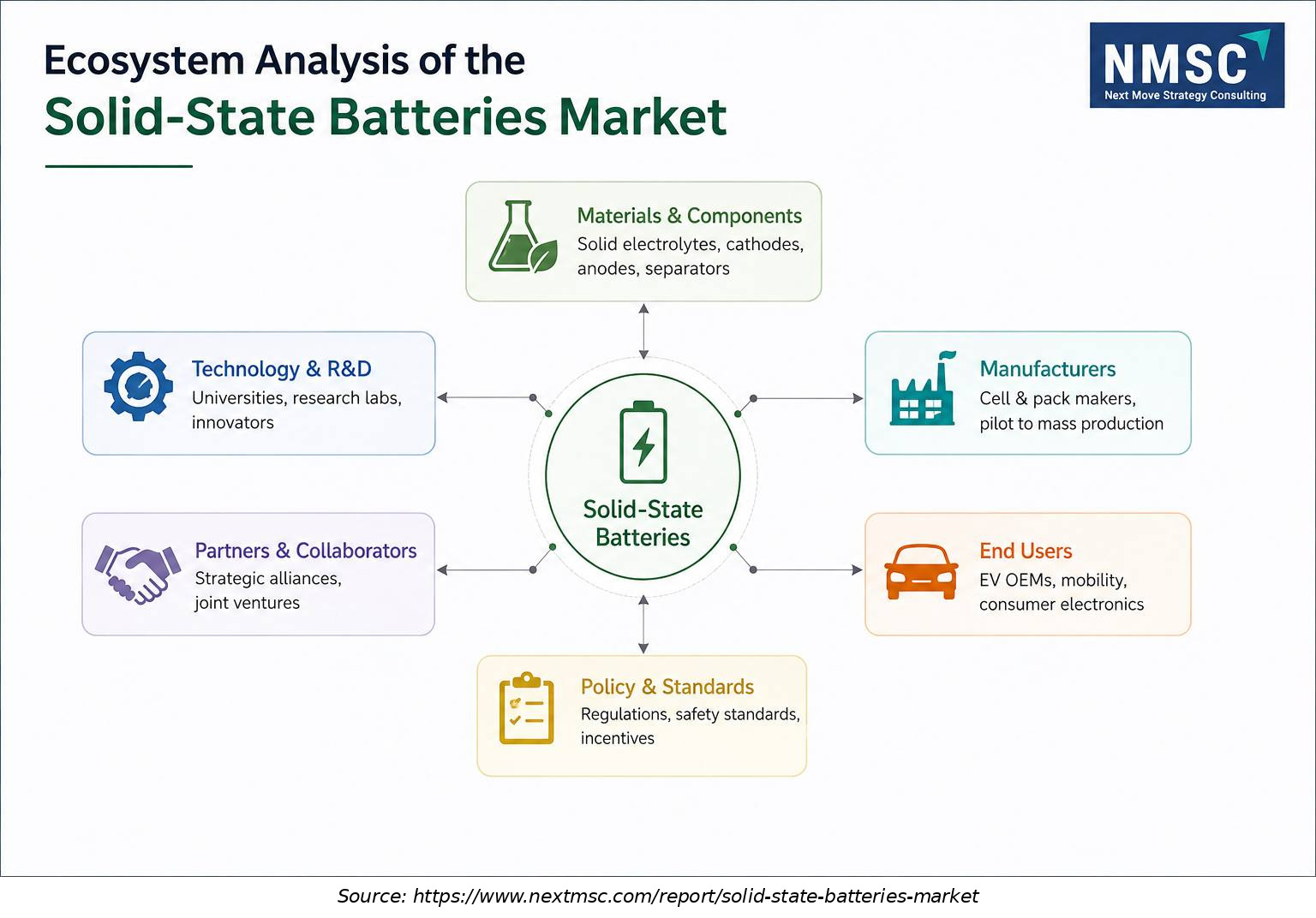
Ecosystem Analysis of the Solid-State Batteries Industry

The above infographic provides a detailed ecosystem analysis of the solid-state batteries market, mapping out six key components that surround and support the core industry. It illustrates how materials suppliers, manufacturers, and research institutions interact within a connected network to advance battery technology from pilot to mass production. The analysis further highlights the critical roles of strategic partnerships and government policies, such as safety standards and incentives, in shaping the market. Ultimately, it demonstrates how this interconnected chain drives innovation to serve diverse end users, from EV manufacturers to consumer electronics.

What does the Solid-State Batteries Market Encompass?
The Solid-State Batteries Market covers rechargeable batteries that replace the liquid or gel electrolyte of conventional lithium ion cells with a solid electrolyte, supplied as cells, modules and packs. The scope spans thin film and bulk cell constructions, oxide, sulfide, polymer, halide and composite electrolytes, and end uses from consumer electronics and medical devices to automotive, robotics and stationary energy. This market report values product revenue in USD Million and excludes conventional liquid electrolyte lithium ion batteries.
Structural evolution is being shaped by standardization and industrial scale up. China published a draft first national standard for automotive solid-state batteries, covering terminology and classification, and it does not treat semi solid as a standard category. In parallel, electrolyte suppliers such as Idemitsu Kosan and Solid Power are building pilot facilities, which signals that supply chain depth is becoming as important as cell chemistry for commercialization.

Market Drivers & Dynamics

Interactive Dataset
Automaker commercialization programs targeting 2027 and 2028 driver +4.1% Asia Pacific, North America, Europe 2026–2030
Sulfide electrolyte and lithium sulfide capacity expansion driver +3.2% Asia Pacific, North America 2026–2031
Demand from humanoid robotics and physical AI for energy dense, safe cells driver +2.3% Global 2027–2035
OEM and cell maker joint evaluation and licensing programs driver +1.9% Global 2026–2032
Standardization of solid-state terminology and classification driver +0.9% Asia Pacific 2026–2029
High manufacturing cost and low yields at pilot scale restraint −3.4% Global 2026–2032
Interface durability and cracking during repeated charge and discharge restraint −2.1% Global 2026–2031
Raw material and lithium sulfide supply constraints restraint −1.3% Asia Pacific, Europe 2026–2030
Long automotive qualification and certification cycles restraint −1.0% North America, Europe 2026–2033
Source: Next Move Strategy Consulting

Growth Drivers

What Is the Primary Growth Driver in the Solid-State Batteries Market?

Automaker commercialization programs are the primary driver. Toyota and Idemitsu Kosan have stated an aim to commercialize all-solid-state batteries in 2027 or 2028, and Stellantis and Factorial Energy began road tests of a solid-state development vehicle in June 2026. Automotive revenue grows from USD 2,600.79 Million in 2025 to USD 37,260.57 Million by 2035 at 24.22% CAGR in our model, which makes vehicle programs the anchor for cell, electrolyte and pack capacity decisions.

How Is Sulfide Electrolyte Capacity Expansion Driving the Market Growth?

Electrolyte availability gates cell output, so each new pilot or production line raises the ceiling for cell shipments. Idemitsu Kosan's Chiba facility and Solid Power's continuous line target 2027 and the end of 2026 respectively. Our analysis shows that Sulfide Solid Electrolytes grow from USD 2,190.15 Million in 2025 to USD 29,954.58 Million by 2035, and that Battery Packs, the fastest growing product at 23.15% CAGR, benefit as cell supply stabilizes.

Growth Inhibitors

What Is Restraining the Solid-State Batteries Market?

Manufacturing cost, yield and interface durability are the main restraints. Toyota has described repeated charging and discharging as a cause of cracks between electrodes and the solid electrolyte, and pilot lines still operate at volumes far below automotive requirements. Long qualification cycles at automakers extend the gap between sample shipments and series revenue, so we expect restraint effects to ease only after yields and cycle life are demonstrated on production equipment.

What Are the Growth Opportunities?

Can Halide and Sulfide Electrolyte Suppliers Capture the Materials Gap?

Qualified electrolyte supply is a gating input for cell makers, which creates a merchant materials opportunity. Halide Solid Electrolytes grow at 28.96% CAGR to USD 7,306.00 Million by 2035, and Sulfide Solid Electrolytes remain the largest technology. The mechanism is supply agreements tied to pilot lines, and the beneficiaries are electrolyte and lithium sulfide producers that can certify consistent quality.

Will Humanoid Robotics Become a Premium Cell Market in the Solid-State Batteries Market?

Humanoid platforms pay for energy density and safety because battery weight and thermal risk limit uptime. Humanoid Robotics grows from USD 123.19 Million in 2025 to USD 5,508.72 Million by 2035 in our model. The mechanism is design wins for small format and thin film cells, and the beneficiaries are specialists with low volume qualification capability in Japan, South Korea and the U.S.

Can Pack Level Integration Create a Premium Layer for High Performance Vehicles?

Battery Packs grow at 23.15% CAGR, and the Above 100 kWh band grows at 28.05%. BMW introduced an i7 test vehicle featuring Solid Power cells, and QuantumScape cells feature in a Volkswagen Group motorcycle program. Integrators that master thermal design and cell stack pressure can charge a premium to automakers seeking differentiated range and charging performance.

Segmentation Analysis

2025 (USD Million)
2035 (USD Million)
Battery Cells 2025: $3,559.0 Million | 2035: $32,146.4 Million
Battery Cell
Thin-Film Cells 2025: $1,352.4 Million | 2035: $5,143.4 Million
Thin-Film Ce
Bulk Cells 2025: $1,957.4 Million | 2035: $24,431.3 Million
Bulk Cells
Other Cell Constructions 2025: $249.1 Million | 2035: $2,571.7 Million
Other Cell C
Battery Modules 2025: $889.8 Million | 2035: $9,497.8 Million
Battery Modu
Battery Packs 2025: $2,395.5 Million | 2035: $31,415.8 Million
Battery Pack
Battery Cells $3,559.0 Million $32,146.4 Million 18.66%
Thin-Film Cells $1,352.4 Million $5,143.4 Million 8.50%
Bulk Cells $1,957.4 Million $24,431.3 Million 22.49%
Other Cell Constructions $249.1 Million $2,571.7 Million 20.24%
Battery Modules $889.8 Million $9,497.8 Million 20.67%
Battery Packs $2,395.5 Million $31,415.8 Million 23.15%

Which Product Type Leads the Solid-State Batteries Market and Which Is Growing Fastest?
Battery Cells lead with USD 3,558.98 Million in 2025, approximately 52% of revenue, rising to USD 32,146.39 Million by 2035. Within cells, Bulk Cells are the main contributor and grow at 22.49% CAGR, while Thin-Film Cells grow at 8.50% because they serve compact consumer and medical devices where energy per area matters more than pack scale.

We found that Battery Packs are the fastest growing product at 23.15% CAGR, increasing from USD 2,395.47 Million to USD 31,415.78 Million, as automakers and robotics integrators procure integrated systems with thermal management and controls. Battery Modules grow at 20.67% CAGR and serve as the bridge between cell qualification and pack production.

2025 (USD Million)
2035 (USD Million)
Oxide Solid
Sulfide Soli
Polymer Soli
Halide Solid
Composite So
Segment Item 2025 (USD Million) 2035 (USD Million) CAGR
Oxide Solid Electrolytes $10.0 USD Million $40.0 USD Million 16.0%
Sulfide Solid Electrolytes $17.1 USD Million $51.1 USD Million 22.0%
Polymer Solid Electrolytes $24.2 USD Million $62.2 USD Million 16.0%
Halide Solid Electrolytes $31.3 USD Million $73.3 USD Million 26.0%
Composite Solid Electrolytes $38.4 USD Million $84.4 USD Million 25.0%

Segment-wise data is locked

Unlock complete segment-wise numbers for By Technology.

Unlock Full Data

Which Solid Electrolyte Technology Dominates and Which Is Growing Fastest?

Sulfide Solid Electrolytes lead with USD 2,190.15 Million in 2025, approximately 32% of revenue, because their ionic conductivity suits automotive power and fast charging requirements. They reach USD 29,954.58 Million by 2035 at 23.66% CAGR, supported by pilot capacity at Idemitsu Kosan and Solid Power. Oxide Solid Electrolytes follow at 17.07% CAGR, favored where stability in air and thin film processing matter.

Our analysis shows that Halide Solid Electrolytes are the fastest growing technology at 28.96% CAGR, from a small base of USD 342.21 Million in 2025 to USD 7,306.00 Million by 2035. Polymer Solid Electrolytes grow slowest at 11.65% CAGR, and their share declines as ceramic and composite approaches move toward higher energy applications.

2025 (USD Million)
2035 (USD Million)
Cell Capacit
Below 20 mAh
20 to 500 mA
Above 500 mA
Module and P
Segment Item 2025 (USD Million) 2035 (USD Million) CAGR
Cell Capacity $10.0 USD Million $40.0 USD Million 23.0%
Below 20 mAh $17.1 USD Million $51.1 USD Million 13.0%
20 to 500 mAh $24.2 USD Million $62.2 USD Million 11.0%
Above 500 mAh $31.3 USD Million $73.3 USD Million 13.0%
Module and Pack Energy $38.4 USD Million $84.4 USD Million 18.0%

Segment-wise data is locked

Unlock complete segment-wise numbers for By Rated Capacity.

Unlock Full Data

How Do Rated Capacity Bands Shape Demand Across Cells, Modules and Packs?

Cell Capacity accounts for USD 3,558.98 Million in 2025 and USD 32,146.39 Million by 2035. The 20 to 500 mAh band is the largest cell band and grows at 19.36% CAGR, while Above 500 mAh is the fastest growing band at 31.73% CAGR as larger format cells enter vehicles and robots. Below 20 mAh grows at 8.32% CAGR and stays tied to wearables, sensors and medical implants.

NMSC's analysis indicates that Module and Pack Energy grows faster than Cell Capacity at 22.53% CAGR versus 18.66%. The 10 to 100 kWh band is the largest at USD 2,036.84 Million in 2025, matching passenger vehicle packs, and Above 100 kWh is the fastest at 28.05% CAGR as stationary and commercial vehicle systems scale.

2025 (USD Million)
2035 (USD Million)
Automotive
Consumer Ele
Medical
Industrial a
Robotics and
Segment Item 2025 (USD Million) 2035 (USD Million) CAGR
Automotive $10.0 USD Million $40.0 USD Million 20.0%
Consumer Electronics $17.1 USD Million $51.1 USD Million 26.0%
Medical $24.2 USD Million $62.2 USD Million 24.0%
Industrial and IoT $31.3 USD Million $73.3 USD Million 26.0%
Robotics and Physical AI $38.4 USD Million $84.4 USD Million 9.0%

Segment-wise data is locked

Unlock complete segment-wise numbers for By End User Industry.

Unlock Full Data

Which End User Industry Leads and Which Is Growing Fastest?

Automotive leads with USD 2,600.79 Million in 2025, approximately 38% of revenue, and reaches USD 37,260.57 Million by 2035 at 24.22% CAGR, driven by automaker programs targeting 2027 and 2028. Consumer Electronics is the second largest in 2025 at USD 1,779.49 Million, but its CAGR of 11.42% lowers its share as automotive volumes scale.

During our market evaluation, we noticed that Robotics and Physical AI is the fastest growing end user industry at 29.89% CAGR, led by Humanoid Robotics at 38.39%. Industrial and IoT grows at 19.06% and Medical at 17.98%, supported by safety sensitive devices that value non flammable electrolytes.

2025 (USD Million)
2035 (USD Million)
Direct to OE
Authorized D
Others
Segment Item 2025 (USD Million) 2035 (USD Million) CAGR
Direct to OEM $10.0 USD Million $40.0 USD Million 24.0%
Authorized Distributor $17.1 USD Million $51.1 USD Million 10.0%
Others $24.2 USD Million $62.2 USD Million 8.0%

Segment-wise data is locked

Unlock complete segment-wise numbers for By Sales Channel.

Unlock Full Data

Which Sales Channel Dominates and Which Is Growing Fastest?

Direct to OEM dominates with USD 4,859.38 Million in 2025, approximately 71% of revenue, because automakers and large electronics brands qualify cells through joint development before purchase. It reaches USD 46,758.37 Million by 2035 at 19.42% CAGR.

Our findings suggest that Authorized Distributor is the fastest growing channel at 23.49% CAGR, rising from USD 1,300.40 Million to USD 17,534.39 Million, as industrial, medical and robotics buyers with lower volumes rely on distributors for sampling, logistics and technical support.

Growth Opportunities

Our analysis shows that three opportunities are positioned to generate disproportionate revenue for vendors that invest ahead of demand.

Can Halide and Sulfide Electrolyte Suppliers Capture the Materials Gap?

Qualified electrolyte supply is a gating input for cell makers, which creates a merchant materials opportunity. Halide Solid Electrolytes grow at 28.96% CAGR to USD 7,306.00 Million by 2035, and Sulfide Solid Electrolytes remain the largest technology. The mechanism is supply agreements tied to pilot lines, and the beneficiaries are electrolyte and lithium sulfide producers that can certify consistent quality.

Will Humanoid Robotics Become a Premium Cell Market in the Solid-State Batteries Market?

Humanoid platforms pay for energy density and safety because battery weight and thermal risk limit uptime. Humanoid Robotics grows from USD 123.19 Million in 2025 to USD 5,508.72 Million by 2035 in our model. The mechanism is design wins for small format and thin film cells, and the beneficiaries are specialists with low volume qualification capability in Japan, South Korea and the U.S.

Can Pack Level Integration Create a Premium Layer for High Performance Vehicles?

Battery Packs grow at 23.15% CAGR, and the Above 100 kWh band grows at 28.05%. BMW introduced an i7 test vehicle featuring Solid Power cells, and QuantumScape cells feature in a Volkswagen Group motorcycle program. Integrators that master thermal design and cell stack pressure can charge a premium to automakers seeking differentiated range and charging performance.

Regional Outlook

2025 (USD Million)
2035 (USD Million)
North Americ
Europe
Asia Pacific
Middle East
Latin Americ
Region 2025 (USD Million) 2035 (USD Million) CAGR (%)
North America $10.0 USD Million $40.0 USD Million 9.0%
Europe $17.1 USD Million $51.1 USD Million 27.0%
Asia Pacific $24.2 USD Million $62.2 USD Million 25.0%
Middle East & Africa $31.3 USD Million $73.3 USD Million 23.0%
Latin America $38.4 USD Million $84.4 USD Million 12.0%

Regional data is locked

Unlock complete regional numbers for this market.

Unlock Full Data

Competitive Landscape

Our findings suggest that the Solid-State Batteries Market is organized around four groups of players that combine technology ownership, manufacturing capability and customer access in different ways.
Dimension Description
Dimension Assessment
Market Structure Fragmented and pre commercial; large incumbent cell makers, automaker affiliated programs and venture backed developers coexist, and no single player holds a verified commanding share.
Innovation Focus Sulfide and halide electrolyte processing, lithium metal anodes, thin film cells, pilot line automation, and cell stack pressure management.
M&A Activity Partnerships, joint evaluation agreements and licensing dominate; outright acquisitions are limited.

How Do Companies Compete in the Solid-State Batteries Market?

Companies compete on proof of performance, measured by energy density, cycle life, fast charging behavior and safety at automotive cell sizes. Factorial Energy and Stellantis validated 77 Ah FEST cells at 375 Wh/kg with over 600 cycles, which shows how public milestones serve as sales credentials. Pricing is secondary today, because supply is sampled and priced through joint development agreements, and geographic expansion follows OEM plant locations.

Which Competitive Archetypes Dominate the Solid-State Batteries Market?

Four archetypes dominate. Automaker affiliated programs include Toyota, Honda, Nissan and Suzuki. Incumbent cell makers include Samsung SDI, LG Energy Solution, Contemporary Amperex Technology, Panasonic Energy and SK On. Developers include QuantumScape, Solid Power, Factorial Energy, ProLogium and ION Storage Systems. Materials and specialty groups include Ganfeng Lithium, Qingtao, Maxell, TDK, Blue Solutions and SOLiTHOR. This grouping describes business models, not market rank.

How Do Companies Differentiate Through Innovation in the Solid-State Batteries Market?

Differentiation centers on manufacturability. QuantumScape's Cobra separator process and Eagle Line target scalable ceramic separator production, while Solid Power focuses on sulfide electrolyte supply and cell designs licensed to partners. We observed that firms with proprietary electrolyte or separator processes can sell to several cell makers, whereas cell focused firms depend on a smaller set of automaker programs.

What Is the Current M&A Landscape in the Solid-State Batteries Market?

Deal activity centers on alliances rather than acquisitions. Solid Power has agreements with BMW, Samsung SDI and SK On covering joint evaluation and line installation, and it has discussed a potential joint venture for commercial scale electrolyte production in the Republic of Korea. Our assessment indicates that consolidation is more likely after pilot results separate viable technologies, with electrolyte and separator specialists the likeliest targets.

Key Market Players

Based on research conducted by NMSC, the following 20 companies represent the leadership set across solid-state battery cells, electrolytes and system development.

ProLogium Technology Co., Ltd. Blue Solutions S.A.S. Ganfeng Lithium Group Co., Ltd. Qingtao (Kunshan) Energy Development Group Co., Ltd. Maxell, Ltd. Samsung SDI Co., Ltd. Toyota Motor Corporation LG Energy Solution, Ltd. Contemporary Amperex Technology Co., Limited Panasonic Energy Co., Ltd. Honda Motor Co., Ltd. Nissan Motor Co., Ltd. Solid Power, Inc. QuantumScape Corporation Factorial Energy, Inc. SK On Co., Ltd. TDK Corporation ION Storage Systems, Inc. Suzuki Motor Corporation SOLiTHOR NV

Latest Developments

During our market evaluation, we noticed that 2025–2026 activity is concentrated on pilot line completion, electrolyte capacity and vehicle level validation rather than commercial launches.

Date Event
September 2026 Mitsui Kinzoku and Factorial signed a joint development agreement to support industrialization of Factorial’s Solstice all-solid-state battery platform.
September 2026 Panasonic Energy developed a new solid-state battery capable of operating at temperatures up to 150°C, raising the limit from 125°C.
September 2026 Maxell developed a rechargeable all-solid-state battery module in the compact format of a 1/2AA-size ER battery, with wireless-charging compatibility.
July 2026 Factorial and SK On signed an MoU to evaluate manufacturing feasibility for Factorial’s FEST solid-state battery technology using SK On’s global manufacturing footprint and existing lithium-ion infrastructure.
June 2026 QuantumScape and Honda R&D signed a multi-year joint research agreement to advance QuantumScape’s solid-state lithium-metal battery platform and related manufacturing processes.

Expert Insights

Yoon-ho Choi

Yoon-ho Choi

President and CEO | Samsung SDI

"Samsung SDI's preparations for mass-producing next-generation products of various form factors such as all solid-state battery are well underway as we are set to lead the global battery market with our unrivalled ‘super-gap’ technology."

Analyst Interpretation

The statement demonstrates the industry's transition from solid-state battery research toward mass-production readiness. Large battery manufacturers are allocating resources to production processes, technology validation, and commercialization roadmaps, indicating that manufacturing capability is becoming a decisive competitive factor. Progress toward scalable production is expected to improve the availability of solid-state cells and support adoption in EVs and other high-performance applications.

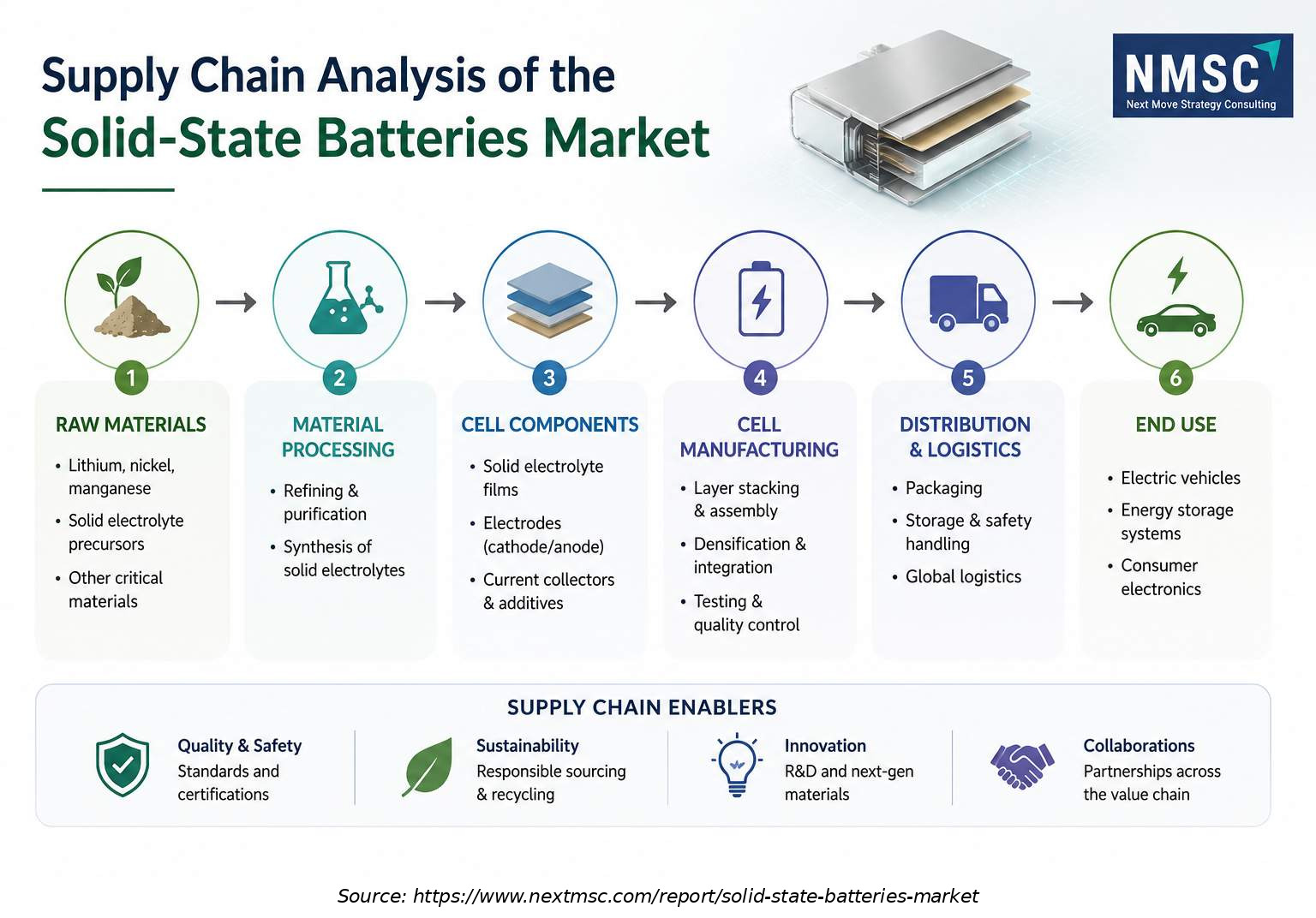
Supply Chain Analysis of the Solid-State Batteries Market
Supply Chain Analysis of the Solid-State Batteries Market

The above infographic provides a detailed supply chain analysis of the solid-state batteries market, outlining a six-step flow from raw materials to end use. It traces the process from sourcing lithium and nickel through material processing, cell manufacturing, and distribution to final deployment in electric vehicles and energy storage systems. The analysis further highlights crucial supply chain enablers, such as quality standards, sustainability, and innovation, that support the industry. Ultimately, it demonstrates how this interconnected chain, driven by R&D and strategic collaborations, delivers advanced battery solutions to diverse end users.

Investment Opportunities

How Are Capital Inflows Shaping the Solid-State Batteries Market?

Capital is flowing into pilot lines and electrolyte capacity rather than final gigafactories. Solid Power reported capital expenditures of USD 10.2 Million in 2025 and USD 6.3 Million in the second quarter of 2026, mainly for its continuous electrolyte production pilot line. We found that strategic partners, including automakers and cell makers, are the main source of capital, which links funding to qualification milestones.

What Infrastructure Investments Are Supporting the Solid-State Batteries Market?

Infrastructure priorities include electrolyte plants, lithium sulfide supply and automated pilot cell lines. Idemitsu Kosan's Chiba facility targets completion in 2027, QuantumScape has installed its Eagle Line, and Solid Power plans to commission its electrolyte line by the end of 2026. Our analysis shows that dry room capacity, precision stacking equipment and quality data systems are the capital items most likely to attract further investment.

How Are ESG Considerations Influencing the Solid-State Batteries Market?

Solid electrolytes can reduce flammability risk compared with liquid electrolytes, which supports safety and insurance outcomes. Idemitsu Kosan produces sulfide electrolytes from sulfur byproducts of petroleum refining, which links materials supply to resource efficiency. The EU Battery Regulation introduces battery passport and carbon footprint requirements from 2027, so governance of material traceability will influence supplier selection in Europe.

Key Benefits for Stakeholders

How Does This Report Benefit Enterprise and Industry Leaders?

Automakers, electronics brands and robotics integrators gain segment level revenue forecasts and CAGR benchmarks across five segmentation axes, supporting technology selection, supplier qualification and expansion planning. The analysis shows where product, electrolyte and capacity choices carry the highest growth, from 23.15% CAGR in Battery Packs to 28.96% in Halide Solid Electrolytes.

How Does This Report Benefit Investors and Financial Analysts?

Investors and analysts gain a reconciled market model, from USD 6,844.20 Million in 2025 to USD 73,059.96 Million by 2035, with regional and country estimates and a competitive assessment of 20 companies. The report supports investment planning by separating growth drivers from restraints and by identifying where capital is concentrating, including pilot lines and electrolyte capacity.

How Does This Report Benefit Technology Vendors and Product Teams?

Electrolyte suppliers, cell designers and pack integrators gain visibility into which segments scale fastest, including Above 500 mAh cells at 31.73% CAGR and Robotics and Physical AI at 29.89%. The competitive assessment and latest developments help teams benchmark partnership models and plan technology roadmaps against verified milestones.

Key Market Segments Evaluated

By Product

  • Battery Cells 
    • Thin-Film Cells
    • Bulk Cells
    • Other Cell Constructions
  • Battery Modules
  • Battery Packs

By Technology

  • Oxide Solid Electrolytes
  • Sulfide Solid Electrolytes
  • Polymer Solid Electrolytes
  • Halide Solid Electrolytes
  • Composite Solid Electrolytes
  • Other Solid Electrolytes

By Rated Capacity

  • Cell Capacity 
    • Below 20 mAh
    • 20 to 500 mAh
    • Above 500 mAh
  • Module and Pack Energy 
    • Below 10 kWh
    • 10 to 100 kWh
    • Above 100 kWh

By End User Industry

  • Automotive
  • Consumer Electronics
  • Medical
  • Industrial and IoT
  • Robotics and Physical AI 
    • Humanoid Robotics
    • Other Robotics
    • Other Physical AI
  • Aerospace and Defense
  • Stationary Energy
  • Other Mobility
  • Other Applications

By Sales Channel

  • Direct to OEM
  • Authorized Distributor
  • Others

By Region

  • North America 
    • U.S.
    • Canada
    • Mexico
  • Europe 
    • UK
    • Germany
    • France
    • Italy
    • Spain
    • Sweden
    • Denmark
    • Finland
    • Netherlands
    • Rest of Europe
  • Asia Pacific 
    • China
    • India
    • Japan
    • South Korea
    • Taiwan
    • Indonesia
    • Vietnam
    • Australia
    • Philippines
    • Malaysia
    • Rest of APAC
  • Middle East & Africa 
    • Saudi Arabia
    • UAE
    • Egypt
    • Israel
    • Turkey
    • Nigeria
    • South Africa
    • Rest of MEA
  • Latin America 
    • Brazil
    • Argentina
    • Chile
    • Colombia
    • Rest of LATAM

Conclusion & Recommendations

The outlook is strongly positive, with revenue expanding from USD 13,465.78 Million in 2026 to USD 73,059.96 Million by 2035 at 20.67% CAGR. Growth depends on converting pilot lines into series supply between 2027 and 2030, after which Automotive and Battery Packs carry most incremental revenue. Asia Pacific retains leadership, while Middle East & Africa and Latin America grow faster from small bases.

What Strategic Positioning Recommendations Should Companies Follow in the Market?

Cell makers should secure sulfide electrolyte supply early and pursue direct OEM qualification, since Direct to OEM holds approximately 71% of revenue. Electrolyte suppliers should invest in halide and sulfide processing, which grow at 28.96% and 23.66% CAGR. Integrators should target packs above 100 kWh and robotics platforms, where energy density commands a premium.

How Attractive Is Investment in the Solid-State Batteries Market?

Attractiveness is high but milestone dependent, supported by an opportunity of USD 59,594.18 Million between 2026 and 2035. Investors should favor companies with documented pilot results, partner commitments and capital light licensing models. Electrolyte and separator specialists offer exposure to several cell makers, which reduces dependence on a single automaker program.

What Are the Key Market Shifts and Risks Market?

Key shifts include the move from sample shipments to pilot lines, tighter terminology under national standards, and growth of robotics demand. Key risks include high manufacturing cost, low pilot yields, interface durability and long qualification cycles. A delay in automaker launch windows beyond 2028 would shift revenue later in the forecast and weaken near term growth.

What Are the Key Growth Pathways in the Solid-State Batteries Market?

Primary pathways include sulfide and halide electrolyte supply, pack level integration for high performance vehicles and small format cells for humanoid robotics, which grows at 38.39% CAGR. Geographic expansion should follow OEM plant locations in Japan, China, South Korea, the U.S. and Germany, with partnerships substituting for proprietary gigafactories.

FAQs

Sources & References

1.

QuantumScape Corporation, Investor Relations (Eagle Line announcement, December 2025)

[https://ir.quantumscape.com/news-releases/news-release-details/quantumscape-announces-completion-key-annual-goal-and](https://ir.quantumscape.com/news-releases/news-release-details/quantumscape-announces-completion-key-annual-goal-and)
2.

QuantumScape Corporation, Form 8-K (fourth quarter and fiscal year 2025 results)

[https://ir.quantumscape.com/static-files/dd749367-7f29-4d7d-9b22-6b46f5b0f910](https://ir.quantumscape.com/static-files/dd749367-7f29-4d7d-9b22-6b46f5b0f910)
3.

QuantumScape Corporation, Form 8-K (first quarter 2026 results)

[https://ir.quantumscape.com/static-files/8944c4a5-fd5a-4dc8-9396-e6a71ceaef87](https://ir.quantumscape.com/static-files/8944c4a5-fd5a-4dc8-9396-e6a71ceaef87)
4.

QuantumScape Corporation (B1 sample shipment, October 2025)

[https://www.quantumscape.com/quantumscape-announces-shipment-of-b1-samples-achieving-a-key-annual-goal/](https://www.quantumscape.com/quantumscape-announces-shipment-of-b1-samples-achieving-a-key-annual-goal/)
5.

Idemitsu Kosan Co., Ltd. (news release, 29 January 2026)

[https://www.idemitsu.com/jp/news/2025/260129_en.pdf](https://www.idemitsu.com/jp/news/2025/260129_en.pdf)
6.

Idemitsu Kosan Co., Ltd. (news release, 21 April 2025)

[https://www.idemitsu.com/jp/news/2025/250421_en.pdf](https://www.idemitsu.com/jp/news/2025/250421_en.pdf)
7.

Stellantis N.V. (press release, 11 June 2026)

[https://www.media.stellantis.com/at-de/corporate/press/stellantis-und-factorial-integrieren-fortschrittliche-festkoerperbatterie-in-stellantis-entwicklungsfahrzeug-und-starten-strassentests-11062026](https://www.media.stellantis.com/at-de/corporate/press/stellantis-und-factorial-integrieren-fortschrittliche-festkoerperbatterie-in-stellantis-entwicklungsfahrzeug-und-starten-strassentests-11062026)
8.

Stellantis N.V. and Factorial Energy (press release, 24 April 2025)

[https://www.businesswire.com/news/home/20250424693631/en/](https://www.businesswire.com/news/home/20250424693631/en/)
9.

Factorial Energy, Inc., Form 8-K investor presentation (August 2026)

[https://www.sec.gov/Archives/edgar/data/0002049662/000162828026055695/fpresentation_081126.htm](https://www.sec.gov/Archives/edgar/data/0002049662/000162828026055695/fpresentation_081126.htm)
10.

Solid Power, Inc. (second quarter 2026 results)

[https://www.nasdaq.com/press-release/solid-power-reports-second-quarter-2026-results-2026-08-04](https://www.nasdaq.com/press-release/solid-power-reports-second-quarter-2026-results-2026-08-04)
11.

Solid Power, Inc. (full year 2025 results)

[https://www.businesswire.com/news/home/20260224365911/en/solid-power-reports-full-year-2025-results/](https://www.businesswire.com/news/home/20260224365911/en/solid-power-reports-full-year-2025-results/)
12.

China Daily, government portal (draft national standard for solid-state batteries)

[https://govt.chinadaily.com.cn/s/202601/12/WS6964a8af498e23165e06cb93/rules-for-solid-state-battery-set.html](https://govt.chinadaily.com.cn/s/202601/12/WS6964a8af498e23165e06cb93/rules-for-solid-state-battery-set.html)
13.

Associated Press (Toyota and Idemitsu cooperation announcement)

[https://www.therepublic.com/](https://www.therepublic.com/?p=599761)

About the Author

Mayurima Roy

Mayurima Roy

Mayurima Roy is Research Analyst at Next Move Strategy Consulting, where she has spent 4 years working across the firm's full industry coverage rather than a single fixed vertical. Her work centers on structured research, ongoing trend tracking, competitive assessment, and insight-led content development, translating complex market data into clear, decision-ready narratives that support informed client decision-making across diverse global industries, market sectors, and world regions every day.

About the Reviewer

Debashree Dey

Debashree Dey

Debashree Dey is Assistant Manager at Next Move Strategy Consulting, where she supports cross-vertical market content and communications across diverse industries for 6 years. Her professional background includes senior content writing, communications, and published manuscript authorship, with experience developing audience-focused business narratives and maintaining clear, consistent messaging. Her role supports research-led content development and editorial quality across NextMSC publications.

Download Free Sample

Semih Kavaklioglu

SEMIH KAVAKLIOGLU

Co-Founder & Sales Manager

Decortie

I work a lot in the marketing industry and I know that research is an essential part of any campaign. I have used Market research reports for my own products and I found them to be very informative and well-researched. The team here produces insightful reports for a good price

Robert Sean Trevino

ROBERT SEAN TREVINO

Sr. Director, Head of Strategic Insights & Analytics

Foundation Medicine

I realized that it was a reliable source of information. These days, there are many people who are looking for authentic data, and this is one of the only sources that can offer them with what they need;

Kevin Coker

KEVIN COKER

Founder, CEO and Board Diector

Proxima Clinical Research

I have been using Next MSC reports for product positioning in a new geography for a long time. They have by far the best reports I have found and the price is reasonable too!

Pratyush Kumar Das

PRATYUSH KUMAR DAS

Assistant Manager

Polycab India Limited

We would like to express our appreciation for the data and insights provided by nextmsc. We are very pleased with the quality and depth of the information, which has proven to be highly valuable and beneficial for our business decision-making.

Diana Trejo

DIANA TREJO

Assistant Manager

Sumitomo Corporation de Mexico, S.A. de C.V.

Recently, we purchased a report on the Mexico Data Center Market from Next Move Strategy Consulting. The service has been excellent, with support that is always timely and thoroughly professional. The information provided is interesting, highly useful, and delivered with clarity. I would highly recommend NextMSC for anyone seeking insightful and dependable analysis.

Custom Market Research Services

We will customize the research for you if the listed report does not fully match your requirements.

Get 30% Free Customization

Select License

This website uses cookies to ensure you get the best experience on our website. Learn more

✖