Boilers Market By Type (Residential Boilers, Commercial Boilers, Industrial Boilers, Utility Boilers), By Fuel Type (Natural Gas, Oil, Coal, Electric, Biomass, Others), By Capacity (Less than 0.3 MMBtu/hr, 0.3 to 2.5 MMBtu/hr, 2.5 to 10 MMBtu/hr, 10 to 50 MMBtu/hr, Others), By Pressure Class (Low Pressure, Others), By Configuration (Wall Hung, others), By Distribution Channel (Direct OEM, Others), By End User (Hospitality, Others) – Global Opportunity Analysis and Industry Forecast, 2025–2030.
Industry: Energy & Power | Publishing Date: July 27, 2026 | Last Updated: September 30, 2026 | No of Pages: N/A | No. of Tables: N/A | No. of Figures: N/A | Format: PDF | Report Code: EP3447
Industry Overview
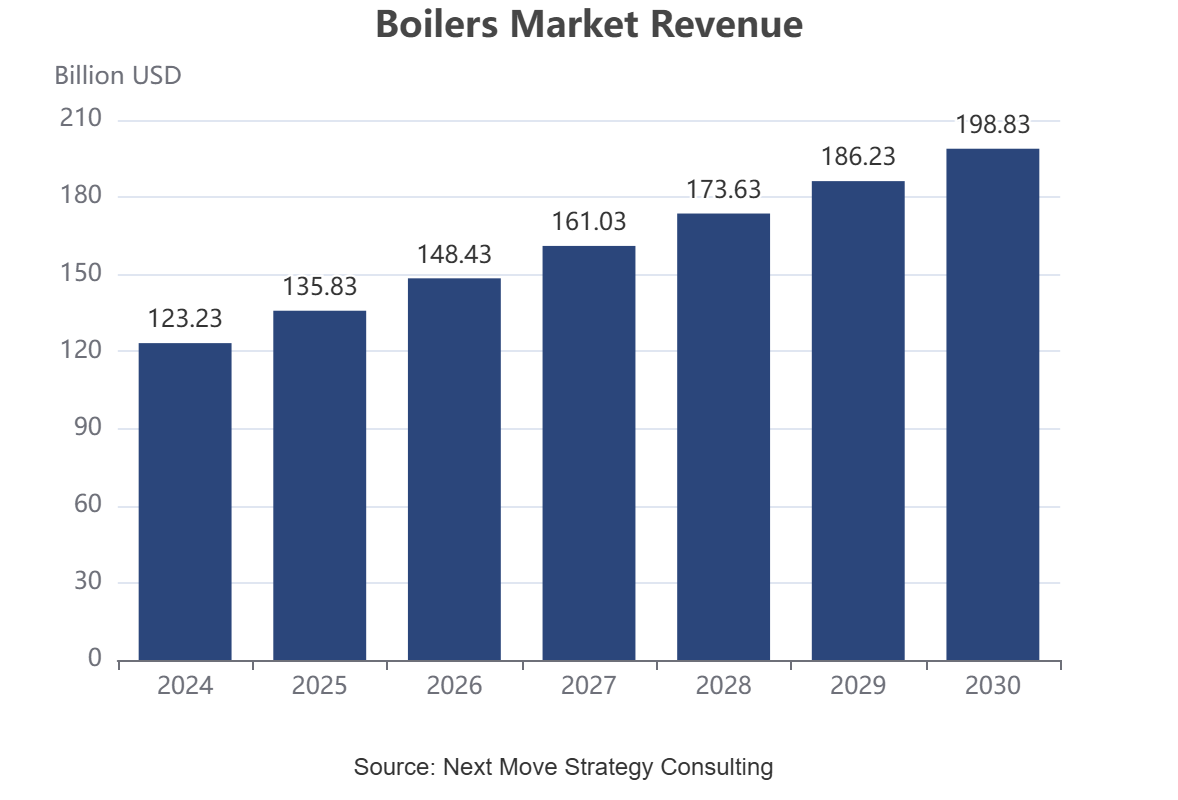
The global Boilers Market size was valued at USD 123.23 billion in 2024 and is predicted to reach USD 133.46 billion by the end of 2025. The industry is predicted to reach USD 198.83 billion by 2030 with a CAGR of 8.3% from 2025 to 2030.
The market is experiencing steady growth, driven by rising demand for energy-efficient heating solutions, rapid industrialization, and expanding urban infrastructure. As industries and consumers prioritize sustainability and cost savings, high-efficiency boilers are gaining traction across residential, commercial, and industrial sectors.
Urban growth in emerging economies, coupled with infrastructure development and smart city initiatives, is further boosting market demand. Regulatory pressure to reduce emissions and adopt cleaner technologies is compelling the replacement of outdated systems with advanced, low-emission boilers.
However, the high initial cost of these systems remains a key barrier, particularly for cost-sensitive users. At the same time, technological advancements, including the integration of smart and IoT-enabled features, are creating new growth opportunities by enhancing operational efficiency and aligning with digital infrastructure trends. Overall, the market is being shaped by a combination of environmental, economic, and technological factors, positioning it for sustained long-term expansion.
Rising Demand for Energy-Efficient Heating Solutions Drives Boiler Adoption
The increasing demand for energy-efficient heating solutions is a key driver of the market, as consumers and industries seek to reduce energy consumption, lower operational costs, and comply with environmental regulations. High-efficiency boilers, such as condensing models, offer improved thermal performance by capturing and reusing waste heat, making them an attractive alternative to conventional systems.
This trend is further supported by government initiatives, including strict energy-efficiency standards, emissions regulations, and financial incentives like subsidies and tax benefits. As a result, the shift toward sustainable and cost-effective heating is accelerating the adoption of advanced boiler technologies across residential, commercial, and industrial sectors.
Industrial Growth and Urbanization Fuels Market Expansion
Rapid industrialization and urbanization, particularly in emerging economies, remain key drivers of the boilers market growth. According to the World Bank in 2024, the urban population in the United States stands at 84% of the total population, reflecting a mature urban infrastructure with established demand for advanced heating systems.
In contrast, India’s urban population is 37%, indicating significant potential for future urban expansion and infrastructure development. As India and other emerging economies continue to urbanize, there is a growing need for boilers in newly built residential and commercial buildings, as well as in expanding industrial sectors such as chemicals, pharmaceuticals, food processing, and paper manufacturing, all of which require reliable heating solutions.
Large-scale infrastructure projects, industrial corridors, and smart city initiatives are further accelerating boiler installations. This parallel growth in urban infrastructure and industrial output across varying stages of development is driving sustained demand for both industrial and commercial boilers globally.
Government Regulations and Emission Standards Accelerates Market Growth
Stringent government regulations and emission standards are significantly driving the growth of the market. In an effort to reduce air pollution and greenhouse gas emissions, regulatory bodies across the globe are mandating stricter efficiency benchmarks and lower emission limits for heating equipment. These policies are compelling industries and building owners to replace older, inefficient boilers with modern systems that comply with environmental standards.
Governments are also introducing supportive measures such as carbon pricing, energy-efficiency labelling, and financial incentives to encourage the adoption of cleaner technologies. This regulatory pressure is not only boosting demand for high-efficiency, low-emission boilers but also stimulating innovation among manufacturers to develop environmentally compliant solutions, thereby reshaping the competitive landscape of the market.
High Initial Cost of Advanced Boiler Systems Limits Market Growth
One major restraint in the boilers market expansion is the high upfront cost associated with purchasing and installing advanced, energy-efficient boiler systems. While these modern boilers offer long-term savings through reduced energy consumption and maintenance, the initial investment is a significant barrier, particularly for small and medium enterprises (SMEs) and residential users. Costs related to system upgrades, retrofitting, and compliance with new emission standards further add to the financial burden, slowing down adoption in cost-sensitive markets.
Integration of Smart and IoT-Enabled Boiler Technologies Unlocks New Growth Opportunities
A key opportunity in the market lies in the growing demand for smart and IoT-enabled boiler systems. These advanced systems allow for real-time monitoring, predictive maintenance, remote control, and optimization of performance, leading to improved energy management and operational efficiency.
As digitalization spreads across industrial and building infrastructure, integrating intelligent features into boilers offers manufacturers a chance to differentiate their products, cater to smart building trends, and tap into new market segments focused on automation and sustainability.
Market Segmentations and Scope of the Study
The boilers market report is segmented by technology, fuel type, capacity, configuration, end-user, and regions. Technologies include fire tube, water tube, condensing and non-condensing, electric boilers, and heat recovery boilers, each catering to specific performance and application needs. Fuel types comprise natural gas, oil-fired, coal-fired, biomass-fired, electricity, and waste heat sources. End users span residential, commercial, and industrial sectors. Geographically, the market is analysed across North America, Europe, Asia-Pacific, and the Rest of the World, reflecting strong and growing demand across diverse regions and industries.
Geographical Analysis
In North America, especially the United States and Canada, strict environmental regulations and efforts to reduce carbon emissions are driving demand for high-efficiency and low-emission boilers. Government initiatives such as the U.S. Department of Energy’s energy-efficiency programs and Canada's climate action plans are promoting the replacement of old systems with cleaner technologies.
In Europe, the boilers market share is being driven by the widespread adoption of district heating systems and a strong regulatory push toward sustainability and energy efficiency. District heating, especially common in countries like Germany, Sweden, and Denmark, enables centralized heat generation through large-scale, efficient boilers that integrates renewable energy and waste heat sources.
The European Union’s Eco-design Directive and the European Green Deal are key policy instruments encouraging the use of low-emission, high-efficiency boilers by setting strict environmental standards and promoting decarbonization. Additionally, government incentives, rising carbon taxes, and support for energy renovation programs are accelerating the replacement of old systems with modern, eco-friendly alternatives, positioning Europe as a leader in the transition to clean heating technologies.
In the Asia-Pacific region, the market is experiencing strong growth due to rapid industrialization and large-scale infrastructure development, particularly in countries like China, India, and across Southeast Asia. Expanding sectors such as manufacturing, chemicals, textiles, pharmaceuticals, and food processing rely heavily on boilers for steam and heat generation, creating sustained industrial demand.
At the same time, massive investments in urban infrastructure, driven by population growth, urban migration, and government-led development initiatives, are increasing the need for reliable heating solutions in residential, commercial, and institutional buildings. Supportive policies, rising energy needs, and efforts to modernize aging energy systems are further contributing to the adoption of advanced, efficient boiler technologies across the region.
In the Rest of the World, which includes regions such as Latin America, Africa, and the Middle East, the market is being driven by expanding energy access, accelerating urbanization, and infrastructure modernization. As governments and private sectors invest in upgrading public utilities, industrial facilities, and residential housing, there is a growing demand for reliable and efficient heating systems to support economic development and rising living standards.
Urban population growth is leading to the construction of new residential and commercial buildings that require centralized or semi-centralized heating, while industries such as mining, petrochemicals, and food processing are increasingly adopting modern boiler systems to improve productivity and comply with environmental and safety standards. In many of these emerging markets, where centralized heating systems have traditionally been limited, the need for decentralized, efficient boiler solutions is creating new opportunities for market expansion, particularly in off-grid or semi-urban areas undergoing rapid transformation.
Strategic Developments in the Industry
Key players in the boilers industry are actively pursuing product innovation, strategic acquisitions, and international project expansion to strengthen their global footprint and meet evolving industrial demands.
-
In July 2025, Bharat Heavy Electricals Limited secured a major order from Adani Power for equipment for six 800 MW thermal power units, strengthening its position in India's large-scale thermal power equipment market.
-
In December 2025, Mitsubishi Heavy Industries, Ltd., the power solutions brand of MHI, and Mitsubishi Electric completed functional testing of a next-generation gas turbine control system for thermal power plants, supporting improved plant operation and efficiency.
-
In July 2024, Thermax Limited secured an international order worth USD 62 Million in mid‑2024 to supply two 550 TPH CFBC boilers to Botswana for national power generation.
Key Benefits
-
The report provides quantitative analysis and estimations of the market from 2025 to 2030, which assists in identifying the prevailing sector opportunities.
-
The study comprises a deep-dive analysis of the current and future boilers market trends to depict prevalent investment pockets in the industry.
-
Information related to key drivers, restraints, and opportunities and their impact on the market is provided in the report.
-
Competitive analysis of the key players, along with their market share is provided in the report.
-
SWOT analysis and Porters Five Forces model is elaborated in the study.
-
Value chain analysis in the market study provides a clear picture of roles of stakeholders.
Boilers Market Key Segments
By Type
-
Residential Boilers
-
Combi Boilers
-
System Boilers
-
Conventional Boilers
-
Electric Boilers
-
Other Residential Boilers
-
-
Commercial Boilers
-
Condensing Boilers
-
Non-condensing Boilers
-
Electric Boilers
-
Other Commercial Boilers
-
-
Industrial Boilers
-
Fire Tube Boilers
-
Water Tube Boilers
-
Electric Boilers
-
Biomass Boilers
-
Waste Heat Boilers
-
Other Industrial Boilers
-
-
Utility Boilers
-
Pulverized Coal Boilers
-
Circulating Fluidized Bed Boilers
-
Gas Fired Boilers
-
Biomass Boilers
-
Waste Heat Boilers
-
Other Utility Boilers
-
By Fuel Type
-
Natural Gas
-
Oil
-
Coal
-
Electric
-
Biomass
-
Hydrogen Ready
-
Waste Heat
-
Other Fuels
By Capacity
-
Less than 0.3 MMBtu/hr
-
0.3 to 2.5 MMBtu/hr
-
2.5 to 10 MMBtu/hr
-
10 to 50 MMBtu/hr
-
50 to 100 MMBtu/hr
-
100 to 250 MMBtu/hr
-
Above 250 MMBtu/hr
By Pressure Class
-
Low Pressure
-
Medium Pressure
-
High Pressure
-
Subcritical
-
Supercritical
-
Ultra Supercritical
By Configuration
-
Wall Hung
-
Floor Standing
-
Packaged
-
Modular
-
Skid Mounted
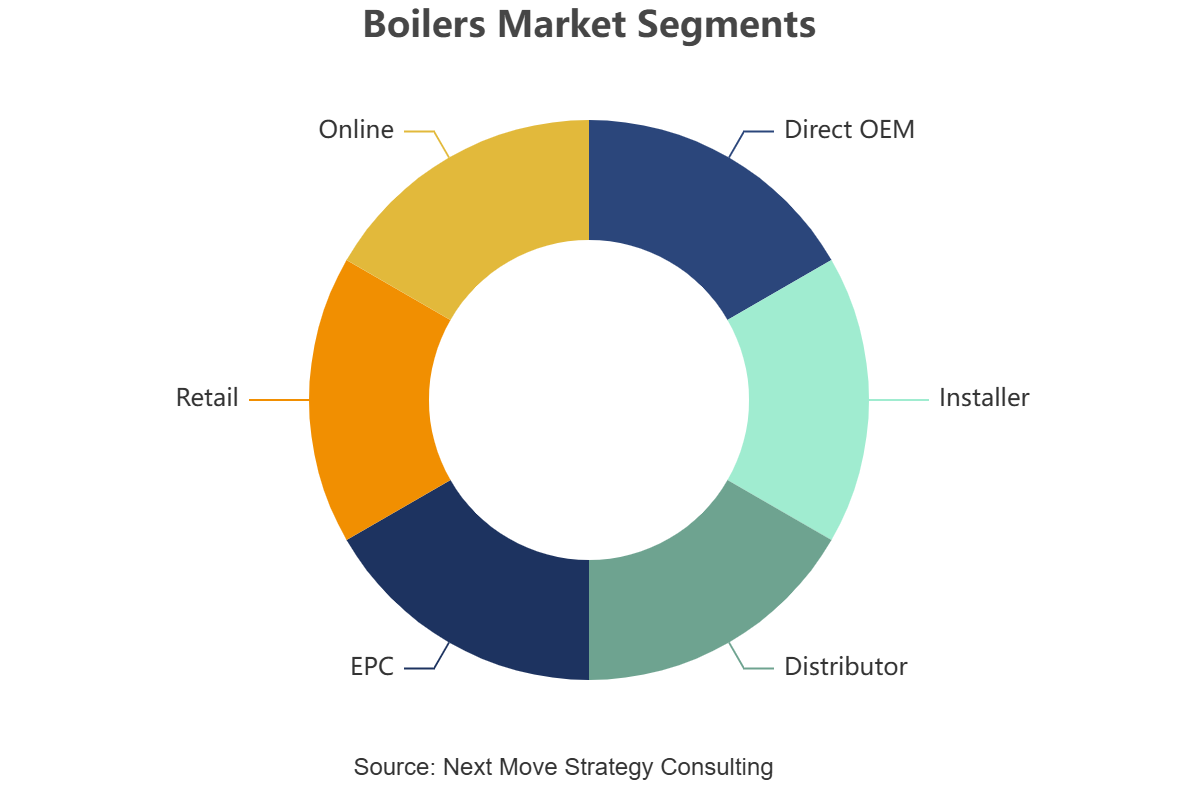
By Distribution Channel
-
Direct OEM
-
Installer
-
Distributor
-
EPC
-
Retail
-
Online
By End User
-
Hospitality
-
Healthcare
-
Education
-
Offices and Retail
-
Food and Beverage
-
Chemicals
-
Refining and Petrochemicals
-
Pulp and Paper
-
Primary Metals
-
Power and Utilities
-
Waste to Energy
-
Other End Users
By Region
-
North America
-
The U.S.
-
Canada
-
Mexico
-
-
Europe
-
The UK
-
Germany
-
France
-
Italy
-
Spain
-
Denmark
-
Netherlands
-
Finland
-
Sweden
-
Norway
-
Russia
-
Rest of Europe
-
-
Asia-Pacific
-
China
-
Japan
-
India
-
South Korea
-
Australia
-
Indonesia
-
Singapore
-
Taiwan
-
Thailand
-
Rest of Asia-Pacific
-
-
RoW
-
Latin America
-
Middle East
-
Africa
-
Key Players
-
Mitsubishi Heavy Industries, Ltd.
-
Bharat Heavy Electricals Limited
-
Harbin Electric Corporation
-
Dongfang Electric Corporation
-
IHI Corporation
-
GE Vernova Inc.
-
Shanghai Electric Group Company Limited
-
Doosan Enerbility Co., Ltd.
-
Babcock & Wilcox Enterprises, Inc.
-
Thermax Limited
-
Miura Co., Ltd.
-
Bosch Industriekessel GmbH
-
Fulton
-
Viessmann Climate Solutions SE
-
Vaillant GmbH
-
BDR Thermea Group B.V.
-
Ariston Holding N.V.
-
Groupe Atlantic
-
Hoval Aktiengesellschaft
-
Hurst Boiler & Welding Company, Inc.
Report Scope and Segmentation
|
Parameters |
Details |
|
Market Size in 2025 |
USD 133.46 Billion |
|
Revenue Forecast in 2030 |
USD 198.83 Billion |
|
Growth Rate |
CAGR of 8.3% from 2025 to 2030 |
|
Analysis Period |
2024–2030 |
|
Base Year Considered |
2024 |
|
Forecast Period |
2025–2030 |
|
Market Size Estimation |
Billion (USD) |
|
Growth Factors |
|
|
Countries Covered |
28 |
|
Companies Profiled |
15 |
|
Market Share |
Available for 10 companies |
|
Customization Scope |
Free customization (equivalent up to 80 working hours of analysts) after purchase. Addition or alteration to country, regional, and segment scope. |
|
Pricing and Purchase Options |
Avail customized purchase options to meet your exact research needs. |
About the Author
 Jayanta Das
— Jayanta Das is Senior Analyst at Next Move Strategy Consulting, where he has spent 4.5 years covering the firm's full industry taxonomy — spanning aerospace and defense, healthcare, BFSI, energy and power, semiconductors, and beyond — rather than one specialization. His work follows NextMSC's research model, combining data mining, analytics, and secondary research to build market sizing and forecasts behind NextMSC's 2,000-plus research reports, trusted by more than 3,000 organizations globally.
Jayanta Das
— Jayanta Das is Senior Analyst at Next Move Strategy Consulting, where he has spent 4.5 years covering the firm's full industry taxonomy — spanning aerospace and defense, healthcare, BFSI, energy and power, semiconductors, and beyond — rather than one specialization. His work follows NextMSC's research model, combining data mining, analytics, and secondary research to build market sizing and forecasts behind NextMSC's 2,000-plus research reports, trusted by more than 3,000 organizations globally.
About the Reviewer
 Supradip Baul
— Supradip Baul is an accomplished business consultant and strategist with over a decade of rich experience in market intelligence, strategy, technology, and business transformation. His work has included rigorous qualitative and quantitative analysis across multiple industries, helping clients shape investment decisions and long-term roadmaps. Earlier in his career, he was associated with Gartner, where he contributed to industry-leading reports and market share analyses. He has worked with leading global companies and holds an MBA with a dual specialization in Marketing and Finance.
Supradip Baul
— Supradip Baul is an accomplished business consultant and strategist with over a decade of rich experience in market intelligence, strategy, technology, and business transformation. His work has included rigorous qualitative and quantitative analysis across multiple industries, helping clients shape investment decisions and long-term roadmaps. Earlier in his career, he was associated with Gartner, where he contributed to industry-leading reports and market share analyses. He has worked with leading global companies and holds an MBA with a dual specialization in Marketing and Finance.
At Next Move Strategy Consulting, we understand that insightful market research is the cornerstone of successful business decisions. That's why we employ a robust and multifaceted approach, combining various methodologies to deliver the most accurate and actionable data for our clients.

Research Landscape
We navigate the world of research with two primary approaches:
Qualitative Approach
Our qualitative research methodologies involve immersive techniques such as in-depth interviews, focus groups, and observational studies. By engaging directly with individuals and stakeholders, we uncover valuable insights that quantitative data alone may overlook.

Quantitative Research
In tandem with qualitative methodologies, NMSC leverages the power of Quantitative Research to provide a robust foundation of numerical insights. Through systematic data collection and analysis, we quantify patterns, preferences, and market trends, offering a comprehensive view of the business landscape.
Our quantitative research approach employs diverse tools, including surveys, experiments, and statistical modelling. These methodologies enable us to gather data from a large and representative sample, ensuring the statistical significance of our findings. By employing structured questionnaires and standardized data collection methods, we guarantee the reliability and validity of the information we present to our clients.
Quantitative research is particularly effective in measuring the prevalence of trends, assessing market size, and gauging the impact of various factors on consumer behavior. The numerical precision attained through this approach equips our clients with actionable insights, facilitating data-driven decision-making and strategy formulation.


Our Specialized Toolbox for Industry-Specific Market Research
We deploy a specialized arsenal of techniques tailored to meet your unique requirements. Here's a glimpse into our comprehensive toolbox:

Information Procurement
The stage entails acquiring market data or relevant information through various sources and methodologies.


Market Research Approach
We utilize both top-down and bottom-up approaches in market research analysis to achieve a comprehensive understanding of the market dynamics, leveraging the broad perspective of industry trends and macroeconomic factors alongside detailed insights from specific segments and individual companies.

Porters Five Forces Analysis
We conduct Porter's Five Forces analysis to evaluate the competitive landscape of an industry, providing us with insights into factors that affect profitability and strategic positioning.

SWOT Analysis

Forecasting
We utilize a forecasting model to predict future consumption by considering parameters like population, economics, regulations, market competition, drivers, constraints, technology, and pricing. We also employ statistical techniques such as multilinear regression, exponential smoothing, moving average, ARIMA, and Monte Carlo simulations for accurate predictions. In econometric forecasting, we analyzed short-term and long-term event impacts, attributing values based on regulatory frameworks, economic factors, and market events.





 Speak to Our Analyst