South Korea Industrial Robotics Market Size, Share, Trends and Growth Analysis, By Robot Type (Articulated Robots, SCARA Robots, Cartesian and Gantry Robots, Delta Robots, Collaborative Robots, Autonomous Mobile Robots (AMRs), Automated Guided Vehicles (AGVs), and Other Robots), By Offering (Hardware, Software, and Services), By Application (Handling, Welding and Soldering), By Mounting Type, By Mobility, By Payload Capacity, By End User – Opportunity Analysis and Industry Forecast, 2025–2035
Industry: Semiconductor & Electronics | Latest Edition: September 1, 2026 | No of Pages: 269 | No. of Tables: 144 | No. of Figures: 130 | Format: PDF | Report Code: SE3726
What Is the South Korea Industrial Robotics Market Size?
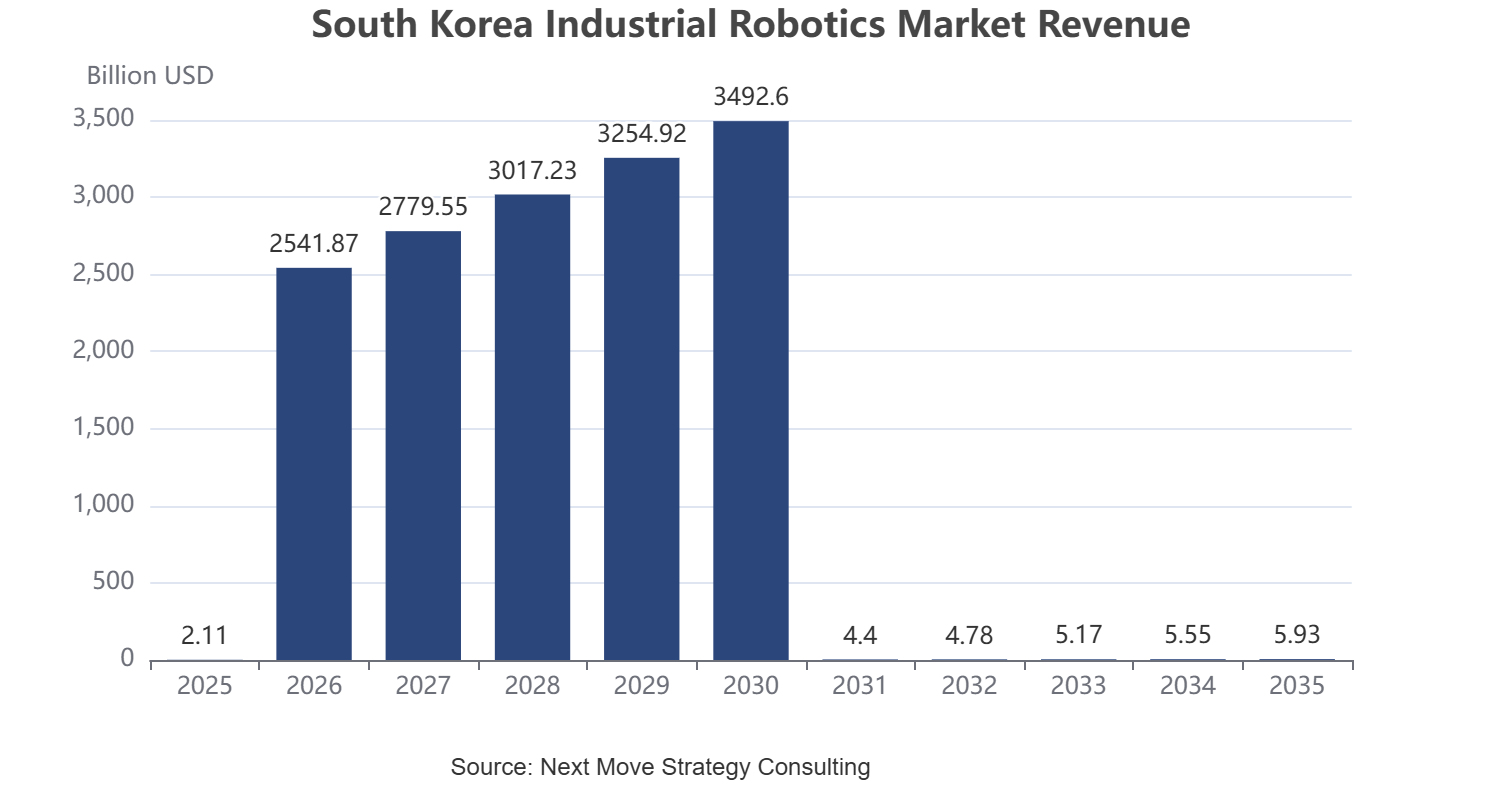
The South Korea industrial robotics market size was valued at USD 2.11 billion in 2025 and is estimated at USD 2.34 billion in 2026, forecast to reach USD 5.93 billion by 2035, expanding at a 10.91% CAGR between 2026 and 2035. Articulated robots dominate the market by robot type, reflecting sustained deployment across automotive and electronics assembly lines.
In unit terms, deployed robot volume is estimated at 28 thousand units in 2025 and 31 thousand units in 2026, rising to 90 thousand units by 2035 at a 12.42% CAGR between 2026 and 2035, a faster expansion rate than the value CAGR that reflects rising deployment of lower-cost collaborative and mobile robots across South Korean manufacturing facilities.
We observed that market growth is supported by expanding semiconductor and display manufacturing capacity, accelerating adoption of humanoid and collaborative robotics led by domestic conglomerates, and continuous automation investment addressing South Korea’s shrinking manufacturing workforce through 2035.
|
Parameters |
Details |
|
Market Size in 2025 |
USD 2.11 Billion |
|
Market Size in 2026 |
USD 2.34 Billion |
|
Revenue Forecast in 2035 |
USD 5.93 Billion |
|
Growth Rate |
CAGR of 10.91% from 2026 to 2035 |
|
Market Volume in 2025 |
28 Thousand Units |
|
Market Volume in 2026 |
31 Thousand Units |
|
Volume Forecast in 2035 |
90 Thousand Units |
|
Volume Growth Rate |
CAGR of 12.42% from 2026 to 2035 |
|
Analysis Period |
2025–2035 |
|
Base Year Considered |
2025 |
|
Forecast Period |
2026–2035 |
|
Market Size Estimation |
Revenue (USD Billion) |
|
Companies Profiled |
15 |
|
Market Share |
Available for Top 10 Companies |
Strategic Framework of the South Korea Industrial Robotics Market
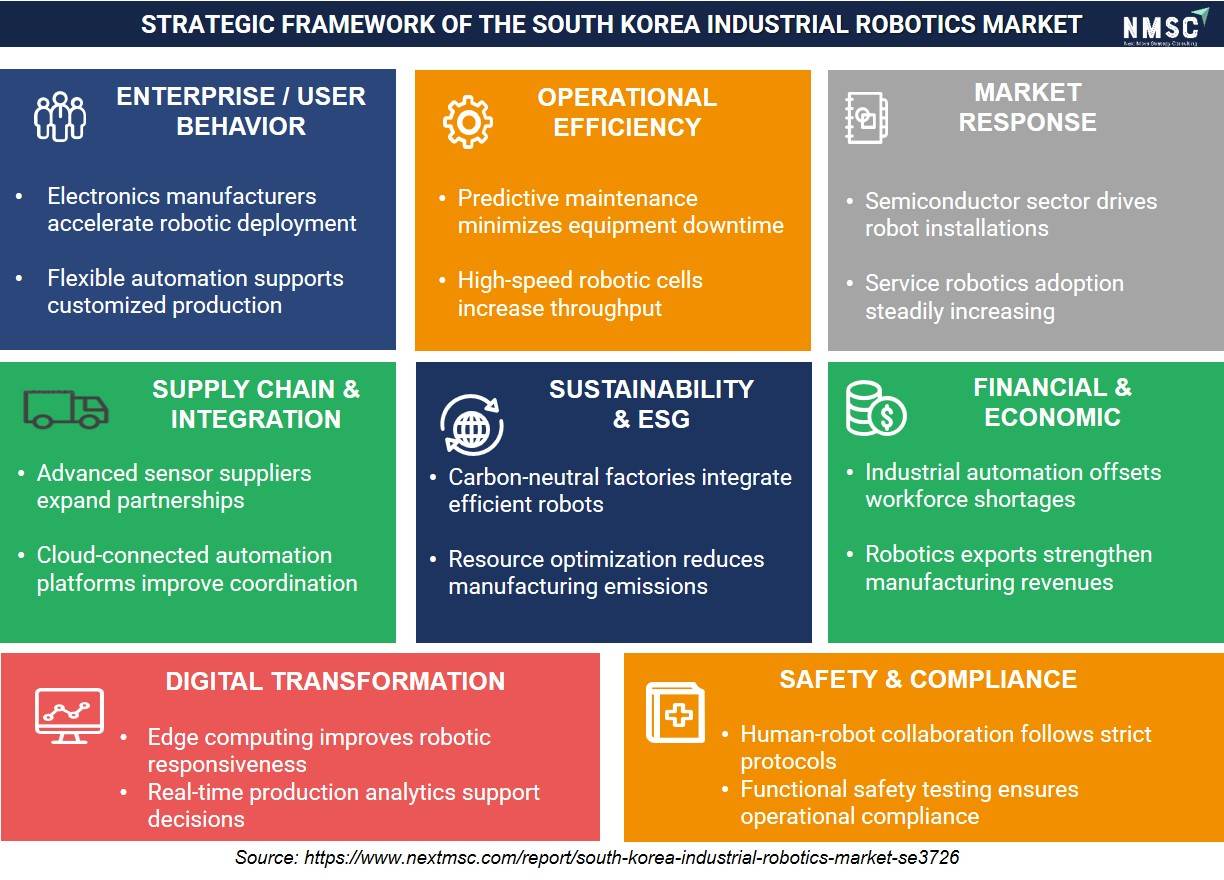
South Korea’s industrial robotics market is shaped by enterprise automation, operational efficiency, and digital transformation. AI-enabled manufacturing, predictive maintenance, and cloud-connected systems improve productivity, while sustainability initiatives and stringent safety standards support responsible growth. Strong supply chain integration and export-oriented manufacturing reinforce the market’s long-term competitiveness and innovation-driven expansion.
Key Emerging Trends
Based on research conducted by NMSC, we found that four structural trends are reshaping robot deployment, conglomerate investment strategy, and competitive dynamics across the South Korea industrial robotics market.
How Is Humanoid Robot Development Accelerating Industrial Automation in South Korea?
Humanoid and dual-arm mobile manipulator robots are advancing from laboratory research into commercial pilot deployment across South Korean manufacturing and logistics sites. We observed that Samsung Electronics increased its stake in Rainbow Robotics Co., Ltd. to 35% and incorporated the firm as a subsidiary to accelerate humanoid robot development. This shift is enabling early commercial trials, including warehouse pilots, that validate humanoid platforms for real-world material handling and manufacturing tasks.
Why Is Conglomerate-Backed Robotics Investment Reshaping Domestic Manufacturing?
Robotics investment led by Samsung Electronics, LG Electronics, and Hyundai Motor Group affiliates is increasingly directed toward internal factory automation and robotics commercialization. Our findings suggest that conglomerate-affiliated robotics units are reporting steep revenue growth as parent companies route factory automation spending to firms in which they hold controlling stakes. This trend is reinforcing demand for collaborative and mobile robots deployed across domestic production lines and smart factory initiatives.
How Is Physical AI Transforming Robot Deployment Across Korean Factories?
Physical AI software stacks that connect collaborative robots with vision, motion-planning, and decision-making systems are becoming central to South Korean automation strategy. We observed that Doosan Robotics Inc. partnered with a global technology provider to deliver an end-to-end physical AI software stack for its collaborative robot customers across manufacturing and logistics applications. This shift is reducing deployment complexity while expanding the addressable market for AI-enabled robotic automation.
What Role Do Collaborative Robots Play in Addressing Labor Shortages?
Collaborative robots are increasingly deployed by South Korean manufacturers confronting a shrinking working-age population and persistent skilled-labor shortages. Our analysis indicates that domestic cobot makers are expanding palletizing, deburring, and end-of-line automation solutions to support electric vehicle component and general manufacturing operations. This trend is broadening automation adoption beyond large conglomerate-affiliated plants into small and mid-sized manufacturing facilities nationwide.
Growth Drivers and Restraints
Growth Catalyst and Risk Assessment Matrix
|
FACTORS |
TYPE |
(+/-) % IMPACT ON CAGR FORECAST |
GEOGRAPHIC RELEVANCE |
IMPACT TIMELINE |
|
Expanding semiconductor and display manufacturing capacity increasing demand for high-precision SCARA and cleanroom robots |
Driver |
+2.95% |
South Korea (strongest in Gyeonggi and Chungcheong semiconductor clusters) |
2026–2032 |
|
Conglomerate-led robotics investment by Samsung, LG, and Hyundai affiliates accelerating domestic automation deployment |
Driver |
+2.55% |
South Korea (nationwide; strongest in conglomerate-affiliated plants) |
2026–2033 |
|
Structural manufacturing labor shortages amid a declining working-age population accelerating collaborative and humanoid robot adoption |
Driver |
+2.20% |
South Korea (nationwide) |
2026–2035 |
|
Growing integration of physical AI and vision-guided automation improving deployment flexibility and reducing commissioning time |
Driver |
+1.75% |
South Korea (nationwide) |
2026–2034 |
|
Government-backed robot industry expansion policy supporting automation investment and export competitiveness |
Driver |
+1.30% |
South Korea (nationwide) |
2026–2031 |
|
High capital costs of advanced humanoid and AI-enabled robotic systems limiting adoption among small and mid-sized manufacturers |
Restraint |
-1.55% |
South Korea (strongest among SMEs) |
2026–2029 |
|
Shortage of qualified robotics integration engineers constraining deployment pace outside major industrial clusters |
Restraint |
-1.20% |
South Korea (nationwide; strongest outside Gyeonggi) |
2026–2030 |
|
Regulatory scrutiny of conglomerate robotics investment activity creating near-term governance uncertainty |
Restraint |
-0.85% |
South Korea (nationwide) |
2026–2028 |
What Is the Primary Growth Driver of the South Korea Industrial Robotics Market?
Expanding semiconductor and display manufacturing capacity is the primary growth driver of the South Korea industrial robotics market. According to the Korea Association of AI Robot Industry, which serves as Korea’s designated national statistics reporting organization for the robotics sector, continued investment in high-precision assembly and cleanroom automation is reinforcing demand for SCARA and Cartesian robot systems. We observed that capacity expansion across Gyeonggi and Chungcheong semiconductor clusters is directly increasing procurement of vision-guided and cleanroom-compatible robots.
How Is Conglomerate-Backed Investment Driving South Korea Industrial Robotics Market Growth?
Robotics investment led by Samsung Electronics, LG Electronics, and Hyundai Motor Group affiliates is accelerating industrial automation adoption across South Korea. Our assessment indicates that first-quarter 2026 disclosures showed steep year-on-year revenue growth at conglomerate-affiliated robotics units, reflecting parent companies routing factory automation spending to firms in which they hold controlling stakes. This dynamic is reinforcing demand for collaborative and mobile robots deployed on domestic production lines.
What Is Restraining South Korea Industrial Robotics Market Expansion?
High capital costs associated with humanoid and AI-enabled robotic systems, combined with a shortage of qualified integration engineers, continue to restrain market expansion outside major industrial clusters. We found that heightened regulatory scrutiny, including a 2026 prosecutorial investigation into alleged insider trade tied to conglomerate robotics acquisitions, has introduced near-term governance uncertainty. These constraints slow automation adoption among smaller manufacturers despite strong underlying demand for productivity improvement.
Segmentation Analysis
By Robot Type Insights
How Is the South Korea Industrial Robotics Market Segmented by Robot Type?
Based on robot type, the South Korea industrial robotics market is segmented into articulated robots, SCARA robots, Cartesian and gantry robots, delta robots, collaborative robots, autonomous mobile robots (AMRs), automated guided vehicles (AGVs), and other robots.
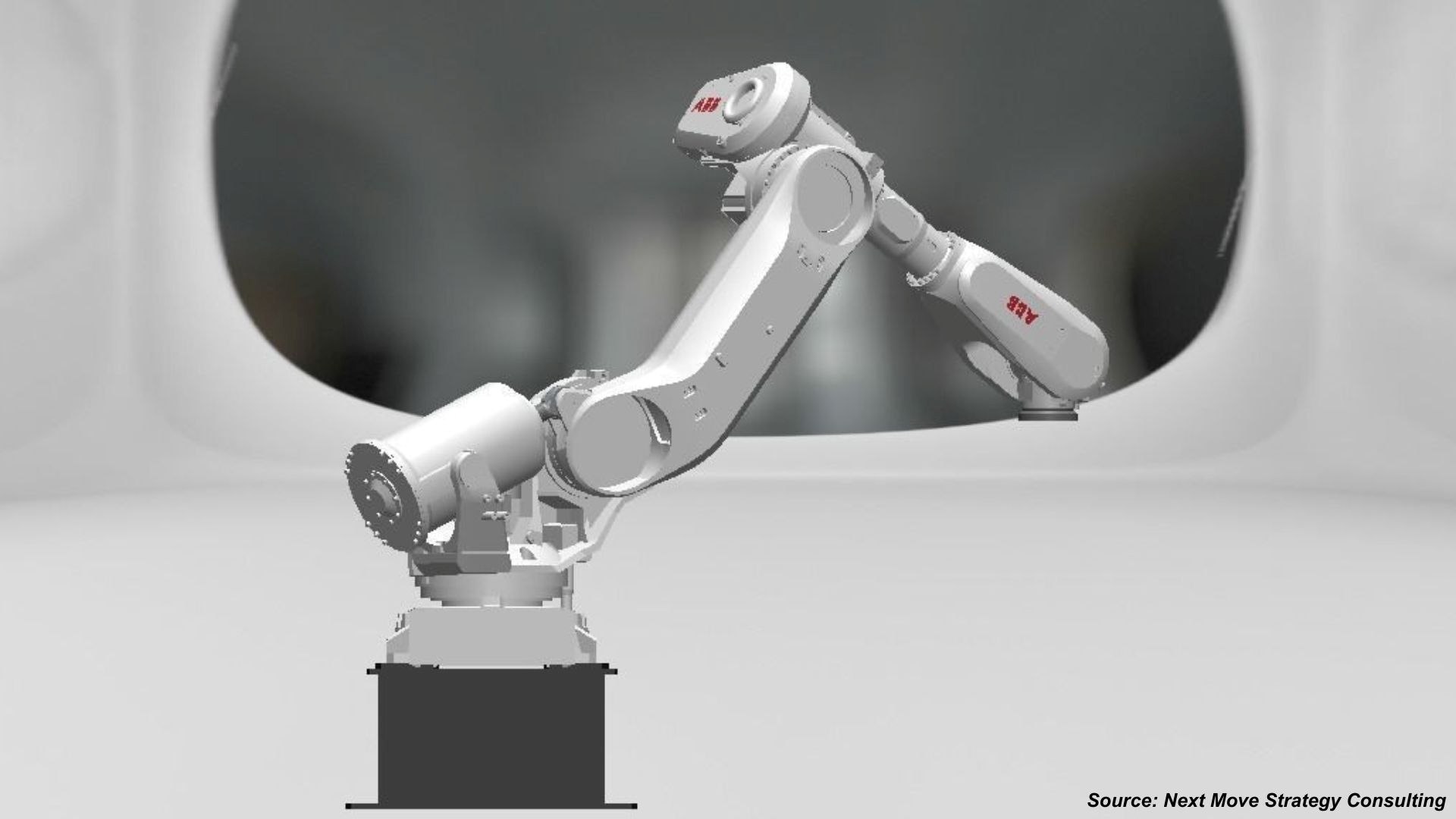
Articulated robots dominate the market, reflecting their versatility across welding, handling, and assembly applications in automotive and electronics manufacturing, where multi-axis flexibility supports complex motion paths required on high-volume semiconductor and display production lines. Collaborative robots represent the fastest-growing segment as domestic manufacturers and conglomerate-backed robotics firms accelerate cobot deployment to offset labor shortages. SCARA and delta robots continue supporting high-speed electronics assembly, while autonomous mobile robots and automated guided vehicles expand steadily within intralogistics operations across South Korean manufacturing facilities.
By End User Insights
How Is the South Korea Industrial Robotics Market Segmented by End User?
Based on end user, the South Korea industrial robotics market is segmented into automotive, electrical and electronics, metals and machinery, food and beverages, pharmaceuticals and medical devices, plastics rubber and chemicals, logistics and warehousing, and other industries.
The automotive industry dominates the market, driven by South Korea’s position as a major global vehicle and component manufacturing hub requiring high-precision welding, handling, and assembly automation. The electrical and electronics industry is the fastest-growing end user, supported by expanding semiconductor and display manufacturing capacity and rising demand for cleanroom and vision-guided assembly robotics. Metals and machinery, food and beverages, and pharmaceuticals continue to broaden robotics adoption as automation extends beyond traditional automotive applications nationwide.
Supply Chain Structure of the South Korea Industrial Robotics Market
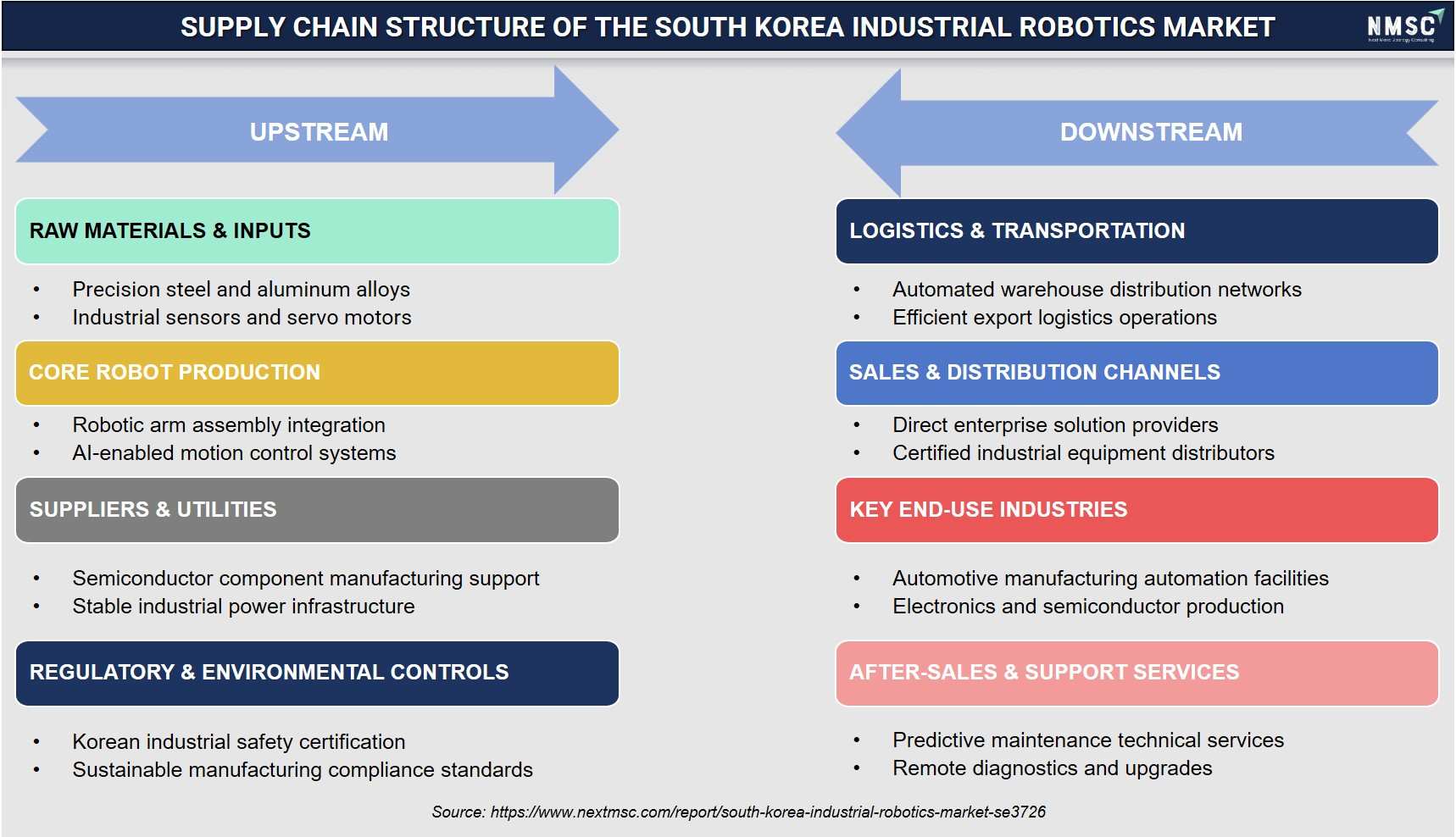
South Korea’s industrial robotics supply chain is built on advanced materials, precision components, semiconductor capabilities, and robust industrial infrastructure. Efficient logistics, established distribution channels, and comprehensive after-sales support ensure reliable market delivery. Strong regulatory compliance and sustainability standards further enhance operational efficiency, supply chain resilience, and competitiveness across automotive, electronics, and semiconductor manufacturing.
Growth Opportunities
Our analysis shows that three forward-looking opportunities stand out for stakeholders operating in the South Korea industrial robotics market over the 2026–2035 forecast period.
How Can Humanoid Robotics Development Unlock New Growth Opportunities?
Accelerating investment in humanoid and dual-arm mobile manipulator robots presents a significant opportunity for domestic robotics developers and their conglomerate partners. Companies that successfully transition humanoid platforms from pilot testing into commercial logistics and manufacturing deployment can capture substantial first-mover advantage across South Korea’s automation-focused industrial base.
Where Does Physical AI Integration Create New Demand for System Integrators?
Growing demand for physical AI software stacks that connect collaborative robots with vision and motion-planning systems is creating opportunity for integration partners. Companies offering end-to-end physical AI deployment services, including partnerships between domestic cobot makers and global software providers, can capture higher-value integration contracts as manufacturers seek turnkey automation solutions.
How Can Flexible Financing Models Expand Collaborative Robot Adoption Among SMEs?
Small and mid-sized South Korean manufacturers represent a substantial whitespace opportunity for collaborative robot providers offering flexible financing and subscription-based deployment models. Vendors that lower upfront capital requirements can accelerate cobot adoption across food processing, metals fabrication, and general machinery segments that have historically lacked automation investment capacity.
Competitive Landscape
We observed that the South Korea industrial robotics market features a highly competitive landscape, with global industrial robotics manufacturers competing alongside domestic conglomerate-backed robotics firms and specialized collaborative robot providers across the industry.
Key Takeaways
|
Dimension |
Description |
|
Market Structure |
Highly competitive, with global manufacturers holding significant share alongside domestic conglomerate-backed robotics units and specialized collaborative and humanoid robot developers serving automotive and electronics plants. |
|
Innovation Focus |
Humanoid robotics, physical AI integration, collaborative robot platforms, and vision-guided automation dominate current product development strategies across leading manufacturers. |
|
M&A Activity |
Strategic conglomerate investment, equity stake increases, and technology partnerships continue to shape competitive positioning as companies strengthen presence across semiconductor and automotive manufacturing corridors. |
How Do Companies Compete in the South Korea Industrial Robotics Market?
Companies compete primarily through automation reliability, software integration depth, and total cost of ownership. Leading manufacturers such as ABB Korea Co., Ltd., Korea FANUC Corporation, and KUKA Robotics Korea Co., Ltd. leverage extensive service networks and established automotive relationships to maintain market leadership, while domestic firms including HD Hyundai Robotics Co., Ltd. and Doosan Robotics Inc. differentiate through localized engineering support and rapid deployment capabilities across electronics and general manufacturing.
Which Competitive Archetypes Dominate the South Korea Industrial Robotics Market?
Two primary competitive archetypes characterize the market. The first comprises diversified multinational robotics manufacturers offering comprehensive portfolios across articulated, SCARA, and Cartesian systems, including ABB Korea Co., Ltd., Korea FANUC Corporation, KUKA Robotics Korea Co., Ltd., and Yaskawa Electric Korea Co., Ltd. The second includes domestic conglomerate-backed and collaborative robotics specialists such as Doosan Robotics Inc., Rainbow Robotics Co., Ltd., and Neuromeka Co., Ltd., which focus on humanoid platforms, cobot deployment, and application-specific automation for smaller manufacturers.
How Are Companies Differentiating Through Innovation in the South Korea Industrial Robotics Industry?
Innovation strategies increasingly focus on humanoid robotics, physical AI software integration, and cloud-connected fleet management for mobile robots. Companies are investing in AI-powered vision, motion-planning partnerships, and simplified programming interfaces to reduce integration complexity for first-time automation adopters. Our analysis indicates that manufacturers combining hardware reliability with software-enabled AI capabilities are strengthening competitive positioning across South Korea’s expanding industrial base.
What M&A and Expansion Activity Is Shaping the South Korea Industrial Robotics Market?
Strategic conglomerate investment continues to shape competition, exemplified by Samsung Electronics increasing its stake in Rainbow Robotics Co., Ltd. to 35% and incorporating the company as a subsidiary to accelerate humanoid robot development. Leading companies are strengthening service footprints near semiconductor and automotive manufacturing clusters, enabling faster deployment support and closer alignment with expanding production requirements across South Korea.
Key Market Players
Our assessment indicates that the following 15 companies are actively shaping robot innovation, humanoid platform development, and competitive dynamics within the South Korea industrial robotics market.
-
ABB Korea Co., Ltd.
-
Korea FANUC Corporation
-
KUKA Robotics Korea Co., Ltd.
-
Kawasaki Robotics Korea Ltd.
-
Yaskawa Electric Korea Co., Ltd.
-
Omron Electronics Korea Co., Ltd.
-
Zebra Technologies Korea Ltd.
-
Daifuku Korea Co., Ltd.
-
HD Hyundai Robotics Co., Ltd.
-
Doosan Robotics Inc.
-
Rainbow Robotics Co., Ltd.
-
Neuromeka Co., Ltd.
-
Universal Robots Korea Ltd.
-
Stäubli Korea Co., Ltd.
-
DENSO Korea Corporation
Latest Developments
We found that recent developments within the South Korea industrial robotics market concentrate on humanoid robotics commercialization, physical AI partnerships, and expanded conglomerate investment activity.
|
Date |
Event |
|
Feb 2026 |
Hyundai Motor Group announced a new Innovation Hub in Korea focused on robotics, AI and advanced manufacturing technologies to strengthen domestic industrial automation capabilities. |
Investment Opportunities
What Capital Inflows Are Targeting the South Korea Industrial Robotics Market?
Capital inflows into the South Korea industrial robotics market are increasingly directed toward humanoid robotics, physical AI software, and collaborative robot platforms. Leading domestic conglomerates continue investing in affiliated robotics units to support internal factory automation and future robot commercialization. We observed that Samsung Electronics’ increased stake in Rainbow Robotics Co., Ltd. to 35%, alongside comparable robotics investment by other domestic conglomerates, signals sustained capital commitment toward domestic robotics scale-up.
How Is Infrastructure Investment Supporting the South Korea Industrial Robotics Market?
Infrastructure investment is expanding manufacturing capacity, engineering support facilities, and pilot deployment programs across South Korea’s semiconductor, automotive, and logistics sectors. Our findings suggest that companies are investing in warehouse and fulfillment center pilot programs, exemplified by Rainbow Robotics Co., Ltd.’s dual-arm manipulator trial inside a Coupang fulfillment center, to validate commercial-scale automation performance before broader rollout across South Korean facilities.
What ESG Considerations Are Shaping Investment Decisions in the South Korea Industrial Robotics Market?
Environmental, social, and governance considerations are becoming integral to investment decisions, with workplace safety compliance, energy-efficient automation, and corporate governance transparency emerging as key priorities. We found that heightened regulatory scrutiny, including a 2026 prosecutorial investigation into insider trading allegations tied to conglomerate robotics acquisitions, is reinforcing investor focus on governance transparency alongside continued support for workforce transition programs amid rising automation adoption.
Key Benefits for Stakeholders
How Does This Report Benefit Enterprise and Industry Leaders?
Enterprise and industry leaders gain access to validated market segmentation, competitive benchmarking, and technology adoption analysis that support strategic planning and automation investment decisions across the South Korea industrial robotics market. Our analysis shows that detailed assessments of robot type, application, and end-user trends help companies identify high-growth opportunities and strengthen long-term manufacturing competitiveness.
How Does This Report Benefit Investors and Financial Analysts?
Investors and financial analysts benefit from consistent market size estimates, growth forecasts, and competitive assessments supporting investment evaluation across the South Korea industrial robotics market. We observed that the report’s detailed analysis of humanoid robotics, physical AI integration, and conglomerate-backed investment activity enables stakeholders to identify companies with the strongest long-term growth potential through 2035.
How Does This Report Benefit Technology Vendors and Product Teams?
Technology vendors and product development teams gain valuable insights into emerging innovation trends, including humanoid robotics, physical AI software integration, and collaborative robot platforms transforming South Korea’s industrial automation landscape. Our findings suggest that this analysis helps research and development teams prioritize product pipelines and align offerings with evolving manufacturer requirements.
Key Market Segments
By Robot Type
-
Articulated Robots
-
SCARA Robots
-
Cartesian and Gantry Robots
-
Delta Robots
-
Collaborative Robots
-
Autonomous Mobile Robots (AMRs)
-
Automated Guided Vehicles (AGVs)
-
Other Robots
By Offering
-
Hardware
-
Robot Arms
-
Controllers
-
End Effectors and Grippers
-
Sensors and Vision Systems
-
-
Software
-
Control and Programming Software
-
Simulation and Offline Programming Software
-
Fleet Management Software
-
-
Services
-
System Integration and Installation
-
Maintenance and Support
-
Training and Consulting
-
By Application
-
Handling
-
Pick and Place
-
Machine Tending
-
Palletizing and Depalletizing
-
-
Welding and Soldering
-
Assembly and Disassembly
-
Dispensing
-
Painting
-
Adhesive and Sealant Application
-
-
Processing
-
Cutting and Machining
-
Grinding and Polishing
-
- Cleanroom Operations
-
Inspection and Quality Control
-
Packaging and Labeling
-
Intralogistics and Transport
By Mounting Type
-
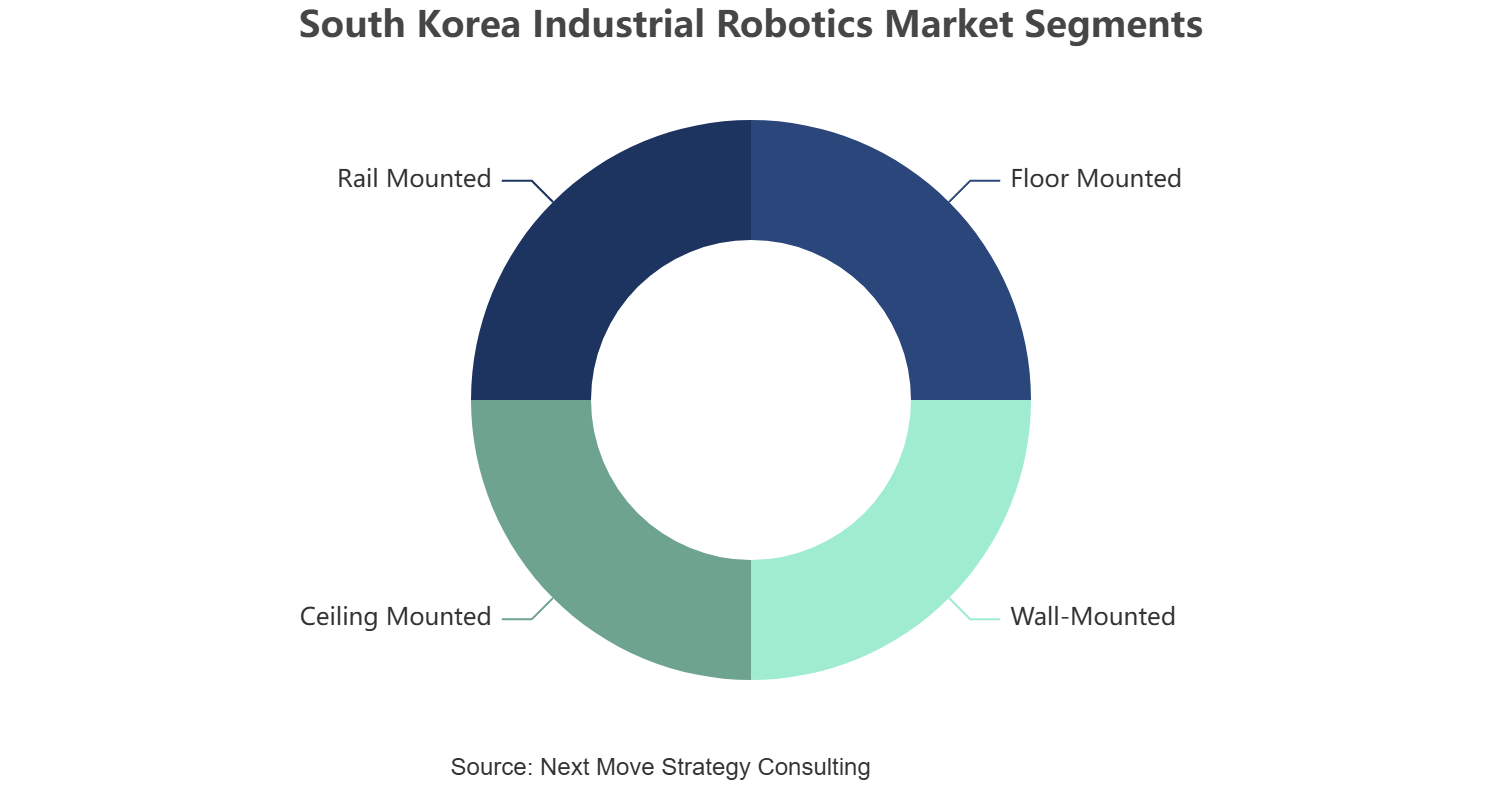
Floor Mounted
-
Wall-Mounted
-
Ceiling Mounted
-
Rail Mounted
By Mobility
-
Stationary Robots
-
Mobile Robots
By Payload Capacity
-
Low Payload Up to 20 kg
-
Medium Payload 20 kg to 100 kg
-
High Payload 100 kg to 500 kg
-
Heavy Duty Payload Over 500 kg
By End User
-
Automotive Industry
-
Electrical and Electronics Industry
-
Metals and Machinery Industry
-
Food and Beverages Industry
-
Pharmaceuticals and Medical Devices Industry
-
Plastics Rubber and Chemicals Industry
-
Logistics and Warehousing
-
Other Industries
Conclusion and Recommendations
What Is the Long-Term Outlook for the South Korea Industrial Robotics Market?
The long-term outlook for the South Korea industrial robotics market remains positive, supported by expanding semiconductor manufacturing investment, persistent labor shortages, and continued advancement in humanoid and physical AI robotics. We observed that growing adoption of collaborative robots and conglomerate-backed automation platforms will continue to drive market expansion from USD 2.34 billion in 2026 to USD 5.93 billion by 2035 across handling, assembly, and inspection applications.
What Strategic Positioning Should Robotics Companies Pursue?
Manufacturers should prioritize investments in humanoid and collaborative robotics, physical AI software integration, and simplified deployment tools while strengthening local engineering support capacity. Our assessment indicates that companies expanding flexible financing models and application-specific automation solutions will be well positioned to capture growing demand from small and mid-sized manufacturers across South Korea.
How Attractive Is the South Korea Industrial Robotics Market for New Investment?
The South Korea industrial robotics market presents an attractive investment opportunity, supported by a projected 10.91% CAGR between 2026 and 2035, expanding semiconductor and electronics automation spending, and continued innovation in humanoid robotics. We found that investment potential is particularly strong for companies focused on collaborative robotics, physical AI integration, and conglomerate-backed automation platforms capable of capitalizing on South Korea’s expanding industrial base.
What Market Shifts and Key Risks Should Stakeholders Monitor?
Stakeholders should closely monitor regulatory scrutiny of conglomerate robotics investment activity, persistent shortages of qualified integration engineers, and high capital costs associated with humanoid robot deployment. Our analysis shows that companies unable to manage governance transparency or integration capacity constraints may face increasing competitive pressure within the South Korea industrial robotics market.
What Are the Key Growth Pathways for the South Korea Industrial Robotics Market?
Key growth pathways include accelerating humanoid robotics commercialization, expanding physical AI software integration, strengthening collaborative robot adoption among small and mid-sized manufacturers, and deepening semiconductor-driven automation investment. NMSC’s analysis indicates that companies combining conglomerate-backed capital strength with software-enabled AI capabilities will be best positioned to capture the market’s projected growth through 2035.
About the Author
 Mihul Sharma
— Mihul Sharma is Research Associate at Next Move Strategy Consulting, where he has covered technology, industrial, and healthcare markets for 3 years. His work applies structured business research, market analysis, and secondary-source review to assess market trends, competitive developments, and growth opportunities. He supports report development by fully synthesizing industry data, company information, and market signals into concise findings for strategy and investment-focused research teams.
Mihul Sharma
— Mihul Sharma is Research Associate at Next Move Strategy Consulting, where he has covered technology, industrial, and healthcare markets for 3 years. His work applies structured business research, market analysis, and secondary-source review to assess market trends, competitive developments, and growth opportunities. He supports report development by fully synthesizing industry data, company information, and market signals into concise findings for strategy and investment-focused research teams.
About the Reviewer
 Supradip Baul
— Supradip Baul is an accomplished business consultant and strategist with over a decade of rich experience in market intelligence, strategy, technology, and business transformation. His work has included rigorous qualitative and quantitative analysis across multiple industries, helping clients shape investment decisions and long-term roadmaps. Earlier in his career, he was associated with Gartner, where he contributed to industry-leading reports and market share analyses. He has worked with leading global companies and holds an MBA with a dual specialization in Marketing and Finance.
Supradip Baul
— Supradip Baul is an accomplished business consultant and strategist with over a decade of rich experience in market intelligence, strategy, technology, and business transformation. His work has included rigorous qualitative and quantitative analysis across multiple industries, helping clients shape investment decisions and long-term roadmaps. Earlier in his career, he was associated with Gartner, where he contributed to industry-leading reports and market share analyses. He has worked with leading global companies and holds an MBA with a dual specialization in Marketing and Finance.
At Next Move Strategy Consulting, we understand that insightful market research is the cornerstone of successful business decisions. That's why we employ a robust and multifaceted approach, combining various methodologies to deliver the most accurate and actionable data for our clients.

Research Landscape
We navigate the world of research with two primary approaches:
Qualitative Approach
Our qualitative research methodologies involve immersive techniques such as in-depth interviews, focus groups, and observational studies. By engaging directly with individuals and stakeholders, we uncover valuable insights that quantitative data alone may overlook.

Quantitative Research
In tandem with qualitative methodologies, NMSC leverages the power of Quantitative Research to provide a robust foundation of numerical insights. Through systematic data collection and analysis, we quantify patterns, preferences, and market trends, offering a comprehensive view of the business landscape.
Our quantitative research approach employs diverse tools, including surveys, experiments, and statistical modelling. These methodologies enable us to gather data from a large and representative sample, ensuring the statistical significance of our findings. By employing structured questionnaires and standardized data collection methods, we guarantee the reliability and validity of the information we present to our clients.
Quantitative research is particularly effective in measuring the prevalence of trends, assessing market size, and gauging the impact of various factors on consumer behavior. The numerical precision attained through this approach equips our clients with actionable insights, facilitating data-driven decision-making and strategy formulation.


Our Specialized Toolbox for Industry-Specific Market Research
We deploy a specialized arsenal of techniques tailored to meet your unique requirements. Here's a glimpse into our comprehensive toolbox:

Information Procurement
The stage entails acquiring market data or relevant information through various sources and methodologies.


Market Research Approach
We utilize both top-down and bottom-up approaches in market research analysis to achieve a comprehensive understanding of the market dynamics, leveraging the broad perspective of industry trends and macroeconomic factors alongside detailed insights from specific segments and individual companies.

Porters Five Forces Analysis
We conduct Porter's Five Forces analysis to evaluate the competitive landscape of an industry, providing us with insights into factors that affect profitability and strategic positioning.

SWOT Analysis

Forecasting
We utilize a forecasting model to predict future consumption by considering parameters like population, economics, regulations, market competition, drivers, constraints, technology, and pricing. We also employ statistical techniques such as multilinear regression, exponential smoothing, moving average, ARIMA, and Monte Carlo simulations for accurate predictions. In econometric forecasting, we analyzed short-term and long-term event impacts, attributing values based on regulatory frameworks, economic factors, and market events.





 Speak to Our Analyst