Specialty Amines Market Global Industry Analysis and Forecast (2026–2035)

The global Specialty Amines Market is forecast to reach USD 23.40 billion by 2035, expanding at a 5.9% CAGR from 2026 to 2035. Key drivers include rising agrochemical formulation demand and increasing personal care and cosmetics applications, supported by growing use of amine-based surfactants and emulsifiers in crop protection and fertilizer formulations and expanding demand for ethanolamine and fatty amine derivatives for pH adjustment, conditioning, and emulsification, with Asia-Pacific leading the global market.
Download Free Sample PDF
Base Year (2025)
$13.20 Billion
Forecast (2035)
$23.40 Billion
CAGR (2026-2035)
5.9%
Top Region
Asia-Pacific

What does the Specialty Amines Market Encompass?

The specialty amines market report covers ammonia-derived nitrogen compounds engineered for high-value, application-specific performance rather than commodity bulk chemistry, spanning ethanolamines, alkyl amines, fatty amines, aromatic amines, and ether amines used as intermediates, surfactants, and functional additives. We found that scope in this market report is defined at the point of first commercial sale by amine producers, excluding downstream formulated end products such as finished detergents or crop protection formulations to avoid double-counting across the value chain.

Structurally, the industry has consolidated around integrated ethylene oxide and ammonia value chains held by diversified chemical majors, while regional players in India and China have expanded through cost-advantaged capacity additions. Regulatory frameworks including REACH registration in Europe and Toxic Substances Control Act reporting in the United States shape production and formulation choices, and technology adoption trends such as continuous amination processes and bio-based feedstock substitution are increasingly influencing how producers position their specialty amine portfolios for long-term compliance and margin resilience.

PESTEL Analysis of the Specialty Amines Market

PESTEL Analysis of the Specialty Amines Market

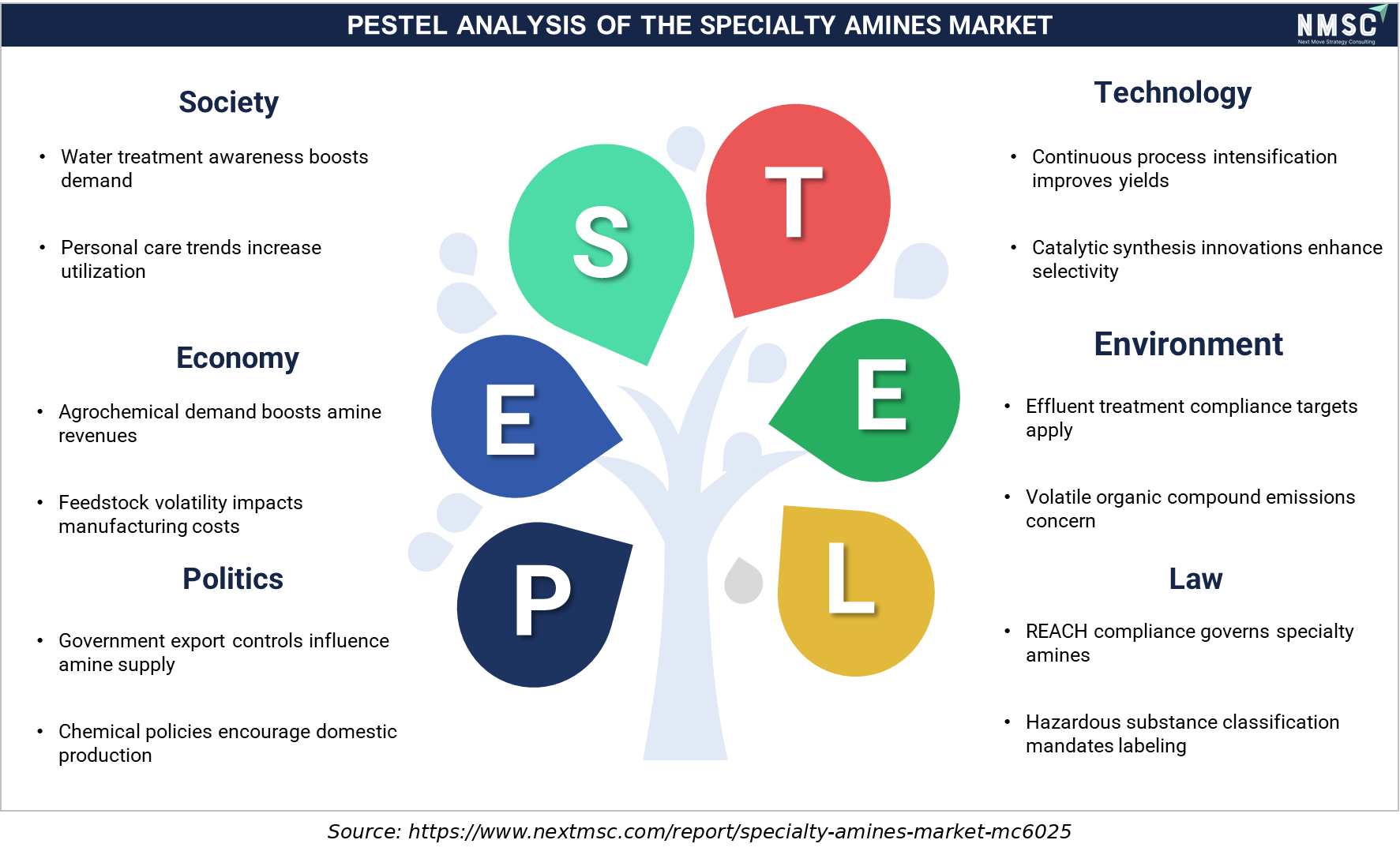
NMSC's analysis indicates that growing water treatment awareness, personal care trends, and agricultural demand drive expansion in the Specialty Amines Market. Furthermore, process intensification and catalytic synthesis enhance yields and selectivity. Concurrently, feedstock volatility impacts manufacturing costs, while government export controls, chemical policies, effluent treatment targets, volatile organic compound emissions, REACH compliance, and hazardous substance labeling govern regulatory operations across the Specialty Amines Industry.

Market Drivers & Dynamics

Interactive Dataset
Rising agrochemical formulation demand driver +1.4% Asia-Pacific, Latin America 2026–2035
Expansion of personal care and cosmetic surfactant use driver +1.1% North America, Europe 2026–2032
Growth in water and wastewater treatment infrastructure driver +0.9% Asia-Pacific, Middle East & Africa 2026–2035
Increasing use of amine-based corrosion inhibitors in oil and gas driver +0.7% Middle East & Africa, North America 2026–2033
Adoption of bio-based and low-carbon amine feedstocks driver +0.6% Europe, North America 2027–2035
Rising pharmaceutical intermediate demand driver +0.5% North America, Europe, Asia-Pacific 2026–2035
Volatility in ethylene oxide and ammonia feedstock prices restraint −0.8% Global 2026–2030
Stringent REACH-linked environmental compliance costs restraint −0.6% Europe 2026–2032
Availability of substitute amine chemistries in select applications restraint −0.4% Asia-Pacific, North America 2026–2035
Source: Next Move Strategy Consulting

Growth Drivers

What Is the Primary Growth Driver?

Rising agrochemical formulation demand is the primary growth driver, contributing an estimated 1.4 percentage points to the 2026–2035 CAGR. We found that global fertilizer and crop protection consumption continues to expand alongside food security priorities, with the U.S. Environmental Protection Agency reporting sustained registration activity for new active-ingredient formulations that rely on amine-based surfactants and emulsifiers as functional carriers.

How Is Personal Care Demand Driving Market Growth?

Personal care and cosmetics formulators are increasingly specifying ethanolamine and fatty amine derivatives for pH adjustment, conditioning, and emulsification in premium skincare and haircare lines. NMSC's analysis indicates that this application is growing at an 8.2% CAGR between 2026 and 2035, the fastest among application segments, as producers introduce low-odor and biodegradable amine derivatives tailored to clean-label consumer preferences in North America and Europe.

Growth Inhibitors

What Is Restraining the Specialty Amines Market?

Feedstock price volatility tied to ethylene oxide and ammonia remains the leading restraint, subtracting an estimated 0.8 percentage points from the CAGR. Our assessment indicates that natural gas price swings, which the U.S. Energy Information Administration and equivalent regulatory bodies track as a core ammonia production input, continue to compress margins for amine producers without long-term feedstock supply agreements, particularly smaller regional manufacturers lacking vertical integration.

What Are the Growth Opportunities?

What Opportunity Does Bio-Based Feedstock Conversion Create for Established Producers?

Converting fatty amine and ethanolamine lines to bio-derived feedstocks opens premium pricing tiers for personal care and agrochemical formulators seeking certified renewable-content ingredients. Established producers with integrated oleochemical access, such as fatty amine leaders in Europe, are best positioned to capture this margin uplift ahead of smaller regional competitors lacking feedstock flexibility.

How Does Water Treatment Infrastructure Expansion Benefit Amine Suppliers?

Municipal and industrial wastewater infrastructure investment across Asia-Pacific and the Middle East is expanding demand for amine-based flocculants and corrosion inhibitors. Suppliers with regional blending and technical service capability, particularly in China and Saudi Arabia, stand to benefit as utilities and industrial operators prioritize supply security over lowest-cost sourcing.

What Whitespace Exists in Ether Amine Supply for Wind Energy Composites?

Ether amine curing agents used in epoxy systems for wind turbine blades represent an underserved niche relative to overall specialty amine capacity, given the segment's 9.7% projected CAGR. Producers investing in dedicated high-purity ether amine lines can capture early-mover positioning with composite manufacturers before capacity broadens industry-wide.

Segmentation Analysis

2025 (USD Billion)
2035 (USD Billion)
Ethanolamines 2025: $3.83 Billion | 2035: $6.32 Billion
Ethanolamine
Alkyl amines 2025: $2.64 Billion | 2035: $4.45 Billion
Alkyl amines
Fatty amines 2025: $2.38 Billion | 2035: $3.98 Billion
Fatty amines
Aromatic amines 2025: $1.85 Billion | 2035: $2.81 Billion
Aromatic ami
Ether amines 2025: $1.45 Billion | 2035: $3.51 Billion
Ether amines
Other specialty amines 2025: $1.05 Billion | 2035: $2.33 Billion
Other specia
Ethanolamines $3.83 Billion $6.32 Billion 5.1%
Alkyl amines $2.64 Billion $4.45 Billion 5.3%
Fatty amines $2.38 Billion $3.98 Billion 5.2%
Aromatic amines $1.85 Billion $2.81 Billion 4.2%
Ether amines $1.45 Billion $3.51 Billion 9.2%
Other specialty amines $1.05 Billion $2.33 Billion 8.3%

What Is the Outlook for the Type Segment?

The type axis spans ethanolamines, alkyl amines, fatty amines, aromatic amines, ether amines, and Other specialty amines each serving distinct reactivity and solubility requirements. We found that ethanolamines remain dominant at a 29% share in 2025, valued at USD 3.83 Billion, on the back of established gas treatment, personal care, and agrochemical uses, while ether amines are the fastest-growing type at a 9.2% CAGR through 2035, driven by demand for epoxy curing agents in wind energy composites and advanced coatings.

2025 (USD Billion)
2035 (USD Billion)
Agrochemical
Surfactants
Water treatm
Personal car
Pharmaceutic
Segment Item 2025 (USD Billion) 2035 (USD Billion) CAGR
Agrochemicals $10.0 USD Billion $40.0 USD Billion 25.0%
Surfactants $17.1 USD Billion $51.1 USD Billion 11.0%
Water treatment chemicals $24.2 USD Billion $62.2 USD Billion 25.0%
Personal care and cosmetics $31.3 USD Billion $73.3 USD Billion 11.0%
Pharmaceutical intermediates $38.4 USD Billion $84.4 USD Billion 16.0%

Segment-wise data is locked

Unlock complete segment-wise numbers for By Application.

Unlock Full Data

Which Application Segment Leads Demand Growth?

Agrochemicals remain the dominant application at USD 3.17 Billion in 2025, a 24% share, reflecting sustained use of amine-based surfactants and adjuvants in crop protection formulations. Our analysis shows that personal care and cosmetics is the fastest-growing application at an 8.2% CAGR, as formulators substitute conventional surfactants with milder amine derivatives, while water treatment chemicals is gaining share on expanding municipal and industrial wastewater infrastructure investment across Asia-Pacific.

2025 (USD Billion)
2035 (USD Billion)
Liquid
Solid and po
Gel and past
Segment Item 2025 (USD Billion) 2035 (USD Billion) CAGR
Liquid $10.0 USD Billion $40.0 USD Billion 27.0%
Solid and powder $17.1 USD Billion $51.1 USD Billion 9.0%
Gel and paste $24.2 USD Billion $62.2 USD Billion 19.0%

Segment-wise data is locked

Unlock complete segment-wise numbers for By Product Form.

Unlock Full Data

How Does Product Form Influence Specialty Amine Adoption?

Liquid formats dominate at USD 10.30 Billion in 2025, an approximate 78% share, since most amines are handled, blended, and dosed as liquids across industrial and formulation processes. Based on research conducted by NMSC, we found that gel and paste forms are growing fastest at an 8.0% CAGR, led by personal care applications that require higher viscosity conditioning bases, while solid and powder grades are expanding in agrochemical granule and water treatment tablet applications.

2025 (USD Billion)
2035 (USD Billion)
North Americ
Canada
Mexico
Europe: UK
Germany
Segment Item 2025 (USD Billion) 2035 (USD Billion) CAGR
North America: U.S. $10.0 USD Billion $40.0 USD Billion 14.0%
Canada $17.1 USD Billion $51.1 USD Billion 24.0%
Mexico $24.2 USD Billion $62.2 USD Billion 22.0%
Europe: UK $31.3 USD Billion $73.3 USD Billion 12.0%
Germany $38.4 USD Billion $84.4 USD Billion 27.0%

Segment-wise data is locked

Unlock complete segment-wise numbers for By Region.

Unlock Full Data

Growth Opportunities

Beyond the primary demand drivers, three forward-looking whitespace opportunities stand out for specialty amine producers positioning capacity and R&D spend through 2035.

What Opportunity Does Bio-Based Feedstock Conversion Create for Established Producers?

Converting fatty amine and ethanolamine lines to bio-derived feedstocks opens premium pricing tiers for personal care and agrochemical formulators seeking certified renewable-content ingredients. Established producers with integrated oleochemical access, such as fatty amine leaders in Europe, are best positioned to capture this margin uplift ahead of smaller regional competitors lacking feedstock flexibility.

How Does Water Treatment Infrastructure Expansion Benefit Amine Suppliers?

Municipal and industrial wastewater infrastructure investment across Asia-Pacific and the Middle East is expanding demand for amine-based flocculants and corrosion inhibitors. Suppliers with regional blending and technical service capability, particularly in China and Saudi Arabia, stand to benefit as utilities and industrial operators prioritize supply security over lowest-cost sourcing.

What Whitespace Exists in Ether Amine Supply for Wind Energy Composites?

Ether amine curing agents used in epoxy systems for wind turbine blades represent an underserved niche relative to overall specialty amine capacity, given the segment's 9.7% projected CAGR. Producers investing in dedicated high-purity ether amine lines can capture early-mover positioning with composite manufacturers before capacity broadens industry-wide.

Regional Outlook

2025 (USD Billion)
2035 (USD Billion)
North Americ
Europe
Asia-Pacific
Middle East
Latin Americ
Region 2025 (USD Billion) 2035 (USD Billion) CAGR (%)
North America $10.0 USD Billion $40.0 USD Billion 9.0%
Europe $17.1 USD Billion $51.1 USD Billion 27.0%
Asia-Pacific $24.2 USD Billion $62.2 USD Billion 25.0%
Middle East & Africa $31.3 USD Billion $73.3 USD Billion 23.0%
Latin America $38.4 USD Billion $84.4 USD Billion 12.0%

Regional data is locked

Unlock complete regional numbers for this market.

Unlock Full Data

Supply Chain Structure of the Specialty Amines Market

Supply Chain Structure of the Specialty Amines Market

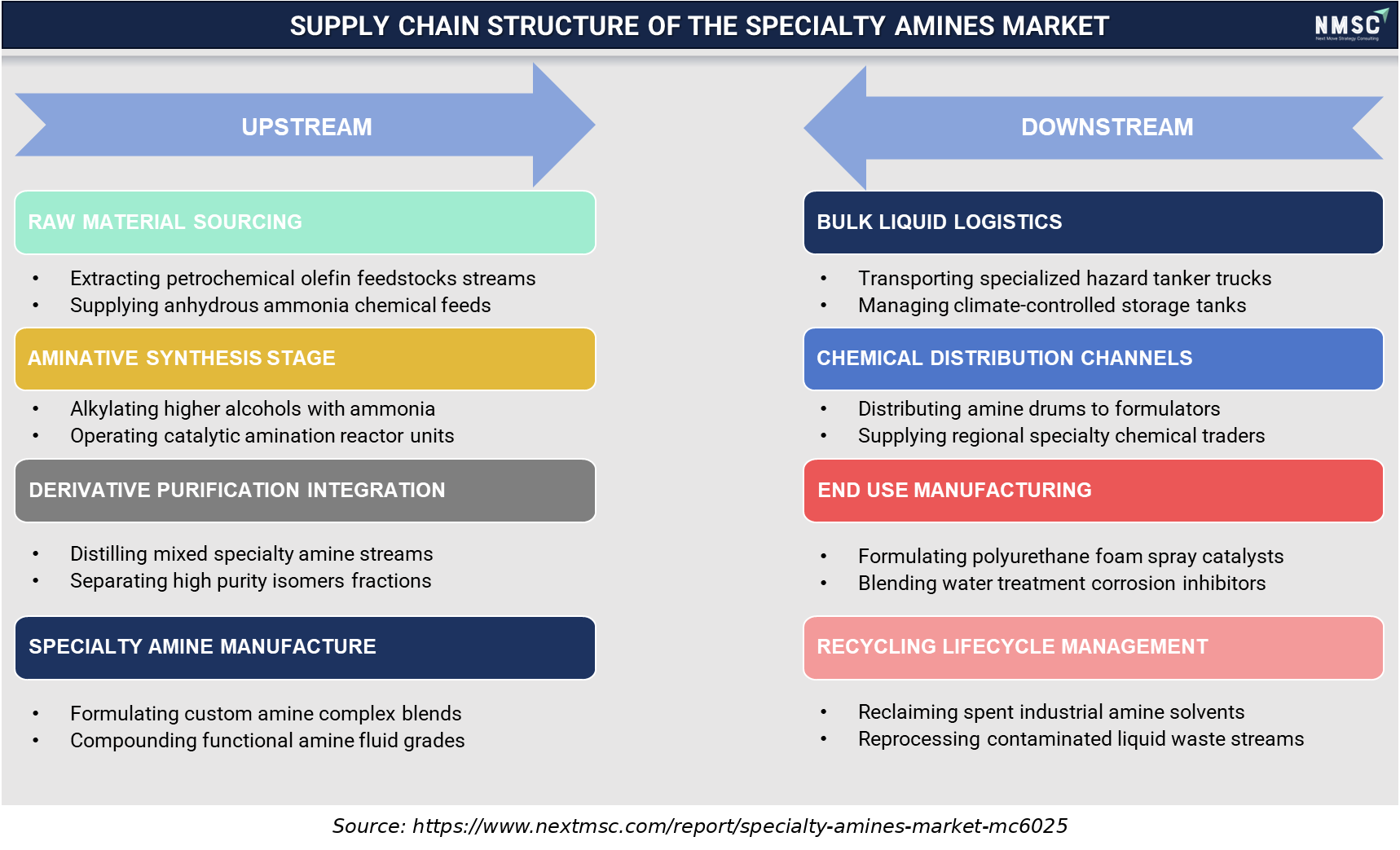
Based on research conducted by NMSC, we found that the supply chain structure of the Specialty Amines Market connects olefin extraction, amination synthesis, derivative purification, and custom amine blending with hazardous tanker transport. Downstream, distribution channels supply formulators for manufacturing polyurethane foam spray catalysts and water treatment corrosion inhibitors. Ultimately, reclaiming spent solvents and reprocessing contaminated liquid waste streams ensure sustainable lifecycle management across the Specialty Amines Industry.

Competitive Landscape

We observed that the specialty amines market is moderately consolidated, with global diversified chemical majors competing alongside cost-advantaged regional producers in India and China across a fragmented set of application niches.

Dimension Description
Dimension Assessment
Market Structure Moderately consolidated; top 10 companies hold a majority of global capacity, with regional players competing on cost in commodity-adjacent grades
Innovation Focus Bio-based feedstock conversion, high-purity electronics-grade amines, and low-emission catalytic amination technologies
M&A Activity Selective bolt-on capacity expansions and joint development agreements rather than large-scale consolidation

How Do Companies Compete in the Specialty Amines Market?

Companies compete primarily on feedstock integration, purity grade, and technical service depth rather than price alone. During our market evaluation, we noticed that producers with Verbund-style integrated ethylene oxide and ammonia access, such as BASF, sustain cost advantages that smaller regional players cannot replicate, while Indian manufacturers compete through capacity-led cost efficiency in standard ethanolamine and alkyl amine grades.

Which Competitive Archetypes Dominate the Industry?

Two archetypes dominate the specialty amines market: globally integrated diversified chemical majors offering broad amine portfolios with technical service support, and regionally focused specialists concentrated in India and China competing on cost and agility. This dual structure explains why differentiation themes center on either application-specific purity grades or manufacturing cost leadership rather than brand positioning.

What Innovation and Differentiation Strategies Are Companies Pursuing?

Industry leaders are differentiating through bio-based feedstock conversion, low-emission process technology, and application-specific product development such as semiconductor-grade and wind energy composite curing amines. Our analysis shows that this innovation focus is increasingly tied to customer decarbonization requirements, pushing amine producers to publish product carbon footprint data alongside conventional technical specifications.

How Active Is M&A in the Specialty Amines Market?

M&A activity remains selective, with companies favoring organic capacity expansion, joint development agreements, and geographic footprint extension over large-scale acquisitions. We found that recent activity has concentrated on brownfield capacity additions in China and North America rather than consolidation among the top 20 producers, reflecting a preference for capital-efficient growth over balance-sheet risk.

Key Market Players

Our assessment indicates that the following companies represent the validated set of leading specialty amine producers active as of 2026, ranked by market-specific revenue, production capacity, and scale of operations.

BASF SE Huntsman Corporation Dow Inc. Nouryon Chemicals Holding B.V. Eastman Chemical Company Evonik Industries AG Arkema S.A. Solvay SA INEOS Group Holdings S.A. Clariant AG LANXESS AG Celanese Corporation Mitsubishi Gas Chemical Company, Inc. Mitsubishi Chemical Group Corporation Tosoh Corporation Sumitomo Chemical Co., Ltd. Kao Corporation Alkyl Amines Chemicals Limited Balaji Amines Limited Jubilant Ingrevia Limited

Latest Developments

We observed that recent company disclosures point to continued capacity expansion and decarbonization investment across the specialty amines value chain.

Date Event
April 2026 Evonik inaugurated its expanded specialty amine production facility in Nanjing, China following a double-digit-million-euro investment. The expansion enables commercial-scale production of advanced reactive specialty amines for polyurethane and epoxy applications while strengthening the company's global manufacturing network and supply reliability.
March 2026 Huntsman inaugurated an expanded Performance Products manufacturing facility in Petfurdo, Hungary. The investment increases global capacity and flexibility for specialty amines, including JEFFCAT amine catalysts.
December 2025 BASF launched Lupragen N 208, a new reactive amine catalyst for polyurethane foam production. Manufactured at BASF’s Ludwigshafen site and marketed worldwide, the catalyst is designed to reduce VOC emissions and odor while supporting flexible, semi-rigid, and rigid foam applications requiring stringent low-emission performance.

Expert Insights

Joachim Schmidt-Leithoff

Joachim Schmidt-Leithoff

Vice President of Business Management Amines, Acetylenics and Carbonyl Derivatives, Intermediates Asia Pacific | BASF

"“As one of the world’s largest amines producers, BASF is taking a step towards sustainability by converting to 100% renewable electricity for the amines produced at BASF’s Nanjing site. This move enhances competitiveness for both BASF and our customers in the region by reducing carbon emissions, positioning us closer to becoming their preferred partner for sustainable intermediates.”"

Analyst Interpretation

The statement highlights the growing integration of sustainability and carbon reduction into specialty amine production. NMSC's analysis indicates that amine manufacturers are increasingly adopting renewable electricity and lower-carbon production approaches while expanding capacity for application-specific intermediates. The shift is expected to strengthen demand for sustainable specialty amines as customers across polyurethane, epoxy, coatings, adhesives, and other downstream applications increasingly seek intermediates with improved environmental profiles without compromising performance.

Investment Opportunities

Where Are Capital Inflows Concentrating in the Specialty Amines Market?

Capital inflows are concentrating in Asia-Pacific brownfield capacity expansions and North American high-purity amine lines. Our findings suggest that producers are prioritizing debottlenecking existing integrated sites over greenfield investment, given the capital efficiency of leveraging established ethylene oxide and ammonia access at sites such as BASF's Ludwigshafen and Geismar Verbund locations.

How Is Infrastructure Investment Shaping Long-Term Supply?

Infrastructure investment in water and wastewater treatment across Asia-Pacific and the Middle East is creating durable downstream demand for amine-based flocculants and corrosion inhibitors. We observed that national water security programs in Gulf Cooperation Council countries are driving multi-year procurement commitments that favor amine suppliers with established regional blending infrastructure.

What ESG Considerations Are Influencing Investment Decisions?

Environmental, Social, and Governance considerations are increasingly central to investment decisions, with producers such as BASF committing amine production lines to renewable electricity sourcing. Our analysis shows that customer procurement teams across personal care and agrochemical sectors are incorporating product carbon footprint data into supplier scorecards, making decarbonization investment a competitive necessity rather than a discretionary initiative.

Key Benefits for Stakeholders

How Does This Report Benefit Industry Leaders?

Industry leaders gain a validated segmentation framework, verified competitor set, and region-by-region growth forecast that supports capacity planning and portfolio prioritization decisions. This report's data on dominant and fastest-growing segments helps manufacturing and commercial teams align capital allocation with the highest-return application and geographic opportunities through 2035.

How Does This Report Benefit Investors and Financial Analysts?

Investors and financial analysts benefit from a fundamentals-supported market size and CAGR derivation, consistent across every table and section, that supports valuation and due diligence work on specialty chemical producers. The report's regional and segment forecasts provide a defensible basis for assessing capital expenditure announcements against underlying demand trajectories.

How Does This Report Benefit Technology Vendors and Product Teams?

Technology vendors and product teams serving amine producers can use this report's trend analysis on bio-based feedstock conversion, digitalization, and high-purity process requirements to prioritize R&D and commercial engagement. The segmentation analysis clarifies which application areas, such as personal care and ether amines, offer the strongest near-term growth for process technology and analytical instrumentation providers.

Key Market Segments Evaluated

By Type

  • Ethanolamines
  • Alkyl amines
  • Fatty amines
  • Aromatic amines
  • Ether amines
  • Other specialty amines

By Application

  • Agrochemicals
  • Surfactants
  • Water treatment chemicals
  • Personal care and cosmetics
  • Pharmaceutical intermediates
  • Corrosion inhibitors
  • Oilfield chemicals
  • Other applications

By Product Form

  • Liquid
  • Solid and powder
  • Gel and paste

By Region

  • North America: U.S.
  • Canada
  • Mexico
  • Europe: UK
  • Germany
  • France
  • Italy
  • Spain
  • Sweden
  • Denmark
  • Finland
  • Netherlands
  • Rest of Europe
  • Asia-Pacific: China
  • India
  • Japan
  • South Korea
  • Taiwan
  • Indonesia
  • Vietnam
  • Australia
  • Philippines
  • Malaysia
  • Rest of APAC
  • Middle East & Africa: Saudi Arabia
  • UAE
  • Egypt
  • Israel
  • Turkey
  • Nigeria
  • South Africa
  • Rest of MEA
  • Latin America: Brazil
  • Argentina
  • Chile
  • Colombia
  • Rest of LATAM

Conclusion & Recommendations

The long-term outlook remains constructive, with the market projected to grow from USD 13.20 Billion in 2025 to USD 23.40 Billion by 2035 at a 5.9% CAGR. We found that this trajectory reflects durable demand across agrochemicals, personal care, and water treatment applications, supported by steady capacity investment from established producers rather than speculative overbuild, which supports a smooth, sustainable growth curve through the forecast period.

What Strategic Positioning Should Producers Pursue?

Producers should prioritize bio-based feedstock conversion and high-purity application development to defend margin against feedstock volatility. Our assessment indicates that companies combining integrated ethylene oxide and ammonia access with targeted investment in ether amines and personal care grades will be best positioned to outperform the broader market's 5.9% CAGR through 2035.

How Attractive Is the Market for New Investment?

Investment attractiveness is highest in Asia-Pacific and Latin America, where CAGRs of 6.5% and 8.8%, respectively, outpace the global average. NMSC's analysis indicates that capital deployed toward regional blending capacity in these markets offers higher growth potential relative to incremental capacity in mature North American and European markets, where growth is comparatively moderate at 4.6% and 4.1%.

What Market Shifts and Key Risks Should Stakeholders Monitor?

Stakeholders should monitor ethylene oxide and ammonia feedstock price volatility, which subtracts an estimated 0.8 percentage points from the CAGR, alongside tightening REACH compliance costs in Europe. Our findings suggest that producers lacking feedstock integration or regulatory compliance infrastructure face the greatest margin risk over the 2026–2035 forecast period.

What Are the Clearest Growth Pathways Through 2035?

The clearest growth pathways run through ether amines for renewable energy composites, personal care amine derivatives, and water treatment chemicals in Asia-Pacific and the Middle East. We observed that companies aligning capacity investment with these three pathways are best placed to capture the USD 9.42 Billion absolute dollar opportunity identified between 2026 and 2035.

FAQs

Market Size & Forecast

Specialty Amines Market Global Industry Analysis and Forecast (2026–2035) Revenue Forecast

Values in USD Billion

2025 $13.20 Billion
2025
2026 $13.98 Billion
2026
2027 $14.80 Billion
2027
2028 $15.68 Billion
2028
2029 $16.60 Billion
2029
2030 $17.58 Billion
2030
2031 $18.62 Billion
2031
2032 $19.72 Billion
2032
2033 $20.88 Billion
2033
2034 $22.11 Billion
2034
2035 $23.40 Billion
2035

Key Takeaways

By Type: Ethanolamines held the largest share, expanding from USD 3.83 billion in 2025 to USD 6.32 billion by 2035; Ether Amines is the fastest-growing sub-segment at 9.2% CAGR from 2026–2035.

By Application: Agrochemicals held the largest share, expanding from USD 3.17 billion in 2025 to USD 5.15 billion by 2035; Personal Care and Cosmetics is the fastest-growing sub-segment at 8.2% CAGR from 2026–2035.

By Product Form: Liquid held the largest share, expanding from USD 10.30 billion in 2025 to USD 17.55 billion by 2035; Gel and Paste is the fastest-growing sub-segment at 8.0% CAGR from 2026–2035.

Dominant Region: Asia-Pacific dominated, expanding from USD 4.88 billion in 2025 to USD 9.13 billion by 2035.

Fastest-Growing Region: Latin America is expected to register the highest CAGR of 8.8% during 2026–2035.

Dominant Country: China led the market, expanding from USD 2.05 billion in 2025 to USD 3.92 billion by 2035.

Fastest-Growing Country: India is the fastest-growing country at a CAGR of 7.7% during 2026–2035.

The specialty amines market presents an absolute dollar opportunity of USD 9.42 billion between 2026 and 2035, a gap that NMSC views as a direct signal for producers to prioritize capital allocation toward ethanolamine, ether amine, and bio-based fatty amine capacity ahead of demand acceleration in agrochemical and personal care end uses.

According to NMSC analysis, the personal care and cosmetics application segment and the gel and paste product form are converging as a distinct growth pocket, since formulators are increasingly specifying low-odor, skin-compatible amine derivatives that combine surfactant and conditioning functions in a single ingredient.

About the Author

Mayurima Roy

Mayurima Roy

Mayurima Roy is Research Analyst at Next Move Strategy Consulting, where she has spent 4 years working across the firm's full industry coverage rather than a single fixed vertical. Her work centers on structured research, ongoing trend tracking, competitive assessment, and insight-led content development, translating complex market data into clear, decision-ready narratives that support informed client decision-making across diverse global industries, market sectors, and world regions every day.

About the Reviewer

Supradip Baul

Supradip Baul

Supradip Baul is an accomplished business consultant and strategist with over a decade of rich experience in market intelligence, strategy, technology, and business transformation. His work has included rigorous qualitative and quantitative analysis across multiple industries, helping clients shape investment decisions and long-term roadmaps. Earlier in his career, he was associated with Gartner, where he contributed to industry-leading reports and market share analyses. He has worked with leading global companies and holds an MBA with a dual specialization in Marketing and Finance.

Download Free Sample

Mohit Agarwal

MOHIT AGARWAL

Chief Manager

DryChem India Pvt. Ltd.

Next Move Strategy Consulting is an amazing team of consultants. We required a market study report for our investors on top priority and the team went above and beyond our expectations to deliver the same with ample supporting data within a short time span enabling us to secure the investments and keep our project timeline maintained. Their professionalism, attention to detail, and timely delivery of actionable recommendations have left a lasting impression on our organization.

Ross J Mckenzie

ROSS J MCKENZIE

Business Insight Manager

Staysure Group

“Next MSC have been incredibly helpful in providing detailed & robust information on our market, alongside quantifying growth by different segments. The process to procure was simple and easy, with sample reports and regular contact to ensure we had what we needed. Succinct detail on their sources & methodologies is also greatly received, allowing transparency in this respect helps build trust in the detail you pay for. Joseph in particular was fantastic, and helped ensure efficient provision of the insight pack – thank you NMSC!”.

Gustaf Hummel Burstrom

GUSTAF HUMMEL BURSTROM

Founder

Revline Tools AB

Joseph and the team at Next Move Strategy Consulting have been excellent to work with, in supplying us with relevant market data and forecasts for our specific category. We had some special requirements and they were able to do a custom package to suit our needs. We would definitely recommend them to any other company needing market data and forecasts

Robert Sean Trevino

ROBERT SEAN TREVINO

Sr. Director, Head of Strategic Insights & Analytics

Foundation Medicine

I realized that it was a reliable source of information. These days, there are many people who are looking for authentic data, and this is one of the only sources that can offer them with what they need;

Pratyush Kumar Das

PRATYUSH KUMAR DAS

Assistant Manager

Polycab India Limited

We would like to express our appreciation for the data and insights provided by nextmsc. We are very pleased with the quality and depth of the information, which has proven to be highly valuable and beneficial for our business decision-making.

Custom Market Research Services

We will customize the research for you if the listed report does not fully match your requirements.

Get 30% Free Customization

Select License

This website uses cookies to ensure you get the best experience on our website. Learn more

✖