Standard Dropoff Mechanism Market Global Industry Analysis and Forecast (2026–2035)

The global Standard Dropoff Mechanism Market size was valued at USD 86.4 million in 2025 and is estimated at USD 92.7 million in 2026, forecast to reach USD 190.0 million by 2035, expanding at an 8.3% CAGR from 2026 to 2035. Key drivers include expanding government-funded wildlife-monitoring and endangered-species programs and growing adoption of satellite-linked, remotely triggered drop-off mechanisms, with North America leading the global market.

Download Free Sample PDF
Base Year (2025)
$86.4 Million
Forecast (2035)
$190.0 Million
CAGR (2026-2035)
8.3%
Top Region
North America

What Is the Standard Dropoff Mechanism Market Size?

The global standard dropoff mechanism market size was valued at USD 86.4 million in 2025 and is estimated at USD 92.7 million in 2026, forecast to reach USD 190.0 million by 2035, expanding at an 8.3% CAGR between 2026 and 2035. North America leads with approximately 34% share, while timer-based mechanisms dominate all other release trigger types with approximately 44% share.

We observed that growth is broad-based across every segmentation axis, with satellite command release adoption and expanding conservation-agency procurement driving the dominant structural shifts through 2035.

Standard Dropoff Mechanism Market Global Industry Analysis and Forecast (2026–2035) Revenue Forecast

Values in USD Million

2025 $86.4 Million
2025
2026 $93.6 Million
2026
2027 $101.3 Million
2027
2028 $109.7 Million
2028
2029 $118.9 Million
2029
2030 $128.7 Million
2030
2031 $139.4 Million
2031
2032 $151.0 Million
2032
2033 $163.5 Million
2033
2034 $177.1 Million
2034
2035 $190.0 Million
2035

Key Takeaways

By Release Trigger Type: Timer-Based Drop-Off Mechanisms held the largest share of approximately 44% (USD 38.0 million) in 2025; Satellite Command Drop-Off Mechanisms is the fastest-growing sub-segment at 16.1% CAGR from 2026–2035.

By Animal Class: Terrestrial Mammal Tracking held the largest share of approximately 60% (USD 52.0 million) in 2025; Fish and Aquatic Species Tags is the fastest-growing sub-segment at 12.1% CAGR from 2026–2035.

By End User: Academic and University Research Institutions held the largest share of approximately 39% (USD 34.0 million) in 2025; Non-Governmental Conservation Organizations is the fastest-growing sub-segment at 12.2% CAGR from 2026–2035.

Dominant Region: North America dominated with approximately 34% revenue share (USD 29.5 million) in 2025.

Fastest-Growing Region: Asia-Pacific is expected to register the highest CAGR of 12.1% during 2026–2035.

Dominant Country: U.S. led with approximately USD 24.0 million in 2025.

Fastest-Growing Country: India is the fastest-growing country at approximately 15.3% CAGR from 2026–2035.

Market Opportunity: The standard dropoff mechanism market is expected to create an absolute dollar opportunity of USD 97.3 million between 2026 and 2035, presenting meaningful investment potential across the wildlife telemetry equipment value chain.

According to NMSC analysis, conservation agencies and universities are increasingly specifying two-way satellite command release as a standard procurement requirement rather than an optional add-on, a shift that favors manufacturers with proven Iridium integration over suppliers offering only pre-programmed timer release as the forecast period progresses.

What Does the Standard Dropoff Mechanism Market Encompass?

The standard dropoff mechanism market encompasses timer-based, radio-command, satellite-command, and degradable-link release devices that detach a GPS, VHF, or Iridium tracking collar or tag from a wild animal without requiring recapture. Our assessment indicates that the scope spans mechanisms sold as integrated collar components and as standalone add-on modules, supplied to academic institutions, government conservation agencies, non-governmental organizations, and zoos across terrestrial mammal, avian, marine mammal, and fish telemetry applications worldwide. This market report covers the underlying release hardware rather than the broader tracking collar itself.
We observed that the category has evolved from simple corrodible metal links and preprogrammed timer counters into two-way, remotely triggered satellite command modules that allow researchers to adjust release timing after deployment. Animal-welfare guidance from organizations such as the Association for the Study of Animal Behaviour and procurement standards applied by agencies including the U.S. Fish and Wildlife Service increasingly favor mechanisms with verifiable, non-recapture release reliability. NMSC's analysis indicates that this shift toward remote-command architectures, combined with expanding satellite-linked conservation programs, is redefining specification criteria across the standard dropoff mechanism market.

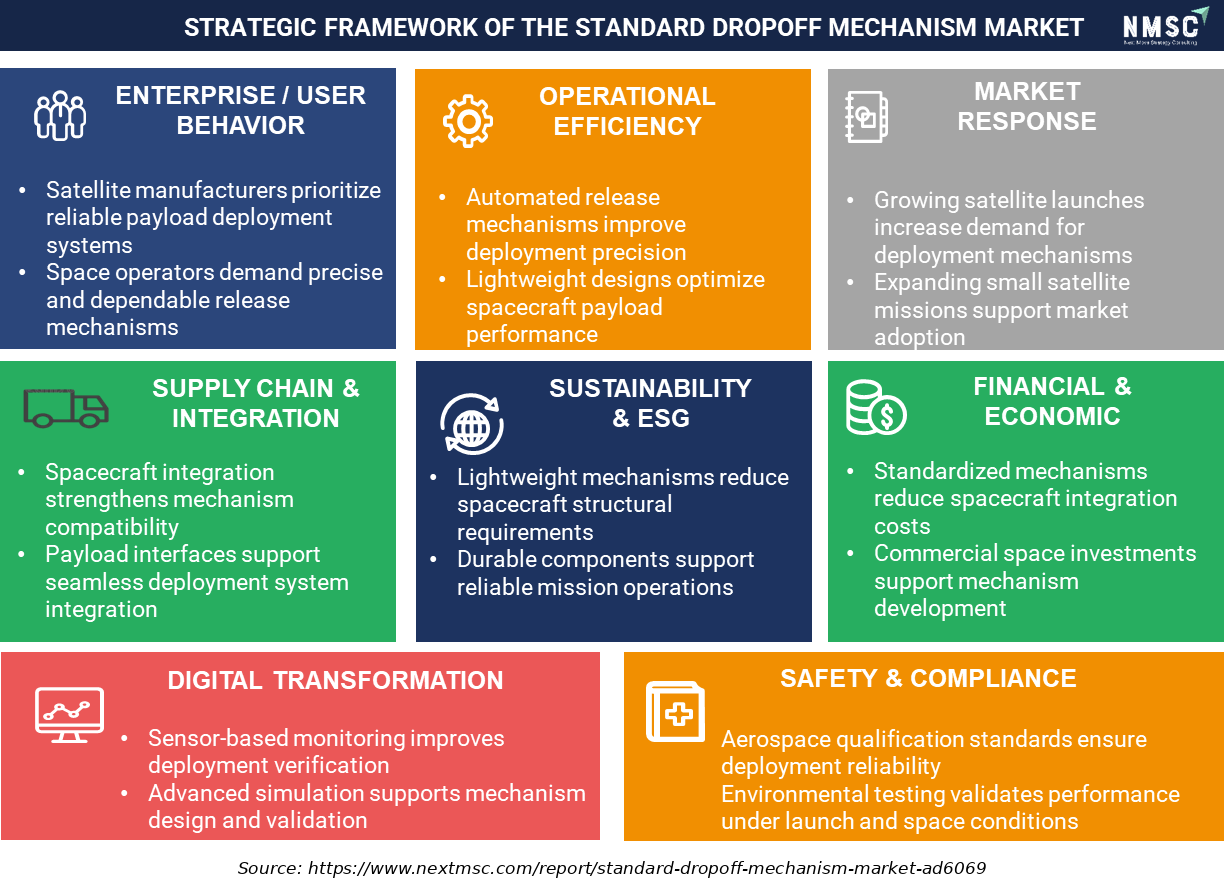
Strategic Framework of the Standard Dropoff Mechanism Market

Strategic Framework of the Standard Dropoff Mechanism Market

Our analysis indicates that the Standard Dropoff Mechanism Market is shaped by reliable deployment requirements, operational efficiency, supply chain integration, sustainability, financial considerations, digital transformation, and safety compliance. Satellite manufacturers and space operators prioritize precise and dependable release systems, while automated mechanisms improve deployment accuracy. Standardized designs reduce integration costs, and lightweight components support efficient spacecraft operations. Sensor-based monitoring, simulation technologies, aerospace qualification standards, and environmental testing further strengthen mechanism reliability and market adoption.

Market Drivers & Dynamics

Interactive Dataset
Expanding government-funded wildlife-monitoring and endangered-species programs driver +2.0% Global 2026-2035
Rising NGO and philanthropic conservation funding for satellite telemetry driver +1.6% Global 2026-2035
Growing adoption of Iridium satellite-command release in remote habitats driver +1.5% North America, Europe, MEA 2026-2035
Expansion of anti-poaching and rewilding collar programs across Africa and Asia driver +1.2% Middle East & Africa, Asia-Pacific 2026-2035
University research-grant expansion for long-term movement-ecology studies driver +1.1% North America, Europe 2026-2032
Increasing emphasis on non-recapture, welfare-aligned research protocols driver +0.9% Global 2026-2035
High unit cost of satellite-command drop-off modules limiting small-budget studies restraint -1.0% Global 2026-2035
Field-failure and premature-release risk in extreme climate conditions restraint -0.7% North America, Asia-Pacific 2026-2032
Constrained public wildlife-research budgets in select developing economies restraint -0.5% Latin America, Middle East & Africa 2028-2035
Source: Next Move Strategy Consulting

Growth Drivers

What Is the Primary Growth Driver of the Standard Dropoff Mechanism Market?

Expanding government-funded wildlife-monitoring and endangered-species programs represent the primary driver of the market. The U.S. Fish and Wildlife Service continues to fund long-term collar-based monitoring of threatened and endangered terrestrial species under its endangered species recovery programs. We observed that this sustained public-sector commitment, reinforced by parallel programs at national conservation agencies across Europe and Africa, continues to anchor baseline demand for reliable, non-recapture release mechanisms across developed and emerging research markets alike.

How Is Satellite Connectivity Driving Standard Dropoff Mechanism Market Growth?

Expanding Iridium satellite network coverage and declining data-transmission costs are accelerating adoption of two-way, remotely triggered drop-off mechanisms. We found that satellite-linked telemetry devices are increasingly specified for cross-border and marine research where ground-based radio command is impractical. Our assessment indicates that this connectivity improvement, combined with growing multi-year conservation funding commitments, is compressing adoption timelines for satellite command architectures across government and academic research programs.

Growth Inhibitors

What Is Restraining Standard Dropoff Mechanism Market Expansion?

The high unit cost of satellite-command drop-off modules restrains adoption among smaller, grant-constrained research programs. The U.S. National Science Foundation's biological sciences funding data reflect continued but selective growth in field-ecology grant budgets, meaning cost-sensitive researchers frequently default to lower-cost timer-based or degradable-link mechanisms. We found that smaller university programs and regional conservation groups face particular exposure, as limited budgets reduce their ability to specify premium remote-command release hardware.

What Are the Growth Opportunities?

How Can Miniaturized Modules Unlock Small-Mammal and Avian Research Demand?

Miniaturized, lightweight drop-off modules present a whitespace opportunity for manufacturers serving small-mammal and avian researchers who currently rely on degradable links due to weight constraints. Suppliers that commercialize sub-10-gram programmable release hardware stand to capture recurring component sales as avian ecology and small-carnivore studies expand their reliance on precise, non-recapture retrieval.

Where Does African Conservation Deployment Create Demand for Remote-Command Release?

African anti-poaching and rewilding programs represent an underpenetrated opportunity for manufacturers offering rugged, remotely triggered release hardware suited to extreme field conditions. Companies that deepen distribution partnerships with regional integrators such as Africa Wildlife Tracking can secure long-term procurement relationships with government and non-governmental conservation organizations operating across Sub-Saharan Africa.

How Can Bundled Satellite Retrofits Benefit Long-Term University Research Programs?

Bundled satellite-command retrofit kits present an opportunity for suppliers to upgrade existing timer-based collar fleets without requiring full hardware replacement. Manufacturers that offer field-compatible retrofit modules can capture recurring upgrade revenue from university and government research programs seeking to extend multi-year study fleets with remote-command flexibility.

Segmentation Analysis

2025 (USD Million)
2035 (USD Million)
Timer-Based Drop-Off Mechanisms 2025: $38.0 Million | 2035: $71.5 Million
Timer-Based
Radio Command Drop-Off Mechanisms 2025: $22.0 Million | 2035: $48.0 Million
Radio Comman
Satellite Command Drop-Off Mechanisms 2025: $14.0 Million | 2035: $53.5 Million
Satellite Co
Degradable Link Drop-Off Mechanisms 2025: $12.4 Million | 2035: $17.0 Million
Degradable L
Timer-Based Drop-Off Mechanisms $38.0 Million $71.5 Million 7.3%
Radio Command Drop-Off Mechanisms $22.0 Million $48.0 Million 9.1%
Satellite Command Drop-Off Mechanisms $14.0 Million $53.5 Million 16.1%
Degradable Link Drop-Off Mechanisms $12.4 Million $17.0 Million 3.6%

Which Release Trigger Type Segment Dominates the Standard Dropoff Mechanism Market?

Timer-Based Drop-Off Mechanisms, encompassing preprogrammed and field-programmable variants, led the market with USD 38.0 million in 2025, supported by their lower unit cost and proven reliability across decades of field deployment. We observed that Satellite Command Drop-Off Mechanisms are the fastest-growing release trigger type, expanding at a 16.1% CAGR from 2026 to 2035, as two-way Iridium command adoption accelerates among government and multi-year academic research programs requiring remote release flexibility.

2025 (USD Million)
2035 (USD Million)
Terrestrial
Avian Tracki
Marine Mamma
Fish and Aqu
Segment Item 2025 (USD Million) 2035 (USD Million) CAGR
Terrestrial Mammal Tracking $10.0 USD Million $40.0 USD Million 15.0%
Avian Tracking Harnesses $17.1 USD Million $51.1 USD Million 17.0%
Marine Mammal Tags $24.2 USD Million $62.2 USD Million 19.0%
Fish and Aquatic Species Tags $31.3 USD Million $73.3 USD Million 13.0%

Segment-wise data is locked

Unlock complete segment-wise numbers for By Animal Class.

Unlock Full Data

Which Animal Class Segment Leads Standard Dropoff Mechanism Market Demand?
Terrestrial Mammal Tracking remained the leading animal class within the market, valued at USD 52.0 million in 2025 on sustained ungulate and carnivore collar deployment across government and academic research programs. Our findings suggest that Fish and Aquatic Species Tags is the fastest-growing animal class, registering a 12.1% CAGR from 2026 to 2035, as acoustic and archival tag release mechanisms increasingly support juvenile fish and migratory species studies requiring precise, non-recapture retrieval.

2025 (USD Million)
2035 (USD Million)
Academic and
Government W
Non-Governme
Zoos
Wildlife Par
Segment Item 2025 (USD Million) 2035 (USD Million) CAGR
Academic and University Research Institutions $10.0 USD Million $40.0 USD Million 26.0%
Government Wildlife and Conservation Agencies $17.1 USD Million $51.1 USD Million 16.0%
Non-Governmental Conservation Organizations $24.2 USD Million $62.2 USD Million 18.0%
Zoos $31.3 USD Million $73.3 USD Million 8.0%
Wildlife Parks and Commercial Consultancies $38.4 USD Million $84.4 USD Million 23.0%

Segment-wise data is locked

Unlock complete segment-wise numbers for By End User.

Unlock Full Data

Which End User Segment Dominates the Standard Dropoff Mechanism Market?

Academic and University Research Institutions dominated the market with USD 34.0 million in 2025, reflecting their central role in long-term movement-ecology and conservation-biology research programs worldwide. Based on research conducted by NMSC, we found that Non-Governmental Conservation Organizations represent the fastest-growing end user, expanding at a 12.2% CAGR from 2026 to 2035, as philanthropic conservation funding increasingly supports anti-poaching and rewilding collar programs across Africa and Asia-Pacific.

Growth Opportunities

Our analysis shows that three forward-looking opportunities stand out for stakeholders positioning within the standard dropoff mechanism market over the 2026–2035 forecast period.

How Can Miniaturized Modules Unlock Small-Mammal and Avian Research Demand?

Miniaturized, lightweight drop-off modules present a whitespace opportunity for manufacturers serving small-mammal and avian researchers who currently rely on degradable links due to weight constraints. Suppliers that commercialize sub-10-gram programmable release hardware stand to capture recurring component sales as avian ecology and small-carnivore studies expand their reliance on precise, non-recapture retrieval.

Where Does African Conservation Deployment Create Demand for Remote-Command Release?

African anti-poaching and rewilding programs represent an underpenetrated opportunity for manufacturers offering rugged, remotely triggered release hardware suited to extreme field conditions. Companies that deepen distribution partnerships with regional integrators such as Africa Wildlife Tracking can secure long-term procurement relationships with government and non-governmental conservation organizations operating across Sub-Saharan Africa.

How Can Bundled Satellite Retrofits Benefit Long-Term University Research Programs?

Bundled satellite-command retrofit kits present an opportunity for suppliers to upgrade existing timer-based collar fleets without requiring full hardware replacement. Manufacturers that offer field-compatible retrofit modules can capture recurring upgrade revenue from university and government research programs seeking to extend multi-year study fleets with remote-command flexibility.

Regional Outlook

2025 (USD Million)
2035 (USD Million)
North Americ
Europe
Asia-Pacific
Middle East
Latin Americ
Region 2025 (USD Million) 2035 (USD Million) CAGR (%)
North America $10.0 USD Million $40.0 USD Million 9.0%
Europe $17.1 USD Million $51.1 USD Million 27.0%
Asia-Pacific $24.2 USD Million $62.2 USD Million 25.0%
Middle East & Africa $31.3 USD Million $73.3 USD Million 23.0%
Latin America $38.4 USD Million $84.4 USD Million 12.0%

Regional data is locked

Unlock complete regional numbers for this market.

Unlock Full Data

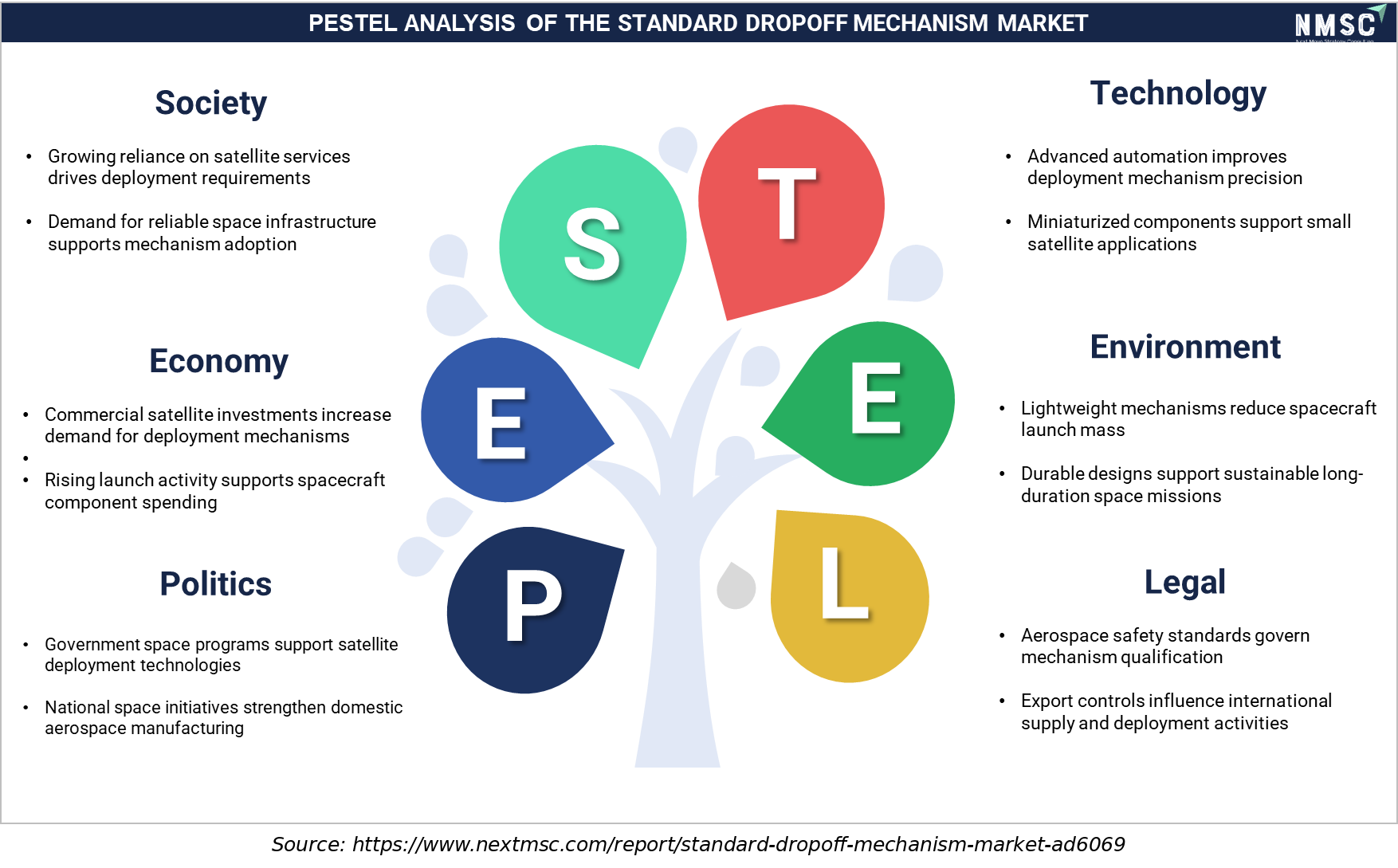
PESTEL Analysis of the Standard Dropoff Mechanism Market

PESTEL Analysis of the Standard Dropoff Mechanism Market
Our analysis indicates that the Standard Dropoff Mechanism Market is influenced by government space programs, commercial space investments, evolving spacecraft technologies, environmental considerations, and aerospace regulations. Government initiatives support satellite deployment and space infrastructure, while economic investment strengthens demand for reliable mechanisms. Technological advancements improve precision and lightweight designs, whereas environmental priorities encourage efficient spacecraft components. Strict aerospace safety, qualification, export-control, and compliance requirements shape product development, testing, and international market participation.

Competitive Landscape

We observed that the standard dropoff mechanism market features a highly specialized, moderately concentrated competitive landscape, with a small number of established wildlife telemetry manufacturers competing on reliability, remote-command capability, and field-service reputation. Key Takeaways

Dimension Description
Market Structure Moderately concentrated; the eight companies profiled in this report collectively account for a majority of global standard dropoff mechanism market revenue, reflecting the market's specialized, research-driven customer base.
Innovation Focus Two-way satellite command release, cloud-connected collar-management software, and miniaturized release hardware for small-species research dominate current innovation pipelines across leading suppliers.
M&A Activity Historical consolidation through platform acquisitions, exemplified by Lotek Wireless Inc.'s integration of Biotrack Ltd. and Sirtrack Ltd. into its group structure to broaden regional wildlife telemetry coverage.

How Do Companies Compete in the Standard Dropoff Mechanism Market?

Companies compete primarily on release reliability, remote-command capability, and long-term field-service reputation across the industry. Global players such as Lotek Wireless Inc. and Vectronic Aerospace GmbH leverage broad collar-platform portfolios and integrated software to serve multinational research institutions, while specialized regional manufacturers compete on customization flexibility and rapid technical support for smaller academic and conservation-organization budgets.

Which Competitive Archetypes Dominate the Standard Dropoff Mechanism Market?

Two archetypes dominate the market: diversified telemetry-platform manufacturers offering integrated collar, software, and release-mechanism systems, and specialized regional developers focused on lightweight or cost-efficient release hardware. Lotek Wireless Inc. and Vectronic Aerospace GmbH exemplify the diversified archetype through end-to-end collar and software integration, while Africa Wildlife Tracking and Holohil Systems Ltd. exemplify the specialized archetype serving regional and species-specific research demand.

How Are Companies Differentiating Through Innovation in Standard Dropoff Mechanisms?

Innovation and differentiation strategy increasingly center on two-way satellite command confirmation and integrated collar-management software. Vectronic Aerospace GmbH's INVENTA platform and Followit Sweden AB's Followit GEO application both enable remote drop-off triggering alongside GPS data management. Our analysis shows that suppliers unable to demonstrate reliable, software-integrated remote command risk exclusion from long-term institutional research contracts requiring multi-year fleet management.

What M&A and Expansion Activity Is Shaping the Standard Dropoff Mechanism Market?

Consolidation activity in this market has historically centered on regional platform integration rather than large-scale mergers, given the industry's small, specialized customer base. Lotek Wireless Inc.'s earlier integration of Biotrack Ltd. and Sirtrack Ltd. broadened its regional service footprint across the UK and New Zealand, illustrating how diversified telemetry manufacturers pursue geographic expansion and combined engineering capability across terrestrial, avian, and marine research segments.

Key Market Players

Our assessment indicates that the following 8 companies are actively shaping product reliability, remote-command innovation, and field-service capability within the global standard dropoff mechanism market.

Lotek Wireless Inc. Vectronic Aerospace GmbH Telonics, Inc. Advanced Telemetry Systems, Inc. Africa Wildlife Tracking (Pty) Ltd. Holohil Systems Ltd. e-obs GmbH Followit Sweden AB

Latest Developments

Date Event
August 2025 VECTRONIC Aerospace GmbH released INVENTA 2.103.1, introducing dedicated drop-off management architecture directly into wildlife tracking software workflows. The update incorporated specialized 'Internal Drop Off' and 'External Drop Off' property columns within the core collars table, alongside a dedicated drop-off management interface to seamlessly track, filter, attach, and detach remote release mechanisms.

Investment Opportunities

What Capital Inflows Are Targeting the Standard Dropoff Mechanism Market?

Capital inflows into the standard dropoff mechanism market are directed primarily toward software integration and satellite-connectivity capability rather than large-scale manufacturing expansion, reflecting the industry's small, specialized scale. We observed that established manufacturers continue to self-fund incremental firmware and platform development, as seen in Vectronic Aerospace GmbH's ongoing INVENTA software investment, rather than pursuing external capital raises common in larger consumer technology markets.

How Is Infrastructure Investment Supporting Standard Dropoff Mechanism Manufacturing?

Infrastructure investment is concentrated on expanding satellite-command testing and field-validation capability rather than large-scale production capacity, given the market's low-volume, research-grade manufacturing model. Our findings suggest that manufacturers are investing in ruggedization testing for extreme climate and marine deployment conditions, supporting reliability claims that underpin long-term institutional procurement relationships across government and academic research programs.

What ESG Considerations Are Shaping Standard Dropoff Mechanism Investment Decisions?

Environmental, social, and governance considerations center on animal-welfare outcomes and non-recapture research ethics rather than traditional industrial sustainability metrics. Guidance from the Association for the Study of Animal Behaviour continues to inform institutional procurement standards favoring verified, low-stress release methods. We found that investors and funding bodies increasingly treat documented release reliability as a governance indicator alongside standard research-ethics compliance requirements.

Key Benefits for Stakeholders

How Does This Report Benefit Research Institution Procurement Leaders?

Research institution procurement leaders gain access to validated segmentation, competitive benchmarking, and regional demand forecasts that support equipment-sourcing and multi-year fleet-planning decisions across the standard dropoff mechanism industry. Our analysis shows that detailed release-trigger-type and animal-class breakdowns help procurement teams align specifications with study requirements and institutional animal-welfare review criteria.

How Does This Report Benefit Investors and Funding Analysts?

Investors and funding analysts benefit from consistent, single-point market size and CAGR estimates that support grant-allocation and capital-planning decisions across the standard dropoff mechanism market supply chain. We observed that the report's regional and segment-level growth differentials help identify which manufacturers and end-user categories are best positioned to capture above-market growth in satellite command and conservation-organization procurement through 2035.

How Does This Report Benefit Equipment Manufacturers and Product Teams?

Equipment manufacturers and product teams gain insight into emerging design requirements, including two-way satellite command integration and miniaturized release hardware, that are reshaping the industry. Our findings suggest that this analysis helps engineering teams prioritize development roadmaps around remote-command reliability and field-ruggedization features increasingly required by government and academic research procurement processes.

Key Market Segments Evaluated

By Release Trigger Type

  • Timer-Based Drop-Off Mechanisms
  • Radio Command Drop-Off Mechanisms
  • Satellite Command Drop-Off Mechanisms
  • Degradable Link Drop-Off Mechanisms

By Animal Class

  • Terrestrial Mammal Tracking
  • Avian Tracking Harnesses
  • Marine Mammal Tags
  • Fish and Aquatic Species Tags

By End User

  • Academic and University Research Institutions
  • Government Wildlife and Conservation Agencies
  • Non-Governmental Conservation Organizations
  • Zoos, Wildlife Parks and Commercial Consultancies

Conclusion & Recommendations

The long-term outlook for the market remains positive, with global revenue projected to more than double from USD 86.4 million in 2025 to USD 190.0 million by 2035 at an 8.3% CAGR. We observed that sustained government and philanthropic conservation funding, growing satellite-connectivity adoption, and expanding institutional animal-welfare requirements will continue underpinning demand across academic, government, and non-governmental research applications through the forecast period.

What Strategic Positioning Should Standard Dropoff Mechanism Suppliers Pursue?

Suppliers should prioritize two-way satellite command architectures and cloud-connected fleet-management software to secure long-term institutional research contracts. Our assessment indicates that manufacturers investing early in remote-command reliability and miniaturized hardware for small-species research will be best positioned to capture premium pricing within the standard dropoff mechanism market as institutional welfare requirements tighten.

How Attractive Is the Standard Dropoff Mechanism Market for New Investment?
The standard dropoff mechanism industry presents a niche but steady investment case, supported by a USD 97.3 million absolute dollar opportunity between 2026 and 2035 and above-average growth in satellite command and non-governmental conservation-organization procurement. We found that investment attractiveness is highest for manufacturers combining proven field reliability with software-integrated remote command, positioning them to serve both cost-sensitive and premium institutional segments simultaneously.

What Market Shifts and Key Risks Should Stakeholders Monitor?

Stakeholders should monitor high satellite-hardware costs, field-failure risk in extreme climates, and constrained public research budgets in select developing economies as key risks to the standard dropoff mechanism market. Our analysis shows that suppliers unable to demonstrate documented release reliability risk losing institutional contracts to competitors with stronger field-validation track records, particularly within budget-constrained regional research programs.

What Are the Key Growth Pathways for the Standard Dropoff Mechanism Market?

Key growth pathways include expanding satellite command product lines, scaling miniaturized release hardware for small-species research, and deepening distribution partnerships across African and Asia-Pacific conservation programs. NMSC's analysis indicates that suppliers pursuing these pathways while maintaining reliability leadership in timer-based mechanisms will be best positioned to capture the standard dropoff mechanism market's projected growth through 2035.

FAQs

About the Author

Saista Faiyaz

Saista Faiyaz

Saista Faiyaz is Research Associate at Next Move Strategy Consulting, where she has covered consumer markets and healthcare technologies for 3 years. Her work includes primary interview review, secondary-source validation, market sizing, and structured analysis of company and industry data. She supports research by comparing evidence across sources, organizing findings into market narratives, and documenting assumptions used in analysis. Her scope includes cross-market benchmarking, and reports.

About the Reviewer

Supradip Baul

Supradip Baul

Supradip Baul is an accomplished business consultant and strategist with over a decade of rich experience in market intelligence, strategy, technology, and business transformation. His work has included rigorous qualitative and quantitative analysis across multiple industries, helping clients shape investment decisions and long-term roadmaps. Earlier in his career, he was associated with Gartner, where he contributed to industry-leading reports and market share analyses. He has worked with leading global companies and holds an MBA with a dual specialization in Marketing and Finance.

Download Free Sample

Mohit Agarwal

MOHIT AGARWAL

Chief Manager

DryChem India Pvt. Ltd.

Next Move Strategy Consulting is an amazing team of consultants. We required a market study report for our investors on top priority and the team went above and beyond our expectations to deliver the same with ample supporting data within a short time span enabling us to secure the investments and keep our project timeline maintained. Their professionalism, attention to detail, and timely delivery of actionable recommendations have left a lasting impression on our organization.

Diana Trejo

DIANA TREJO

Assistant Manager

Sumitomo Corporation de Mexico, S.A. de C.V.

Recently, we purchased a report on the Mexico Data Center Market from Next Move Strategy Consulting. The service has been excellent, with support that is always timely and thoroughly professional. The information provided is interesting, highly useful, and delivered with clarity. I would highly recommend NextMSC for anyone seeking insightful and dependable analysis.

Melanie Samko

MELANIE SAMKO

Director of Marketing

TOSOH BIOSCIENCE, INC.

The information provided by NMSC is incredibly valuable, thank you so much for such a excellent work. I really appreciate it. I will make sure to reference all of it, in my summary document.

Henri Knyphausen

HENRI KNYPHAUSEN

Partner at Singulier [Ex-BCG]

Singulier

I recently engaged NEXTMSC.com for a commercial due diligence project within the intralogistics sector, and I am pleased to provide a reference based on my experience. In utilizing NEXTMSC.com's services, I found their report to offer valuable insights into market dynamics and key industry players. The initial report provided a solid foundation for our analysis. However, as we were investigating a smaller target in the market, and I had specific customization requests requiring additional research. These requests included detailed information on product portfolios of various players and sub-market sizes, both inclusive and exclusive of certain product categories. NEXTMSC.com demonstrated commendable responsiveness and agility in accommodating these customization requests. Within a timeframe of 1-2 weeks, they delivered a revised report that met our specific needs. Furthermore, they were receptive to my follow-up inquiries, ensuring clarity and understanding of the data provided. The final deliverable significantly contributed to our due diligence efforts. One of NEXTMSC.com's notable strengths lies in their qualitative research capabilities. However, for future engagements, I would recommend the inclusion of a quantified market model in Excel format. Such a model would offer the ability to conduct in-depth analyses and explore various market segments, including country-specific data and subcomponent breakdowns. Based on my positive experience, I would not hesitate to work with NEXTMSC.com again. Their responsiveness, willingness to accommodate customization requests, and commitment to delivering actionable insights make them a reliable partner for commercial research projects.

Gaurav Jaiswal

GAURAV JAISWAL

Founder & CEO

Yano Charge Private Limited

The EV Charging market research report provided by the NextMSC was exceptionally detailed and insightful. It offered a comprehensive analysis that proved to be a game-changer for our strategic planning. Truly a testament to the NextMSC’s expertise and thoroughness in EV market landscape & analysis.

Custom Market Research Services

We will customize the research for you if the listed report does not fully match your requirements.

Get 30% Free Customization

Select License

This website uses cookies to ensure you get the best experience on our website. Learn more

✖