Synthetic Aperture Radar (SAR) Market Size, Share, Growth & Forecast by Offering (SAR Systems, SAR Data Products, SAR Software, SAR Services), Platform (Spaceborne, Airborne, Ground-Based), Frequency Band (X-Band, C-Band, L-Band, S-Band, P-Band, Ku-Band, Ka-Band, VHF/UHF), Acquisition Mode (Stripmap, Spotlight, ScanSAR, Others), Customer Type (Government, Defense, Commercial), Application, Sales Channel, and Revenue Stream — Global Analysis & Forecast, 2026–2035
Industry: Aerospace & Defense | Publishing Date: July 13, 2026 | Last Updated: September 30, 2026 | No of Pages: N/A | No. of Tables: N/A | No. of Figures: N/A | Format: PDF | Report Code: AD5101
What Is the Synthetic Aperture Radar (SAR) Market Size?
The global Synthetic Aperture Radar (SAR) Market was valued at USD 5.2 billion in 2025 and is expected to reach USD 5.8 billion in 2026. Rising defense modernization programs, expanding commercial Earth observation constellations, and growing demand for all-weather surveillance are projected to propel the the SAR market to USD 15.8 billion by 2035, advancing at a CAGR of 11.7% from 2026 to 2035.
Key growth drivers include the proliferation of small satellite SAR constellations in low Earth orbit, increasing investment in dual-use SAR platforms by governments and commercial operators, rising adoption of SAR analytics in agriculture and disaster management, and growing defense budgets across NATO member states and Asia-Pacific nations. This report covers global Synthetic Aperture Radar market revenue, size, share, demand, trends, competitive landscape, and forecasts through 2035.
|
Parameter |
Details |
|
Market Size in 2025 |
USD 5.2 Billion |
|
Market Size in 2026 |
USD 5.8 Billion |
|
Revenue Forecast in 2035 |
USD 15.8 Billion |
|
Growth Rate |
CAGR of 11.7% from 2026 to 2035 |
|
Analysis Period |
2025–2035 |
|
Base Year Considered |
2025 |
|
Forecast Period |
2026–2035 |
|
Market Size Estimation |
Billion USD |
|
Companies Profiled |
20 |
|
Countries Covered |
33 |
|
Market Share |
Top 10 |
Synthetic Aperture Radar (SAR) Market Overview
What Is the Synthetic Aperture Radar (SAR) Market?
Synthetic Aperture Radar (SAR) is a form of active remote sensing technology that uses microwave signals to generate high-resolution imagery of the Earth's surface, regardless of weather conditions or daylight availability. Unlike optical sensors, SAR systems transmit and receive microwave pulses that penetrate clouds, rain, and darkness, making the technology indispensable for persistent surveillance, border monitoring, disaster response, and environmental assessment. The Synthetic Aperture Radar (SAR) Market encompasses spaceborne, airborne, and ground-based SAR systems, alongside associated data products, processing software, and managed services across defense, civil government, and commercial customer segments.
How Has the Synthetic Aperture Radar (SAR) Market Evolved?
The Synthetic Aperture Radar (SAR) Market has evolved through three distinct phases of technological and commercial transformation. The first phase, spanning from the 1970s through the 1990s, was defined by government-funded, large-format satellites operated primarily by defense and space agencies in the United States, Europe, and Japan. The second phase, running from 2000 through 2018, introduced commercial SAR missions such as TerraSAR-X and COSMO-SkyMed, enabling private sector access to high-resolution imagery. the current phase is characterized by LEO small satellite SAR constellation deployment, AI-driven automated analysis pipelines, and the commoditization of SAR data through subscription and tasking service models.
How Do Regulations Influence the Synthetic Aperture Radar (SAR) Market?
Regulatory frameworks at the national and international levels significantly influence the Synthetic Aperture Radar (SAR) Market's structure and growth trajectory. In the United States, the National and Commercial Space Policy and the Department of Commerce's commercial remote sensing licensing regime under NOAA Part 960 govern the operation and data distribution of commercial SAR satellites. Export control frameworks, including the International Traffic in Arms Regulations (ITAR) and the Export Administration Regulations (EAR), impose restrictions on the transfer of SAR technologies and high-resolution imagery to foreign nationals. These regulatory requirements shape competitive positioning and market entry strategies across the this market.
How Is Technology Adoption Expanding Across the Synthetic Aperture Radar (SAR) Market?
Technology adoption across the Synthetic Aperture Radar (SAR) Market is accelerating as new entrants deploy compact, software-defined SAR payloads aboard small satellites and unmanned aerial vehicles. The convergence of SAR hardware miniaturization, cloud-based image processing pipelines, and AI-powered change detection algorithms is lowering the technical and financial barriers to entry for commercial SAR operators. This democratization of SAR technology is expanding the addressable market beyond traditional defense agencies to include agriculture, mining, infrastructure monitoring, and maritime domain awareness applications, which now collectively represent a growing proportion of total the market revenue.
|
Key Takeaways |
|
By Offering, SAR Systems held the largest share of the Synthetic Aperture Radar (SAR) Market at USD 3.0 billion in 2025, with Spaceborne SAR Systems, particularly LEO Constellation SAR platforms, representing the dominant and fastest-growing sub-segment. The SAR Services segment is the fastest-growing offering category, projected to expand at a CAGR of 14.2% from 2026 to 2035, driven by rising demand for data subscription, analytics subscription, and tasking service models among commercial enterprise and civil government customers. |
|
By Platform, Spaceborne SAR platforms commanded the largest revenue share at USD 2.8 billion in 2025, accounting for approximately 54% of total Synthetic Aperture Radar (SAR) Market revenue. Ground Based SAR Systems represent the fastest-growing platform segment within the the SAR industry at a CAGR of 12.5% from 2026 to 2035, driven by demand for fixed and mobile ground surveillance systems in border security and infrastructure monitoring applications. |
|
By Frequency Band, X Band held the largest share of the Synthetic Aperture Radar (SAR) Market at USD 1.8 billion in 2025, reflecting its established adoption in high-resolution defense and commercial imaging applications. The L Band is the fastest-growing frequency segment in the this segment at a CAGR of 13.1% from 2026 to 2035, driven by NISAR mission data and expanding applications in vegetation mapping, soil moisture analysis, and subsurface feature detection. |
|
By Acquisition Mode, Stripmap mode represents the dominant acquisition mode in the Synthetic Aperture Radar (SAR) Market, valued at USD 1.4 billion in 2025, due to its balanced resolution and area coverage characteristics. Spotlight mode is the fastest-growing acquisition mode at a CAGR of 13.8%, supported by defense demand for ultra-high-resolution target characterization imagery. |
|
By Customer Type, Defense and Intelligence customers held the largest share at USD 2.6 billion in 2025, representing approximately 50% of total Synthetic Aperture Radar (SAR) Market revenue, reflecting the foundational role of military programs in driving SAR system procurement and capability development. Commercial Enterprise is the fastest-growing customer type in the the sector at a CAGR of 15.3% from 2026 to 2035. |
|
By Application, Border and Maritime Surveillance is the dominant application segment at USD 1.2 billion in 2025. Disaster Management is the fastest-growing application in the Synthetic Aperture Radar (SAR) Market at a CAGR of 14.9%, driven by government investment in resilient early warning systems and the expanding use of SAR change detection for flood mapping and earthquake damage assessment. |
|
By Sales Channel, Direct Sales held the largest revenue share at USD 2.4 billion in 2025. Prime Contractor is the fastest-growing channel at a CAGR of 12.9%, reflecting the trend toward turnkey SAR system integration contracts in defense acquisition programs globally. |
|
By Revenue Stream, New System Sales held the largest share at USD 1.9 billion in 2025 in the Synthetic Aperture Radar (SAR) Market. Subscription Revenue is the fastest-growing stream in the the SAR sector at a CAGR of 17.4%, driven by commercial SAR constellation operators offering flexible data access plans to enterprise and government buyers. |
|
North America held the largest Synthetic Aperture Radar market share at USD 2.0 billion in 2025, projected to reach USD 5.9 billion by 2035 at a CAGR of 11.4%, anchored by U.S. Department of Defense procurement programs, NRO satellite constellation investments, and a highly developed commercial SAR industry anchored by Capella Space, Umbra, and L3Harris. |
|
Asia-Pacific is the fastest-growing major region in the Synthetic Aperture Radar (SAR) Market at a CAGR of 13.6%, driven by Japan's ALOS-4 and planned DAICHI constellation programs, India's Radar Imaging Satellite series, South Korea's military SAR satellite investments, and China's expanding civil and military SAR constellation buildout. |
|
The United States is the single largest country market in the Synthetic Aperture Radar (SAR) Market, representing over 75% of North American revenue in 2025, underpinned by the world's highest concentration of defense SAR procurement, NRO and DoD constellation programs, and an increasingly active commercial SAR startup ecosystem. |
|
Japan is the fastest-growing national market in Asia-Pacific within the Synthetic Aperture Radar (SAR) Market at a CAGR of 14.2%, propelled by JAXA's ALOS SAR satellite series, Japan's National Space Policy, and the dual-use defense and civil Earth observation investment roadmap endorsed by the Cabinet Office's Basic Plan on Space Policy. |
Key Emerging Trends in the Synthetic Aperture Radar (SAR) Market
How Is the Proliferation of LEO Small Satellite Constellations Transforming the Synthetic Aperture Radar (SAR) Market?
The deployment of low Earth orbit small satellite constellations is the most disruptive structural trend reshaping the Synthetic Aperture Radar (SAR) Market. Companies such as ICEYE, Capella Space, and Umbra have launched constellations of compact SAR satellites capable of delivering sub-meter resolution imagery with revisit intervals measured in hours rather than days. this shift is commoditizing SAR data access, enabling agricultural enterprises, insurance underwriters, and maritime domain awareness operators to subscribe to persistent monitoring capabilities previously available only to national intelligence agencies and defense customers.
How Is Artificial Intelligence Reshaping SAR Data Analytics in the Synthetic Aperture Radar (SAR) Market?
Artificial intelligence and machine learning are fundamentally altering the value chain of the Synthetic Aperture Radar (SAR) Market by automating the interpretation of vast volumes of SAR imagery that was previously dependent on skilled human analysts. Deep learning models trained on SAR datasets are now capable of autonomous ship detection, vehicle tracking, infrastructure change detection, and flood extent mapping with accuracy levels approaching human expert performance. companies such as Synspective and Capella Space have integrated AI-driven analytics directly into their data product offerings, enabling customers to access structured, analysis-ready insights rather than raw imagery files.
What Role Is SAR Interferometry Playing in the Evolution of the Synthetic Aperture Radar (SAR) Market?
Interferometric SAR, commonly referred to as InSAR, is experiencing a significant renaissance within the Synthetic Aperture Radar (SAR) Market as higher revisit frequency satellites enable millimeter-precision ground deformation measurements at scale. InSAR-derived products are now commercially available for infrastructure subsidence monitoring, volcanic activity tracking, and earthquake deformation analysis. The European Space Agency's Sentinel-1 constellation has established the foundational open-access InSAR data layer upon which commercial analytics companies are building high-value monitoring subscription products for infrastructure asset owners, insurers, and government geological survey agencies.
How Is Dual-Use SAR Technology Creating New Opportunities in the Synthetic Aperture Radar (SAR) Market?
The convergence of defense and commercial SAR technology development is creating compelling dual-use opportunities that are expanding the total addressable market within the Synthetic Aperture Radar (SAR) Market. Governments across Europe, Asia-Pacific, and North America are increasingly procuring commercial SAR constellation data to supplement national intelligence satellite capabilities, creating a structural bridge between defense procurement and commercial operator revenue streams. this dual-use dynamic is incentivizing commercial SAR operators to invest in security-grade data handling capabilities, classified data handling accreditation, and government-specific analytics workflows that enable them to compete for national defense and intelligence community contracts.
What Are the Key Market Drivers, Breakthroughs, and Investment Opportunities That Will Shape the Synthetic Aperture Radar (SAR) Market Industry in the Next Decade?
|
Drivers / Trends / Restraints |
(+/-) % Impact on CAGR Forecast |
Geographic Relevance |
Impact Timeline |
|
Rising Defense SAR Constellation Investment |
+2.1% |
Global (U.S., Europe, APAC) |
2025–2032 |
|
Commercial LEO SAR Constellation Expansion |
+2.4% |
Global (all regions) |
2025–2030 |
|
AI-Driven Automated SAR Analytics |
+1.6% |
North America, Europe, APAC |
2025–2035 |
|
Disaster Management and Climate Monitoring Demand |
+1.2% |
Global |
2026–2035 |
|
Maritime Domain Awareness Programs |
+0.9% |
Europe, MEA, APAC |
2025–2032 |
|
High System Procurement and Integration Costs |
-1.4% |
SMB, Emerging Markets |
2025–2028 |
|
Skilled SAR Data Analyst Shortage |
-0.7% |
All regions |
Ongoing |
|
Export Control and ITAR Restrictions |
-0.8% |
Non-U.S. markets |
Ongoing |
|
SAR-as-a-Service Subscription Model Growth |
+1.8% |
North America, Europe |
2026–2035 |
|
Infrastructure and Agricultural Monitoring Expansion |
+1.3% |
Global |
2026–2035 |
What Are the Growth Drivers of the Synthetic Aperture Radar (SAR) Market?
How Are Increasing Defense Budgets and Military Modernization Programs Driving the Synthetic Aperture Radar (SAR) Market?
National defense modernization programs are a primary and sustained driver of Synthetic Aperture Radar market demand. Emerging trends toward persistent area monitoring, rapid revisit rates, and AI-ready data products are accelerating procurement across defense and commercial buyer segments. NATO member states have collectively committed to increasing defense expenditure, with the alliance's 2% GDP spending target creating structured procurement pipelines for ISR (Intelligence, Surveillance, and Reconnaissance) platforms including airborne and spaceborne SAR systems. The U.S. Department of Defense's National Defense Space Architecture (NDSA), coordinated through the Space Development Agency, allocates dedicated funding to SAR satellite procurement and commercial data purchase agreements, creating a durable government revenue stream for the Synthetic Aperture Radar (SAR) Market participants across the defense customer segment.
How Is the Growth of Commercial Earth Observation Constellations Expanding the Synthetic Aperture Radar (SAR) Market?
The commercialization of Earth observation via small satellite SAR constellations is expanding the Synthetic Aperture Radar (SAR) Market's revenue base beyond traditional government buyers. ICEYE has launched over 35 SAR satellites as of 2026, creating a persistent monitoring capability with hourly revisit rates over areas of interest, generating recurring subscription revenue from insurance, maritime, and government customers. The European Space Agency's Sentinel-1 open-access SAR data policy has catalyzed a downstream commercial analytics ecosystem. the U.S. National Oceanic and Atmospheric Administration's expanded commercial data purchase programs are further validating the government-commercial SAR data market and accelerating private investment in constellation expansion.
How Is the Growing Demand for All-Weather, Day-Night Surveillance Fueling Synthetic Aperture Radar (SAR) Market Growth?
The fundamental physical advantage of SAR technology, its capacity to penetrate cloud cover, rain, smoke, and darkness to deliver consistent imagery, creates irreplaceable operational value across border security, maritime patrol, and battlefield reconnaissance applications. Tropical and monsoon-affected regions across South and Southeast Asia, sub-Saharan Africa, and Latin America have cloud coverage conditions that render optical satellite imagery unreliable for persistent monitoring, driving government and commercial operators in these regions toward SAR-dependent solutions. this all-weather surveillance requirement is particularly acute in maritime domain awareness, where vessel detection and tracking in cloud-affected ocean zones represents a growing revenue opportunity within the Synthetic Aperture Radar (SAR) Market.
Pestel Analysis of the Synthetic Aperture Radar (SAR) Market
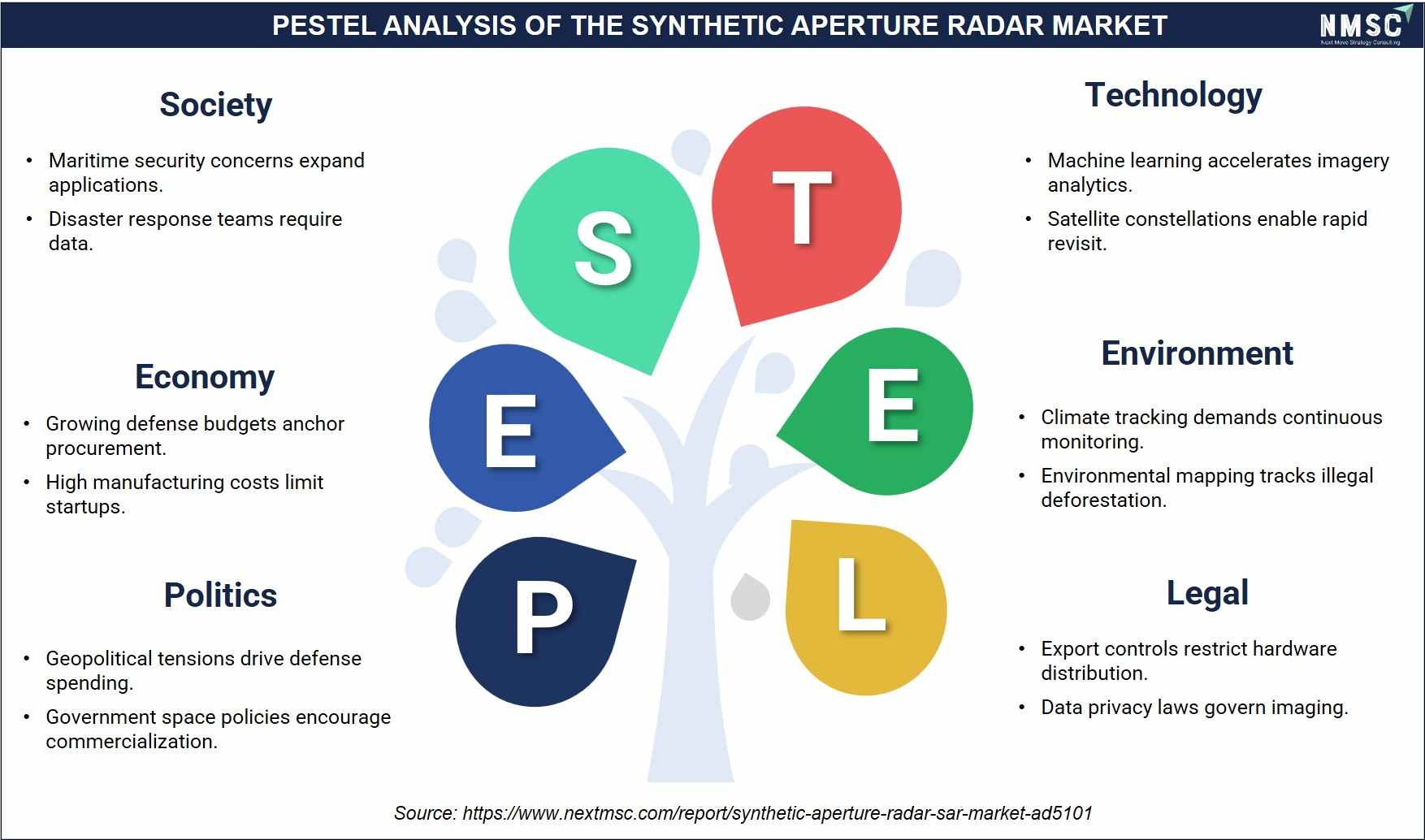
The PESTEL analysis of the Synthetic Aperture Radar (SAR) market highlights the external factors shaping industry growth and adoption. Political factors include rising defense spending and national security initiatives, while economic factors are driven by increasing investments in space technologies and Earth observation programs. Technological advancements in satellite miniaturization, AI-powered analytics, and high-resolution imaging support market expansion. Environmental monitoring needs, regulatory frameworks governing space activities, and legal requirements related to data security and satellite operations further influence market development. Collectively, these factors create opportunities for innovation and long-term growth in the SAR market.
What Are the Growth Inhibitors of the Synthetic Aperture Radar (SAR) Market?
How Do High System Procurement and Integration Costs Constrain Synthetic Aperture Radar (SAR) Market Expansion?
The capital intensity of SAR system development, manufacturing, launch, and operations represents a significant structural barrier to market entry and adoption growth across the Synthetic Aperture Radar (SAR) Market. Heritage space-grade SAR satellites carry procurement costs measured in hundreds of millions of dollars, placing them beyond the reach of all but national space agencies and large defense integrators. Even the new generation of small satellite SAR systems requires tens of millions of dollars in development and launch investment, creating funding barriers for emerging market governments and smaller commercial operators. The U.S. Government Accountability Office has documented recurring cost overruns in major defense space programs that directly affect SAR capability delivery timelines and budgets.
How Does the Shortage of Specialized SAR Data Analysts Limit the Synthetic Aperture Radar (SAR) Market's Growth Potential?
Despite advances in AI-powered SAR analytics and automated image processing, the effective exploitation of SAR data products continues to require specialized expertise in microwave physics, radar signal processing, and domain-specific interpretation that remains in short supply globally. Defense agencies, research institutions, and commercial customers frequently encounter procurement barriers associated with the limited availability of trained SAR analysts capable of deriving actionable intelligence from complex interferometric and polarimetric SAR datasets. this skills gap extends deployment timelines, reduces the perceived return on investment for new SAR system and data service procurement, and creates a structural bottleneck that constrains near-term growth in the Synthetic Aperture Radar (SAR) Market beyond the defense and intelligence community buyer segment.
Ecosystem Analysis of the Synthetic Aperture Radar (SAR) Market
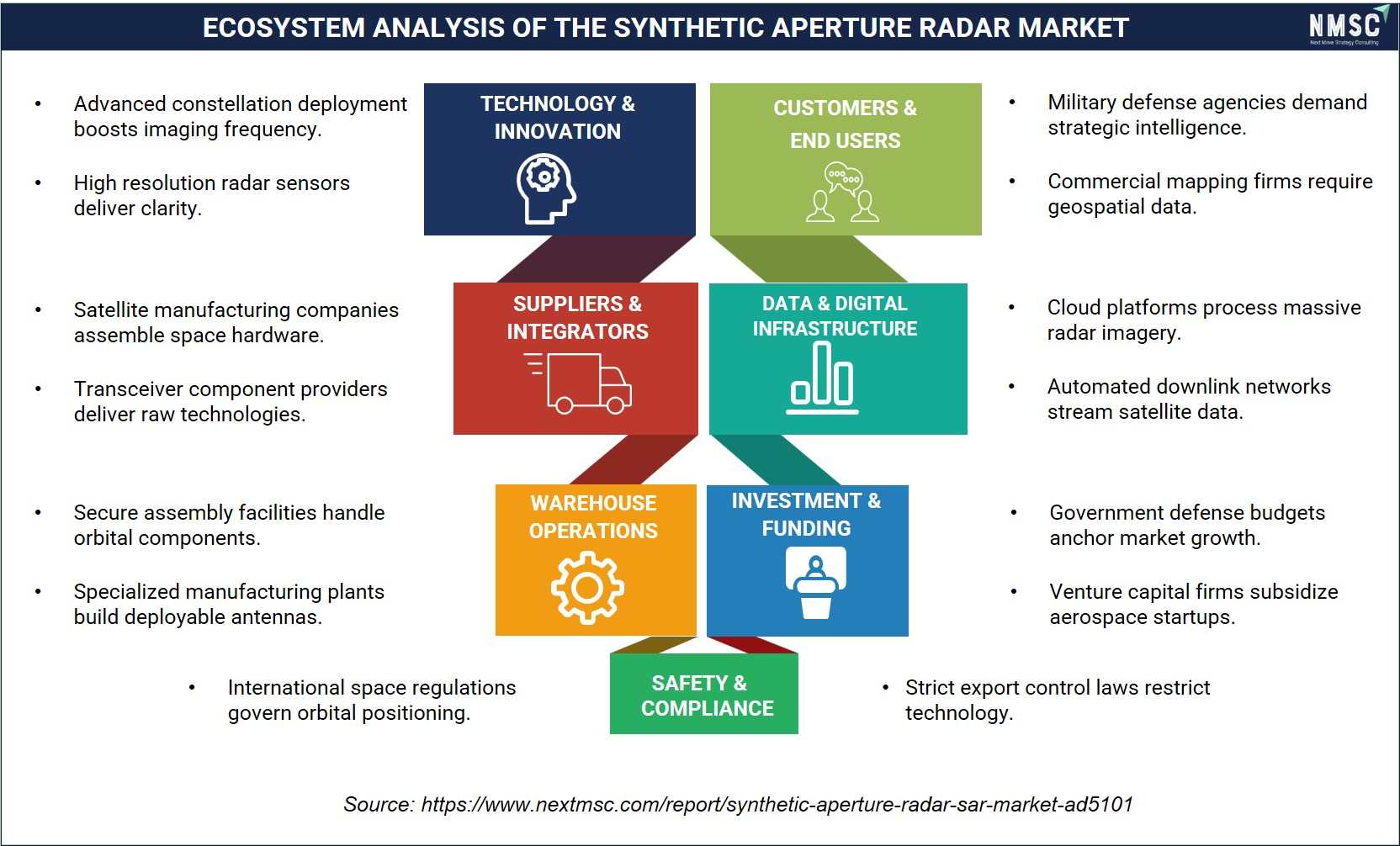
The Synthetic Aperture Radar (SAR) market ecosystem comprises multiple interconnected stakeholders that collectively drive technology development, deployment, and commercialization. Technology and innovation providers develop advanced radar systems and analytics capabilities, while suppliers and integrators support satellite manufacturing and system integration. Data and digital infrastructure enable data processing, storage, and dissemination. Investment and funding organizations support market expansion, while safety and compliance bodies ensure regulatory adherence. End users, including defense, government, maritime, agriculture, and environmental sectors, generate demand for SAR-based monitoring and intelligence solutions.
What Are the Growth Opportunities in the Synthetic Aperture Radar (SAR) Market?
How Does the Expansion of SAR Applications in Agriculture and Forestry Create a Multi-Billion Dollar Opportunity in the Synthetic Aperture Radar (SAR) Market?
Agricultural monitoring represents one of the most structurally significant and underserved growth opportunities within the Synthetic Aperture Radar (SAR) Market. SAR's capacity to measure soil moisture, estimate crop biomass, monitor field-level planting and harvest cycles, and detect unauthorized land conversion makes it uniquely suited for food security monitoring programs operated by national governments and international organizations. The Food and Agriculture Organization of the United Nations (FAO) actively uses SAR data in its Global Agricultural Monitoring program, and the European Commission's Copernicus Agriculture Monitoring Service uses Sentinel-1 SAR data to provide pan-European crop monitoring at no cost to end users, demonstrating the policy appetite for SAR-based agricultural intelligence.
How Does Disaster Management and Climate Resilience Investment Create Durable Demand in the Synthetic Aperture Radar (SAR) Market?
Climate change is increasing the frequency and severity of natural disasters globally, creating growing institutional demand for SAR-based rapid disaster mapping and damage assessment capabilities that operate independently of weather conditions. The United Nations Office for the Coordination of Humanitarian Affairs (OCHA) and the Copernicus Emergency Management Service both utilize SAR imagery as a primary source for flood extent mapping, earthquake damage assessment, and wildfire perimeter monitoring within hours of disaster events. this disaster response use case is creating durable revenue streams for SAR data product providers who can demonstrate sub-24-hour tasking and delivery capabilities to humanitarian agencies and national emergency management organizations.
How Does the Expansion of SAR-as-a-Service Models Create a New Distribution Opportunity in the Synthetic Aperture Radar (SAR) Market?
The transition from traditional system sales toward recurring subscription-based SAR-as-a-Service models is creating a fundamentally new commercial architecture within the Synthetic Aperture Radar (SAR) Market that expands the total addressable customer base. Subscription models eliminate large upfront capital expenditures, enabling mid-market commercial enterprises, regional government agencies, and research institutions to access SAR monitoring capabilities that were previously affordable only to large defense agencies and national space programs. Commercial operators including ICEYE, Capella Space, and Umbra have demonstrated that SAR data subscription revenue can generate predictable, high-margin annual recurring revenue streams that are more financially sustainable than episodic system procurement contracts.
How Is the Synthetic Aperture Radar (SAR) Market Segmented in This Report, and What Are the Key Insights from the Segmentation Analysis?
How Do the Four Offering Categories Define the Revenue Architecture of the Synthetic Aperture Radar (SAR) Market?
|
Segment |
2025 (USD Bn) |
2035 (USD Bn) |
CAGR (%) |
|
SAR Systems |
3.0 |
8.6 |
11.1% |
|
– Spaceborne SAR Systems |
1.7 |
5.0 |
11.4% |
|
– Airborne SAR Systems |
0.9 |
2.5 |
10.8% |
|
– Ground Based SAR Systems |
0.4 |
1.1 |
12.5% |
|
SAR Data Products |
0.8 |
2.7 |
12.9% |
|
SAR Software |
0.5 |
1.6 |
12.3% |
|
SAR Services |
0.9 |
2.9 |
14.2% |
SAR market revenue distribution analysis shows that the Synthetic Aperture Radar (SAR) Market is structured around four primary offering categories: SAR Systems, SAR Data Products, SAR Software, and SAR Services. SAR Systems dominate the offering landscape at USD 3.0 billion in 2025, with Spaceborne SAR Systems constituting the largest subsegment driven by ongoing government and commercial satellite constellation investments. Airborne SAR Systems, encompassing fixed wing, rotary wing, and UAV platforms, are witnessing steady demand from border surveillance and battlefield reconnaissance programs. Ground Based SAR Systems, including fixed and mobile variants, represent the fastest-growing platform category within the systems segment. SAR Data Products, encompassing raw data, processed imagery, interferometric products, change detection outputs, and analytics-ready datasets, are growing rapidly as downstream commercial customers prefer processed intelligence over raw sensor outputs. SAR Services, which include data subscription, analytics subscription, tasking, integration, and maintenance services, represent the fastest-growing offering category at a CAGR of 14.2%, reflecting the broader industry shift toward recurring service revenue models.
How Does Platform Type Shape Revenue Concentration in the Synthetic Aperture Radar (SAR) Market?
|
Segment |
2025 (USD Bn) |
2035 (USD Bn) |
CAGR (%) |
|
Spaceborne |
2.8 |
8.5 |
11.7% |
|
Airborne |
1.9 |
5.2 |
10.6% |
|
Ground Based |
0.5 |
2.1 |
12.5% |
Platform-level revenue dynamics in the Synthetic Aperture Radar (SAR) Market reveals that Spaceborne platforms hold the commanding position at USD 2.8 billion in 2025, driven by both legacy government satellite programs and the growing commercial LEO SAR constellation segment led by ICEYE, Capella Space, and Umbra. Airborne SAR platforms, encompassing fixed wing aircraft, rotary wing helicopters, and UAV-mounted systems, represent the second-largest platform category at USD 1.9 billion, with UAV SAR adoption accelerating across border surveillance, battlefield reconnaissance, and infrastructure inspection applications. Ground Based SAR systems, including fixed installation radar and mobile vehicle-mounted variants, represent the smallest but fastest-growing platform segment within the the market, driven by demand for persistent area surveillance and infrastructure deformation monitoring.
How Do Frequency Band Characteristics Influence Market Share Distribution in the Synthetic Aperture Radar (SAR) Market?
|
Segment |
2025 (USD Bn) |
2035 (USD Bn) |
CAGR (%) |
|
X Band |
1.8 |
5.2 |
11.2% |
|
C Band |
1.3 |
3.7 |
11.0% |
|
L Band |
0.9 |
3.1 |
13.1% |
|
S Band |
0.4 |
1.2 |
11.6% |
|
P Band |
0.2 |
0.6 |
11.6% |
|
Ku Band |
0.2 |
0.6 |
11.6% |
|
Ka Band |
0.2 |
0.7 |
12.8% |
|
VHF/UHF Band |
0.1 |
0.4 |
12.8% |
|
Other Band |
0.1 |
0.3 |
11.6% |
Frequency band adoption trends in the Synthetic Aperture Radar (SAR) Market, we identified that X Band commands the largest revenue share at USD 1.8 billion in 2025, reflecting its established position as the preferred frequency for high-resolution commercial and defense SAR imaging applications including maritime vessel detection and infrastructure monitoring. C Band remains the second-largest segment at USD 1.3 billion, anchored by the European Space Agency's Sentinel-1 constellation and Canada's RADARSAT-2 and RCM programs. L Band is the fastest-growing frequency at a CAGR of 13.1%, driven by the NASA-ISRO NISAR mission and expanding applications in forest biomass estimation, soil moisture monitoring, and subsurface geological feature mapping. Ka Band and VHF/UHF bands are also emerging as growth segments within the the SAR market, addressing very high-resolution imaging and foliage-penetrating radar requirements respectively.
How Do Acquisition Mode Preferences Reflect Evolving Customer Requirements in the Synthetic Aperture Radar (SAR) Market?
|
Segment |
2025 (USD Bn) |
2035 (USD Bn) |
CAGR (%) |
|
Stripmap |
1.4 |
4.0 |
11.1% |
|
Spotlight |
1.2 |
3.8 |
13.8% |
|
ScanSAR |
0.9 |
2.5 |
10.8% |
|
Sliding Spotlight |
0.6 |
1.8 |
12.6% |
|
Interferometric SAR |
0.5 |
1.5 |
11.6% |
|
Polarimetric SAR |
0.3 |
1.0 |
12.8% |
|
Ground Moving Target Indication |
0.2 |
0.7 |
13.3% |
|
Other Mode |
0.1 |
0.5 |
17.5% |
Acquisition mode preference trends in the Synthetic Aperture Radar (SAR) Market indicates that Stripmap remains the baseline mode for large-area monitoring applications at USD 1.4 billion in 2025, owing to its balanced resolution and swath width characteristics that suit routine surveillance, agricultural monitoring, and ocean wind field mapping. Spotlight mode is the fastest-growing standard acquisition mode at a CAGR of 13.8%, driven by defense and intelligence demand for sub-meter resolution imagery of specific targets and high-value facilities. Sliding Spotlight mode is gaining adoption as a versatile intermediate option between Spotlight and Stripmap for commercial operators seeking to optimize revisit frequency against resolution requirements. Interferometric SAR and Polarimetric SAR modes are growing as specialized product lines for infrastructure deformation monitoring and agricultural biomass assessment respectively within the the SAR market.
How Do Customer Type Dynamics Reflect the Shifting Buyer Base in the Synthetic Aperture Radar (SAR) Market?
|
Segment |
2025 (USD Bn) |
2035 (USD Bn) |
CAGR (%) |
|
Defense and Intelligence |
2.6 |
7.0 |
10.4% |
|
Civil Government |
1.0 |
3.1 |
12.0% |
|
Commercial Enterprise |
0.9 |
3.6 |
15.3% |
|
Research and Academic |
0.4 |
1.1 |
10.7% |
|
International Organization |
0.2 |
0.6 |
11.6% |
|
Other Customer Type |
0.1 |
0.4 |
14.9% |
Customer type segmentation within the Synthetic Aperture Radar (SAR) Market, Defense and Intelligence customers constitute the largest revenue segment at USD 2.6 billion in 2025, representing approximately 50% of the total market, reflecting the foundational role of military reconnaissance, target detection, and battlefield awareness programs in driving SAR system procurement globally. Civil Government buyers, including national mapping agencies, disaster management authorities, and transportation ministries, represent the second-largest customer segment at USD 1.0 billion in 2025. Commercial Enterprise is the fastest-growing customer type at a CAGR of 15.3% from 2026 to 2035, driven by expanding SAR adoption in insurance, maritime logistics, agriculture, and energy infrastructure monitoring, where private sector buyers are substituting SAR-based analytics for costly field surveys and in-person inspections within the this market.
How Do Application Area Trends Indicate Evolving Use Cases in the Synthetic Aperture Radar (SAR) Market?
|
Segment |
2025 (USD Bn) |
2035 (USD Bn) |
CAGR (%) |
|
Border and Maritime Surveillance |
1.2 |
3.5 |
11.3% |
|
Battlefield Reconnaissance |
0.8 |
2.2 |
10.6% |
|
Target Detection and Tracking |
0.7 |
2.0 |
11.1% |
|
Disaster Management |
0.5 |
1.8 |
14.9% |
|
Environmental Monitoring |
0.4 |
1.3 |
12.5% |
|
Infrastructure Monitoring |
0.5 |
1.7 |
13.0% |
|
Agriculture and Forestry |
0.4 |
1.4 |
13.4% |
|
Mining |
0.3 |
0.9 |
11.6% |
|
Maritime |
0.3 |
0.9 |
11.6% |
|
Science and Research |
0.2 |
0.6 |
11.6% |
|
Other Applications |
0.1 |
0.5 |
17.5% |
Border and Maritime Surveillance remains the dominant application segment in the Synthetic Aperture Radar (SAR) Market at USD 1.2 billion in 2025, driven by persistent coast guard, border security, and maritime traffic monitoring programs operated by governments across Europe, North America, and Asia-Pacific. Battlefield Reconnaissance and Target Detection and Tracking remain the second and third largest applications respectively, reflecting the central role of defense customers in driving the market revenue. Disaster Management is the fastest-growing application at a CAGR of 14.9%, followed by Agriculture and Forestry at 13.4%, as both civil government and commercial enterprise buyers invest in SAR-based monitoring solutions to address climate risk and food security challenges. Infrastructure Monitoring is growing rapidly at 13.0% CAGR, driven by utility operators and transportation agencies using InSAR-derived deformation measurements to detect subsidence in roads, bridges, dams, and pipelines.
How Do Sales Channel Preferences Reflect Go-to-Market Dynamics in the Synthetic Aperture Radar (SAR) Market?
|
Segment |
2025 (USD Bn) |
2035 (USD Bn) |
CAGR (%) |
|
Direct Sales |
2.4 |
6.6 |
10.6% |
|
System Integrator |
0.9 |
2.6 |
11.2% |
|
Prime Contractor |
1.0 |
3.1 |
12.9% |
|
Reseller/Distributor |
0.5 |
1.4 |
10.8% |
|
Marketplace |
0.3 |
1.5 |
17.5% |
|
Other Channel |
0.1 |
0.6 |
19.6% |
Analysis of sales channel dynamics in the Synthetic Aperture Radar (SAR) Market indicates that Direct Sales remains the dominant go-to-market channel at USD 2.4 billion in 2025, reflecting the enterprise-grade, relationship-driven nature of SAR system procurement for defense and civil government customers that require customized technical specifications, security clearances, and long-term maintenance support agreements. Prime Contractor is the fastest-growing traditional channel at a CAGR of 12.9%, driven by defense acquisition trends that favor turnkey prime contractor models for complex multi-sensor ISR platform integrations. Marketplace channels, including online data platforms and API-accessible SAR data marketplaces operated by Airbus, Planet, and commercial satellite operators, represent the fastest-growing distribution channel in absolute growth rate terms within the the SAR industry, as commercial enterprise buyers prefer frictionless digital procurement of standardized SAR data products.
How Do Revenue Stream Diversification Trends Reflect the Commercial Evolution of the Synthetic Aperture Radar (SAR) Market?
|
Segment |
2025 (USD Bn) |
2035 (USD Bn) |
CAGR (%) |
|
New System Sales |
1.9 |
5.0 |
10.2% |
|
Upgrade and Retrofit |
0.5 |
1.3 |
10.0% |
|
Subscription Revenue |
0.6 |
2.8 |
17.4% |
|
Tasking Revenue |
0.8 |
2.4 |
11.6% |
|
Project Revenue |
0.7 |
1.9 |
10.5% |
|
Maintenance and Support |
0.5 |
1.6 |
12.3% |
|
Other Revenue |
0.2 |
0.8 |
14.9% |
Revenue stream evolution in the Synthetic Aperture Radar (SAR) Market reveals that New System Sales remains the largest revenue stream at USD 1.9 billion in 2025, reflecting the dominant role of government procurement programs for complete SAR satellite, airborne platform, and ground system acquisitions. Tasking Revenue, which refers to per-acquisition fees charged by commercial SAR operators for on-demand imagery requests, represents the second-largest emerging revenue stream at USD 0.8 billion in 2025. Subscription Revenue is the fastest-growing revenue stream in the this segment at a CAGR of 17.4%, driven by commercial operators offering structured area monitoring subscription plans with guaranteed revisit frequencies, flexible resolution tiers, and analytics-ready data delivery formats that align with enterprise procurement preferences and operational analytics workflows.
Regional Outlook
Synthetic Aperture Radar (SAR) Market — Geographic Performance Snapshot by Region
|
Region |
2025 (USD Bn) |
2035 (USD Bn) |
CAGR (%) |
Key Driver |
|
North America |
2.0 |
5.9 |
11.4% |
U.S. DoD programs, commercial SAR startups |
|
Europe |
1.4 |
4.2 |
11.6% |
ESA missions, dual-use defense investment |
|
Asia-Pacific |
1.1 |
4.0 |
13.6% |
Japan, India, South Korea SAR programs |
|
Middle East & Africa |
0.4 |
1.2 |
11.6% |
Border security, Vision 2030 investments |
|
Latin America |
0.3 |
0.5 |
5.2% |
Disaster management, government satellite programs |
North America Synthetic Aperture Radar (SAR) Market
North America is the largest regional market in the global Synthetic Aperture Radar (SAR) Market, accounting for USD 2.0 billion in 2025 and forecast to reach USD 5.9 billion by 2035 at a CAGR of 11.4%. The United States dominates the regional landscape through its unparalleled concentration of defense SAR procurement, NRO and DoD space programs, and a vibrant commercial SAR startup ecosystem including Capella Space, Umbra, and L3Harris. Canada contributes significantly through the RADARSAT Constellation Mission operated by the Canadian Space Agency and its defense SAR capabilities managed by MDA Space. The regulatory environment under NOAA commercial remote sensing licensing and DoD acquisition frameworks creates both structured demand and competitive oversight that shapes market dynamics across North America.
U.S. Synthetic Aperture Radar (SAR) Market
the United States is the world's single largest national Synthetic Aperture Radar (SAR) market, representing over 75% of North American revenue in 2025. U.S. DoD programs including the Space Development Agency's proliferated LEO constellation and NRO's SAR intelligence satellite programs and commercial imagery purchase programs generate the highest defense SAR procurement budgets globally. The National Geospatial-Intelligence Agency's Commercial SAR Pilot program and NASA's Earth science missions including NISAR drive additional government demand. Commercial operators including Capella Space, Umbra, and General Atomics Aeronautical Systems are well-positioned in both the U.S. defense services market and the growing commercial enterprise segment within the mMarket.
Canada Synthetic Aperture Radar (SAR) Market
Canada represents a technically advanced and well-established participant in the Synthetic Aperture Radar (SAR) Market, anchored by the Canadian Space Agency's RADARSAT Constellation Mission (RCM), which provides C-Band SAR imagery at 26-day full-Earth-coverage intervals with sub-50 cm compact polarimetric resolution. MDA Space, headquartered in Brampton, Ontario, is Canada's premier SAR system integrator and data provider, with extensive export market presence. Canada's Arctic sovereignty monitoring requirements create specialized government demand for SAR ice and ice thickness monitoring capabilities. The Canadian government's expanded defense and dual-use space investment roadmap under the National Defence Strategy will sustain structured procurement demand within the the sector through the forecast period.
Mexico Synthetic Aperture Radar (SAR) Market
Mexico represents an emerging Synthetic Aperture Radar (SAR) market within the North American region, with primary demand driven by government applications in border surveillance, illegal mining detection, and natural disaster response, particularly for hurricane and flood monitoring along its Caribbean and Pacific coastlines. Mexico's National Civil Protection System increasingly relies on SAR-derived flood and landslide maps sourced through international cooperation agreements with ESA's Copernicus Emergency Management Service and NASA. Growing infrastructure investment across Mexico's energy and transportation sectors is creating early-stage commercial demand for InSAR-based subsidence monitoring within the industry.
Europe Synthetic Aperture Radar (SAR) Market
Europe is the second-largest regional market in the global Synthetic Aperture Radar (SAR) Market, contributing USD 1.4 billion in 2025 and forecast to reach USD 4.2 billion by 2035 at a CAGR of 11.6%. The European Space Agency's Sentinel-1 open-access SAR program has positioned Europe as the global center of SAR data democratization, creating an extensive downstream commercial analytics industry. National defense SAR investments by Germany, France, Italy, Spain, and the United Kingdom are expanding the dual-use market. The European Union's space budget under Horizon Europe and the European Defence Fund is sustaining structured SAR capability development investment across the region's aerospace and defense industry within the the SAR sector.
UK Synthetic Aperture Radar (SAR) Market
the United Kingdom maintains a sophisticated and strategically important position in the global Synthetic Aperture Radar (SAR) Market through its national defense SAR capabilities, domestic aerospace industry, and government space investment programs. BAE Systems and QinetiQ represent key UK-based SAR technology developers for defense airborne and ground-based systems. The UK Space Agency's National Space Strategy allocates investment toward dual-use Earth observation capabilities. The UK Ministry of Defence's Defence Intelligence operates advanced SAR data analytics capabilities. NovaSAR, the UK's first commercial S-Band SAR satellite, developed with Surrey Satellite Technology, demonstrates the country's commercial SAR capability within the this market.
Germany Synthetic Aperture Radar (SAR) Market
Germany occupies a central position in the European Synthetic Aperture Radar (SAR) Market as both a major system developer and a sophisticated buyer of SAR capabilities. Airbus Defence and Space, headquartered in Munich, developed and operates the TerraSAR-X and TanDEM-X satellites, which established Germany's role as a commercial high-resolution SAR data market leader. HENSOLDT AG specializes in airborne and ground-based SAR radar systems for defense applications. The German Aerospace Center (DLR) operates TerraSAR-X alongside Airbus and conducts leading research in SAR signal processing, interferometry, and data fusion within the the market.
France Synthetic Aperture Radar (SAR) Market
we noticed that France is a major participant in the Synthetic Aperture Radar (SAR) Market through its defense SAR satellite programs and Thales Group's extensive radar technology portfolio. The French defense procurement agency (DGA) funds SAR satellite capabilities under the Composante Spatiale Optique (CSO) and surveillance radar programs. Thales develops advanced airborne SAR systems including the Searchmaster radar for maritime patrol aircraft. France's CNES space agency is a key contributor to the SWOT and future SAR-based oceanography missions. The French military's investment in persistent space-based ISR, including SAR imaging satellites, sustains strong domestic demand within the the SAR market.
Italy Synthetic Aperture Radar (SAR) Market
Italy is a significant Synthetic Aperture Radar (SAR) market participant through its COSMO-SkyMed dual-use constellation program, operated by the Italian Space Agency (ASI) and the Italian Ministry of Defence with satellite manufacturing and system integration performed by Leonardo. COSMO-SkyMed provides X-Band SAR imagery at meter-level resolution for both commercial and defense customers globally. The second-generation COSMO-SkyMed Seconda Generazione (CSG) system enhances resolution and flexibility. Leonardo's airborne radar division develops synthetic aperture radar systems for military aircraft and unmanned platforms, further strengthening Italy's vertical integration across the market value chain.
Spain Synthetic Aperture Radar (SAR) Market
Spain's Synthetic Aperture Radar (SAR) Market is driven by national defense investment in radar surveillance systems and participation in European SAR programs through Indra Sistemas, which develops airborne radar and ground surveillance systems for NATO and national defense customers. Spain's National Institute of Aerospace Technology (INTA) conducts domestic SAR research and small satellite development. The Spanish Ministry of Defence invests in SAR capabilities for maritime patrol, border surveillance across the Strait of Gibraltar, and NATO collective defense commitments. Commercial demand for agricultural monitoring and environmental assessment using open Sentinel-1 SAR data is growing within the the SAR market.
Sweden Synthetic Aperture Radar (SAR) Market
Sweden contributes to the Synthetic Aperture Radar (SAR) Market through Saab Group's defense radar technology portfolio, which includes ground and airborne SAR systems for Swedish Armed Forces applications. The Swedish National Space Agency (SNSA) supports national Earth observation and space surveillance programs. Sweden's geographic position in the Baltic Sea region creates government demand for persistent SAR-based maritime surveillance of ice conditions, vessel traffic, and environmental monitoring in the Arctic. Sweden's defense spending increase in response to regional security developments creates a structural demand driver for advanced SAR surveillance capabilities within the this market.
Denmark Synthetic Aperture Radar (SAR) Market
Denmark's Synthetic Aperture Radar (SAR) Market is characterized by government demand for maritime surveillance in the North Sea and Greenlandic waters, where SAR-based vessel detection and ice monitoring are operationally critical for the Royal Danish Navy and the Danish Meteorological Institute. Denmark's Arctic territory, Greenland, creates unique requirements for SAR-based ice sheet monitoring and environmental change assessment that align with Denmark's international climate commitments. Commercial agriculture and offshore wind energy monitoring applications are developing within the Danish private sector as operators of wind farms use InSAR deformation monitoring for offshore infrastructure assessment.
Finland Synthetic Aperture Radar (SAR) Market
Finland's Synthetic Aperture Radar (SAR) Market is driven by government demand for forest resource monitoring
Finland's Synthetic Aperture Radar (SAR) Market is driven by government demand for forest resource monitoring, where SAR-based biomass estimation and forest loss detection support Finland's National Forest Inventory operated by the Natural Resources Institute Finland (Luke). SAR-based sea ice monitoring in the Baltic Sea is operationally critical for the Finnish Transport and Communications Agency and the Finnish Border Guard. ICEYE Oy, headquartered in Espoo, Finland, is one of the globally leading commercial SAR satellite constellation operators within the the market, positioning Finland as a commercially significant innovation hub far exceeding its market size.
Netherlands Synthetic Aperture Radar (SAR) Market
the Netherlands participates in the Synthetic Aperture Radar (SAR) Market through MetaSensing B.V., a Netherlands-based developer of compact airborne and ground-based SAR systems for scientific and commercial applications. The Netherlands Aerospace Centre (NLR) conducts SAR research for defense and civil applications. Dutch enterprises in water management, agriculture, and infrastructure use SAR-derived subsidence and soil moisture data operationally. The Netherlands' low-lying geography creates a critical national interest in InSAR-based land subsidence and dyke deformation monitoring, driving specialized SAR data product demand from water management authorities such as Rijkswaterstaat.
Rest of Europe Synthetic Aperture Radar (SAR) Market
the Rest of Europe, encompassing Poland, Belgium, Switzerland, Austria, Portugal, Czech Republic, and other European nations, collectively represents a growing segment of the Synthetic Aperture Radar (SAR) Market. Poland's expanding defense investment as a NATO frontline state is driving airborne and ground-based SAR capability procurement. Switzerland's Federal Office of Topography (swisstopo) uses SAR interferometry for national glacier monitoring and landslide hazard assessment. Belgium's participation in ESA programs and Belgian defense industry involvement in airborne radar systems contribute to regional SAR market development within the the SAR industry.
Asia-Pacific Synthetic Aperture Radar (SAR) Market
Asia-Pacific is the fastest-growing major region in the Synthetic Aperture Radar (SAR) Market, advancing from USD 1.1 billion in 2025 to an estimated USD 4.0 billion by 2035 at a CAGR of 13.6%. The region's growth is propelled by Japan's ALOS-4 satellite program and planned constellation, India's RISAT series and the joint NASA-ISRO NISAR mission, South Korea's military SAR satellite programs, and China's expanding civil and defense SAR constellation portfolio. Increasing defense expenditure across the region, driven by regional security dynamics, is expanding airborne and spaceborne SAR procurement within the this segment.
China Synthetic Aperture Radar (SAR) Market
China is the largest single market in Asia-Pacific for Synthetic Aperture Radar (SAR), with a vast government-funded program encompassing both military SAR satellite constellations under the People's Liberation Army Strategic Support Force and civil SAR missions operated by the China National Space Administration (CNSA). China's Gaofen-3 and successor missions provide high-resolution SAR imagery for ocean monitoring, disaster assessment, and resource surveying. Domestic SAR system manufacturers including the China Academy of Space Technology (CAST) supply the state's growing constellation requirements, limiting foreign market access while creating a large captive domestic Synthetic Aperture Radar (SAR) market. Agricultural monitoring and coastal surveillance are primary civil government SAR applications.
India Synthetic Aperture Radar (SAR) Market
India is one of the fastest-growing national Synthetic Aperture Radar (SAR) markets in Asia-Pacific, driven by the Indian Space Research Organisation's (ISRO) Radar Imaging Satellite (RISAT) series and the landmark joint NASA-ISRO Synthetic Aperture Radar (NISAR) mission, which will provide L-Band and S-Band SAR global coverage when launched. India's National Remote Sensing Centre uses SAR data for disaster management, agricultural crop assessment, and national resource mapping. India's defense forces are investing in airborne SAR platforms for border surveillance along mountainous and forested terrain. The private space sector under the IN-SPACe framework is creating early-stage commercial SAR capability development within the market.
Japan Synthetic Aperture Radar (SAR) Market
Japan is the second-largest and fastest-growing Synthetic Aperture Radar (SAR) market in Asia-Pacific at a CAGR of 14.2%, propelled by JAXA's Advanced Land Observing Satellite (ALOS) SAR program and the planned ALOS-4 Daichi-4 mission with ultra-high resolution L-Band SAR capability. Japan's Cabinet Satellite Intelligence Center operates dedicated reconnaissance SAR satellites supporting national security. iQPS Inc., a Japanese commercial SAR startup, has begun deploying its small X-Band SAR constellation targeting sub-meter resolution imaging. Synspective Inc. operates a commercial SAR constellation providing analytics products for infrastructure monitoring and disaster response within the market.
South Korea Synthetic Aperture Radar (SAR) Market
South Korea has made significant investments in the Synthetic Aperture Radar (SAR) Market through its military reconnaissance satellite program, which includes X-Band SAR satellites providing high-resolution imagery of the Korean Peninsula for national security applications. The Korea Aerospace Research Institute (KARI) operates civil Earth observation SAR programs. Korea's Agency for Defense Development (ADD) develops airborne and spaceborne SAR capabilities for the Republic of Korea Armed Forces. The country's advanced semiconductor and electronics manufacturing base provides a strong domestic supply chain for SAR component development within the the sector.
Taiwan Synthetic Aperture Radar (SAR) Market
Taiwan's Synthetic Aperture Radar (SAR) market is primarily driven by national security applications supporting maritime domain awareness in the Taiwan Strait and surrounding waters, where SAR-based vessel tracking and anomaly detection are operationally critical for the Republic of China Navy and National Security Bureau. Taiwan's National Space Organization, Australia, Philippines, Malaysia and the rest of APAC.
Indonesia Synthetic Aperture Radar (SAR) Market
Indonesia represents one of the most strategically important emerging Synthetic Aperture Radar (SAR) markets in Southeast Asia, driven by the country's vast maritime territory spanning over 17,000 islands, which creates a pressing and persistent government requirement for SAR-based vessel tracking, illegal fishing detection, and maritime border surveillance. The National Institute of Aeronautics and Space (LAPAN, now BRIN) operates SAR remote sensing programs. Indonesia's Archipelago topography and tropical rainfall patterns make SAR-based monitoring operationally superior to optical imagery for consistent area coverage. Disaster management requirements related to volcanic activity, earthquakes, and flooding are driving government SAR data procurement within the market.
Vietnam Synthetic Aperture Radar (SAR) Market
Vietnam is an emerging Synthetic Aperture Radar (SAR) market in Southeast Asia, with government demand driven by maritime surveillance in the South China Sea, agricultural monitoring of the Mekong Delta, and disaster management for tropical cyclone and flood events affecting its 3,260 km coastline. The Vietnam National Space Center, established under the Ministry of Science and Technology, coordinates Vietnam's Earth observation and SAR data procurement programs. Vietnam's subscription to data services from international SAR constellation operators including ICEYE and the Copernicus Sentinel program represents the primary access route for SAR imagery within the industry.
Australia Synthetic Aperture Radar (SAR) Market
Australia is the most mature Synthetic Aperture Radar (SAR) market in the Pacific region, with sustained government demand for defense, maritime surveillance, and agricultural monitoring applications across its vast continental territory. Geoscience Australia uses SAR data for national land surface change detection, flood mapping, and mineral exploration support. The Australian Defence Force procures airborne SAR capabilities through major platforms including the P-8A Poseidon maritime patrol aircraft. Australia's broad adoption of precision agriculture creates commercial demand for SAR-based soil moisture and crop monitoring services. Australia's membership in the Five Eyes intelligence alliance influences SAR data sharing and procurement frameworks within the market.
Philippines Synthetic Aperture Radar (SAR) Market
the Philippines is a developing Synthetic Aperture Radar (SAR) market characterized by government demand for disaster management, maritime surveillance, and agricultural monitoring driven by the country's high typhoon exposure and extensive exclusive economic zone. The Philippine Space Agency (PhilSA), established in 2019, coordinates national Earth observation programs and SAR data procurement. The country's archipelagic geography and persistent cloud cover from monsoon systems make SAR-derived imagery operationally essential for national disaster preparedness planning. International SAR data access through Copernicus and commercial constellation operators provides the primary imagery supply for government users within the sector.
Malaysia Synthetic Aperture Radar (SAR) Market
Malaysia's Synthetic Aperture Radar (SAR) Market is supported by government demand for maritime surveillance across the strategically important Strait of Malacca, one of the world's most critical shipping lanes, where vessel detection and tracking represent a national security and economic priority. The Malaysia Remote Sensing Agency (MRSA) and the Department of Survey and Mapping Malaysia (JUPEM) use SAR data for national mapping, forest monitoring, and coastal zone management. Malaysia's palm oil industry creates significant commercial demand for SAR-based plantation monitoring and deforestation detection, responding to international sustainability certification requirements within the the SAR sector.
Rest of Asia-Pacific Synthetic Aperture Radar (SAR) Market
the Rest of Asia-Pacific, encompassing Thailand, Singapore, Bangladesh, Sri Lanka, Pakistan, New Zealand, and other Pacific nations, collectively represents a growing segment of the regional Synthetic Aperture Radar (SAR) Market. Singapore's DSO National Laboratories develops defense SAR capabilities, and Singapore's role as a regional hub supports SAR data service distribution across Southeast Asia. Thailand's Geo-Informatics and Space Technology Development Agency (GISTDA) uses SAR data for flood monitoring, a critical application given the country's recurring flood vulnerability. New Zealand's Land Information New Zealand (LINZ) uses SAR data for national land monitoring and Antarctic science programs within the this market.
Middle East and Africa Synthetic Aperture Radar (SAR) Market
The Middle East and Africa represent the third-largest developing region in the global Synthetic Aperture Radar (SAR) Market, advancing from USD 0.4 billion in 2025 to an estimated USD 1.2 billion by 2035 at a CAGR of 11.6%. Vision 2030-aligned investments in Saudi Arabia and the UAE, Israel's advanced defense and commercial technology sector, and growing government investment in border and maritime surveillance across sub-Saharan Africa are the primary regional growth drivers. The region's geopolitical dynamics create persistent demand for advanced SAR-based ISR capabilities within the the market.
Saudi Arabia Synthetic Aperture Radar (SAR) Market
Saudi Arabia represents the largest Synthetic Aperture Radar (SAR) market in the Middle East and Africa, driven by Vision 2030's National Space Program, KACST (King Abdulaziz City for Science and Technology) Earth observation initiatives, and Saudi Aramco's infrastructure monitoring requirements across its vast oil and gas pipeline network. The Saudi Space Commission, established in 2018, has articulated plans for domestic satellite development including Earth observation and SAR capabilities. Saudi Arabia's defense modernization programs include procurement of airborne SAR radar systems for border surveillance along its extensive Yemen, Iraq, and Jordan borders within the market.
UAE Synthetic Aperture Radar (SAR) Market
the UAE is the second-largest Synthetic Aperture Radar (SAR) market in the MEA region, powered by the UAE Space Agency's investment in Earth observation capabilities and the Mohammed Bin Rashid Space Centre's satellite programs. The UAE's defense sector, including the Critical Infrastructure and Coastal Protection Authority (CICPA), invests in SAR-based maritime and border surveillance systems. The UAE's national AI Strategy 2031 integrates satellite data analytics including SAR as a foundational intelligence layer for smart city applications across Dubai and Abu Dhabi. Commercial enterprise demand for SAR-based infrastructure monitoring is growing alongside UAE's major construction and energy projects within the market.
Egypt Synthetic Aperture Radar (SAR) Market
Egypt is an emerging Synthetic Aperture Radar (SAR) market in Africa, with government demand driven by Nile River monitoring, agricultural land use mapping, and military border surveillance along its Sinai Peninsula and Libyan border regions. The Egyptian Space Agency (EgSA), established in 2017, coordinates Egypt's satellite Earth observation programs. Egypt's EgyptSat-A optical satellite program has laid groundwork for future SAR capability investment. The Grand Ethiopian Renaissance Dam situation on the Blue Nile has elevated the strategic importance of SAR-based water resource monitoring for Egypt's national security and agricultural planning within this sector.
Israel Synthetic Aperture Radar (SAR) Market
Israel occupies a uniquely prominent position in the global Synthetic Aperture Radar (SAR) Market as both a world-class technology developer and an intensive operational user. Israel Aerospace Industries (IAI) develops advanced spaceborne SAR satellites including the TecSAR and Synthetic Aperture Radar Satellite (SARSat) series for Israel Defense Forces and international export customers. Elbit Systems develops airborne SAR radar systems. Israel's national security environment creates persistent demand for the highest-resolution SAR imagery and moving target indication capabilities. Israel's SAR technology exports contribute significantly to its defense industry revenue across the the SAR market.
Turkey Synthetic Aperture Radar (SAR) Market
Turkey is a growing Synthetic Aperture Radar (SAR) market characterized by significant domestic defense technology development ambitions and government procurement programs. ROKETSAN and Aselsan develop defense radar systems for Turkish Armed Forces applications. Turkey's GÖKTÜRK satellite program, operated by the Turkish defence procurement agency, focuses primarily on optical imagery, but national ambitions for indigenous SAR satellite capability have been articulated under Turkey's National Space Program. Turkey's strategic geography in NATO's southeastern flank creates sustained demand for airborne and ground-based SAR surveillance systems within the sector.
Nigeria Synthetic Aperture Radar (SAR) Market
Nigeria's Synthetic Aperture Radar (SAR) Market is driven by government demand for maritime surveillance in the Gulf of Guinea, where illegal fishing, oil pipeline vandalism, and maritime piracy create persistent monitoring requirements. The Nigerian National Space Research and Development Agency (NASRDA) operates the NigeriaSat-2 and NigeriaSat-X Earth observation satellites. Nigeria's extensive oil and gas pipeline network operated by NNPC creates commercial demand for SAR-based pipeline encroachment detection and infrastructure integrity monitoring services within the the SAR market. The country's tropical cloud cover makes SAR operationally indispensable compared to optical remote sensing alternatives.
South Africa Synthetic Aperture Radar (SAR) Market
South Africa is the most technologically advanced Synthetic Aperture Radar (SAR) market in Sub-Saharan Africa, with capabilities centered on the South African National Space Agency (SANSA) and its collaboration with global SAR data providers for disaster management, agricultural monitoring, and resource mapping applications across Southern Africa. South Africa's mining industry represents a significant commercial SAR customer for subsidence monitoring and mine waste dump stability assessment. The country's long coastline and extensive exclusive economic zone create government demand for SAR-based maritime surveillance and illegal fishing detection within the market.
Rest of MEA Synthetic Aperture Radar (SAR) Market
the Rest of the Middle East and Africa, comprising Jordan, Kuwait, Qatar, Oman, Kenya, Ethiopia, Morocco, Algeria, and other African nations, represents a growing and commercially developing segment of the Synthetic Aperture Radar (SAR) Market. Qatar's Qatar Space Agency and Kuwait's National Space Science and Technology Center are investing in satellite Earth observation capabilities. Kenya's emerging space program is developing SAR data utilization capabilities through the Kenya Space Agency. Morocco's Royal Centre for Remote Sensing (CRTS) uses SAR data for agricultural monitoring and desertification assessment, reflecting regional government demand patterns within the this market.
Latin America Synthetic Aperture Radar (SAR) Market
Latin America represents a developing Synthetic Aperture Radar (SAR) market, advancing from USD 0.3 billion in 2025 to an estimated USD 0.5 billion by 2035. Government demand for disaster monitoring, deforestation detection, and border surveillance are the primary growth drivers across the region. Brazil, as the region's largest economy and Amazon basin steward, dominates the Latin American SAR market through INPE's SAR data programs and planned domestic satellite development. The region's high tropical cloud coverage makes SAR particularly valuable for consistent area monitoring, and international SAR data access through Copernicus and commercial subscription services is growing within the market.
Brazil Synthetic Aperture Radar (SAR) Market
Brazil is the largest Synthetic Aperture Radar (SAR) market in Latin America, driven by the National Institute for Space Research (INPE)'s Amazon deforestation monitoring programs using Sentinel-1 SAR data and its own MAPSAR satellite program heritage. Brazil's agricultural sector, the world's largest soybean and sugarcane exporter, increasingly adopts SAR-based crop monitoring for production estimation and land use compliance. Brazil's defense forces procure airborne SAR capabilities for Amazon border surveillance. Brazil's domestic satellite development program under the Amazônia-1 series has aspirations for future SAR capability within the market.
Argentina Synthetic Aperture Radar (SAR) Market
Argentina participates in the Synthetic Aperture Radar (SAR) Market through the National Commission on Space Activities (CONAE)'s SAOCOM mission, which operates L-Band SAR satellites in constellation with ASI's COSMO-SkyMed system. SAOCOM-1A and SAOCOM-1B operate in L-Band, complementing the C-Band capabilities of the COSMO-SkyMed constellation within the SIASGE system, providing for soil moisture monitoring, flood mapping, and agricultural assessment across Argentina's vast Pampas farmland. This sovereign SAR capability positions Argentina as the most technically advanced national SAR operator in Latin America and provides regional access to L-Band SAR data products through the the market.
Chile Synthetic Aperture Radar (SAR) Market
Chile's Synthetic Aperture Radar (SAR) Market is driven by government demand for natural disaster monitoring, particularly volcanic activity surveillance in the Chilean Andes, earthquake deformation mapping along the Nazca-South American plate boundary, and glacial retreat monitoring under climate change programs. Chile's National Geology and Mining Service (SERNAGEOMIN) uses InSAR-derived ground deformation data for volcano observatory programs. The Chilean Space Agency (AChE) is developing national Earth observation capability. Chile's mining sector, the world's largest copper producer, creates commercial demand for SAR-based pit wall stability and subsidence monitoring within the the SAR industry.
Colombia Synthetic Aperture Radar (SAR) Market
Colombia's Synthetic Aperture Radar (SAR) Market is growing in alignment with national priorities for Amazon deforestation monitoring, coca cultivation detection, and oil pipeline infrastructure surveillance. The Colombian Institute of Hydrology, Meteorology and Environmental Studies (IDEAM) uses SAR data for flood monitoring and forest cover assessment. Colombia's unique geography, spanning Pacific coast, Andean highlands, and Amazon basin with persistent cloud coverage over all three zones, makes SAR data operationally indispensable for national environmental monitoring and law enforcement applications within the this segment.
Rest of Latin America Synthetic Aperture Radar (SAR) Market
the Rest of Latin America, comprising Peru, Venezuela, Ecuador, Bolivia, Paraguay, Uruguay, and Central American nations, collectively represents an emerging segment of the Synthetic Aperture Radar (SAR) Market. Peru's Amazon basin monitoring and Andean glacier retreat assessment create specialized government demand for SAR imagery. Ecuador's SENACYT science agency supports SAR utilization for Galapagos environmental monitoring. Venezuela's petroleum industry creates latent commercial demand for pipeline integrity and subsidence monitoring applications. Collectively, the Rest of Latin America market is developing primarily through government access to Copernicus Sentinel-1 open data and bilateral cooperation agreements with ESA and NASA within the the sector.
Competitive Landscape
Competitive Dynamics and M&A Landscape
|
Key Takeaways |
Details |
|
Market Structure |
The Synthetic Aperture Radar (SAR) Market features multi-tiered competition among legacy defense primes (Northrop Grumman, Thales, Leonardo, L3Harris), established commercial satellite operators (Airbus, MDA), specialized commercial SAR constellation operators (ICEYE, Capella Space, Umbra), and advanced technology niche players (IMSAR, MetaSensing), each competing on distinct capability, mission type, and customer segment positioning. |
|
Innovation Focus |
Innovation in the Synthetic Aperture Radar (SAR) Market is concentrated in AI-enabled automated change detection analytics, compact SAR payload miniaturization for small satellites and UAVs, software-defined SAR receivers enabling multi-mode operation, and multi-temporal SAR data fusion for persistent monitoring subscription services targeting commercial enterprise customers. |
|
M&A Activity |
Consolidation in the Synthetic Aperture Radar (SAR) Market has been driven by large defense primes acquiring specialized SAR technology firms to strengthen ISR portfolios. RTX Corporation's integration of Raytheon's Intelligence and Space SAR capabilities, and L3Harris Technologies' formation through the merger of L3 Technologies and Harris Corporation, exemplify vertical integration strategies. Commercial SAR constellation operators are attracting private equity and sovereign wealth fund investment to fund constellation expansion across the the SAR sector. |
How Do Companies Compete in the Synthetic Aperture Radar (SAR) Market?
The Synthetic Aperture Radar (SAR) Market is characterized by multi-tiered competition across capability tiers, customer segments, and geographic markets. Legacy defense primes including Northrop Grumman, L3Harris, RTX, and BAE Systems compete on system integration expertise, security clearance depth, long-term government relationships, and end-to-end platform capability from sensor development to mission operations. Commercial satellite operators including Airbus, MDA, and ICEYE differentiate on data quality, revisit frequency, geographic coverage, and platform agility. Niche technology players including IMSAR and MetaSensing compete on specialized SAR system compactness, cost-efficiency, and tailored performance characteristics for UAV and maritime patrol applications within the this market.
Which Kind of Companies Dominate the Synthetic Aperture Radar (SAR) Market?
Three distinct categories of companies dominate the Synthetic Aperture Radar (SAR) Market. First, global defense primes including Northrop Grumman, L3Harris, RTX, BAE Systems, and Lockheed Martin leverage defense procurement access, security-cleared system integration capabilities, and large program management infrastructure to maintain dominant positions in the defense and intelligence customer segment. Second, established commercial SAR satellite operators including Airbus, MDA, and Leonardo dominate the heritage commercial SAR data market through operational high-resolution satellite assets and long-standing government customer relationships. Third, a new generation of commercial SAR constellation operators including ICEYE, Capella Space, Umbra, Synspective, and iQPS are disrupting the traditional market structure through frequent-revisit small satellite architectures and data subscription business models.
AI-Native Differentiation and Open Standards Drive Market Success in the Synthetic Aperture Radar (SAR) Market
Innovation focus across the Synthetic Aperture Radar (SAR) Market is converging on AI-native data exploitation, software-defined radar architectures, and analytics-as-a-service delivery models that create recurring revenue streams beyond traditional hardware sales. Companies integrating AI-powered change detection, automated maritime vessel identification, and building damage classification directly into their data delivery platforms are capturing premium pricing and stronger customer retention. Open API data access models and developer-friendly SAR data platforms are differentiating commercial SAR operators competing for the growing commercial enterprise customer segment within the the market.
Market Players to Opt for Merger and Acquisition Strategies to Expand Their Presence in the Synthetic Aperture Radar (SAR) Market
Mergers and acquisitions are reshaping competitive positioning across the Synthetic Aperture Radar (SAR) Market as defense primes seek to integrate commercial SAR data analytics capabilities and commercial SAR operators seek to strengthen their government market access. Large defense integrators are evaluating acquisitions of commercial SAR constellation operators as a strategy to access recurring data service revenue and demonstrate innovation credibility within intelligence community procurement programs. Private equity and venture capital investment in commercial SAR startups is creating a pipeline of acquisition targets within the the SAR market, with particularly active investor interest in AI-powered SAR analytics platforms and next-generation small satellite SAR hardware developers through the 2025–2028 investment horizon.
Who Are the Key Market Players in the Synthetic Aperture Radar (SAR) Market?
-
Airbus SE
-
ICEYE Oy
-
MDA Space Ltd.
-
Thales S.A.
-
Leonardo S.p.A.
-
Northrop Grumman Corporation
-
RTX Corporation
-
L3Harris Technologies, Inc.
-
Israel Aerospace Industries Ltd.
-
Capella Space Corp.
-
Umbra Lab, Inc.
-
Synspective Inc.
-
General Atomics Aeronautical Systems, Inc.
-
HENSOLDT AG
-
BAE Systems plc
-
Lockheed Martin Corporation
-
iQPS Inc.
-
OHB SE
-
IMSAR LLC
-
MetaSensing B.V.
What Are the Latest Developments in the Synthetic Aperture Radar (SAR) Market Industry?
|
Date |
Event |
|
May 2026 |
MDA Space secured 41 customer contracts and letters of interest for MDA CHORUS, demonstrating strong demand for next-generation SAR Earth observation data. |
|
September 2025 |
ICEYE and SATIM launched the Detect & Classify product for AI-powered SAR imagery analysis following their earlier partnership. |
What Are the Investment Opportunities in the Synthetic Aperture Radar (SAR) Market?
Capital Inflows and Venture Activity
The Synthetic Aperture Radar (SAR) Market is attracting substantial and growing private capital investment, reflecting strong investor conviction in the commercial viability of SAR-as-a-Service business models. ICEYE has raised over USD 400 million in venture and growth equity funding, and Capella Space and Umbra have each raised significant growth capital from strategic and financial investors to fund constellation expansion. The U.S. Space Development Agency's commercial SAR data purchase programs create government-backed revenue visibility that has been instrumental in reducing investor risk perception and attracting institutional capital into the commercial the SAR market. Defense technology and space systems have consistently ranked among the fastest-growing venture investment categories, with capital inflows into commercial SAR constellation operators accelerating through 2025 and into 2026.
Infrastructure Investment
SAR satellite constellation deployment represents the foundational infrastructure investment opportunity within the Synthetic Aperture Radar (SAR) Market, with each next-generation commercial SAR satellite requiring USD 15–60 million in manufacturing and launch cost depending on platform size and performance specification. Ground segment infrastructure, including mission operations centers, data processing pipelines, and cloud delivery architectures, represents additional but essential capital expenditure for commercial constellation operators. Government-backed programs including the European Union's Copernicus Evolution initiative under the next Multiannual Financial Framework are committing multi-billion dollar public investment to next-generation Earth observation SAR infrastructure, creating co-investment and data purchase opportunities for private sector participants in the this market.
ESG and Sustainable Technology Alignment
Synthetic Aperture Radar (SAR) technology is increasingly recognized as an enabling infrastructure for environmental, social, and governance (ESG) monitoring programs, creating structural alignment between SAR investment and ESG mandate requirements of institutional investors. SAR-based deforestation monitoring supports EU Deforestation Regulation (EUDR) compliance programs requiring supply chain due diligence for imported commodities. SAR-derived methane emission detection from oil and gas infrastructure aligns with net-zero transition monitoring mandates. The European Commission's Copernicus Climate Change Service uses SAR data as a core input to climate monitoring programs, demonstrating government validation of SAR's ESG infrastructure value within the Synthetic Aperture Radar (SAR) Market.
Digital Transformation Enablement
SAR data and analytics platforms serve as a critical digital transformation enabler for industries including agriculture, infrastructure management, insurance, and maritime logistics, making SAR investment structurally tied to broader enterprise digitalization programs. Farmers adopting precision agriculture platforms, infrastructure owners implementing digital twin monitoring systems, and insurance underwriters building parametric risk assessment models all generate structural demand for SAR-derived data inputs. NIST's digital infrastructure frameworks and the European Commission's Destination Earth initiative both reference satellite remote sensing including SAR as foundational inputs to next-generation digital infrastructure, creating policy tailwinds for enterprise SAR adoption within the Synthetic Aperture Radar (SAR) Market.
Private Equity and Strategic M&A Activity
Private equity and strategic investors are actively evaluating the Synthetic Aperture Radar (SAR) Market as a high-growth, technology-differentiated investment universe. Established defense prime contractors are evaluating commercial SAR constellation acquisitions to integrate recurring data service revenue streams into their traditional program-of-record business models. Private equity firms with aerospace and defense specializations are building portfolio exposure to SAR analytics software companies that leverage commodity SAR data from open government satellites to deliver high-margin, AI-powered monitoring services. the most compelling near-term M&A targets in the the market include commercial SAR analytics software companies, niche SAR payload hardware developers with dual-use capability, and emerging commercial constellation operators with established government customer relationships and demonstrated subscription revenue traction.
Key Benefits for Stakeholders
For Defense and Government Procurement Agencies
Defense and government procurement agencies gain comprehensive, vendor-neutral intelligence on the global Synthetic Aperture Radar (SAR) Market, including quantitative sizing across all platform types, frequency bands, acquisition modes, and customer segments. This intelligence supports capability gap assessment, vendor evaluation for SAR system and data service procurement, and strategic technology investment roadmap development. Our competitive landscape analysis enables procurement teams to benchmark vendor pricing strategies and evaluate build-versus-buy decisions for SAR data service requirements with evidence-based analytical rigor across the the SAR industry.
For Commercial SAR Operators and System Integrators
Commercial SAR operators and system integrators gain actionable intelligence on white-space market opportunities, fastest-growing application segments, and geographic expansion priorities within the Synthetic Aperture Radar (SAR) Market. Application segment analysis identifies highest-value commercial verticals including insurance, agriculture, and infrastructure monitoring for targeted product development. Our competitive landscape and M&A analysis provides early-signal frameworks for identifying partnership opportunities, technology acquisition targets, and potential consolidation scenarios relevant to strategic positioning across the this segment.
For Investors and Financial Analysts
Investors and financial analysts access a structured, data-rich assessment of the Synthetic Aperture Radar (SAR) Market's growth trajectory, competitive dynamics, and segment-level revenue forecasts through 2035. CAGR analysis by offering, platform, frequency band, acquisition mode, and region enables precise portfolio construction and valuation modeling. Detailed competitive positioning profiles for all 20 covered companies, combined with latest development tracking and M&A landscape assessment, provide an early-signal intelligence framework for identifying acquisition targets, emerging leaders, and at-risk incumbents within the global the sector ecosystem.
For Government and Regulatory Bodies
Government agencies and regulatory bodies gain a structured analysis of how national space policies, commercial remote sensing licensing frameworks, and export control regimes including ITAR and EAR are influencing the Synthetic Aperture Radar (SAR) Market's structure and competitive dynamics. Country-level insights provide policymakers with evidence-based perspectives on how regulatory design choices affect domestic SAR industry development, commercial operator market access, and enterprise adoption rates. The regional outlook analysis offers direct relevance to national space program strategy development and commercial remote sensing policy formulation across the the SAR sector.
Key Market Segments
By Offering
-
SAR Systems
-
Spaceborne SAR Systems
-
LEO Constellation SAR
-
GEO SAR
-
Other Spaceborne SAR
-
-
Airborne SAR Systems
-
Fixed Wing SAR
-
Rotary Wing SAR
-
UAV SAR
-
Other Airborne SAR
-
-
Ground Based SAR Systems
-
Fixed Ground SAR
-
Mobile Ground SAR
-
Other Ground SAR
-
-
-
SAR Data Products
-
Raw Data
-
Processed Imagery
-
Interferometric Products
-
Change Detection Products
-
Analytics Ready Data
-
Other Data Products
-
-
SAR Software
-
Image Processing Software
-
Analytics Software
-
Mission Planning Software
-
Other Software
-
-
SAR Services
-
Data Subscription
-
Analytics Subscription
-
Tasking Services
-
Integration Services
-
Maintenance and Support
-
Training and Support
-
Other Services
-
By Platform
-
Spaceborne
-
Airborne
-
Ground Based
By Frequency Band
-
X Band
-
C Band
-
L Band
-
S Band
-
P Band
-
Ku Band
-
Ka Band
-
VHF UHF Band
-
Other Band
By Acquisition Mode
-
Spotlight
-
Stripmap
-
ScanSAR
-
Sliding Spotlight
-
Interferometric SAR
-
Polarimetric SAR
-
Ground Moving Target Indication
-
Other Mode
By Customer Type
-
Defense and Intelligence
-
Civil Government
-
Commercial Enterprise
-
Research and Academic
-
International Organization
-
Other Customer Type
By Revenue Stream
-
New System Sales
-
Upgrade and Retrofit
-
Subscription Revenue
-
Tasking Revenue
-
Project Revenue
-
Maintenance and Support
-
Other Revenue
By Sales Channel
-
Direct Sales
-
System Integrator
-
Prime Contractor
-
Reseller Distributor
-
Marketplace
-
Other Channel
By Application
-
Border and Maritime Surveillance
-
Battlefield Reconnaissance
-
Target Detection and Tracking
-
Disaster Management
-
Environmental Monitoring
-
Infrastructure Monitoring
-
Agriculture and Forestry
-
Mining
-
Maritime
-
Science and Research
-
Other Applications
By Region
-
North America: U.S., Canada, and Mexico.
-
Europe: UK, Germany, France, Italy, Spain, Sweden, Denmark, Finland, the Netherlands, and the rest of Europe.
-
Asia Pacific: China, India, Japan, South Korea, Taiwan, Indonesia, Vietnam , Australia, Philippines, Malaysia and the rest of APAC.
-
Middle East & Africa (MEA): Saudi Arabia, UAE, Egypt, Israel, Turkey, Nigeria, South Africa, and the rest of MEA.
-
Latin America: Brazil, Argentina, Chile, Colombia, and the rest of LATAM.
Conclusion and Recommendations
Long-Term Outlook
The Synthetic Aperture Radar (SAR) Market is entering one of the most consequential decades in its commercial and technological history, driven by converging forces of defense modernization investment, commercial constellation proliferation, AI-powered analytics democratization, and expanding non-defense application adoption across agriculture, infrastructure, and environmental monitoring. The market is forecast to grow from USD 5.8 billion in 2026 to USD 15.8 billion by 2035, at a CAGR of 11.7%, reflecting both the structural expansion of SAR-addressable use cases and the fundamental shift from hardware-centric system sales toward recurring service and subscription revenue models. this trajectory is supported by durable secular drivers that will sustain market growth through and beyond the 2035 forecast horizon within the this market.
Strategic Positioning Recommendations
Commercial SAR operators should prioritize subscription model development and analytics-ready data product portfolios to capture premium recurring revenue from enterprise customers, rather than competing solely on resolution and revisit frequency metrics with defense-oriented positioning. System integrators should invest in AI-powered SAR data fusion and automated change detection capabilities that transform raw imagery into structured intelligence outputs. Defense prime contractors should evaluate commercial SAR constellation data integration as a cost-efficient supplement to proprietary national intelligence satellite capabilities. Vendors targeting emerging market government buyers should develop financing structures and capacity-building program offerings that lower the barrier to initial SAR system and service adoption within the Synthetic Aperture Radar (SAR) Market.
Investment Attractiveness
The Synthetic Aperture Radar (SAR) Market represents an attractive investment environment given its dual government and commercial revenue base, recurring service model transition creating predictable ARR growth, and multiple high-CAGR segment opportunities. The highest-conviction investment themes are commercial LEO SAR constellation expansion, AI-powered SAR analytics software, SAR-as-a-Service subscription platforms, and niche SAR payload hardware for UAV and small satellite applications. Investors should monitor consolidation activity as large defense primes seek to acquire commercial SAR data service capabilities to complement their traditional government procurement revenue within the the market.
Market Shifts and Key Risks
The most significant market shift underway in the Synthetic Aperture Radar (SAR) Market is the commoditization of SAR data access through open government constellation programs (Sentinel-1) and commercially competitive small satellite operators, which is compressing per-image pricing while expanding total data volume consumption. This shift rewards analytics value-add over raw data provision. Key risks include export control restrictions constraining international technology transfer and market access, geopolitical disruptions affecting satellite operations, competition from emerging domestic SAR programs in China and India displacing international vendors, and atmospheric and radio frequency interference challenges affecting SAR data quality for specialized applications within the the SAR market.
Growth Pathways
Organizations seeking to maximize value from the Synthetic Aperture Radar (SAR) Market should pursue a three-horizon growth strategy. In the near term (2025–2027), prioritize establishing subscription-based data service contracts with anchor government and commercial enterprise customers to build predictable ARR foundations and demonstrate operational reliability. In the mid-term (2027–2031), invest in AI analytics platform development, multi-sensor data fusion capabilities, and geographic expansion into fastest-growing Asia-Pacific and MEA markets. In the long term (2031–2035), position for SAR data ecosystem orchestration roles that integrate multi-constellation SAR data, optical imagery, IoT, and ground truth data into unified operational intelligence platforms that command premium pricing and create structural customer lock-in across the the SAR market.
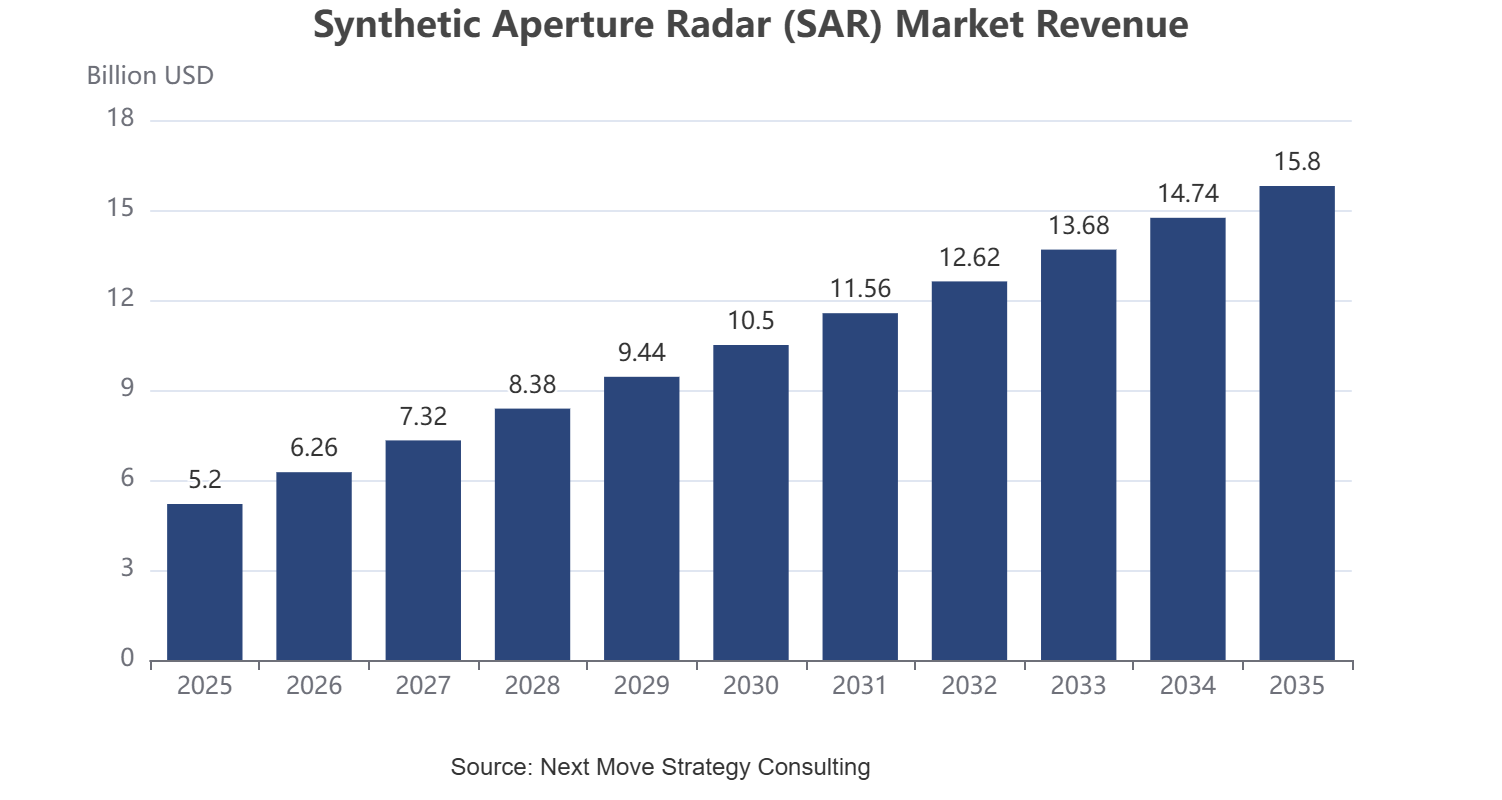
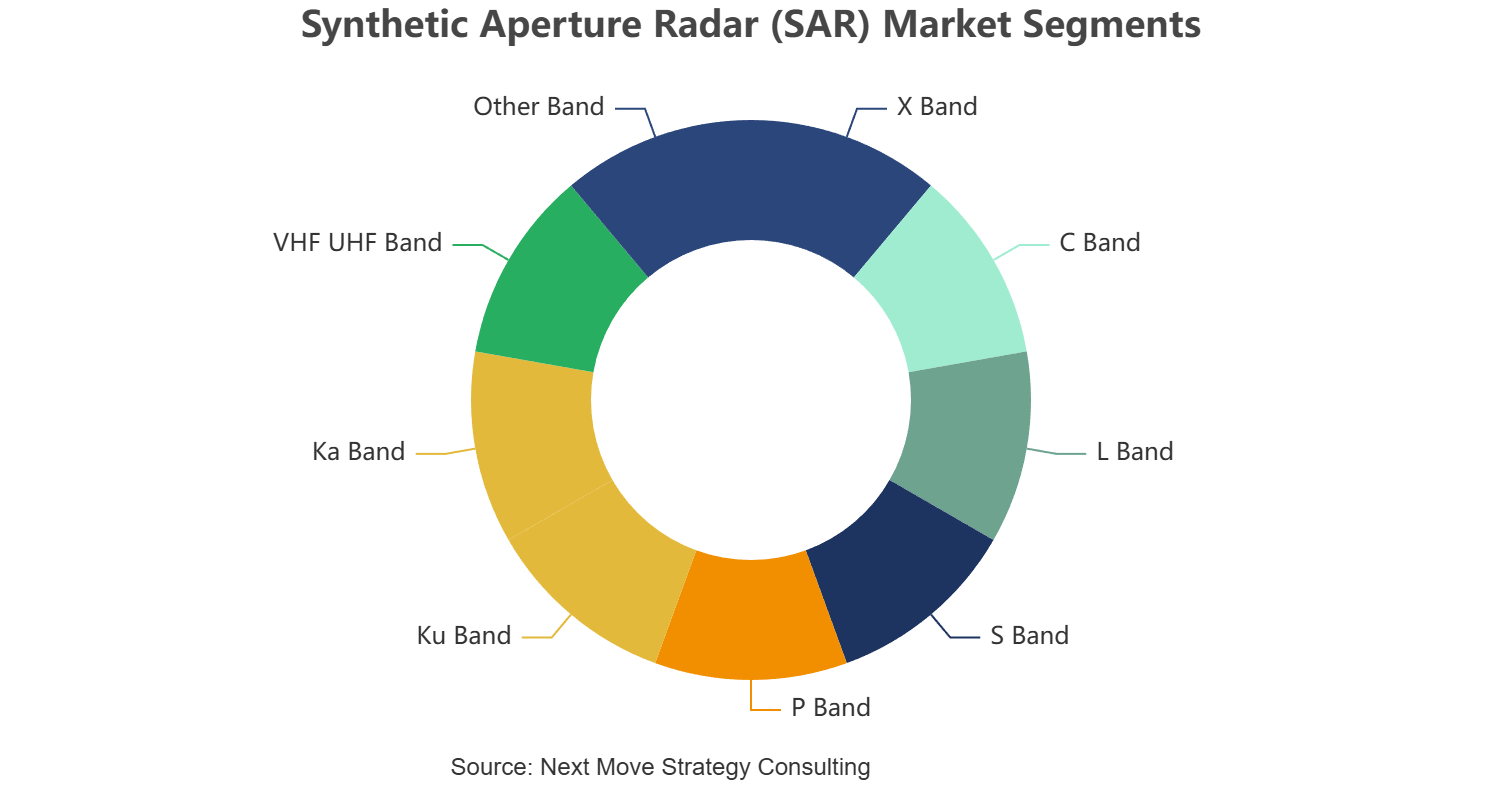
About the Author
 Liza Phukan
— Liza Phukan is Research Associate at Next Move Strategy Consulting, where she has covered emerging industries and market research across sectors for 3.5 years. Her work includes analyzing industry developments, validating market data, and developing structured business content from research findings. She uses secondary research and data-validation practices to turn complex market information into clear decision-useful market analysis for business audiences and support report development and B2B.
Liza Phukan
— Liza Phukan is Research Associate at Next Move Strategy Consulting, where she has covered emerging industries and market research across sectors for 3.5 years. Her work includes analyzing industry developments, validating market data, and developing structured business content from research findings. She uses secondary research and data-validation practices to turn complex market information into clear decision-useful market analysis for business audiences and support report development and B2B.
About the Reviewer
 Supradip Baul
— Supradip Baul is an accomplished business consultant and strategist with over a decade of rich experience in market intelligence, strategy, technology, and business transformation. His work has included rigorous qualitative and quantitative analysis across multiple industries, helping clients shape investment decisions and long-term roadmaps. Earlier in his career, he was associated with Gartner, where he contributed to industry-leading reports and market share analyses. He has worked with leading global companies and holds an MBA with a dual specialization in Marketing and Finance.
Supradip Baul
— Supradip Baul is an accomplished business consultant and strategist with over a decade of rich experience in market intelligence, strategy, technology, and business transformation. His work has included rigorous qualitative and quantitative analysis across multiple industries, helping clients shape investment decisions and long-term roadmaps. Earlier in his career, he was associated with Gartner, where he contributed to industry-leading reports and market share analyses. He has worked with leading global companies and holds an MBA with a dual specialization in Marketing and Finance.
At Next Move Strategy Consulting, we understand that insightful market research is the cornerstone of successful business decisions. That's why we employ a robust and multifaceted approach, combining various methodologies to deliver the most accurate and actionable data for our clients.

Research Landscape
We navigate the world of research with two primary approaches:
Qualitative Approach
Our qualitative research methodologies involve immersive techniques such as in-depth interviews, focus groups, and observational studies. By engaging directly with individuals and stakeholders, we uncover valuable insights that quantitative data alone may overlook.

Quantitative Research
In tandem with qualitative methodologies, NMSC leverages the power of Quantitative Research to provide a robust foundation of numerical insights. Through systematic data collection and analysis, we quantify patterns, preferences, and market trends, offering a comprehensive view of the business landscape.
Our quantitative research approach employs diverse tools, including surveys, experiments, and statistical modelling. These methodologies enable us to gather data from a large and representative sample, ensuring the statistical significance of our findings. By employing structured questionnaires and standardized data collection methods, we guarantee the reliability and validity of the information we present to our clients.
Quantitative research is particularly effective in measuring the prevalence of trends, assessing market size, and gauging the impact of various factors on consumer behavior. The numerical precision attained through this approach equips our clients with actionable insights, facilitating data-driven decision-making and strategy formulation.


Our Specialized Toolbox for Industry-Specific Market Research
We deploy a specialized arsenal of techniques tailored to meet your unique requirements. Here's a glimpse into our comprehensive toolbox:

Information Procurement
The stage entails acquiring market data or relevant information through various sources and methodologies.


Market Research Approach
We utilize both top-down and bottom-up approaches in market research analysis to achieve a comprehensive understanding of the market dynamics, leveraging the broad perspective of industry trends and macroeconomic factors alongside detailed insights from specific segments and individual companies.

Porters Five Forces Analysis
We conduct Porter's Five Forces analysis to evaluate the competitive landscape of an industry, providing us with insights into factors that affect profitability and strategic positioning.

SWOT Analysis

Forecasting
We utilize a forecasting model to predict future consumption by considering parameters like population, economics, regulations, market competition, drivers, constraints, technology, and pricing. We also employ statistical techniques such as multilinear regression, exponential smoothing, moving average, ARIMA, and Monte Carlo simulations for accurate predictions. In econometric forecasting, we analyzed short-term and long-term event impacts, attributing values based on regulatory frameworks, economic factors, and market events.





 Speak to Our Analyst