Anti-Satellite (ASAT) Weapons Market Size, Share, Growth & Forecast by ASAT System Type (Kinetic ASAT Systems, Non-Kinetic ASAT Systems, ASAT Mission Enablement Systems, Lifecycle Services), Platform (Land-Based, Air-Based, Sea-Based, Space-Based), Customer (National Defense Ministries, Space Forces, Strategic Commands, Missile Defense Agencies, Intelligence Agencies, Other Government Security Organizations), 2025–2035
Industry: Aerospace & Defense | Publishing Date: June 26, 2026 | Last Updated: September 17, 2026 | No of Pages: N/A | No. of Tables: N/A | No. of Figures: N/A | Format: PDF | Report Code: AD4815
What Is the Anti Satellite (ASAT) Weapons Market Size?
The global Anti Satellite (ASAT) Weapons Market was valued at USD 10.2 billion in 2025 and is projected to reach USD 11.1 billion in 2026. Expanding counter-space doctrine, escalating geopolitical rivalry in the space domain, and accelerating investment in directed energy and cyber counter-space capabilities are set to propel the market to USD 23.8 billion by 2035, advancing at a CAGR of 8.8% from 2026 to 2035. Key growth drivers include rising national security priorities around space asset protection, the proliferation of low Earth orbit satellite constellations, growing demand for non-kinetic ASAT technologies, and increased defense budgets allocated to space warfare capabilities across the United States, China, Russia, India, and allied nations.
|
Parameters |
Details |
|
Market Size in 2025 |
USD 10.2 Billion |
|
Market Size in 2026 |
USD 11.1 Billion |
|
Revenue Forecast in 2035 |
USD 23.8 Billion |
|
Growth Rate |
CAGR of 8.8% from 2026 to 2035 |
|
Analysis Period |
2025–2035 |
|
Base Year Considered |
2025 |
|
Forecast Period |
2026–2035 |
|
Market Size Estimation |
USD Billion |
|
Companies Profiled |
20 |
|
Countries Covered |
33 |
|
Market Share |
Top 10 |
Anti Satellite (ASAT) Weapons Market Overview
What Is the Anti Satellite (ASAT) Weapons Market?
The Anti Satellite (ASAT) Weapons Market encompasses the development, procurement, integration, and sustainment of weapon systems designed to deny, degrade, disrupt, or destroy adversary satellite assets across all orbital regimes. This market report covers kinetic systems, including direct-ascent missiles and co-orbital interceptors, as well as non-kinetic systems encompassing electronic warfare, directed energy, and cyber counter-space technologies. The market also includes mission enablement systems such as space surveillance networks, targeting platforms, and command and control infrastructure.
How Has the Anti Satellite (ASAT) Weapons Market Evolved?
The Anti Satellite (ASAT) Weapons Market has evolved across three distinct phases. The first phase, spanning the Cold War era through the 1980s, centered on direct-ascent kinetic interceptors and nuclear-tipped systems developed by the United States and Soviet Union. The second phase, from the 1990s through the early 2010s, saw the integration of electronic warfare and satellite jamming capabilities. NMSC's analysis indicates that the current phase is defined by co-orbital systems, directed energy weapons, cyber counter-space capabilities, and multi-domain operational doctrines, as space has formally been recognized as a contested warfare domain.
How Do Regulations and Treaties Influence the Anti Satellite (ASAT) Weapons Market?
The regulatory environment of the market is shaped by the Outer Space Treaty of 1967, which prohibits nuclear weapons in orbit but does not explicitly ban conventional ASAT systems. The United Nations Committee on the Peaceful Uses of Outer Space (COPUOS) has pursued debris mitigation guidelines that constrain destructive kinetic testing. The United States unilaterally declared a moratorium on destructive direct-ascent ASAT missile testing in April 2022, a position subsequently endorsed by multiple allied nations. These policy developments are accelerating demand for reversible, non-kinetic ASAT capabilities across the Anti Satellite (ASAT) Weapons Market.
How Is Technology Adoption Expanding Across the Anti Satellite (ASAT) Weapons Market?
Technology adoption across the Anti Satellite (ASAT) Weapons Market is accelerating as defense organizations shift from exclusively kinetic approaches toward integrated multi-domain counter-space operations. Our analysis shows that directed energy systems, particularly high-energy laser and high-power microwave platforms, are transitioning from experimental to program-of-record status in multiple national defense budgets. Simultaneously, cyber counter-space systems and electronic warfare jamming platforms are being integrated into joint force operations. The increasing use of digital twin simulation and AI-assisted targeting algorithms is advancing the mission enablement segment.
|
Key Takeaways |
|
By ASAT System Type, the Kinetic ASAT Systems segment held the largest share of the Anti Satellite (ASAT) Weapons Market at USD 4.8 billion in 2025, dominated by Direct-Ascent ASAT Missiles, particularly Ground-Based Interceptors deployed by the United States, Russia, China, and India, which represent the most operationally proven counter-space weapon category globally. |
|
The Non-Kinetic ASAT Systems segment is the fastest-growing sub-category within the Anti Satellite (ASAT) Weapons Market at a CAGR of 10.4% from 2026 to 2035, driven by the U.S. moratorium on destructive ASAT testing and escalating demand for reversible, attribution-resistant electronic warfare and cyber counter-space capabilities. |
|
By Platform, the Land-Based segment commanded the largest share of the Anti Satellite (ASAT) Weapons Market at USD 5.1 billion in 2025, owing to the operational maturity, strategic deterrence value, and lower deployment costs of fixed ground-based interceptor systems compared to mobile and domain-agnostic alternatives. |
|
The Space-Based platform segment is the fastest-growing in the Anti Satellite (ASAT) Weapons Market at a CAGR of 11.2% from 2026 to 2035, propelled by investment in co-orbital interceptor satellites, proximity kill vehicles, and dual-use orbital robotic systems as major spacefaring nations develop persistent on-orbit counter-space capabilities. |
|
By Customer, National Defense Ministries held the dominant share at USD 4.2 billion in 2025, reflecting direct government procurement authority over offensive counter-space programs across the United States, China, Russia, India, and key NATO allies within the Anti Satellite (ASAT) Weapons Market. |
|
Space Forces, as a rapidly institutionalized customer segment, represent the fastest-growing buyer category in the Anti Satellite (ASAT) Weapons Market, driven by the establishment of the U.S. Space Force, the French Space Command, and equivalent organizations in Japan, Australia, and the UK committing dedicated counter-space acquisition budgets. |
|
By Revenue Stream, Product Sales constituted the largest revenue share of the Anti Satellite (ASAT) Weapons Market at USD 4.5 billion in 2025, underpinned by high-value procurement contracts for direct-ascent interceptor missiles, directed energy weapon systems, and satellite surveillance radar platforms. |
|
The Sustainment Services segment is the fastest-growing revenue stream in the Anti Satellite (ASAT) Weapons Market at a CAGR of 9.6% from 2026 to 2035, as growing inventories of fielded ASAT platforms require sustained through-life support, software updates, and operational readiness management across multi-decade system lifecycles. |
|
By Technology, Kinetic Interception dominates the Anti Satellite (ASAT) Weapons Market revenue with USD 3.9 billion in 2025, reflecting the operational deployment status of direct-ascent and co-orbital kinetic systems across all major counter-space powers. |
|
Directed Energy technology is the fastest-growing segment in the Anti Satellite (ASAT) Weapons Market at a CAGR of 12.8% from 2026 to 2035, as U.S. Space Force, the U.S. Air Force, and allied defense agencies accelerate transition from prototype to program-of-record status for both laser dazzling and high-energy laser damage capabilities. |
|
North America held the largest regional share of the Anti Satellite (ASAT) Weapons Market at USD 4.9 billion in 2025, projected to reach USD 11.4 billion by 2035 at a CAGR of 8.8%, anchored by U.S. Space Force counter-space programs, Missile Defense Agency investments, and the world's highest concentration of ASAT-capable defense primes. |
|
Asia-Pacific is the fastest-growing major region in the Anti Satellite (ASAT) Weapons Market at a CAGR of 10.6% from 2026 to 2035, propelled by China's expanding co-orbital and directed energy programs, India's Mission Shakti follow-on investments, and Japan's newly established Space Self-Defense Force counter-space acquisition activities. |
|
The United States is the single largest country market in the Anti Satellite (ASAT) Weapons Market share, representing approximately 42% of global revenue in 2025, underpinned by U.S. Space Force Space Systems Command, Missile Defense Agency, and classified NRO and NGA counter-space budgets. |
|
India is the fastest-growing individual country market within the Anti Satellite (ASAT) Weapons Market at a CAGR of 13.2% from 2026 to 2035, propelled by follow-on development of directed-ascent capabilities following the 2019 Mission Shakti test, the establishment of the Defence Space Agency, and India's broader defense indigenization push under Atmanirbhar Bharat. |
Key Emerging Trends in the Anti Satellite (ASAT) Weapons Market
How Is the Shift from Kinetic to Non-Kinetic ASAT Capabilities Reshaping the Anti Satellite (ASAT) Weapons Market?
Based on NMSC's research, we found that the market is undergoing a doctrinal transition from debris-generating kinetic strikes toward reversible, deniable non-kinetic capabilities. The U.S. government's April 2022 unilateral moratorium on direct-ascent destructive ASAT testing has accelerated investment in jamming, spoofing, laser dazzling, and cyber exploitation platforms. For example, the U.S. Space Force's Counter Communications System Block 10.2 represents a fielded electronic attack capability against adversary satellite uplinks, illustrating the operational maturity now reached by non-kinetic systems within the Anti Satellite (ASAT) Weapons Market.
How Are Directed Energy Weapons Transforming Competitive Dynamics in the Anti Satellite (ASAT) Weapons Market?
Directed energy technologies are redefining capability benchmarks across the Anti Satellite (ASAT) Weapons Market. From our research, we found that the U.S. Space Force formally included high-energy laser and high-power microwave programs in its Counter Space Capabilities portfolio within the Future Years Defense Program. Lockheed Martin's 300 kW Laser Weapon System demonstrator and Raytheon's High Power Microwave Advanced Missile Project reflect active industry transition from research to weapon-grade systems. Directed energy platforms offer repeatable engagement capacity without expendable munitions, creating a compelling lifecycle cost advantage for sustained counter-space operations.
What Role Are Co-Orbital Systems Playing in the Evolution of the Anti Satellite (ASAT) Weapons Market?
Co-orbital counter-space systems are emerging as a structurally important growth vector in the Anti Satellite (ASAT) Weapons Market. Our assessment indicates that Russia's Cosmos-2542 and Cosmos-2543 inspector satellites demonstrated close-approach maneuverability and projectile ejection capabilities that alarmed the U.S. intelligence community, as documented in the Defense Intelligence Agency's Space Threat Assessment. China's Shijian-21 satellite conducted active debris removal missions that simultaneously demonstrated co-orbital rendezvous and docking capabilities directly applicable to orbital interception. These activities are compelling allied defense ministries to accelerate co-orbital surveillance and response program investments.
How Is Multi-Domain Counter-Space Integration Driving New Requirements in the Anti Satellite (ASAT) Weapons Market?
Through NMSC's assessment, we found that multi-domain operational doctrine is reshaping procurement priorities across the Anti Satellite (ASAT) Weapons Market. The U.S. Space Force's Space Warfighting Analysis Center and the Joint All-Domain Command and Control (JADC2) initiative require ASAT mission systems to be seamlessly integrated with terrestrial and aerial battle management networks. Integrated counter-space operations now demand that targeting algorithms, battle management software, and communication networks function cohesively across classified and unclassified architectures. This systems integration imperative is expanding the ASAT Mission Enablement Systems segment and elevating software-defined platform architectures.
What Are the Key Market Drivers, Breakthroughs, and Investment Opportunities that Will Shape the Anti Satellite (ASAT) Weapons Market Industry in the Next Decade?
Growth Catalyst and Risk Assessment Matrix
|
Drivers / Trends / Restraints |
(+/-) % Impact on CAGR Forecast |
Geographic Relevance |
Impact Timeline |
|
Escalating Geopolitical Space Competition |
+2.1% |
Global (US, China, Russia, India) |
2025–2035 |
|
LEO Constellation Proliferation Expanding Target Sets |
+1.6% |
Global |
2025–2030 |
|
Non-Kinetic ASAT Doctrine Adoption |
+1.4% |
North America, Europe, APAC |
2025–2032 |
|
Directed Energy Transition to Programs of Record |
+1.8% |
North America, UK, Australia |
2025–2030 |
|
Co-Orbital Counter-Space Investment |
+1.3% |
US, China, Russia, Japan |
2026–2035 |
|
ASAT Testing Moratoriums / Debris Mitigation Policy |
-1.0% |
North America, Europe |
Ongoing |
|
Treaty and Arms Control Risk |
-0.8% |
Global |
Ongoing |
|
Export Control and ITAR Restrictions |
-0.6% |
North America, Europe |
Ongoing |
|
Cyber Counter-Space Opportunities |
+1.2% |
Global |
2025–2035 |
|
Allied Capability Investment via NATO |
+1.1% |
Europe, Canada, Australia |
2026–2035 |
What Are the Growth Drivers of the Anti Satellite (ASAT) Weapons Market?
How Is Escalating Geopolitical Competition in Space Driving Investment in the Anti Satellite (ASAT) Weapons Market?
Geopolitical competition across the space domain is the primary structural driver of the Anti Satellite (ASAT) Weapons Market. The U.S. Department of Defense's 2022 National Defense Strategy explicitly identifies China and Russia as adversaries developing capabilities to contest U.S. space superiority. China conducted a direct-ascent ASAT missile test in 2007, destroying the Fengyun-1C satellite and generating over 3,500 pieces of trackable orbital debris, as documented by NASA's Orbital Debris Program Office. Russia tested its PL-19 Nudol direct-ascent ASAT system in November 2021, creating a debris field that endangered the International Space Station crew. These demonstrated capabilities are compelling every major spacefaring nation to develop responsive counter-space programs.
How Does the Proliferation of Low Earth Orbit Satellite Constellations Expand the Anti Satellite (ASAT) Weapons Market?
The rapid proliferation of commercial and military satellite constellations across low Earth orbit is materially expanding both the strategic rationale and the target environment for anti-satellite weapon development. The U.S. Space Force's Space Surveillance Network currently tracks over 48,000 orbital objects, with thousands of newly launched satellites from programs including Starlink, OneWeb, and Amazon Project Kuiper entering service annually. From our assessment, we found that the dependence of modern military operations on satellite-based positioning, navigation, and timing from GPS, as administered by the U.S. Space Force, creates high-value target sets that adversaries are highly incentivized to attack, thereby sustaining investment in protective and offensive ASAT programs.
How Are Expanding Defense Budgets Fueling the Anti Satellite (ASAT) Weapons Market?
Rising national defense budgets are directly translating into increased Anti Satellite (ASAT) Weapons Market investment. The U.S. Space Force requested USD 30.3 billion for fiscal year 2025, including dedicated counter-space mission system funding. NATO's Strategic Concept adopted at the Madrid Summit in 2022 formally defined space as a domain of warfare and acknowledged that attacks on satellites may trigger Article 5 collective defense responses. India's Defence Space Agency, established in 2019, oversees a dedicated counter-space budget within India's broader annual defense allocation that exceeded USD 74 billion in the fiscal year 2024 to 2025 as reported by the Ministry of Defence.
What Are the Growth Inhibitors of the Anti Satellite (ASAT) Weapons Market?
How Do International Norms and Testing Moratoriums Constrain Growth in the Anti Satellite (ASAT) Weapons Market?
International diplomatic pressure and self-imposed testing constraints are creating structural boundaries within the Anti Satellite (ASAT) Weapons Market, particularly for kinetic direct-ascent systems. The U.S. unilateral moratorium on destructive ASAT testing, announced by Vice President Harris in April 2022 and endorsed by the UN General Assembly through Resolution 77/41, has removed a key validation pathway for new kinetic interceptor systems. Our findings suggest that allied nations including the UK, Canada, Australia, New Zealand, and Japan have formally endorsed this moratorium, collectively limiting the operational demonstration opportunities that defense procurement programs typically require before committing to full-rate production.
How Do Export Controls and Technology Restrictions Limit the Anti Satellite (ASAT) Weapons Market Expansion?
The International Traffic in Arms Regulations administered by the U.S. Department of State and the Export Administration Regulations administered by the U.S. Department of Commerce impose stringent transfer controls on ASAT-relevant technologies, including directed energy systems, satellite tracking sensors, and kinetic interceptor components. These controls limit international market development for U.S.-origin ASAT companies by extending approval timelines and restricting the pool of eligible export customers. Our analysis shows that ITAR restrictions on space-related technologies have been a persistent inhibitor of allied co-development programs, although AUKUS Pillar II advanced capabilities cooperation represents a partial mitigation pathway for trusted allied partners.
What Are the Growth Opportunities in the Anti Satellite (ASAT) Weapons Market?
How Does the Growing Allied Counter-Space Investment Create Anti Satellite (ASAT) Weapons Market Opportunity?
Allied nations' accelerating investments in independent and collective counter-space capabilities represent one of the most significant commercial opportunities in the Anti Satellite (ASAT) Weapons Market. NATO's Space Centre of Excellence in Toulouse, France, and the UK's Space Command established in 2021 are creating institutional demand for interoperable ASAT mission enablement, surveillance, and electronic warfare systems. Australia's Defence Strategic Review 2023 explicitly prioritized space domain awareness and counter-space investment. Through our market evaluation, we found that Japan's 2022 National Security Strategy identified adversary satellite capabilities as a direct national security threat, committing multi-year counter-space investment that creates export opportunities for U.S. and European defense primes.
How Is the Directed Energy Transition from R&D to Operational Status Creating New Revenue Streams in the Anti Satellite (ASAT) Weapons Market?
The maturation of directed energy technologies from research programs to fielded operational systems is creating durable new revenue streams within the Anti Satellite (ASAT) Weapons Market. The U.S. Air Force Research Laboratory and Space Force have progressed multiple high-energy laser and high-power microwave programs toward technology readiness levels sufficient for program-of-record transition. NMSC's analysis indicates that directed energy systems require substantial ongoing sustainment, software optimization, and power generation infrastructure investment that creates recurring lifecycle revenue beyond initial procurement. The repeatable engagement capacity of directed energy platforms, as compared to expendable kinetic systems, offers defense ministries a cost-per-engagement advantage that is accelerating adoption decisions.
What Opportunities Does the Rise of Cyber Counter-Space Create in the Anti Satellite (ASAT) Weapons Market?
Cyber counter-space capabilities represent a strategically important and commercially expanding segment of the Anti Satellite (ASAT) Weapons Market that operates largely without the policy constraints applied to kinetic systems. Our analysis shows that the U.S. Cyber Command and Space Force have integrated cyber operations into counter-space mission planning, creating demand for specialized ground segment penetration tools, data link manipulation capabilities, and satellite access exploitation systems. The non-destructive nature of cyber ASAT operations makes them politically and legally more accessible than kinetic alternatives, driving growing investment from defense ministries seeking attribution-resistant counter-space options compatible with international norms.
How Is the Anti Satellite (ASAT) Weapons Market Segmented in This Report, and What Are the Key Insights from the Segmentation Analysis?
How Do Kinetic and Non-Kinetic System Types Define Revenue Distribution in the Anti Satellite (ASAT) Weapons Market?
|
ASAT System Type Segment |
2025 (USD Bn) |
2035 (USD Bn) |
CAGR (%) |
|
Kinetic ASAT Systems |
4.8 |
9.6 |
7.2% |
|
Non-Kinetic ASAT Systems |
3.1 |
8.8 |
10.4% |
|
ASAT Mission Enablement Systems |
1.7 |
3.9 |
8.6% |
|
Lifecycle Services |
0.6 |
1.5 |
9.6% |
Based on our analysis of counter-space program structures, we found that the Anti Satellite (ASAT) Weapons Market is segmented into Kinetic ASAT Systems, Non-Kinetic ASAT Systems, ASAT Mission Enablement Systems, and Lifecycle Services. Kinetic ASAT Systems remain the dominant segment due to the operational maturity of direct-ascent missile programs in the United States, Russia, China, and India, with Ground-Based Interceptors representing the largest revenue sub-segment. Non-Kinetic ASAT Systems, encompassing Electronic Warfare, Cyber Counter-Space, Directed Energy, and Co-Orbital Non-Kinetic platforms, are growing fastest as policy constraints on destructive testing redirect investment toward reversible and deniable counter-space methods. ASAT Mission Enablement Systems, including Space Surveillance, Targeting, Command and Control, and Test and Training platforms, are expanding in line with growing program complexity and multi-domain integration requirements.
Which Deployment Platforms Are Driving the Most Growth Across the Anti Satellite (ASAT) Weapons Market?
|
Platform Segment |
2025 (USD Bn) |
2035 (USD Bn) |
CAGR (%) |
|
Land-Based |
5.1 |
10.7 |
7.7% |
|
Air-Based |
1.9 |
4.3 |
8.5% |
|
Sea-Based |
1.4 |
3.2 |
8.6% |
|
Space-Based |
1.8 |
5.6 |
11.2% |
Through NMSC's assessment, we found that the Anti Satellite (ASAT) Weapons Market platform segment is divided into Land-Based, Air-Based, Sea-Based, and Space-Based categories. Land-Based systems dominate due to the established operational deployment of fixed and mobile ground-based interceptors and electronic warfare stations across major counter-space powers. Fixed Systems, including silo-based and tower-mounted interceptor installations, represent the largest platform sub-segment. Air-Based platforms, including Fighter Aircraft and Strategic Aircraft-launched ASAT systems, are gaining investment following the demonstrated feasibility of air-launch profiles that extend engagement envelopes. Space-Based platforms, encompassing Co-Orbital Satellites and Orbital Payloads, represent the fastest-growing platform category as nations invest in persistent on-orbit counter-space presence. Sea-Based ASAT systems, including Surface Combatant and Naval Interceptor launch systems, benefit from the dual-use nature of ship-based missile defense architectures.
Which Customer Segments Are Driving Procurement Decisions in the Anti Satellite (ASAT) Weapons Market?
|
Customer Segment |
2025 (USD Bn) |
2035 (USD Bn) |
CAGR (%) |
|
National Defense Ministries |
4.2 |
8.8 |
7.7% |
|
Space Forces |
1.8 |
5.1 |
11.0% |
|
Strategic Commands |
1.6 |
3.6 |
8.4% |
|
Missile Defense Agencies |
1.4 |
3.2 |
8.6% |
|
Intelligence Agencies |
0.8 |
1.9 |
9.0% |
|
Other Government Security Organizations |
0.4 |
1.2 |
11.6% |
Our analysis of defense procurement structures reveals that the Anti Satellite (ASAT) Weapons Market is served by National Defense Ministries, Space Forces, Strategic Commands, Missile Defense Agencies, Intelligence Agencies, and Other Government Security Organizations. National Defense Ministries remain the dominant customer as they control overarching counter-space budget allocations and program approval processes. Space Forces represent the fastest-growing customer segment, with the U.S. Space Force, the French Commandement de l'Espace, and Japan's Space Operations Command institutionalizing dedicated counter-space acquisition capacity. Strategic Commands, including the U.S. Strategic Command and equivalent joint force headquarters, maintain co-operative oversight over ASAT employment authorities, generating demand for integrated command and control systems that interface with the broader nuclear and conventional deterrence architectures.
How Are Revenue Streams Evolving Across the Anti Satellite (ASAT) Weapons Market?
|
Revenue Stream Segment |
2025 (USD Bn) |
2035 (USD Bn) |
CAGR (%) |
|
Product Sales |
4.5 |
9.2 |
7.4% |
|
System Integration |
2.1 |
4.9 |
8.8% |
|
Software |
0.8 |
2.8 |
13.3% |
|
Engineering Services |
1.2 |
2.8 |
8.8% |
|
Sustainment Services |
1.0 |
2.7 |
9.6% |
|
Training Services |
0.6 |
1.4 |
8.8% |
Based on NMSC's research, we found that the Anti Satellite (ASAT) Weapons Market revenue streams are distributed across Product Sales, System Integration, Software, Engineering Services, Sustainment Services, and Training Services. Product Sales represent the largest revenue category, driven by high-unit-value procurements of direct-ascent interceptors, directed energy weapon systems, and space surveillance radar installations. Software is the fastest-growing revenue stream, reflecting the increasing criticality of targeting algorithms, battle management software, cyber exploitation tools, and simulation systems within modern ASAT mission architectures. System Integration services are expanding as ASAT platforms require interfacing with multi-domain command networks, space surveillance databases, and national command authority systems. Sustainment Services growth is driven by accumulating inventories of fielded counter-space systems requiring ongoing readiness management.
Which Technologies Are Emerging as Dominant Capabilities Within the Anti Satellite (ASAT) Weapons Market?
|
Technology Segment |
2025 (USD Bn) |
2035 (USD Bn) |
CAGR (%) |
|
Kinetic Interception |
3.9 |
7.6 |
6.9% |
|
Electronic Warfare |
2.2 |
5.3 |
9.2% |
|
Cyber Warfare |
1.3 |
3.8 |
11.3% |
|
Directed Energy |
1.1 |
3.9 |
12.8% |
|
Orbital Robotics |
0.9 |
2.4 |
10.2% |
|
Multi-Domain Counter-Space |
0.8 |
0.8 |
8.8% |
NMSC's analysis indicates that the Anti Satellite (ASAT) Weapons Market technology portfolio spans Kinetic Interception, Electronic Warfare, Cyber Warfare, Directed Energy, Orbital Robotics, and Multi-Domain Counter-Space categories. Kinetic Interception technology retains the largest installed base revenue due to decades of program investment in hit-to-kill vehicles and ground-based interceptor systems. Directed Energy technology is the fastest-growing segment, advancing from prototype to operational status across the U.S. Space Force, Missile Defense Agency, and allied programs. Electronic Warfare, encompassing uplink jamming, downlink jamming, navigation signal denial, and communications interference, constitutes the broadest operationally deployed non-kinetic counter-space capability globally. Cyber Warfare and Orbital Robotics are emerging technology growth segments as advanced counter-space powers integrate these capabilities into operational doctrine.
How Does Target Satellite Class Structure Influence Procurement Priorities in the Anti Satellite (ASAT) Weapons Market?
|
Target Satellite Class |
2025 (USD Bn) |
2035 (USD Bn) |
CAGR (%) |
|
Communications Satellites |
2.6 |
5.9 |
8.5% |
|
ISR Satellites |
2.4 |
5.4 |
8.4% |
|
Navigation Satellites |
2.1 |
4.8 |
8.6% |
|
Early Warning Satellites |
1.6 |
3.5 |
8.1% |
|
Military Constellations |
1.0 |
3.2 |
12.3% |
|
Other Space Assets |
0.5 |
1.0 |
7.2% |
Our findings suggest that the Anti Satellite (ASAT) Weapons Market target satellite class segmentation reflects the strategic prioritization of adversary satellite architectures. Communications Satellites represent the highest-value counter-space target class, given their central role in C2 networks and strike coordination, and accordingly attract the largest share of ASAT investment across kinetic, electronic, and cyber domains. ISR Satellites and Navigation Satellites, particularly GPS and its GLONASS, BeiDou, and Galileo equivalents, constitute similarly high-priority targets that drive dedicated jamming, spoofing, and directed energy investment. Military Constellations, including proliferated LEO architectures operated by major powers, are the fastest-growing target class segment as the strategic value of distributed satellite networks increases their counter-space priority.
Regional Outlook
Geographic Performance Snapshot
|
Region |
2025 (USD Bn) |
2035 (USD Bn) |
CAGR (%) |
Key Driver |
|
North America |
4.9 |
11.4 |
8.8% |
U.S. Space Force, MDA programs |
|
Asia-Pacific |
2.8 |
7.6 |
10.6% |
China, India, Japan space rivalry |
|
Europe |
1.5 |
3.2 |
7.8% |
NATO counter-space, allied programs |
|
Middle East & Africa |
0.6 |
1.1 |
6.2% |
Israel, UAE defense modernization |
|
Latin America |
0.4 |
0.5 |
2.3% |
Brazil, nascent programs |
North America Anti Satellite (ASAT) Weapons Market
North America is the global leader of the Anti Satellite (ASAT) Weapons Market, accounting for USD 4.9 billion in 2025 and forecast to reach USD 11.4 billion by 2035 at a CAGR of 8.8%. The region benefits from the institutional depth of the U.S. Space Force, the Missile Defense Agency, U.S. Strategic Command, and the National Reconnaissance Office, each of which operates distinct counter-space program portfolios. Strong defense industrial base capacity, classified program funding beyond public budget lines, and the deepest concentration of ASAT-capable prime contractors globally underpin sustained North American market leadership.
U.S. Anti Satellite (ASAT) Weapons Market
Based on our engagements with defense industry stakeholders, the United States represents approximately 89% of North American Anti Satellite (ASAT) Weapons Market revenue in 2025, establishing it as the world's single largest national ASAT market. U.S. Space Force Space Systems Command manages the Counter Communications System, Space Domain Awareness programs, and classified offensive counter-space programs as stated in Space Force budget justification documents submitted to Congress. The Defense Intelligence Agency's Space Threat Assessment publications articulate the strategic rationale driving persistent ASAT investment across kinetic, directed energy, electronic warfare, and cyber counter-space domains.
Canada Anti Satellite (ASAT) Weapons Market
Through our analysis, Canada participates in the Anti Satellite (ASAT) Weapons Market primarily through its integrated role in NORAD, the binational North American Aerospace Defense Command that provides space domain awareness and missile warning to both the United States and Canada. Canada's 2024 NORAD Modernization investment commitment includes space surveillance enhancements relevant to counter-space mission enablement. The Canadian Department of National Defence has articulated space as a critical domain in its 2024 Defence Policy Update, though independent Canadian ASAT procurement remains nascent relative to the U.S. share of regional investment.
Mexico Anti Satellite (ASAT) Weapons Market
From our assessment, Mexico maintains a minimal direct presence in the Anti Satellite (ASAT) Weapons Market, with no publicly documented indigenous ASAT development programs. Mexico's defense space activities are focused on satellite communications and earth observation procurement rather than counter-space capabilities. The country's participation in broader space-related discussions through COPUOS and the UN reflects a policy orientation more aligned with peaceful uses of outer space. ASAT market activity in Mexico is effectively zero in terms of indigenous program investment, with relevance limited to potential future allied security cooperation arrangements.
Europe Anti Satellite (ASAT) Weapons Market
Europe constitutes the third-largest region in the Anti Satellite (ASAT) Weapons Market, contributing USD 1.5 billion in 2025 and forecast to reach USD 3.2 billion by 2035 at a CAGR of 7.8%. Europe's counter-space development is shaped by NATO's June 2021 space policy, which defines attacks on allies' satellites as potentially triggering collective defense responses, and by the European Union's Space Strategy for Security and Defence published in 2023. France, the UK, and Germany are the primary European counter-space investment centers, each operating national space command structures with dedicated counter-space portfolios.
UK Anti Satellite (ASAT) Weapons Market
Based on our engagements, the United Kingdom is Europe's leading investor in the Anti Satellite (ASAT) Weapons Market following the establishment of UK Space Command in April 2021 under Air Command. The UK's Defence Space Strategy, published in February 2022, explicitly acknowledged that the UK must develop offensive space capabilities. The UK has endorsed the U.S. ASAT testing moratorium, steering investment toward electronic warfare, directed energy research, and cyber counter-space programs. Dstl and DSEI partnership programs with the United States under AUKUS Pillar II frameworks create significant allied co-development opportunities within the UK counter-space industrial base.
Germany Anti Satellite (ASAT) Weapons Market
According to our evaluation, Germany is expanding its Anti Satellite (ASAT) Weapons Market presence through the German Air Force's Space Situational Awareness Center and Germany's contribution to NATO space operations. The Bundeswehr's Weltraumkommando Deutschland, established in 2021, provides institutional governance for German space and counter-space programs. Germany's 2022 National Security Strategy and the 100 billion euro Bundeswehr special fund have created new investment capacity for space domain awareness and electronic warfare programs relevant to counter-space mission enablement within the broader German defense modernization program.
France Anti Satellite (ASAT) Weapons Market
Through our analysis, we noticed that France is the European nation most advanced in explicitly acknowledging and developing offensive counter-space capabilities in the Anti Satellite (ASAT) Weapons Market. France's Space Defence Strategy, published by the Ministry for the Armed Forces in 2019 and updated in 2023, committed to developing defensive and offensive capabilities to protect French satellites and respond to hostile space acts. The French Commandement de l'Espace, established in 2019 under the French Air and Space Force, operates dedicated space surveillance radars and has initiated a defensive armed satellite program designated YODA for operational deployment.
Italy Anti Satellite (ASAT) Weapons Market
From our assessment, Italy participates in the Anti Satellite (ASAT) Weapons Market through its contributions to NATO space operations and through the Italian Air Force's space surveillance capabilities. Italy operates the Space Surveillance and Tracking national infrastructure under the EU SST framework. While Italy does not publicly maintain an independent offensive ASAT program, its industrial base, including Leonardo and Thales Alenia Space, provides electronic warfare, space surveillance sensor, and satellite communication jamming capabilities relevant to the broader counter-space technology ecosystem. Italy's growing defense budget commitments align with NATO's 2% GDP spending target.
Spain Anti Satellite (ASAT) Weapons Market
Based on our evaluation, Spain's presence in the Anti Satellite (ASAT) Weapons Market remains modest but is growing through its participation in NATO space operations and EU SST contributions. The Spanish Air Force operates space surveillance and satellite control capabilities at Torrejón de Ardoz. Spain's defence modernization program, funded through increased NATO spending commitments, is creating incremental investment in electronic warfare systems and space domain awareness platforms with counter-space relevance. Indra Sistemas provides core space surveillance and electronic warfare capabilities to the Spanish Armed Forces.
Sweden Anti Satellite (ASAT) Weapons Market
Through our analysis, Sweden has emerged as a notable contributor to the European Anti Satellite (ASAT) Weapons Market context through its NATO accession finalized in March 2024 and its advanced electronic warfare industrial base centered on Saab's electronic warfare division. Sweden's FMV Defence Materiel Administration has invested in space domain awareness to protect Swedish communications satellites. Saab's signature AESA radar technologies and advanced electronic warfare systems have broad applicability to counter-space mission requirements, positioning Swedish industry as a growing participant in NATO allied counter-space supply chains.
Denmark Anti Satellite (ASAT) Weapons Market
According to our evaluation, Denmark participates in the Anti Satellite (ASAT) Weapons Market through its NATO membership, its contribution to joint space domain awareness operations, and Denmark's own satellite communications infrastructure protection requirements. Denmark's Defence Agreement 2024 to 2033 substantially increased defense spending to reach NATO's 2% GDP target, creating new investment capacity for space-related electronic warfare and communications security capabilities. Denmark's geographic position, including Greenland's early warning radar infrastructure operated jointly with the United States, gives Denmark a strategic role in space domain awareness supporting broader counter-space mission chains.
Finland Anti Satellite (ASAT) Weapons Market
From our assessment, Finland's NATO accession in April 2023 has integrated Finnish defense capabilities, including its advanced electronic warfare and signals intelligence infrastructure developed during decades of proximity to Russian military activities, into the broader NATO counter-space ecosystem. Finland's National Defence University and Defence Research Agency conduct research relevant to electronic warfare and cyber security dimensions of counter-space operations. Finland's industrial base, including Nokia's network security division and Patria's defense electronics capabilities, supports electronic attack mission areas with counter-space application within the Anti Satellite (ASAT) Weapons Market.
Netherlands Anti Satellite (ASAT) Weapons Market
Based on our engagements, the Netherlands plays an important infrastructure and policy role in the European Anti Satellite (ASAT) Weapons Market through hosting NATO Allied Air Command at Ramstein-adjacent coordination structures and through Netherlands Aerospace Centre research programs. The Royal Netherlands Air Force operates Patriot missile defense systems with ballistic missile intercept capabilities that can be configured for ASAT mission profiles. The Netherlands Space Office participates in ESA and EU SST programs. Dutch company TNO conducts advanced electronic warfare research with applicability to counter-satellite operations as part of its defence and security research portfolio.
Rest of Europe Anti Satellite (ASAT) Weapons Market
Through our analysis, the Rest of Europe, including Poland, Norway, Belgium, Switzerland, Czech Republic, and other NATO members, collectively contributes an emerging share of Anti Satellite (ASAT) Weapons Market investment. Poland is increasing defense spending beyond 4% of GDP, the highest among NATO members, creating capacity for electronic warfare and space domain awareness programs. Norway participates through the Andøya Space range and its partnership with the United States on early warning radar infrastructure. Switzerland and Austria maintain neutral status that limits offensive ASAT participation, while Nordic and Eastern European states are progressively integrating into allied counter-space supply chains.
Asia-Pacific Anti Satellite (ASAT) Weapons Market
Asia-Pacific is the fastest-growing major region in the Anti Satellite (ASAT) Weapons Market, advancing from USD 2.8 billion in 2025 to an estimated USD 7.6 billion by 2035 at a CAGR of 10.6%. China's demonstrated kinetic ASAT capability combined with ongoing directed energy and co-orbital development, India's operationally proven direct-ascent capability following Mission Shakti, and Japan's emerging counter-space command structure are collectively establishing Asia-Pacific as the most dynamically contested regional counter-space environment. South Korea and Australia are also expanding space domain awareness and electronic warfare investments.
China Anti Satellite (ASAT) Weapons Market
Based on our engagements with defense analysis sources, China represents the largest Anti Satellite (ASAT) Weapons Market in Asia-Pacific, driven by the People's Liberation Army Strategic Support Force and its successor Space and Cyberspace Force established in 2024. The Defense Intelligence Agency's Space Threat Assessment annually documents China's advancing ASAT capabilities across direct-ascent missiles, ground-based lasers, co-orbital systems, jamming, and cyber counter-space domains. China's SC-19 and DN-3 direct-ascent ASAT systems and the Shijian satellite series collectively constitute one of the most comprehensive ASAT arsenals globally, driving peer-competitive investment across the United States and allied nations.
India Anti Satellite (ASAT) Weapons Market
Through our analysis, India is the fastest-growing individual country market in the Anti Satellite (ASAT) Weapons Market at a CAGR of 13.2% from 2026 to 2035. India's Ministry of Defence confirmed the successful test of Mission Shakti, a direct-ascent ASAT missile test, on March 27, 2019, making India the fourth nation globally to demonstrate a kinetic ASAT capability. The Defence Space Agency, established under the Integrated Defence Staff, coordinates India's counter-space doctrine and capability development. India's Defence Research and Development Organisation is advancing directed energy and electronic warfare programs as part of India's post-Mission Shakti counter-space modernization agenda.
Japan Anti Satellite (ASAT) Weapons Market
Based on our engagements, Japan is rapidly expanding its presence in the Anti Satellite (ASAT) Weapons Market through the Japan Air Self-Defence Force's Space Operations Squadron, established in 2020 and expanded to a Space Operations Group in 2022. Japan's three foundational national security documents released in December 2022, the National Security Strategy, the National Defence Strategy, and the Defence Buildup Program, collectively identified adversary space capabilities as a critical threat and committed to doubling defence spending. Japan's acquisition of Aegis destroyers with ballistic missile intercept capability provides an inherent sea-based ASAT option alongside dedicated space domain awareness investments.
South Korea Anti Satellite (ASAT) Weapons Market
From our assessment, South Korea is an emerging participant in the Anti Satellite (ASAT) Weapons Market, driven by the threat from North Korea's growing reconnaissance satellite program and the broader regional space security environment. The Korean Space Force, integrated within the Republic of Korea Air Force, oversees space operations including domain awareness. South Korea's Space Development Promotion Act and the Korea AeroSpace Administration established in 2024 create institutional frameworks supporting both civilian and military space programs. South Korea's advanced missile defense investments, including the Cheolmae-2 and L-SAM systems, provide inherent exo-atmospheric intercept capabilities relevant to counter-space mission profiles.
Taiwan Anti Satellite (ASAT) Weapons Market
According to our evaluation, Taiwan's Anti Satellite (ASAT) Weapons Market engagement is shaped primarily by the asymmetric threat environment created by China's demonstrated and advancing ASAT capabilities directed at Taiwan's communications and ISR satellite dependencies. The Republic of China Armed Forces' space domain awareness and satellite communications resilience programs are driven by the imperative to maintain operational capability in degraded space environments. Taiwan's National Space Organization manages both civilian and defence-relevant satellite programs. Taiwan does not publicly maintain offensive ASAT programs, with investment focused on resilience, redundancy, and electronic protection of military satellite links.
Indonesia Anti Satellite (ASAT) Weapons Market
Through our analysis, Indonesia's participation in the Anti Satellite (ASAT) Weapons Market is nascent, focused primarily on satellite communications and earth observation programs through the National Institute of Aeronautics and Space (LAPAN), now integrated into the National Research and Innovation Agency (BRIN). Indonesia's defence white paper priorities are centered on maritime security, and counter-space capabilities are not a stated near-term procurement priority. However, Indonesia's strategic location and growing defence modernization budget may create future demand for space domain awareness and communications security capabilities with counter-space relevance as the regional security environment evolves.
Vietnam Anti Satellite (ASAT) Weapons Market
Based on our assessment, Vietnam maintains a minimal Anti Satellite (ASAT) Weapons Market footprint, with no publicly documented offensive counter-space programs. Vietnam's space activities are managed through the Vietnam National Space Center under the Vietnam Academy of Science and Technology, focused on remote sensing satellite operations. Vietnam's defence modernization priorities are oriented toward conventional maritime and air capabilities. Electronic warfare investments with potential counter-space application exist within the Vietnam People's Air Force, but these do not constitute a materially significant segment of the Anti Satellite (ASAT) Weapons Market globally.
Australia Anti Satellite (ASAT) Weapons Market
From our engagements, Australia is an increasingly significant participant in the Anti Satellite (ASAT) Weapons Market through the AUKUS Pillar II advanced capabilities program, the Australian Space Agency's Defence Coordination Office, and the Royal Australian Air Force's No. 4 Squadron space operations. Australia's 2023 Defence Strategic Review committed to developing integrated counter-space capabilities as part of a broader deterrence posture. Australia co-hosts the Harold E. Holt Naval Communication Station and Pine Gap joint facilities, both of which provide space domain awareness and signal intelligence capabilities critical to counter-space mission enablement.
Philippines Anti Satellite (ASAT) Weapons Market
According to our evaluation, the Philippines has negligible direct investment in the Anti Satellite (ASAT) Weapons Market, with no independent offensive counter-space programs. The Philippine Space Agency, established in 2019, is focused on civilian earth observation and disaster response applications. The Enhanced Defence Cooperation Agreement with the United States provides access to U.S. space-enabled capabilities for the Armed Forces of the Philippines but does not constitute indigenous ASAT development. Electronic warfare and communications security investments relevant to satellite link protection represent the closest proximity the Philippine defence budget has to counter-space expenditure.
Malaysia Anti Satellite (ASAT) Weapons Market
Through our analysis, Malaysia maintains a minimal but emerging awareness-level presence in the Anti Satellite (ASAT) Weapons Market context. The Malaysian Space Agency supports government satellite communications and remote sensing programs. Malaysia's defence focus is on conventional force modernization, maritime patrol, and counterterrorism rather than dedicated counter-space programs. No publicly documented offensive ASAT programs exist within Malaysia's defence acquisition portfolio. Participation in ASEAN-level space security discussions and bilateral defence cooperation with major space powers may create future pathways for Malaysian acquisition of space domain awareness capabilities.
Rest of Asia-Pacific Anti Satellite (ASAT) Weapons Market
Based on our assessment, the Rest of Asia-Pacific, comprising New Zealand, Singapore, Thailand, Bangladesh, and Pacific Island nations, collectively represents a growing but modest contribution to the Anti Satellite (ASAT) Weapons Market. Singapore, through its Defence Science and Technology Agency and Singapore Armed Forces, maintains space domain awareness capabilities and electronic warfare programs with counter-space applications. New Zealand participates in the Five Eyes intelligence community and the AUKUS dialogue, providing space awareness data contributions. Thailand and other Southeast Asian nations are in the early stages of military space program development with limited direct counter-space investment.
Middle East and Africa Anti Satellite (ASAT) Weapons Market
The Middle East and Africa constitute the fourth-largest region in the Anti Satellite (ASAT) Weapons Market, valued at USD 0.6 billion in 2025 and forecast to reach USD 1.1 billion by 2035 at a CAGR of 6.2%. Israel represents the dominant counter-space investment center in the region, with an advanced defense technology industrial base. The UAE is investing in space domain awareness and electronic warfare as part of its broader defense modernization under Vision 2031. Saudi Arabia's Vision 2030 defense transformation is creating nascent demand for space situational awareness and communications protection capabilities.
Saudi Arabia Anti Satellite (ASAT) Weapons Market
Saudi Arabia Anti Satellite (ASAT) Weapons Market
Based on our engagements, Saudi Arabia's Anti Satellite (ASAT) Weapons Market participation is primarily driven by communications satellite protection requirements and space domain awareness investments aligned with Vision 2030's defense modernization objectives. The Saudi Space Commission, established in 2018, oversees national space strategy. While Saudi Arabia does not publicly maintain offensive ASAT programs, its partnerships with major Western defense primes and participation in GEOINT and space domain awareness programs through allies create exposure to counter-space mission enablement technology. The Kingdom's substantial defense procurement budget creates potential for future capability investments aligned with its strategic threat environment.
UAE Anti Satellite (ASAT) Weapons Market
Through our analysis, the UAE is an emerging participant in the Anti Satellite (ASAT) Weapons Market through its advanced electronic warfare programs and its Mohammed Bin Rashid Space Centre investment portfolio. The UAE's National Space Programme and Space Policy 2030 align civil and military space investments. The UAE Armed Forces have procured advanced electronic warfare systems, including Raytheon and L3Harris platforms, with inherent communications jamming capabilities relevant to counter-space operations. EDGE Group, the UAE's state-owned advanced technology conglomerate, is developing indigenous electronic warfare capabilities that extend into the satellite communications disruption domain.
Egypt Anti Satellite (ASAT) Weapons Market
According to our evaluation, Egypt has a minimal direct presence in the Anti Satellite (ASAT) Weapons Market, with no publicly documented offensive counter-space programs. Egypt's space activities are managed through the Egyptian Space Agency, established in 2019, focusing on remote sensing and communications satellite operations. Egyptian military modernization priorities are centered on conventional air defense, naval forces, and land warfare capabilities. Electronic warfare systems procured from Russian and Western suppliers provide indirect exposure to ASAT-adjacent jamming capabilities but do not constitute a dedicated counter-space investment program.
Israel Anti Satellite (ASAT) Weapons Market
From our engagements, Israel is the most technically advanced counter-space technology developer in the Middle East and Africa Anti Satellite (ASAT) Weapons Market segment. Israel has demonstrated directed energy capability through its Iron Beam laser air defense system, representing a technology base directly applicable to dazzling and blinding satellite sensors. Elbit Systems, Rafael Advanced Defense Systems, and IAI all produce electronic warfare systems with demonstrated satellite communications disruption capabilities. Israel's Rafael has exported SPICE and Rampage precision munitions incorporating satellite navigation denial countermeasures. Israeli intelligence agencies maintain classified ASAT mission capabilities that are not publicly documented.
Turkey Anti Satellite (ASAT) Weapons Market
Based on our analysis, Turkey is a growing participant in the Anti Satellite (ASAT) Weapons Market through its expanding defense electronics industrial base. ASELSAN, Turkey's dominant defense electronics company, produces electronic warfare systems including KORAL, a land-based electronic warfare system with communications jamming capabilities relevant to satellite link disruption. Turkey's own Göktürk reconnaissance satellite operations and TürkSAT communications satellite dependencies create domestic incentives for counter-space awareness investments. Turkey's geopolitical positioning as both a NATO member and an autonomous defense procurement nation creates a unique market dynamic within the regional counter-space context.
Nigeria Anti Satellite (ASAT) Weapons Market
Through our assessment, Nigeria's engagement with the Anti Satellite (ASAT) Weapons Market is negligible in terms of direct procurement. Nigeria's National Space Research and Development Agency focuses exclusively on civilian satellite applications. The Nigerian Armed Forces' space-related activities are limited to communications satellite utilization and basic GPS-dependent navigation systems. No publicly documented offensive or non-kinetic counter-space programs exist within Nigeria's defence budget. Nigeria's regional security focus on counterterrorism, piracy, and internal stability operations dominates defence expenditure, with no near-term driver for dedicated ASAT capability development.
South Africa Anti Satellite (ASAT) Weapons Market
Based on our evaluation, South Africa maintains a minimal presence in the Anti Satellite (ASAT) Weapons Market. The South African National Space Agency focuses on remote sensing and space science. Denel, South Africa's state-owned defense industrial group, has historically developed advanced missile and electronic warfare systems, including the Umkhonto ship-launched missile, which provides a theoretical sea-based intercept capability though not explicitly designed for ASAT missions. South Africa's participation in the Africa Aerospace and Defence industry context and its historical radar research capabilities at the SARAO create an indigenous technology foundation that could support future counter-space adjacent program development.
Rest of Middle East and Africa Anti Satellite (ASAT) Weapons Market
Through our analysis, the Rest of the Middle East and Africa, encompassing Jordan, Kuwait, Bahrain, Oman, Qatar, and sub-Saharan African nations, collectively contributes a marginal share of Anti Satellite (ASAT) Weapons Market investment. Qatar's Emiri Air Force has procured advanced Western electronic warfare systems through its F-15QA and Typhoon acquisitions that incorporate communications protection capabilities. Jordan participates in counter-space adjacent electronic warfare programs through its bilateral defense relationships. Sub-Saharan African nations outside South Africa have no documented ASAT investment activities given their current defense budget prioritization levels and security environments.
Latin America Anti Satellite (ASAT) Weapons Market
Latin America represents the smallest regional market in the market, valued at USD 0.4 billion in 2025 and forecast to reach USD 0.5 billion by 2035 at a modest CAGR of 2.3%. Counter-space investments in the region are minimal and primarily limited to Brazil, which maintains the most advanced space program in Latin America through the Brazilian Space Agency. Latin American defense priorities are focused on internal security, border control, and conventional force modernization rather than dedicated counter-space capability development. The region is not a material driver of global Anti Satellite (ASAT) Weapons Market growth in the 2025 to 2035 forecast period.
Brazil Anti Satellite (ASAT) Weapons Market
Based on our engagements, Brazil is the only Latin American nation with a material presence in the Anti Satellite (ASAT) Weapons Market, driven by its comprehensive space program under the Brazilian Space Agency and its indigenous rocket development program at the Alcântara Launch Center. Brazil's Armed Forces operate communications and earth observation satellites and maintain electronic warfare systems through Embraer Defence and Security and its subsidiaries. Brazil's SISFRON border monitoring system and its satellite communications infrastructure create domestic incentives for space domain awareness investment. However, no offensive ASAT programs are publicly documented within Brazil's defense budget.
Argentina Anti Satellite (ASAT) Weapons Market
Through our analysis, Argentina has minimal direct investment in the Anti Satellite (ASAT) Weapons Market. The Argentine National Commission for Space Activities operates a small constellation of remote sensing and scientific satellites. Argentina's defence budget constraints and political focus on economic recovery limit near-term counter-space capability development. INVAP, Argentina's state-owned research and technology company, develops research reactors and space technology with some defence electronic applications, but no dedicated ASAT systems are under development. Argentina's primary space security interest is protecting its own Arsat satellite communications assets rather than developing counter-space capabilities.
Chile Anti Satellite (ASAT) Weapons Market
According to our evaluation, Chile's Anti Satellite (ASAT) Weapons Market participation is negligible, with defense priorities focused on conventional air, land, and maritime capabilities. Chile's National Office of Outer Space Affairs participates in COPUOS discussions aligned with peaceful uses of outer space. The Chilean Air Force operates a satellite tracking station that contributes to space domain awareness but does not constitute a counter-space capability. Chile's increasing defence budget commitments may create future demand for electronic warfare and communications security investments relevant to satellite link protection within the Chilean Armed Forces communications architecture.
Colombia Anti Satellite (ASAT) Weapons Market
From our assessment, Colombia has no material presence in the Anti Satellite (ASAT) Weapons Market. Colombia's space activities are managed through the Colombian Space Commission with a focus on civilian applications. The Colombian Armed Forces utilize GPS and satellite communications as customers rather than developers of counter-space capabilities. Colombia's primary defence priorities remain internal security, narcotics interdiction, and post-peace accord implementation, which do not create demand for anti-satellite weapon systems. Participation in inter-American defense cooperation frameworks provides exposure to allied counter-space awareness without constituting indigenous program investment.
Rest of Latin America Anti Satellite (ASAT) Weapons Market
Based on our analysis, the Rest of Latin America, including Peru, Mexico, Venezuela, Ecuador, and Central American and Caribbean nations, contributes negligible investment to the market. Mexico, despite being part of NORAD's continental defense framework, does not independently fund ASAT programs. Venezuela has historically operated a small communications satellite with Chinese partnership but no counter-space programs. The collective absence of dedicated counter-space investment across smaller Latin American defence budgets means this sub-region does not constitute a near-term growth driver for the Anti Satellite (ASAT) Weapons Market global forecast.
PESTEL Analysis of the Anti-Satellite (ASAT) Market
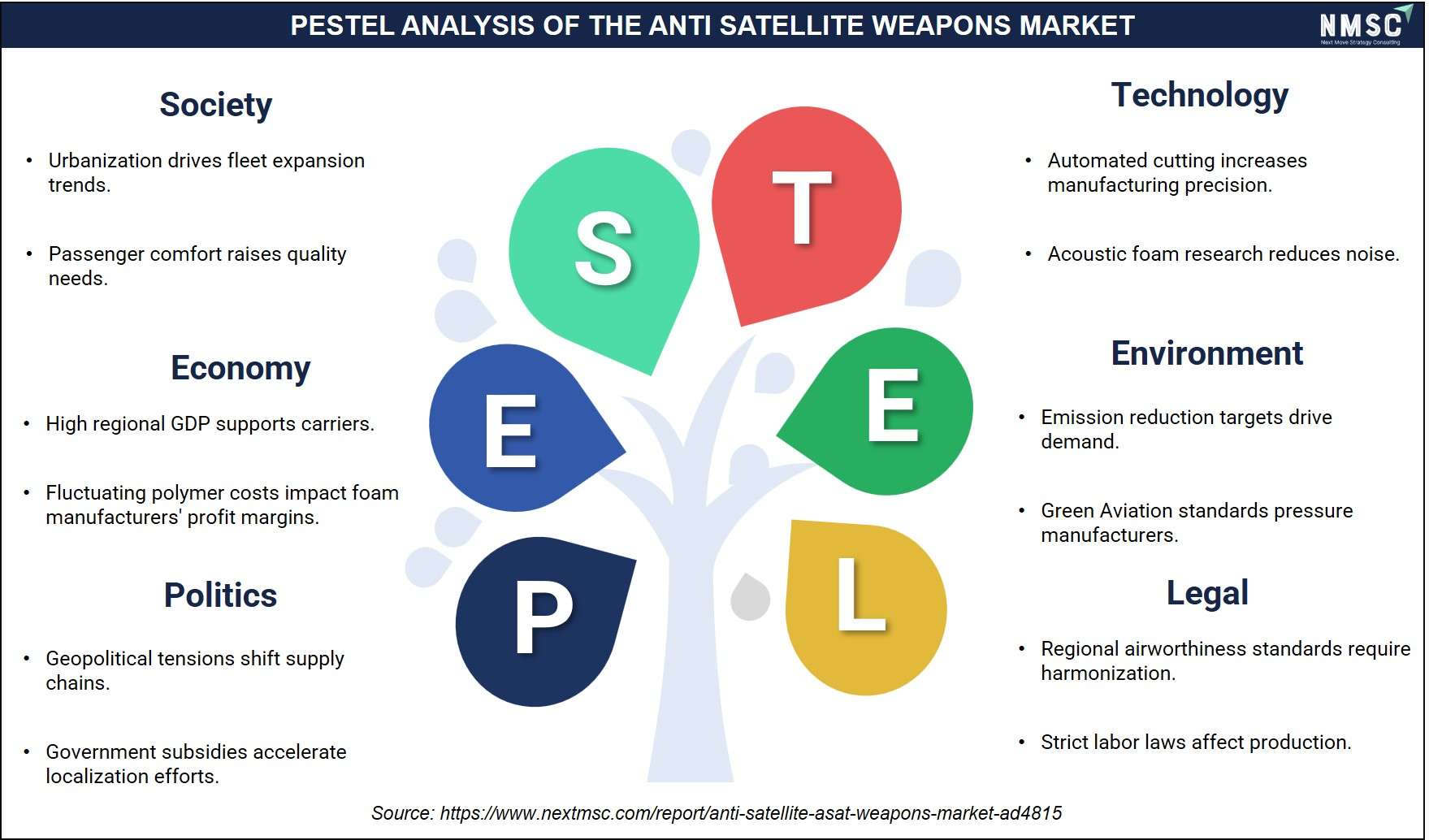
The PESTEL analysis of the Anti-Satellite (ASAT) Weapons Market demonstrates how geopolitical priorities, economic investments, technological advancements, environmental concerns, legal frameworks, and societal security expectations influence market growth. Political factors such as national defense strategies and space-security initiatives drive funding, while rising defense budgets support program expansion. Technological progress in directed-energy systems, cyber capabilities, and space surveillance accelerates innovation. Environmental concerns regarding orbital debris and space sustainability are shaping future policies. International treaties, export controls, and national security regulations create a complex legal landscape, while growing dependence on satellite-based services increases the strategic importance of ASAT capabilities worldwide.
Competitive Landscape
Competitive Dynamics and M&A Landscape
|
Key Takeaways |
Details |
|
Market Structure |
Oligopolistic; dominated by U.S. defense primes including Lockheed Martin, Northrop Grumman, RTX, and The Boeing Company, alongside Chinese state-owned enterprises and Russian state corporations in domestic markets |
|
Innovation Focus |
Directed energy weapon systems, AI-assisted targeting algorithms, cyber counter-space platforms, co-orbital robotic systems, and multi-domain battle management software integration |
|
M&A Activity |
Consolidation around electronic warfare specialists, space situational awareness software firms, and directed energy technology developers; notable U.S. restrictions on foreign acquisition of ASAT-relevant technology companies under CFIUS review |
How Do Companies Compete in the Anti Satellite (ASAT) Weapons Market?
Competition in the Anti Satellite (ASAT) Weapons Market is defined by classified program access, technological depth across kinetic and non-kinetic domains, and long-standing prime contractor relationships with national defense ministries. The market is highly concentrated among a small number of vertically integrated defense primes that combine systems integration, sensor development, software engineering, and lifecycle sustainment capabilities. Competitive strategies center on securing multi-year program-of-record contracts, establishing proprietary battle management software ecosystems, and leveraging classified program experience to qualify for follow-on ASAT capability development contracts.
Innovation investment is heavily focused on transitioning directed energy platforms from prototype to operational status, developing AI-assisted space domain awareness and targeting algorithms, and advancing cyber counter-space exploitation tools. International competition is bifurcated between the U.S.-led allied industrial base and the independent industrial ecosystems of China and Russia, which operate their respective programs without access to Western technology supply chains. M&A activity within the Anti Satellite (ASAT) Weapons Market industrial base is subject to intense CFIUS scrutiny given the national security sensitivity of counter-space technologies.
Which Kind of Companies Dominate the Anti Satellite (ASAT) Weapons Market?
Large-scale, vertically integrated defense prime contractors with classified program clearances, established government customer relationships, and broad technology portfolios spanning kinetic, electronic, directed energy, and cyber counter-space domains dominate the Anti Satellite (ASAT) Weapons Market. Companies including Lockheed Martin Corporation, Northrop Grumman Corporation, RTX Corporation, and The Boeing Company collectively command a substantial majority of U.S. counter-space program revenue through long-term development and production contracts. State-owned enterprises including China Aerospace Science and Technology Corporation, China Aerospace Science and Industry Corporation, and Russia's Almaz-Antey and Rostec State Corporation dominate their respective domestic ASAT programs.
AI-Native Differentiation and Software-Defined Architectures Drive Market Success in the Anti Satellite (ASAT) Weapons Market
Our findings suggest that companies embedding AI-assisted targeting algorithms, machine learning-based space object tracking, and software-defined electronic warfare capabilities are achieving superior mission performance and winning competitive program awards across the Anti Satellite (ASAT) Weapons Market.
Northrop Grumman's Space Systems division integrates AI into space domain awareness and space control mission systems. L3Harris Technologies has positioned its electronic warfare division as a software-defined platform provider capable of rapid mission update deployment for evolving counter-space threats. Kratos Defense and Security Solutions has established a strong position in space vehicle ground control software with increasing relevance to counter-space mission enablement systems.
Market Players to Opt for Merger and Acquisition Strategies to Expand Their Presence in the Anti Satellite (ASAT) Weapons Market
Merger and acquisition activity in the Anti Satellite (ASAT) Weapons Market is focused on consolidating electronic warfare software developers, space situational awareness analytics firms, and directed energy technology companies. RTX Corporation's Raytheon Intelligence and Space division has historically grown through acquisitions of electronic warfare and space systems companies. Hanwha Aerospace has pursued aggressive expansion into advanced defense electronics aligned with South Korea's growing counter-space investment program. European primes including BAE Systems, Airbus, and Thales are investing in electronic warfare and space domain awareness capabilities through both organic development and targeted acquisitions to maintain competitive positions in allied counter-space program competitions.
Who Are the Key Market Players in the Anti Satellite (ASAT) Weapons Market?
-
Lockheed Martin Corporation
-
Northrop Grumman Corporation
-
RTX Corporation
-
The Boeing Company
-
L3Harris Technologies, Inc.
-
BAE Systems plc
-
Airbus SE
-
Thales S.A.
-
General Dynamics Corporation
-
China Aerospace Science and Technology Corporation
-
China Aerospace Science and Industry Corporation
-
Almaz-Antey Air and Space Defence Corporation
-
Rostec State Corporation
-
Mitsubishi Heavy Industries, Ltd.
-
Kratos Defense and Security Solutions, Inc.
-
Kongsberg Gruppen ASA
-
Hanwha Aerospace Co., Ltd.
-
Bharat Electronics Limited
-
Hensoldt AG
-
Elbit Systems Ltd.
What Are the Latest Developments in the Anti Satellite (ASAT) Weapons Market Industry?
|
Date |
Event |
|
Dec 2025 |
L3Harris Technologies, Inc. received an USD 843 million SDA contract to build 18 infrared tracking satellites for the Tranche 3 Tracking Layer supporting missile warning and defense missions. |
|
Dec 2025 |
Lockheed Martin Corporation secured an SDA contract worth more than USD 1 billion to provide 18 missile warning, tracking and defense satellites under the Tranche 3 Tracking Layer constellation. |
What Are the Investment Opportunities in the Anti Satellite (ASAT) Weapons Market?
Capital Inflows into Directed Energy and Non-Kinetic Counter-Space Programs
Capital inflows into the Anti Satellite (ASAT) Weapons Market are increasingly directed toward non-kinetic capability development, particularly directed energy and electronic warfare platforms, as policy constraints on destructive kinetic testing redirect programmatic investment. The U.S. Space Force's Future Years Defense Program includes classified and unclassified directed energy program lines that represent durable multi-year investment commitments. Congressional authorization committees have consistently supported increased funding for non-kinetic counter-space programs as compliant alternatives to debris-generating kinetic systems within the Anti Satellite (ASAT) Weapons Market investment landscape.
Infrastructure Investments in Space Domain Awareness and Surveillance Networks
Investment in space domain awareness infrastructure represents a foundational enablement layer across the Anti Satellite (ASAT) Weapons Market. The U.S. Space Force's Space Fence radar network on Kwajalein Atoll, operated by Lockheed Martin, represents a multi-billion dollar investment in space surveillance capability that directly enables counter-space targeting functions. Allied nations are co-investing in space domain awareness through the Combined Space Operations Center at Vandenberg Space Force Base and through bilateral sensor network sharing agreements. NMSC's analysis indicates that this infrastructure investment creates sustained long-term sustainment and upgrade revenue streams for prime contractors and specialized sensor manufacturers.
ESG Considerations and Debris Mitigation in the Anti Satellite (ASAT) Weapons Market
Environmental, social, and governance considerations are influencing procurement priorities within the Anti Satellite (ASAT) Weapons Market, particularly regarding orbital debris generation from destructive kinetic systems. The UN General Assembly's Resolution 77/41, supported by 155 member states, endorsing responsible behavior norms including ASAT testing moratoriums, creates institutional pressure to favor non-debris-generating counter-space systems. Our assessment indicates that this ESG dimension is accelerating investment in reversible, non-kinetic ASAT alternatives such as electronic warfare, directed energy dazzling, and cyber exploitation platforms that achieve counter-space effects without creating permanent orbital debris.
Private Equity and Venture Capital Activity in the Anti Satellite (ASAT) Weapons Market
Private equity and venture capital investment is increasingly flowing into the Anti Satellite (ASAT) Weapons Market technology base through defense-focused investment vehicles. U.S. In-Q-Tel, the CIA's strategic investment vehicle, and the U.S. Space Force's SpaceWERX innovation program are actively investing in dual-use counter-space technologies spanning space domain awareness software, electronic warfare, and orbital robotic systems. The U.S. Department of Defense's Defense Innovation Unit is accelerating commercial technology transitions with ASAT mission relevance through Other Transaction Authority agreements that lower barriers for non-traditional defense technology companies to enter the counter-space supply chain.
Key Benefits for Stakeholders
For Defense Procurement Agencies and Military End Users
Defense procurement agencies, armed forces, and space command organizations gain comprehensive, vendor-neutral insights into the Anti-Satellite (ASAT) Weapons Market, including quantitative analysis across weapon types, engagement methods, deployment platforms, and operational doctrines. This intelligence supports long-term force modernization planning, capability gap assessments, and strategic defense investment decisions. Our competitive landscape analysis enables procurement authorities to benchmark technological capabilities, evaluate indigenous versus foreign procurement options, and assess the effectiveness of kinetic and non-kinetic ASAT solutions within evolving space security environments.
For Investors and Financial Analysts
Investors and financial analysts gain access to a structured assessment of the Anti-Satellite (ASAT) Weapons Market's growth prospects, defense spending trends, competitive dynamics, and technology development pipelines through 2035. Market forecasts by weapon type, platform, region, and end-user segment support investment evaluation and defense-sector portfolio planning. Detailed profiles of leading defense contractors, missile developers, directed-energy technology providers, and space security firms, combined with analysis of recent contracts, partnerships, and R&D investments, provide an early-warning framework for identifying emerging opportunities and competitive shifts within the global ASAT ecosystem.
For Defense Contractors and Technology Providers
Defense contractors, missile manufacturers, space security companies, and advanced technology developers gain actionable intelligence on emerging capability requirements, competitive positioning, and high-growth technology segments within the Anti-Satellite (ASAT) Weapons Market. Segment-level analysis highlights opportunities in direct-ascent interceptors, co-orbital systems, electronic warfare-based counterspace capabilities, cyber-enabled space disruption technologies, and directed-energy weapons. Regional outlook assessments identify priority markets based on defense modernization programs, space force development initiatives, and geopolitical security concerns. The analysis enables industry participants to refine R&D priorities, strengthen partnership strategies, and align product development with evolving military requirements.
For Government, Defense, and National Security Policymakers
Government agencies, defense ministries, national security organizations, and space governance bodies gain a structured analysis of how geopolitical tensions, military space strategies, arms control discussions, and national security policies are shaping the Anti-Satellite (ASAT) Weapons Market. Country-level insights provide policymakers with evidence-based perspectives on the impact of counterspace capabilities on deterrence strategies, military readiness, and space infrastructure resilience. Analysis of international space security frameworks, responsible space operation initiatives, and emerging counterspace doctrines offers direct relevance for policy development, defense planning, and long-term national space security strategies.
Regulatory Framework of the Anti-Satellite (ASAT) Weapons Market
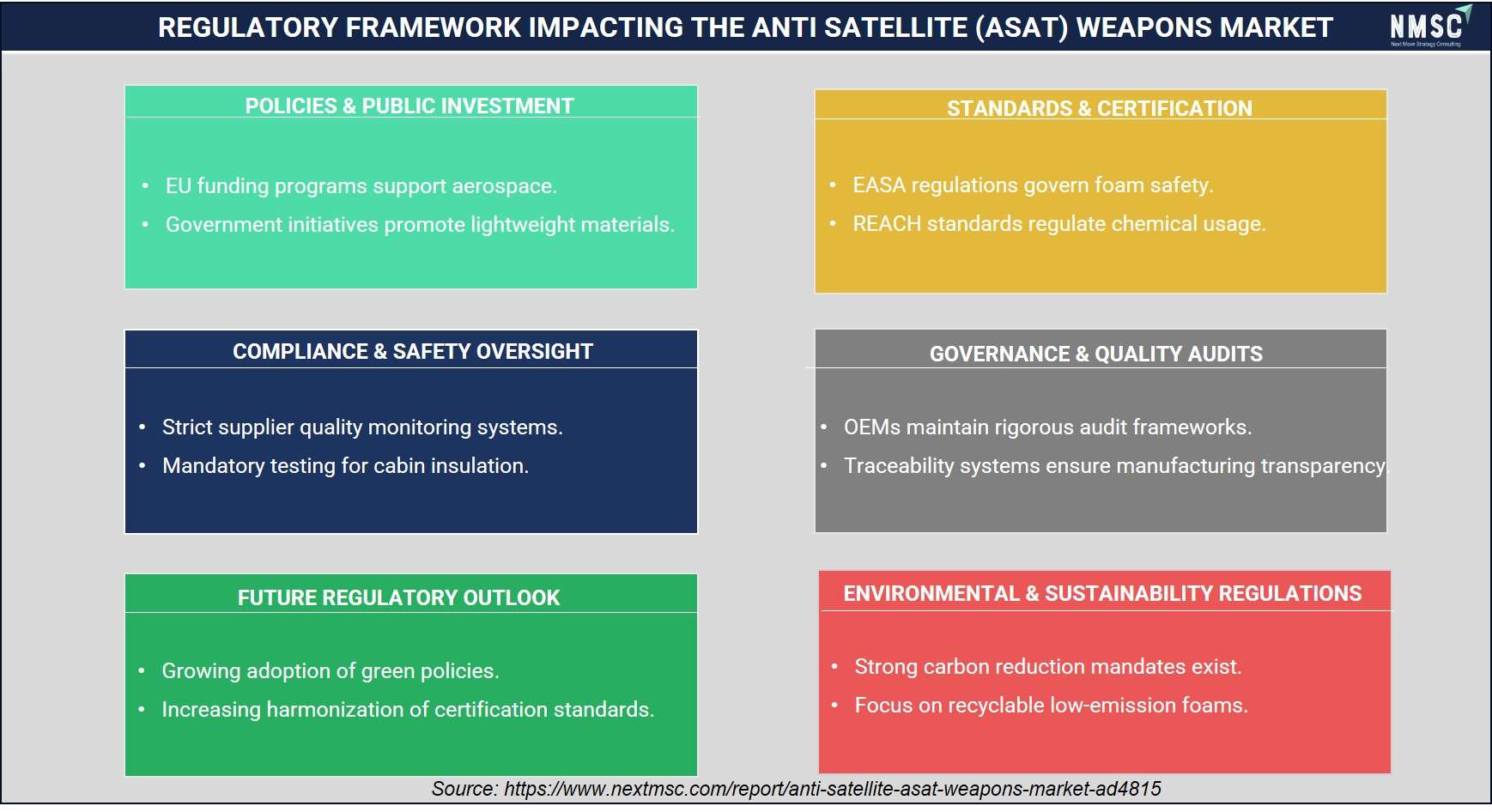
This regulatory framework highlights how government policies, defense standards, compliance requirements, governance mechanisms, and sustainability considerations shape the Anti-Satellite (ASAT) Weapons Market. Public investments and national security programs support research, testing, and deployment of advanced space-defense capabilities, while stringent certification standards govern system reliability and operational safety. Regulatory oversight emphasizes auditability, technology control, and compliance with international space norms. Future regulations are expected to focus on space sustainability, debris mitigation, and responsible military space operations, influencing market development, procurement strategies, and long-term investment decisions.
Key Market Segments
By ASAT System Type
-
Kinetic ASAT Systems
-
Direct-Ascent ASAT Missiles
-
Ground-Based Interceptors
-
Mobile Interceptors
-
Hit-to-Kill Vehicles
-
-
Air-Launched ASAT Weapons
-
Fighter-Launched Systems
-
High-Altitude Launch Systems
-
-
Sea-Launched ASAT Weapons
-
Surface Combatant Launch Systems
-
Naval Interceptor Systems
-
-
Co-Orbital Kinetic Systems
-
Orbital Interceptor Satellites
-
Proximity Kill Vehicles
-
-
-
Non-Kinetic ASAT Systems
-
Electronic Warfare Systems
-
Uplink Jamming
-
Downlink Jamming
-
Navigation Signal Denial
-
Communications Interference
-
-
Cyber Counter-Space Systems
-
Satellite Access Exploitation
-
Ground Segment Penetration
-
Data Link Manipulation
-
-
Directed Energy Systems
-
Laser Dazzling
-
Laser Blinding
-
High-Energy Laser Damage
-
High-Power Microwave Systems
-
-
Co-Orbital Non-Kinetic Systems
-
Electronic Attack Payloads
-
Signal Disruption Payloads
-
Robotic Interference Systems
-
-
-
ASAT Mission Enablement Systems
-
Space Surveillance Systems
-
Ground Radar
-
Optical Tracking
-
Space-Based Tracking
-
-
Targeting and Fire Control Systems
-
Tracking Algorithms
-
Engagement Planning
-
Battle Management
-
-
Command and Control Systems
-
Mission Command
-
Network Management
-
Integrated Counter-Space Operations
-
-
Test and Training Systems
-
Simulation Systems
-
Digital Twin Systems
-
Operational Training Systems
-
-
-
Lifecycle Services
-
Engineering Services
-
System Integration Services
-
Modernization Services
-
Sustainment Services
-
Mission Support Services
-
By Platform
-
Land-Based
-
Fixed Systems
-
Mobile Systems
-
-
Air-Based
-
Fighter Aircraft
-
Strategic Aircraft
-
-
Sea-Based
-
Surface Combatants
-
Specialized Vessels
-
-
Space-Based
-
Co-Orbital Satellites
-
Orbital Payloads
-
By Customer
-
National Defense Ministries
-
Space Forces
-
Strategic Commands
-
Missile Defense Agencies
-
Intelligence Agencies
-
Other Government Security Organizations
By Revenue Stream
-
Product Sales
-
System Integration
-
Software
-
Engineering Services
-
Sustainment Services
-
Training Services
By Technology
-
Kinetic Interception
-
Electronic Warfare
-
Cyber Warfare
-
Directed Energy
-
Orbital Robotics
-
Multi-Domain Counter-Space
By Target Satellite Class
-
Communications Satellites
-
ISR Satellites
-
Navigation Satellites
-
Early Warning Satellites
-
Military Constellations
-
Other Space Assets
By Region
-
North America: U.S., Canada, and Mexico.
-
Europe: UK, Germany, France, Italy, Spain, Sweden, Denmark, Finland, the Netherlands, and the rest of Europe.
-
Asia Pacific: China, India, Japan, South Korea, Taiwan, Indonesia, Vietnam, Australia, Philippines, Malaysia and the rest of APAC.
-
Middle East & Africa (MEA): Saudi Arabia, UAE, Egypt, Israel, Turkey, Nigeria, South Africa, and the rest of MEA.
-
Latin America: Brazil, Argentina, Chile, Colombia, and the rest of LATAM.
Conclusion and Recommendations
Long-Term Outlook
The Anti Satellite (ASAT) Weapons Market is entering a decade of structurally sustained growth driven by the formalization of space as a contested warfighting domain across all major military powers. The market is forecast to grow from USD 11.1 billion in 2026 to USD 23.8 billion by 2035, at a CAGR of 8.8%. Our assessment indicates that this expansion reflects both the maturation of emerging non-kinetic technologies from prototype to program-of-record status and the broadening of counter-space investment beyond the United States, Russia, and China to include India, Japan, Australia, the UK, France, and other allied nations with newly established space force organizational structures.
Strategic Positioning Recommendations
Defense prime contractors should prioritize directed energy and cyber counter-space portfolio differentiation as the highest-growth technology categories within the Anti Satellite (ASAT) Weapons Market through 2035. Companies that establish proprietary battle management software ecosystems and AI-assisted targeting algorithm capabilities will achieve superior competitive positioning in multi-domain counter-space program competitions. Allied market expansion through AUKUS Pillar II, NATO counter-space frameworks, and bilateral foreign military sales channels represents the most accessible near-term revenue diversification pathway for U.S. defense primes operating in the Anti Satellite (ASAT) Weapons Market.
Investment Attractiveness
The Anti Satellite (ASAT) Weapons Market represents a highly defensible investment environment given its classified program barriers to entry, long-term government contract structures, and the near-irreversible nature of national counter-space doctrine commitments once institutionalized. Our assessment identifies directed energy systems at a CAGR of 12.8%, Space-Based platforms at 11.2%, Cyber Warfare technology at 11.3%, and Space Forces as a customer segment at 11.0% as the highest-conviction investment themes within the market. The transition of multiple ASAT technology categories from development to production phases creates near-term revenue conversion opportunities for investors positioned in the counter-space supply chain.
Market Shifts and Key Risks
The most consequential market shift underway in the Anti Satellite (ASAT) Weapons Market is the policy-driven migration from kinetic to non-kinetic counter-space systems, which is redistributing approximately 10 to 15 percent of program investment value over the forecast period from direct-ascent missile programs toward directed energy, electronic warfare, and cyber counter-space alternatives. Key risks include international arms control treaty developments that could constrain counter-space capability categories beyond kinetic testing, macroeconomic pressures on national defense budgets, the potential emergence of space security confidence-building measures reducing operational ASAT deployment incentives, and the risk of escalation dynamics that complicate allied counter-space program export approvals.
Growth Pathways
Organizations seeking to maximize value from the Anti Satellite (ASAT) Weapons Market should pursue a three-horizon strategy. In the near term from 2025 to 2027, prioritize electronic warfare platform modernization and cyber counter-space capability development as politically accessible, operationally deployable near-term investments. In the mid-term from 2027 to 2031, invest in directed energy transition from prototype to production, co-orbital system development, and AI-assisted battle management software integration to capture the highest-growth technology segments. In the long term from 2031 to 2035, position for multi-domain integrated counter-space architectures that seamlessly combine space, air, cyber, and electronic warfare capabilities as joint operational doctrine matures across allied defense establishments.
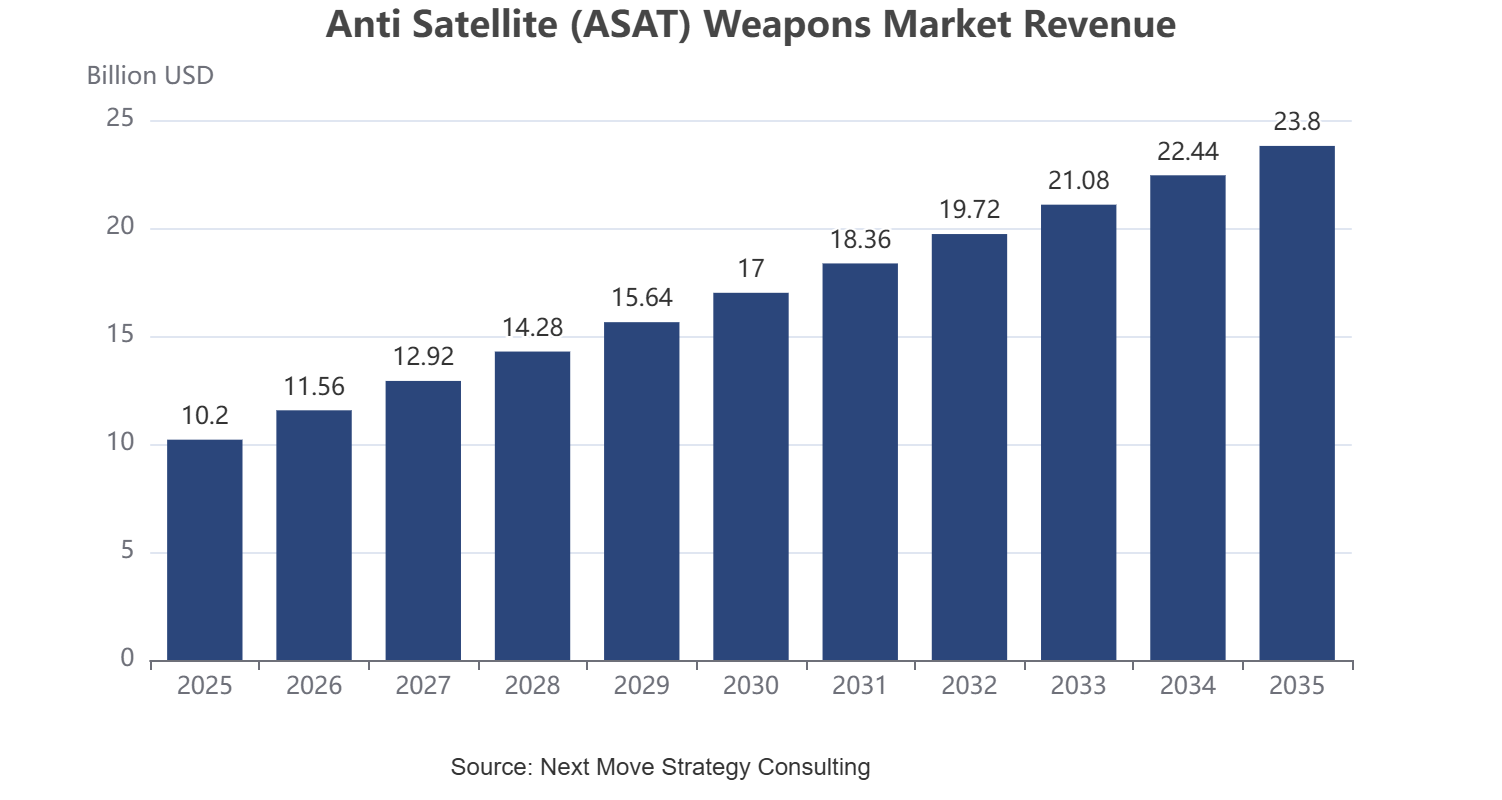
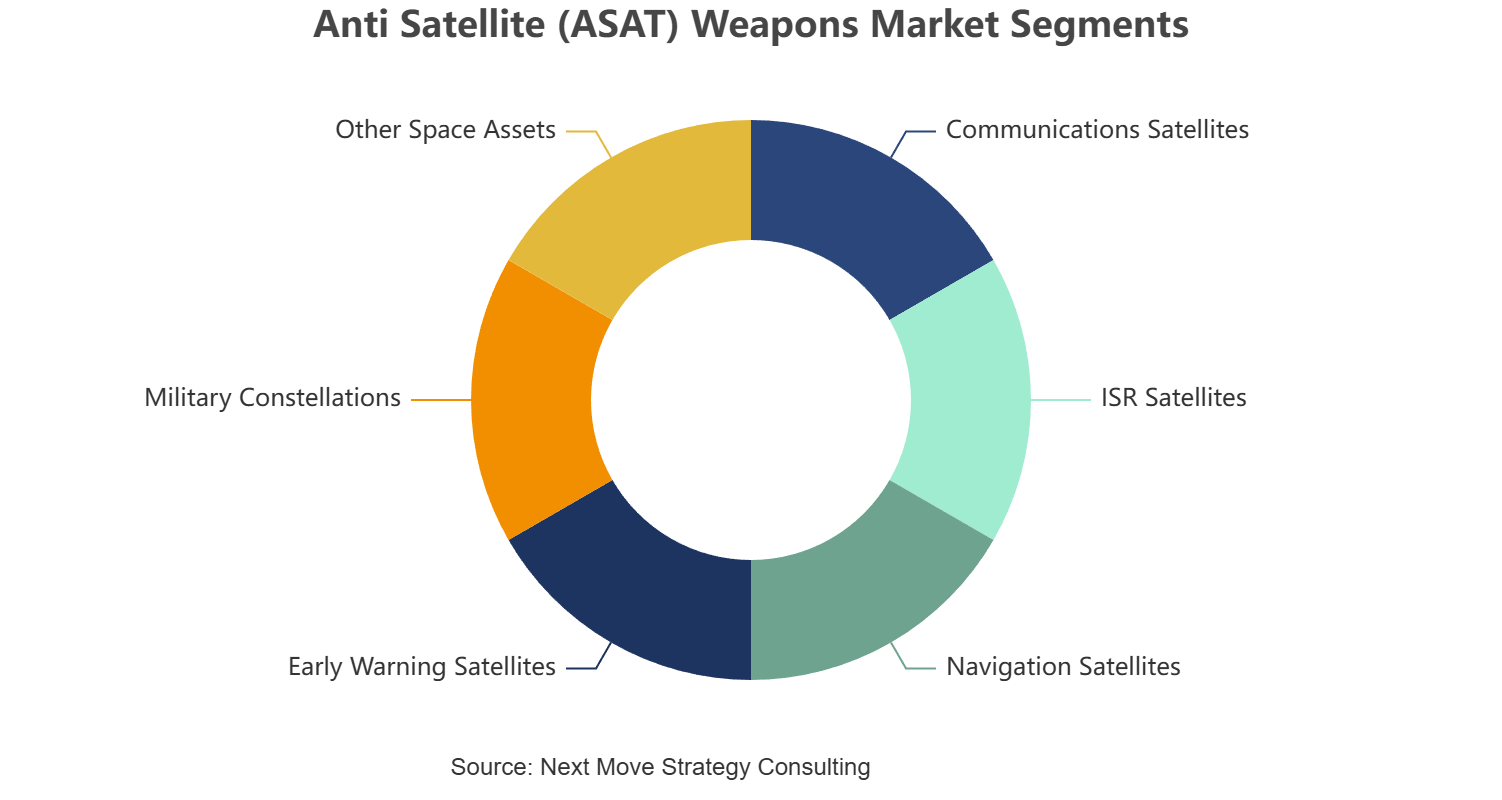
About the Author
 Tushmi Dutta
— Tushmi Dutta is a focused researcher specializing in detailed analysis and insight-driven research across diverse business landscapes. She supports strategic initiatives through structured data interpretation, thorough validation, and clear communication of findings that aid informed decision-making. With a strong interest in writing, she enjoys presenting research insights in an engaging and accessible manner. Beyond work, she enjoys traveling, reading, painting, and continuously learning new skills that contribute to her creative and professional growth.
Tushmi Dutta
— Tushmi Dutta is a focused researcher specializing in detailed analysis and insight-driven research across diverse business landscapes. She supports strategic initiatives through structured data interpretation, thorough validation, and clear communication of findings that aid informed decision-making. With a strong interest in writing, she enjoys presenting research insights in an engaging and accessible manner. Beyond work, she enjoys traveling, reading, painting, and continuously learning new skills that contribute to her creative and professional growth.
About the Reviewer
 Supradip Baul
— Supradip Baul is an accomplished business consultant and strategist with over a decade of rich experience in market intelligence, strategy, technology, and business transformation. His work has included rigorous qualitative and quantitative analysis across multiple industries, helping clients shape investment decisions and long-term roadmaps. Earlier in his career, he was associated with Gartner, where he contributed to industry-leading reports and market share analyses. He has worked with leading global companies and holds an MBA with a dual specialization in Marketing and Finance.
Supradip Baul
— Supradip Baul is an accomplished business consultant and strategist with over a decade of rich experience in market intelligence, strategy, technology, and business transformation. His work has included rigorous qualitative and quantitative analysis across multiple industries, helping clients shape investment decisions and long-term roadmaps. Earlier in his career, he was associated with Gartner, where he contributed to industry-leading reports and market share analyses. He has worked with leading global companies and holds an MBA with a dual specialization in Marketing and Finance.
At Next Move Strategy Consulting, we understand that insightful market research is the cornerstone of successful business decisions. That's why we employ a robust and multifaceted approach, combining various methodologies to deliver the most accurate and actionable data for our clients.

Research Landscape
We navigate the world of research with two primary approaches:
Qualitative Approach
Our qualitative research methodologies involve immersive techniques such as in-depth interviews, focus groups, and observational studies. By engaging directly with individuals and stakeholders, we uncover valuable insights that quantitative data alone may overlook.

Quantitative Research
In tandem with qualitative methodologies, NMSC leverages the power of Quantitative Research to provide a robust foundation of numerical insights. Through systematic data collection and analysis, we quantify patterns, preferences, and market trends, offering a comprehensive view of the business landscape.
Our quantitative research approach employs diverse tools, including surveys, experiments, and statistical modelling. These methodologies enable us to gather data from a large and representative sample, ensuring the statistical significance of our findings. By employing structured questionnaires and standardized data collection methods, we guarantee the reliability and validity of the information we present to our clients.
Quantitative research is particularly effective in measuring the prevalence of trends, assessing market size, and gauging the impact of various factors on consumer behavior. The numerical precision attained through this approach equips our clients with actionable insights, facilitating data-driven decision-making and strategy formulation.


Our Specialized Toolbox for Industry-Specific Market Research
We deploy a specialized arsenal of techniques tailored to meet your unique requirements. Here's a glimpse into our comprehensive toolbox:

Information Procurement
The stage entails acquiring market data or relevant information through various sources and methodologies.


Market Research Approach
We utilize both top-down and bottom-up approaches in market research analysis to achieve a comprehensive understanding of the market dynamics, leveraging the broad perspective of industry trends and macroeconomic factors alongside detailed insights from specific segments and individual companies.

Porters Five Forces Analysis
We conduct Porter's Five Forces analysis to evaluate the competitive landscape of an industry, providing us with insights into factors that affect profitability and strategic positioning.

SWOT Analysis

Forecasting
We utilize a forecasting model to predict future consumption by considering parameters like population, economics, regulations, market competition, drivers, constraints, technology, and pricing. We also employ statistical techniques such as multilinear regression, exponential smoothing, moving average, ARIMA, and Monte Carlo simulations for accurate predictions. In econometric forecasting, we analyzed short-term and long-term event impacts, attributing values based on regulatory frameworks, economic factors, and market events.





 Speak to Our Analyst