Surety Market Size, Share, Trends and Growth Analysis, By Bond Type (Contract Surety Bonds, Commercial Surety Bonds, Fidelity Surety Bonds, and Court Surety Bonds), By End-User {Private Sector Enterprises (Construction, Financial Institutions, Healthcare, Transportation & Logistics, Manufacturing, Retail, and Others) and Government & Public Sector}, By Distribution Channel (Direct Sales, Brokers and Agents, and Online Platforms), and By Region — Global Industry Report and Forecast, 2026–2035
Industry: BFSI | Publishing Date: August 11, 2026 | Last Updated: August 11, 2026 | No of Pages: N/A | No. of Tables: N/A | No. of Figures: N/A | Format: PDF | Report Code: BF2893
What Is the Surety Market Size?
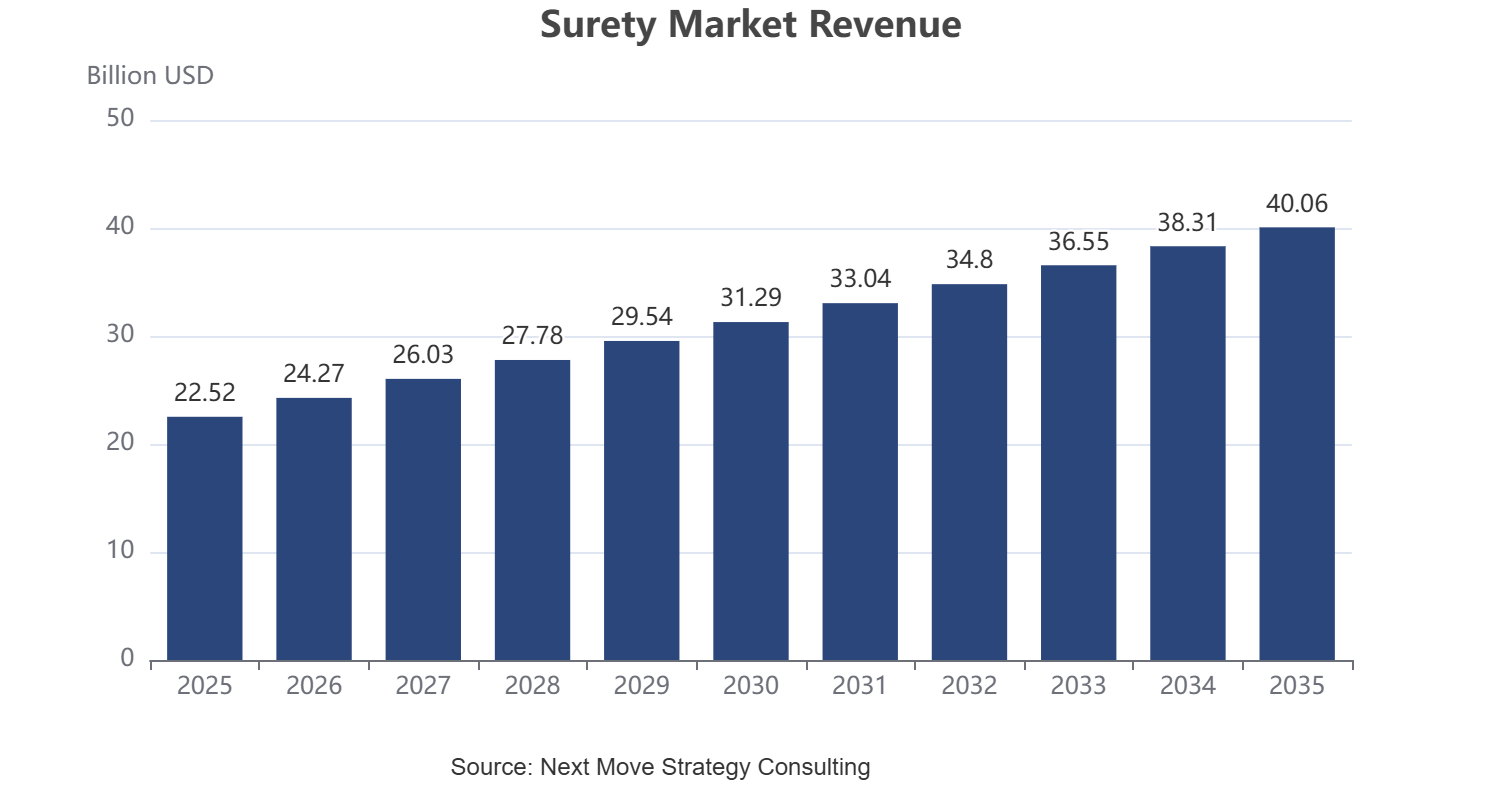
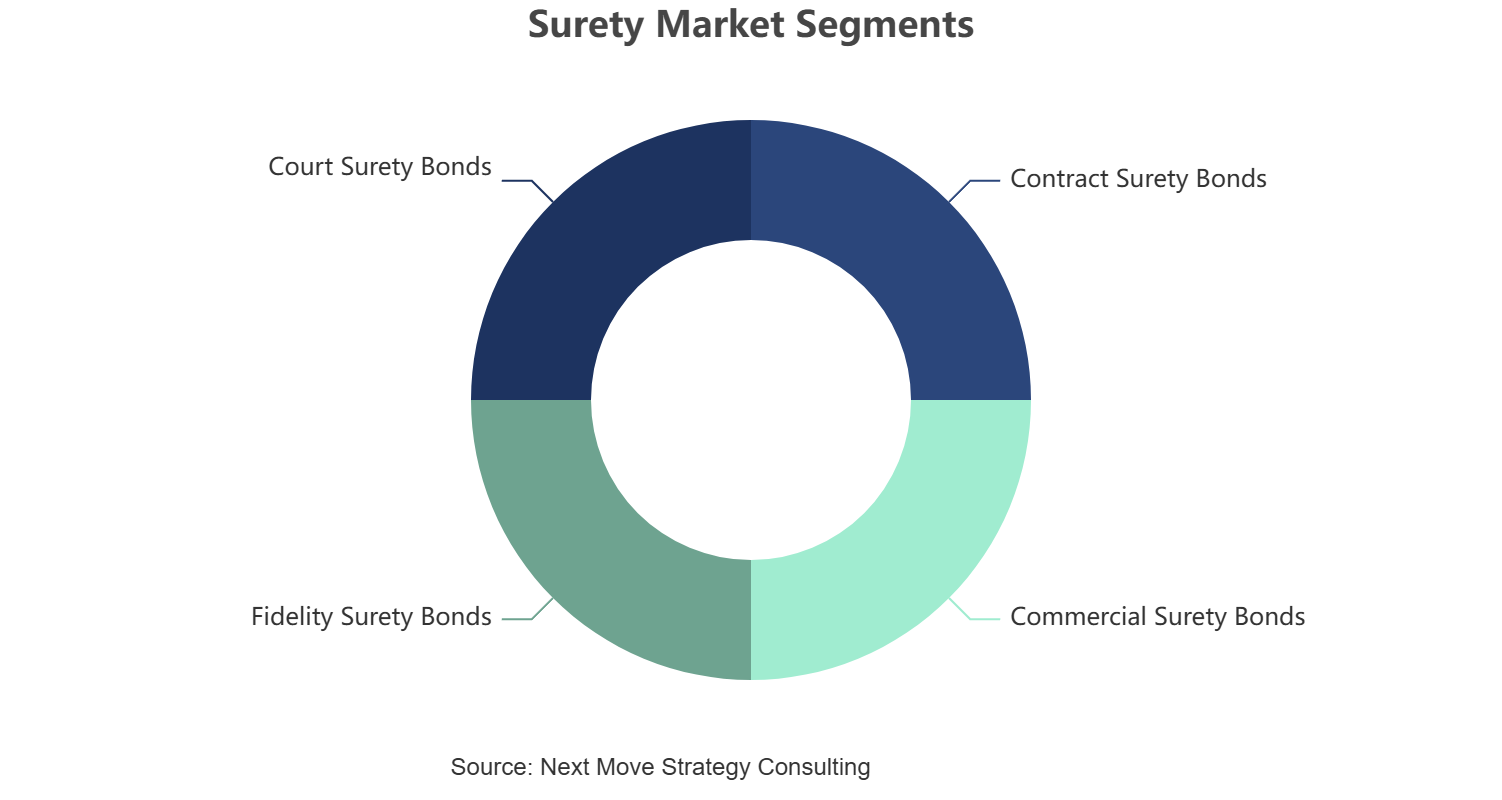
The Surety Market size was valued at USD 22.52 Billion in 2025 and is estimated at USD 23.86 Billion in 2026, forecast to reach USD 40.06 Billion by 2035, expanding at a 5.93% CAGR between 2026 and 2035. North America leads with approximately a 46% share, while Contract Surety Bonds dominate all bond types with approximately a 52% share.
We observed that growth is concentrated in construction-linked contract bonds and rising government infrastructure procurement, with digital underwriting platforms gaining a disproportionate share against traditional broker-led distribution through 2035.
|
Key Takeaways |
|
By Bond Type: Contract Surety Bonds held the largest share of approximately 52% (USD 11.71 Billion) in 2025; Commercial Surety Bonds are the fastest-growing sub-segment at 6.66% CAGR from 2026–2035. |
|
By End-User: Private Sector Enterprises held the largest share of approximately 78% (USD 17.57 Billion) in 2025; Government & Public Sector is the fastest-growing sub-segment at 6.95% CAGR from 2026–2035. |
|
By Distribution Channel: Brokers and Agents held the largest share of approximately 68% (USD 15.31 Billion) in 2025; Online Platforms is the fastest-growing sub-segment at 15.17% CAGR from 2026–2035. |
|
Dominant Region: North America dominated with approximately 46% revenue share (USD 10.36 Billion) in 2025. |
|
Fastest-Growing Region: Asia-Pacific is expected to register the highest CAGR of 9.38% during 2026–2035. |
|
Dominant Country: The U.S. led the market with approximately USD 8.81 Billion in 2025. |
|
Fastest-Growing Country: India is expected to register the highest CAGR of approximately 11.2% during 2026–2035. |
Market Opportunity: The Surety market is expected to create an absolute dollar opportunity of USD 16.20 Billion between 2026 and 2035, presenting significant investment potential across digital underwriting platforms and government infrastructure-linked bonding programs.
According to NMSC analysis, large diversified insurers are increasingly bundling surety capacity with broader specialty and management liability lines rather than underwriting bonds as a standalone product, a shift that favors carriers with integrated Bond & Specialty divisions over monoline surety providers as large construction project activity accelerates through 2035.
What Does the Surety Market Encompass?
The Surety Market encompasses contractual guarantee instruments issued by insurers and specialty carriers that protect obligees against a principal's failure to perform contractual, commercial, fiduciary, or court-ordered obligations. Our assessment indicates that the scope covers contract, commercial, fidelity, and court surety bonds distributed through direct sales, brokers and agents, and online platforms to private sector enterprises and government and public sector buyers, reflecting close linkage with broader property and casualty (P&C) insurance underwriting capacity.
Regulatory frameworks including the U.S. Miller Act's federal contractor bonding requirements and state-level licensing statutes increasingly shape underwriting standards and capacity allocation for surety providers. We observed that technology adoption is shifting from manual, broker-intermediated underwriting toward digital bond issuance platforms that reduce turnaround time for standard commercial bonds. NMSC's analysis indicates that this structural shift, combined with rising government infrastructure procurement, is redefining distribution economics across the surety value chain.
|
Parameters |
Details |
|
Market Size in 2025 |
USD 22.52 Billion |
|
Market Size in 2026 |
USD 23.86 Billion |
|
Revenue Forecast in 2035 |
USD 40.06 Billion |
|
Growth Rate |
CAGR of 5.93% from 2026 to 2035 |
|
Analysis Period |
2025–2035 |
|
Base Year Considered |
2025 |
|
Forecast Period |
2026–2035 |
|
Market Size Estimation |
USD Billion |
|
Companies Profiled |
15 |
|
Countries Covered |
38 |
|
Market Share |
Available for Top 10 Companies |
Key Emerging Trends
Based on research conducted by NMSC, we found that four structural trends are reshaping underwriting practice, distribution strategy, and stakeholder engagement across the Surety market.
How Is Digital Underwriting Transforming Commercial Bond Issuance?
Digital bond issuance platforms are replacing manual, paper-based underwriting for standard commercial and fidelity bonds. We observed that carriers are increasingly deploying instant-issue online portals to reduce turnaround time for small and mid-sized commercial obligees. This shift toward insurtech-enabled bonding is transforming distribution economics for carriers competing on speed rather than solely on price.
Why Is Large Construction Project Activity Accelerating Contract Bond Demand?
Large-scale infrastructure and construction project activity is driving outsized growth in contract surety premiums. Travelers reported that its Bond & Specialty Insurance segment's surety line grew 40% in the second quarter of 2026, driven by strong activity on large construction projects. This trend is elevating the strategic importance of contract surety bonds within diversified insurers' specialty portfolios.
How Is Portfolio Diversification Reshaping Carrier Strategy?
Diversified insurers are increasingly retaining surety operations even while divesting adjacent commercial lines to focus capital on higher-margin specialty business. Travelers' 2025 agreement to sell its Canadian personal and commercial insurance business while explicitly retaining its Canadian surety operations illustrates this trend. This shift is elevating surety as a standalone strategic priority within diversified carriers' business mix.
What Role Does Reserve Development Play in Surety Profitability Trends?
Favorable prior-year reserve development within fidelity and surety product lines is improving underwriting profitability for major carriers. Our analysis shows that Travelers' Bond & Specialty Insurance segment reported improved combined ratios driven partly by better-than-expected loss experience in its surety book across recent accident years. This trend is reinforcing capital allocation toward surety as a comparatively low-volatility specialty line.
Growth Drivers and Restraints
Growth Catalyst and Risk Assessment Matrix
|
Factors |
Type |
(+/-) % Impact on CAGR |
Geographic Relevance |
Impact Timeline |
|
Rising large-scale construction and infrastructure project activity |
Driver |
+2.1% |
North America, Asia-Pacific |
2026-2035 |
|
Growth of government infrastructure procurement and bonding mandates |
Driver |
+1.6% |
Global |
2026-2035 |
|
Expansion of digital bond issuance and underwriting platforms |
Driver |
+1.2% |
North America, Europe |
2026-2032 |
|
Rising commercial surety demand from licensing and compliance bonds |
Driver |
+0.9% |
Global |
2026-2035 |
|
Growing enterprise risk management adoption among mid-sized firms |
Driver |
+0.7% |
Global |
2026-2035 |
|
Expanding surety penetration in emerging construction markets |
Driver |
+0.5% |
Asia-Pacific, Middle East & Africa |
2028-2035 |
|
Softening commercial insurance pricing cycle |
Restraint |
-0.8% |
North America, Europe |
2026-2030 |
|
Elevated contractor default risk amid construction cost inflation |
Restraint |
-0.6% |
Global |
2026-2032 |
|
Limited surety product awareness in smaller emerging markets |
Restraint |
-0.4% |
Latin America, Middle East & Africa |
2026-2032 |
What Is the Primary Growth Driver of the Surety Market?
Rising large-scale construction and infrastructure project activity is the primary driver of the market. Travelers reported that strong activity on large construction projects drove a 40% surety premium increase within its Bond & Specialty Insurance segment in the second quarter of 2026. We observed that this project-driven demand, reinforced by sustained public infrastructure procurement, continues to anchor baseline growth for contract surety bonds across developed construction markets.
How Is Government Infrastructure Procurement Driving Market Growth?
Growing government infrastructure procurement is accelerating demand for contract and court surety bonds tied to public works contracting requirements. The U.S. Federal Acquisition Regulation continues to mandate performance and payment bonds under the Miller Act for qualifying federal construction contracts. Our assessment indicates that this regulatory mandate, combined with expanding public infrastructure budgets, is compressing sales cycles for carriers with established government contracting relationships.
What Is Restraining Surety Market Expansion?
Softening commercial insurance pricing cycles restrain premium growth across specialty lines, including surety. Industry-wide combined ratio improvements reported across major carriers reflect a broader pricing environment description characterized by decelerating premium growth into 2026. We found that this pricing softness disproportionately affects smaller regional surety providers with less diversified specialty portfolios compared with large, diversified carriers able to offset softness through investment income.
Segmentation Analysis
Segment Sizing: By Bond Type
|
Segment |
2025 (USD Billion) |
2035 (USD Billion) |
CAGR% (2026-2035) |
|
Contract Surety Bonds |
11.71 |
20.03 |
5.46% |
|
Commercial Surety Bonds |
6.98 |
13.22 |
6.66% |
|
Fidelity Surety Bonds |
2.70 |
4.81 |
5.95% |
|
Court Surety Bonds |
1.13 |
2.00 |
5.94% |
|
Total |
22.52 |
40.06 |
5.93% |
Which Bond Type Segment Dominates the Surety Market?
Contract Surety Bonds led the market with USD 11.71 Billion in 2025, supported by sustained large-scale construction project activity requiring performance and payment guarantees. We observed that Commercial Surety Bonds are the fastest-growing bond type, expanding at a 6.66% CAGR from 2026 to 2035, as licensing, permit, and compliance bonding requirements expand across a broadening range of regulated commercial activities.
Segment Sizing: By End-User
|
Segment |
2025 (USD Billion) |
2035 (USD Billion) |
CAGR% (2026-2035) |
|
Private Sector Enterprises |
17.57 |
30.45 |
5.62% |
|
Government & Public Sector |
4.95 |
9.61 |
6.95% |
|
Total |
22.52 |
40.06 |
5.93% |
Which End-User Segment Leads the Market?
Private Sector Enterprises led the market with USD 17.57 Billion in 2025, supported by broad-based bonding demand across construction, financial institutions, and other regulated commercial verticals. Government & Public Sector is the fastest-growing end-user segment, expanding at a 6.95% CAGR from 2026 to 2035, as public infrastructure procurement volumes rise and statutory bonding mandates expand across federal, state, and municipal contracting programs.
Segment Sizing: By Region
|
Segment |
2025 (USD Billion) |
2035 (USD Billion) |
CAGR% (2026-2035) |
|
North America |
10.36 |
16.04 |
4.30% |
|
Europe |
5.86 |
9.61 |
4.99% |
|
Asia-Pacific |
4.05 |
9.61 |
9.38% |
|
Middle East & Africa |
1.12 |
2.40 |
8.07% |
|
Latin America |
1.13 |
2.40 |
8.11% |
|
Total |
22.52 |
40.06 |
5.93% |
Which Region Leads Surety Market Demand?
North America remained the leading region, valued at USD 10.36 Billion in 2025 on sustained federal, state, and private construction bonding demand. Our findings suggest that Asia-Pacific is the fastest-growing region, registering a 9.38% CAGR from 2026 to 2035, as rapid urbanization and expanding risk management awareness drive rising commercial and contract surety adoption across the region.
Porter’s Five Forces Analysis of the Surety Industry
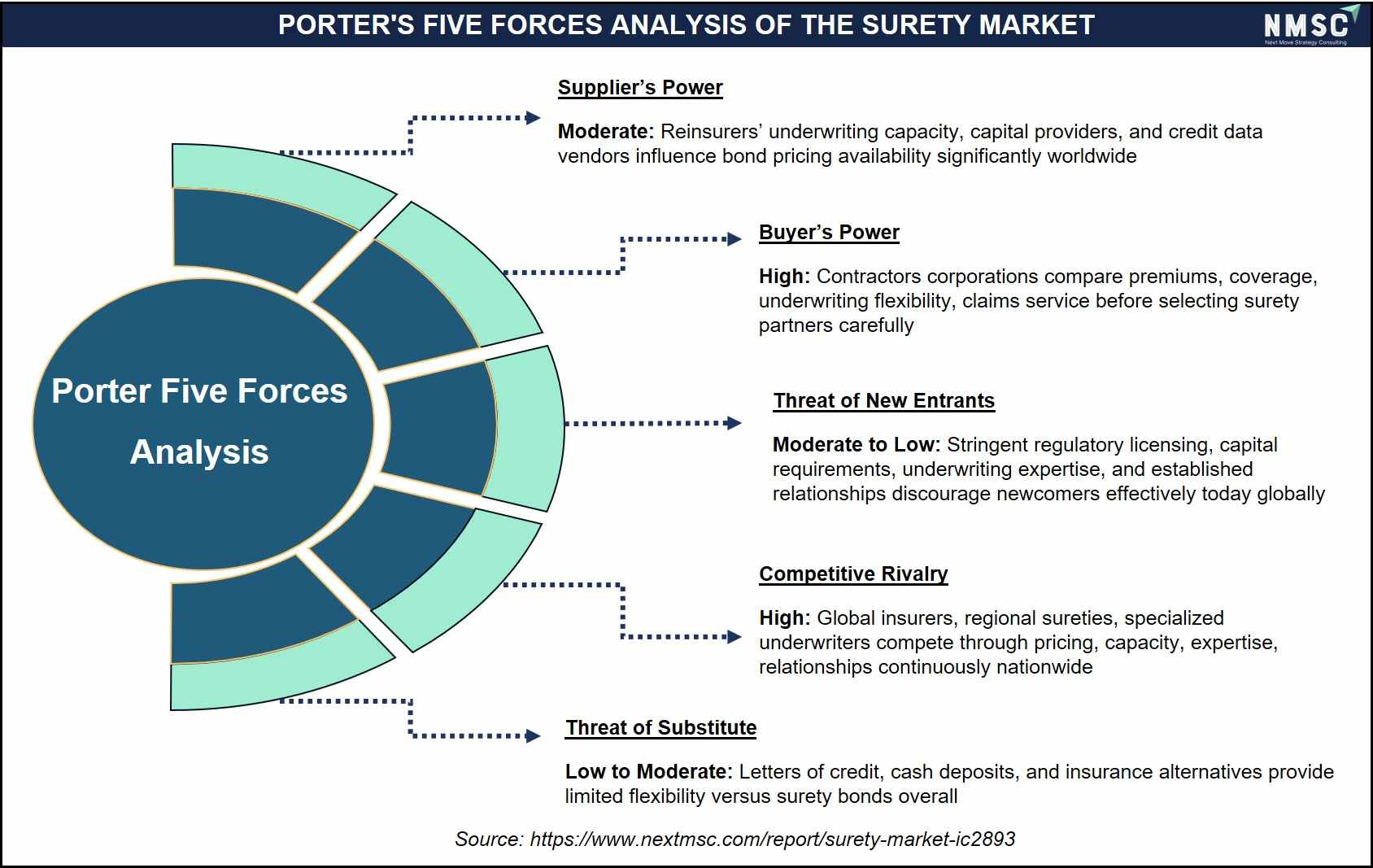
The above infographic presents a Porter's Five Forces analysis of the surety market, where supplier power remains moderate due to reliance on reinsurance, capital providers, and credit data vendors that influence bond pricing and availability. At the same time, buyer power is high as contractors and corporations compare premiums, coverage, and underwriting terms before selecting partners. The threat of new entrants is moderate to low, constrained by stringent licensing, capital requirements, and established industry relationships, while competitive rivalry is intense among global insurers and regional underwriters competing through pricing, capacity, and expertise. Looking ahead, we observed that the threat of substitutes stays low to moderate, as letters of credit and cash deposits offer limited flexibility compared to surety bonds.
Growth Opportunities
We found that three forward-looking whitespace opportunities stand out for stakeholders positioning within the Surety market over the coming decade.
How Can Carriers Capture Demand from Digital Bond Platforms?
Expanding demand for instant-issue commercial bonds creates a mechanism for carriers to capture small and mid-sized enterprise customers through digital risk management-enabled online platforms. Carriers offering automated underwriting stand to benefit most, as smaller obligees increasingly prefer rapid digital issuance over traditional broker-intermediated processes.
What Opportunity Does Emerging Market Infrastructure Present for Surety Providers?
Expanding infrastructure investment across Asia-Pacific and the Middle East & Africa creates a mechanism for surety providers to enter markets with historically low bonding penetration. Providers building local underwriting capacity and regulatory relationships stand to benefit most, capturing early-mover positioning as government contracting bonding requirements mature in these regions.
How Can Providers Unlock Bundled Specialty Insurance Contracts?
Growing enterprise preference for consolidated specialty insurance relationships creates a mechanism for diversified carriers to bundle surety capacity with management liability and professional liability lines. Carriers with integrated Bond & Specialty divisions stand to benefit most, capturing cross-sell opportunities as large commercial clients increasingly favor single-carrier specialty programs.
Regional Outlook
|
Region |
2025 (USD Billion) |
2035 (USD Billion) |
CAGR% (2026-2035) |
Key Driver |
|
North America |
10.36 |
16.04 |
4.30% |
Federal and state construction bonding mandates |
|
Europe |
5.86 |
9.61 |
4.99% |
Public infrastructure modernization programs |
|
Asia-Pacific |
4.05 |
9.61 |
9.38% |
Rapid urbanization and construction growth |
|
Middle East & Africa |
1.12 |
2.40 |
8.07% |
Government infrastructure diversification |
|
Latin America |
1.13 |
2.40 |
8.11% |
Growing public works procurement |
|
Total |
22.52 |
40.06 |
5.93% |
— |
North America
North America's surety market reflects a mature regulatory environment anchored by the Miller Act's federal contractor bonding requirements. We observed that carriers are prioritizing large construction project relationships as commercial insurance pricing softens elsewhere in their portfolios. Technology adoption favors digital issuance for standard commercial bonds, and the region's strategic outlook remains anchored to sustained infrastructure and private construction investment through 2035.
Europe
Europe's market is shaped by public infrastructure modernization programs and evolving national contractor licensing regimes. Our assessment indicates that regional carriers are advancing digital surety platform adoption to meet rising demand for faster commercial bond issuance. The region's strategic outlook favors providers with strong pan-European underwriting networks serving multinational construction and specialty contractors.
Asia-Pacific
Asia-Pacific's market benefits from rapid urbanization and expanding commercial construction activity across major economies. We found that regional awareness of enterprise risk management and bonding solutions is rising faster than in other regions, reflecting growing government contracting formalization. The region's strategic outlook remains the strongest globally, anchored by sustained infrastructure investment and rising commercial project volumes.
Middle East & Africa
The Middle East & Africa market is expanding from a smaller base, supported by national economic diversification programs prioritizing infrastructure development. Our analysis shows that regional demand is concentrated in government-linked construction and public works bonding. The region's strategic outlook depends on continued infrastructure investment and gradual formalization of contractor licensing and bonding requirements through 2035.
Latin America
Latin America's market is growing steadily, supported by expanding public works procurement and growing private construction investment. We observed that Brazil's infrastructure programs are creating incremental demand for contract surety bonds among domestic contractors. The region's strategic outlook favors providers able to serve multiple national markets with standardized commercial and contract bond products.
U.S.
Based on our estimates, the U.S. surety market was valued at approximately USD 8.81 Billion in 2025 and is projected to reach USD 13.63 Billion by 2035 at a 4.3% CAGR. Demand structure favors contract surety bonds tied to federal and state construction procurement, supported by strong regulatory influence from Miller Act bonding mandates and rising technology penetration of digital commercial bond issuance among leading carriers.
Canada
The market in Canada was valued at approximately USD 1.14 Billion in 2025 and is projected to reach USD 1.76 Billion by 2035 at a 4.3% CAGR. Demand structure reflects steady public infrastructure procurement, moderate regulatory influence from provincial contractor licensing standards, and rising competitive intensity as carriers such as Travelers retain dedicated surety operations even amid broader Canadian portfolio restructuring.
UK
As per our estimate, the UK market was valued at approximately USD 1.41 Billion in 2025 and is projected to reach USD 2.31 Billion by 2035 at a 4.9% CAGR. Demand structure centers on public infrastructure and commercial construction bonding, with strong regulatory influence from national contractor licensing standards and rising technology penetration of digital surety issuance platforms.
Germany
According to our analysis, the Germany market was valued at approximately USD 1.52 Billion in 2025 and is projected to reach USD 2.50 Billion by 2035 at a 5.0% CAGR. Demand structure reflects the country's sustained infrastructure modernization programs, high regulatory influence from national contracting standards, and strong competitive intensity among established European specialty insurers.
France
Based on our estimates, the France market was valued at approximately USD 0.88 Billion in 2025 and is projected to reach USD 1.44 Billion by 2035 at a 5.0% CAGR. Demand structure favors commercial and contract bonds among public works contractors, supported by government-backed infrastructure programs and growing technology penetration of digital underwriting tools.
China
The market in China was valued at approximately USD 1.62 Billion in 2025 and is projected to reach USD 3.84 Billion by 2035 at a 9.4% CAGR. Demand structure benefits from the country's large-scale domestic construction and infrastructure base, strong regulatory influence from national contractor qualification standards, and rising technology penetration of digital surety platforms among leading domestic carriers.
India
As per our estimate, the India surety market was valued at approximately USD 0.65 Billion in 2025 and is projected to reach USD 1.66 Billion by 2035 at an 11.2% CAGR, the fastest among all countries covered. Demand structure reflects rapidly expanding infrastructure procurement following regulatory reforms enabling surety bonds as bank guarantee alternatives, growing regulatory influence from national infrastructure policy, and rising adoption among domestic and multinational carriers.
Japan
According to our analysis, the Japan market was valued at approximately USD 0.73 Billion in 2025 and is projected to reach USD 1.73 Billion by 2035 at a 9.3% CAGR. Demand structure favors commercial surety bonds among established construction contractors, supported by strong domestic underwriting capacity and steady technology penetration ofdigital bond issuance.
South Korea
Based on our estimates, the South Korea market was valued at approximately USD 0.53 Billion in 2025 and is projected to reach USD 1.25 Billion by 2035 at a 9.4% CAGR. Demand structure benefits from strong domestic infrastructure procurement, strong regulatory influence from national contractor licensing standards, and rising strategic outlook tied to expanding commercial construction bonding demand.
Australia
The market in Australia was valued at approximately USD 0.36 Billion in 2025 and is projected to reach USD 0.86 Billion by 2035 at a 9.4% CAGR. Demand structure reflects growing public infrastructure investment, with moderate regulatory influence from state-level contractor licensing codes and gradually rising technology penetration of digital surety issuance platforms.
UAE
As per our estimate, the UAE market was valued at approximately USD 0.34 Billion in 2025 and is projected to reach USD 0.72 Billion by 2035 at an 8.0% CAGR. Demand structure reflects growing government-linked construction bonding requirements, moderate regulatory influence from national economic diversification strategies, and rising technology penetration as regional infrastructure investment expands.
Saudi Arabia
According to our analysis, the Saudi Arabia market was valued at approximately USD 0.39 Billion in 2025 and is projected to reach USD 0.84 Billion by 2035 at an 8.2% CAGR. Demand structure benefits from large-scale national infrastructure programs supporting Vision 2030 diversification targets, with strong regulatory influence and rising strategic outlook tied to state-backed construction investment.
South Africa
Based on our estimates, the South Africa surety market was valued at approximately USD 0.22 Billion in 2025 and is projected to reach USD 0.48 Billion by 2035 at an 8.4% CAGR. Demand structure remains concentrated in government-linked public works bonding, with moderate regulatory influence from national infrastructure procurement programs and gradually rising competitive intensity among regional providers.
Brazil
The market in Brazil was valued at approximately USD 0.62 Billion in 2025 and is projected to reach USD 1.32 Billion by 2035 at an 8.2% CAGR. Demand structure reflects the country's expanding public infrastructure programs, with growing regulatory influence from national contracting compliance requirements and rising technology penetration of digital bond issuance among domestic carriers.
Argentina
As per our estimate, the Argentina market was valued at approximately USD 0.23 Billion in 2025 and is projected to reach USD 0.48 Billion by 2035 at an 8.0% CAGR. Demand structure remains at a developing stage, supported by gradually expanding public works procurement, limited regulatory influence from national contracting reform, and modest but rising competitive intensity among regional providers.
PESTEL Analysis of the Surety Industry
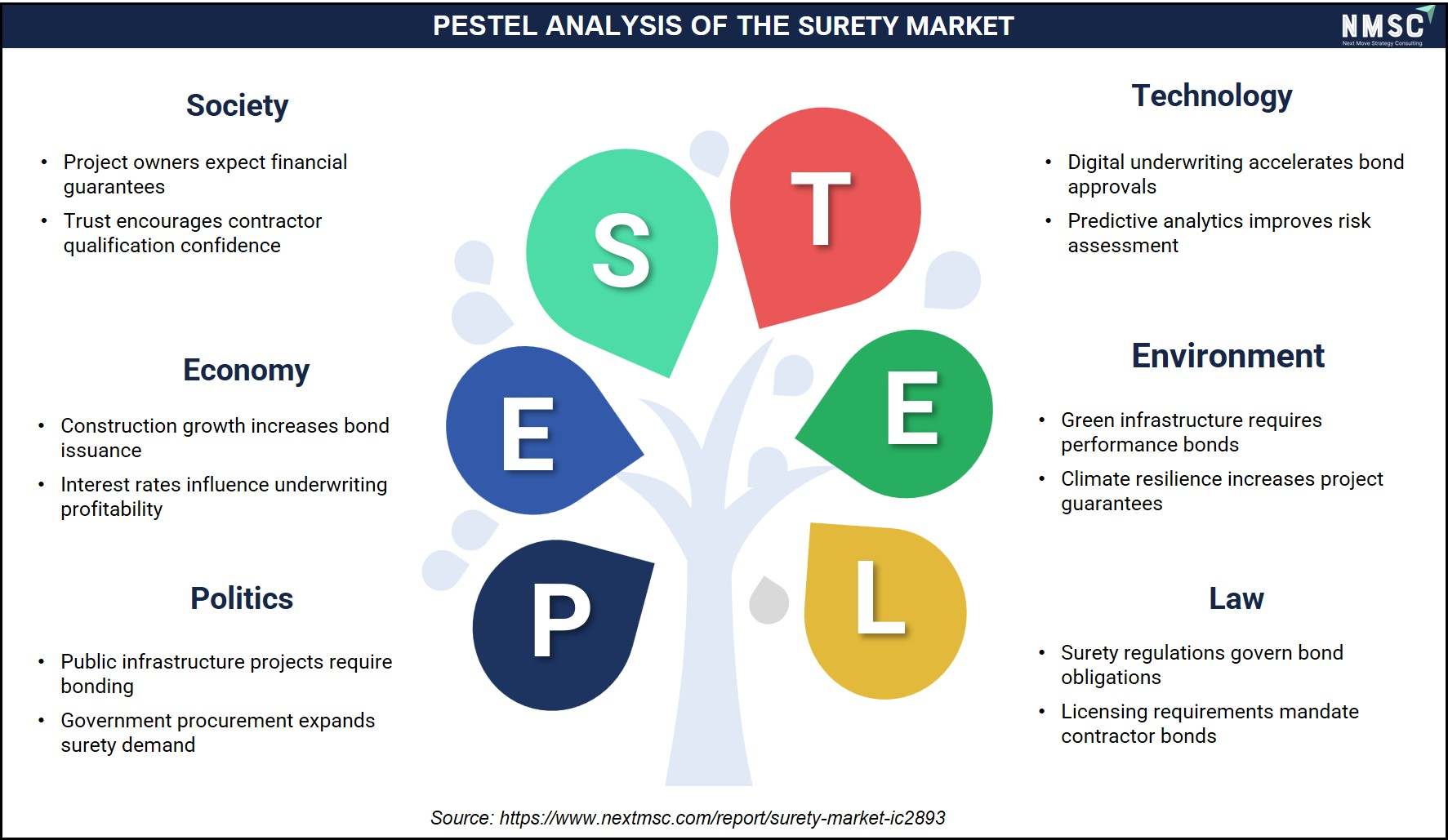
The above infographic presents a PESTEL analysis of the surety market, where government procurement and public infrastructure projects are driving demand for contract bonds. Interest rates are influencing underwriting profitability, while trust in contractor qualification and financial security are shaping social acceptance. Digital underwriting and predictive analytics are further improving risk assessment, and climate resilience is increasing project guarantees. All these developments are taking place within a legal framework of bonding regulations and compliance. Looking ahead, we observed that these interconnected factors collectively shape the market's evolution across the construction sector.
Competitive Landscape
We observed that the Surety market features a moderately consolidated competitive landscape, with large diversified global insurers competing alongside specialty carriers on underwriting capacity, distribution reach, and government contracting relationships.
Key Takeaways
|
Dimension |
Description |
|
Market Structure |
Moderately consolidated; leading diversified global insurers profiled in this report collectively account for a significant share of branded surety premium, while regional specialty carriers serve smaller commercial bond demand. |
|
Innovation Focus |
Digital bond issuance platforms, automated underwriting, and integrated Bond & Specialty product bundling dominate current innovation pipelines across leading carriers. |
|
M&A Activity |
Selective portfolio restructuring with surety retention, exemplified by Travelers' 2025 divestiture of Canadian personal and commercial insurance lines while explicitly retaining its Canadian surety operations. |
How Do Companies Compete in the Surety Market?
Companies compete primarily on underwriting capacity, government contracting relationships, and distribution breadth across brokers and digital channels. Global diversified insurers such as Chubb Limited and Travelers Companies leverage integrated Bond & Specialty divisions to serve large construction and commercial clients, while other carriers such as CNA Financial and Arch Capital Group compete on specialized underwriting expertise for niche commercial and fidelity bond categories.
Which Competitive Archetypes Dominate the Surety Industry?
Two archetypes dominate the market: diversified global insurers offering integrated specialty insurance portfolios spanning surety, fidelity, and management liability, and focused specialty carriers concentrating on niche commercial and fidelity bond underwriting. Travelers Companies and Chubb Limited exemplify the diversified archetype through broad Bond & Specialty divisions, while CNA Financial and Arch Capital Group exemplify the focused archetype building deep underwriting expertise in specific bond categories.
How Are Companies Differentiating Through Innovation in Surety?
Innovation and differentiation strategy increasingly center on digital bond issuance and underwriting automation. Travelers' sustained surety growth alongside its broader digital claims and underwriting modernization reflects efforts to secure differentiated positioning among large construction clients. Our analysis shows that carriers unable to demonstrate fast, digitally enabled commercial bond issuance risk losing smaller obligees to more automated competitors.
What M&A and Expansion Activity Is Shaping the Surety Market?
Portfolio restructuring and selective retention of surety operations continue to reshape competitive positioning within the industry. Travelers' 2025 agreement to sell its Canadian personal and majority commercial insurance business to Definity Financial Corporation for approximately USD 2.4 billion, while explicitly retaining its Canadian surety business, illustrates how carriers are prioritizing surety as a distinct strategic asset even amid broader portfolio simplification.
Key Market Players
Our assessment indicates that the following 15 companies are actively shaping underwriting capacity, distribution innovation, and specialty portfolio strategy within the Surety market.
-
AXA S.A.
-
Zurich Insurance Group AG
-
Assicurazioni Generali S.p.A.
-
American International Group, Inc. (AIG)
-
Tokio Marine Holdings, Inc.
-
Travelers Companies, Inc.
-
Liberty Mutual Holding Company Inc.
-
Munich Re
-
Sompo Holdings, Inc.
-
QBE Insurance Group Limited
-
CNA Financial Corporation
-
Arch Capital Group Ltd.
-
American Financial Group, Inc.
Latest Developments
We found that recent financial results and portfolio actions within the surety supply chain are concentrated on construction-linked premium growth and specialty portfolio restructuring.
|
Date |
Event |
|
December 2025 |
In December 2025, Chubb, Liberty Mutual, and Travelers, together with The Hartford, announced the launch of SuretyBind, a technology company intended to provide shared digital infrastructure for the surety industry. |
Expert Insights
 “The surety landscape is evolving with greater speed and complexity than many firms have experienced in prior cycles. Growth expectations are rising, talent dynamics are shifting, and client demands continue to expand beyond traditional transaction execution. In this environment, perspective matters. More specifically, relevant, actionable data matters.”
— Mark H. McCallum, CEO, National Association of Surety Bond Producers (NASBP)
Statement made while discussing the changing surety industry landscape and the need for surety agencies to adapt to evolving market conditions, technology utilization, client expectations, and operating models.
Market Interpretation
The insight highlights the structural transformation of the surety market, as rising growth expectations and evolving client requirements push the industry beyond traditional bond transaction models. The increasing complexity of the market is encouraging surety providers and agencies to strengthen technology adoption, improve data utilization, and modernize service models. This evolution is expected to support continued investment in digital capabilities and more data-driven approaches to underwriting, client service, and risk management across the surety ecosystem.
Investment Opportunities
What Capital Inflows Are Supporting the Surety Industry?
Diversified insurers are directing capital toward surety underwriting capacity even while restructuring adjacent commercial insurance lines. Travelers' retention of its Canadian surety business amid a broader USD 2.4 billion divestiture illustrates sustained capital commitment to surety as a distinct strategic priority within diversified specialty portfolios.
How Is Infrastructure Investment Shaping Surety Demand?
Government infrastructure spending continues to expand the addressable base for contract and court surety bond demand. Our assessment indicates that sustained public works procurement, combined with growing third-party risk management adoption among large contractors, is creating multi-year procurement pipelines for carriers with established government bonding relationships.
What ESG Considerations Are Influencing Surety Investment Decisions?
Environmental, social, and governance considerations are increasingly influencing capital allocation toward contractors and projects with documented sustainability and compliance credentials. Carriers are incorporating contractor governance and compliance history more systematically into underwriting decisions for large infrastructure bonds. We observed that investors are favoring insurers with transparent underwriting governance as sustainability-linked scrutiny of specialty insurance portfolios increases.
Key Benefits for Stakeholders
How Does This Report Benefit Industry Leaders and Underwriting Teams?
Industry leaders and underwriting teams gain granular segmentation data across bond type, end-user, and regional axes, enabling informed capacity allocation decisions for new commercial and government bonding programs. Our analysis, data, and forecasts help underwriting teams benchmark portfolio strategy against verified 2025–2035 market trajectories and evolving distribution channel trends.
How Does This Report Benefit Investors and Financial Analysts?
Investors and financial analysts gain a validated 2025 base-year market size, a fundamentals-supported 2026–2035 CAGR, and segment-level growth trajectories that support capital allocation and competitive benchmarking decisions. The report's strategic insights into carrier portfolio restructuring and premium growth trends help analysts assess relative positioning across the surety value chain.
How Does This Report Benefit Technology Vendors and Product Teams?
Technology vendors and product teams gain visibility into the fastest-growing sub-segments, including Online Platforms distribution and Government & Public Sector end users, informing product roadmap and go-to-market prioritization aligned with documented buyer and distribution demand shifts through 2035.
Key Market Segments
By Bond Type
-
Contract Surety Bonds
-
Commercial Surety Bonds
-
Fidelity Surety Bonds
-
Court Surety Bonds
By End-User Individuals
-
Private Sector Enterprises
-
Construction
-
Financial Institutions
-
Healthcare
-
Transportation & Logistics
-
Manufacturing
-
Retail
-
IT & Technology
-
Other Professional Services
-
-
Government & Public Sector
By Distribution Channel
-
Direct Sales
-
Brokers and Agents
-
Online Platforms
By Region
-
North America: U.S., Canada, Mexico.
-
Europe: UK, Germany, France, Italy, Spain, Sweden, Denmark, Finland, Netherlands, Rest of Europe.
-
Asia-Pacific: China, India, Japan, South Korea, Taiwan, Indonesia, Vietnam, Australia,Philippines, Malaysia, Rest of APAC.
-
Middle East & Africa: Saudi Arabia, UAE, Egypt, Israel, Turkey, Nigeria, South Africa, Rest of MEA.
-
Latin America: Brazil, Argentina, Chile, Colombia, Rest of LATAM.
Conclusion and Recommendations
What Is the Long-Term Outlook for the Surety Market?
The Surety market is positioned for sustained growth through 2035, underpinned by large construction project activity and rising government infrastructure procurement. We expect Commercial Surety Bonds and Government & Public Sector demand to gain structural share as licensing and public works bonding requirements expand, while Contract Surety Bonds and Private Sector Enterprises retain their position as the largest revenue contributors across the forecast period.
What Strategic Positioning Should Insurers Pursue?
Carriers should prioritize digital underwriting capability and integrated Bond & Specialty portfolio strategy to align with construction client procurement preferences. Our assessment indicates that carriers investing in automated commercial bond issuance, following the pattern established by Travelers' sustained surety premium growth, are best positioned to capture emerging market and digital distribution opportunities through 2035.
How Attractive Is the Surety Market for Investment?
The market presents an attractive investment case, supported by a validated USD 16.20 Billion absolute dollar opportunity between 2026 and 2035 and a fundamentals-backed 5.93% CAGR. Sustained premium growth momentum, as demonstrated by Travelers' reported surety segment gains across multiple 2025 and 2026 quarters, signals sustained carrier and investor confidence in the segment's stability and growth trajectory.
What Market Shifts and Key Risks Should Stakeholders Monitor?
Stakeholders should monitor softening commercial insurance pricing cycles, which restrain premium growth across specialty lines including surety. We found that elevated contractor default risk amid construction cost inflation also poses a risk to underwriting profitability, particularly for carriers with concentrated exposure to large single-project contract bonds.
What Are the Key Growth Pathways Through 2035?
Key growth pathways include expanding digital bond issuance for commercial obligees, scaling government infrastructure-linked bonding programs, and deepening bundled specialty insurance relationships with large enterprise clients. Our findings suggest that carriers combining underwriting scale with digital distribution capability are best positioned to capture a disproportionate share of the market's projected USD 40.06 Billion 2035 revenue base.
About the Author
 Mayurima Roy
— Mayurima Roy is Research Analyst at Next Move Strategy Consulting, where she has spent 4 years working across the firm's full industry coverage rather than a single fixed vertical. Her work centers on structured research, ongoing trend tracking, competitive assessment, and insight-led content development, translating complex market data into clear, decision-ready narratives that support informed client decision-making across diverse global industries, market sectors, and world regions every day.
Mayurima Roy
— Mayurima Roy is Research Analyst at Next Move Strategy Consulting, where she has spent 4 years working across the firm's full industry coverage rather than a single fixed vertical. Her work centers on structured research, ongoing trend tracking, competitive assessment, and insight-led content development, translating complex market data into clear, decision-ready narratives that support informed client decision-making across diverse global industries, market sectors, and world regions every day.
About the Reviewer
 Supradip Baul
— Supradip Baul is an accomplished business consultant and strategist with over a decade of rich experience in market intelligence, strategy, technology, and business transformation. His work has included rigorous qualitative and quantitative analysis across multiple industries, helping clients shape investment decisions and long-term roadmaps. Earlier in his career, he was associated with Gartner, where he contributed to industry-leading reports and market share analyses. He has worked with leading global companies and holds an MBA with a dual specialization in Marketing and Finance.
Supradip Baul
— Supradip Baul is an accomplished business consultant and strategist with over a decade of rich experience in market intelligence, strategy, technology, and business transformation. His work has included rigorous qualitative and quantitative analysis across multiple industries, helping clients shape investment decisions and long-term roadmaps. Earlier in his career, he was associated with Gartner, where he contributed to industry-leading reports and market share analyses. He has worked with leading global companies and holds an MBA with a dual specialization in Marketing and Finance.
At Next Move Strategy Consulting, we understand that insightful market research is the cornerstone of successful business decisions. That's why we employ a robust and multifaceted approach, combining various methodologies to deliver the most accurate and actionable data for our clients.

Research Landscape
We navigate the world of research with two primary approaches:
Qualitative Approach
Our qualitative research methodologies involve immersive techniques such as in-depth interviews, focus groups, and observational studies. By engaging directly with individuals and stakeholders, we uncover valuable insights that quantitative data alone may overlook.

Quantitative Research
In tandem with qualitative methodologies, NMSC leverages the power of Quantitative Research to provide a robust foundation of numerical insights. Through systematic data collection and analysis, we quantify patterns, preferences, and market trends, offering a comprehensive view of the business landscape.
Our quantitative research approach employs diverse tools, including surveys, experiments, and statistical modelling. These methodologies enable us to gather data from a large and representative sample, ensuring the statistical significance of our findings. By employing structured questionnaires and standardized data collection methods, we guarantee the reliability and validity of the information we present to our clients.
Quantitative research is particularly effective in measuring the prevalence of trends, assessing market size, and gauging the impact of various factors on consumer behavior. The numerical precision attained through this approach equips our clients with actionable insights, facilitating data-driven decision-making and strategy formulation.


Our Specialized Toolbox for Industry-Specific Market Research
We deploy a specialized arsenal of techniques tailored to meet your unique requirements. Here's a glimpse into our comprehensive toolbox:

Information Procurement
The stage entails acquiring market data or relevant information through various sources and methodologies.


Market Research Approach
We utilize both top-down and bottom-up approaches in market research analysis to achieve a comprehensive understanding of the market dynamics, leveraging the broad perspective of industry trends and macroeconomic factors alongside detailed insights from specific segments and individual companies.

Porters Five Forces Analysis
We conduct Porter's Five Forces analysis to evaluate the competitive landscape of an industry, providing us with insights into factors that affect profitability and strategic positioning.

SWOT Analysis

Forecasting
We utilize a forecasting model to predict future consumption by considering parameters like population, economics, regulations, market competition, drivers, constraints, technology, and pricing. We also employ statistical techniques such as multilinear regression, exponential smoothing, moving average, ARIMA, and Monte Carlo simulations for accurate predictions. In econometric forecasting, we analyzed short-term and long-term event impacts, attributing values based on regulatory frameworks, economic factors, and market events.





 Speak to Our Analyst