Toilet Market Size, Share, and Trends 2026–2035: Segmentation by Product Type (One-Piece, Two-Piece, Wall-Hung Toilets, and Others), Installation Type (Floor-Mounted and Wall-Mounted), Technology (Conventional and Smart), Flush Mechanism (Gravity Flush, Pressure-Assisted Flush, and Vacuum Flush), Flush Control, Operation, Material, Distribution Channel, Price Tier, End User (Residential, Commercial, Industrial, and Institutional), and Region – Global Industry Report and Forecast, 2026–2035
Industry: Retail and Consumer | Publishing Date: July 22, 2026 | Last Updated: September 30, 2026 | No of Pages: N/A | No. of Tables: N/A | No. of Figures: N/A | Format: PDF | Report Code: RC5305
What Is the Toilet Market Size?
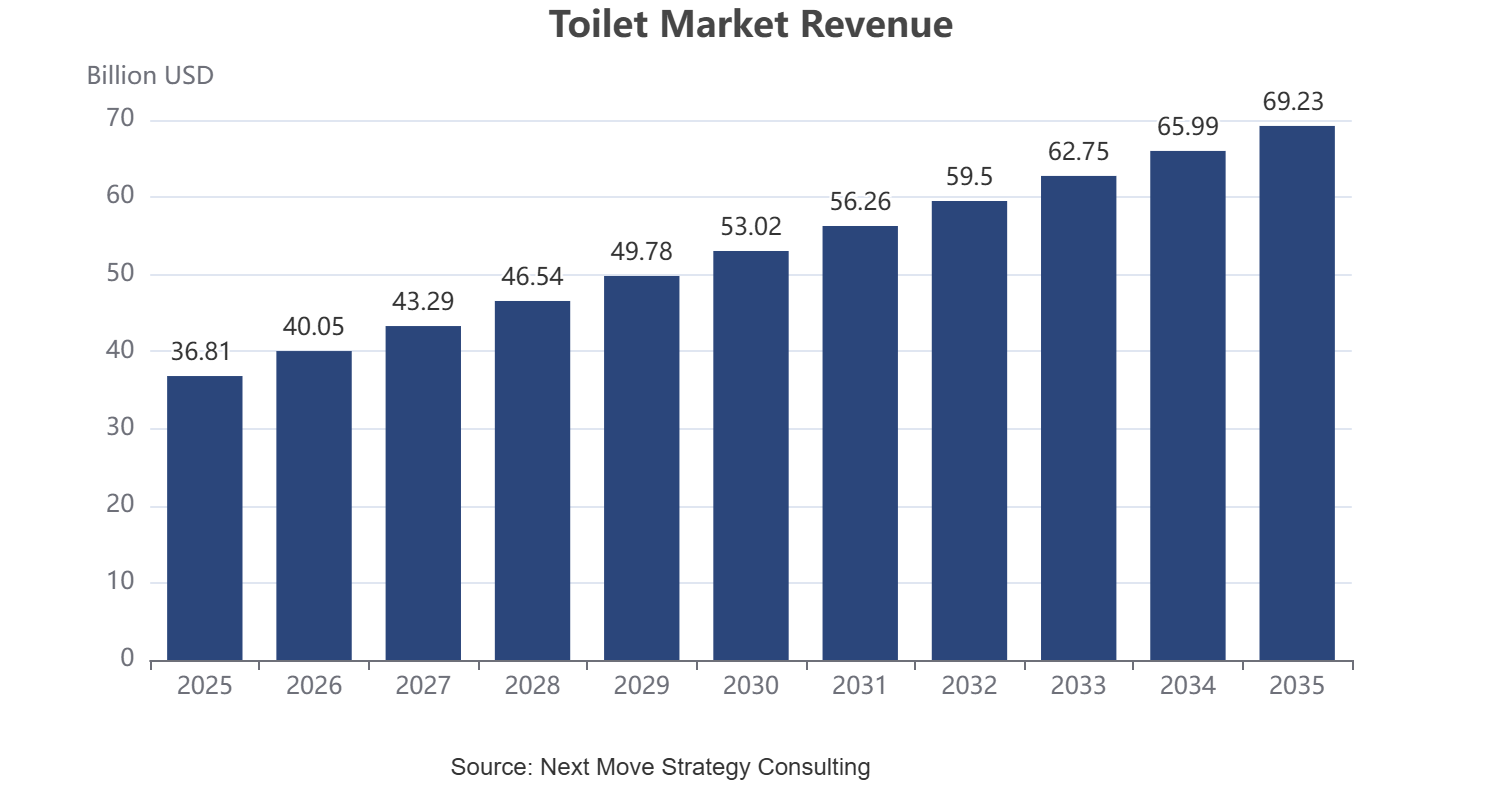
The global toilet market size was valued at USD 36.81 billion in 2025 and is estimated at USD 39.21 billion in 2026, projected to reach USD 69.23 billion by 2035, growing at a CAGR of 6.52% from 2026 to 2035. Asia-Pacific led the market with an approximate 36% revenue share in 2025, while Two-Piece Toilets remained the dominant product type at roughly 38% share.
Our findings suggest that the following key takeaways summarize the toilet market's segment-level and geographic dynamics as of 2025.
|
Key Takeaways |
|
By Product Type: Two-Piece Toilets held the largest share of approximately 38% (USD 14.00 billion) in 2025; Tankless Toilets is the fastest-growing sub-segment at 12.7% CAGR from 2026–2035. |
|
By Installation Type: Floor-Mounted Toilets held the largest share of approximately 83% (USD 30.55 billion) in 2025; Wall-Mounted Toilets is the fastest-growing sub-segment at 11.6% CAGR from 2026–2035. |
|
By Technology: Conventional Toilets held the largest share of approximately 88% (USD 32.39 billion) in 2025; Smart Toilets is the fastest-growing sub-segment at 15.1% CAGR from 2026–2035. |
|
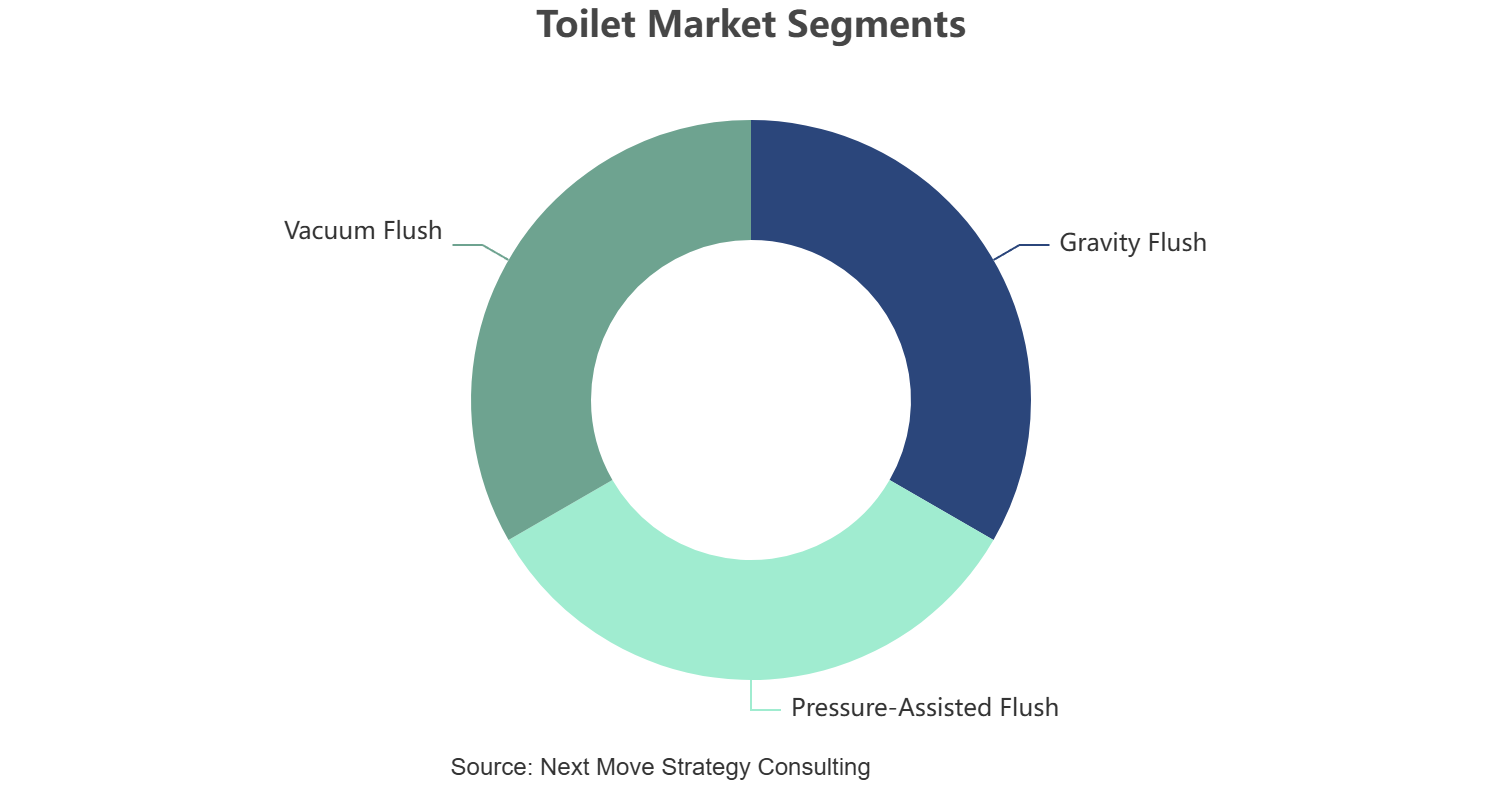
By Flush Mechanism: Gravity Flush Toilets held the largest share of approximately 71% (USD 26.14 billion) in 2025; Pressure-Assisted Flush is the fastest-growing sub-segment at 10.4% CAGR from 2026–2035. |
|
By Flush Control: Single Flush Toilets held the largest share of approximately 62% (USD 22.82 billion) in 2025; Dual Flush is the fastest-growing sub-segment at 9.5% CAGR from 2026–2035. |
|
By Operation Mode: Manual Toilets held the largest share of approximately 84% (USD 30.92 billion) in 2025; Sensor-Activated Toilets is the fastest-growing sub-segment at 13.0% CAGR from 2026–2035. |
|
By Material: Vitreous China Toilets held the largest share of approximately 76% (USD 27.98 billion) in 2025; Composite Toilets is the fastest-growing sub-segment at 13.2% CAGR from 2026–2035. |
|
By Distribution Channel: Distributors held the largest share of approximately 34% (USD 12.52 billion) in 2025; E-Commerce is the fastest-growing sub-segment at 13.2% CAGR from 2026–2035. |
|
By Price Tier: Mid-Range Toilets held the largest share of approximately 44% (USD 16.20 billion) in 2025; Premium Toilets is the fastest-growing sub-segment at 9.9% CAGR from 2026–2035. |
|
By End User: Residential held the largest share of approximately 58% (USD 21.35 billion) in 2025; Institutional is the fastest-growing sub-segment at 8.2% CAGR from 2026–2035. |
|
Dominant Region: Asia-Pacific dominated with approximately 36% revenue share (USD 13.25 billion) in 2025. |
|
Fastest-Growing Region: Middle East & Africa is expected to register the highest CAGR of 10.5% during 2026–2035. |
|
Dominant Country: China led with approximately USD 4.51 billion in 2025. |
|
Fastest-Growing Country: Saudi Arabia is the fastest-growing country at approximately 10.5% CAGR from 2026–2035. |
Market Opportunity: The toilet market presents an absolute dollar opportunity of approximately USD 30.02 billion between 2026 and 2035, calculated as the difference between the 2035 forecast value and the 2026 base value, an investment window favoring manufacturers scaling smart and premium product tiers.
According to NMSC analysis, we found that the gap between global sanitation-access commitments and installed smart-toilet penetration is widening the addressable market for both affordable fixed-function toilets in emerging economies and connected, sensor-based toilets in mature markets simultaneously.
What does the Toilet Market Encompass?
The toilet market encompasses the manufacture, distribution, and installation of sanitary fixtures used for human waste disposal across residential, commercial, industrial, and institutional buildings, spanning one-piece, two-piece, wall-hung, back-to-wall, tankless, and squat configurations in vitreous china, stainless steel, plastic, and composite materials. We observed that the market has structurally evolved from purely mechanical, gravity-fed fixtures toward sensor-activated and app-connected smart toilets that integrate bidet cleansing, auto-flush, and water-usage monitoring, particularly across premium residential and hospitality segments.
Regulatory frameworks such as the U.S. EPA WaterSense Specification for Tank-Type Toilets and the federal 1.6 gallon-per-flush standard, alongside the EU's water-efficiency labeling initiatives, continue to compress maximum flush volumes and push manufacturers toward dual-flush and pressure-assisted designs. During our market evaluation, we noticed that technology adoption is concentrated in Japan, South Korea, and North America, while government-funded sanitation infrastructure programs are the primary demand driver across South Asia, Southeast Asia, and Sub-Saharan Africa, creating a bifurcated but complementary global growth pattern through 2035.
|
Parameters |
Details |
|
Market Size in 2025 |
USD 36.81 Billion |
|
Market Size in 2026 |
USD 39.21 Billion |
|
Revenue Forecast in 2035 |
USD 69.23 Billion |
|
Growth Rate |
CAGR of 6.52% from 2026 to 2035 |
|
Analysis Period |
2025–2035 |
|
Base Year Considered |
2025 |
|
Forecast Period |
2026–2035 |
|
Market Size Estimation |
USD Billion |
|
Companies Profiled |
20 |
|
Countries Covered |
38 |
|
Market Share |
Available for Top 10 Companies |
Key Emerging Trends
Our analysis shows that four structural trends are reshaping product design, purchasing behavior, and manufacturer strategy across the global toilet market heading into 2035.
How Is Smart Toilet Adoption Transforming the Bathroom Experience?
Sensor-activated, app-connected toilets are transforming the bathroom from a purely functional space into a personalized wellness environment, with heated seats, auto-flush, and bidet cleansing shifting from luxury add-ons to mainstream expectations in premium residential builds. Kohler's Numi 2.0, which pairs Amazon Alexa voice control with the Kohler Konnect app for personalized multi-user presets, illustrates how manufacturers are embedding smart home connectivity directly into fixture hardware. Stakeholder impact is greatest for premium retailers and installers adapting to electrical and Wi-Fi provisioning requirements.
Why Are Water-Efficient Flush Technologies Becoming a Design Standard?
Water-efficient flush engineering is becoming a baseline design standard rather than a differentiator, as utilities and regulators tighten maximum flush-volume thresholds across mature markets. TOTO's INTEGRAVITY SYSTEM flush engine, which debuted on the Aurora WASHLET+ S7A one-piece toilet at KBIS 2026, exemplifies how manufacturers are re-engineering bowl geometry and rim-flush dynamics to sustain cleaning performance at 1.0-gallon-per-flush volumes. We found that utility rebate programs tied to WaterSense-labeled fixtures are accelerating replacement-cycle demand among cost-conscious homeowners.
How Is Skirted, Fully Integrated Design Reshaping Product Platforms?
Fully skirted, integrated one-piece and two-piece platforms are replacing exposed-trapway designs across new product launches, reflecting consumer preference for easier cleaning and a more contemporary aesthetic. TOTO's 2026 Aurora, Redington, and Glaston collections all adopt fully skirted profiles across both 1.28 and 1.0 gallon-per-flush configurations, spanning entry to premium price tiers. Our assessment indicates that skirted platforms are increasingly bundled with WASHLET-style bidet-seat compatibility, letting retailers upsell smart features without requiring buyers to commit to an all-in-one smart toilet at first purchase.
Why Is IoT-Enabled Commercial Restroom Infrastructure Gaining Traction?
IoT-ready commercial fixtures that report real-time water consumption, flush-rate anomalies, and maintenance alerts to building management systems are gaining traction among facility operators seeking to control water costs and streamline upkeep across high-traffic institutional restrooms. TOTO's 2026 ECOPOWER flush-valve and touchless-fixture lineup, offered in both IoT-Ready and IoT-Enabled tiers, allows facilities to defer connectivity spending until infrastructure is in place. Based on research conducted by NMSC, we found that this tiered approach is lowering the adoption barrier for schools, healthcare facilities, and transportation hubs with constrained capital budgets.
Growth Drivers & Restraints
|
Factors |
Type |
(+/−) % Impact on CAGR |
Geographic Relevance |
Impact Timeline |
|
Government-funded sanitation infrastructure programs |
Driver |
+1.4% |
Asia-Pacific, MEA |
2026–2032 |
|
Rising adoption of smart, sensor-activated toilets |
Driver |
+1.2% |
North America, Japan, South Korea |
2026–2035 |
|
Tightening water-efficiency regulation and rebate incentives |
Driver |
+0.9% |
North America, Europe |
2026–2030 |
|
Hospitality and tourism construction boom in the Gulf |
Driver |
+0.8% |
Middle East & Africa |
2026–2032 |
|
Aging population and accessibility-driven bathroom retrofits |
Driver |
+0.6% |
North America, Europe, Japan |
2026–2035 |
|
E-commerce expansion for direct-to-consumer fixture sales |
Driver |
+0.5% |
Global |
2026–2030 |
|
Volatility in vitreous china raw-material and energy costs |
Restraint |
−0.7% |
Global |
2026–2029 |
|
High retrofit and plumbing-modification costs for renovation |
Restraint |
−0.6% |
North America, Europe |
2026–2032 |
|
Persistent reliance on non-piped or basic sanitation in low-income regions |
Restraint |
−0.5% |
Sub-Saharan Africa, South Asia |
2026–2033 |
What Is the Primary Growth Driver of the Toilet Industry?
Government-funded sanitation infrastructure remains the single largest driver of toilet market volume, particularly across Asia-Pacific. India's Swachh Bharat Mission has supported the construction of over 110 million individual household latrines since October 2014, according to the Ministry of Jal Shakti, sustaining baseline replacement and upgrade demand well beyond the program's original open-defecation-free milestone. We observed that this government-anchored demand base provides volume stability even as premium segments fluctuate with discretionary renovation spending.
How Is Smart Toilet Adoption Driving Market Growth?
Rising disposable income and home-automation adoption are driving smart toilet penetration well above the category average, with the segment expanding at a 15.1% CAGR from 2026 to 2035 versus 6.52% for the overall market. TOTO's WASHLET line has exceeded 60 million cumulative units sold globally since its 1980 launch, reflecting durable consumer demand for integrated bidet-cleansing technology. Our analysis shows that North America, Japan, and South Korea are absorbing the largest share of this premiumization, supported by expanding retail distribution of mid-tier bidet-seat products.
What Is Restraining Toilet Market Growth?
Volatile vitreous china input costs and elevated retrofit expenses restrain margin expansion and slow renovation-driven replacement, particularly in mature markets where labor costs for plumbing modification often exceed the fixture cost itself. The U.S. EPA's WaterSense Version 2.0 tank-type toilet specification, effective July 1, 2025, has also required manufacturers to requalify dual-flush models against a stricter 1.28-gallon-per-flush ceiling, adding near-term compliance costs. We found that these pressures weigh most heavily on mid-market manufacturers with limited pricing power against premium and value-tier competitors.
Segmentation Analysis
Segment Sizing: By Product Type
|
Segment |
2025 (USD) |
2035 (USD) |
CAGR% (2026–2035) |
|
One-Piece Toilets |
9.94 Billion |
20.77 Billion |
7.6% |
|
Two-Piece Toilets |
14.00 Billion |
22.15 Billion |
4.7% |
|
Wall-Hung Toilets |
5.15 Billion |
11.08 Billion |
8.0% |
|
Back-to-Wall Toilets |
3.31 Billion |
6.23 Billion |
6.5% |
|
Tankless Toilets |
1.47 Billion |
4.85 Billion |
12.7% |
|
Squat Toilets |
2.94 Billion |
4.15 Billion |
3.5% |
|
Total |
36.81 Billion |
69.23 Billion |
6.52% |
Which Product Type Dominates the Toilet Industry?
Two-Piece Toilets dominate the toilet market with approximately 38% share in 2025, valued at USD 14.00 billion, reflecting their lower manufacturing and shipping cost relative to one-piece platforms and continued preference across value-conscious residential renovation projects. Tankless Toilets are the fastest-growing product type at a 12.7% CAGR from 2026 to 2035, driven by TOTO's WASHLET S5 and S2 instantaneous water-heater platforms that eliminate bulky tank hardware while cutting energy consumption by an estimated 38% per the manufacturer's own testing.
Segment Sizing: By Technology
|
Segment |
2025 (USD) |
2035 (USD) |
CAGR% (2026–2035) |
|
Conventional Toilets |
32.39 Billion |
51.23 Billion |
4.7% |
|
Smart Toilets |
4.42 Billion |
18.00 Billion |
15.1% |
|
Total |
36.81 Billion |
69.23 Billion |
6.52% |
Which Technology Segment Is Growing Fastest?
Conventional Toilets retain a dominant 88% share in 2025 at USD 32.39 billion, underscoring the continued centrality of fixed-function fixtures in cost-sensitive residential and institutional construction globally. Smart Toilets are expanding at a 15.1% CAGR from 2026 to 2035, more than double the market average, as Kohler, TOTO, and LIXIL's INAX brand scale sensor-activated, app-controlled product lines from ultra-premium price points toward broader mid-tier accessibility.
Segment Sizing: By End User
|
Segment |
2025 (USD) |
2035 (USD) |
CAGR% (2026–2035) |
|
Residential |
21.35 Billion |
37.38 Billion |
5.8% |
|
Commercial |
11.04 Billion |
22.85 Billion |
7.5% |
|
Industrial |
2.21 Billion |
4.15 Billion |
6.5% |
|
Institutional |
2.21 Billion |
4.85 Billion |
8.2% |
|
Total |
36.81 Billion |
69.23 Billion |
6.52% |
Which End User Segment Leads the Toilet Industry?
Residential end users lead the toilet market with approximately 58% share in 2025 at USD 21.35 billion, anchored by new construction and renovation demand across both mature and emerging housing markets. The Institutional segment, encompassing schools, government buildings, and transportation facilities, is the fastest-growing end-user category at an 8.2% CAGR, supported by continued government sanitation-infrastructure funding and post-pandemic hygiene-driven restroom upgrades in public facilities.
Price Point Analysis of the Toilet Industry
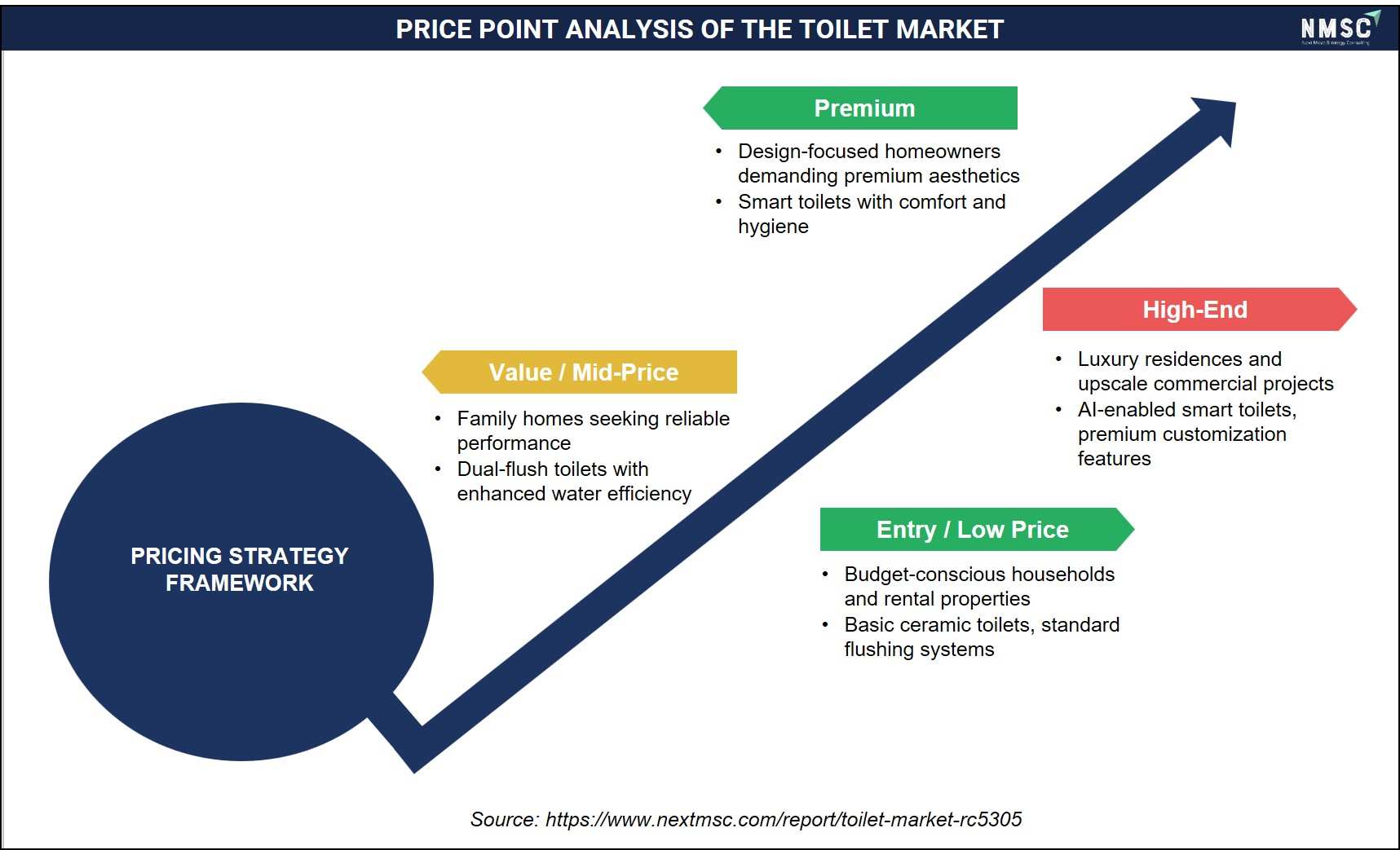
The above infographic presents a price point analysis of the toilet market, outlining a tiered pricing strategy that spans from budget-friendly essentials to luxury smart toilets. Entry and value segments serve cost-conscious households and family homes with basic ceramic models and water-efficient dual-flush systems, while premium and high-end tiers cater to design-focused and luxury buyers seeking smart features, advanced hygiene, and premium customization. Looking ahead, we observed that this diversified approach effectively addresses varying consumer needs and purchasing power across the market.
Growth Opportunities
Beyond the core drivers shaping overall demand, three whitespace opportunities stand out for manufacturers positioning portfolios toward 2035.
How Can Manufacturers Capture Value from Retrofit-Friendly Smart Upgrades?
Modular smart-toilet retrofit kits that upgrade an existing bowl to WASHLET-style bidet functionality without full fixture replacement, such as TOTO's WC Element flush-frame system, open a mechanism for capturing premium revenue from cost-conscious homeowners. Fixture manufacturers and specialty retailers stand to benefit most from this incremental-upgrade sales motion.
What Opportunity Exists in IoT-Enabled Institutional Restroom Retrofits?
Tiered IoT-Ready commercial fixture programs that let facility operators defer connectivity activation until budget allows create a mechanism for capturing large-format institutional and commercial contracts that would otherwise stall on upfront technology cost. Commercial fixture manufacturers and facility-management technology vendors are the primary beneficiaries of this staged-adoption opportunity.
How Can Suppliers Benefit from Government Sanitation Procurement Programs?
Sustained government procurement tied to programs such as Swachh Bharat and comparable national sanitation initiatives across Sub-Saharan Africa creates a durable volume mechanism for manufacturers offering affordable, standardized ceramic and composite toilet platforms. Regional manufacturers and distributors serving public-tender channels are best positioned to capture this government-anchored opportunity.
Regional Outlook
|
Region |
2025 (USD) |
2035 (USD) |
CAGR% (2026–2035) |
Key Driver |
|
North America |
9.57 Billion |
15.23 Billion |
4.8% |
Water-efficiency regulation and smart toilet premiumization |
|
Europe |
8.10 Billion |
13.15 Billion |
5.0% |
Water-conservation policy and renovation demand |
|
Asia-Pacific |
13.25 Billion |
25.62 Billion |
6.8% |
Government sanitation programs and new construction |
|
Middle East & Africa |
3.31 Billion |
9.00 Billion |
10.5% |
Hospitality construction and infrastructure investment |
|
Latin America |
2.58 Billion |
6.23 Billion |
9.2% |
Urban housing expansion and formalized construction |
|
Total |
36.81 Billion |
69.23 Billion |
6.52% |
— |
North America
North America's toilet market is mature, with growth concentrated in smart toilet premiumization and WaterSense-driven replacement cycles rather than new-unit volume. Regulatory tightening under the EPA's Version 2.0 tank-type toilet specification is reshaping dual-flush product compliance, while retailers report strong bidet-seat attach-rate growth. We observed that strategic outlook favors manufacturers with certified, high-efficiency product lines and established retail and e-commerce distribution.
Europe
Europe's market benefits from stringent water-efficiency policy and a well-established renovation culture across Germany, the UK, and France, with technology adoption skewing toward wall-hung and back-to-wall installations in space-constrained urban housing. Geberit's AquaClean smart-toilet-seat platform, refreshed across fourteen European markets, illustrates sustained regional investment in connected bathroom technology. Strategic outlook favors suppliers integrating water-saving flush engineering with compact, space-efficient form factors.
Asia-Pacific
Asia-Pacific is the largest and fastest-scaling regional market by absolute dollar growth, propelled by government sanitation infrastructure programs in India and continued new-construction volume in China and Southeast Asia. Technology adoption is most advanced in Japan, where smart bidet toilets are present in a majority of households, contrasting sharply with basic-fixture demand still prevalent across parts of South and Southeast Asia. Strategic outlook favors manufacturers able to serve both premium and entry-tier demand within a single regional footprint.
Middle East & Africa
The Middle East & Africa market is the fastest-growing region globally at a 10.5% CAGR, driven by hospitality, tourism, and mixed-use construction tied to Gulf economic diversification programs alongside continued basic-sanitation investment across Sub-Saharan Africa. Regulatory influence remains lighter than in North America or Europe, giving manufacturers flexibility on flush-volume specification. Strategic outlook favors suppliers with strong regional distributor relationships and hospitality-sector project pipelines.
Latin America
Latin America's toilet market is expanding steadily as urban housing formalization and rising middle-class renovation spending in Brazil and Argentina drive demand for mid-range two-piece and one-piece products. Technology adoption remains nascent relative to North America and Asia-Pacific, concentrated in premium residential developments in major metropolitan centers. Strategic outlook favors manufacturers building distributor and home-improvement retail partnerships ahead of anticipated construction-sector recovery.
U.S.
Based on our estimates, the U.S. market was valued at approximately USD 6.89 billion in 2025 and is projected to reach USD 10.36 billion by 2035, growing at a 4.2% CAGR. Demand is anchored in replacement and renovation activity, with high smart toilet adoption, strong WaterSense regulatory influence, and intense competitive activity among Kohler, TOTO, and American Standard supporting a mature but technology-forward strategic outlook.
Canada
The market in Canada was valued at approximately USD 1.72 billion in 2025 and is forecast to reach USD 2.74 billion by 2035, expanding at a 4.8% CAGR. Demand structure mirrors the U.S. with a renovation-led profile, moderate smart toilet penetration concentrated in urban centers, and provincial water-efficiency codes shaping flush-volume specification across new residential construction.
UK
As per our estimate, the UK market stood at approximately USD 1.30 billion in 2025 and is projected to reach USD 1.97 billion by 2035, growing at a 4.3% CAGR. Demand structure favors wall-hung and back-to-wall installations suited to compact urban bathrooms, with Building Regulations Part G water-efficiency requirements and steady renovation activity supporting a stable strategic outlook.
Germany
According to our analysis, Germany's market was valued at approximately USD 1.54 billion in 2025 and is expected to reach USD 2.37 billion by 2035, at a 4.4% CAGR. Demand is driven by high renovation intensity and premium fixture preference, with Geberit and Duravit maintaining strong domestic distribution and regulatory alignment with EU water-efficiency and ecodesign frameworks shaping product specification.
France
Based on our estimates, France's toilet market was valued at approximately USD 1.13 billion in 2025 and is projected to reach USD 1.71 billion by 2035, growing at a 4.2% CAGR. Demand structure is renovation-led with moderate technology penetration, and competitive intensity remains high among European sanitaryware brands competing on design and water-efficiency credentials within the country's regulated construction sector.
China
The market in China was valued at approximately USD 4.51 billion in 2025 and is projected to reach USD 7.69 billion by 2035, growing at a 5.5% CAGR, the largest country-level market globally. Demand structure spans both large-scale new construction and rapidly growing smart toilet adoption, with JOMOO, Huida, and Arrow competing alongside multinational brands, supported by continued urbanization and rising middle-class renovation spending.
India
According to our analysis, India's market was valued at approximately USD 2.39 billion in 2025 and is projected to reach USD 6.15 billion by 2035, expanding at a 9.9% CAGR, among the fastest-growing large markets globally. Demand is dominated by government sanitation procurement under the Swachh Bharat Mission, which the Ministry of Jal Shakti reports has supported over 110 million household toilet installations, alongside a fast-emerging premium smart toilet segment led by Jaquar and Hindware.
Japan
As per our estimate, Japan's market was valued at approximately USD 1.46 billion in 2025 and is projected to reach USD 2.05 billion by 2035, growing at a 3.5% CAGR. Demand structure is the most technology-mature globally, with smart bidet toilets present in the large majority of households and TOTO and LIXIL's INAX brand competing on incremental hygiene and water-efficiency innovation within a saturated replacement-driven market.
South Korea
Based on our estimates, South Korea's market was valued at approximately USD 1.06 billion in 2025 and is projected to reach USD 1.79 billion by 2035, at a 5.4% CAGR. Demand structure closely resembles Japan's with high smart toilet penetration in urban apartment renovation, strong domestic brand competition, and technology adoption reinforced by broader consumer familiarity with connected home appliances.
Australia
The market in Australia was valued at approximately USD 0.80 billion in 2025 and is projected to reach USD 1.28 billion by 2035, growing at a 4.9% CAGR. Demand structure is renovation-led with dual-flush water-efficiency labeling mandated nationally, supporting consistent adoption of water-saving flush technology across both residential and commercial new-build segments.
UAE
According to our analysis, the UAE market was valued at approximately USD 0.60 billion in 2025 and is projected to reach USD 1.53 billion by 2035, growing at a 9.9% CAGR. Demand structure is dominated by large-scale hospitality and mixed-use construction tied to Dubai's long-term urban master planning, with RAK Ceramics maintaining a strong domestic manufacturing presence and rising smart toilet adoption in luxury residential and hotel developments.
Saudi Arabia
Based on our estimates, Saudi Arabia's toilet market was valued at approximately USD 0.73 billion in 2025 and is projected to reach USD 1.98 billion by 2035, growing at a 10.5% CAGR, the fastest country-level growth rate in this report. Demand is driven by Vision 2030-linked giga-projects and hospitality construction, with strong regulatory alignment to Saudi Standards, Metrology and Quality Organization requirements shaping fixture specifications across new institutional and commercial developments.
South Africa
As per our estimate, South Africa's market was valued at approximately USD 0.30 billion in 2025 and is projected to reach USD 0.81 billion by 2035, growing at a 10.5% CAGR. Demand structure combines government-funded basic sanitation programs in underserved communities with a growing formal residential and commercial construction sector concentrated in major metropolitan areas.
Brazil
The market in Brazil was valued at approximately USD 1.03 billion in 2025 and is projected to reach USD 2.37 billion by 2035, growing at an 8.7% CAGR, the largest market in Latin America. Demand structure is led by urban housing formalization and mid-range two-piece toilet demand, with Latin American distributors expanding home-improvement retail partnerships to serve rising middle-class renovation spending.
Argentina
According to our analysis, Argentina's toilet market was valued at approximately USD 0.46 billion in 2025 and is projected to reach USD 1.12 billion by 2035, growing at a 9.2% CAGR. Demand structure reflects a recovering construction sector and steady replacement demand, with distributors and specialty retailers remaining the primary channels for both economy and mid-range fixture sales.
Competitive Landscape
Our assessment indicates that competitive intensity is shaped by a mix of Japanese and Western multinational technology leaders and regional ceramic manufacturers competing across sharply differentiated price tiers within the broader plumbing fixtures industry.
|
Field |
Details |
|
Market Structure |
Moderately consolidated at the premium and smart toilet tiers, fragmented at the economy and mid-range tiers across regional ceramic manufacturers. |
|
Innovation Focus |
Sensor-activated bidet integration, water-efficient flush engineering, and IoT-enabled commercial fixture connectivity. |
|
M&A Activity |
Selective technology licensing and regional distribution partnerships rather than large-scale consolidation. |
How Do Companies Compete in the Toilet Industry?
Companies compete primarily on flush performance, water efficiency certification, smart-feature integration, and brand trust built over decades of bathroom-technology innovation. Our analysis shows that TOTO and Kohler compete heavily on proprietary flush engineering and app-connected smart features, while regional Chinese and Indian manufacturers such as JOMOO and Jaquar compete on price-tier breadth and distributor network density across high-growth emerging markets.
Which Competitive Archetypes Dominate the Market?
Two archetypes dominate the market: vertically integrated global technology leaders offering proprietary smart toilet platforms with premium brand positioning, and regional ceramic manufacturers competing on manufacturing scale and distributor relationships across economy and mid-range tiers. TOTO and Kohler exemplify the technology-leader archetype through their WASHLET and Numi platforms, while JOMOO Group and Huida Sanitary Ware exemplify the regional scale archetype serving China's vast domestic construction volume.
How Are Companies Differentiating Through Innovation?
Innovation and differentiation increasingly center on integrated flush-engine redesign and connected-home compatibility. TOTO's INTEGRAVITY SYSTEM flush engine, debuted at KBIS 2026, and Kohler's Konnect app ecosystem both illustrate how manufacturers are embedding proprietary technology directly into fixture hardware to justify premium pricing and build platform lock-in across smart home ecosystems.
What M&A and Expansion Activity Is Shaping the Toilet Industry?
Expansion activity is concentrated in technology licensing and manufacturing-capacity investment rather than large-format acquisitions. LIXIL's commercial license agreement with Georgia Tech's Generation 2 Reinvented Toilet consortium illustrates how established manufacturers are securing rights to next-generation sanitation technology, while regional players continue expanding distributor networks across the Middle East and Sub-Saharan Africa to capture government sanitation procurement volume.
Key Market Players
Our assessment indicates that the following 20 companies are actively shaping product innovation, manufacturing scale, and distribution strategy within the global toilet market.
-
TOTO Ltd.
-
LIXIL Corporation
-
Kohler Co.
-
Roca Sanitario, S.A.
-
Geberit AG
-
Villeroy & Boch AG
-
Duravit AG
-
JOMOO Group Co., Ltd.
-
Huida Sanitary Ware Co., Ltd.
-
Arrow Home Group Co., Ltd.
-
HEGII Sanitary Ware Co., Ltd.
-
Dongpeng Holdings Co., Ltd.
-
Jaquar Group
-
VitrA Karo Sanayi ve Ticaret A.Ş.
-
Lecico Egypt S.A.E.
-
RAK Ceramics PJSC
-
SCG Ceramics Public Company Limited
-
Hindware Limited
-
Catalano S.p.A.
Latest Developments
We found that recent product launches within the market are concentrated on smart-technology integration, water-efficiency innovation, and sanitation-access initiatives across both premium and emerging-market segments.
|
Date |
Event |
|
February 2026 |
TOTO unveiled the Aurora WASHLET+ S7A one-piece bidet toilet featuring its new INTEGRAVITY SYSTEM flush engine at KBIS 2026. |
|
May 2025 |
LIXIL opened a new Toilet Museum within its INAX MUSEUMS complex in Tokoname City, Japan, marking the 100th anniversary of its water and tile products business. |
|
February 2025 |
TOTO unveiled its WASHLET S5 and S2 next-generation tankless bidet seats at KBIS 2025, featuring instantaneous water heaters that cut energy consumption by an estimated 38%. |
Expert Insights
 “Tackling the global sanitation crisis is about more than hygiene; it’s about unlocking human dignity, fostering economic prosperity, and ensuring environmental sustainability.”
— Kinya Seto, CEO of LIXIL
Statement made in connection with LIXIL's global sanitation initiatives and its efforts to expand access to safe and sustainable toilet solutions.
Market Interpretation
This statement highlights the broader role of toilet and sanitation products beyond basic hygiene, emphasizing their connection to health, sustainability, and socioeconomic development. NMSC's analysis indicates that the toilet market is increasingly influenced by demand for affordable sanitation solutions alongside water-efficient and environmentally sustainable products. The focus on expanding access also highlights opportunities for manufacturers to address underserved residential and community markets globally.
Consumer Behavior Analysis of the Toilet Industry
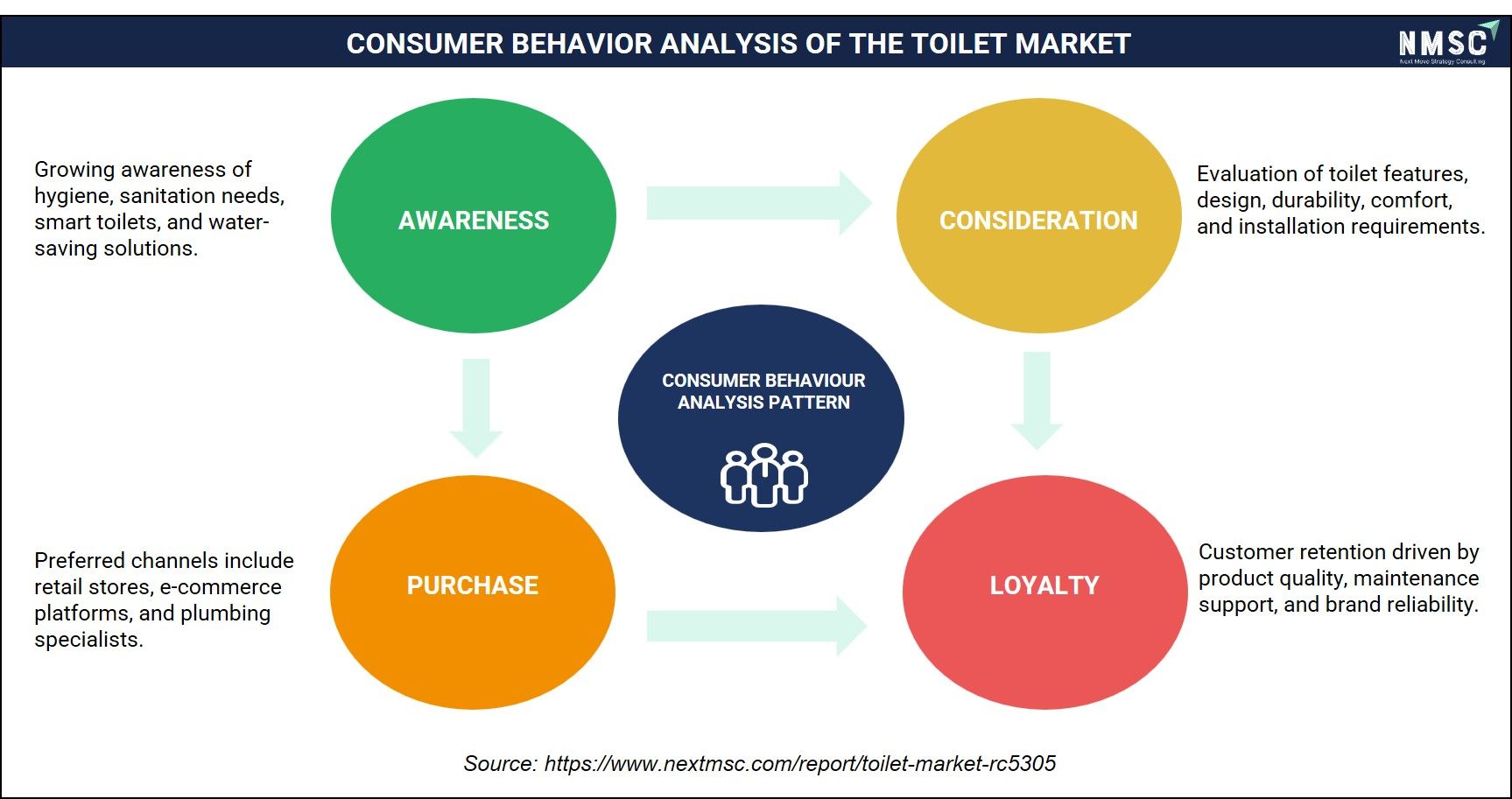
The above infographic presents a consumer behavior analysis of the toilet Industry, mapping the journey from awareness to loyalty. Shaped by growing awareness of hygiene, sanitation needs, and water-saving solutions, consumers prioritize features, durability, and comfort before purchasing through retail stores, e-commerce platforms, and plumbing specialists. Looking ahead, we observed that loyalty is reinforced by product quality, reliable maintenance support, and trusted brand reputation, ensuring sustained engagement across the market.
Investment Opportunities
What Capital Inflows Are Targeting the Toilet Industry?
Capital inflows are increasingly directed toward smart-toilet R&D and manufacturing-capacity expansion in Asia-Pacific, where JOMOO, Huida, and Arrow continue scaling domestic production to serve both government procurement and rising premium residential demand. We observed that investors favor manufacturers demonstrating credible water-efficiency certification, viewing regulatory alignment as a proxy for long-term retailer and utility-rebate program eligibility.
How Is Infrastructure Investment Supporting Market Growth?
Infrastructure investment tied to government sanitation programs, including India's Swachh Bharat Mission and comparable initiatives across Sub-Saharan Africa, continues to underwrite baseline manufacturing and distribution capacity for standardized ceramic toilet platforms. Our findings suggest that manufacturers with established public-tender relationships are best positioned to capture this durable, policy-anchored investment flow through 2035.
What ESG Considerations Are Shaping Market Investment Decisions?
Water conservation is the central ESG consideration shaping investment decisions across the toilet market, with the U.S. EPA's WaterSense program reporting that labeled products have collectively saved 7.5 trillion gallons of water since the program's 2006 launch. We found that investors increasingly treat WaterSense and equivalent regional water-efficiency certification as a governance indicator alongside manufacturing labor and safety compliance.
Key Benefits for Stakeholders
How Does This Report Benefit Enterprise and Industry Leaders?
Enterprise and industry leaders gain access to validated segmentation, competitive benchmarking, and regional demand forecasts that support sourcing and product-portfolio decisions across the toilet industry. Our analysis shows that detailed product-type, technology, and end-user breakdowns help procurement and product teams align specifications with regional regulatory requirements while identifying underserved segments for portfolio expansion.
How Does This Report Benefit Investors and Financial Analysts?
Investors and financial analysts benefit from consistent, single-point market size and CAGR estimates that support valuation and capital-allocation decisions across the toilet market supply chain. We observed that the report's regional and segment-level growth differentials help identify which manufacturers and distributors are best positioned to capture above-market growth in smart and premium product categories through 2035.
How Does This Report Benefit Technology Vendors and Product Teams?
Technology vendors and product teams gain insight into emerging design requirements, including IoT-enabled connectivity, sensor-activated operation, and water-efficient flush engineering, that are reshaping the industry. Our findings suggest that this analysis helps R&D teams prioritize development roadmaps around certification-ready water efficiency and modular smart-upgrade compatibility increasingly required by retailer and utility rebate programs.
Key Market Segments
By Product Type
-
One-Piece Toilets
-
Two-Piece Toilets
-
Wall-Hung Toilets
-
Back-to-Wall Toilets
-
Tankless Toilets
-
Squat Toilets
By Installation Type
-
Floor-Mounted
-
Wall-Mounted
By Technology
-
Conventional Toilets
-
Smart Toilets
By Flush Mechanism
-
Gravity Flush
-
Pressure-Assisted Flush
-
Vacuum Flush
By Flush Control
-
Single Flush
-
Dual Flush
By Operation
-
Manual
-
Sensor-Activated
By Material
-
Vitreous China
-
Stainless Steel
-
Plastic
-
Composite
-
Other Materials
By Distribution Channel
-
Direct Sales
-
Distributors
-
Specialty Retailers
-
Home Improvement Retailers
-
E-Commerce
By Price Tier
-
Economy
-
Mid-Range
-
Premium
-
Luxury
By End User
-
Residential
-
New Construction
-
Renovation
-
Commercial
-
Office Buildings
-
Hospitality
-
Retail
-
Healthcare
-
Educational Institutions
-
Government Buildings
-
Transportation Facilities
-
Sports Venues
-
Industrial
-
Institutional
By Region
-
North America: U.S., Canada, Mexico
-
Europe: UK, Germany, France, Italy, Spain, Sweden, Denmark, Finland, Netherlands, Rest of Europe
-
Asia-Pacific: China, India, Japan, South Korea, Taiwan, Indonesia, Vietnam, Australia, Philippines, Malaysia, Rest of APAC
-
Middle East & Africa: Saudi Arabia, UAE, Egypt, Israel, Turkey, Nigeria, South Africa, Rest of MEA
-
Latin America: Brazil, Argentina, Chile, Colombia, Rest of LATAM
Conclusion and Recommendations
What Is the Long-Term Outlook for the Toilet Market?
The long-term outlook for the toilet market remains positive, with global revenue projected to nearly double from USD 36.81 billion in 2025 to USD 69.23 billion by 2035 at a 6.52% CAGR. We observed that sustained government sanitation investment, smart toilet premiumization, and water-efficiency regulation will continue underpinning demand across residential, commercial, and institutional applications through the forecast period.
What Strategic Positioning Should Toilet Suppliers Pursue?
Suppliers should prioritize modular smart-upgrade compatibility and certified water-efficient flush platforms while maintaining manufacturing scale to serve government procurement channels in emerging markets. Our assessment indicates that manufacturers investing early in sensor-activated technology and WaterSense-equivalent certification will be best positioned to capture premium pricing while retaining volume access to policy-anchored demand.
How Attractive Is the Market for New Investment?
The toilet market presents an attractive investment case, supported by a USD 30.02 billion absolute dollar opportunity between 2026 and 2035 and above-average growth in the Middle East & Africa and smart toilet product categories. We found that investment attractiveness is highest for manufacturers combining water-efficiency credentials with scaled production capacity, positioning them to serve both cost-sensitive and premium buyer segments simultaneously.
What Market Shifts and Key Risks Should Stakeholders Monitor?
Stakeholders should monitor vitreous china raw-material cost volatility, tightening flush-volume regulation compliance costs, and competitive pressure from low-cost regional manufacturers as key risks to the toilet market. Our analysis shows that suppliers unable to adapt to evolving WaterSense-equivalent specifications risk losing shelf space to competitors with certified, pre-qualified product lines, particularly across North America's increasingly regulated plumbing fixture market.
What Are the Key Growth Pathways for the Toilet Market?
Key growth pathways include expanding modular smart-upgrade product lines, scaling IoT-enabled commercial fixture connectivity, and deepening penetration into government-funded institutional sanitation channels across emerging markets. Next Move Strategy Consulting's analysis indicates that suppliers pursuing these pathways while maintaining cost competitiveness in conventional product categories will be best positioned to capture the toilet market's projected growth through 2035.
About the Author
 Mayurima Roy
— Mayurima Roy is Research Analyst at Next Move Strategy Consulting, where she has spent 4 years working across the firm's full industry coverage rather than a single fixed vertical. Her work centers on structured research, ongoing trend tracking, competitive assessment, and insight-led content development, translating complex market data into clear, decision-ready narratives that support informed client decision-making across diverse global industries, market sectors, and world regions every day.
Mayurima Roy
— Mayurima Roy is Research Analyst at Next Move Strategy Consulting, where she has spent 4 years working across the firm's full industry coverage rather than a single fixed vertical. Her work centers on structured research, ongoing trend tracking, competitive assessment, and insight-led content development, translating complex market data into clear, decision-ready narratives that support informed client decision-making across diverse global industries, market sectors, and world regions every day.
About the Reviewer
 Supradip Baul
— Supradip Baul is an accomplished business consultant and strategist with over a decade of rich experience in market intelligence, strategy, technology, and business transformation. His work has included rigorous qualitative and quantitative analysis across multiple industries, helping clients shape investment decisions and long-term roadmaps. Earlier in his career, he was associated with Gartner, where he contributed to industry-leading reports and market share analyses. He has worked with leading global companies and holds an MBA with a dual specialization in Marketing and Finance.
Supradip Baul
— Supradip Baul is an accomplished business consultant and strategist with over a decade of rich experience in market intelligence, strategy, technology, and business transformation. His work has included rigorous qualitative and quantitative analysis across multiple industries, helping clients shape investment decisions and long-term roadmaps. Earlier in his career, he was associated with Gartner, where he contributed to industry-leading reports and market share analyses. He has worked with leading global companies and holds an MBA with a dual specialization in Marketing and Finance.
At Next Move Strategy Consulting, we understand that insightful market research is the cornerstone of successful business decisions. That's why we employ a robust and multifaceted approach, combining various methodologies to deliver the most accurate and actionable data for our clients.

Research Landscape
We navigate the world of research with two primary approaches:
Qualitative Approach
Our qualitative research methodologies involve immersive techniques such as in-depth interviews, focus groups, and observational studies. By engaging directly with individuals and stakeholders, we uncover valuable insights that quantitative data alone may overlook.

Quantitative Research
In tandem with qualitative methodologies, NMSC leverages the power of Quantitative Research to provide a robust foundation of numerical insights. Through systematic data collection and analysis, we quantify patterns, preferences, and market trends, offering a comprehensive view of the business landscape.
Our quantitative research approach employs diverse tools, including surveys, experiments, and statistical modelling. These methodologies enable us to gather data from a large and representative sample, ensuring the statistical significance of our findings. By employing structured questionnaires and standardized data collection methods, we guarantee the reliability and validity of the information we present to our clients.
Quantitative research is particularly effective in measuring the prevalence of trends, assessing market size, and gauging the impact of various factors on consumer behavior. The numerical precision attained through this approach equips our clients with actionable insights, facilitating data-driven decision-making and strategy formulation.


Our Specialized Toolbox for Industry-Specific Market Research
We deploy a specialized arsenal of techniques tailored to meet your unique requirements. Here's a glimpse into our comprehensive toolbox:

Information Procurement
The stage entails acquiring market data or relevant information through various sources and methodologies.


Market Research Approach
We utilize both top-down and bottom-up approaches in market research analysis to achieve a comprehensive understanding of the market dynamics, leveraging the broad perspective of industry trends and macroeconomic factors alongside detailed insights from specific segments and individual companies.

Porters Five Forces Analysis
We conduct Porter's Five Forces analysis to evaluate the competitive landscape of an industry, providing us with insights into factors that affect profitability and strategic positioning.

SWOT Analysis

Forecasting
We utilize a forecasting model to predict future consumption by considering parameters like population, economics, regulations, market competition, drivers, constraints, technology, and pricing. We also employ statistical techniques such as multilinear regression, exponential smoothing, moving average, ARIMA, and Monte Carlo simulations for accurate predictions. In econometric forecasting, we analyzed short-term and long-term event impacts, attributing values based on regulatory frameworks, economic factors, and market events.





 Speak to Our Analyst