Ultra-High Performance Concrete Market Global Industry Analysis and Forecast (2026–2035)

Ultra-High Performance Concrete Market size was USD 1.18 Billion in 2025, projected to reach USD 2.81 Billion by 2035, growing at a CAGR of 9.04% from 2026 to 2035. Key drivers include infrastructure rehabilitation demand, thin-section structural efficiency, and durability in aggressive environments, with North America leading the global market.

Download Free Sample PDF
Base Year (2025)
$1.18 Billion
Forecast (2035)
$2.81 Billion
CAGR (2026-2035)
9.0%
Top Region
North America

What Is the Ultra-High Performance Concrete Market Size?

The global Ultra-High Performance Concrete Market reached USD 1.18 Billion in 2025 and is estimated at USD 1.29 Billion in 2026, forecast to reach USD 2.81 Billion by 2035 at a CAGR of 9.04% between 2026 and 2035. North America leads with approximately 34% revenue share in 2025, while Non-Fibre UHPC is the dominant fibre reinforcement, holding approximately 47% of total market revenue.

We observed that technological shifts in binder chemistry, particularly the use of silica fume, fine quartz powder, and optimized superplasticizers, have enabled producers to achieve dense microstructures with minimal porosity. Advances in steel and polymer fibre dispersion further improve tensile capacity and ductility, addressing longstanding brittleness concerns. Operational scale is also expanding as precast plants and ready-mix operators establish dedicated production lines, shifting the material from specialty pilot projects toward repeatable industrial output across infrastructure and building segments.

Ultra-High Performance Concrete Market Global Industry Analysis and Forecast (2026–2035) Revenue Forecast

Values in USD Billion

2025 $1.18 Billion
2025
2026 $1.29 Billion
2026
2027 $1.41 Billion
2027
2028 $1.53 Billion
2028
2029 $1.67 Billion
2029
2030 $1.82 Billion
2030
2031 $1.99 Billion
2031
2032 $2.17 Billion
2032
2033 $2.36 Billion
2033
2034 $2.58 Billion
2034
2035 $2.81 Billion
2035

Key Takeaways

By Fibre Reinforcement: Non-Fibre UHPC held the largest share, expanding from USD 0.56 Billion in 2025 to USD 1.11 Billion by 2035; Hybrid-Fibre UHPC is the fastest-growing at 13.14% CAGR from 2026–2035.

By Application: Transportation Infrastructure held the largest share, expanding from USD 0.45 Billion in 2025 to USD 1.03 Billion by 2035; Other Qualified Applications is the fastest-growing at 12.98% CAGR from 2026–2035.

By Buyer Type: Concrete Producers held the largest share, expanding from USD 0.47 Billion in 2025 to USD 0.99 Billion by 2035; Industrial Equipment OEMs is the fastest-growing at 11.27% CAGR from 2026–2035.

By Distribution Channel: Direct Manufacturer Sales held the largest share, expanding from USD 0.71 Billion in 2025 to USD 1.47 Billion by 2035; Indirect Sales is the fastest-growing at 11.33% CAGR from 2026–2035.

Dominant Region: North America dominated the market with approximately 34% revenue share (USD 0.4 Billion) in 2025, anchored by mature bridge and transport infrastructure, early institutional adoption of precast UHPC specifications, and high concentrations of leading cement and specialty admixture producers.

Fastest-Growing Region: Asia-Pacific is expected to register the highest CAGR of 12.25% during 2026–2035, driven by rapid infrastructure expansion, massive public programs, and expanding commercial adoption across high-density markets.

Dominant Country: The U.S. led the market with an estimated USD 0.3 Billion in 2025 (~75% of North America), supported by extensive infrastructure adoption, dense producer presence, and early structural code deployment.

Fastest-Growing Country: India is among the fastest-growing major countries, projected to expand from USD 0.06 Billion in 2025 at a CAGR of approximately 14.13% from 2026–2035, driven by national highway expansion, dedicated freight corridor construction, and expanding commercial infrastructure rollouts.

Our findings suggest that the Ultra-High Performance Concrete Market presents an absolute opportunity of USD 1.52 Billion between 2026 and 2035, derived from the difference between the USD 1.29 Billion current valuation and the USD 2.81 Billion forecast. Much of this incremental value will originate from infrastructure rehabilitation programs, where engineers replace deteriorating joints and overlays with high-durability UHPC systems. Demand from modular construction and prefabricated building systems will further broaden the addressable base as contractors seek thinner, higher-strength components.

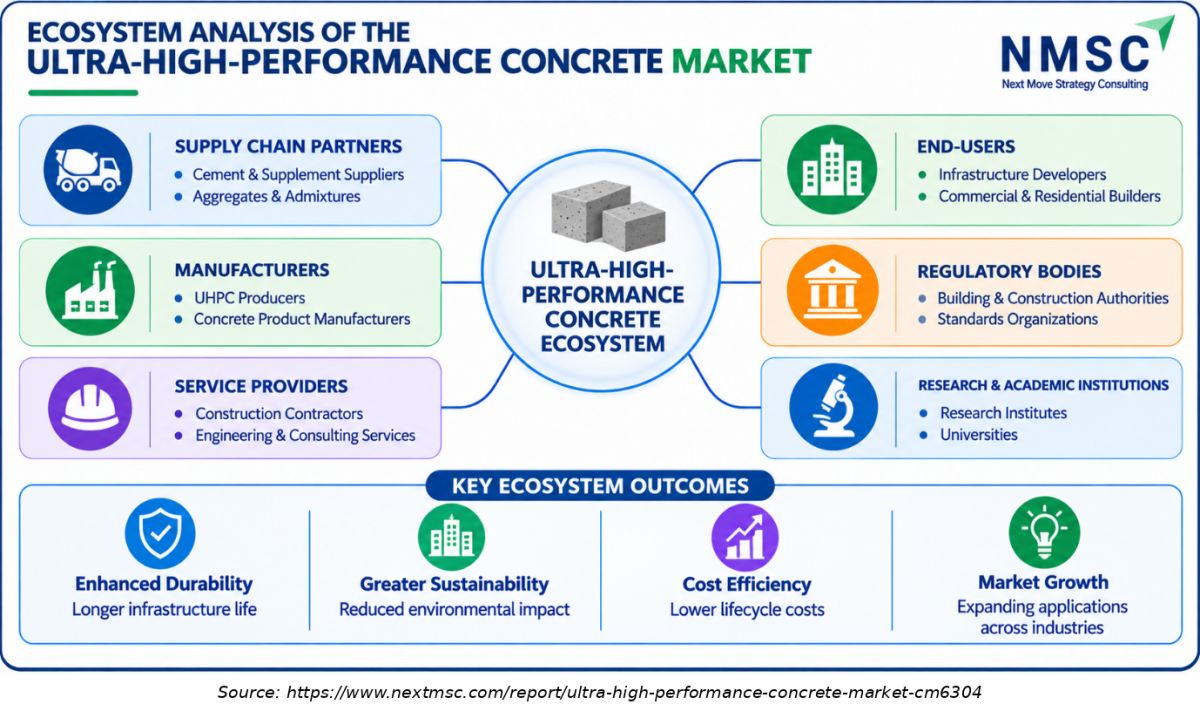
Ecosystem Analysis of the Ultra-High Performance Concrete Industry

The above infographic provides a detailed ecosystem analysis of the ultra-high-performance concrete (UHPC) market, mapping out key stakeholders from supply chain partners and manufacturers to regulatory bodies and research institutions. It illustrates how service providers, engineering consultants, and end-users interact to deliver advanced concrete solutions for infrastructure and commercial projects. Ultimately, the diagram highlights the key ecosystem outcomes, demonstrating that this collaboration drives enhanced durability, greater sustainability, cost efficiency, and overall market growth.

What Does the Ultra-High Performance Concrete Market Encompass?

The Ultra-High Performance Concrete Industry encompasses cementitious composites engineered with a low water-to-binder ratio, densely packed fine aggregates, silica fume, and high-tensile steel or polymer fibres. Product types include premixed dry blends for site batching, ready-to-use mixes for precast production, and specialty grades formulated for repair and overlay applications. Core technologies cover particle packing optimization, high-range water reducers, and fibre dispersion methods that together determine mechanical performance and workability.

Design specifications typically reference compressive strengths exceeding 150 MPa, tensile post-cracking capacity, and freeze-thaw durability benchmarks. Material innovations focus on reduced cement content, supplementary cementitious materials, and lower embodied carbon formulations that respond to sustainability targets. Certifications and qualification protocols, including national structural codes and product approvals issued by bodies such as ASTM International and CEN, govern acceptance on public infrastructure projects and influence specification decisions by consulting engineers.

Market Drivers & Dynamics

Interactive Dataset
Infrastructure Rehabilitation Demand driver High Global (High in North America & Europe) Immediate
Thin-Section Structural Efficiency driver High Global (High in Asia-Pacific & Europe) Immediate
Durability in Aggressive Environments driver Medium Global (Coastal & Cold-Climate Regions) Medium-term
High Material Cost Relative to Conventional Concrete restraint High Global (High in Emerging Markets) Immediate
Limited Contractor Familiarity and Placement Expertise restraint Medium Globa Medium-term
Evolving Code Provisions for Structural Applications restraint Low Globa Long-term
Source: Next Move Strategy Consulting

Growth Drivers

Infrastructure Rehabilitation Demand

The primary catalyst for ultra-high-performance concrete is the rising demand for infrastructure rehabilitation in aging transport networks. Bridge decks, parking structures, and marine facilities deteriorate under chloride exposure and freeze-thaw cycling, prompting asset owners to specify materials with markedly lower permeability. Because ultra-high-performance concrete allows thinner overlays and longer maintenance intervals, it addresses both durability and traffic disruption concerns that conventional repair mixes cannot resolve efficiently.

Thin-Section Structural Efficiency

Durability in Aggressive Environments

Growth Inhibitors

High Material Cost Relative to Conventional Concrete

The primary commercial restraint is the elevated cost of constituent materials, including high-purity silica fume, specialty superplasticizers, and engineered steel or polymer fibres. These inputs depend on a relatively concentrated set of suppliers, which can introduce price volatility and availability constraints during periods of high infrastructure demand. Producers must therefore balance premium pricing against competing conventional solutions, particularly in cost-sensitive public tenders where initial capital expenditure carries significant weight.

Limited Contractor Familiarity and Placement Expertise

Evolving Code Provisions for Structural Applications

Segmentation Analysis

2025 (USD Billion)
2035 (USD Billion)
Non-Fibre UHPC 2025: $0.56 Billion | 2035: $0.62 Billion
Non-Fibre UH
Single-Fibre UHPC 2025: $0.37 Billion | 2035: $0.40 Billion
Single-Fibre
Hybrid-Fibre UHPC 2025: $0.25 Billion | 2035: $0.27 Billion
Hybrid-Fibre
Non-Fibre UHPC $0.56 Billion $0.62 Billion USD 1.11 Billion
Single-Fibre UHPC $0.37 Billion $0.40 Billion USD 0.88 Billion
Hybrid-Fibre UHPC $0.25 Billion $0.27 Billion USD 0.82 Billion

Which Fibre Reinforcement Segment Dominates the Market?

The installed base of non-fibre ultra-high-performance concrete anchors the segment, accounting for approximately 47% of revenue and USD 0.56 Billion in 2025. Its dominance reflects long-standing capital procurement habits among producers who have standardized mix designs and plant equipment around this formulation. Hybrid-fibre ultra-high-performance concrete, however, advances at a 13.14% CAGR through 2035, as contractors seek combined tensile ductility and crack control. This dual structure creates a stable revenue foundation alongside a faster-moving technical growth engine.

2025 (USD Billion)
2035 (USD Billion)
Category A
Category B
Category C
Category D
Segment Item 2025 (USD Billion) 2035 (USD Billion) CAGR
Category A $10.0 USD Billion $40.0 USD Billion 25.0%
Category B $17.1 USD Billion $51.1 USD Billion 11.0%
Category C $24.2 USD Billion $62.2 USD Billion 25.0%
Category D $31.3 USD Billion $73.3 USD Billion 11.0%

Segment-wise data is locked

Unlock complete segment-wise numbers for By Application.

Unlock Full Data
2025 (USD Billion)
2035 (USD Billion)
Category A
Category B
Category C
Category D
Segment Item 2025 (USD Billion) 2035 (USD Billion) CAGR
Category A $10.0 USD Billion $40.0 USD Billion 27.0%
Category B $17.1 USD Billion $51.1 USD Billion 9.0%
Category C $24.2 USD Billion $62.2 USD Billion 19.0%
Category D $31.3 USD Billion $73.3 USD Billion 17.0%

Segment-wise data is locked

Unlock complete segment-wise numbers for By Buyer Type.

Unlock Full Data
2025 (USD Billion)
2035 (USD Billion)
Category A
Category B
Category C
Category D
Segment Item 2025 (USD Billion) 2035 (USD Billion) CAGR
Category A $10.0 USD Billion $40.0 USD Billion 14.0%
Category B $17.1 USD Billion $51.1 USD Billion 24.0%
Category C $24.2 USD Billion $62.2 USD Billion 22.0%
Category D $31.3 USD Billion $73.3 USD Billion 12.0%

Segment-wise data is locked

Unlock complete segment-wise numbers for By Distribution Channel.

Unlock Full Data
2025 (USD Billion)
2035 (USD Billion)
Category A
Category B
Category C
Category D
Segment Item 2025 (USD Billion) 2035 (USD Billion) CAGR
Category A $10.0 USD Billion $40.0 USD Billion 24.0%
Category B $17.1 USD Billion $51.1 USD Billion 22.0%
Category C $24.2 USD Billion $62.2 USD Billion 20.0%
Category D $31.3 USD Billion $73.3 USD Billion 22.0%

Segment-wise data is locked

Unlock complete segment-wise numbers for By Region.

Unlock Full Data

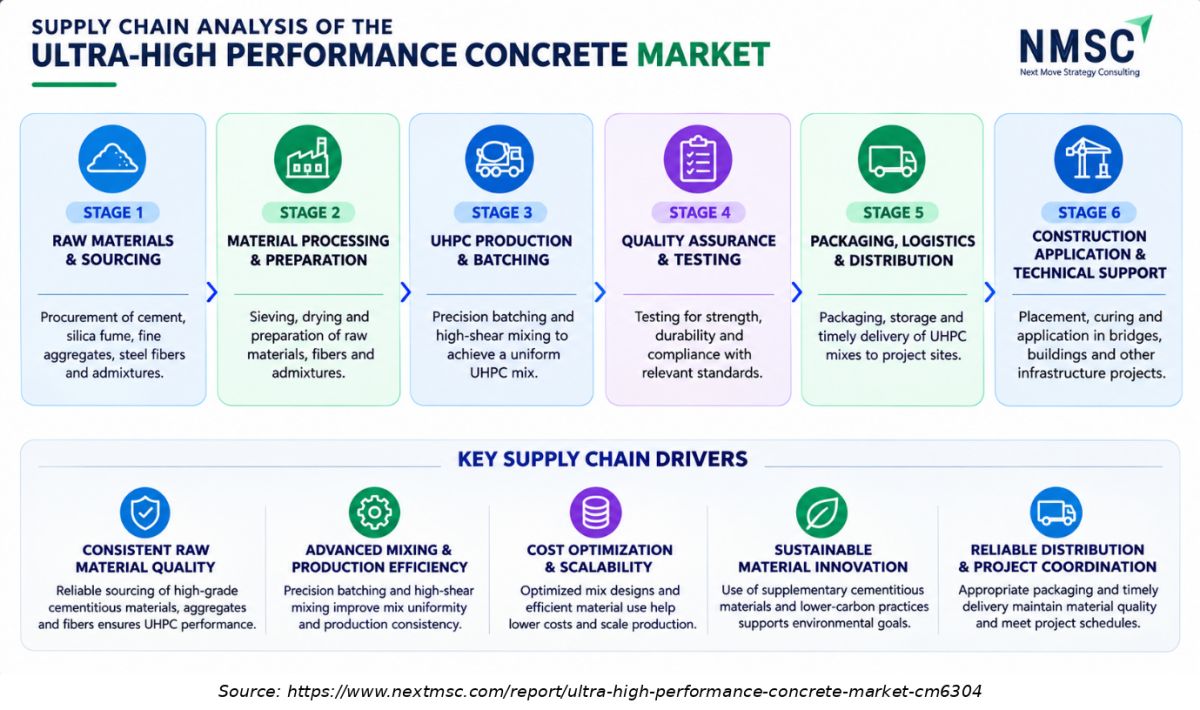
Supply Chain Analysis of the Ultra-High Performance Concrete Industry

Supply Chain Analysis of the Ultra-High Performance Concrete Industry
The above infographic outlines the supply chain of the ultra-high-performance concrete (UHPC) market, tracing a six-stage flow from raw material sourcing and preparation to production, quality testing, and final construction application. It illustrates how cement, silica fume, and steel fibres are precision-batched and delivered to infrastructure projects. Ultimately, the analysis highlights key drivers such as consistent raw material quality, advanced mixing efficiency, cost optimization, and sustainable innovation that ensure reliable project coordination.

Growth Opportunities

Our analysis shows that three structural whitespace opportunities are positioned to generate disproportionate commercial returns in the Ultra-High Performance Concrete Industry through 2035:

Can Precast Element Manufacturing Capture High-Density Deployments?

Precast fabricators represent a high-value opportunity for ultra-high-performance concrete because controlled factory conditions improve fibre alignment and curing consistency. Producing bridge girders, façade panels, and architectural elements in dedicated plants allows manufacturers to achieve the mechanical performance that site batching sometimes cannot guarantee. Partnerships between material suppliers and precast producers can therefore unlock repeatable volume across densely built urban corridors and large infrastructure programs.

How Is Mid-Tier and Regional Facility Adoption Unlocking New Market Volume?

Secondary facilities and regional production hubs are emerging as important volume centers for ultra-high-performance concrete. Regional ready-mix operators are investing in dry-blend storage and modest batching upgrades that allow local contractors to adopt the material without full capital investment in dedicated plants. This decentralization broadens geographic reach, enabling project owners in less dense markets to access durable repair and structural solutions previously limited to major metropolitan areas.

Can Specialized Vertical Implementations Become Distinct Premium Markets?

Specialized applications such as blast-resistant structures, nuclear shielding, and offshore platform components could develop into distinct premium segments for ultra-high-performance concrete. These use cases demand tailored formulations, rigorous qualification testing, and long-term performance guarantees, which support higher price realization. Producers that develop certified grades for these niches can build differentiated positions less exposed to commodity pricing pressure in general construction.

Regional Outlook

2025 (USD Billion)
2035 (USD Billion)
North Americ
Europe
Asia-Pacific
Latin Americ
Middle East
Region 2025 (USD Billion) 2035 (USD Billion) CAGR (%)
North America $10.0 USD Billion $40.0 USD Billion 9.0%
Europe $17.1 USD Billion $51.1 USD Billion 27.0%
Asia-Pacific $24.2 USD Billion $62.2 USD Billion 25.0%
Latin America $31.3 USD Billion $73.3 USD Billion 23.0%
Middle East & Africa $38.4 USD Billion $84.4 USD Billion 12.0%

Regional data is locked

Unlock complete regional numbers for this market.

Unlock Full Data

Competitive Landscape

The competitive structure of the Ultra-High Performance Concrete Market is shaped by a mix of multinational cement and building materials groups and specialized formulators. Holcim Group, Cemex S.A.B. de C.V., Sika AG, Heidelberg Materials AG, and Buzzi Unicem S.p.A. compete on scale, plant footprint, and technical service capability. Ductal, a proprietary UHPC brand of Holcim Group, illustrates how proprietary formulations can anchor premium positioning within this competitive landscape.

Product Quality & Durability

Ultra-high performance concrete suppliers compete on compressive strength, permeability resistance, and proven service life in aggressive environments, which govern specification decisions on critical infrastructure.

Distribution & Retail Reach

Coverage across direct manufacturer relationships and regional distributors determines access to precast plants, batching facilities, and project sites that consume ultra-high-performance concrete.

Design & Customization Moat

Proprietary mix engineering and fibre system customization allow suppliers to tailor ultra-high-performance concrete to specific structural geometries and loading requirements, creating switching costs.

Material Innovation & Sustainability

Development of lower-carbon binders and hybrid-fibre formulations positions suppliers to meet evolving environmental expectations among public owners and large construction contractors.

Key Market Players

Based on research conducted by NMSC, the following 20 companies represent the validated leadership set across Ultra-High Performance Concrete Market developers, manufacturers, and solution providers:

Cemex S.A.B. de C.V. Sika AG Holcim Group Heidelberg Materials AG Buzzi Unicem S.p.A. Eiffage S.A. Bekaert N.V. Sumitomo Osaka Cement Co., Ltd. UltraTech Cement Ltd Taiheiyo Cement Corporation CRH PLC Mapei S.p.A. BASF SE Fosroc International Ltd. TAKTL LLC UHPC Solutions North America, LLC ELO Beton GmbH

Latest Developments

During our market evaluation, we noticed that recent commercial activities, platform introductions, and partnerships within the industry reflect the latest market developments:

Date Event
March 2026 Amrize launched its EVERtect high-performance concrete range at CONEXPO-CON/AGG 2026, rebranding its current performance concrete mixes under the new line.
February 2025 CarbonBuilt acquired Jolley Concrete and Block to upgrade the plant into a commercial producer of ultra-low-carbon concrete products.

Investment Opportunities

Where Are Capital Inflows Concentrating in the Ultra-High Performance Concrete Industry?

Capital inflows in the Ultra-High Performance Concrete Market are concentrating in hybrid-fibre formulations and low-carbon production technologies. Investors and operators prioritize projects that combine performance validation with commercial deployment readiness. Acquisitions of existing plants by technology-focused developers illustrate how capital is being redirected toward converting proven mix designs into scalable output.

How Is Infrastructure Investment Shaping Market Capacity?

Infrastructure investment is driving expansion in precast production facilities, automated batching equipment, and regional distribution hubs serving ultra-high-performance concrete demand. Transportation projects in particular require dependable supply of specialized mixes, encouraging producers to add dedicated lines. Capacity decisions increasingly reflect long-term contracts with public owners and large contractors seeking consistent material availability.

What ESG Considerations Are Influencing Market Investment?

Environmental considerations are shaping investment priorities across the ultra-high-performance concrete ecosystem, particularly regarding embodied carbon and binder composition. Producers are evaluating energy efficiency upgrades and circular material inputs to meet owner requirements on sustainable projects. Safety compliance and worker protection during mixing and handling also influence facility design and operational investment decisions.

Key Benefits for Stakeholders

How Does This Report Benefit Industry Leaders and Enterprise Operators?

Operational executives, procurement directors, and commercial operators gain empirical benchmarks for planning ultra-high-performance concrete production and purchasing. The segment breakdowns clarify where installed demand is concentrated and where growth is accelerating. These insights support capacity decisions, supplier evaluation, and contract structuring across transportation, building, and industrial applications.

How Does This Report Benefit Investors and Financial Analysts?

The market is projected to expand from USD 1.18 Billion in 2025 to USD 2.81 Billion by 2035, providing a clear valuation reference for investors. The report contextualizes revenue trajectories against regional leadership and segment-level growth patterns. Analysts can use these benchmarks to assess competitive positioning and identify where margin expansion is most probable.

How Does This Report Benefit Material Formulators and Additive Suppliers?

Material formulators and additive suppliers can align product roadmaps with the fastest-growing fibre and application segments in ultra-high-performance concrete. Insight into buyer adoption patterns helps teams prioritize development efforts for hybrid-fibre systems and specialized industrial applications. Clear competitive benchmarks also support decisions about partnership strategies and differentiation.

Key Market Segments Evaluated

By Fibre Reinforcement

  • Non-Fibre UHPC
  • Single-Fibre UHPC 
    • Steel-Fibre UHPC
      • Carbon Steel Fibres
      • Stainless Steel Fibres
    • Synthetic-Polymer-Fibre UHPC
      • PVA Fibres
      • Polyethylene Fibres
      • Polypropylene Fibres
      • Other Synthetic Polymer Fibres
    • Glass-Fibre UHPC
      • Alkali-Resistant Glass Fibres
      • Other Glass Fibres
    • Carbon-Fibre UHPC
    • Mineral-Fibre UHPC
    • Other Single-Fibre UHPC
  • Hybrid-Fibre UHPC 
    • Steel-Containing Hybrid UHPC
    • Non-Steel Hybrid UHPC

By Application

  • Transportation Infrastructure 
    • Bridges and Bridge Structures
      • Bridge Deck Elements
      • Bridge Deck Overlays
      • Bridge Joints and Connections
      • Others
    • Roads and Highways
      • Pavements and Wearing Courses
      • Road Barriers
      • Safety Structures
    • Rail and Transit Infrastructure
    • Transport Tunnels
    • Airports and Aviation Infrastructure
  • Buildings and Architecture 
    • Load-Bearing Building Elements
    • Façades and Cladding Systems
    • Architectural Products
  • Marine and Coastal Infrastructure 
    • Ports and Harbours
    • Coastal Protection
    • Hydraulic Structures
  • Energy Infrastructure 
    • Wind Energy Structures
    • Oil and Gas Structures
    • Power Generation and Nuclear Structures
  • Water and Wastewater Infrastructure 
    • Potable Water Treatment, Storage and Conveyance Structures
    • Wastewater Collection, Treatment and Conveyance Structures
    • Industrial and Mining Infrastructure
  • Industrial Floors and Pavements 
    • Wear-Resistant Linings
    • Equipment Foundations and Machine Bases
    • Mining Structures and Supports
  • Defence and Security Infrastructure 
    • Protective and Blast-Resistant Structures
    • Military and Security Facilities
  • Other Qualified Applications

By Buyer Type

  • Concrete Producers
  • Construction Contractors
  • Asset Owners and Operators
  • Industrial Equipment OEMs
  • Distributors and Resellers
  • Other Commercial and Institutional Buyers

By Distribution Channel

  • Direct Manufacturer Sales
  • Indirect Sales

By Region

  • North America 
    • U.S.
    • Canada
    • Mexico.
  • Europe 
    • UK
    • Germany
    • France
    • Italy
    • Rest of Europe.
  • Asia-Pacific 
    • China
    • India
    • Japan
    • South Korea
    • Australia
    • Rest of APAC.
  • Latin America 
    • Brazil
    • Argentina
    • Colombia
    • Rest of Latin America.
  • Middle East & Africa 
    • UAE
    • Saudi Arabia
    • South Africa
    • Rest of MEA.

Conclusion & Recommendations

What Is the Long-Term Outlook for the Ultra-High Performance Concrete Industry?

The long-term outlook for the Ultra-High Performance Concrete Market is strongly positive, with revenue expanding from USD 1.29 Billion in 2026 to USD 2.81 Billion by 2035 at a 9.04% CAGR. Growth is underpinned by durable infrastructure demand expansion, the structural shift toward high-performance specialized formulations, and continuous technological innovation across precast and batching operations. Participants that align capacity and technical capability with these trends are well positioned for sustained value creation.

What Strategic Positioning Recommendations Does NMSC Offer?

Market participants should prioritize hybrid-fibre ultra-high-performance concrete development and capacity planning to capture the segment's accelerated trajectory. Producers and OEMs should deepen engagement with transportation owners and industrial equipment manufacturers to secure long-term specification positions. Distributors should expand regional coverage to serve indirect channel growth while maintaining technical support standards.

How Attractive Is the Ultra-High Performance Concrete Market for Investment?

Investment attractiveness is high, supported by the USD 1.52 Billion absolute growth opportunity between 2026 and 2035. Margins are sustained by performance-based pricing and proprietary mix engineering that limit commoditization. Demand drivers from transportation infrastructure and expanding specialized applications reinforce the case for capital commitment in ultra-high-performance concrete capacity and technology.

What Are the Key Market Shifts and Risks in the Ultra-High Performance Concrete Industry?

Structural shifts include the migration toward hybrid-fibre systems and lower-carbon binder formulations within the ultra-high-performance concrete value chain. Primary risks involve raw material price volatility, fibre supply continuity, and the capital intensity of specialized batching and precast facilities. Producers must manage these exposures while maintaining consistent quality across demanding infrastructure specifications.

What Are the Primary Growth Pathways Through 2035?

Growth pathways center on hybrid-fibre formulations, other qualified applications, and industrial equipment OEM adoption, which collectively drive a disproportionate share of the USD 1.52 Billion absolute growth opportunity in ultra-high-performance concrete. Asia-Pacific expansion at 12.25% CAGR offers additional geographic upside. Companies that combine technical differentiation with regional scale are best placed to capture these pathways.

FAQs

About the Author

Mayurima Roy

Mayurima Roy

Mayurima Roy is Research Analyst at Next Move Strategy Consulting, where she has spent 4 years working across the firm's full industry coverage rather than a single fixed vertical. Her work centers on structured research, ongoing trend tracking, competitive assessment, and insight-led content development, translating complex market data into clear, decision-ready narratives that support informed client decision-making across diverse global industries, market sectors, and world regions every day.

About the Reviewer

Supradip Baul

Supradip Baul

Supradip Baul is an accomplished business consultant and strategist with over a decade of rich experience in market intelligence, strategy, technology, and business transformation. His work has included rigorous qualitative and quantitative analysis across multiple industries, helping clients shape investment decisions and long-term roadmaps. Earlier in his career, he was associated with Gartner, where he contributed to industry-leading reports and market share analyses. He has worked with leading global companies and holds an MBA with a dual specialization in Marketing and Finance.

Download Free Sample

Rishabh Jogani

RISHABH JOGANI

Strategy Analyst

Accenture Japan

We are incredibly impressed with the market report on the real estate market in India provided by Next Move Strategy Consulting. The report was thorough, insightful, and well-structured, offering deep analysis and actionable recommendations. It not only captured the current trends and dynamics but also provided a forward-looking perspective that has been invaluable for our strategic planning. Their team demonstrated exceptional professionalism, attention to detail, and a profound understanding of the industry. The data-driven insights and clarity of presentation exceeded our expectations, making complex market trends easy to understand. We highly recommend Next Move Strategy Consulting to anyone looking for reliable and comprehensive market research services. Their expertise has given us the confidence to navigate the complexities of the Indian real estate market with clarity and foresight.

Kevin Coker

KEVIN COKER

Founder, CEO and Board Diector

Proxima Clinical Research

I have been using Next MSC reports for product positioning in a new geography for a long time. They have by far the best reports I have found and the price is reasonable too!

Diana Trejo

DIANA TREJO

Assistant Manager

Sumitomo Corporation de Mexico, S.A. de C.V.

Recently, we purchased a report on the Mexico Data Center Market from Next Move Strategy Consulting. The service has been excellent, with support that is always timely and thoroughly professional. The information provided is interesting, highly useful, and delivered with clarity. I would highly recommend NextMSC for anyone seeking insightful and dependable analysis.

Henri Knyphausen

HENRI KNYPHAUSEN

Partner at Singulier [Ex-BCG]

Singulier

I recently engaged NEXTMSC.com for a commercial due diligence project within the intralogistics sector, and I am pleased to provide a reference based on my experience. In utilizing NEXTMSC.com's services, I found their report to offer valuable insights into market dynamics and key industry players. The initial report provided a solid foundation for our analysis. However, as we were investigating a smaller target in the market, and I had specific customization requests requiring additional research. These requests included detailed information on product portfolios of various players and sub-market sizes, both inclusive and exclusive of certain product categories. NEXTMSC.com demonstrated commendable responsiveness and agility in accommodating these customization requests. Within a timeframe of 1-2 weeks, they delivered a revised report that met our specific needs. Furthermore, they were receptive to my follow-up inquiries, ensuring clarity and understanding of the data provided. The final deliverable significantly contributed to our due diligence efforts. One of NEXTMSC.com's notable strengths lies in their qualitative research capabilities. However, for future engagements, I would recommend the inclusion of a quantified market model in Excel format. Such a model would offer the ability to conduct in-depth analyses and explore various market segments, including country-specific data and subcomponent breakdowns. Based on my positive experience, I would not hesitate to work with NEXTMSC.com again. Their responsiveness, willingness to accommodate customization requests, and commitment to delivering actionable insights make them a reliable partner for commercial research projects.

Amos Chang

AMOS CHANG

Strategy Consultant

Kardex Group

I have bought the intralogistics market reports from NMSC two times so far. Joseph and his team are always very helpful and flexible in responding to any customization requirements on the report. Their expertise in market reports really helps us steer the day-to-day business. I will definitely recommend and come back myself whenever there is a need.

Custom Market Research Services

We will customize the research for you if the listed report does not fully match your requirements.

Get 30% Free Customization

Select License

This website uses cookies to ensure you get the best experience on our website. Learn more

✖