Unified Threat Management Market By Component (Hardware, Software, & Virtual), By Deployment (Cloud, On-premise), By Service (Managed UTM, Support & Maintenance Consulting), By Enterprise Size (Large Enterprise, Small and Medium Enterprises), and By End Use (BFSI, Government, Healthcare, Manufacturing, Retail, Telecom & IT, Others) – Global Opportunity Analysis and Industry Forecast, 2025–2030
Industry: ICT & Media | Publishing Date: June 8, 2026 | Last Updated: October 16, 2026 | No of Pages: N/A | No. of Tables: N/A | No. of Figures: N/A | Format: PDF | Report Code: IC3813
Industry Outlook
The global Unified Threat Management Market size was valued at USD 8.28 billion in 2024 and is expected to reach USD 9.41 billion by 2025. Looking ahead, the industry is projected to expand significantly, reaching USD 17.37 billion by 2030, registering a CAGR of 12.47% from 2025 to 2030.
The industry today sit at the intersection of consolidation and modernization: they package firewall, VPN, intrusion prevention, antivirus, web/email filtering and other controls into single, centrally managed platforms to simplify security operations and reduce tool sprawl. Organizations from SMBs to distributed enterprises use UTM appliances and cloud-delivered variants to secure branch offices, remote workers, and IoT/edge devices while easing compliance and day-to-day administration. Vendors are positioning UTM as a pragmatic way to lower operational overhead and shorten incident response cycles by unifying telemetry and policy enforcement across multiple attack surfaces.
Today’s UTM use cases emphasize hybrid deployment models and tighter integration with broader networking stacks: cloud-native and managed UTM offerings, SD-WAN and SASE convergence, and AI-assisted threat detection are common in product roadmaps. Typical deployments include perimeter protection for branch/retail networks, secure connectivity for remote and mobile workforces, and a managed service delivery model for MSPs serving resource-constrained customers. Looking ahead, UTM is likely to evolve further into software-first, cloud-managed security platforms that bake in automation, threat intelligence sharing, and deeper identity and access controls, shifting from single-box appliances to distributed, policy-driven security fabrics.
What Are the Key Trends in the Unified Threat Management Market?
How is AI Reshaping Unified Threat Management’s Detection and Response?
AI has become a practical requirement in the unified threat management market report as attackers weaponize automation and large models. Recent industry reports highlight a sharp rise in AI-assisted attacks and automated scanning, which has pushed vendors to bake ML/behavioural analytics into UTM stacks to maintain signal-over-noise in telemetry. That shift means UTM appliances and cloud services are increasingly pairing signature engines with anomaly detection, model-driven phishing classifiers, and automated playbooks that escalate or contain based on confidence scores. Practically, companies treat models like another subsystem, where they validate ML pipelines against adversarial inputs, continuously retrain with fresh telemetry, and instrument explainability so SOC teams trust automated responses. For product teams, this translates into shipping transparent detection confidence, offering tuned model update cadences for customers, and exposing safe APIs for customers to inject threat intelligence.
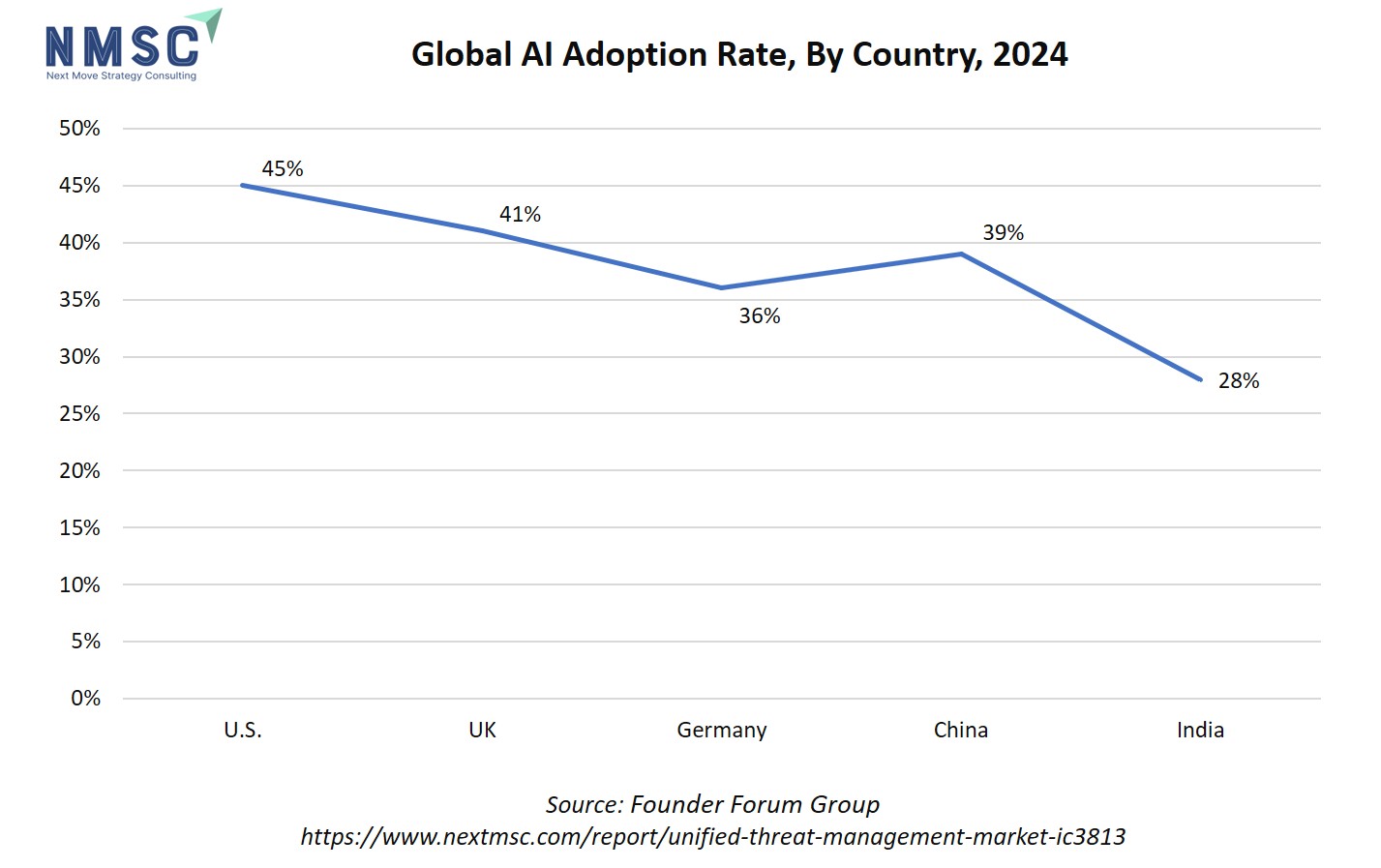
The chart presents the global AI adoption rates by country for 2024, which has important implications for the Unified Threat Management (UTM) market in Europe by highlighting regions likely to experience accelerated adoption of advanced cybersecurity technologies, including AI-driven threat detection. These figures suggest that European countries such as Germany and the UK are at the forefront of AI integration, potentially driving greater demand for sophisticated UTM platforms capable of leveraging AI for real-time monitoring, automated incident response, and adaptive security measures. For UTM vendors and enterprises in Europe, this emphasizes the need to invest in AI-enabled solutions to keep pace with global advancements and effectively counter evolving digital threats.
How is the Shift to Cloud and Software-Defined Architectures Transforming UTM Delivery?
The unified threat management market forecast is moving rapidly from single-box appliances to software-first, cloud-managed protection as organisations embrace remote work, edge compute, and ephemeral workloads. Market intelligence indicates meaningful growth in cloud-delivered UTM and software UTM offerings, with market value and CAGR estimates showing strong expansion through the late 2020s. In practice, this means vendors are rearchitecting for multi-tenant management planes, API-first policy controls, containerised inspection engines, and elastic threat-intelligence distribution so protection follows workloads rather than being tied to hardware.
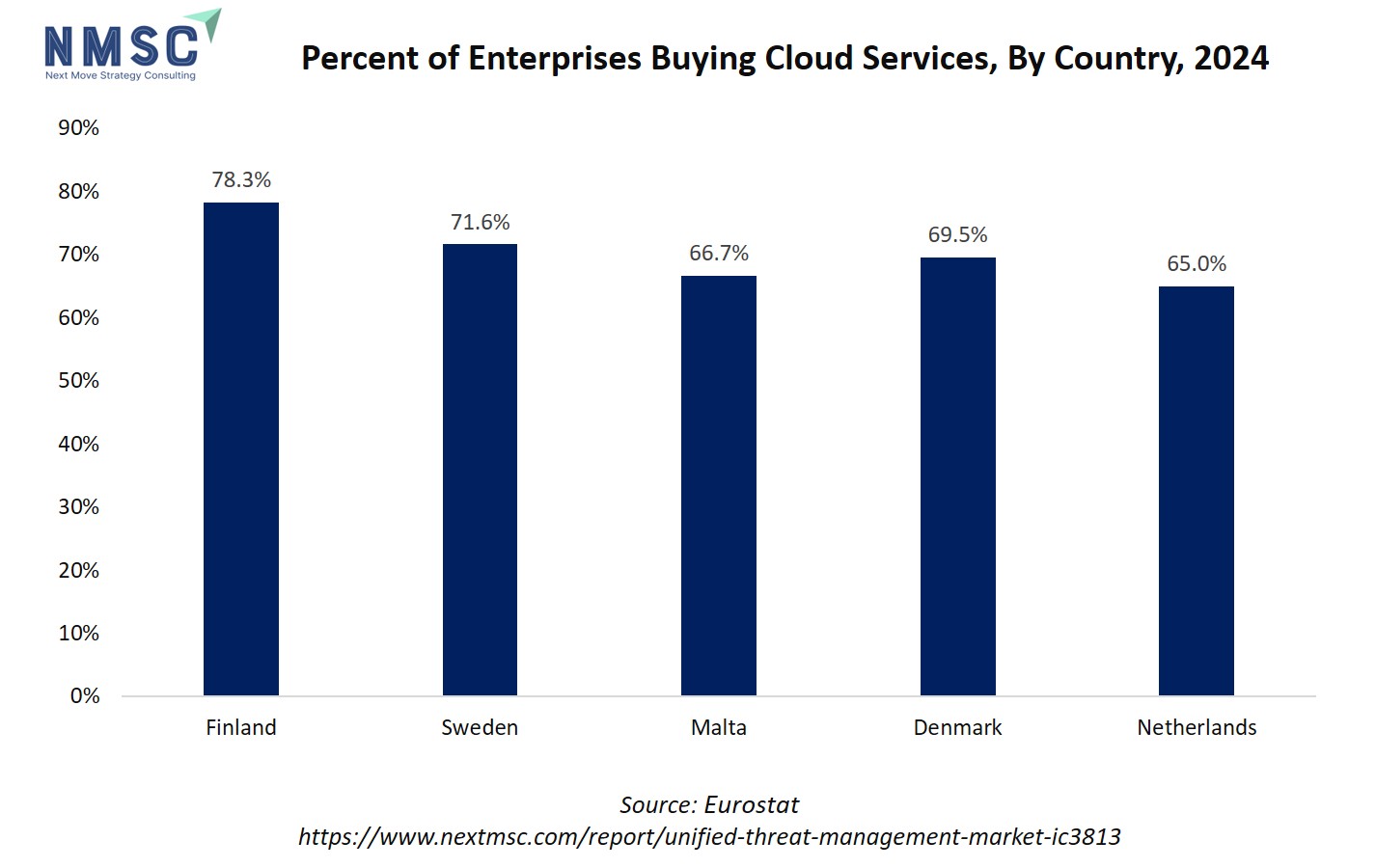
The chart above shows the percentage of enterprises purchasing cloud services in selected European countries in 2024, a key indicator of digital transformation that influenced demand for network security solutions across the region. Finland leads the highest, followed by Sweden, Denmark, Malta, and the Netherlands. These elevated cloud service procurement levels signal a growing reliance on cloud-based infrastructure, which in turn drives the need for advanced UTM systems to secure enterprise environments against evolving cyber threats. For UTM vendors and security stakeholders in Europe, these trends highlight the necessity to innovate and scale cloud security offerings in tandem with enterprise cloud migration, ensuring robust threat management capabilities are readily available for organizations embracing extensive cloud integration.
How is UTM Converging with SASE and SD-WAN to Simplify Branch and Remote Security?
UTM is increasingly discussed as one component within broader secure-access fabrics rather than a standalone perimeter appliance. SASE studies show many organisations actively implementing convergence of SD-WAN and security (SASE) because centralised policy and routing improve performance while reducing tool sprawl. Integrating with SD-WAN controllers, offers inline inspection that understands application flow and SSO identity contexts, and supports policy translation so a single rule apply whether traffic originates in a branch, cloud, or mobile user session. From a go-to-market perspective, teams partner with networking vendors or provide tight orchestration plugins and design policies that are identity-aware and latency-sensitive. That approach helps sellers’ position UTM capabilities as part of an outcome rather than a boxed product, which customers, especially distributed enterprises, find easier to consume and justify.
How are Managed Services and MSP-Led UTM Offerings Changing Market Access?
The growth of managed security services is reshaping how UTM reaches customers. Many SMBs and regional enterprises prefer an MSSP subscription that bundles UTM controls, monitoring, and compliance reporting. Analyses show managed security spending growing robustly, reflecting regulatory pressure and talent shortages; this creates an opening for UTM vendors to offer MSSP-friendly solutions. For vendors and channel leaders, building first-class multi-tenant management, telemetry aggregation for SOC-as-a-service, and packaged playbooks for common verticals is important so that partners deploy quickly and at scale. Doing so turns UTM from a one-time appliance sale into a recurring, serviceable platform, accelerating adoption where customers want outcomes.
What Are the Key Market Drivers, Breakthroughs, and Investment Opportunities that will Shape the Unified Threat Management Market in the Next Decade?
Malware protection systems continues to serve as a practical, consolidated security stack for organizations that need multi-function protection without multiplying point products. Today UTM sits between legacy perimeter appliances and modern, cloud-delivered security fabrics, where many deployments are hybrid to protect branches, remote users, and IoT/edge devices while simplifying policy and compliance.
At the same time, rising threat sophistication and the growth of managed security demand are pushing UTM vendors to add automation, telemetry-sharing and multi-tenant management features so UTM be delivered as a service. Government guidance and advisories stressing rapid detection/response reinforce UTM’s role in a layered defence, particularly for organizations that lack large in-house SOCs. Building that capability internally is the expensive path, since a staffed in-house SOC runs $600,000 to $1,000,000 a year before tooling.
Growth Drivers:
How is the Rise in Automated, High-Volume Attacks Driving UTM Adoption?
Automated and commoditized attacks, from large-scale phishing campaigns to ransomware-as-a-service, are increasing the need for integrated, multi-layer controls that reduce detection gaps. Public advisories and tactical guidance, for example from CISA emphasising rapid containment, centralised telemetry, and consistent policy enforcement across sites, which map directly to UTM capabilities. Organisations favour UTM because it consolidates signature, behavioral, URL/DNS filtering and VPN controls into one management plane, reducing time-to-detect and simplify playbook automation. For vendors and buyers this means prioritizing faster telemetry ingestion, playbook orchestration, and documented hardening guides that align with public guidance.
How is the Shift to Cloud-Managed and Service-Delivered Security Expanding Unified Threat Management Market Reach?
Enterprises are moving policy control planes to cloud or managed services while retaining lightweight local enforcement, enabling consistent protection for hybrid infrastructure and remote workers. Analyst signals show strong demand for managed security and cloud-delivered security features, which makes UTM attractive as a packaged service for SMBs and branches that cannot operate a full SOC. This trend favours vendors that offer multi-tenant consoles, APIs for automation, and clear appliance-SaaS migration paths; channel partners and MSSPs monetise recurring services by bundling UTM controls with monitoring and compliance reporting.
Growth Inhibitors:
What Limitations Could Slow Unified Threat Management Market Adoption Despite Growing Threats and Cloud Demand?
UTM’s perceived limitation is feature depth versus best-of-breed point solutions. Large enterprises with mature SOCs prefer specialised XDR, cloud-native network controls, or separate advanced DLP and CASB tools for deeper inspection or native cloud platform integration. Additionally, migration complexity, such as policy translation, performance for encrypted traffic inspection, and regulatory constraints, transition from legacy appliances to cloud-managed UTM. To overcome this, UTM vendors publish independent performance benchmarks and provide guided migration tooling and hybrid architectures that let customers stage adoption without disrupting critical services.
Where Should Investors and Vendors Focus to Capture the Next Wave of Unified Threat Management Market Growth?
Investments that combine policy convergence, such as, SASE/SSE integration, strong multi-tenant management for MSSPs, and AI-enhanced but explainable detection, offer high leverage. Market forecasts’ guidance point to accelerated spending on managed and cloud security services; backing cloud control planes, telemetry marketplaces, and automation playbooks creates recurring revenue and easier channel adoption. Investors favour companies with clear API ecosystems, measurable performance for encrypted inspection, and compliance-focused reporting that maps to widely used frameworks (e.g., NIST CSF). These attributes make UTM a sticky, serviceable platform rather than a one-time hardware sale.
How Is the Unified Threat Management Market Segmented in this Report, and What are the Key Insights from the Segmentation Analysis?
By Component Insights
Which UTM Components are Driving Market Growth in 2025?
Based on component, the unified threat management market segmentation into hardware, software, and virtual.
Hardware-based UTM solutions combine multiple security features, such as, firewall, intrusion detection, antivirus, and VPN into a single physical appliance. These appliances are preferred by organizations seeking dedicated, on-premise security with high performance, low latency, and robust reliability. Hardware UTMs are widely deployed in small to medium enterprises (SMEs) and critical infrastructure where dedicated physical security appliances are essential.
Software-based UTM solutions provide flexibility and scalability, allowing deployment on existing hardware or servers. These solutions are cost-effective, easy to update, and support integration with other IT systems. Software UTMs are increasingly adopted by organizations that need centralized security management without investing in dedicated appliances. They also allow rapid deployment in remote or branch offices and scale according to user and network requirements. Their primary advantage is agility and ease of management, though performance depend on the underlying hardware, making them ideal for organizations with moderate security demands.
Virtual UTM solutions leverage virtualization platforms to deliver comprehensive security without the need for dedicated physical hardware. These solutions are particularly suitable for cloud environments, data centers, and multi-tenant infrastructures, offering flexibility, dynamic scaling, and cost-efficiency. Virtual UTMs enable rapid provisioning, centralized management, and easy integration with cloud-native services. They are increasingly preferred by enterprises moving to hybrid or cloud environments, supporting agile deployments and remote management.
By Deployment Insights
Is Cloud or On-Premise Deployment Driving the Unified Threat Management Market in 2025?
On the basis of deployment, the unified threat management market report is segmented into cloud and on-premise.
Cloud-based UTM solutions are increasingly adopted due to the growing shift toward cloud infrastructure, remote work, and hybrid IT environments. They offer scalability, centralized management, rapid provisioning, and lower upfront costs. Cloud UTMs are ideal for organizations with distributed networks and branch offices, enabling real-time threat monitoring and updates without the need for physical appliances. Their flexibility and ease of integration with cloud services make them popular among enterprises prioritizing agility, cost efficiency, and continuous security management.
On-premise UTM solutions remain preferred by organizations requiring full control over their security infrastructure, such as critical infrastructure, government, and large enterprises. They provide high performance, low latency, and customizable configurations, with physical appliances dedicated to managing security traffic. While upfront costs and maintenance efforts are higher, on-premise UTMs offer reliability, compliance adherence, and predictable performance, making them suitable for environments with stringent data security and regulatory requirements.
By Service Insights
Which UTM Services are Driving Market Growth in 2025?
On the basis of service, the unified threat management market demand is segmented into managed UTM and support & maintenance consulting.
Managed UTM services provide organizations with outsourced monitoring, management, and threat response for their security infrastructure. These services are particularly appealing to small and medium-sized enterprises (SMEs) and organizations lacking dedicated IT security teams. Managed services ensure continuous updates, real-time threat detection, and rapid incident response, reducing the burden on internal resources. The segment is growing due to increasing cyber threats, demand for cost-effective security solutions, and the need for expert-led operations without significant capital investment.
Support and maintenance consulting services help organizations maintain, optimize, and troubleshoot their UTM deployments. These services include regular updates, patch management, configuration support, and strategic consulting for security policy implementation. Enterprises with on-premise or hybrid UTM deployments rely on these services to ensure performance, compliance, and minimal downtime. Growth in this segment is driven by complex network environments and the need for continuous expert guidance to manage evolving security challenges.
By Enterprise Size Insights
Which Enterprise Segments are Driving the Unified Threat Management Market in 2025?
Based on enterprise size, the unified threat management market share is divided into large enterprise and small and medium enterprises (SMEs).
Large enterprises are major adopters of UTM solutions due to their complex network infrastructures, higher cybersecurity budgets, and strict compliance requirements. They deploy hardware, software, and virtual UTMs across multiple branches and data centers to protect against advanced threats. Large enterprises prioritize integrated security, real-time monitoring, and customizable policies, making them key drivers of UTM adoption. The segment also invests in managed services and consulting to ensure robust security operations and minimal downtime, supporting steady market growth.
SMEs are increasingly adopting UTM solutions to simplify security management and reduce operational complexity. Cloud-based and software UTMs are particularly attractive due to lower upfront costs, scalability, and ease of deployment. SMEs benefit from managed UTM services to access expert security capabilities without investing heavily in in-house teams. The growth of SMEs in digital operations and remote work adoption is fueling demand for cost-effective, integrated threat management solutions.
By End-User Insights
Which Industries are Leading the Adoption of UTM Solutions in 2025?
On the basis of end-user, the unified threat management market drivers is segmented into BFSI, government, healthcare, manufacturing, retail, telecom & IT, and others.
Banks, insurance companies, and financial institutions rely heavily on UTM solutions to secure sensitive financial data, prevent fraud, and comply with regulatory standards. Integrated threat management is critical for protecting customer information and digital transactions in this high-risk sector. Government agencies adopt UTMs to protect citizen data, national infrastructure, and inter-agency communications. Compliance with security regulations and protection against cyber espionage drive significant demand for robust UTM deployment.
Healthcare organizations utilize UTMs to safeguard electronic health records, medical devices, and telehealth platforms. With the increasing digitization of medical services, securing sensitive patient data has become a top priority. UTMs in manufacturing protect industrial control systems, IoT devices, and production networks. As smart factories and Industry 4.0 adoption rise, cybersecurity solutions are essential to prevent operational disruption and data theft.
Regional Outlook
The unified threat management industry is geographically studied across North America, Europe, Asia Pacific, Middle East & Africa, and Latin America and each region is further studied across countries.
Unified Threat Management Market in North America
The North American’s market remains a high-adoption region for consolidated security stacks because enterprises and public agencies face frequent, sophisticated attacks that reward integrated telemetry and rapid containment. U.S. federal guidance, incident volumes and private-sector telemetry are pushing buyers toward cloud-managed UTM, AI-assisted detection, and managed service delivery to close skills gaps. Large MSP ecosystems in the region also accelerate UTM-as-a-service offerings for SMBs. These dynamics make North America an innovation leader for SaaS control planes, automation playbooks, and multi-tenant telemetry fabrics that vendors productize.
Unified Threat Management Market in United States
In the United States, the pace of regulatory guidance, threat disclosure, and high-profile incidents has created an outsized demand for rapid detection and consolidated controls. Federal work (CISA) and the national cybersecurity posture reports emphasise rapid detection/response and supply-chain resilience, which map directly to UTM capabilities such as centralised policy, VPN/zero-trust integration, and encrypted-traffic inspection. Commercial buyers favour cloud-managed UTM to get consistent policy across remote workforces and branch estates while SOC teams layer AI-assisted triage on top to reduce analyst toil.
Unified Threat Management Market in Canada
Canadian buyers emphasize coordinated threat intelligence sharing and resilience; public cyber assessments from the Canadian Cyber Centre highlight ransomware and nation-state activity as top risks. This environment favours UTM solutions that are easy to operate, integrate with national reporting channels, and is delivered via managed services for smaller public and private organisations. AI-based detection and automation are increasingly attractive to compensate for scarce security staff, and vendors showing strong telemetry ingestion and privacy-aware data handling get faster adoption in regulated sectors.
Unified Threat Management Market in Europe
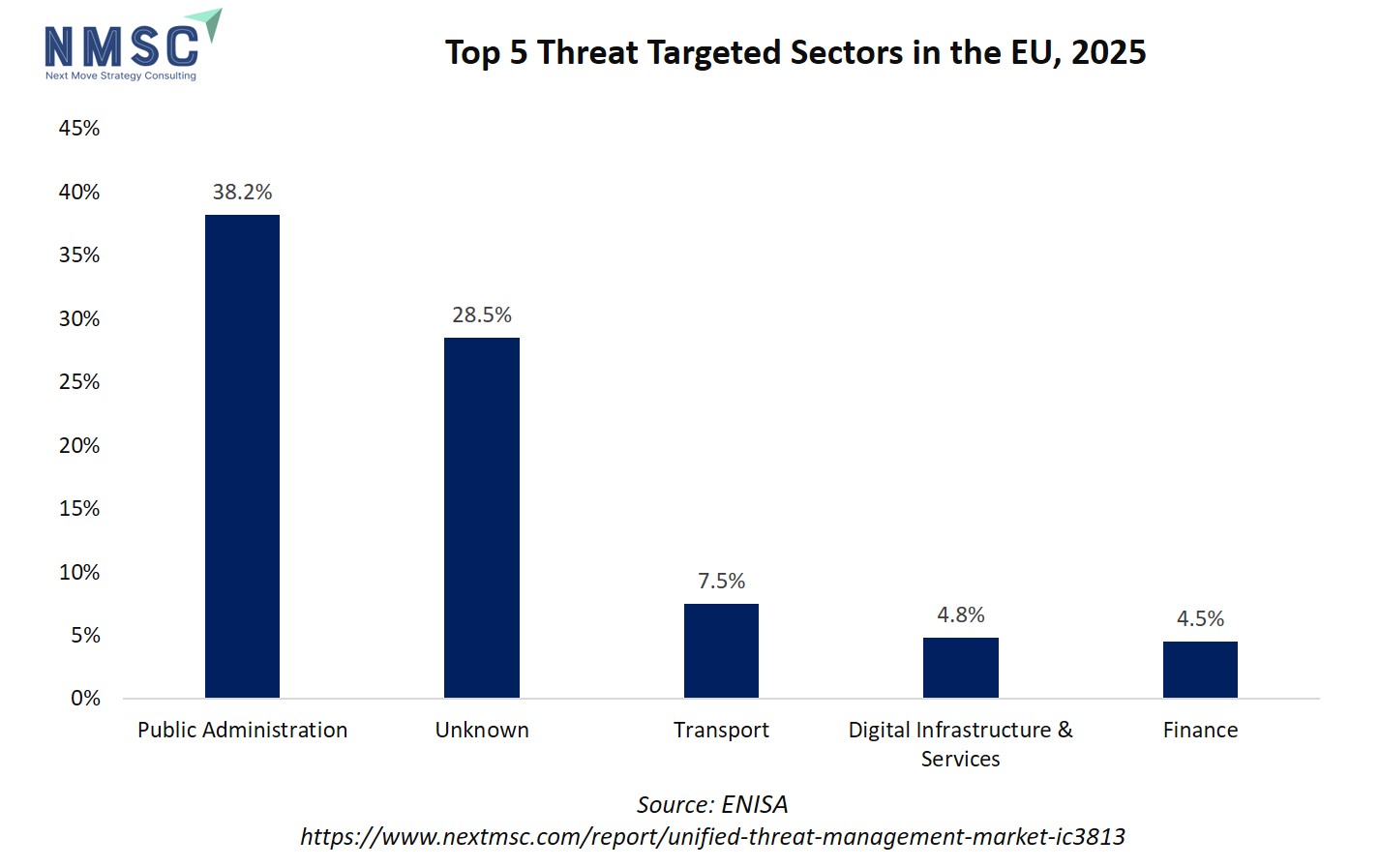
Europe’s heterogeneous regulatory landscape and the rollout of NIS2 have increased minimum security expectations across member states, encouraging purchases of consolidated security stacks that simplify compliance. ENISA’s 2024 threat landscape shows ransomware, availability attacks and data-targeting remain dominant, which pushes enterprises to adopt UTM that centralizes URL/DNS filtering, IPS, and logging for auditability. Vendors that provide advanced encryption inspection, privacy-aware telemetry, and integration with national CERTs see stronger traction. The continent’s mix of cloud-first and on-prem customers also drives hybrid UTM delivery models.
Unified Threat Management Market in United Kingdom
The U.K. has seen a sharp increase in nationally significant incidents and guidance from NCSC that favours resilient architectures and centralized logging. Organizations in finance, retail, and critical infrastructure prefer UTM that are consumed as a managed service and that supports fast forensic log exports and playbook automation. The NCSC’s heightened incident activity makes investments in consolidated stacks and vendor-managed monitoring an easier board-level sell, boosting managed unified threat management industry and driving feature parity with SaaS-based security fabrics.
Unified Threat Management Market in Germany
Germany’s federal BSI reports and regulatory posture create a market where proof of performance and data sovereignty matter. Enterprises require local logging, certified encryption handling, and demonstrable inspection throughput for encrypted traffic, all features UTM vendors must show to win deals. The BSI’s focus on supply-chain and critical infrastructure resilience also increases demand for integrated, centrally managed controls that are deployed across industrial and IT estates; vendors with strong local channel partners and compliance toolkits perform best.
Unified Threat Management Market in France
French public guidance and private-sector investment in cybersecurity push enterprises toward managed detection and consolidated controls. Buyers emphasise rigorous privacy safeguards and integration with national CERT workflows; UTM vendors that localise telemetry handling and offer clear compliance mappings (e.g., GDPR-ready logging and role-based access) gain faster procurement approval. AI-driven detection helps, but explainability and audit trails are decisive in regulated verticals such as public services and finance.
Unified Threat Management Market in Italy
In Italy the combination of increasing ransomware incidents and public-sector digitalization programs creates demand for turnkey security that reduces operational overhead. Organizations, particularly in mid-market and public administration, prefer UTM delivered as a managed service to avoid building in-house SOCs. Vendors that provide localized onboarding, compliance templates, and low-friction policy migration from legacy firewalls find faster adoption. Regional integrators who bundle UTM with incident response offerings are gaining market access.
Unified Threat Management Market in Spain
Spanish organizations are reacting to a higher cadence of ransomware and availability attacks by centralizing threat controls; UTM adoption is spurred by demand for consistent remote-worker protections and simplified compliance. Managed service consumption is rising for SMEs and public entities, and vendors that localize language, reporting, and support see better traction. Public incident reports and regional cyber initiatives amplify the need for consolidated, easy-to-operate security stacks.
Unified Threat Management Market in Nordics
Nordic countries combine high cloud adoption with strong privacy and security norms, producing demand for cloud-managed UTM that still respects data locality and robust identity integration. Organizations there are quick to pilot AI-assisted detection but insist on explainable decisions and strong integration with identity providers and SIEMs. Because their digital infrastructure is modern and well-connected, vendors that emphasize API-first control planes and automation win early contracts and scale quickly through MSPs.
Unified Threat Management Market in the Asia-Pacific
APAC is diverse, where advanced markets like, Japan, Australia, South Korea push for cloud-managed, AI-enhanced UTM and regulatory compliance, while emerging markets favour low-cost, appliance-based UTM and managed services. The region’s rapid cloud & mobile growth, combined with rising targeted attacks, drives demand for consolidated stacks that secure branches and remote users. Vendors that offer flexible delivery (appliance - cloud) and strong channel/MSSP enablement generally capture the broadest share of APAC growth.
Unified Threat Management Market in China
China’s market dynamics are shaped by heavy domestic vendor presence, strict data-sovereignty requirements, and a focus on integrated on-prem and cloud solutions. Large enterprises and state actors demand high-throughput inspection and locally compliant telemetry handling; UTM features that align with national cybersecurity standards and embed deep protocol visibility gain traction. International vendors face entry barriers while domestic providers bundle UTM into broader enterprise stacks.
Unified Threat Management Market in Japan
Japan’s industrial and supply-chain focus and government strategies to strengthen domestic cybersecurity push enterprises to prefer vendors that demonstrate supply-chain assurance, product localization, and integration with national cybersecurity initiatives. The METI strategy and related policies promote local capabilities and cloud migration, nudging UTM vendors to offer domestic support, measurable performance, and compliance documentation; AI-enabled detection is welcomed if paired with explainability and vendor accountability.
Unified Threat Management Market in India
India’s rapidly digitalizing economy and high incident counts reported in national threat reports encourage broad UTM adoption across government, BFSI, and SME sectors. CERT-IN’s digital threat reporting shows a rising incident trend, which makes cloud-managed UTM and MSSP models attractive for organizations that lack deep security teams. Vendors that offer low-cost managed packages, localized support, and compliance templates for Indian regulations capture market share.
Unified Threat Management Market in South Korea
South Korea’s advanced digital economy, high internet penetration and national focus on cyber resilience drive demand for high-performance UTM that handles encrypted traffic and integrates with national monitoring. Domestic vendors are strong, and procurement often favors solutions that offer deep traffic analysis and low-latency inline inspection for gaming, manufacturing, and finance sectors. AI-augmented detection is an increasingly important purchase criterion, alongside support for rapid incident sharing.
Unified Threat Management Market in Taiwan
Taiwan’s elevated threat exposure from targeted geopolitical activity has elevated the need for resilient, centrally managed security stacks. Recent reporting of rising attack volumes underlines demand for real-time telemetry, DDoS resilience and rapid patching, capabilities UTM vendors must emphasize. That geopolitical pressure accelerates investment in managed UTM and in hybrid models that allow rapid local enforcement plus centralised threat sharing.
Unified Threat Management Market in Indonesia
Indonesia and Southeast Asian markets balance rapid cloud adoption with constrained security budgets; managed UTM and cloud-delivered appliances are attractive because they reduce operations overhead. Regional CISO analyses show ransomware and supply-chain risks rising, prompting local governments and large telcos to push security services to SMEs. Vendors that partner with local MSPs and offer consumption pricing and quick onboarding templates win in these markets.
Unified Threat Management Market in Australia
Australia’s threat reports from ASD/ACSC highlight targeted espionage and ransomware as major concerns, driving public and private investment in centralized detection and consolidated controls. Organizations prefer UTM that pairs cloud management with strong incident-response integrations and logging that are shared with national agencies. Managed services and vendor-led SOC partnerships accelerate adoption among mid-market buyers who need outcomes rather than product procurement.
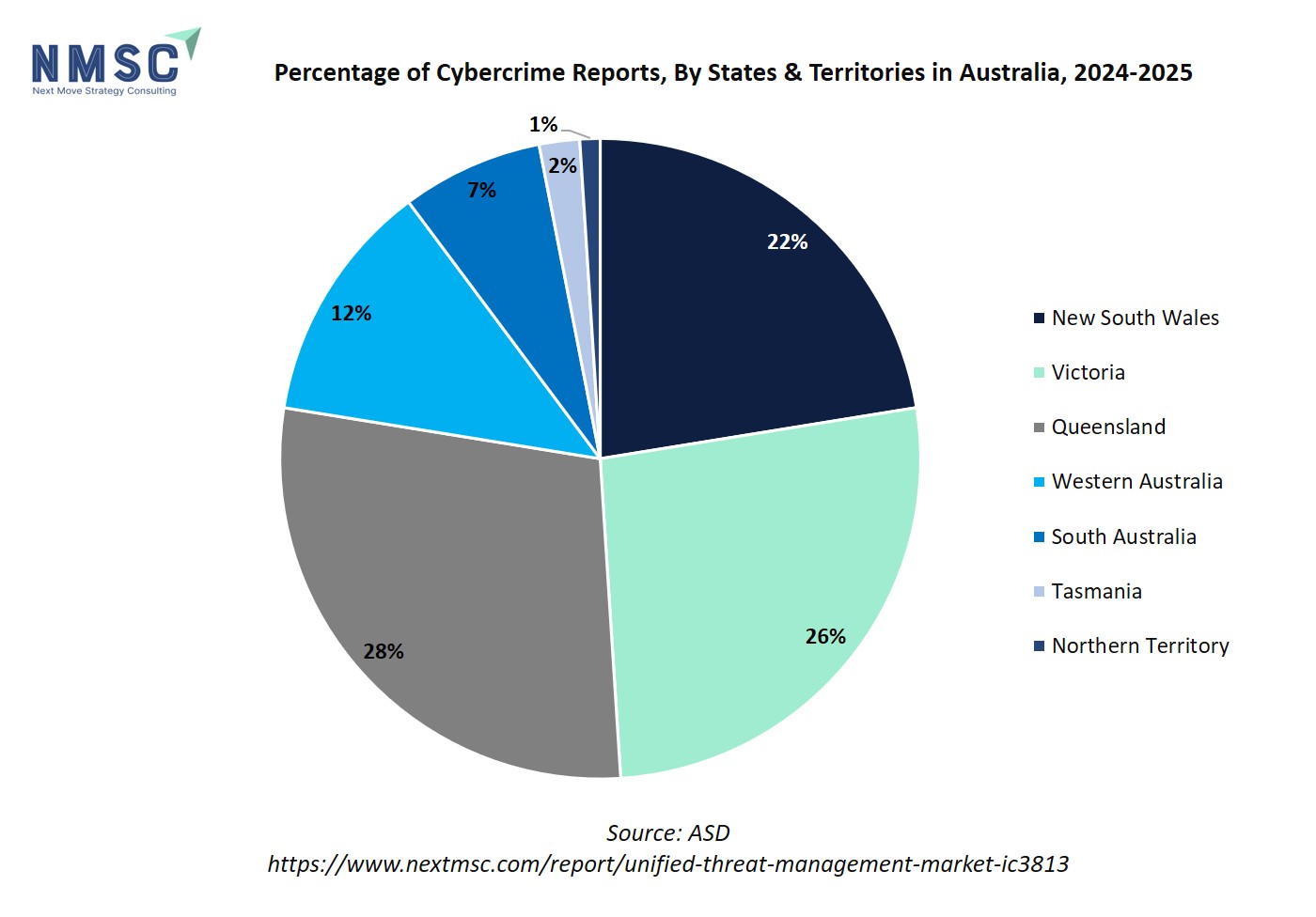
The above chart illustrates the distribution of cybercrime reports across Australian states and territories for 2024-2025, offering strategic insights for the Unified Threat Management (UTM) market in Europe when analysing parallels in cybersecurity risk concentration. These variations emphasize the importance of regionalized UTM strategies, ensuring security providers address the highest risk geographies with tailored solutions and robust capabilities to mitigate complex cyber threats.
Unified Threat Management Market in Latin America
Latin American organizations face rising ransomware and extortion activity and often limited in-house capabilities, which makes MSSPs and packaged UTM services especially compelling. Regional CISO studies show many enterprises prefer managed detection and consolidated stacks to reduce vendor sprawl and to meet local regulations. Vendors that adapt pricing, localize support, and provide channel enablement see better penetration across both large enterprises and SMEs.
Unified Threat Management Market in Middle East & Africa
Markets in the Middle East and Africa vary widely: large oil-and-gas and government entities invest heavily in integrated controls and bespoke telemetry sharing, while smaller enterprises often rely on MSPs for basic protections. Cross-border risk, digital transformation of state services, and rising targeted attacks lead to demand for UTM that supports multi-cloud, strong identity integration and managed service models. Vendors who build local partner ecosystems and compliance toolkits tailored to national regulations make faster inroads.
Competitive Landscape
Which Companies Dominate the Unified Threat Management Market and How do they Compete?
The unified threat management industry is led by established cybersecurity giants like Fortinet, Cisco, Check Point, and Sophos, alongside specialists such as SonicWall and WatchGuard. Fortinet commands a significant share, with its FortiGate series recognized as the most deployed network firewall globally. Cisco's Meraki MX and Firepower series offer integrated security solutions, emphasizing cloud-managed services. Check Point's Infinity Architecture delivers advanced threat prevention across networks, endpoints, and mobile devices. Sophos provides synchronized security through its XG Firewall and Intercept X solutions. These companies differentiate themselves through product features, deployment models, and integration capabilities, catering to various market segments from small businesses to large enterprises.
Market Dominated by Unified Threat Management Giants and Specialists
The unified threat management industry is characterized by a mix of industry giants and specialized vendors. Companies like Fortinet, Cisco, and Check Point dominate the enterprise segment with comprehensive, integrated solutions that address complex security needs. In contrast, specialists such as SonicWall and WatchGuard focus on delivering cost-effective, scalable solutions tailored for small to medium-sized businesses. This division shapes competition across regions and niches, with large enterprises favouring established players for their robust features and support, while smaller organisations lean towards specialists for affordability and simplicity. The competition is further influenced by factors like compliance requirements, deployment preferences (cloud vs. on-premises), and the need for specialised threat intelligence.
Innovation and Adaptability Drive Market Success
Innovation is a key driver in the unified threat management industry, with companies continuously enhancing their offerings to stay competitive. Fortinet has introduced AI-powered threat detection and high-performance security processors in its FortiGate series. Cisco has integrated advanced analytics and automation into its Meraki MX and Firepower platforms, focusing on simplifying security management. Check Point emphasizes its Infinity Architecture, which provides unified threat prevention across all network layers. SonicWall has launched its Generation 8 platform, featuring cloud-managed firewalls with integrated Zero Trust Network Access and co-managed security services. These innovations enable vendors to address evolving cyber threats and meet the diverse needs of their customers.
Market Players to Opt for Merger & Acquisition Strategies to Expand their Presence
To strengthen their positions in the unified threat management market share, several companies have pursued strategic mergers and acquisitions. Cisco acquired Splunk for USD 28 billion to enhance its software offerings and cybersecurity capabilities amid the AI surge. Fortinet has expanded its portfolio through acquisitions, integrating advanced technologies to bolster its security solutions. Check Point continues to enhance its product suite through strategic partnerships and acquisitions, focusing on expanding its threat prevention capabilities. These M&A activities allow companies to broaden their technological expertise, enter new markets, and offer more comprehensive solutions to their customers.
List of Key Unified Threat Management Companies
-
Check Point Software Technologies Ltd.
-
SonicGuard
-
Fortinet, Inc
-
Untangle
-
Juniper Networks, Inc
-
Sophos Ltd.
-
WatchGuard Technologies, Inc
-
Barracuda Networks
-
Hughes Network Systems
-
Sangfor Technologies
-
Hillstone Networks
-
Stormshield
-
Clavister
What Are the Latest Key Industry Developments?
-
August 2025- SonicWall launched its Generation 8 TZ Series firewalls, designed for small and medium-sized businesses. These firewalls offer high-speed threat prevention, simplified management, and integrated Zero Trust Network Access, catering to the evolving security needs of SMBs.
-
June 2025- Fortinet expanded its data and productivity security portfolio by launching the FortiMail Workspace Security suite. This suite incorporates AI to safeguard users and sensitive data across dynamic work environments, addressing the growing need for comprehensive security solutions.
-
March 2024- Cisco completed its acquisition of Splunk for approximately USD 28 billion. This strategic move aims to enhance Cisco's AI-driven analytics capabilities, bolstering its position in the cybersecurity market.
-
2024- At Cisco Live 2024, Cisco unveiled its Malware Defense Cloud and Malware Analytics offerings, integrating them with existing security architectures like Secure Email, Secure Web, and Meraki. This integration aims to provide a unified approach to threat detection and response across various platforms.
What Are the Key Factors Influencing Investment Analysis & Opportunities in the Unified Threat Management Market?
Venture funding for cybersecurity remains robust but more selective. Investors are concentrating capital into fewer, higher-quality bets while early- and seed-stage activity persists where differentiated AI and automation is shown. Deal value recovered through 2024-H1-2025 with several sources reporting strong year-to-date capital inflows, yet investors are favouring companies with clear ARR, defensible tech (AI-backed detection, encrypted-traffic inspection) and path-to-recurring revenue, a pattern that has compressed risk appetite and stabilized valuations for market leaders.
Investment hotspots concentrate where talent, exit pathways and government demand intersect: the U.S. and Israel lead in deal size and exits, Europe (London/Paris) draws growth funds focused on AI/cyber convergence, and APAC (notably India and Australia) is attracting strategic and VC interest for managed-security and cloud-native controls. Funds and corporates are prioritizing scale-able SaaS, MSSP enablement, and AI-explainability, themes that make UTM-adjacent platforms appealing acquisition targets or growth investments.
Key Benefits for Stakeholders:
Next Move Strategy Consulting (NMSC) presents a comprehensive analysis of the unified threat management market trends, covering historical trends from 2020 through 2024 and offering detailed forecasts through 2030. Our study examines the market at regional and country levels, providing quantitative projections and insights into key growth drivers, challenges, and investment opportunities across all major endpoint security management.
The uified threat management industry delivers clear value to multiple stakeholders. Investors benefit from a growing, recurring-revenue-driven market, where SaaS, managed services, and AI-enabled automation create predictable cash flows and attractive exit opportunities. Customers, ranging from SMBs to large enterprises, gain simplified, consolidated security stacks that reduce operational complexity, lower the need for specialized in-house SOC teams, and accelerate compliance with regulatory requirements. Managed UTM and cloud-delivered solutions allow organizations to scale protection across branches, remote users, and hybrid infrastructures without extensive capital expenditure. Together, these dynamics create a virtuous cycle: strong market adoption drives investor confidence, while continuous innovation in AI-assisted detection, telemetry integration, and policy automation ensures that end-users receive measurable, outcome-oriented security benefits.
Report Scope
|
Parameters |
Details |
|
Market Size in 2025 |
USD 9.41 Billion |
|
Revenue Forecast in 2030 |
USD 17.37 Billion |
|
Growth Rate |
CAGR of 12.47% from 2025 to 2030 |
|
Analysis Period |
2024–2030 |
|
Base Year Considered |
2024 |
|
Forecast Period |
2025–2030 |
|
Market Size Estimation |
Billion (USD) |
|
Growth Factors |
|
|
Companies Profiled |
15 |
|
Countries Covered |
33 |
|
Market Share |
Available for 10 companies |
|
Customization Scope |
Free customization (equivalent to up to 80 analyst-working hours) after purchase. Addition or alteration to country, regional & segment scope. |
|
Pricing and Purchase Options |
Avail customized purchase options to meet your exact research needs. |
|
Approach |
In-depth primary and secondary research; proprietary databases; rigorous quality control and validation measures. |
|
Analytical Tools |
Porter's Five Forces, SWOT, value chain, and Harvey ball analysis to assess competitive intensity, stakeholder roles, and relative impact of key factors. |
Key Market Segments
By Component
-
Hardware
-
Software
-
Virtual
By Deployment
-
Cloud
-
On-premise
By Service
-
Managed UTM
-
Support & Maintenance
-
Consulting
By Enterprise Size
-
Large Enterprise
-
Small and Medium Enterprises (SMEs)
By End Use
-
BFSI
-
Government
-
Healthcare
-
Manufacturing
-
Retail
-
Telecom & IT
-
Others
Geographical Breakdown
-
North America: U.S., Canada, and Mexico.
-
Europe: U.K., Germany, France, Italy, Spain, Sweden, Denmark, Finland, Netherlands, and rest of Europe.
-
Asia Pacific: China, India, Japan, South Korea, Taiwan, Indonesia, Vietnam, Australia, Philippines, Malaysia and rest of APAC.
-
Middle East & Africa (MEA): Saudi Arabia, UAE, Egypt, Israel, Turkey, Nigeria, South Africa, and rest of MEA.
-
Latin America: Brazil, Argentina, Chile, Colombia, and rest of LATAM
Conclusion & Recommendations
Our report equips stakeholders, industry participants, investors, and consultants with actionable intelligence to capitalize on Unified Threat Management’s transformative potential. By combining robust data-driven analysis with strategic frameworks, NMSC’s report serves as a vital resource for understanding and navigating the evolving landscape of unified threat management solutions.
The unified threat management market growth is poised for sustained growth as organizations confront increasingly sophisticated cyber threats, regulatory pressures, and distributed IT environments. Strategic takeaways highlight the importance of AI-assisted detection, cloud-managed and hybrid delivery models, and MSSP-friendly multi-tenant platforms. Vendors that prioritize automation, explainable AI, and seamless integration with identity and access frameworks are better positioned to capture global adoption. The convergence of UTM with SASE, SD-WAN, and managed security services underscores the market’s shift from appliance-centric solutions to outcome-driven, serviceable security platforms, creating long-term value across geographies and industry verticals.
Executives and investors act on these insights by focusing on scalable, cloud-native or hybrid UTM solutions with strong automation and compliance capabilities. Investment strategies should target companies offering SaaS control planes, AI-enhanced threat intelligence, and MSSP enablement, while enterprise buyers should evaluate UTM platforms for integration, automation, and measurable operational impact. Prioritizing these elements ensures optimized security outcomes, predictable revenue streams, and sustainable growth in the evolving cybersecurity landscape.


About the Author
 Mayurima Roy
— Mayurima Roy is Research Analyst at Next Move Strategy Consulting, where she has spent 4 years working across the firm's full industry coverage rather than a single fixed vertical. Her work centers on structured research, ongoing trend tracking, competitive assessment, and insight-led content development, translating complex market data into clear, decision-ready narratives that support informed client decision-making across diverse global industries, market sectors, and world regions every day.
Mayurima Roy
— Mayurima Roy is Research Analyst at Next Move Strategy Consulting, where she has spent 4 years working across the firm's full industry coverage rather than a single fixed vertical. Her work centers on structured research, ongoing trend tracking, competitive assessment, and insight-led content development, translating complex market data into clear, decision-ready narratives that support informed client decision-making across diverse global industries, market sectors, and world regions every day.
About the Reviewer
 Supradip Baul
— Supradip Baul is an accomplished business consultant and strategist with over a decade of rich experience in market intelligence, strategy, technology, and business transformation. His work has included rigorous qualitative and quantitative analysis across multiple industries, helping clients shape investment decisions and long-term roadmaps. Earlier in his career, he was associated with Gartner, where he contributed to industry-leading reports and market share analyses. He has worked with leading global companies and holds an MBA with a dual specialization in Marketing and Finance.
Supradip Baul
— Supradip Baul is an accomplished business consultant and strategist with over a decade of rich experience in market intelligence, strategy, technology, and business transformation. His work has included rigorous qualitative and quantitative analysis across multiple industries, helping clients shape investment decisions and long-term roadmaps. Earlier in his career, he was associated with Gartner, where he contributed to industry-leading reports and market share analyses. He has worked with leading global companies and holds an MBA with a dual specialization in Marketing and Finance.
At Next Move Strategy Consulting, we understand that insightful market research is the cornerstone of successful business decisions. That's why we employ a robust and multifaceted approach, combining various methodologies to deliver the most accurate and actionable data for our clients.

Research Landscape
We navigate the world of research with two primary approaches:
Qualitative Approach
Our qualitative research methodologies involve immersive techniques such as in-depth interviews, focus groups, and observational studies. By engaging directly with individuals and stakeholders, we uncover valuable insights that quantitative data alone may overlook.

Quantitative Research
In tandem with qualitative methodologies, NMSC leverages the power of Quantitative Research to provide a robust foundation of numerical insights. Through systematic data collection and analysis, we quantify patterns, preferences, and market trends, offering a comprehensive view of the business landscape.
Our quantitative research approach employs diverse tools, including surveys, experiments, and statistical modelling. These methodologies enable us to gather data from a large and representative sample, ensuring the statistical significance of our findings. By employing structured questionnaires and standardized data collection methods, we guarantee the reliability and validity of the information we present to our clients.
Quantitative research is particularly effective in measuring the prevalence of trends, assessing market size, and gauging the impact of various factors on consumer behavior. The numerical precision attained through this approach equips our clients with actionable insights, facilitating data-driven decision-making and strategy formulation.


Our Specialized Toolbox for Industry-Specific Market Research
We deploy a specialized arsenal of techniques tailored to meet your unique requirements. Here's a glimpse into our comprehensive toolbox:

Information Procurement
The stage entails acquiring market data or relevant information through various sources and methodologies.


Market Research Approach
We utilize both top-down and bottom-up approaches in market research analysis to achieve a comprehensive understanding of the market dynamics, leveraging the broad perspective of industry trends and macroeconomic factors alongside detailed insights from specific segments and individual companies.

Porters Five Forces Analysis
We conduct Porter's Five Forces analysis to evaluate the competitive landscape of an industry, providing us with insights into factors that affect profitability and strategic positioning.

SWOT Analysis

Forecasting
We utilize a forecasting model to predict future consumption by considering parameters like population, economics, regulations, market competition, drivers, constraints, technology, and pricing. We also employ statistical techniques such as multilinear regression, exponential smoothing, moving average, ARIMA, and Monte Carlo simulations for accurate predictions. In econometric forecasting, we analyzed short-term and long-term event impacts, attributing values based on regulatory frameworks, economic factors, and market events.





 Speak to Our Analyst