Vehicle to Grid Market

The global Vehicle to Grid Market was estimated at USD 31.16 billion in 2026, projected to reach USD 168.46 billion by 2035, expanding at a CAGR of 20.62% from 2026 to 2035. Key growth drivers include the rapid expansion of the global EV fleet, rising electricity demand and renewable energy penetration, and increasing demand for flexible grid resources, with Europe leading the market with approximately 34% revenue share.

Download Free Sample PDF
Base Year (2025)
$15.90 Billion
Forecast (2035)
$168.46 Billion
CAGR (2026-2035)
20.6%
Top Country
Europe

What Is the Vehicle to Grid Market Size?

The global Vehicle to Grid market was valued at USD 15.90 billion in 2025 and is estimated at USD 31.16 billion in 2026, forecast to reach USD 168.46 billion by 2035, expanding at a 20.62% CAGR from 2026 to 2035. Europe leads with approximately 34% revenue share, while Hardware accounted for approximately 47% of market revenue in 2025 .

NMSC's analysis indicates that the Vehicle to Grid market is approaching a commercial inflection point, as expanding bidirectional EV fleets, dynamic electricity tariffs, and grid-participation policy frameworks in Europe, North America, and Asia-Pacific are converging to create scalable aggregation economics that were not achievable during earlier pilot phases.

Vehicle to Grid Market Revenue Forecast

Values in USD Billion

2025 $15.90 Billion
2025
2026 $19.18 Billion
2026
2027 $23.13 Billion
2027
2028 $27.90 Billion
2028
2029 $33.66 Billion
2029
2030 $40.60 Billion
2030
2031 $48.97 Billion
2031
2032 $59.07 Billion
2032
2033 $71.24 Billion
2033
2034 $85.94 Billion
2034
2035 $168.46 Billion
2035

Key Takeaways

By Offering: Hardware held the largest share of approximately 47% (USD 7.47 Billion) in 2025 and is estimated at USD 58.96 Billion in 2035; Software is the fastest-growing offering segment at 24.5% CAGR from 2026–2035.

By Vehicle Class: Passenger EVs held the largest share of approximately 45% (USD 7.16 Billion) in 2025 and is estimated at USD 70.75 Billion in 2035; Buses are the fastest-growing sub-segment at 23.3% CAGR from 2026–2035.

By Grid Jurisdiction: Distribution Grid held the largest share of approximately 65% (USD 10.34 Billion) in 2025; Transmission Grid is the fastest-growing sub-segment at approximately 22.0% CAGR from 2026–2035.

By Deployment Setting: Residential held the largest share of approximately 27% (USD 4.29 Billion) in 2025; Charging Hubs is the fastest-growing sub-segment at approximately 25.0% CAGR from 2026–2035.

By Buyer Type: Residential Customers held the largest share of approximately 25% (USD 3.97 Billion) in 2025 and is estimated at USD 39.58 Billion in 2035; Utilities and Grid Operators are the fastest-growing segment at 22.7% CAGR from 2026–2035.

By Contracting Channel: Direct Contracting held the largest share of approximately 32% (USD 5.09 Billion) in 2025; Public Procurement is the fastest-growing sub-segment at approximately 23.5% CAGR from 2026–2035.

By Use Case: Renewable Energy Integration held the largest share of approximately 30% (USD 4.77 Billion) in 2025; Resilience and Backup is the fastest-growing sub-segment at approximately 25.0% CAGR from 2026–2035.

Dominant Region: Europe dominated with approximately 34% revenue share (USD 5.40 Billion) in 2025.

Fastest-Growing Region: Asia-Pacific is expected to register the highest regional CAGR of approximately 22.2% during 2026–2035.

Dominant Country: U.S. led with approximately USD 4.36 Billion in 2025.

Fastest-Growing Country: India and Australia are among the fastest-growing named countries at approximately 23.6% CAGR from 2026–2035.

Market Opportunity: The Vehicle to Grid market is expected to create an absolute dollar opportunity of USD 137.30 billion between 2026 and 2035, positioning bidirectional EV charging infrastructure, aggregation software, and grid-flexibility services as one of the most capital-attractive energy transition investment themes of the decade.

According to NMSC analysis, the structural shift from vehicle-specific pilot programs to multi-OEM, multi-charger aggregation platforms operating under standardized grid-participation rules is the most consequential near-term enabler of Vehicle to Grid market scale, because it transforms V2G from a model-specific product into a service that any compatible vehicle can access through a consistent customer and utility interface.

What Does the Vehicle to Grid Market Encompass?

The Vehicle-to-Grid (V2G) market encompasses the hardware, software, services, and turnkey solutions that enable bidirectional energy flow between electric vehicles and the electricity grid. The scope includes AC/DC bidirectional EV supply equipment, V2G site equipment, power conversion units, charging and energy management software, aggregation platforms, grid integration solutions, and related engineering, installation, operations, and grid services. One-directional smart charging, standalone vehicle-to-home systems, and stationary battery storage without EV charging integration are excluded.
The regulatory landscape is evolving across Europe, North America, and Asia-Pacific, supported by frameworks such as the EU's alternative fuels regulations, U.S. FERC Order 2222, Japan's Virtual Power Plant programs, and Australia's V2G trials. Technology adoption is progressing toward ISO 15118-20 communication, software-defined fleet aggregation, and AI-driven dispatch, enabling optimized EV charging, discharging, and participation in grid services.

Market Drivers & Dynamics

Interactive Dataset
EV fleet expansion creating growing pool of V2G-eligible connected batteries driver +4.2% Global 2026–2035
Rising electricity demand and renewable penetration increasing flexibility value driver +3.8% Global 2026–2035
Smart charging and grid-participation policy frameworks creating flexibility revenue routes driver +3.5% Europe, North America, Asia-Pacific 2026–2033
Dynamic electricity tariffs making V2G charging cost optimization actionable for customers driver +2.8% Europe, Australia 2026–2033
Fleet electrification creating predictable high-availability V2G assets at depots driver +2.5% Global 2026–2035
Smart meter expansion enabling automated home charging and aggregation driver +1.8% Europe, Australia 2026–2032
Limited availability of bidirectional vehicle and charger combinations restricting interoperable deployment restraint −2.3% Global 2026–2032
Battery degradation concerns and uncertain value stacking weakening customer economics restraint −1.8% Global 2026–2030
Grid interconnection and certification complexity slowing commercial V2G rollout restraint −1.2% Global 2026–2030
Source: Next Move Strategy Consulting

Growth Drivers

What Is the Primary Growth Driver of the Vehicle to Grid Market?

The rapid expansion of the global EV fleet is the strongest demand catalyst for the Vehicle to Grid market, as V2G deployment depends on a sufficiently large base of bidirectional-capable vehicles. The International Energy Agency reports that global electric car sales exceeded 20 million in 2025, increasing 20% from 2024 and reaching 25% of global new car sales. This growing connected battery base provides the physical foundation for V2G aggregation, enabling more vehicles to respond to grid signals while parked and allowing aggregators to deliver flexibility at scale.

How Is Rising Electricity Demand and Renewable Growth Driving Vehicle to Grid Market Demand?

The International Energy Agency reports that global electricity demand grew approximately 3% in 2025, adding around 800 TWh, while renewable generation increased approximately 8.5% and reached 34% of global electricity generation. Rising renewable penetration increases the value of flexible demand and distributed storage because generation is not always aligned with consumption. EV batteries can support this shift by charging during periods of high renewable output and discharging when grid flexibility is more valuable. This trend increases potential aggregator revenue from V2G dispatch and strengthens the customer economics supporting adoption.

Growth Inhibitors

What Is Restraining the Vehicle to Grid Market?

Limited availability of compatible bidirectional vehicle and charger combinations is the primary structural restraint on Vehicle to Grid market expansion. Bidirectional operation requires compatibility across the vehicle powertrain, battery management system, inverter, connector, communications stack, and charger certification. The International Energy Agency's 2026 V2G technology assessment noted that early commercial offerings for private EV owners emerged in 2025 but were generally limited to specific EV models and charger pairings, while ISO 15118-20 implementation remains inconsistent. This creates selection risk and installation complexity for customers while limiting aggregator portfolios when vehicle and charger combinations cannot be easily interchanged across brands and operating environments.

Segmentation Analysis

2025 (USD Billion)
2035 (USD Billion)
Hardware
AC Bidirecti
Residential
Commercial A
DC Bidirecti
Segment Item 2025 (USD Billion) 2035 (USD Billion) CAGR
Hardware $10.0 USD Billion $40.0 USD Billion 15.0%
AC Bidirectional EVSE $17.1 USD Billion $51.1 USD Billion 9.0%
Residential AC Chargers $24.2 USD Billion $62.2 USD Billion 19.0%
Commercial AC Chargers $31.3 USD Billion $73.3 USD Billion 21.0%
DC Bidirectional EVSE $38.4 USD Billion $84.4 USD Billion 26.0%

Segment-wise data is locked

Unlock complete segment-wise numbers for By Offering.

Unlock Full Data

Which Offering Segment Dominates the Vehicle to Grid Market?

Hardware commanded the largest revenue share at USD 7.47 billion in 2025, driven by investment in AC and DC bidirectional EVSE, V2G site equipment, and power conversion units. Software is the fastest-growing offering segment, expanding at a 24.5% CAGR from 2026 to 2035, supported by rising demand for charging and discharging management, V2G aggregation platforms, and grid integration software. As the hardware base expands, software revenue per connected vehicle is expected to increase, shifting the market toward higher-margin platform and stationary energy storage adjacent software capabilities.

2025 (USD Billion)
2035 (USD Billion)
Passenger EV
Light Commer
Medium and H
Buses
Two-Wheelers
Segment Item 2025 (USD Billion) 2035 (USD Billion) CAGR
Passenger EVs $10.0 USD Billion $40.0 USD Billion 8.0%
Light Commercial EVs $17.1 USD Billion $51.1 USD Billion 18.0%
Medium and Heavy Commercial EVs $24.2 USD Billion $62.2 USD Billion 20.0%
Buses $31.3 USD Billion $73.3 USD Billion 18.0%
Two-Wheelers $38.4 USD Billion $84.4 USD Billion 9.0%

Segment-wise data is locked

Unlock complete segment-wise numbers for By Vehicle Class.

Unlock Full Data

Which Vehicle Class Segment Leads the Vehicle to Grid Market?

Passenger EVs generated the largest revenue share at USD 7.16 billion in 2025, supported by the large global base of consumer battery electric vehicles and their deployment across residential and commercial charging environments. Buses are the fastest-growing vehicle class, expanding at a 23.3% CAGR from 2026 to 2035, driven by public transit electrification in China, Europe, and North America. Their large, depot-based fleets and predictable schedules make buses particularly well-suited for V2G grid-service dispatch and provide more predictable capacity commitments than residential passenger EVs.

2025 (USD Billion)
2035 (USD Billion)
Transmission
Distribution
Segment Item 2025 (USD Billion) 2035 (USD Billion) CAGR
Transmission Grid $10.0 USD Billion $40.0 USD Billion 27.0%
Distribution Grid $17.1 USD Billion $51.1 USD Billion 9.0%

Segment-wise data is locked

Unlock complete segment-wise numbers for By Grid Jurisdiction.

Unlock Full Data
2025 (USD Billion)
2035 (USD Billion)
Residential
Commercial a
Industrial
Dedicated Fl
Public and I
Segment Item 2025 (USD Billion) 2035 (USD Billion) CAGR
Residential $10.0 USD Billion $40.0 USD Billion 20.0%
Commercial and Retail $17.1 USD Billion $51.1 USD Billion 26.0%
Industrial $24.2 USD Billion $62.2 USD Billion 12.0%
Dedicated Fleet Depots $31.3 USD Billion $73.3 USD Billion 18.0%
Public and Institutional $38.4 USD Billion $84.4 USD Billion 9.0%

Segment-wise data is locked

Unlock complete segment-wise numbers for By Deployment Setting.

Unlock Full Data
2025 (USD Billion)
2035 (USD Billion)
Residential
Commercial a
Fleet Operat
Charge Point
Utilities an
Segment Item 2025 (USD Billion) 2035 (USD Billion) CAGR
Residential Customers $10.0 USD Billion $40.0 USD Billion 22.0%
Commercial and Industrial Enterprises $17.1 USD Billion $51.1 USD Billion 12.0%
Fleet Operators $24.2 USD Billion $62.2 USD Billion 14.0%
Charge Point Operators $31.3 USD Billion $73.3 USD Billion 12.0%
Utilities and Grid Operators $38.4 USD Billion $84.4 USD Billion 15.0%

Segment-wise data is locked

Unlock complete segment-wise numbers for By Buyer Type.

Unlock Full Data

Which Buyer Type Leads the Vehicle to Grid Market?

Residential Customers generated the largest buyer segment revenue at USD 3.97 billion in 2025, driven by the growing installation of home bidirectional chargers in markets with active V2G tariff programs, particularly the United Kingdom, Netherlands, Germany, and Japan. Utilities and Grid Operators are the fastest-growing buyer segment, expanding at a 22.7% CAGR from 2026 to 2035, as grid operators increasingly procure V2G aggregation services and invest in infrastructure to integrate distributed EV batteries as flexibility resources for system balancing and network management.

2025 (USD Billion)
2035 (USD Billion)
Direct Contr
OEM Bundling
Energy Partn
Installer Co
Distributor
Segment Item 2025 (USD Billion) 2035 (USD Billion) CAGR
Direct Contracting $10.0 USD Billion $40.0 USD Billion 18.0%
OEM Bundling $17.1 USD Billion $51.1 USD Billion 20.0%
Energy Partner Contracting $24.2 USD Billion $62.2 USD Billion 22.0%
Installer Contracting $31.3 USD Billion $73.3 USD Billion 8.0%
Distributor Contracting $38.4 USD Billion $84.4 USD Billion 19.0%

Segment-wise data is locked

Unlock complete segment-wise numbers for By Contracting Channel.

Unlock Full Data
2025 (USD Billion)
2035 (USD Billion)
Power Qualit
Voltage Regu
Power Factor
Harmonic Mit
Grid Balanci
Segment Item 2025 (USD Billion) 2035 (USD Billion) CAGR
Power Quality Management $10.0 USD Billion $40.0 USD Billion 23.0%
Voltage Regulation $17.1 USD Billion $51.1 USD Billion 17.0%
Power Factor Management $24.2 USD Billion $62.2 USD Billion 15.0%
Harmonic Mitigation $31.3 USD Billion $73.3 USD Billion 25.0%
Grid Balancing $38.4 USD Billion $84.4 USD Billion 18.0%

Segment-wise data is locked

Unlock complete segment-wise numbers for By Use Case.

Unlock Full Data

Growth Opportunities

Our assessment indicates that three structurally significant whitespace opportunities are available to market participants seeking to capture above-market growth within the Vehicle to Grid ecosystem through the 2026–2035 forecast period.

How Can Residential V2G Aggregation Turn Home Charging Assets Into Scalable Flexibility Services?

Residential charging creates a large aggregation opportunity because vehicles are frequently parked near homes for extended periods, enabling bidirectional dispatch to be coordinated with household electricity demand, rooftop solar generation, smart meter data, and network conditions. The UK Department for Energy Security and Net Zero reported 41 million smart and advanced meters installed in domestic and smaller non-domestic premises across Great Britain by end of December 2025, representing more than two-thirds of eligible meters. This digital metering base can support time-varying electricity pricing, which is a critical prerequisite for automated home V2G economics. Energy retailers and aggregators that combine vehicle compatibility, automated dispatch software, and IoT energy management platforms with transparent customer contracts are best positioned to convert this infrastructure into scalable residential V2G propositions.

How Can Commercial Fleet and Depot V2G Create High-Utilization Grid Assets With Predictable Revenue?

Electrifying commercial fleets and deploying depot V2G creates aggregation assets with predictable operational availability that is structurally superior to residential V2G for grid contract purposes. Fleet vehicles follow defined route and dwell schedules, enabling aggregators to commit to firm capacity in ancillary service markets without the uncertainty of individual household EV availability. We observed that Fermata Energy and The Mobility House are structuring fleet V2G contracts with utilities and grid operators that deliver frequency regulation and peak demand reduction services from commercial EV depot batteries, demonstrating that the economic value stack from frequency services, peak shaving, and distribution network relief can justify V2G infrastructure investment at fleet scale even before residential markets mature.

How Can Virtual Power Plant Formation Through EV Aggregation Unlock Wholesale Electricity Market Access?

The aggregation of large numbers of V2G-capable vehicles into virtual power plants capable of responding to wholesale electricity market signals represents a high-value commercial pathway that goes beyond individual customer bill savings. FERC Order 2222 in the United States opened wholesale markets to distributed energy resource aggregators, while European clean energy market reforms are enabling distributed V2G assets to participate in balancing and capacity mechanisms. Nuvve, WeaveGrid, and Virta are building aggregation platforms that position EVs as bidirectional grid assets within these regulatory frameworks. This wholesale market access opportunity is most immediately actionable for utilities, grid operators, and charge point operators investing in energy storage infrastructure at scale, because they hold the grid connection rights and customer relationships needed to qualify aggregated EV resources for market participation.

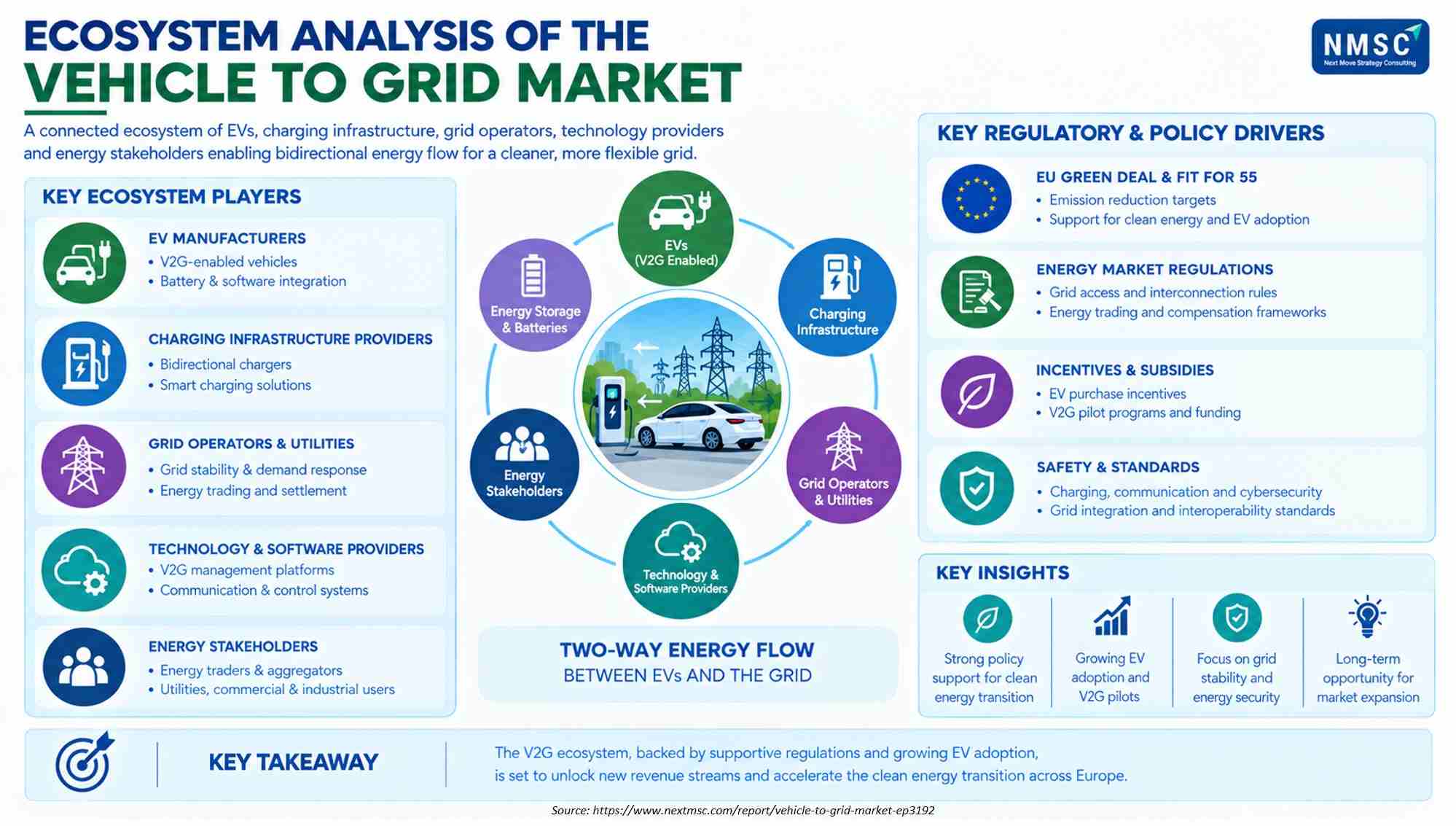
Ecosystem Analysis of the Vehicle to Grid Market

The Vehicle to Grid (V2G) ecosystem connects EV manufacturers, charging infrastructure providers, utilities, technology companies, and energy stakeholders to enable bidirectional power flow. Its development depends on interoperable charging systems, grid integration, software platforms, and supportive policies. As EV adoption expands, coordinated ecosystem participation can strengthen grid flexibility, create new revenue opportunities, and support the transition toward cleaner energy systems.

Regional Outlook

2025 (USD Billion)
2035 (USD Billion)
North Americ
Europe
Asia-Pacific
Middle East
Latin Americ
Region 2025 (USD Billion) 2035 (USD Billion) CAGR (%)
North America $10.0 USD Billion $40.0 USD Billion 9.0%
Europe $17.1 USD Billion $51.1 USD Billion 27.0%
Asia-Pacific $24.2 USD Billion $62.2 USD Billion 25.0%
Middle East & Africa $31.3 USD Billion $73.3 USD Billion 23.0%
Latin America $38.4 USD Billion $84.4 USD Billion 12.0%

Regional data is locked

Unlock complete regional numbers for this market.

Unlock Full Data

Competitive Landscape

During our market evaluation, we noticed that the Vehicle to Grid market features a multi-tiered competitive structure encompassing dedicated V2G software and aggregation specialists, EV charging hardware manufacturers integrating bidirectional capability, automotive OEMs embedding V2G in vehicle platforms, and energy retailers and utilities building customer-facing V2G service businesses.

Dimension Description
Market Structure The market is fragmented across hardware, software, services, and solutions, with V2G specialists such as Nuvve, Fermata Energy, The Mobility House, Kaluza, Virta, WeaveGrid, and Synop competing alongside hardware manufacturers and automotive OEMs embedding V2G capabilities into vehicle and charging platforms.
Innovation Focus Key innovation areas include ISO 15118-20 bidirectional communication, AI-driven aggregation, multi-OEM compatibility, battery state-of-health monitoring, and wholesale electricity market integration APIs for real-time V2G dispatch and settlement.
M&A Activity M&A and strategic investment are focused on V2G aggregation software, V2G-capable charging companies, and energy management platforms, as utilities, energy retailers, and automotive OEMs seek greater control over the bidirectional ecosystem and integrated fleet and building energy management.

How Do Companies Compete in the Vehicle to Grid Industry?

Competition in the Vehicle to Grid market spans technology, commercial models, and ecosystem control. Technology competition focuses on vehicle compatibility, ISO 15118-20 implementation, aggregation algorithms, and battery state management. Commercial competition centers on customer value propositions, including residential savings, fleet cost reduction, and wholesale market revenue. Ecosystem competition depends on controlling the vehicle-charger-software-utility chain, giving companies such as Volkswagen AG an advantage through integrated vehicle, charging, and energy management capabilities.

Which Competitive Archetypes Dominate the Vehicle to Grid Market?

Three archetypes dominate the market. Pure-play V2G software and aggregation specialists such as Nuvve, The Mobility House, WeaveGrid, Kaluza, and Virta compete on aggregation, market access, vehicle compatibility, and grid relationships. Hardware specialists such as ABB, Wallbox, Delta Electronics, Eaton, and Schneider Electric compete on bidirectional charger performance, certification, and installer networks. Automotive OEM-led integrators including Volkswagen, Nissan, Hyundai, and Ford integrate V2G into vehicle-charger-app ecosystems to control the customer experience and monetize vehicle batteries as energy assets.

How Are Companies Innovating and Differentiating in the Vehicle to Grid Market?

Innovation focuses on AI-driven dispatch, multi-brand vehicle aggregation, battery health monitoring, and wholesale market settlement APIs. These technologies optimize battery use, support heterogeneous EV fleets, monitor V2G cycling impacts, and automate energy market participation. Synop and WeaveGrid are investing heavily in fleet-scale aggregation, while The Mobility House and Kaluza are advancing residential V2G commercialization and energy retailer integration.

What M&A and Strategic Activity Is Shaping the Vehicle to Grid Market?

Strategic investments and partnerships currently outweigh outright M&A, reflecting the software-driven nature of V2G aggregation. NMSC's analysis identifies Octopus Energy's investment in Kaluza and its V2G tariff rollout as a significant energy retailer strategy. Volkswagen AG's integrated vehicle-charger-energy management ecosystem and Ford's bidirectional F-150 Lightning platform illustrate OEM-led strategies that reduce reliance on third-party aggregators for specific V2G applications.

Key Market Players

Our findings suggest that the following 20 companies are the primary producers, platform providers, and service developers shaping the global Vehicle to Grid market across hardware, software, services, and integrated solution segments as of 2026.

Nuvve Holding Corp. The Mobility House GmbH Wallbox N.V. Fermata Energy, Inc. Kaluza Ltd. Virta Ltd. WeaveGrid, Inc. Synop, Inc. ABB Ltd. Delta Electronics, Inc. Schneider Electric SE Eaton Corporation plc Volkswagen AG General Motors Company Nissan Motor Co., Ltd. Renault S.A. Ford Motor Company Hyundai Motor Company Octopus Energy Group Limited Mercedes-Benz Group AG

Latest Developments

Based on NMSC research, 2025–2026 developments in the Vehicle to Grid market focus on commercial service launches, bidirectional vehicle platform announcements, aggregation software partnerships, and regulatory implementations, collectively accelerating the market from pilot programs toward early commercial adoption.

Date Event
September 2026 Nuvve launched an AI-powered forecasting platform that combines energy-market, weather, grid, outage, telemetry, and policy signals to forecast energy prices and load. The platform is already in production across Nuvve’s battery portfolio and with initial European customers, strengthening software capabilities for V2G and distributed energy optimization.
August 2026 Hyundai Motor Group selected Kaluza as its global technology partner for EV smart charging and V2G services, beginning with the UK and Australia. Kaluza is integrating its energy intelligence into Hyundai and Kia digital ecosystems, with plans to expand the solution globally and connect vehicles directly with energy services.
July 2026 Hyundai Motor Group launched AllDayEnergy , bringing its V1G, V2G and V2H services under one global identity. Rollout begins with smart charging in the UK during the second half of 2026 through the Kia App, with planned expansion across Europe, the United States and Korea.
July 2026 WeaveGrid and GM Energy expanded collaboration around managed charging, distribution-level orchestration, bidirectional charging and residential energy storage. Eligible Chevrolet, GMC and Cadillac EV owners can participate in utility programs where available, while GM said its V2H systems are being developed to support future grid power flow.
June 2026 Volkswagen Group and Elli introduced an integrated German V2G package combining compatible EVs, the Elli BiDi Charger, Volkswagen Naturstrom V2G Flow electricity tariff and Elli BiDi App. The offering enables participating customers to charge, discharge and actively use their EV batteries within the energy market.

Expert Insights

Andrew Miller

Andrew Miller

Chief Executive | Motability Operations

"“It’s great to see V2G technology becoming available at scale – effectively turning EVs into energy assets that can help power homes and support the grid. For our customers, this could mean significantly lower energy bills and an even more affordable route into electric driving.”"

Analyst Interpretation

The statement highlights the growing commercialization of vehicle-to-grid technology and the transformation of EVs from transportation assets into distributed energy resources. By allowing vehicle batteries to support household electricity consumption and the wider grid, V2G can create additional economic value for EV owners while improving grid flexibility. This value proposition can support broader EV adoption, particularly as consumers increasingly evaluate the total cost of ownership and potential energy savings associated with electric vehicles.

Investment Opportunities

What Capital Inflows Are Targeting the Vehicle to Grid Market?

Capital inflows are increasing across V2G software aggregation, utility and energy retailer programs, and automotive OEM investments in bidirectional vehicle and charging ecosystems. Nuvve, Fermata Energy, WeaveGrid, and Virta have attracted venture and strategic funding, reflecting growing confidence in software-enabled V2G as a scalable energy service. U.S. Department of Energy and European Commission programs are also supporting V2G demonstrations, infrastructure, and regulatory development.

How Is Infrastructure Investment Supporting Vehicle to Grid Market Development?

Investment in bidirectional charging infrastructure is being driven by charging companies, automotive OEMs, and public EV infrastructure programs. ABB, Schneider Electric, Eaton, and Delta Electronics are investing in bidirectional EVSE development and manufacturing. Programs across the EU, UK, U.S., Japan, and South Korea are expanding charging infrastructure, while fleet depot investments offer strong near-term V2G potential because predictable vehicle schedules support reliable grid-service capacity.

What ESG Considerations Are Shaping Vehicle to Grid Investment Decisions?

V2G is gaining ESG investment interest by supporting renewable energy integration, reducing reliance on peaking generation, and improving grid reliability. Sustainability reporting frameworks, including the European Sustainability Reporting Standards and SEC climate disclosure requirements, are encouraging companies with EV fleets to quantify grid-service benefits, strengthening the ESG case for fleet V2G programs alongside financial returns.

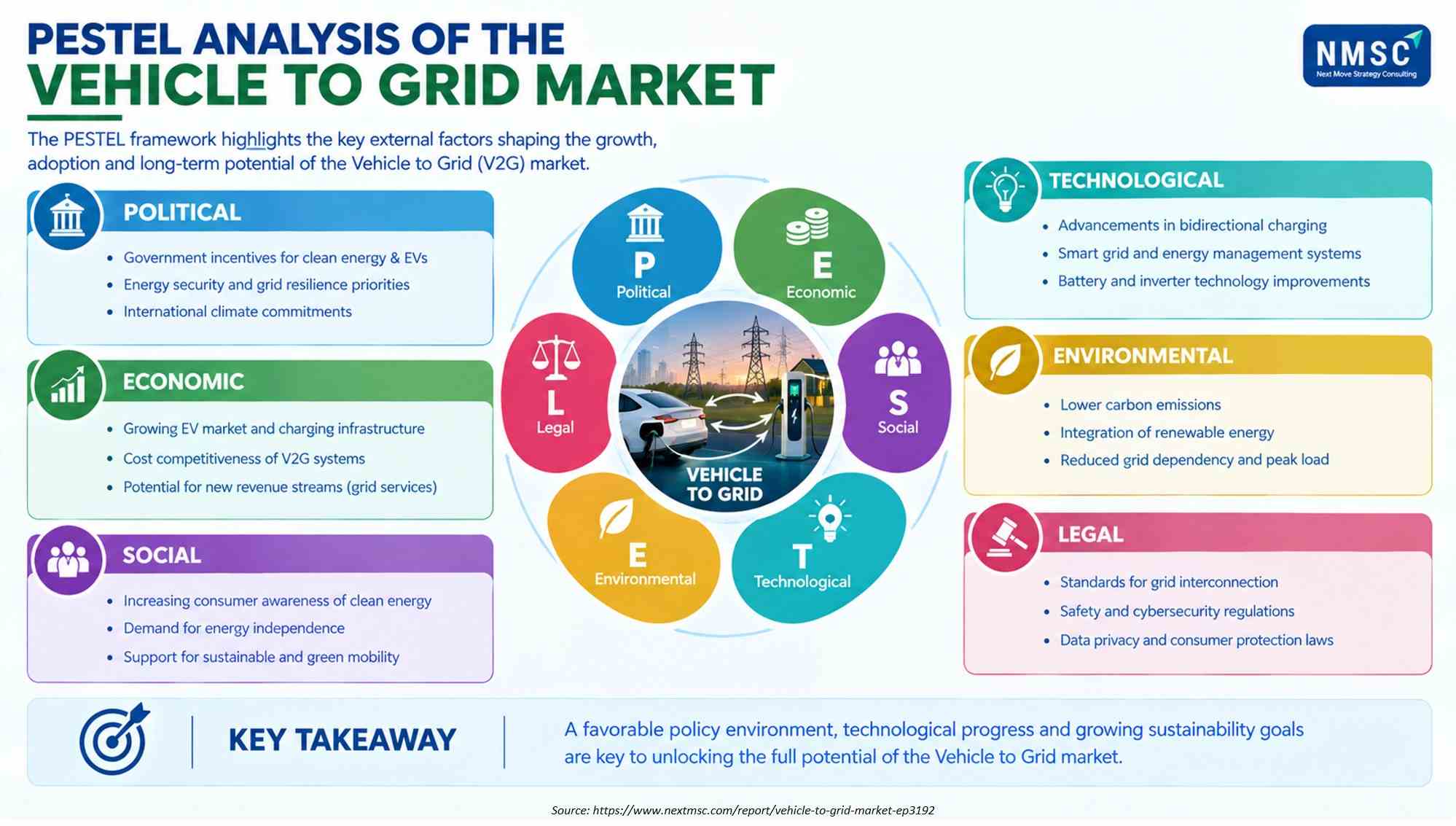
PESTEL Analysis of the Vehicle to Grid Market

PESTEL Analysis of the Vehicle to Grid Market

The Vehicle to Grid market is influenced by interconnected political, economic, social, technological, environmental, and legal factors. Government incentives, EV adoption, consumer interest in energy independence, advances in bidirectional charging, decarbonization goals, and evolving grid-interconnection standards are shaping market development. Together, these factors determine investment attractiveness, deployment feasibility, regulatory readiness, and the pace of V2G commercialization.

Key Benefits for Stakeholders

How Does This Report Benefit EV Charging Companies, Utilities, and Energy Service Providers?

EV charging companies, utilities, and energy service providers gain segmentation across offering, vehicle class, grid jurisdiction, deployment setting, buyer type, contracting channel, and use case. The report highlights Software as the fastest-growing offering segment at a 24.5% CAGR and Utilities and Grid Operators as the fastest-growing buyer type at 22.7% CAGR from 2026 to 2035, supporting investment decisions across a market projected to grow from USD 15.90 billion in 2025 to USD 168.46 billion by 2035.

How Does This Report Benefit Investors and Financial Analysts in the Vehicle to Grid Market?

Investors and financial analysts gain market size estimates, regional and segmental breakdowns, and growth comparisons supporting investment theses, comparable-company analysis, and portfolio decisions. The report identifies Asia-Pacific as growing at a 22.2% CAGR versus 8.6% for Latin America, helping investors assess geographic growth concentration and international expansion opportunities.

How Does This Report Benefit Automotive OEMs and Technology Developers in the Vehicle to Grid Market?

Automotive OEMs and technology developers gain insights into buyer, vehicle class, and deployment trends shaping V2G procurement through 2035. The report highlights Buses at a 23.3% CAGR, Fleet Operators at 21.2%, and Charging Hubs at approximately 25.0%, helping product and business development teams align V2G roadmaps and partnerships with the fastest-growing commercial opportunities.

Key Market Segments Evaluated

By Offering

  • Hardware
  • Software
  • Services
  • Turnkey Solutions

By Vehicle Class

  • Passenger EVs
  • Light Commercial EVs
  • Medium and Heavy Commercial EVs
  • Buses
  • Two-Wheelers
  • Other EVs

By Grid Jurisdiction

  • Transmission Grid
  • Distribution Grid

By Deployment Setting

  • Residential
  • Commercial and Retail
  • Industrial
  • Dedicated Fleet Depots
  • Public and Institutional
  • Charging Hubs

By Buyer Type

  • Residential Customers
  • Commercial and Industrial Enterprises
  • Fleet Operators
  • Charge Point Operators
  • Utilities and Grid Operators
  • Energy Retailers and Aggregators
  • Automotive OEMs

By Contracting Channel

  • Direct Contracting
  • OEM Bundling
  • Energy Partner Contracting
  • Installer Contracting
  • Distributor Contracting
  • Systems Integrator Contracting
  • Public Procurement

By Use Case

  • Power Quality Management
  • Voltage Regulation
  • Power Factor Management
  • Harmonic Mitigation
  • Grid Balancing
  • Frequency Regulation
  • Spinning Reserve
  • Fast Frequency Response
  • Peak Load Management
  • Peak Shaving
  • Distribution Congestion Management
  • Renewable Energy Integration
  • Renewable Energy Absorption
  • Renewable Energy Firming
  • Renewable Energy Matching
  • Resilience and Backup
  • Grid Connected Backup
  • Critical Load Support

Conclusion & Recommendations

The Vehicle to Grid market is entering a period of sustained high growth, rising from USD 31.16 billion in 2026 to USD 168.46 billion by 2035 at a 20.62% CAGR. Growth is supported by expanding EV fleets, rising demand for flexible electricity resources and distributed storage, and advancing regulations, interoperability standards, and aggregation models that enable scalable V2G revenue.

What Strategic Positioning Should Market Participants Pursue?

Hardware manufacturers should prioritize ISO 15118-20 certification and multi-OEM compatibility, while software providers should focus on AI-driven dispatch, battery health monitoring, and wholesale market settlement. Automotive OEMs should integrate V2G into vehicle platforms and energy apps that deliver immediate customer value. Asia-Pacific, particularly China, India, South Korea, and Japan, represents a key expansion opportunity for established V2G companies.

How Attractive Is the Vehicle to Grid Market for New Investment?

The Vehicle to Grid market offers an attractive investment profile through 2035, combining a 20.62% CAGR with structural demand from EV expansion, renewable integration, and grid flexibility requirements. Software, Buses, Utilities and Grid Operators, and Asia-Pacific are the fastest-growing vectors at 24.5%, 23.3%, 22.7%, and 22.2% CAGR, respectively. The market also offers USD 137.30 billion in absolute dollar opportunity between 2026 and 2035, alongside strong ESG alignment.

What Market Shifts and Key Risks Should Stakeholders Monitor?

The market is expected to shift from hardware-dominated revenue toward software and services as the bidirectional charger base expands. Key risks include slow ISO 15118-20 adoption, battery warranty restrictions, delays in wholesale market access, and high customer acquisition costs in residential V2G programs. Interoperability and customer-economics risks are expected to be greatest in Latin America and the Middle East, where regulatory and EV-market maturity remains lower.

What Are the Key Growth Pathways for the Vehicle to Grid Market?

Three pathways are expected to drive growth. Fleet depot V2G offers the fastest route to commercial scale through predictable vehicle availability and contracted grid services. Residential V2G through dynamic energy tariffs provides the largest long-term customer and battery pool, supported by bill savings. Virtual power plants using multi-site EV aggregation can generate high per-vehicle revenue but require advanced regulatory access, software, and market-participation infrastructure.

FAQs

About the Author

Mihul Sharma

Mihul Sharma

Mihul Sharma is Research Associate at Next Move Strategy Consulting, where he has covered technology, industrial, and healthcare markets for 3 years. His work applies structured business research, market analysis, and secondary-source review to assess market trends, competitive developments, and growth opportunities. He supports report development by fully synthesizing industry data, company information, and market signals into concise findings for strategy and investment-focused research teams.

About the Reviewer

Supradip Baul

Supradip Baul

Supradip Baul is an accomplished business consultant and strategist with over a decade of rich experience in market intelligence, strategy, technology, and business transformation. His work has included rigorous qualitative and quantitative analysis across multiple industries, helping clients shape investment decisions and long-term roadmaps. Earlier in his career, he was associated with Gartner, where he contributed to industry-leading reports and market share analyses. He has worked with leading global companies and holds an MBA with a dual specialization in Marketing and Finance.

Download Free Sample

Pratyush Kumar Das

PRATYUSH KUMAR DAS

Assistant Manager

Polycab India Limited

We would like to express our appreciation for the data and insights provided by nextmsc. We are very pleased with the quality and depth of the information, which has proven to be highly valuable and beneficial for our business decision-making.

Semih Kavaklioglu

SEMIH KAVAKLIOGLU

Co-Founder & Sales Manager

Decortie

I work a lot in the marketing industry and I know that research is an essential part of any campaign. I have used Market research reports for my own products and I found them to be very informative and well-researched. The team here produces insightful reports for a good price

Mohit Agarwal

MOHIT AGARWAL

Chief Manager

DryChem India Pvt. Ltd.

Next Move Strategy Consulting is an amazing team of consultants. We required a market study report for our investors on top priority and the team went above and beyond our expectations to deliver the same with ample supporting data within a short time span enabling us to secure the investments and keep our project timeline maintained. Their professionalism, attention to detail, and timely delivery of actionable recommendations have left a lasting impression on our organization.

Nishant Awate

NISHANT AWATE

Business Development Global Sales

Zehnder Group Deutschland GmbH

Our experience working with Next Move Strategy Consulting was positive. The team was responsive, professional, and open to incorporating our specific requirements throughout the project. The India AHU market study was comprehensive and well structured, covering market value and volume forecasts, product and application segments, and key industry trends. The inclusion of both AHU and residential MVHR market insights made the study particularly relevant for our strategic market assessment. Overall, the report provides a solid foundation for evaluating market potential, identifying priority segments, and supporting business-development decisions in India.

Melanie Samko

MELANIE SAMKO

Director of Marketing

TOSOH BIOSCIENCE, INC.

The information provided by NMSC is incredibly valuable, thank you so much for such a excellent work. I really appreciate it. I will make sure to reference all of it, in my summary document.

Custom Market Research Services

We will customize the research for you if the listed report does not fully match your requirements.

Get 30% Free Customization

Select License

This website uses cookies to ensure you get the best experience on our website. Learn more

✖