AI Grid Balancing Market Size, Share, Growth and Forecast by Offering (Software, Hardware, Services), Grid Domain (Transmission, Distribution, Behind the Meter, Microgrid), Flexibility Asset Type (Load Type, Electric Vehicles, Storage), Core Grid Function (Peak Load Management, Frequency Regulation, Congestion Management), Revenue Model, Buyer Type (Transmission System Operator, Distribution System Operator, Integrated Utility), and Distribution Channel - Global Analysis 2025 to 2035
Industry: Energy & Power | Publishing Date: July 7, 2026 | Last Updated: September 30, 2026 | No of Pages: N/A | No. of Tables: N/A | No. of Figures: N/A | Format: PDF | Report Code: EP4999
What Is the AI Grid Balancing Market Size?
The global AI Grid Balancing Market was valued at USD 4.85 billion in 2025 and is expected to reach USD 6.21 billion in 2026. Rising renewable energy penetration, escalating grid congestion events, growing deployment of distributed energy resources, and expanding utility investment in artificial intelligence powered grid orchestration platforms are projected to propel the market to USD 57.71 billion by 2035, advancing at a CAGR of 28.1% from 2026 to 2035. Additional momentum stems from accelerating electric vehicle charging loads, demand response program expansion, and regulatory mandates compelling grid operators to deploy automated flexibility management software across transmission and distribution networks.
|
Parameters |
Details |
|
Market Size in 2025 |
USD 4.85 Billion |
|
Market Size in 2026 |
USD 6.21 Billion |
|
Revenue Forecast in 2035 |
USD 57.71 Billion |
|
Growth Rate |
CAGR of 28.1% from 2026 to 2035 |
|
Analysis Period |
2025–2035 |
|
Base Year Considered |
2025 |
|
Forecast Period |
2026–2035 |
|
Market Size Estimation |
USD Billion |
|
Companies Profiled |
20 |
|
Countries Covered |
33 |
|
Market Share |
Top 10 |
AI Grid Balancing Market Overview
What Is the AI Grid Balancing Market?
The AI Grid Balancing Market comprises software platforms, hardware sensing and control devices, and managed services that apply artificial intelligence and machine learning to forecast, optimize, and dispatch grid flexibility resources in real time. The AI Grid Balancing Market enables transmission system operators, distribution utilities, aggregators, and commercial site owners to manage frequency regulation, peak load reduction, congestion relief, and renewable integration through automated decision engines that coordinate distributed energy resources, storage assets, electric vehicle charging, and demand response programs across increasingly complex and decentralised grid architectures.
How Has the AI Grid Balancing Market Evolved?
The AI Grid Balancing Market has progressed through several distinct technology phases. Early grid management relied on rule-based SCADA and basic demand response dispatch systems. The subsequent phase introduced distributed energy resource management systems capable of aggregating thousands of small assets. NMSC's analysis indicates that the current phase is defined by AI-native virtual power plant platforms, predictive forecasting engines, and digital twin technology that simulate grid behaviour under variable renewable generation, enabling operators to balance supply and demand with materially reduced manual intervention across transmission and distribution networks.
How Do Regulations Influence the AI Grid Balancing Market?
Regulatory frameworks are a decisive structural factor shaping the AI Grid Balancing Market. In the United States, Federal Energy Regulatory Commission Order 2222 requires grid operators to allow distributed energy resource aggregations to participate in wholesale electricity markets, directly expanding addressable demand for flexibility orchestration platforms. The European Union's Network Code on Demand Response and national grid codes across member states are compelling distribution system operators to adopt automated balancing software. These regulatory mandates are transforming AI-driven grid balancing from a discretionary technology investment into a compliance-linked infrastructure requirement for utilities and grid operators.
How Is Technology Adoption Expanding Across the AI Grid Balancing Market?
Technology adoption across the AI Grid Balancing Market is accelerating as utilities transition from pilot programs to enterprise-scale deployment. Through our market assessment, we observed that machine learning forecasting models, edge computing gateways, and cloud-native orchestration platforms are reducing the latency between grid signal detection and flexibility dispatch from minutes to seconds. Utilities are increasingly combining advanced distribution management systems with virtual power plant platforms to coordinate millions of distributed assets simultaneously, while growing electric vehicle fleets and behind-the-meter storage are expanding the pool of controllable flexibility resources available for AI-driven balancing programs.
|
Key Takeaways |
|
By offering, the Software segment dominated the AI Grid Balancing Market at USD 2.72 billion in 2025, representing the largest share of total revenue. Services is the fastest-growing offering segment at a CAGR of 33.3% from 2026 to 2035, advancing from USD 0.87 billion in 2025 to USD 11.54 billion by 2035, as utilities increasingly require implementation, managed flexibility, and advisory support for complex multi-vendor deployments. |
|
By grid domain, Distribution held the largest share at USD 2.23 billion in 2025, reflecting the concentration of distributed energy resources and behind-the-meter assets at the distribution level. Microgrid is the fastest-growing grid domain at a CAGR of 33.0% from 2026 to 2035, advancing from USD 0.53 billion in 2025 to USD 6.92 billion by 2035, driven by resilience-focused investment following extreme weather grid disruptions. |
|
By flexibility asset type, Load Type assets accounted for USD 1.65 billion in 2025, the largest revenue share within the AI Grid Balancing Market. Electric Vehicles represent the fastest-growing asset category at a CAGR of 36.3% from 2026 to 2035, advancing from USD 0.78 billion in 2025 to USD 12.70 billion by 2035, as managed EV charging and fleet electrification scale rapidly across major economies. |
|
By core grid function, Peak Load Management held the largest share at USD 1.07 billion in 2025. Renewable Integration and Smoothing is the fastest-growing grid function at a CAGR of 36.3% from 2026 to 2035, advancing from USD 0.78 billion in 2025 to USD 12.70 billion by 2035, as grid operators deploy AI forecasting to manage intermittent solar and wind output at scale. |
|
By revenue model, Recurring Subscription generated USD 1.84 billion in 2025, the largest share within the AI Grid Balancing Market. Technology Partner Marketplace is the fastest-growing distribution channel at a CAGR of 37.9% from 2026 to 2035, advancing from USD 0.48 billion in 2025 to USD 8.66 billion by 2035, reflecting growing ecosystem partnerships between software vendors and hardware OEMs. |
|
By buyer type, Integrated Utility accounted for USD 1.31 billion in 2025, the largest buyer category in the AI Grid Balancing Market. Aggregator is the fastest-growing buyer type at a CAGR of 35.7% from 2026 to 2035, advancing from USD 0.63 billion in 2025 to USD 9.81 billion by 2035, as independent aggregators scale flexibility portfolios across multiple utility territories. |
|
North America led the AI Grid Balancing Market at USD 1.84 billion in 2025, projected to reach USD 18.47 billion by 2035 at a CAGR of 29.2%, supported by FERC Order 2222 implementation and extensive utility AI pilot-to-scale programs. Middle East and Africa is the fastest-growing overall region at a CAGR of 36.3%, while Asia-Pacific is the fastest-growing major region at 35.6%, driven by renewable capacity expansion across China and India. |
|
The United States is the single largest country market in the AI Grid Balancing Market, representing the majority of North American revenue in 2025, driven by FERC Order 2222 compliance deadlines and the highest concentration of utility-scale virtual power plant deployments. China is the fastest-growing national market within Asia-Pacific, propelled by record renewable capacity additions and national grid modernization investment under its latest five-year energy plan. |
Ecosystem Analysis of the AI Grid Balancing Market
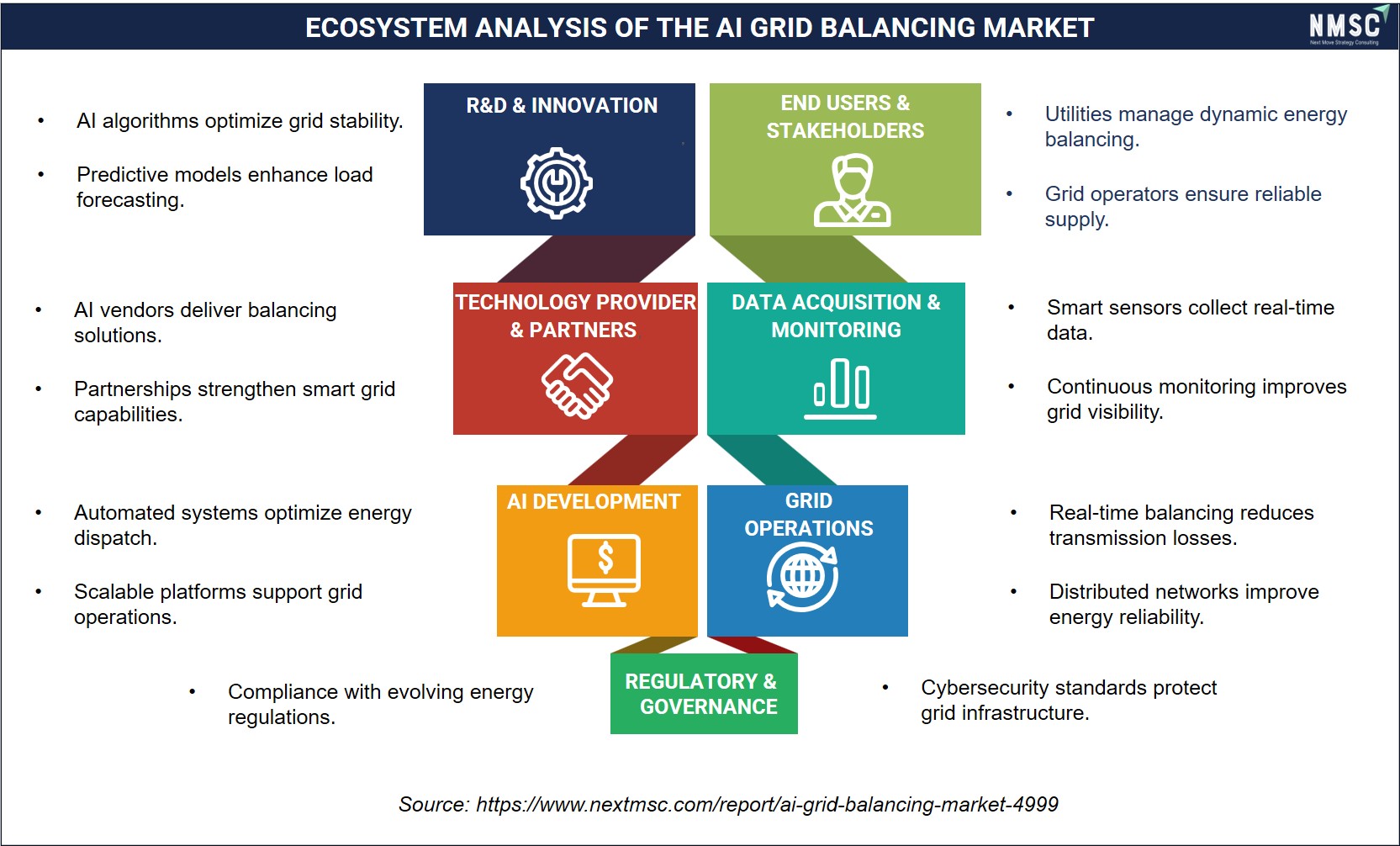
The above framework presents an ecosystem analysis of the AI Grid Balancing Market across R&D, AI development, data acquisition, grid operations, regulatory governance, and end-user stakeholders. We observed that utilities manage dynamic energy balancing while grid operators ensure reliable supply, shaping customer and user dynamics. Technology providers and partners support AI development and grid operations, with data acquisition and monitoring enabling real-time energy flow optimization. Further, regulatory governance enforces grid reliability standards, energy compliance, and environmental policies, collectively fostering innovation and operational resilience in this evolving energy management landscape.
Key Emerging Trends in the AI Grid Balancing Market
How Is the Rise of Virtual Power Plant Platforms Transforming the AI Grid Balancing Market?
Virtual power plant platforms are fundamentally reshaping the AI Grid Balancing Market by aggregating thousands of distributed solar, storage, and demand response assets into a single dispatchable resource. Based on research conducted by NMSC, we found that Tesla's Virtual Power Plant program in California and Texas coordinates residential Powerwall batteries to deliver grid services during peak demand events, with the California Independent System Operator recognising aggregated battery dispatch as a qualified capacity resource. This convergence of distributed hardware and centralized AI orchestration is compelling utilities to redesign tariff structures and accelerating investment in aggregation-grade software platforms.
How Is Real-Time Forecasting Reshaping Renewable Integration Within the AI Grid Balancing Market?
AI-powered real-time forecasting is becoming foundational to renewable integration strategies across the AI Grid Balancing Market. Through our market assessment, we observed that grid operators are deploying machine learning models that ingest satellite imagery, weather telemetry, and historical generation data to predict solar and wind output with materially improved accuracy compared to traditional statistical methods. The U.S. Department of Energy's National Renewable Energy Laboratory has published research confirming that improved short-term forecasting reduces the reserve capacity utilities must hold, directly lowering operational costs while enabling higher renewable penetration without compromising grid reliability standards.
How Is Electric Vehicle Fleet Integration Creating New Demand Within the AI Grid Balancing Market?
The rapid scaling of electric vehicle charging infrastructure is creating a structurally significant new flexibility resource category within the AI Grid Balancing Market. NMSC's analysis indicates that managed charging platforms are coordinating EV charging schedules to avoid grid congestion during peak hours while enabling vehicle-to-grid discharge during periods of high demand. The U.S. Department of Transportation's Federal Highway Administration has documented expanding electric vehicle registrations nationally, creating a growing pool of controllable load that utilities and aggregators are increasingly incorporating into demand response and frequency regulation programs.
How Are Digital Twin Technologies Enhancing Grid Resilience Planning in the AI Grid Balancing Market?
Digital twin technology, which creates dynamic virtual replicas of physical grid infrastructure, is gaining significant traction within the AI Grid Balancing Market as utilities seek to simulate grid behaviour under extreme weather and high-renewable scenarios before committing capital to physical upgrades. Our findings suggest that grid operators are using digital twin simulations to test contingency scenarios, optimize asset placement, and validate AI dispatch algorithms in a risk-free virtual environment. This trend is reducing field deployment errors and accelerating the pace at which utilities can safely scale AI-driven balancing programs across increasingly complex distribution networks.
What Are the Key Market Drivers, Breakthroughs, and Investment Opportunities that Will Shape the AI Grid Balancing Market in the Next Decade?
|
Drivers / Trends / Restraints |
(+/-) % Impact on CAGR Forecast |
Geographic Relevance |
Impact Timeline |
|
Rising renewable energy penetration requiring AI-based balancing |
+3.2% |
Global (led by North America, APAC, Europe) |
2025–2035 |
|
FERC Order 2222 and equivalent regulatory mandates for DER market access |
+2.4% |
North America, Europe |
2025–2030 |
|
Electric vehicle fleet expansion creating new flexibility resources |
+2.6% |
North America, Europe, China |
2026–2035 |
|
Grid resilience investment following extreme weather disruptions |
+1.8% |
North America, Europe, APAC |
2025–2032 |
|
Virtual power plant commercialization and aggregator market growth |
+2.1% |
North America, Europe, Australia |
2026–2035 |
|
Declining battery storage costs expanding behind-the-meter flexibility |
+1.6% |
Global |
2025–2033 |
|
Interoperability and legacy grid infrastructure integration complexity |
-1.4% |
Global, more acute in MEA, LATAM |
Ongoing |
|
Cybersecurity risk in distributed AI-controlled grid assets |
-0.9% |
Global |
Ongoing |
|
High upfront capital cost for utility-scale AI platform deployment |
-0.7% |
Emerging markets, smaller utilities globally |
2025–2029 |
|
Cross-border grid interconnection and market design opportunities |
+1.5% |
Europe, Southeast Asia, GCC |
2027–2035 |
What Are the Drivers of the AI Grid Balancing Market Growth?
How Is Rising Renewable Energy Penetration Driving Demand in the AI Grid Balancing Market?
Expanding renewable energy capacity is the primary structural catalyst behind sustained investment in the AI Grid Balancing Market. Based on our market evaluation, we noticed that intermittent solar and wind generation introduces variability that traditional grid management tools cannot resolve without automated forecasting and dispatch capability. The U.S. Energy Information Administration reports that renewable sources accounted for a growing share of total U.S. electricity generation in 2024, with continued capacity additions projected through the decade, directly expanding the addressable market for AI-driven forecasting, balancing, and renewable smoothing software across transmission and distribution networks.
How Are Regulatory Mandates for Distributed Energy Resource Market Access Expanding the AI Grid Balancing Market?
Regulatory mandates requiring smart grid operators to integrate distributed energy resources into wholesale and retail electricity markets are creating durable structural demand for AI Grid Balancing Market platforms. The Federal Energy Regulatory Commission's Order 2222, finalized in 2020, requires regional transmission organizations to establish participation models enabling aggregated distributed resources to compete in capacity, energy, and ancillary service markets. Our assessment indicates that this single regulatory action has catalyzed aggregator platform investment across multiple U.S. regional transmission organizations, with equivalent demand response network codes advancing across the European Union's member states.
How Is Electric Vehicle Fleet Growth Expanding Flexibility Resource Pools Within the AI Grid Balancing Market?
The rapid scaling of electric vehicle adoption is expanding the pool of controllable flexibility resources available to grid operators and aggregators within the AI Grid Balancing Market. From our research, we found that the U.S. Department of Energy's Alternative Fuels Data Center has documented continued growth in registered electric vehicles nationally, with managed charging and vehicle-to-grid pilot programs expanding across multiple investor-owned utility territories. This growing fleet of controllable load and storage capacity is directly increasing demand for AI-powered managed charging platforms capable of coordinating thousands of vehicles simultaneously without compromising grid stability.
What Are the Growth Inhibitors of the AI Grid Balancing Market?
How Does Legacy Grid Infrastructure Complexity Constrain AI Grid Balancing Market Adoption?
The technical complexity of integrating AI-driven balancing platforms with aging grid infrastructure represents a significant constraint on the AI Grid Balancing Market, particularly in regions with limited digital substation penetration. Many distribution networks still rely on decades-old SCADA systems lacking the communication protocols required for real-time AI dispatch. Our analysis shows that the U.S. Government Accountability Office has documented persistent grid modernization funding gaps across smaller utility territories, confirming that infrastructure interoperability challenges meaningfully extend deployment timelines and increase total implementation costs for AI grid balancing platforms.
How Does Cybersecurity Risk in Distributed AI-Controlled Assets Limit Market Penetration?
Cybersecurity vulnerabilities inherent in distributed, internet-connected grid control systems represent a meaningful restraint on the AI Grid Balancing Market, as utilities weigh operational efficiency gains against expanded attack surface risk. Through our market assessment, we observed that the U.S. Cybersecurity and Infrastructure Security Agency has issued multiple advisories regarding vulnerabilities in distributed energy resource management systems and grid edge devices. These documented risks are compelling utilities to extend security validation timelines before deploying AI-driven dispatch software at scale, particularly for systems controlling critical transmission-level balancing functions.
What Are the Growth Opportunities in the AI Grid Balancing Market?
How Does Cross-Border Grid Interconnection Create a Structural Opportunity in the AI Grid Balancing Market?
Expanding cross-border grid interconnection projects across Europe and Southeast Asia represent a significant opportunity for AI Grid Balancing Market vendors capable of coordinating flexibility resources across multiple jurisdictions and market designs. The European Network of Transmission System Operators for Electricity coordinates cross-border balancing markets requiring sophisticated multi-country forecasting and settlement software. NMSC's research found that this regulatory architecture is creating demand for AI platforms capable of operating within harmonized European balancing market rules, representing a differentiated and defensible opportunity for vendors with proven multi-jurisdictional compliance capability.
How Does Declining Battery Storage Cost Create a High-Growth Opportunity for AI Grid Balancing Market Vendors?
Continuing reductions in battery storage costs are expanding the economic viability of behind-the-meter and grid-scale storage deployments, directly enlarging the addressable opportunity for AI Grid Balancing Market vendors. The U.S. Department of Energy's Office of Electricity has documented sustained battery cost reduction trends supporting expanded storage deployment nationally. Based on NMSC's research, we found that vendors offering optimization software capable of co-dispatching storage alongside solar generation and demand response are positioned to capture disproportionate value as utilities scale hybrid renewable-storage-flexibility portfolios across their service territories.
How Does Aggregator Market Expansion Represent a Transformative Commercial Opportunity in the AI Grid Balancing Market?
The maturation of independent aggregator business models is creating a transformative commercial opportunity within the AI Grid Balancing Market, as aggregators scale flexibility portfolios across multiple utility territories without owning underlying generation or storage assets. Through NMSC's assessment, we found that aggregators are increasingly procuring white-label AI dispatch and bid optimization platforms rather than building proprietary technology, creating durable recurring software revenue opportunities. Vendors offering modular, multi-utility compatible platforms are best positioned to capture this expanding intermediary market segment as aggregator participation in wholesale markets continues to scale.
How Is the AI Grid Balancing Market Segmented in This Report, and What Are the Key Insights from the Segmentation Analysis?
How Do Software, Hardware, and Services Offerings Define Revenue Distribution in the AI Grid Balancing Market?
|
Offering Segment |
2025 (USD Bn) |
2035 (USD Bn) |
CAGR (%) |
|
Software |
2.72 |
35.78 |
33.2% |
|
Hardware |
1.26 |
10.39 |
26.4% |
|
Services |
0.87 |
11.54 |
33.3% |
Based on our market evaluation, we assessed that the AI Grid Balancing Market is segmented by offering into Software, Hardware, and Services. The Software segment, which spans Grid Operations and Control, Flexibility and Aggregation, Optimization, Analytics and AI, and other platform categories, dominates the market at USD 2.72 billion in 2025 due to growing utility demand for advanced distribution management, virtual power plant orchestration, and predictive forecasting tools. Hardware, encompassing grid sensors and edge gateways, supports the physical data acquisition layer underpinning software-driven decisions. Services is the fastest-growing offering category as utilities increasingly require implementation, managed flexibility operations, and regulatory advisory support for complex multi-vendor deployments.
Which Grid Domains Generate the Most Value in the AI Grid Balancing Market?
|
Grid Domain |
2025 (USD Bn) |
2035 (USD Bn) |
CAGR (%) |
|
Transmission |
1.07 |
10.39 |
28.7% |
|
Distribution |
2.23 |
28.86 |
32.9% |
|
Behind the Meter |
1.02 |
11.54 |
30.9% |
|
Microgrid |
0.53 |
6.92 |
33.0% |
Our assessment indicates that the AI Grid Balancing Market grid domain segmentation spans Transmission, Distribution, Behind the Meter, and Microgrid categories. Distribution dominates at USD 2.23 billion in 2025, reflecting the concentration of distributed energy resources, rooftop solar, and behind-the-meter storage assets that require coordinated AI-driven balancing at the distribution network level. Transmission-level balancing remains essential for frequency regulation and bulk renewable integration. Microgrid is the fastest-growing domain at a CAGR of 33.0% from 2026 to 2035, as resilience-focused investment following extreme weather grid disruptions accelerates microgrid deployment across critical infrastructure, military installations, and remote communities.
Which Flexibility Asset Types Are Driving the Most Demand in the AI Grid Balancing Market?
|
Flexibility Asset Type |
2025 (USD Bn) |
2035 (USD Bn) |
CAGR (%) |
|
Load Type |
1.65 |
15.00 |
27.8% |
|
Electric Vehicles |
0.78 |
12.70 |
36.3% |
|
Storage |
1.16 |
16.16 |
34.0% |
|
Generation |
0.97 |
10.96 |
30.9% |
|
Other Flexibility Assets |
0.29 |
2.89 |
29.1% |
From our research, we found that the AI Grid Balancing Market flexibility asset landscape is segmented into Load Type, Electric Vehicles, Storage, Generation, and Other Flexibility Assets. Load Type assets, spanning industrial, HVAC, commercial, residential, and water heating loads, hold the largest share at USD 1.65 billion in 2025 due to the scale and maturity of demand response program enrollment across these categories. Storage is the second-largest and fastest-maturing category as battery costs decline. Electric Vehicles represent the fastest-growing asset type at a CAGR of 36.3% from 2026 to 2035, as managed charging and vehicle-to-grid programs scale rapidly across North America, Europe, and China.
How Do Core Grid Functions Shape Platform Demand in the AI Grid Balancing Market?
|
Core Grid Function |
2025 (USD Bn) |
2035 (USD Bn) |
CAGR (%) |
|
Peak Load Management |
1.07 |
10.39 |
28.7% |
|
Frequency Regulation |
0.87 |
9.23 |
30.0% |
|
Congestion Management |
0.63 |
6.93 |
30.5% |
|
Voltage Support |
0.53 |
5.77 |
30.4% |
|
Renewable Integration and Smoothing |
0.78 |
12.70 |
36.3% |
|
Reserve Capacity Provision |
0.48 |
6.35 |
33.2% |
|
System Restoration and Resilience |
0.29 |
4.04 |
34.0% |
|
Other Grid Functions |
0.20 |
2.30 |
31.2% |
Based on NMSC's research, we found that the AI Grid Balancing Market core grid function segmentation spans Peak Load Management, Frequency Regulation, Congestion Management, Voltage Support, Renewable Integration and Smoothing, Reserve Capacity Provision, System Restoration and Resilience, and Other Grid Functions. Peak Load Management leads at USD 1.07 billion in 2025, reflecting its foundational role in utility cost management. Frequency Regulation holds the second position given its mission-critical role in grid stability. Renewable Integration and Smoothing is the fastest-growing function at a CAGR of 36.3% from 2026 to 2035, as grid operators deploy AI forecasting and storage dispatch to manage intermittent solar and wind output at increasing scale.
How Do Revenue Models Reflect the Commercial Evolution of the AI Grid Balancing Market?
|
Revenue Model |
2025 (USD Bn) |
2035 (USD Bn) |
CAGR (%) |
|
Recurring Subscription |
1.84 |
24.24 |
33.2% |
|
Usage-Based |
1.07 |
15.58 |
34.7% |
|
Project-Based |
0.97 |
6.93 |
24.4% |
|
Performance-Based |
0.63 |
8.08 |
32.8% |
|
Transaction-Based |
0.34 |
2.88 |
26.8% |
In our analysis of utility procurement and vendor commercialisation trends, we assessed that the AI Grid Balancing Market is segmented by revenue model into Recurring Subscription, Usage-Based, Project-Based, Performance-Based, and Transaction-Based structures. Recurring Subscription, including SaaS and platform access fees, dominates at USD 1.84 billion in 2025 as utilities prefer predictable multi-year software costs aligned with regulatory rate case planning. Usage-Based pricing, tied to per-device or per-megawatt-managed fees, is the fastest-growing model at a CAGR of 34.7% from 2026 to 2035, as aggregators and commercial buyers prefer cost structures that scale directly with the size of managed flexibility portfolios.
Which Buyer Types Are Driving Purchasing Decisions in the AI Grid Balancing Market?
|
Buyer Type |
2025 (USD Bn) |
2035 (USD Bn) |
CAGR (%) |
|
Transmission System Operator |
0.58 |
5.77 |
29.1% |
|
Distribution System Operator |
0.97 |
10.96 |
30.9% |
|
Integrated Utility |
1.31 |
15.00 |
31.1% |
|
Energy Retailer |
0.53 |
6.35 |
31.8% |
|
Aggregator |
0.63 |
9.81 |
35.7% |
|
Commercial and Industrial Site Owner |
0.48 |
6.35 |
33.2% |
|
Residential Program Operator |
0.19 |
2.31 |
32.0% |
|
Developer and Original Equipment Manufacturer |
0.16 |
1.16 |
24.6% |
Based on our analysis of utility procurement structures, we noticed that the AI Grid Balancing Market buyer landscape spans Transmission System Operators, Distribution System Operators, Integrated Utilities, Energy Retailers, Aggregators, Commercial and Industrial Site Owners, Residential Program Operators, and Developers and Original Equipment Manufacturers. Integrated Utilities dominate at USD 1.31 billion in 2025 due to their direct accountability for both transmission and distribution reliability outcomes. Aggregator is the fastest-growing buyer type at a CAGR of 35.7% from 2026 to 2035, as independent aggregators scale flexibility portfolios across multiple utility territories withoutowning underlying generation or storage infrastructure themselves.
How Are Distribution Channels Evolving in the AI Grid Balancing Market?
|
Distribution Channel |
2025 (USD Bn) |
2035 (USD Bn) |
CAGR (%) |
|
Direct Enterprise Sales |
1.65 |
17.31 |
29.8% |
|
Utility Procurement |
1.36 |
13.85 |
29.4% |
|
System Integrator and Consultant |
0.87 |
10.39 |
31.7% |
|
Technology Partner Marketplace |
0.48 |
8.66 |
37.9% |
|
Original Equipment Manufacturer Embedded |
0.34 |
4.62 |
33.6% |
|
API Marketplace |
0.15 |
2.88 |
38.9% |
We noticed that the AI Grid Balancing Market is segmented by distribution channel into Direct Enterprise Sales, Utility Procurement, System Integrator and Consultant, Technology Partner Marketplace, Original Equipment Manufacturer Embedded, and API Marketplace channels. Direct Enterprise Sales leads at USD 1.65 billion in 2025, reflecting utility preference for direct vendor relationships on mission-critical grid infrastructure. Utility Procurement, governed by formal regulatory tender processes, represents the second-largest channel. Technology Partner Marketplace and API Marketplace are the fastest-growing channels at CAGRs of 37.9% and 38.9%, respectively, as software ecosystem partnerships and embedded API integrations accelerate go-to-market velocity for emerging AI grid balancing vendors.
PESTEL Analysis of the AI Grid Balancing Market
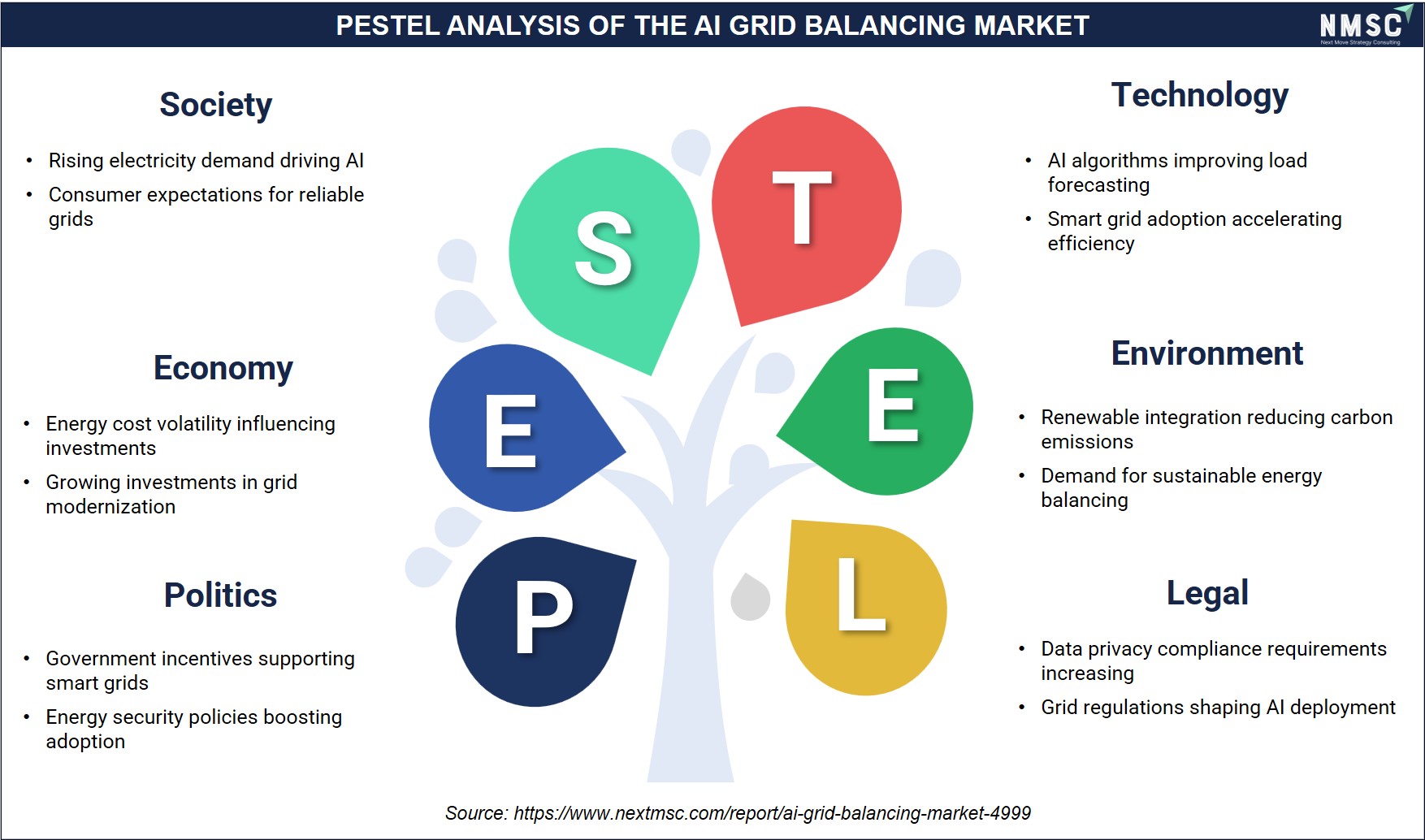
The above infographic presents a PESTEL analysis of the AI Grid Balancing Market, highlighting the external factors influencing market evolution and investment potential. It evaluates political, economic, social, technological, environmental, and legal dimensions that shape adoption patterns and regulatory priorities. The framework also underscores how renewable energy integration, grid modernisation initiatives, decarbonization targets, and advances in AI-driven forecasting are accelerating demand for intelligent grid balancing solutions worldwide.
Regional Outlook
Geographic Performance Snapshot
|
Region |
2025 (USD Bn) |
2035 (USD Bn) |
CAGR (%) |
Key Driver |
|
North America |
1.84 |
18.47 |
29.2% |
FERC Order 2222, utility AI scale-up |
|
Europe |
1.36 |
13.85 |
29.4% |
EU demand response network codes |
|
Asia-Pacific |
0.97 |
15.00 |
35.6% |
China and India renewable capacity growth |
|
Middle East and Africa |
0.39 |
6.35 |
36.3% |
Gulf grid modernization, Vision programs |
|
Latin America |
0.29 |
4.04 |
34.0% |
Brazil renewable integration, grid digitization |
North America AI Grid Balancing Market
North America is the dominant region in the AI Grid Balancing Market, generating USD 1.84 billion in 2025 and forecast to reach USD 18.47 billion by 2035 at a CAGR of 29.2%. The region benefits from FERC Order 2222 implementation, which mandates distributed energy resource market access across regional transmission organizations. Strong utility AI investment, mature aggregator business models, and the highest concentration of virtual power plant deployments globally underpin sustained market leadership. The U.S. Department of Energy's Grid Deployment Office further accelerates public and private grid modernization investment across the region.
U.S. AI Grid Balancing Market
Based on our engagements across the North American utility sector, we observed that the United States represents the substantial majority of North American AI Grid Balancing Market revenue in 2025. The U.S. benefits from FERC Order 2222 compliance deadlines, the largest concentration of regional transmission organizations, and the headquarters of leading aggregator and virtual power plant platform vendors. The U.S. Department of Energy's Grid Resilience and Innovation Partnerships program is funding utility-scale AI grid balancing pilots, while the California Independent System Operator's distributed energy resource provider framework continues to validate aggregated dispatch as a qualified capacity resource.
Canada AI Grid Balancing Market
Based on our engagements with Canadian utilities, Canada represents a meaningful share of North American AI Grid Balancing Market revenue, supported by provincial grid modernization mandates and growing renewable integration in Ontario and Alberta. Canadian utilities are deploying demand response and distributed energy resource management platforms to manage rising electric vehicle adoption and seasonal peak demand. The federal government's Smart Renewables and Electrification Pathways Program is funding grid flexibility infrastructure investment, while provincial regulators are advancing market design reforms that support third-party aggregator participation in balancing services.
Mexico AI Grid Balancing Market
Through our analysis, Mexico is an emerging AI Grid Balancing Market within North America, supported by expanding renewable generation capacity and the national electricity system operator's ongoing grid modernization initiatives. Mexico's growing industrial sector and manufacturing nearshoring wave are creating demand for demand response and load management platforms among large commercial and industrial energy consumers. CENACE, Mexico's national grid operator, continues to evaluate market reforms supporting distributed energy resource integration, while declining solar costs are accelerating distributed generation deployment that requires coordinated AI-driven balancing across the national transmission network.
Europe AI Grid Balancing Market
Europe is the second-largest region in the AI Grid Balancing Market, contributing USD 1.36 billion in 2025 and forecast to reach USD 13.85 billion by 2035 at a CAGR of 29.4%. The region's regulatory environment, anchored by the European Network of Transmission System Operators for Electricity balancing market harmonization rules and national demand response network codes, is a primary structural growth driver. Strong renewable capacity additions across Germany, Spain, and the Nordics are creating sustained demand for AI-driven forecasting and flexibility orchestration platforms across both transmission and distribution network levels.
UK AI Grid Balancing Market
From our assessment, the United Kingdom is one of Europe's largest individual AI Grid Balancing Markets, supported by National Grid Electricity System Operator's Balancing Mechanism reforms and growing battery storage capacity. Ofgem's Targeted Charging Review and flexibility market reforms are creating structured demand for AI dispatch platforms among aggregators and distribution network operators. The UK's accelerating offshore wind capacity additions are increasing the need for sophisticated forecasting and balancing software, while National Grid ESO's Open Balancing Platform initiative is expanding third-party access to balancing market participation.
Germany AI Grid Balancing Market
According to evaluation, Germany is among the largest European AI Grid Balancing Market, driven by its leading renewable generation capacity and the federal government's Energiewende energy transition program. German transmission system operators including 50Hertz and Amprion, are investing heavily in AI-driven congestion management software to manage growing north-south power flow imbalances caused by offshore wind generation. The Bundesnetzagentur's redispatch reform regulations are compelling grid operators to adopt automated balancing tools, while Germany's expanding battery storage and electric vehicle fleet are creating new flexibility resource pools for AI coordination.
France AI Grid Balancing Market
Through our analysis, France represents a significant European AI Grid Balancing Market, distinguished by RTE's transmission-level investment in AI forecasting tools to manage nuclear baseload alongside growing renewable capacity. France's national energy strategy is directing investment toward grid flexibility infrastructure to support electric vehicle adoption targets. The Commission de Regulation de l'Energie continues to advance market reforms enabling aggregator participation in balancing services, while RTE's EcoWatt platform demonstrates growing French utility appetite for AI-driven demand forecasting and consumer engagement tools.
Italy AI Grid Balancing Market
In our assessment, Italy is a growing European AI Grid Balancing Market, with Terna, the national transmission operator, investing in AI-based congestion management to address growing solar capacity concentrated in southern regions. Italy's Piano Nazionale di Ripresa e Resilienza has allocated substantial funding toward grid digitization and storage deployment. The Autorita di Regolazione per Energia Reti e Ambiente continues to advance regulatory reforms supporting distributed energy resource aggregation, while Italy's expanding rooftop solar capacity is increasing the structural need for distribution-level AI balancing platforms.
Spain AI Grid Balancing Market
Based on our evaluation, Spain demonstrates strong momentum in the AI Grid Balancing Market, driven by leading European solar and wind capacity additions and Red Electrica's investment in advanced grid forecasting tools. Spain's National Integrated Energy and Climate Plan targets substantial renewable capacity expansion, directly increasing the need for AI-driven balancing software to manage variable generation. The Comision Nacional de los Mercados y la Competencia continues to evaluate market reforms supporting demand response aggregation, while Spain's growing battery storage pipeline is expanding flexibility resource availability for grid operators.
Sweden AI Grid Balancing Market
Sweden demonstrates high AI Grid Balancing Market maturity within the Nordic region, supported by Svenska Kraftnat's investment in frequency regulation technology to manage growing wind capacity in northern Sweden. Swedish industrial electrification, including green steel production, is creating substantial new flexible load requiring AI-coordinated balancing. The Swedish Energy Agency continues to fund grid flexibility research and pilot programs. Sweden's strong hydropower flexibility combined with expanding wind capacity creates a distinctive balancing requirement that favours sophisticated multi-source AI forecasting and dispatch platforms across the national transmission network.
Denmark AI Grid Balancing Market
Through our analysis, Denmark is among the most advanced European AI Grid Balancing Markets given its position as a global leader in wind power penetration. Energinet, Denmark's transmission system operator, has pioneered AI-based balancing tools necessary to manage periods when wind generation exceeds total national demand. Denmark's Climate Act targets continued renewable expansion, sustaining structural demand for advanced forecasting software. The Danish Energy Agency's flexibility market reforms continue to expand third-party aggregator access, while Denmark's district heating sector increasingly integrates with electricity balancing through sector coupling initiatives.
Finland AI Grid Balancing Market
Finland's AI Grid Balancing Market is characterised by Fingrid's substantial investment in frequency regulation services to support growing wind capacity and the Olkiluoto nuclear facility's variable output management. Finland's national energy and climate strategy targets carbon neutrality, driving continued renewable capacity expansion that requires sophisticated AI balancing tools. The Finnish Energy Authority continues to advance demand response market reforms. Finland's cold climate creates significant heating-related flexible load potential, with heat pump electrification creating new opportunities for AI-coordinated demand response programs across the national grid.
Netherlands AI Grid Balancing Market
From our assessment, the Netherlands is a critical AI Grid Balancing Market hub within Europe, with TenneT investing significantly in AI-driven congestion management to address growing grid bottlenecks from solar and offshore wind capacity. The Dutch Authority for Consumers and Markets continues to advance market reforms enabling flexibility aggregation. The Netherlands' dense industrial base and high electric vehicle adoption rate are creating substantial flexible load potential. TenneT's congestion management programs increasingly rely on AI forecasting to allocate limited grid capacity among competing generation and demand resources across the country.
Rest of Europe AI Grid Balancing Market
Rest of Europe, comprising Poland, Belgium, Switzerland, Austria, Portugal, Czech Republic, and other European nations, collectively represents a growing portion of the European AI Grid Balancing Market. Poland's coal-to-renewable transition is creating new balancing requirements as wind and solar capacity expand rapidly. Belgium's Elia Group continues to invest in cross-border balancing coordination given the country's dense interconnection with neighbouring grids. Switzerland's hydropower-dominant grid increasingly integrates AI forecasting to optimize storage dispatch alongside growing solar capacity, while Austria and Portugal are advancing national grid digitization programs supporting distributed energy resource integration.
Asia-Pacific AI Grid Balancing Market
Asia-Pacific is the fastest-growing major region in the AI Grid Balancing Market, advancing from USD 0.97 billion in 2025 to an estimated USD 15.00 billion by 2035 at a CAGR of 35.6%. The region's growth is propelled by China's record renewable capacity additions, India's national grid modernisation programs, and the advanced digital grid infrastructure of Japan, South Korea, and Australia. Government-directed clean energy targets across China, Japan, and South Korea are creating sustained structural demand for AI-driven grid balancing platforms capable of managing rapidly scaling intermittent generation across the region.
China AI Grid Balancing Market
China is the largest single AI Grid Balancing Market within Asia-Pacific, driven by record annual renewable capacity additions and the State Grid Corporation of China's substantial investment in AI-based dispatch and forecasting systems. China's National Energy Administration has set ambitious renewable capacity targets under its current five-year energy plan, directly expanding the need for automated balancing software across the world's largest electricity grid. Domestic technology providers are scaling AI grid management platforms rapidly, supported by the National Development and Reform Commission's policies promoting smart grid digitization and virtual power plant pilot programs across multiple provinces.
India AI Grid Balancing Market
India is a rapidly scaling AI Grid Balancing Market within Asia-Pacific, propelled by the Ministry of Power's Green Energy Corridor initiative and the Central Electricity Authority's National Electricity Plan targeting substantial renewable capacity expansion. The Power System Operation Corporation Limited oversees national load dispatch and is increasingly deploying AI-based renewable forecasting tools to manage growing solar and wind generation. The Ministry of New and Renewable Energy continues to advance policies supporting distributed solar and storage deployment, creating expanding demand for AI grid balancing platforms across India's regional and national transmission networks.
Japan AI Grid Balancing Market
In our evaluation, Japan is a mature AI Grid Balancing Market within Asia-Pacific, supported by the Organization for Cross-regional Coordination of Transmission Operators' investment in AI-driven frequency regulation following the country's post-Fukushima energy transition. Japan's Ministry of Economy, Trade and Industry continues to advance feed-in-tariff and feed-in-premium reforms supporting renewable integration. Japanese utilities including TEPCO and Kansai Electric Power are deploying virtual power plant pilot programs to aggregate residential solar and storage assets, supported by national policy incentives promoting distributed energy resource market participation across the country's regional grids.
South Korea AI Grid Balancing Market
From our assessment, South Korea demonstrates growing AI Grid Balancing Market maturity, supported by the Korea Power Exchange's investment in AI-based renewable forecasting and the Ministry of Trade, Industry and Energy's Renewable Energy 3020 policy framework. Korea Electric Power Corporation continues to modernize grid infrastructure to accommodate growing offshore wind and solar capacity. The Korean government's virtual power plant pilot program is expanding aggregator participation in balancing markets, while South Korea's advanced semiconductor manufacturing sector creates significant industrial demand response potential for AI-coordinated load management programs.
Taiwan AI Grid Balancing Market
Taiwan's AI Grid Balancing Market is shaped by Taiwan Power Company's investment in AI-based grid management to support the island's offshore wind expansion and semiconductor manufacturing electricity demand. The Bureau of Energy under the Ministry of Economic Affairs continues to advance renewable energy development goals supporting structural grid flexibility investment. Taiwan's concentrated semiconductor manufacturing base, anchored by companies requiring uninterrupted power supply, creates significant demand for AI-driven demand response and frequency regulation services capable of managing the island's growing renewable capacity without compromising industrial reliability requirements.
Indonesia AI Grid Balancing Market
Indonesia is an emerging AI Grid Balancing Market in Southeast Asia, supported by PLN's National Electricity Supply Business Plan targeting expanded renewable capacity across the archipelago's diverse grid infrastructure. The Ministry of Energy and Mineral Resources continues to advance policies supporting distributed generation and microgrid deployment across Indonesia's many islands, where centralized grid balancing faces unique geographic challenges. Indonesia's growing industrial electrification and PLN's smart grid roadmap are creating early-stage but structurally significant demand for AI grid balancing platforms suited to archipelagic and microgrid-intensive electricity systems.
Vietnam AI Grid Balancing Market
Vietnam is a high-growth AI Grid Balancing Market in Southeast Asia, supported by Vietnam Electricity's substantial investment in grid infrastructure to manage the country's rapid solar and wind capacity expansion under its Power Development Plan. The Ministry of Industry and Trade continues to advance renewable energy policy reforms supporting grid integration. Vietnam's manufacturing sector expansion, driven by supply chain diversification, is increasing industrial electricity demand, requiring sophisticated load management. Vietnam Electricity's National Load Dispatch Center is increasingly evaluating AI-based forecasting tools to manage the country's rapidly diversifying generation portfolio.
Australia AI Grid Balancing Market
Australia is among the most advanced AI Grid Balancing Market globally given its exceptionally high rooftop solar penetration and growing battery storage capacity. The Australian Energy Market Operator has pioneered AI-based forecasting and virtual power plant integration to manage one of the world's highest per-capita distributed solar penetration rates. The Clean Energy Regulator continues to support renewable capacity expansion under the Renewable Energy Target scheme. Australia's Distributed Energy Resources Register and growing aggregator ecosystem demonstrate mature market infrastructure supporting large-scale AI-coordinated flexibility programs across the National Electricity Market.
Philippines AI Grid Balancing Market
The Philippines is a developing AI Grid Balancing Market in Southeast Asia, supported by the National Grid Corporation of the Philippines' investment in grid modernization and the Department of Energy's Renewable Energy Roadmap targeting expanded renewable capacity. The Energy Regulatory Commission continues to advance policy reforms supporting distributed generation integration across the country's island grids. The Philippines' vulnerability to typhoons is driving resilience-focused grid investment, creating demand for AI-based system restoration and microgrid coordination tools across both the main Luzon grid and outlying island electrical systems.
Malaysia AI Grid Balancing Market
Malaysia is a growing AI Grid Balancing Market in Southeast Asia, supported by Tenaga Nasional Berhad's investment in grid digitization and the Energy Commission's National Energy Transition Roadmap targeting substantial renewable capacity expansion. The Sustainable Energy Development Authority continues to advance net energy metering and large-scale solar programs supporting distributed generation growth. Malaysia's growing data center and semiconductor manufacturing sectors are increasing industrial electricity demand, creating expanding requirements for AI-coordinated demand response and grid balancing solutions across Peninsular Malaysia's interconnected grid infrastructure.
Rest of Asia-Pacific AI Grid Balancing Market
Rest of Asia-Pacific, comprising Thailand, Singapore, Bangladesh, Sri Lanka, Pakistan, New Zealand, and smaller Pacific Island nations, collectively represents a growing share of the regional AI Grid Balancing Market. Singapore's Energy Market Authority continues to advance grid modernization despite the city-state's limited renewable resource base, focusing instead on regional power import coordination. Thailand's Provincial Electricity Authority is expanding distributed solar integration under national renewable energy plans. New Zealand's Electricity Authority continues to support flexibility market reforms given the country's hydropower-dominant generation mix requiring sophisticated multi-source balancing coordination.
Middle East and Africa AI Grid Balancing Market
The Middle East and Africa is the fastest-growing overall region in the AI Grid Balancing Market, advancing from USD 0.39 billion in 2025 to USD 6.35 billion by 2035 at a CAGR of 36.3%. Vision-driven national transformation programs in Saudi Arabia and the UAE are the primary growth engines, supplemented by Israel's advanced technology sector and South Africa's grid resilience investment following recurring load-shedding events. Sovereign renewable capacity investment across the Gulf Cooperation Council is creating durable structural demand for AI-driven grid balancing platforms across the region.
Saudi Arabia AI Grid Balancing Market
Saudi Arabia is the largest AI Grid Balancing Market in the Middle East and Africa region, driven by Vision 2030's National Renewable Energy Program and NEOM's smart grid infrastructure requirements. The Saudi Electricity Company and National Grid SA continue to invest in AI-based forecasting and dispatch to manage growing solar capacity in one of the world's highest solar irradiance regions. The Saudi Energy Efficiency Center continues to advance grid modernization policy, while the kingdom's substantial renewable capacity targets under Vision 2030 are creating sustained demand for advanced grid balancing software across the national transmission network.
UAE AI Grid Balancing Market
The UAE is the second-largest AI Grid Balancing Market in MEA, powered by Dubai Electricity and Water Authority's substantial investment in AI-driven grid management to support the Mohammed bin Rashid Al Maktoum Solar Park's expanding capacity. The UAE's National Energy Strategy 2050 targets significant renewable capacity growth, directly increasing demand for forecasting and balancing software. The Abu Dhabi Department of Energy continues to advance grid digitization policy, while the UAE's growing data center and tourism sector electricity demand is creating expanding requirements for AI-coordinated demand response programs.
Egypt AI Grid Balancing Market
Egypt is an emerging AI Grid Balancing Market in Africa and the broader MEA region, supported by the Egyptian Electricity Transmission Company's grid modernization investment and the New and Renewable Energy Authority's expanding solar and wind capacity targets under Egypt Vision 2030. The Egyptian government continues to advance the Benban Solar Park and similar large-scale renewable projects, creating structural demand for AI-based forecasting tools. Egypt's growing population and industrial electrification are increasing grid complexity, requiring expanded investment in automated balancing software across the national interconnected grid.
Israel AI Grid Balancing Market
Based on our analysis, Israel occupies a distinctive position within the AI Grid Balancing Market as both a vendor origin country, hosting numerous grid technology and energy storage startups, and a sophisticated domestic adopter. The Israel Electricity Authority continues to advance renewable capacity targets under national energy policy, while the Public Utility Authority for Electricity oversees grid modernization investment. Israel's compact geography and growing solar capacity require sophisticated AI-driven balancing given limited interconnection options with neighbouring grids, creating a uniquely self-contained and technologically advanced domestic market.
Turkey AI Grid Balancing Market
Through our evaluation, Turkey is a growing AI Grid Balancing Market within the MEA region, characterised by TEIAS's investment in grid modernization to support the country's expanding wind and solar capacity. Turkey's Energy Market Regulatory Authority continues to advance renewable energy support mechanisms, encouraging distributed generation growth. Turkey's strategic position as an energy transit hub between Europe and Asia creates additional grid coordination complexity, while the country's growing industrial base is increasing demand for AI-coordinated demand response and frequency regulation services across its expanding transmission infrastructure.
Nigeria AI Grid Balancing Market
Nigeria is Sub-Saharan Africa's largest AI Grid Balancing Market opportunity, supported by the Transmission Company of Nigeria's grid modernization efforts and the Nigerian Electricity Regulatory Commission's policies promoting distributed generation amid persistent grid reliability challenges. The Rural Electrification Agency continues to advance microgrid deployment across underserved regions, creating structural demand for AI-coordinated microgrid balancing solutions. Nigeria's growing population and industrial electrification needs are increasing pressure on grid infrastructure, positioning AI-driven balancing and microgrid technology as critical enablers of expanded electricity access nationally.
South Africa AI Grid Balancing Market
South Africa is the most mature AI Grid Balancing Market in Sub-Saharan Africa, driven by Eskom's substantial investment in grid stabilization technology following recurring load-shedding events that have highlighted critical grid balancing deficiencies. The National Energy Regulator of South Africa continues to advance renewable energy procurement programs under the Renewable Energy Independent Power Producer Procurement Programme. South Africa's growing rooftop solar and battery storage adoption among commercial and residential consumers, driven by grid reliability concerns, is creating substantial demand for distributed energy resource management and AI-coordinated balancing platforms.
Rest of Middle East and Africa AI Grid Balancing Market
Rest of MEA, comprising Kuwait, Qatar, Bahrain, Oman, Morocco, Kenya, Ghana, and Ethiopia among other nations, collectively represents a growing segment of the MEA AI Grid Balancing Market. Gulf Cooperation Council nations beyond Saudi Arabia and the UAE are increasing grid modernization investment as part of national diversification programs. Morocco's substantial wind and solar capacity additions are creating demand for advanced forecasting tools. Sub-Saharan African markets, including Kenya, are at early adoption stages, with growing geothermal and wind capacity creating emerging requirements for AI-coordinated grid balancing solutions.
Latin America AI Grid Balancing Market
Latin America is an emerging and rapidly growing region in the AI Grid Balancing Market, advancing from USD 0.29 billion in 2025 to USD 4.04 billion by 2035 at a CAGR of 34.0%. Expanding renewable capacity, particularly wind and solar in Brazil and Chile, combined with growing grid digitization investment, are collectively driving adoption across the region. National grid operators across the region are increasingly investing in AI-based forecasting tools to manage growing intermittent generation while maintaining reliability standards across geographically dispersed transmission networks.
Brazil AI Grid Balancing Market
Based on our engagements, Brazil is the largest AI Grid Balancing Market in Latin America, driven by the Operador Nacional do Sistema Eletrico's substantial investment in AI-based forecasting to manage the country's hydropower-dominant grid alongside rapidly expanding wind and solar capacity. Brazil's National Electric Energy Agency continues to advance distributed generation policy supporting rooftop solar growth. Brazil's vast geography and diverse generation mix create complex balancing requirements, positioning the country as a leading adopter of sophisticated multi-source AI forecasting and dispatch optimization platforms across Latin America.
Argentina AI Grid Balancing Market
Through our analysis, Argentina is the second-largest AI Grid Balancing Market in Latin America, supported by the Compania Administradora del Mercado Mayorista Electrico's investment in grid modernization and growing wind capacity in Patagonia's high wind resource regions. Argentina's Secretariat of Energy continues to advance renewable energy auction programs supporting capacity expansion. Argentina's geographically concentrated wind resources require sophisticated transmission-level balancing coordination, creating structural demand for AI-driven forecasting tools capable of managing the country's growing renewable generation portfolio across its national interconnected grid.
Chile AI Grid Balancing Market
From our assessment, Chile is a leading AI Grid Balancing Market in Latin America, characterised by the Coordinador Electrico Nacional's substantial investment in AI-based dispatch optimization to manage one of the world's highest solar irradiance regions in the Atacama Desert. Chile's Ministry of Energy continues to advance renewable capacity targets under its long-term energy planning framework. Chile's growing battery storage pipeline, driven by transmission constraints between northern generation and southern demand centers, is creating substantial opportunity for AI-coordinated storage dispatch and grid balancing platforms.
Colombia AI Grid Balancing Market
According to our evaluation, Colombia is an emerging AI Grid Balancing Market in Latin America, supported by XM, Colombia's grid operator, advancing AI-based forecasting tools to manage growing solar and wind capacity diversifying the country's traditionally hydropower-dominant generation mix. Colombia's Mining and Energy Planning Unit continues to advance renewable energy auction programs supporting capacity expansion. Colombia's vulnerability to hydrological variability is increasing the strategic importance of diversified generation balancing, creating growing demand for AI-coordinated forecasting and dispatch tools across the national interconnected grid.
Rest of Latin America AI Grid Balancing Market
Rest of Latin America, comprising Peru, Ecuador, Panama, Costa Rica, Uruguay, and other Central American and Caribbean nations, collectively represents a growing portion of the regional AI Grid Balancing Market. Uruguay's exceptionally high renewable penetration, anchored by wind and biomass generation, has created advanced grid balancing requirements managed by the national grid operator. Peru's growing solar capacity in its northern desert regions is creating emerging demand for AI forecasting tools. Central American nations are advancing regional grid interconnection projects that will require coordinated cross-border balancing software in coming years.
Competitive Landscape
Competitive Dynamics and M&A Landscape
|
Key Takeaways |
Details |
|
Market Structure |
The competitive landscape is moderately fragmented, combining large diversified industrial conglomerates, pure-play aggregator specialists, and cloud-native software vendors competing across distinct utility and commercial buyer segments. |
|
Innovation Focus |
Vendors are prioritizing AI-native forecasting accuracy, multi-asset orchestration breadth, and open API interoperability as primary differentiation levers across software platform development roadmaps. |
|
M&A Activity |
Strategic consolidation is accelerating as diversified industrial vendors acquire specialized DERMS and aggregation software companies to expand platform breadth and accelerate time-to-market across utility customer bases. |
How Do Companies Compete in the AI Grid Balancing Market?
Competition within the AI Grid Balancing Market is intensifying across product breadth, forecasting accuracy, and ecosystem partnership strategy. NMSC's analysis indicates that pricing competition is shifting toward outcome-based and performance-based models as utilities seek measurable reliability and cost-saving guarantees. Innovation focus has concentrated on AI forecasting precision, multi-asset orchestration across storage, EVs, and distributed generation, and open interoperability standards that reduce integration friction. M&A activity is accelerating as diversified industrial vendors acquire specialized aggregation software companies to expand platform breadth. Geographic expansion into Asia-Pacific and the Middle East represents a key growth lever, while pricing strategies increasingly favour subscription and usage-based models over traditional capital-intensive licensing arrangements.
Which Kind of Companies Dominate the AI Grid Balancing Market?
Diversified industrial conglomerates with established utility relationships and broad hardware-software portfolios currently dominate the AI Grid Balancing Market, leveraging decades of grid infrastructure expertise alongside newly developed AI capabilities. Based on our market evaluation, we noticed that companies including Siemens, Schneider Electric, GE Vernova, and ABB hold structural advantages through existing transmission and distribution system operator relationships, enabling faster enterprise sales cycles than newer entrants. However, specialized pure-play aggregators and AI-native software vendors are capturing disproportionate share within fast-growing segments including virtual power plant orchestration and electric vehicle managed charging, where agility and software-first architecture outweigh incumbent scale advantages.
AI-Native Differentiation and Open Standards Drive Market Success in the AI Grid Balancing Market
Vendors that have embedded AI natively within their core architecture, rather than retrofitting machine learning onto legacy SCADA platforms, are demonstrating superior forecasting accuracy and faster customer deployment timelines within the AI Grid Balancing Market. Our findings suggest that open API standards and interoperability with third-party hardware and software are increasingly decisive purchasing criteria for utilities seeking to avoid vendor lock-in across multi-decade infrastructure investments. Companies prioritizing modular, API-first architecture are capturing disproportionate new business relative to vendors offering closed, proprietary integration models within competitive utility procurement processes.
Market Players to opt for Merger and Acquisition Strategies to Expand Their Presence in the AI Grid Balancing Market
Strategic merger and acquisition activity is accelerating as established grid technology vendors seek to acquire specialized AI forecasting, aggregation, and demand response capabilities rather than building these competencies organically. Through our market assessment, we observed that large industrial vendors are pursuing acquisitions of smaller, AI-native software companies to close capability gaps and accelerate market entry into high-growth flexibility asset categories including electric vehicle fleet management and behind-the-meter storage optimization. This consolidation trend is expected to continue as the AI Grid Balancing Market matures and competitive differentiation increasingly depends on integrated multi-asset orchestration breadth.
Who Are the Key Market Players in the AI Grid Balancing Market?
-
Siemens AG
-
Schneider Electric SE
-
GE Vernova Inc.
-
ABB Ltd.
-
Hitachi Energy Ltd.
-
Oracle Corporation
-
Itron Inc.
-
Honeywell International Inc.
-
Tesla Inc.
-
Eaton Corporation plc
-
Next Kraftwerke GmbH
-
Open Access Technology International Inc
-
EnergyHub Inc.
-
Uplight Inc.
-
Voltus Inc.
-
CPower Energy Management
-
Landis+Gyr Group AG
-
Sympower B.V.
-
Stem Inc.
-
Camus Energy Inc.
What Are the Latest Developments in the AI Grid Balancing Market?
|
Date |
Event |
|
February 2026 |
GE Vernova Inc. announced the launch of GridOS for Distribution, a unified software solution that is designed to enable utilities to operate their distribution grids as one intelligent, orchestrated system. |
Expert Insights
 "The energy landscape is evolving faster than ever, and our customers expect reliable power regardless of weather, demand spikes, or grid complexity."
— Melanie Miller, General Manager of Data and Technology, Alabama Power
Statement made during the deployment of GE Vernova's GridOS for Distribution platform.
Market Interpretation
The statement highlights the growing transition from fragmented grid management systems toward AI-enabled orchestration platforms capable of coordinating distributed energy resources and improving system resilience. As utilities face increasing renewable penetration, weather variability, and demand fluctuations, intelligent and self-healing grid architectures are becoming essential. Consequently, utilities are accelerating investments in AI-driven grid balancing technologies to enhance reliability, optimize power flows, and enable more flexible electricity networks.
What Are the Investment Opportunities in the AI Grid Balancing Market?
Capital Inflows and Venture Activity
The AI Grid Balancing Market continues to attract substantial venture and growth capital investment. NMSC's assessment of publicly disclosed funding activity reveals that grid software and aggregation companies, including Stem, Voltus, and Camus Energy have collectively demonstrated strong investor confidence in AI-driven flexibility orchestration as a durable commercial category. The U.S. Department of Energy's Loan Programs Office continues to extend financing support for grid modernization projects, while the National Renewable Energy Laboratory's published research on grid flexibility economics continues to validate the investment case for AI-driven balancing platforms across utility and commercial buyer segments.
Infrastructure Investment
Grid infrastructure investment is expanding AI Grid Balancing Market capacity at scale. The U.S. Department of Energy's Grid Deployment Office has allocated substantial funding under the Bipartisan Infrastructure Law toward grid resilience and smart grid technology deployment. Our analysis shows that these public infrastructure investments directly expand the addressable base of digitized grid assets capable of supporting AI-driven balancing software, while complementary private investment from utilities in advanced metering infrastructure and grid sensors is creating the data foundation necessary for accurate AI forecasting and dispatch optimization across transmission and distribution networks globally.
ESG Considerations in AI Grid Balancing Platform Investment
Environmental, Social, and Governance considerations are increasingly influencing AI Grid Balancing Market investment decisions, as AI-driven balancing directly enables higher renewable energy penetration without compromising grid reliability. From our market assessment, we observed that the U.S. Environmental Protection Agency continues to track renewable integration progress as a key decarbonization metric, with AI grid balancing technology recognized as a critical enabler of emissions reduction goals. Investors and utilities increasingly prioritize AI grid balancing platforms within broader ESG-aligned capital allocation frameworks, given their direct contribution to renewable integration and grid decarbonization outcomes.
Digital Transformation Enablement
AI grid balancing platforms serve as a foundational layer for broader utility digital transformation programs, making them structurally integral to multi-year grid modernization investment cycles. Utilities undergoing advanced metering infrastructure rollouts, distribution automation upgrades, and renewable interconnection programs require AI-driven forecasting and orchestration software to extract operational value from these underlying infrastructure investments. NMSC's research found that the U.S. Department of Energy's Grid Modernization Initiative explicitly identifies AI and machine learning as priority technology areas, creating policy-supported demand for AI grid balancing platforms across investor-owned, municipal, and cooperative utility segments throughout the forecast period.
Private Equity and Strategic M&A Activity
Private equity and strategic acquirers are deploying significant capital within the AI Grid Balancing Market, targeting specialized aggregation software vendors, demand response platforms, and AI forecasting companies. Diversified industrial vendors including Siemens, Schneider Electric, and Hitachi Energy have pursued strategic acquisitions to expand grid software portfolio breadth. Our assessment indicates that continued consolidation is likely as larger vendors seek to acquire specialized capabilities in electric vehicle managed charging, behind-the-meter storage optimization, and cross-border balancing market coordination, representing structurally attractive acquisition targets within the AI Grid Balancing Market through the remainder of the forecast period.
Key Benefits for Stakeholders
For Enterprise Buyers
Enterprise buyers gain comprehensive, vendor-neutral insights into the AI Grid Balancing Market trends, including quantitative sizing across all offering types, grid domains, flexibility asset types, core grid functions, revenue models, buyer types, and distribution channels. This intelligence supports platform selection, procurement strategy development, and multi-year vendor negotiation roadmaps. Our competitive landscape analysis enables utility and aggregator procurement teams to benchmark vendor pricing models and evaluate build-versus-buy decisions for AI forecasting and orchestration capabilities with confidence and analytical rigour.
For Investors and Financial Analysts
Investors and financial analysts access a structured, data-rich assessment of the AI Grid Balancing Market growth trajectory, competitive dynamics, M&A pipeline, and segment-level revenue forecasts through 2035. CAGR analysis by offering, grid domain, flexibility asset type, and buyer type enables precise portfolio construction and vendor valuation modelling. Detailed company profiles of all 20 covered vendors, combined with latest development tracking across published product announcements, provide an early-signal framework for identifying acquisition targets and high-growth specialists within the global AI grid balancing landscape.
For AI Grid Balancing Vendors and Platform Providers
AI Grid Balancing vendors and platform providers gain actionable intelligence on white-space opportunities, competitive positioning gaps, and fastest-growing sub-segments within the market. Flexibility asset type analysis reveals electric vehicle integration and storage optimization as structural growth priorities warranting product roadmap investment. Our analysis of the regional outlook sections identifies geographic expansion priorities with regulatory and renewable adoption context. The buyer type and distribution channel analysis enables vendors to refine go-to-market strategies and optimize channel mix between direct enterprise sales, utility procurement, and technology partner marketplace routes.
For Government and Regulatory Bodies
Government agencies and regulatory bodies gain a structured analysis of how national grid modernization frameworks, including FERC Order 2222, European demand response network codes, and renewable capacity targets across Asia-Pacific and MEA, are influencing the AI Grid Balancing Market's structure and competitive dynamics. Country-level insights provide policymakers with evidence-based perspectives on how regulatory design choices affect renewable integration outcomes, grid resilience investment, and distributed energy resource market participation. The grid domain analysis offers direct relevance to national grid infrastructure strategy development and decarbonization policy planning.
AI Grid Balancing Market Key Segments
By Offering
-
Software
-
Grid Operations and Control
-
Advanced Distribution Management
-
Distributed Energy Resource Management
-
Network Management
-
Outage Management
-
Advanced Energy Management
-
Low-Voltage Grid Management
-
-
Flexibility and Aggregation
-
Virtual Power Plant Platform
-
Demand Response Platform
-
Flexibility Aggregation Platform
-
Grid Orchestration Platform
-
-
Optimization
-
Forecasting Software
-
Scheduling Software
-
Bid Optimization Software
-
Dispatch Optimization Software
-
-
Analytics and AI
-
Predictive Analytics Software
-
Digital Twin Software
-
Reporting and Visualization Software
-
Data Management Platform
-
-
Other Platforms
-
-
Hardware
-
Sensing Infrastructure
-
Grid Sensors
-
Power Quality Sensors
-
Feeder Monitoring Sensors
-
-
Edge Gateways and Controllers
-
Edge Computing Gateways
-
Intelligent Controllers
-
Load Control Devices
-
-
Other Hardware and Edge Systems
-
-
Services
-
Implementation and Integration
-
System Design and Engineering
-
Configuration and Deployment
-
-
Managed Flexibility
-
Aggregation Operations
-
Dispatch Operations
-
-
Advisory and Program Design
-
Market Design Advisory
-
Regulatory Advisory
-
-
Support and Maintenance
-
Technical Support
-
Operations and Maintenance
-
-
Other Services
-
By Grid Domain
-
Transmission
-
Distribution
-
Behind the Meter
-
Microgrid
By Flexibility Asset Type
-
Load Type
-
Industrial
-
HVAC
-
Commercial
-
Residential
-
Water Heating
-
-
Electric Vehicles
-
Electric Vehicle Charging
-
Electric Vehicle Fleet
-
-
Storage
-
Generation
-
Solar Photovoltaic
-
Distributed Generator
-
-
Other Flexibility Assets
By Core Grid Function
-
Peak Load Management
-
Frequency Regulation
-
Congestion Management
-
Voltage Support
-
Renewable Integration and Smoothing
-
Reserve Capacity Provision
-
System Restoration and Resilience
-
Other Grid Functions
By Revenue Model
-
Recurring Subscription
-
SaaS
-
Platform Access Fee
-
-
Usage-Based
-
Per Device Fee
-
Per Megawatt Managed Fee
-
-
Project-Based
-
One-Time License Fee
-
Implementation Fee
-
Advisory Fee
-
-
Performance-Based
-
Shared Savings Fee
-
Availability Fee
-
-
Transaction-Based
-
Bid Success Fee
-
Market Settlement Fee
-
By Buyer Type
-
Transmission System Operator
-
Distribution System Operator
-
Integrated Utility
-
Energy Retailer
-
Aggregator
-
Commercial and Industrial Site Owner
-
Residential Program Operator
-
Developer and Original Equipment Manufacturer
By Distribution Channel
-
Direct Enterprise Sales
-
Utility Procurement
-
System Integrator and Consultant
-
Technology Partner Marketplace
-
Original Equipment Manufacturer Embedded
-
API Marketplace
Conclusion and Recommendations
Long-Term Outlook
The AI Grid Balancing Market is entering the most consequential growth decade in its history, driven by accelerating renewable capacity additions, regulatory mandates for distributed energy resource market access, and rapidly scaling electric vehicle adoption. The market is forecast to grow from USD 6.21 billion in 2026 to USD 57.71 billion by 2035 at a CAGR of 28.1%. NMSC's further analysis indicates that this growth reflects both the structural expansion of intermittent renewable generation requiring automated balancing and the increasing willingness of utilities to procure AI-native software rather than relying on manual or rule-based grid management approaches.
Strategic Positioning Recommendations
Platform vendors should prioritize multi-asset orchestration breadth spanning storage, electric vehicles, and distributed generation as a primary strategic differentiator within the AI Grid Balancing Market. Organizations that embed open API interoperability and AI-native forecasting accuracy will command premium pricing and superior land-and-expand economics across utility customer bases. Vendors targeting European, Middle Eastern, and Asia-Pacific buyers should prioritize cross-border and multi-jurisdictional market design compliance capability, as these represent structurally growing requirements given expanding regional grid interconnection and harmonization initiatives throughout the forecast period.
Investment Attractiveness
The AI Grid Balancing Market represents an exceptionally attractive investment environment given durable multi-decade secular drivers, recurring subscription-based revenue models, and a structural shift from manual grid operations toward automated AI-driven flexibility management. Our assessment identifies the highest-conviction investment themes as Electric Vehicles (36.3% CAGR), Renewable Integration and Smoothing (36.3% CAGR), Aggregator buyer expansion (35.7% CAGR), Technology Partner Marketplace distribution (37.9% CAGR), and Microgrid grid domain growth (33.0% CAGR). Investors should monitor consolidation activity among specialized aggregation and AI forecasting vendors as attractive acquisition targets through 2028.
Market Shifts and Key Risks
The most significant market shift underway is the convergence of previously siloed grid management tools into unified, multi-asset AI orchestration platforms capable of simultaneously coordinating storage, electric vehicles, demand response, and distributed generation. This shift benefits vendors with broad platform capabilities at the expense of single-function point solutions. Key risks for the AI Grid Balancing Market include legacy infrastructure interoperability challenges constraining deployment timelines, cybersecurity vulnerabilities in distributed control systems, and the possibility that slower-than-expected renewable capacity additions in certain regions could moderate near-term demand growth relative to current forecasts.
Growth Pathways
Organizations seeking to maximize value from the AI Grid Balancing Market should pursue a three-horizon strategy. In the near term (2025–2027), prioritize distribution-level AI forecasting deployment and FERC Order 2222 compliance readiness to capture immediate regulatory-driven demand. In the mid-term (2027–2031), invest in electric vehicle managed charging integration and storage co-optimization capabilities to capture the fastest-growing flexibility asset categories. In the long term (2031–2035), position for cross-border balancing market coordination and microgrid resilience solutions as grid complexity and climate-driven reliability requirements continue to expand across global electricity systems.
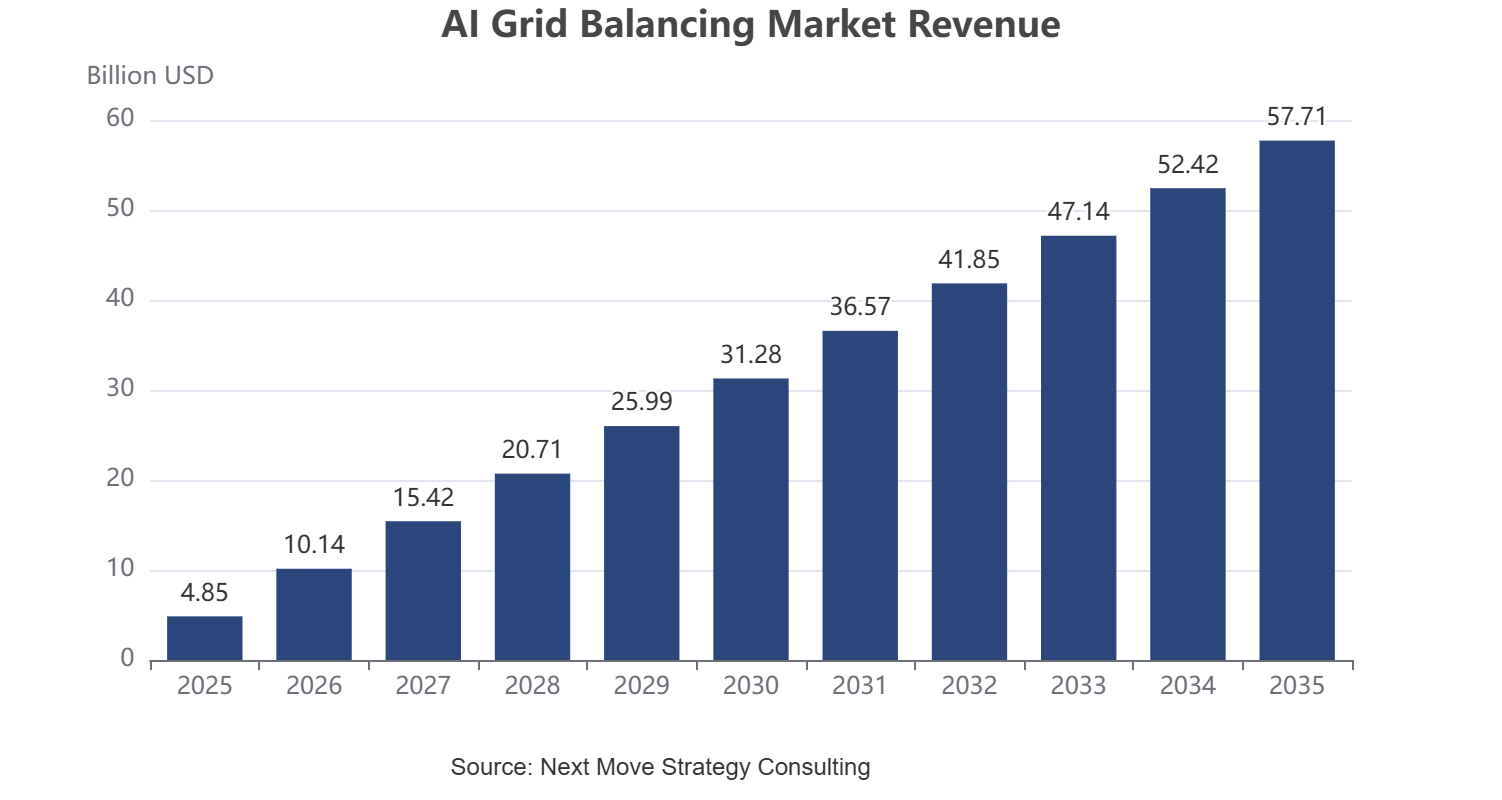
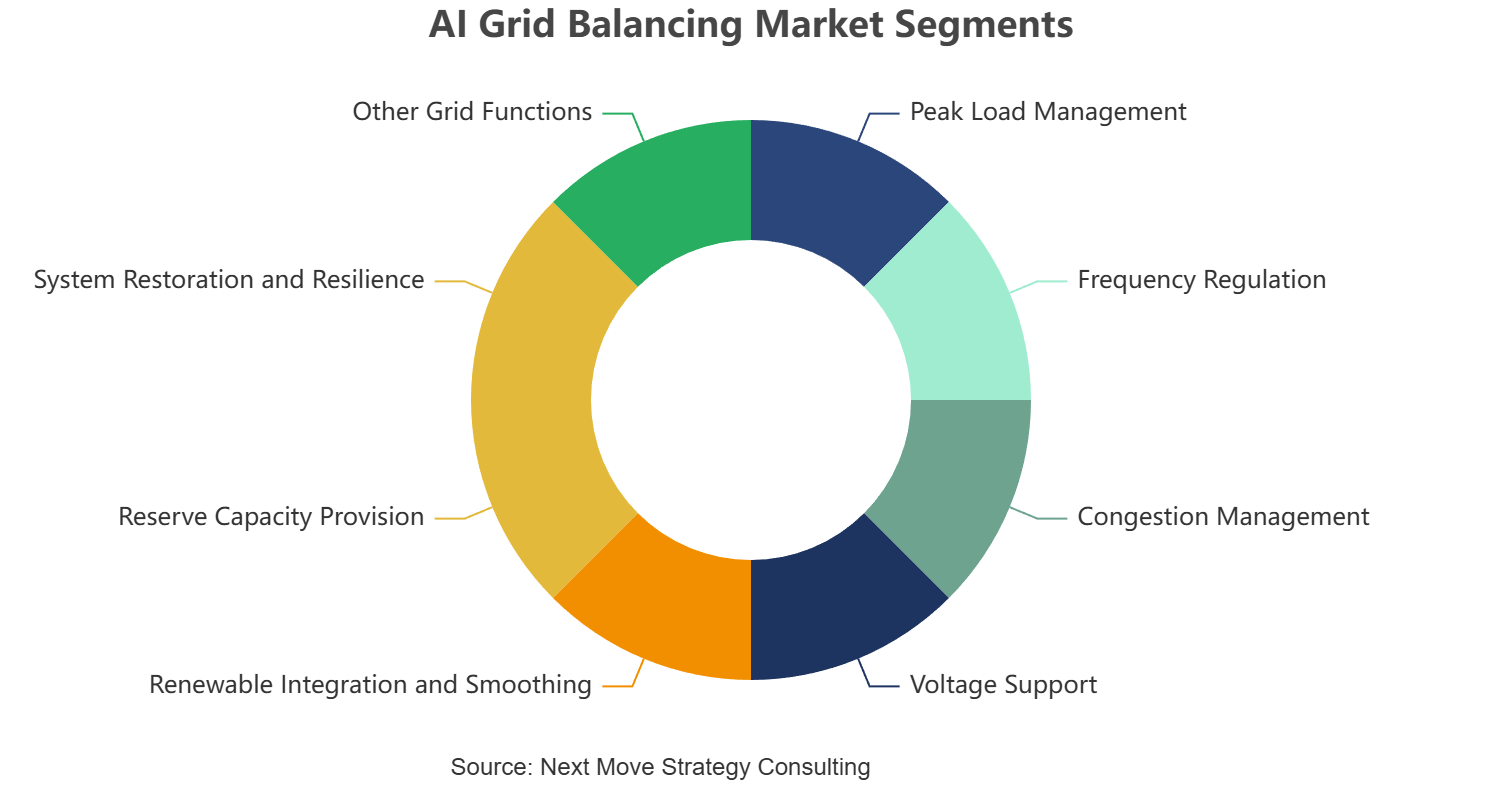
About the Author
 Mayurima Roy
— Mayurima Roy is Research Analyst at Next Move Strategy Consulting, where she has spent 4 years working across the firm's full industry coverage rather than a single fixed vertical. Her work centers on structured research, ongoing trend tracking, competitive assessment, and insight-led content development, translating complex market data into clear, decision-ready narratives that support informed client decision-making across diverse global industries, market sectors, and world regions every day.
Mayurima Roy
— Mayurima Roy is Research Analyst at Next Move Strategy Consulting, where she has spent 4 years working across the firm's full industry coverage rather than a single fixed vertical. Her work centers on structured research, ongoing trend tracking, competitive assessment, and insight-led content development, translating complex market data into clear, decision-ready narratives that support informed client decision-making across diverse global industries, market sectors, and world regions every day.
About the Reviewer
 Supradip Baul
— Supradip Baul is an accomplished business consultant and strategist with over a decade of rich experience in market intelligence, strategy, technology, and business transformation. His work has included rigorous qualitative and quantitative analysis across multiple industries, helping clients shape investment decisions and long-term roadmaps. Earlier in his career, he was associated with Gartner, where he contributed to industry-leading reports and market share analyses. He has worked with leading global companies and holds an MBA with a dual specialization in Marketing and Finance.
Supradip Baul
— Supradip Baul is an accomplished business consultant and strategist with over a decade of rich experience in market intelligence, strategy, technology, and business transformation. His work has included rigorous qualitative and quantitative analysis across multiple industries, helping clients shape investment decisions and long-term roadmaps. Earlier in his career, he was associated with Gartner, where he contributed to industry-leading reports and market share analyses. He has worked with leading global companies and holds an MBA with a dual specialization in Marketing and Finance.
At Next Move Strategy Consulting, we understand that insightful market research is the cornerstone of successful business decisions. That's why we employ a robust and multifaceted approach, combining various methodologies to deliver the most accurate and actionable data for our clients.

Research Landscape
We navigate the world of research with two primary approaches:
Qualitative Approach
Our qualitative research methodologies involve immersive techniques such as in-depth interviews, focus groups, and observational studies. By engaging directly with individuals and stakeholders, we uncover valuable insights that quantitative data alone may overlook.

Quantitative Research
In tandem with qualitative methodologies, NMSC leverages the power of Quantitative Research to provide a robust foundation of numerical insights. Through systematic data collection and analysis, we quantify patterns, preferences, and market trends, offering a comprehensive view of the business landscape.
Our quantitative research approach employs diverse tools, including surveys, experiments, and statistical modelling. These methodologies enable us to gather data from a large and representative sample, ensuring the statistical significance of our findings. By employing structured questionnaires and standardized data collection methods, we guarantee the reliability and validity of the information we present to our clients.
Quantitative research is particularly effective in measuring the prevalence of trends, assessing market size, and gauging the impact of various factors on consumer behavior. The numerical precision attained through this approach equips our clients with actionable insights, facilitating data-driven decision-making and strategy formulation.


Our Specialized Toolbox for Industry-Specific Market Research
We deploy a specialized arsenal of techniques tailored to meet your unique requirements. Here's a glimpse into our comprehensive toolbox:

Information Procurement
The stage entails acquiring market data or relevant information through various sources and methodologies.


Market Research Approach
We utilize both top-down and bottom-up approaches in market research analysis to achieve a comprehensive understanding of the market dynamics, leveraging the broad perspective of industry trends and macroeconomic factors alongside detailed insights from specific segments and individual companies.

Porters Five Forces Analysis
We conduct Porter's Five Forces analysis to evaluate the competitive landscape of an industry, providing us with insights into factors that affect profitability and strategic positioning.

SWOT Analysis

Forecasting
We utilize a forecasting model to predict future consumption by considering parameters like population, economics, regulations, market competition, drivers, constraints, technology, and pricing. We also employ statistical techniques such as multilinear regression, exponential smoothing, moving average, ARIMA, and Monte Carlo simulations for accurate predictions. In econometric forecasting, we analyzed short-term and long-term event impacts, attributing values based on regulatory frameworks, economic factors, and market events.





 Speak to Our Analyst