Grid Storage Management Market Size, Share, Growth & Forecast by Offering (Software Platforms: Site Control Software, Fleet Optimisation Software; and Others), Deployment Type (Utility Scale, Commercial and Industrial, Microgrid, Virtual Power Plant), End User (Grid Infrastructure, Power Generation, Distributed Energy Networks), and Storage Technology Managed (Lithium Iron Phosphate, and Other Electrochemical Storage) — Global Analysis 2025–2035
Industry: Energy & Power | Publishing Date: July 7, 2026 | Last Updated: September 30, 2026 | No of Pages: N/A | No. of Tables: N/A | No. of Figures: N/A | Format: PDF | Report Code: EP5005
What Is the Grid Storage Management Market Size?
The global Grid Storage Management Market was valued at USD 2.8 billion in 2025 and is projected to reach USD 3.3 billion in 2026. Accelerating renewable energy integration, the global push toward grid decarbonisation, and the rapid buildout of battery energy storage systems (BESS) are expected to propel the market to USD 18.4 billion by 2035, advancing at a CAGR of 21.0% from 2026 to 2035. Key growth drivers include rising utility-scale storage deployments, expanding virtual power plant ecosystems, growing demand for AI-enhanced energy management systems, and tightening grid reliability regulations across North America, Europe, and Asia-Pacific.
|
Parameters |
Details |
|
Market Size in 2025 |
USD 2.8 Billion |
|
Market Size in 2026 |
USD 3.3 Billion |
|
Revenue Forecast in 2035 |
USD 18.4 Billion |
|
Growth Rate |
CAGR of 21.0% from 2026 to 2035 |
|
Analysis Period |
2025–2035 |
|
Base Year Considered |
2025 |
|
Forecast Period |
2026–2035 |
|
Market Size Estimation |
USD Billion |
|
Companies Profiled |
20 |
|
Countries Covered |
33 |
|
Market Share |
Top 10 |
Grid Storage Management Market Overview
What Is the Grid Storage Management Market?
Grid Storage Management encompasses the software platforms, control systems, and managed services used to operate, optimise, and monetise stationary energy storage assets connected to electricity grids. NMSC's analysis indicates that these systems provide real-time monitoring, automated dispatch, state-of-health tracking, and revenue-maximisation algorithms for batteries, flow cells, and other storage technologies ranging from sub-megawatt commercial installations to multi-gigawatt-hour utility deployments. The market sits at the intersection of energy software, power electronics, and digital infrastructure, and is experiencing rapid structural expansion driven by unprecedented global investment in clean energy and grid modernisation.
How Has the Grid Storage Management Market Evolved?
From our research, we found that the Grid Storage Management Market has transitioned through distinct phases of maturity. The first phase, spanning roughly 2010 to 2017, was characterised by bespoke SCADA-based control systems deployed at individual pilot projects. The second phase, from 2018 to 2022, saw the emergence of dedicated energy storage software vendors offering site-level battery management and energy management systems. The current phase is defined by fleet-scale portfolio management, AI-driven forecasting, virtual power plant aggregation, and performance-based commercial models that align vendor revenue with asset output. Our assessment indicates that this evolution has fundamentally changed how grid operators and developers procure and value software.
How Do Regulations Influence the Grid Storage Management Market?
Regulatory frameworks are a primary structural driver of the Grid Storage Management Market. The U.S. Federal Energy Regulatory Commission's Order 841, which mandated the participation of electric storage resources in capacity, energy, and ancillary service markets, directly expanded the addressable market for grid storage software by creating revenue stacking opportunities that require sophisticated management platforms. Similarly, the European Union's Battery Regulation and Clean Energy Package establish technical standards and grid interconnection requirements that mandate advanced management software for storage assets. Through NMSC's assessment, we found that regulatory clarity is the single most consistent predictor of Grid Storage Management software adoption across regions.
How Is Technology Adoption Expanding Across the Grid Storage Management Market?
Based on NMSC's research, we found that technology adoption across the Grid Storage Management Market is accelerating on multiple fronts. Lithium iron phosphate (LFP) chemistry is now the dominant technology managed by these platforms, displacing earlier NMC chemistries at utility scale. Simultaneously, the integration of AI-based state-of-health estimation, digital twin simulation, and autonomous dispatch algorithms is elevating the capability ceiling of leading software platforms. Cloud-native architectures and API-first design philosophies are enabling faster integration with wholesale market systems, renewable energy plant controllers, and demand-side management platforms, broadening the total addressable market for Grid Storage Management solutions.
|
Key Takeaways |
|
By offering, Software Platforms held the largest share in the Grid Storage Management Market at USD 1.68 billion in 2025, driven by growing adoption of energy management systems, battery fleet optimization software, and distributed energy resource orchestration platforms. Virtual Power Plant (VPP) Platforms represent the fastest-growing software sub-segment at a CAGR of 22.9% from 2026 to 2035, supported by increasing aggregation of distributed energy resources and participation in flexibility markets. |
|
By deployment type, Utility Scale deployments accounted for the largest market share at USD 1.34 billion in 2025, reflecting large-scale battery energy storage projects integrated with transmission and distribution networks. Virtual Power Plant (VPP) deployments are the fastest-growing deployment type at a CAGR of 25.7% from 2026 to 2035, driven by expanding distributed energy ecosystems and growing demand for grid flexibility services. |
|
By commercial model, Subscription Software generated the highest revenue at USD 0.84 billion in 2025, reflecting the increasing adoption of cloud-based energy management and storage optimization platforms. Performance-Based Agreements are the fastest-growing commercial model at a CAGR of 27.4% from 2026 to 2035, as utilities and asset owners increasingly seek outcome-driven pricing structures tied to operational performance improvements. |
|
By buyer type, Utilities represented the dominant buyer category at USD 1.12 billion in 2025, supported by large-scale investments in grid modernization, renewable integration, and storage asset optimization. Energy Aggregators are the fastest-growing buyer category at a CAGR of 27.6% from 2026 to 2035, driven by expanding virtual power plant programs, distributed energy participation, and flexibility market opportunities. |
|
By end user, Power Generation accounted for the largest market share at USD 1.12 billion in 2025, supported by increasing deployment of battery storage assets alongside renewable generation facilities. Distributed Energy Networks represent the fastest-growing end-user segment at a CAGR of 23.9% from 2026 to 2035, reflecting the growing importance of decentralized energy systems and grid-edge optimization technologies. |
|
By application, Frequency Regulation generated the largest revenue contribution at USD 0.56 billion in 2025, supported by the high technical requirements and corresponding software premium associated with sub-second response dispatch. Capacity Optimisation is the fastest-growing application segment at a CAGR of 27.3% from 2026 to 2035, while Energy Arbitrage remains one of the faster-growing use cases at 22.5% as wholesale electricity price volatility amplifies the value of AI-optimised storage dispatch. |
|
By storage technology, Lithium Iron Phosphate (LFP) batteries held the dominant market share in 2025, supported by superior safety characteristics, longer cycle life, and widespread deployment across utility-scale energy storage projects. Sodium-Ion Battery Management Systems represent the fastest-growing storage technology segment, driven by increasing commercialization efforts, lower material costs, and growing interest in alternative battery chemistries. |
|
North America held the largest regional share in the Grid Storage Management Market at USD 0.96 billion in 2025, projected to reach approximately USD 6.1 billion by 2035 at a CAGR of 20.4%, supported by advanced grid infrastructure, large-scale battery deployment programs, and supportive energy storage policies. |
|
Asia-Pacific is the fastest-growing region in the Grid Storage Management Market at a CAGR of 22.8% from 2026 to 2035, driven by rapid renewable energy expansion, grid modernization initiatives, increasing battery energy storage deployments, and strong government support across China, India, Japan, and Australia. |
|
The United States is the largest country market in the Grid Storage Management Market, supported by substantial utility-scale battery deployment, advanced energy market structures, and strong investment in grid modernization initiatives. |
|
India is the fastest-growing country market within Asia-Pacific in the Grid Storage Management Market, driven by ambitious renewable energy targets, growing battery storage investments, expanding grid infrastructure, and supportive government policies promoting energy transition initiatives. |
Key Emerging Trends in the Grid Storage Management Market
How Is Artificial Intelligence Transforming Real-Time Dispatch in the Grid Storage Management Market?
AI-driven dispatch optimisation is fundamentally reshaping how storage assets are operated within the Grid Storage Management Market. Machine learning algorithms trained on price signals, weather forecasts, load profiles, and battery state-of-health data now routinely outperform rule-based dispatch strategies by 15% to 25% in revenue capture at utility-scale installations. Our analysis shows that vendors such as Stem, Inc. and Fluence Energy have embedded proprietary AI engines within their platform offerings, with Stem's Athena AI platform now managing over 1.5 GWh of storage assets. This AI-first approach to dispatch is becoming a baseline requirement for competitive positioning in the Market.
How Are Virtual Power Plant Platforms Expanding the Grid Storage Management Market Opportunity?
Virtual power plant platforms represent one of the most structurally significant growth vectors in the Grid Storage Management Market. By aggregating hundreds or thousands of distributed storage assets, residential solar inverters, and demand-response resources, VPP platforms create dispatchable capacity that can bid into wholesale energy and ancillary service markets. NMSC's analysis indicates that the Australian Energy Market Operator's VPP demonstration program validated 50 MW of distributed storage capacity participating in frequency control ancillary services. In Europe, Germany's regulatory framework for virtual power plants under the Energiewirtschaftsgesetz has enabled software-defined aggregation at commercial scale, driving demand for advanced fleet optimisation software.
How Is the Shift to Performance-Based Contracts Reshaping the Grid Storage Management Market Commercial Model?
The emergence of performance-based agreements and managed energy storage contracts is fundamentally changing how Grid Storage Management software is procured and priced. Under these models, software vendors and service providers retain a share of the revenue generated by storage assets through ancillary services, energy arbitrage, and capacity payments. Based on our market evaluation, we noticed that this commercial evolution is removing barriers to software adoption by eliminating upfront licensing costs and aligning vendor incentives with asset owner outcomes. Leading players including Stem and Fluence are actively expanding their performance-based offering suites, compelling competitors to develop similar outcome-oriented pricing capabilities.
How Is Long-Duration Energy Storage Management Emerging as a New Software Category in the Grid Storage Management Market?
Long-duration energy storage technologies, including flow batteries, iron-air batteries, compressed air energy storage, and gravity-based mechanical systems, are creating an entirely new management software sub-category within the Grid Storage Management Market. Unlike lithium-ion BESS systems, these technologies require fundamentally different state-of-charge modelling, degradation tracking, and dispatch optimisation approaches due to their distinct electrochemical and mechanical characteristics. Through our market assessment, we observed that Energy Vault, Form Energy, and ESS Inc. are each developing proprietary management software stacks for their respective long-duration technologies, creating opportunities for independent platform vendors to offer agnostic management layers across diverse storage technology portfolios.
Supply Chain Structure of the Grid Storage Management Market
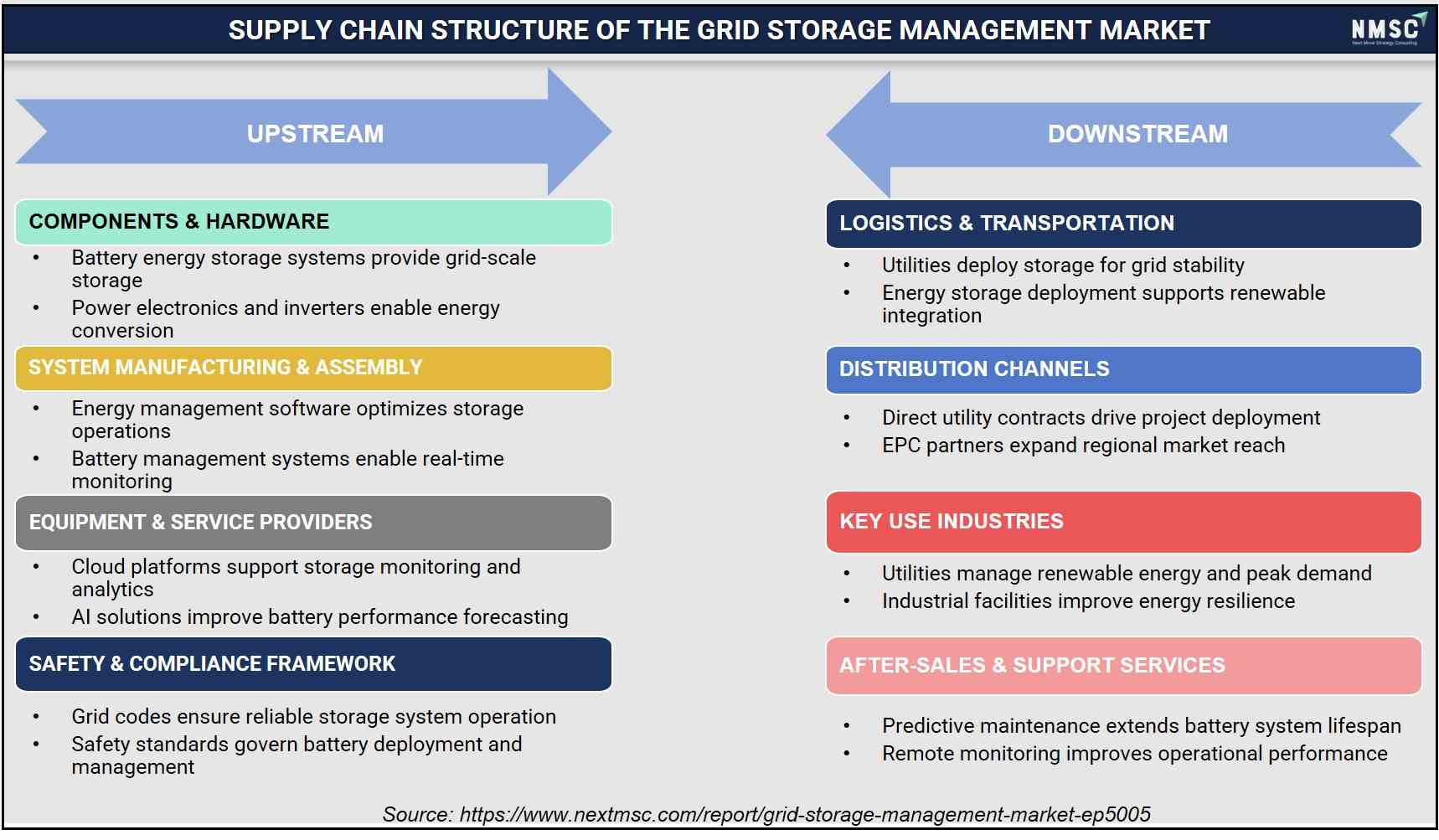
Based on our comprehensive assessment, we found that the Grid Storage Management Market relies on a robust supply chain involving battery storage systems, power electronics manufacturers, software developers, cloud analytics providers, utilities, and EPC partners. Advanced energy management platforms optimize storage performance and renewable integration. Our analysis indicates that regulatory compliance, predictive maintenance services, and utility-driven deployments are essential for sustaining market expansion.
What Are the Key Market Drivers, Breakthroughs, and Investment Opportunities that Will Shape the Grid Storage Management Industry in the Next Decade?
|
Drivers / Trends / Restraints |
(+/-) % Impact on CAGR Forecast |
Geographic Relevance |
Impact Timeline |
|
Accelerating Utility-Scale BESS Deployments |
+3.2% |
North America, APAC, Europe |
2025–2030 |
|
FERC Order 841 and Market Access Regulations |
+1.8% |
North America |
2025–2032 |
|
EU Battery Regulation and Clean Energy Package |
+1.4% |
Europe |
2026–2035 |
|
Rising Renewable Curtailment Driving Storage Need |
+2.1% |
Global (all regions) |
2025–2035 |
|
AI-Driven Dispatch Optimisation Adoption |
+1.9% |
North America, Europe, Australia |
2025–2030 |
|
Virtual Power Plant Policy Frameworks |
+1.6% |
Europe, Australia, North America |
2026–2035 |
|
Long-Duration Storage Technology Commercialisation |
+1.2% |
Global |
2028–2035 |
|
Cybersecurity Requirements for Grid OT Systems |
-0.9% |
North America, Europe |
Ongoing |
|
High Software Integration Complexity with Legacy SCADA |
-0.7% |
All regions |
2025–2028 |
|
Data Standardisation and Interoperability Gaps |
-0.6% |
Global |
Ongoing |
|
Performance-Based Software Commercial Models |
+1.4% |
North America, Australia, Europe |
2025–2032 |
|
Emerging Market Grid Infrastructure Buildout |
+1.1% |
MEA, Southeast Asia, Latin America |
2027–2035 |
What Are the Growth Drivers of the Grid Storage Management Market?
How Is the Global Buildout of Utility-Scale Battery Energy Storage Systems Driving the Grid Storage Management Market?
The rapid global deployment of utility-scale battery energy storage systems represents the most direct and powerful driver of the Grid Storage Management Market. Based on our research, we found that the U.S. Energy Information Administration reported that U.S. battery storage capacity reached 26 GW at the end of 2024, with an additional 30 GW in the construction pipeline as of early 2025. Each gigawatt-hour of installed BESS capacity requires dedicated site control software, battery management systems, and lifecycle management services, creating a scalable and recurring software revenue opportunity. As utility procurement of large-scale storage accelerates under IRA incentives, the software layer managing these assets expands commensurately.
How Are Regulatory Market Access Frameworks Catalysing Grid Storage Management Software Adoption?
Regulatory frameworks that enable storage assets to participate in multiple electricity market products have fundamentally expanded the commercial logic of Grid Storage Management software. The U.S. Federal Energy Regulatory Commission's Order 841, issued in 2018 and subsequently upheld by the U.S. Court of Appeals, removed barriers preventing storage from bidding into capacity, energy, and ancillary service markets. NMSC's analysis indicates that this regulatory clarity transformed the ROI calculation for storage owners, who now rely on sophisticated multi-service optimisation software to capture revenue from frequency regulation, spinning reserves, and energy arbitrage simultaneously. The UK's National Grid Electricity System Operator has similarly expanded storage participation in Balancing Mechanism and ancillary service contracts, reinforcing European demand.
How Is Rising Renewable Penetration and Curtailment Creating Structural Demand for Grid Storage Management Solutions?
The accelerating integration of variable renewable energy, particularly solar and wind, is generating systemic grid stability challenges that only storage-plus-management software can effectively address. The U.S. Department of Energy's National Renewable Energy Laboratory has documented that renewable curtailment in California routinely exceeds several TWh annually, representing both an economic loss and a system efficiency challenge that co-located storage managed by advanced software can resolve. Based on NMSC's research, we found that grid operators across Germany, Australia, and California are mandating or incentivising storage co-location with large renewable projects, directly expanding the market for hybrid renewable storage management software platforms.
What Are the Inhibitors of the Grid Storage Management Market Growth?
How Do Cybersecurity Requirements for Operational Technology Create Compliance Complexity in the Grid Storage Management Market?
Grid Storage Management systems operate as operational technology interfacing directly with critical electricity infrastructure, placing them within the scope of rigorous cybersecurity standards. In North America, the North American Electric Reliability Corporation's Critical Infrastructure Protection (NERC CIP) standards impose mandatory security controls on software systems connected to bulk electric system assets. Our market assessment indicates that compliance with NERC CIP, the EU Network and Information Security (NIS2) Directive, and analogous national frameworks significantly increases software development and certification costs for vendors, extends deployment timelines for customers, and raises barriers to entry for smaller software providers. These compliance obligations are particularly challenging in markets requiring real-time OT-IT integration across multi-vendor hardware environments.
How Does Integration Complexity with Legacy Grid Infrastructure Constrain Grid Storage Management Market Expansion?
Many electricity utilities and grid operators operate SCADA systems, energy management platforms, and distribution management systems that were designed decades before modern battery storage became commercially viable. Integrating contemporary Grid Storage Management software with these legacy operational technology environments requires bespoke engineering, custom protocol adapters, and extended commissioning timelines. The U.S. Government Accountability Office has documented that grid modernisation projects frequently encounter cost overruns and delays attributable to legacy system integration challenges. Our findings suggest that these integration barriers lengthen sales cycles, increase total cost of ownership for customers, and disproportionately disadvantage smaller software vendors that lack the systems integration capabilities of large infrastructure players.
What Are the Growth Opportunities in the Grid Storage Management Market?
How Does the Emergence of Long-Duration Energy Storage Create a Multi-Billion Dollar Software Opportunity in the Grid Storage Management Market?
Long-duration energy storage technologies capable of delivering 8 to 100 hours of discharge duration are emerging as a critical complement to shorter-duration lithium-ion systems, creating a structurally new software management category. The U.S. Department of Energy's Long Duration Storage Shot initiative targets a 90% reduction in long-duration storage costs by 2030, accelerating the commercialisation timeline for flow batteries, iron-air batteries, and mechanical systems. Through our market assessment, we observed that each of these technology classes requires purpose-built management software to model their distinct state-of-charge characteristics, degradation patterns, and thermal dynamics. This technology diversity creates a durable and expanding software opportunity for vendors capable of developing agnostic, multi-chemistry management platforms.
How Do Virtual Power Plant Policy Frameworks Open New Revenue Channels for Grid Storage Management Software Providers?
The formalisation of virtual power plant participation frameworks by electricity market operators across Australia, Germany, the United Kingdom, and increasingly the United States is creating a structured commercial opportunity for Grid Storage Management software providers with fleet optimisation and aggregation capabilities. The Australian Energy Market Operator's VPP demonstration projects have confirmed that software-aggregated distributed storage can compete effectively with conventional peaking generation in frequency control ancillary service markets. NMSC's analysis indicates that the European Commission's Electricity Market Design Reform explicitly supports demand response and VPP participation in wholesale markets, creating regulatory certainty that underpins multi-year software platform investment decisions across the Grid Storage Management Market.
How Is the Expansion of Grid Storage Across Emerging Markets Creating New Geographic Opportunities for Grid Storage Management Providers?
Energy-transition investments across the Middle East, Southeast Asia, India, and Latin America are creating new geographic demand centers for Grid Storage Management software that were negligible just five years ago. India's Ministry of Power has mandated that renewable energy projects above 5 MW install co-located battery storage, creating immediate demand for management software across thousands of new installations. Saudi Arabia's Vision 2030 energy plan targets 50% renewable generation by 2030, requiring extensive grid storage deployments and associated management platforms. Our assessment indicates that these emerging market deployments collectively represent a USD 2.0 billion incremental software opportunity by 2035 that established vendors are only beginning to actively pursue through localized product adaptation and partnership strategies.
How Is the Grid Storage Management Market Segmented in This Report, and What Are the Key Insights from the Segmentation Analysis?
How Do Software Platforms and Services Define the Revenue Architecture of the Grid Storage Management Market?
|
Offering Segment |
2025 (USD Bn) |
2035 (USD Bn) |
CAGR (%) |
|
Software Platforms |
1.68 |
11.30 |
20.8% |
|
Site Control Software |
0.92 |
5.80 |
20.2% |
|
Battery Management Systems |
0.28 |
1.80 |
20.5% |
|
Energy Management Systems |
0.24 |
1.56 |
20.5% |
|
Plant Controllers |
0.22 |
1.36 |
20.0% |
|
SCADA and Monitoring |
0.18 |
1.08 |
19.6% |
|
Fleet Optimisation Software |
0.76 |
5.50 |
21.9% |
|
Portfolio Management Platforms |
0.22 |
1.52 |
21.2% |
|
Virtual Power Plant Platforms |
0.18 |
1.40 |
22.9% |
|
Energy Trading Platforms |
0.16 |
1.22 |
22.5% |
|
Forecasting and Analytics Platforms |
0.20 |
1.36 |
21.1% |
|
Services |
1.12 |
7.10 |
20.2% |
|
Deployment Services |
0.48 |
2.80 |
19.3% |
|
System Configuration |
0.16 |
0.92 |
19.1% |
|
Grid Integration |
0.18 |
1.08 |
19.6% |
|
Software Commissioning |
0.14 |
0.80 |
19.0% |
|
Lifecycle Services |
0.64 |
4.30 |
21.0% |
|
Monitoring Services |
0.18 |
1.14 |
20.3% |
|
Software Maintenance |
0.16 |
1.02 |
20.3% |
|
Performance Optimisation |
0.16 |
1.12 |
21.5% |
|
Managed Operations |
0.14 |
1.02 |
21.9% |
From our analysis of vendor revenue structures and enterprise procurement patterns, we observed that the Grid Storage Management Market is segmented into Software Platforms and Services, with Software Platforms accounting for the dominant share at USD 1.68 billion in 2025. Within Software Platforms, Site Control Software commands the largest sub-segment due to its non-discretionary role in ensuring battery safety, regulatory compliance, and real-time asset control across all storage deployment types. Virtual Power Plant (VPP) Platforms represent the fastest-growing sub-segment, driven by the rapid expansion of distributed energy aggregation, flexibility market participation, and portfolio-level dispatch coordination across multi-asset environments. Within the Services segment, Lifecycle Services are growing faster than Deployment Services as the installed base of storage assets matures and operators prioritise long-term performance optimisation and managed operations over initial commissioning activities.
How Do Utility Scale, Commercial and Industrial, Microgrid, and Virtual Power Plant Deployments Shape Revenue Distribution Across the Grid Storage Management Market?
|
Deployment Type Segment |
2025 (USD Bn) |
2035 (USD Bn) |
CAGR (%) |
|
Utility Scale |
1.34 |
8.10 |
19.7% |
|
Standalone Storage |
0.62 |
3.60 |
19.2% |
|
Hybrid Renewable Storage |
0.72 |
4.50 |
20.2% |
|
Commercial and Industrial |
0.70 |
4.30 |
19.8% |
|
Industrial Facilities |
0.28 |
1.76 |
20.2% |
|
Commercial Facilities |
0.24 |
1.44 |
19.6% |
|
Critical Infrastructure |
0.18 |
1.10 |
19.8% |
|
Microgrid |
0.42 |
2.70 |
20.4% |
|
Campus Microgrids |
0.18 |
1.12 |
20.0% |
|
Remote Microgrids |
0.14 |
0.96 |
21.3% |
|
Islanded Systems |
0.10 |
0.62 |
20.0% |
|
Virtual Power Plant |
0.34 |
3.30 |
25.7% |
|
Distributed Storage Networks |
0.18 |
1.74 |
25.4% |
|
Aggregated Energy Assets |
0.16 |
1.56 |
25.4% |
Based on NMSC's research, we found that the Grid Storage Management Market is segmented by deployment type into Utility Scale, Commercial and Industrial, Microgrid, and Virtual Power Plant categories. Utility Scale deployments dominate at USD 1.34 billion in 2025, reflecting the large per-project software contract values associated with hundred-megawatt-plus BESS installations and the non-negotiable software requirements imposed by grid interconnection agreements. Hybrid Renewable Storage, co-located with solar and wind assets, is the fastest-growing sub-segment within Utility Scale as developers seek to combine production optimization with storage dispatch. Virtual Power Plant deployments represent the highest-growth deployment category overall, advancing at a projected CAGR of 25.7% as aggregation platforms achieve commercial scale across residential and commercial asset pools.
How Are Evolving Commercial Models Reshaping Vendor Revenue Strategies in the Grid Storage Management Market?
|
Commercial Model Segment |
2025 (USD Bn) |
2035 (USD Bn) |
CAGR (%) |
|
Perpetual License |
0.36 |
1.20 |
12.8% |
|
Subscription Software |
0.84 |
5.40 |
20.5% |
|
Project-Based Contract |
0.56 |
2.90 |
17.9% |
|
Managed Service |
0.68 |
4.80 |
21.6% |
|
Performance Based Agreement |
0.36 |
4.10 |
27.4% |
Our analysis shows that the Grid Storage Management Market commercial model landscape is evolving rapidly away from one-time perpetual licensing toward subscription, managed service, and performance-based revenue structures. Subscription Software is currently the dominant commercial model at USD 0.84 billion in 2025, offering predictable recurring revenue for vendors and lower upfront costs for asset owners. Managed Service contracts are growing at 21.6% CAGR as operators delegate ongoing monitoring, optimisation, and maintenance responsibilities to software providers. Performance Based Agreements represent the fastest-growing commercial model at 27.4% CAGR, reflecting a structural shift toward outcome-oriented procurement where vendors earn a share of the incremental revenue generated by their software-driven dispatch optimisation strategies.
How Do Utilities, Power Producers, Commercial and Industrial Owners, and Energy Aggregators Drive Procurement in the Grid Storage Management Market?
|
Buyer Type Segment |
2025 (USD Bn) |
2035 (USD Bn) |
CAGR (%) |
|
Utilities |
1.12 |
6.60 |
19.4% |
|
Transmission Operators |
0.36 |
2.00 |
18.7% |
|
Distribution Operators |
0.48 |
2.90 |
19.7% |
|
Vertically Integrated Utilities |
0.28 |
1.70 |
19.7% |
|
Power Producers |
0.84 |
5.20 |
19.9% |
|
Independent Power Producers |
0.48 |
3.00 |
20.0% |
|
Renewable Developers |
0.36 |
2.20 |
19.8% |
|
Commercial and Industrial Owners |
0.56 |
3.40 |
19.8% |
|
Industrial Operators |
0.22 |
1.34 |
19.8% |
|
Data Centre Operators |
0.20 |
1.34 |
21.0% |
|
Commercial Real Estate |
0.14 |
0.72 |
17.8% |
|
Energy Aggregators |
0.28 |
3.20 |
27.6% |
|
Retail Energy Providers |
0.12 |
1.34 |
27.2% |
|
Virtual Power Plant Operators |
0.16 |
1.86 |
27.9% |
Through our market assessment, we observed that the Grid Storage Management Market buyer base spans four distinct procurement segments: Utilities, Power Producers, Commercial and Industrial Owners, and Energy Aggregators. Utilities represent the largest buyer segment at USD 1.12 billion in 2025, with Distribution Operators being the most active procurement category as distribution networks absorb increasing quantities of distributed solar, EV charging, and residential storage. Power Producers, particularly Independent Power Producers and Renewable Developers, are the second-largest segment as storage co-location with renewable projects becomes a standard project finance requirement. Energy Aggregators represent the fastest-growing buyer category at 27.6% CAGR, with Virtual Power Plant Operators emerging as the most dynamic sub-segment as aggregation business models achieve commercial viability across major electricity markets.
How Does End-User Segmentation Reveal the Structural Demand Distribution Across the Grid Storage Management Market?
|
End User Segment |
2025 (USD Bn) |
2035 (USD Bn) |
CAGR (%) |
|
Grid Infrastructure |
0.98 |
5.60 |
19.0% |
|
Transmission Networks |
0.38 |
2.10 |
18.7% |
|
Distribution Networks |
0.42 |
2.46 |
19.3% |
|
Substations |
0.18 |
1.04 |
19.1% |
|
Power Generation |
1.12 |
6.80 |
19.7% |
|
Solar and Storage Plants |
0.42 |
2.80 |
21.0% |
|
Wind and Storage Plants |
0.26 |
1.62 |
20.1% |
|
Standalone Storage Plants |
0.28 |
1.62 |
19.2% |
|
Thermal Hybrid Plants |
0.16 |
0.76 |
16.9% |
|
Distributed Energy Networks |
0.70 |
6.00 |
23.9% |
|
Virtual Power Plants |
0.28 |
2.56 |
24.7% |
|
Residential Storage Networks |
0.22 |
1.86 |
23.8% |
|
Aggregator Portfolios |
0.20 |
1.58 |
23.0% |
NMSC's analysis indicates that Power Generation assets represent the largest end-user category in the Grid Storage Management Market, generating USD 1.12 billion in 2025, with Solar and Storage Plants being the most active application environment due to the global surge in co-located solar-plus-storage project development. Grid Infrastructure remains a substantial end-user segment as transmission and distribution operators deploy storage for congestion relief, black start capability, and distribution voltage management. Distributed Energy Networks are the fastest-growing end-user category at 23.9% CAGR, reflecting the rapid proliferation of residential storage systems, community energy projects, and aggregator-managed asset portfolios that together constitute a growing share of total grid-connected storage capacity requiring software management.
How Do Different Grid Applications Drive Revenue Differentiation in the Grid Storage Management Market?
|
Application Segment |
2025 (USD Bn) |
2035 (USD Bn) |
CAGR (%) |
|
Frequency Regulation |
0.56 |
3.10 |
18.7% |
|
Energy Arbitrage |
0.42 |
3.20 |
22.5% |
|
Renewable Firming |
0.50 |
3.20 |
20.4% |
|
Peak Demand Management |
0.42 |
2.60 |
19.8% |
|
Backup and Resilience |
0.28 |
1.60 |
19.1% |
|
Congestion Relief |
0.22 |
1.34 |
19.8% |
|
Black Start Support |
0.14 |
0.70 |
17.5% |
|
Capacity Optimisation |
0.24 |
2.66 |
27.3% |
Based on our market evaluation, we noticed that the Grid Storage Management Market application landscape spans eight distinct use cases, each requiring differentiated software capabilities and generating distinct revenue profiles. Frequency Regulation remains the largest single application by revenue at USD 0.56 billion in 2025 due to the high technical requirements and corresponding software premium associated with sub-second response dispatch. Renewable Firming is the second-largest application as solar and wind curtailment mitigation becomes a universal grid management priority. Capacity Optimisation is the fastest-growing application at 27.3% CAGR, reflecting the value of AI-driven software that continuously adjusts asset utilisation to maximise capacity factor and revenue capture across stacked services. Energy Arbitrage also remains one of the faster-growing applications at 22.5% CAGR as increasing renewable penetration amplifies wholesale price volatility.
How Does the Storage Technology Mix Shape Software Platform Requirements in the Grid Storage Management Market?
|
Storage Technology Segment |
2025 (USD Bn) |
2035 (USD Bn) |
CAGR (%) |
|
Lithium Iron Phosphate (LFP) |
1.29 |
7.80 |
19.6% |
|
Lithium Nickel Manganese Cobalt (NMC) |
0.56 |
2.80 |
17.5% |
|
Sodium Ion |
0.08 |
1.20 |
31.3% |
|
Flow Battery |
0.22 |
1.80 |
23.3% |
|
Mechanical Storage |
0.14 |
0.80 |
19.2% |
|
Thermal Storage |
0.14 |
0.80 |
19.2% |
|
Hybrid Storage |
0.22 |
2.00 |
24.7% |
|
Other Electrochemical Storage |
0.15 |
1.20 |
23.1% |
Our findings suggest that Lithium Iron Phosphate (LFP) technology dominates the Grid Storage Management Market's storage technology managed segment at USD 1.29 billion in 2025, reflecting LFP's preferred status for utility-scale and large commercial deployments globally due to its favourable safety profile, long cycle life, and rapidly declining cost per kilowatt-hour. NMC-based systems remain significant in applications requiring higher energy density. Sodium Ion technology represents the highest-growth emerging segment at a projected CAGR of 31.3%, as commercial-scale sodium-ion battery deployments from manufacturers including CATL begin requiring dedicated management software. Hybrid Storage systems, combining multiple chemistry types, are also growing rapidly at 24.7% CAGR as operators pursue resilience and application flexibility across increasingly complex storage portfolios.
Regional Outlook
Geographic Performance Snapshot
|
Region |
2025 (USD Bn) |
2035 (USD Bn) |
CAGR (%) |
Key Driver |
|
North America |
0.96 |
6.10 |
20.4% |
IRA storage incentives, FERC Order 841, utility BESS pipeline |
|
Europe |
0.72 |
4.20 |
19.3% |
REPowerEU, EU Battery Regulation, VPP market frameworks |
|
Asia-Pacific |
0.82 |
6.40 |
22.8% |
China national storage targets, India policy mandates, Australia AEMO |
|
Middle East & Africa |
0.16 |
1.20 |
22.4% |
Vision 2030, renewable integration, grid modernisation |
|
Latin America |
0.14 |
0.80 |
19.0% |
Renewable buildout, energy security, distributed storage |
North America Grid Storage Management Market
North America is the largest regional market for Grid Storage Management, generating USD 0.96 billion in 2025 and forecast to reach USD 6.1 billion by 2035 at a CAGR of 20.4%. The region benefits from the most active utility-scale BESS procurement pipeline globally, federal tax incentives under the Inflation Reduction Act that provide a 30% investment tax credit for standalone storage, and regulatory market access established by FERC Order 841. Our analysis shows that the combination of policy clarity, deep capital markets, and the headquarters concentration of leading Grid Storage Management software vendors creates a self-reinforcing market leadership position for North America throughout the forecast period.
U.S. Grid Storage Management Market
Based on our engagements across the U.S. energy storage sector, the United States represents approximately 85% of North American Grid Storage Management revenue and is the world's single largest national market. The U.S. Energy Information Administration has documented that battery storage capacity additions set new annual records in 2023 and 2024, directly expanding software management demand. FERC Order 841 and its implementation across Regional Transmission Organizations have created multi-service revenue stacking opportunities that are only accessible through sophisticated Grid Storage Management software platforms. The IRA's direct-pay provisions have also accelerated storage deployments among tax-exempt utilities and cooperatives, broadening the customer base for management software providers.
Canada Grid Storage Management Market
Through our analysis of the Canadian energy landscape, Canada's Grid Storage Management Market is growing at an estimated CAGR of 20.5% from 2026 to 2035, supported by provincial clean electricity standards in Ontario, British Columbia, and Quebec. Natural Resources Canada's Smart Renewables and Electrification Pathways Program is funding grid-scale storage projects that require advanced management software. Canadian electricity markets, particularly Ontario's Independent Electricity System Operator, are expanding storage participation in capacity auction frameworks, creating commercial incentives for Grid Storage Management software investment. Technology adoption skews toward utility-scale standalone and hybrid configurations, with growing interest in community microgrid management software applications.
Mexico Grid Storage Management Market
From our assessment of Mexico's emerging energy storage sector, the Grid Storage Management Market is nascent but growing in response to Mexico's expanding renewable energy portfolio and grid stability challenges. The Comision Federal de Electricidad (CFE) and private renewable developers are increasingly incorporating storage co-location into new projects to manage renewable variability and reduce curtailment. Mexico's National Electric System Development Program identifies grid modernisation and storage integration as strategic priorities. Grid Storage Management software adoption is currently concentrated among large-scale independent power producers, though commercial and industrial demand is beginning to emerge in regions with high electricity tariff volatility.
Europe Grid Storage Management Market
Europe represents the second-largest regional market for Grid Storage Management, generating USD 0.72 billion in 2025 and projected to reach USD 4.2 billion by 2035 at a CAGR of 19.3%. The EU's REPowerEU plan, which targets 600 GW of solar and 510 GW of wind by 2030, directly implies a substantial expansion of co-located and grid-scale storage deployments. NMSC's analysis indicates that Europe's regulatory environment, encompassing the Clean Energy Package, the EU Battery Regulation, and the Electricity Market Design Reform, is creating a structured and durable demand environment for Grid Storage Management software platforms capable of operating across multiple national market frameworks simultaneously.
UK Grid Storage Management Market
Based on our engagements with UK energy storage stakeholders, the United Kingdom is Europe's largest Grid Storage Management market, with the world's highest per-capita operational battery storage capacity as of 2024. National Grid ESO's Pathfinder and System Needs and Product Strategy processes have progressively expanded the ancillary service products available to storage assets, creating multiple revenue stacking opportunities that require sophisticated management software. The UK's Capacity Market, Balancing Mechanism, and Dynamic Containment service together represent the most liquid storage revenue environment in Europe. Grid Storage Management software vendors with UK-specific market integration capabilities benefit from disproportionate competitive advantage in this technically demanding market.
Germany Grid Storage Management Market
Through our analysis of Germany's Energiewende, Germany represents the largest continental European Grid Storage Management market. Germany's renewable capacity surpassed 60% of annual electricity generation in 2024, creating significant grid balancing requirements that underpin storage software demand. The German transmission system operators' procurement of primary control reserve, secondary control reserve, and minute reserve products through the regelleistung.net platform creates direct commercial incentives for Grid Storage Management software with automated market bidding capabilities. From our assessment, the Bundesnetzagentur's regulatory framework for battery storage participation is among the most developed in Europe, supporting strong software adoption among utility and independent storage operators.
France Grid Storage Management Market
According to evaluation of France's energy storage landscape, the Grid Storage Management Market in France is expanding as the country pursues its multi-annual energy plan targets for renewable energy and grid flexibility. RTE France's capacity mechanism and ancillary service products are increasingly incorporating storage participation, and the Commission de Regulation de l'Energie is progressively clarifying the regulatory status of standalone storage. Our assessment indicates that France's significant nuclear baseload creates a distinctive grid frequency profile that places premium value on fast-responding frequency regulation services, driving demand for high-precision grid storage management software capable of sub-second dispatch execution.
Italy Grid Storage Management Market
From our assessment of Italy's energy transition, the Grid Storage Management Market is benefiting from Terna's transmission network modernisation program and Italy's high solar penetration on distribution networks. The ARERA regulatory authority has expanded utility-scale storage participation in balancing services through the MSD market. Italy's southern regions, which face high renewable curtailment rates, are particularly active markets for storage software that can coordinate renewable firming and congestion relief services. Our analysis shows that Italian distribution network operators are increasingly procuring commercial and industrial storage management software to address voltage regulation and local congestion challenges.
Spain Grid Storage Management Market
Based on our engagements with Spanish energy sector stakeholders, Spain's Grid Storage Management Market is growing rapidly as the country's renewable generation capacity, the second-largest in Europe, creates persistent balancing challenges. Red Electrica de Espana operates one of Europe's most active ancillary service markets, with secondary and tertiary regulation products accessible to storage assets with appropriate management software. The Spanish government's National Energy and Climate Plan targets 74% renewable electricity by 2030, implying substantial additional storage deployments. Our findings suggest that Spain's market is particularly competitive among European Grid Storage Management vendors due to its high software complexity requirements and large project scale.
Sweden Grid Storage Management Market
Through our analysis of Sweden's energy sector, the Grid Storage Management Market operates within the Nordic power market framework administered by Svenska kraftnat. Sweden's low-carbon electricity system, dominated by hydropower and nuclear, creates distinctive frequency regulation requirements where battery storage with advanced management software complements existing hydro flexibility. The government's energy storage incentive programs are stimulating early-stage commercial deployments. From our assessment, Sweden's technically sophisticated utility sector is prioritising battery storage for distribution network support and island grid applications, creating demand for microgrid and distribution management software capabilities.
Denmark Grid Storage Management Market
According to evaluation of Denmark's electricity market, Denmark's Grid Storage Management Market is shaped by the world's highest wind energy penetration as a share of total generation, which regularly exceeds 50% on an annual basis. Energinet, Denmark's transmission system operator, has been an early adopter of advanced ancillary service products suitable for battery storage, including fast frequency response services. Our analysis indicates that Denmark's electricity market integration within the Nordic pool and the developing coupling with German and Dutch markets creates complex multi-market optimisation requirements that advanced Grid Storage Management software platforms are well-positioned to address.
Finland Grid Storage Management Market
From our assessment of Finland's energy storage sector, the Grid Storage Management Market is developing in the context of Finland's high renewable energy ambitions and the Nordic synchronous area frequency dynamics. Fingrid, Finland's transmission system operator, has introduced fast frequency reserves and automatic frequency restoration reserves that are increasingly being provided by battery storage systems. Our findings suggest that Finland's cold climate creates distinctive thermal management requirements for storage systems that advanced battery management software must address. The Nordic electricity market's competitive structure incentivises sophisticated price forecasting and arbitrage capabilities within Grid Storage Management platforms deployed in Finland.
Netherlands Grid Storage Management Market
Based on our engagements with Dutch energy sector participants, the Netherlands Grid Storage Management Market is one of the most commercially active in Continental Europe, supported by TenneT's transparent ancillary service procurement and the Netherlands Authority for Consumers and Markets' progressive storage regulatory framework. The Dutch government's Climate Agreement targets 70% renewable electricity by 2030, requiring substantial storage deployment and corresponding management software. Our analysis indicates that the Netherlands' port and industrial complex including the Port of Rotterdam is an active market for behind-the-meter commercial and industrial storage management software, driven by significant and variable industrial electricity demand.
Asia-Pacific Grid Storage Management Market
Asia-Pacific is the fastest-growing regional market for Grid Storage Management, generating USD 0.82 billion in 2025 and projected to reach USD 6.4 billion by 2035 at a CAGR of 22.8%. China's national energy storage deployment targets, India's Ministry of Power storage mandates, Australia's unique grid modernisation challenges, and Japan and South Korea's decarbonisation commitments collectively create the most dynamic regional growth environment globally. NMSC's analysis indicates that the diversity of Asia-Pacific's grid architectures, regulatory frameworks, and storage technology preferences requires Grid Storage Management vendors to maintain highly adaptable software platforms capable of operating across radically different market structures.
China Grid Storage Management Market
Based on our engagements with the Chinese energy storage sector, China's Grid Storage Management Market is the largest in Asia-Pacific and among the fastest-growing globally. The National Development and Reform Commission and the National Energy Administration have mandated storage co-installation with new renewable projects in multiple provinces, directly driving software management demand. China's State Grid Corporation and China Southern Power Grid are deploying grid-scale storage at unprecedented scale as part of the 14th Five-Year Plan. From our assessment, China's Grid Storage Management market is characterised by strong domestic software vendors including Huawei and Sungrow that integrate management software with their proprietary storage hardware solutions, creating an integrated vendor ecosystem.
India Grid Storage Management Market
Through our analysis of India's energy transition, the Market is entering a phase of rapid acceleration driven by the Ministry of Power's storage procurement mandate and the Ministry of New and Renewable Energy's push toward 500 GW of renewable capacity by 2030. The Central Electricity Regulatory Commission has issued regulations enabling storage participation in ancillary services, and Solar Energy Corporation of India has procured multiple rounds of storage capacity. Our findings suggest that India's Grid Storage Management market presents significant growth opportunities for both international vendors and emerging domestic software providers as the scale of storage deployments increases dramatically over the forecast period.
Japan Grid Storage Management Market
According to evaluation of Japan's energy storage landscape, Japan's Grid Storage Management Market is shaped by the country's ambitious greenhouse gas reduction targets and the legacy of the 2011 Fukushima nuclear accident that prompted a fundamental rethinking of energy security. The Agency for Natural Resources and Energy oversees storage integration into Japan's electricity market reform framework. Our analysis indicates that Japan's technically demanding grid frequency standards and the active participation of major industrial conglomerates including Panasonic, Mitsubishi, and Toshiba in storage system deployment create a sophisticated and well-resourced customer base for Grid Storage Management software.
South Korea Grid Storage Management Market
From our assessment of South Korea's energy storage sector, the country represents one of the world's most advanced energy storage markets, with South Korea deploying grid-scale storage at a per-capita rate among the highest globally in the early 2020s. The Korea Electric Power Corporation and private renewable developers are active procurers of storage management software. Our findings suggest that South Korea's Ministry of Trade, Industry and Energy policy framework for storage integration into frequency regulation and peak shifting applications continues to create structured software demand, though the market has matured from its early hyper-growth phase into a more stable expansion trajectory.
Taiwan Grid Storage Management Market
Based on our engagements with Taiwan's energy sector, the Grid Storage Management Market is growing in response to Taiwan Power Company's extensive storage procurement program as part of Taiwan's energy transition away from nuclear power toward renewables. Taiwan's frequency regulation market has been expanded to include battery storage participation, creating commercially attractive revenue stacking opportunities. Our analysis indicates that Taiwan's semiconductor industry, which accounts for a disproportionate share of national electricity demand, is an active market for behind-the-meter commercial and industrial storage management software for power quality and resilience applications.
Indonesia Grid Storage Management Market
Through our analysis of Indonesia's energy transition, the Grid Storage Management Market is at an early but expanding stage, supported by PLN's program to modernise outer island microgrids with hybrid renewable-storage systems. Indonesia's archipelagic geography creates compelling economics for islanded microgrid storage management software that can reduce diesel fuel consumption in remote communities. The government's National Energy Policy mandates 23% renewable energy by 2025, requiring grid balancing storage that necessitates advanced management software. Our assessment indicates that Indonesia represents a significant medium-term Grid Storage Management software opportunity, particularly within the microgrid and remote island system categories.
Vietnam Grid Storage Management Market
According to evaluation of Vietnam's energy sector, Vietnam's Grid Storage Management Market is emerging from high solar deployment levels that have created curtailment challenges for the national grid. The Vietnam Electricity group and private independent power producers are increasingly incorporating storage co-location into new solar projects to manage output variability and reduce curtailment. The Ministry of Industry and Trade is developing storage-specific regulations as part of Vietnam's Power Development Plan 8. Our findings suggest that Vietnam's rapidly expanding renewable energy sector creates growing demand for hybrid renewable storage management software, particularly in the south-central region where solar curtailment rates are highest.
Australia Grid Storage Management Market
From our assessment of Australia's electricity sector, Australia is the most advanced and commercially dynamic Grid Storage Management market within Asia-Pacific and among the most sophisticated globally. The Australian Energy Market Operator's Integrated System Plan mandates substantial transmission-connected storage deployments, and the world-record Hornsdale Power Reserve project demonstrated the commercial viability of large-scale storage management software. Our analysis indicates that Australia's competitive National Electricity Market structure, high renewable penetration, and transparent ancillary service products create a market environment that rewards sophisticated Grid Storage Management software optimisation capabilities, making Australia a key reference market for global software vendors.
Philippines Grid Storage Management Market
Based on our engagements with the Philippine energy sector, the Grid Storage Management Market is growing in response to the Energy Regulatory Commission's efforts to integrate storage into the Wholesale Electricity Spot Market. The Department of Energy's Renewable Energy roadmap is accelerating solar and wind deployments that require storage co-location for grid stability purposes. Our findings suggest that the Philippines' island grid structure creates particular demand for microgrid storage management software, as multiple distribution utilities operate isolated grids that depend on storage for frequency stability and supply reliability.
Malaysia Grid Storage Management Market
Through our analysis of Malaysia's energy transition, the Grid Storage Management Market is developing alongside Malaysia's New Industrial Master Plan 2030, which emphasises clean energy and grid modernisation investments. Tenaga Nasional Berhad, Malaysia's dominant utility, is piloting utility-scale storage deployments for grid balancing purposes. Our assessment indicates that Malaysia's growing data centre industry, one of Southeast Asia's largest, is an emerging market for behind-the-meter commercial storage management software for power quality and resilience applications, creating a distinct demand vertical within the broader Grid Storage Management landscape.
Middle East & Africa Grid Storage Management Market
The Middle East and Africa is a rapidly growing regional market for Grid Storage Management, generating USD 0.16 billion in 2025 and projected to reach USD 1.2 billion by 2035 at a CAGR of 22.4%. Saudi Arabia's Vision 2030 energy plan, the UAE's net-zero ambitions, South Africa's grid stability crisis, and Nigeria's rural electrification agenda collectively create diverse but growing demand for storage management software across very different market structures. Our analysis shows that the MEA region is characterised by large-scale utility procurement alongside microgrid deployments for off-grid and weak-grid applications, requiring Grid Storage Management vendors to support a wide spectrum of system scales and complexity levels.
Saudi Arabia Grid Storage Management Market
Based on our engagements with Saudi Arabia's energy sector, the Grid Storage Management Market is growing rapidly as the Saudi government pursues its Vision 2030 renewable energy targets under the Saudi Green Initiative. The Saudi Electricity Company and ACWA Power are among the most active utility-scale storage procurers in the MEA region. NMSC's analysis indicates that Saudi Arabia's commitment to 50% renewable electricity by 2030 implies approximately 20 GW of storage deployment, creating a substantial and durable software management opportunity. The Saudi Arabian Energy Efficiency Center's guidelines on grid stability are shaping minimum software capability requirements for storage systems connected to the national grid.
UAE Grid Storage Management Market
Through our analysis of the UAE's energy landscape, the Grid Storage Management Market is supported by the UAE's net-zero by 2050 strategic initiative and the country's substantial investment in solar energy through projects including the Mohammed bin Rashid Al Maktoum Solar Park in Dubai. The Abu Dhabi Department of Energy and Dubai Electricity and Water Authority are evaluating and deploying grid-scale storage for frequency regulation and solar firming applications. Our findings suggest that the UAE's ambition to become a regional clean energy hub and its high institutional capacity make it one of the most sophisticated Grid Storage Management software markets in the MEA region.
Egypt Grid Storage Management Market
According to evaluation of Egypt's energy sector, the Grid Storage Management Market is in early development but benefits from Egypt's substantial renewable energy ambitions under its Integrated Sustainable Energy Strategy. Egypt's national grid expansion and the development of large-scale solar zones including the Benban Solar Park create a foundation for storage co-location and management software demand. Our assessment indicates that Egypt's grid stability challenges, driven by rapid demand growth and variable renewable integration, are creating early-stage utility procurement interest in grid storage management solutions for frequency regulation and load balancing applications.
Israel Grid Storage Management Market
From our assessment of Israel's energy landscape, the Grid Storage Management Market is growing steadily as the Electricity Authority expands storage participation in Israel's electricity market. Israel's high solar irradiance and ambitious 30% renewable electricity targets are driving solar-plus-storage project development that requires advanced management software. Our analysis indicates that Israel's strong technology sector and deep software engineering talent pool have supported the development of domestic Grid Storage Management software capabilities, making Israel both a market for international vendors and a source of competitive software innovation in energy management systems.
Turkey Grid Storage Management Market
Based on our engagements with Turkey's energy sector, the Grid Storage Management Market is expanding as TEIAS, Turkey's transmission system operator, addresses grid frequency stability challenges arising from rapid renewable energy expansion. Turkey's Renewable Energy Resource Zones program has led to the deployment of large wind and solar farms that are increasingly requiring storage co-location. Our findings suggest that Turkey's strategic geographic position between European and Middle Eastern energy markets, combined with its ambitious domestic renewable targets, creates a growing and strategically important Grid Storage Management software market within the MEA region.
Nigeria Grid Storage Management Market
Through our analysis of Nigeria's energy sector, the Grid Storage Management Market is primarily driven by the country's persistent grid reliability challenges and the resulting demand for behind-the-meter and microgrid storage solutions for commercial and industrial consumers. The Rural Electrification Agency's Solar Hybrid program is deploying off-grid and weak-grid storage systems that require remote monitoring and management software capabilities. Our assessment indicates that Nigeria's substantial commercial and industrial backup power market, which relies heavily on diesel generators, represents a significant opportunity for Grid Storage Management software that can optimise diesel-solar-battery hybrid systems and reduce fuel consumption.
South Africa Grid Storage Management Market
According to evaluation of South Africa's electricity crisis, the Grid Storage Management Market is among the fastest-growing in Africa, driven by the severe load-shedding situation that has compelled commercial, industrial, and residential consumers to invest in backup and self-consumption storage at unprecedented rates. Eskom's grid stability challenges and the Electricity Regulation Amendment Act's provisions for self-generation have created a highly active storage deployment environment. Our analysis indicates that South Africa's Grid Storage Management market has a distinctively strong commercial and industrial segment, with sophisticated buyers including mining companies, manufacturing facilities, and data centres procuring management software for cost optimisation and resilience applications.
Latin America Grid Storage Management Market
Latin America generated USD 0.14 billion in Grid Storage Management revenue in 2025 and is projected to reach USD 0.8 billion by 2035 at a CAGR of 19.0%. Brazil's large renewable energy sector, Chile's world-class solar resources, Colombia's grid flexibility needs, and Argentina's energy transition aspirations collectively define the regional opportunity. NMSC's analysis indicates that Latin America's Grid Storage Management market is at an earlier stage of regulatory development compared to North America and Europe, with procurement activity currently concentrated among large utility-scale projects and commercial and industrial behind-the-meter applications in countries with high industrial electricity tariff exposure.
Brazil Grid Storage Management Market
Based on our engagements with Brazil's energy sector, Brazil is the largest Grid Storage Management market in Latin America, supported by the National Electric Energy Agency's progressive integration of storage into Brazil's electricity auctions and ancillary service contracts. Brazil's hydroelectric-dominated grid historically provided natural flexibility, but increasing drought frequency is creating demand for battery storage as a complementary balancing resource. Our findings suggest that the Câmara de Comercialização de Energia Elétrica's market frameworks are progressively enabling storage revenue stacking, creating commercial incentives for Grid Storage Management software investment among independent power producers and renewable developers.
Argentina Grid Storage Management Market
Through our analysis of Argentina's energy situation, the Grid Storage Management Market is characterised by early-stage but growing deployment activity driven by Argentina's substantial renewable energy resources and the RENOVAR renewable energy program. Argentina's grid frequency regulation market is developing storage participation frameworks. Our assessment indicates that economic volatility and currency constraints create specific procurement challenges for international Grid Storage Management software vendors operating in Argentina, though the scale of Argentina's planned renewable energy expansion implies significant medium-term software management demand as the market stabilises.
Chile Grid Storage Management Market
According to evaluation of Chile's energy transition, Chile represents one of the most technically advanced Grid Storage Management markets in Latin America, supported by the National Energy Commission's storage-inclusive tendering processes and Chile's world-class solar resources in the Atacama Desert. Chile's electricity system operator, Coordinador Eléctrico Nacional, has established ancillary service frameworks that enable storage revenue participation. Our analysis indicates that Chile's exceptionally high solar curtailment rates in the northern grid create strong economic incentives for storage co-location with renewable projects, directly driving demand for sophisticated Grid Storage Management software capable of maximising renewable asset utilisation.
Colombia Grid Storage Management Market
From our assessment of Colombia's energy landscape, the Grid Storage Management Market is developing within the context of Colombia's Energy Transition Law and XM's electricity market modernisation program. Colombia's grid has historically relied on hydropower flexibility, but El Nino-driven drought events are creating interest in battery storage as a resilience tool. Our findings suggest that Colombia's commercial and industrial sector, particularly in manufacturing and mining, is exploring behind-the-meter storage management solutions for energy cost reduction and power quality improvement, representing an early-stage but growing Grid Storage Management software demand segment.
Strategic Framework Analysis of the Grid Storage Management Market
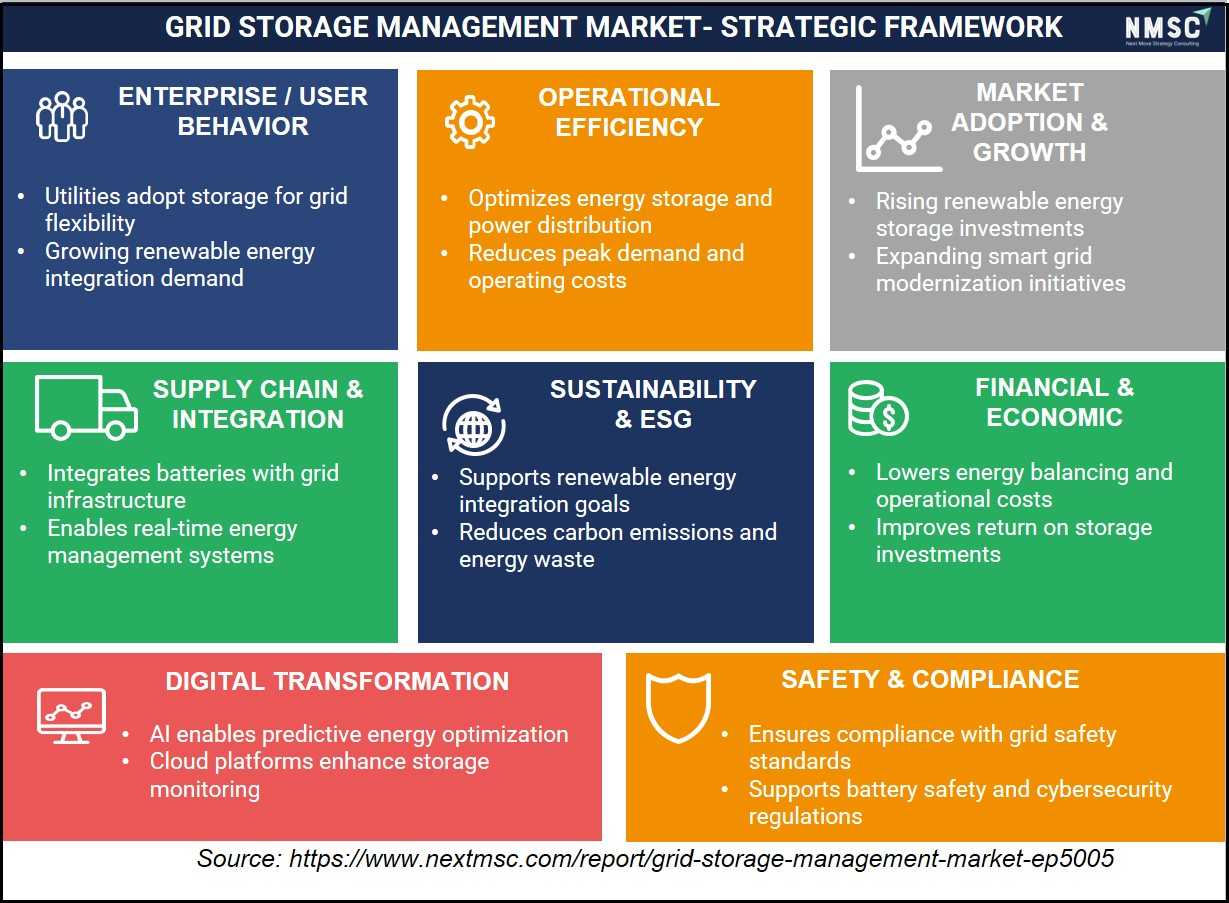
Based on our comprehensive assessment, we found that the Grid Storage Management Market is driven by increasing renewable energy integration, smart grid modernization, and utility demand for grid flexibility. AI-powered optimization, cloud-based monitoring, and real-time energy management improve operational efficiency and storage utilization. Our analysis indicates that sustainability goals, regulatory compliance requirements, and cost reduction strategies continue to strengthen long-term market adoption.
Competitive Landscape
Competitive Dynamics and M&A Landscape
|
Key Takeaways |
Details |
|
Market Structure |
The Grid Storage Management industry exhibits a moderately concentrated competitive structure, with a small number of global platform vendors, including Fluence Energy, Tesla, Siemens, GE Vernova, and ABB, holding significant market share through integrated hardware-software offerings. The market also supports a growing ecosystem of pure-play software specialists including Stem, FlexGen, and Powin that compete on software-first, hardware-agnostic platforms. Competitive differentiation centres on AI dispatch optimisation capability, market integration breadth, scalability across system sizes, and the depth of performance guarantee commercials. |
|
Innovation Focus |
Innovation activity in the Grid Storage Management Market is concentrated in AI-powered dispatch algorithms, multi-chemistry battery management capabilities, virtual power plant orchestration, long-duration storage management extensions, and cybersecurity-hardened control architectures. Leading vendors are investing in digital twin simulation for predictive maintenance, automated market bidding with real-time price signal integration, and open API frameworks that enable third-party service extensions. NMSC's analysis indicates that the competitive frontier is moving toward autonomous energy management systems that require minimal operator intervention while continuously optimising across multiple revenue streams. |
|
M&A Activity |
M&A activity in the Grid Storage Management Market has accelerated significantly as utilities, industrial conglomerates, and energy software investors seek to consolidate capabilities across hardware, software, and services. Notable activity includes Fluence Energy's acquisition of Nispera AG, a solar and wind asset performance management software firm, in 2022, which expanded its fleet analytics capabilities. Wärtsilä Corporation has pursued strategic acquisitions in energy storage and grid optimisation software to build its GEMS platform. The entry of large industrial technology companies including Honeywell, Emerson, and Schneider Electric reflects the broadening of competitive intensity as the market matures. |
How Do Companies Compete in the Grid Storage Management Market?
The Grid Storage Management Market is characterised by multi-dimensional competitive dynamics where differentiation occurs across software capability, commercial model flexibility, hardware integration breadth, and geographic reach. Established industrial automation companies including Schneider Electric, Siemens, and ABB compete through deep utility relationships, OT cybersecurity credentials, and the ability to bundle Grid Storage Management software within broader grid automation and substation automation offerings. Pure-play software vendors including Stem and FlexGen compete on AI dispatch performance, software deployment speed, and outcome-based pricing models. Hardware manufacturers including Tesla and Sungrow leverage vertically integrated hardware-software advantages and project-level bundling to capture software revenue alongside equipment sales.
Which Kind of Companies Dominate the Grid Storage Management Market?
The Grid Storage Management Market is dominated by two distinct company archetypes. The first comprises large industrial technology corporations, specifically Siemens, ABB, Schneider Electric, GE Vernova, Honeywell, and Emerson, which leverage global utility relationships, regulatory compliance credentials, and operational technology integration expertise to offer comprehensive grid energy management platforms. The second comprises specialist storage software and services companies, including Fluence Energy, Stem, FlexGen, and Powin, which compete on software-native architectures, AI-driven optimisation engines, and flexible commercial models. NMSC's analysis indicates that the market is gradually consolidating as specialist vendors scale and large industrials acquire software capabilities to close the AI and analytics gap.
AI-Native Differentiation and Open Standards Drive Market Success in the Grid Storage Management Market
From our research, we found that AI-native software architectures are becoming the primary source of competitive differentiation in the Grid Storage Management Market. Vendors that have built machine learning dispatch engines from the ground up, rather than layering AI on top of legacy SCADA-based control systems, consistently demonstrate superior revenue capture for their clients' storage assets. Simultaneously, open standards adoption, including the use of IEC 61850 communication protocols, OpenADR demand response signalling, and CIM-based data models, is increasingly a procurement requirement among sophisticated utility buyers that are managing multi-vendor storage fleets and seeking to avoid single-vendor lock-in across their Grid Storage Management software environments.
Market Players to Opt for Merger and Acquisition Strategies to Expand Their Presence in the Grid Storage Management Market
Merger and acquisition activity represents a central competitive strategy in the Grid Storage Management Market as participants seek to rapidly expand geographic coverage, technology capability, and customer base. Energy software consolidation has been driven by the recognition that a comprehensive Grid Storage Management platform must span site-level battery management, fleet-level portfolio optimisation, market bidding integration, and lifecycle managed services. Strategic buyers from outside the core storage software space, including ERP providers, renewable energy asset managers, and grid software vendors, are actively evaluating acquisition targets within the Market as the strategic importance of the software layer in the energy storage value chain becomes increasingly apparent to investors and corporates alike.
Who Are the Key Market Players in the Grid Storage Management Market?
-
Tesla, Inc.
-
Fluence Energy, Inc.
-
Wärtsilä Corporation
-
Schneider Electric SE
-
Siemens AG
-
GE Vernova Inc.
-
ABB Ltd
-
Sungrow Power Supply Co., Ltd.
-
Huawei Technologies Co., Ltd.
-
FlexGen Power Systems, Inc.
-
Stem, Inc.
-
Powin, LLC
-
Hitachi Energy Ltd.
-
Honeywell International Inc.
-
Envision Energy Co., Ltd.
-
Nidec Corporation
-
Energy Vault Holdings, Inc.
-
Emerson Electric Co.
-
Johnson Controls International plc
-
Doosan GridTech, Inc.
What Are the Latest Developments in the Grid Storage Management Industry?
|
Date |
Event |
|
June 2026 |
Wärtsilä Corporation announced a strategic joint venture with Germany’s RCT Solutions to consolidate its global energy storage business. This move aims to leverage RCT's manufacturing capabilities to achieve vertical integration and battery-storage production targets by late 2027. |
|
June 2026 |
GE Vernova introduced GridOS for Transmission at its Orchestrate 2026 conference. This unified intelligence solution integrates real-time operations, forecasting, and system stability into a single digital environment, specifically designed to address the coordination challenges of increasingly decentralized grids. |
|
May 2026 |
Schneider Electric launched its next-generation, "cell-to-grid-to-cell" Battery Energy Storage System (BESS) at its Innovation Summit India 2026. This platform is battery-agnostic and integrates directly with their ETAP-based design tools and digital services (Asset Advisor/Microgrid Advisor) to enable predictive maintenance and optimized market dispatch. |
Expert Insights

"Batteries will be an essential resource at data centers reliant on onsite gas generation, as gas generators are not fast enough to follow volatile AI data center demand."
— Ben Hertz-Shargel, Global Head of Grid Transformation, Wood Mackenzie
Statement made while discussing the growing role of battery energy storage systems in balancing power demand, improving grid flexibility, and supporting rapidly expanding electricity consumption from AI-driven data centers.
Market Interpretation
The comment highlights the increasing importance of grid storage management solutions in maintaining grid stability and balancing fluctuating electricity demand. As renewable energy deployment expands and electricity consumption from data centers, industrial facilities, and electrification initiatives continues to rise, battery energy storage systems are becoming critical assets for grid operators and utilities. Advanced grid storage management platforms enable real-time monitoring, energy dispatch optimization, load balancing, and demand forecasting, helping maximize storage performance and improve grid reliability. The growing need for flexible and intelligent energy management is driving investment in grid-scale storage infrastructure and sophisticated storage management software, supporting the long-term expansion of the Grid Storage Management Market.
What Are the Investment Opportunities in the Grid Storage Management Market?
Capital Inflows and Venture Funding
The Grid Storage Management Market is attracting sustained and growing capital inflows from both strategic investors and financial investors recognising the structural growth trajectory of energy storage software. Venture capital and growth equity investment in energy storage software platforms has accelerated alongside the global energy transition, with Grid Storage Management platforms benefiting from the broader tailwind of clean energy technology investment. Based on our market evaluation, we noticed that the U.S. Department of Energy's Loan Programs Office and the European Investment Bank have both provided capital to energy storage projects that include significant software management components, creating a mixed public-private investment environment that de-risks early-stage commercial deployments.
Infrastructure Investment and Project Finance
Grid storage infrastructure investments funded through project finance structures create a recurring and predictable revenue stream for Grid Storage Management software providers. As utilities and independent power producers sign 10 to 20-year project finance agreements for grid-scale storage, the associated software management contracts generate multi-year subscription or performance-based revenue. Our analysis shows that the alignment between long-duration storage asset finance agreements and recurring software revenue models is particularly attractive to investors seeking utility-like cash flow visibility from energy software assets. Infrastructure-focused private equity firms are increasingly structuring investments in Grid Storage Management software platforms as quasi-infrastructure investments with predictable contracted revenue profiles.
ESG Considerations and Clean Energy Mandates
Grid Storage Management software plays a direct role in enabling the renewable energy integration that underlies most institutional investors' ESG and net-zero commitments. Asset managers operating under the Task Force on Climate-related Financial Disclosures framework and sustainability mandates are directing capital toward grid storage infrastructure and supporting software. From our research, we found that the UN Principles for Responsible Investment network's guidance on energy transition investment explicitly recognises grid storage as a critical enabling technology, creating a structural alignment between institutional ESG investment mandates and Grid Storage Management software market growth. This ESG tailwind is expected to sustain above-average capital availability for the sector throughout the forecast period.
Digital Transformation of Grid Operations
The digital transformation of electricity grid operations represents a multi-decade investment cycle that directly benefits Grid Storage Management software providers. Utilities and grid operators are simultaneously investing in advanced metering infrastructure, distribution automation, operational technology cybersecurity, and energy storage management software as components of a broader grid modernisation program. NMSC's analysis indicates that the U.S. Department of Energy's Grid Modernisation Initiative, with multiple billion dollars of federal investment across DOE national laboratories and industry partners, is accelerating the technology development and market adoption timelines for next-generation grid storage management capabilities including AI-driven dispatch and digital twin asset management.
Private Equity and Strategic M&A Activity
Private equity activity in the Grid Storage Management Market has intensified as financial investors recognise the sector's recurring revenue potential, regulatory tailwinds, and long-term growth visibility. Platform-building investment strategies, where PE firms acquire multiple complementary Grid Storage Management software businesses and combine them into integrated offerings, are creating a new category of well-capitalised mid-tier competitors. Our assessment indicates that strategic M&A from large industrial technology companies including Honeywell, Emerson, Schneider Electric, and Siemens represents a parallel investment theme as these organisations seek to supplement organic development with acquired software capabilities in AI dispatch optimisation, VPP orchestration, and performance-based commercial model design.
Key Benefits for Stakeholders
For Utility Companies
Utility companies gain comprehensive intelligence into the Grid Storage Management Market trends, including quantitative analysis across software categories, deployment models, application segments, and utility-scale storage deployments. The report supports storage software procurement planning, vendor evaluation, and long-term grid modernization strategies by providing visibility into platform capabilities, software adoption trends, and commercial model evolution. Detailed regional analysis further enables utilities to benchmark investment priorities, evaluate technology maturity, and align storage management initiatives with reliability, resiliency, and renewable integration objectives.
For Independent Power Producers and Renewable Energy Developers
Independent power producers and renewable energy developers gain actionable insights into revenue optimization opportunities, software adoption trends, and market growth potential across grid-connected storage assets. The report provides detailed analysis of application-level demand, commercial model preferences, and software vendor positioning, supporting investment planning and project development decisions. Segment-level forecasts and regional outlook assessments help developers identify attractive growth markets and optimize software selection for renewable energy storage projects and hybrid power generation facilities.
For Energy Aggregators and Virtual Power Plant Operators
Energy aggregators and virtual power plant operators obtain structured intelligence on fleet optimization platforms, distributed energy resource management systems, and grid participation software solutions. The report provides visibility into emerging software capabilities, market access requirements, and regulatory developments influencing virtual power plant deployment across key regions. This analysis supports technology selection, partnership evaluation, and long-term investment planning for organizations seeking to maximize value from aggregated energy assets.
For Software Vendors and Technology Providers
Software vendors and technology providers gain actionable intelligence regarding competitive positioning, whitespace opportunities, customer adoption trends, and evolving buyer requirements within the Grid Storage Management Market. Detailed segmentation analysis highlights the fastest-growing software categories, deployment preferences, and end-user demand patterns, enabling vendors to refine product development roadmaps and optimize go-to-market strategies. Regional assessments further support geographic expansion planning and channel development initiatives across mature and emerging energy storage markets.
For Financial Investors
Private equity firms, venture capital investors, infrastructure funds, and institutional investors gain access to a comprehensive assessment of the Grid Storage Management Market's growth outlook, competitive landscape, and investment opportunities through 2035. Detailed market sizing, CAGR forecasts, and company-level analysis support valuation modeling, investment screening, and portfolio construction activities. Strategic development tracking and competitive benchmarking provide early visibility into acquisition opportunities, emerging market leaders, and technology segments positioned for accelerated growth.
For Regulatory and Policy Stakeholders
Government agencies, energy regulators, transmission authorities, and policy advisory organizations gain structured insights into energy storage software adoption trends, market development patterns, and regulatory influences shaping the Grid Storage Management Market. Country-level and regional analysis support evidence-based policy development, storage market design initiatives, grid modernization planning, and renewable energy integration programs. The report also provides visibility into emerging technology trends and operational challenges relevant to future regulatory frameworks.
For Research and Academic Institutions
Research and academic institutions gain access to a comprehensive and data-rich assessment of the Grid Storage Management Market that supports scholarly research, policy analysis, and technology evaluation activities. The report's detailed market sizing, technology trend analysis, and regional performance data provide a robust empirical foundation for academic publications, conference presentations, and grant-funded research programs focused on energy storage, grid modernization, and digital energy transition topics.
Grid Storage Management Market Key Segments
By Offering
-
Software Platforms
-
Site Control Software
-
Battery Management Systems
-
Energy Management Systems
-
Plant Controllers
-
SCADA and Monitoring
-
-
Fleet Optimisation Software
-
Portfolio Management Platforms
-
Virtual Power Plant Platforms
-
Energy Trading Platforms
-
Forecasting and Analytics Platforms
-
-
-
Services
-
Deployment Services
-
System Configuration
-
Grid Integration
-
Software Commissioning
-
-
Lifecycle Services
-
Monitoring Services
-
Software Maintenance
-
Performance Optimization
-
Managed Operations
-
-
By Deployment Type
-
Utility Scale
-
Standalone Storage
-
Hybrid Renewable Storage
-
-
Commercial and Industrial
-
Industrial Facilities
-
Commercial Facilities
-
Critical Infrastructure
-
-
Microgrid
-
Campus Microgrids
-
Remote Microgrids
-
Islanded Systems
-
-
Virtual Power Plant
-
Distributed Storage Networks
-
Aggregated Energy Assets
-
By Commercial Model
-
Perpetual License
-
Subscription Software
-
Project-Based Contract
-
Managed Service
-
Performance Based Agreement
By Buyer Type
-
Utilities
-
Transmission Operators
-
Distribution Operators
-
Vertically Integrated Utilities
-
-
Power Producers
-
Independent Power Producers
-
Renewable Developers
-
-
Commercial and Industrial Owners
-
Industrial Operators
-
Data Centre Operators
-
Commercial Real Estate
-
-
Energy Aggregators
-
Retail Energy Providers
-
Virtual Power Plant Operators
-
By End User
-
Grid Infrastructure
-
Transmission Networks
-
Distribution Networks
-
Substations
-
-
Power Generation
-
Solar and Storage Plants
-
Wind and Storage Plants
-
Standalone Storage Plants
-
Thermal Hybrid Plants
-
-
Distributed Energy Networks
-
Virtual Power Plants
-
Residential Storage Networks
-
Aggregator Portfolios
-
By Application
-
Frequency Regulation
-
Energy Arbitrage
-
Renewable Firming
-
Peak Demand Management
-
Backup and Resilience
-
Congestion Relief
-
Black Start Support
-
Capacity Optimization
By Storage Technology Managed
-
Lithium Iron Phosphate
-
Lithium Nickel Manganese Cobalt
-
Sodium Ion
-
Flow Battery
-
Mechanical Storage
-
Thermal Storage
-
Hybrid Storage
-
Other Electrochemical Storage
By Region
-
North America: U.S., Canada, and Mexico
-
Europe: UK, Germany, France, Italy, Spain, Sweden, Denmark, Finland, the Netherlands, and the Rest of Europe
-
Asia-Pacific: China, India, Japan, South Korea, Taiwan, Indonesia, Vietnam, Australia, Philippines, Malaysia, and the Rest of APAC
-
Middle East and Africa: Saudi Arabia, UAE, Egypt, Israel, Turkey, Nigeria, South Africa, and the Rest of MEA
-
Latin America: Brazil, Argentina, Chile, Colombia, and the Rest of LATAM
Conclusion and Recommendations
Long-Term Outlook
The Grid Storage Management Market is entering a decade of structural expansion driven by the convergence of unprecedented renewable energy investment, grid decarbonisation policy commitments, and rapid advancement in AI-powered energy optimisation software. Our analysis shows that the market is projected to grow from USD 2.8 billion in 2025 to USD 18.4 billion by 2035 at a CAGR of 21.0%, reflecting both the scale of storage deployments requiring software management and the increasing strategic premium placed on optimisation software by asset owners, utilities, and investors. The long-term trajectory of the Market is supported by durable structural drivers that are unlikely to reverse within the forecast period.
Strategic Positioning
NMSC's analysis indicates that the most successful Grid Storage Management competitors will be those that establish defensible positions across multiple dimensions of competitive advantage simultaneously. Platforms with the deepest AI dispatch optimisation capabilities, the broadest regulatory market integration coverage, and the most flexible commercial model portfolios will disproportionately capture market share as buyers move away from lowest-cost software selection toward total-return-on-software-investment analysis. Strategic positioning around open architecture, multi-chemistry compatibility, and VPP orchestration capabilities will be particularly valuable as the market evolves toward aggregated distributed storage management at scale.
Investment Attractiveness
From a capital allocation perspective, the Grid Storage Management Market presents a highly attractive investment profile characterised by recurring subscription and performance-based revenue models, strong secular growth tailwinds from energy transition policy, significant barriers to entry from regulatory compliance requirements, and an expanding addressable market driven by the global storage deployment pipeline. Our assessment indicates that companies with proven AI dispatch optimisation performance, multi-market regulatory certifications, and established managed service capabilities are the most defensible and highest-value investment targets within the market's current competitive landscape.
Market Shifts and Key Risks
The Grid Storage Management Market faces several key risks that stakeholders should monitor throughout the forecast period. Cybersecurity threats targeting OT systems connected to critical grid infrastructure represent the most operationally significant risk, as a major incident involving a compromised Grid Storage Management platform could trigger regulatory responses that increase compliance costs across the industry. Technology disruption risk is also present if breakthrough storage technologies with fundamentally different management requirements achieve faster-than-expected commercial deployment. Geopolitical risks affecting global battery supply chains could slow storage deployment rates and indirectly constrain software management market growth, particularly in markets dependent on imported BESS equipment.
Growth Pathways
The most compelling growth pathways for Grid Storage Management Market participants over the forecast period include geographic expansion into Asia-Pacific emerging markets where storage deployment is accelerating but software adoption lags, the development of long-duration storage management software capabilities for iron-air and flow battery systems, and the build-out of VPP orchestration platforms as aggregation market frameworks formalise across major electricity markets. Additionally, the integration of Grid Storage Management software with electric vehicle smart charging management and demand-side management platforms represents a convergence opportunity that could materially expand the software addressable market for leading platform vendors beyond the core BESS management use case.
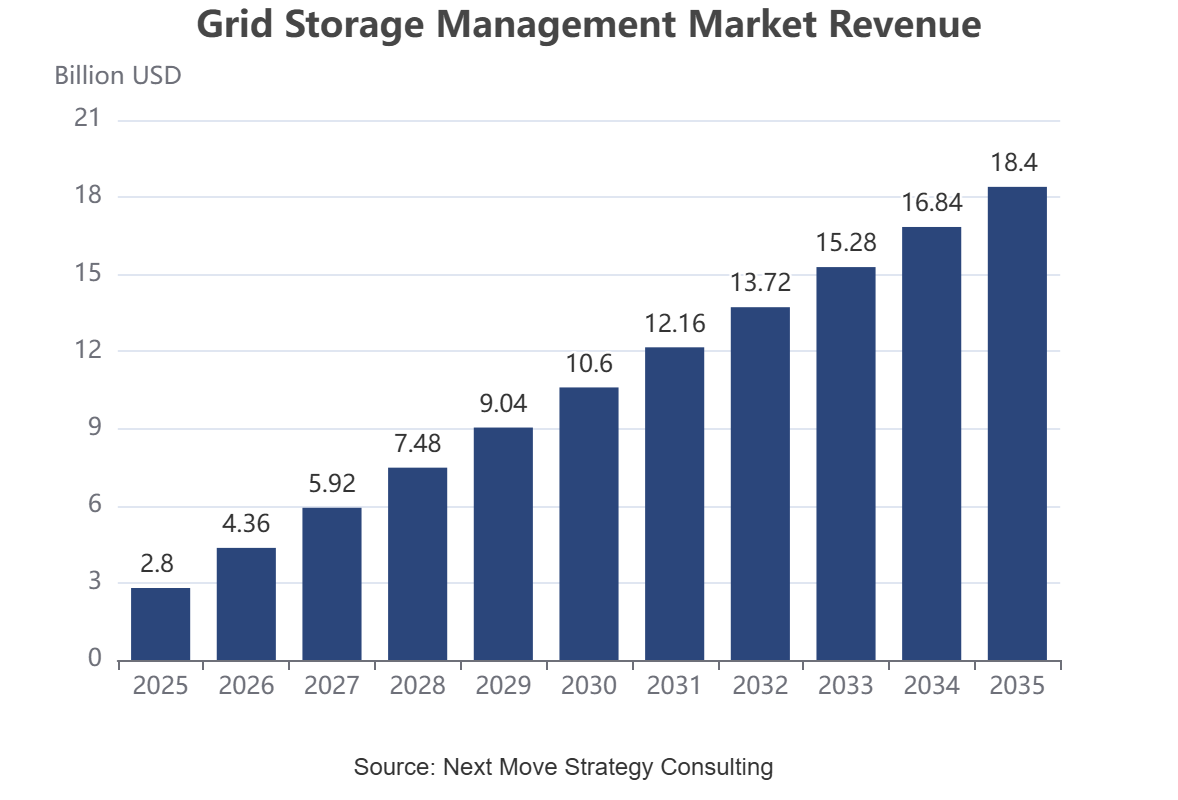
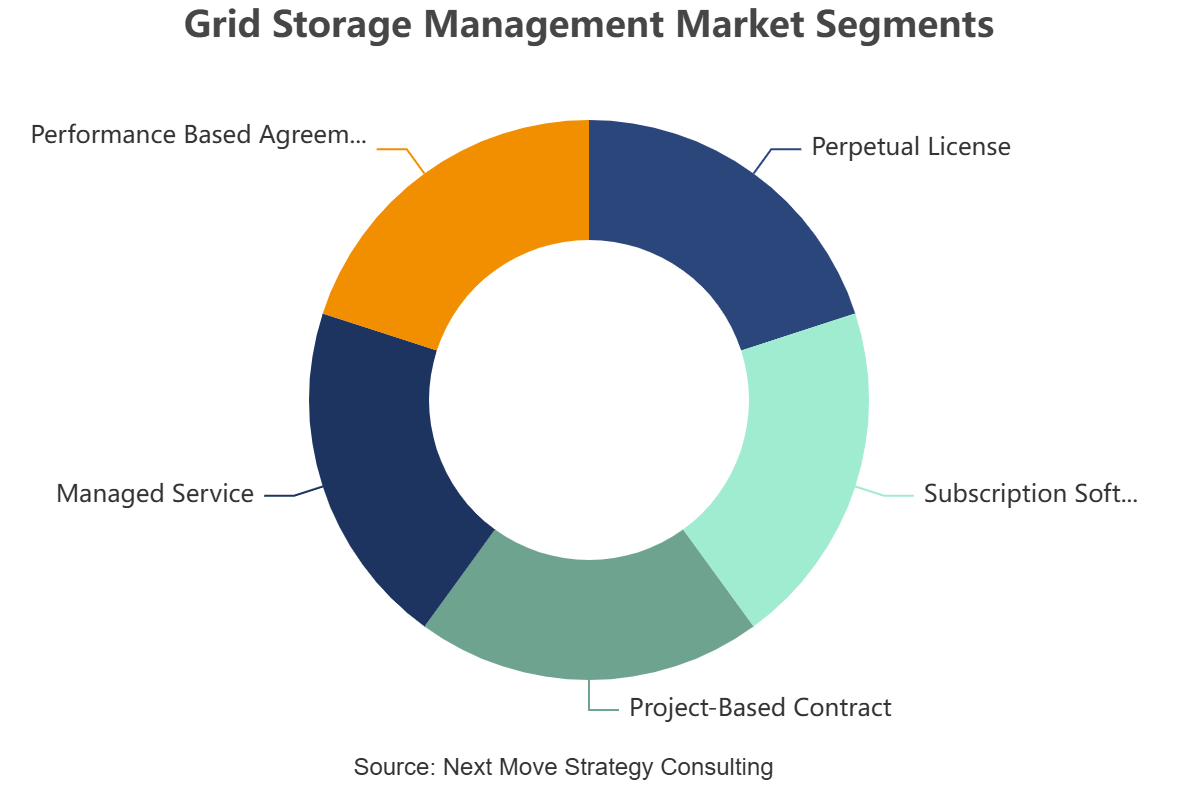
About the Author
 Saista Faiyaz
— Saista Faiyaz is Research Associate at Next Move Strategy Consulting, where she has covered consumer markets and healthcare technologies for 3 years. Her work includes primary interview review, secondary-source validation, market sizing, and structured analysis of company and industry data. She supports research by comparing evidence across sources, organizing findings into market narratives, and documenting assumptions used in analysis. Her scope includes cross-market benchmarking, and reports.
Saista Faiyaz
— Saista Faiyaz is Research Associate at Next Move Strategy Consulting, where she has covered consumer markets and healthcare technologies for 3 years. Her work includes primary interview review, secondary-source validation, market sizing, and structured analysis of company and industry data. She supports research by comparing evidence across sources, organizing findings into market narratives, and documenting assumptions used in analysis. Her scope includes cross-market benchmarking, and reports.
About the Reviewer
 Supradip Baul
— Supradip Baul is an accomplished business consultant and strategist with over a decade of rich experience in market intelligence, strategy, technology, and business transformation. His work has included rigorous qualitative and quantitative analysis across multiple industries, helping clients shape investment decisions and long-term roadmaps. Earlier in his career, he was associated with Gartner, where he contributed to industry-leading reports and market share analyses. He has worked with leading global companies and holds an MBA with a dual specialization in Marketing and Finance.
Supradip Baul
— Supradip Baul is an accomplished business consultant and strategist with over a decade of rich experience in market intelligence, strategy, technology, and business transformation. His work has included rigorous qualitative and quantitative analysis across multiple industries, helping clients shape investment decisions and long-term roadmaps. Earlier in his career, he was associated with Gartner, where he contributed to industry-leading reports and market share analyses. He has worked with leading global companies and holds an MBA with a dual specialization in Marketing and Finance.
At Next Move Strategy Consulting, we understand that insightful market research is the cornerstone of successful business decisions. That's why we employ a robust and multifaceted approach, combining various methodologies to deliver the most accurate and actionable data for our clients.

Research Landscape
We navigate the world of research with two primary approaches:
Qualitative Approach
Our qualitative research methodologies involve immersive techniques such as in-depth interviews, focus groups, and observational studies. By engaging directly with individuals and stakeholders, we uncover valuable insights that quantitative data alone may overlook.

Quantitative Research
In tandem with qualitative methodologies, NMSC leverages the power of Quantitative Research to provide a robust foundation of numerical insights. Through systematic data collection and analysis, we quantify patterns, preferences, and market trends, offering a comprehensive view of the business landscape.
Our quantitative research approach employs diverse tools, including surveys, experiments, and statistical modelling. These methodologies enable us to gather data from a large and representative sample, ensuring the statistical significance of our findings. By employing structured questionnaires and standardized data collection methods, we guarantee the reliability and validity of the information we present to our clients.
Quantitative research is particularly effective in measuring the prevalence of trends, assessing market size, and gauging the impact of various factors on consumer behavior. The numerical precision attained through this approach equips our clients with actionable insights, facilitating data-driven decision-making and strategy formulation.


Our Specialized Toolbox for Industry-Specific Market Research
We deploy a specialized arsenal of techniques tailored to meet your unique requirements. Here's a glimpse into our comprehensive toolbox:

Information Procurement
The stage entails acquiring market data or relevant information through various sources and methodologies.


Market Research Approach
We utilize both top-down and bottom-up approaches in market research analysis to achieve a comprehensive understanding of the market dynamics, leveraging the broad perspective of industry trends and macroeconomic factors alongside detailed insights from specific segments and individual companies.

Porters Five Forces Analysis
We conduct Porter's Five Forces analysis to evaluate the competitive landscape of an industry, providing us with insights into factors that affect profitability and strategic positioning.

SWOT Analysis

Forecasting
We utilize a forecasting model to predict future consumption by considering parameters like population, economics, regulations, market competition, drivers, constraints, technology, and pricing. We also employ statistical techniques such as multilinear regression, exponential smoothing, moving average, ARIMA, and Monte Carlo simulations for accurate predictions. In econometric forecasting, we analyzed short-term and long-term event impacts, attributing values based on regulatory frameworks, economic factors, and market events.





 Speak to Our Analyst