Viral Vector Market Global Industry Analysis and Forecast (2026–2035)

Viral Vector Market size was USD 25 Billion in 2025, projected to reach USD 51.54 Billion by 2035, growing at a CAGR of 7.5% from 2026 to 2035. Key drivers include expanding gene and cell therapy pipelines, rising outsourcing to contract manufacturers, capsid engineering advances, with North America leading the global market.

Download Free Sample PDF
Base Year (2025)
$25.00 Billion
Forecast (2035)
$51.54 Billion
CAGR (2026-2035)
7.5%
Top Region
North America

What Is the Viral Vector Market Size?

The global viral vector market reached USD 25 Billion in 2025 and is estimated at USD 26.88 Billion in 2026, forecast to reach USD 51.54 Billion by 2035 at a CAGR of 7.5% between 2026 and 2035. North America leads with approximately 34% revenue share in 2025, while the Standard Viral Vector Systems segment is the dominant product type, holding approximately 49% of total market revenue.

We observed that technological shifts are reshaping the viral vector landscape as developers move from transient plasmid-based production toward stable producer cell lines and scalable suspension culture systems. Advances in capsid engineering are enabling tissue-targeted delivery with improved transduction efficiency, which in turn raises the bar for analytical characterization of genome titer, empty-to-full capsid ratios, and residual host cell impurities. Our findings suggest that operational scale, rather than process invention alone, now determines which manufacturers can secure long-term supply agreements with sponsors advancing late-stage programs.

Viral Vector Market Global Industry Analysis and Forecast (2026–2035) Revenue Forecast

Values in USD Billion

2025 $25.00 Billion
2025
2026 $26.88 Billion
2026
2027 $28.90 Billion
2027
2028 $31.06 Billion
2028
2029 $33.39 Billion
2029
2030 $35.90 Billion
2030
2031 $38.59 Billion
2031
2032 $41.48 Billion
2032
2033 $44.60 Billion
2033
2034 $47.94 Billion
2034
2035 $51.54 Billion
2035

Key Takeaways

By Product Type: Standard Viral Vector Systems held the largest share, expanding from USD 12.25 Billion in 2025 to USD 23.45 Billion by 2035; The Specialized Custom Formats segment is the fastest-growing at 9.63% CAGR from 2026–2035.

By Application: Commercial Operations held the largest share, expanding from USD 10.67 Billion in 2025 to USD 18.73 Billion by 2035; The Specialized Operational Deployments segment is the fastest-growing at 9.65% CAGR from 2026–2035.

By End User: Commercial Enterprises & Operators held the largest share, expanding from USD 12.14 Billion in 2025 to USD 22.27 Billion by 2035; The Institutional & Public Sector Entities segment is the fastest-growing cohort at 9.79% CAGR from 2026–2035.

By Sales Channel: Direct Enterprise Procurement held the largest share, expanding from USD 10.72 Billion in 2025 to USD 18.49 Billion by 2035; The Specialized Systems Integrators segment is the fastest-growing channel at 10.41% CAGR from 2026–2035.

Dominant Region: North America dominated the market with approximately 34% revenue share (USD 8.5 Billion) in 2025, anchored by mature commercial infrastructure, robust customer demand, and high concentrations of established industry participants.

Fastest-Growing Region: Asia-Pacific is expected to register the highest CAGR of 10.64% during 2026–2035, driven by expanding biopharmaceutical research activity, rising private investment in gene and cell therapy development, and increasing regional manufacturing capacity.

Dominant Country: The U.S. led the market with an estimated USD 6.46 Billion in 2025 (~76% of North America), supported by extensive commercial demand, established supplier networks, and strong domestic buyer participation.

Fastest-Growing Country: India is among the fastest-growing major countries, projected to expand from USD 1.35 Billion in 2025 at a CAGR of approximately 12.45%, driven by growing regional adoption, expanding domestic distribution networks, and increasing local market demand.

Between 2026 and 2035, the viral vector market is positioned to add an absolute dollar opportunity of USD 24.66 billion, expanding from USD 26.88 billion to USD 51.54 billion. This incremental value reflects the convergence of rising therapeutic pipelines, broader indication coverage beyond rare monogenic disorders, and increasing reliance on external manufacturing partners. Capturing this opportunity will depend on sponsors' ability to secure timely capacity, maintain consistent vector quality across batches, and align production timelines with clinical trial milestones.

Competitive consolidation in the viral vector market is accelerating as large contract manufacturers, plasmid and vector specialists, and [biologics](https: //www.nextmsc.com/report/biologics-market) developers pursue vertical integration and strategic alliances. Partnerships between OEM-scale producers and emerging therapy developers are reshaping supply chain architecture by linking upstream plasmid supply with downstream vector fill and finish. Recent collaborations, such as the lentiviral plasmid supply renewal between Aldevron and Minaris in May 2026, illustrate how long-term supply agreements are becoming a core instrument for securing manufacturing continuity and scale.

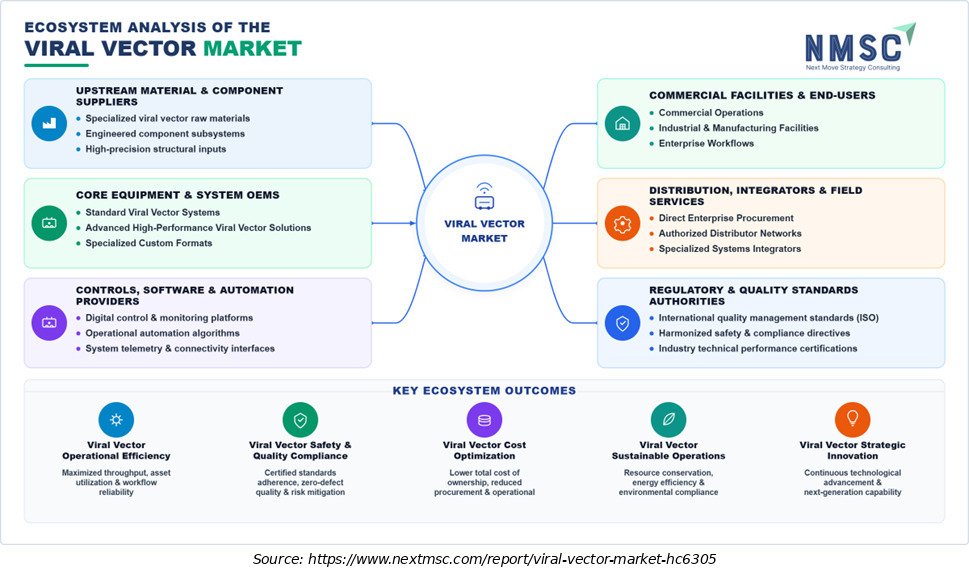
Ecosystem Analysis of the Viral Vector Industry

The above infographic presents the Viral Vector market ecosystem in a structured format, focusing on six core stakeholder groups: upstream material & component suppliers, core equipment & system OEMs, controls, software & automation providers, commercial facilities & end-users, distribution, integrators & field services, regulatory & quality standards authorities. It shows how these participants support operations while contributing to operational efficiency, safety, cost optimization, sustainability, and technological innovation across diverse operating environments.

What Does the Viral Vector Market Encompass?

The viral vector market encompasses the design, production, purification, and supply of engineered viral carriers used to deliver genetic material into target cells for research and therapeutic purposes. Core product types include adeno-associated virus vectors, lentiviral vectors, adenoviral vectors, and retroviral vectors, each suited to distinct tissue targets and payload sizes. Upstream inputs such as plasmid DNA, packaging cell lines, and specialized culture media feed into these core technologies, which collectively support gene therapy, cell therapy, and vaccine development programs.

Design specifications in the viral vector market focus on capsid serotype selection, transgene cassette architecture, titer targets, and purity thresholds that govern transduction performance and patient safety. Material innovations include serum-free suspension culture media, stable producer cell lines, and chromatography resins optimized for high recovery of intact particles. Manufacturing sites are typically evaluated against good manufacturing practice standards, and certification frameworks issued by national health authorities define acceptance criteria for clinical and commercial supply.

Market Drivers & Dynamics

Interactive Dataset
Expanding gene and cell therapy pipelines driver High Immediate
Rising outsourcing to contract manufacturers driver High Immediate
Capsid engineering advances driver Medium Medium-term
Complex and costly manufacturing processes restraint High Immediate
Stringent regulatory and quality requirements restraint Medium Medium-term
Immunogenicity and safety concerns restraint Low Long-term
Source: Next Move Strategy Consulting

Growth Drivers

Expanding gene and cell therapy pipelines

The primary catalyst for the viral vector market is the growing clinical and commercial pipeline of gene and cell therapies that depend on vector-based delivery. Each advancing program creates demand for research-grade, clinical-grade, and commercial-grade vector supply, which compounds as more candidates enter late-stage trials. Next Move Strategy Consulting's analysis indicates that this pipeline depth is the most direct determinant of volume expansion across the forecast period.

Growth Inhibitors

Complex and costly manufacturing processes

The principal restraint is the high cost and technical complexity of producing clinical-grade viral vectors at commercial scale. Low volumetric yields, extended purification sequences, and limited availability of specialized equipment elevate the cost per dose. Our assessment indicates that capacity bottlenecks in downstream processing and fill and finish will continue to constrain how quickly the market can convert pipeline demand into supply.

What Are the Growth Opportunities?

Can Next-Generation Capsid Platforms Expand Therapeutic Applications?

Engineered capsids with improved tissue selectivity offer a pathway to indications that current serotypes cannot address efficiently. Developers that secure proprietary capsid libraries can differentiate their production offerings and attract sponsors seeking differentiated delivery profiles. Commercializing these next-generation capsids will require scalable manufacturing processes and validated potency assays to ensure consistent production and therapeutic performance.

How Is Mid-Tier and Regional Facility Adoption Unlocking New Market Volume?

Mid-tier and regional manufacturing facilities are expanding their viral vector capabilities to serve local biotechnology clusters and academic translational programs. Shorter supply chains and closer proximity to clinical sites reduce shipping complexity for time-sensitive vector lots. Such facilities can unlock incremental volume by offering flexible batch sizes and responsive technical support to emerging sponsors.

Can Specialized Vertical Implementations Become Distinct Premium Markets?

Specialized applications, including allogeneic cell therapy engineering and in vivo gene editing delivery, require tailored vector designs and premium-grade process controls. These niches command higher pricing reflecting their technical demands and limited supplier pools. Companies that build dedicated capabilities for these applications may establish durable premium positions within the broader viral vector market.

Segmentation Analysis

2025 (USD Billion)
2035 (USD Billion)
Standard Viral Vector Systems 2025: $12.25 Billion | 2035: $13.18 Billion
Standard Vir
Advanced High-Performance Viral Vector Solutions 2025: $7.51 Billion | 2035: $8.07 Billion
Advanced Hig
Specialized Custom Formats 2025: $5.24 Billion | 2035: $5.63 Billion
Specialized
Standard Viral Vector Systems $12.25 Billion $13.18 Billion USD 23.45 Billion
Advanced High-Performance Viral Vector Solutions $7.51 Billion $8.07 Billion USD 15.21 Billion
Specialized Custom Formats $5.24 Billion $5.63 Billion USD 12.88 Billion

Which Product Type Segment Dominates the Market?

The installed base of standard systems anchors the viral vector market, with Standard Viral Vector Systems accounting for roughly 49% of revenue and USD 12.25 billion in 2025. Capital procurement favors established platforms because manufacturers have validated these systems against regulatory expectations and existing production workflows. Specialized Custom Formats, however, are expanding at a 9.63% CAGR through 2035 as developers demand tailored constructs for novel therapeutic targets. This divergence positions standard systems as the demand anchor while custom formats serve as the principal growth engine.

2025 (USD Billion)
2035 (USD Billion)
Category A
Category B
Category C
Category D
Segment Item 2025 (USD Billion) 2035 (USD Billion) CAGR
Category A $10.0 USD Billion $40.0 USD Billion 18.0%
Category B $17.1 USD Billion $51.1 USD Billion 16.0%
Category C $24.2 USD Billion $62.2 USD Billion 22.0%
Category D $31.3 USD Billion $73.3 USD Billion 12.0%

Segment-wise data is locked

Unlock complete segment-wise numbers for By Application.

Unlock Full Data
2025 (USD Billion)
2035 (USD Billion)
Category A
Category B
Category C
Category D
Segment Item 2025 (USD Billion) 2035 (USD Billion) CAGR
Category A $10.0 USD Billion $40.0 USD Billion 26.0%
Category B $17.1 USD Billion $51.1 USD Billion 16.0%
Category C $24.2 USD Billion $62.2 USD Billion 18.0%
Category D $31.3 USD Billion $73.3 USD Billion 8.0%

Segment-wise data is locked

Unlock complete segment-wise numbers for By End User.

Unlock Full Data
2025 (USD Billion)
2035 (USD Billion)
Category A
Category B
Category C
Category D
Segment Item 2025 (USD Billion) 2035 (USD Billion) CAGR
Category A $10.0 USD Billion $40.0 USD Billion 24.0%
Category B $17.1 USD Billion $51.1 USD Billion 10.0%
Category C $24.2 USD Billion $62.2 USD Billion 8.0%
Category D $31.3 USD Billion $73.3 USD Billion 14.0%

Segment-wise data is locked

Unlock complete segment-wise numbers for By Sales Channel.

Unlock Full Data

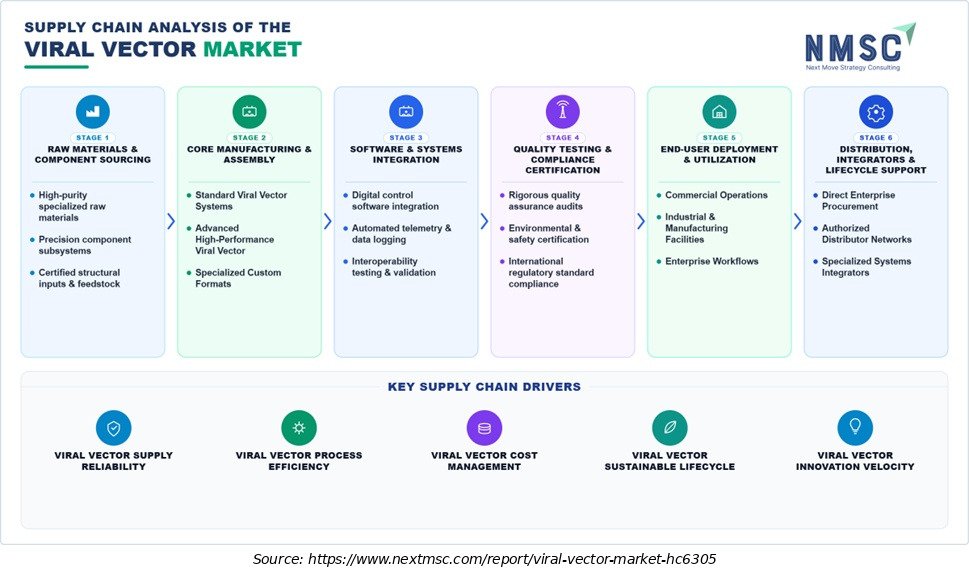
Supply Chain Analysis of the Viral Vector Industry

Supply Chain Analysis of the Viral Vector Industry
The above infographic maps the Viral Vector market supply chain across six sequential stages: stage 1: raw materials & component sourcing, stage 2: core manufacturing & assembly, stage 3: software & systems integration, stage 4: quality testing & compliance certification, stage 5: end-user deployment & utilization, stage 6: distribution, integrators & lifecycle support. It illustrates how these stages connect to ensure component reliability, manufacturing precision, supply stability, cost control, and rapid technological deployment across end-user environments.

Growth Opportunities

Our analysis shows that three emerging growth opportunities are positioned to generate disproportionate commercial returns in the Viral Vector Market through 2035:

Can Next-Generation Capsid Platforms Expand Therapeutic Applications?

Engineered capsids with improved tissue selectivity offer a pathway to indications that current serotypes cannot address efficiently. Developers that secure proprietary capsid libraries can differentiate their production offerings and attract sponsors seeking differentiated delivery profiles. Commercializing these next-generation capsids will require scalable manufacturing processes and validated potency assays to ensure consistent production and therapeutic performance.

How Is Mid-Tier and Regional Facility Adoption Unlocking New Market Volume?

Mid-tier and regional manufacturing facilities are expanding their viral vector capabilities to serve local biotechnology clusters and academic translational programs. Shorter supply chains and closer proximity to clinical sites reduce shipping complexity for time-sensitive vector lots. Such facilities can unlock incremental volume by offering flexible batch sizes and responsive technical support to emerging sponsors.

Can Specialized Vertical Implementations Become Distinct Premium Markets?

Specialized applications, including allogeneic cell therapy engineering and in vivo gene editing delivery, require tailored vector designs and premium-grade process controls. These niches command higher pricing reflecting their technical demands and limited supplier pools. Companies that build dedicated capabilities for these applications may establish durable premium positions within the broader viral vector market.

Regional Outlook

2025 (USD Billion)
2035 (USD Billion)
North Americ
Europe
Asia-Pacific
Latin Americ
Middle East
Region 2025 (USD Billion) 2035 (USD Billion) CAGR (%)
North America $10.0 USD Billion $40.0 USD Billion 9.0%
Europe $17.1 USD Billion $51.1 USD Billion 27.0%
Asia-Pacific $24.2 USD Billion $62.2 USD Billion 25.0%
Latin America $31.3 USD Billion $73.3 USD Billion 23.0%
Middle East & Africa $38.4 USD Billion $84.4 USD Billion 12.0%

Regional data is locked

Unlock complete regional numbers for this market.

Unlock Full Data

Competitive Landscape

The viral vector market is shaped by a concentrated group of established contract development and manufacturing organizations alongside specialized vector producers. Thermo Fisher Scientific Inc., Lonza Group AG, Catalent, Inc., Merck KGaA, and WuXi AppTec Co., Ltd. hold substantial scale advantages in process development and commercial supply. Smaller specialists such as Oxford Biomedica PLC, Aldevron LLC, and AGC Biologics, Inc. compete on focused technical capabilities. Competitive intensity is rising as recent partnerships broaden platform access across research and commercial stages.

Dimension Description
Vector Quality & Batch Consistency Consistent vector purity, potency, and lot-to-lot reproducibility determine supplier qualification and long-term retention across viral vector programs.
Manufacturing Footprint & Supply Reach Global manufacturing facilities and established supply networks enable viral vector manufacturers to serve pharmaceutical and biotechnology developers across North America, Europe, and Asia-Pacific.
Design & Customization Moat Ability to engineer custom vector constructs and capsids for novel therapeutic targets creates differentiation in the fastest-growing specialized formats.
Material Innovation & Sustainability Advances in plasmid production, cell line efficiency, and process intensification reduce material consumption and improve manufacturing yields.

How Do Companies Compete in the Viral Vector Market?

Companies in the viral vector market differentiate primarily on process reliability, yield performance, and regulatory documentation depth. Pricing is typically structured around batch scale, development services, and long-term supply commitments rather than standardized unit rates. Distribution relies heavily on direct enterprise relationships supplemented by systems integrators who bundle implementation support. Providers that combine technical service depth with dependable supply continuity secure stronger positions with therapeutic developers.

Which Competitive Archetypes Dominate the Viral Vector Market?

The viral vector market features three primary participant archetypes: integrated CDMO platforms, specialized vector manufacturers, and plasmid and materials suppliers. Integrated platforms such as Lonza Group AG, Thermo Fisher Scientific Inc., and Catalent, Inc. offer end-to-end development and commercial production. Specialized manufacturers including Oxford Biomedica PLC, AGC Biologics, Inc., and FUJIFILM Holdings Corporation focus on vector production depth. Aldevron LLC exemplifies the plasmid supply archetype that underpins upstream manufacturing workflows.

What Innovation and Differentiation Strategies Are Companies Pursuing?

Sustainable advantages in the viral vector market rest on validated process platforms, accumulated regulatory track records, and proven scale-up capability. Providers that maintain consistent quality across development and commercial batches build durable customer trust over multi-year programs. Long-standing supply agreements, such as recurring lentiviral plasmid arrangements, reinforce switching costs for developers. Integrated service portfolios spanning research through commercial supply further deepen these advantages.

What Strategic Partnerships and Collaborations Are Shaping the Market?

Strategic partnerships in the viral vector market focus on expanding manufacturing capabilities, advancing vector technologies, and strengthening access to critical upstream materials. Recent examples include AAV capsid development collaborations, retroviral manufacturing partnerships, and lentiviral plasmid supply agreements. These arrangements enable companies to access complementary technical expertise, share development risks, and strengthen manufacturing capabilities across the viral vector value chain.

Key Market Players

Based on research conducted by NMSC, the following 20 companies represent the key market participants profiled across viral vector development, manufacturing, and supply:

Thermo Fisher Scientific Inc. Lonza Group AG Catalent, Inc. Merck KGaA WuXi AppTec Co., Ltd. Charles River Laboratories International, Inc. Oxford Biomedica PLC Aldevron LLC FUJIFILM Holdings Corporation AGC Biologics, Inc. Novasep Holding SAS Kaneka Eurogentec S.A. REGENXBIO Inc. FinVector Oy Sanofi S.A. F. Hoffmann-La Roche AG Advanced BioScience Laboratories, Inc. Mustang Bio, Inc. VGXI, Inc. BioNTech SE

Latest Developments

During our market evaluation, we noticed that recent commercial activities, platform introductions, and partnerships within the industry reflect the latest market developments:

Date Event
August 2026 VectorBuilder and Lir Therapeutics partnered to advance AAV capsids designed for clinical success. | https:/​/​www.​businesswire.​com/​news/​home/​20260818050345/​en/​VectorBuilder-​and-​Lir-​Therapeutics-​Partner-​to-​Advance-​AAV-​Capsids-​Designed-​for-​Clinical-​Success
June 2026 SK pharmteco launched SKyvec, a unified, high-yield multimodal viral vector platform spanning research through commercial manufacturing. | https:/​/​globenewswire.​com/​news-​release/​2026/​06/​23/​3316049/​0/​en/​sk-​pharmteco-​announces-​skyvec-​a-​unified-​high-​yield-​viral-​vector-​platform-​designed-​to-​accelerate-​gene-​therapy-​development-​from-​batch-​to-​bedside.​html
May 2026 Aldevron and Minaris renewed their lentiviral plasmid supply agreement to accelerate gene-modified cell therapy development. | https:/​/​www.​businesswire.​com/​news/​home/​20260511761139/​en/​Aldevron-​and-​Minaris-​Renew-​Lentiviral-​Plasmid-​Agreement-​to-​Accelerate-​Gene-​Modified-​Cell-​Therapy-​Development
July 2025 ViroCell Biologics and AvenCell Therapeutics announced a retroviral vector manufacturing collaboration to accelerate allogeneic CAR-T therapies for blood cancers. | https:/​/​www.​businesswire.​com/​news/​home/​20250728879540/​en/​ViroCell-​Biologics-​and-​AvenCell-​Therapeutics-​Announce-​Retroviral-​Vector-​Manufacturing-​Collaboration-​to-​Accelerate-​Development-​of-​Novel-​Allogeneic-​CAR-​T-​Therapies-​for-​Blood-​Cancers

Expert Insights

Joerg Ahlgrimm

Joerg Ahlgrimm

CEO | SK pharmteco

"Gene therapy developers are under enormous pressure to move promising science into the clinic quickly, but speed cannot come at the expense of quality."

Analyst Interpretation

SK pharmteco's SKyvec platform integrates AAV, lentiviral, and adenoviral vector development and manufacturing capabilities. The company reports 5x to 6x productivity gains from its AAV processing enhancements and describes upstream process development up to 200 L, with established scale-up to 500 L and 1,000 L bioreactors. These company-reported capabilities highlight its focus on improving AAV productivity and manufacturing scalability, potentially strengthening its competitive positioning in the viral vector CDMO market.

Investment Opportunities

Where Are Capital Inflows Concentrating in the Viral Vector Market?

Capital inflows in the viral vector market are concentrating in manufacturing capacity expansion and process technology upgrades. Investors and operators are directing funds toward platforms that support both standard systems and emerging custom formats. Collaborative manufacturing arrangements are also attracting investment because they distribute technical and financial risk. Consequently, capital allocation increasingly rewards providers with scalable, validated production architectures.

How Is Infrastructure Investment Shaping Market Capacity?

Infrastructure investment is reshaping market capacity through new production facilities, automated processing equipment, and expanded distribution hubs. Automation improves batch consistency, which supports the quality expectations of therapeutic developers. Distribution hubs located near key regional demand centers shorten delivery timelines for time-sensitive materials. Moreover, these investments enable providers to absorb rising volume demand without compromising operational reliability.

What ESG Considerations Are Influencing Market Investment?

Environmental and safety considerations are increasingly influencing investment decisions across the viral vector ecosystem. Energy-efficient facility design and reduced solvent consumption help providers manage operational footprints. Biosafety compliance remains central, as handling protocols and waste management directly affect regulatory standing. Investors therefore evaluate sustainability performance alongside technical capability when assessing long-term viability.

Key Benefits for Stakeholders

How Does This Report Benefit Industry Leaders and Enterprise Operators?

Operational executives, procurement directors, and commercial operators gain access to empirical benchmarks that inform sourcing and capacity decisions. The segmentation analysis clarifies where standard systems anchor demand and where specialized formats offer accelerated growth. Forecasts spanning 2026 to 2035 support multi-year planning for capacity, partnerships, and supply agreements. These insights help enterprise teams align procurement strategy with evolving therapeutic development pipelines.

How Does This Report Benefit Investors and Financial Analysts?

The market is projected to expand from USD 25 billion in 2025 to USD 51.54 billion by 2035, providing a clear valuation framework. Analysts can evaluate margin trends across product types, applications, and end user cohorts to identify attractive entry points. The 7.5% CAGR across the forecast period offers a reference for comparing growth potential against alternative healthcare investments. Regional and channel data further support risk-adjusted portfolio assessment.

How Does This Report Benefit Technology Vendors and Solution Platform Teams?

Technology vendors can use segment-level insights to prioritize product roadmaps toward high growth areas such as specialized custom formats. Understanding the expansion of systems integrators helps platform teams design partnership and bundled service models. Competitive benchmarking highlights where differentiation through process reliability and customization creates defensible positions. These findings guide investment in capabilities that match the operational needs of viral vector developers.

Key Market Segments Evaluated

By Product Type

  • Standard Viral Vector Systems 
    • Baseline Commercial Grade
    • Heavy-Duty Reinforced Units
  • Advanced High-Performance Viral Vector Solutions 
    • Integrated Next-Generation Platforms
    • Precision Engineered Subsystems
  • Specialized Custom Formats

By Application

  • Commercial Operations
  • Industrial & Manufacturing Facilities
  • Enterprise Workflows
  • Specialized Operational Deployments

By End User

  • Commercial Enterprises & Operators
  • Industrial Facilities
  • Institutional & Public Sector Entities

By Sales Channel

  • Direct Enterprise Procurement
  • Authorized Distributor Networks
  • Specialized Systems Integrators

By Region

  • North America 
    • U.S.
    • Canada
    • Mexico.
  • Europe 
    • UK
    • Germany
    • France
    • Italy
    • Rest of Europe.
  • Asia-Pacific 
    • China
    • India
    • Japan
    • South Korea
    • Australia
    • Rest of APAC.
  • Latin America 
    • Brazil
    • Argentina
    • Colombia
    • Rest of Latin America.
  • Middle East & Africa 
    • UAE
    • Saudi Arabia
    • South Africa
    • Rest of MEA.

Conclusion & Recommendations

What Is the Long-Term Outlook for the Viral Vector Market?

The long-term outlook for the Viral Vector Market is strongly positive, with revenue expanding from USD 26.88 billion in 2026 to USD 51.54 billion by 2035 at a 7.5% CAGR. Growth is underpinned by durable commercial demand expansion, the structural shift toward high-performance specialized solutions, and continuous technological innovation across core operational workflows. Providers that align capacity and capability with these trends are best positioned to capture sustained value through the forecast horizon.

What Strategic Positioning Recommendations Does NMSC Offer?

Market participants should prioritize validated process platforms that support both standard and specialized viral vector formats. Manufacturers and distributors can strengthen positions by offering integrated development through commercial supply, reducing transition risk for therapeutic developers. Expanding partnerships with systems integrators and maintaining direct enterprise relationships will sustain channel reach. Investment in custom construct engineering targets the fastest-growing formats while preserving the installed base.

How Attractive Is the Viral Vector Market for Investment?

Investment attractiveness is supported by an absolute revenue opportunity of USD 24.66 billion between 2026 and 2035. Demand is driven by expanding gene and cell therapy pipelines that require consistent, high-quality vector supply. Margin potential is strongest for providers that combine specialized technical capabilities with reliable commercial-scale manufacturing. These characteristics make the sector relevant for long-term investment consideration.

What Are the Key Market Shifts and Risks in the Viral Vector Market?

The viral vector market is shifting toward custom constructs and integrated development platforms that shorten timelines. Primary risks include batch-to-batch variability, constrained availability of upstream plasmid and cell line materials, and capacity bottlenecks during demand surges. Supply continuity depends heavily on long-term agreements with reliable raw material providers. Managing these operational exposures remains essential for sustained participation in the sector.

What Are the Primary Growth Pathways Through 2035?

Specialized custom formats and institutional buyers represent potential growth pathways through 2035. Capturing a larger share of the projected USD 24.66 billion revenue opportunity between 2026 and 2035 will depend on expanding custom construct capabilities and services for institutional research and therapeutic developers. Partnerships with specialized manufacturing and technical service providers may offer an additional route to market, helping companies establish long-term supply relationships.

FAQs

About the Author

Mihul Sharma

Mihul Sharma

Mihul Sharma is Research Associate at Next Move Strategy Consulting, where he has covered technology, industrial, and healthcare markets for 3 years. His work applies structured business research, market analysis, and secondary-source review to assess market trends, competitive developments, and growth opportunities. He supports report development by fully synthesizing industry data, company information, and market signals into concise findings for strategy and investment-focused research teams.

About the Reviewer

Supradip Baul

Supradip Baul

Supradip Baul is an accomplished business consultant and strategist with over a decade of rich experience in market intelligence, strategy, technology, and business transformation. His work has included rigorous qualitative and quantitative analysis across multiple industries, helping clients shape investment decisions and long-term roadmaps. Earlier in his career, he was associated with Gartner, where he contributed to industry-leading reports and market share analyses. He has worked with leading global companies and holds an MBA with a dual specialization in Marketing and Finance.

Download Free Sample

Robert Sean Trevino

ROBERT SEAN TREVINO

Sr. Director, Head of Strategic Insights & Analytics

Foundation Medicine

I realized that it was a reliable source of information. These days, there are many people who are looking for authentic data, and this is one of the only sources that can offer them with what they need;

Amos Chang

AMOS CHANG

Strategy Consultant

Kardex Group

I have bought the intralogistics market reports from NMSC two times so far. Joseph and his team are always very helpful and flexible in responding to any customization requirements on the report. Their expertise in market reports really helps us steer the day-to-day business. I will definitely recommend and come back myself whenever there is a need.

Kishu Kanda

KISHU KANDA

Strategy Analyst

Accenture

We purchased the AI Consumer Market Report from this company. Not only did they customize the report to meet our specific requirements, but they also showed great flexibility in accommodating our budget. The report we received fully met our expectations. Additionally, they provided prompt and thorough responses to both our pre-purchase and follow-up questions. We look forward to working with this company again in the future.

Nishant Awate

NISHANT AWATE

Business Development Global Sales

Zehnder Group Deutschland GmbH

Our experience working with Next Move Strategy Consulting was positive. The team was responsive, professional, and open to incorporating our specific requirements throughout the project. The India AHU market study was comprehensive and well structured, covering market value and volume forecasts, product and application segments, and key industry trends. The inclusion of both AHU and residential MVHR market insights made the study particularly relevant for our strategic market assessment. Overall, the report provides a solid foundation for evaluating market potential, identifying priority segments, and supporting business-development decisions in India.

Ross J Mckenzie

ROSS J MCKENZIE

Business Insight Manager

Staysure Group

“Next MSC have been incredibly helpful in providing detailed & robust information on our market, alongside quantifying growth by different segments. The process to procure was simple and easy, with sample reports and regular contact to ensure we had what we needed. Succinct detail on their sources & methodologies is also greatly received, allowing transparency in this respect helps build trust in the detail you pay for. Joseph in particular was fantastic, and helped ensure efficient provision of the insight pack – thank you NMSC!”.

Custom Market Research Services

We will customize the research for you if the listed report does not fully match your requirements.

Get 30% Free Customization

Select License

This website uses cookies to ensure you get the best experience on our website. Learn more

✖