VSAT Market Size, Share, Trends and Growth Analysis, By Revenue Type (Equipment, Connectivity, Software, Professional Services), By Technology Type (Satellite Frequency Band, Satellite Architecture, Orbit Configuration, Antenna Technology), By Deployment Type (Fixed, Transportable, Mobile), By Customer Type, By Sales Channel, By End User (Enterprise, Government & Defense, Maritime, Aviation, Consumer), and Region — Global Industry Report and Forecast, 2026–2035
Industry: ICT & Media | Publishing Date: July 24, 2026 | Last Updated: September 30, 2026 | No of Pages: N/A | No. of Tables: N/A | No. of Figures: N/A | Format: PDF | Report Code: IC5379
What Is the VSAT Market Size?
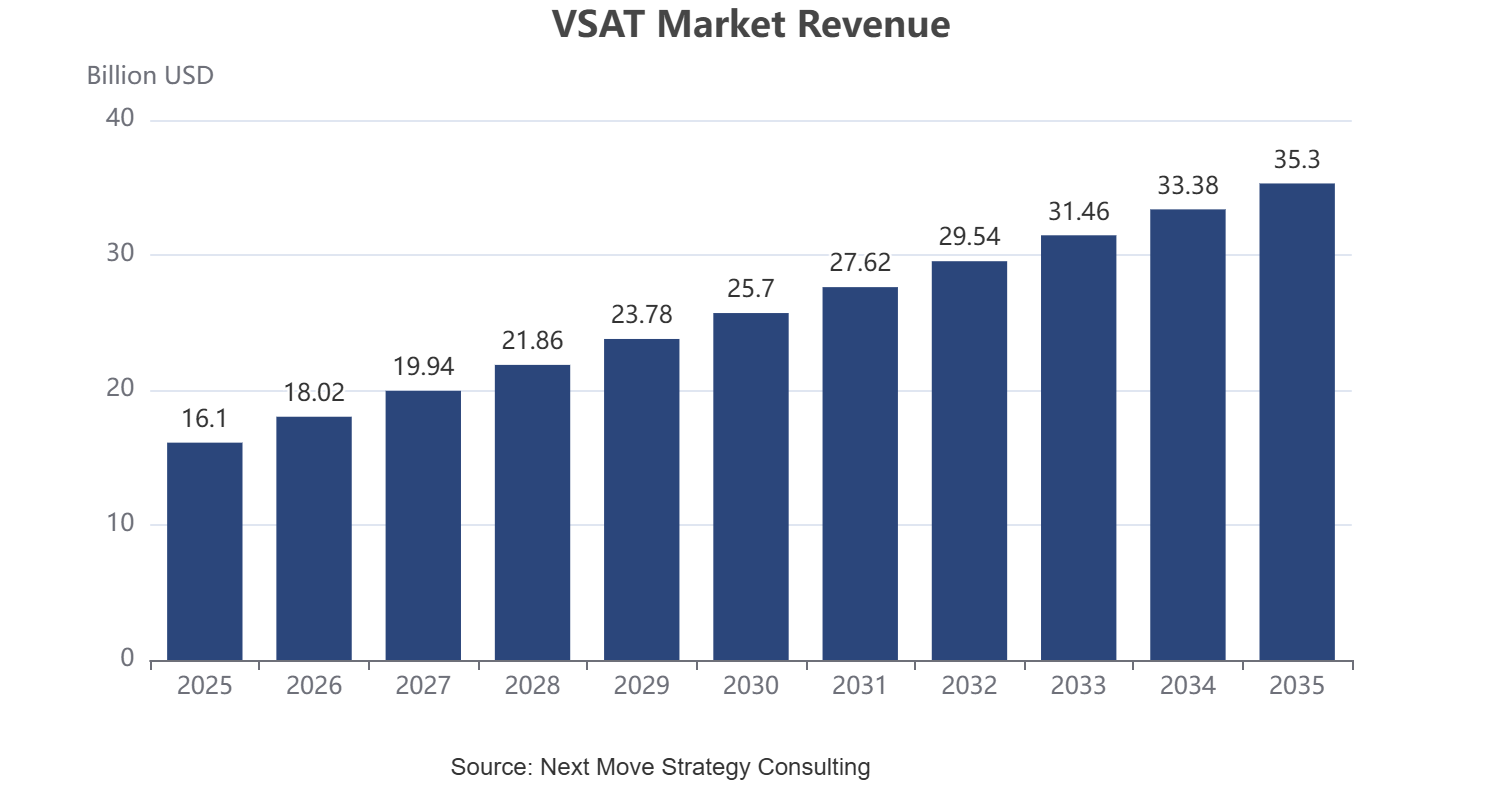
The global VSAT market size was valued at USD 16.1 billion in 2025 and is estimated at USD 17.4 billion in 2026, forecast to reach USD 35.3 billion by 2035, expanding at an 8.2% CAGR between 2026 and 2035. North America leads with approximately 38% share, while Fixed Deployment dominates all deployment types with approximately 52% share.
We observed that growth is broad-based across every segmentation axis, with multi-orbit architecture and electronically steered antenna adoption driving the sharpest structural shifts through 2035.
|
Key Takeaways |
|
By Revenue Type: Equipment held the largest share of approximately 44% (USD 7.08 billion) in 2025; Software is the fastest-growing sub-segment at 13.8% CAGR from 2026–2035. |
|
By Satellite Frequency Band: Ku Band VSAT held the largest share of approximately 38% (USD 6.12 billion) in 2025; Ka Band VSAT is the fastest-growing sub-segment at 11.5% CAGR from 2026–2035. |
|
By Satellite Architecture: High Throughput Satellite Architecture held the largest share of approximately 46% (USD 7.41 billion) in 2025; Very High Throughput Satellite Architecture is the fastest-growing sub-segment at 14.2% CAGR from 2026–2035. |
|
By Orbit Configuration: Geostationary held the largest share of approximately 58% (USD 9.34 billion) in 2025; Multi-Orbit is the fastest-growing sub-segment at 16.8% CAGR from 2026–2035. |
|
By Antenna Technology: Reflector held the largest share of approximately 48% (USD 7.73 billion) in 2025; Electronically Steered is the fastest-growing sub-segment at 15.5% CAGR from 2026–2035. |
|
By Deployment Type: Fixed Deployment held the largest share of approximately 52% (USD 8.37 billion) in 2025; Mobile Deployment is the fastest-growing sub-segment at 11.2% CAGR from 2026–2035. |
|
By Customer Type: Satellite Service Providers held the largest share of approximately 34% (USD 5.47 billion) in 2025; Government Customers is the fastest-growing sub-segment at 9.8% CAGR from 2026–2035. |
|
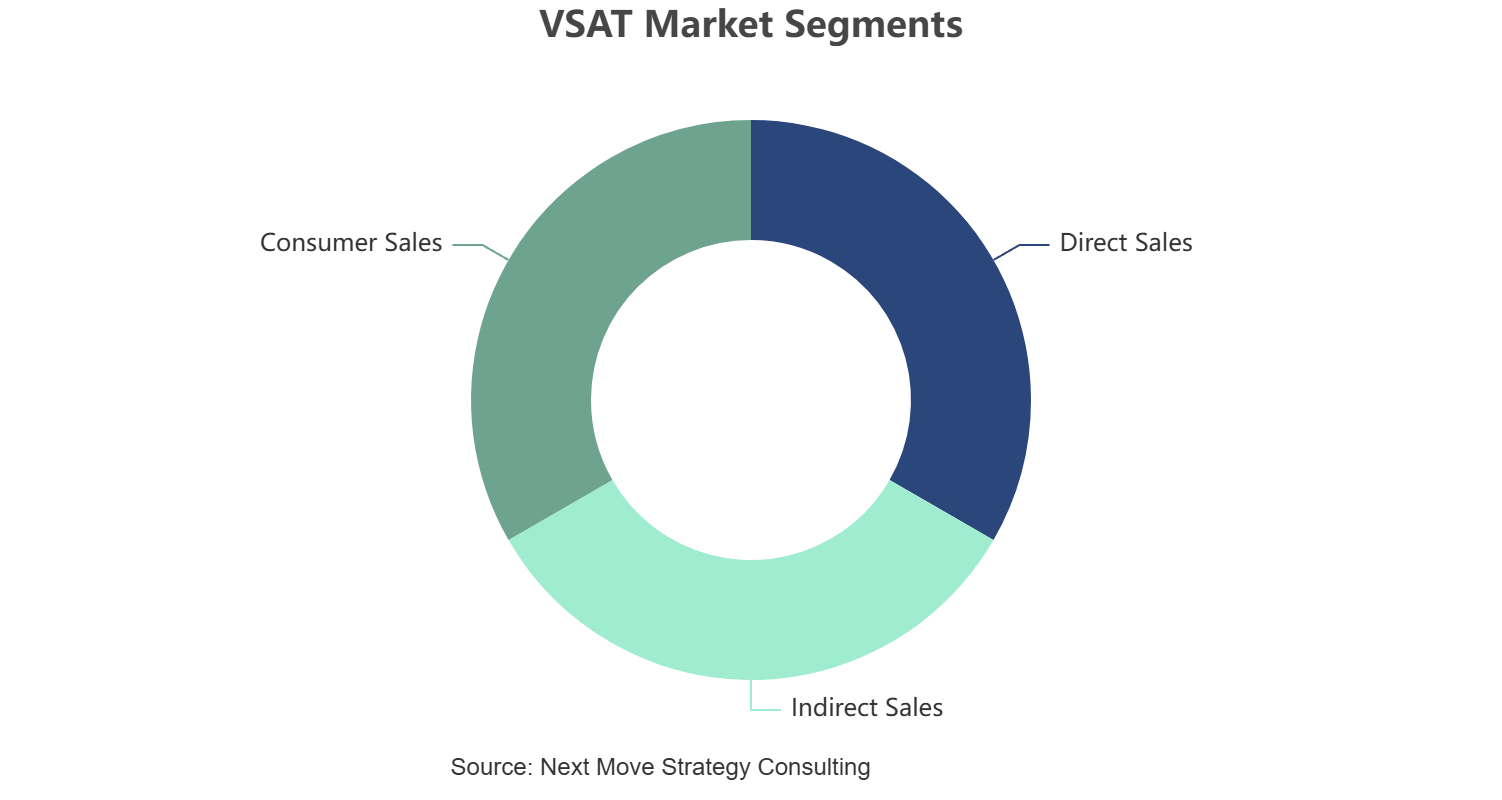
By Sales Channel: Direct Sales held the largest share of approximately 54% (USD 8.69 billion) in 2025; Indirect Sales is the fastest-growing sub-segment at 9.5% CAGR from 2026–2035. |
|
By End User: Enterprise held the largest share of approximately 29% (USD 4.67 billion) in 2025; Aviation is the fastest-growing sub-segment at 10.3% CAGR from 2026–2035. |
|
Dominant Region: North America dominated with approximately 38% revenue share (USD 6.12 billion) in 2025. |
|
Fastest-Growing Region: Asia-Pacific is expected to register the highest CAGR of 10.4% during 2026–2035. |
|
Dominant Country: U.S. led with approximately USD 4.90 billion in 2025. |
|
Fastest-Growing Country: India is the fastest-growing country at approximately 13.7% CAGR from 2026–2035. |
Market Opportunity: The VSAT market is expected to create an absolute dollar opportunity of USD 17.9 billion between 2026 and 2035, presenting significant investment potential across multi-orbit terminal manufacturing, electronically steered antenna production, and government and defense connectivity programs.
According to Next Move Strategy Consulting analysis, satellite operators and terminal manufacturers are increasingly consolidating around multi-orbit and multi-band capability, a shift that favors vendors able to interoperate across geostationary and non-geostationary constellations over single-orbit specialists as enterprise and defense buyers demand network resilience through 2035.
What Does the VSAT Market Encompass?
The market encompasses very small aperture terminal equipment, connectivity services, software, and professional services that deliver two-way satellite-based data, voice, and video communication to fixed, transportable, and mobile sites. Our assessment indicates that the scope spans user terminals, hub and gateway infrastructure, network management software, and installation and managed services supplied to enterprise, government, maritime, aviation, and consumer end users. The category sits alongside the broader Satellite Internet market, sharing ground-segment and space-segment infrastructure while remaining distinct in its two-way, business-grade service model.
The category has evolved from narrowband C-band and Ku-band data links into a multi-orbit, high-throughput industry. We observed that satellite operators are consolidating around combined geostationary and non-geostationary fleets, exemplified by SES's completed acquisition of Intelsat and Telesat's Lightspeed low Earth orbit constellation, both aimed at delivering resilient, low-latency connectivity alongside traditional GEO coverage. Next Move Strategy Consulting's analysis indicates that this structural shift, combined with rising defense and enterprise demand for network diversity, is redefining terminal and connectivity procurement criteria across the market.
Regulatory frameworks shape spectrum access and cross-border service delivery across the industry. The U.S. Federal Communications Commission continues to approve spectrum transactions and satellite authorizations that expand non-geostationary broadband capacity, while national telecom regulators across Asia-Pacific and the Middle East are opening licensing regimes for foreign satellite operators. We observed that technology adoption is shifting toward electronically steered flat panel antennas capable of switching between multiple orbits and frequency bands, reducing the equipment footprint required for multi-orbit connectivity.
|
Field |
Details |
|
Market Size in 2025 |
USD 16.1 Billion |
|
Market Size in 2026 |
USD 17.4 Billion |
|
Revenue Forecast in 2035 |
USD 35.3 Billion |
|
Growth Rate |
CAGR of 8.2% from 2026 to 2035 |
|
Analysis Period |
2025–2035 |
|
Base Year Considered |
2025 |
|
Forecast Period |
2026–2035 |
|
Market Size Estimation |
USD Billion |
|
Companies Profiled |
20 |
|
Countries Covered |
38 |
|
Market Share |
Available for Top 10 Companies |
Key Emerging Trends
Based on research conducted by Next Move Strategy Consulting, we found that four structural trends are reshaping terminal design, network architecture, and stakeholder procurement across the industry.
How Is Multi-Orbit Architecture Transforming VSAT Networks?
Satellite operators and terminal manufacturers are converging around multi-orbit networks that combine geostationary coverage with low Earth orbit latency and resilience. We observed that Kymeta's March 2026 KuKa 8-Series terminal, the first single-aperture, multi-band, multi-orbit flat panel antenna, exemplifies this shift toward hardware capable of switching seamlessly across GEO, MEO, and LEO constellations. This trend connects directly to the growth of the LEO Satellite Mega Constellations space segment, as VSAT terminal vendors race to support an expanding set of non-geostationary networks alongside legacy GEO fleets.
Why Is Electronically Steered Antenna Technology Gaining Adoption?
Electronically steered flat panel antennas are displacing traditional mechanically steered reflector dishes for mobile and transportable applications. Our findings suggest that Eutelsat OneWeb's May 2025 general availability of the Kymeta Goshawk u8 terminal, approved for land, maritime, and fixed government and military use, reflects growing demand for low-profile, no-moving-parts antennas that reduce installation complexity. This shift parallels progress in the broader Tunable Antennas field, as manufacturers including ThinKom Solutions and SatixFy expand electronically steered portfolios to serve aviation and defense customers seeking rapid mobility without mechanical tracking components.
How Is Satellite Operator Consolidation Reshaping the Competitive Landscape?
Mergers and acquisitions among satellite operators and ground equipment manufacturers are consolidating capabilities across the value chain. We observed that SES completed its acquisition of Intelsat in July 2025, creating a combined multi-orbit fleet of more than 120 satellites, while Gilat Satellite Networks agreed in June 2026 to acquire the majority of Comtech's Satellite and Space Communications segment for USD 157.5 million. This consolidation is concentrating scale advantages among fewer, more diversified vendors capable of serving both commercial and government customers.
Why Is High Throughput Satellite Capacity Redefining Enterprise Broadband?
High throughput and very high throughput satellite architectures are expanding available bandwidth per terminal, enabling VSAT networks to compete more directly with terrestrial broadband for enterprise and rural connectivity use cases. Our analysis shows that Telesat's Lightspeed constellation, designed for multi-gigabit enterprise and government links via optical inter-satellite connections, illustrates the shift toward high-capacity, low-latency architectures, even as the program's 2028 service entry reflects the technical complexity of deploying next-generation payload electronics at scale.
Porter's Five Forces Analysis of the Vsat Market
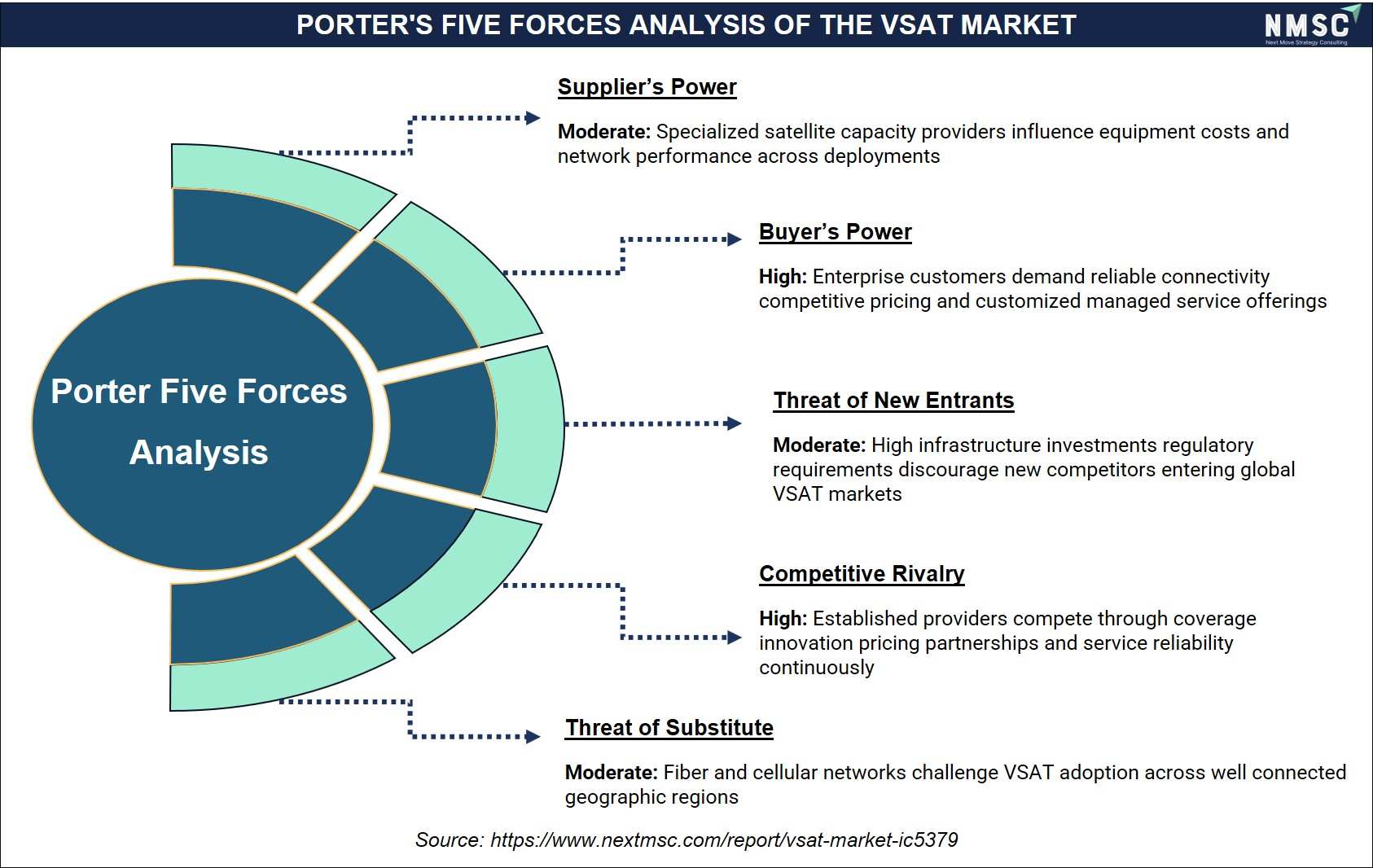
The Porter's Five Forces Analysis of the VSAT Market evaluates the competitive dynamics influencing industry growth by examining the bargaining power of suppliers and buyers, the threat of new entrants and substitute technologies, and the intensity of competitive rivalry. The analysis indicates that continuous technological innovation, high capital investment requirements, evolving satellite communication networks, and increasing demand for reliable connectivity across enterprise, government, maritime, aviation, and defense sectors collectively shape the market's competitive landscape.
Growth Drivers and Restraints
Growth Catalyst and Risk Assessment Matrix
|
Factors |
Type |
(+/-) % Impact on CAGR |
Geographic Relevance |
Impact Timeline |
|
Expansion of multi-orbit and high throughput satellite capacity |
Driver |
+2.1% |
Global |
2026–2035 |
|
Rising government and defense demand for resilient connectivity |
Driver |
+1.8% |
North America, Europe, Asia-Pacific |
2026–2035 |
|
Growth of electronically steered flat panel antenna adoption |
Driver |
+1.4% |
Global |
2026–2032 |
|
Expanding maritime and aviation broadband connectivity demand |
Driver |
+1.2% |
Global |
2026–2035 |
|
Satellite operator and terminal manufacturer consolidation |
Driver |
+0.9% |
North America, Europe |
2026–2030 |
|
Rural and remote broadband access initiatives |
Driver |
+0.8% |
Asia-Pacific, Latin America, MEA |
2026–2035 |
|
Terrestrial 5G and fiber network competitive substitution |
Restraint |
-1.1% |
North America, Europe |
2026–2032 |
|
High terminal and satellite manufacturing capital costs |
Restraint |
-0.7% |
Global |
2026–2030 |
|
Payload and ASIC supply chain delays affecting new constellations |
Restraint |
-0.5% |
Global |
2026–2029 |
What Is the Primary Growth Driver of the VSAT Market?
Expansion of multi-orbit and high throughput satellite capacity is the primary driver of the market. SEC filings confirm that SES's completed acquisition of Intelsat created a combined fleet exceeding 120 satellites, positioning the combined operator to deliver diversified GEO and MEO capacity to government, mobility, and fixed data customers. We observed that this capacity expansion, combined with new LEO constellations entering service, continues to anchor terminal and connectivity upgrade demand across enterprise and government buyers alike.
How Is Government and Defense Demand Driving VSAT Market Growth?
Rising government and defense demand for resilient, multi-orbit connectivity is accelerating platform adoption across allied nations. Eutelsat OneWeb's official statement on its Kymeta Goshawk u8 terminal noted that defense infrastructure is being reshaped at speed, reflecting the strategic priority defense organizations place on satellite communications. Our assessment indicates that this demand, combined with Gilat's expanding Defense Tactical Radio adjacent capabilities following its Comtech acquisition, is compressing adoption timelines for multi-orbit terminals across military and public safety end users.
What Is Restraining VSAT Market Expansion?
Terrestrial 5G and fiber network competitive substitution restrains VSAT adoption in densely populated markets with mature terrestrial infrastructure. Federal Communications Commission spectrum approvals for AT&T and SpaceX direct-to-cell services, valued at approximately USD 40 billion combined, illustrate how terrestrial carriers are extending coverage into previously underserved areas using satellite-augmented cellular networks. We found that this convergence pressures traditional VSAT connectivity pricing in markets where hybrid terrestrial-satellite alternatives become commercially available.
Segmentation Analysis
Segment Sizing: By Revenue Type
|
Segment |
2025 (USD) |
2035 (USD) |
CAGR% (2026–2035) |
|
Equipment |
USD 7.08 Billion |
USD 13.41 Billion |
6.6% |
|
Connectivity |
USD 6.12 Billion |
USD 14.12 Billion |
8.7% |
|
Software |
USD 0.97 Billion |
USD 3.53 Billion |
13.8% |
|
Professional Services |
USD 1.93 Billion |
USD 4.24 Billion |
8.2% |
|
Total |
USD 16.1 Billion |
USD 35.3 Billion |
8.2% |
Which Revenue Type Segment Dominates the VSAT Market?
Equipment led the market with USD 7.08 billion in 2025, reflecting the significant upfront hardware investment required for user terminals, hub infrastructure, and ground equipment across new site deployments. We observed that Software is the fastest-growing revenue type, expanding at a 13.8% CAGR from 2026 to 2035, as network management, bandwidth optimization, and cybersecurity software attach rates rise alongside more complex multi-orbit, multi-band terminal fleets.
Segment Sizing: By Deployment Type
|
Segment |
2025 (USD) |
2035 (USD) |
CAGR% (2026–2035) |
|
Fixed Deployment |
USD 8.37 Billion |
USD 15.88 Billion |
6.6% |
|
Transportable Deployment |
USD 3.22 Billion |
USD 6.35 Billion |
7.0% |
|
Mobile Deployment |
USD 4.51 Billion |
USD 13.07 Billion |
11.2% |
|
Total |
USD 16.1 Billion |
USD 35.3 Billion |
8.2% |
Which Deployment Type Leads VSAT Market Demand?
Fixed Deployment remained the leading deployment type, valued at USD 8.37 billion in 2025 on sustained enterprise network site, government facility, and consumer broadband terminal installations. Our findings suggest that Mobile Deployment is the fastest-growing category, registering an 11.2% CAGR from 2026 to 2035, as vehicle-mounted, maritime, and aeronautical terminals increasingly adopt electronically steered antennas capable of maintaining connectivity while in motion across multiple satellite orbits.
Segment Sizing: By End User
|
Segment |
2025 (USD) |
2035 (USD) |
CAGR% (2026–2035) |
|
Enterprise |
USD 4.67 Billion |
USD 8.82 Billion |
6.6% |
|
Government and Defense |
USD 4.35 Billion |
USD 10.59 Billion |
9.3% |
|
Maritime |
USD 2.90 Billion |
USD 6.00 Billion |
7.5% |
|
Aviation |
USD 2.25 Billion |
USD 6.00 Billion |
10.3% |
|
Consumer |
USD 1.93 Billion |
USD 3.89 Billion |
7.3% |
|
Total |
USD 16.1 Billion |
USD 35.3 Billion |
8.2% |
Which End User Segment Is Growing Fastest in the VSAT Market?
Enterprise remained the leading end user, valued at USD 4.67 billion in 2025 on sustained distributed enterprise, industrial, and retail site connectivity demand. Based on research conducted by Next Move Strategy Consulting, we found that Aviation is the fastest-growing end user, expanding at a 10.3% CAGR from 2026 to 2035, as commercial and business aviation operators upgrade in-flight connectivity systems to leverage new low Earth orbit capacity entering service through 2028.
Growth Opportunities
Our analysis shows that three forward-looking opportunities stand out for stakeholders positioning within the market over the 2026–2035 forecast period.
How Can Multi-Orbit Terminals Unlock Value for Defense Buyers?
Multi-band, multi-orbit terminals present a whitespace opportunity for defense and government buyers seeking network resilience against jamming and single-point-of-failure risk. Vendors that ship compact, low-SWaP terminals capable of switching between GEO, MEO, and LEO networks stand to capture recurring procurement contracts as allied nations prioritize secure, rapidly deployable communications across land, maritime, and airborne platforms.
Where Do Aviation Connectivity Upgrades Create New Demand?
Commercial and business aviation operators upgrading in-flight connectivity systems represent an underpenetrated opportunity as new low Earth orbit capacity enters service. Terminal manufacturers and service providers that deliver validated, low-drag antenna systems compatible with emerging Mobile Satellite Services constellations can secure long-term airline contracts, benefiting from recurring connectivity revenue tied to passenger experience and cockpit data requirements.
How Can Rural Broadband Programs Benefit Equipment Manufacturers?
Government-funded rural and remote broadband programs create an opportunity for equipment manufacturers and connectivity providers offering cost-effective fixed VSAT terminals. Early movers that secure national broadband subsidy program approvals can differentiate with telecom operators and rural service providers pursuing last-mile connectivity commitments across underserved geographies in Asia-Pacific, Latin America, and Africa.
Pain Point Analysis of the VSAT Market
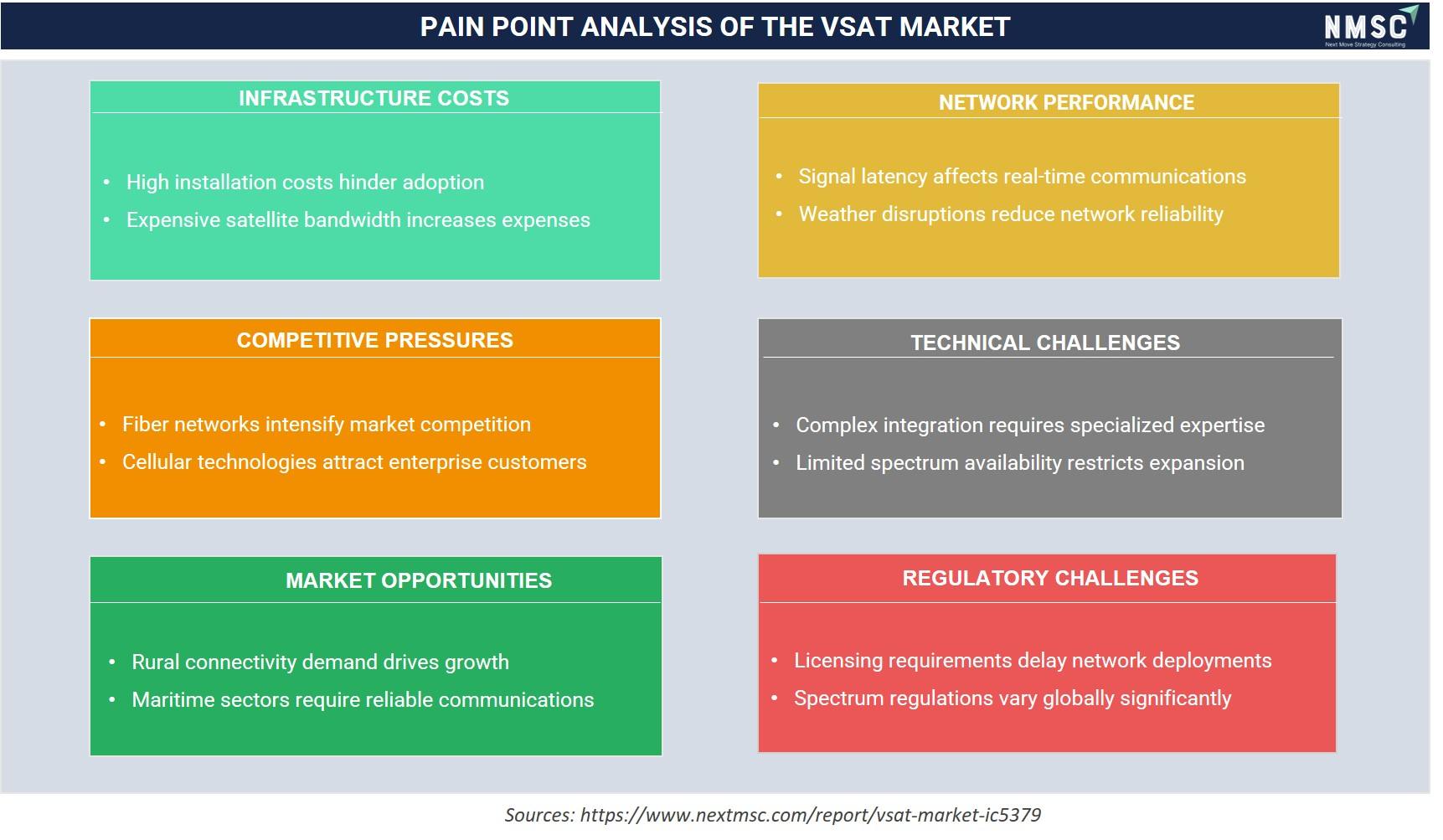
The Pain Point Analysis of the VSAT Market highlights the major challenges and growth opportunities influencing market adoption. High infrastructure and bandwidth costs, signal latency, adverse weather conditions, and complex system integration remain key barriers to deployment. Additionally, regulatory complexities and spectrum limitations impact network expansion. Despite these challenges, increasing demand for reliable connectivity in rural, maritime, aviation, enterprise, and government sectors continues to create significant growth opportunities for VSAT solution providers.
Regional Outlook
Geographic Performance Snapshot
|
Region |
2025 (USD) |
2035 (USD) |
CAGR% (2026–2035) |
Key Driver |
|
North America |
USD 6.12 Billion |
USD 11.30 Billion |
6.3% |
Mature satellite operator base and large government and defense procurement |
|
Europe |
USD 3.54 Billion |
USD 7.06 Billion |
7.1% |
Multi-orbit fleet consolidation and EU connectivity infrastructure programs |
|
Asia-Pacific |
USD 4.19 Billion |
USD 11.30 Billion |
10.4% |
Expanding satellite licensing regimes and rural broadband initiatives |
|
Middle East & Africa |
USD 1.45 Billion |
USD 3.88 Billion |
10.3% |
National connectivity programs and expanding maritime and energy sectors |
|
Latin America |
USD 0.80 Billion |
USD 1.76 Billion |
8.2% |
Growing rural connectivity demand and expanding enterprise cloud adoption |
|
Total |
USD 16.1 Billion |
USD 35.3 Billion |
8.2% |
-- |
North America VSAT Market Outlook
North America leads the market with the largest concentration of satellite operators, terminal manufacturers, and government and defense procurement programs globally. We observed that Federal Communications Commission spectrum approvals for major operator transactions continue to shape network capacity and competitive dynamics across the region. Technology adoption remains concentrated among large enterprises and defense agencies, while strategic outlook favors vendors that can demonstrate multi-orbit interoperability to increasingly resilience-focused government buyers.
Europe VSAT Market Outlook
Europe's market benefits from strong multi-orbit fleet consolidation, exemplified by SES's Luxembourg-headquartered combined operations following its Intelsat acquisition. Our assessment indicates that European Commission digital connectivity initiatives are reinforcing demand for satellite-based rural and remote broadband access across member states. Strategic outlook favors vendors offering European data-hosting options alongside multi-orbit terminal support for enterprise and government customers operating across multiple EU jurisdictions.
Asia-Pacific VSAT Market Outlook
Asia-Pacific is the fastest-growing region in the market, propelled by expanding satellite licensing regimes and rural broadband initiatives across China, India, and Southeast Asia. We found that opening telecom licensing frameworks are enabling first-time market entry for international satellite operators alongside established domestic providers. Technology adoption is accelerating fastest among enterprise and government end users, with strategic outlook favoring vendors that can navigate diverse national spectrum and licensing requirements across the region.
Middle East & Africa VSAT Market Outlook
The Middle East and Africa market is expanding on the back of national connectivity programs and growing maritime and energy sector demand across the Gulf states and broader Africa. Our findings suggest that government-led digital transformation initiatives are creating sustained demand for government and defense connectivity terminals. Regulatory influence remains moderate, with strategic outlook favoring vendors partnering with regional systems integrators to support fixed and transportable deployments across remote industrial and energy sites.
Latin America VSAT Market Outlook
Latin America's market is growing alongside rising rural connectivity demand and expanding enterprise cloud adoption across Brazil and Argentina. We observed that government broadband subsidy programs are driving early-stage demand for fixed terminal deployments among rural service providers. Technology adoption remains concentrated in fixed and transportable deployment types given limited in-region mobile terminal manufacturing, with strategic outlook favoring vendors offering flexible financing suited to the region's mid-market customer base.
United States VSAT Market Outlook
Based on our estimates, the United States market was valued at approximately USD 4.90 billion in 2025 and is projected to reach USD 8.70 billion by 2035, expanding at a 5.9% CAGR. Demand structure is concentrated among government, defense, and large enterprise buyers with established satellite procurement programs. Competitive intensity is elevated, with the U.S. hosting a majority of the market's leading satellite operators and terminal manufacturers.
Canada VSAT Market Outlook
The market in Canada was valued at approximately USD 0.80 billion in 2025 and is projected to reach USD 1.58 billion by 2035, expanding at a 7.1% CAGR. Demand structure is anchored by Telesat's domestic satellite operations and rural connectivity programs serving remote communities. Regulatory influence remains supportive, with strategic outlook favoring vendors extending U.S. enterprise relationships into Canadian government and rural broadband programs.
United Kingdom VSAT Market Outlook
As per our estimate, the United Kingdom VSAT market was valued at approximately USD 0.99 billion in 2025 and is projected to reach USD 1.84 billion by 2035, expanding at a 6.4% CAGR. Demand structure is led by government, defense, and maritime buyers with mature satellite licensing frameworks. Technology penetration remains strong given the UK's role in licensing multiple non-geostationary constellations, and strategic outlook favors vendors with established local compliance support.
Germany VSAT Market Outlook
According to our analysis, the German VSAT market was valued at approximately USD 0.78 billion in 2025 and is projected to reach USD 1.48 billion by 2035, expanding at a 6.6% CAGR. Demand structure is concentrated among industrial and government enterprises pursuing resilient backup connectivity. Regulatory influence from German and EU spectrum requirements shapes vendor selection, and strategic outlook favors platforms supporting strong multi-orbit and hybrid deployment options.
France VSAT Market Outlook
Based on our estimates, the French VSAT market was valued at approximately USD 0.60 billion in 2025 and is projected to reach USD 1.20 billion by 2035, expanding at a 7.1% CAGR. Demand structure spans government, defense, and maritime buyers navigating national satellite sovereignty initiatives. Technology adoption is growing steadily among enterprise customers, and strategic outlook favors vendors partnering with regional systems integrators.
China VSAT Market Outlook
The market in China was valued at approximately USD 1.17 billion in 2025 and is projected to reach USD 2.71 billion by 2035, expanding at an 8.7% CAGR. Demand structure is dominated by domestic satellite operators and government-directed rural connectivity programs. Competitive intensity features strong domestic ground equipment manufacturing, and strategic outlook favors vendors capable of navigating China's distinct regulatory and licensing environment.
India VSAT Market Outlook
As per our estimate, the Indian VSAT market was valued at approximately USD 0.75 billion in 2025 and is projected to reach USD 2.71 billion by 2035, the fastest-growing country in this report at a 13.7% CAGR. Demand structure is led by enterprise, government, and rural broadband buyers following the liberalization of India's satellite spectrum allocation framework. Technology adoption is accelerating rapidly as international operators enter the market alongside established domestic providers.
Japan VSAT Market Outlook
According to our analysis, the Japanese VSAT market was valued at approximately USD 0.67 billion in 2025 and is projected to reach USD 1.47 billion by 2035, expanding at an 8.2% CAGR. Demand structure is concentrated among maritime, government, and disaster management buyers given Japan's exposure to natural disasters. Regulatory influence remains moderate, and strategic outlook favors vendors offering strong Japanese-language support and disaster-resilient network design.
South Korea VSAT Market Outlook
Based on our estimates, the South Korean VSAT market was valued at approximately USD 0.42 billion in 2025 and is projected to reach USD 1.13 billion by 2035, expanding at a 10.4% CAGR. Demand structure is led by government, defense, and maritime shipping enterprises scaling satellite connectivity investment. Competitive intensity is rising as domestic and international vendors expand presence, and strategic outlook favors platforms supporting both fixed and mobile deployment types.
Australia VSAT Market Outlook
The market in Australia was valued at approximately USD 0.46 billion in 2025 and is projected to reach USD 1.13 billion by 2035, expanding at a 9.4% CAGR. Demand structure spans mining, energy, agriculture, and government buyers with extensive remote and regional connectivity needs. Technology penetration is high relative to other Asia-Pacific markets, and strategic outlook favors vendors with established regional presence and remote industrial site expertise.
United Arab Emirates VSAT Market Outlook
As per our estimate, the UAE VSAT market was valued at approximately USD 0.39 billion in 2025 and is projected to reach USD 1.01 billion by 2035, expanding at a 9.9% CAGR. Demand structure is concentrated among government, maritime, and energy sector buyers driving national connectivity initiatives. Competitive intensity is rising as global vendors establish regional partnerships, and strategic outlook favors platforms supporting Arabic-language interfaces and regional compliance requirements.
Saudi Arabia VSAT Market Outlook
According to our analysis, the Saudi Arabian VSAT market was valued at approximately USD 0.36 billion in 2025 and is projected to reach USD 1.01 billion by 2035, expanding at a 10.8% CAGR. Demand structure is driven by Vision 2030-linked digital transformation programs across government, energy, and defense sectors. Technology adoption is accelerating as national connectivity infrastructure expands, and strategic outlook favors vendors partnering with domestic systems integrators for large-scale government deployments.
South Africa VSAT Market Outlook
Based on our estimates, the South African VSAT market was valued at approximately USD 0.19 billion in 2025 and is projected to reach USD 0.50 billion by 2035, expanding at a 10.3% CAGR. Demand structure is led by mining, energy, and government enterprises serving as the region's connectivity adoption leaders. Regulatory influence remains developing, and strategic outlook favors vendors extending European delivery teams to support South African enterprise customers.
Brazil VSAT Market Outlook
The market in Brazil was valued at approximately USD 0.36 billion in 2025 and is projected to reach USD 0.77 billion by 2035, expanding at an 8.0% CAGR. Demand structure is concentrated among agribusiness, energy, and rural broadband buyers scaling connectivity infrastructure. Technology penetration continues to rise as government broadband subsidy programs expand, and strategic outlook favors vendors offering Portuguese-language support and flexible financing suited to rural service providers.
Argentina VSAT Market Outlook
As per our estimate, the Argentine VSAT market was valued at approximately USD 0.15 billion in 2025 and is projected to reach USD 0.35 billion by 2035, expanding at an 8.8% CAGR. Demand structure spans agriculture, energy, and government enterprises adopting satellite connectivity amid limited terrestrial broadband coverage in rural areas. Competitive intensity remains modest relative to Brazil, and strategic outlook favors vendors entering through regional partnerships and multi-country Latin American sales motions.
Competitive Landscape
We observed that the VSAT market features a consolidating competitive landscape, with diversified satellite operators, specialized terminal manufacturers, and network equipment vendors competing alongside a growing base of electronically steered antenna specialists.
Key Takeaways
|
Dimension |
Description |
|
Market Structure |
Moderately consolidated; the top companies profiled in this report collectively account for a significant share of global VSAT market revenue, while numerous regional integrators serve country-specific government and enterprise demand. |
|
Innovation Focus |
Multi-orbit, multi-band terminal engineering and electronically steered flat panel antenna development dominate current innovation pipelines across leading vendors. |
|
M&A Activity |
Active consolidation, exemplified by SES's completed acquisition of Intelsat and Gilat Satellite Networks' agreement to acquire the majority of Comtech's Satellite and Space Communications segment, as vendors broaden multi-orbit and defense capabilities. |
How Do Companies Compete in the VSAT Market?
Companies compete primarily on multi-orbit interoperability, terminal miniaturization, and government and defense qualification across the industry. Diversified operators such as SES and Eutelsat Group leverage combined GEO and non-geostationary fleets to serve multinational enterprise and government customers, while terminal specialists such as Kymeta, Intellian Technologies, and ThinKom Solutions compete on antenna performance, size, weight, and power efficiency for mobile applications. Marlink competes on managed connectivity depth for commercial shipping and offshore energy customers, an end-user base closely tied to the broader Maritime Safety System category.
Which Competitive Archetypes Dominate the VSAT Market?
Two archetypes dominate the market: diversified satellite operators offering integrated space and ground segment capabilities, and specialized terminal and antenna manufacturers focused on a single deployment type or technology. SpaceX, SES, and Eutelsat Group exemplify the diversified archetype through combined satellite fleet and ground infrastructure ownership, while Kymeta, SatixFy, and Intellian Technologies exemplify the specialized archetype serving specific antenna and terminal use cases.
How Are Companies Differentiating Through Innovation in VSAT?
Innovation and differentiation strategy increasingly center on multi-band, multi-orbit terminal engineering. Kymeta's March 2026 KuKa 8-Series terminal and Eutelsat OneWeb's Goshawk u8 multi-orbit terminal both extend seamless GEO-LEO switching to government and commercial customers. Our analysis shows that vendors unable to demonstrate credible multi-orbit interoperability risk exclusion from defense and enterprise shortlists as network resilience becomes a board-level and mission-critical procurement criterion.
What M&A and Expansion Activity Is Shaping the VSAT Market?
Mergers, acquisitions, and platform expansion continue to consolidate capabilities within the industry. SES's July 2025 completed acquisition of Intelsat created a combined multi-orbit fleet exceeding 120 satellites, while Gilat Satellite Networks' June 2026 agreement to acquire the majority of Comtech's Satellite and Space Communications segment is expected to expand Gilat's annual revenue beyond USD 700 million. Our findings suggest that this M&A activity reflects growing customer demand for unified, multi-orbit capable vendors over fragmented single-orbit specialists.
Key Market Players
Our assessment indicates that the following 20 companies are actively shaping product innovation, platform consolidation, and multi-orbit connectivity strategy within the global VSAT market.
-
SpaceX
-
Viasat Inc.
-
EchoStar Corporation
-
SES S.A.
-
Intelsat S.A.
-
ST Engineering iDirect
-
Gilat Satellite Networks Ltd.
-
Speedcast
-
Marlink AS
-
Comtech Telecommunications Corp.
-
Intellian Technologies Inc.
-
Cobham Satcom
-
KVH Industries Inc.
-
Kymeta Corporation
-
Telesat Corporation
-
SatixFy Ltd.
-
ThinKom Solutions Inc.
-
Orbit Communication Systems Ltd.
-
Advantech Wireless Technologies Inc.
Latest Developments
We found that recent M&A activity and product launches within the VSAT market are concentrated on multi-orbit terminal engineering and satellite operator consolidation, reflecting the industry's broader shift toward network resilience.
|
Date |
Event |
|
July 2025 |
SES completed its USD 3.1 billion acquisition of Intelsat, creating a combined multi-orbit fleet of more than 120 satellites and an expanded government, mobility, and fixed data customer base. |
Expert Insights
 “We are committed to GEO and MEO constellations and we partner with LEO partners. We believe we are positioned not only as a multi-orbit operator but an 'all-orbit' operator. We provide solutions across all orbits.”
— Adel Al-Saleh, Chief Executive Officer (CEO), SES
Statement made in an interview with Via Satellite (April 2024) discussing SES's multi-orbit strategy and the company's vision for delivering integrated satellite connectivity solutions across GEO, MEO, and LEO constellations.
Market Interpretation:
The statement highlights the satellite communications industry's transition toward multi-orbit connectivity by integrating geostationary (GEO), medium Earth orbit (MEO), and low Earth orbit (LEO) satellite networks. This evolution is expected to accelerate the adoption of next-generation VSAT systems capable of seamlessly operating across multiple orbital layers, enabling enhanced network resilience, broader coverage, lower latency, and improved service continuity. Consequently, increasing investments in multi-orbit satellite infrastructure are expected to drive demand for advanced VSAT terminals and managed connectivity solutions across enterprise, government, maritime, aviation, and defense applications.
Investment Opportunities
What Capital Inflows Are Targeting the VSAT Market?
Capital inflows into the VSAT market are increasingly directed toward multi-orbit terminal engineering and satellite operator consolidation. Strategic acquirers continue to fund platform consolidation, as seen in SES's USD 3.1 billion acquisition of Intelsat and Gilat's USD 157.5 million agreement for Comtech's Satellite and Space Communications segment. We observed that investors favor vendors demonstrating multi-orbit interoperability and defense qualification, viewing these capabilities as a proxy for durable government and enterprise contract retention.
How Is Infrastructure Investment Supporting VSAT Network Scaling?
Infrastructure investment is expanding both space-segment and ground-segment capacity to support growing multi-orbit demand. Telesat's Lightspeed program, backed by CAD 2.1 billion in Canadian government support and built around a next-generation Satellite Bus platform from MDA Space, illustrates the scale of capital committed to enterprise-grade low Earth orbit broadband. Our findings suggest that ground infrastructure investment is similarly expanding to support higher-throughput gateway and teleport equipment required for multi-orbit terminal traffic.
What ESG Considerations Are Shaping VSAT Investment Decisions?
Environmental, social, and governance considerations are gaining relevance across the industry as orbital debris mitigation and rural digital inclusion become differentiating criteria. We found that satellite operators launching new non-geostationary constellations face increasing scrutiny over end-of-life deorbit planning and space sustainability commitments. Rural broadband programs funded through government connectivity initiatives are simultaneously positioning VSAT investment as a social inclusion tool, treating last-mile access expansion as a governance and community-impact indicator alongside financial returns.
Key Benefits for Stakeholders
How Does This Report Benefit Enterprise and Industry Leaders?
Enterprise and industry leaders gain access to validated segmentation, competitive benchmarking, and regional demand forecasts that support terminal and connectivity procurement decisions across the VSAT industry. Our analysis shows that detailed revenue-type, deployment-type, and end-user breakdowns help technology and operations leaders align vendor selection with organizational resilience requirements while identifying underserved deployment categories, such as mobile and transportable terminals, for near-term investment.
How Does This Report Benefit Investors and Financial Analysts?
Investors and financial analysts benefit from consistent, single-point market size and CAGR estimates that support valuation and capital-allocation decisions across the VSAT market's operator and manufacturer landscape. We observed that the report's regional and segment-level growth differentials help identify which platform categories, including electronically steered antennas and multi-orbit terminals, are best positioned to capture above-market growth through 2035.
How Does This Report Benefit Technology Vendors and Product Teams?
Technology vendors and product teams gain insight into emerging buyer requirements, including multi-orbit interoperability, electronically steered antenna miniaturization, and defense qualification standards, that are reshaping the industry. Our findings suggest that this analysis helps product teams prioritize development roadmaps around mobile and aviation deployment categories that are increasingly decisive in enterprise and government procurement processes.
Key Market Segments
By Revenue Type
-
Equipment
-
User Terminals
-
Fixed VSAT Terminals
-
Transportable VSAT Terminals
-
Maritime VSAT Terminals
-
Aeronautical VSAT Terminals
-
Tactical Military Terminals
-
-
Hardware
-
Satellite Modems
-
Modulators and Demodulators
-
Radio Frequency Equipment
-
Hub Equipment
-
Network Controllers
-
-
Ground Infrastructure
-
Teleport Equipment
-
Gateway Equipment
-
Satellite Access Equipment
-
-
-
Connectivity
-
Fixed Services
-
Dedicated Bandwidth
-
Shared Bandwidth
-
Enterprise Broadband
-
Rural Broadband
-
-
Mobile Services
-
Maritime
-
Aviation
-
Land Mobile
-
-
Government Services
-
Military
-
Emergency
-
Government
-
-
-
Software
-
Network Management Software
-
Bandwidth Optimization Software
-
Remote Monitoring Software
-
Cybersecurity Software
-
-
Professional Services
-
Installation Services
-
System Integration Services
-
Maintenance Services
-
Technical Support Services
-
By Technology Type
-
Satellite Frequency Band
-
C Band VSAT
-
X Band VSAT
-
Ku Band VSAT
-
Ka Band VSAT
-
Q and V Band VSAT
-
-
Satellite Architecture
-
Traditional Satellite Architecture
-
High Throughput Satellite Architecture
-
Very High Throughput Satellite Architecture
-
-
Orbit Configuration
-
Geostationary
-
Non-Geostationary
-
Multi-Orbit
-
-
Antenna Technology
-
Reflector
-
Flat Panel
-
Electronically Steered
-
By Deployment Type
-
Fixed Deployment
-
Enterprise Network Sites
-
Consumer Broadband Terminals
-
Government Facilities
-
Remote Industrial Sites
-
-
Transportable Deployment
-
Flyaway Terminals
-
Portable Terminals
-
Emergency Response Terminals
-
-
Mobile Deployment
-
Vehicle-Mounted
-
Maritime
-
Aeronautical
-
By Customer Type
-
Satellite Service Providers
-
Satellite Network Operators
-
Broadband Service Providers
-
Managed Service Providers
-
-
Enterprise Customers
-
Large Corporations
-
Industrial Operators
-
Distributed Enterprises
-
-
Government Customers
-
Defense Organizations
-
Civil Government Agencies
-
-
System Integrators
-
Telecommunications Integrators
- Defense Integrators
-
By Sales Channel
-
Direct Sales
-
Enterprise Contracts
-
Government Contracts
-
Operator Partnerships
-
-
Indirect Sales
-
Distributors
-
Value Added Resellers
-
Integration Partners
-
-
Consumer Sales
-
Online Direct Sales
-
Retail Distribution
-
By End User
-
Enterprise
-
BFSI
-
Retail and Distributed Operations
-
Mining and Construction
-
Energy and Utilities
-
Telecommunications
-
-
Government and Defense
-
Military Communications
-
Public Safety
-
Disaster Management
-
Border Security
-
-
Maritime
-
Commercial Shipping
-
Offshore Energy
-
Cruise Operations
-
Fishing Fleets
-
-
Aviation
-
Commercial Airlines
-
Business Aviation
-
Government Aviation
-
-
Consumer
-
Residential Broadband
-
Rural Connectivity
-
By Region
-
North America: U.S., Canada, Mexico
-
Europe: UK, Germany, France, Italy, Spain, Sweden, Denmark, Finland, Netherlands, Rest of Europe
-
Asia-Pacific: China, India, Japan, South Korea, Taiwan, Indonesia, Vietnam, Australia, Philippines, Malaysia, Rest of APAC
-
Middle East & Africa: Saudi Arabia, UAE, Egypt, Israel, Turkey, Nigeria, South Africa, Rest of MEA
-
Latin America: Brazil, Argentina, Chile, Colombia, Rest of LATAM
Conclusion & Recommendations
What Is the Long-Term Outlook for the VSAT Market?
The long-term outlook for the VSAT market is strongly positive, with the industry forecast to more than double from USD 17.4 billion in 2026 to USD 35.3 billion by 2035. Our assessment indicates that this growth will be driven by the durable expansion of multi-orbit satellite capacity and rising government and defense demand for resilient connectivity. Vendors that scale multi-band, multi-orbit terminal portfolios are best positioned to capture the market's long-term trajectory.
What Strategic Positioning Should Vendors Pursue?
Vendors should pursue strategic positioning around multi-orbit interoperability and electronically steered antenna miniaturization rather than single-orbit terminal manufacturing alone. Next Move Strategy Consulting's analysis indicates that platforms combining low-SWaP hardware, defense-grade security, and seamless GEO-LEO switching will differentiate most clearly as enterprises and governments consolidate vendor relationships. Strategic partnerships with satellite operators and defense integrators will further strengthen distribution reach.
How Attractive Is the VSAT Market for New Investment?
The VSAT industry presents an attractive investment case, supported by a USD 17.9 billion absolute dollar opportunity between 2026 and 2035 and above-average growth in Asia-Pacific and Aviation end-user categories. We found that investment attractiveness is highest for vendors combining multi-orbit terminal capability with defense and government qualification, positioning them to serve both cost-sensitive rural broadband and complex defense segments simultaneously.
What Market Shifts and Key Risks Should Stakeholders Monitor?
Stakeholders should monitor terrestrial 5G and fiber substitution, satellite payload and ASIC supply chain delays, and continued operator consolidation as key risks to the VSAT market. Our analysis shows that vendors unable to demonstrate clear multi-orbit differentiation from increasingly capable direct-to-cell and hybrid terrestrial-satellite alternatives risk losing share, particularly in markets with mature terrestrial broadband infrastructure.
What Are the Key Growth Pathways for the VSAT Market?
Key growth pathways include expanding multi-orbit terminal portfolios, scaling electronically steered antenna production, and deepening aviation and government and defense connectivity penetration. Next Move Strategy Consulting's analysis indicates that vendors pursuing these pathways while maintaining cost competitiveness in fixed deployment categories will be best positioned to capture the VSAT market's projected growth through 2035.
About the Author
 Liza Phukan
— Liza Phukan is Research Associate at Next Move Strategy Consulting, where she has covered emerging industries and market research across sectors for 3.5 years. Her work includes analyzing industry developments, validating market data, and developing structured business content from research findings. She uses secondary research and data-validation practices to turn complex market information into clear decision-useful market analysis for business audiences and support report development and B2B.
Liza Phukan
— Liza Phukan is Research Associate at Next Move Strategy Consulting, where she has covered emerging industries and market research across sectors for 3.5 years. Her work includes analyzing industry developments, validating market data, and developing structured business content from research findings. She uses secondary research and data-validation practices to turn complex market information into clear decision-useful market analysis for business audiences and support report development and B2B.
About the Reviewer
 Supradip Baul
— Supradip Baul is an accomplished business consultant and strategist with over a decade of rich experience in market intelligence, strategy, technology, and business transformation. His work has included rigorous qualitative and quantitative analysis across multiple industries, helping clients shape investment decisions and long-term roadmaps. Earlier in his career, he was associated with Gartner, where he contributed to industry-leading reports and market share analyses. He has worked with leading global companies and holds an MBA with a dual specialization in Marketing and Finance.
Supradip Baul
— Supradip Baul is an accomplished business consultant and strategist with over a decade of rich experience in market intelligence, strategy, technology, and business transformation. His work has included rigorous qualitative and quantitative analysis across multiple industries, helping clients shape investment decisions and long-term roadmaps. Earlier in his career, he was associated with Gartner, where he contributed to industry-leading reports and market share analyses. He has worked with leading global companies and holds an MBA with a dual specialization in Marketing and Finance.
At Next Move Strategy Consulting, we understand that insightful market research is the cornerstone of successful business decisions. That's why we employ a robust and multifaceted approach, combining various methodologies to deliver the most accurate and actionable data for our clients.

Research Landscape
We navigate the world of research with two primary approaches:
Qualitative Approach
Our qualitative research methodologies involve immersive techniques such as in-depth interviews, focus groups, and observational studies. By engaging directly with individuals and stakeholders, we uncover valuable insights that quantitative data alone may overlook.

Quantitative Research
In tandem with qualitative methodologies, NMSC leverages the power of Quantitative Research to provide a robust foundation of numerical insights. Through systematic data collection and analysis, we quantify patterns, preferences, and market trends, offering a comprehensive view of the business landscape.
Our quantitative research approach employs diverse tools, including surveys, experiments, and statistical modelling. These methodologies enable us to gather data from a large and representative sample, ensuring the statistical significance of our findings. By employing structured questionnaires and standardized data collection methods, we guarantee the reliability and validity of the information we present to our clients.
Quantitative research is particularly effective in measuring the prevalence of trends, assessing market size, and gauging the impact of various factors on consumer behavior. The numerical precision attained through this approach equips our clients with actionable insights, facilitating data-driven decision-making and strategy formulation.


Our Specialized Toolbox for Industry-Specific Market Research
We deploy a specialized arsenal of techniques tailored to meet your unique requirements. Here's a glimpse into our comprehensive toolbox:

Information Procurement
The stage entails acquiring market data or relevant information through various sources and methodologies.


Market Research Approach
We utilize both top-down and bottom-up approaches in market research analysis to achieve a comprehensive understanding of the market dynamics, leveraging the broad perspective of industry trends and macroeconomic factors alongside detailed insights from specific segments and individual companies.

Porters Five Forces Analysis
We conduct Porter's Five Forces analysis to evaluate the competitive landscape of an industry, providing us with insights into factors that affect profitability and strategic positioning.

SWOT Analysis

Forecasting
We utilize a forecasting model to predict future consumption by considering parameters like population, economics, regulations, market competition, drivers, constraints, technology, and pricing. We also employ statistical techniques such as multilinear regression, exponential smoothing, moving average, ARIMA, and Monte Carlo simulations for accurate predictions. In econometric forecasting, we analyzed short-term and long-term event impacts, attributing values based on regulatory frameworks, economic factors, and market events.





 Speak to Our Analyst