Water-Soluble Packaging Market By Product Form (Films, Bags, Pouches & Sachets, Labels and Specialty Formats), By Material Chemistry (Polyvinyl Alcohol, Modified Polyvinyl Alcohol, Starch Based Materials, Protein Based Materials), By Solubility Profile (Cold Water-Soluble, Warm Water-Soluble, Hot Water-Soluble, Process Specific Soluble), By End Use Industry (Household Care, Industrial Chemicals, Food Service, Construction and Composites) – Global Analysis & Forecast, 2026–2035
Industry: Construction & Manufacturing | Publishing Date: July 4, 2026 | Last Updated: September 30, 2026 | No of Pages: N/A | No. of Tables: N/A | No. of Figures: N/A | Format: PDF | Report Code: CM4949
What Is the Water-Soluble Packaging Market Size?
The global Water-Soluble Packaging Market size was valued at USD 6.45 billion in 2025 and is expected to reach USD 7.02 billion in 2026. The market is projected to grow to USD 15.02 billion by 2035, recording a CAGR of 8.82% between 2026 and 2035. This expansion is driven by escalating regulatory pressure to eliminate single-use plastics, growing consumer preference for convenient unit-dose formats in household care, rising adoption of polyvinyl alcohol films across agrochemical and industrial chemical sectors, and increasing awareness of environmentally responsible packaging alternatives across global supply chains.
|
Parameters |
Details |
|
Market Size in 2025 |
USD 6.45 Billion |
|
Market Size in 2026 |
USD 7.02 Billion |
|
Revenue Forecast in 2035 |
USD 15.02 Billion |
|
Growth Rate |
CAGR of 8.82% from 2026 to 2035 |
|
Analysis Period |
2025–2035 |
|
Base Year Considered |
2025 |
|
Forecast Period |
2026–2035 |
|
Market Size Estimation |
USD Billion |
|
Companies Profiled |
20 |
|
Countries Covered |
33 |
|
Market Share |
Top 10 |
Water-Soluble Packaging Market Overview
What Is the Water-Soluble Packaging Market?
The water-soluble packaging market encompasses materials, formats, and systems that dissolve completely in water, releasing their enclosed contents or disintegrating into non-toxic compounds upon contact with water at defined temperatures. NMSC's analysis indicates that the market spans a broad product continuum, from polyvinyl alcohol films used in agrochemical dosing bags to unit-dose laundry pods, medical infection control bags, embroidery backing films, and pharmaceutical dosing sachets across multiple industries and applications globally.
How Has the Water-Soluble Packaging Market Evolved Structurally?
The structural evolution of the water-soluble packaging market reflects decades of gradual development, accelerating sharply from the early 2010s as laundry pod adoption by major household care brands demonstrated commercial viability at mass scale. From our research, we found that the market has since expanded well beyond laundry origins into agrochemicals, hospital infection control, industrial water treatment, textile processing, and pharmaceutical drug delivery, broadening both the demand base and the material innovation agenda.
How Does the Regulatory Environment Shape the Water-Soluble Packaging Market?
The regulatory environment surrounding water-soluble packaging is becoming progressively more favourable globally. Through our market assessment, we observed that the EU Single Use Plastics Directive, U.S. EPA sustainable packaging guidelines, and China's national plastic restriction policies are creating structural demand pull for water-soluble alternatives. These frameworks simultaneously accelerate adoption timelines and raise the minimum performance standards that water-soluble packaging materials must meet to qualify for regulated product applications.
How Is Technology Adoption Transforming the Water-Soluble Packaging Market?
Technology adoption is advancing along two primary vectors: material performance enhancement and format diversification. Based on NMSC's research, we found that leading suppliers including MonoSol LLC, Aicello Corporation, and Mitsubishi Chemical Group are investing in next-generation PVOH formulations with improved dissolution control and mechanical strength. Concurrently, format innovation is expanding applications into construction chemicals, specialty food service, and pharmaceutical dosing requiring precisely controlled dissolution profiles that standard commercial materials cannot adequately deliver at scale.
|
Key Takeaways |
|
Films held the largest share of the water-soluble packaging market at USD 1.74 billion in 2025, serving as the primary substrate material converted into bags, sachets, and labels across industrial, agrochemical, and household care applications. |
|
Pods and Capsules are the fastest-growing product form, projected at a CAGR of 9.4% from 2026 to 2035, reaching USD 3.22 billion by 2035, driven by accelerating mainstream adoption of laundry pods and dishwasher pods across North American, European, and Asia Pacific markets. |
|
Polyvinyl Alcohol dominates material chemistry at USD 3.15 billion in 2025, representing approximately 49% of global revenue, anchored by PVOH's unmatched combination of precise dissolution control, mechanical film strength, and compatibility with high-speed converting equipment. |
|
Protein-based materials are the fastest-growing material chemistry at a CAGR of 10.3% through 2035, reaching USD 1.01 billion, driven by intensifying R&D in casein and plant protein-derived packaging films offering fully bio-based and compostable end-of-life profiles. |
|
Cold Water-Soluble formats command the largest share at USD 2.41 billion in 2025, as the ability to dissolve in unheated tap water broadens suitability across household care, healthcare, and food service end uses where controlled ambient-temperature dissolution is a fundamental requirement. |
|
Process Specific Soluble formulations are the fastest-growing profile at 9.4% CAGR, as industrial and agrochemical users increasingly require precision dissolution profiles matched to specific process temperatures, pH conditions, or water hardness parameters. |
|
Direct Sales leads at USD 2.52 billion in 2025, reflecting enterprise procurement model dominance among large multinational household care manufacturers, agrochemical companies, and industrial chemical producers sourcing via long-term supply agreements directly with material manufacturers. |
|
E-commerce is the fastest-growing channel at a CAGR of 10.4% through 2035 to USD 1.45 billion, as proliferation of direct-to-consumer household care brands opens online distribution pathways for unit-dose water-soluble products outside traditional retail networks. |
|
Household Care is the dominant end use industry at USD 2.18 billion in 2025, anchored by laundry detergents as the largest sub-segment, with unit-dose pods and liquid detergent sachets driving the majority of global PVOH film consumption. |
|
Healthcare and Pharmaceuticals is the fastest-growing end use at a CAGR of 9.4% through 2035, as hospital infection control requirements, pharmaceutical unit-dose standards, and biosafety mandates expand demand for medical-grade water-soluble bags and dosing sachets. |
|
North America is the dominant regional market at USD 2.19 billion in 2025, underpinned by widespread consumer adoption of laundry pods, a mature agrochemical sector using PVOH sachets, and favorable regulatory conditions promoting sustainable packaging under EPA and state-level frameworks. |
|
Asia Pacific is the fastest-growing region at a CAGR of 9.3% through 2035, reaching USD 4.02 billion, driven by China's plastic restriction policies, India's expanding insurance penetration, and Southeast Asia's growing middle-class consumer base adopting premium household care formats. |
|
The United States is the largest country-level market in 2025, generating the majority of North American revenue, supported by the highest per-capita consumption of unit-dose laundry products globally and a well-developed agrochemical distribution network using PVOH-packaged crop protection chemicals. |
|
China is among the fastest-growing country-level markets through 2035, reflecting mandatory plastic restriction policies enforced since 2020, a rapidly premiumizing laundry care market transitioning toward pod formats, and growing government investment in domestic bio-based material manufacturing. |
Ecosystem Analysis of the Water-Soluble Packaging Market
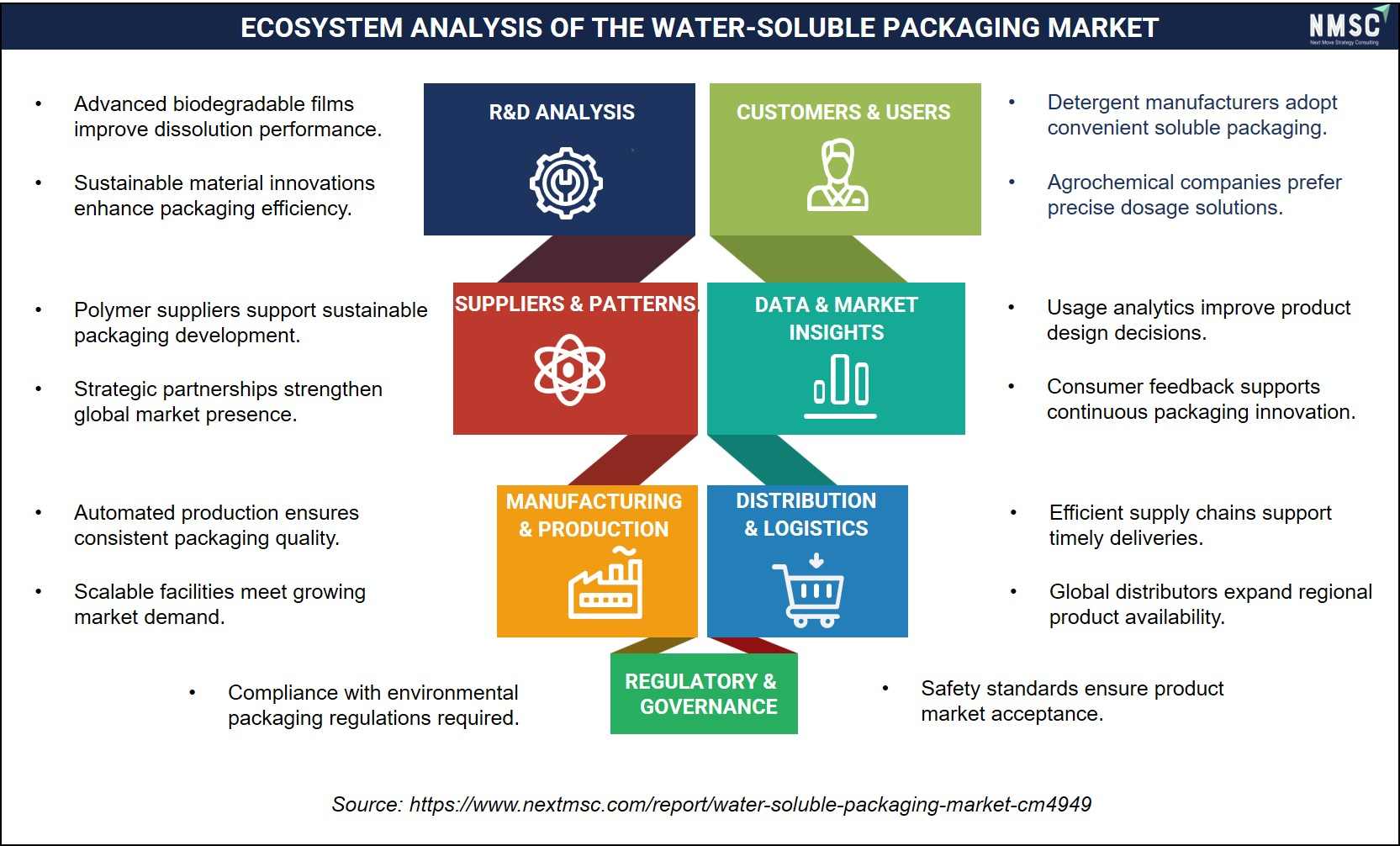
The above framework presents an ecosystem analysis of the Water-Soluble Packaging Market across R&D, manufacturing, distribution, data insights, regulatory governance, and end-user segments. We observed that detergent manufacturers adopt convenient soluble packaging while agrochemical companies prefer precise dosage solutions, shaping customer and user dynamics. Suppliers and partners drive manufacturing and production, with distribution and logistics enabling global market reach. Data and market insights facilitate demand forecasting and formulation optimization, while regulatory governance enforces biodegradability standards, material safety, and environmental compliance, collectively fostering innovation and sustainability in this evolving packaging landscape.
Key Emerging Trends in Water-Soluble Packaging Market
How Is the Transition to Bio-Based PVOH Formulations Reshaping Material Standards?
The water-soluble packaging market is experiencing a decisive shift from petroleum-derived conventional PVOH toward bio-based and partially bio-derived PVOH formulations that deliver equivalent technical performance with a reduced carbon footprint. NMSC's analysis indicates that suppliers including Aquapak Polymers Ltd. have introduced Hydropol, a bio-based polymer combining water solubility with marine biodegradability. Our assessment shows that leading consumer goods manufacturers are establishing bio-based content requirements in packaging specifications, accelerating supplier reformulation timelines and reshaping procurement criteria across the water-soluble packaging industry.
How Are Unit-Dose and Pre-Measured Formats Driving Premiumization in Household Care?
The proliferation of unit-dose water-soluble packaging formats across laundry, dishwashing, and home cleaning categories is creating a premiumization dynamic that is expanding per-unit packaging value and broadening the water-soluble packaging revenue base. From our research, we found that major household care brands are extending pod and capsule formats beyond laundry into automatic dishwashing and multi-surface disinfection applications. Premiumization supports higher average selling prices per package and is driving material specification upgrades toward higher-performance PVOH grades that deliver consistent dissolution in variable consumer conditions.
How Is Precision Agriculture Adoption Transforming Agrochemical Water-Soluble Packaging Demand?
The accelerating adoption of precision agriculture practices is creating specialized demand for water-soluble packaging formats that enable accurate, safe chemical dosing in field settings. Our market evaluation observed that agrochemical manufacturers are transitioning crop protection chemical products from manually measured liquid concentrates toward pre-portioned PVOH sachets that reduce applicator chemical exposure and improve application consistency. Companies including Arrow Greentech Ltd. have developed agrochemical-grade water-soluble films meeting ISO 15747 container standards, and regulatory agencies in the EU and U.S. are increasingly mandating closed transfer systems for concentrated pesticides.
How Are Healthcare and Infection Control Requirements Accelerating Medical Grade Water-Soluble Packaging?
Rising global standards for infection prevention and control in healthcare settings are creating sustained demand for medical-grade water-soluble bags used in hospital laundry and contaminated textile management. Based on our engagements with healthcare packaging stakeholders, we observed that infection control protocols adopted following the COVID-19 pandemic have become institutionalised in hospital procurement standards across North America and Europe. Medical water-soluble bags conforming to EN 13795 and similar standards are now specified by an expanding base of hospital group purchasing organizations, creating high-volume repeat procurement opportunities for manufacturers.
What Are the Key Market Drivers, Breakthroughs, and Investment Opportunities that will Shape the Water-Soluble Packaging Industry in the Next Decade?
Growth Catalyst and Risk Assessment Matrix
|
Drivers/Trends/Restraints |
(+/-) % Impact on CAGR Forecast |
Geographic Relevance |
Impact Timeline |
|
Expanding regulatory restrictions on single-use conventional plastics mandating sustainable packaging alternatives |
+2.8% |
Europe, North America, China, South/Southeast Asia |
Short to Medium Term (1–4 years) |
|
Growing consumer adoption of pre-measured unit-dose household care formats driving pod and pouch demand |
+2.4% |
North America, Europe, Japan, South Korea |
Short to Medium Term (1–4 years) |
|
Rising agrochemical industry use of PVOH sachets for crop protection chemical safe handling |
+1.7% |
North America, Europe, Brazil, India |
Medium Term (2–5 years) |
|
Raw material supply concentration and price volatility of petroleum-derived PVOH constraining margin stability |
-1.9% |
Global – all markets |
Medium Term (2–5 years) |
|
Child safety incidents with unit-dose laundry pods driving legislative restrictions in some markets |
-1.4% |
North America, Europe |
Short to Medium Term (1–4 years) |
|
Healthcare infection control institutional procurement expanding water-soluble bag demand |
+1.3% |
North America, Europe, Middle East |
Medium Term (2–5 years) |
What Are the Growth Drivers of Water-Soluble Packaging Market?
How Are Regulatory Restrictions on Single-Use Plastics Creating Structural Demand for Water-Soluble Packaging?
Global regulatory action against conventional single-use plastic packaging is creating powerful structural demand pull for water-soluble packaging materials as a technically viable and environmentally acceptable alternative. NMSC's analysis indicates that the European Union's Single Use Plastics Directive prohibits a range of conventional plastic packaging items and requires extended producer responsibility for others, creating market openings for water-soluble alternatives in laundry, cleaning, and industrial applications. The U.S. EPA has published voluntary sustainable packaging guidelines that acknowledge water solubility as a positive end-of-life characteristic. These regulatory frameworks are converting what was previously a value-added premium for water-soluble formats into a structural market access requirement in regulated product categories.
How Is Consumer Demand for Convenient Unit-Dose Formats Driving Water-Soluble Packaging Market Growth?
The ongoing consumer transition toward pre-measured, mess-free unit-dose formats in household care products continues to be a primary growth driver for the water-soluble packaging market demand across developed and developing markets. Our assessment indicates that unit-dose laundry pods and dishwasher pods have achieved mainstream penetration in North American and European markets and are demonstrating strong adoption momentum in South Korea, Japan, and coastal urban markets in China. The convenience attributes of water-soluble packaging formats, including precise dosing, reduced product waste, and elimination of measurement error, align with broad consumer trends toward premium, performance-oriented household care products that support brand differentiation and price premium capture.
How Is Agrochemical Industry Safety Regulation Accelerating PVOH Sachet Adoption?
Tightening occupational health and safety regulations governing agrochemical handling are creating a growing mandate for water-soluble sachets as the preferred packaging format for concentrated crop protection chemicals. Our research shows that regulatory frameworks including EU Regulation 1107/2009 on plant protection products and the U.S. EPA's Worker Protection Standard require employers to minimize applicator chemical exposure, with closed transfer system requirements increasingly favouring PVOH-packaged formulations. The Pesticide Action Network has documented the role of precision dosing sachets in reducing agricultural worker chemical exposure incidents, providing independent validation for the water-soluble packaging value proposition in agrochemical applications.
What Are the Growth Inhibitors of the Water-Soluble Packaging Market?
How Does Raw Material Supply Concentration and PVOH Price Volatility Constrain Market Expansion?
The water-soluble packaging market remains heavily dependent on polyvinyl alcohol as its primary functional material, and the concentrated geographic production base for PVOH resin, predominantly manufactured in China, Japan, and the United States, creates structural supply chain vulnerability and price volatility risk. NMSC's assessment indicates that chemical precursors for PVOH production, including vinyl acetate monomer, are subject to petrochemical feedstock price cycles that significantly impact PVOH resin pricing and availability. Supply disruptions from this concentrated manufacturing base constrain packaging manufacturers' ability to maintain stable cost structures and can delay capacity expansion plans for water-soluble packaging production.
How Do Child Safety Incidents with Unit-Dose Products Create Legislative Headwinds for the Market?
Documented poisoning incidents involving young children accessing unit-dose laundry pods have prompted legislative action in multiple markets that creates compliance complexity and potential market constraint for water-soluble packaging applications in consumer household care products. Through our market assessment, we observed that the U.S. Consumer Product Safety Improvement Act and European child safety standards require increasingly stringent packaging barrier and child-resistance features for unit-dose laundry and dishwashing products. While these regulations have not prohibited water-soluble pod formats, they have increased product development and testing costs, creating incremental compliance overhead that smaller brands and private label manufacturers find challenging to absorb.
What Are the Growth Opportunities in the Water-Soluble Packaging Market?
How Is the Pharmaceutical Unit-Dose Market Creating New Premium Opportunities for Water-Soluble Packaging?
The pharmaceutical industry's growing adoption of unit-dose oral film and pouch drug delivery formats is creating a premium growth opportunity for water-soluble packaging material suppliers capable of meeting pharmaceutical-grade manufacturing standards. From our research, we found that the FDA's guidance on oral disintegrating films and soluble drug delivery systems recognizes water-soluble polymer matrices as acceptable excipient systems for drug product manufacturing, providing regulatory pathway clarity for pharmaceutical water-soluble packaging applications. Companies including Cortec Corporation and SmartSolve Industries LLC are developing pharmaceutical-grade water-soluble film specifications serving this high-value, lower-volume but premium-priced extension of the market.
How Is the Construction Industry Creating an Emerging Demand for Water-Soluble Packaging?
The construction industry's growing use of pre-bagged fiber, pigment, and additive products in concrete, mortar, and composite manufacturing is creating an emerging application category for water-soluble packaging that delivers both processing efficiency and worker safety benefits. Our findings suggest that water-soluble bags for concrete admixtures allow contractors to add precisely measured product quantities to mixers without bag removal, eliminating bag contamination of the finished product and reducing material handling time. This industrial application is growing as construction efficiency standards intensify and as concrete admixture manufacturers seek packaging differentiators. Companies including Noble Industries Inc. are active in this emerging segment.
How Is the E-Commerce Channel Unlocking New Distribution Pathways for Water-Soluble Packaging?
The rapid growth of direct-to-consumer and specialty product e-commerce channels is creating new distribution pathways for water-soluble packaging formats that bypass traditional retail and distributor networks, enabling smaller and entrepreneurial brands to reach consumers with innovative unit-dose products. Based on our market evaluation, we noticed that the e-commerce channel is particularly significant for specialty cleaning concentrates, personalized detergent pods, and health-oriented cleaning products where direct-to-consumer brands are achieving significant market presence. Platform ecosystems on Amazon, Shopify, and Asian equivalent channels enable niche water-soluble packaging manufacturers and brands to achieve commercial scale without traditional minimum order quantity and shelf space constraints.
How Is the Water-Soluble Packaging Market Segmented in this Report, and What Are the Key Insights from the Segmentation Analysis?
Which Product Form Is Generating the Highest Revenue in the Water-Soluble Packaging Market?
|
Segments |
2025 (USD Billion) |
2035 (USD Billion) |
CAGR (%) |
|
Films |
1.74 |
3.94 |
8.5% |
|
Bags |
1.42 |
3.28 |
8.7% |
|
Pouches and Sachets |
1.18 |
2.79 |
9.0% |
|
Pods and Capsules |
1.31 |
3.22 |
9.4% |
|
Labels and Specialty Formats |
0.52 |
1.19 |
8.6% |
|
Other Product Forms |
0.28 |
0.60 |
7.9% |
Product form segmentation within the water-soluble packaging market reflects the diverse physical configurations in which water-soluble materials are converted and commercialized across application sectors. Films represent the largest product form at USD 1.74 billion in 2025, functioning as the primary feedstock converted into bags, sachets, and labels, with Packaging Films, Protective Films, Release Films, and Process Films each serving distinct industrial applications. Bags follow at USD 1.42 billion, led by Laundry Bags and Medical Infection Control Bags. Pods and Capsules are the fastest-growing product form at 9.4% CAGR, driven by Laundry Pods and Dishwasher Pods commanding mainstream consumer adoption. Pouches and Sachets, including Unit Dose Pouches and Agrochemical Sachets, grow steadily. Labels and Specialty Formats encompass Water-Soluble Labels, Embroidery Backing Films, and Seed Tapes serving specialty demand.
How Does Material Chemistry Influence Performance and Application Suitability in the Water-Soluble Packaging Market?
|
Segments |
2025 (USD Billion) |
2035 (USD Billion) |
CAGR (%) |
|
Polyvinyl Alcohol |
3.15 |
7.42 |
9.0% |
|
Modified Polyvinyl Alcohol |
1.48 |
3.47 |
8.9% |
|
Starch Based Materials |
0.89 |
2.08 |
8.9% |
|
Protein Based Materials |
0.38 |
1.01 |
10.3% |
|
Other Bio Based Materials |
0.55 |
1.04 |
6.6% |
Material chemistry is the defining technical variable in the water-soluble packaging market, determining dissolution profile, mechanical performance, barrier characteristics, chemical compatibility, and environmental end-of-life properties across all application segments. Polyvinyl Alcohol dominates at USD 3.15 billion in 2025, reflecting its unmatched combination of precise dissolution control, high tensile strength, and compatibility with detergent, agrochemical, and industrial chemical contents. Modified Polyvinyl Alcohol at USD 1.48 billion serves applications requiring delayed dissolution or improved moisture resistance. Starch Based Materials at USD 0.89 billion favour cost-competitive bio-based applications. Protein Based Materials are the fastest-growing chemistry at 10.3% CAGR, with Lactips SAS leading casein-derived film commercialization. Other Bio Based Materials serve specialty applications requiring full bio-derived content certification.
How Does Solubility Profile Segmentation Reflect the Diverse Application Requirements of the Water-Soluble Packaging Market?
|
Segments |
2025 (USD Billion) |
2035 (USD Billion) |
CAGR (%) |
|
Cold Water-Soluble |
2.41 |
5.69 |
9.0% |
|
Warm Water-Soluble |
2.18 |
5.02 |
8.7% |
|
Hot Water-Soluble |
1.29 |
2.91 |
8.5% |
|
Process Specific Soluble |
0.57 |
1.40 |
9.4% |
Solubility profile segmentation reflects the critical application-specific performance parameter determining product fitness for use across diverse end use categories in the water-soluble packaging market. Cold Water-Soluble formats command the largest share at USD 2.41 billion in 2025, as dissolution in unheated tap water is essential for household laundry, cleaning, and healthcare applications where controlled ambient-temperature dissolution is a fundamental requirement. Warm Water-Soluble formats at USD 2.18 billion serve dishwashing and textile processing applications. Hot Water-Soluble materials at USD 1.29 billion serve industrial processes including paper manufacturing and embroidery. Process-Specific Soluble formulations at 9.4% CAGR are the fastest-growing profile, serving pharmaceutical and specialty industrial applications where custom dissolution triggers are required.
How Are Distribution Channels Evolving to Support the Expanding Buyer Base in the Water-Soluble Packaging Market?
|
Segments |
2025 (USD Billion) |
2035 (USD Billion) |
CAGR (%) |
|
Direct Sales |
2.52 |
5.71 |
8.5% |
|
Distributor Network |
1.93 |
4.41 |
8.6% |
|
Contract Packaging |
0.82 |
1.93 |
8.9% |
|
Original Equipment Manufacturer |
0.64 |
1.52 |
9.0% |
|
E-commerce |
0.54 |
1.45 |
10.4% |
Sales channel segmentation in the water-soluble packaging market reflects the spectrum of commercial relationships through which film manufacturers, bag and pouch converters, and finished product producers access the market. Direct Sales dominates at USD 2.52 billion in 2025, serving major multinational household care and agrochemical manufacturers through long-term strategic supply agreements that ensure volume commitment and product development collaboration. Distributor Networks at USD 1.93 billion reach regional industrial chemical producers and mid-tier agrochemical companies. Contract Packaging at USD 0.82 billion serves brands outsourcing pod and sachet filling operations to specialist converters. Original Equipment Manufacturer channels serve equipment manufacturers integrating water-soluble formats into dispensing systems. E-commerce is the fastest-growing channel at 10.4% CAGR, reflecting direct-to-consumer brand expansion across cleaning concentrates and specialty pod formats.
Which End Use Industries Are Driving the Broadest Adoption of Water-Soluble Packaging Solutions?
|
Segments |
2025 (USD Billion) |
2035 (USD Billion) |
CAGR (%) |
|
Household Care |
2.18 |
5.06 |
8.8% |
|
Industrial Chemicals |
1.24 |
2.87 |
8.8% |
|
Healthcare and Pharmaceuticals |
0.78 |
1.91 |
9.4% |
|
Agriculture |
0.91 |
2.11 |
8.8% |
|
Textile and Embroidery |
0.52 |
1.18 |
8.6% |
|
Food Service |
0.38 |
0.88 |
8.8% |
|
Construction and Composites |
0.29 |
0.68 |
8.9% |
|
Other Industries |
0.15 |
0.33 |
8.2% |
End use industry segmentation reveals the broad commercial reach of the water-soluble packaging market across consumer, industrial, agricultural, and institutional sectors. Household Care is the dominant industry at USD 2.18 billion in 2025, anchored by Laundry Detergents as the largest sub-segment, followed by Dishwashing Products and Home Cleaning Products. Industrial Chemicals at USD 1.24 billion encompasses Water Treatment Chemicals, Specialty Chemicals, and Oil and Gas Chemical packaging. Agriculture at USD 0.91 billion reflects Crop Protection Chemicals as the primary sub-segment, with Fertilizers and Seed Treatment growing. Healthcare and Pharmaceuticals at USD 0.78 billion and a 9.4% CAGR is the fastest-growing end use, covering Hospital Laundry, Infection Control, and Pharmaceutical Dosing applications. Textile and Embroidery, Food Service, and Construction and Composites represent expanding opportunity segments.
Regional Outlook
Geographic Performance Snapshot
|
Region |
2025 (USD Billion) |
2035 (USD Billion) |
CAGR (%) |
|
North America |
2.19 |
5.01 |
8.6% |
|
Europe |
1.74 |
3.98 |
8.6% |
|
Asia Pacific |
1.65 |
4.02 |
9.3% |
|
Middle East and Africa |
0.52 |
1.19 |
8.6% |
|
Latin America |
0.35 |
0.82 |
8.9% |
North America Water-Soluble Packaging Market
North America is the dominant regional market for water-soluble packaging, generating USD 2.19 billion in 2025. The region's maturity is underpinned by widespread consumer adoption of unit-dose laundry pods, a robust agrochemical sector using PVOH sachets, and a healthcare sector with established infection control protocols requiring medical-grade water-soluble bags. NMSC's analysis indicates that regulatory developments at federal and state levels are providing progressive support for water-soluble materials as alternatives to restricted single-use plastic formats, expected to reach USD 5.01 billion by 2035 at an 8.6% CAGR.
United States Water-Soluble Packaging Market
Based on our engagements with industry stakeholders, the United States is the world's largest national market for water-soluble packaging, driven by the world's highest per-capita consumption of unit-dose laundry and dishwasher products, a large and technologically advanced agrochemical sector, and institutional healthcare procurement programs standardizing on medical-grade water-soluble infection control products. The U.S. EPA's Safer Choice program and packaging sustainability guidelines are actively promoting water-soluble packaging alternatives. Technology penetration is highest among Tier 1 household care brands, with MonoSol LLC serving as the primary domestic PVOH film supplier.
Canada Water-Soluble Packaging Market
Through our analysis, Canada's water-soluble packaging market mirrors the U.S. consumer adoption patterns for unit-dose household care products, with laundry pod penetration at near-equivalent levels. Environment and Climate Change Canada's packaging regulations and provincial extended producer responsibility frameworks are creating positive regulatory conditions for water-soluble formats. The competitive landscape reflects dominance of multinational brands using U.S.-integrated supply chains, with limited domestic water-soluble film production requiring most supply to be imported. French-English bilingual claims processing requirements create incremental complexity that AI document intelligence vendors are actively addressing.
Mexico Water-Soluble Packaging Market
From our assessment, Mexico's water-soluble packaging market is in a growth phase, with laundry pod format penetration accelerating as middle-class expansion and urbanization drive premium household care product adoption. Mexico's federal plastic waste reduction program is creating incremental regulatory momentum for packaging alternatives. The agrochemical sector provides industrial demand for PVOH-packaged pesticide formulations. Market development is supported by proximity to U.S.-based film suppliers and the presence of multinational consumer goods manufacturers operating Mexican production facilities deploying water-soluble formats consistent with their global packaging standards.
Europe Water-Soluble Packaging Market
Europe is the second-largest regional market at USD 1.74 billion in 2025, characterised by the most stringent regulatory environment globally for packaging sustainability, with the EU Single Use Plastics Directive and the European Green Deal creating structural demand for water-soluble alternatives to conventional plastic formats. Our analysis indicates that European household care markets, particularly Germany, the UK, and France, have among the world's highest unit-dose product penetration rates. The European water-soluble packaging industry is supported by a strong regional manufacturing base including Ecopol S.p.A. in Italy and Mondi plc.
United Kingdom Water-Soluble Packaging Market
Based on our engagements, the United Kingdom represents one of Europe's most advanced water-soluble packaging markets, with high consumer acceptance of laundry pod formats, a proactive regulatory environment under the UK Plastics Pact and Extended Producer Responsibility framework, and a growing domestic household care brand ecosystem investing in sustainable packaging credentials. Post-Brexit regulatory divergence from EU frameworks creates both opportunities for UK-specific innovation and complexity for vendors operating simultaneously in both markets. Aquapak Polymers Ltd., headquartered in Birmingham, is a notable domestic water-soluble material innovator developing Hydropol for UK and global markets.
Germany Water-Soluble Packaging Market
Through our analysis, Germany's water-soluble packaging market benefits from the country's leading position in both household care product consumption and industrial chemical manufacturing. The Verpackungsgesetz packaging law requires producers to register and contribute to recycling systems, with water-soluble packaging receiving favourable treatment. German insurers place high emphasis on data sovereignty, supporting demand for private cloud and hybrid deployment models. German chemical companies are significant users of PVOH packaging for industrial and specialty chemicals, and Germany's strong sustainability culture supports retail acceptance of water-soluble household care products at dm, Rewe, and Edeka retail chains.
France Water-Soluble Packaging Market
From our assessment, France's water-soluble packaging market is growing, supported by the Anti-Waste for a Circular Economy law that imposes progressive restrictions on single-use plastic packaging, creating demand for water-soluble alternatives. French household care consumers have adopted laundry pod formats at rates comparable to the UK. France's agricultural sector, one of Europe's largest, provides agrochemical packaging demand. Regulatory emphasis on material transparency and end-of-life traceability is influencing water-soluble film specification requirements, as manufacturers must demonstrate environmental performance beyond simple water dissolution to satisfy retail buyer sustainability audit requirements.
Italy Water-Soluble Packaging Market
According to evaluation of Italy's market, Ecopol S.p.A. headquartered in Italy positions the country as a significant water-soluble packaging manufacturing hub within Europe, producing PVOH films and packaging materials for domestic and export markets. Italian household care and industrial chemical sectors provide both domestic end-use demand and contract manufacturing volumes for pan-European brands. Italy's plastic restriction legislation implementing EU Directive requirements is creating incremental market openings. The Italian food service sector, known for large-volume catering operations, is an emerging end use for water-soluble portion packaging in high-volume institutional catering environments.
Spain Water-Soluble Packaging Market
Based on our engagements, Spain's water-soluble packaging market is expanding under the influence of Spain's Residues and Contaminated Soils Law, which imposes progressive restrictions on single-use plastics and encourages producers to adopt sustainable packaging alternatives. Spanish agrochemical consumption creates industrial demand for PVOH sachets. Household care pod adoption is growing, particularly among urban consumers. Rovi Packaging S.L., a Spanish company, represents domestic market participation in water-soluble packaging development, serving specialty applications within the Iberian market and contributing to regional water-soluble packaging industry development.
Sweden Water-Soluble Packaging Market
Through our analysis, Sweden's water-soluble packaging market benefits from Scandinavia's advanced sustainability culture and high consumer willingness to pay for environmentally certified packaging formats. Swedish retail chains including ICA and Coop have sustainability sourcing requirements that favour water-soluble packaging credentials. Sweden's producer responsibility regulations create financial incentives for brands to transition toward sustainable formats including water-soluble unit-dose products. The industrial chemicals and water treatment sector provides additional B2B demand for PVOH-packaged dosing formats in industrial facilities throughout the country.
Denmark Water-Soluble Packaging Market
From our assessment, Denmark's water-soluble packaging market operates within a highly environmentally conscious consumer and regulatory context. The Danish Plastics Pact commitments and the Danish Environmental Protection Act's packaging provisions encourage sustainable packaging adoption. Danish household care brands and retail buyers apply high sustainability scrutiny to packaging procurement, supporting water-soluble format adoption. Denmark's sophisticated food service and commercial kitchen sector represents a growing institutional application for pre-portioned water-soluble cleaning and sanitizing product formats in commercial hospitality environments.
Finland Water-Soluble Packaging Market
Based on our engagements, Finland's water-soluble packaging market reflects the country's position as a global leader in sustainable forestry and bio-based material development, creating a natural commercial and policy environment for bio-derived water-soluble packaging alternatives. Finnish retail and institutional procurement programs emphasize environmental credentials, benefiting water-soluble packaging suppliers. The pulp and paper industry intersects with water-soluble packaging through process chemical applications where PVOH bags and sachets are used for controlled additive dosing in high-volume paper manufacturing operations.
Netherlands Water-Soluble Packaging Market
Through our analysis, the Netherlands water-soluble packaging market operates within an advanced logistics and packaging hub that serves as a distribution center for water-soluble packaging products across Northern and Western Europe. Dutch retail chains including Albert Heijn and Jumbo carry extensive ranges of unit-dose water-soluble household care products. The Netherlands' chemical industry cluster in the Rotterdam port region generates industrial chemical packaging demand. NEPTUN Technologies GmbH's European distribution operations maintain Netherlands-based logistics for water-soluble packaging supply chains serving the broader European market.
Rest of Europe Water-Soluble Packaging Market
According to evaluation of remaining European markets including Poland, Belgium, Austria, Switzerland, Czech Republic, Portugal, and other EU and non-EU European markets, water-soluble packaging adoption is expanding in line with the progressive implementation of EU packaging sustainability directives across member states. Central and Eastern European markets including Poland are at earlier stages of water-soluble consumer product penetration but are experiencing accelerating adoption as multinational brands standardize packaging formats across EU markets. Switzerland's chemical and pharmaceutical industries are notable industrial end users of water-soluble packaging materials.
Asia Pacific Water-Soluble Packaging Market
Asia Pacific is the fastest-growing regional market, projected to expand from USD 1.65 billion in 2025 to USD 4.02 billion by 2035 at a 9.3% CAGR. NMSC's analysis indicates that China's national plastic restriction policies, India's rapid consumer goods market expansion, South Korea and Japan's mature unit-dose household care markets, and Southeast Asia's growing middle-class consumer base are collectively driving regional growth. Asia Pacific is also a major manufacturing hub for water-soluble packaging materials, with significant PVOH film production concentrated in China and Japan.
China Water-Soluble Packaging Market
Based on our engagements, China is the largest and fastest-growing market in Asia Pacific for water-soluble packaging, driven by national plastic restriction policies enforced progressively since 2020, a massive and rapidly premiumizing household care market, a dominant domestic PVOH manufacturing base, and growing agrochemical sector adoption. Companies including Foshan Polyva Materials Co., Ltd., Jiangmen Proudly Water-Soluble Plastic Co., Ltd., and Changzhou Green Cradleland Macromolecule Materials Co., Ltd. represent significant Chinese water-soluble packaging manufacturers serving both domestic and export markets.
India Water-Soluble Packaging Market
Through our analysis, India's water-soluble packaging market is in a robust growth phase, driven by rising household incomes supporting premium household care product adoption, the agrochemical sector's growing investment in safer pesticide packaging formats following multiple fatal farmer exposure incidents, and the government's plastic waste management rules progressively restricting single-use plastic packaging. The Bureau of Indian Standards and Ministry of Agriculture are developing standards for water-soluble pesticide packaging that will mandate safer format adoption. Arrow Greentech Ltd. is a prominent Indian manufacturer serving both domestic and export markets.
Japan Water-Soluble Packaging Market
From our assessment, Japan is one of Asia Pacific's most mature water-soluble packaging markets, with Aicello Corporation representing Japan's foremost specialist water-soluble film manufacturer with a global product portfolio. Japanese consumers show high acceptance of unit-dose cleaning formats, and the country's industrial sector is a significant user of water-soluble packaging for chemical processing applications. Japan's plastic resource circulation law, enacted in 2022, creates ongoing positive regulatory momentum. The aging population trend supports demand for convenient pre-measured household product formats compatible with water-soluble packaging.
South Korea Water-Soluble Packaging Market
According to our evaluation of South Korea's market, the country is a mature and growing water-soluble packaging consumer, with high household care product premiumization and strong retail distribution of unit-dose pod and sachet formats. Korea's Act on the Promotion of Saving and Recycling of Resources and supporting packaging regulations provide a favourable regulatory backdrop. South Korean consumer goods brands are adopting water-soluble packaging as a product quality and sustainability signal. The country's advanced chemical manufacturing sector creates industrial demand for water-soluble packaging in specialty chemical and pharmaceutical dosing applications.
Taiwan Water-Soluble Packaging Market
Based on our engagements, Taiwan's water-soluble packaging market benefits from the country's advanced chemical manufacturing ecosystem and technology-oriented packaging industry. The Environmental Protection Administration's plastic use restrictions are creating market openings for water-soluble alternatives. Taiwan's pharmaceutical and specialty chemical industries are notable end users of water-soluble packaging formats. Domestic packaging converters serve both the Taiwanese market and regional export demand, maintaining Taiwan's position as a packaging technology hub within the Asia Pacific supply chain network.
Indonesia Water-Soluble Packaging Market
Through our analysis, Indonesia's water-soluble packaging market is at an early but expanding stage, supported by the world's fourth-largest population, rapid urbanization driving premium household care adoption in urban centers, and government programs addressing Indonesia's severe plastic waste crisis in marine and coastal environments. The Ministry of Environment and Forestry's plastic waste regulations are creating incremental demand for dissolvable packaging alternatives. Advent Packaging Sdn. Bhd. and regional converting operations serve the Indonesian market through distributor networks.
Vietnam Water-Soluble Packaging Market
From our assessment, Vietnam's water-soluble packaging market is emerging, driven by rapid economic development, a young and increasingly affluent consumer base, and Vietnam's commitment to eliminating single-use plastic packaging under its National Strategy on Integrated Solid Waste Management. The agricultural sector's large footprint creates industrial demand for PVOH-packaged agrochemical formulations. Household care brands are introducing unit-dose products to Vietnamese consumers as part of premium product line extensions, with mobile-first digital retail channels accelerating consumer product discovery and purchase.
Australia Water-Soluble Packaging Market
According to our evaluation of Australia's market, the country is among Asia Pacific's most mature water-soluble packaging consumers, with a highly developed household care market and established institutional procurement of water-soluble infection control products by healthcare facilities. Australia's National Packaging Targets administered by the Australian Packaging Covenant Organisation create positive conditions for water-soluble formats. The agricultural sector's extensive use of crop protection chemicals creates structural demand for PVOH-packaged agrochemical products. SmartSolve Industries LLC and international vendors serve the Australian market through distributor partnerships.
Philippines Water-Soluble Packaging Market
Based on our engagements, the Philippines water-soluble packaging market is developing, supported by growing consumer awareness of plastic waste impacts on the country's coastal and marine environments and by the Extended Producer Responsibility Act of 2022 that mandates producers to manage their plastic packaging waste. Unit-dose household care formats are gaining adoption in urban Philippine markets. Advent Packaging Sdn. Bhd. and regional converting partners serve the Philippine market, with mobile and digital retail channels accelerating unit-dose product accessibility for Filipino consumers.
Malaysia Water-Soluble Packaging Market
Through our analysis, Malaysia's water-soluble packaging market is advancing, supported by the Roadmap Towards Zero Single Use Plastics 2018–2030. Advent Packaging Sdn. Bhd., headquartered in Malaysia, is the most prominent regional water-soluble packaging manufacturer, serving both domestic and export markets across Southeast Asia. Malaysia's chemical manufacturing sector provides industrial demand for water-soluble packaging. Household care market growth and premium product adoption among Malaysia's growing middle class are expanding the consumer end-use segment, with laundry pods gaining strong urban market presence.
Rest of APAC Water-Soluble Packaging Market
From our assessment, remaining Asia Pacific markets including Thailand, New Zealand, Bangladesh, Pakistan, Sri Lanka, and Pacific Island nations represent a combined emerging growth opportunity for water-soluble packaging. Thailand's large household care and agricultural sectors create dual consumer and industrial demand. New Zealand's high environmental standards align with water-soluble packaging's sustainability profile, with national programs supporting adoption. Bangladesh's garment manufacturing sector creates demand for textile-grade water-soluble embroidery backing films serving global fashion supply chains.
Middle East and Africa Water-Soluble Packaging Market
The Middle East and Africa region represents an emerging market for water-soluble packaging, valued at USD 0.52 billion in 2025 and projected to reach USD 1.19 billion by 2035 at an 8.6% CAGR. NMSC's analysis indicates that Gulf Cooperation Council countries are the primary drivers of regional demand, supported by high household care product consumption standards, an expanding healthcare infrastructure requiring medical-grade water-soluble infection control products, and Vision 2030 programs in Saudi Arabia and UAE promoting sustainable manufacturing and consumption practices.
Saudi Arabia Water-Soluble Packaging Market
Based on our engagements, Saudi Arabia is the largest water-soluble packaging market in the Middle East, driven by high household care product consumption among Saudi Arabia's affluent urban population, an expanding healthcare sector requiring infection control packaging, and Saudi Vision 2030's sustainability commitments creating institutional demand for environmentally responsible packaging alternatives. The Saudi Standards, Metrology and Quality Organization is developing packaging sustainability standards aligned with international frameworks. Saudi Arabia's large agricultural sector and intensified food security investment are creating incremental agrochemical packaging demand.
UAE Water-Soluble Packaging Market
Through our analysis, the UAE water-soluble packaging market benefits from the country's advanced retail infrastructure, high consumer spending power, and progressive environmental regulations, including the UAE's ban on single-use plastic bags implemented from 2022 under Cabinet Decision No. 37 of 2021. The UAE's position as a regional trading hub supports water-soluble packaging import and re-export activity to broader MENA markets. Healthcare demand from Dubai's world-class hospital network drives medical-grade water-soluble product adoption, while the hospitality and food service industry represents a growing institutional application.
Egypt Water-Soluble Packaging Market
From our assessment, Egypt's water-soluble packaging market is developing within a large and growing consumer economy, with rising middle-class household care expenditure creating demand for premium unit-dose product formats. Egypt's plastic waste management regulations are in progressive development, with the Egyptian government's environmental programs targeting packaging waste reduction. Agricultural demand for agrochemical sachets is present given Egypt's large irrigation-based farming sector. Cost sensitivity remains a key market parameter, favouring value-for-money water-soluble formats over premium product configurations.
Israel Water-Soluble Packaging Market
According to our evaluation of Israel's market, the country's advanced technology ecosystem and environmental consciousness support strong institutional adoption of water-soluble packaging in healthcare, pharmaceutical, and specialty chemical applications. The Israeli Standards Institute and Ministry of Environmental Protection are implementing packaging regulations aligned with EU sustainability frameworks. Israel's pharmaceutical industry, a globally recognized sector, creates specialty demand for pharmaceutical-grade water-soluble dosing formats. Agricultural applications for PVOH-packaged agrochemicals serve Israel's precision irrigation-intensive agricultural sector.
Turkey Water-Soluble Packaging Market
Based on our engagements, Turkey's water-soluble packaging market operates within a large and growing consumer economy with increasing premium household care product adoption among urban consumers. Turkey's Solid Waste Control Regulation and plastic packaging producer responsibility requirements are creating progressive regulatory incentives for water-soluble packaging alternatives. Turkey's large textile manufacturing sector, one of the world's leading garment exporters, generates significant demand for water-soluble embroidery backing films used in high-volume embroidery operations serving global fashion brands.
Nigeria Water-Soluble Packaging Market
Through our analysis, Nigeria's water-soluble packaging market is at an early commercial stage, with urban consumer markets in Lagos, Abuja, and Port Harcourt representing the primary demand nodes for premium household care products incorporating water-soluble formats. Nigeria's National Environmental Standards and Regulations Enforcement Agency is developing plastic packaging waste regulations that may accelerate water-soluble adoption. The agricultural sector presents long-term demand potential for PVOH-packaged agrochemicals as farm input quality standards improve and distribution infrastructure extends.
South Africa Water-Soluble Packaging Market
From our assessment, South Africa is the most mature water-soluble packaging market in Sub-Saharan Africa, supported by a developed consumer goods retail sector, an established pharmaceutical and healthcare industry, and South Africa's Extended Producer Responsibility regulations for paper and packaging creating compliance motivation for sustainable packaging adoption. South African household care brands are introducing unit-dose pod formats, and institutional healthcare buyers are procuring medical-grade water-soluble infection control bags. The mining and industrial chemical sector provides B2B demand for water treatment and chemical dosing applications.
Rest of MEA Water-Soluble Packaging Market
According to evaluation of remaining MEA markets including Kuwait, Qatar, Bahrain, Oman, Morocco, Kenya, Ghana, Ethiopia, and Tanzania, water-soluble packaging adoption reflects the spectrum from near-developed Gulf market standards to early-stage Sub-Saharan commercial development. Gulf markets benefit from high consumer spending power and progressive sustainability programs aligned with global standards. East African markets are experiencing growing demand for agrochemical water-soluble packaging as agricultural modernisation programs expand. Morocco's proximity to European markets and its own plastic restriction legislation are supporting growth.
Latin America Water-Soluble Packaging Market
Latin America's water-soluble packaging market is valued at USD 0.35 billion in 2025 and is projected to expand at a CAGR of 8.9% through 2035, reaching USD 0.82 billion. NMSC's analysis indicates that Brazil's large household care and agricultural markets drive the majority of regional demand, followed by Colombia and Chile's growing middle-class consumer bases. Cost sensitivity remains a key market parameter, favouring unit-dose formats that reduce product waste. Regulatory development around plastic waste is creating progressive support for water-soluble alternatives across Latin American markets.
Brazil Water-Soluble Packaging Market
Based on our engagements, Brazil is Latin America's largest water-soluble packaging market, driven by the region's largest consumer goods market, a massive and technologically advanced agricultural sector, and Brazil's National Solid Waste Policy mandating progressive reduction of conventional plastic packaging waste. Brazilian household care brands including Unilever Brazil and Procter & Gamble Brazil are introducing unit-dose water-soluble formats. The agricultural sector's demand for PVOH-packaged pesticide formulations is growing as Brazilian regulatory standards for farm worker chemical safety strengthen progressively.
Argentina Water-Soluble Packaging Market
Through our analysis, Argentina's water-soluble packaging market faces the constraint of ongoing macroeconomic volatility, but structural demand remains supported by a large agricultural economy with significant crop protection chemical consumption, growing urban household care market adoption of premium formats, and environmental regulation development. Argentina's Law on Minimum Budgets for Environmental Management includes provisions relevant to chemical packaging safety. PVOH-packaged pesticide formulations serve Argentina's soybean, corn, and wheat production sectors. Economic stabilisation programs are expected to unlock greater institutional and consumer packaging investment over the forecast period.
Chile Water-Soluble Packaging Market
From our assessment, Chile represents one of Latin America's most environmentally advanced markets for water-soluble packaging, with the Framework Law on Waste Management, Extended Producer Responsibility and Promotion of Recycling creating robust producer responsibilities for packaging sustainability. Chilean consumers are among Latin America's most receptive to premium sustainable packaging formats. The mining sector creates industrial demand for water-soluble packaging in chemical dosing applications for mineral processing operations. Chile's advanced food export sector also creates specialty demand for food-contact-grade water-soluble packaging materials.
Colombia Water-Soluble Packaging Market
According to evaluation of Colombia's market, the water-soluble packaging sector is advancing under Colombia's National Policy for Sustainable Production and Consumption and Resolution 1407 of 2018 on plastic packaging management. Colombia's growing middle class in Bogotá, Medellín, and Cali is driving household care product premiumization that supports unit-dose water-soluble format adoption. The agricultural sector uses PVOH-packaged agricultural chemical formulations. Colombia's growing pharmaceutical manufacturing sector creates specialty demand for pharmaceutical-grade water-soluble packaging with high purity and dissolution consistency requirements.
Rest of LATAM Water-Soluble Packaging Market
From our assessment, remaining Latin American markets including Peru, Ecuador, Uruguay, Paraguay, Bolivia, Venezuela, and Central American countries are at earlier stages of water-soluble packaging market development. Peru's large agricultural export sector creates demand for crop protection chemical packaging. Uruguay's advanced environmental regulations create a positive backdrop for sustainable packaging adoption. Central American markets, including Costa Rica with its strong environmental credentials, represent developing opportunities for water-soluble packaging in both consumer and industrial applications as regional distribution networks expand their geographic coverage.
Pestel Analysis Of The Water-soluble Packaging Market
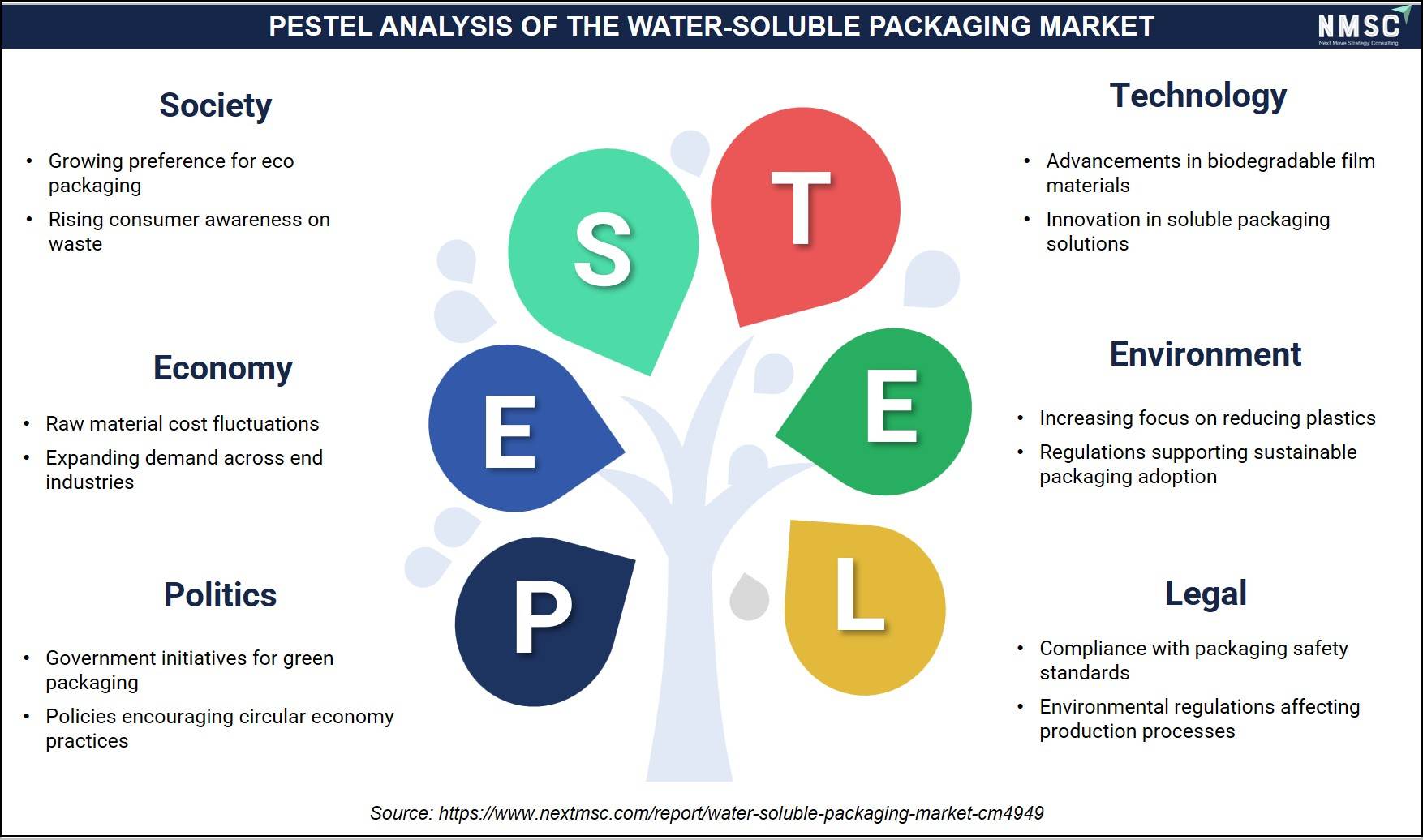
The above infographic presents a PESTEL analysis of the Water-Soluble Packaging Market, illustrating the external factors influencing industry growth and competitive positioning. It examines political, economic, social, technological, environmental, and legal dynamics shaping market development. The framework also highlights how sustainability regulations, consumer preference for eco-friendly packaging, advances in biodegradable materials, and stricter waste management policies are accelerating adoption across multiple end-use industries.
Competitive Landscape
Competitive Dynamics and M&A Landscape
|
Key Takeaways |
Details |
|
Market Structure |
Moderately fragmented; led by specialized PVOH film manufacturers (MonoSol LLC, Aicello Corporation, Mitsubishi Chemical Group) alongside European specialty converters (Ecopol, Mondi) and a growing tier of regional Asian manufacturers. No single vendor commands more than 20% global market share. |
|
Innovation Focus |
Bio-based PVOH and protein-based polymer development, precision dissolution profile engineering, pharmaceutical-grade water-soluble film certification, marine biodegradable formulations, and child-resistant water-soluble packaging are the primary innovation vectors across leading vendors. |
|
M&A Activity |
Strategic acquisitions are occurring as global chemical and packaging groups seek to add water-soluble film capabilities; Kuraray's acquisition of MonoSol is the landmark transaction of the past decade, with further consolidation expected as bio-based material startups attract acquirer interest. |
How Do Companies Compete in Water-Soluble Packaging Market?
The competitive landscape of the water-soluble packaging industry is structured around several distinct capability tiers, ranging from vertically integrated PVOH resin-to-film producers to specialist converters that transform purchased film into finished bags, pouches, and sachets. NMSC's analysis indicates that market structure is moderately fragmented, with approximately 20 significant global vendors competing across different geographies, product categories, and application segments. MonoSol LLC, a Kuraray subsidiary, holds a leadership position in North American household care water-soluble film supply, anchored by long-term supply relationships with major consumer goods manufacturers that have created deep application integration. Aicello Corporation in Japan and Mitsubishi Chemical Group Corporation's PVOH polymer division compete globally with differentiated film grades serving industrial, agricultural, and pharmaceutical applications. European players including Ecopol S.p.A. and Mondi plc bring specialty converting and broader packaging group resources to the market.
Which Kind of Companies Dominate the Water-Soluble Packaging Market?
The water-soluble packaging market is dominated by two primary company archetypes. The first comprises vertically integrated PVOH specialists and chemical group subsidiaries, including MonoSol LLC (Kuraray), Aicello Corporation, and Mitsubishi Chemical Group Corporation, which control PVOH polymer-to-film conversion, often including resin production, providing competitive advantages in material consistency, quality control, and new formulation development speed. These companies serve the largest household care and industrial accounts through direct supply agreements backed by significant technical application support resources and regulatory documentation capabilities that establish high switching costs.
The second dominant category comprises European specialty packaging and material companies, including Ecopol S.p.A., Mondi plc, Aquapak Polymers Ltd., and Cortec Corporation, that bring deep converting expertise, sustainability-oriented formulation capability, and established distribution into regulated Western markets. A third growing category includes Asian regional manufacturers, particularly Chinese producers such as Foshan Polyva Materials Co., Ltd., Jiangmen Proudly Water-Soluble Plastic Co., Ltd., and Changzhou Green Cradleland Macromolecule Materials Co., Ltd., that serve domestic and export markets with competitive price points. A fourth emerging segment comprises bio-based material innovators, including Lactips SAS and Aquapak, attracting growth investment through differentiated sustainability credentials.
Material Science Innovation and Sustainability Standards Drive Market Success in the Water-Soluble Packaging Market
NMSC's analysis indicates that material science leadership and verifiable sustainability performance are becoming the primary competitive differentiators in the water-soluble packaging market as customer procurement criteria evolve beyond basic dissolution performance toward comprehensive environmental assessment. Vendors investing in bio-based feedstock integration, marine biodegradability certification, and lifecycle analysis documentation are gaining preference in competitive evaluations among multinational consumer goods companies with science-based sustainability targets. The development of globally recognized standards for water-soluble packaging environmental performance, including work underway by ISO technical committees, will further elevate standards compliance as a competitive requirement.
Market Players to opt for Merger and Acquisition Strategies to Expand Their Presence in the Water-Soluble Packaging Market
M&A activity in the water-soluble packaging industry is intensifying, driven by global chemical and packaging groups seeking to strengthen their sustainable packaging portfolios and by private equity investors attracted to the specialty materials segment's above-GDP growth rate and high barriers to entry. Our findings suggest that bio-based material startups with proprietary formulations, niche application specialists with deep customer integration, and regional Asian manufacturers with established production scale are the most likely M&A targets. Geographic expansion through acquisition of regional converters enables established material suppliers to extend into fast-growing Asia Pacific and Latin American markets without greenfield capital commitment.
Who Are the Key Market Players in Water-Soluble Packaging Market?
-
MonoSol LLC
-
Ecopol S.p.A.
-
Mitsubishi Chemical Group Corporation
-
Aicello Corporation
-
Mondi plc
-
Arrow Greentech Ltd.
-
Aquapak Polymers Ltd.
-
Cortec Corporation
-
Lactips SAS
-
Foshan Polyva Materials Co., Ltd.
-
Solupak Ltd.
-
SmartSolve Industries LLC
-
Jiangmen Proudly Water-Soluble Plastic Co., Ltd.
-
Changzhou Green Cradleland Macromolecule Materials Co., Ltd.
-
Soluble Technology Ltd.
-
Noble Industries Inc.
-
NEPTUN Technologies GmbH
-
Rovi Packaging S.L.
-
Advent Packaging Sdn. Bhd.
-
JRF Technology LLC
What Are the Latest Developments in the Water-Soluble Packaging Industry?
|
Date |
Event |
|
March 2026 |
SmartSolve Industries introduced PureNil 0, a plastic-free, water-soluble packaging substrate for consumer packaged goods. |
|
February 2025 |
Mondi plc partnered with Proquimia to launch paper-based stand-up pouches containing water-soluble dishwasher tablets in Spain and Portugal. |
Expert Insights

"Consumers across Europe are switching to household brands that have adopted a more sustainable packaging solution. By closely collaborating with our customers, we aim to balance resource efficiency with the lowest possible environmental impact, meeting the demands of our customers and their end-consumers alike."
-Alessandro D’Agostino, Business Development Manager for Home & Personal Care at Mondi
Statement made during the launch of paper-based stand-up pouches for dishwashing tabs.
Market Interpretation:
The statement highlights the increasing consumer-driven shift toward sustainable packaging formats, which is accelerating innovation across the Water-Soluble Packaging market. As environmentally conscious consumers increasingly favor brands adopting lower-impact packaging solutions, manufacturers are focusing on balancing resource efficiency with product performance and environmental sustainability. Consequently, collaboration between packaging suppliers and consumer goods companies is driving the commercialization and broader adoption of water-soluble and circular packaging solutions in household and personal care applications.
What Are the Investment Opportunities in Water-Soluble Packaging Market?
Capital Inflows
The water-soluble packaging market is attracting increasing capital inflows from sustainability-focused investors, specialty chemical strategics, and consumer packaging private equity firms, drawn by above-GDP growth rates, high barriers to entry through material science qualifications, and structural alignment with global packaging sustainability trends. Our analysis indicates that investment activity is concentrated in bio-based material innovation companies, specialty PVOH film capacity expansion, and pharmaceutical-grade water-soluble packaging development programs that command premium valuations relative to conventional packaging investments.
Infrastructure Investments
Infrastructure investments encompass polymer production capacity, film extrusion lines, and converting equipment for bag, pouch, and pod formats that represent high capital commitments with long payback periods. NMSC's findings suggest that leading material producers including MonoSol, Aicello, and Ecopol are making sustained capital expenditure investments to expand production capacity in response to growing demand. Manufacturing footprint expansion in Asia, particularly in high-domestic-demand markets, represents an attractive infrastructure investment thesis for mid-tier water-soluble packaging manufacturers seeking cost optimization.
ESG Considerations
ESG considerations are central to investment thesis development in the water-soluble packaging sector, as the category's fundamental environmental proposition of eliminating packaging waste through dissolution creates natural alignment with institutional ESG screening criteria. Our assessment indicates that investors applying sustainability-linked frameworks increasingly include water-soluble packaging within circular economy portfolio themes. OECD biodegradability certification standards and upcoming EU bio-based product labelling standards provide the ESG documentation infrastructure that institutional investors require for portfolio justification and fund reporting compliance.
Digital Transformation
Digital transformation is creating new investment opportunities through e-commerce channel development, direct-to-consumer brand building, and digital supply chain tools for dissolution specification communication. From our research, we found that direct-to-consumer cleaning concentrate brands using water-soluble pod formats are attracting venture capital investment. Brands including Dropps and Grove Collaborative have demonstrated the unit economics of e-commerce distributed water-soluble household care products, validating the digital-first packaging investment thesis for growth investors targeting the sector.
Private Equity and M&A Landscape
Private equity and venture capital activity in the water-soluble packaging sector is accelerating, with growth equity firms building positions in bio-based material innovators, specialty converters with premium application expertise, and direct-to-consumer brands leveraging water-soluble packaging as a sustainability differentiator. NMSC's analysis indicates that the most attractive PE investment structures are companies with long-term supply agreements with consumer goods multinationals, proprietary formulation portfolios that are difficult to replicate, and geographic diversification across multiple regulatory jurisdictions that reduces single-market risk exposure.
Key Benefits for Stakeholders
Consumer Goods Manufacturers
Consumer goods manufacturers gain detailed segmentation analysis across product form, material chemistry, and solubility profile, enabling identification of the optimal packaging configuration for their specific product formulation and market requirements. The competitive landscape analysis provides intelligence on material supplier roadmap priorities, format innovation pipelines, and regulatory compliance benchmarks, enabling procurement teams to make informed supplier selection decisions and packaging specification upgrades aligned with sustainability commitments and quantified lifecycle analysis documentation.
Material Suppliers
Water-soluble material suppliers gain detailed market sizing across all application segments, competitive landscape intelligence, and geographic growth forecasting through 2035. NMSC's analysis provides actionable intelligence on application growth trajectories, buyer segment investment patterns, and distribution channel dynamics, enabling material suppliers to prioritize capacity investment and product development resources toward the fastest-growing end use industries and geographic markets with the greatest volume expansion and pricing premium potential.
Investors and Financial Analysts
Investors and financial analysts access a structured, data-rich assessment of the water-soluble packaging market's growth trajectory, competitive dynamics, and segment-level revenue forecasts through 2035. The CAGR analysis by segment, region, and application enables precise portfolio construction and valuation modelling. The M&A landscape intelligence and latest developments tracking section provide early-signal frameworks for identifying technology transitions, competitive disruption risks, and emerging growth opportunities within the global water-soluble packaging landscape.
Packaging Converters
Packaging converters gain insight into material chemistry trends, end-use industry demand growth, and converting technology requirements that inform equipment investment and market entry strategy decisions. Our analysis identifies the fastest-growing product formats, including pods, capsules, and unit-dose pouches, where converting capacity investment generates the most favourable return. Regional demand mapping enables converters to identify geographic market expansion priorities aligned with their current production footprint and customer development pipeline growth objectives.
Agrochemical and Industrial Chemical Producers
Agrochemical and industrial chemical producers gain evidence-based intelligence on regulatory requirements for closed transfer system packaging, market adoption benchmarks across key geographies, and technical standards for PVOH sachet implementation in crop protection and industrial chemical applications. Our drivers analysis provides regulatory data from U.S. EPA and EU frameworks supporting the business case for PVOH sachet format transitions that measurably improve applicator safety and product dosing accuracy across field and industrial applications.
Regulators and Standards Bodies
Regulators and standards bodies gain evidence-based intelligence on market adoption rates of water-soluble packaging materials, material environmental performance data, and compliance landscape assessments relevant to developing safety, environmental, and labelling standards. Our regional analysis provides jurisdiction-specific context on how different regulatory frameworks are influencing material specification adoption and technology transition timelines across North American, European, and Asia Pacific markets, supporting well-informed policy development and standards harmonisation efforts.
Key Market Segments
By Product Form
-
Films
-
Packaging Films
-
Protective Films
-
Release Films
-
Process Films
-
-
Bags
-
Laundry Bags
-
Medical Infection Control Bags
-
Industrial Bags
-
Retail and Consumer Bags
-
-
Pouches and Sachets
-
Unit Dose Pouches
-
Chemical Dosing Sachets
-
Agrochemical Sachets
-
-
Pods and Capsules
-
Laundry Pods
-
Dishwasher Pods
-
Personal Care Pods
-
Industrial Soluble Capsules
-
-
Labels and Specialty Formats
-
Water-Soluble Labels
-
Wash Off Labels
-
Embroidery Backing Films
-
Seed Tapes
-
Specialty Soluble Articles
-
-
Other Product Forms
By Material Chemistry
-
Polyvinyl Alcohol
-
Modified Polyvinyl Alcohol
-
Starch Based Materials
-
Protein Based Materials
-
Other Bio Based Materials
By Solubility Profile
-
Cold Water-Soluble
-
Warm Water-Soluble
-
Hot Water-Soluble
-
Process Specific Soluble
By Sales Channel
-
Direct Sales
-
Distributor Network
-
Contract Packaging
-
Original Equipment Manufacturer
-
E-commerce
By End Use Industry
-
Household Care
-
Laundry Detergents
-
Dishwashing Products
-
Home Cleaning Products
-
-
Industrial Chemicals
-
Water Treatment Chemicals
-
Specialty Chemicals
-
Oil and Gas Chemicals
-
-
Healthcare and Pharmaceuticals
-
Hospital Laundry
-
Infection Control
-
Pharmaceutical Dosing
-
-
Agriculture
-
Crop Protection Chemicals
-
Fertilizers
-
Seed Treatment Products
-
-
Textile and Embroidery
-
Embroidery Backing
-
Textile Processing
-
-
Food Service
-
Construction and Composites
-
Other Industries
By Region
-
North America: U.S., Canada, Mexico
-
Europe: UK, Germany, France, Italy, Spain, Sweden, Denmark, Finland, Netherlands, Rest of Europe
-
Asia Pacific: China, India, Japan, South Korea, Taiwan, Indonesia, Vietnam, Australia, Philippines, Malaysia, Rest of APAC
-
Middle East and Africa: Saudi Arabia, UAE, Egypt, Israel, Turkey, Nigeria, South Africa, Rest of MEA
-
Latin America: Brazil, Argentina, Chile, Colombia, Rest of LATAM
Conclusion and Recommendations
Long-Term Outlook
The water-soluble packaging market is projected to expand from USD 6.45 billion in 2025 to USD 15.02 billion by 2035 at a CAGR of 8.82%. NMSC's analysis indicates this trajectory is underpinned by progressive regulatory restrictions on conventional plastic alternatives, accelerating consumer adoption of unit-dose formats, and advancing material science extending water-soluble packaging into pharmaceuticals, construction chemicals, and precision agriculture, creating a broadened demand base well beyond the traditional household care sector that historically anchored market volumes.
Investment
Investment attractiveness is highest for companies with proprietary material formulations generating defensible performance differentiation, established long-term supply agreements with Tier 1 consumer goods or agrochemical customers, and geographic diversification across major regional markets. The bio-based material segment commands premium valuations reflecting the convergence of sustainability demand and material science novelty. Our assessment indicates that consistent above-GDP growth, high implementation barriers, and strong sustainability alignment create a compelling long-term investment thesis for this market.
Key Market Shifts and Risks
The most significant market shift underway is the progressive expansion of water-soluble packaging applications beyond household care into pharmaceuticals, construction, and precision agriculture, reducing sector concentration risk. Key risks include PVOH raw material price volatility driven by petrochemical feedstock cycles, child safety legislation imposing incremental compliance costs on consumer-facing unit-dose applications, and competitive pressure from low-cost Asian manufacturers in commodity film segments that may compress margins for non-differentiated material suppliers operating in price-sensitive markets.
Market Participants
Organizations should pursue a three-horizon strategy. Near-term from 2025 to 2027, prioritize pharmaceutical unit-dose format qualification, healthcare infection control institutional growth, and Asia Pacific consumer market penetration as laundry pod adoption accelerates. Mid-term from 2027 to 2031, invest in bio-based material capability and construction chemical pre-packaging solutions. Long-term from 2031 to 2035, position for e-commerce channel expansion enabling direct-to-consumer brand proliferation leveraging water-soluble packaging sustainability credentials as a core competitive differentiator in premium product categories.
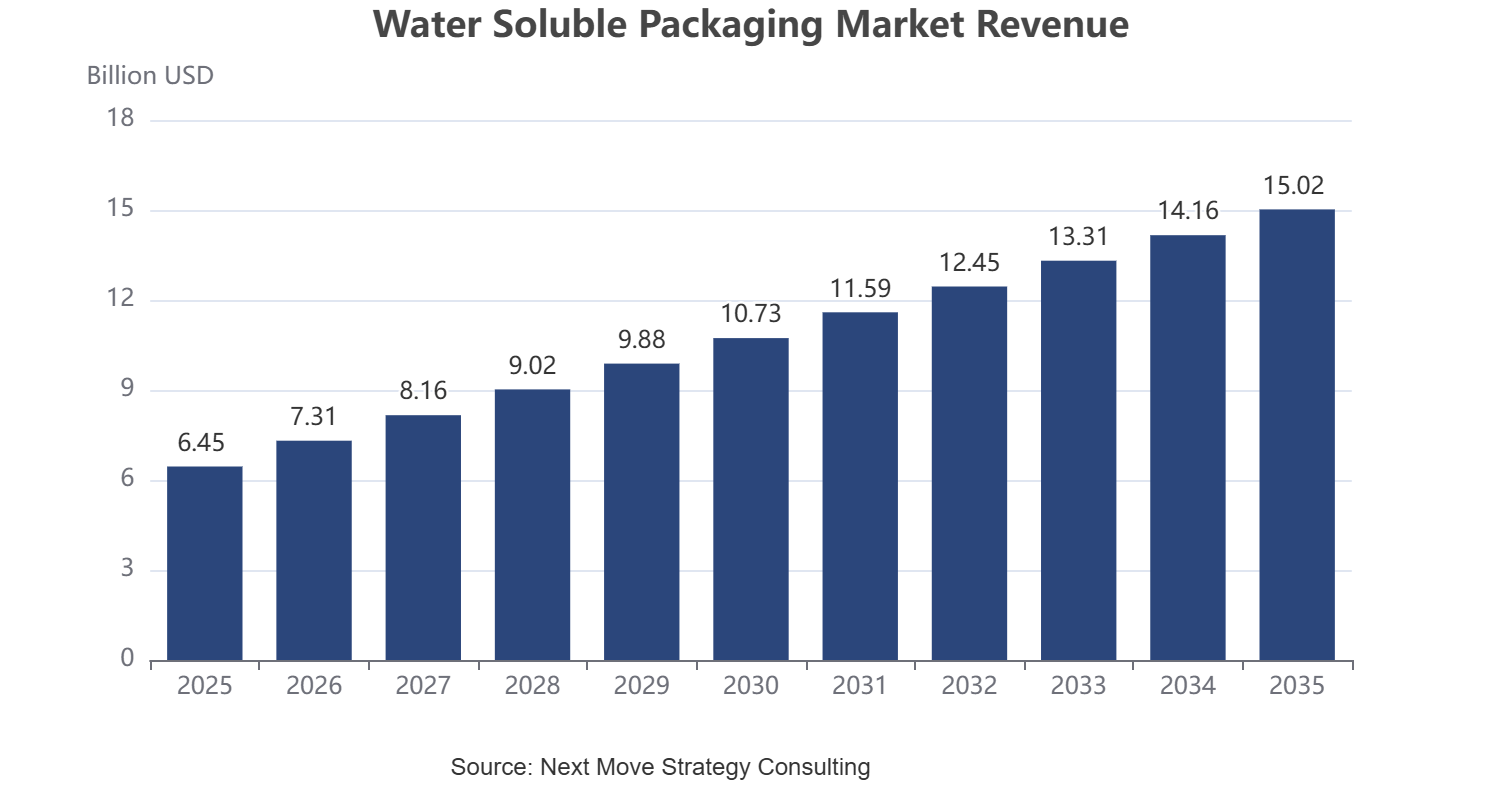
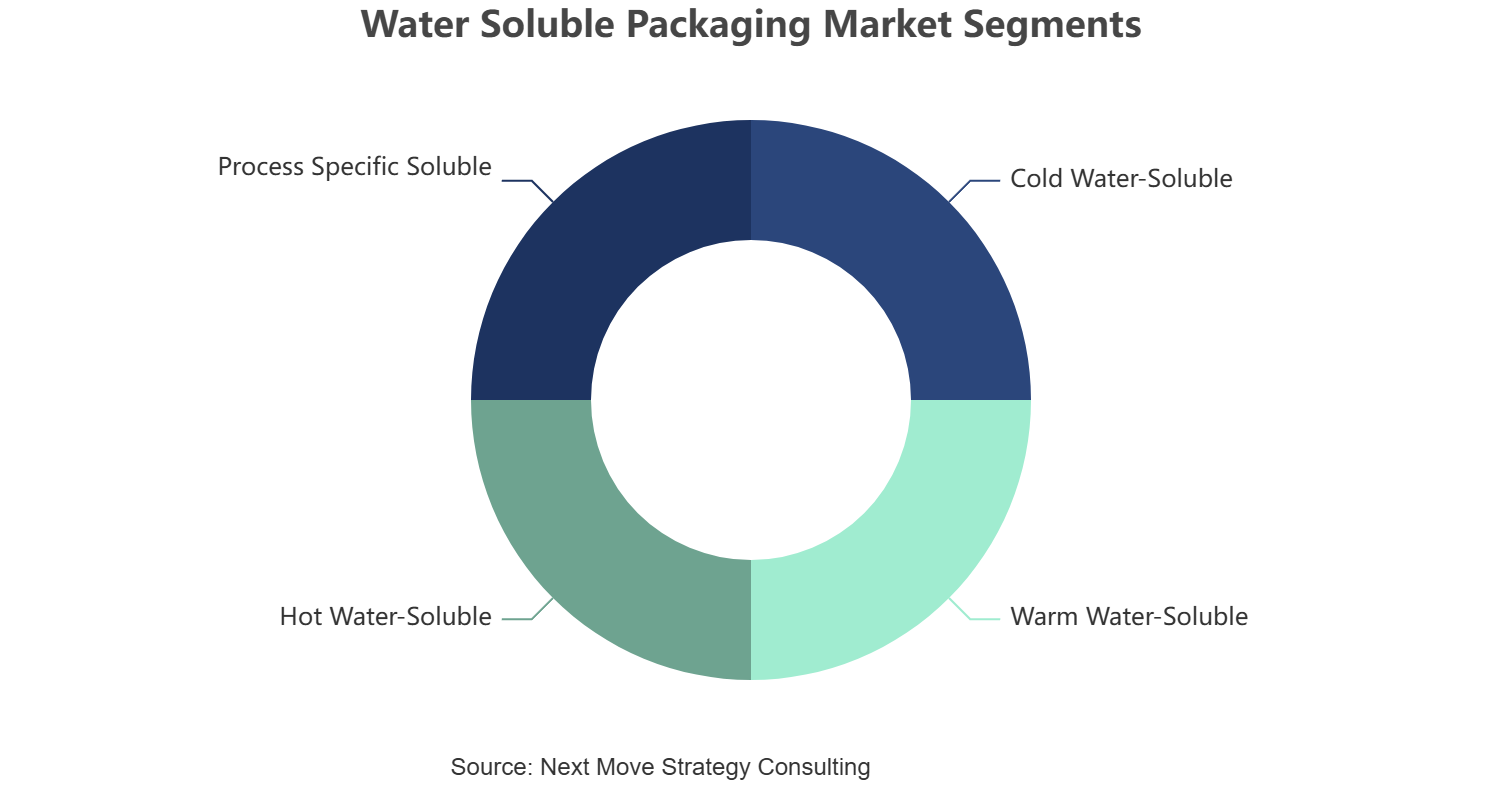
About the Author
 Mayurima Roy
— Mayurima Roy is Research Analyst at Next Move Strategy Consulting, where she has spent 4 years working across the firm's full industry coverage rather than a single fixed vertical. Her work centers on structured research, ongoing trend tracking, competitive assessment, and insight-led content development, translating complex market data into clear, decision-ready narratives that support informed client decision-making across diverse global industries, market sectors, and world regions every day.
Mayurima Roy
— Mayurima Roy is Research Analyst at Next Move Strategy Consulting, where she has spent 4 years working across the firm's full industry coverage rather than a single fixed vertical. Her work centers on structured research, ongoing trend tracking, competitive assessment, and insight-led content development, translating complex market data into clear, decision-ready narratives that support informed client decision-making across diverse global industries, market sectors, and world regions every day.
About the Reviewer
 Supradip Baul
— Supradip Baul is an accomplished business consultant and strategist with over a decade of rich experience in market intelligence, strategy, technology, and business transformation. His work has included rigorous qualitative and quantitative analysis across multiple industries, helping clients shape investment decisions and long-term roadmaps. Earlier in his career, he was associated with Gartner, where he contributed to industry-leading reports and market share analyses. He has worked with leading global companies and holds an MBA with a dual specialization in Marketing and Finance.
Supradip Baul
— Supradip Baul is an accomplished business consultant and strategist with over a decade of rich experience in market intelligence, strategy, technology, and business transformation. His work has included rigorous qualitative and quantitative analysis across multiple industries, helping clients shape investment decisions and long-term roadmaps. Earlier in his career, he was associated with Gartner, where he contributed to industry-leading reports and market share analyses. He has worked with leading global companies and holds an MBA with a dual specialization in Marketing and Finance.
At Next Move Strategy Consulting, we understand that insightful market research is the cornerstone of successful business decisions. That's why we employ a robust and multifaceted approach, combining various methodologies to deliver the most accurate and actionable data for our clients.

Research Landscape
We navigate the world of research with two primary approaches:
Qualitative Approach
Our qualitative research methodologies involve immersive techniques such as in-depth interviews, focus groups, and observational studies. By engaging directly with individuals and stakeholders, we uncover valuable insights that quantitative data alone may overlook.

Quantitative Research
In tandem with qualitative methodologies, NMSC leverages the power of Quantitative Research to provide a robust foundation of numerical insights. Through systematic data collection and analysis, we quantify patterns, preferences, and market trends, offering a comprehensive view of the business landscape.
Our quantitative research approach employs diverse tools, including surveys, experiments, and statistical modelling. These methodologies enable us to gather data from a large and representative sample, ensuring the statistical significance of our findings. By employing structured questionnaires and standardized data collection methods, we guarantee the reliability and validity of the information we present to our clients.
Quantitative research is particularly effective in measuring the prevalence of trends, assessing market size, and gauging the impact of various factors on consumer behavior. The numerical precision attained through this approach equips our clients with actionable insights, facilitating data-driven decision-making and strategy formulation.


Our Specialized Toolbox for Industry-Specific Market Research
We deploy a specialized arsenal of techniques tailored to meet your unique requirements. Here's a glimpse into our comprehensive toolbox:

Information Procurement
The stage entails acquiring market data or relevant information through various sources and methodologies.


Market Research Approach
We utilize both top-down and bottom-up approaches in market research analysis to achieve a comprehensive understanding of the market dynamics, leveraging the broad perspective of industry trends and macroeconomic factors alongside detailed insights from specific segments and individual companies.

Porters Five Forces Analysis
We conduct Porter's Five Forces analysis to evaluate the competitive landscape of an industry, providing us with insights into factors that affect profitability and strategic positioning.

SWOT Analysis

Forecasting
We utilize a forecasting model to predict future consumption by considering parameters like population, economics, regulations, market competition, drivers, constraints, technology, and pricing. We also employ statistical techniques such as multilinear regression, exponential smoothing, moving average, ARIMA, and Monte Carlo simulations for accurate predictions. In econometric forecasting, we analyzed short-term and long-term event impacts, attributing values based on regulatory frameworks, economic factors, and market events.





 Speak to Our Analyst