Sachet Packaging Market

Sachet Packaging Market size was USD 10.55 Billion in 2025, projected to reach USD 19.15 Billion by 2035, growing at a CAGR of 5.22% from 2026 to 2035. Key drivers include rising premiumisation of single-serve formats in emerging economies, growth in pharmaceutical and personal care unit-dose applications, and accelerating adoption of biobased and compostable sachet laminates, with Asia-Pacific holding the dominant regional position.

Download Free Sample PDF
Base Year (2025)
$10.55 Billion
Forecast (2035)
$19.15 Billion
CAGR (2026-2035)
5.2%
Top Region
Asia-Pacific

What Is the Sachet Packaging Market Size?

The global Market size reached USD 10.55 Billion in 2025 and is estimated at USD 11.33 Billion in 2026, forecast to reach USD 19.15 Billion by 2035 at a CAGR of 5.22% between 2026 and 2035. Asia-Pacific leads with approximately 44% regional revenue share in 2025, while Plastic Laminates dominate the material type axis at approximately 52% share.

Sachet Packaging Market Revenue Forecast

Values in USD Billion

2025 $10.55 Billion
2025
2026 $11.10 Billion
2026
2027 $11.68 Billion
2027
2028 $12.29 Billion
2028
2029 $12.93 Billion
2029
2030 $13.61 Billion
2030
2031 $14.32 Billion
2031
2032 $15.06 Billion
2032
2033 $15.85 Billion
2033
2034 $16.68 Billion
2034
2035 $19.15 Billion
2035

Key Takeaways

By Material Type: Plastic Laminates held the largest share, expanding from USD 5.49 Billion in 2025 to USD 9.20 Billion by 2035; Biobased Laminates is the fastest-growing sub-segment at 8.47% CAGR from 2026–2035.

By End Use: Food and Beverage held the largest share, expanding from USD 3.59 Billion in 2025 to USD 6.32 Billion by 2035; Pharmaceuticals is the fastest-growing sub-segment at 6.71% CAGR from 2026–2035.

By Sealing Technology: Heat Seal held the largest share, expanding from USD 7.39 Billion in 2025 to USD 13.18 Billion by 2035; Ultrasonic Seal is the fastest-growing sub-segment at 7.88% CAGR from 2026–2035.

By Distribution Channel: Direct Sales held the largest share, expanding from USD 5.49 Billion in 2025 to USD 9.77 Billion by 2035; E-Commerce is the fastest-growing sub-segment at 8.12% CAGR from 2026–2035.

Dominant Region: Asia-Pacific dominated with approximately 44% revenue share in 2025.

Fastest-Growing Region: Latin America is also expected to register the highest CAGR of 6.81% during 2026–2035.

Dominant Country: China led the market, anchored by the world's largest fast-moving consumer goods production base and sachet export volumes.

Fastest-Growing Country: Argentina is the fastest-growing country, driven by strong sachet format preference in personal care and household care categories .

The Sachet Packaging Market presents an absolute investment opportunity of approximately USD 7.82 Billion between 2026 and 2035, calculated as the difference between the 2035 forecast of USD 19.15 Billion and the 2026 estimate of USD 11.33 Billion, positioning material innovators and precision filling equipment makers for sustained revenue compounding.

According to NMSC analysis, the rapid proliferation of digital printing technology enabling cost-effective short-run sachet graphics is unlocking premium brand positioning for FMCG and pharmaceutical companies in emerging markets, structurally expanding the average selling price per sachet beyond the commodity price trajectory of the previous decade.

What Does the Sachet Packaging Market Encompass?

Th is Market covers small, sealed, single-use or single-dose flexible pouches manufactured from plastic laminates, aluminium foil laminates, paper-based laminates, and biobased laminates, sold to brand owners in food and beverage, personal care and cosmetics, pharmaceutical, and household care categories for primary packaging of liquid, gel, powder, and granule products. The market scope encompasses sachet structures from mono-layer polyethylene and oriented polypropylene films through high-barrier multi-layer co-extruded and metallised constructions, sealed by heat, cold, or ultrasonic processes, and distributed through direct sales to manufacturers, retail procurement channels, and fast-growing e-commerce fulfilment routes.

The Sachet Packaging Market has evolved from a low-cost emerging-market distribution format into a global premium packaging category spanning pharmaceutical unit-dose compliance aids, cosmetic sample formats, and single-serve food condiments across mature and high-growth economies alike. Regulatory influence from the EU Single-Use Plastics Directive, U.S. FDA pharmaceutical packaging guidance, and China GB standard revisions is accelerating laminate material transitions from conventional plastic toward biobased, recyclable, and compostable alternatives, reshaping sourcing strategy for leading brand owners and laminate converters globally.
Market Drivers & Dynamics

Interactive Dataset
Rising FMCG sacheting in low-unit-price emerging market distribution channels driver +1.6% Asia-Pacific, MEA, Latin America 2026–2035
Pharmaceutical unit-dose sachet adoption in generic medicine and ORS formats driver +1.1% Asia-Pacific, MEA 2026–2033
Growth of e-commerce channels requiring sachet-compatible direct-to-consumer packaging driver +0.9% Global 2026–2035
Biobased and compostable laminate product development capturing sustainability mandates driver +0.6% Europe, North America 2027–2035
Digital printing cost reduction enabling short-run premium sachet formats driver +0.4% Global 2026–2032
Rising raw material cost volatility in polyethylene, aluminium, and paper substrates restraint −0.7% Global 2026–2035
EU Single-Use Plastics Directive restricting conventional plastic sachet use in targeted segments restraint −0.5% Europe 2026–2030
Counterfeiting and quality control risks in low-cost regional sachet converter supply chains restraint −0.3% Asia-Pacific, MEA, Latin America 2026–2031
Consumer preference for refillable and zero-waste format alternatives in premium segments restraint −0.2% Europe, North America 2027–2035
Source: Next Move Strategy Consulting

Growth Drivers

What Is the Primary Growth Driver in the Sachet Packaging Market?

Rising FMCG sacheting across low-unit-price emerging market distribution channels is the primary growth driver for the Market, contributing an estimated +1.6% incremental CAGR impact. India's Fast-Moving Consumer Goods sector, documented in DPIIT investment data published by India's Ministry of Commerce and Industry, shows sachet formats as the dominant format for shampoo, hair oil, and detergent distribution to rural and semi-urban markets, where single-use affordability and brand trial mechanics sustain high sachet volume throughput in independent retailer and kirana store networks.

How Is Pharmaceutical Unit-Dose Demand Driving the Sachet Packaging Market Growth?

Our analysis shows that pharmaceutical unit-dose sachet demand is creating a structurally differentiated growth channel for sachet converters capable of meeting Good Manufacturing Practice laminate quality standards and pharmaceutical-grade heat seal integrity specifications. The World Health Organization's model list of essential medicines, published through official WHO channels, identifies oral rehydration salts, zinc supplement sachets, and antibiotic powder sachets as priority maternal and child health delivery formats in low- and middle-income countries, directly sustaining multi-year procurement of pharmaceutical sachet formats through national essential medicine supply programs .

Growth Inhibitors

What Is Restraining the Sachet Packaging Market?

Volatile raw material costs across polyethylene resin, aluminium foil, and paper substrate supply chains represent the dominant operational restraint on sachet converter margins, with raw material costs representing 55–65% of total sachet manufacturing cost structure according to industry-derived estimates. Spot price fluctuations in oil-linked polyethylene and paper pulp markets during supply chain disruption events have historically compressed converter margins in fixed-price supply agreements with FMCG customers, limiting manufacturers' ability to translate revenue growth into proportional EBITDA expansion during input cost escalation periods.

What Are the Growth Opportunities?

Can Biobased and Recyclable Sachet Laminates Capture Premium Brand-Owner Contract Pipeline?

Sachet converters developing fully certified compostable and recyclable laminate structures compatible with existing vertical-form-fill-seal filling equipment can capture a rapidly growing procurement pipeline from FMCG and pharmaceutical brand owners under EU Single-Use Plastics Directive compliance obligations and voluntary corporate net-zero packaging commitments. This opportunity primarily benefits the Biobased Laminates material type segment and Food and Beverage and Personal Care end-use categories as these are the first sectors facing regulatory and consumer-demand sustainability pressure on sachet format material specifications.

Does Pharmaceutical Unit-Dose Sachet Growth in Emerging Economies Create a Differentiated Converter Segment?

GMP-qualified sachet converters capable of supplying aluminium foil and paper-based pharmaceutical-grade sachet structures to WHO pre-qualified and national essential medicine program procurement agencies represent a structurally growing and margin-superior demand channel relative to commodity FMCG sachet volume. This opportunity benefits the Pharmaceuticals end-use segment and Aluminium Foil Laminates material type, as pharmaceutical powder and granule dose formats require high barrier foil laminate constructions meeting stringent moisture vapour transmission and oxygen barrier specifications across tropical climate essential medicine distribution environments.

How Can Digital Printing Capability Unlock Premium Short-Run Sachet Value-Added Revenue?

Converting lines integrating digital printing capability alongside existing flexographic sachet production capacity can offer FMCG and personal care brand owners regionally differentiated packaging artwork, promotional variant runs, and personalised sachet format campaigns without minimum order quantity constraints, commanding a premium per-unit price over standard long-run flexographic sachet supply. This opportunity benefits the E-Commerce distribution channel segment and Personal Care and Cosmetics end-use category, where short-run premium positioning generates demand for differentiated sachets well beyond commodity shampoo or condiment volume production.

Segmentation Analysis

2025 (USD Billion)
2035 (USD Billion)
Plastic Laminates 2025: $5.49 Billion | 2035: $9.20 Billion
Plastic Lami
Aluminium Foil Laminates 2025: $2.74 Billion | 2035: $4.60 Billion
Aluminium Fo
Paper-Based Laminates 2025: $1.69 Billion | 2035: $3.22 Billion
Paper-Based
Biobased Laminates 2025: $0.63 Billion | 2035: $2.13 Billion
Biobased Lam
Plastic Laminates $5.49 Billion $9.20 Billion 5.31%
Aluminium Foil Laminates $2.74 Billion $4.60 Billion 5.32%
Paper-Based Laminates $1.69 Billion $3.22 Billion 6.61%
Biobased Laminates $0.63 Billion $2.13 Billion 8.47%

Segment Sizing: By Material Type

2025 (USD Billion)
2035 (USD Billion)
Food and Beverage 2025: $3.59 Billion | 2035: $6.32 Billion
Food and Bev
Personal Care and Cosmetics 2025: $2.53 Billion | 2035: $4.41 Billion
Personal Car
Pharmaceuticals 2025: $1.90 Billion | 2035: $3.66 Billion
Pharmaceutic
Household Care 2025: $1.69 Billion | 2035: $2.99 Billion
Household Ca
Others 2025: $0.84 Billion | 2035: $1.77 Billion
Others
Food and Beverage $3.59 Billion $6.32 Billion 5.84%
Personal Care and Cosmetics $2.53 Billion $4.41 Billion 5.69%
Pharmaceuticals $1.90 Billion $3.66 Billion 6.71%
Household Care $1.69 Billion $2.99 Billion 5.85%
Others $0.84 Billion $1.77 Billion 6 . 23 %

Segment Sizing: By End Use

2025 (USD Billion)
2035 (USD Billion)
Heat Seal 2025: $7.39 Billion | 2035: $13.18 Billion
Heat Seal
Cold Seal 2025: $2.11 Billion | 2035: $4.09 Billion
Cold Seal
Ultrasonic Seal 2025: $1.05 Billion | 2035: $1.88 Billion
Ultrasonic S
Heat Seal $7.39 Billion $13.18 Billion 5.96%
Cold Seal $2.11 Billion $4.09 Billion 6.82%
Ultrasonic Seal $1.05 Billion $1.88 Billion 7.88%

Segment Sizing: By Sealing Technology

2025 (USD Billion)
2035 (USD Billion)
Direct Sales
Brand Owner
Contract Man
Retail
Modern Trade
Segment Item 2025 (USD Billion) 2035 (USD Billion) CAGR
Direct Sales $10.0 USD Billion $40.0 USD Billion 25.0%
Brand Owner Direct Procurement $17.1 USD Billion $51.1 USD Billion 19.0%
Contract Manufacturing Supply $24.2 USD Billion $62.2 USD Billion 25.0%
Retail $31.3 USD Billion $73.3 USD Billion 19.0%
Modern Trade Retail $38.4 USD Billion $84.4 USD Billion 20.0%

Segment-wise data not detailed in this view

Unlock complete segment-wise numbers for By Distribution Channel.

Unlock Full Data
2025 (USD Billion)
2035 (USD Billion)
North Americ
Canada
Mexico
Europe: UK
Germany
Segment Item 2025 (USD Billion) 2035 (USD Billion) CAGR
North America: U.S. $10.0 USD Billion $40.0 USD Billion 10.0%
Canada $17.1 USD Billion $51.1 USD Billion 8.0%
Mexico $24.2 USD Billion $62.2 USD Billion 18.0%
Europe: UK $31.3 USD Billion $73.3 USD Billion 8.0%
Germany $38.4 USD Billion $84.4 USD Billion 15.0%

Segment-wise data not detailed in this view

Unlock complete segment-wise numbers for By Region.

Unlock Full Data

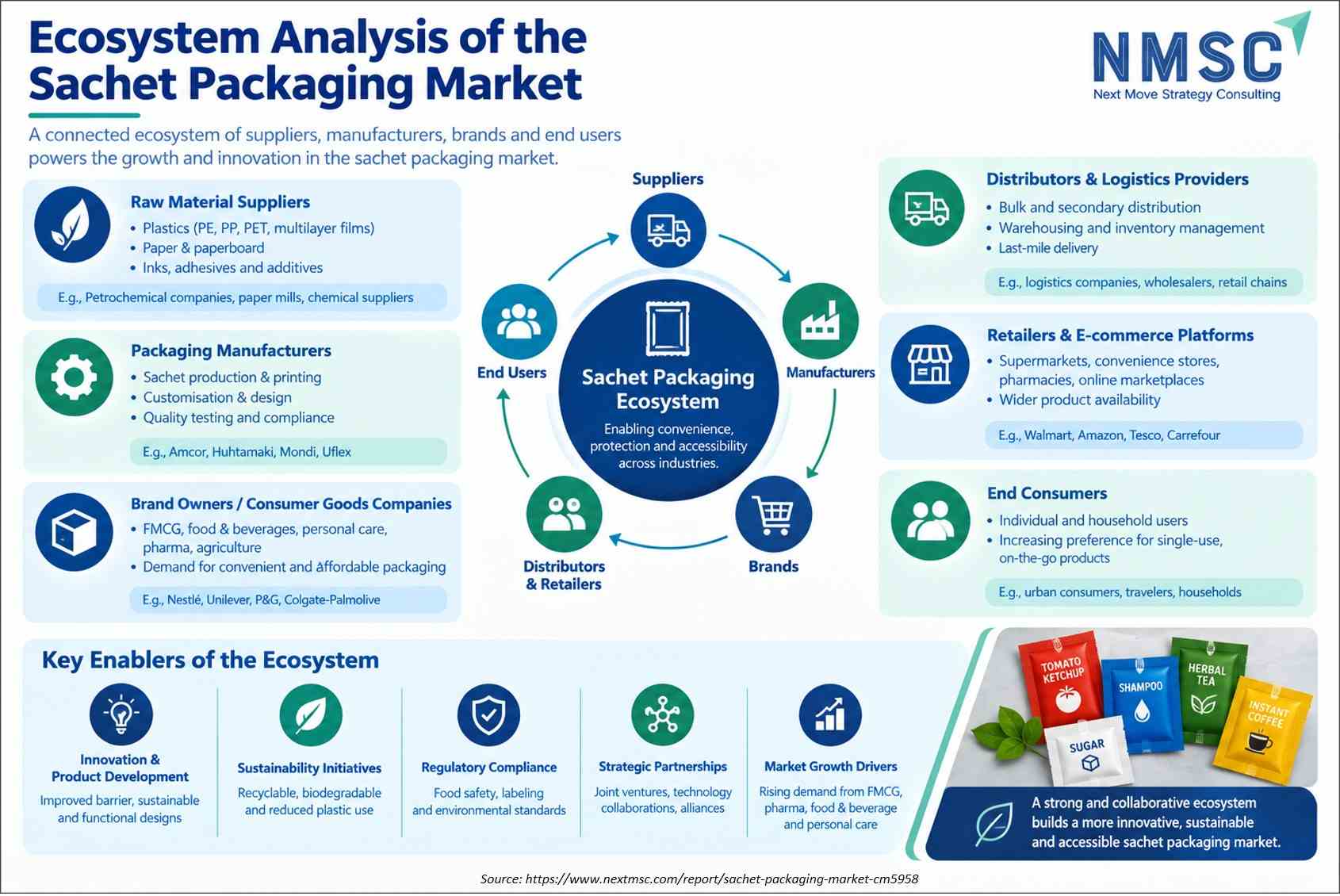
Ecosystem Analysis

Growth Opportunities

NMSC's analysis indicates that three forward-looking whitespace opportunities represent the highest-conviction growth pathways for sachet converters, material suppliers, and brand owners competing in the Sachet Packaging Market through 2035.

Can Biobased and Recyclable Sachet Laminates Capture Premium Brand-Owner Contract Pipeline?

Sachet converters developing fully certified compostable and recyclable laminate structures compatible with existing vertical-form-fill-seal filling equipment can capture a rapidly growing procurement pipeline from FMCG and pharmaceutical brand owners under EU Single-Use Plastics Directive compliance obligations and voluntary corporate net-zero packaging commitments. This opportunity primarily benefits the Biobased Laminates material type segment and Food and Beverage and Personal Care end-use categories as these are the first sectors facing regulatory and consumer-demand sustainability pressure on sachet format material specifications.

Does Pharmaceutical Unit-Dose Sachet Growth in Emerging Economies Create a Differentiated Converter Segment?

GMP-qualified sachet converters capable of supplying aluminium foil and paper-based pharmaceutical-grade sachet structures to WHO pre-qualified and national essential medicine program procurement agencies represent a structurally growing and margin-superior demand channel relative to commodity FMCG sachet volume. This opportunity benefits the Pharmaceuticals end-use segment and Aluminium Foil Laminates material type, as pharmaceutical powder and granule dose formats require high barrier foil laminate constructions meeting stringent moisture vapour transmission and oxygen barrier specifications across tropical climate essential medicine distribution environments.

How Can Digital Printing Capability Unlock Premium Short-Run Sachet Value-Added Revenue?

Converting lines integrating digital printing capability alongside existing flexographic sachet production capacity can offer FMCG and personal care brand owners regionally differentiated packaging artwork, promotional variant runs, and personalised sachet format campaigns without minimum order quantity constraints, commanding a premium per-unit price over standard long-run flexographic sachet supply. This opportunity benefits the E-Commerce distribution channel segment and Personal Care and Cosmetics end-use category, where short-run premium positioning generates demand for differentiated sachets well beyond commodity shampoo or condiment volume production.

Regional Outlook

North America $1.69 Billion $2.68 Billion 4.72%
Asia-Pacific $4.64 Billion $8.53 Billion 6.81%
Europe $2.11 Billion $3.45 Billion 5.05%
Middle East & Africa $1.27 Billion $2.55 Billion 7.21%
Latin America $0.84 Billion $1.94 Billion 9.62%

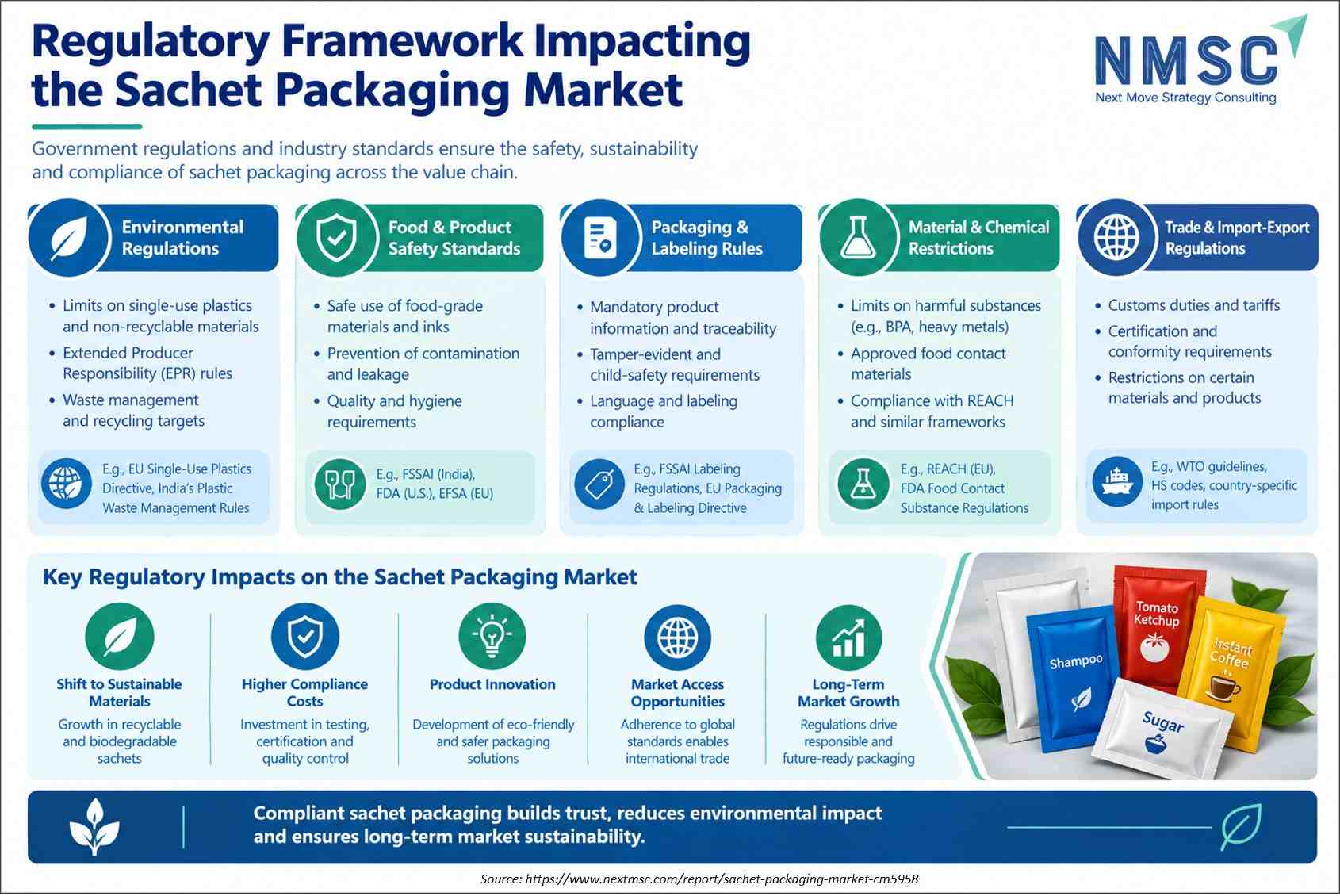
Regulatory Framework Impacting the Sachet Packaging Industry

The infographic outlines the regulatory framework impacting the sachet packaging market, identifying five key areas of compliance, including environmental rules, food safety standards, and trade regulations. It illustrates how these mandates, such as extended producer responsibility and material restrictions, are driving a significant shift toward sustainable and recyclable materials. While these regulations increase compliance costs and require product innovation, they also create market access opportunities and foster long-term growth. Ultimately, the analysis concludes that compliant sachet packaging is essential for building trust, reducing environmental impact, and ensuring market sustainability.

Competitive Landscape

Based on research conducted by NMSC, the Sachet Packaging Market competitive landscape spans global integrated flexible packaging and laminate groups, specialist sachet converter networks, and regional producer ecosystems , each differentiated by laminate technology breadth, geographic converter footprint, and end-use application qualification capability. Dimension | Assessment Market Structure | Moderately fragmented; top 10 converters hold approximately 40–50% combined global market share, with a dense regional converter population in Asia-Pacific and Europe serving local FMCG and pharmaceutical brand owner sachet procurement through proximity supply chain models Innovation Focus | Biobased and compostable laminate structure development with certified end-of-life claims; digital print integration into sachet converting lines; ultra-high-barrier co-extruded film development for pharmaceutical and premium food sachet applications; smart packaging QR integration on sachet print surfaces M&A Activity | Acquisitive consolidation among European and North American integrated flexible packaging groups targeting emerging market sachet converter capacity and specialist pharmaceutical sachet GMP-qualified production assets in Asia-Pacific Source: www.nextmsc.com

Dimension Description
Market Structure Moderately fragmented; top 10 converters hold approximately 40–50% combined global market share, with a dense regional converter population in Asia-Pacific and Europe serving local FMCG and pharmaceutical brand owner sachet procurement through proximity supply chain models
Innovation Focus Biobased and compostable laminate structure development with certified end-of-life claims; digital print integration into sachet converting lines; ultra-high-barrier co-extruded film development for pharmaceutical and premium food sachet applications; smart packaging QR integration on sachet print surfaces
M&A Activity Acquisitive consolidation among European and North American integrated flexible packaging groups targeting emerging market sachet converter capacity and specialist pharmaceutical sachet GMP-qualified production assets in Asia-Pacific

How Do Companies Compete in the Sachet Packaging Market?

Companies compete primarily on laminate material technology breadth, geographic converter proximity to brand owner filling facilities, and end-use application qualification depth, as sachet format compliance with FHWA pharmaceutical GMP standards, FDA food contact material requirements, and EU packaging regulation sustainability criteria represents a pre-qualification barrier that limits switching to lower-cost converters without extended requalification timelines. We observed that converters holding the widest portfolio of approved laminate structures across multiple end-use regulatory regimes maintain structural procurement advantage in multinational FMCG and pharmaceutical brand owner supply relationships spanning multiple geographies.

Which Competitive Archetypes Dominate the Sachet Packaging Industry?

Integrated flexible packaging groups including Amcor, Berry Global, and Mondi dominate through multi-application sachet laminate portfolios, global converter footprints, and corporate sustainability programs that align with major FMCG brand owner supplier qualification requirements. Specialist pharmaceutical sachet converters , including Constantia Flexibles and Huhtamaki , differentiate through GMP-qualified production lines, pharmaceutical-grade laminate qualification portfolios, and regulatory expertise in health authority sachet packaging submission dossiers across multiple market jurisdictions.

What Innovation and Differentiation Strategies Are Companies Pursuing?

Our findings suggest that leading sachet converters are pursuing three parallel innovation tracks: biobased and compostable laminate structure development with certifiable end-of-life claims aligned to EU packaging regulation requirements; digital printing line integration enabling cost-competitive short-run sachet artwork; and pharmaceutical-grade barrier co-extrusion process development targeting ultra-low moisture vapour and oxygen transmission rate specifications for humidity-sensitive oral sachet drug product stability requirements in tropical climate distribution markets.

Key Market Players

Our assessment indicates that the following companies represent the validated set of leading sachet packaging producers and laminate converters active across the global Sachet Packaging Market as of 2026, ranked by market-specific revenue scale and production breadth.

Amcor PLC Berry Global Group, Inc. Mondi PLC Sealed Air Corporation Huhtamaki Oyj Constantia Flexibles Group GmbH ProAmpac LLC Sonoco Products Company Coveris Management GmbH Uflex Limited Wipak Group Oy ULMA Packaging S.Coop. Paxton Companies, Inc. Peel Plastic Products Ltd. Südpack Verpackungen GmbH & Co. KG Glenroy Inc. Winpak Ltd. Logos Packaging Holding B.V. Flair Flexible Packaging Corporation Printpack, Inc.

Latest Developments

During our market evaluation, we noticed that the most significant recent activity across the Sachet Packaging Market reflects accelerating biobased laminate commercialisation, pharmaceutical sachet contract wins, and digital printing technology integration across converter production lines through 2025 and 2026.

Date Event
August 2026 Constantia Flexibles showcased its PERPETUA and PERPETUA ALTA mono-PP pharmaceutical packaging solutions, designed to provide high barrier performance and support recyclability.
July 2026 Flair Packaging launched ACTIV8, a program of ferrous, self-reacting oxygen-absorber sachets made with 100% PFA-free, food-grade materials.
August 2025 Mondi ramped up production of FunctionalBarrier Paper Ultimate following a €16 million investment in state-of-the-art technology at its Solec, Poland plant.
January 2025 Huhtamaki Flexibles showcased its blue loop sachet, stick pack and blister solutions at Pharma Pack 2025

Expert Insights

Abhishek Chitlangia

Abhishek Chitlangia

CEO | V-Shapes

"The question for brands is no longer whether consumers have a need for single-dose formats. It is how effectively brands can use them. The opportunity now is for brands to look at what single-dose packaging can do for their products and consumers ."

Analyst Interpretation

Our analysis indicates that rising adoption of single-dose formats is strengthening demand for sachet packaging across FMCG, food & beverage, personal care, and pharmaceutical applications. Sachets are evolving beyond low-cost packaging toward convenient, hygienic, and portion-controlled formats. Advances in automated filling, sealing, and co-packaging are enabling brands to expand single-dose offerings while maintaining cost efficiency and product differentiation .

Investment Opportunities

Where Are Capital Inflows Concentrating in the Sachet Packaging Market?

Capital inflows are concentrating in biobased and compostable sachet laminate production asset development and pharmaceutical-grade GMP sachet converter capacity in Asia-Pacific, as both represent premium-margin growth channels with structural brand-owner demand well ahead of current qualified supply. Private equity and strategic acquirer interest in specialist pharmaceutical sachet converters in India and Southeast Asia is accelerating, driven by the margin premium of pharmaceutical-grade sachet supply relative to commodity FMCG sachet volumes and the multi-year contract visibility that pharmaceutical essential medicine program supply agreements provide to converter revenue planning.

How Is Infrastructure Investment in Emerging Markets Shaping Sachet Converter Capacity?

Infrastructure investment in modern retail and cold-chain distribution in India, Southeast Asia, and Sub-Saharan Africa is expanding the addressable FMCG sachet procurement base by bringing brand trial and repeat purchase sachet mechanics to consumer populations previously served only through informal and open-market trade formats. We found that sachet converter groups investing in local production capacity in Nigeria, Bangladesh, and Vietnam are positioned to capture growing brand-owner demand for proximity supply that reduces import lead time risk and supports local content preferences embedded in national industrial policy investment incentives in these high-growth sachet markets.

What ESG Considerations Are Influencing Market Investment?

Environmental, social, and governance considerations in the Sachet Packaging Market center on the transition from conventional plastic laminate toward biobased, recyclable, and compostable sachet structures aligned with Extended Producer Responsibility legislation and brand-owner packaging sustainability commitments. Investors are progressively differentiating converter valuation between companies with credible certified sustainable sachet laminate pipelines and those remaining concentrated in conventional plastic structure production, recognising that regulatory and brand-owner contract allocation risk creates structural revenue displacement risk for converters without qualifying sustainable alternatives across their core sachet laminate product lines.

Key Benefits for Stakeholders

How Does This Report Benefit Sachet Packaging Industry Leaders?

Sachet packaging industry leaders gain segment-level revenue forecasts and CAGR benchmarks across material type, end use, sealing technology, and distribution channel, supporting informed product portfolio prioritisation and manufacturing capacity allocation within a consistent 2025–2035 market framework. Our findings identify Biobased Laminates, with an 8.47% CAGR, Pharmaceuticals end use, with a 6.71% CAGR, and E-Commerce channels, with an 8.12% CAGR, as the fastest-growing segments, providing actionable investment insights for converters and laminate film producers evaluating competing product development and capacity expansion priorities .

How Does This Report Benefit Investors and Financial Analysts?

Investors and financial analysts gain access to a reconciled market sizing model, with the market valued at USD 10.55 billion in 2025 and projected to reach USD 19.15 billion by 2035, reflecting a 5.22% CAGR, alongside a competitive landscape assessment and M&A activity tracking that supports valuation and capital allocation decisions across flexible packaging portfolio companies. The Growth Catalyst and Risk Assessment Matrix quantifies the factors driving and constraining the 5.22% CAGR, enabling scenario construction that distinguishes structural FMCG sacheting growth, secular pharmaceutical unit dose demand, and investment return timelines associated with the transition to biobased laminates .

How Does This Report Benefit FMCG and Pharmaceutical Brand Owners?

FMCG and pharmaceutical brand owners gain regional market size intelligence, converter competitive landscape insights, and material innovation trend analysis that support sachet packaging procurement strategies, material transition roadmap planning, and sachet format optimisation across emerging market distribution channels. Our regional analysis identifies Latin America at a 9.62% CAGR, MEA at 7.21%, and Asia Pacific at 6.81% as the fastest-growing markets, providing concrete geographic prioritisation insights for brand owners planning sachet format extensions or sustainable laminate transition programs across multi-country supply chain configurations .

Key Market Segments Evaluated

By Material Type

  • Plastic Laminates
  • Aluminium Foil Laminates
  • Paper-Based Laminates
  • Biobased Laminates

By End Use

  • Food and Beverage
  • Personal Care and Cosmetics
  • Pharmaceuticals
  • Household Care
  • Others

By Sealing Technology

  • Heat Seal
  • Cold Seal
  • Ultrasonic Seal

By Distribution Channel

  • Direct Sales
  • Brand Owner Direct Procurement
  • Contract Manufacturing Supply
  • Retail
  • Modern Trade Retail
  • General Trade and Kirana Stores
  • E-Commerce
  • Brand Direct-to-Consumer
  • Third-Party Marketplace Fulfilment

By Region

  • North America: U.S.
  • Canada
  • Mexico
  • Europe: UK
  • Germany
  • France
  • Italy
  • Spain
  • Sweden
  • Denmark
  • Finland
  • Netherlands
  • Rest of Europe
  • Asia-Pacific: China
  • India
  • Japan
  • South Korea
  • Taiwan
  • Indonesia
  • Vietnam
  • Australia
  • Philippines
  • Malaysia
  • Rest of APAC
  • Middle East & Africa: Saudi Arabia
  • UAE
  • Egypt
  • Israel
  • Turkey
  • Nigeria
  • South Africa
  • Rest of MEA
  • Latin America: Brazil
  • Argentina
  • Chile
  • Colombia
  • Rest of LATAM

Conclusion & Recommendations

The long-term outlook is structurally positive, with the Sachet Packaging Market expanding from USD 11.33 Billion in 2026 to USD 19.15 Billion by 2035 at a 5.22% CAGR. We observed that this trajectory is underpinned by durable FMCG sacheting demand in Asia-Pacific, MEA, and Latin American emerging markets, growing pharmaceutical unit-dose sachet volumes in essential medicine programs, and a structural material innovation wave in biobased and compostable laminates that is expanding the market's revenue quality beyond the commodity price trajectory of conventional plastic sachet laminate production.

What Strategic Positioning Do We Recommend?

Our assessment indicates that sachet converters should prioritise biobased and compostable laminate qualification programs to capture European brand-owner sustainability contract reallocation, invest in GMP pharmaceutical sachet production capability to access the margin-superior pharmaceutical unit-dose channel, and integrate digital printing capability to unlock short-run premium sachet value-added revenue streams. Converters without established Asia-Pacific production presence should evaluate acquisition or joint venture partnerships with regional sachet producers in India, Vietnam, or Indonesia to address competitive gaps in the market's highest-growth geography.

How Attractive Is the Sachet Packaging Market for Investment?

Investment attractiveness is highest in the Biobased Laminates material type at 8.47% CAGR, the E-Commerce distribution channel at 8.12% CAGR, and Latin America and MEA regional markets at 9.62% and 7.21% CAGR , respectively, all materially exceeding the market's 5.22% overall CAGR. We found that the absolute investment opportunity of USD 7.82 Billion between 2026 and 2035 positions the Sachet Packaging Market as a compelling mid-cycle consumer packaging investment with strong emerging market consumer demand and pharmaceutical application tailwinds underpinning durable long-horizon revenue growth.

What Are the Market Shifts and Key Risks?

The most significant structural market shift is the progressive regulatory and brand-owner-driven transition from conventional plastic laminate toward biobased, recyclable, and compostable sachet structures, which is bifurcating the converter competitive landscape between sustainability-capable producers and commodity laminate suppliers facing growing contract reallocation risk. Key risks include raw material input cost volatility, EU regulatory uncertainty around compostable certification scheme harmonisation, and potential consumer preference shift toward refillable or zero-waste format alternatives in premium personal care segments that could displace some sachet volume in developed market channels.

What Are the Primary Growth Pathways Through 2035?

Primary growth pathways include biobased and compostable laminate commercialisation capturing European sustainability mandate contract flows, pharmaceutical unit dose sachet expansion through essential medicine procurement programs in Asia Pacific and MEA, and e-commerce channel sachet format adoption in personal care and food direct-to-consumer supply. Our analysis shows that converters and laminate film producers combining all three pathways, sustainable material capability, pharmaceutical GMP qualification, and e-commerce compatible sachet structure development, are positioned to capture the USD 7.82 billion absolute market opportunity between 2026 and 2035 .

FAQs

About the Author

Mayurima Roy

Mayurima Roy

Mayurima Roy is Research Analyst at Next Move Strategy Consulting, where she has spent 4 years working across the firm's full industry coverage rather than a single fixed vertical. Her work centers on structured research, ongoing trend tracking, competitive assessment, and insight-led content development, translating complex market data into clear, decision-ready narratives that support informed client decision-making across diverse global industries, market sectors, and world regions every day.

About the Reviewer

Supradip Baul

Supradip Baul

Supradip Baul is an accomplished business consultant and strategist with over a decade of rich experience in market intelligence, strategy, technology, and business transformation. His work has included rigorous qualitative and quantitative analysis across multiple industries, helping clients shape investment decisions and long-term roadmaps. Earlier in his career, he was associated with Gartner, where he contributed to industry-leading reports and market share analyses. He has worked with leading global companies and holds an MBA with a dual specialization in Marketing and Finance.

Download Free Sample

Rishabh Jogani

RISHABH JOGANI

Strategy Analyst

Accenture Japan

We are incredibly impressed with the market report on the real estate market in India provided by Next Move Strategy Consulting. The report was thorough, insightful, and well-structured, offering deep analysis and actionable recommendations. It not only captured the current trends and dynamics but also provided a forward-looking perspective that has been invaluable for our strategic planning. Their team demonstrated exceptional professionalism, attention to detail, and a profound understanding of the industry. The data-driven insights and clarity of presentation exceeded our expectations, making complex market trends easy to understand. We highly recommend Next Move Strategy Consulting to anyone looking for reliable and comprehensive market research services. Their expertise has given us the confidence to navigate the complexities of the Indian real estate market with clarity and foresight.

Melanie Samko

MELANIE SAMKO

Director of Marketing

TOSOH BIOSCIENCE, INC.

The information provided by NMSC is incredibly valuable, thank you so much for such a excellent work. I really appreciate it. I will make sure to reference all of it, in my summary document.

Ross J Mckenzie

ROSS J MCKENZIE

Business Insight Manager

Staysure Group

“Next MSC have been incredibly helpful in providing detailed & robust information on our market, alongside quantifying growth by different segments. The process to procure was simple and easy, with sample reports and regular contact to ensure we had what we needed. Succinct detail on their sources & methodologies is also greatly received, allowing transparency in this respect helps build trust in the detail you pay for. Joseph in particular was fantastic, and helped ensure efficient provision of the insight pack – thank you NMSC!”.

Robert Sean Trevino

ROBERT SEAN TREVINO

Sr. Director, Head of Strategic Insights & Analytics

Foundation Medicine

I realized that it was a reliable source of information. These days, there are many people who are looking for authentic data, and this is one of the only sources that can offer them with what they need;

Kishu Kanda

KISHU KANDA

Strategy Analyst

Accenture

We purchased the AI Consumer Market Report from this company. Not only did they customize the report to meet our specific requirements, but they also showed great flexibility in accommodating our budget. The report we received fully met our expectations. Additionally, they provided prompt and thorough responses to both our pre-purchase and follow-up questions. We look forward to working with this company again in the future.

Custom Market Research Services

We will customize the research for you if the listed report does not fully match your requirements.

Get 30% Free Customization

Select License

This website uses cookies to ensure you get the best experience on our website. Learn more

✖