Packaging Material Market Global Industry Analysis and Forecast (2026–2035)

The global Packaging Material Market is estimated at USD 1,205.78 Billion in 2026 and is projected to reach USD 1,713.71 billion by 2035, growing at a CAGR of 3.98% from 2026 to 2035 Growth is driven by rising demand for flexible and rigid packaging, e-commerce, healthcare, and pharmaceutical applications, with sustainable materials gaining adoption.

Download Free Sample PDF
Base Year (2025)
$1,149.34 Billion
Forecast (2035)
$1,713.71 Billion
CAGR (2026-2035)
4.0%
Top Region
Asia-Pacific

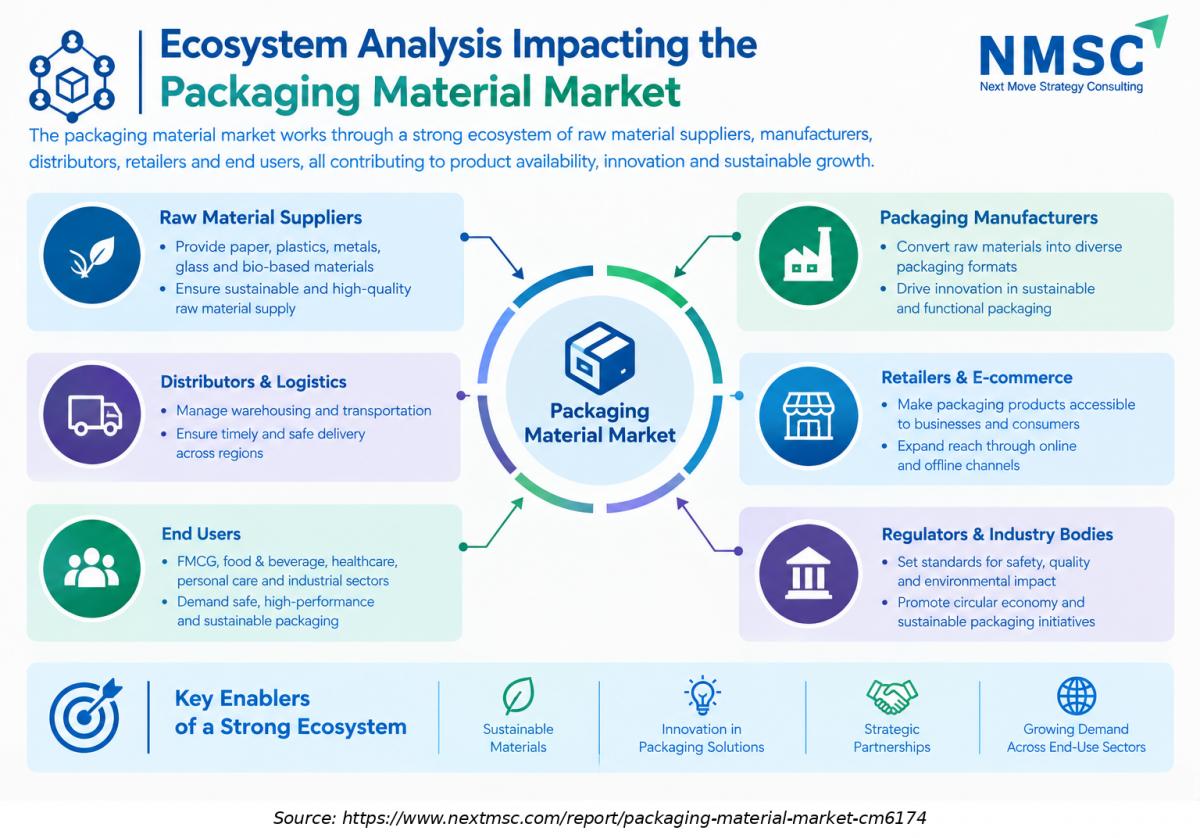
Ecosystem Analysis Impacting the Packaging Material Market
The Ecosystem Analysis infographic for the Packaging Material Market highlights key stakeholders, including raw material suppliers, packaging material manufacturers, converters, technology providers, distributors, brand owners, retailers, and end users. It illustrates their interconnected roles across material production, packaging manufacturing, distribution, and end-use applications.
Competitive Landscape

Our assessment indicates that the global Packaging Material Market is defined by a fragmented competitive structure where a handful of integrated global producers compete on material innovation, sustainability certification, and geographic scale, while thousands of regional and specialist converters serve domestic and niche end-use demand through application-specific material expertise and customer proximity.
Regional Outlook

2025 (USD Billion)
2035 (USD Billion)
Asia-Pacific
North Americ
Europe
Middle East
Latin Americ
Region 2025 (USD Billion) 2035 (USD Billion) CAGR (%)
Asia-Pacific $10.0 USD Billion $40.0 USD Billion 9.0%
North America $17.1 USD Billion $51.1 USD Billion 27.0%
Europe $24.2 USD Billion $62.2 USD Billion 25.0%
Middle East & Africa $31.3 USD Billion $73.3 USD Billion 23.0%
Latin America $38.4 USD Billion $84.4 USD Billion 12.0%

Regional data is locked

Unlock complete regional numbers for this market.

Unlock Full Data

Competitive Landscape

Dimension Description
Market Structure Fragmented globally; top 5 players — Amcor, Berry Global, Sealed Air, DS Smith (International Paper), and Smurfit Westrock command an estimated 20–24% of global packaging material revenue; the remainder is split across hundreds of regional and specialist manufacturers across paper, plastic, metal, and glass substrates
Innovation Focus Mono-material recyclable flexible films, compostable biobased barrier coatings, lightweighted metal cans, high-PCR-content corrugated boards, active and intelligent packaging with freshness indicators, and digital watermark recycling guidance
M&A Activity Consolidation-driven M&A at global scale International Paper's acquisition of DS Smith and Smurfit Kappa's merger with WestRock are the defining transactions of 2024–2025; further bolt-on acquisitions targeting biobased materials, sustainable film coating, and Asia-Pacific corrugated capacity

How Do Companies Compete in the Packaging Material Industry?

Companies compete primarily on material performance per unit cost barrier properties, lightweighting, printability, and recycling compatibility per tonne of material alongside sustainability certification credentials, supply chain reliability, and technical application support for converter customers redesigning packaging structures to meet regulatory recyclability requirements. We found that the transition from commodity material supply toward certified sustainable material specification is structurally advantaging producers with established FSC chain-of-custody, How2Recycle, and EN 13432 compostability certifications that brand owner procurement teams can reference in sustainability reporting.

Which Competitive Archetypes Dominate the Packaging Material Market?

Integrated global material platform companies Amcor, Berry Global (now merged), Smurfit Westrock, and Sealed Air dominate through vertical integration from material production through packaging conversion, enabling full cost capture and specification control across the material to finished package value chain. Specialty substrate producers Mondi in fiber-based barrier packaging and Silgan in metal packaging compete through application-specific material depth and technical service capabilities that generalist integrated players cannot replicate at equivalent depth across all material categories simultaneously.

What Innovation and Differentiation Strategies Are Companies Pursuing?

NMSC's analysis indicates that leading packaging material producers are investing in four primary innovation directions: mono-material recyclable flexible film architectures that replace multi-layer barrier laminates with PE-only or PP-only structures compatible with existing mechanical recycling streams; fiber-based barrier coatings that replace aluminium foil and plastic barrier layers in paperboard with water-based functional coating applications; chemical recycling partnerships that convert post-consumer mixed plastic packaging into virgin-equivalent polymer feedstock; and bioplastic recycling infrastructure investment to close the certified compostable material loop at commercial scale.

What M&A Activity Is Shaping the Competitive Landscape?

We observed that M&A activity in the Packaging Material Market is at a multi-year high, with Amcor's acquisition of Berry Global Group and the Smurfit Kappa WestRock merger creating two packaging supergroups that significantly alter the global competitive landscape for flexible and corrugated packaging materials respectively. These transactions reflect a strategic thesis that global scale, sustainability technology investment, and integrated material-to-conversion capability are prerequisites for serving the largest FMCG and e-commerce brand owner customers, who are themselves consolidating procurement relationships toward fewer, larger suppliers capable of meeting global volume and sustainability specification requirements simultaneously.
Key Market Players

Based on research conducted by NMSC, the following 20 companies represent the validated set of leading participants in the global Packaging Material Market, ranked by market-specific packaging material revenue, manufacturing scale, and geographic presence as of 2026.

Amcor PLC Smurfit Westrock PLC International Paper Company Sealed Air Corporation Mondi Group PLC Sonoco Products Company Silgan Holdings Inc. Greif Inc. Huhtamaki Oyj Graphic Packaging Holding Company Oji Holdings Corporation Nippon Paper Industries Co., Ltd. Toray Industries Inc. Novatek International Group Coveris Holdings S.A. CCL Industries Inc. Ball Corporation Crown Holdings Inc. Ardagh Group S.A. Verralia SA

Latest Developments

We found that mergers, capacity expansions, and sustainable material launch in 2025–2026 reflect the Packaging Material Market's simultaneous consolidation and innovation acceleration, as global leaders’ position for scale-driven sustainability specification leadership through 2035.

Date Event
September 2026 Smurfit Westrock agreed to acquire CMPC’s Chilean containerboard and corrugated business for USD 420 million
September 2026 Sealed Air introduced Zero Prep hand-dispensing pouches under its CRYOVAC brand for food-service condiments and sauces
September 2026 Amcor and Ge Wu an launched the Li Kou pet-food cup, marking the first commercial deployment of an inverted-cup format in China.
September 2026 Ball announced a new two-line beverage-can manufacturing facility in Uttar Pradesh, India, expected to become operational in 2029
July 2026 Graphic Packaging launched Pace Setter Ridgeline, marking its entry into the uncoated recycled paperboard market
February 2025 Huhtamaki launched Pro Dairy, a recyclable single-coated paper cup for yogurt and dairy products

Key Benefits for Stakeholders

How Does This Report Benefit Packaging Material Industry Leaders?

Packaging material producers, converters, and brand owner packaging teams gain segment-level revenue forecasts across material type, packaging format, and end-use dimensions enabling capital investment prioritization, product portfolio planning, and supply chain strategy decisions grounded in the 2025–2035 data consistent throughout this analysis. The competitive landscape and M&A activity sections provide intelligence on how global integration transactions are reshaping competitive dynamics and customer service expectations, informing positioning and partnership decisions for regional and specialty packaging material producers.

How Does This Report Benefit Investors and Financial Analysts?

Investors and financial analysts gain a reconciled market-sizing model USD 1,149.34 Billion in 2025 to USD 1,713.71 Billion by 2035 at 3.98% CAGR alongside quantified driver and restraint impacts, post-merger competitive structure assessment, and 38-country demand projections supporting packaging material company valuation, M&A due-diligence, and infrastructure fund investment thesis construction. The USD 507.93 Billion absolute opportunity between 2026 and 2035 and the Biobased and Compostable Materials segment's 7.74% CAGR provide the scenario-analysis inputs needed to model outperformance potential relative to the overall market.

How Does This Report Benefit Policy Makers and Sustainability Professionals?

Regulatory analysts, corporate sustainability teams, and policy makers gain quantified evidence on how packaging material market composition is evolving in response to regulation including the measurable volume shift from plastic to paper, biobased, and certified-recyclable formats across food, pharmaceutical, and e-commerce applications. The regional regulatory landscape section and country-level demand projections provide benchmarking data for sustainability target setting, EPR program design, and recycled content mandate impact assessment across covered geographies.

How Does This Report Benefit Packaging Material Industry Leaders?

Packaging material producers, converters, and brand owner packaging teams gain segment-level revenue forecasts across material type, packaging format, and end-use dimensions enabling capital investment prioritization, product portfolio planning, and supply chain strategy decisions grounded in the 2025–2035 data consistent throughout this analysis. The competitive landscape and M&A activity sections provide intelligence on how global integration transactions are reshaping competitive dynamics and customer service expectations, informing positioning and partnership decisions for regional and specialty packaging material producers.
How Does This Report Benefit Investors and Financial Analysts?
Investors and financial analysts gain a reconciled market-sizing model USD 1,149.34 Billion in 2025 to USD 1,713.71 Billion by 2035 at 3.98% CAGR alongside quantified driver and restraint impacts, post-merger competitive structure assessment, and 38-country demand projections supporting packaging material company valuation, M&A due-diligence, and infrastructure fund investment thesis construction. The USD 507.93 Billion absolute opportunity between 2026 and 2035 and the Biobased and Compostable Materials segment's 7.74% CAGR provide the scenario-analysis inputs needed to model outperformance potential relative to the overall market.
How Does This Report Benefit Policy Makers and Sustainability Professionals?
Regulatory analysts, corporate sustainability teams, and policy makers gain quantified evidence on how packaging material market composition is evolving in response to regulation including the measurable volume shift from plastic to paper, biobased, and certified-recyclable formats across food, pharmaceutical, and e-commerce applications. The regional regulatory landscape section and country-level demand projections provide benchmarking data for sustainability target setting, EPR program design, and recycled content mandate impact assessment across covered geographies.

Key Market Segments Evaluated

By Material Type

  • Paper and Paperboard 
    • Corrugated containerboard
    • Folding carton board
    • Kraft paper and bags
    • Tissue and specialty paper
  • Plastic 
    • Polyethylene (PE) films and containers
    • Polypropylene (PP) packaging
    • PET bottles and trays
    • Multilayer barrier films and laminates
  • Metal 
    • Aluminium cans and closures
    • Steel cans and drums
    • Aluminium foil and lidding
  • Glass 
    • Glass bottles and jars
    • Glass ampoules and vials
  • Wood 
    • Wooden pallets and crates
    • Moulded wood fiber packaging
  • Biobased and Compostable Materials 
    • PLA and PHA biopolymer films
    • Sugarcane bio-PE resin and packaging
    • Thermoplastic starch composites
    • Certified-compostable paper-based barrier structures

By Packaging Format

  • Rigid Packaging 
    • Bottles, jars, and cans
    • Rigid trays and tubs
    • Drums, IBCs, and industrial containers
  • Flexible Packaging 
    • Stand-up pouches and sachets
    • Flexible films and wraps
    • Vacuum and modified atmosphere packaging
  • Corrugated and Containerboard 
    • Single-wall and double-wall corrugated cases
    • Solid fiber and grey board packaging
    • Shelf-ready and retail-ready packaging

By End Use

  • Food and Beverage 
    • Dry food and confectionery
    • Fresh and chilled food
    • Beverage (liquid carton, can, bottle)
  • E-Commerce and Logistics 
    • Parcel and transit corrugated packaging
    • Protective and void-fill packaging
    • Mailer and poly bag packaging
  • Healthcare and Pharmaceuticals 
    • Primary drug packaging (blister, vial, ampoule)
    • Medical device and diagnostic packaging
  • Personal Care and Cosmetics 
    • Premium carton board and glass
    • Flexible tube and sachet formats
  • Industrial and Consumer Goods 
    • Heavy-duty industrial packaging
    • Household chemical and cleaning packaging

By Region

  • North America 
    • U.S.
    • Canada
    • Mexico
  • Europe 
    • UK
    • Germany
    • France
    • Italy
    • Spain
    • Sweden
    • Denmark
    • Finland
    • Netherlands
    • Rest of Europe
  • Asia-Pacific 
    • China
    • India
    • Japan
    • South Korea
    • Taiwan
    • Indonesia
    • Vietnam
    • Australia
    • Philippines
    • Malaysia
    • Rest of APAC
  • Middle East & Africa 
    • Saudi Arabia
    • UAE
    • Egypt
    • Israel
    • Turkey
    • Nigeria
    • South Africa
    • Rest of MEA
  • Latin America 
    • Brazil
    • Argentina
    • Chile
    • Colombia
    • Rest of LATAM

What Is the Long-Term Outlook for the Packaging Material Market?

The long-term outlook is stable and structurally positive, with the market expanding from USD 1,205.78 Billion in 2026 to USD 1,713.71 Billion by 2035 at a 3.98% CAGR. We observed that growth is underpinned by structurally durable demand from food and beverage production, e-commerce logistics expansion, and pharmaceutical packaging requirements all of which are non-discretionary demand drivers alongside a sustainability transition that is adding per-tonne revenue elevation through material premiumization as certified biobased and recycled content formats capture volume from conventional commodity plastics.
What Strategic Positioning Do We Recommend?
Our assessment indicates that packaging material producers should prioritize biobased and compostable material capacity investment, pharmaceutical-grade barrier material development, and high PCR content corrugated board production as the three highest return strategic investments through 2030. Companies that build certified sustainable material production capability verified FSC, How2Recycle, or EN 13432 certification ahead of regulatory mandate enforcement windows in Europe and Asia-Pacific will capture premium supply agreement positions with FMCG and e-commerce brand owners executing 2025–2030 sustainable packaging commitments under contract rather than as aspirational targets.
How Attractive Is the Packaging Material Market for Investment?
Investment attractiveness is highest in the Biobased and Compostable Materials segment at 7.74% CAGR, the E-Commerce and Logistics end-use segment at 6.20% CAGR, and the Healthcare and Pharmaceuticals end-use segment at 4.63% CAGR all three outperforming the overall market CAGR of 3.98% by significant margins. The USD 507.93 Billion absolute revenue opportunity between 2026 and 2035 is concentrated in these faster-growing segments, where regulatory demand, operational necessity, and brand sustainability commitment create capital deployment rationale that is substantially more durable than discretionary consumer product growth alone.
What Are the Key Market Shifts and Risks?
Key risks include raw material cost volatility particularly petrochemical resin, pulp, and aluminium that can compress converter margins faster than customer pricing adjustments, extended producer responsibility compliance costs creating administrative burden for smaller regional packaging material manufacturers, and the uncertainty of chemical recycling technology commercialization timelines that several biobased and recycled-content material investment theses depend upon. Our analysis shows that producers overexposed to non-recyclable multi-layer packaging formats face accelerating volume displacement risk as regulatory enforcement of recyclability mandates moves from voluntary to compulsory across major markets.

What Are the Primary Growth Pathways Through 2035?

Primary growth pathways include the commercial scale deployment of biobased and compostable film alternatives to single-use plastic packaging, geographic expansion into MEA and Latin America corrugated and flexible material markets growing above 4.5% CAGR, and pharmaceutical packaging material development that commands 30–60% average selling price premiums above equivalent consumer goods material specifications. We found that companies combining certified sustainable material credentials, e-commerce-optimized corrugated product portfolios, and Asia-Pacific manufacturing presence are best positioned to capture the USD 507.93 Billion absolute opportunity the Packaging Material Market presents between 2026 and 2035.

Frequently Asked Questions

1. What is the Packaging Material market size in 2026?

The Packaging Material Market is estimated at USD 1,205.78 Billion in 2026.

2. What is the Packaging Material market forecast for 2035?

The market is projected to reach USD 1,713.71 Billion by 2035.

3. What is the CAGR of the Packaging Material market from 2026 to 2035?

The market is projected to grow at a CAGR of 3.98% from 2026 to 2035.

4. Which material type dominates the market?

Paper and Paperboard dominates at USD 321.82 Billion in 2025, representing approximately 28% of global packaging material revenue.

5. Which material type is the fastest-growing?

Biobased and Compostable Materials is the fastest-growing material type at a 7.74% CAGR from 2026 to 2035, driven by regulatory plastic substitution mandates and brand sustainability commitments.

6. Which packaging format is fastest-growing?

Corrugated and Containerboard is the fastest-growing packaging format at a 4.93% CAGR from 2026 to 2035, driven by global e-commerce and last-mile logistics packaging demand.

7. Which region dominates the Packaging Material market?

Asia-Pacific dominates with approximately 38% revenue share in 2025, valued at USD 437.76 Billion.

8. Which region is growing fastest?

Latin America is the fastest-growing region, expanding at a 5.20% CAGR from 2026 to 2035, led by Brazil's food export and FMCG packaging demand.

9. Who are the key players in the Packaging Material market?

Key players include Amcor PLC, Smurfit Westrock PLC, International Paper Company, Sealed Air Corporation, and Mondi Group PLC, among 20 companies profiled in this report.

10. What is driving Packaging Material market growth?

E-commerce corrugated demand and food and beverage sector expansion are the top two growth drivers, contributing an estimated +0.9% and +0.7% impact on CAGR, respectively.

11. What is restraining market growth?

Raw material cost volatility for petrochemical resins, pulp, and aluminium is the primary restraint, with an estimated −0.5% impact on CAGR, compressing converter margins without equivalent customer price pass-through.

12. What are the major growth opportunities?

Biobased film substitution for single-use plastic, pharmaceutical-grade barrier material development, and high-PCR corrugated board production represent the primary opportunities within the USD 507.93 Billion absolute market opportunity from 2026 to 2035.

13. How is regulation impacting the Packaging Material market?

EU PPWD mandates, the U.S. state EPR legislation, and India's single-use plastic phase-out are the three most commercially significant regulatory drivers, structurally accelerating demand for certified-recyclable, biobased, and fiber-based packaging materials at the expense of non-recyclable conventional plastic formats.

14. What is the market size in India?

India's Packaging Material Market was approximately USD 89.65 Billion in 2025 and is projected to reach USD 153.72 Billion by 2035 at approximately 5.55% CAGR the fastest among all covered countries.

15. Which end-use segment is growing fastest?

E-Commerce and Logistics is the fastest-growing end-use segment at a 6.20% CAGR from 2026 to 2035, expanding from USD 172.40 Billion in 2025 to USD 314.20 Billion by 2035.

Market Size & Forecast

Packaging Material Market Global Industry Analysis and Forecast (2026–2035) Revenue Forecast

Values in USD Billion

2025 $1,149.34 Billion
2025
2026 $1,195.08 Billion
2026
2027 $1,242.65 Billion
2027
2028 $1,292.11 Billion
2028
2029 $1,343.53 Billion
2029
2030 $1,397.00 Billion
2030
2031 $1,452.60 Billion
2031
2032 $1,510.42 Billion
2032
2033 $1,570.53 Billion
2033
2034 $1,633.04 Billion
2034
2035 $1,713.71 Billion
2035

What Does the Packaging Material Market Encompass?

The Packaging Material Market covers raw, intermediate, and semi-processed materials used to manufacture primary, secondary, and tertiary packaging across industrial and consumer supply chains. It includes paper and paperboard, plastics, metals, glass, wood-based materials, and biobased or compostable substrates. The market encompasses packaging-grade films, rigid container stock, corrugated board, aluminium and steel sheet, glass inputs, and biopolymer resins, with revenue measured at the point of sale between material manufacturers and packaging converters. Market development is increasingly shaped by material performance, recyclability, sustainability requirements, and barrier properties, which influence material specifications across food and beverage, healthcare and pharmaceuticals, e-commerce, personal care, and industrial packaging applications.

Regulatory requirements are increasingly influencing packaging material selection and investment worldwide. In Europe, the Packaging and Packaging Waste Regulation (PPWR) establishes requirements related to packaging recyclability, recycled content, and material use. In India, restrictions on selected single-use plastic products are encouraging the adoption of alternative packaging materials, while China's green-packaging standards and initiatives promote greater material efficiency and recyclability. In the U.S., sustainable materials management programs and state-level packaging policies are supporting increased interest in recycled, recyclable, and lower-impact materials. At the same time, technologies such as mono-material film structures, sugarcane-based bio-PE, and fiber-based barrier coatings are advancing from development and pilot stages toward broader commercial adoption.

Investment Opportunities

Where Are Capital Inflows Concentrating in the Packaging Material Market?

Capital is concentrating in biobased polymer production capacity, chemical recycling infrastructure, and fiber-based barrier coating technology the three material innovation pathways that simultaneously address regulatory recyclability mandates and brand owner sustainable packaging commitments. Strategic and private equity capital is targeting biobased PE and PLA producers expanding from pilot to commercial scale, chemical recycling ventures converting mixed plastic waste into certified recycled polymer feedstock, and corrugated board manufacturers adding high PCR content capacity to serve the 4.93% CAGR growth of the Corrugated and Containerboard format segment.

How Is Regulatory and Infrastructure Investment Shaping Long-Term Market Capacity?

Extended producer responsibility regulations in Europe, North America, and Asia-Pacific are driving packaging material producers to invest in certified-recyclable material design and production capacity ahead of compliance deadlines, creating a regulatory investment cycle that generates structural demand for material innovation capital deployment. EU Green Deal packaging regulation is specifically creating a demand floor for biobased and recycled content material production capacity that producers investing in certified sustainable material output ahead of 2027 will be positioned to serve under preferential supply agreements.

What ESG Considerations Are Influencing Packaging Material Investment Decisions?

ESG considerations in the Packaging Material Market center on carbon footprint per tonne of material produced, post-consumer recycled content percentage, fossil resource dependency reduction, and the availability of independently certified material sustainability claims FSC, PEFC, How2Recycle, EN 13432, and USDA Bio Preferred. Investors are evaluating packaging material producers on Scope 1, 2, and 3 emissions intensity, the proportion of revenue derived from certified-sustainable material formats, and science-based targets aligned with the Paris Agreement. The digital circular economy framework is an emerging investment theme that intersects with smart packaging material platforms enabling digital watermark guided sorting and recycling.

Market Drivers & Dynamics

Interactive Dataset
Surge in e-commerce and last-mile logistics driving corrugated and flexible packaging demand driver +0.9% Global — led by China, U.S., India 2026–2035
Rising food and beverage industry output requiring primary and secondary packaging solutions driver +0.7% Asia-Pacific, Latin America, MEA 2026–2035
Global regulatory mandates on single-use plastic reduction accelerating sustainable material adoption driver +0.6% Europe, North America, Australia 2026–2033
Pharmaceutical and healthcare sector expansion increasing sterile and tamper-evident packaging demand driver +0.5% Global 2026–2035
Growth of organized modern retail and private-label brands requiring shelf-ready packaging formats driver +0.4% Asia-Pacific, Latin America 2026–2032
Volatile raw material prices for petrochemical resins, pulp, and aluminum constraining margins restraint −0.5% Global 2026–2031
Extended producer responsibility regulations increasing compliance costs for packaging manufacturers restraint −0.3% Europe, North America 2026–2033
Consumer pushback on over-packaging and excess material use pressuring lightweight redesign investment restraint −0.2% Europe, North America 2026–2031
Trade policy disruptions and tariffs affecting international raw material supply chains restraint −0.1% Global 2026–2030
Source: Next Move Strategy Consulting

Growth Drivers

What Is the Primary Growth Driver in the Packaging Material Market?

The primary growth driver is the sustained global expansion of e-commerce and last-mile delivery logistics, which is generating structural demand growth for corrugated containerboard, paper-based protective packaging, and lightweight flexible transit films at volumes and with geographic distribution patterns that brick and mortar retail packaging could not create. The U.S. EPA's Sustainable Materials Management data confirms that paper and paperboard packaging constitutes the single largest category of municipal solid waste by weight in the U.S., reflecting the structural volume already embedded in the supply chain and e-commerce is accelerating net demand for the corrugated formats at the center of the packaging material market growth story through 2035.

How Are the Food and Beverage Industry Driving Packaging Material Market Growth?
Our findings suggest that global food and beverage production growth driven by population expansion in Asia-Pacific, Africa, and Latin America and the continued premiumization of consumer food formats creates the largest single end-use demand base for packaging materials. The Food and Agriculture Organization of the United Nations reports continuous growth in global food processing output, each unit of which requires primary packaging material at the point of production and secondary corrugated or flexible wrap at the point of distribution. Industry-derived estimates indicate that food and beverage accounts for 41% of total packaging material volume demand globally in 2025, establishing it as the most structurally resilient end-use segment across economic cycles.

Growth Inhibitors

What Is Restraining the Packaging Material Market?

The primary restraint is raw material cost volatility across petrochemical resin, virgin pulp, aluminium ingot, and silica sand inputs all of which are sensitive to energy prices, logistics disruptions, and commodity supply-demand imbalances that can compress converter margins within quarters of cost escalation without equivalent ability to pass price increases through to brand owner customers under multi-year supply agreements. Extended producer responsibility regulations in Europe and North America are adding a second cost layer, requiring packaging manufacturers to register, report, and contribute financially to national collection and recycling infrastructure compliance obligations that disproportionately burden smaller regional converters relative to integrated global players.

Segmentation Analysis

2025 (USD Billion)
2035 (USD Billion)
Paper and Paperboard 2025: $0.00 Billion | 2035: $0.00 Billion
Paper and Pa
Plastic 2025: $0.00 Billion | 2035: $0.00 Billion
Plastic
Metal 2025: $0.00 Billion | 2035: $0.00 Billion
Metal
Glass 2025: $0.00 Billion | 2035: $0.00 Billion
Glass
Wood 2025: $0.00 Billion | 2035: $0.00 Billion
Wood
Biobased and Compostable Materials 2025: $0.00 Billion | 2035: $0.00 Billion
Biobased and
Paper and Paperboard $0.00 Billion $0.00 Billion 3.76%
Plastic $0.00 Billion $0.00 Billion 3.17%
Metal $0.00 Billion $0.00 Billion 3.61%
Glass $0.00 Billion $0.00 Billion 2.48%
Wood $0.00 Billion $0.00 Billion 3.77%
Biobased and Compostable Materials $0.00 Billion $0.00 Billion 8.07%

Which Material Type Dominates and Which Is Fastest-Growing?

Paper and Paperboard leads the material-type segment at USD 321.82 Billion in 2025, expanding to USD 470.84 Billion by 2035, reflecting its position as the dominant substrate across corrugated transit packaging, folding carton, and commercial printing applications globally. Plastic holds the second-largest position at USD 310.32 Billion in 2025 despite regulatory headwinds, reflecting its entrenched volume across food film, rigid containers, and flexible pouches. Biobased and Compostable Materials is the fastest-growing sub-segment at 7.74% CAGR, driven by regulatory mandate and brand sustainability commitments expanding beyond the specialty tier into mainstream flexible packaging and rigid container applications.

2025 (USD Billion)
2035 (USD Billion)
Bottles
jars
and cans
Rigid trays
Drums
Segment Item 2025 (USD Billion) 2035 (USD Billion) CAGR
Bottles $10.0 USD Billion $40.0 USD Billion 25.0%
jars $17.1 USD Billion $51.1 USD Billion 15.0%
and cans $24.2 USD Billion $62.2 USD Billion 25.0%
Rigid trays and tubs $31.3 USD Billion $73.3 USD Billion 27.0%
Drums $38.4 USD Billion $84.4 USD Billion 16.0%

Segment-wise data is locked

Unlock complete segment-wise numbers for By Packaging Format.

Unlock Full Data

Which Packaging Format Leads and Which Grows Fastest?

Rigid Packaging leads the format segment at USD 517.20 Billion in 2025, reflecting the entrenched volume of glass bottles, metal cans, rigid plastic containers, and glass jars across food, beverage, pharmaceutical, and household chemical markets where barrier performance, shelf stability, and brand presentation are primary format selection criteria. Corrugated and Containerboard is the fastest-growing format at 4.93% CAGR, expanding from USD 252.86 Billion in 2025 to USD 409.18 Billion by 2035, driven directly by e-commerce packaging demand growth across China, India, the U.S., and emerging Southeast Asian markets where parcel volume growth exceeds retail packaging volume growth by a significant margin annually.

2025 (USD Billion)
2035 (USD Billion)
Dry food and
Fresh and ch
Beverage (li
can
bottle)
Segment Item 2025 (USD Billion) 2035 (USD Billion) CAGR
Dry food and confectionery $10.0 USD Billion $40.0 USD Billion 15.0%
Fresh and chilled food $17.1 USD Billion $51.1 USD Billion 13.0%
Beverage (liquid carton $24.2 USD Billion $62.2 USD Billion 23.0%
can $31.3 USD Billion $73.3 USD Billion 9.0%
bottle) $38.4 USD Billion $84.4 USD Billion 18.0%

Segment-wise data is locked

Unlock complete segment-wise numbers for By End Use.

Unlock Full Data

Which End Use Segment Leads and Which Is Fastest-Growing?

Food and Beverage lead the end-use segment at USD 471.23 Billion in 2025 and USD 680.40 Billion by 2035, establishing it as both the largest and most stable demand base across the Packaging Material Market, sustained by structural population and food processing growth that is independent of consumer discretionary spending cycles. E-Commerce and Logistics is the fastest-growing end-use segment at 6.20% CAGR, expanding from USD 172.40 Billion to USD 314.20 Billion by 2035, directly driven by the structural shift from physical retail to online purchasing that is generating demand for e-commerce packaging material across corrugated boards, protective films, and paper-based cushioning materials.

Expert Insights

Michał Thomas

President | SUPRAVIS S.A.

"The key issue isn’t plastic vs. paper, but function vs. impact."

Analyst Interpretation

The statement highlights the shift from choosing packaging solely by material category toward evaluating performance and environmental impact together. This supports broader use of application-specific material selection, lightweight structures, barrier materials, and recyclable designs. Packaging manufacturers are increasingly balancing protection, material efficiency, recyclability, and lifecycle impact when developing next-generation packaging materials

FAQs

About the Author

Mayurima Roy

Mayurima Roy

Mayurima Roy is Research Analyst at Next Move Strategy Consulting, where she has spent 4 years working across the firm's full industry coverage rather than a single fixed vertical. Her work centers on structured research, ongoing trend tracking, competitive assessment, and insight-led content development, translating complex market data into clear, decision-ready narratives that support informed client decision-making across diverse global industries, market sectors, and world regions every day.

About the Reviewer

Supradip Baul

Supradip Baul

Supradip Baul is an accomplished business consultant and strategist with over a decade of rich experience in market intelligence, strategy, technology, and business transformation. His work has included rigorous qualitative and quantitative analysis across multiple industries, helping clients shape investment decisions and long-term roadmaps. Earlier in his career, he was associated with Gartner, where he contributed to industry-leading reports and market share analyses. He has worked with leading global companies and holds an MBA with a dual specialization in Marketing and Finance.

Download Free Sample

Pratyush Kumar Das

PRATYUSH KUMAR DAS

Assistant Manager

Polycab India Limited

We would like to express our appreciation for the data and insights provided by nextmsc. We are very pleased with the quality and depth of the information, which has proven to be highly valuable and beneficial for our business decision-making.

Gaurav Jaiswal

GAURAV JAISWAL

Founder & CEO

Yano Charge Private Limited

The EV Charging market research report provided by the NextMSC was exceptionally detailed and insightful. It offered a comprehensive analysis that proved to be a game-changer for our strategic planning. Truly a testament to the NextMSC’s expertise and thoroughness in EV market landscape & analysis.

Robert Sean Trevino

ROBERT SEAN TREVINO

Sr. Director, Head of Strategic Insights & Analytics

Foundation Medicine

I realized that it was a reliable source of information. These days, there are many people who are looking for authentic data, and this is one of the only sources that can offer them with what they need;

Ross J Mckenzie

ROSS J MCKENZIE

Business Insight Manager

Staysure Group

“Next MSC have been incredibly helpful in providing detailed & robust information on our market, alongside quantifying growth by different segments. The process to procure was simple and easy, with sample reports and regular contact to ensure we had what we needed. Succinct detail on their sources & methodologies is also greatly received, allowing transparency in this respect helps build trust in the detail you pay for. Joseph in particular was fantastic, and helped ensure efficient provision of the insight pack – thank you NMSC!”.

Amos Chang

AMOS CHANG

Strategy Consultant

Kardex Group

I have bought the intralogistics market reports from NMSC two times so far. Joseph and his team are always very helpful and flexible in responding to any customization requirements on the report. Their expertise in market reports really helps us steer the day-to-day business. I will definitely recommend and come back myself whenever there is a need.

Custom Market Research Services

We will customize the research for you if the listed report does not fully match your requirements.

Get 30% Free Customization

Select License

This website uses cookies to ensure you get the best experience on our website. Learn more

✖