Wheel Alignment Market Size, Share, Trends and Growth Analysis, By Alignment Type (Front-end Alignment, Four-wheel/Full Alignment, Thrust/Rear-axle Correction, Two-wheel Motorcycle Alignment, and Heavy-duty Specialized Alignment), By Service Type (OEM and Aftermarket), By Vehicle Type (Passenger Cars, Light Commercial Vehicles, Heavy Commercial Vehicles, and Two-wheelers), By End User (Service Centers, Dealerships and Others), and Region – Global Industry Report and Forecast, 2026–2035.
Industry: Automotive & Transportation | Publishing Date: July 28, 2026 | Last Updated: October 12, 2026 | No of Pages: N/A | No. of Tables: N/A | No. of Figures: N/A | Format: PDF | Report Code: AT476
What Is the Wheel Alignment Market Size?
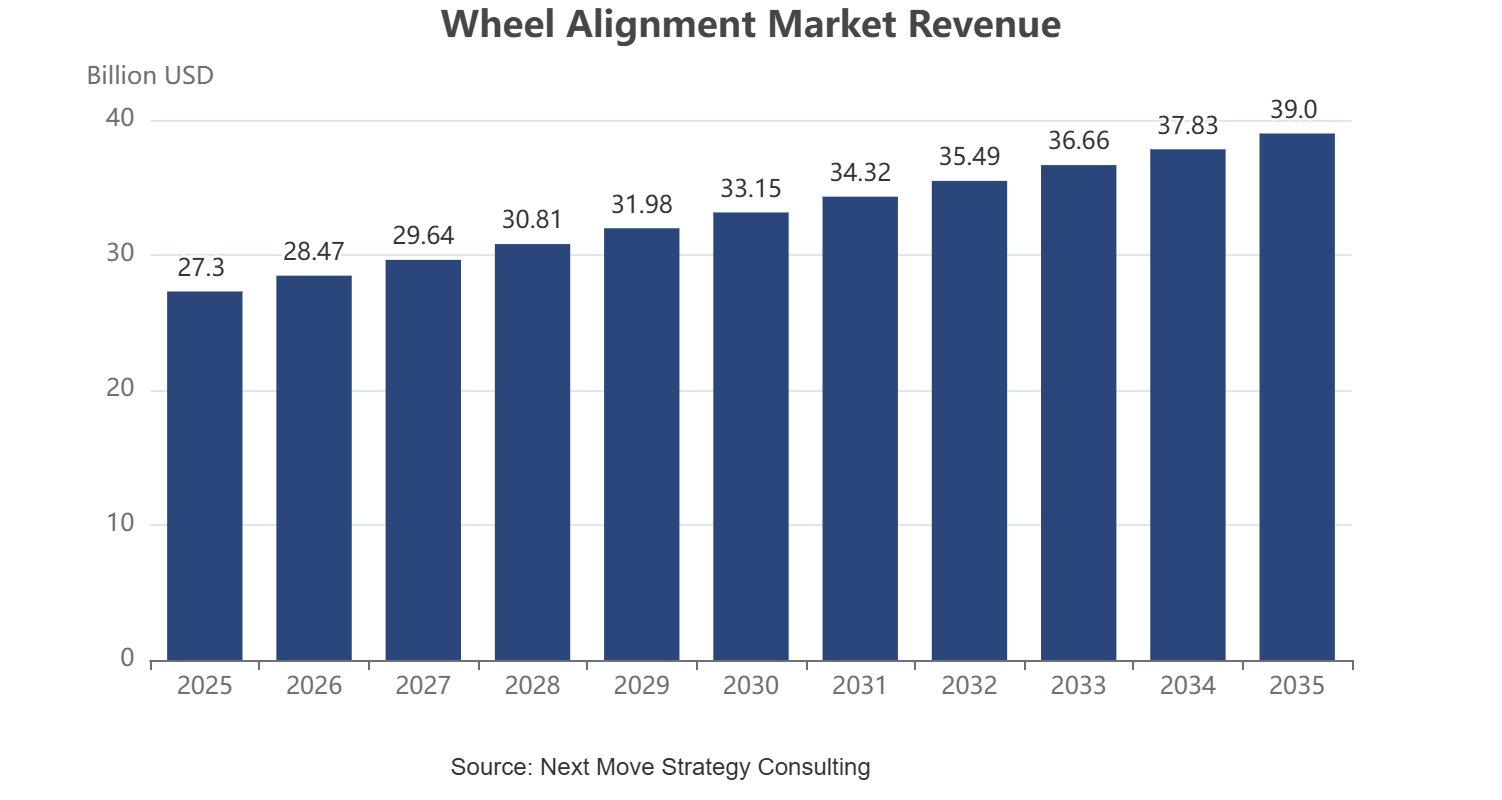
The global wheel alignment market size was valued at USD 27.3 billion in 2025 and is estimated at USD 28.2 billion in 2026, forecast to reach USD 39.0 billion by 2035, expanding at a 3.7% CAGR between 2026 and 2035. Asia-Pacific leads with approximately 32% share, while Four-wheel/Full Alignment dominates all other alignment types with approximately 48% share.
We observed that growth is broad-based across every segmentation axis, with ADAS calibration integration and electric vehicle-specific alignment procedures driving the most pronounced structural shifts through 2035.
|
Key Takeaways |
|
By Alignment Type: Four-wheel/Full Alignment held the largest share of approximately 48% (USD 13.10 billion) in 2025; Heavy-duty Specialized Alignment is the fastest-growing sub-segment at 10.9% CAGR from 2026–2035. |
|
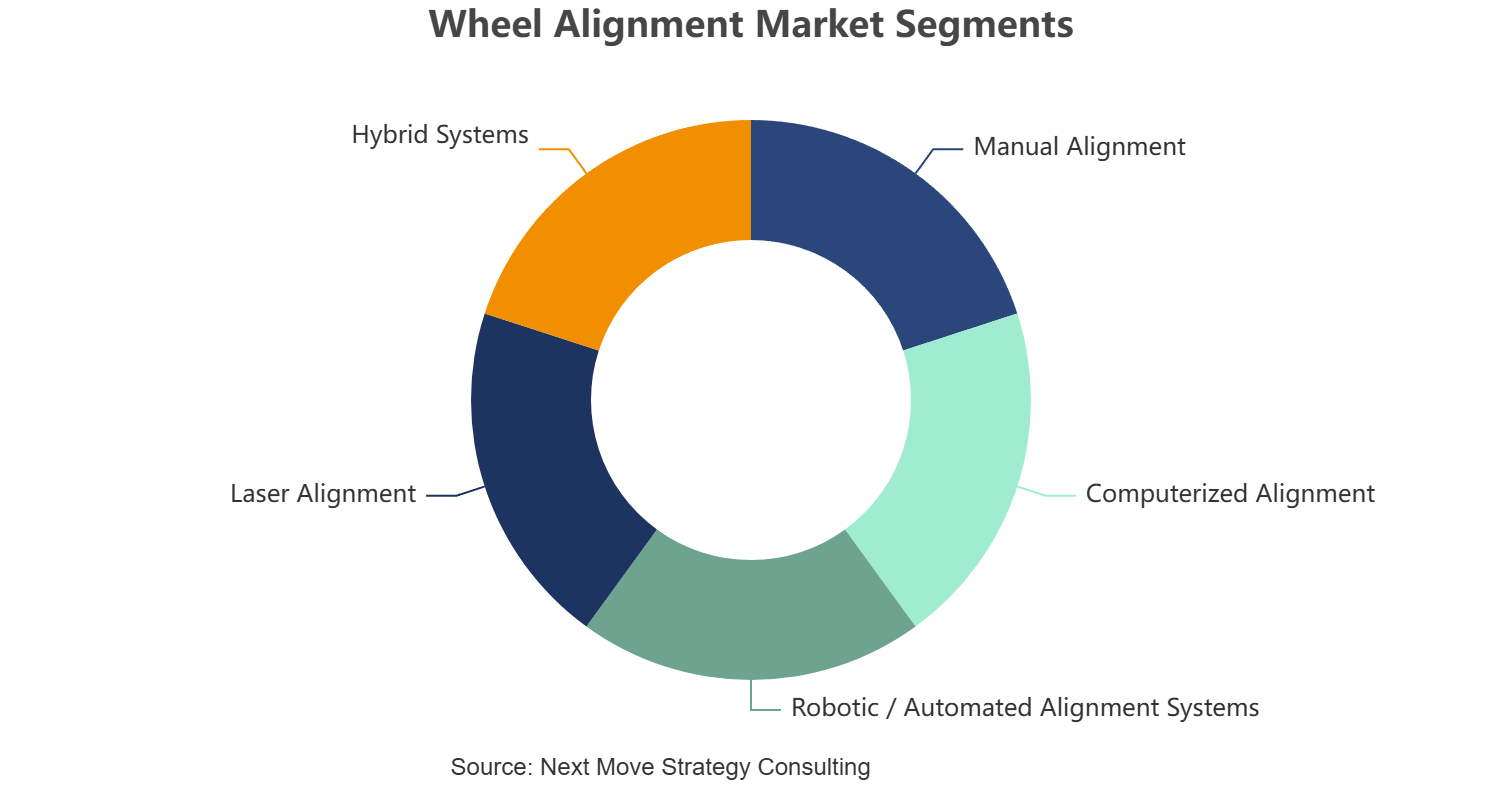
By Service Type: Computerized Alignment held the largest share of approximately 52% (USD 14.20 billion) in 2025; Robotic/Automated Alignment Systems is the fastest-growing sub-segment at 12.7% CAGR from 2026–2035. |
|
By Vehicle Type: Passenger Vehicles held the largest share of approximately 55% (USD 15.02 billion) in 2025; Electric Vehicles (EVs) is the fastest-growing sub-segment at 12.4% CAGR from 2026–2035. |
|
By End-User: Independent Aftermarket Garages & Workshops held the largest share of approximately 34% (USD 9.28 billion) in 2025; Fleet Operators is the fastest-growing sub-segment at 7.0% CAGR from 2026–2035. |
|
Dominant Region: Asia-Pacific dominated with approximately 32% revenue share (USD 8.74 billion) in 2025. |
|
Fastest-Growing Region: Middle East & Africa is expected to register the highest CAGR of 7.0% during 2026–2035. |
|
Dominant Country: The U.S. led with approximately USD 6,716 million in 2025. |
|
Fastest-Growing Country: Saudi Arabia is the fastest-growing country at approximately 8.0% CAGR from 2026–2035. |
Market Opportunity: The wheel alignment market is expected to create an absolute dollar opportunity of USD 10.8 billion between 2026 and 2035, presenting significant investment potential across ADAS-integrated alignment systems, electric vehicle-specific procedures, and fleet operator service contracts.
According to Next Move Strategy Consulting analysis, alignment equipment manufacturers that bundle ADAS calibration capability into a single bay are capturing share faster than standalone aligner providers, a shift that is reshaping capital equipment purchasing decisions among independent aftermarket garages through 2035.
What Does the Wheel Alignment Market Encompass?
The wheel alignment market encompasses front-end, four-wheel/full, thrust/rear-axle, two-wheel motorcycle, and heavy-duty specialized alignment procedures performed using manual, computerized, robotic/automated, laser, and hybrid alignment systems across passenger vehicles, two-wheelers, three-wheelers, light commercial vehicles, electric vehicles, medium and heavy commercial vehicles, and off-road and heavy equipment. We observed that the scope spans OEM manufacturing plants, authorized dealers and OEM service centers, independent aftermarket garages, fleet operators, rental and leasing companies, DIY retail consumers, and specialty service providers. The category has evolved from a purely mechanical adjustment service into a technology-integrated diagnostic process as vehicles increasingly incorporate advanced driver assistance systems requiring camera and sensor recalibration.
Regulatory frameworks such as vehicle safety inspection requirements administered by national transportation authorities shape recurring alignment service demand across the industry. Our assessment indicates that technology adoption is shifting toward combined alignment and ADAS calibration systems that allow technicians to complete both procedures in a single bay. Next Move Strategy Consulting's analysis indicates that this structural shift, combined with the growing share of ADAS-equipped vehicles in operation, is redefining equipment purchasing criteria across the wheel alignment market.
|
Parameters |
Details |
|
Market Size in 2025 |
USD 27.3 Billion |
|
Market Size in 2026 |
USD 28.2 Billion |
|
Revenue Forecast in 2035 |
USD 39.0 Billion |
|
Growth Rate |
CAGR of 3.7% from 2026 to 2035 |
|
Analysis Period |
2025–2035 |
|
Base Year Considered |
2025 |
|
Forecast Period |
2026–2035 |
|
Market Size Estimation |
USD Billion |
|
Companies Profiled |
15 |
|
Countries Covered |
33 |
|
Market Share |
Available for Top 10 Companies |
Key Emerging Trends
Based on research conducted by Next Move Strategy Consulting, we found that four structural trends are reshaping equipment design, service delivery, and stakeholder engagement across the industry.
How Is ADAS Calibration Integration Transforming Alignment Bay Design?
ADAS calibration integration is transforming how repair shops configure alignment bays, combining wheel alignment and camera or sensor recalibration into a single workflow. We observed that Hunter Engineering Company's Ultimate ADAS system, approved by Honda, Acura, Nissan, Infiniti, Subaru, Toyota, and Lexus, supports static calibration procedures for more than 90% of vehicles currently in operation. This integration is reducing the need for shops to invest in separate calibration-only equipment.
Why Is Expandable, Upgrade-Path Equipment Gaining Adoption Among Tire Dealers?
Expandable alignment equipment that allows a gradual upgrade path is gaining adoption among tire dealers and independent garages hesitant to commit to full static ADAS calibration systems immediately. Our findings suggest that Hunter Engineering's HawkEye Elite X platform allows shops to begin with standard alignment and diagnostic capability, then expand into full Ultimate ADAS precision as calibration volume increases, lowering the initial capital barrier for smaller operators.
How Are OEM Approvals Expanding Static Calibration Coverage?
OEM approvals are expanding the range of vehicles that independent shops can service using static ADAS calibration equipment rather than routing customers to dealerships. We observed that Hunter Engineering received Rivian approval for its Ultimate ADAS alignment and calibration system in April 2026, extending coverage to the electric vehicle manufacturer's entire lineup. This approval pattern is reducing fragmentation between OEM-specific calibration requirements and aftermarket equipment capability.
What Role Does Semi-Annual Vehicle Database Coverage Play in Service Accuracy?
Semi-annual vehicle database updates are playing a growing role in ensuring alignment specification accuracy as new vehicle models and OEM changes accumulate. Based on research conducted by Next Move Strategy Consulting, we found that Hunter Engineering's November 2025 WinAlign database update added 421 new vehicle records and 2,492 updates to existing records, including coverage for newly released 2026 model-year vehicles. Equipment providers offering frequent, comprehensive database updates are increasingly favored by shops managing diverse vehicle fleets.
Pain Point Analysis Of The Wheel Alignment Market
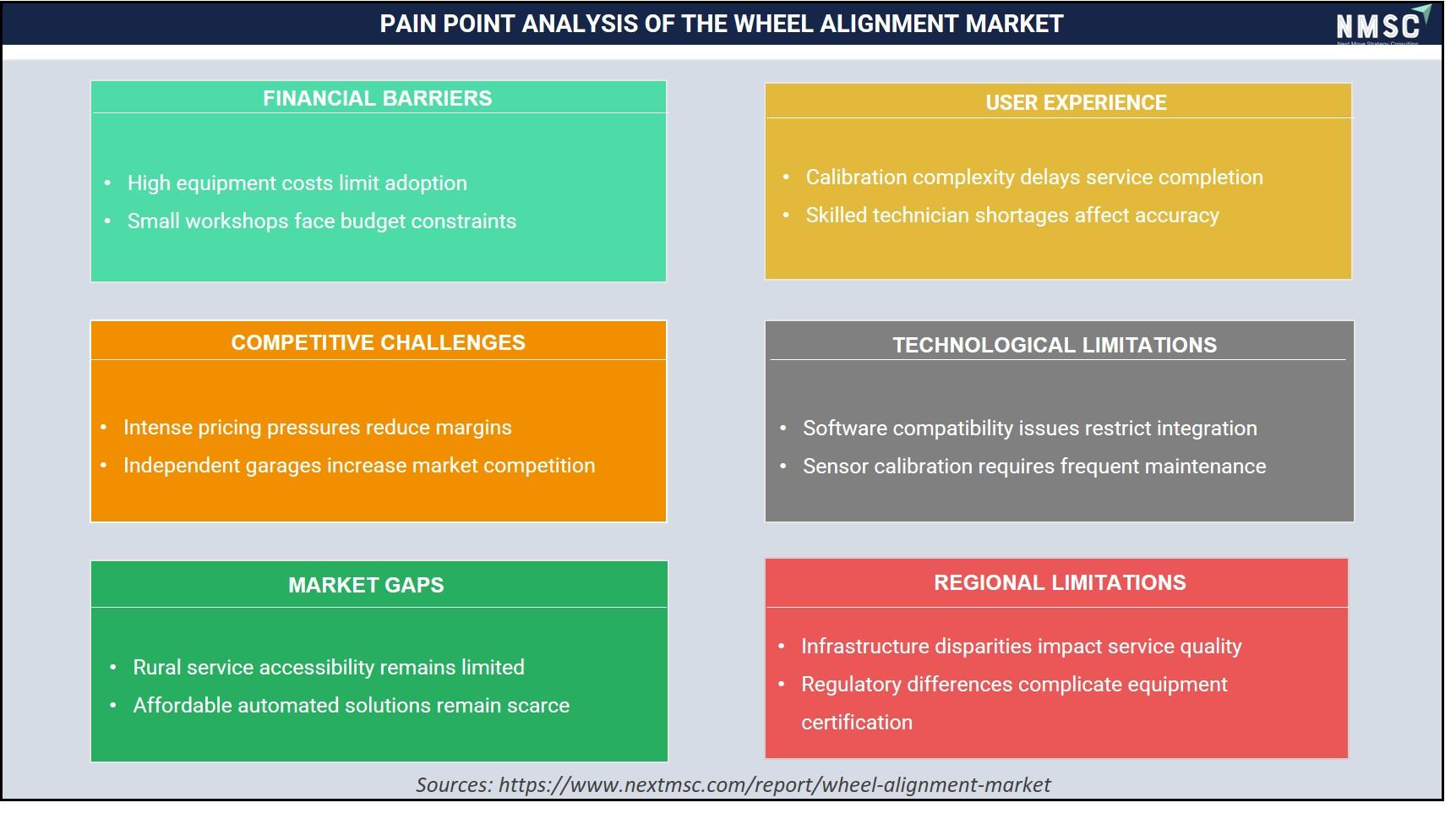
The wheel alignment market faces several operational and commercial challenges that hinder widespread adoption. High equipment investment and maintenance costs limit technology upgrades for small workshops, while the growing complexity of ADAS-enabled vehicles increases calibration time and dependence on skilled technicians. Intense competition from low-cost service providers, software integration issues, regional infrastructure disparities, and limited access to advanced alignment solutions in rural areas further restrain market growth and service quality. These pain points encourage manufacturers to develop cost-effective, automated, and connected alignment systems.
Growth Drivers and Restraints
Growth Catalyst and Risk Assessment Matrix
|
Factors |
Type |
(+/−) % Impact on CAGR |
Geographic Relevance |
Impact Timeline |
|
Rising ADAS-equipped vehicle parc requiring calibration alongside alignment |
Driver |
+1.4% |
Global |
2026–2035 |
|
Electric vehicle-specific alignment procedures and suspension geometry |
Driver |
+1.1% |
Global |
2026–2035 |
|
Growing fleet operator service contracts across logistics and delivery |
Driver |
+0.9% |
North America, Middle East & Africa |
2026–2032 |
|
Middle East infrastructure and vehicle fleet expansion |
Driver |
+0.8% |
Middle East & Africa |
2026–2035 |
|
Vehicle safety inspection requirements sustaining recurring alignment demand |
Driver |
+0.6% |
Global |
2026–2035 |
|
OEM approvals expanding aftermarket static calibration coverage |
Driver |
+0.5% |
North America, Europe |
2026–2030 |
|
Declining demand for manual alignment as computerized systems mature |
Restraint |
−0.6% |
Global |
2026–2030 |
|
High capital cost of combined alignment and ADAS calibration equipment |
Restraint |
−0.4% |
Global |
2026–2030 |
|
Extended vehicle replacement cycles reducing alignment frequency in mature markets |
Restraint |
−0.3% |
North America, Europe |
2026–2032 |
What Is the Primary Growth Driver of the Wheel Alignment Market?
Rising numbers of ADAS-equipped vehicles requiring calibration alongside alignment remain the primary driver of the market. Hunter Engineering Company confirmed that its Ultimate ADAS calibration system supports static calibration procedures for more than 90% of vehicles currently in operation, reflecting the scale of the installed ADAS-equipped fleet. We observed that this expanding requirement is sustaining sequential equipment investment among independent aftermarket garages and dealership service centers.
How Is OEM Approval Expansion Driving Market Growth?
OEM approval expansion is driving growth by widening the range of vehicles that aftermarket shops can legally and accurately service using static calibration equipment. Hunter Engineering Company announced Rivian's approval of its Ultimate ADAS alignment and calibration system for the manufacturer's entire vehicle lineup in April 2026. Our assessment indicates that this approval pattern, following earlier clearances from Honda, Acura, Nissan, Infiniti, Subaru, Toyota, and Lexus, is accelerating equipment adoption among shops seeking broader vehicle coverage.
What Is Restraining Wheel Alignment Market Expansion?
Declining demand for manual alignment procedures restrains overall market expansion as computerized and laser-guided systems continue to displace older equipment. Industry-derived estimates indicate that manual alignment revenue is contracting in most developed markets as shops upgrade to computerized platforms capable of handling modern vehicle specifications. We found that the high capital cost of combined alignment and ADAS calibration equipment further compounds this restraint, extending purchase decision timelines for smaller independent garages.
Segmentation Analysis
Segment Sizing: By Alignment Type
|
Segment |
2025 (USD) |
2035 (USD) |
CAGR% (2026–2035) |
|
Front-end alignment |
USD 7.64 Billion |
USD 8.58 Billion |
0.9% |
|
Four-wheel / Full alignment |
USD 13.10 Billion |
USD 19.50 Billion |
4.1% |
|
Thrust / Rear-axle correction |
USD 2.73 Billion |
USD 3.51 Billion |
2.5% |
|
Two-wheel motorcycle alignment |
USD 2.18 Billion |
USD 3.12 Billion |
3.7% |
|
Heavy-duty Specialized Alignment |
USD 1.64 Billion |
USD 4.29 Billion |
10.9% |
|
Total |
USD 27.30 Billion |
USD 39.00 Billion |
3.7% |
Which Alignment Type Segment Dominates the Wheel Alignment Market?
Four-wheel/Full Alignment led the market with USD 13.10 billion in 2025, supported by its status as the standard procedure for modern passenger vehicles with independent rear suspension. We observed that Heavy-duty Specialized Alignment is the fastest-growing alignment type, expanding at a 10.9% CAGR from 2026 to 2035, as fleet operators and commercial vehicle owners increasingly specify precision alignment services suited to heavier axle loads and specialized suspension geometries.
Segment Sizing: By Service Type
|
Segment |
2025 (USD) |
2035 (USD) |
CAGR% (2026–2035) |
|
Manual Alignment |
USD 4.09 Billion |
USD 3.12 Billion |
-3.3% |
|
Computerized Alignment |
USD 14.20 Billion |
USD 18.72 Billion |
2.8% |
|
Robotic / Automated Alignment Systems |
USD 2.18 Billion |
USD 6.63 Billion |
12.7% |
|
Laser Alignment |
USD 4.91 Billion |
USD 7.41 Billion |
4.3% |
|
Hybrid Systems |
USD 1.91 Billion |
USD 3.12 Billion |
5.2% |
|
Total |
USD 27.30 Billion |
USD 39.00 Billion |
3.7% |
Which Service Type Segment Leads Market Demand?
Computerized Alignment remained the leading service type, valued at USD 14.20 billion in 2025, reflecting its established role as the industry-standard alignment method across independent garages and dealerships. Our findings suggest that Robotic/Automated Alignment Systems is the fastest-growing service type, registering a 12.7% CAGR from 2026 to 2035, as combined alignment and ADAS calibration platforms automate target placement and reduce manual setup time by up to 70% for select procedures.
Segment Sizing: By End-User
|
Segment |
2025 (USD) |
2035 (USD) |
CAGR% (2026–2035) |
|
OEM/Manufacturing |
USD 3.82 Billion |
USD 5.07 Billion |
2.8% |
|
Authorized dealers / OEM service centers |
USD 6.55 Billion |
USD 8.97 Billion |
3.2% |
|
Independent Aftermarket Garages & workshops |
USD 9.28 Billion |
USD 11.70 Billion |
2.2% |
|
Fleet Operators |
USD 3.28 Billion |
USD 6.24 Billion |
7.0% |
|
Rental & leasing companies |
USD 1.36 Billion |
USD 2.34 Billion |
5.8% |
|
DIY/Retail Consumers |
USD 0.82 Billion |
USD 1.17 Billion |
3.7% |
|
Specialty service providers |
USD 2.18 Billion
|
USD 3.51 Billion |
5.0% |
|
Total |
USD 27.30 Billion |
USD 39.00 Billion |
3.7% |
Which End-User Segment Dominates the Wheel Alignment Market?
Independent Aftermarket Garages & Workshops remained the leading end-user, reaching USD 9.28 billion in 2025, as the majority of routine alignment services occur outside dealership networks. Based on research conducted by Next Move Strategy Consulting, we found that Fleet Operators is the fastest-growing end-user, expanding at a 7.0% CAGR from 2026 to 2035, as logistics, delivery, and transport fleets increasingly adopt scheduled alignment programs to reduce tire wear and fuel consumption across large vehicle populations.
Growth Opportunities
Our analysis shows that three forward-looking opportunities stand out for stakeholders positioning within the wheel alignment market over the 2026–2035 forecast period.
How Can Combined Alignment-ADAS Platforms Unlock Value for Independent Garages?
Combined alignment and ADAS calibration platforms present a whitespace opportunity for equipment manufacturers serving independent garages seeking to retain ADAS-equipped vehicle customers. Suppliers that offer expandable, upgrade-path systems stand to capture recurring equipment sales as smaller shops gradually scale from standard alignment into full static calibration capability without requiring a complete initial capital outlay.
Where Does Electric Vehicle-Specific Alignment Create New Demand?
Electric vehicle-specific alignment procedures create a significant opportunity as EV suspension geometry and weight distribution differ from internal combustion vehicles. Manufacturers that develop dedicated EV alignment specifications and equipment calibration profiles can capture long-term service contracts with dealerships and fleet operators managing growing electric vehicle populations.
How Can Fleet Service Contracts Benefit Alignment Equipment Providers?
Scheduled fleet alignment service contracts create an opportunity for equipment providers and service networks serving logistics and delivery fleet operators. Providers that offer data-driven, predictive alignment scheduling tied to tire wear and fuel efficiency metrics can secure recurring, multi-vehicle contracts as fleet operators seek to reduce total cost of ownership across expanding commercial vehicle populations.
Supply Chain Structure Of The Wheel Alignment Market
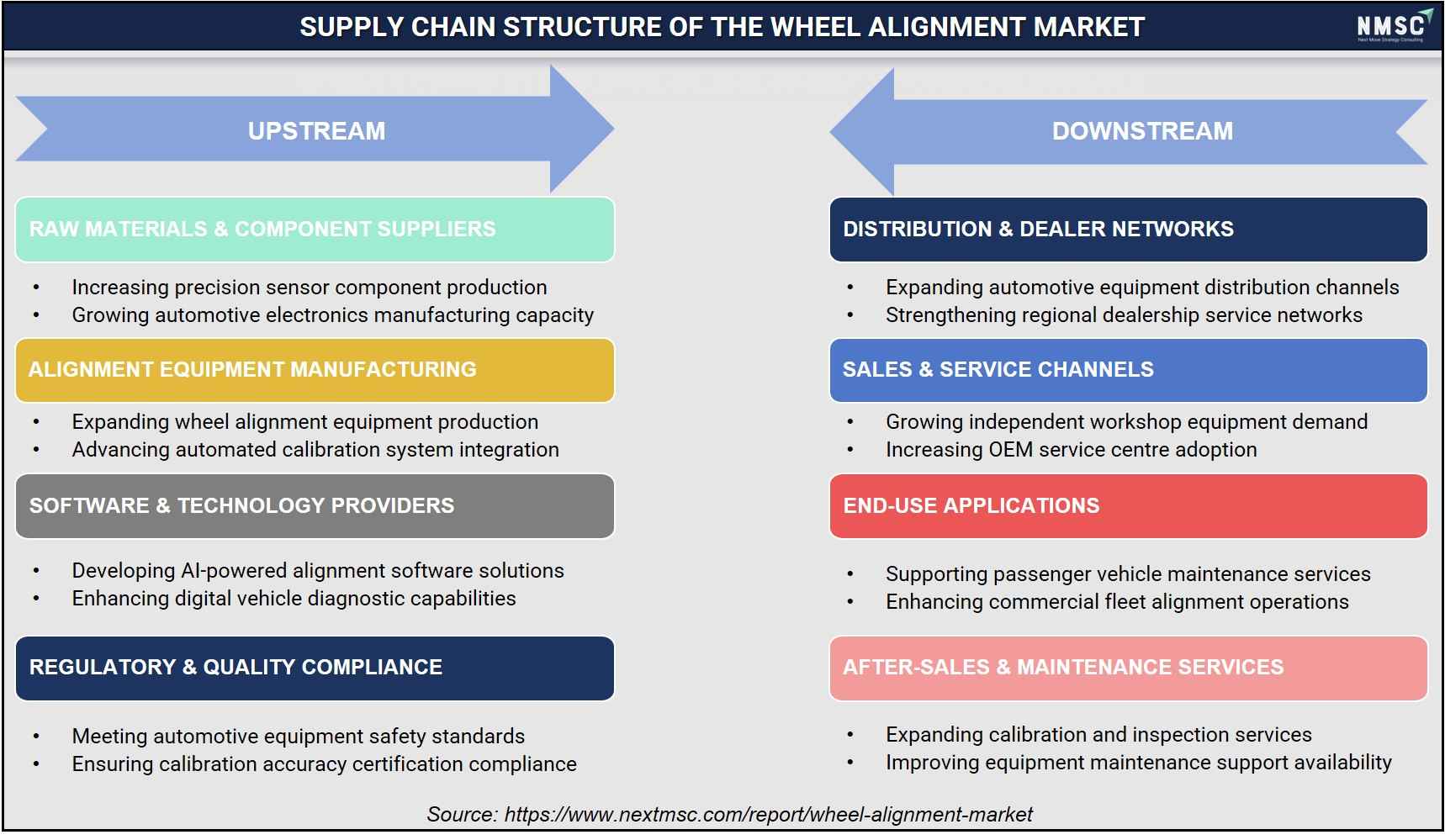
The wheel alignment market supply chain comprises precision component suppliers, equipment manufacturers, software developers, distributors, and aftermarket service providers working together to deliver advanced alignment solutions. Upstream activities focus on sensor production, automated alignment equipment manufacturing, AI-enabled diagnostic software, and regulatory compliance. Downstream operations include dealer networks, OEM and independent workshops, fleet maintenance providers, and after-sales services. Growing demand for ADAS-compatible alignment systems, digital diagnostics, and preventive vehicle maintenance is strengthening collaboration across the supply chain, improving equipment availability, service efficiency, and calibration accuracy worldwide.
Regional Outlook
Geographic Performance Snapshot
|
Region |
2025 (USD) |
2035 (USD) |
CAGR% (2026–2035) |
Key Driver |
|
North America |
USD 8.19 Billion |
USD 10.92 Billion |
2.9% |
ADAS calibration integration and OEM equipment approval expansion |
|
Europe |
USD 7.10 Billion |
USD 9.36 Billion |
2.8% |
Vehicle safety inspection requirements and established equipment manufacturing base |
|
Asia-Pacific |
USD 8.74 Billion |
USD 13.26 Billion |
4.4% |
Expanding vehicle parc and growing independent aftermarket garage network |
|
Middle East & Africa |
USD 1.64 Billion |
USD 3.12 Billion |
7.0% |
Infrastructure investment and growing commercial fleet operations |
|
Latin America |
USD 1.64 Billion |
USD 2.34 Billion |
3.7% |
Expanding vehicle parc and growing fleet operator service demand |
|
Total |
USD 27.30 Billion |
USD 39.00 Billion |
3.7% |
— |
North America Wheel Alignment Market Outlook
North America's wheel alignment market reflects a technology-intensive landscape shaped by Hunter Engineering Company's leadership in combined alignment and ADAS calibration systems. We observed that Hunter's Ultimate ADAS system, approved for Rivian's entire lineup in April 2026, illustrates the region's accelerating shift toward integrated calibration capability. Technology adoption favors robotic and automated alignment systems, and strategic outlook remains steady given the region's mature but technologically advancing installed equipment base.
Europe Wheel Alignment Market Outlook
Europe's market reflects an established equipment manufacturing base anchored by Ravaglioli, CEMB, Beissbarth, MAHA Maschinenbau, and Corghi. Our findings suggest that vehicle safety inspection requirements across Germany, France, and the UK sustain recurring alignment service demand independent of new vehicle sales cycles. Technology adoption favors computerized and laser alignment systems, and competitive intensity remains high among long-established domestic equipment manufacturers.
Asia-Pacific Wheel Alignment Market Outlook
Asia-Pacific is the dominant region in the wheel alignment market, anchored by China's expanding vehicle parc and growing independent aftermarket garage network. We found that Launch Tech Co., Ltd.'s domestic manufacturing presence supports regional equipment affordability and availability. Regulatory frameworks remain less harmonized than in North America or Europe, and technology adoption is accelerating as regional garages upgrade from manual to computerized alignment systems.
Middle East & Africa Wheel Alignment Market Outlook
The Middle East & Africa is the fastest-growing region, propelled by infrastructure investment and expanding commercial fleet operations across Saudi Arabia and the UAE. Our analysis shows that these programs are driving sustained demand for heavy-duty specialized alignment services suited to logistics and construction vehicle fleets. Regulatory frameworks remain developing, and technology adoption is advancing quickly as regional distributors expand equipment availability.
Latin America Wheel Alignment Market Outlook
Latin America's market is supported by expanding vehicle parc and growing fleet operator service demand in Brazil and Argentina. We observed that regulatory frameworks remain less harmonized than in North America or Europe, though national vehicle inspection programs continue to sustain baseline alignment demand. Technology adoption remains centered on computerized alignment systems, with competitive intensity increasing as international equipment manufacturers expand regional distributor partnerships.
U.S. Wheel Alignment Market
Based on our estimates, the U.S. market was valued at approximately USD 6,716 million in 2025 and is projected to reach USD 8,736 million by 2035, growing at a 2.6% CAGR. Demand is anchored by Hunter Engineering Company's domestic manufacturing base and its widely adopted Ultimate ADAS calibration platform. Technology penetration favors combined alignment and ADAS systems, and competitive intensity is high among Hunter Engineering, Snap-on/John Bean, and Bee Line Company serving national dealership and independent garage customers.
Canada Wheel Alignment Market
The market in Canada reached roughly USD 983 million in 2025 and is forecast to hit USD 1,420 million by 2035 at a 3.8% CAGR. Demand structure mirrors U.S. dealership and independent garage patterns, supported by cross-border equipment supply from U.S.-based manufacturers. Technology penetration is rising as shops adopt ADAS-integrated alignment systems, with competitive intensity moderate given reliance on established North American equipment brands.
UK Wheel Alignment Market
As per our estimate, the UK market stood at about USD 1,704 million in 2025, advancing toward USD 2,200 million by 2035 at a 2.5% CAGR. Demand is driven by mandatory vehicle safety inspection requirements sustaining recurring alignment service volume. Regulatory influence remains significant under national roadworthiness testing frameworks, technology penetration favors computerized and laser alignment systems, and competitive intensity remains steady among domestic and continental European equipment suppliers.
Germany Wheel Alignment Market
According to our analysis, Germany's market was valued near USD 2,271 million in 2025 and is set to reach USD 2,948 million by 2035, expanding at a 2.6% CAGR. Demand structure benefits from Germany's strong domestic equipment manufacturing base, anchored by Beissbarth and MAHA Maschinenbau. Germany's periodic technical inspection requirements drive regulatory influence, while technology penetration favors advanced computerized and hybrid alignment systems among established dealership networks.
France Wheel Alignment Market
Based on our estimates, France's market reached approximately USD 1,278 million in 2025, projected to climb to USD 1,638 million by 2035 at a 2.4% CAGR. Demand is supported by national vehicle inspection requirements and a stable independent garage network. Regulatory influence from periodic technical control requirements is notable, and competitive intensity remains moderate given the concentration of established European equipment manufacturers serving domestic garages.
China Wheel Alignment Market
The market in China stood at roughly USD 3,669 million in 2025 and is forecast to reach USD 5,171 million by 2035, registering a 3.5% CAGR. Demand is fueled by the country's expansive vehicle parc and growing independent aftermarket garage network. Regulatory influence is increasing gradually under domestic vehicle safety standards, technology penetration is advancing as garages adopt computerized alignment systems supplied by Launch Tech Co., Ltd. and other domestic manufacturers, and competitive intensity remains high.
India Wheel Alignment Market
As per our estimate, India's market was valued at about USD 1,398 million in 2025, projected to reach USD 2,519 million by 2035 at a 6.4% CAGR, the fastest among Asia-Pacific countries covered. Demand structure reflects rapidly expanding vehicle ownership and a growing independent aftermarket garage base. Regulatory influence remains developing under national vehicle safety guidelines, while technology penetration is rising quickly as Manatec Electronics and international suppliers expand local equipment availability.
Japan Wheel Alignment Market
According to our analysis, Japan's market reached close to USD 1,398 million in 2025 and is expected to hit USD 1,923 million by 2035, growing at a 3.2% CAGR. Demand is supported by Japan's mature vehicle inspection system and established dealership service network. Regulatory influence is well established, technology penetration is advanced across computerized and robotic alignment systems, and competitive intensity remains high among established domestic and international equipment suppliers.
South Korea Wheel Alignment Market
Based on our estimates, South Korea's market stood at approximately USD 1,048 million in 2025, forecast to reach USD 1,525 million by 2035 at a 3.9% CAGR. Demand structure benefits from the country's advanced automotive manufacturing base and growing electric vehicle adoption. Technology penetration is rising as dealerships adopt EV-specific alignment procedures, and competitive intensity remains moderate amid a mix of domestic and international equipment suppliers.
Australia Wheel Alignment Market
The market in Australia reached about USD 699 million in 2025 and is projected to reach USD 1,061 million by 2035, expanding at a 4.4% CAGR. Demand is supported by a growing independent aftermarket garage network and expanding light commercial vehicle fleet. Regulatory influence stems from state-level vehicle inspection requirements, while technology penetration favors imported computerized and laser alignment systems amid moderate competitive intensity.
UAE Wheel Alignment Market
As per our estimate, the UAE market was valued near USD 491 million in 2025, projected to reach USD 905 million by 2035 at a 6.6% CAGR. Demand structure is shaped by the UAE's role as a regional logistics and vehicle distribution hub. Regulatory influence remains moderate, technology penetration is improving through imported combined alignment and calibration systems, and competitive intensity is rising as international equipment suppliers expand regional distribution partnerships.
Saudi Arabia Wheel Alignment Market
According to our analysis, Saudi Arabia's market reached roughly USD 557 million in 2025 and is expected to hit USD 1,154 million by 2035, growing at an 8.0% CAGR, the fastest among all covered countries. Demand is driven by expanding infrastructure investment and growing commercial fleet operations tied to national economic diversification goals. Regulatory influence is developing under national transportation authority guidelines, and technology penetration is advancing as international equipment suppliers scale regional operations.
South Africa Wheel Alignment Market
Based on our estimates, South Africa's market stood at about USD 262 million in 2025, forecast to reach USD 468 million by 2035 at a 6.3% CAGR. Demand structure reflects a developing independent aftermarket garage base addressing rising vehicle ownership. Regulatory influence remains moderate, technology penetration is gradually improving, and competitive intensity is limited given reliance on international equipment suppliers routing distribution through regional partners.
Brazil Wheel Alignment Market
The market in Brazil reached approximately USD 901 million in 2025 and is projected to reach USD 1,240 million by 2035, registering a 3.2% CAGR. Demand is underpinned by Brazil's expansive vehicle parc and growing fleet operator service demand. Regulatory influence stems from national vehicle inspection programs, technology penetration favors established computerized alignment systems, and competitive intensity remains moderate among regional distributors.
Argentina Wheel Alignment Market
As per our estimate, Argentina's market was valued near USD 328 million in 2025, projected to reach USD 491 million by 2035 at a 4.2% CAGR. Demand structure is supported by steady vehicle service demand despite macroeconomic volatility. Regulatory influence remains limited, technology penetration is modest, and competitive intensity is centered on a small number of regional distributors partnering with global equipment manufacturers.
Competitive Landscape
We observed that the competitive landscape spans North American, European, and Asian equipment manufacturers, with differentiation increasingly determined by ADAS calibration integration rather than alignment accuracy alone.
|
Category |
Assessment |
|
Market Structure |
Moderately consolidated; established North American and European manufacturers hold premium technology positioning alongside cost-competitive Asian equipment suppliers |
|
Innovation Focus |
Combined alignment and ADAS calibration systems, expandable upgrade-path platforms, EV-specific alignment specifications, and laser-guided target placement |
|
M&A Activity |
Limited direct M&A activity; competitive dynamics instead centered on OEM approval expansion and semi-annual vehicle database coverage updates |
How Do Companies Compete in the Wheel Alignment Market?
Companies compete primarily on OEM approval breadth, vehicle database coverage, and the ability to integrate ADAS calibration into a single alignment bay. We found that Hunter Engineering Company's Ultimate ADAS system, approved by seven major automakers as of 2026, increasingly anchors competitive positioning against standalone aligner manufacturers. Pricing strategies remain closely tied to equipment sophistication, pushing suppliers toward expandable platforms that lower the initial capital barrier for smaller garages.
Which Competitive Archetypes Dominate the Wheel Alignment Market?
Two archetypes dominate the wheel alignment market: technology-focused manufacturers that compete on ADAS calibration integration and OEM approval breadth, and cost-competitive regional manufacturers that compete on affordability and localized service networks. Our analysis shows that differentiation increasingly centers on combined alignment-calibration capability, positioning technology-focused suppliers to capture greater equipment upgrade cycles as ADAS-equipped vehicle populations expand.
How Are Companies Differentiating Through Innovation?
Leading manufacturers are differentiating through laser-guided target placement, expandable equipment architectures, and frequent vehicle specification database updates. During our market evaluation, we noticed that several manufacturers are simultaneously pursuing OEM-specific calibration approvals and expanding electric vehicle alignment specifications, positioning themselves as full-service technology partners rather than single-function alignment equipment providers.
What M&A and Geographic Expansion Activity Is Reshaping the Market?
Geographic expansion through OEM approval and vehicle database coverage is reshaping competitive positioning across the industry. We observed that Hunter Engineering Company's April 2026 Rivian approval and November 2025 semi-annual database update, adding 421 new vehicle records, both illustrate how equipment manufacturers are competing through continuous vehicle coverage expansion rather than large-scale acquisition activity.
Key Market Players
Our assessment indicates that the following companies represent the leading equipment manufacturers shaping competitive dynamics across the wheel alignment market.
-
Hunter Engineering Company
-
Ravaglioli S.p.A.
-
CEMB S.p.A.
-
Beissbarth Automotive Testing Solutions GmbH
-
Manatec Electronics Private Limited (Manatec)
-
MAHA Maschinenbau Haldenwang GmbH & Co. KG
-
Corghi S.p.A.
-
Launch Tech Co., Ltd.
-
Bee Line Company
-
GAT MACHINERY CO.,LTD
-
Cormach S.r.l.
-
TEXA S.p.A.
-
SICE S.p.A. (SICE)
-
HAWEKA GmbH
Latest Developments
We found that recent product launches, OEM approvals, and database updates underscore the pace of change across the wheel alignment equipment industry.
|
Date |
Event |
|
June 2026 |
Hunter Engineering partnered with AutoNetTV to integrate real-time wheel alignment and tire tread inspection data from its Quick Check Drive system into AutoNetTV's in-store digital displays. The partnership improves customer engagement, increases transparency, and helps workshops drive wheel alignment service sales. |
|
April 2026 |
Kia America officially approved Hunter Engineering's Ultimate ADAS Alignment & Calibration System for its North American dealer and collision repair network. The approval strengthens the adoption of integrated ADAS and wheel alignment technologies across OEM service centres. |
Investment Opportunities
Where Are Capital Inflows Concentrated in the Wheel Alignment Market?
Capital inflows are concentrated in combined alignment and ADAS calibration product development. We observed that Hunter Engineering Company's continued investment in its Ultimate ADAS and HawkEye Elite X platforms, alongside sequential OEM approvals through 2026, reflects sustained manufacturer commitment to integrated calibration capability. This pattern signals continued private investment in technology that reduces the equipment footprint required to service ADAS-equipped vehicles.
How Is Infrastructure Investment Expanding Equipment Coverage?
Infrastructure investment is expanding equipment coverage as manufacturers scale semi-annual vehicle database updates and OEM approval programs. We found that Hunter Engineering Company's November 2025 and May 2026 database releases collectively added nearly 1,000 new vehicle records, reflecting continuous investment in keeping pace with rapid new vehicle model introductions across North America.
What ESG Considerations Are Shaping Wheel Alignment Investment?
Environmental, social, and governance considerations are shaping investment as proper wheel alignment reduces tire wear, fuel consumption, and associated emissions across vehicle fleets. Our findings suggest that fleet operators increasingly view scheduled alignment programs as a measurable efficiency lever, favoring equipment providers that can demonstrate quantifiable fuel and tire life improvements over providers offering alignment services alone without efficiency documentation.
Key Benefits for Stakeholders
How Does This Report Benefit Enterprise and Industry Leaders?
Enterprise and industry leaders gain a structured view of segment-level demand across alignment type, service type, vehicle type, and end-user, supported by Next Move Strategy Consulting's forecasts through 2035. Our analysis shows that this data enables equipment investment decisions, helping manufacturers and service networks prioritize the fastest-growing segments, including robotic/automated systems and electric vehicle-specific alignment.
How Does This Report Benefit Investors and Financial Analysts?
Investors and financial analysts benefit from validated market sizing, regional growth differentials, and competitive landscape analysis that inform capital allocation decisions. We found that the report's country-level revenue breakdowns and CAGR projections support comparative evaluation of expansion opportunities across North America, Europe, Asia-Pacific, the Middle East & Africa, and Latin America, strengthening due diligence on alignment equipment-related investment targets.
How Does This Report Benefit Technology Vendors and Product Teams?
Technology vendors and product teams gain insight into emerging trends, including combined alignment-ADAS calibration platforms, expandable equipment architectures, and OEM approval expansion. Our assessment indicates that this analysis helps product teams prioritize research and development roadmaps toward the service types and vehicle categories showing the strongest forecast growth, improving alignment between innovation investment and evolving shop-level purchasing criteria.
Key Market Segments
By Alignment Type
-
Front-end alignment
-
Front-Axle
-
2-wheel for passenger cars
-
-
Four-wheel / Full alignment
-
Thrust / Rear-axle correction
-
Two-wheel motorcycle alignment
-
Heavy-duty Specialized Alignment
-
By Service Type
-
Manual Alignment
-
Computerized Alignment
-
Robotic / Automated Alignment Systems
-
Laser Alignment
-
Hybrid Systems
By Vehicle Type
-
Passenger Vehicles
-
Sedans/Hatchbacks/Compacts
-
SUVs/Crossovers
-
-
Two-wheelers
-
Motorcycles
-
Scooters
-
-
Three-wheelers
-
Light Commercial Vehicles (Vans, Light Trucks)
-
Electric Vehicles (EVs)
-
Medium & Heavy Commercial Vehicles
-
Trucks
-
Buses
-
-
Off-road & Heavy Equipment
-
Construction
-
Agricultural
-
By End-User
-
OEM/Manufacturing
-
Authorized dealers / OEM service centers
-
Independent Aftermarket Garages & workshops
-
Fleet Operators (logistics, delivery, transport fleets)
-
Rental & leasing companies
-
DIY/Retail Consumers
-
Specialty service providers
By Region
-
North America: U.S., Canada, Mexico
-
Europe: UK, Germany, France, Italy, Spain, Sweden, Denmark, Finland, Netherlands, Rest of Europe
-
Asia-Pacific: China, India, Japan, South Korea, Taiwan, Indonesia, Vietnam, Australia, Philippines, Malaysia, Rest of APAC
-
Middle East & Africa: Saudi Arabia, UAE, Egypt, Israel, Turkey, Nigeria, South Africa, Rest of MEA
-
Latin America: Brazil, Argentina, Chile, Colombia, Rest of LATAM
Conclusion and Recommendations
What Is the Long-Term Outlook for the Wheel Alignment Market?
The long-term outlook remains steady, with the market projected to expand from USD 28.2 billion in 2026 to USD 39.0 billion by 2035 at a 3.7% CAGR. Our assessment indicates that this growth will be increasingly concentrated in ADAS calibration-integrated equipment and electric vehicle-specific procedures as vehicle technology continues to advance across every major region through 2035.
What Strategic Positioning Should Manufacturers Pursue?
Manufacturers should pursue integrated positioning that combines alignment accuracy with ADAS calibration capability in a single bay. We found that companies expanding OEM approval breadth, following Hunter Engineering Company's model with Rivian and multiple other automakers, are best positioned to capture long-term equipment upgrade cycles as ADAS-equipped vehicle populations continue expanding through 2035.
How Attractive Is the Market for New Investment?
The market presents moderate but stable investment attractiveness given its 3.7% forecast CAGR and the sector's essential, non-discretionary service nature. Our findings suggest that investors focusing on robotic/automated alignment systems, electric vehicle-specific procedures, and fleet operator service contracts stand to benefit from above-market growth relative to the broader wheel alignment category.
What Are the Key Market Shifts and Risks?
Key shifts include the transition toward combined alignment-ADAS calibration platforms and growing electric vehicle-specific alignment demand. We observed that principal risks include declining manual alignment revenue, high capital costs for advanced combined systems, and extended vehicle replacement cycles in mature markets, all of which could moderate the pace of the industry's equipment upgrade cycle if unresolved.
What Are the Primary Growth Pathways Through 2035?
Primary growth pathways include scaling combined alignment-ADAS calibration systems, expanding electric vehicle-specific alignment specifications, and deepening fleet operator service contracts. Based on research conducted by Next Move Strategy Consulting, we found that manufacturers combining these three pathways with continuous OEM approval expansion are best positioned to capture the USD 10.8 billion absolute dollar opportunity created between 2026 and 2035.
About the Author
 Liza Phukan
— Liza Phukan is Research Associate at Next Move Strategy Consulting, where she has covered emerging industries and market research across sectors for 3.5 years. Her work includes analyzing industry developments, validating market data, and developing structured business content from research findings. She uses secondary research and data-validation practices to turn complex market information into clear decision-useful market analysis for business audiences and support report development and B2B.
Liza Phukan
— Liza Phukan is Research Associate at Next Move Strategy Consulting, where she has covered emerging industries and market research across sectors for 3.5 years. Her work includes analyzing industry developments, validating market data, and developing structured business content from research findings. She uses secondary research and data-validation practices to turn complex market information into clear decision-useful market analysis for business audiences and support report development and B2B.
About the Reviewer
 Supradip Baul
— Supradip Baul is an accomplished business consultant and strategist with over a decade of rich experience in market intelligence, strategy, technology, and business transformation. His work has included rigorous qualitative and quantitative analysis across multiple industries, helping clients shape investment decisions and long-term roadmaps. Earlier in his career, he was associated with Gartner, where he contributed to industry-leading reports and market share analyses. He has worked with leading global companies and holds an MBA with a dual specialization in Marketing and Finance.
Supradip Baul
— Supradip Baul is an accomplished business consultant and strategist with over a decade of rich experience in market intelligence, strategy, technology, and business transformation. His work has included rigorous qualitative and quantitative analysis across multiple industries, helping clients shape investment decisions and long-term roadmaps. Earlier in his career, he was associated with Gartner, where he contributed to industry-leading reports and market share analyses. He has worked with leading global companies and holds an MBA with a dual specialization in Marketing and Finance.
At Next Move Strategy Consulting, we understand that insightful market research is the cornerstone of successful business decisions. That's why we employ a robust and multifaceted approach, combining various methodologies to deliver the most accurate and actionable data for our clients.

Research Landscape
We navigate the world of research with two primary approaches:
Qualitative Approach
Our qualitative research methodologies involve immersive techniques such as in-depth interviews, focus groups, and observational studies. By engaging directly with individuals and stakeholders, we uncover valuable insights that quantitative data alone may overlook.

Quantitative Research
In tandem with qualitative methodologies, NMSC leverages the power of Quantitative Research to provide a robust foundation of numerical insights. Through systematic data collection and analysis, we quantify patterns, preferences, and market trends, offering a comprehensive view of the business landscape.
Our quantitative research approach employs diverse tools, including surveys, experiments, and statistical modelling. These methodologies enable us to gather data from a large and representative sample, ensuring the statistical significance of our findings. By employing structured questionnaires and standardized data collection methods, we guarantee the reliability and validity of the information we present to our clients.
Quantitative research is particularly effective in measuring the prevalence of trends, assessing market size, and gauging the impact of various factors on consumer behavior. The numerical precision attained through this approach equips our clients with actionable insights, facilitating data-driven decision-making and strategy formulation.


Our Specialized Toolbox for Industry-Specific Market Research
We deploy a specialized arsenal of techniques tailored to meet your unique requirements. Here's a glimpse into our comprehensive toolbox:

Information Procurement
The stage entails acquiring market data or relevant information through various sources and methodologies.


Market Research Approach
We utilize both top-down and bottom-up approaches in market research analysis to achieve a comprehensive understanding of the market dynamics, leveraging the broad perspective of industry trends and macroeconomic factors alongside detailed insights from specific segments and individual companies.

Porters Five Forces Analysis
We conduct Porter's Five Forces analysis to evaluate the competitive landscape of an industry, providing us with insights into factors that affect profitability and strategic positioning.

SWOT Analysis

Forecasting
We utilize a forecasting model to predict future consumption by considering parameters like population, economics, regulations, market competition, drivers, constraints, technology, and pricing. We also employ statistical techniques such as multilinear regression, exponential smoothing, moving average, ARIMA, and Monte Carlo simulations for accurate predictions. In econometric forecasting, we analyzed short-term and long-term event impacts, attributing values based on regulatory frameworks, economic factors, and market events.





 Speak to Our Analyst