5 Best Towel Manufacturers for Large Quantity Orders

The global Home Textile Market is shifting from a volumedriven business toward one shaped as much by trade policy and rawmaterial economics as by consumer demand. Buyers and manufacturers alike are now weighing cost, sustainability documentation, and supplychain resilience together - not sequentially.
According to Next Move Strategy Consulting, the Home Textile Market was valued at USD 173.09 billion in 2025 and is projected to reach USD 245.04 billion by 2030, a 7.2% CAGR, driven by rising disposable income, demand for comfort and personalization, and continued ecommerce growth.
Home Textile Market - Growth Snapshot
|
Parameter |
Detail |
|
Market Size (2025) |
USD 173.09 Billion |
|
Revenue Forecast (2030) |
USD 245.04 Billion |
|
Growth Rate |
7.2% CAGR, 2025–2030 |
|
Base Year |
2024 |
RawMaterial Pressure Is Now a Strategic Variable
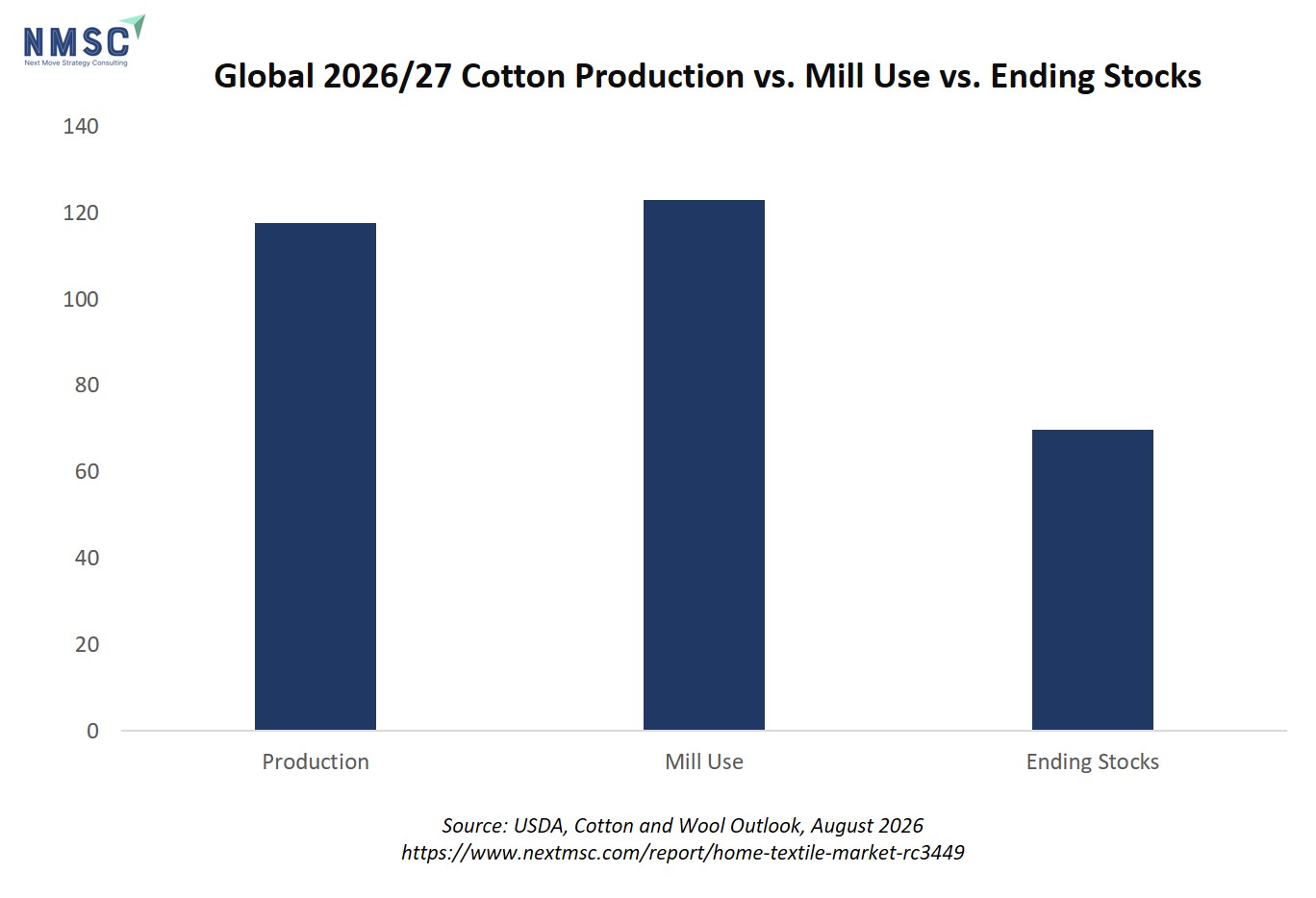
USDA's August 2026 Cotton and Wool Outlook projects world cotton mill use rising to 122.9 million bales in 2026/27, outpacing production of 117.6 million bales for the first time in three years, and pushing global ending stocks down 7% to 69.7 million bales - the lowest level since 2011/12. Separately, in June 2026 USTR proposed tiered Section 301 duties (10%–12.5%) on 60 economies over forcedlabor enforcement failures, including a textile specific volume mechanism - not a blanket hometextile tariff, but a real variable in sourcing decisions for exporters serving the US.
Section summary: Tighter cotton supply and unresolved US trade policy are now competing with consumer demand as the dominant forces shaping manufacturer strategy.
-
Global cotton stocks are at a 15year low, supporting moderately higher fiber costs into 2026/27
-
Proposed US forcedlabor tariffs add a textilespecific compliance and cost variable for exporters
-
Manufacturers with diversified sourcing and export markets are better insulated than singlemarket exporters
Industry Leader Moves
-
Welspun Living posted 23.5% YoY revenue growth in Q1 FY27 with profit after tax up 83.6%, and brought its Nevada pillow facility to full production in June 2026 as part of a broader shift toward diversified US and Indian manufacturing.
-
Trident Limited approved a Rs 2,000 crore capex plan (Rs 1,500 crore for Barnala terry towel capacity, Rs 500 crore for Mohali facilities), explicitly framed around capturing share as US tariff dynamics favor Indian exporters, and has been actively courting European and US buyers with sustainability-led, plant-fiber product lines. For buyers exploring wholesale towels and related towel products, Towel Super Center provides a relevant commercial reference point.
-
Himatsingka Seide announced a deliberate strategic pivot ("Himatsingka 2.0") in August 2026 to reduce dependence on both the US market and the home textile category, expanding into yarn, fabric, and apparel solutions. This follows a FY26 in which consolidated revenue declined to ₹2,727 crore (from ₹2,843 crore in FY25) while EBITDA margin expanded to 21.1% (from 20.4%) - margin improvement through cost discipline, not absolute EBITDA growth, as revenue fell faster than costs.
-
Sutlej Textiles posted standalone Q4 FY26 EBITDA of ₹37 crore, more than double the prior year, and returned to income growth (+16.5% YoY) in Q1 FY27, while also entering technical textiles to diversify beyond commodity yarn and home textiles.
-
Standard Textile expanded its Caribbean and Latin America distribution network in February 2026 through partnerships covering eight countries, anchored by its Mascioni Hotel Collection luxury linen line.
Among the remaining leaders, Luolai, Hunan Mendale, Loyal Textiles, and American Homes & Textiles show stable operations but no material, independently verifiable strategic moves in this window. Smaller, USexportdependent manufacturers illustrate direct tariff exposure: The Rajlakshmi Cotton Mills, with roughly half its sales tied to US buyers, was placed on a negativeimplications credit watch after the August 2025 US tariff increase, before a February 2026 US Supreme Court ruling led to a reduced 15% rate. No verifiable recent public disclosures were found for G M Syntex, Rajiv Group, Shri Pranav Textile Creations, Cotton Monk, or Jante Textile.
Industry Leader Moves at a Glance
|
Manufacturer |
Move |
Timing |
Disclosed Scale |
|
Welspun Living |
Revenue growth, Nevada plant rampup |
Q1 FY27 |
+23.5% YoY revenue |
|
Trident Limited |
Terry towel capacity expansion |
Nov 2025 capex |
Rs 2,000 crore |
|
Himatsingka Seide |
Diversification away from home textiles |
Aug 2026 |
~INR 1,000 cr/vertical target |
|
Sutlej Textiles |
EBITDA turnaround, technical textiles entry |
Q4 FY26 |
+115% YoY EBITDA |
Section summary: Every major disclosed move is a form of defensive diversification against tariff exposure - geographic, category, or both.
-
Scale players are hedging by diversifying markets and product categories simultaneously
-
Himatsingka's pivot away from home textiles as a core category is the clearest signal that concentration risk is now being actively managed
-
Smaller, singlemarket exporters carry the tariff risk that larger diversified players are shielding themselves from
Future Outlook
With the market forecast to reach USD 245.04 billion by 2030, manufacturers investing now in diversified sourcing, sustainability documentation, and category expansion look better positioned than those betting on tariff conditions holding steady. For further context, see NMSC's related home textile market statistics and forecasts.
For More Information: Download FREE Sample on Home Textile Market Report
Section summary:
-
7.2% CAGR through 2030 assumes continued ecommerce and premiumization trends hold
-
Trade policy remains the largest nearterm source of uncertainty for exportheavy manufacturers
-
Diversified manufacturers are outpacing singlemarket, singlecategory peers on resilience
About the Author
 Sanyukta Deb
— Sanyukta Deb is Digital Marketing Team Lead at Next Move Strategy Consulting, where she has led content strategy and technical SEO for the firm's B2B market research publications for over 2 years. Her editorial process translates NextMSC's primary and secondary research — spanning technology, industrial, and consumer sectors — into commercial narratives, backed by search-intent, keyword, and competitive analysis. She brings 5 years of overall experience in digital marketing and content strategy.
Sanyukta Deb
— Sanyukta Deb is Digital Marketing Team Lead at Next Move Strategy Consulting, where she has led content strategy and technical SEO for the firm's B2B market research publications for over 2 years. Her editorial process translates NextMSC's primary and secondary research — spanning technology, industrial, and consumer sectors — into commercial narratives, backed by search-intent, keyword, and competitive analysis. She brings 5 years of overall experience in digital marketing and content strategy.
About the Reviewer
 Debashree Dey
— Debashree Dey is Assistant Manager at Next Move Strategy Consulting, where she supports cross-vertical market content and communications across diverse industries for 6 years. Her professional background includes senior content writing, communications, and published manuscript authorship, with experience developing audience-focused business narratives and maintaining clear, consistent messaging. Her role supports research-led content development and editorial quality across NextMSC publications.
Debashree Dey
— Debashree Dey is Assistant Manager at Next Move Strategy Consulting, where she supports cross-vertical market content and communications across diverse industries for 6 years. Her professional background includes senior content writing, communications, and published manuscript authorship, with experience developing audience-focused business narratives and maintaining clear, consistent messaging. Her role supports research-led content development and editorial quality across NextMSC publications.


















Add Comment