AI Integration: Shaping IT's Future in 2025
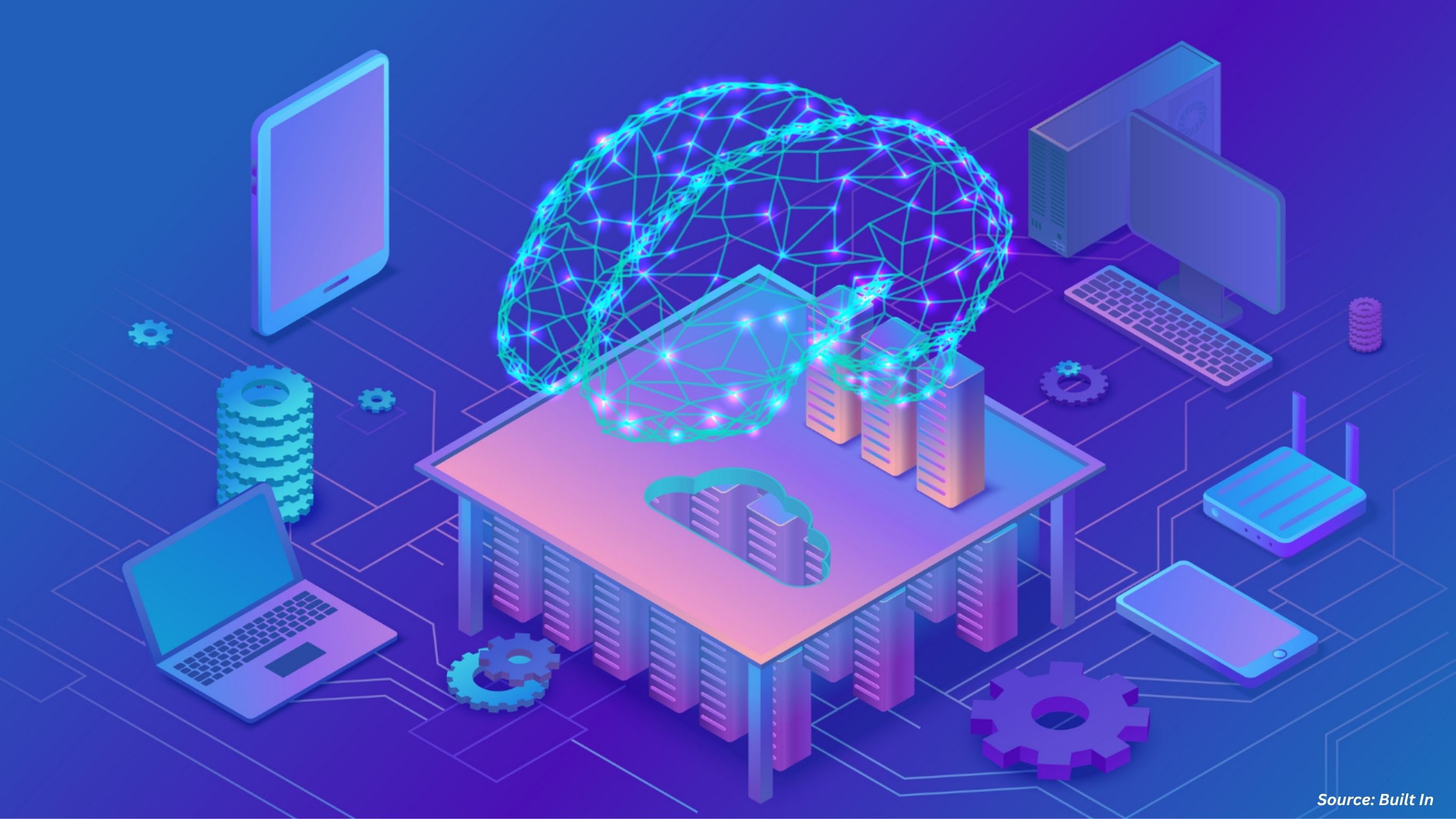
Five years ago, “digital transformation” mostly meant moving on-premise software to the cloud and giving employees a chatbot. That framing is already out of date. According to Next Move Strategy Consulting's Digital Transformation Market analysis, the global digital transformation market was valued at USD 1,128.63 billion in 2023 and is projected to reach USD 4,907.10 billion by 2030, growing at a CAGR of 23.4% from 2024 to 2030 and the last two quarters show why the pace is accelerating: nearly every major enterprise technology vendor has shipped a production-grade AI agent platform, not just a chatbot.
That shift reaches well past the household names. For smaller organizations, the same transformation shows up in far more mundane decisions, such as replacing a legacy on-premise phone system with a cloud-based platform like Dialaxy, which lets a small team set up multi-country virtual numbers and automated call routing without dedicated telecom infrastructure a direct descendant of the VOIP shift that was already reshaping business communication a few years ago. What has changed is less the existence of these tools than how quickly enterprise vendors are now racing to put an autonomous AI agent on top of every layer of the stack.
Why Digital Transformation Spending Keeps Accelerating
Two forces are compounding. The first is a genuine change in what “digital transformation” buys: rather than a better dashboard, enterprises are now purchasing systems that can reason over business context and take action, from routing a support ticket to executing a multi-step supply-chain decision. The second is competitive pressure once one hyperscaler ships a production agent platform, its direct competitors have little choice but to match it within a quarter or two, which is exactly the pattern the last six months have shown across cloud, enterprise software, and networking vendors alike.
Security and data-readiness concerns remain the clearest headwind. Enterprises adopting agentic AI are discovering that ungoverned agents ones with unclear permissions, no audit trail, or access to stale data create new operational and compliance risk even as they promise efficiency gains, which is one reason “agent governance” has become its own product category in 2026 rather than a bolt-on feature.
Content key takeaways
In short: digital transformation spending is accelerating because the unit of purchase has shifted from software licenses to autonomous agents, and governance has become a first-class requirement rather than an afterthought.
-
The market is projected to nearly quadruple from USD 1,128.63 billion (2023) to USD 4,907.10 billion by 2030
-
Competitive pressure is compressing the gap between hyperscaler AI agent launches to a matter of weeks
-
Agent governance, identity, and observability have become distinct, fast-growing product categories in their own right
-
Smaller organizations experience the same shift through more modest, cloud-based tooling upgrades
Industry Leader Moves: The Agentic AI Buildout
Next Move Strategy Consulting's Digital Transformation Market report tracks fifteen key players, and 2026 has been an unusually active year for nearly all of the larger ones as the industry pivots from generative AI chatbots to autonomous agents that act inside enterprise systems.
Microsoft Corporation made Agent 365 generally available in May 2026, giving IT teams a control plane to discover, govern, and secure AI agents operating with their own credentials across Windows, cloud, and third-party platforms. At Build 2026 (June 2-3), Microsoft extended this into a full six-layer agent stack spanning custom silicon (Maia 200), its own MAI model family, and a new Microsoft IQ context layer and expanded Copilot's Agent Mode capabilities across Microsoft 365.
Alphabet Inc. (Google) used Google Cloud Next '26 in April to consolidate Vertex AI and Agentspace into a single Gemini Enterprise Agent Platform, adding an Agentic Data Cloud built on an open Apache Iceberg lakehouse and reporting 40% quarter-over-quarter growth in paid Gemini Enterprise users. The company positioned the launch around owning the full stack chips, models, data, and agents rather than assembling it from partners.
IBM Corporation used Think 2026 (May 5-6) to move the next generation of watsonx Orchestrate into an “agentic control plane” that can govern agents built on any vendor's framework, alongside IBM Bob, an AI coding assistant already used internally by 80,000 IBM employees. IBM also completed the integration of its $11 billion Confluent acquisition into watsonx.data for real-time data streaming, and expanded its Agent2Agent interoperability work with SAP SE, whose Joule agents can now be orchestrated directly alongside IBM Consulting's own agents a concrete example of two of the market's largest enterprise software vendors choosing interoperability over a walled garden.
Cisco Systems, Inc. shipped the Silicon One G300 switch chip in February 2026 for gigawatt-scale AI clusters, then unveiled Cisco Cloud Control at Cisco Live US in June a unified platform for managing networking, security, and observability across both human administrators and AI agents, which the company's own product leadership called its most consequential launch in years.
Adobe Inc. moved through a rapid product cadence: Firefly Foundry for custom enterprise AI models (March), a conversational Firefly AI Assistant that orchestrates work across Creative Cloud apps (April), and Firefly Graph and Creative Production Enterprise Edition (July), which turn an individual creator's workflow into a reusable, node-based organizational asset.
Alibaba Group Holding Limited pushed its Qwen ecosystem well beyond China: the Qwen App reached roughly 295 million monthly active users by March 2026, and in August the company opened an international public beta of QwenWork, a workplace AI agent platform, to users across Asia, the Middle East, and Latin America a direct challenge to Google, Microsoft, and Salesforce in the market for general-purpose workplace agents.
Apple Inc. took a more cautious path, unveiling a rebuilt Siri at WWDC 2026 (June 8-9) built on a custom version of Google's Gemini model and framed around on-device privacy, though the company confirmed the new Siri AI will not launch in the European Union or China at first a meaningful gap for any multinational enterprise standardizing on Apple devices.
Accenture Plc leaned into implementation rather than platform-building, launching Accenture Edge in July 2026 in partnership with Google Cloud to bring pre-built, industry-specific agents to mid-market companies that lack the resources to build agentic AI in-house a sign that the market for AI implementation services is growing alongside the platforms themselves.
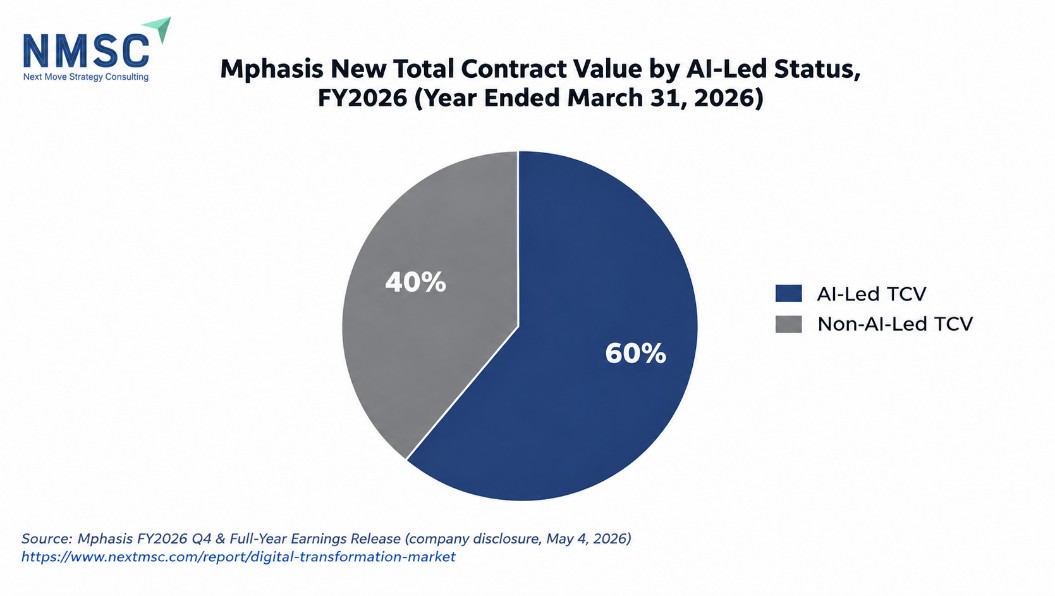
Mphasis reported FY2026 results (year ended March 31, 2026) with a record USD 2.1 billion in new total contract value, up 68% year-on-year, of which 60% was classified as AI-led supported by its acquisition of Theory and Practice (TAP) to strengthen context-aware, agentic delivery capabilities.
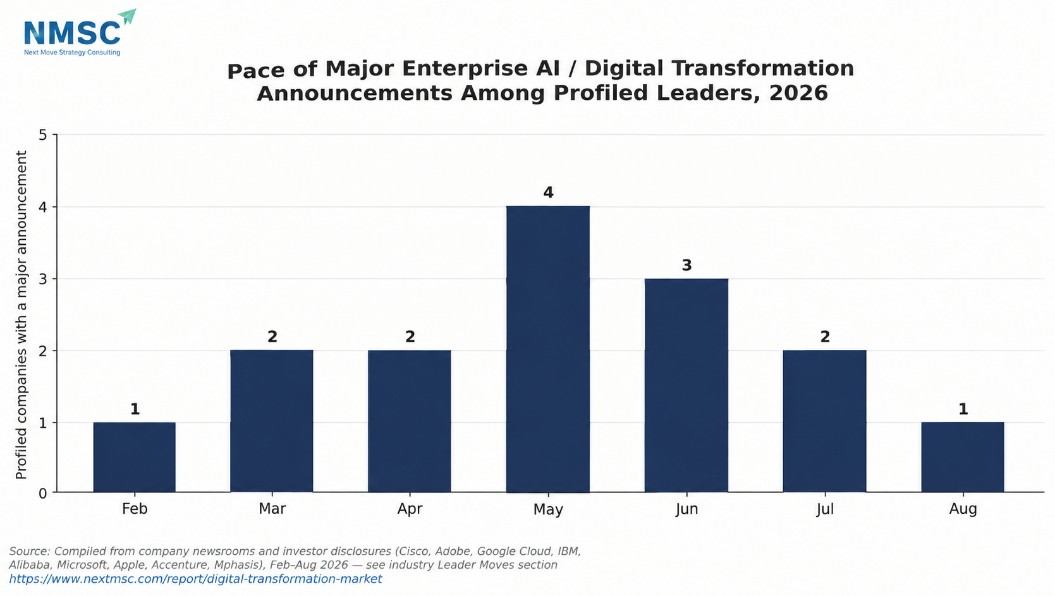
Taken together, these moves point to the same underlying shift shown below: the pace of major agentic AI announcements among the leaders NMSC profiles rose sharply through the second quarter of 2026 before settling into a steadier cadence, consistent with a market moving from launch announcements toward production deployment.
No material, publicly disclosed developments in the past six months were identified for ScienceSoft, Golden Owl, LeewayHertz, or Optimum Solutions beyond routine partner-status and recognition announcements (for instance, ScienceSoft's Advanced Tier Services Partner status with AWS in March 2026); this is noted rather than assumed, consistent with their role as smaller, specialist implementation firms operating alongside the larger platform vendors.
Industry Impact key takeaways
In short: 2026's defining shift is from generative AI features to governed, production agent platforms, with Microsoft, Google, and IBM racing to own the control plane and Cisco, Adobe, and Alibaba extending the same logic into networking, creative work, and workplace productivity respectively.
-
Microsoft, Google, and IBM each shipped a governance-first “agent control plane” within the same three-month window
-
IBM and SAP's Agent2Agent interoperability work signals that even direct competitors see value in agents that can talk to each other
-
Alibaba's QwenWork international launch extends the agentic-platform race beyond U.S. hyperscalers
-
Implementation and services players (Accenture, Mphasis) are growing alongside the platform vendors, not being displaced by them
Digital Transformation Market: Report Scope and Segmentation
|
Parameter |
Detail |
|
Market Size in 2023 |
USD 1,128.63 Billion |
|
Revenue Forecast in 2030 |
USD 4,907.10 Billion |
|
Growth Rate |
CAGR of 23.4% from 2024 to 2030 |
|
Analysis Period |
2023–2030 |
|
Base Year Considered |
2023 |
|
Countries Covered |
28 |
|
Companies Profiled |
15 |
|
Growth Factors |
Rising digital transformation in the BFSI sector; growing digitalization in the automotive industry; increasing adoption of digital accessibility in healthcare |
Industry Leader Moves at a Glance
|
Company |
Recent Move |
When |
Source |
|
Microsoft Corporation |
Agent 365 general availability; Build 2026 six-layer agent stack; Agent Mode default in Microsoft 365 |
May–Jun 2026 |
Microsoft Newsroom / TechCommunity |
|
Alphabet Inc. (Google) |
Gemini Enterprise Agent Platform launched at Cloud Next '26; Agentic Data Cloud; 40% QoQ paid MAU growth |
Apr 2026 |
Google Cloud Blog |
|
IBM Corporation |
watsonx Orchestrate agentic control plane; IBM Bob GA; Confluent ($11B) integration; SAP Agent2Agent link |
May 2026 |
IBM Newsroom |
|
SAP SE |
Joule agents made interoperable with IBM watsonx Orchestrate via Agent2Agent standard |
May 2026 |
IBM Newsroom |
|
Cisco Systems, Inc. |
Silicon One G300 AI networking chip; Cisco Cloud Control agentic management platform |
Feb & Jun 2026 |
Cisco Newsroom |
|
Adobe Inc. |
Firefly Foundry; Firefly AI Assistant; Firefly Graph & Creative Production Enterprise Edition |
Mar–Jul 2026 |
Adobe Newsroom |
|
Alibaba Group Holding Limited |
Qwen App reaches ~295M MAU; QwenWork international public beta launched |
Mar & Aug 2026 |
Alibaba Cloud / SEC Form 20-F |
|
Apple Inc. |
Rebuilt Siri AI (built on Google Gemini) unveiled at WWDC 2026; excluded from EU and China at launch |
Jun 2026 |
Apple Newsroom |
|
Accenture Plc |
Launched Accenture Edge with Google Cloud for mid-market agentic AI adoption |
Jul 2026 |
Accenture Newsroom |
|
Mphasis |
Record USD 2.1B new TCV for FY2026, 60% AI-led; Theory and Practice (TAP) acquisition |
May 2026 |
Mphasis Investor Relations |
Future Outlook
Governance is likely to define the next stage of this market as much as capability does. That is also the clearest link to Next Move Strategy Consulting's Agentic AI Market research, which tracks the identity, permissioning, and observability tools like Microsoft's Agent 365, Google's Agent Identity, and IBM's Agentic Control Plane that are quickly becoming a distinct budget line rather than a feature bundled into a broader platform.
Three other trends look likely to continue. First, interoperability standards such as Agent2Agent will keep expanding, since even direct competitors like IBM and SAP have concluded that a closed agent ecosystem is a weaker sell than an open one. Second, implementation and services providers (Accenture, Mphasis) will keep growing revenue alongside the platform vendors rather than being disintermediated by self-serve AI tools, because most enterprises still need help translating a platform capability into a working, governed deployment. Third, expect continued regional fragmentation, illustrated by Apple's EU/China exclusion for Siri AI and Alibaba's deliberate international expansion strategy for QwenWork regulatory and geopolitical boundaries are shaping where specific agentic capabilities can actually ship, not just how fast they are built.
Future Outlook key takeaways
In short: capability is no longer the bottleneck for digital transformation governance, interoperability, and regulatory geography are.
-
Agent governance and identity tooling is emerging as its own budget category, distinct from the underlying AI platform
-
Interoperability standards like Agent2Agent will keep expanding even among direct competitors
-
Implementation and services providers are growing alongside, not being replaced by, self-serve AI platforms
-
Regulatory and geopolitical boundaries increasingly determine where specific agentic features can launch
Conclusion
The digital transformation market's path to a projected USD 4,907.10 billion by 2030 is no longer a story about moving workloads to the cloud. It is a story about which vendors can ship autonomous, governable AI agents fast enough to matter and which organizations, from hyperscalers down to a small business swapping in a cloud phone system, can absorb that shift without losing control of it.
Curious how these figures break down by offering, deployment mode, and region? Download Free Sample of NMSC's full Digital Transformation Market report.
About the Author
 Sanyukta Deb
— Sanyukta Deb is Digital Marketing Team Lead at Next Move Strategy Consulting, where she has led content strategy and technical SEO for the firm's B2B market research publications for over 2 years. Her editorial process translates NextMSC's primary and secondary research — spanning technology, industrial, and consumer sectors — into commercial narratives, backed by search-intent, keyword, and competitive analysis. She brings 5 years of overall experience in digital marketing and content strategy.
Sanyukta Deb
— Sanyukta Deb is Digital Marketing Team Lead at Next Move Strategy Consulting, where she has led content strategy and technical SEO for the firm's B2B market research publications for over 2 years. Her editorial process translates NextMSC's primary and secondary research — spanning technology, industrial, and consumer sectors — into commercial narratives, backed by search-intent, keyword, and competitive analysis. She brings 5 years of overall experience in digital marketing and content strategy.
About the Reviewer
 Debashree Dey
— Debashree Dey is Assistant Manager at Next Move Strategy Consulting, where she supports cross-vertical market content and communications across diverse industries for 6 years. Her professional background includes senior content writing, communications, and published manuscript authorship, with experience developing audience-focused business narratives and maintaining clear, consistent messaging. Her role supports research-led content development and editorial quality across NextMSC publications.
Debashree Dey
— Debashree Dey is Assistant Manager at Next Move Strategy Consulting, where she supports cross-vertical market content and communications across diverse industries for 6 years. Her professional background includes senior content writing, communications, and published manuscript authorship, with experience developing audience-focused business narratives and maintaining clear, consistent messaging. Her role supports research-led content development and editorial quality across NextMSC publications.

















Add Comment