Are Agricultural Drones Transforming Farm Productivity Worldwide?
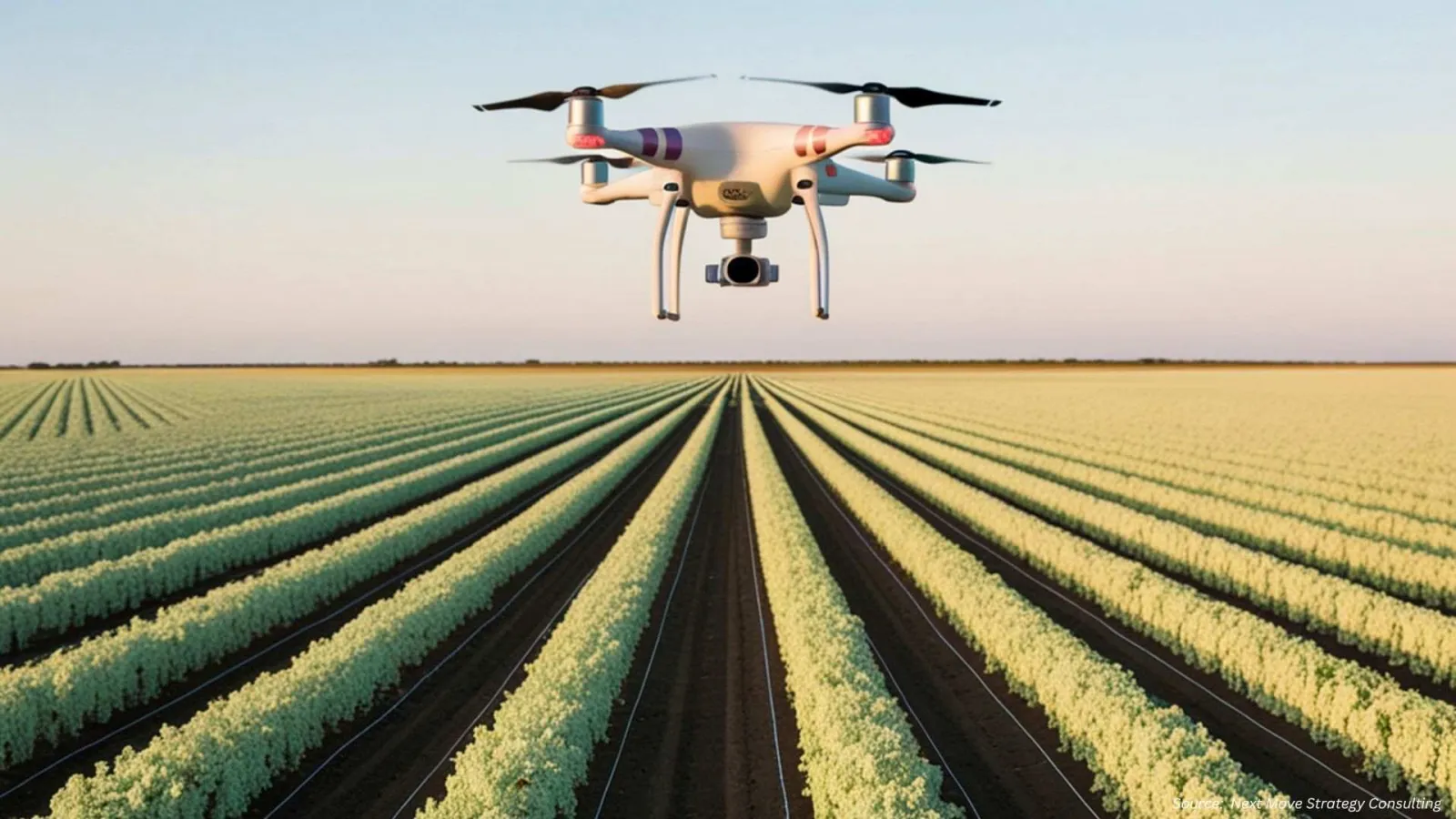
Agriculture is undergoing a measurable technological shift. Over the past two years, agricultural drones have moved from experimental equipment to operational farm infrastructure. Verified data from 2024 and 2025 show rapid global expansion, tangible environmental savings, and significant economic contribution. According to research discussed in The Conversation, based on findings published in Science and reported by The Conversation, agricultural drones are spreading faster than most previous farming technologies.
How Rapid Is Agricultural Drone Adoption?
As of June 2025, more than 500,000 agricultural drones have been deployed worldwide. Their use has saved approximately 330 million metric tons of water and reduced carbon emissions by about 42.6 million tons. China represents the most advanced case of integration. In 2024 alone, agricultural drones covered more than 173 million hectares, generated around US$1.8 billion in sector value, and created employment opportunities for nearly 500,000 people. These figures confirm that agricultural drones are operating at national scale rather than pilot scale. Adoption is no longer confined to early adopters. It is widespread, economically measurable, and policy-supported. Agricultural drone deployment in 2024–2025 reflects industrial-level integration rather than technological curiosity.
Scale with Substance
The defining feature of current growth is quantifiable impact. Hectares covered, emissions reduced, and employment created demonstrate that adoption is producing measurable outcomes across economic and environmental dimensions.
From Specialized Equipment to Accessible Infrastructure?
Only a few years ago, agricultural drones were small, costly, and technically demanding. Today’s models can carry loads up to 220 pounds (100 kilograms) and can be flown immediately after purchase. Cost varies significantly by geography. In the United States, comparable equipment typically costs US$20,000 to US$30,000, while similar models in China may cost under US$10,000. However, ownership is not the dominant model. Many farmers hire service providers who supply both equipment and trained pilots, reducing capital barriers and accelerating access.
What Are Agricultural Drones Doing on Farms?
Agricultural drones are multifunctional platforms used across the production cycle. Their tasks include crop spraying, fertilizer spreading, seed sowing, produce transportation, livestock monitoring, field mapping, and crop health measurement.
In China, applications have expanded further. In Hubei province, drones transported 85 kilograms of oranges in two minutes. In Yunnan province, a drone dispatch system reduced banana transportation losses from 30% to less than 5%. In Inner Mongolia, drone-based crop management raised corn yields by more than 10%. These examples demonstrate that drones are not limited to spraying. They are integrated into logistics, crop monitoring, and yield enhancement. Agricultural drones are multifunctional systems embedded throughout the farming lifecycle. Their value increases when deployed across multiple farm operations rather than single-use scenarios.
Operational and Economic Highlights of Agricultural Drone Expansion
|
Category |
Data Point |
Period |
|
Spray Capacity |
10–25 acres per hour |
2024–2025 |
|
Labor Equivalent |
30–100 manual workers |
2024–2025 |
|
Maximum Payload |
220 pounds (100 kg) |
Current models (2025) |
|
U.S. Registered Units |
~1,000 to ~5,500 increase |
Jan 2024–Mid 2025 |
|
Yield Improvement |
More than 10% increase |
2024 |
|
Transportation Loss Reduction |
30% to <5% (bananas) |
2024 |
Are Agricultural Drones Improving Safety and Labor Efficiency?
In countries such as China, Thailand, and Vietnam, farmers have transitioned from backpack spraying to drone-based application. This shift reduces direct exposure to agrochemicals and lowers physical strain. Drones can spray between 10 and 25 acres per hour, equivalent to the work of 30 to 100 manual laborers. Smallholders farming less than 5 acres (2 hectares) represent 85% of farms globally. For these farmers, drones reduce the need for manual spraying while saving time and labor costs.
Labor Transformation, Not Elimination
While some manual spraying roles may decline, new skilled employment has emerged. Nearly half a million jobs have been created in China’s agricultural drone sector.
Policy and Institutional Momentum
Regulatory systems are adapting alongside technological expansion. In China, agricultural drones are recognized as part of the low-altitude economy, and the 2025 No. 1 Central Document included low-altitude technology alongside artificial intelligence and big data. In the United States, the number of registered agricultural drones increased from approximately 1,000 in January 2024 to about 5,500 by mid-2025. Government recognition and regulatory adaptation signal institutional commitment. Policy inclusion suggests that agricultural drones are viewed as strategic infrastructure rather than temporary innovation.
Leading Companies Strengthening Their Position Through Product Innovation
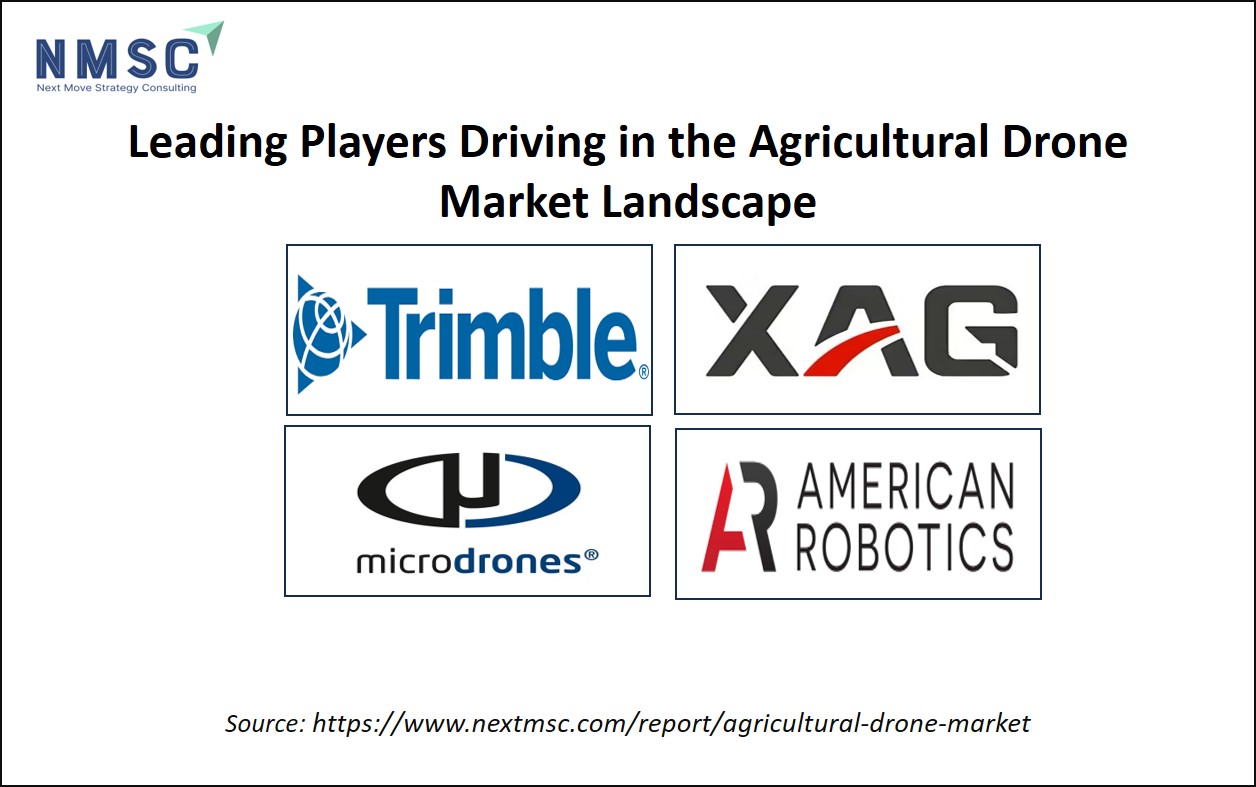
Key companies operating in the agricultural drone sector include Shenzhen DJI Technology Co., Ltd., XAG Co., Ltd., Parrot SA, Hylio, AeroVironment, Inc., Trimble Inc., Microdrones, Terra Drone Corporation, Agribotix LLC, and American Robotics, Inc., among others. These companies continue to focus on strategic product launches and technology enhancements to strengthen their competitive positioning and sustain their influence across global agricultural operations.
Next Move Strategy Consulting View: Institutional Endorsement Accelerates Adoption
Formal recognition strengthens investor confidence, encourages service expansion, and supports sustained integration.
Next Steps
-
Establish structured pilot training and certification programs to ensure safe and standardized operations.
-
Promote service-provider partnerships to expand accessibility among smallholder farmers.
-
Implement clear operational guidelines to minimize pesticide drift and environmental risk.
-
Encourage youth participation through skill development initiatives in rural regions.
-
Integrate drone-generated data into broader farm management systems to maximize efficiency gains.
Final Conclusion
Agricultural drones market in 2024–2025 represent one of the fastest transitions from innovation to operational infrastructure in modern farming. Verified data confirm measurable water savings, emission reductions, yield improvements, and employment creation.
The evidence demonstrates that agricultural drones are not a future possibility. They are a present operational force reshaping farm productivity, environmental efficiency, and rural labor structures worldwide.
About the Author
 Sanyukta Deb
— Sanyukta Deb is Digital Marketing Team Lead at Next Move Strategy Consulting, where she has led content strategy and technical SEO for the firm's B2B market research publications for over 2 years. Her editorial process translates NextMSC's primary and secondary research — spanning technology, industrial, and consumer sectors — into commercial narratives, backed by search-intent, keyword, and competitive analysis. She brings 5 years of overall experience in digital marketing and content strategy.
Sanyukta Deb
— Sanyukta Deb is Digital Marketing Team Lead at Next Move Strategy Consulting, where she has led content strategy and technical SEO for the firm's B2B market research publications for over 2 years. Her editorial process translates NextMSC's primary and secondary research — spanning technology, industrial, and consumer sectors — into commercial narratives, backed by search-intent, keyword, and competitive analysis. She brings 5 years of overall experience in digital marketing and content strategy.
About the Reviewer
 Debashree Dey
— Debashree Dey is Assistant Manager at Next Move Strategy Consulting, where she supports cross-vertical market content and communications across diverse industries for 6 years. Her professional background includes senior content writing, communications, and published manuscript authorship, with experience developing audience-focused business narratives and maintaining clear, consistent messaging. Her role supports research-led content development and editorial quality across NextMSC publications.
Debashree Dey
— Debashree Dey is Assistant Manager at Next Move Strategy Consulting, where she supports cross-vertical market content and communications across diverse industries for 6 years. Her professional background includes senior content writing, communications, and published manuscript authorship, with experience developing audience-focused business narratives and maintaining clear, consistent messaging. Her role supports research-led content development and editorial quality across NextMSC publications.
















Add Comment