Autonomous Underwater Vehicles (AUVs) Market Size, Share, Trends and Growth Analysis, By Offering (AUV Platforms, AUV Components & Subsystems, and AUV Services), By Vehicle Type, By Propulsion Technology, By Autonomy Level, By Application, By End User (Defense Organizations and Navies, Energy and Commercial Operators, Research Institutions and Universities, Survey and Hydrographic Service Providers, and Infrastructure Operators), and Region — Global Industry Report and Forecast, 2026–2035
Industry: Aerospace & Defense | Publishing Date: July 29, 2026 | Last Updated: September 30, 2026 | No of Pages: N/A | No. of Tables: N/A | No. of Figures: N/A | Format: PDF | Report Code: AD5458
What Is the Autonomous Underwater Vehicles (AUVs) Market Size?
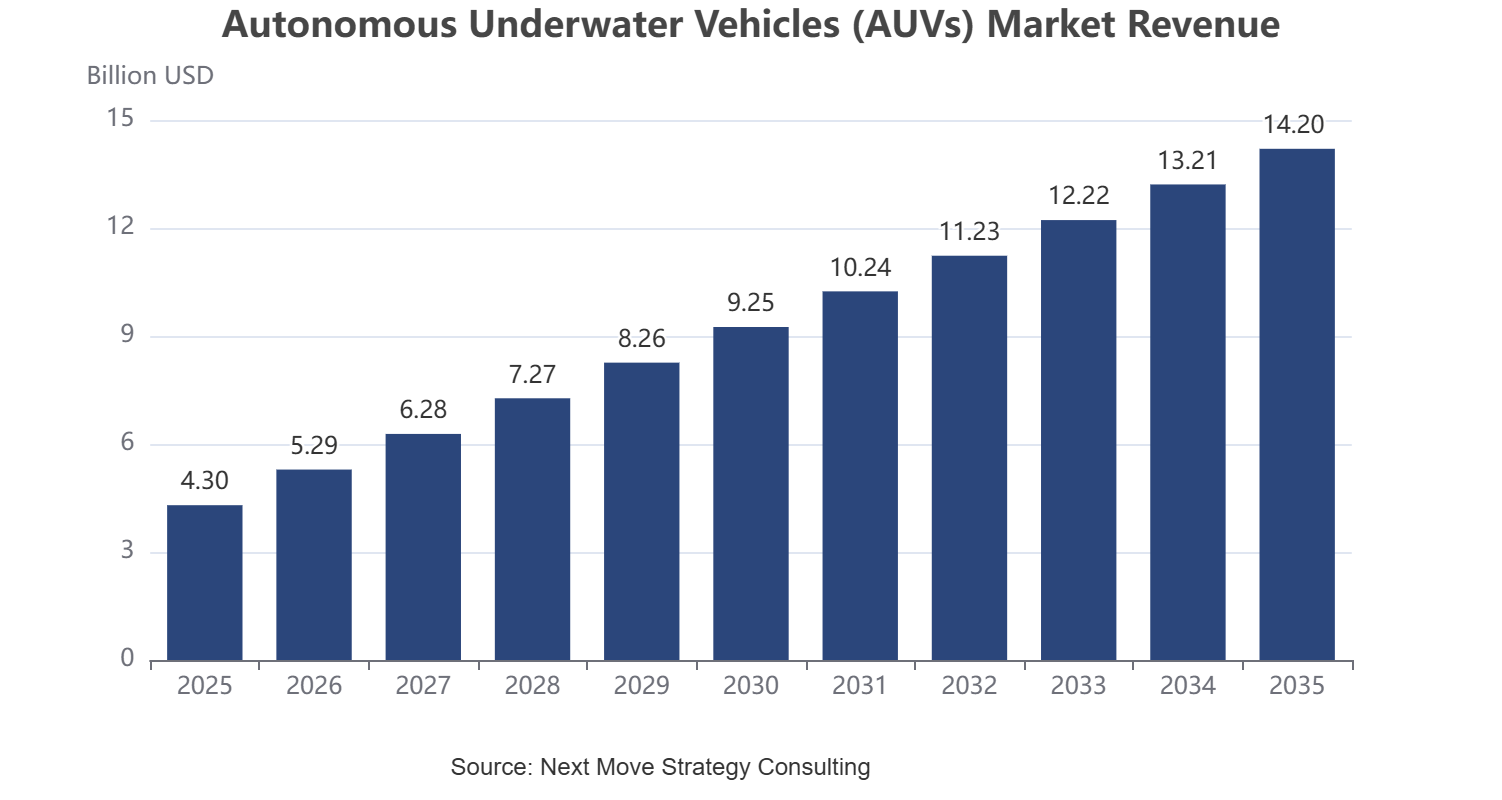
The global Autonomous Underwater Vehicles (AUVs) Market size was valued at USD 3.85 Billion in 2025 and is estimated at USD 4.30 Billion in 2026, forecast to reach USD 14.20 Billion by 2035, expanding at a 14.2% CAGR between 2026 and 2035. North America leads with approximately 38% share, while AUV platforms dominate all other offering categories with approximately 58% share.
We observed that defense modernization and sovereign manufacturing programs are the dominant structural forces behind this growth, with AI-enabled autonomy and extra-large platforms expanding well above the market average through 2035.
|
Key Takeaways |
|
By Offering: AUV Platforms held the largest share of approximately 58% (USD 2.23 Billion) in 2025; AUV Services is the fastest-growing sub-segment at 21.4% CAGR from 2026–2035. |
|
By Vehicle Type: Micro/Small AUVs held the largest share of approximately 34% (USD 1.31 Billion) in 2025; Extra Large AUVs is the fastest-growing sub-segment at 19.1% CAGR from 2026–2035. |
|
By Propulsion Technology: Electric Propulsion held the largest share of approximately 71% (USD 2.73 Billion) in 2025; Other Propulsion is the fastest-growing sub-segment at 21.2% CAGR from 2026–2035. |
|
By Autonomy Level: Pre-Programmed Autonomy held the largest share of approximately 46% (USD 1.77 Billion) in 2025; AI Enabled Autonomy is the fastest-growing sub-segment at 21.9% CAGR from 2026–2035. |
|
By Application: Defense & Security held the largest share of approximately 42% (USD 1.62 Billion) in 2025; Renewable Energy is the fastest-growing sub-segment at 22.5% CAGR from 2026–2035. |
|
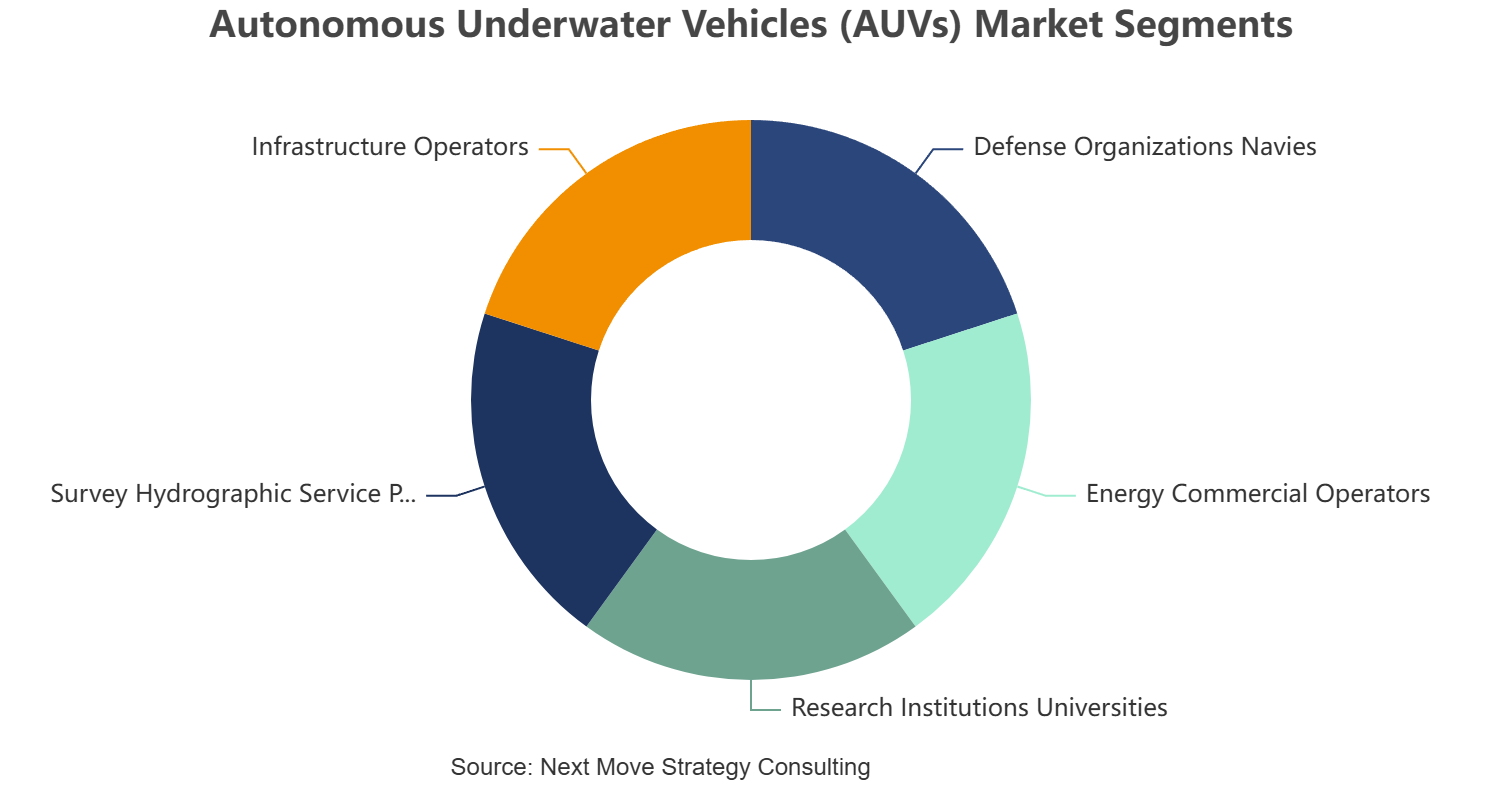
By End User: Defense Organizations & Navies held the largest share of approximately 44% (USD 1.69 Billion) in 2025; Infrastructure Operators is the fastest-growing sub-segment at 22.5% CAGR from 2026–2035. |
|
Dominant Region: North America dominated with approximately 38% revenue share (USD 1.46 Billion) in 2025. |
|
Fastest-Growing Region: Middle East & Africa is expected to register the highest CAGR of 17.9% during 2026–2035. |
|
Dominant Country: U.S. led with approximately USD 1.20 Billion in 2025. |
|
Fastest-Growing Country: Australia is the fastest-growing country at approximately 23.7% CAGR from 2026–2035. |
Market Opportunity: The Autonomous Underwater Vehicles (AUVs) Market is expected to create an absolute dollar opportunity of USD 9.90 Billion between 2026 and 2035, presenting significant investment potential across defense mine-countermeasure programs, offshore wind seabed survey, and subsea critical-infrastructure protection.
According to Next Move Strategy Consulting analysis, navies and offshore energy operators are increasingly favoring extra-large, long-endurance platforms over fleets of smaller vehicles to reduce surface-vessel support costs, a shift that is redirecting capital toward fewer, higher-value AUV programs even as unit counts grow more slowly than dollar revenue through 2035.
What Does the Autonomous Underwater Vehicles (AUVs) Market Encompass?
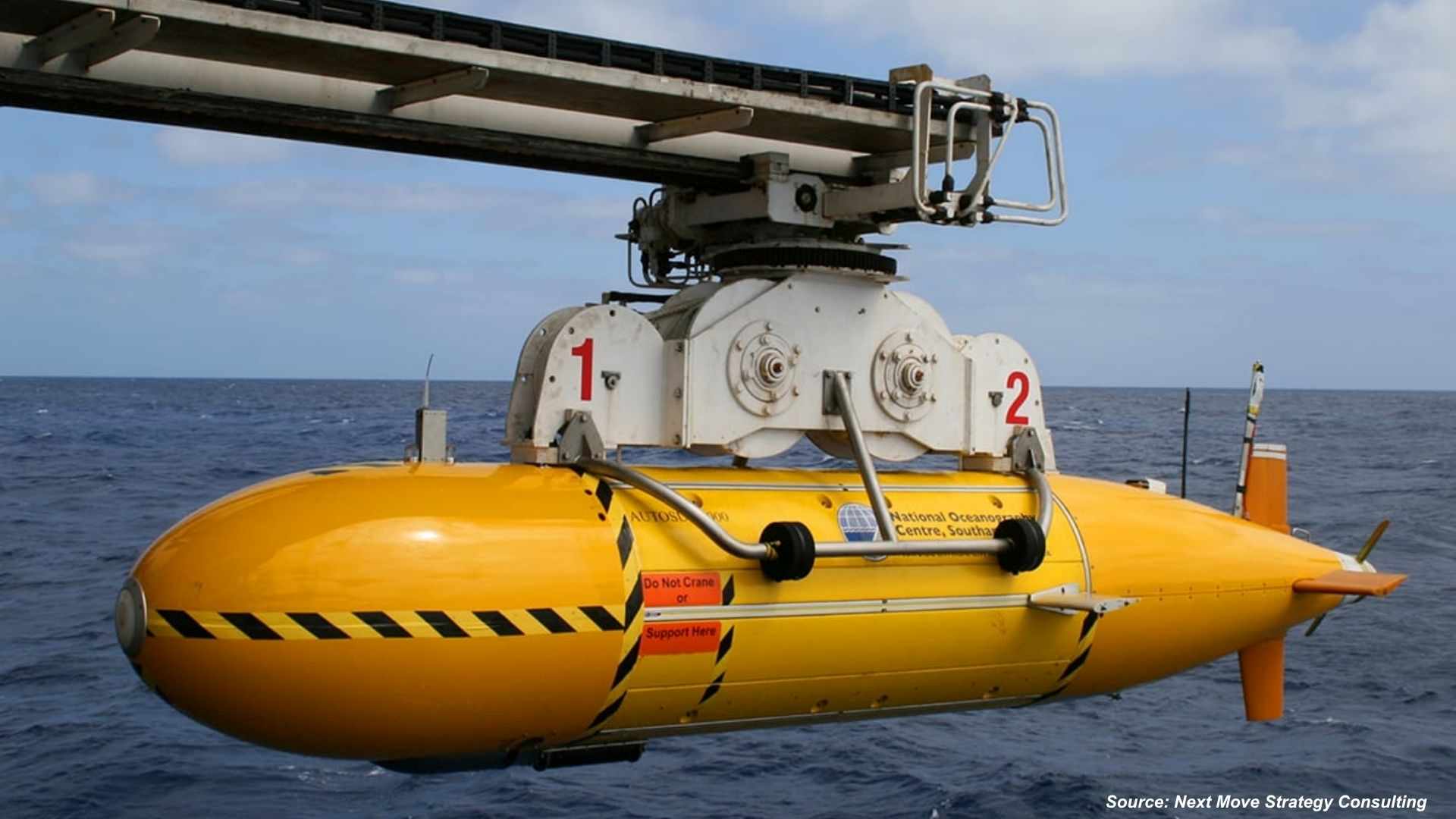
The autonomous underwater vehicles market encompasses untethered underwater robotic platforms, their propulsion, navigation, sensor, and power subsystems, and the survey, inspection, and data-processing services built around them. Our assessment indicates that the scope spans defense mine countermeasures and anti-submarine warfare, oil and gas pipeline inspection, marine science, offshore renewable energy survey, subsea infrastructure inspection, and commercial hydrographic survey applications delivered to naval, energy, research, and infrastructure end users. The category has evolved from bespoke research platforms into programs of record procured at fleet scale by navies and commercial operators seeking to reduce reliance on crewed survey vessels.
Regulatory frameworks including U.S. export-control classifications on dual-use autonomous underwater technology and International Maritime Organization guidance on autonomous maritime systems shape cross-border deployment and technology transfer. We observed that technology adoption is shifting from pre-programmed waypoint navigation toward AI-enabled autonomy that reduces dependence on real-time surface-vessel communication links. Next Move Strategy Consulting's analysis indicates that this shift, combined with sovereign manufacturing investment, is redefining how navies and commercial operators source AUV capability.
|
Parameter |
Details |
|
Market Size in 2025 |
USD 3.85 Billion |
|
Market Size in 2026 |
USD 4.30 Billion |
|
Revenue Forecast in 2035 |
USD 14.20 Billion |
|
Growth Rate |
CAGR of 14.2% from 2026 to 2035 |
|
Analysis Period |
2025–2035 |
|
Base Year Considered |
2025 |
|
Forecast Period |
2026–2035 |
|
Market Size Estimation |
Revenue (USD Billion) |
|
Companies Profiled |
20 |
|
Countries Covered |
33 |
|
Market Share |
Available for Top 10 Companies |
Key Emerging Trends
We found that four structural trends are reshaping how AUVs are designed, manufactured, and deployed, each carrying distinct implications for platform builders and their defense and commercial customers.
How Is AI-Enabled Autonomy Reducing Dependence on Surface Support?
AI-enabled navigation and onboard object recognition are reducing AUV dependence on real-time links to surface support vessels, extending mission autonomy in communication-denied subsea environments. Our analysis shows that research programs are demonstrating AUVs that autonomously detect, classify, and track objects of interest without human intervention. NOAA Ocean Exploration's Deployable Artificial Intelligence project has tested an onboard detector-and-agent imaging system on a long-range AUV, illustrating how stakeholders are validating autonomous decision-making before fleet-scale deployment.
Why Is Sovereign AUV Manufacturing Accelerating?
Governments are increasingly requiring domestic production of defense AUV platforms to secure supply chains and reduce dependence on foreign vendors. Our findings suggest that this shift is reshaping where capacity is built rather than simply how much is procured. Anduril Australia opened a dedicated Ghost Shark extra-large AUV manufacturing facility in Sydney under a program of record with the Royal Australian Navy, illustrating how stakeholders are localizing production to meet sovereign-capability mandates.
How Is Modular Payload Integration Extending Platform Endurance?
Modular sonar and battery payload integration is allowing existing AUV platforms to gain capability without full redesign, extending operational endurance and mission flexibility. We observed that battery and sonar suppliers are increasingly designing payload-agnostic modules compatible with multiple third-party platforms rather than proprietary single-vehicle systems. Kraken Robotics has supplied synthetic aperture sonar and SeaPower battery systems for integration on Teledyne Marine's Gavia and SeaRaptor AUVs, demonstrating how stakeholders are decoupling sensor innovation from platform manufacturing.
What Role Are Lean-Crewed Robotic Support Fleets Playing?
Lean-crewed robotic support vessels are reducing the crewed-vessel cost burden associated with deploying and recovering AUVs on extended offshore missions. Based on research conducted by Next Move Strategy Consulting, we found that operators are increasingly pairing AUV fleets with remotely monitored support vessels rather than traditional fully crewed research ships. Ocean Infinity completed a fourteen-vessel Armada fleet of lean-crewed offshore support vessels designed to carry and deploy robotic survey systems, illustrating how stakeholders are restructuring offshore operating models around vehicle fleets.
Supply Chain Structure of the Autonomous Underwater Vehicles (AUVs) Market
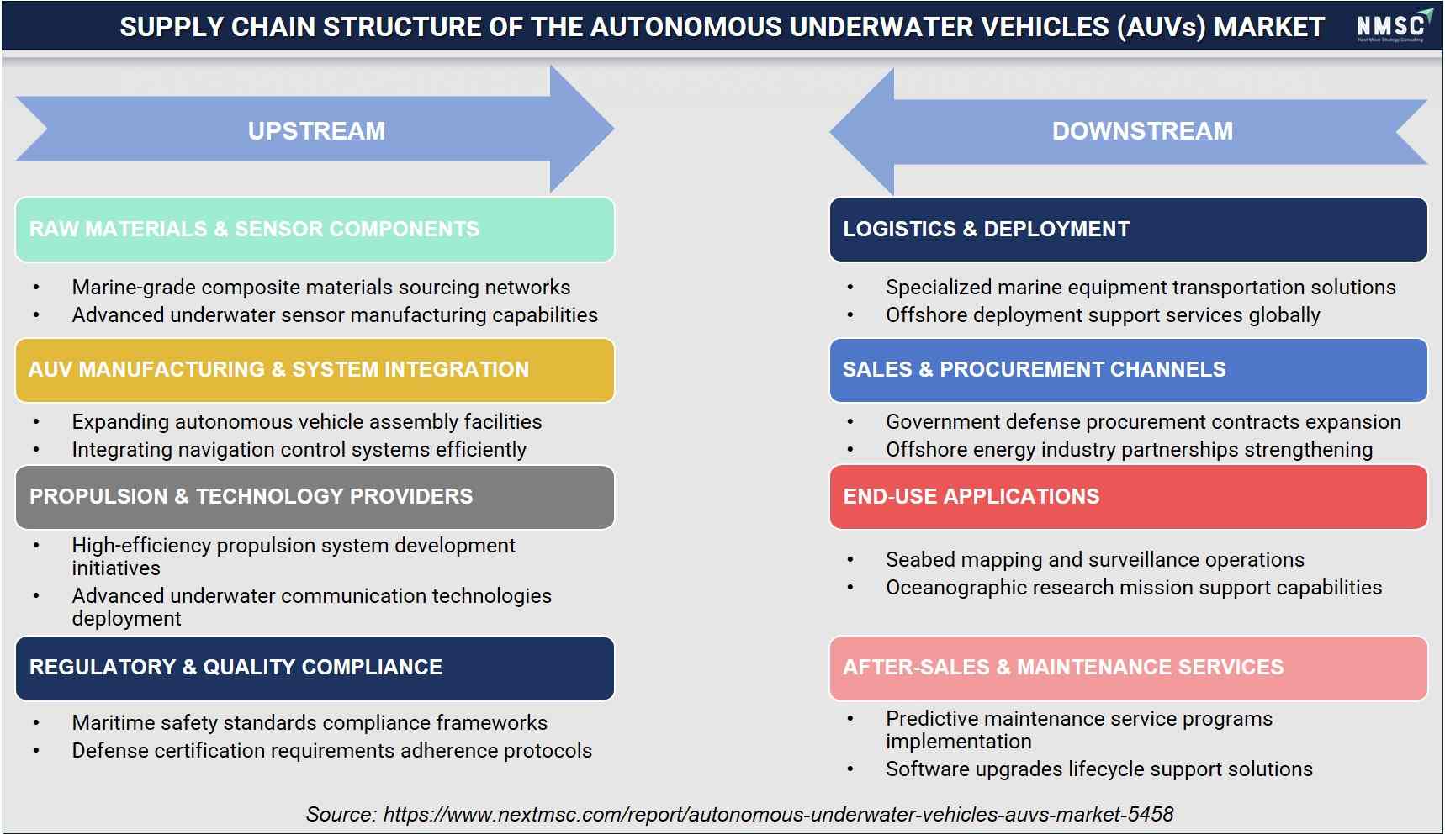
Based on our supply chain assessment, we identified that raw material suppliers, component manufacturers, propulsion technology providers, system integrators, logistics partners, procurement networks, end users, and after-sales service providers collectively shape the autonomous underwater vehicles (AUVs) market. Furthermore, our industry analysis indicates that advanced sensor technologies, precision manufacturing, specialized marine logistics, defense procurement, offshore energy demand, predictive maintenance, and lifecycle support strengthen operational reliability, improve deployment efficiency, and accelerate long-term market adoption.
Growth Drivers & Restraints
|
Factors |
Type |
(+/−) % Impact on CAGR |
Geographic Relevance |
Impact Timeline |
|
Rising naval mine-countermeasure and ISR modernization budgets |
Driver |
+3.1% |
North America, Asia-Pacific |
2026–2033 |
|
Expansion of offshore wind seabed survey and cable inspection demand |
Driver |
+2.0% |
Europe, Asia-Pacific |
2026–2035 |
|
AI-enabled autonomy reducing reliance on surface support vessels |
Driver |
+1.8% |
Global |
2026–2035 |
|
Rising subsea critical-infrastructure protection mandates |
Driver |
+1.5% |
Europe, North America |
2026–2032 |
|
Expansion of lean-crewed offshore robotic vessel fleets |
Driver |
+1.3% |
Global |
2026–2033 |
|
Government-backed sovereign AUV manufacturing programs |
Driver |
+1.2% |
Asia-Pacific, Europe |
2026–2031 |
|
High unit cost and long qualification cycles for large AUVs |
Restraint |
−0.9% |
Global |
2026–2035 |
|
Limited subsea communication bandwidth constraining real-time autonomy |
Restraint |
−0.6% |
Global |
2026–2033 |
|
Export-control restrictions on dual-use underwater technology |
Restraint |
−0.5% |
North America, Europe |
2026–2031 |
What Is the Primary Growth Driver for the Autonomous Underwater Vehicles (AUVs) Market?
The primary growth driver is accelerating naval modernization spending on mine countermeasures, intelligence surveillance reconnaissance, and anti-submarine warfare capability. The U.S. Department of Defense's Defense Innovation Unit awarded a 24-month frame contract for large-displacement unmanned underwater vehicles, under which Kongsberg Discovery delivered its first HUGIN Superior AUV within a single year, illustrating how accelerated defense procurement pathways are compressing traditional multi-year AUV acquisition timelines.
How Is Sovereign Manufacturing Driving Market Growth?
Sovereign manufacturing mandates are driving market growth by converting single-program contracts into sustained domestic production capacity for extra-large unmanned surface and underwater platforms. The Royal Australian Navy awarded Anduril Australia an approximately USD 1.1 billion program-of-record contract for Ghost Shark extra-large AUVs, and the company opened a dedicated Sydney manufacturing facility seven weeks later, illustrating how quickly procurement decisions are translating into domestic capacity investment.
What Is Restraining the Autonomous Underwater Vehicles (AUVs) Market?
The primary restraint is the high unit cost and extended qualification timeline associated with large and extra-large AUV platforms, which limits adoption among smaller commercial operators and research institutions. Industry-derived estimates (no publicly verifiable dataset available) suggest that extra-large platform qualification cycles can run considerably longer than small AUV procurement, discouraging budget-constrained buyers from specifying extra-large platforms even where mission endurance would justify the investment.
Segmentation Analysis
Segment Sizing: By Offering
|
Segment |
2025 (USD) |
2035 (USD) |
CAGR% (2026–2035) |
|
AUV Platforms |
2.23 Billion |
7.10 Billion |
12.3% |
|
AUV Components & Subsystems |
1.04 Billion |
3.41 Billion |
12.7% |
|
AUV Services |
0.58 Billion |
3.69 Billion |
21.4% |
|
Total |
3.85 Billion |
14.20 Billion |
14.2% |
Which Offering Segment Dominates the Autonomous Underwater Vehicles (AUVs) Market?
AUV platforms dominate the market with approximately 58% share in 2025, reflecting that vehicle hardware still represents the largest single procurement line item across defense and commercial programs. Our analysis shows that AUV services are the fastest-growing category at 21.4% CAGR through 2035 as operators increasingly outsource survey, mapping, and data-processing work to specialist service providers rather than building in-house analytical capability, evidenced by growing lean-crewed fleet operations.
Segment Sizing: By Autonomy Level
|
Segment |
2025 (USD) |
2035 (USD) |
CAGR% (2026–2035) |
|
Pre-Programmed Autonomy |
1.77 Billion |
4.26 Billion |
8.9% |
|
Adaptive Autonomy |
1.31 Billion |
4.83 Billion |
14.2% |
|
AI Enabled Autonomy |
0.77 Billion |
5.11 Billion |
21.9% |
|
Total |
3.85 Billion |
14.20 Billion |
14.2% |
Which Autonomy Level Segment Is Growing Fastest?
Pre-programmed autonomy dominates with approximately 46% share in 2025, reflecting the continued prevalence of waypoint and mission-based navigation across established survey and inspection fleets. We observed that AI-enabled autonomy is the fastest-growing category at 21.9% CAGR through 2035, driven by defense and research programs demonstrating autonomous object detection and classification that reduces dependence on pre-scripted missions and real-time human oversight.
Segment Sizing: By Application
|
Segment |
2025 (USD) |
2035 (USD) |
CAGR% (2026–2035) |
|
Defense & Security |
1.62 Billion |
5.11 Billion |
12.3% |
|
Oil & Gas |
0.77 Billion |
2.27 Billion |
11.4% |
|
Marine Science & Oceanography |
0.54 Billion |
1.70 Billion |
12.3% |
|
Renewable Energy |
0.31 Billion |
2.13 Billion |
22.5% |
|
Subsea Infrastructure |
0.39 Billion |
1.85 Billion |
17.6% |
|
Commercial Survey |
0.23 Billion |
1.14 Billion |
17.9% |
|
Total |
3.85 Billion |
14.20 Billion |
14.2% |
Which Application Segment Leads AUV Demand?
Defense and security applications lead with approximately 42% share in 2025, reflecting dense deployment across mine countermeasures, intelligence surveillance reconnaissance, and anti-submarine warfare programs. Our findings suggest that renewable energy is the fastest-growing application at 22.5% CAGR through 2035, driven by expanding offshore wind farm seabed survey and inspection demand as installed offshore wind capacity continues to scale globally.
Growth Opportunities
Beyond the core growth drivers, three forward-looking whitespace opportunities stand out for stakeholders positioning ahead of demand through 2035.
Can Modular Extra-Large Platforms Unlock Multi-Mission Fleets?
Modular extra-large AUV architectures that swap payload sections for defense, survey, or infrastructure-inspection missions could let navies and commercial operators field a single hull design across multiple mission types. Defense organizations and infrastructure operators stand to benefit most from reduced program-of-record complexity and shared sustainment costs.
Does Offshore Wind Create a Regional AUV Service Opportunity?
Localizing AUV survey and inspection service capacity near expanding offshore wind clusters in Europe and Asia-Pacific could reduce mobilization costs currently absorbed by operators sourcing vehicles from distant bases. Survey and hydrographic service providers stand to benefit from establishing regional operating hubs ahead of installed offshore wind capacity growth.
Can AI-Enabled Fleets Reduce Subsea Infrastructure Monitoring Costs?
AI-enabled AUV fleets capable of autonomous, recurring subsea cable and pipeline inspection without dedicated support-vessel mobilization could substantially lower the cost of continuous infrastructure monitoring. Infrastructure operators managing subsea cables and pipelines stand to benefit most from shifting to persistent autonomous monitoring rather than periodic crewed inspection campaigns.
Regional Outlook
|
Region |
2025 (USD) |
2035 (USD) |
CAGR% (2026–2035) |
Key Driver |
|
North America |
1.46 Billion |
4.69 Billion |
12.4% |
Naval modernization programs |
|
Europe |
0.92 Billion |
3.12 Billion |
13.1% |
Offshore wind and subsea infrastructure |
|
Asia-Pacific |
1.00 Billion |
4.26 Billion |
16.0% |
Sovereign defense manufacturing |
|
Middle East & Africa |
0.23 Billion |
1.14 Billion |
17.9% |
Maritime security investment |
|
Latin America |
0.23 Billion |
0.99 Billion |
16.2% |
Offshore oil and gas survey |
|
Total |
3.85 Billion |
14.20 Billion |
14.2% |
— |
North America Autonomous Underwater Vehicles (AUVs) Market Outlook
North America's Autonomous Underwater Vehicles (AUVs) Market reflects a mature, defense-anchored base led by U.S. Navy large-displacement unmanned underwater vehicle programs and Defense Innovation Unit-accelerated procurement pathways. Our assessment indicates that regulatory emphasis on domestic production is drawing platform manufacturing capacity into the region, while established relationships between primes and navies support premium platform specification. Technology adoption skews toward AI-enabled autonomy, positioning the region for steady, program-driven growth through 2035.
Europe Autonomous Underwater Vehicles (AUVs) Market Outlook
Europe's market is shaped by expanding offshore wind farm development and subsea critical-infrastructure protection mandates following heightened concern over cable and pipeline security. We observed that regional navies and energy operators are early adopters of AI-enabled autonomy for persistent infrastructure monitoring, while regional platform manufacturers maintain technology leadership in sonar and navigation systems, supporting a strategic outlook centered on infrastructure-protection differentiation.
Asia-Pacific Autonomous Underwater Vehicles (AUVs) Market Outlook
Asia-Pacific's rapid growth reflects sovereign defense manufacturing investment led by Australia's extra-large AUV program alongside expanding naval modernization across China, Japan, and South Korea. Our assessment indicates that government-backed domestic production mandates are deepening local platform and component sourcing, while rising offshore energy and hydrographic survey demand sustains elevated capital spending, supporting the region's position as the fastest-scaling large market through 2035.
Middle East & Africa Autonomous Underwater Vehicles (AUVs) Market Outlook
The Middle East & Africa market remains comparatively nascent but is expanding rapidly as Gulf states invest in maritime security and offshore energy infrastructure protection. We found that new port security and offshore oil and gas survey investment is introducing AUV capability at previously underserved facilities, while regulatory frameworks for imported defense-adjacent technology remain a manageable but real compliance consideration for platform suppliers entering the region.
Latin America Autonomous Underwater Vehicles (AUVs) Market Outlook
Latin America's Autonomous Underwater Vehicles (AUVs) Market is expanding steadily, propelled by offshore oil and gas survey investment concentrated in Brazil's deepwater basins. Our analysis shows that regional operators increasingly specify commercial survey AUVs sourced through established international vendors rather than developing domestic manufacturing, reflecting a still-developing local service integration base with strategic upside as offshore energy investment deepens through 2035.
U.S. Autonomous Underwater Vehicles (AUVs) Market
Based on our estimates, the U.S. Autonomous Underwater Vehicles (AUVs) Market was valued at approximately USD 1.20 billion in 2025 and is projected to reach approximately USD 3.84 billion by 2035, expanding at a 12.4% CAGR. Demand is concentrated among Navy mine-countermeasure and ISR programs, with high technology adoption of AI-enabled autonomy, competitive intensity led by established defense primes, and a strategic outlook favoring extra-large, long-endurance platforms.
Canada Autonomous Underwater Vehicles (AUVs) Market
The market in Canada reflects a smaller but steadily expanding base, with 2025 revenue of approximately USD 0.26 billion projected to reach approximately USD 0.84 billion by 2035 at a 13.6% CAGR. Demand structure leans toward Arctic and coastal survey applications, regulatory influence from national ocean-monitoring programs supports research-institution adoption, and competitive intensity remains moderate as operators rely on established platform vendors.
UK Autonomous Underwater Vehicles (AUVs) Market
As per our estimate, the UK Autonomous Underwater Vehicles (AUVs) Market registered approximately USD 0.22 billion in 2025 and is estimated to reach approximately USD 0.75 billion by 2035 at a 13.1% CAGR. Demand structure centers on offshore wind survey and Royal Navy mine-countermeasure requirements, technology penetration favors adaptive and AI-enabled autonomy, and regulatory influence from national maritime security policy shapes procurement across the strategic outlook.
Germany Autonomous Underwater Vehicles (AUVs) Market
According to our analysis, Germany's Autonomous Underwater Vehicles (AUVs) Market reached approximately USD 0.28 billion in 2025 and is forecast to reach approximately USD 0.94 billion by 2035 at a 13.1% CAGR. Demand structure reflects naval modernization and Baltic Sea subsea-infrastructure protection priorities, regulatory influence from national maritime security policy supports adoption, and competitive intensity is shaped by established domestic defense manufacturers across the strategic outlook.
France Autonomous Underwater Vehicles (AUVs) Market
Based on our estimates, France's market stood at approximately USD 0.17 billion in 2025, projected to reach approximately USD 0.56 billion by 2035 at a 13.1% CAGR. Demand structure reflects naval mine-countermeasure and marine science research needs, technology penetration is rising for adaptive autonomy, and competitive intensity remains led by established domestic defense and marine technology suppliers across the country's strategic outlook.
China Autonomous Underwater Vehicles (AUVs) Market
China's market reached approximately USD 0.34 billion in 2025, projected to reach approximately USD 1.45 billion by 2035 at a 15.2% CAGR. Demand structure is dominated by naval modernization and offshore energy survey requirements, technology penetration is accelerating for domestically produced platforms, and regulatory influence from national maritime strategy supports a strategic outlook of steady capacity expansion.
India Autonomous Underwater Vehicles (AUVs) Market
As per our estimate, India's market stood at approximately USD 0.14 billion in 2025, projected to reach approximately USD 0.60 billion by 2035 at a 17.5% CAGR. Demand structure reflects expanding naval modernization and hydrographic survey investment, technology penetration is rising from a low base, and competitive intensity is increasing as international platform manufacturers establish regional partnerships across the strategic outlook.
Japan Autonomous Underwater Vehicles (AUVs) Market
According to our analysis, Japan's market reached approximately USD 0.19 billion in 2025, projected to reach approximately USD 0.81 billion by 2035 at a 16.0% CAGR. Demand structure is anchored by maritime security and offshore energy survey requirements, technology penetration is high given established domestic marine robotics manufacturers, and competitive intensity is shaped by long-standing defense procurement relationships across the strategic outlook.
South Korea Autonomous Underwater Vehicles (AUVs) Market
Based on our estimates, South Korea's market registered approximately USD 0.13 billion in 2025, projected to reach approximately USD 0.55 billion by 2035 at a 16.0% CAGR. Demand structure reflects naval modernization and shipbuilding-adjacent marine technology investment, regulatory influence from national defense procurement policy supports adoption, and competitive intensity remains high among integrators serving the country's strategic outlook.
Australia Autonomous Underwater Vehicles (AUVs) Market
As per our estimate, Australia is the fastest-growing country in the market, valued at approximately USD 0.09 billion in 2025 and projected to reach approximately USD 0.68 billion by 2035 at a 23.7% CAGR, driven by the Royal Australian Navy's sovereign extra-large AUV production program. Regulatory influence from national sovereign-capability policy and rapidly rising competitive intensity among domestic suppliers support a strategic outlook centered on program-of-record manufacturing scale-up.
UAE Autonomous Underwater Vehicles (AUVs) Market
The UAE market reached approximately USD 0.07 billion in 2025, projected to reach approximately USD 0.34 billion by 2035 at an 18.6% CAGR. Demand structure reflects growing maritime security and offshore energy infrastructure protection investment, regulatory influence from national industrial diversification strategy supports adoption incentives, and competitive intensity remains led by international suppliers establishing regional partnerships.
Saudi Arabia Autonomous Underwater Vehicles (AUVs) Market
As per our estimate, Saudi Arabia's market stood at approximately USD 0.06 billion in 2025, projected to reach approximately USD 0.30 billion by 2035 at a 17.9% CAGR. Demand structure is emerging around Vision 2030-linked maritime security and offshore infrastructure projects, technology penetration remains at an early stage, and competitive intensity is limited as global suppliers establish initial regional coverage.
South Africa Autonomous Underwater Vehicles (AUVs) Market
According to our analysis, South Africa's market reached approximately USD 0.03 billion in 2025, projected to reach approximately USD 0.15 billion by 2035 at a 17.9% CAGR. Demand structure centers on naval patrol and offshore survey requirements, technology penetration is modest, and regulatory influence from national maritime security programs supports a gradually strengthening strategic outlook for autonomous system adoption.
Brazil Autonomous Underwater Vehicles (AUVs) Market
Based on our estimates, Brazil's market registered approximately USD 0.11 billion in 2025, projected to reach approximately USD 0.48 billion by 2035 at a 16.2% CAGR. Demand structure is anchored by deepwater oil and gas survey investment, technology penetration is rising for commercial-grade platforms, and competitive intensity is increasing as international vendors expand regional service capacity through 2035.
Argentina Autonomous Underwater Vehicles (AUVs) Market
The Argentina's market stood at approximately USD 0.04 billion in 2025, projected to reach approximately USD 0.17 billion by 2035 at a 16.2% CAGR. Demand structure reflects offshore survey and coastal research needs, technology penetration remains at an early stage, and competitive intensity is limited, with a strategic outlook dependent on broader offshore investment recovery.
Regulatory Framework Impacting the Autonomous Underwater Vehicles (AUVs) Market
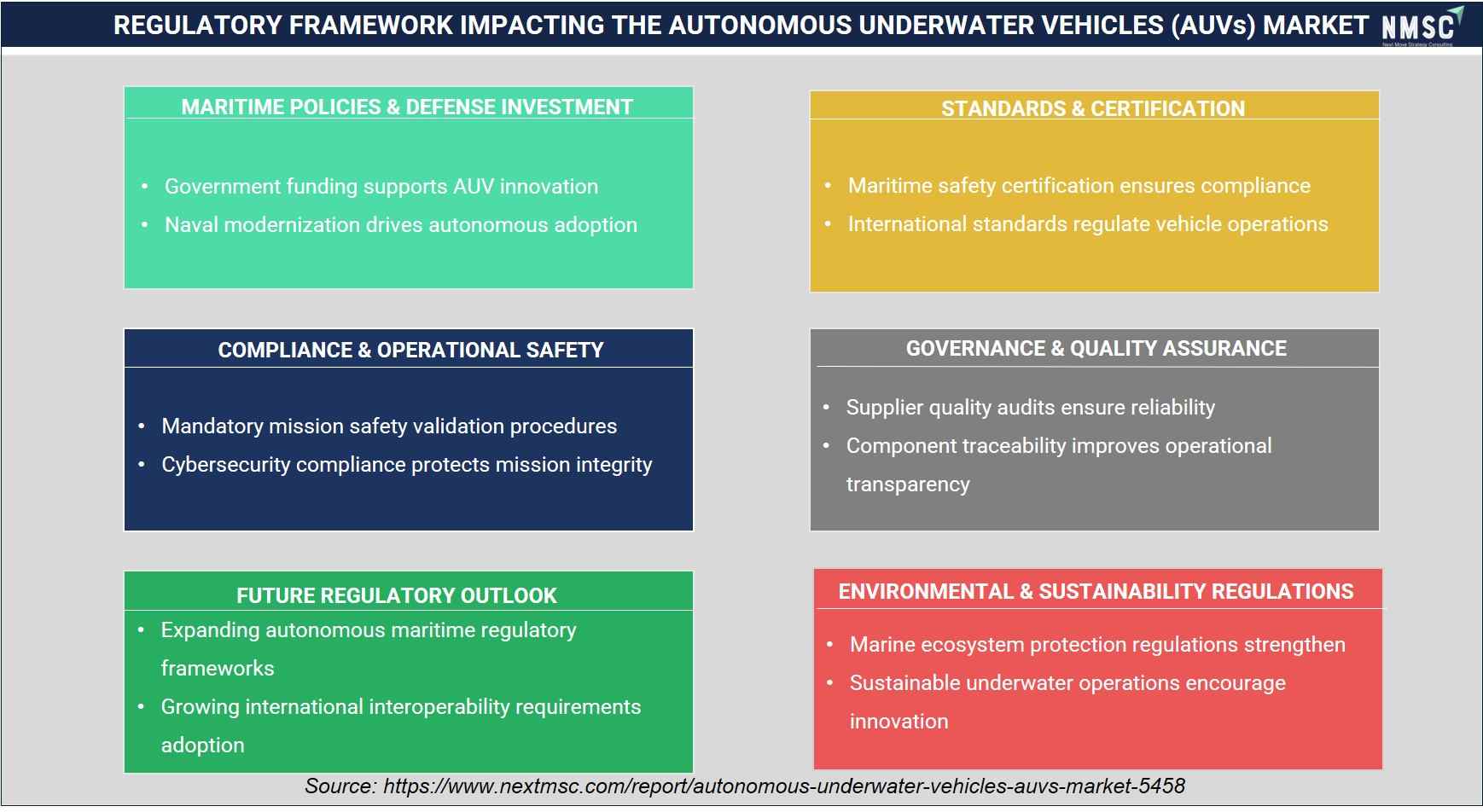
Based on our regulatory assessment, we observed that maritime policies, certification standards, operational safety requirements, governance frameworks, environmental regulations, and international interoperability guidelines collectively influence the autonomous underwater vehicles (AUVs) market. Moreover, our market evaluation highlights that government investments, mandatory compliance procedures, cybersecurity protocols, supplier quality assurance, sustainability regulations, and harmonized global standards enhance mission safety, strengthen operational transparency, encourage technological innovation, and support sustainable market expansion.
Competitive Landscape
Our assessment indicates that the Autonomous Underwater Vehicles (AUVs) Market remains moderately concentrated among established defense primes and specialist marine robotics firms competing across differentiated platform-scale and application niches.
|
Dimension |
Assessment |
|
Market Structure |
Moderately concentrated; top 10 companies hold a substantial combined share driven by defense program awards |
|
Innovation Focus |
AI-enabled autonomy, extra-large long-endurance platforms, and modular sonar and battery payload integration |
|
M&A Activity |
Selective acquisitions targeting sensor, battery, and navigation subsystem capability |
How Do Companies Compete in the AUV Industry?
Companies compete primarily on platform endurance, payload flexibility, and demonstrated program-of-record delivery track record with defense and commercial customers. Our findings suggest that buyers increasingly evaluate suppliers on production scalability alongside baseline vehicle specifications, pushing manufacturers to expand domestic manufacturing capacity rather than competing on prototype capability alone.
Which Competitive Archetypes Dominate the AUV Industry?
Three archetypes dominate: diversified defense primes with broad platform and systems-integration portfolios, specialist marine robotics manufacturers commanding premium positioning on endurance and autonomy software, and regional service operators competing on survey and inspection delivery rather than hardware sales. This structure allows primes to defend share in large defense programs while specialists capture premium subsystem and software revenue.
What Innovation and Differentiation Strategies Are Emerging?
Innovation strategies increasingly center on AI-enabled autonomous navigation, modular payload architectures that accept third-party sonar and battery systems, and lean-crewed support-vessel integration that lowers total mission cost. We observed that manufacturers investing in payload-agnostic platform design are capturing disproportionate share of both defense and commercial survey applications where proprietary single-vendor systems previously dominated.
What M&A and Geographic Expansion Activity Is Shaping the Market?
M&A activity remains selective, concentrated on acquisitions that add sensor, battery, or navigation subsystem capability rather than large consolidating platform transactions. Geographic expansion is most visible in Asia-Pacific, where manufacturers are establishing sovereign production capacity to meet domestic-content procurement requirements, while pricing strategies bifurcate between premium defense-grade platforms and cost-competitive commercial survey systems.
Key Market Players
Our analysis shows that the following companies represent the leading validated participants shaping the competitive structure of the Autonomous Underwater Vehicles (AUVs) Market.
-
Kongsberg Gruppen ASA
-
Teledyne Technologies Incorporated
-
Huntington Ingalls Industries, Inc.
-
Exail Technologies SA
-
General Dynamics Corporation
-
Saab AB
-
L3Harris Technologies, Inc.
-
The Boeing Company
-
Oceaneering International, Inc.
-
Fugro N.V.
-
Ocean Infinity Group Limited
-
Atlas Elektronik GmbH
-
International Submarine Engineering Limited
-
Kraken Robotics Inc.
-
RTSYS
-
Cellula Robotics Ltd.
-
BAE Systems plc
-
Anduril Industries, Inc.
-
Boston Engineering Corporation
Latest Developments
We found that recent company activity reflects sustained investment in sovereign manufacturing capacity, defense platform delivery, and modular payload integration across the AUV value chain.
|
Date |
Event |
|
July 2026 |
Exail expanded its strategic partnership with KNDS to mass-produce advanced autonomous mine neutralization systems, combining cutting-edge robotics capabilities to accelerate the delivery of robust subsea defense solutions for naval forces. |
|
March 2026 |
Teledyne Marine secured a major contract from the UK Royal Navy to deliver advanced autonomous underwater vehicles, oceanographic gliders, and persistent profiling floats, enhancing long-endurance subsea data collection, environmental intelligence, and Atlantic tactical operations. |
|
July 2025 |
Kongsberg Discovery announced a strategic decision to establish domestic manufacturing capabilities for its HUGIN Autonomous Underwater Vehicle (AUV) series in the United States, expanding production at its Lynnwood, Washington facility to better serve rising U.S. government, defense, and commercial market demands. |
Investment Opportunities
Where Are Capital Inflows Concentrating in the Autonomous Underwater Vehicles (AUVs) Market?
Capital inflows are concentrating in extra-large platform manufacturing capacity and AI-enabled autonomy software, segments commanding above-average CAGR through 2035. Investment is also flowing into modular sonar and battery subsystems compatible with maritime safety and third-party AUV platforms, where recurring order activity from multiple manufacturers is proving more durable than single-program hardware sales.
How Significant Is Infrastructure Investment in Supporting Market Growth?
Infrastructure investment in sovereign manufacturing facilities is significant, particularly across Asia-Pacific, where governments are requiring domestic production as a condition of defense procurement. Government-backed naval modernization programs in the U.S. and Australia are indirectly catalyzing this infrastructure buildout by guaranteeing multi-year platform demand tied to programs of record.
What ESG Considerations Are Shaping Investment Decisions?
Environmental, Social, and Governance considerations increasingly influence supplier selection, with commercial buyers favoring AUV operators that demonstrate reduced-emission survey operations relative to traditional crewed vessel campaigns. Social governance considerations extend to workforce safety, given that lean-crewed offshore vessel fleets reduce personnel exposure to hazardous offshore working conditions, a factor increasingly referenced in operator sustainability disclosures.
Key Benefits for Stakeholders
How Does This Report Benefit Industry Leaders?
Industry leaders gain access to reconciled segmentation, regional, and competitive data that supports platform roadmap and manufacturing-capacity planning decisions. The report's forecasts and segmentation analysis help defense and commercial program leaders benchmark portfolio exposure against the fastest-growing autonomy levels and application segments through 2035.
How Does This Report Benefit Investors and Financial Analysts?
Investors and financial analysts benefit from a reconciled market-sizing model spanning 2025 to 2035, enabling direct comparison of segment-level growth rates when evaluating program awards or capital allocation across the AUV value chain. The competitive landscape and latest developments sections support diligence on strategic positioning among the twenty profiled companies.
How Does This Report Benefit Technology Vendors and Product Teams?
Technology vendors and product teams benefit from segmentation detail across propulsion technology and autonomy level, supporting roadmap alignment with defense and commercial autonomy requirements. Regional outlook data further helps product teams prioritize sovereign-manufacturing localization where technology adoption and competitive intensity are shifting fastest.
Key Market Segments
By Offering
-
AUV Platforms
-
Small AUVs
-
Medium AUVs
-
Large AUVs
-
Extra Large AUVs
-
-
AUV Components & Subsystems
-
Propulsion Systems
-
Navigation Systems
-
Sensors & Payloads
-
Power & Energy Storage Systems
-
Communication Systems
-
-
AUV Services
-
Survey & Mapping Services
-
Inspection Services
-
Data Processing & Analytics Services
-
By Vehicle Type
-
Micro & Small AUVs
-
Medium AUVs
-
Large AUVs
-
Extra Large AUVs
By Propulsion Technology
-
Electric Propulsion
-
Battery Electric Propulsion
-
-
Hybrid Propulsion
-
Fuel Cell Propulsion
-
Diesel Electric Propulsion
-
-
Other Propulsion
-
Advanced Energy Propulsion
-
By Autonomy Level
-
Pre-Programmed Autonomy
-
Waypoint Navigation
-
Mission Based Navigation
-
Adaptive Autonomy
-
Sensor Based Navigation
-
Dynamic Mission Planning
-
AI Enabled Autonomy
-
AI Navigation
-
Collaborative Autonomous Operations
By Application
-
Defense & Security
-
Mine Countermeasures
-
Intelligence Surveillance Reconnaissance
-
Anti-Submarine Warfare
-
Maritime Security
-
-
Oil & Gas
-
Pipeline Inspection
-
Offshore Structure Inspection
-
Seabed Survey
-
-
Marine Science & Oceanography
-
Oceanographic Research
-
Environmental Monitoring
-
Climate Monitoring
-
-
Renewable Energy
-
Offshore Wind Survey
-
Offshore Wind Inspection
-
Marine Energy Survey
-
-
Subsea Infrastructure
-
Subsea Cable Inspection
-
Port & Harbor Inspection
-
Underwater Structure Inspection
-
-
Commercial Survey
-
Hydrographic Survey
-
Seabed Mapping
-
By End User
-
Defense Organizations & Navies
-
Energy & Commercial Operators
-
Research Institutions & Universities
-
Survey & Hydrographic Service Providers
-
Infrastructure Operators
By Region
-
North America: U.S., Canada, Mexico
-
Europe: UK, Germany, France, Italy, Spain, Sweden, Denmark, Finland, Netherlands, Rest of Europe
-
Asia-Pacific: China, India, Japan, South Korea, Taiwan, Indonesia, Vietnam,Australia, Philippines, Malaysia, Rest of APAC
-
Middle East & Africa: Saudi Arabia, UAE, Egypt, Israel, Turkey, Nigeria, South Africa, Rest of MEA
-
Latin America: Brazil, Argentina, Chile, Colombia, Rest of LATAM
Conclusion & Recommendations
What Is the Long-Term Outlook for the Autonomous Underwater Vehicles (AUVs) Market?
The long-term outlook remains structurally positive, with the market expanding from USD 4.30 Billion in 2026 to USD 14.20 Billion by 2035 as naval modernization, offshore renewable energy, and subsea infrastructure protection programs scale simultaneously. Our assessment indicates that AI-enabled autonomy and extra-large platform demand will continue rising faster than unit volume, sustaining elevated per-vehicle revenue through the forecast period.
What Strategic Positioning Should Manufacturers Pursue?
Manufacturers should prioritize sovereign-manufacturing capacity in Asia-Pacific and Europe, since domestic-content procurement requirements increasingly determine program eligibility ahead of pure technical differentiation. Next Move Strategy Consulting's analysis indicates that manufacturers combining defense-grade endurance with commercial-survey payload flexibility are best positioned to capture demand across both dual-use customer bases.
How Attractive Is the Autonomous Underwater Vehicles (AUVs) Market for Investment?
Investment attractiveness is elevated in AI-enabled autonomy, extra-large platforms, and renewable-energy survey services, where above-average CAGR reflects genuine program-driven demand rather than cyclical procurement. We found that investors evaluating the space should weigh program-of-record concentration among a small number of defense customers, which limits revenue diversification relative to broader industrial robotics categories.
What Market Shifts and Key Risks Should Stakeholders Monitor?
Stakeholders should monitor export-control classification changes affecting cross-border transfer of dual-use autonomous underwater technology, alongside program-timing risk tied to national defense budget cycles. Our findings suggest that subsea communication bandwidth limitations represent a structural constraint on real-time autonomy that will require continued sensor and software investment to overcome through 2035.
What Are the Clearest Growth Pathways Through 2035?
The clearest growth pathways run through naval mine-countermeasure modernization, offshore wind seabed survey, and subsea critical-infrastructure protection, each combining above-average CAGR with structurally rising per-mission vehicle content. Manufacturers aligning product roadmaps with these three pathways stand to outpace the market's overall 14.2% CAGR through 2035.
About the Author
 Saista Faiyaz
— Saista Faiyaz is Research Associate at Next Move Strategy Consulting, where she has covered consumer markets and healthcare technologies for 3 years. Her work includes primary interview review, secondary-source validation, market sizing, and structured analysis of company and industry data. She supports research by comparing evidence across sources, organizing findings into market narratives, and documenting assumptions used in analysis. Her scope includes cross-market benchmarking, and reports.
Saista Faiyaz
— Saista Faiyaz is Research Associate at Next Move Strategy Consulting, where she has covered consumer markets and healthcare technologies for 3 years. Her work includes primary interview review, secondary-source validation, market sizing, and structured analysis of company and industry data. She supports research by comparing evidence across sources, organizing findings into market narratives, and documenting assumptions used in analysis. Her scope includes cross-market benchmarking, and reports.
About the Reviewer
 Supradip Baul
— Supradip Baul is an accomplished business consultant and strategist with over a decade of rich experience in market intelligence, strategy, technology, and business transformation. His work has included rigorous qualitative and quantitative analysis across multiple industries, helping clients shape investment decisions and long-term roadmaps. Earlier in his career, he was associated with Gartner, where he contributed to industry-leading reports and market share analyses. He has worked with leading global companies and holds an MBA with a dual specialization in Marketing and Finance.
Supradip Baul
— Supradip Baul is an accomplished business consultant and strategist with over a decade of rich experience in market intelligence, strategy, technology, and business transformation. His work has included rigorous qualitative and quantitative analysis across multiple industries, helping clients shape investment decisions and long-term roadmaps. Earlier in his career, he was associated with Gartner, where he contributed to industry-leading reports and market share analyses. He has worked with leading global companies and holds an MBA with a dual specialization in Marketing and Finance.
At Next Move Strategy Consulting, we understand that insightful market research is the cornerstone of successful business decisions. That's why we employ a robust and multifaceted approach, combining various methodologies to deliver the most accurate and actionable data for our clients.

Research Landscape
We navigate the world of research with two primary approaches:
Qualitative Approach
Our qualitative research methodologies involve immersive techniques such as in-depth interviews, focus groups, and observational studies. By engaging directly with individuals and stakeholders, we uncover valuable insights that quantitative data alone may overlook.

Quantitative Research
In tandem with qualitative methodologies, NMSC leverages the power of Quantitative Research to provide a robust foundation of numerical insights. Through systematic data collection and analysis, we quantify patterns, preferences, and market trends, offering a comprehensive view of the business landscape.
Our quantitative research approach employs diverse tools, including surveys, experiments, and statistical modelling. These methodologies enable us to gather data from a large and representative sample, ensuring the statistical significance of our findings. By employing structured questionnaires and standardized data collection methods, we guarantee the reliability and validity of the information we present to our clients.
Quantitative research is particularly effective in measuring the prevalence of trends, assessing market size, and gauging the impact of various factors on consumer behavior. The numerical precision attained through this approach equips our clients with actionable insights, facilitating data-driven decision-making and strategy formulation.


Our Specialized Toolbox for Industry-Specific Market Research
We deploy a specialized arsenal of techniques tailored to meet your unique requirements. Here's a glimpse into our comprehensive toolbox:

Information Procurement
The stage entails acquiring market data or relevant information through various sources and methodologies.


Market Research Approach
We utilize both top-down and bottom-up approaches in market research analysis to achieve a comprehensive understanding of the market dynamics, leveraging the broad perspective of industry trends and macroeconomic factors alongside detailed insights from specific segments and individual companies.

Porters Five Forces Analysis
We conduct Porter's Five Forces analysis to evaluate the competitive landscape of an industry, providing us with insights into factors that affect profitability and strategic positioning.

SWOT Analysis

Forecasting
We utilize a forecasting model to predict future consumption by considering parameters like population, economics, regulations, market competition, drivers, constraints, technology, and pricing. We also employ statistical techniques such as multilinear regression, exponential smoothing, moving average, ARIMA, and Monte Carlo simulations for accurate predictions. In econometric forecasting, we analyzed short-term and long-term event impacts, attributing values based on regulatory frameworks, economic factors, and market events.





 Speak to Our Analyst