Ball Valves: Industrial Precision, Innovation, and 2026 Market Momentum
Introduction: Why Ball Valves Matter in Modern Industry
Ball valves are essential flow control components used to regulate, direct, and shut off liquids and gases in industrial systems. Their simple rotating mechanism allows quick operation, making them widely used in oil and gas, manufacturing, power systems, and advanced cooling applications.
In 2026, the relevance of ball valves is expanding beyond traditional industries into high-tech domains such as data center cooling and precision fluid systems. This shift is being shaped by innovations in design, material science, and global manufacturing capabilities.
Insights from Next Move Strategy Consulting indicate that the evolution of ball valves is increasingly linked to efficiency demands and system miniaturization across industries, where reliability and rapid response are critical performance factors.
Industrial Expansion of Ball Valves in Global Trade
A notable development in 2026 is the export of large-diameter welded ball valves manufactured by Jinbin Valve, which were shipped to Belarus for industrial use. These valves are designed for large-scale pipeline systems requiring high durability and stable flow control under demanding conditions.
The shipment highlights the continued global demand for heavy-duty valve infrastructure, particularly in regions investing in energy and industrial pipeline expansion.
Key Highlights
-
Large-diameter welded ball valves designed for high-capacity pipelines
-
Exported industrial units delivered to Belarus for infrastructure applications
-
Focus on durability and long operational lifecycle in demanding environments

Analysis from Next Move Strategy Consulting indicates that such exports reflect a sustained global dependency on robust flow control systems, especially in energy and heavy industry sectors where system downtime can result in significant operational losses.
Ball Valves in Advanced Cooling Systems
Beyond traditional industrial applications, ball valve technology is increasingly being integrated into next-generation thermal management systems.
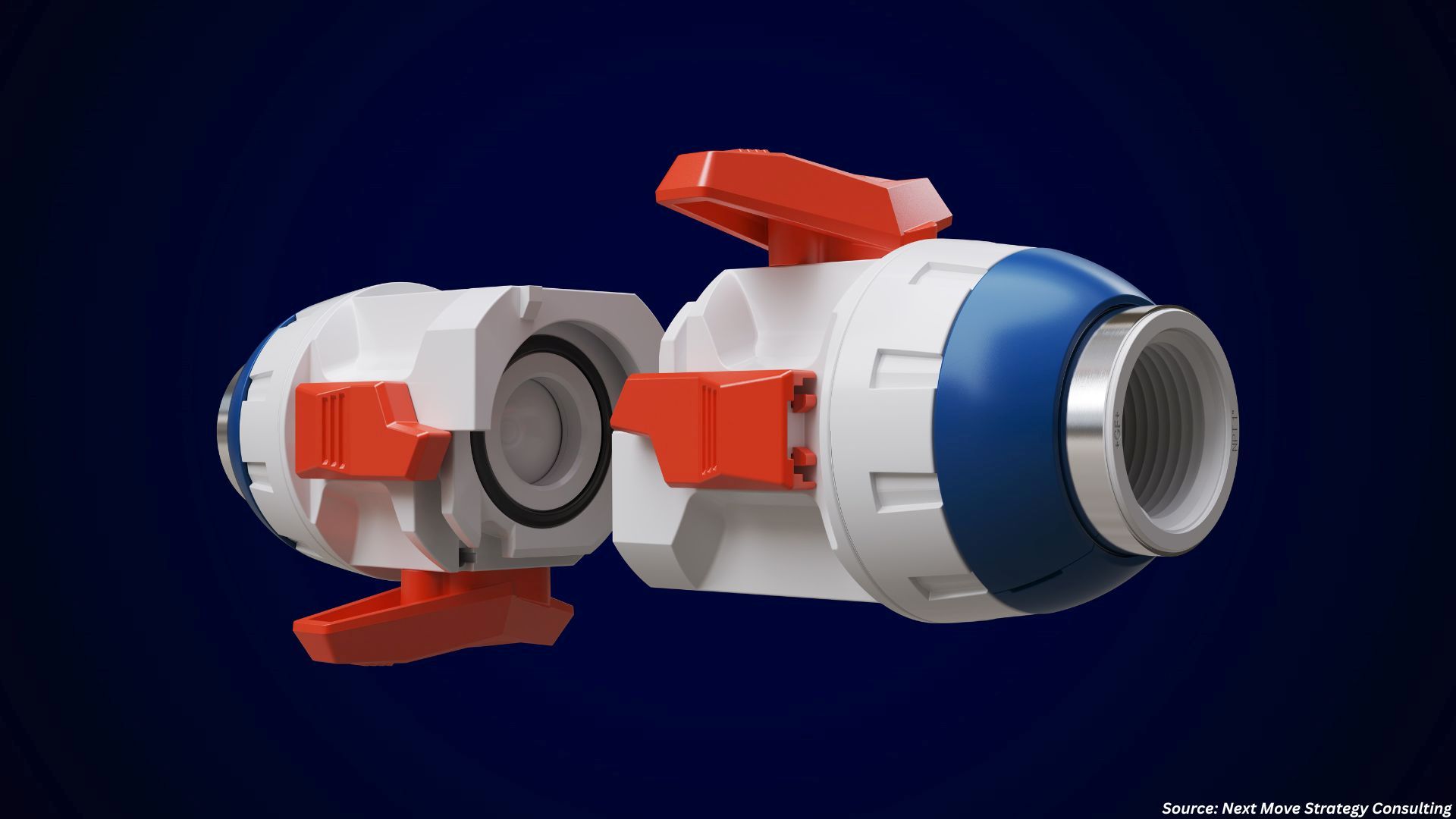
A significant innovation introduced by GF Piping Systems is the first-ever full-polymer quick-connect valve designed for direct-to-chip cooling systems. This solution supports high-performance computing environments where precise thermal control is essential.
This development demonstrates how ball valve engineering is evolving toward lightweight, corrosion-resistant, and high-efficiency polymer-based designs.
Key Highlights
-
Full-polymer quick-connect valve introduced for cooling applications
-
Designed for direct-to-chip cooling in high-performance computing systems
-
Enhances installation speed and system reliability
Our observations at Next Move Strategy Consulting indicate that the adoption of polymer-based valve systems reflects a broader industry shift toward energy-efficient data infrastructure and modular cooling architectures.
Key Industrial Applications of Ball Valves
Ball valves are used across multiple sectors due to their efficiency and reliability.
Major Applications
-
Oil and Gas Systems: Pipeline shut-off and flow regulation
-
Power Generation: Steam and water control systems
-
Chemical Processing: Safe handling of reactive fluids
-
Data Center Cooling: Precision thermal fluid management (emerging use case)
These applications highlight the adaptability of ball valves across both traditional and emerging industries.
Insights from Next Move Strategy Consulting suggest that cross-industry adoption is accelerating due to increasing automation and the need for low-maintenance flow control systems that can operate under variable pressure conditions.
Material Innovation and Engineering Shift
The 2026 developments show a clear trend toward material innovation in ball valve manufacturing.
The introduction of full-polymer valve systems marks a shift from conventional metal-based designs toward advanced engineered plastics that offer:
-
Reduced weight
-
Corrosion resistance
-
Faster installation cycles

Meanwhile, heavy industrial welded valves continue to rely on reinforced metal structures for high-pressure environments, as seen in large-scale exports to infrastructure projects.
Analysis from Next Move Strategy Consulting indicates that this dual-material evolution reflects a bifurcated market structure where industrial demand is segmented between high-durability infrastructure systems and high-efficiency precision environments.
Next Move Strategy Consulting’s Perspective: Industry Impact of Recent Developments
The recent advancements in ball valve technology are reshaping the competitive landscape of the flow control industry. According to Next Move Strategy Consulting, two major shifts are emerging:
Traditional infrastructure markets continue to rely on large-scale welded valve systems for energy and pipeline expansion.
High-tech industries are adopting polymer-based, quick-connect valves to support compact and energy-efficient systems.

This dual-track evolution suggests that manufacturers must now diversify their product portfolios to remain competitive across both heavy industrial and precision-engineered applications. It also indicates increasing demand for customization based on end-use environments.
Next Steps: Strategic Takeaways
-
Manufacturers should invest in both metal and polymer-based valve technologies
-
Industrial exporters can expand into emerging infrastructure markets
-
Data center cooling solutions present a high-growth application segment
-
R&D focus should prioritize lightweight and corrosion-resistant materials
-
Companies must align product design with industry-specific flow requirements
Conclusion
Ball valves continue to play a critical role in global industrial systems, but their function is evolving rapidly. From heavy-duty welded valves used in international infrastructure projects to innovative polymer-based solutions for advanced cooling systems, the technology is adapting to diverse operational demands.
About the Author
 Joydeep Dey
— Joydeep Dey is a content writer and analyst fueled by creativity, research, and continuous learning. He combines compelling storytelling with market insights to turn complex information into engaging, impactful content. Passionate about emerging trends, digital strategy, and innovation-driven communication, he believes curiosity and consistent growth are key to creating meaningful influence in every project.
Joydeep Dey
— Joydeep Dey is a content writer and analyst fueled by creativity, research, and continuous learning. He combines compelling storytelling with market insights to turn complex information into engaging, impactful content. Passionate about emerging trends, digital strategy, and innovation-driven communication, he believes curiosity and consistent growth are key to creating meaningful influence in every project.
About the Reviewer
 Debashree Dey
— Debashree Dey is Assistant Manager at Next Move Strategy Consulting, where she supports cross-vertical market content and communications across diverse industries for 6 years. Her professional background includes senior content writing, communications, and published manuscript authorship, with experience developing audience-focused business narratives and maintaining clear, consistent messaging. Her role supports research-led content development and editorial quality across NextMSC publications.
Debashree Dey
— Debashree Dey is Assistant Manager at Next Move Strategy Consulting, where she supports cross-vertical market content and communications across diverse industries for 6 years. Her professional background includes senior content writing, communications, and published manuscript authorship, with experience developing audience-focused business narratives and maintaining clear, consistent messaging. Her role supports research-led content development and editorial quality across NextMSC publications.

















Add Comment