Big and Bulky E-Commerce Fulfillment: Where the Market Is Heading in 2026-2027
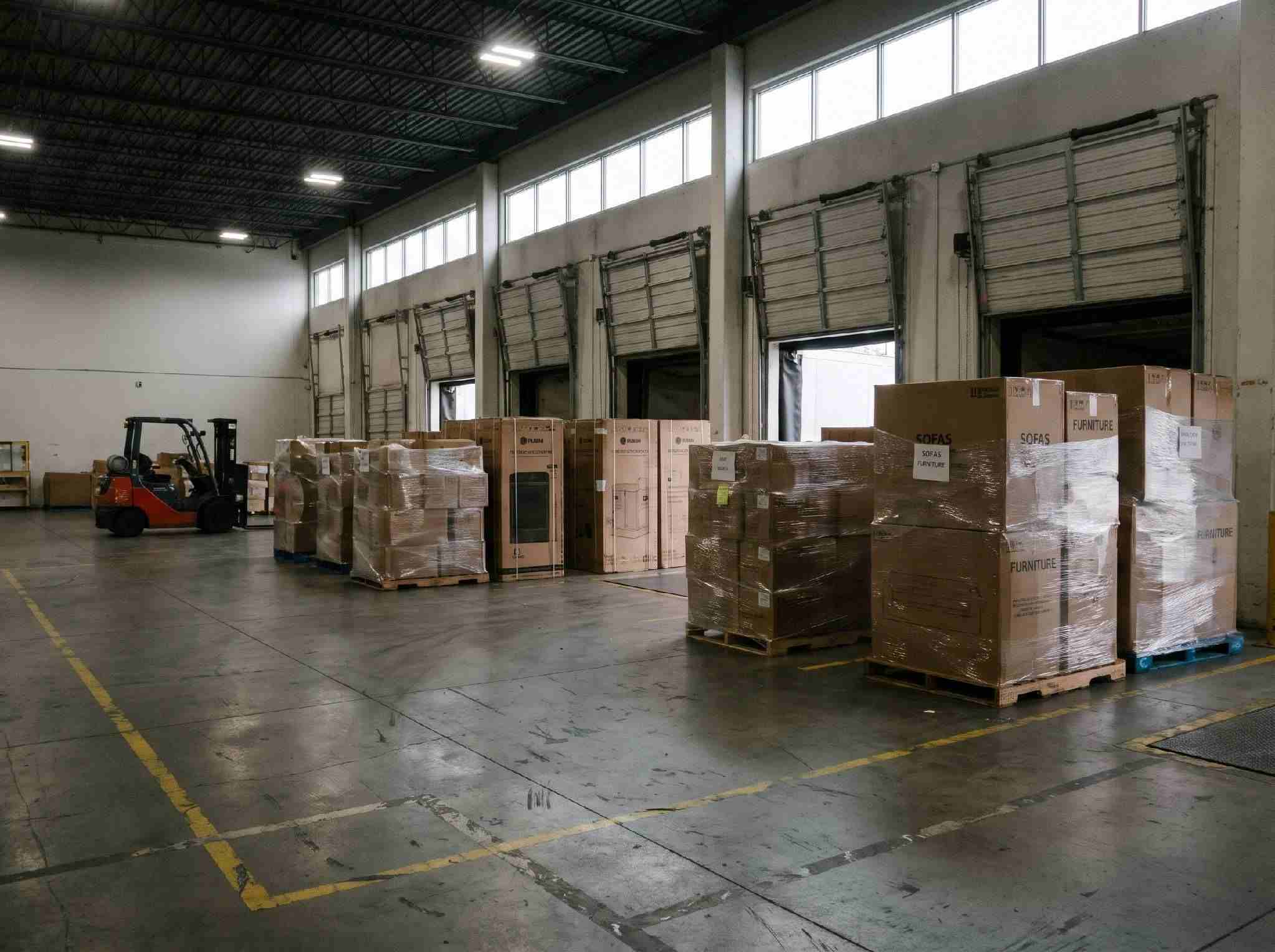
Pallets of boxed furniture and large appliances staged inside a distribution center
Online shopping now accounts for 17.1% of all U.S. retail sales. The U.S. Census Bureau’s Quarterly Retail E-Commerce report for the second quarter of 2026 put the figure at $340.2 billion, up 12.2% from a year earlier while total retail grew 6.7%. Those are preliminary numbers, but the direction is not in doubt.
Yet the average online order looks nothing like a sofa, a treadmill or a refrigerator. Small, light parcels fit the networks that e-commerce was built on. Oversized goods don’t, and the gap shows up in cost, in damage rates and in the way growth is now behaving. After years of double-digit expansion, the big and bulky segment is cooling even as online share rises.
This article looks at why that happens: what the category includes, how large the market is, where the money goes, what returns do to margins, and what to watch through 2027.
What Counts as Big and Bulky in Online Retail
There’s no single legal definition, which is part of the problem. In practice the category covers furniture, major appliances, fitness equipment, flooring, mattresses, outdoor gear and a long list of home improvement products. What they share isn’t price. It’s physical size, weight, or an awkward shape that makes standard parcel handling slow, risky or impossible.
Parcel carriers set their own limits on weight, length and girth, and a package that crosses them gets surcharges or gets rerouted into freight networks. Many oversized items never touch a parcel sorter at all. They travel by less-than-truckload freight to a regional hub, then go out on a straight truck with a driver and a helper who carry the item to a room of the customer’s choice. Some retailers add assembly and packaging removal on top.
That’s why many brands hand the work to specialized providers. A business offering 3PL for big and bulky fulfillment typically takes on receiving, storage on floor positions or heavy-duty racking, order consolidation, appointment scheduling and the final delivery leg, rather than splitting those tasks across a parcel carrier and a separate freight broker.
The service tiers matter for cost. Curbside or threshold delivery is the cheapest. “Room of choice” adds labor. “White glove” adds assembly, debris removal and installation, and it prices accordingly. A retailer that sells all three levels is effectively running three different businesses under one checkout button.
Market Size and the Growth Slowdown
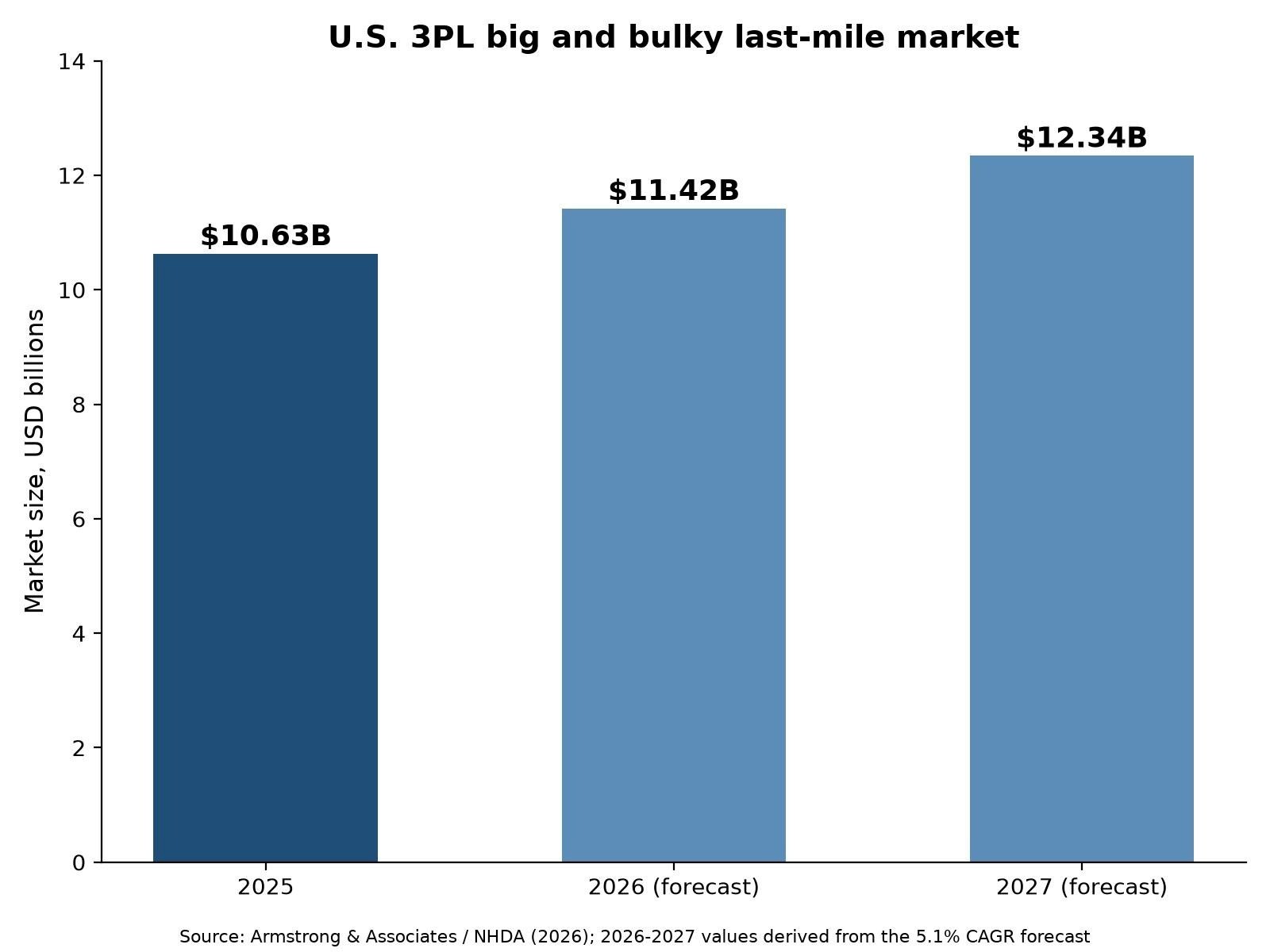
Estimated U.S. 3PL big and bulky last-mile market, 2025 to 2027
The most useful recent data comes from Armstrong & Associates and the National Home Delivery Association. Their July 2026 report, “Recalibrating: Big and Bulky Last-Mile Delivery in the United States,” estimates that the U.S. third-party big and bulky last-mile market reached $10.63 billion in 2025. For context, that’s the market served by outsourced providers; it isn’t the total spend on moving large items.
The growth curve is the interesting part. The market expanded at a 10.6% compound annual rate from 2017 to 2025. The same report forecasts a 5.1% rate from 2025 to 2027, which implies roughly $11.42 billion in 2026 and $12.34 billion in 2027. Growth is still positive, but it has roughly halved.
The researchers point to several headwinds. Consumer softness is one. Housing turnover sits at a 30-year low, and that matters because a move or a new home is the single biggest trigger for buying a couch, a dining set or a washer and dryer. Furniture store sales have also declined. Tariff policy, which unsettled sourcing for much of the sector, stabilized in 2025 and 2026, which removes one source of volatility but doesn’t create demand.
On the supply side, Armstrong & Associates ties growth to Amazon, Wayfair, Home Depot and Lowe’s, which have made large-format products central to their online strategies. Those retailers have normalized ordering big items online, so the change in consumer habits is largely done. What’s left is a market that grows with housing and household formation, not with novelty.
One caution about the numbers. Estimates of bulky-item logistics vary widely between research firms, because definitions differ: some count only third-party last-mile delivery, others add warehousing, freight and retailer-run fleets. The surveyed 3PLs in the Armstrong & Associates study represent about 33% of the market, so a considerable share of delivery volume stays with retailers’ own operations. Compare figures only when the scope matches.
Why Oversized Freight Costs So Much More
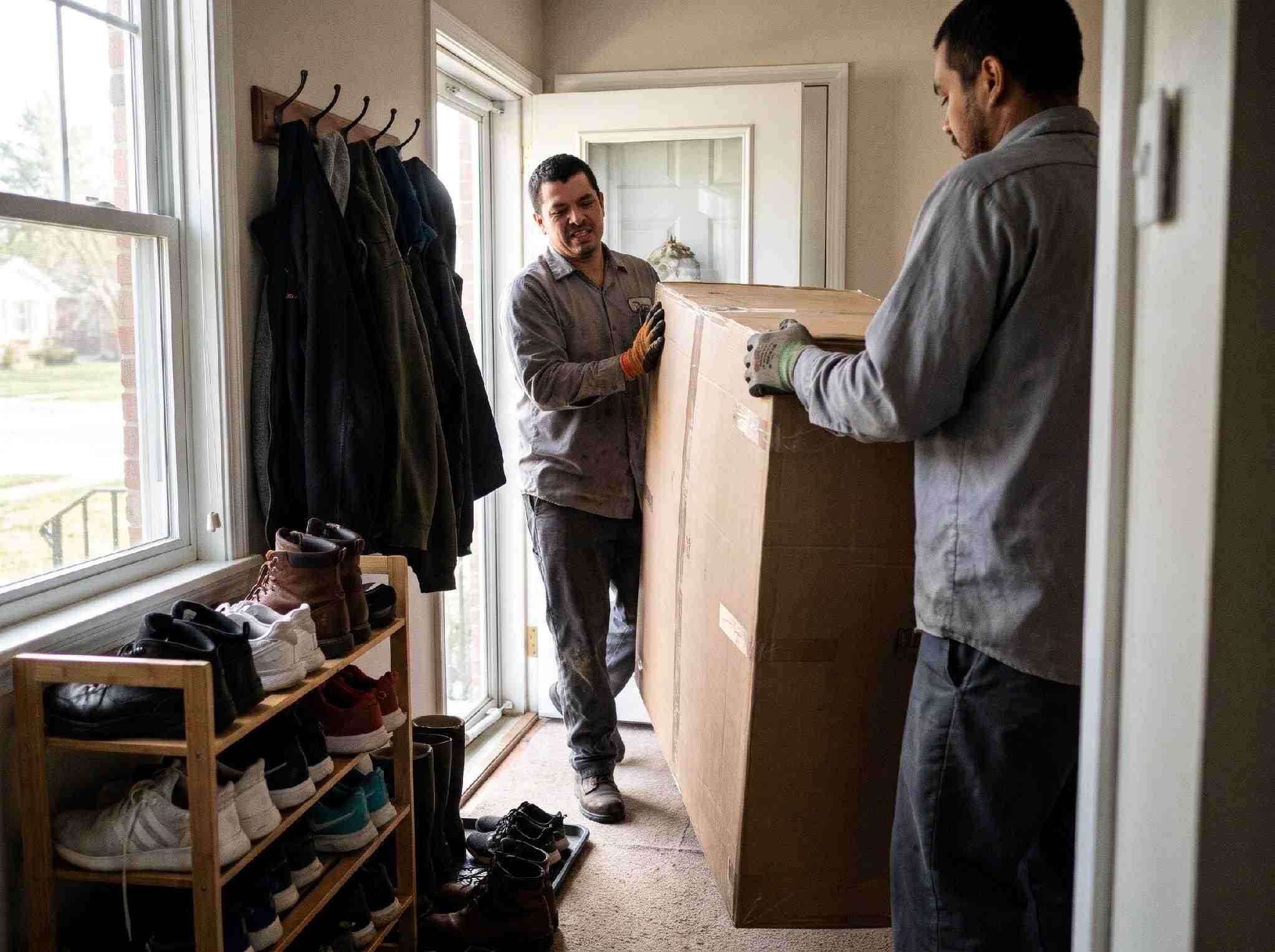
Two-person delivery crew carrying a boxed sofa through a home entryway
A parcel driver drops a package at the door in a minute or two. A two-person bulky crew can spend a large part of an hour at a single address. The economics start there.
Labor is the largest piece. Two people are usually needed to lift and carry heavy items, and the time at each stop stretches when the delivery involves stairs, tight hallways, elevator reservations or unpacking. Revenue per stop doesn’t rise in proportion, so productivity per route is low even when the crews work well.
Space is the second factor. A truck fills up on volume long before it reaches its weight limit, which means fewer deliveries per route and a higher cost per item. Carriers that bill by dimensional weight charge for the room a package occupies, not just what it weighs, and oversized cartons get hit hardest.
Damage is the third. Large items are more fragile than their weight suggests: scratched finishes, cracked glass tops and dented appliance panels are common claims. A damaged sofa can’t be shipped back in a polybag the way a damaged shirt can. It needs a second trip, a replacement and often a refund while the original sits in a warehouse waiting for a claim decision.
Then there’s the failed delivery. Bulky deliveries typically need someone at home during a scheduled window, and if the customer isn’t there or the item doesn’t fit through the door, the crew leaves with it. The retailer pays for the attempt and for the next one. Plenty of fees hide in this chain, including residential surcharges, liftgate charges, inside delivery and redelivery, and they vary enough by contract that it’s unwise to quote a single average. Anyone who gives you one without a named, dated source is guessing.
Warehouse and Inventory Challenges
Fulfillment centers feel the same pressure from the other side. A pallet of small items can hold thousands of units; a pallet of flat-packed bookcases holds a few dozen. Storage cost per unit climbs accordingly, so slotting decisions matter more. Heavy, slow-moving goods sit on the floor or in low-level pallet positions, while faster movers go into racking where forklifts can reach them quickly.
Handling is slower and more dangerous. Operators need forklifts, clamp attachments, pallet jacks and sometimes overhead cranes, and the workers who run them need training that general warehouse staff don’t have. Picking an order for a heavy appliance isn’t the same as picking a phone case, and injury rates in manual lifting reflect that. Labor shortages make the problem harder, since experienced material-handling operators are scarce.
Automation is the obvious response, though it arrives unevenly. In our earlier piece on collaborative robots in warehouse operations, we covered how robots that work beside people take over repetitive carrying and sorting tasks. Those gains are clearest in small-item picking. Applying them to a heavy crate or an irregular carton is harder, because grippers, sensors and conveyor systems all have to be sized for objects that vary in shape, so adoption in bulky fulfillment trails the rest of the industry.
Inventory is the other pain point. A retailer holding bulky stock has much of its capital sitting in a warehouse, occupying expensive space. Forecasting errors cost more: an overstock of couches takes up a whole bay, while an overstock of socks fits on a shelf. Many sellers respond by holding fewer SKUs, using drop-ship arrangements with manufacturers, or splitting stock across regional nodes closer to customers so each delivery travels a shorter distance.
Returns: The Hidden Margin Problem
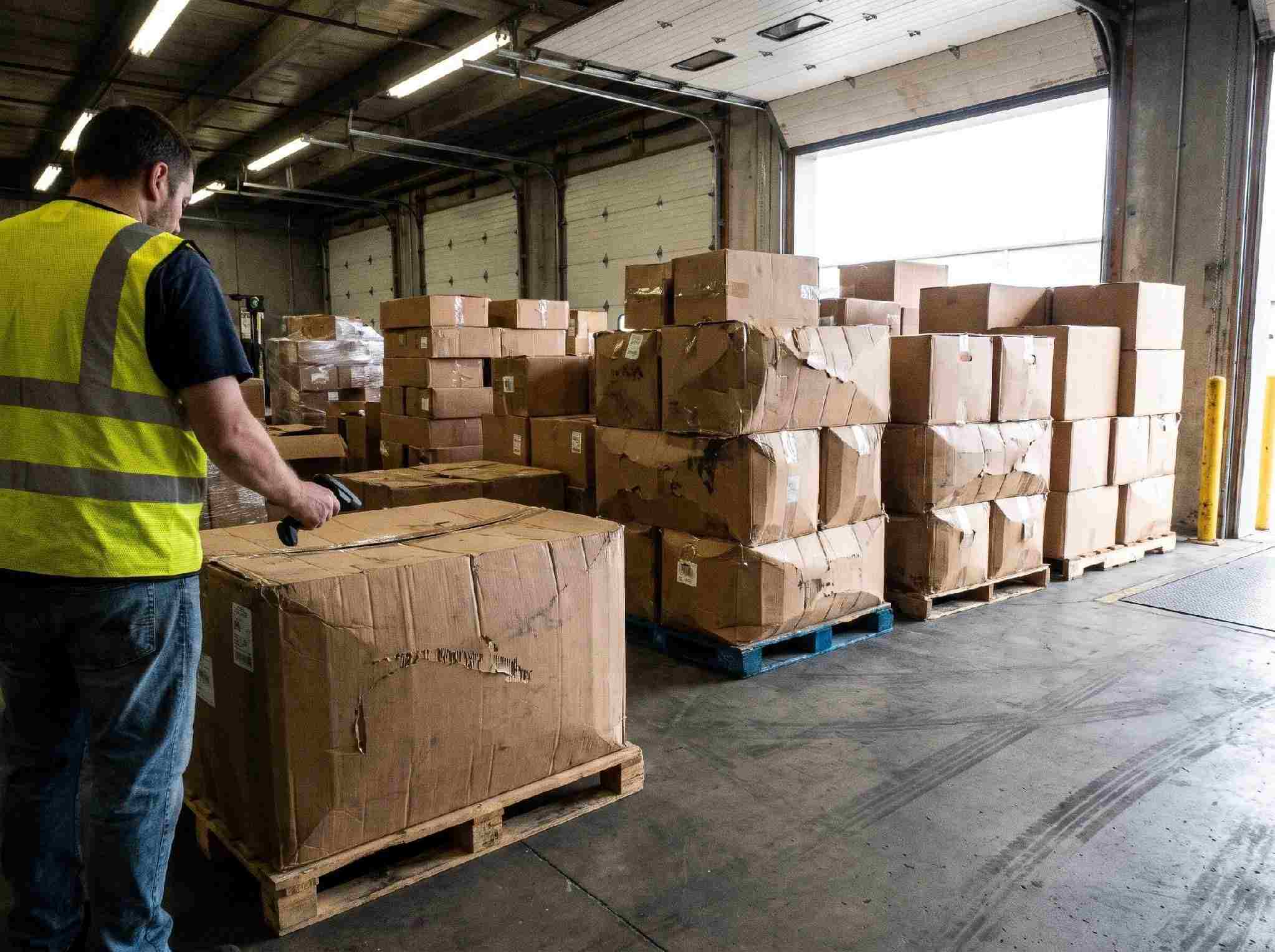
Returned large boxes waiting for inspection at a receiving dock
Returns eat margin in every e-commerce category, and they hit large items harder. The National Retail Federation and Happy Returns estimated in their 2025 retail returns report that 19.3% of online sales would be returned in 2025. Total returns across retail came to about $849.9 billion, or 15.8% of sales, compared with $890 billion in 2024. The survey covered 2,006 consumers and 358 retail e-commerce professionals.
Those figures are for retail as a whole. The NRF report doesn’t break out furniture or appliances, and the furniture-specific return rates that circulate online mostly come from unsourced blogs, so treat them with suspicion. The logic of why bulky returns cost more doesn’t depend on an exact percentage, though.
Reverse logistics for a small item means a prepaid label and a drop-off. For a bulky one it can mean a scheduled pickup, a two-person crew, freight back to a hub, inspection, repackaging that may be impossible without the original carton, and either refurbishment or liquidation. The retailer pays freight twice and often recovers only part of the value. Some simply refund the customer and let them keep or dispose of the item, which is cheaper than retrieving it but gives up the entire unit cost.
Returns also expose a design problem. Many large-item returns trace back to size and fit: a sofa that doesn’t clear a stairwell, a dresser that is deeper than the photos suggested. Better product pages with exact dimensions, measuring guides and delivery-path checks reduce returns more cheaply than any warehouse upgrade does. That’s an area where retailers have room to act today.
What to Watch Through 2027
Four things will decide how this segment develops.
First, housing. Turnover at a 30-year low suppresses demand for furniture and appliances, so any recovery in home sales would lift volume faster than any logistics innovation. If home sales stay weak, expect the 5.1% forecast to hold rather than improve.
Second, the split between retailer-owned and outsourced capacity. With surveyed 3PLs holding about a third of the market per Armstrong & Associates, there’s room for outsourcing to grow, but only if providers can show consistent service. Large retailers with their own fleets have little reason to give that up, while mid-sized brands without scale have little choice but to outsource.
Third, delivery transparency. Customers who must stay home for a scheduled window are the main source of failed attempts. Narrower windows, live tracking and text-based confirmation of access conditions cut redelivery, and they cost far less than a second crew visit.
Fourth, automation and storage density. High-density systems are spreading in warehouses generally; we looked at the market for warehouse ASRS after Honeywell sold its Intelligrated and Transnorm units to American Industrial Partners in July 2026, and our estimate there was a market of about $6.87 billion in 2025 growing to $22.74 billion by 2035, at an 11.46% annual rate. Bulky goods are a harder fit for most of that equipment, so I’d expect gains to come first from slotting software and better handling equipment, not from fully automated storage.
My own view is that regional networks will matter more than national scale. A bulky item that ships a short regional distance rather than across the country avoids most of the handling, damage and delay that make the category expensive.
Conclusion
Big and bulky e-commerce has outgrown the stage where volume alone drove results. With growth in the U.S. third-party market forecast at 5.1% a year to 2027, down from 10.6% over the previous eight, the winners will be the operators that cut cost per delivery, not those that add the most orders. Returns, failed deliveries and damage are the places where margin is lost, and each can be improved with better product data, tighter scheduling and shorter shipping distances. Treat the segment as a logistics problem first and a marketing opportunity second.
About the Author
 Sanyukta Deb
— Sanyukta Deb is Digital Marketing Team Lead at Next Move Strategy Consulting, where she has led content strategy and technical SEO for the firm's B2B market research publications for over 2 years. Her editorial process translates NextMSC's primary and secondary research — spanning technology, industrial, and consumer sectors — into commercial narratives, backed by search-intent, keyword, and competitive analysis. She brings 5 years of overall experience in digital marketing and content strategy.
About the Reviewer
 Debashree Dey
— Debashree Dey is Assistant Manager at Next Move Strategy Consulting, where she supports cross-vertical market content and communications across diverse industries for 6 years. Her professional background includes senior content writing, communications, and published manuscript authorship, with experience developing audience-focused business narratives and maintaining clear, consistent messaging. Her role supports research-led content development and editorial quality across NextMSC publications.
















Add Comment