How Are Semiconductor Lasers Reshaping Chip Innovation?
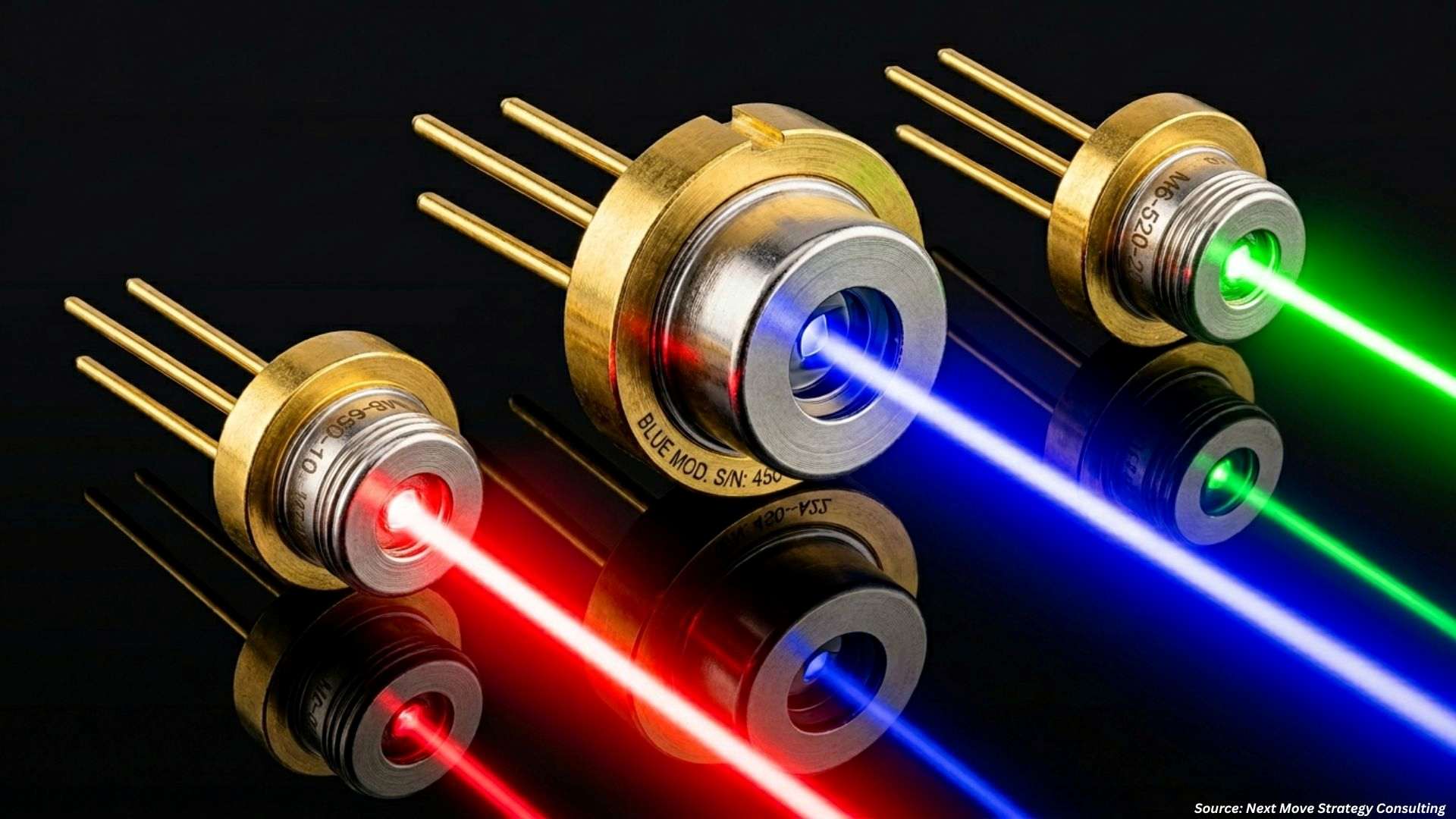
Semiconductor Lasers Market are becoming one of the most important technologies behind next-generation chip manufacturing, quantum systems, and precision industrial tools. In 2026, two major developments highlighted how quickly this field is evolving: a UV laser partnership between OXIDE Corporation and Vexlum, and a $40 million funding round for xLight’s advanced extreme-ultraviolet platform.
These announcements show a clear direction: laser innovation is no longer limited to laboratories. It is moving directly into factories, production lines, and future computing systems.
Semiconductor lasers are shifting from niche components to strategic enablers of modern electronics. They support smaller and denser chips, improve precision manufacturing, and enable future quantum applications.
How Is Precision Light Becoming the New Engine of Electronics?
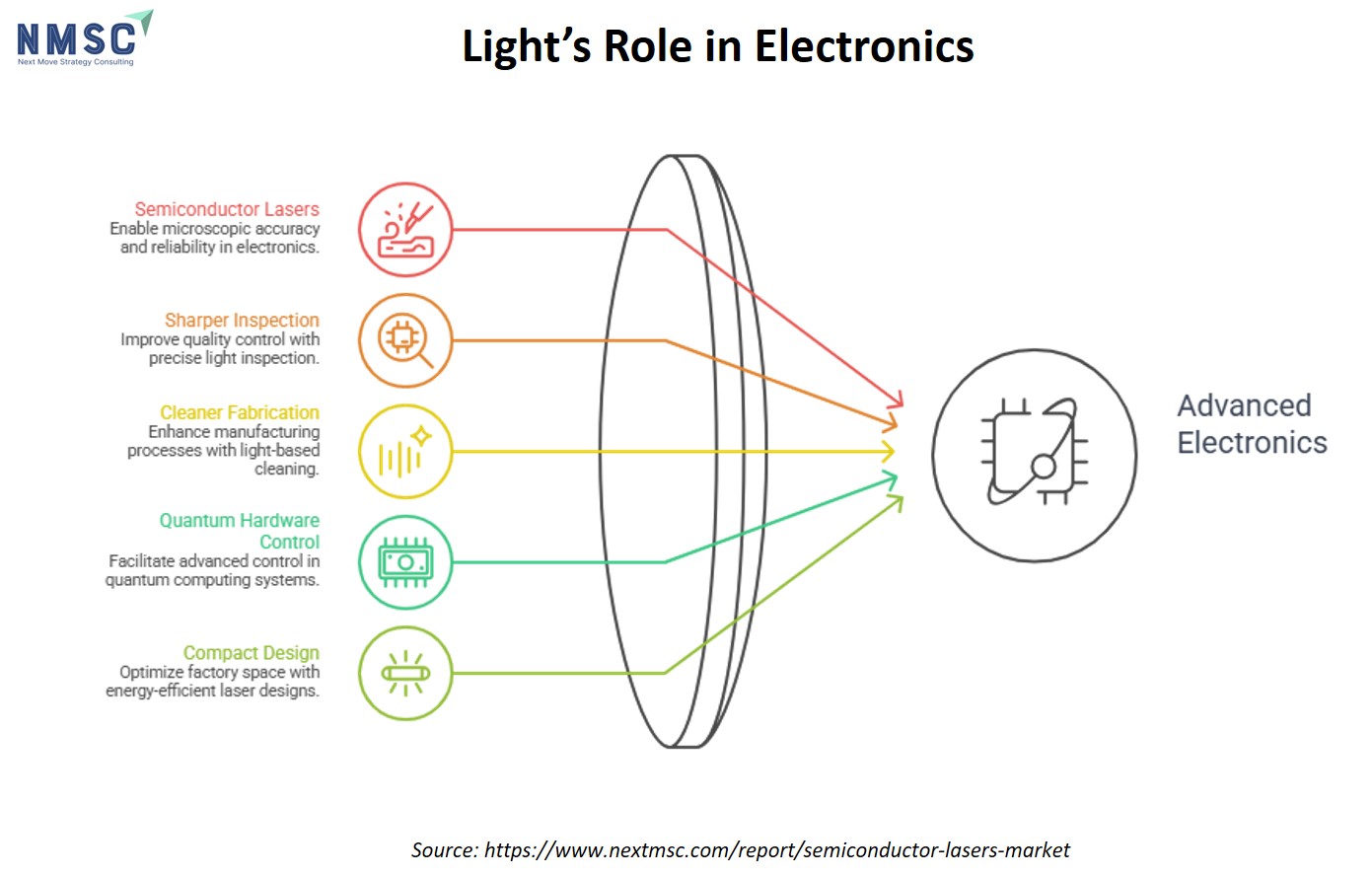
Precision light is emerging as one of the most valuable resources in the electronics industry. As devices become smaller, faster, and more complex, manufacturers need tools that can operate with microscopic accuracy and consistent reliability. Semiconductor lasers are meeting this need by enabling sharper inspection, cleaner fabrication processes, and better control in advanced systems such as quantum hardware. Their compact design and energy efficiency also make them practical for modern factories where performance and space optimization matter equally. This shift shows that the next era of electronics will not rely on silicon alone, but on the intelligent use of light to unlock higher levels of innovation and productivity.
Why Are Semiconductor Lasers Important in Modern Manufacturing?
A semiconductor laser is a compact light source made using semiconductor materials. Unlike traditional bulky systems, these lasers can be smaller, more efficient, and easier to integrate into industrial equipment.
In semiconductor manufacturing, highly precise light sources are essential for chip inspection, patterning advanced circuits, measuring microscopic defects, improving production speed, and supporting automation. As chips become more complex, the need for stable and scalable laser systems continues to grow.
Precision light is now a production necessity, not an optional upgrade.
|
Key Use Area |
Why It Matters |
|
Chip Inspection |
Detects tiny defects |
|
Circuit Fabrication |
Enables finer features |
|
Quantum Systems |
Controls atomic states |
|
Factory Automation |
Supports 24/7 reliability |
How Is the OXIDE–Vexlum Partnership Expanding UV Laser Capabilities?
At the APS Global Summit 2026, Japan-based OXIDE Corporation and Vexlum announced a strategic partnership focused on high-power ultraviolet laser systems. Their goal is to solve scaling challenges in both quantum computing and semiconductor production.
The collaboration combines Vexlum’s VECSEL technology with OXIDE’s optical crystal and frequency conversion expertise. Together, they aim to deliver compact systems with wider wavelength coverage, higher stability, and stronger output performance. A key milestone is the commercial availability of a 302 nm laser light source.
This wavelength is especially relevant for advanced applications where high-energy UV light is required.
The partnership demonstrates how combining laser chips with optical materials can unlock new industrial performance levels.
How Do 2026 Trends Illustrate Market Momentum?
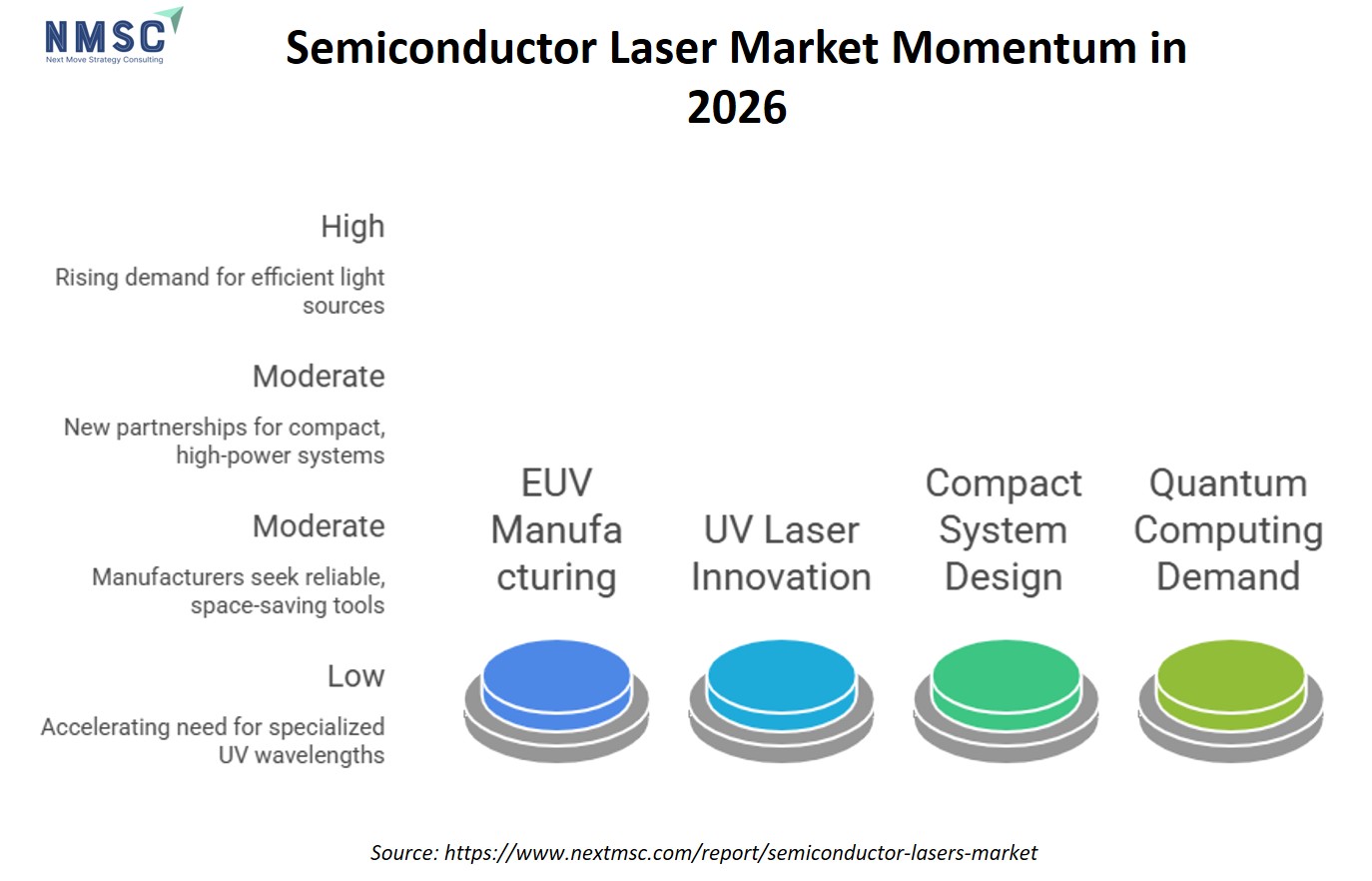
The infographic highlights where current momentum is strongest across the semiconductor laser landscape. EUV manufacturing push leads the chart, reflecting rising demand for more efficient light sources that can support advanced chip scaling and higher fab productivity. UV laser innovation follows closely, driven by new partnerships focused on compact and high-power systems for industrial use. Compact system design remains a major priority as manufacturers seek reliable tools that fit modern production environments. Quantum computing demand is also accelerating the need for specialized ultraviolet wavelengths, while research partnerships continue to strengthen the innovation pipeline. Together, these trends show that semiconductor lasers are becoming a core technology for both present manufacturing needs and future computing breakthroughs.
How Could Semiconductor Lasers Accelerate Quantum Computing?
One of the most interesting use cases from the OXIDE–Vexlum announcement is quantum computing. Neutral-atom quantum systems use lasers to cool, trap, and control atoms that act as qubits.
Specific UV lasers are also needed to excite atoms into Rydberg states, a process used for quantum gate operations. Without reliable laser systems, scaling these machines becomes far more difficult.
This makes semiconductor-based UV systems valuable because they can offer compact hardware design, better operational stability, easier deployment outside laboratories, and potentially lower maintenance requirements.
Laser reliability may become just as important as processor design in the race to practical quantum computing.
Space Connects Market Growth Drivers: EUV Manufacturing Leads Innovation Landscape
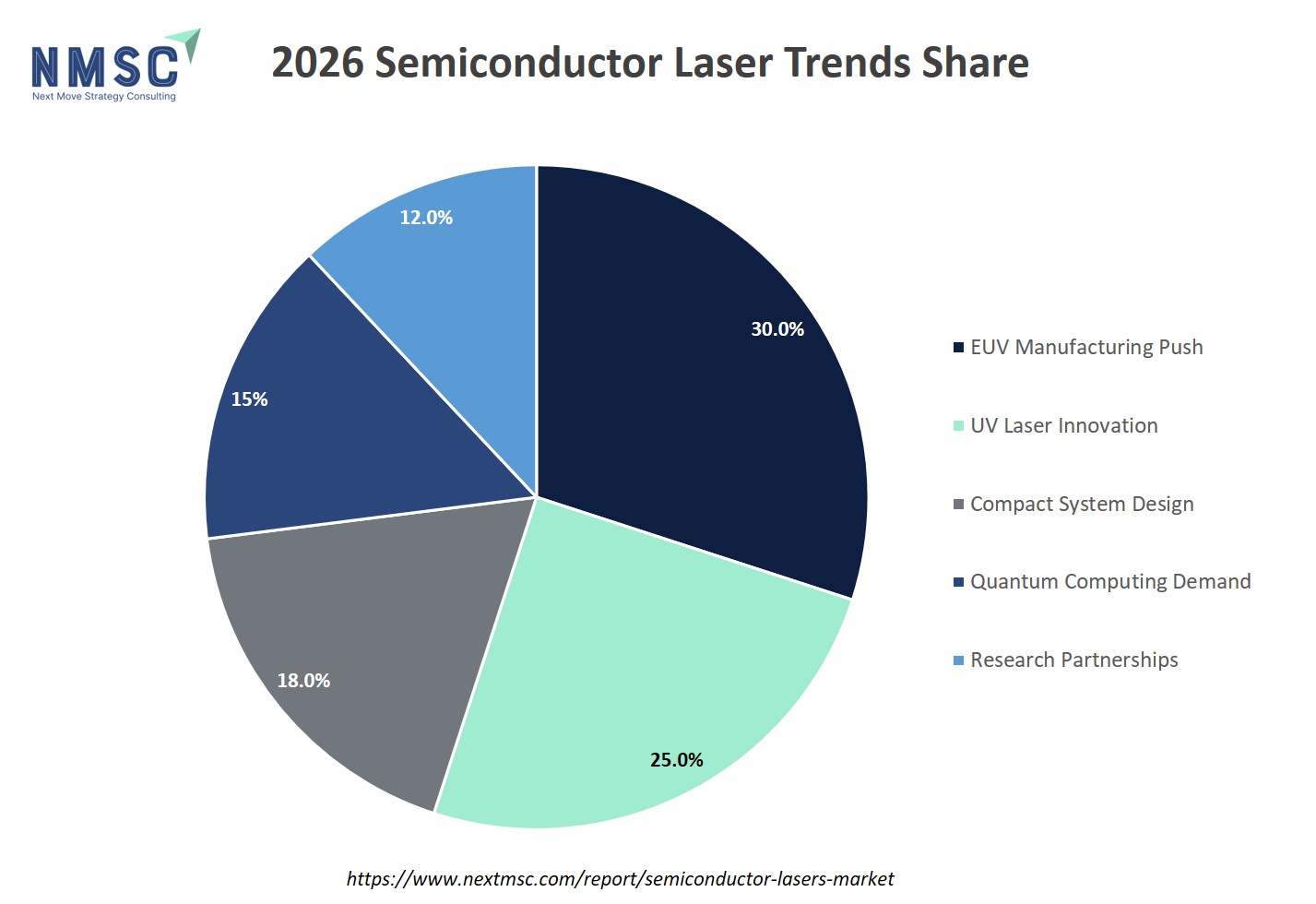
The pie chart illustrates the key growth drivers shaping the Space Connects market and highlights how different technological and research factors contribute to overall industry expansion.
The largest share is held by EUV Manufacturing Push (30%), indicating that advanced semiconductor lithography is the most influential driver, strongly supporting next-generation space-enabled technologies. UV Laser Innovation (25%) follows closely, reflecting its critical role in improving precision systems and high-performance communication and sensing technologies.
Compact System Design (18%) represents the industry’s shift toward miniaturization, enabling more efficient and cost-effective space hardware. Quantum Computing Demand (15%) highlights the growing integration of quantum technologies for enhanced data processing and secure communications in space applications.
Finally, Research Partnerships (12%) contribute the smallest but still essential share, emphasizing collaboration between institutions and companies to accelerate innovation.
Overall, the chart shows a technology-driven ecosystem where advanced manufacturing and photonics dominate, while emerging fields like quantum computing and collaborative research continue to support long-term growth.
How Is xLight Challenging the Future of EUV Lithography?
xLight announced an oversubscribed $40 million Series B funding round to accelerate development of free electron lasers for advanced semiconductor manufacturing.
The company is building EUV light sources designed to address three major industry pressures: cost, capabilities, and capacity. According to the company, its platform could deliver an energy-efficient EUV laser with tenfold improvements over existing technologies. If achieved commercially, this could help chipmakers maintain scaling progress and improve fabrication output.
The funding round was led by Playground Global, with participation from Boardman Bay Capital Management, Morpheus Ventures, and others.
Investors are signaling strong confidence that next-generation light sources can transform chip fabrication economics.
Semiconductor Lasers Market: Key Players and Competitive Strategies
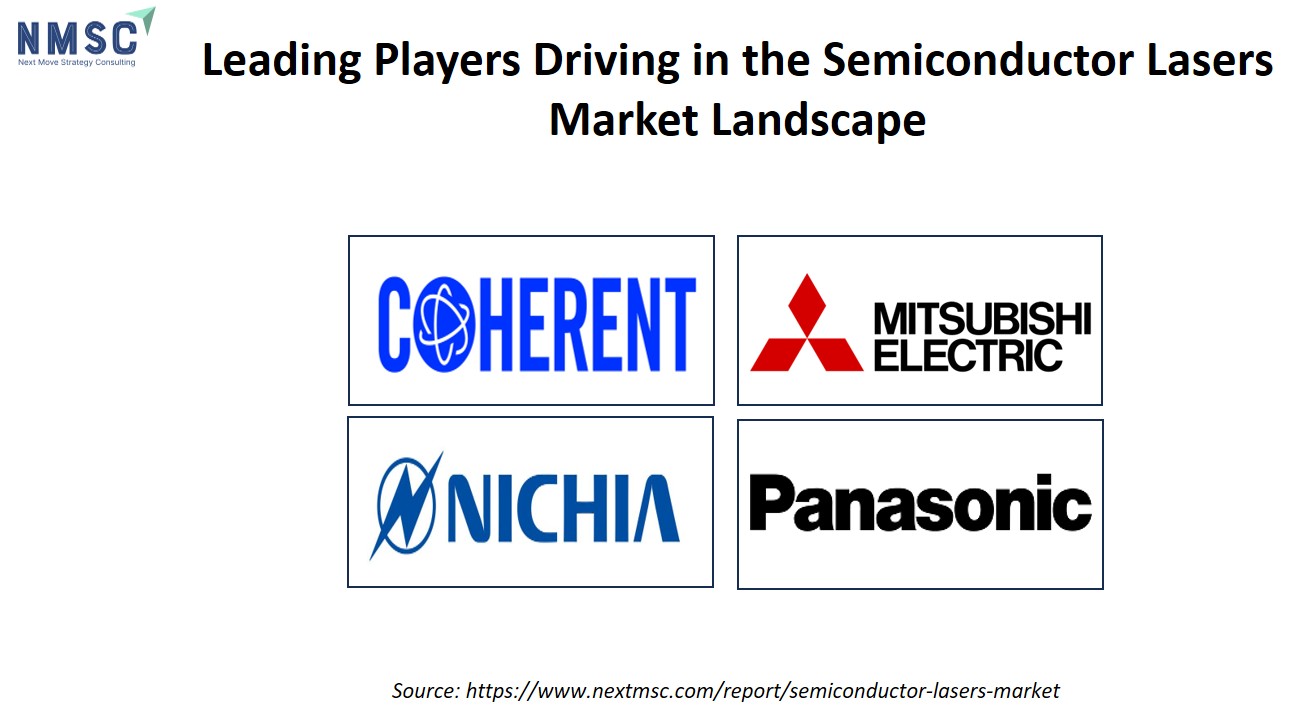
The semiconductor lasers industry is characterized by intense competition and features a wide range of global market participants. Prominent companies operating in this space include Coherent Corp., IPG Photonics Corporation, Lumentum Holdings Inc., Trumpf GmbH + Co. KG, Nichia Corporation, Hamamatsu Photonics K.K., NLIGHT, Inc., Jenoptik AG, Sharp Corporation, Panasonic Corporation, ROHM Semiconductor, Mitsubishi Electric Corporation, Sumitomo Electric Industries, Ltd., Sony Semiconductor Solutions Corporation, and Frankfurt Laser Company.
To strengthen their market position, these players actively pursue strategies such as strategic collaborations, mergers and acquisitions, continuous innovation, and strong investment in research and development. These approaches help them maintain technological leadership and sustain competitiveness in a rapidly evolving industry.
What Do Research Partnerships Reveal About Industry Direction?
xLight also highlighted ongoing collaborations with Cornell CLASSE, Los Alamos National Laboratory, and Fermilab.
These partnerships focus on accelerator systems, machine learning automation, superconducting radio frequency technology, and prototype development. This matters because advanced semiconductor lasers increasingly require expertise across multiple disciplines including physics, materials science, artificial intelligence, precision engineering, and manufacturing systems.
The future of semiconductor lasers will likely be built through ecosystems, not isolated innovation.
What Should Businesses Watch Next?
The next phase of development will likely focus on scaling, commercialization, and cost efficiency. Companies across electronics, photonics, and industrial automation should monitor progress closely.
Next Steps
Track commercialization timelines for compact UV systems. Watch whether EUV free electron lasers move from prototype to fab deployment. Explore partnerships between laser firms and chip manufacturers. Monitor quantum hardware companies adopting specialized UV sources. Assess supply chain opportunities in optics, crystals, and semiconductor components.
-
Track commercialization timelines for compact UV systems.
-
Watch whether EUV free electron lasers move from prototype to fab deployment.
-
Explore partnerships between laser firms and chip manufacturers.
-
Monitor quantum hardware companies adopting specialized UV sources.
-
Assess supply chain opportunities in optics, crystals, and semiconductor components.
Final Takeaway
Semiconductor lasers are entering a decisive growth phase. From UV systems supporting quantum computers to EUV platforms aiming to redefine chipmaking, the technology is becoming central to industrial competitiveness. The latest partnerships and investments suggest that future breakthroughs in computing may depend as much on light as on silicon.
About the Author
 Sanyukta Deb
— Sanyukta Deb is Digital Marketing Team Lead at Next Move Strategy Consulting, where she has led content strategy and technical SEO for the firm's B2B market research publications for over 2 years. Her editorial process translates NextMSC's primary and secondary research — spanning technology, industrial, and consumer sectors — into commercial narratives, backed by search-intent, keyword, and competitive analysis. She brings 5 years of overall experience in digital marketing and content strategy.
Sanyukta Deb
— Sanyukta Deb is Digital Marketing Team Lead at Next Move Strategy Consulting, where she has led content strategy and technical SEO for the firm's B2B market research publications for over 2 years. Her editorial process translates NextMSC's primary and secondary research — spanning technology, industrial, and consumer sectors — into commercial narratives, backed by search-intent, keyword, and competitive analysis. She brings 5 years of overall experience in digital marketing and content strategy.
About the Reviewer
 Debashree Dey
— Debashree Dey is Assistant Manager at Next Move Strategy Consulting, where she supports cross-vertical market content and communications across diverse industries for 6 years. Her professional background includes senior content writing, communications, and published manuscript authorship, with experience developing audience-focused business narratives and maintaining clear, consistent messaging. Her role supports research-led content development and editorial quality across NextMSC publications.
Debashree Dey
— Debashree Dey is Assistant Manager at Next Move Strategy Consulting, where she supports cross-vertical market content and communications across diverse industries for 6 years. Her professional background includes senior content writing, communications, and published manuscript authorship, with experience developing audience-focused business narratives and maintaining clear, consistent messaging. Her role supports research-led content development and editorial quality across NextMSC publications.

















Add Comment