Coffee Market Trends, Supply Shocks & Forecasts for 2026

Introduction
Few global commodity markets have experienced the degree of structural turbulence that has defined the coffee market over the past twelve months. From record-breaking price spikes driven by climate-induced supply deficits to a sudden and confounding reversal in mid-2026, the global coffee market is navigating one of the most complex and consequential periods in its modern history. For C-level executives, institutional investors, and beverage industry strategists, understanding the forces reshaping this market is no longer a matter of peripheral interest — it is a core strategic priority.
According to Next Move Strategy Consulting (NMSC), the global Coffee Market was valued at USD 211.33 billion in 2025 and is expected to reach USD 222.62 billion by the end of 2026, with a long-term trajectory toward USD 355.55 billion by 2035 at a CAGR of 5.34% between 2026 and 2035. Beneath this steady growth trajectory lies a market under profound structural pressure — from supply chain fragmentation and climate-driven production volatility to the accelerating premiumisation of consumer preferences and the rapid expansion of café culture across Asia-Pacific. The organisations that navigate these forces with strategic clarity will define the competitive landscape of the global coffee market for the decade ahead.
For More Information: Download FREE Sample on Coffee Market Report
Historic Price Volatility and the Global Supply Deficit Crisis Redefine the Coffee Market
A Market in Paradox: Record Highs Followed by Sudden Reversal
The most globally impactful event reshaping the coffee market in 2025–2026 is the extraordinary price volatility that has caught traders, roasters, and analysts off-guard. As Bloomberg reported in July 2026, a sudden burst of extreme price volatility in the coffee market has confounded market participants who had anticipated ample supply — describing it as a new era of market instability that has fundamentally altered procurement strategies across the global coffee value chain.
The roots of this volatility lie in successive years of production deficits driven by extreme weather events in key producing regions. According to the World Bank's October 2025 Commodity Markets Outlook, Arabica coffee averaged approximately USD 9/kg in November 2025 — roughly 35% higher than a year earlier — while Robusta approached USD 5/kg. The World Bank's beverage price index rose an estimated 18% in 2025, before projecting a 7% decline in 2026 and a further 5% in 2027 as supplies continue to expand.
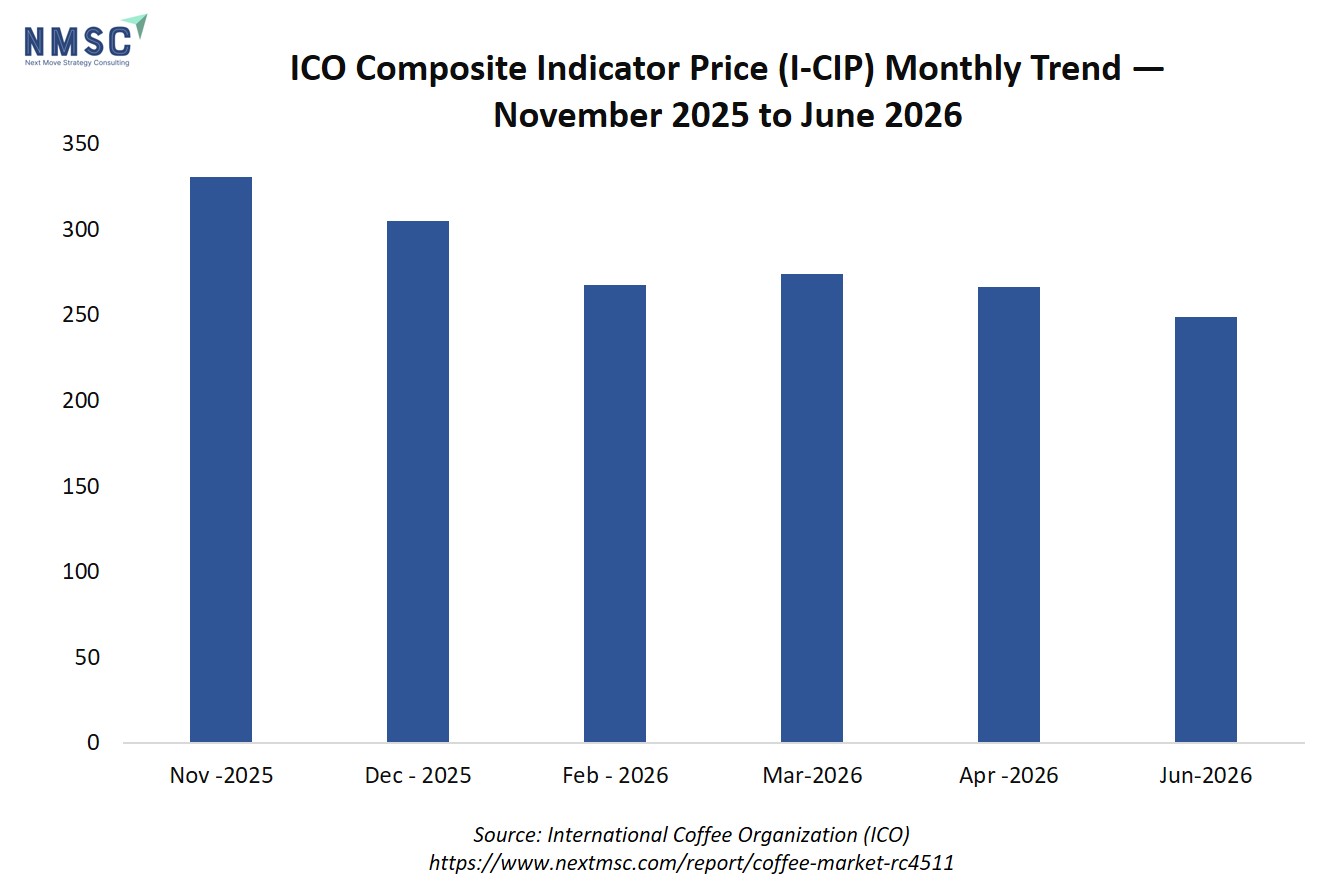
The ICO Composite Indicator Price (I-CIP) — the benchmark for global coffee pricing — averaged 330.44 US cents/lb in November 2025, before declining to 304.68 US cents/lb in December 2025 (down 7.8% month-on-month) as easing supply concerns and stronger export flows reshaped market sentiment. By March 2026, the I-CIP edged up 2.3% to 273.70 US cents/lb, signalling a pause in the downward trend, before averaging 248.90 US cents/lb in June 2026 — a 2.8% decrease from May 2026 — with prices falling to a near two-year low of 231.96 US cents/lb on 9 June before rebounding sharply by 17.4% to 272.39 US cents/lb by month-end.
Supply Recovery: A Structural Shift in Production Dynamics
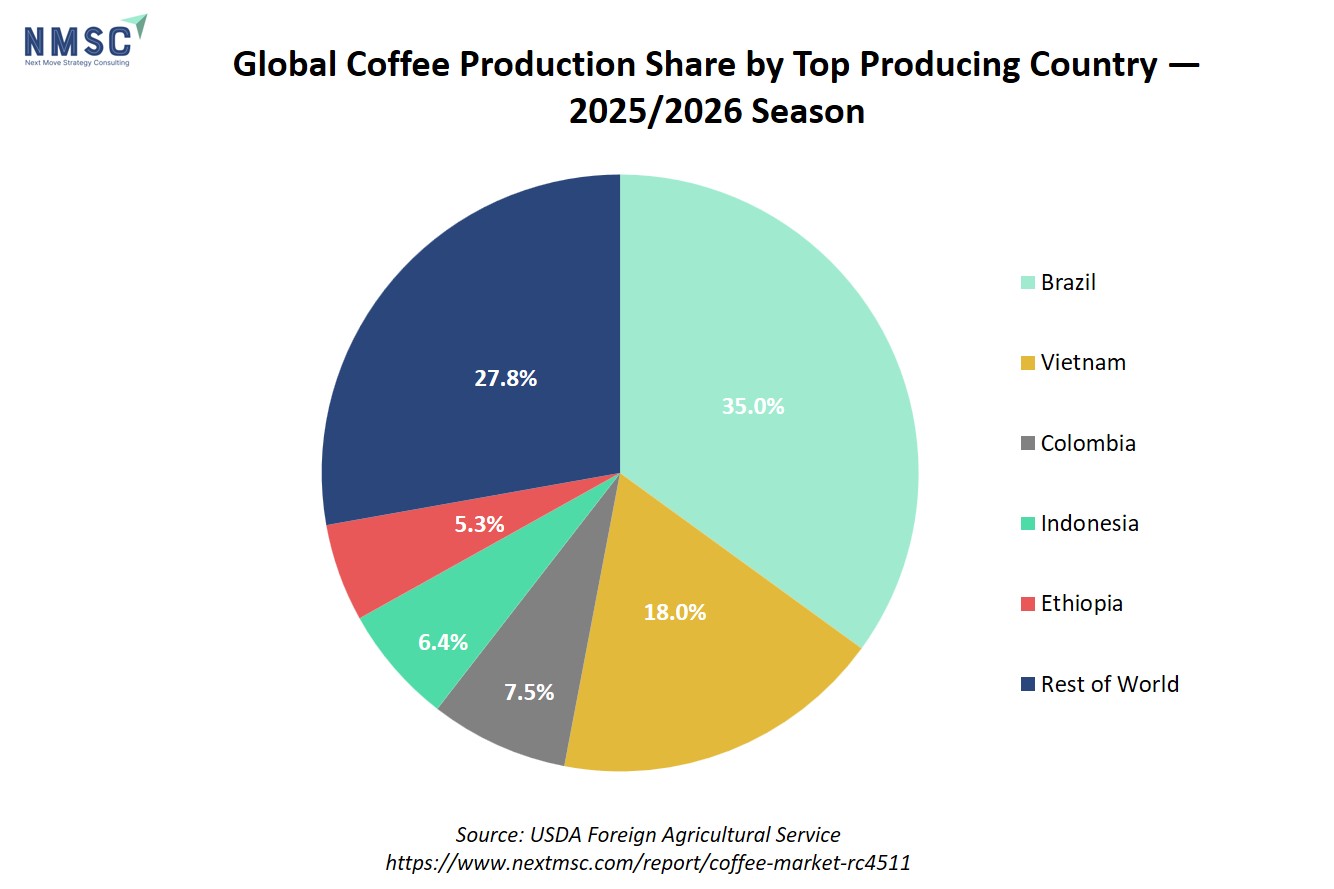
On the supply side, the USDA Foreign Agricultural Service projects global coffee production at 178.83 million 60 KG bags for the 2025/2026 season, up from 176.82 million bags in 2024/2025 — representing a 1% year-over-year increase and a meaningful recovery from the deficit years that drove prices to historic highs. Brazil remains the dominant producer at 35% of global output (approximately 63 million bags), followed by Vietnam at 18% (approximately 31.7 million bags), with Colombia, Indonesia, Ethiopia, Honduras, Uganda, India, Peru, and Mexico completing the top ten producing nations.
The World Bank projects global coffee production to reach approximately 179 million bags in 2025–26, with Arabica prices forecast to fall 13% in 2026 and 5% in 2027 following a projected 50% increase in 2025, while Robusta prices are expected to ease by 2% in both 2026 and 2027. However, the ICO Executive Director Vanusia Nogueira cautioned in July 2025 that meaningful supply relief from new plantations — spurred by record-high prices — would take approximately three years to materialise, and that the end of successive deficits would depend heavily on weather conditions in Brazil, Colombia, and Vietnam.
On the trade side, world coffee exports amounted to 11.88 million bags in June 2026, compared with 11.84 million in June 2025. In the twelve months ending June 2026, Arabica exports totalled 81.59 million bags (down from 86.69 million bags the prior year), while Robusta exports rose to 58.99 million bags (up from 54.08 million bags) — reflecting a structural shift in trade flows as Robusta's cost advantage drives substitution in blended and instant coffee segments.
The FAO, in its July 2026 publication Price Dynamics in Global Beverage Markets: Trends, Drivers and Consequences, confirmed that global beverage markets remain highly exposed to shocks — from extreme weather and supply constraints to pest outbreaks and logistics disruptions — and that supply and demand shocks drive most global price movements, yet their effects are transmitted incompletely and unevenly across value chains, affecting producers and consumers differently.
NMSC Strategic Perspective: Navigating the Price Volatility Paradox
From NMSC's analytical standpoint, the 2025–2026 coffee price cycle represents more than a commodity market correction — it is a structural signal that the global coffee supply chain remains fundamentally fragile and disproportionately exposed to climate risk. The concentration of production in a small number of countries — with Brazil and Vietnam alone accounting for over 53% of global output — creates systemic vulnerability that no amount of short-term price correction can resolve.
NMSC's analysis indicates that the most strategically resilient coffee companies are those investing in supply chain diversification, direct sourcing partnerships with farmers across multiple producing regions, and forward procurement strategies that reduce exposure to spot market volatility. The current price correction window — with Arabica prices projected to decline through 2026 and 2027 — presents a tactical opportunity for roasters and beverage companies to rebuild inventory positions and renegotiate procurement contracts at more favourable terms. However, organisations that treat this as a purely transactional opportunity, without addressing the underlying supply chain fragility, will remain exposed to the next climate-driven shock cycle.
Section Summary: The global coffee market is navigating an unprecedented price volatility cycle driven by climate-induced supply deficits, with production recovery underway but structural supply chain fragility persisting through the medium term.
Key Takeaways:
-
The ICO Composite Indicator Price averaged 248.90 US cents/lb in June 2026, down from a high of 330.44 US cents/lb in November 2025, reflecting a sharp but volatile correction.
-
Global coffee production is projected at 178.83 million 60 KG bags for 2025/2026 (USDA FAS), representing a 1% year-over-year recovery.
-
Brazil (35%) and Vietnam (18%) together account for over 53% of global coffee production, creating systemic supply concentration risk.
-
Robusta exports rose to 58.99 million bags in the twelve months ending June 2026, reflecting structural trade flow shifts driven by cost-driven substitution in blended and instant segments.
Industry Impact Analysis
The Premiumisation Wave: Specialty Coffee and the Artisanal Roasting Revolution
Simultaneously with the supply-side turbulence, the demand side of the coffee market is undergoing a structural premiumisation shift that is fundamentally elevating the value of the global coffee market. Consumer preferences across North America, Europe, and rapidly urbanising Asia-Pacific markets are shifting decisively toward specialty coffee, single-origin beans, artisanal roasting profiles, and transparent supply chains. This shift is not cyclical — it reflects a generational change in how consumers relate to coffee as a lifestyle product rather than a commodity beverage.
In March 2026, Luigi Lavazza S.p.A. reported consolidated revenues of approximately €3.9 billion for fiscal year 2025, reflecting strong growth despite record-high green coffee prices and challenging global market conditions. The company attributed its performance to continued expansion in international markets — particularly North America — premium portfolio growth, and strategic investments in branded coffee products, underscoring that premium brand positioning provides meaningful insulation against commodity price volatility.
In November 2025, Löfbergs AB launched one of Europe's first commercially available Regenerative Organic Certified (ROC) coffee products — a significant milestone in the coffee industry's sustainability journey, moving beyond conventional certification schemes toward regenerative agricultural practices that prioritise soil health, biodiversity, carbon sequestration, and ecosystem restoration.
The FAO notes that coffee sustains the livelihoods of some 25 million farmers globally and creates additional employment throughout the coffee value chain, with coffee exports representing an important source of revenue for many low-income countries. The ICO reinforces this, noting that coffee provides income for around 12.5 million farming families worldwide and plays a central role in shaping socio-economic development across producing regions.
Ready-to-Drink Coffee: The Fastest-Growing Consumption Format
The ready-to-drink (RTD) coffee segment is emerging as one of the most dynamic growth vectors within the global coffee market. In June 2026, Starbucks Corporation expanded its ready-to-drink beverage portfolio with the retail launch of a bottled Strawberry Açaí Lemonade Refresher across grocery and national retail channels — a strategic move to strengthen Starbucks' presence in the at-home beverage category and capitalise on growing demand for convenient premium beverages outside traditional coffee shops. This launch reflects a broader industry trend: leading coffee brands are aggressively expanding their retail footprint beyond café environments to capture the growing at-home and on-the-go consumption occasions.
M&A Activity: Consolidation Reshaping the Competitive Landscape
In March 2026, Farmer Brothers entered into a definitive agreement to be acquired by Royal Cup Coffee & Tea for USD 1.29 per share in an all-cash transaction — combining two long-established names in the U.S. coffee industry to create a more integrated beverage solutions platform focused on the hospitality and foodservice sectors. This transaction exemplifies the consolidation trend reshaping the competitive landscape, as companies seek to strengthen distribution capabilities, scale roasting capacity, and expand foodservice presence in an increasingly competitive market.
Section Summary: The coffee market's demand side is being structurally elevated by premiumisation, RTD innovation, and sustainability-driven product development, while the competitive landscape is consolidating through strategic M&A activity.
Key Takeaways:
-
Lavazza's €3.9 billion FY2025 revenues demonstrate that premium brand positioning provides meaningful insulation against commodity price volatility.
-
Löfbergs' November 2025 ROC coffee launch signals a structural shift toward regenerative agriculture certification as the next frontier of sustainability differentiation.
-
Starbucks' June 2026 RTD retail expansion reflects the accelerating convergence of café brands and retail beverage channels.
-
The Farmer Brothers–Royal Cup Coffee & Tea acquisition (March 2026) exemplifies the consolidation trend reshaping the U.S. foodservice coffee landscape.
Pros and Cons of Recent Market Developments
|
Recent Development |
Pros |
Cons |
|
Extreme Coffee Price Volatility (2025–2026) |
Creates procurement opportunities during price correction windows; incentivises new plantation investment; drives supply chain innovation |
Increases cost unpredictability for roasters and packaged coffee manufacturers; compresses margins for SME operators; creates consumer price pass-through risk |
|
Global Production Recovery (178.83M bags, 2025/26 — USDA FAS) |
Eases supply tightness; supports price stabilisation; reduces input cost pressure for roasters |
Recovery concentrated in Brazil and Vietnam, maintaining systemic supply concentration risk; climate shocks can rapidly reverse gains |
|
Premiumisation and Specialty Coffee Growth |
Elevates average selling prices and brand margins; strengthens consumer loyalty; reduces commodity price sensitivity |
Increases sourcing complexity and cost; requires significant investment in roasting expertise and origin partnerships; limits addressable market in price-sensitive regions |
|
RTD Coffee Expansion (Starbucks, June 2026) |
Opens new consumption occasions and retail channels; attracts younger demographics; diversifies revenue beyond café environments |
Intensifies competition in retail beverage aisles; requires significant packaging and cold-chain investment; margin profiles differ from café operations |
|
Sustainability and Regenerative Agriculture Certification (Löfbergs ROC, November 2025) |
Strengthens brand credibility and consumer trust; supports long-term supply chain resilience; aligns with ESG investment criteria |
Higher certification and sourcing costs; limited scale of certified supply; consumer willingness to pay premium varies by market |
|
M&A Consolidation (Farmer Brothers–Royal Cup, March 2026) |
Strengthens distribution capabilities and operational scale; improves foodservice channel coverage; accelerates capability transfer |
Integration complexity and cultural alignment risks; potential loss of brand identity for acquired entities; regulatory scrutiny in concentrated markets |
Future Outlook & Forecast
Market Trajectory: From USD 222.62 Billion to USD 355.55 Billion
According to NMSC's proprietary analysis, the global coffee market is projected to grow from USD 222.62 billion in 2026 to USD 355.55 billion by 2035, at a CAGR of 5.34% during the forecast period. This trajectory reflects the convergence of sustained consumption growth, premiumisation-driven value expansion, RTD innovation, and the structural expansion of café culture across emerging markets — particularly Asia-Pacific.
Segment-Level Outlook
By Product Form: Ground coffee maintains dominant market share through widespread retail availability and household consumption. However, RTD coffee and coffee pods and capsules are the fastest-growing formats, driven by convenience-oriented consumption patterns and the expansion of single-serve brewing ecosystems in households and offices. Soluble coffee retains strong demand in price-sensitive and convenience-driven markets.
By Bean Type: Arabica dominates global consumption through its premium positioning and smoother flavour profile, while Robusta is gaining export share — as evidenced by the 49.1% year-on-year surge in Robusta shipments recorded by the ICO in February 2026 — driven by cost-efficiency advantages in instant coffee and blended product formulations.
By Price Tier: Mid-range coffee leads volume demand, while premium and specialty segments are the fastest-growing by value, supported by the premiumisation trend and expanding consumer willingness to pay for origin transparency, artisanal roasting, and sustainability credentials.
By Distribution Channel: Supermarkets and hypermarkets account for the largest share of global coffee retail sales. However, e-commerce is the fastest-growing channel, driven by subscription models, direct-to-consumer platforms, and the expansion of digital grocery retail across Asia-Pacific and North America.
Regional Outlook
Asia-Pacific is the fastest-growing regional market, driven by urbanisation, rising disposable incomes, and the rapid expansion of café networks across China, India, South Korea, and Southeast Asia. China's coffee market is demonstrating one of the fastest consumption growth trajectories globally, supported by younger consumers adopting coffee as a daily lifestyle beverage across major cities.
North America remains the most mature and high-value consumption market, with the United States leading regional demand through large coffeehouse chains, specialty roasters, and RTD beverage manufacturers. The Farmer Brothers–Royal Cup Coffee & Tea consolidation reflects the intensifying competition for foodservice channel dominance.
Europe is characterised by high per-capita consumption, strong espresso traditions, and increasing demand for specialty and sustainably sourced coffee. The Nordic countries represent some of the highest per-capita coffee consuming markets globally, with sustainability credentials and ethical sourcing playing a decisive role in purchasing decisions.
Latin America functions as both the world's most critical production hub and a steadily expanding consumption market, with Brazil, Colombia, and Mexico driving regional activity through strong domestic production and growing urban café culture.
Innovation Horizon: Functional Coffee, Sustainability, and Digital Retail
Looking ahead, innovation is concentrating around three strategic pillars: functional coffee beverages integrating health-oriented ingredients (adaptogens, nootropics, protein); regenerative and traceable sourcing platforms that link farm-level data to consumer-facing sustainability narratives; and digital retail ecosystems — including subscription models, AI-driven personalisation, and direct-to-consumer platforms — that deepen consumer engagement and reduce channel dependency. The ICO's 2026 campaign theme, "Coffee Is Part of the Solution," reflects the sector's growing ambition to position coffee as a vehicle for socio-economic development, climate resilience, and sustainable agriculture — a narrative that is increasingly resonating with ESG-oriented investors and sustainability-conscious consumers.
Section Summary: The global coffee market is on a sustained growth trajectory toward USD 355.55 billion by 2035, with Asia-Pacific as the primary growth engine, premiumisation and RTD innovation as the key value drivers, and supply chain resilience as the defining strategic challenge.
Key Takeaways:
-
NMSC projects the global coffee market to reach USD 355.55 billion by 2035 at a CAGR of 5.34% from 2026 to 2035.
-
Asia-Pacific is the fastest-growing regional market, with China and India as primary demand growth engines.
-
Robusta's rising export share — up 49.1% year-on-year in February 2026 per ICO data — signals a structural shift in global trade flows driven by cost-efficiency dynamics.
-
Functional coffee, regenerative sourcing certification, and digital retail ecosystems represent the three primary innovation frontiers through 2035.
Next Steps for Stakeholders
For Coffee Manufacturers, Roasters, and C-Level Executives:
-
Capitalise on the Price Correction Window for Strategic Procurement. With Arabica prices projected to decline 13% in 2026 and Robusta easing by 2% (World Bank), the current market environment presents a tactical window to rebuild inventory positions, renegotiate long-term supply contracts, and lock in favourable procurement terms. Organisations that act with procurement discipline during this correction phase will enter the next price cycle with a structural cost advantage.
-
Diversify Supply Chain Geography to Reduce Climate Concentration Risk. With Brazil and Vietnam accounting for over 53% of global production, supply chain concentration risk is structurally elevated. Executives should actively develop sourcing partnerships across secondary producing regions — including Ethiopia, Colombia, Uganda, and Honduras — to build climate-resilient procurement portfolios that reduce single-country exposure.
-
Invest in Premium and Specialty Portfolio Development. The premiumisation trend is structural and multi-decade. Organisations that build or acquire capabilities in specialty roasting, single-origin sourcing, and sustainability certification — including emerging frameworks such as Regenerative Organic Certification — will capture the highest-value consumer segments and build brand equity that is insulated from commodity price cycles.
-
Accelerate RTD and E-Commerce Channel Investment. The convergence of RTD coffee innovation and digital retail expansion represents the most dynamic near-term growth opportunity in the coffee market. Organisations should prioritise investment in RTD product development, cold-chain distribution capabilities, and direct-to-consumer digital platforms to capture the growing at-home and on-the-go consumption occasions.
For Institutional Investors:
-
Focus Capital Allocation on Premium Brand Equity and Vertically Integrated Roasters. Investment opportunities are most compelling in companies with strong premium brand positioning, diversified geographic revenue exposure, and vertically integrated supply chains that reduce commodity price sensitivity. Lavazza's €3.9 billion FY2025 revenue performance — achieved despite record-high green coffee prices — demonstrates the margin protection that premium brand equity provides.
-
Monitor Asia-Pacific Market Entry and Café Network Expansion. The fastest-growing investment opportunities in the global coffee market are concentrated in Asia-Pacific café network expansion, RTD beverage platforms, and e-commerce-enabled specialty coffee brands targeting urban middle-class consumers in China, India, and Southeast Asia.
Conclusion
The global coffee market in 2026 is defined by a compelling paradox: extraordinary structural growth potential coexisting with acute supply chain fragility and unprecedented price volatility. The convergence of climate-driven production deficits, the premiumisation of consumer preferences, the rapid expansion of RTD and digital retail channels, and the accelerating growth of café culture across Asia-Pacific is collectively repositioning coffee as one of the most strategically complex and commercially dynamic commodity markets in the global economy.
NMSC's forecast of a USD 355.55 billion market by 2035, growing at a CAGR of 5.34%, reflects the depth and durability of these structural demand drivers. For coffee manufacturers, roasters, retailers, and institutional investors, the organisations that will capture disproportionate value in this market are those that treat supply chain resilience, premium brand development, and digital channel innovation not as separate workstreams, but as integrated pillars of a unified long-term growth strategy. The current price correction window is not a signal to pause — it is a strategic invitation to act.
About the Author
 Sanyukta Deb
— Sanyukta Deb is Digital Marketing Team Lead at Next Move Strategy Consulting, where she has led content strategy and technical SEO for the firm's B2B market research publications for over 2 years. Her editorial process translates NextMSC's primary and secondary research — spanning technology, industrial, and consumer sectors — into commercial narratives, backed by search-intent, keyword, and competitive analysis. She brings 5 years of overall experience in digital marketing and content strategy.
Sanyukta Deb
— Sanyukta Deb is Digital Marketing Team Lead at Next Move Strategy Consulting, where she has led content strategy and technical SEO for the firm's B2B market research publications for over 2 years. Her editorial process translates NextMSC's primary and secondary research — spanning technology, industrial, and consumer sectors — into commercial narratives, backed by search-intent, keyword, and competitive analysis. She brings 5 years of overall experience in digital marketing and content strategy.
About the Reviewer
 Debashree Dey
— Debashree Dey is Assistant Manager at Next Move Strategy Consulting, where she supports cross-vertical market content and communications across diverse industries for 6 years. Her professional background includes senior content writing, communications, and published manuscript authorship, with experience developing audience-focused business narratives and maintaining clear, consistent messaging. Her role supports research-led content development and editorial quality across NextMSC publications.
Debashree Dey
— Debashree Dey is Assistant Manager at Next Move Strategy Consulting, where she supports cross-vertical market content and communications across diverse industries for 6 years. Her professional background includes senior content writing, communications, and published manuscript authorship, with experience developing audience-focused business narratives and maintaining clear, consistent messaging. Her role supports research-led content development and editorial quality across NextMSC publications.


















Add Comment